I got the idea after reading this article from this
Website. I will add my personal opinions and what has happened since then. I remembered being a little kid during the Vietnam War, My dad did 2 tours, in 1968 and 1972 and I remembered the hippies and other leftist spitting on my Dad when he came back in 72. I also remember the societal pressure about wearing uniforms, like it was something to be scorned. I grew up on Military posts and even we were not immune to the culture war that the left had waged on the GI's. I remembered the TV shows and they always showed the military as corrupt, inept and one step above the Keystone Cops. As I got older, I remembered my dad watching the TV as South Vietnam fell and I didn't understand the funk he was in for quite a long time. I also remembered shortly after that in kid years the
Axe Murders in Korea. I also started hearing the term "Hollow Army". I didn't ask my dad about it because anytime I asked him about the Army, I got a lot of static and I didn't bother him and so I never really asked. I found out later what it was. The late 70's was a bad time to be in the service, the institution wasn't respected by the country that it was tasked to defend. I remembered the humiliation that we felt when the Iranians seized our embassy and we couldn't do anything about it and the resulting debacle at
Desert One and the shame we felt as a nation. It felt like we were going nowhere as a country except more humiliation as the Soviet Union became more aggressive.

In 1980 Ronald Reagan was elected and he expressed open pride in the United States and he immediately pushed through several large budget increases to bring the services back up to bar after years of neglect after the Vietnam war. We had gone to a volunteer service, not drafted and the pay was increased after several public embarrassments of servicemen having to be on food stamps to support their families because the pay and benefits were so bad. By the mid 1980's the service were flush with funds for training, equipment and confidence. Grenada was a positive boost to our morale despite all the problems that were uncovered. I joined in 1985 and went to basic in Fort Lost in the Woods in Misery.(Fort Leonard Woods in Missouri). I remembered hearing about the "fragging" and other disciplinary issues the Army was having at the tail end of Vietnam and the aftermath. My dad was an MP his first tour in Vietnam and was "El CID" the tour in 1972 He did talk about that kind of stuff with his fellow Soldiers, I was a little kid but I did hang around and listen. While I was in basic, they covered in great detail what would happen if we disobeyed the UCMJ and we would be in Leavenworth making gravel for the Colonels driveway. I remembered wondering when I went in would I see the same kind of stuff in the service that I remembered reading about and remembering what my dad talked about. It was a totally different environment than I expected, total professionalism, we trained hard and had excellent morale. This was reinforced when I got sent to Germany to the Stuttgart area. We expected the Soviets to run through the Fulda gap like cockroaches in New York Apartment.

I spent a lot of time inside the 1KM zone during my first tour and the Officers and NCO's were top notch, we trained really hard and we were implementing the new "Airland" battle that the Army was rolling out to disrupt the Soviet echelons if they attacked.

We trained hard for an attack that never came, the Soviet Union collapsed due to economic problems. We tested our tactics and procedures on the Iraqi's as we evicted them out of Kuwait and punished them. Iraq had the distinction of having rotten timing, if they had waited a couple of years then grabbed Kuwait, we may not have been able to do "Desert Storm". After the Soviet Union basically collapsed, the Military was under a lot of pressure to cut back the force for the "Peace dividend" that the politicians were expected to spend on social projects. I and many of my fellow soldiers got sent to the Gulf and we completed the mission. After I got out, I went from job to job, my Military Occupational Specialty had no civilian counterpart. In finally settled down and got married and got hired by Ford Motor Company, and I was in a store looking at books and ran across this one and bought it.
You can buy your own copy off Amazon, it is very good.
I bought this book and read it, and it totally engrossed me, it explained how the Officers that won in the desert what their experiences were, how their peers transformed a shattered military with non existent morale and worn out equipment changed the culture, mindset and ultimately changed how we fight. The book talked about how America changed and this reflected in the quality of men and women that were enlisting and decided to serve.
This were a couple of the reviews of the book.
Freelance journalist Kitfield relies heavily on personal accounts
in this story of the officers who reshaped the U.S. Army and Air Force
after the experience of Vietnam and then led our troops in Operation
Desert Storm. In the 1970s the U.S. began to adjust to a professional
military after depending on the Selective Service system. In the 1980s,
increased defense budgets enabled the modernization of arsenals and the
stockpiling of supplies and equipment, while cumbersome higher command
systems were simplified. By the time of Iraq's invasion of Kuwait in
1990, America's military leaders were eager to demonstrate what 20 years
of reform had wrought. This is a highly favorable account of that
effort.
Copyright 1994 Reed Business Information, Inc.
From Library Journal
The transformation of the American armed forces from the
dispirited shell-shocked military at the close of the Vietnam era to the
superbly trained, highly motivated, and universally respected victors
in the Persian Gulf War is as dramatic a tale as any in American
military history. Kitfield, an award-winning journalist on defense
issues, follows the careers of dozens of army, navy, air force, and
marine officers from their early service years in Vietnam to their
success as commanders in the defeat of the Iraqis. While organizational
and technical issues play a role, the book concentrates on the human
aspect of this startling redirection of the U.S. military. A useful
supplement to Michael Gordon's The Generals' War (LJ 12/94) and Al
Santoli's overlooked Leading the Way (LJ 9/15/93), this is an essential
addition to Vietnam and Persian Gulf War collections. Strongly
recommended for academic and public libraries.
As we draw down after the Wars in Iraq and still fighting the war in Afghanistan, we have had no incidence of "fragging" that I am aware of. I do know that a muslim soldier shot up a tent full of officers right before the invasion of Iraq in 2003, other than that I am not aware of any. I get into arguments that state that we need to "bring back the Draft". I say "NO", You get a far better quality of recruit when people volunteer vs getting drafted. This helps a lot with mindset and discipline, you get far less resentment and hostility from someone that enlisted vs getting told to "Report or else".
I ran across this article and I really liked it so I snagged it.
During its long withdrawal from South Vietnam, the U.S. military
experienced a serious crisis in morale. Chronic indiscipline, illegal
drug use, and racial militancy all contributed to trouble within the
ranks. But most chilling of all was the advent of a new phenomenon:
large numbers of young enlisted men turning their weapons on their
superiors.
The Vietnam War was one of the least popular in American history. It
was also the least “popular” with the GI’s who were sent to fight it. By
the late 1960’s, news of GI unrest was being carried on TV and in
newspapers around the country and Vietnam vets were speaking at anti-war
demonstrations.
But word of the GI resistance in Vietnam itself trickled back more
slowly – the soldiers flashing peace signs and Black Power salutes, the
group refusals to fight, anti-war petitions and demonstrations, and even
the fragging of officers. What we’ve read in the newspapers, however,
has just been bits and pieces. Seldom have we had a chance to hear the
whole story from the GI’s themselves.
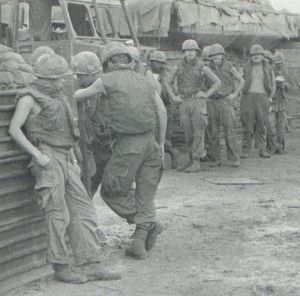
These battle weary troops from the 1st Air Cav. had just staged a “combat refusal” at Firebase Pace.
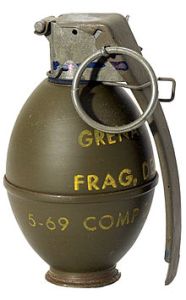
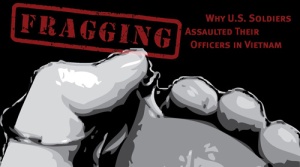
The dictionary defines “fragging” as the term used to describe the
deliberate killing or attempted killing by a soldier of a fellow
soldier, usually a superior officer or non-commissioned officer (NCO).
Fragging often consisted of throwing a grenade into a tent where the
target was sleeping or in the shitters. The word was coined by U.S.
military personnel during the Vietnam War when such killings were most
often attempted with a fragmentation grenade, sometimes making it appear as though the killing was accidental or during combat with the enemy.
The high number of fragging incidents in the latter years of the
Vietnam War was symptomatic of the unpopularity of the war with the
American public and the breakdown of discipline in the U.S. Armed
Forces. Documented and suspected fragging incidents totaled nearly eight
hundred from 1969 to 1972; resulting in 86 deaths and 714 injuries. In
1971, army testimony before Congress cited the following: 126 incidents
in 1969, 271 in 1970, and 333 in 1971. I couldn’t find a count for
1972, but it’s unlikely fragging suddenly ceased.
So why purposely try to kill a soldier with a higher rank?
Most fragging was perpetrated by enlisted men against leaders.
Enlisted men, in the words of one company commander, “feared they would
get stuck with a lieutenant or platoon sergeant who would want to carry
out all kinds of crazy ‘John Wayne’ tactics, who would use their lives
in an effort to win the war single-handedly, win the big medal, and get
his picture in the hometown paper.” Harassment of subordinates by a
superior was another frequent motive. The stereotypical fragging
incident was of “an aggressive career officer being assaulted by
disillusioned subordinates.” Several fragging incidents resulted from
alleged racism between African American and white soldiers. Attempts by
officers to control drug use caused others. Most known fragging
incidents were carried out by soldiers in support units rather than
soldiers in combat units.
Soldiers sometimes used non-lethal smoke and tear-gas grenades to
warn superiors that they were in danger of being fragged if they did not
change their behavior. A few instances occurred—and many more were
rumored—in which enlisted men collected “bounties” on particular
officers or non-commissioned officers to reward soldiers for fragging
them.
In short, for all the tales of soldiers assaulting gung-ho officers
they feared would get them killed, a more likely explanation is that
fragging was the work of rear-echelon misfits with anger management and
substance issues who sulked after getting chewed out and decided to have
their revenge. The nature of the war as such likely contributed only
indirectly — its unpopularity discouraged enlistment and compelled the
military to accept more trouble-prone recruits. The prevalence of drugs
couldn’t have helped either — one study of soldiers returning from
Vietnam found one-fifth had been addicted to narcotics.
Contrary to Hollywood’s take on Vietnam, most of the drug and
discipline problems were in rear echelon bases – not in the bush. The
combat units largely remained cohesive. Boredom, poor morale and lack of
discipline were a combustible mix. For fear of being fragged some
leaders turned a blind eye to drug use and other indiscipline among the
men in their charge.
After the Tet Offensive in January and February 1968, the Vietnam War
became increasingly unpopular in the United States and among American
soldiers in Vietnam, many of them conscripts. Secondly, racial tensions
between white and African-American soldiers and marines increased after
the assassination of Martin Luther King in April 1968. With soldiers
reluctant to risk their lives in what was perceived as a lost war,
fragging was seen by some enlisted men “as the most effective way to
discourage their superiors from showing enthusiasm for combat.”
- On the evening of October 22, 1970, Company L of the 3rd Battalion,
1st Marine Regiment was engaged in anti-infiltration operations in the
“Rocket Belt,” an area of more than 500 square kilometers ringing the Da
Nang Airbase. The company was set up in bunkers at an outpost on Hill
190, to the west of Da Nang. Assigned to guard duty that night, Private
Gary A. Hendricks settled into his position on the perimeter and made
himself comfortable. Too comfortable, it turned out. A bit later, when
Sergeant Richard L. Tate, the sergeant of the guard, discovered
Hendricks sleeping on post, he gave the private a tongue lashing but
took no further action. Shortly after midnight the next day, Hendricks
tossed a fragmentation grenade into the air vent of Sergeant Tate’s
bunker. The grenade landed on Tate’s stomach and the subsequent blast
blew his legs off, killing the father of three from Asheville, North
Carolina, who had only three weeks left on his tour of duty. The
explosion injured two other sergeants who were also in the bunker.
- Journalist Eugene Linden, in a 1972 Saturday Review article,
described the practice of “bounty hunting” whereby enlisted men pooled
their money to be paid out to a soldier who killed an officer or
sergeant they considered dangerous. One well-known example of bounty
hunting came out of the infamous Battle of Dong Ap Bai, aka Hamburger
Hill, in May 1969. After suffering more than 400 casualties over 10
merciless days of attacks to take the hill, the 101st Airborne Division
soldiers were ordered to withdraw about a week later. Shortly
thereafter, the army underground newspaper in Vietnam, GI Says,
reportedly offered a $10,000 bounty on the very aggressive officer who
led the attacks, Lt. Col. Weldon Honeycutt. Several unsuccessful
attempts were reported to have been made on the colonel’s life.
- In April 1971, Democratic leader Mike Mansfield of Montana
emotionally spoke to the issue on the floor of the Senate. Mansfield
related details of the death of 1st Lt. Thomas A. Dellwo, of Choteau,
Mont. “He was not a victim of combat. He was not a casualty of a
helicopter crash or a jeep accident. In the early morning hours of March
15, the first lieutenant from Montana was ‘fragged’ as he lay sleeping
in his billet at Bien Hoa. Lt. Richard Harlan was also killed in the
incident. He was murdered by a fellow serviceman, an American
GI. Private E-2 Billy Dean Smith was charged with killing the officers
but was acquitted in November 1972.
- On 21 April 1969, a grenade was thrown into the company office of K
Company, 9th Marines, at Quảng Trị Combat Base, RVN; First Lieutenant
Robert T. Rohweller died of wounds he received in the explosion. Private
Reginald F. Smith pleaded guilty to the premeditated murder of
Rohweller and was sentenced to 40 years’ imprisonment; he died in
custody on 25 June 1982.
Why use a grenade?
If you shoot someone, there’s a lot of more forensic evidence. And
the Army is pretty fanatical about keeping track of ammunition. A bullet
can be traced to a particular lot number or a particular gun. You can’t
associate a grenade firing pin with a particular grenade.
With a grenade, it splinters
into thousands of tiny fragments. Trying to piece that together, there’s
no way you’re going to get evidence off of that. Avoiding getting
fingerprints on the spoon [the lever on a grenade that is held down to
prevent it from going off] is pretty easy — just don’t touch the spoon
with the tip of your finger.
Also, with a gun, you have to
be there to shoot it. Whereas with a grenade, you have a certain amount
of lead time. You could set it up as a booby trap if you wanted to, with
a trip wire, or set it against a piece of furniture. There are many
more ways you can make a grenade deadly that you can’t make a gun.
In Vietnam, it was really not
that hard to get your hands on grenades. There were lax standards, which
meant that there were crates of grenades available. You’d make your
stop by the ammunition bunker, and platoon members could grab a couple
or as many as they thought they needed.
- Here’s an example of a shooting in a base camp: Sp4 Enoch ‘Doc’
Hampton, an African American soldier, was respected and well-liked by
his fellow soldiers, he was top notch and knew how to take care of them
in the field. The First Sergeant, Clarence Lowder, whom they called “Top
did everything by the book. When on stand down at the basecamp, Top
continuously harassed Doc for the length of his ‘picked out’ hair,
threatening Article 15’s if he didn’t immediately get his hair cut. That
night at chow, Doc Hampton said he was going to the orderly room to see
the First Sgt. “Either I’ll come out alone,” he said, “or neither of us
is coming out.”
Hanusey, the clerk, was working in the orderly room when Doc came
through the doorway. “His face was cold, stone cold,” Hanusey said. “He
looked like a man in the movies who was about to kill.” The barrel of
Doc’s M-16 was pointed downward, his feet planted firmly apart. Slowly
he raised the barrel and fired a full clip into Top. The sergeant’s back
exploded as pieces of flesh and blood spattered all over the orderly
room. Then Doc walked out and headed to the company latrine where he
barricaded himself for a possible shoot-out with arriving MP’s.
Surprisingly, his fellow soldiers also armed themselves and quickly
formed a perimeter around the latrine to protect their brother in arms
and preventing the MP’s from reaching Doc. The siege was short-lived
when a single shot sounded from the latrine…Enoch ‘Doc’ Hampton took his
own life.
How many soldiers were arrested for fragging?
Only a few ‘fraggers’ were identified and prosecuted. It was often
difficult to distinguish between fragging and enemy action. A grenade
thrown into a foxhole or tent could be a fragging, or the action of an
enemy infiltrator or saboteur. Enlisted men were often close-mouthed in
fragging investigations, refusing to inform on their colleagues out of
fear or solidarity. Only about 10 percent of all fragging incidents
actually ended up being adjudicated. Although the sentences prescribed
for fragging were severe, the few men convicted often served fairly
brief prison sentences.
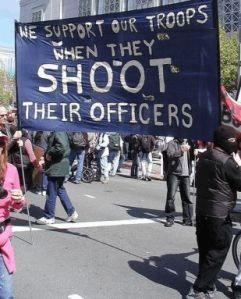
For every actual fragging incident, there was an untold number of
threats of fragging. These threats were made in various forms, such as
the surreptitious placement of a grenade or grenade pin, or perhaps the
detonation of a nonlethal gas or smoke grenade, in the potential
victim’s quarters or work areas. Officers who survived fragging attempts
often did not discover the identity of their attackers, and as a
consequence they lived in constant fear the attacks would be
repeated. According to Captain Barry Steinberg, an Army judge who
presided over a number of fragging courts-martial, once an officer had
been threatened with fragging, he was intimidated to the point of being
“useless to the military because he can no longer carry out orders
essential to the functioning of the Army.”
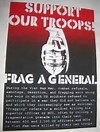
Twenty-eight
soldiers were arrested in Vietnam and tried for fragging a superior
officer. Ten were convicted of murder and served sentences ranging from
ten months to thirty years with a mean prison time of about nine years.
In summary, eighty percent of the murders happened at base camps, not
in the field; (b) 90 percent of the assaults took place within three
days after an argument with the victim; (c) offenders typically felt
they had been unfairly treated; (d) 88 percent of attackers were drunk
or high when they did it; (e) on average they had been in Vietnam for
six months; (f) 26 of the 28 were volunteers, not draftees; (g) only
five had graduated from high school; and (h) many were loners or had
psychological problems.
But since the start of the wars in Iraq and Afghanistan, the military
has charged only one Soldier with killing his commanding officer, a
dramatic turnabout that most experts attribute to the all-volunteer
military.
 The Air War started on January 17th at 3:30 in the morning we were woke up and told to "stand to" in full MOPP Gear level 4. We suited up as fast as we could because we were convinced that the Iraqi's would counterattack with Chemical weapons. We had no reason to doubt this because they have done it before to the Iranians and to the Kurds. We had a couple of M-8 alarms but we really didn't have any real faith in the equipment. To assist us, we had a real live chicken in a cage. We were told that if there are any chemicals in the air, the chicken will keel over first before we got affected. Granted we spent a lot of money building up the force in the 10 years, but the NBC gear wasn't as advanced as some of the other stuff.