Webster

The Constitution was made to guard the people against the dangers of good intentions." --American Statesman Daniel Webster (1782-1852)


Showing posts with label class warfare. Show all posts

Sunday, January 20, 2019

The modern class struggle and the Trump effect.

I got this from my Online friend Brad Torgersen, he had picked it up off USA Today.  I was surprised as was everyone else that the liberal USA Today would print something that wasn't a character assassination on President Trump.  I have blogged repeatedly about the Trump effect and why he got elected, he was the first president that spoke of the forgotten man.  the one that seemed to get forgotten in the inter-sectional identity politics of the modern age.  he surprisingly has become the spokesman for the middle class, you know the one that the GOP traditionally ignores and the Democrats discarded.  You know the ones that President Obama called "Bitter Clingers" and 2016 democratic candidate Hillary Clinton called "Basket of deplorables".  We are the ones forgotten about when the politicians play their games in D.C on the Potomac.  It seems like we play by the rules and "do right" by society by working, paying bills and the myriad of taxes.  Our kids are the ones joining the service and sacrificing but "Our Betters" children go to the Ivy League schools to learn how to network and then use the system to their advantage.


 The article from USA Today:

To understand events around the world today, one must think in terms of the class struggle.
This sentence sounds like something that could be written by a doctrinaire Marxist. But it is nonetheless true. Much of the current tension in America and in many other democracies is in fact a product of a class struggle. It’s not the kind of class struggle that Karl Marx wrote about, with workers and peasants facing off against rapacious capitalists, but it is a case of today’s ruling class facing disaffection from its working class.
In the old Soviet Union, the Marxists assured us that once true communism was established under a “dictatorship of the proletariat,” the state would wither away and everyone would be free. In fact, however, the dictatorship of the proletariat turned into a dictatorship of the party hacks, who had no interest whatsoever in seeing their positions or power wither.


Read more commentary:
Yugoslav dissident Milovan Djilas called these party hacks the “New Class,” noting that instead of workers and peasants against capitalists, it was now a case of workers and peasants being ruled by a managerial new class of technocrats who, while purporting to act for the benefit of the workers and peasants, somehow wound up with the lion’s share of the goodies. Workers and peasants stood in long lines for bread and shoddy household goods, while party leaders and government managers bought imported delicacies in special, secret stores. (In a famous Soviet joke, then-leader Leonid Brezhnev shows his mother his luxury apartment, his limousine, his fancy country house and his helicopter only to have her object: “But what if the communists come back?”) 
Djilas’ work was explosive — he was jailed — because it made clear that the workers and peasants had simply replaced one class of exploiters with another. It set the stage for the Soviet Union’s implosion, and for the discrediting of communism among everyone with any sense.

Elites of postwar institutions don't want change

But the New Class isn’t limited to communist countries, really. Around the world in the postwar era, power was taken up by unelected professional and managerial elites. To understand what’s going on with President Donald Trump and his opposition, and in other countries as diverse as France, Hungary, Italy and Brazil, it’s important to realize that the post-World War II institutional arrangements of the Western democracies are being renegotiated, and that those democracies’ professional and managerial elites don’t like that very much, because they have done very well under those arrangements.  And, like all elites who are doing very well, they don’t want that to change.
The postwar era saw the creation of international institutions ranging from NATO to the United Nations to the World Bank, along with a proliferation of think tanks and nongovernmental organizations (NGOs) to accompany them. It saw the vast expansion of higher education in the United States, and the transformation of academic degrees into something close to must-haves for the upper-middle class. It saw a great expansion of power on the part of media organizations, and on the part of government bureaucrats and lobbyists, both of whose numbers increased enormously.
But after the turn of the millennium, other Americans, much like the workers and peasants in the old Soviet Union, started to notice that while the New Class was doing quite well (America’s richest counties now surround Washington, D.C.), things weren’t going so well for them. And what made it more upsetting was that — while the Soviet Union’s apparatchiks at least pretended to like the workers and peasants — members of America’s ruling class seemed to view ordinary Americans with something like contempt, using terms such as “bitter clingers,” “deplorables” and flyover people.

Class wars in America disguised as culture wars

Suddenly, to a lot of voters, those postwar institutional arrangements stopped looking so good. But, of course, the beneficiaries showed no sign of giving them up. This has led to a lot of political discord, and a lot of culture war, since in America class warfare is usually disguised as cultural warfare. But underneath the surface, talk is a battle between the New Class and what used to be the middle class.
If you look at the “yellow jacket” protests in France, the election of Brazilian President Jair Bolsonaro and events in places like Italy and Hungary — or, for that matter, the Brexit movement in Britain — you find a similar unhappiness with institutional arrangements and the sleek and self-satisfied elites who benefit from them.  People who, in President Bill Clinton’s famous phrase, worked hard and played by the rules now suspect that the rules were rigged, and that they were treated as chumps.
Talking about the yellow-vest movement, French geographer Christophe Guilluy observes: “Immediately, the protesters were denounced as xenophobes, anti-Semites and homophobes. The elites present themselves as anti-fascist and anti-racist, but this is merely a way of defending their class interests. It is the only argument they can muster to defend their status, but it is not working anymore.”
That’s right. It’s class war masquerading as something else, but people have seen through the mask.
Understanding this won’t make the conflict less intense, but it might make it clearer what’s really at stake. What’s happening in America is an echo of what’s happening in democracies around the world, and it’s not happening because of Trump. Trump is the symptom of a ruling class that many of the ruled no longer see as serving their interest, and the anti-Trump response is mostly the angry backlash of that class as it sees its position, its perquisites and — perhaps especially — its self-importance threatened.
Glenn Harlan Reynolds, a University of Tennessee law professor and the author of "The New School: How the Information Age Will Save American Education from Itself," is a member of USA TODAY's Board of Contributors.

Thursday, May 10, 2012

Only in America

Only in America---Top Ten


1) Only in America could politicians talk about the greed of the rich
at a $35,000 a plate campaign fund raising event.

2) Only in America could people claim that the government still
discriminates against black Americans when we have a black President,
a black Attorney General, and roughly 18% of the federal workforce is
black. 12% of the population is black.

3) Only in America could we have had the two people most responsible
for our tax code, Timothy Geithner, the head of the Treasury
Department and Charles Rangel who once ran the Ways and Means
Committee, BOTH turn out to be tax cheats who are in favor of higher
taxes.

4) Only in America can we have terrorists kill people in the name of
Allah and have the media primarily react by fretting that Muslims
might be harmed by the backlash.

5) Only in America would we make people who want to legally become
American citizens wait for years in their home countries and pay tens
of thousands of dollars for the privilege while we discuss letting
anyone who sneaks into the country illegally just become American
citizens.

6) Only in America could the people who believe in balancing the
budget and sticking by the country's Constitution be thought of as
"extremists."

7) Only in America could you need to present a driver's license to
cash a check or buy alcohol, but not to vote.

8) Only in America could people demand the government investigate
whether oil companies are gouging the public because the price of gas
went up when the return on equity invested in a major U.S. oil company
(Marathon Oil) is less than half of a company making tennis shoes
(Nike).

9) Only in America could the government collect more tax dollars from
the people than any nation in recorded history, still spend a trillion
dollars more than it has per year for total spending of $7 million PER
MINUTE, and complain that it doesn't have nearly enough money.

10) Only in America could the rich people who pay 86% of all income
taxes be accused of not paying their "fair share" by people who don't
pay any income taxes at all.


Friday, January 27, 2012

"There are not enough Warren Buffett's"

 photo
Republican Senator Jim DeMint had a good line in response to Obunglers State of the Union address.campaign speech and class warfare rhetoric. He says that there “are not enough Warren Buffetts in the world that we could take all their money” in order to solve our debt crisis.
     Something to think about,  According to an article by Walter Williams
If Congress imposed a 100 percent tax, taking all earnings above $250,000 per year, it would yield the princely sum of $1.4 trillion. That would keep the government running for 141 days, but there's a problem because there are 224 more days left in the year.
How about corporate profits to fill the gap? Fortune 500 companies earn nearly $400 billion in profits. Since leftists think profits are little less than theft and greed, Congress might confiscate these ill-gotten gains so that they can be returned to their rightful owners. Taking corporate profits would keep the government running for another 40 days, but that along with confiscating all income above $250,000 would only get us to the end of June. Congress must search elsewhere.
According to Forbes 400, America has 400 billionaires with a combined net worth of $1.3 trillion. Congress could confiscate their stocks and bonds, and force them to sell their businesses, yachts, airplanes, mansions and jewelry. The problem is that after fleecing the rich of their income and net worth, and the Fortune 500 corporations of their profits, it would only get us to mid-August. The fact of the matter is there are not enough rich people to come anywhere close to satisfying Congress' voracious spending appetite.
       Rich people didn't get rich by being stupid.  They will move or hide their money.  If the government seizes all their property, it will cause 2 problems, one: if you seize everything in the name of "fairness"  to redistribute to the "less fortunate" you will still have people that will not have anything, the poor with few exceptions are poor for a reason.  Also there will be no rich people, this would be a one time thing, once their money is gone, who pays the taxes?   The poor?  yeah right.  The top 50% pay about 97% of all the taxes.  There will be 2 classes of people, the "hoi patoi" and the political elite.  Kinda like the old Soviet Union.  Maybe that is what Obungler has in mind.   The second problem,  is we still have a spending problem, when taxes go up, there is less revenue collected and there will still be a deficit, now it will be acerbated by the seizures of the rich people assets.   We don't have a revenue problem, we have a spending problem and unless COngress ans the president get a grip on it, it will get worse.


Thursday, December 22, 2011

Class warfare we could use....


Saturday, December 10, 2011
The class deserving voters’ wrath is composed of society’s predators and parasites, who span all rungs of the income ladder.

Class warfare is emerging as a major theme for the 2012 presidential election campaign. “Millionaires and billionaires”—a reliable phrase that apparently continues to test well with the Democrats’ focus groups—are the easy target, because even though they receive a large portion of national income, they represent only a small fraction of the electorate. But are the millionaires and billionaires the right enemy? Not according to the Republicans, who warn that the major victims of a class war against millionaires would be small businesses.
In short, the class war as it stands today finds "Democrats accusing Republicans of siding with the rich, and Republicans countering that Democrats were taxing small business owners who create jobs." Voters are faced with an apparent dilemma, a contest between the two powerful emotions of envy and fear: should we let our envy of the supposedly too-wealthy, too-powerful “rich” outweigh our fear of damaging the economy’s ability to create private sector jobs? Which side should we take in the unfolding class war: the Democrats’ message exploiting envy, or the Republicans’ message exploiting fear?
The true heroes in our economy are the producers and earners; they can be found all the way up and down the income ladder, and class warfare should defend and reward them instead of targeting them.
It’s a difficult dilemma—but, fortunately, it’s also a false dilemma. Why? Because, as it stands today, the class war has misidentified the enemy. Not all of the rich are the “bad guys” who deserve targets on their backs. By the same token, not all of the remainder are the “good guys” who deserve to be defended—and that includes the middle class, the poor, small businesses, and any other group we don’t usually think of as rich. It’s just not as simple as “the rich versus the rest.”
The graphic below illustrates the underlying error: the class of people who deserve our enmity is not precisely “the rich” at the very top of the income ladder; instead, the class deserving voters’ wrath is composed of society’s predators and parasites, who span all rungs of the income ladder.
Conover Villains
The point is this: If we’re going to have a war, let’s do it right. The battle lines should be drawn orthogonally to the oversimplified “rich versus the rest.” A virtuous war would be one that rewards society’s honest earners and productive contributors, while punishing society’s predators, pirates, and parasites—all without regard to anyone’s income level. It is a target-rich environment that includes anyone (of any income level) who is cheating to win, any business or union (of any size) with its snout in the public trough, any politician filling that trough and feeding those snouts for reciprocal gain, and any group using the political system (at any level) to maintain its monopoly, or its winning “edge” against less-well-connected competitors.
Among “the rich” are many entertainment superstars, artists, CEOs, inventors, and entrepreneurs. Are all of them villains because of their huge incomes? Of course not. Most of them get where they are because they produce things that entertain us, make us more productive, save us money, or save us time. Most are “rich” because they earned it—and because they earned it, they do not deserve to be targets in the class war.
It’s just not as simple as ‘the rich versus the rest.’
It’s also true that not everyone at the top earned their way to that position. For example, a few are the well-positioned rentiers leveraging their strategic position at a bottleneck in the financial system. As economist Tyler Cowen points out, "The high incomes in finance should give us all pause." Why? Because much of it was not earned; it was instead obtained by gaming the system, by staying a step ahead of the statutes, by keeping profits privatized and risks socialized, and by monetizing moral hazards. This group includes Wall Street firms employing high-speed data feeds into computers programmed to beat less-sophisticated market participants by using a trading technique known as “quote-stuffing,” a method designed to submit-and-retract thousands of dummy bids per second in the profitable quest for fleeting arbitrage events worth pennies each. This group stays one step ahead of the letter of current laws and regulations, lobbies to prevent unfavorable changes in those regulations, nudges the free market a step closer to a fake market, and extracts the resultant economic profits from a comparatively inexpert investing public.
As economic historian Joel Mokyr said of some past economic successes, “Prosperity and success led to the emergence of predators and parasites in various forms and guises who eventually slaughtered the geese that laid the golden eggs.” Might today’s Wall Street situation be a contemporary example of history repeating itself? Cowen’s article implies as much. In any case, any Republicans (or Democrats) who think the profitmaking methods described above are worth defending will have an increasingly difficult time doing that, and deservedly so. As the above diagram depicts, some of “the rich” fall into the class known as “predators and parasites” whose profits are large but not earned.
Some businesses—large and small, national and local—are sufficiently well-connected politically to maintain their comfort and longevity by extracting government subsidies for their special interest.
However, predators and parasites inhabit more than just the ranks of “the rich.” Examples abound. Some tech-savvy individuals and small businesses prey on the elderly, on government programs, or on vulnerable computer systems in governments and other businesses. Some public-sector union bosses are powerful enough to swing elections toward the candidates who will sit on the other side of the negotiating table, thereby bending the public trust to their special advantage. Some businesses—large and small, national and local—are sufficiently well-connected politically to maintain their comfort and longevity by extracting government subsidies for their special interest, or by getting their political friends to pass favorable legislation against competitive threats. The politicians on one side of crony capitalism, as well as the business managers on the other, are part of the problem a virtuous class war should be designed to fix.
A proper class war would require Democrats and Republicans to admit that the distinguishing characteristic of the enemy is not the level of income or wealth; rather, it is whether that income or wealth was earned. The true heroes in our economy are the producers and earners; they can be found all the way up and down the income ladder, and class warfare should defend and reward them instead of targeting them. Conversely, the proper targets are the class that includes cheaters, predators, pirates, and parasites—who can also be found at all income levels.
If class warfare is inevitable, let’s at least go after the right enemy. Fingering “millionaires and billionaires” as the culprits is the easy way out; it might pass muster in focus groups and might fit well into campaign speeches, but it doesn’t even come close to a proper description of the true enemies of economic growth and broadly shared prosperity. If we can target the right enemy, we’ll be fighting a good war; in that case, by all means, let the 2012 class war begin in earnest.

Wednesday, October 5, 2011

Using a picture to explain tax rates to your liberal friends

 Using a picture to explain tax rates to your liberal friends


.
Democrats have convinced themselves that there is no other way to tackle our debt/deficit crisis other than raising taxes.  Those recommendations by Obama’s own deficit commission – cutting spending and entitlement reform – apparently are not considered credible in the eyes of Democrats.  But the panel’s recommendations on tax increases, now that part MUST be credible.  And don’t even THINK about proposing the idea of growing our economy as a way to help shore up our fiscal problems.  They don’t know how to do that.  But let’s stay with this idea for a moment that taxing the rich is the only way to get our fiscal house in order.  To debunk this theory, we go to this column by Walter Williams:Tax the Rich? Good luck with that.  I’ve given you these statistics before, but they continue to be poignant in this discussion on taxing the rich.
If Congress imposed a 100% tax, taking all earnings above $250,000 per year, it would yield the princely sum of $1.4 trillion. That would keep the government running for 141 days, but there's a problem because there are 224 more days left in the year.
How about corporate profits to fill the gap? Fortune 500 companies earn nearly $400 billion in profits … Taking corporate profits would keep the government running for another 40 days, but that along with confiscating all income above $250,000 would only get us to the end of June. Congress must search elsewhere.
According to the Forbes 400, America has 400 billionaires with a combined net worth of $1.3 trillion. Congress could confiscate their stocks and bonds, and force them to sell their businesses, yachts, airplanes, mansions and jewelry. The problem is that after fleecing the rich of their income and net worth, and the Fortune 500 corporations of their profits, it would only get us to mid-August.
These figures, folks, are just to keep our government running .. we aren’t even talking about getting our fiscal house in order!  Now, let’s try and dissect a little more prog-logic.  Shall we?  More from this column by Ron Klain:
The single largest revenue item -- allowing the Bush-era tax cuts for the highest-income taxpayers to expire as scheduled at the end of next year -- could be devoted to several purposes. For example, a large portion could be applied directly to paying down the debt. In other words, easing the future burden on our children, not expanded government spending.
First of all, the Bush tax cuts for the wealthy would net about $800 billion.  Our debt is $14 trillion.  And how are we to trust that this money would even go to paying down the debt and not growing the size of government?  But let’s move on to something even more important.  Klain writes, “easing the future burden on our children, not expanded government spending.”  Government spending?  This prog seems to assume that allowing you to keep more of your money is “government spending.”  This implies that all money belongs to government, and it only allows you to keep a certain amount.  This, folks, is a frightening way to view wealth.  Isn’t it any wonder that these progs think we need to share the wealth?  OK .. one more from Ron Klain:
Here’s the bottom line: Tying tax increases to dedicated and popular uses insulates proposals for much-need revenue from attacks of “class warfare” or general anti-tax sentiment, and can help rebuild faith that marginal dollars collected by the government will be put to a clear and important public purpose.
So now, according to the progressives/liberal/democrat types it is OK to seize wealth from people who earned it so long as it is dedicated to “popular uses.”  Majority rules versus minority rights.  I don’t know about you, but the idea of the tyranny of the majority – democracy – scares the tar out of me.  And this is a prime example as to why.  It is mob rule, the majority forcing their will on the minority.  That is why founders had such a dim view of democracy, they knew what it had done to the Athenian republic over 2000 years ago.  A Constitutional republic protects the rights of the minority and the individual.  I like to use the analogy that democracy is 3 wolves and 1 sheep voting on dinner whereas a constitutional republic the sheep are armed.


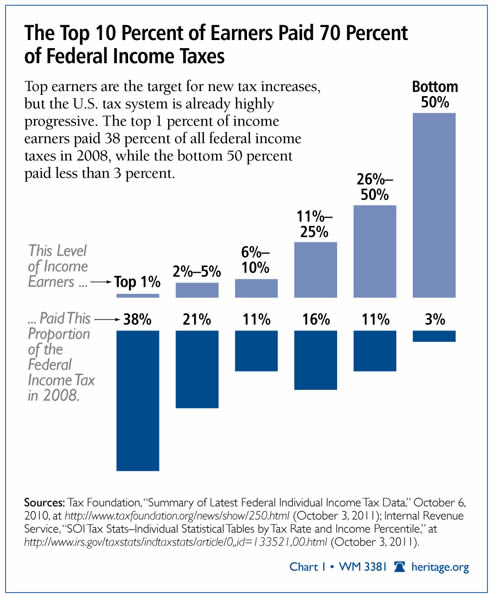
In Pictures: How Much the Top Earners Already Pay in Taxes

America has heard a lot of talk about the “Buffett Rule” — President Barack Obama’s plan to make the tax code more “fair” by permanently raising taxes by $1.5 trillion over 10 years, with most of the burden falling on families and businesses earning more than $250,000 per year. But if he wants to talk about “fairness,” he should look at how much top income earners already pay in taxes, as the chart below shows:

In a new paper, Heritage’s Curtis Dubay explains that the supposed “fairness” of the new rule is anything but fair:
To President Obama, it is “fair” to raise taxes on families and businesses earning more than $250,000 a year by raising their income tax rates and limiting their deductions. That must also mean he believes that they currently pay too little in taxes.
Yet the data show the highest-earning families and businesses already pay the lion’s share of the federal income tax burden. According to the IRS, the top 1 percent of income earners—those earning more than $380,000 in 2008—paid more than 38 percent of all federal income taxes while earning 20 percent of all income. The top 10 percent ($114,000 and above) earned 45 percent of income and paid 70 percent of all taxes. At the same time, the bottom 50 percent of income earners—those earning less than $33,000—earned 13 percent of all income and paid less than 3 percent of federal income taxes.
Read more of Dubay’s paper, “The Buffett Rule: Fair to No One,” at Heritage.org.