I heard something about this a few years ago but just generalities that a congresscritter shot off his mouth during a press conference and released classified information that compromised operational assets. No it wasn't the first time and yes it has happened since and funny that nothing seems to happen to those clowns.
I saw this article chasing a car article...so I clipped it.
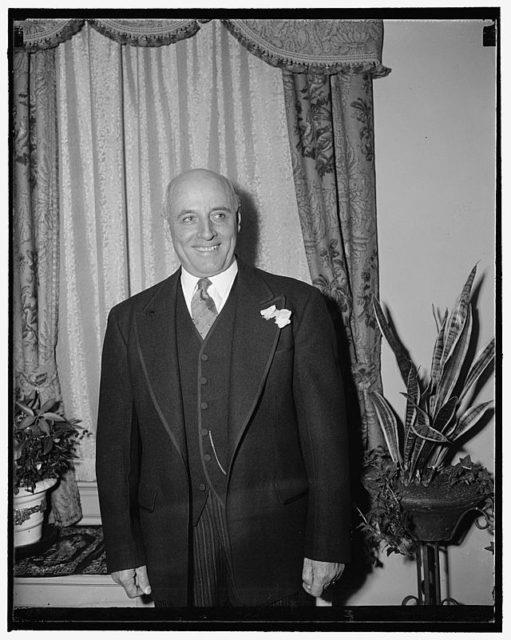
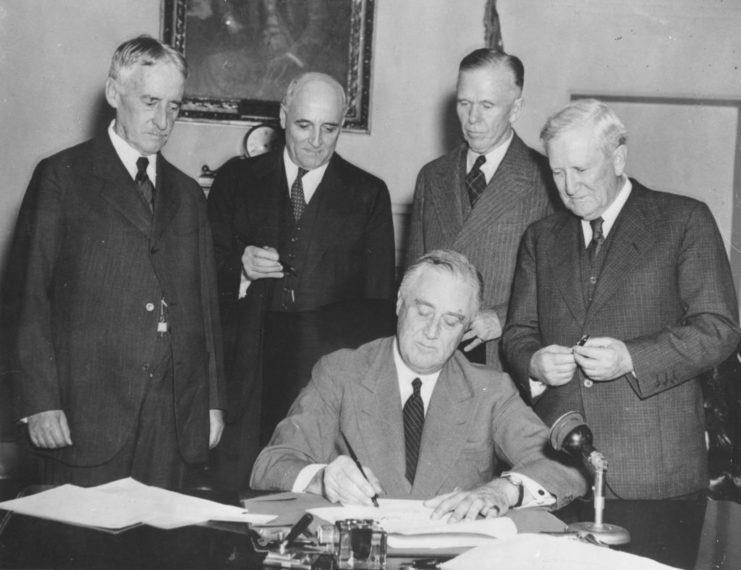
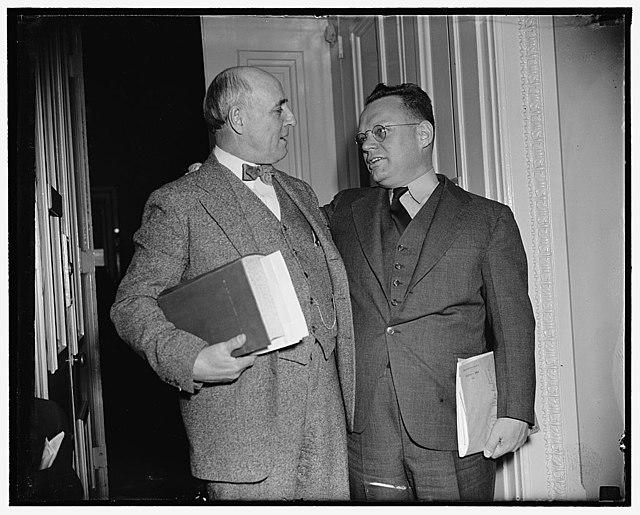
There is a reason certain military knowledge is classified: so it doesn't fall into the hands of the enemy. Congressman Andrew May didn't get the memo, as an ill-fated press conference led to the loss of an estimated 10 submarines and the deaths of 800 Navy crewmen.
The May Incident
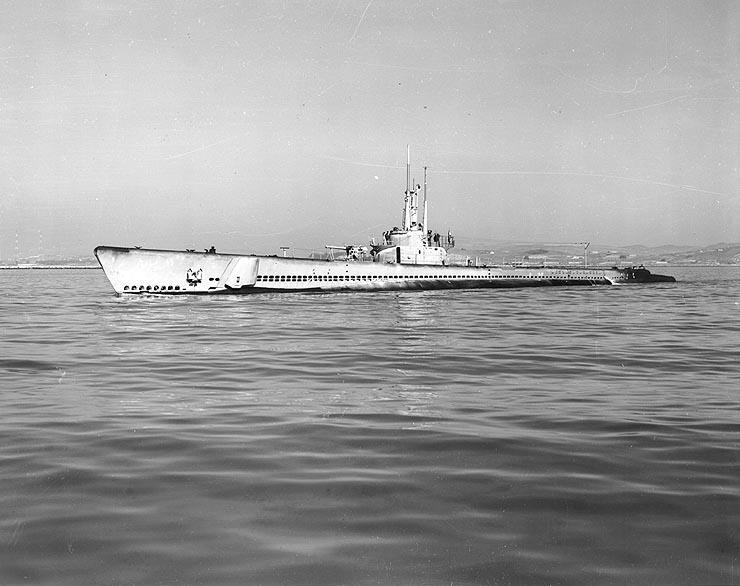
The United States Navy was known for its successes following the country's entrance into WWII. Despite Japanese attempts to sink their vessels, the Allied forces managed to evade their attacks. This was because, at the time, the Balao-class of submarine could dive to depths of 400 feet, deeper than the Japanese set their depth charges.
In 1943, Andrew May, chairman of the House Military Affairs Committee, embarked on a tour of American military areas in thePacific Theater, during which he was privy to a host of sensitive war-related information. When he returned that June, he held a press conference, where he revealed that American submarines only had a high survival rate because the Japanese charges were exploding at too shallow a depth
The fallout of a blabbermouth
Not long after this news spread, the Japanese naval anti-submarine forces adjusted their charges to explode at a greater depth. This prompted Vice Admiral Charles A. Lockwood, commander of the US submarine fleet in the Pacific, to estimate that May's breach cost the Navy 10 submarines and resulted in the deaths of some 800 crewmen.
"I hear Congressman May said the Jap depth charges are not set deep enough," he said. "He would be pleased to know that the Japs set them deeper now."
The Navy's Pacific Submarine Fleet released a report following the press conference, in which it determined Japanese anti-submarine warfare (ASW) forces had failed to uncover the maximum depth the US submarine fleet could reach. However, it failed to state whether the Japanese had altered their depth charge attacks to deeper positions due to May's revelation.
Alleged war profiteering
The ill-fated press conference wasn't the only ding to Andrew May's career. During the early stages of the war, he became involved with two New York-based businessmen, Henry and Murray Garsson. Despite the pair having no prior arms manufacturing knowledge or experience, they sought to financially gain from the US involvement in the conflict by securing munitions contracts from the government.
On the pair's behalf, May used his position as chairman of the House Military Affairs Committee to contact Army ordnance and other government officials to obtain war contracts, favors, and draft deferments. For his efforts, he received substantial cash payments, information that was uncovered by a Senate investigating committee following the war.
This soon turned into a scandal, which only grew following testimony about the profit-taking of the Garssons' company and the defects in their munitions. It was found their 4.2-inch mortar shells had defective fuzes, leading to premature detonation. It's believed this resulted in the death of 38 American servicemen.
Paying for his actions... Maybe?
The fallout for Andrew May's many guffaws during the war included him losing re-election in 1946. He was then put on trial for federal bribery charges, and after less than two hours of jury deliberation was found guilty on July 3, 1947. Despite efforts to avoid incarceration, he was eventually sentenced to nine months in a federal facility.
Murray and Henry Garsson were also sentenced to prison terms.
Despite his be-smudged reputation, May continued to retain influence over politics within the Democratic Party. As such, he was able to secure a full pardon from President Harry Truman in 1952. He was, however, unable to revive his political career and thus returned to Kentucky to practice law until his death.
I snagged this from the 3rd party email, yeah I'm an Army guy that happens to know a bit about Navy stuff, especially Carriers. I still think they need to go back to naming them for battles, and not politicians. I am glad to see the Enterprise coming back though.
The first-in-class USS Gerald Ford carrier (foreground) operated alongside the Nimitz-class USS Dwight D. Eisenhower (at right) in October amid high tensions in the Middle East.
Credit: Petty Officer 3rd Class Janae Chambers/U.S. Navy
The U.S. Navy’s Nimitz-class carriers are about to turn 50. But given the demand for the carrier air wing and delays to the Nimitz-class replacement—the Ford-class—the USS Nimitz (CVN 68) itself is unlikely to retire as soon as expected.
The Navy’s fiscal 2023 budget has already called to extend the first-in-class CVN 68, commissioned in 1975, for another deployment cycle instead of decommissioning it in 2025 as previously planned. Service officials say the upcoming budget request could include a final decision on extending the next in the class, the USS Dwight D. Eisenhower, beyond its 2027 projected end-of-service date—though extending just that ship likely will not be enough.
“Extending Nimitz, extending Ike, it’s going to happen for every Nimitz-class carrier. At least one extension,” Vice Adm. Kenneth Whitesell, then-commander of Naval Air Forces, said during an Aug. 25 discussion at the Tailhook Symposium shortly before retiring from the service.
USS Nimitz extended, Eisenhower likely to follow
The service seeks Ford-class advanced procurement change
Repeated extensions could worsen strike fighter deficit
The future of the Nimitz class and oversight of ongoing issues facing production of the second Ford-class carrier, the USS John F. Kennedy, was a focal point of the discussion at the symposium. The Navy’s current plan for the Nimitz calls for $200 million for extension work as part of a 5.5-month maintenance schedule, according to a March 2023 report to Congress.
“Carriers are the linchpin of everything we do in naval aviation,” Director of Air Warfare Division N98 Rear Adm. Michael Donnelly said. “Our requirements are designed and aligned within our air wings to provide the capability out to the [combatant commands] for our ability to conduct the mission. Our ability to get the carriers out on time, whether it is new procurement or maintenance, is essential.”
The first-in-class USS Gerald R. Ford (CVN 78) is now deployed to the Mediterranean, about two years after it achieved initial operational capability. The Ford was extensively delayed and over budget, commissioning five years before the deployment and 15 years after its naming. Originally projected to cost $10.5 billion, the ship ended up costing $13.3 billion. Though it has advanced capabilities such as the new electromagnetic catapult system and improved weapons elevators, it is not yet able to bring on Lockheed Martin F-35Cs.
The Kennedy (CVN 79) was christened in December 2019 and is scheduled to be delivered in 2025, one year later than its prior expected delivery. The next in the class, the USS Enterprise (CVN 80), has also been affected by labor and supply chain issues, with its delivery date at least a year late as well, now scheduled for 2028.
To address the Refueling and Complex Overhaul issues, the Navy is executing a performance-based contract for the process on the USS John C. Stennis (CVN 74). For new builds, the service is also looking at extended advance procurement contracts to have more of a lead time in the supply chain, switching to a three-year period from the current two years, Donnelly said.
“We have to look at our procurement strategies so that we are designing the budgeting and programming [and] buying those on the right centers [to] keep the momentum going in the industrial process,” he says.
Demand for carriers will not likely abate soon, as evidenced by the Ford and Eisenhower operating together in the Mediterranean. The Navy has been stressed in fulfilling its post-Cold War plan for a permanent 1.0 carrier presence on station in three hubs—the Western Pacific, the wider Middle East and Europe. To keep up this presence, the service needs 15 carriers—a 3:1 ratio because of maintenance and deployment process requirements. This plan was outlined in the 1993 Bottom-Up Review under then-Defense Secretary Les Aspin, but the service has been unable to meet it since, says Steven Wills, a navalist with the Center for Maritime Strategy at the Navy League.
Navy policy has shifted to the Fleet Response Plan, which focuses on being able to surge aircraft carriers forward when needed, as with the six carriers deployed for Operation Desert Storm and the five for Operation Iraqi Freedom. The current fleet size of 11 stresses this model, and with reactor time left on the ships, multiple extensions are possible, Wills says. “We beat our ships up. We’ve only got X amount of carriers, and constantly keeping one-third deployed, that’s rough,” he says.
In some ways, keeping the carriers active may be easier than decommissioning them, says Bryan Clark, a senior fellow and director of the Hudson Institute’s Center for Defense Concepts and Technology. Taking apart a massive, nuclear-powered aircraft carrier is a long, expensive and difficult job of which few companies are capable. Just three responded to a request for proposals to decommission the USS Enterprise. This process requires dismantling the nuclear reactor before shipping it to a nuclear waste storage facility, all while the ship takes up space in a dry dock.
As the Navy is planning its future carrier fleet size, it also faces math problems with its air wings. The service customarily had one more carrier air wing than its total number of carriers before deciding it did not need to keep that many aircraft. The Navy currently has nine air wings to serve on 11 carriers. “That means each air wing is getting worked at max availability,” Clark says.
Not all air wings are populated with enough strike fighters, he notes, and the Navy is not looking to buy more. Current F-35C production is capped by Lockheed Martin’s capacity and issues facing development of new capabilities, such as the Block 4 package. Early Super Hornets are reaching service-life caps, as Boeing’s Block III upgrade process has proven more time-consuming than originally expected, while the Navy wants to end new production.
For now, this means the service has been shuffling aircraft around its squadrons to populate those underway. It is a workable approach for now, but it is not necessarily sustainable, he says.
The Navy plans to address the potential aircraft shortages by leaning heavily into uncrewed aviation. The 2022 Navigation Plan authored by then-Chief of Naval Operations Adm. Mike Gilday, who has now retired, called for carrier air wings to be 60% uncrewed and 40% crewed. This plan hinges for now on the Boeing MQ-25 Stingray, slated to be the trailblazer for uncrewed carrier-based operations ahead of new programs such as Collaborative Combat Aircraft on which the Navy is working with the Air Force. Those uncrewed “loyal wingman”-type aircraft, which are to fly alongside F-35s and Next-Generation Air Dominance platforms, are expected to begin to be fielded by the end of the decade.
The nation of Japan was helpless before the invading force. They were
outnumbered, and the enemy was about to land on the shores of the
Imperial Home Islands. There was nothing left but to fight to the death
against the savage invaders. But then, suddenly and without warning, a
great wind came and destroyed the enemy fleet. The enemy, Mongols under
Kublai Khan, had been destroyed by a sudden typhoon, a “Divine Wind” or
“Kamikaze,” as it came to be known in Japanese history. In the year
1281, Japan had been saved by this help from above.
Nearly 700
years later, in 1944, the same situation faced Japan. It was not Mongols
this time, but an enormous military force led by the United States that
was threatening to invade Japan. The Western Allies had begun their
inexorable advance against Japan three years earlier at New Guinea and
Guadalcanal, and they were now more than halfway across the vast
Pacific, aiming directly for Japan itself. In desperation, some Japanese
leaders looked to another “Divine Wind” again to save them. This time,
the Kamikaze would not be a typhoon, but swarms of suicide planes that
were to be unleashed at the advancing allies.
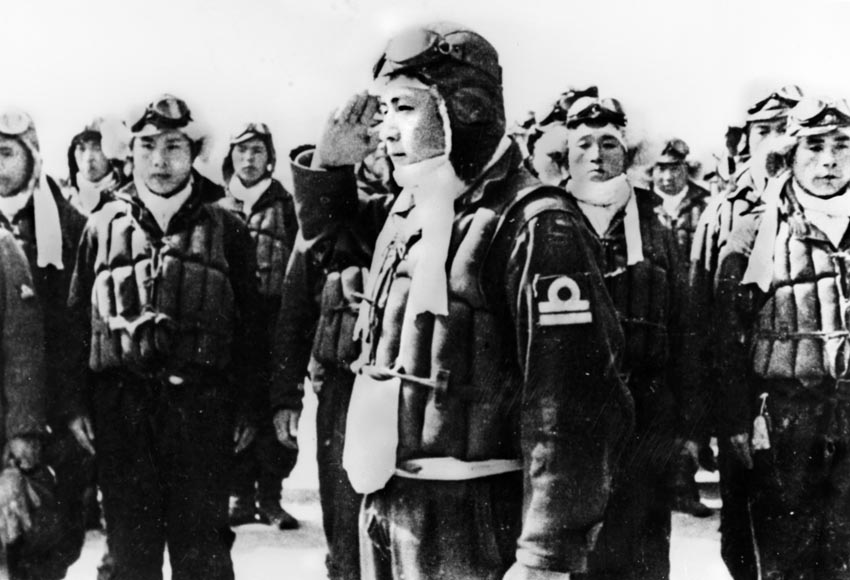
A
kamikaze pilot salutes as he receives his orders for a “divine wind”
mission. It is estimated that over 1,200 pilots (out of 2,314) lost
their lives on such missions.
The concept of
individual suicide was accepted within Japanese society, particularly
among those descended from the warrior, or Samurai, class. Suicide was
generally accepted as the way to atone for failure, and ritual suicide,
also known as seppuku and harakiri, was common among the military of
Japan. It would appear repeatedly during the Pacific war, beginning at
Guadalcanal and lasting to, and even after, Japan’s surrender.
But
mass suicide was something else. Throughout the war, individual
Japanese, particularly pilots whose planes were too badly damaged to
return to base and being culturally unable to accept a surrender to the
enemy, would fly their damaged aircraft into some enemy target, be it a
ship or a ground target. These men were presumed to have been granted a
direct passage to an honored place in heaven for their actions.
Suicide as a doctrinal military tactic, however, did not enter
Japanese military policy until October 1944. By then, the Americans were
invading the Philippines and the Palau Islands, threatening to cut off
Japanese lines of supply from the Far East. Without those supplies,
Japan could not sustain its war effort much longer. All attempts to stop
the American advance had so far failed, and, as in 1281, Japan was
growing increasingly desperate. Once again, the accepted solution was
the Kamikaze.
The origins of the modern Kamikaze are traced to
Luzon, in the Philippines, in October 1944. The Americans were about to
invade those islands, and the Japanese were preparing to meet that
invasion. Captain Rikihei Inoguchi of the Imperial Japanese Navy Air
Forces was at Clark Field discussing attack plans against the
approaching American invasion force. As a senior staff officer of the
1st Air Fleet, he had been assigned the job of organizing the air
defenses of the Philippines.
While speaking with Commander Asaichi
Tamai, commanding the 201st Air Group, he was joined suddenly by Vice
Adm. Takijiro Ohnishi, the recently appointed commander of Japanese
Naval Air Forces in the Philippines. Joined by some squadron leaders,
the group sat down to listen to Admiral Ohnishi’s instructions.
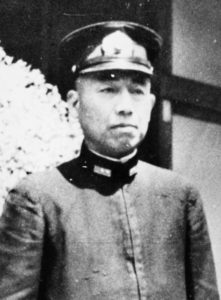
Admiral
Ohnishi was himself a pilot and a long-time advocate of naval aviation
in Japan. He had helped plan the Pearl Harbor attack and had been a
protégé of Admiral Isoroku Yamamoto. As a staff officer, Ohnishi had
long been involved in discussions in Tokyo over the use of suicide
operations, arguing against them. But the continued defeats in the
Pacific and the loss of vital resource territory seemed to have changed
his opinion by the time he was appointed to command the 1st Air Fleet in
the Philippines.
Admiral Ohnishi began by stating the obvious:
Japan’s situation was critical. He then explained that the Imperial
Japanese Navy was about to launch an all-out attack on the American
fleet off Leyte. But the Japanese fleet had no air cover of its own; the
1st Air Fleet on Luzon would have to provide that air cover. He had
orders to protect the fleet for at least one week, keeping the American
aircraft carriers from launching strikes that would cripple or destroy
the oncoming Japanese fleet.
The problem was that the 1st Air
Fleet had only 30 serviceable aircraft on Luzon. How could such a small
force hold back the hundreds, perhaps thousands, of American planes
coming to Leyte Gulf?
Admiral Ohnishi presented his solution. He
told the assembled pilots and staff officers, “In my opinion, there is
only one way of assuring that our meager strength will be effective to a
maximum degree. That is to organize suicide attack units composed of
Zero fighters armed with 250-kilogram bombs, with each plane to
crash-dive into an enemy carrier…What do you think?”
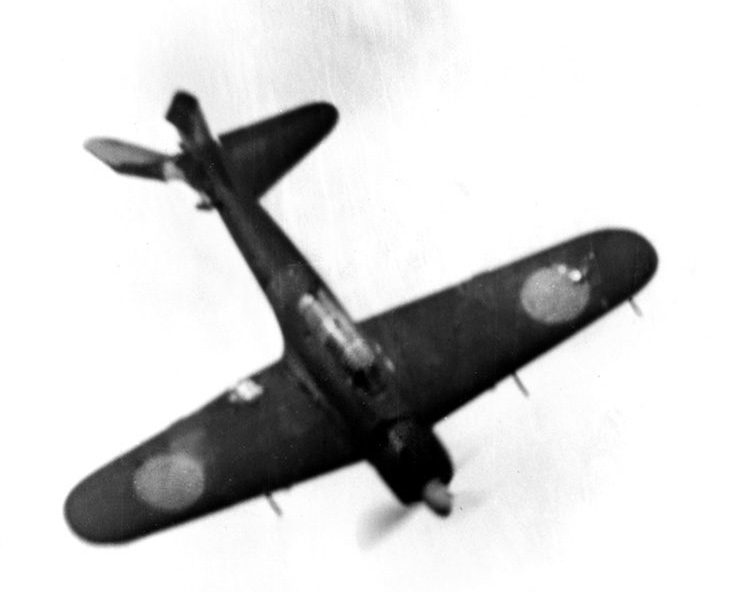
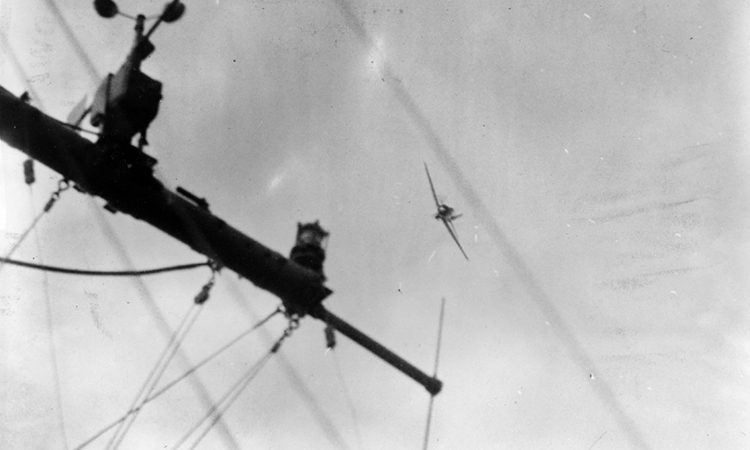
Despite
a broken elevator and wings riddled with bullet holes, a Mitsubishi A6M
“Zeke” Kamikaze plane makes its death plunge toward the carrier USS
Essex off Okinawa, May 14, 1945. Japan’s efforts to cripple the American
invasion of Okinawa brought about the mass employment of suicide
missions.
Silence initially replied to the
admiral’s proposal. Captain Inoguchi remembered, “No one spoke for a
time, but Admiral Ohnishi’s words struck a spark in each of us. Indeed,
‘body-crashing’ (taiatari) tactics had already been used by Navy pilots
in air-to-air combat against big enemy bombers, and there were many
fliers in the combat air units who had urged that the same tactics be
employed against enemy carriers.”
The group then discussed whether
a fighter plane armed with a 250-kilogram bomb would be enough to
disable or even sink an American aircraft carrier. They acknowledged
that accuracy would be greater with a pilot guiding the weapon,
including his own plane, to the target. Commander Tamai, the senior
flying officer present, agreed that the plane and bomb together would be
enough to at least disable any American aircraft carrier it hit.
Commander
Tamai then held a meeting with his pilots, and came back to say, “The
201st Air Group will carry out his proposal. May I ask that you leave to
us the organization of our crash-dive unit?” The Japanese Kamikaze
program of 1944 had begun.
Commander Tamai assembled his enlisted
pilots and explained the new proposal to them. Every one of the 23
pilots joyfully agreed to participate in the Kamikaze program. Returning
to his staff, Commander Tanai and Captain Inoguchi discussed how best
to organize the unit. They wanted an officer, preferably a graduate of
the Japanese Naval Academy at Etajima, to lead the first attack.
After
some discussion, Lieutenant Yukio Seki was selected as the attack
leader. When approached by Inoguchi and Tamai, Lieutenant Seki
responded, “You absolutely must let me do it.”
Discussions
followed regarding the force’s organization. A name was suggested, and
soon the new unit was called Shimpu, another Japanese word for Kamikaze.
Admiral Ohnishi approved the plans, organization, and men for the new
unit.
On the morning of October 20, 1944, the Shimpu attack group
ate breakfast and then assembled for their final instructions. Admiral
Ohnishi gave them a speech encouraging them to succeed, and the 24
pilots were prepared to go. But that was easier said than done.
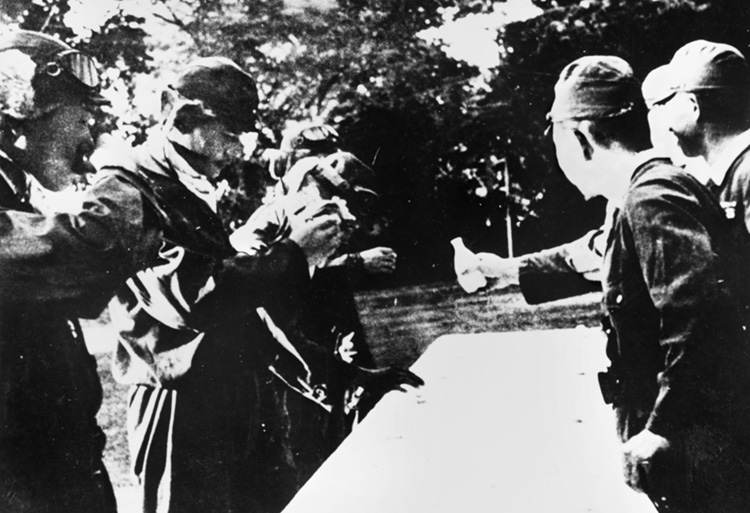
Admiral
Takijiro Ohnishi (right), commander of the Kamikaze Special Attack
Force, dispenses ceremonial cups of sake to suicide pilots about to take
off.
The initial missions had to be aborted:
mechanical failure grounded aircraft, enemy combat air patrols kept the
Japanese grounded, and bad weather prevented takeoff. It wasn’t until
the morning of October 25 that Lieutenant Seki and his group finally
launched their mission.
The Shimpu encountered a support carrier
group known to the Americans as “Taffy 3.” These Americans had already
been attacked by Imperial Japanese Navy surface forces days earlier in
Leyte Gulf. Now, one of the Shimpu group dove out of the sky at the
escort aircraft carrier USS Kitkun Bay (CVE-71).
Sailor Ron
Vaughn, an 18-year-old lookout on Kitkun Bay, spotted the plane as it
climbed, rolled, and plunged down on his ship, aiming for its flight
deck. The ship’s antiaircraft guns opened fire and damaged the plane as
it dove. One round crumpled the tail section, causing it to veer off
course. But the plane hit the water close aboard, damaging the ship and
causing scores of casualties.
Another Shimpu pilot dove on the USS
Kalinin Bay (CVE-68) and hit the deck of the carrier; two others were
driven off by the antiaircraft fire.
American fighter pilots
immediately raced to the scene to defend their home carriers. Despite
their efforts, three more Shimpu planes attacked the escort carrier USS
St. Lo (CVE-63) from above; the first Japanese plane was shot down by
fire from the St. Lo.
The second suffered the same fate, but this
aircraft drew the American’s attention away from the third aircraft,
which was following the ship and simply pulled up, nosed over, and
crashed into the vessel. Witnesses remembered that the plane sliced
through the flight deck, igniting fuel and ammunition in the hanger area
below that deck. One sailor insisted that he saw a bomb drop from the
aircraft an instant before the plane crashed into the ship.
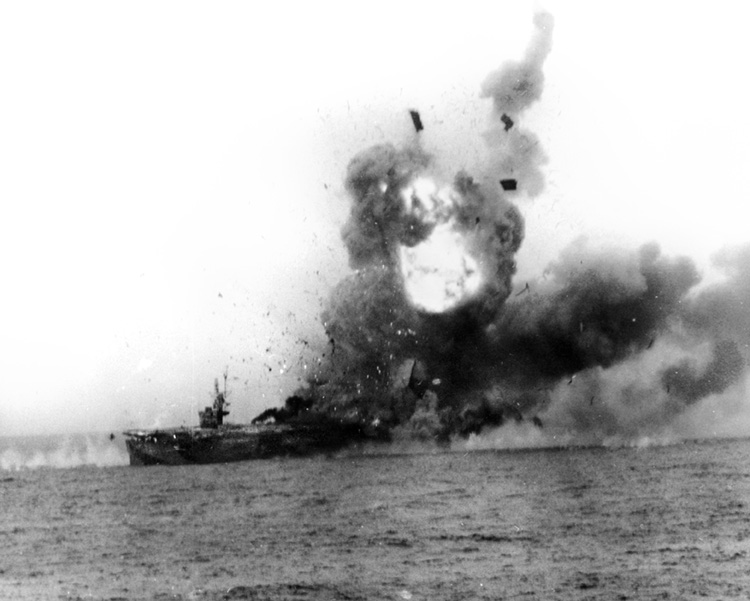
The
impact doomed the St. Lo. Explosions rocked the ship from bow to stern.
Damage-control sailors raced around to save their ship, but it was no
use. Thirty minutes after she was hit, the St. Lo sank. With her went
140 American sailors. She was the first “official” kill of the Kamikaze
attack force.
Admiral Ohnishi committed suicide after Japan’s surrender.
Meanwhile,
the Kalinin Bay was hit again and severely damaged; the USS White
Plains (CVE-66) and USS Kitkun Bay were both narrowly missed. Although
all these three ships were damaged, casualties remained few.
Ashore,
the Japanese awaited the results of the first Kamikaze attack.
Commander Tadashi Nakajima was at his base on Cebu Island when three
Mitsubishi A6M Zero fighter planes landed there. Out of the first to
land came Chief Warrant Officer Hiroyoshi Nishizawa, who ran up to
Commander Nakajima and made his report: Of the five Kamikazes and four
escorts, he reported, Lieutenant Seki had hit a carrier, and a second
Kamikaze hit the same ship, which soon sank. The third Kamikaze struck
another carrier, setting it afire. The fourth plane crashed into a light
cruiser which “sank instantly.” The fifth Kamikaze disappeared. Three
of the four escorts managed to return to Cebu.
The report was a
fiction. In fact, only the USS St. Lo was sunk, with the Kitkun Bay and
White Plains damaged. No light cruiser was struck on October 25. This
report, inaccurate as it was, was forwarded to Tokyo, which accepted it
at face value and broadcast it to the Japanese nation as a great victory
by the newly established Kamikaze Corps.
Believing a great
success had been achieved from a small group of aircraft, the Kamikaze
program continued on October 26. For the expenditure of five Kamikazes
and two escorts, the light carrier USS Suwannee (CVE-27) was slightly
damaged. Earlier, the USS Santee (CVE-29) had been damaged by a Kamikaze
that approached so swiftly that no guns had been able to fire before it
slammed into the ship.
By now, the standard operating procedure
for the launching of Kamikazes had been established. First, they would
await a report from a search plane that would locate, identify, and
report on an American carrier group. Often, these reports were
inaccurate, and a mission would have to be aborted when no ships were
found by the Kamikaze pilots. Each Kamikaze flight had at least two
escorting fighters to assist them in getting past the American combat
air patrols that protected the American carrier battle groups.
Weather
was, of course, always a factor. How many Kamikazes were assigned to
any one mission depended upon the conditions reported by the scouts.
Approaching their targets, the Kamikazes would increase their speed to
make their approaches while the escorting fighters protected them from
the combat air patrol. The signal, “All Planes Attack!” was given by the
flight leader’s raised arm, and each pilot picked his own target, then
plunged down toward it.
The deeds of the “Kamikaze Special Attack
Corps,” one of the names for the new Kamikaze force, had by now reached
Tokyo. Emperor Hirohito had responded to this new tactic with a message
to his naval aviators through Admiral Ohnishi. The message read, “Was it
necessary to go to this extreme? They certainly did a magnificent job.”
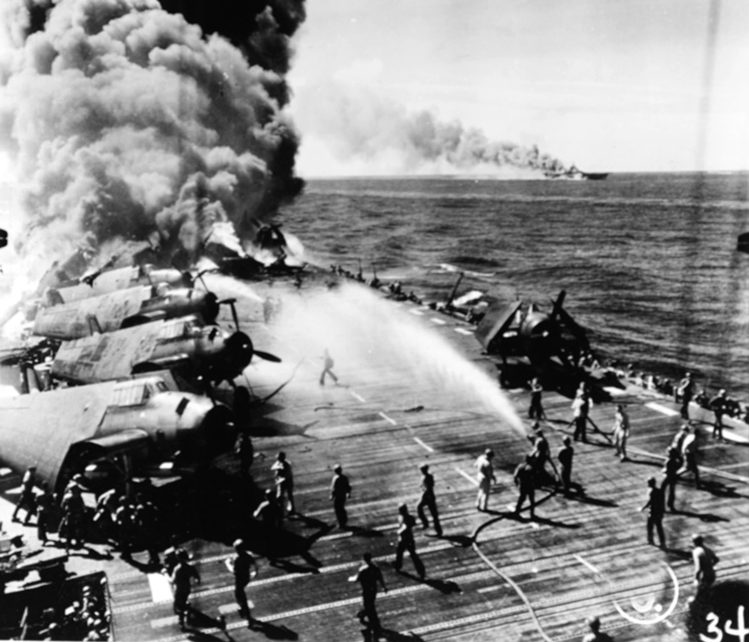
Crewmen
aboard the carrier USS Belleau Wood off the Philippines pour water on
aircraft and burning flight deck after a Kamikaze strike, October 30,
1944. The carrier USS Franklin, also hit by a suicide plane, burns in
the distance.
Captain Inoguchi, who was with
Admiral Ohnishi in Manila, felt that the first sentence of the Emperor’s
words were something of a criticism of Ohnishi’s new project, and
Ohnishi appeared quite upset upon reading this message. But he remained
determined to gain the Emperor’s favor by increasing his success.
Kamikaze
strikes continued against American ships throughout the Philippine
Campaign, including the invasion of Luzon and the clearing of the
southern Philippines.
Meanwhile, the idea spread throughout the
Imperial Japanese Navy and was taken up by the Imperial Japanese Army,
as well. One of the chief reasons for this was the lack of skilled
pilots. At the outbreak of the war, Japanese pilots had been the best of
the best. But over the three years that the war had thus far
progressed, attrition had whittled down those expert pilots to a
precious few, many of whom where now busy training their replacements.
But
the training of new pilots took time and fuel, neither of which the
Japanese had in abundance. A Kamikaze pilot, though, did not need the
in-depth training that a pre-war fighter pilot needed. He only needed to
be able to take off, fly a distance, and crash into an enemy ship. Even
formation flying was optional, although helpful.
As one historian
has written, “Loss of aircraft and veteran pilots and shortages of fuel
led to a reliance on suicidal Kamikaze units by 1944, made up of
largely green, ill-trained aviators and a mélange of planes.”
The
Kamikaze idea had by now spread far and wide among the Japanese
military. Soon Kamikaze Corps were being established in Japan itself.
Those forward bases under attack by the advancing Americans were often
provided with some “Special Attack Units.” Soon this title was expanded
to other suicidal methods of defeating the enemy.
One such method
was known as the “Kaiten”—a manned suicide torpedo that was intended to
sneak into American-held harbors and sink enemy ships at anchor. Then
came the “Ohka” (Cherry Blossom)—a human-piloted bomb released from a
carrying aircraft over the target and flown into that target by the
pilot.
The
first major warship sunk by the Kamikazes was the carrier USS St. Lo,
which was hit off Samar in Leyte Gulf, October 25, 1944. One hundred
forty Americans died.
There were also suicide
explosive speedboats (“Shin’yo” or Sea Quake)—small plywood craft filled
with explosives and driven by a crew of one or two into enemy ships as
they approached the shore of a Japanese base. Hundreds of these were
later captured unused in the Philippines and Okinawa.
At the war’s
end, near Okinawa, even the Imperial Japanese Navy’s super-battleship,
the IJN Yamato, was turned into a form of Kamikaze. (See WWII Quarterly,
Spring 2020.) But none of these other efforts achieved either the fame
or the success of the Imperial Japanese Navy’s “Kamikaze Special Attack
Corps.”
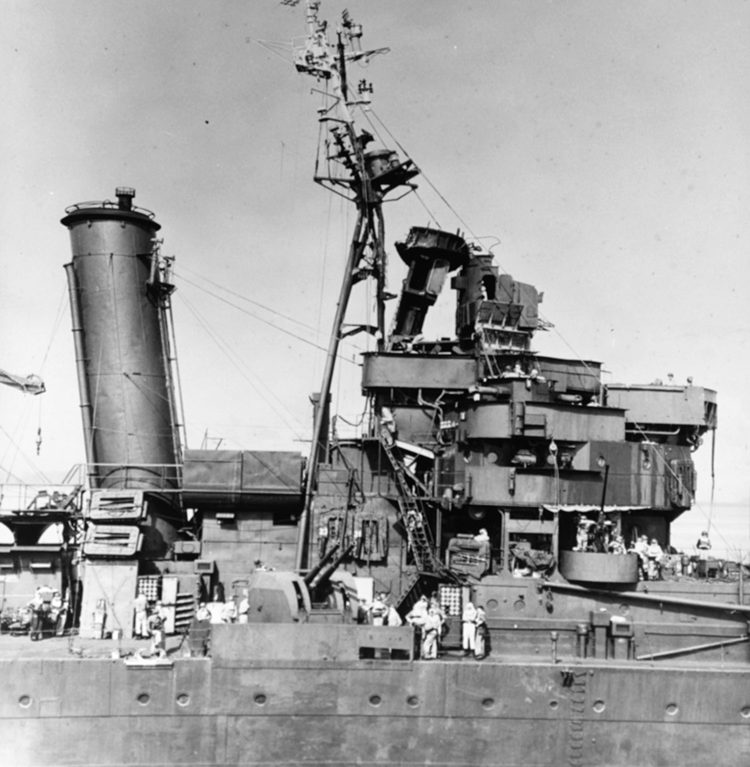
Some ships just seemed to draw the attention of the
Kamikazes. One such ship was the Australian heavy cruiser HMAS
Australia. Perhaps because her appearance different from that of
American ships, she was hit repeatedly, although her near-identical
sister ship, HMAS Shropshire, who often sailed alongside her, was never
hit. Some called her “the Kamikaze Magnet.”
HMAS Australia had
been in the war since the early days of 1939 and had earned herself an
enviable battle record. But she just couldn’t seem to shake the
Kamikazes. She was first targeted in Leyte Gulf on October 21, 1944,
leading some Australians to claim that she was the first victim of the
Kamikazes, and not the USS St. Lo.
That day, the attacking
aircraft was seen to be hit by antiaircraft fire and almost crashed into
the water. But the plane recovered, and despite further heavy
antiaircraft fire, punched into the port side of the heavy cruiser. This
sounds more like a “body-crashing” (Taiatari) tactic than a Kamikaze
attack, but the strike cost the ship her captain, Captain Emile F. V.
Dechaineux, along with five officers and 23 enlisted sailors. Scores of
others were wounded.
The ship returned to the war after repairs in
November, well after the Kamikaze had begun in earnest. In early
January 1945, the HMAS Australia was attacked no less than five times by
Kamikazes. On January 5, she was struck by a Zero, which hit her
amidships; 25 men on the gun crews died and another 30 were wounded.
Damage was slight, and she remained on station with a gunfire support
group off Leyte.
The next day she was hit again, at the middle
smokestack on the starboard side, killing 14 and wounding 26. Damage was
minimal, and she remained on station. January 7 was a quiet day, but
January 8 was not.
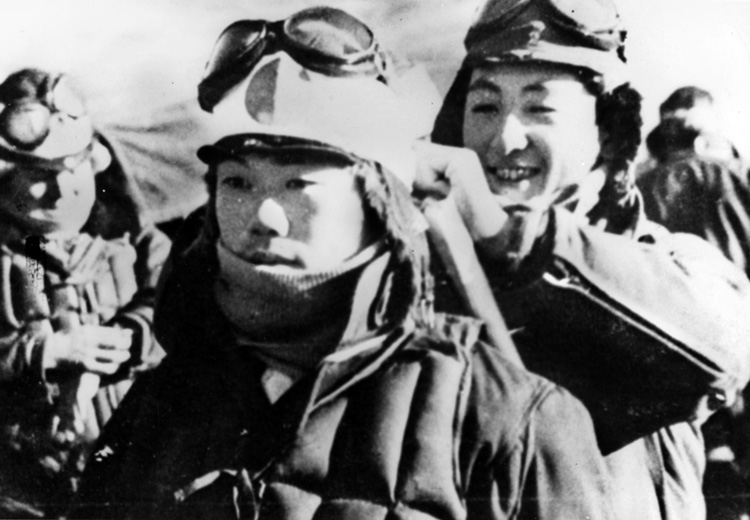
A
solemn Kamikaze pilot has his hachimaki headband, symbolizing manly
courage, attached by a smiling comrade. Ancient Samuri warriors wore a
folded white cloth when going into battle to keep their long hair and
sweat out of their eyes.
A Japanese bomber came
in, chased by four fighters of the combat air patrol. The enemy went
down barely 20 meters off the HMAS Australia’s port side. It skidded
into the cruiser’s hull, but caused no damage or casualties. Less than
20 minutes later, another Japanese bomber appeared and repeated the same
events. But this time, the bomb that the plane was carrying went off
and ripped a large hole in the cruiser’s port side, flooding two
compartments. Once again, there were no casualties. Asked if he wanted
to withdraw for repairs, Captain J.M. Armstrong refused and remained on
station.
By January 9, the Sixth U S. Army was wading ashore on
the main Philippine Island of Luzon, and HMAS Australia was offshore in
support. Eight Kamikazes came in searching for the invasion fleet, and
two headed for the Australia. One of these hit the USS Mississippi
(BB-41) and the other hit the Australia at her foremast, crushing her
forward smokestack and rendering the forward fire room inoperable. With a
hole in her side, her forward fire room out of action, and her speed
reduced, the Australia had had enough. This time she accepted the offer
to retire for repairs, once again with no additional casualties.
Kamikazes
appeared in almost every battle after Leyte. But by far their most
successful and deadly campaign came against the American invasion of
Okinawa. Here, Marines and the soldiers of the Tenth U. S. Army faced a
determined defense, one of whose primary objectives was to draw the
American fleet into a position that would make it vulnerable for attacks
from nearby Japan.
One of the negative by-products of rushing
pilots through an abbreviated training program to qualify them as
Kamikazes was that they had poor ship identification skills. This error
was felt most by the “small boys”—the auxiliary ships that often
accompanied the major fleet units to supply, fuel, and otherwise provide
succor to them when needed.
These included some described by
their titles, including LCS(L)3, or Landing Craft Support (Large) Mark
3. Developed from the original Landing Craft Infantry, or LCI, some had
been modified with rockets, machine guns, 20mm and 40mm guns, and other
assorted armament which, to the untrained Japanese pilot desperately
trying to find a target while avoiding the combat air patrol and
antiaircraft fire, were often mistaken for combat vessels such as
destroyers and even cruisers. As a result, these flat-bottomed,
diesel-powered, 160-foot-long ships often became the targets these
Japanese pilots were seeking.
The U.S. Navy’s Fifth Fleet, under
Admiral Raymond Spruance, was the largest in the world (535 warships),
but its position at Okinawa was exposed. It was committed to the island
for all manner of support and supply duties, which made its ships
stationary targets for the Japanese, who no longer had to guess where
the American fleet could be found.
To protect the fleet, the
Americans had established a series of “radar picket” posts around the
island to give early warning of the Japanese approach. Instead, these
soon presented to the Japanese aviators’ lonely targets, ripe for
attack. The radar-picket destroyers and destroyer escorts were supported
by various “little boys,” which were known at these posts as “pall
bearers,” since they spent so much time picking up survivors out of the
water, making them an inviting target for the Japanese.
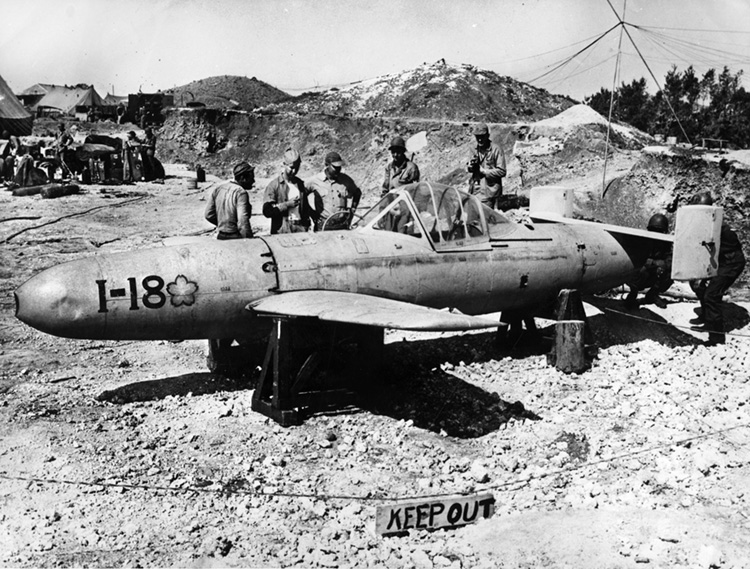
Marines examine a captured Yokosuka MXY-7 Ohka rocket-propelled suicide flying bomb found at the Yontan airfield.
The
Japanese reaction began slowly. On March 20, 1945, the Japanese
Imperial General Headquarters came up with a major offensive involving
Kamikaze pilots called Ten-Goō(“Heavenly Operation”). Tasked with
leading this operation was Vice Adm. Matome Ugaki, commander of the IJN
Fifth Air Fleet.
After gathering every flyable plane he could
find, no matter its obsolescence or original purpose, Ugaki assembled
3,000 of them at bases across Kyushu. The plan, dubbed Operation
Kikusui, was simple: guided by the few experienced pilots Japan had
left, the suicide pilots would be sent out in waves to find the American
ships and destroy them. The veteran pilots would then return to their
bases to pick up another group and repeat the process.
On April 6,
1945, the Japanese struck in force with Kikusui No. 1 against the U.S.
Navy’s Task Force 58 and the British Royal Navy’s Task Force 57, the
latter operating between Formosa and Okinawa. Some 700 planes—half of
them suicide planes—took off and went hunting for the Allied fleets.
The
first to be attacked at Okinawa were the destroyers USS Bush (DD-529)
at picket station number 1, the Colhoun (DD-801) at picket station
number 2, and the Cassin Young (DD-793) at picket station number 3.
Although the three destroyers put up a deadly screen of antiaircraft
fire, enough enemy planes got through to sink both the Bush and Colhoun;
the Cassin Young barely escaped the same fate—for now.
Elsewhere,
the destroyers USS Howorth (DD-592) and Hyman (DD-732) were severely
damaged, while the destroyers USS Leutze (DD-481) and Morris (DD-417)
were knocked out of the war. Destroyer USS Mullany (DD-528) was so badly
damaged that she had to be scrapped. Destroyer USS Newcomb (DD-586) was
also sent home for good, as was the USS Rodman (DD-456).
The list
of sunken ships included LST-447 and support ships Logan Victory and
Hobbs Victory. The minesweeper USS Defense (AM-317) went down as well.
The USS Haynsworth (DD-700) was damaged, as was the USS Feiberling
(DE-640). And this was only one day’s success for the Kamikazes.
The
suicide pilots also tried attacking two American carriers, the
Bennington (CV-20) and Belleau Wood (CV-24), but both ships escaped with
minimal damage.
Both sides suffered badly during Kikusui No. 1.
The Japanese had hit 17 American ships, sunk or knocked 11 out of the
war, and killed over 360 sailors. The Japanese, in turn, had lost over
350 planes and pilots—planes and pilots that could not be replaced.
The
Australian heavy cruiser HMAS Australia, showing damage incurred on
October 21, 1944, was struck so many times by suicide pilots that she
earned the nickname “the Kamikaze magnet.” She was never sunk, however.
The
next day the massive battleship IJN Yamato steamed toward Okinawa and
her doom at the hands of the American pilots from Task Force 58.
The
loss of Yamato did not stop the Japanese from continuing their suicide
attacks on the Allied fleets. After suspending operations for a few days
due to bad weather, on April 11, Kikusui No. 2 was launched—a two-day
assault by 185 suicide planes accompanied by 150 escorts. The carrier
USS Enterprise (CV-6) was the first to feel the enemy’s sting, which
knocked it out of action for two days while repairs were made. The
carrier Essex (CV-9), too, was hit but not sunk.
On April 12,
another dozen ships were hit, with the destroyer USS Mannert L. Abele
(DD-733) and LCS(L)-33 going down. On that same day, the Cassin Young
was in the middle of the fight for her life, as she was targeted during a
heavy Kamikaze raid. Her gunners shot down five aircraft, but a sixth
crashed into her foremast, exploding in midair only 50 feet above the
ship.
Surprisingly, only one man was killed, but 58 were wounded,
many seriously. Although badly damaged, Cassin Young made it to Keramo
Retto under her own power and would return to Okinawa in May after
repairs. She would be attacked again in July, suffering major damage and
loss of life, but she refused to be sunk. (The ship is today on display
at the Charleston Navy Yard in Boston, Massachusetts.)
Each day,
one or more ships were being hit and disabled, if not sunk. The radar
picket posts were the most vulnerable, set far from other support and
usually exposed to the incoming enemy air raids before anyone else. The
raids went on daily throughout April, May, and June, and ship after ship
was lost to the incessant aerial attacks.
CinCPac Admiral Chester
W. Nimitz grew increasingly concerned and pushed Lt. Gen. Simon B.
Buckner, commanding the Tenth U. S. Army, to move quickly to clear
Okinawa of enemy resistance so that he could withdraw his ships from
Japanese target practice. But the Japanese ashore were as determined as
those in the air, and the battle continued well into June.
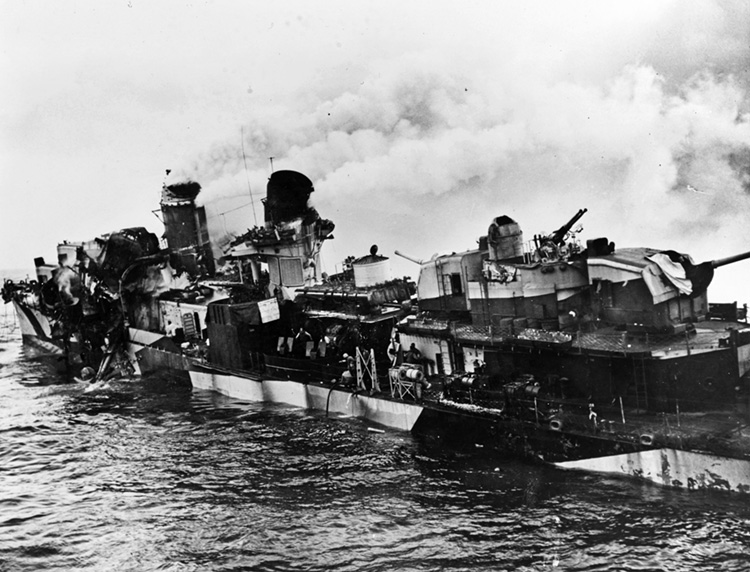
One the
worst attacks by the Kamikazes was that suffered by the USS Laffey
(DD-724), stationed at radar picket post number 1 on April 16. The first
USS Laffey had been sunk during the naval battles for Guadalcanal. The
current USS Laffey, laid down in 1942, had already established herself
as a worthy successor to her namesake and had participated in the naval
support during the landings in Normandy. On April 16, 1945, she would
prove her worth once again.
Soon after dawn, 50 enemy planes were
closing in on the fleet, and Laffey’s radar picked up four enemy planes
approaching her. Three were shot down by Laffey’s antiaircraft fire, and
the fourth was shot down by the guns on board Lieutenant Howell
Chickering’s nearby LCS(L)-51. Carrier-borne Corsairs were slicing
through the enemy formation, downing as many planes as they could.
The
destroyer USS Hazelwood smoulders after being hit by a Kamikaze
attacker off Okinawa, April 29, 1945. Ten officers and 67 men were
killed, including the commanding officer; 36 were missing, presumed
dead.
A fifth plane attacked Laffey, only to be
shot down as well. Then a sixth streaked in, strafing the ship as it
approached. Several casualties resulted from the strafing before this
plane crashed into the ship at the after funnel, jamming the
fire-control radar.
A seventh aircraft smashed into the forward
gun mount and then ricocheted off the ship, leaving no serious damage.
An eighth plane was shot down as it attacked. But a ninth Zero used that
attack to approach undetected and crashed into the starboard 20mm
battery, damaging nearby 40mm batteries, starting a gasoline fire, and
setting off the ammunition.
Almost immediately, a tenth plane hit
the ship’s fantail, knocked out the aft 5-inch gun, and damaged three
20mm antiaircraft guns there. Plane number 11 dropped its bomb first
near the depth-charge rails before crashing into the aft 5-inch gun
mount, already damaged by a previous plane.
Plane number 12
dropped its bomb close aboard, jamming the rudder to a hard-left
position. The Laffey now had no operable guns in the rear of the ship.
The captain, Lt. Cmdr. Frederick J. Becton, now had a ship on fire and
with no guns protecting her stern. The Japanese quickly took advantage
of this weakness, and two more planes came in from astern, crashing
again into the 5-inch mount number 53 and killing several of the crew
who were fighting fires there.
Plane number 15 was shot out of the
sky as it approached from the port quarter. A pursuing combat air
patrol Corsair was so close on his heels that he hit the ship’s mast and
ditched nearby. But this attack knocked out the ship’s radar.
Plane
number 16 was next in line and was shot down over the ship by the
combat air patrol, but not before its bomb shredded the ship’s bow with
shrapnel, knocking out power to 5-inch mount 52, which continued to
operate manually.
Plane number 17 was shot down, and plane number
18 was disintegrated by a shell from mount 52. Plane number 19 was also
shot down, by mount number 51. A twentieth plane came in through the
smoke off the Laffey and dropped its bomb on mount number 53 before
breaking off the ship’s yardarm. It was then splashed by the combat air
patrol.
A
suicide pilot homes in on the carrier USS Enterprise during the battle
for Okinawa, May 14, 1945. The pilot destroyed Big E’s forward elevator,
killed 14, injured 32.
Plane number 21 also
dropped its bomb, knocking out two 20mm antiaircraft mounts before being
shot down by the combat air patrol. A final attacker was also taken out
by the combat air patrol.
The USS Laffey was miraculously still
afloat but in serious trouble. It was down at the stern, the rudder was
jammed, and most of its guns were disabled. Fortunately, the hull and
engines had not been damaged. She had been hit by six Kamikazes, damaged
by two other near misses, struck by three bombs, and had other close
calls. She lost 31 killed and 72 wounded, but the fires were soon under
control and the flooding stopped. She was towed to a repair base off
Okinawa and, after service during the Korean War, would eventually end
up as a memorial at Patriot’s Point, Charleston, South Carolina. Both
LCS(L)s supporting her also survived, although with significant
casualties.
But, like a swarm of angry wasps, the Kamikazes kept
coming. As the battle progressed, their attacks and numbers began to
thin out. Since Okinawa was lost and the next invasion would no doubt be
at Japan itself, the Japanese decided to hoard their remaining Kamikaze
planes and pilots for the final battle.
One of the greatest
tragedies to befall the American fleet was that of the carrier USS
Bunker Hill (CV-17), the flagship of Vice Adm. Marc A. Mitscher’s Task
Force 58. On May 11, the carrier was on station 76 miles east of Okinawa
when a Japanese “Zeke” fighter suddenly appeared out of the cloud
cover.
Having just been refueled with nearly two million gallons
of high-octane aviation fuel, the Bunker Hill was a floating Molotov
cocktail waiting for a spark. The Zeke crashed into the flight deck,
which was brimming with 30 planes waiting to take off; in the hangar
deck below were 48 more that had been fueled and armed.
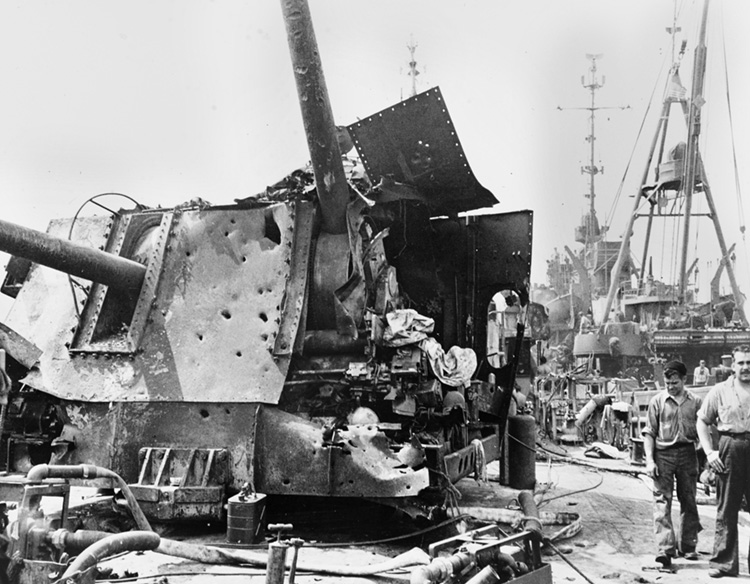
The
shattered 3.5” gun mount aboard the USS Laffey. The ship was attacked
by 22 Japanese planes on April 16, 1945, and struck by four bombs and
five suicide planes. Thirty-one sailors were killed, 72 wounded.
While
the planes on deck exploded and burned, another Kamikaze dashed in and
slammed into the ship’s control center, known as “the island.” Crewmen
sprang into action in a valiant, but ultimately futile, effort to
contain the blaze. Other ships pulled alongside to aid in the effort but
they, too, stood no chance against the roaring inferno.
In the
end, 346 officers and men out of the ship’s complement of 3,000 lost
their lives, 43 were missing, and another 264 were injured. The charred
wreck of the carrier managed to return for repairs to Bremerton,
Washington, via Pearl Harbor, but it would never fight again.
At
the end of the war, the Japanese themselves compiled a recapitulation of
the record of the “Kamikaze Special Attack Corps.” They recorded that,
of the 2,314 planes dispatched (including escorts), 1,086 returned. For
the 1,228 planes “expended,” they claimed 81 ships sunk and 195 damaged,
for a total of 276 ships.
Postwar records indicate that the
correct figures are 34 ships sunk, including three light carriers and 13
destroyers. Of the 195 ships the Japanese claimed as damaged, they had
actually damaged 288 ships, including 16 fleet aircraft carriers, three
light carriers, and 17 escort carriers. It should be noted that several
ships, like the HMAS Australia and USS Laffey, were hit repeatedly but
not sunk. So, the Japanese claim of a total of 276 enemy ships sunk or
damaged by Kamikazes is understated. In fact, they hit 322 allied ships,
sinking 34. It was not the “Divine Wind” of 1281, but it was a
respectable effort, nevertheless.
But, despite all her efforts to
halt the American invasion of Okinawa, Japan had shot her bolt. Once
Okinawa fell, she had very little chance of preventing a full-scale
invasion of the Home Islands.
As the intelligence officer of the Fifth Fleet put it, “The Japanese are defeated, but we have not yet won the victory.” The Kamakaze and the resistance on Iwo Jima and Okinawa with the suicides of the civilians jumping to their death sealed the fate of the Japanese, and the casualties that the Americans suffered prompted President Truman to use the Atomic Bombs to force a surrender.
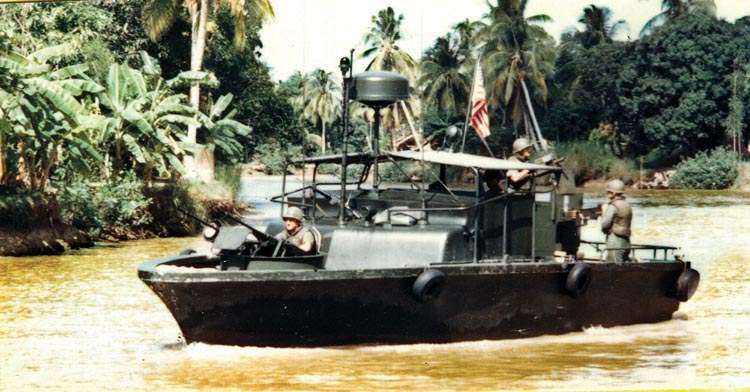
I remembered seeing a PBR at Patriots Point when my son was in the cub scouts, the entire place is worth the visit and the time. Especially when the scouts can stay overnight on the U.S.S. Yorktown. granted it was in Enlisted quarters with the steel decks but still it ranked up there in the "cool" factor. I remember seeing a PBR on the TV for the first time in the Movie "Apocalypse Now" when Martin Sheen character rode in one to go kill the rogue colonel. I had remembered asking my Dad if he had rode in one of those in the course of his duties and he had commented that he did as part of his duties with the "Tropic Lightning"during his first tour. All he said was "it was interesting".
The U.S. Navy deployed a variety of small boats to South Vietnam during the Vietnam War,
but perhaps the best known of these is the river patrol boat. The
“patrol boat: riverine,” or Navy PBR, was the first watercraft built for
the so-called brown water navy in Vietnam. During the height of the
conflict, Navy personnel scouted the rivers and canals of the sprawling
Mekong Delta for communist guerrilla forces, arms, and ammunition. In
addition to patrolling, Navy PBRs participated with Navy and Army troops
in hit-and-run raids, reconnaissance patrols, and day and night
ambushes.
The origins of the
Navy PBR can be traced to Hatteras Yacht Company of New Bern, North
Carolina, which in 1965 responded to a U.S. Navy request for a prototype
for a small patrol boat to operate in shallow waters. The Navy’s Bureau
of Ships sought a prototype for what it designated as “patrol boat,
river” that could achieve speeds between 25 to 30 knots, draw only nine
inches of water, and skim over sandbars. The boat would be crewed by
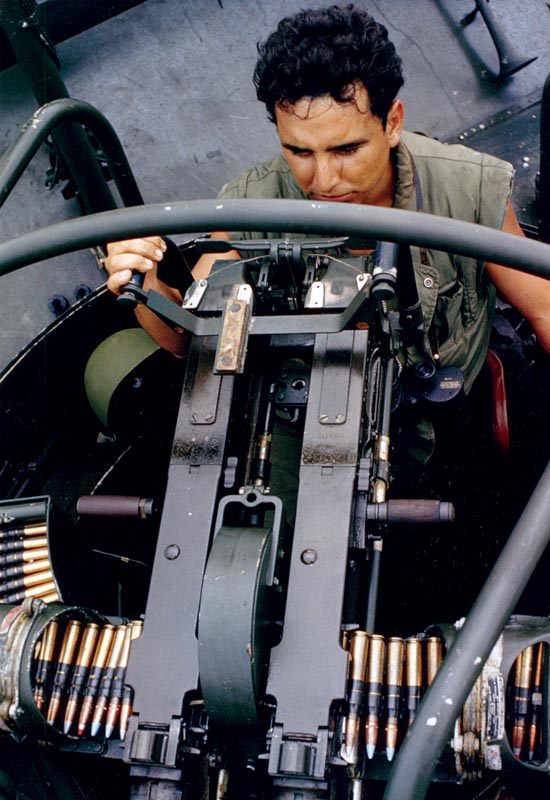
four sailors and have heavy armament. Its armament would consist of a
twin .50-caliber machine gun in an armored forward turret, as well as a
.30-caliber mounted gun in the aft section. Additionally, the boat would
need to be able to reverse direction, turn on a dime, and come to a
quick stop from full speed within a few boat lengths.
Hatteras
stated its intention to build a 28-foot fiberglass hull powered by
water-jet pumps as opposed to screw propellers. The water pumps would
enable the new boat to go into shallow water. The Navy put the PBR
contract out for bid, and eight companies responded with bids. United
Boat Builders of Bellingham, Washington, ultimately won the contract.
The company built the PBR around its existing 31-foot fiberglass hull.
This boat became PBR Mark I. The Navy initially requested 120 PBRs.
Eighty of the Navy PBRs were assigned to the Mekong Delta and 40 to the
Rung Sat Special Zone south of Saigon
The
dark-green Mark I was powered by twin General Motors 220-horsepower
diesel engines and water jet pumps supplied by Jacuzzi Brothers. The jet
pumps shot out streams of water from nozzles located below the
waterline on the stern. The jets of water had sufficient thrust to
propel the boat. Steering was accomplished by rotating the nozzles left
or right. For stern propulsion, a so-called u-gate slipped down over the
nozzles and rerouted the flow 180 degrees, which propelled the boat
backward. When fully loaded, the boat topped out at 14,600 pounds and
could reach a speed of 25.7 knots.
The builder installed ceramic
armor designed to deflect bullets up to .30 caliber around the
coxswain’s flat and at the weapons stations. The boat’s heaviest weapon,
the twin .50 caliber, was installed in an open turret in the bow. In
the fantail area, a single machine gun was affixed to a pedestal.
Amidships on both sides of the boat were open-ended receptacles to which
could be mounted either an M-60 machine gun
or an MK-18 grenade launcher. A similar receptacle built into the aft
machine mount allowed an MK-18 to be piggybacked with the stern machine
gun.
In addition to the mounted machine guns, the crew also took along M16 rifles,
M-79 grenade launchers, handguns, and hand grenades. The boat came
equipped with a Raytheon 1900/N radar system and two AN/VRC046 FM
radios.
Crewman
aboard a fiberglass-hulled Mark II River Patrol Boat watch closely for
enemy activity during a mission in the Mekong Delta. Navy PBRs worked
together with helicopters and ground units to interdict the flow of
enemy troops and supplies on rivers and canals.
The
hull could be repaired quickly and easily. It was designed so that
enemy rounds would pass through it without exploding. There was no solid
surface that would cause detonation.
The
Navy PBR Mark I was not immune to problems. When fully loaded, the Mark
I drew 22.5 inches of water, which greatly exceeded the nine inches
originally requested. Added to that, the Mark I never attained the
desired speed of 25 knots. This was because the jet pumps put a heavy
strain on the boat’s diesel engines. Added to this, Styrofoam blocks
that kept the boat high in the water frequently became waterlogged as a
result of seepage through the hull.
The four-man crew for the Navy
PBR included a first-class petty officer who served as the boat’s
captain. Owing to battle casualties and other reasons, both chiefs and
second-class petty officers also captained the boats. The other crew
members were an engineman, a gunner’s mate, and a seaman.
Large
numbers of communist forces operated in the Mekong Delta region, not
only because it contained half of South Vietnam’s population and was
responsible for half of the country’s rice production, but also because
of its close proximity to Saigon. The communists routinely transported
men and supplies through its 3,000 miles of waterways. As they did so,
the communists actively recruited in the region and extorted funds from
the local people to finance their operations. Communist forces carried
out an estimated 1,000 small-scale attacks each month in 1966 on
government posts and villages in the Mekong Delta.
A
sailor mans his twin air-cooled, belt-fed .50 caliber machine gun mount
while patrolling for Viet Cong activity. The weapon was positioned in
an armored forward turret.
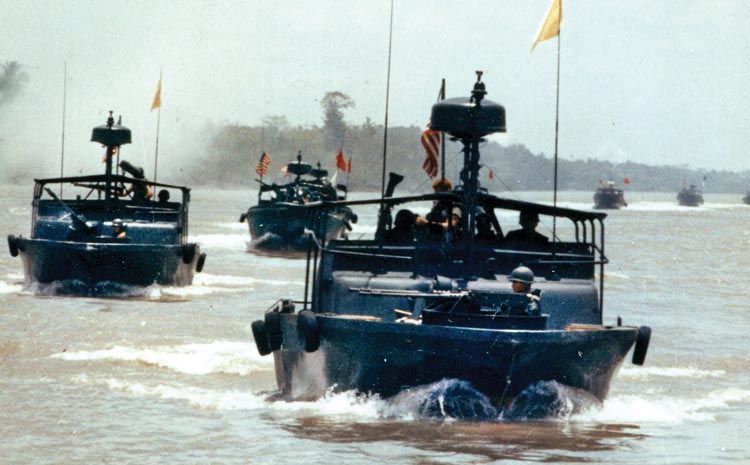
One
of the fundamental tactics developed for the Navy PBRs was to operate
in pairs while conducting patrols. The two boats would travel in a
column, with the trailing boat following 400 to 600 yards behind the
lead boat. This way the two boats were close enough to cover each other.
The crews conducted patrols and searches during the day and at night.
When searching a vessel at night, the boat conducting the search
approached the suspect craft at high speed, illuminated the vessel, and
ordered all occupants to show themselves on the near side of the
watercraft.
The PBRs sought to stay in the middle of the channel
to maintain as much distance between the boat and shore as possible in
case enemy forces were lurking in the foliage. During a search, the crew
of the PBR kept a .50-caliber machine gun trained on the shore opposite
the vessel being searched in case it was fired upon from behind.
The
U.S. Navy launched Operation Game Warden on December 18, 1965, and
established a River Patrol Force in South Vietnam to maintain military
curfews and implement the interdiction program in both the Mekong Delta
and Rung Sat Special Zone. As part of the program, PBR crews routinely
stopped and searched suspect sampans to see if they were transporting
guerrilla troops or smuggling military provisions for communist forces.
The
River Patrol Force, also known as Task Force 116, was composed of a
number of river divisions. Each division had two 10-boat sections. The
River Patrol Force operated from LSTs (landing ships, tank) that served
as floating bases complete with troop quarters. The PBRs served as the
core watercraft for these riverine divisions. The first batch of Navy
PBRs arrived in country in March 1966 during the continuing buildup of
U.S. forces in South Vietnam.
A
flotilla of Navy PBRs fires on enemy positions during Operation Bold
Dragon III in March 1969. PBRs were capable of delivering Navy SEAL
teams and other ground troops to remote locations in the Mekong Delta.
To
furnish close air support for the PBRs in the delta, the Navy activated
Helicopter Attack Squadron 3 at Vung Tau. In addition, Navy SEAL
platoons operated with the River Patrol Force, giving it the ability to
conduct clandestine intelligence operations.
Navy PBR crews
routinely used tape recorders and loudspeakers to announce curfew hours
and issue instructions to Viet Cong who might wish to defect. They also
performed humanitarian missions, such as transporting medical personnel
to isolated villages and wounded villagers to field hospitals.
After
their initial experience using their new watercraft, PBR crews made
some key improvements to the weapons systems on the boats. First and
foremost, they replaced the .30-caliber machine gun aft with a
.50-caliber to reduce the necessity of having to carry two different
types of ammunition. They also added an M-18 grenade launcher and
stripped most of the armor from the forward machine-gun position to
improve the gunner’s field of vision.
A joint service Mobile
Riverine Force began operating in June 1967. The principal
organizational elements of the force were Navy Task Force 117 and the
U.S. Army’s Ninth Infantry Division’s Riverine Forces. The riverine
force was capable of deploying 150 miles from its base within 24 hours.
It possessed a 5,000-man combat force that could engage the enemy
immediately upon arrival at its destination. The riverine force’s
initial anchorage was at Vung Tau on the coast southeast of Saigon, but
it eventually moved to Dong Tam in the upper Mekong Delta.
The
advent of the Mobile Riverine Force in the delta marked a shift in the
balance of power in the region, with the allies gaining superiority over
the communists. The Riverine Force fought five major actions during
1967, in which it killed 1,000 communist troops. The enemy frequently
fought in battalion strength in the larger of these engagements. In
addition to small arms, they used a variety of heavy weapons, including
machine guns, rocket launchers, and recoilless rifles.
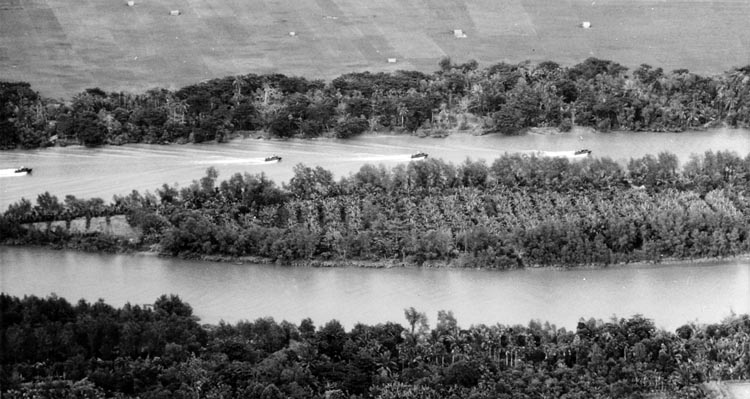
Navy
PBR boats cruise past Tan Dinh Island, trying to draw fire from enemy
fortifications along the river bank. Once the boat crews had pinpointed
the enemy positions, helicopter gunships would attack the strongpoints
from overhead.
The Mobile Riverine Force
conducted a series of major combat operations, including Coronado I
through XI from 1967-1968, Giant Slingshot from 1968-1969, and Sealords
from 1968-1971. The purpose of these operations was to isolate and
destroy Viet Cong and North Vietnamese units and dismantle their
infrastructure in the Mekong Delta and the Capital Military District.
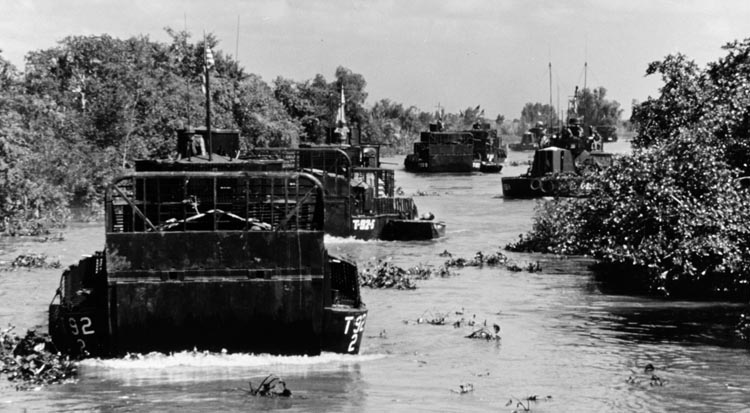
Armored
PBRs of the Mobile Riverine Force on a mission in the Mekong Delta in
1967. A 5,000-man rapid-reaction force was established that year to deal
with large-scale enemy threats.
In
September 1967, the River Patrol Force obtained a new, completely
modified Navy PBR, the Mark II. The new model had larger, improved water
jet pumps made from a metal less prone to corrosion. Additionally, the
boats boasted a new circuitry system for the forward twin .50-caliber
machine guns. The boat was also capable of much higher speeds than its
predecessor. Not long after the introduction of the Mark II, a new Alfa
model was introduced with even more upgrades. By early 1969 there were
250 river patrol boats in South Vietnam, including 130 Mark II and Mark
II Alfa PBRs, as well as 120 Mark I PBRs.
Communist troops
attacked more than 100 of South Vietnam’s cities and towns on January
31, 1968, during the Vietnamese Lunar New Year holiday known as Tet. The
size and the ferocity of the Tet Offensive put U.S. and South
Vietnamese forces on the defensive.
In the Mekong Delta region,
the communists attacked 64 district capitals. The Tet Offensive resulted
in an uptick in riverine units being used for fire support, troop
transport, and amphibious assault. Up until Tet, PBRs typically called
for naval or aerial assistance and then withdrew until help arrived
before re-engaging the enemy; however, the Navy loosened the rules of
engagement during Tet: If the patrol officer in charge of the PBR
decided his boat could stand and fight, he had the discretion to do so.
Another change in doctrine occurred regarding where the PBRs patrolled.
Before Tet, PBRs generally stayed in the main rivers of the delta
region, but during the communist offensive they began to operate in
canals and other narrow waterways.
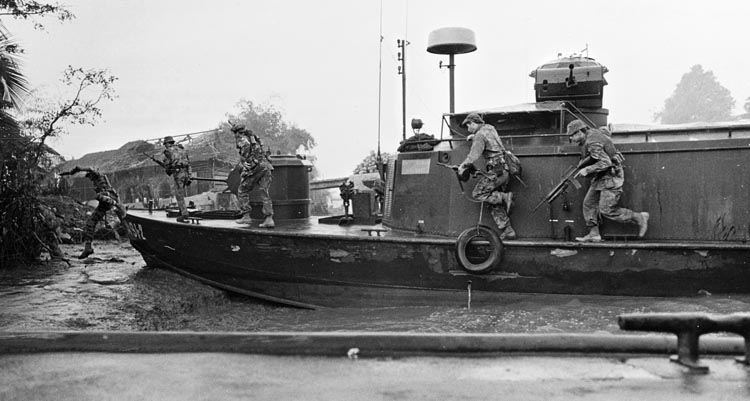
A
SEAL team debarks from a PBR to destroy bunkers and round up Viet Cong
during a raid in Kien Hoa Province. PBRs were powered by water-jet
pumps, as opposed to screw propellers, which enabled them to operate in
extremely shallow water.
The PBRs in the Vietnam
War played a key role in riverine operations and achieved positive
combat results. In the course of their patrols and operations, U.S. Navy
riverine forces killed 3,000 communist soldiers and sank, damaged, or
captured upward of 6,500 boats.
Some key statistics offer insight
into the hazards of PBR service. One of every three PBR sailors was
wounded during his tour of duty. Yet this in no way deterred the
volunteers who clamored to serve aboard the boats. Volunteers for the
PBRs came from all U.S. Navy rates, ratings, and ranks. Furthermore,
morale among the PBR crews remained high throughout the conflict.
For
these reasons, the Navy PBR crews that served during the Vietnam War
were highly respected by sailors and soldiers alike. “We were volunteers
[and] patriots,” said Petty Officer Jere Beery, reflecting on his
service on a PBR. “We were gung-ho as hell. We looked for trouble.”