Webster

The Constitution was made to guard the people against the dangers of good intentions." --American Statesman Daniel Webster (1782-1852)


Showing posts with label Money. Show all posts

Tuesday, December 2, 2025

"Wal-mart Gift Card Scam"


I got this from "MalwareBytes"   when it comes to cyber security, the old adage "There ain't no free Lunch" comes to mind.  Listen to your gut, just because someone says "that it is free"....Is it really?...What is the hook?  The scammers are getting more sophisticated as time goes, and we have to stay on our "A" game to not get fleeced.  for example, I don't use my debit card anymore except at a couple of retailers, everyone else gets the credit card, because of the extra protections the CC gives me and when I get home I pay off the balance.  Debit cards don't give you the same protections..despite the credit card name on the card..and cashapp and zelle, paypal  and the other money transfer services.....none, once the money leaves your account, good luck in getting it back.  so abundant caution.
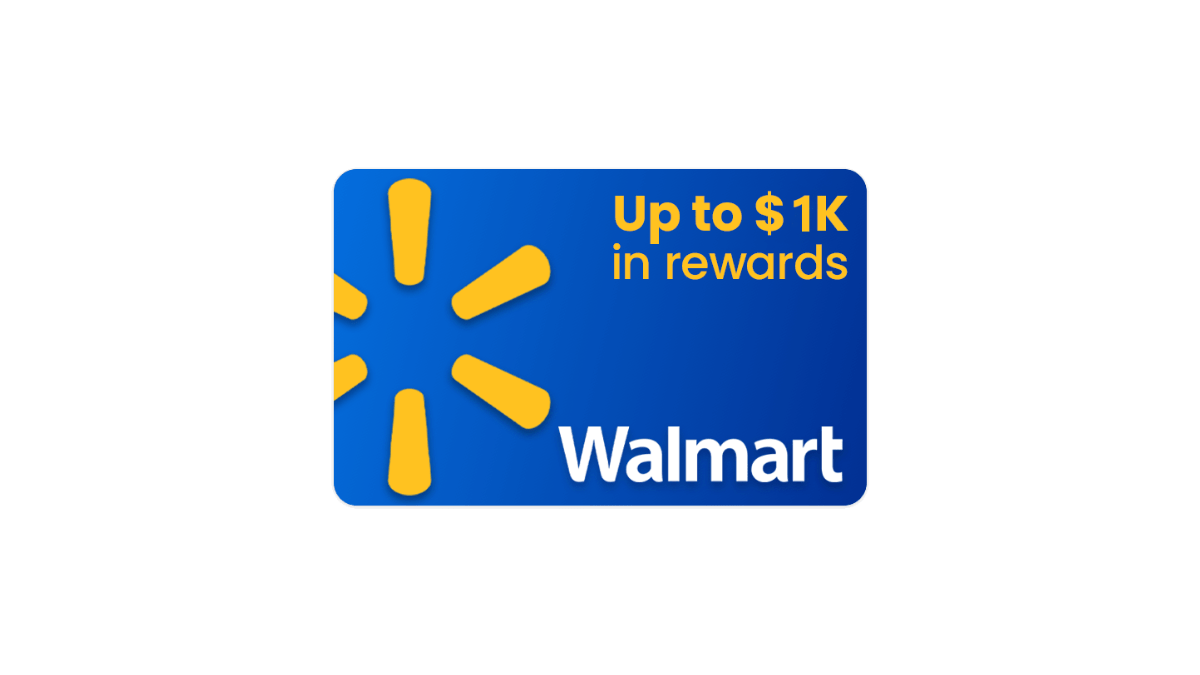
Walmart gift card scam

Watch out for Walmart gift card scams

You’ve probably seen it before—a bright, urgent message claiming you’ve qualified for a $750 or $1000 Walmart gift card. All you have to do is answer a few questions. It looks harmless enough. But once you click, you find yourself in a maze of surveys, redirects, and “partner offers”—without ever actually reaching the end and claiming your prize.

Walmart gift card scam

This so-called “survey” is part of a lead-generation and affiliate marketing scam, designed not to reward you but to harvest your data and push you through ad funnels that make money for others, at the cost of your privacy.

Congrats!

What’s really going on?

It’s a scam because these pages rarely deliver any real gift card. What they’re after is your personal data.

As you move through each step, you’re asked for details like your name, email, phone number, ZIP code and even your home address. In some cases, you’re prompted to share interests such as home repair, debt help, or insurance quotes—each answer helps categorize you for targeted marketing.
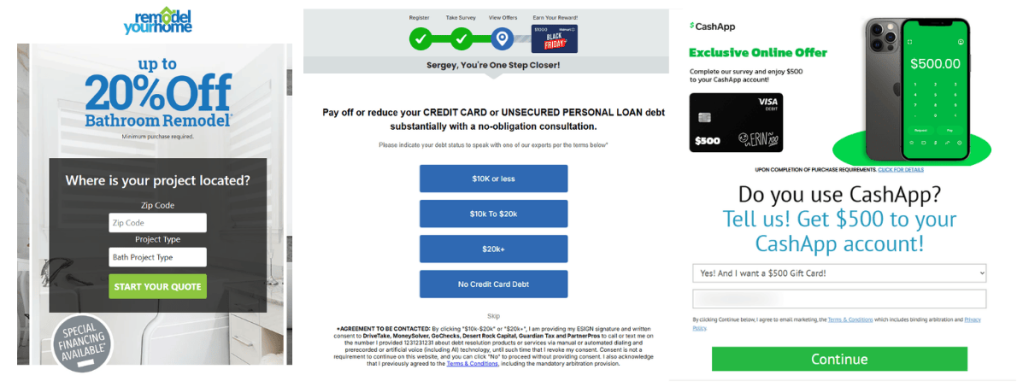
Questions that aim to capture your data

Even if the page itself doesn’t steal money, that information is still valuable. It can be used to target you with more ads and offers, add you to marketing lists, or personalize follow-up contact. In other words, completing the questionnaire hands over data that can be exploited for profit—even when no gift card ever appears.
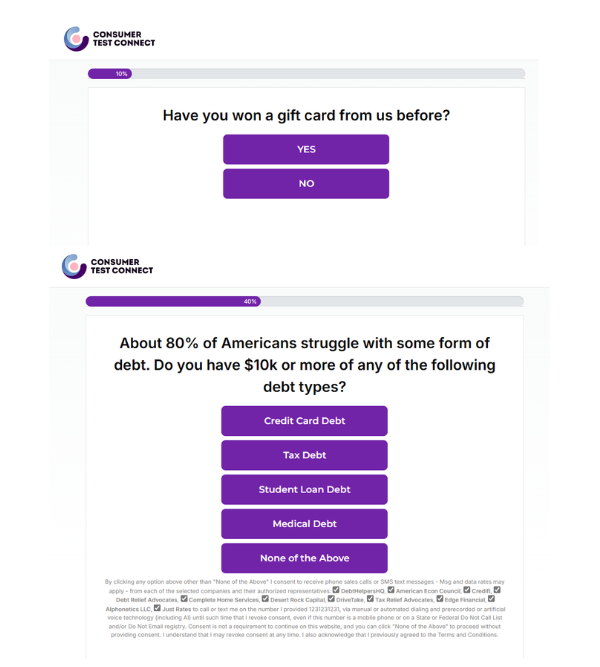
Survey questions from an affiliate

In some cases, the funnel gets even more specific. For example, if the survey asks you about home projects and you say you’re planning to replace your windows, you might be redirected to what looks like a legitimate home improvement site—often just another form asking for the same details again. The whole thing is designed to keep you filling out more forms, giving up more of your data, to more websites and affiliates.


Questions from an affiliate to collect your data
The surveys try to keep you on the site.

These scams aren’t just annoying time-wasters. They are harvesting your data, eroding your privacy and exposing you to wider risks. Once your details are shared, they can travel far beyond that fake survey.

Your information may:

  • Be resold to advertisers and data brokers, who build detailed profiles about your habits, spending, and location.
  • Lead to a surge of spam calls, texts, and phishing emails tailored to your interests.
  • Feed more convincing scams down the line, since criminals can now personalize their lures using real information about you.
  • End up on unregulated marketing lists that circulate for years, keeping your data in play long after you’ve closed the page.

That’s the hidden cost of a “free” gift card: each click fuels a network that profits from your identity, not your participation.

Why do people fall for it?

The hook is simple—free money and easy participation. But this fake Walmart promotion taps into three powerful psychological triggers:

  1. The sense of luck: “You’ve been selected!” sounds personal and special.
  2. The promise of low effort: Answering a few questions feels harmless.
  3. The illusion of credibility: Walmart’s branding lends legitimacy.

It looks easy to claim a gift card.

These scams spread mainly through advertising and malvertising networks—pop-ups, spam emails, social media ads, or sketchy website banners that imitate real promotions.

You might spot them alongside news articles or as “sponsored links” that sound too good to be true. Some appear via push notifications or redirects, whisking you from a real website to a fake reward page in seconds.

The designs often use official logos, countdown timers, and congratulatory language to make them look like authentic brand campaigns—tricking people into lowering their guard.

It’s an easy mental shortcut: “If this was fake, it wouldn’t look so professional.” That’s what these scammers count on—the appearance of legitimacy mixed with urgency and reward.

How to protect yourself

These gift card offers aren’t just harmless internet fluff—they’re the front door to a sprawling network of data collection and affiliate profiteering. Each click, form, and redirect is designed to extract value from your attention and information, not to reward you.

Recognizing these scams early is the best defense. Here’s how to stay safe:

  1. Be suspicious of online surveys promising big rewards. Legitimate promotions from major retailers rarely require long questionnaires or partner offers.
  2. Never give personal information to unknown pages. If a site asks for your phone number or address for a “free prize,” it’s a red flag.
  3. Use browser protection tools. Extensions like Malwarebytes Browser Guard can block known scam domains and malvertising networks before they load.
  4. Check the URL carefully. Real Walmart promotions will always come from official domains (like walmart.com or survey.walmart.com), not random URLs with extra words or numbers.
  5. Stay alert and skeptical. Online quizzes and reward offers are a favorite bait for scammers. When in doubt – close the tab.

We don’t just report on scams—we help detect them

Cybersecurity risks should never spread beyond a headline. If something looks dodgy to you, check if it’s a scam using Malwarebytes Scam Guard, a feature of our mobile protection products. Submit a screenshot, paste suspicious content, or share a text or phone number, and we’ll tell you if it’s a scam or legit. Download Malwarebytes Mobile Security for iOS or Android and try it today!

Thursday, August 7, 2025

"Why A Health Saving Account is an Underrated Wealth Builder"


I have one through my job and I recently found out last year that I could invest the excess money that isn't used in the market.  I wish I had known about this much sooner.  The money I am investing since I will be sixty soon, I can use to when I retire to pay my medicare part B and D out of this money rather than my checking account and since it is a medical expense it is tax free.  When I turn 67 I can withdraw the money out of this without penalty and only pay taxes on any profit, not the principle.  It is a great way to lower your tax liability through the years and spread it out and shield it and let it grow through the magic of "Compounded Interest".  

    No I am not a wealth management, but I did stay at a Holiday Inn Express sometime in my life.

    I shamelessly clipped this from "Art of Manliness"

   P.S.  Still working on the rant, probably will go up this weekend.

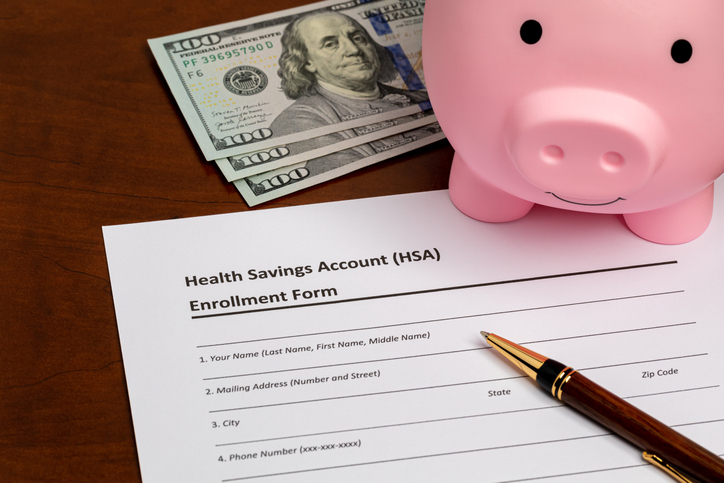
A Health Savings Account enrollment form sits on a desk next to a pen, three $100 bills, and a pink piggy bank—ready to help you build wealth for your six-figure future.


You’re hunched over the kitchen table, flipping through your job’s benefits packet. You see something about a Health Savings Account. Looks like a boring place to stash medical cash. You shrug and skim past.

That could be a big mistake — not marking that little checkbox could cost your future self a six-figure windfall.

If you’re looking for an easy way to maximize your money, allow me to introduce you to a stealth wealth builder: the health savings account or HSA.

I’ve had an HSA since Kate and I first got married. But it wasn’t until fairly recently that I started to realize what an underrated finance tool this thing is.

Today, I’m going to walk you through the benefits of a health savings account and why you might consider opening one up.

HSA Basics

A Health Savings Account is a special kind of savings account designed for medical expenses — but it does a lot more than that. An HSA lets you set aside money tax-free, grow it in the stock market tax-free, and use it for healthcare costs now or decades down the line (yes, tax-free!).

To qualify for an HSA, your health plan needs to have a high deductible — the amount you pay out of pocket before your insurance starts covering costs. As of 2025, the IRS defines a high deductible as at least $1,650 if you’re single or $3,300 for a family. The out-of-pocket max can’t exceed $8,300 or $16,600, respectively.

You can use HSA funds to pay the deductible and any other qualifying medical expenses your insurance doesn’t cover.

You can contribute up to $4,300 a year to your HSA as an individual or $8,550 for a family. If you’re 55 or older, tack on another $1,000. The IRS updates these numbers every year.

HSAs often get confused with FSAs. FSA stands for flexible spending account. FSAs let you set aside pre-tax money from your paycheck to cover qualified out-of-pocket healthcare costs, like copays, prescriptions, and medical supplies. Because the money isn’t taxed, it lowers your taxable income and saves you money. But here’s the catch with FSAs: most FSAs have a “use it or lose it” rule, so you need to spend the funds within the plan year or risk forfeiting what’s left.

This is a big difference between HSAs and FSAs: with HSAs, the money doesn’t vanish if you don’t spend it. It’s yours; it rolls over forever, and you can invest it in the stock market.

Why the HSA Is an Awesome Wealth-Building Tool

The tax savings are huge. The big reason the HSA is such an excellent wealth builder is that it functions like a legal tax shelter.

It offers three big tax benefits:

First, contributions you make to the account are deductible. When you put your money into an HSA, you lower your taxable income. So if you invest $8,550 into your HSA, you reduce your taxable income by $8,550 for the year.

Second, the investments you have in your HSA grow tax-free.

Third, if you use the funds in your HSA for medical expenses, the withdrawals aren’t taxed. So you can pay for braces, doctor appointments, and prescriptions tax-free with money that hasn’t ever been taxed.

All those tax savings really add up and keep money in your pocket where it belongs.

It is possible to use the money in your HSA for non-medical expenses, but that’s not an advisable move, as you’ll have to pay taxes on the amount you used and pay a 20 percent penalty. So, for example, it you withdrew $3,000 from your HSA to pay for a car repair, you’d have to pay income tax on that $3,000 plus an additional $600 (20% penalty). Don’t do that!

The HSA is an inflation-busting healthcare savings builder. An HSA can be a great tool to save on taxes on your immediate healthcare expenses. But where it becomes really powerful is in its ability to help you pay for healthcare expenses decades down the road, when they will likely be higher.

If you’re young and healthy, you probably won’t have to tap into your HSA all that much. This means the money invested in your HSA can take advantage of the power of compounding and grow tax-free for years. This allows you to build an inflation-proof (an HSA can be invested, and investments typically grow faster than inflation) healthcare war chest for the period in your life when medical expenses rise the most: elderhood. Fidelity estimates that a 65-year-old couple will spend $330,000 on medical costs in retirement. That doesn’t even count long-term care. An HSA gives you a way to prep for that monster bill using pre-tax dollars and tax-free market returns.

You can turn an HSA account into a stealth retirement account. An HSA can provide immediate tax savings and help you grow your money for long-term healthcare costs tax-free.

But here’s another cool thing about HSAs: you can turn them into a retirement account when you turn 65.

Once you reach that age, the 20 percent penalty that normally applies to non-medical HSA withdrawals disappears. At that point, you can tap the account for anything — travel, groceries, a new fly rod — and the distribution is simply added to your ordinary income for the year, just like pulling money from a traditional IRA.

The tax-free treatment for qualified medical expenses, however, still applies, so it’s usually smartest to keep using the HSA for healthcare and let other accounts fund your lifestyle. But it should give you some peace of mind knowing that you have another retirement account you can tap into in your golden years.

An HSA is portable and inheritable. You can’t lose your HSA if you change jobs or health insurance plans. It stays with you no matter where life takes you.

When you die, your spouse can take it over tax-free. If it goes to someone else (like a child or grandchild), it’s taxed but not penalized — same as an inherited IRA.

How to Get the Most Out of Your HSA

I hope by now you can see how awesome HSAs are. If it’s an option for you, I definitely recommend opening one up. You can do so through a provider like Fidelity or your employer’s chosen custodian and start contributing funds either directly or through payroll deductions.

Once you’ve got an HSA going, you can get the most out of it as a wealth-building tool by doing the following:

Invest the balance once you’ve cleared the provider’s cash threshold. Most HSAs require you to have a minimum amount in cash. Once you hit that minimum, invest the rest in index funds. This will help your money grow faster.

Do all that you can to leave the money in your HSA alone. That means paying for as many of your medical expenses as you can out-of-pocket. If you’re young and healthy, that likely won’t be too much of an issue. If you or a family member has a chronic health condition, it will be harder. Do what you can based on your situation.

The reason you want to leave the money in your HSA alone is that it allows your money to grow tax-free.

When you do pay for medical expenses out-of-pocket, hold on to those receipts. You can reimburse yourself (tax-free!) from your HSA decades later.

So if you paid $1,000 out-of-pocket for an ER visit in 2025, you can reimburse yourself that $1,000 expense from your HSA tax-free in 2045. During that time, the money in your HSA has been growing tax-free. That $1,000 you would have spent in 2025 from your HSA might be worth $3,000 in 2045 — letting you keep the investment gains and still get reimbursed, effectively turning a medical bill into a wealth-building opportunity.

Hopefully, by now, you can see that an HSA is more than just an account to pay for this year’s doctor’s visits. When used strategically, it’s a long-game wealth builder that saves you in taxes and gives you options down the road.

Wednesday, January 29, 2020

Why You should Still Carry Cash

I shamelessly carry cash, I try not to use plastic.  I spend less if I pay cash vs a card, it helps restrict my spending and I save money.  I shamelessly cribbed this from "Art of Manliness".  I will add a couple comments to the article.


Cash is no longer king.
According to a U.S. Bank survey conducted last year, half of people only carry cash half the time, and among those who do carry cash, nearly 50% carry $20 or less. In another survey done just this year, only 41% of Americans said they regularly carry cash, a number that drops to 34% if you only include Millennials. 16% of respondents had no cash on them at the time they were polled.
The decline of cash is easily traceable. In a world where you can pay and tip your pizza delivery guy and “cabbie” (in the form of an Uber driver) online or from an app, where restaurant and store purchases are easily taken care of by credit or debit card, and peer-to-peer transfer apps like Venmo can be used to split a dinner bill or pay back a friend, many people just don’t see much reason to continue to carry around paper money.
But, there are in fact several good reasons to still keep an ample supply of greenbacks in your wallet, including:
1. To handle/take advantage of emergencies/opportunities that require cash. Even in this digital world, you’d be surprised (and very frustrated if you don’t have any cash) by the number of things that still require concrete cabbage. Roadside stands, super hole-in-the-wall restaurants, and food trucks sometimes only take cash, you need cash as a back-up if you lose your credit or debit card, and other unexpected needs arise all the time.
Here are just a few of the things I needed cash for in the last year:
  • Paying to park in an ad-hoc lot created for a festival
  • Buying fishing bait sold from someone’s house in the middle of nowhere
  • Paying for a campsite at a state park after hours
  • Tipping a valet
  • Paying for a dinner when my debit chip card didn’t work
It’s always good to carry cash both for handling things when they go wrong, and to be able to make sure things go right and certain natural disasters like Hurricanes, the computer system was down and the only thing that would work was "Cash".
2. To pay and tip service providers more generously. Sure, even small-time restaurant owners, service providers (including barbers), and store proprietors typically provide a traditional credit card machine or offer Square Payment. But, it costs them to do so: anywhere from .2%-2.9% of the purchase price, plus a fee of $.10-$.30 per transaction. (Because merchants have to pay these fees both on the transaction of the purchase itself, and on the gratuity you leave, some don’t provide the kind of receipt that offers a line to write in a tip, not because they don’t expect one, but in the hopes that customers will pay that portion in cash.) So every time you pay/tip with a card, you eat into a merchant’s profit margin a bit, which can already be low for small-time operations. Credit card transaction fees can really add up over time. Mom-and-pop merchants and service providers thus tend to very grateful when you pay and tip them in cash.
Waiters are as well, both for the same reason — some restaurant owners deduct the transaction fees incurred from the gratuities charged on customers’ cards from a server’s tips — and for a couple additional reasons as well. The first is that when servers are tipped in cash, they can declare less of this money as income for the purpose of taxation, whereas the record of a credit card tip is set in stone. (Whether or not this is ethical, it is certainly common practice in restaurants.) Secondly, cash tips can be taken home by a waiter that very night, and be put to use just as soon, whereas credit card tips are often added in later to a server’s bi-monthly paycheck.  When I worked for tips, when people put my tip on the card, I had to declare my TIPS, and they took it out on my biweekly check, and I always was told, "When you file your taxes, you will get it back," but it never really worked out that way.
All in all, cash is a more generous way to pay and tip. Keep in mind though that if you don’t have enough cash on hand, it’s certainly better to tip adequately with your card than to leave a smaller amount or nothing in cash. At least in America, a gentleman always tips.
3. To tip employees/service providers who aren’t directly involved in customer transactions. Cash may be a better way to tip, but for the most part, employees and service providers who take credit cards in a way that allows for digital tipping — like Uber drivers and baristas — make out fine.
But there’s a set of workers who have seen their tips diminish as cash has disappeared: those who aren’t directly involved in a customer transaction. Folks like doormen, hotel concierges, airport shuttle drivers, parking valets, etc. You don’t conduct an actual payment transaction with them, and thus don’t get a paper or app-created bill where you can add a tip. Carrying cash is helpful for tipping these folks, and, as you may have noticed that many of them work in the travel industry, always be sure to stick some cash in your wallet before you embark on a trip!
4. To discipline your spending habits. Numerous studies have found that people spend more when they pay with a credit card versus cash. The tangibility of cash makes the transaction, and its accompanying “pain,” feel more real, while the abstractness of plastic makes the reality of the purchase more distant; you handle and count cash before turning it over, whereas with digital payments, money just mysteriously disappears with the tap of the screen or the click of the mouse. The greater “friction” of cash slows down your spending.
So if you’re trying to live on a tight budget, consider making all your purchases with cash. In the early years of our marriage, when we were barely getting by and yet serious about paying down our debt, Kate and I used the “envelope system” of budgeting. We created envelopes for different categories of our budget — groceries, entertainment, eating out, etc. — and then allocated a certain amount of funds, in cash, to each envelope. That’s how much we had to spend in each of those categories each month. Period. It was an easy way make sure we stayed on budget, and because of its simple concreteness, it worked.
5. To protect your privacy. Credit card spending creates lots of data, and this (non)paper trail can be viewed and used by the government and corporate financial institutions. You need not be a tin-hatted conspiracy theorist or a criminal operative to not want third parties tracking all your purchases and surveilling your spending habits. As Conor Friedersdorf writes in The Atlantic, while some politicians, economists, and “technocracy-friendly journalists” have called for and praised the desirability of a future society that goes completely cashless (and 61% of Americans think this is an eventual inevitability),
“Cash should remain, always and everywhere, because it allows, private, peer-to-peer transactions. In doing so, it decentralizes power in society (as well as adding a layer of resilience to the financial system—a diversification between the physical and virtual). Having stuff in society that elites can’t completely control is a good thing. Keeping a large swath of the economy away from Big Finance and Big Data is a good thing. Finally, people like cash; we shouldn’t let the elites take it away.”
Anonymous and untraceable, cash not only enables one to operate outside the digital financial system, creating a check on centralized power and a bulwark for personal privacy and freedom . . .  but it also, at the very least, allows you to purchase a gift for your wife without it appearing as a transaction on your shared bank account! Incognito mode, brought to you by cash.
Long live the green stuff.