Webster

The Constitution was made to guard the people against the dangers of good intentions." --American Statesman Daniel Webster (1782-1852)


Showing posts with label U.S Army. Show all posts

Wednesday, January 14, 2026

The Famous Bayonet Charge of the Korean War.


I was BS'ing with one of my friends at work and talking Army stuff and the difference of training from his time and mine, he is much younger and got towhere  we were talking about the bayonet and we don't even know if they even teach the "Spirit of the Bayonet" is "KILL, KILL, KILL" at that what it was in basic, LOL.  Too bloodthirsty, I suppose.

 When I was in basic training and the drill sergeants talked to us about bayonet fighting and how to use it, they talked about the Korean War when a couple of American Army platoons routed a large group of Chinese off a hill with just the bayonet.  They told us that the Chinese had circulated a piece around their army that the Americans were afraid of the bayonet and hand to hand combat.  Colonel Millett was attacked in 1951 and rather than bunker in, he and his men fixed bayonets and totally routed the Chinese.  The Drill sergeants also told us that we need to know how to use the bayonet, because if we run out of ammo, we will need to know how to fight with the bayonet to survive or if we die, to at least take a couple more with us.  So we trained and trained with the bayonet.  We were the first cycle of trainees in the 80's to get the bayonet training after it was removed in the 70's due to congressional and public pressure.  We always had the bayonet on our rifles, they had the scabbards on them, but they were fixed.

  We got used to the weight and got pretty good with the bayonet, from block and parry to high, medium and low strike or the ever popular buttstock smash.

 Even now once and a while I will affix a bayonet on my rifle and go through the motions.   I honestly believe some people will get real careful if they have to worry about somebody sticking them with a bayonet and swishing things around.
     Well anyway it took a bit of time for me to find the story about that the famous bayonet charge was that the Drill Sergeants were referring to, and here it is.


The grizzled-looking redhead, complete with a handlebar mustache, charged with his men. Their enemy did not stand a chance as they had very sophisticated weapons – the bayonet.
Lewis Lee Millett Sr. was born on December 15, 1920, in Mechanic Falls, Maine. His grandfather had served in the American Civil War, while an uncle had fought with the 101st Field Artillery Regiment of the Massachusetts Army National Guard during WWI. Millett joined the Massachusetts National Guard in 1938 while he was still in High School, enlisting in his uncle’s regiment.
The following year, Germany invaded Poland, ushering in WWII. By 1940 Millett was in gunnery school with the US Army Air Corps. In 1941, frustrated by America’s reluctance to enter the war and eager to fight, he deserted. He and a friend hitchhiked across the border and joined the Canadian Army. They assigned him to the Royal Regiment of Canadian Artillery where the training was quite unlike any he had in the US

“The Canadian infantry was always doing bayonet training,” he later recalled. “Stabbing straw-filled dummies, parry, thrust, shouting. It made an impression on me.”
Sent to Britain Millett underwent commando training. He was also trained as an anti-aircraft radar operator and was stationed in London during the Blitz – the German carpet bombing of British cities between September 1940 and May 1941.
Following the Japanese attack on Pearl Harbor in December 1941, America entered the war. No longer stimulated by radar work, Millett went to the US Embassy in London and rejoined the US Army. He became an anti-tank gunner with the 27th Armored Field Artillery Regiment, 1st Armored Division.


Shermans disembarking from LST at Anzio.

Millett served in Tunisia in North Africa where he became a hero when his group came under fire, and a half-track truck filled with ammunition burst into flames. He jumped into the vehicle and drove it away from Allied soldiers then leaped off before it exploded. He was awarded the Silver Star – the third highest military decoration.
He later shot down a German Messerschmitt Me-109 fighter plane with a half-track mounted machine gun. Millett, by then a sergeant, took part in the Allied invasion of Italy and saw combat at the Battle of Anzio (January – June 1944) that led to the capture of Rome.
While he was serving in Italy, the Army found out about his desertion. Despite Millett’s achievements, heroism, and medals, the army did not take kindly to deserters. He was court martialed, convicted, ordered to pay a fine of $52 ($810 in 2017 values), and denied leave.
Just a few weeks later he was promoted to the rank of second lieutenant and given a battlefield commission. Fortunately, he survived the war and returned home to a hero’s welcome. Millett then went to college. In June 1950 while in his third year, the Korean War broke out and he was called up.
By 1951 Millett was in Korea as a captain and commander of Company E, 2nd Battalion, 27th Infantry Regiment.
On February 7, his company was in the province of Chungchongbuk-Do, South Korea near the village of Soam-ni. Their goal was the top of Hill 180 where today the Osan Air Base is located.

In the ferocious fighting of early 1951, Millett recalled reading a document that said the Chinese believed American soldiers dreaded hand-to-hand combat, and were fearful of “cold steel

“We’ll see about that, you sons of bitches,” he muttered. At a feature called Hill 180, under grenade and rifle fire, he led two platoons in a bayonet charge up the hill.


“I always had my men fix bayonets,” he said. “I never forgot the Canadian training. We didn’t do much bayonet drill in those days, but I gotta say, those Chinese didn’t know what hit them when we charged.”
Captain Millett ordered his men to attach their bayonets and attack. He shouted encouragement to his men throughout the hand to hand fight. When they reached the top, they stormed the enemy position despite heavy fire.
Millett was in the lead when they charged an anti-tank rifle crew. The gunner did not stand a chance as Millett’s bayonet dove into his stomach. Another enemy soldier reached for a machine pistol just as Millett’s blade sliced through his throat. The third was another matter. In his hands was a cocked and loaded submachine gun which he aimed at the crazy redhead making a beeline toward him.
Millett’s face matched the color of his red handlebar mustache as he screamed and hurtled toward the enemy soldier who stood frozen with shock – possibly wondering what a Viking was doing so far from home. Millett’s bayonet claimed its third victim.
“The bayonet went into his forehead,” Millett later said. “With the adrenaline flowing you’re strong as a bull. It was like going into a watermelon.”
The battle continued, and although Millett sustained grenade fragments to his leg, he refused to be evacuated. They routed the Chinese and secured the hill.
“I never forgot the Canadian training,” he proudly said. “We didn’t do much bayonet drill in those days, but I gotta say, those Chinese didn’t know what hit them when we charged.”
He was right. In the aftermath of their attack, some 50 enemy soldiers lay dead – 20 from bayonets. Military historian, Samuel Lyman Atwood Marshall, described it as “the most complete bayonet charge by American troops since Cold Harbor” – which happened during the American Civil War in 1864.

SLA Marshall

Millett led the way and routed the Chinese. His Medal of Honor citation reads: “His dauntless leadership and personal courage so inspired his men that they stormed into the hostile position and used their bayonets with such lethal effect that the enemy fled in wild disorder.”


In the Vietnam war, Millett was involved in a clandestine intelligence program aimed at subverting and killing Viet Cong in the countryside. He retired in 1973 when he felt the U.S. was abandoning South Vietnam.
He once told an interviewer: “I believe deeply in freedom. I’ve fought in three wars, and volunteered for all of them . . . I believe as a free man it is your duty to help those under the attack of tyranny. It’s as simple as that.”
Lewis Millett, old soldier, died on Nov. 14, age 89:


Millett’s impressive military awards include the Medal of Honor, the Distinguished Service Cross, the Silver Star, two Legions of Merit, three Bronze Star Medals, four Purple Hearts, and three Air Medals. In 1973 he retired from the military as a colonel.

Wednesday, July 30, 2025

The Zeppelin Accident at Echterdingen and the Captured Spitfire and some musing from my time there in the 1980's


I was talking to a couple of my Army buddies and we got to talking about where we were stationed and I had recalled the "Zeppelin Monument" and the area.

 I was stationed at Stuttgart Army Airfield for 3 and a half years, I got sent there in 1987 after doing a tour with the 1st Infantry Division(FWD) at Cooke Barracks at Geoppingen. SAAF was a good place to be and it was a good tour and during that time we got sent to the Persian Gulf.  I used to run 10K a day, I would run parallel to the road then cut cross country and work my way back to the gate.  It took me a smidge over an hour.  I used to run past the memorial and I never stopped, I wish I had, but back then I always figured "one day" and as much of a history nut that I am that I didn't do that.  It is on my bucket list to go back to Stuttgart and check out my old haunts and see how things look and visit one of my friends that lives over there and works at the "FlugPlatz"   Here is some pics and information that I saw on "google" about the Zeppelin Monument. 

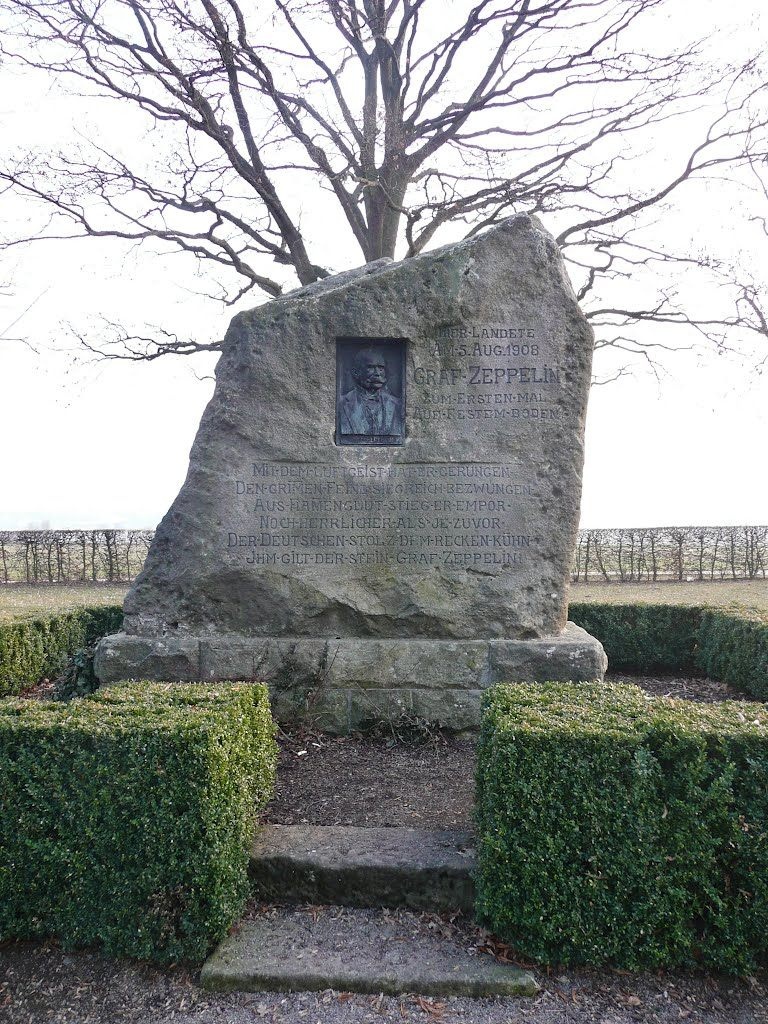
Here is the monument to the LZ-4 is at Echterdingen where the LZ-4 met its fateful accident.

Echterdingen, LZ-4 Monument
LZ-4 Monument at Echterdingen. Photo credit: Undetermined


The memorial was erected in 1908. The monument is decorated with bronze plaques, a portrait of Graf Zeppelin on the front and a rising eagle on the back. In addition to the portrait an inscription reads: "Here Count Zeppelin landed for on solid ground for the first time on the 5th of August 1908." The inscription under the portrait reads: "He struggled long and hard with the Spirit of the Air Successfully vanquished the grim opponent. From a sea of flames he rose up More magnificent than ever before. To the pride of Germans he soared up courageous; To him is set in stone (the name) Count Zeppelin!" (thanks to Alastair Reid for the translation). The back shows a rising eagle and the inscription: "As through the dark clouds of the Aar rises to the golden light, so by tribulation and need the hero struggles to victory."
The monument is located at (Lat Lon) 48.681222 009.180318.(You can cut and paste this on "google Maps" and see a map of the location and the area.
 was pulled from its temporary mooring by a sudden storm and destroyed when its hydrogen ignited.


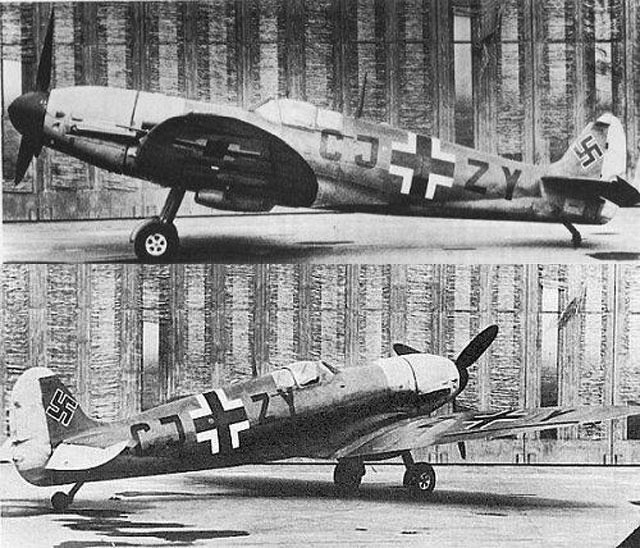
    While I was reading up on Echterdingen, apparently my post in the 1980's was a test site for the Luftwaffe, they experimented with a captured Spitfire.  I remembered seeing the flooded entrances to the underground bunkers that had tunnels connecting all the kasernes around Stuttgart to protect them from the Allied bombings. Apparently "Organization Todt" had filled a lot of the tunnels with explosives so rather than try to disarm all the various boobytraps, the allies just filled them with water.  They also hid a bunch of industry in the tunnels to protect them.  I recall going to the U.S Hospital in Bad Canstantt (We called it Bad C) and there were 4 stories above ground and 3 stories below ground and tunnels going to other kasernes around Stuttgart.  I never been in them, but that was the "rumor" anyway.  They did have the rooms stocked up in case of war with the Soviets.  I personally didn't have a good impression of the U.S. Army hospital at Bad C, a friend of mine was riding his bike and got into an accident with a German on the "Economy.  Well the German "Krankenwagon" took him to the hospital at Bad C, and he walked in under his own power, and the people there told him to just sit down and wait.  after several hours after being blown off by the staff at the front desk, he finally went to the front desk and told the NCO there, "I don't feel well" and passed out.  THey finally took him back and discovered that his liver was separated in the accident, and he bled to death internally.  His remains were shipped back to the world, we raised money so his German girlfriend/fiance could go with him to be buried.  His parents called their congresscritters and launched a "Congressional".  We were pissed.  I remember telling several of my friends, "if I get hurt, take me to a german hospital, I don't trust the quacks at Bad C".  the others said the same thing.   Funny, the things I remember.  I still know his name but I will not post it here.

And a WWII Story.

Spitfire Vb (EN830/NX-X) fell into German hands late in 1942. On November 18th while being flown by P/O Bernard Sheidhauer of the Free French Air force, attached to 131 “County of Kent” Sqn RAF, he and his No.1
P/O Henri de Bordas had been on a “rhubarb” (an RAF World War II code name for operations by aircraft seeking opportunity targets).
Making land fall at St Aubin sur Mer they picked up and followed the Caen to Cherbourg railway attacking several targets along the way. During the mission they were met by flak and purposely avoided Carentan because of the concentration of flak in the area.
Over the small town of Ecausseville, de Bordas lost sight of his partner, he continued to circle for as long as he could, but to no avail. He returned to Westhampnett. Scheidhauer’s aircraft had suffered some sort of damage and started to lose fuel. By mistake he headed west instead of north, after crossing a stretch of water he sighted land which he mistakenly thought was the Isle of Wight.  Picking out a suitable field he place his aircraft down into a wheels up landing. Coming to rest in a field of turnips close to Dielament Manor, Trinity.
Climbing from the aircraft he was met by locals who informed him of his navigational error, he was in fact in German Occupied Jersey and not the Isle of Wight.  Scheidhauer tried to destroy the aircraft, he attempted to acquire some fuel to set fire to it, but there was none, he smashed the instrument panel as best as he could and gave away various items of equipment to the gathering crowd of locals.
The Germans arrived after about 20 minutes and he was taken prisoner, ending up at Stalag Luft 111. He was later murdered by the Gestapo for his part in the ‘Great Escape’.

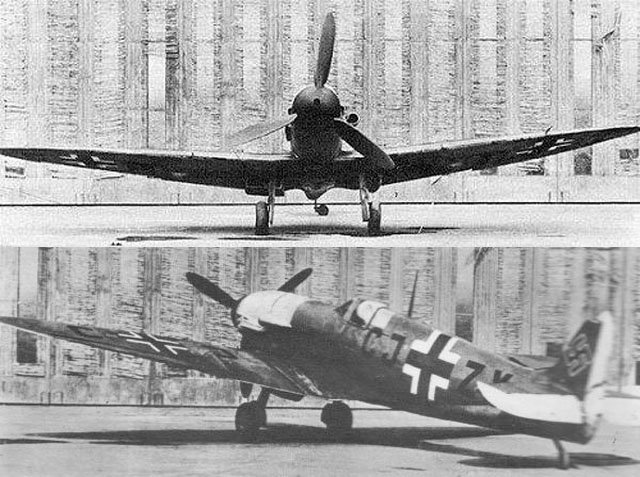
En830 was dismantled and shipped to mainland Europe. It reached Echterdingen without guns and ammunition, with the gun ports closed. The radio equipment had been replaced with ballast, but it still had its original Merlin 45 engine. Several flights were made by Daimler-Benz pilots before conversion was attempted. A decision was made to replace the instruments and the entire electrical system with standard German equipment, because the Luftwaffe used a 24 volt system, whilst the RAF used a 12 volt standard.
A 3.0 m. diameter Bf.109G propeller was added, together with the carburetor scoop from a Bf.109G.
After a couple of weeks, and with a new yellow-painted nose, the Spitfire returned to Echterdingen. Pilot Ellenreider was the first to try the aircraft. He was stunned that the aircraft had much better visibility and handling on the ground than the Bf.109. It took off before he realised it and had an impressive climb rate, around 70 ft. (21 m.) per second. Much of the Spitfire’s better handling could be attributed to its lower wing loading.

The Spitfire’s wing area was about 54 sq. ft. (5m²) greater than that of the Bf.109. The Messerschmitt was faster at low altitude, but at 11,000 ft. the speeds evened out. The DB 605A engine gave better performance, according to the test group, than the Merlin, which was rated 150 hp below the DB 605A. It gave this “MesserSpit” a ceiling of 41,666 ft. (12700 m.), about 3,280 ft. (1000 m.) more than a Bf.109G with the same engine and 5,166 ft. (1475 m.) more than that of a Spitfire Mk.V.
After a brief period at Rechlin verifying the performance data, the modified Spitfire returned to Echterdingen to serve officially as a test bed. It was popular with the pilots during and after work hours. MesserSpit career ended on 14th August, 1944, when a formation of US bombers attacked Echterdingen, wrecking the Spitfire. The remains of the Spitfire Messerschmitt hybrid were scrapped at the Klemm factory at Böblingen

Tuesday, December 20, 2022

Inside the U.S Army's Newest Surveillance Plane

 I saw this article and it caught my attention, when I was in the U.S. Army, one of the platforms used by soldiers in my unit was the "RC-12 Guardrail V System", so this is basically a replacement for that system.  The Guardrail system has been around for a long time and I was wondering if they were going to keep upgrading the system or go move toward a different platform.


From a distance, the all-white business jet parked neatly in a hangar underneath a giant American flag looks a lot like the other sleek, luxurious private planes arriving and departing from this Virginia airport. But inside, this plane is far more working class.

The cabin, full of server racks, looks more like an IT closet than an executive aircraft. The seats are cloth and two computer consoles are connected to a dozen or so antennas protruding from the plane’s belly.

To the U.S. Army, this plane—or something like it—is a ticket to the future of warfare, built to monitor the complex communications of an adversary nation-state from standoff distance, rather than the simpler chatter of insurgents right below.

Called ARTEMIS, the plane uses its antennas and computers to intercept and decipher enemy communications. The aircraft itself is made by Bombardier, but the specialized modifications are made by Virginia-based defense and technology firm Leidos. 

“These [planes] can see very far when operating at 40,000 feet,” Mike Chagnon, deputy group president of Leidos Defense Group, said in an interview.

It’s the second Challenger 650 that Leidos has modified like this for the Army as part of a technology demonstration. L3Harris Technologies are also developing similar business jet intelligence planes, which it calls ARES.


The Leidos and L3Harris planes are helping the Army figure out its long-term plans for new, high-flying intelligence planes, an effort called High Accuracy Detection and Exploitation System or HADES. Those planes will replace the turboprops heavily used to survey the battlefields over Iraq and Afghanistan for insurgents and roadside bombs.

“They want a multi-layer sensing capabilities from space to mud,” Chagnon said. “This is the airborne layer.”

Defense One was invited to see the Leidos aircraft shortly before it was put under the Army’s control and agreed not to share the location of the plane's home base. The extra aircraft will allow the Army to deploy to different locations or participate in more exercises and experiments, Chagnon said.

In November 2021, the first ARTEMIS aircraft was pulled from an Army exercise in the United States and deployed to Europe to be part of the NATO effort to monitor Russian forces near the Ukraine border. Over 10 days, the plane flew from Arizona to Virginia where it received some upgrades before flying to Europe, Chagnon said.

“It really hasn’t been home since,” he said.

As of Dec. 1, the first plane has flown more than 370 missions, racking up more than 3,200 flight hours for combatant commanders around the world, Leidos CEO Roger Krone said at the small turnover ceremony in the hangar. 

“You're flying basically in...a mow-the-lawn-type pattern for 10 hours [and] you're collecting massive amounts of data,” Chagnon said.

The deployed aircraft flies an average of six days per week for nine to 10 hours per day, Chagnon said. The planes are unarmed and don’t fly in so-called “contested” airspace that’s defended by surface-to-air missiles and fighter jets.

“We're not going into the contested environment,” he said. “We're looking inside a contested environment from an altitude and a standoff, whereas our counterinsurgency aircraft were flying in, just looking down, in an uncontested environment.”

As much as the aircraft represents a new generation of conflict, it could also represent a new way of buying weapons.

The planes are owned, operated, and maintained by Leidos employees, not the Army. But, through satellites, Army officials stateside are able to connect to the plane’s sensors remotely, Chagnon said. The Army essentially pays Leidos a by-the-hour fee.

“It benefits the government and it benefits the country,” Chagnon said. “We're responsible for keeping the aircraft in the air. And they [the Army] no longer have to have that long logistics tail, which is sometimes the most expensive part of a government program. 

“They can turn the spigot off on these anytime they want,” he continued. “So, we're incentivized to continue to innovate on these [planes and] make them more useful, and…find as many efficiencies as we can to keep the mission-capability rate high. The first ARTEMIS plane took Leidos about 18 months, from concept to delivery, and the second is on track to be delivered ahead of schedule in just five months from contract signing, Krone said.

Krone, several times, noted that the company and the Army had put “skin in the game” to be able to buy and convert the business jets into militarized intelligence planes. 

“This delivery is the culmination of a lot of really hard work [and] a lot of sharing of the risk,” he said.

The technology is open, so different types of sensors made by different companies can be installed. Some of the sensors are government-owned, others purchased by Leidos.

Leidos has also purchased two larger Bombardier Global 6500 aircraft that it intends to convert into intelligence planes for another Army spy-jet competition called ATHENA-R. It’s competing against an L3Harris and MAG Aerospace team and Sierra Nevada. Those companies are also offering modified Global 6500 aircraft. ATHENA-R aircraft will also be owned and operated by contractors and will be a bridge to the HADES program.

For Leidos, a government contractor better known for its IT and government services, ARTEMIS represents efforts to diversify its portfolio. In 2020, the company purchased Alabama-based Dynetics, a company that specializes in directed energy, space, drone, and hypersonic technology.

“We are a people company,” Krone said. “This is very unusual” that “there's something I can point to.”

Sunday, July 3, 2022

The U.S. Army's new Light Tank

 I don't know about the "Light Tank" system, It has to have the ability to kill the MBT of our enemies and I'm not sure that the 105 mm has the ability to penetrate the new reactive armor on the tanks that the Russians and Chinese are fielding unless they have specialized ammo for that gun and that will add to the cost and complexity of the logistic support. The light tank will be easier to deploy with the combat teams and getting lifted with air assets than the 70 ton M1A2 Abrams. 

    I got this article off "The SandBoxx


The U.S. Army has selected the Griffin II as its first new tank since the Cold War.


But will the new platform give the Army a lightweight but heavily armed vehicle that can support the infantry? Or like the history of light tanks suggests, it will be a liability on the battlefield? That depends on how you view the future of tanks – and the weapons that destroy them.

At the least, America buying a new tank is notable. The backbone of the Army’s armored fleet – the M1 Abrams – dates back to the late 1970s. Although much upgraded since then, it is essentially the same vehicle that was designed to take on waves of Soviet tanks pouring through the Fulda Gap.

The Army awarded a $1.1-billion contract to General Dynamics Land Systems (GDLS) for the new vehicle. GDLS’s Griffin II design weighs 40 tons – about half the weight of a 70-ton M1A2 Abrams – and has a four-person crew. It has a 105-millimeter cannon, rather than the 120-millimeter gun found in Western main battle tanks like the M-1, Germany’s Leopard 2, and Israel’s Merkava 4.

The new tank borrows much from the M1A2, including its fire control system and a turret that resembles that of the Abrams.

The new tank is part of the Army’s Mobile Protected Firepower (MPF) program, which aims to develop a tank to bolster Infantry Brigade Combat Teams and allow for better destruction of enemy tanks and bunkers. The two contenders for the award were GDLS and its Griffin II – whose chassis is based on the Austro-Spanish ASCOD armored vehicle — and BAE, whose design traced back to the 1980s-proposed M8 Buford.

“GDLS offered a new, lightweight chassis with a high-performance power pack and an advanced suspension, combined with a turret featuring the latest version of the fire control system found in the Abrams main battle tank,” noted Defense News.

The Army plans to buy 504 light tanks by 2035, as part of a program that may eventually total $17 billion in procurement and sustainment costs, according to Army officials.

The disadvantages of light tanks

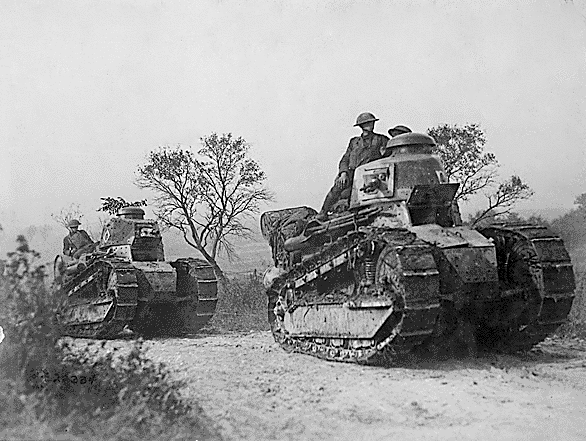
French Renault Light tank
French Renault FT tanks operated by the US Army in France. The light tanks had a crew of only two and were mass-produced during World War I. (Wikimedia Commons)

Tanks should support infantry. In fact, that’s why the tank was invented back in the First World War, as a means to destroy the machine guns and barbed wire that had decimated infantry attacking across No Man’s Land. But tanks, like battleships, are compromises between three requirements: firepower, protection, and mobility. You can favor one or perhaps two of those factors, but only at the cost of the third.

And the Army’s MPF light tank sacrifices protection, given that it weighs only 40 tons. Even if it mounts an Active Protection System to shoot down incoming anti-tank rockets, the tank would seem likely to have protection closer to an infantry fighting vehicle like the M2 Bradley than a main battle tank like the Abrams.

Then there is the troubled history of the light tank concept. The major powers all used light tanks in World War II. The tanks included the U.S. M3 and M5 Stuart, the German Panzerkampfwagen I, and the Soviet T-70. They had smaller cannons and lighter armor, but they were cheaper to build than medium and heavy tanks.

The problem was that in combat, they often faced heavier enemy tanks. During the disastrous Battle of Kasserine Pass in February 1943, the M5 found itself outmatched by heavier, better-armed, and better-armored German PzKpfw III and IV tanks and anti-tank guns. General Patton “issued a directive that light tanks were only to be used for reconnaissance and flank security in view of their weakness in dealing with current German tanks and anti-tank guns,” notes author Steven Zaloga in his book on the Stuart tank. Against heavy German Tiger and Panther tanks, the results could be imagined.

Related: Could the Panther tank once again be seen in Europe?

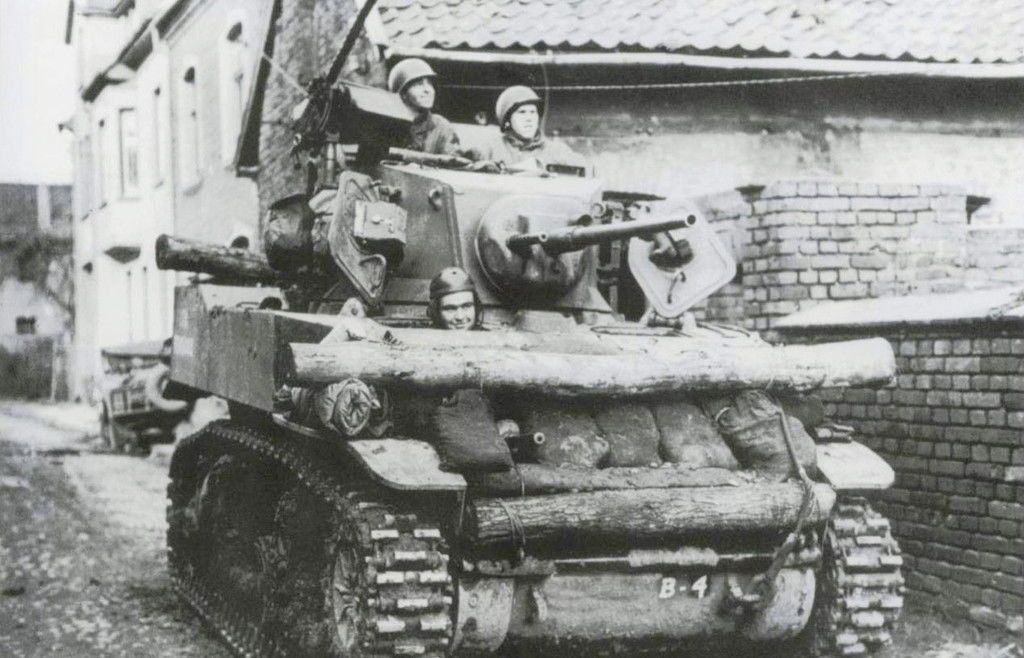
M5A1 light tank during WWII
The M5A1 light tank. Here the crew has added logs to the chassis to increase the vehicle’s protection. (The Museum of American Armor)

By 1944, the U.S. Army had concluded that the “poor armor protection of the M5A1 resulted in a higher rate of crew casualties than in medium tanks, with a medium tank crew having about a one-in-five chance of becoming a casualty when their tank was knocked out, compared to a one-in-three chance in light tanks,” according to Zaloga.

The Stuart was eventually replaced by the somewhat more successful M24 Chaffee, some of which were air-dropped to the doomed French garrison at Dien Bien Phu. After World War II came the infamous M551 Sheridan, an air-droppable light tank built out of aluminum and armed with a powerful 152-millimeter cannon that could fire Shillelagh infrared-guided anti-tank missile. Deployed to Vietnam in 1969, the recoil of the gun was so hard that it knocked out the vehicle’s electronics.

This doesn’t mean that the new Griffin II light tank will be unsuccessful. But U.S. tanks already face a variety of deadly threats, including new Chinese and Russian tanks such as Russia’s T-14 Armata, as well as anti-tank missiles, long-range artillery, and missile-armed drones that have proved devastating in the Russia-Ukraine war.

Some experts are already writing obituaries for the tank. That’s premature because there is no substitute for a vehicle that combines firepower, protection, and mobility. Yet, it does suggest that the modern battlefield is a heavy burden for a light tank.


Wednesday, April 13, 2022

What's in a Name: the Problem with "Warfighter"

 I returned from my adventures in another state, but I caught "The Crud", I have absolutely no energy, and no appetite.  Still had a blast and am planning on going again next year.  I will blog about it in a day or two.

      I shamelessly cribbed this from "Angry Staff Officer", I have used his material before on my blog, my friend Mack twigged me on to him years ago.

Back in the late 1990s, when the Army was being all that it could be, the Army began leaning into the concept that soldiers should think of themselves as “warriors” in order to increase the fighting spirit of the force. I’ve already said my rant, er, I mean, my piece on this, which you can find here. But that same thought process of the time gave rise to another monstrosity: warfighter.

Now, not only is this an assault on the English language in general – “I’m not a teacher, I’m a smartsgiver” – it is also patently and dangerously misleading. Why? Because it assumes that the sole role of the Army – and the military in general – is to only fight wars. The Army has gone one step further and made sure that no one escape just what the Army’s mission is, by giving itself its own mission: “To deploy, fight and win our nation’s wars by providing ready, prompt and sustained land dominance by Army forces across the full spectrum of conflict as part of the joint force.” Pretty convenient when you get to issue your own mission statement, huh?

Now, you might be saying, “What’s the big deal? Shouldn’t we always want the Army to think about winning wars?” Sure, yes, absolutely. Only, see, the problem is, the Army spends most of its time not fighting actual wars. Throughout the history of the Army’s conflicts, “war” – the political act of nations trying to impose their will on each other via violence – takes a very back seat role. Conflict, yes. There’s plenty of that. Irregular, always messy, few clearly defined rules, shifting objectives, politically fraught, sometimes ethnically or racially charged, fought with either little fanfare or with intense media interest. These conflicts have happened anywhere from North America to Africa, from the Pacific to the Middle East, from Siberia to Latin America.

There are also plenty of the Army’s missions that have nothing whatsoever to do with conflict: since 1787, the Army has engaged in public relief missions, infrastructure construction, labor disputes, management of federal lands or national parks, natural disaster relief, or dealing with public unrest. All told, these types of combat missions and non-combat missions make up the majority of what the U.S. Army does.

So, why does this happen? Why does the Army mostly do things that don’t sound like killing people and breaking stuff? Because as much as the AGSU-wearing folks in the five-sided puzzle palace would like you to believe that the Army is actually the master of its fate and the captain of its soul, it is not. The Army receives its missions from the executive branch of the U.S. and its funding from the legislative branch. So while the Army would love to focus on nothing but fighting conventional wars, sometimes the political will of the nation requires it to do something else. Most of the time, the nation’s political and public wills are in unison. Oftentimes, however, the political will diverges from the public will and the Army can find itself fighting a confusing conflict without the support of the people it serves. Obviously, this is not something the Army is excited about.

And so, we turn to the concept of the warfighter. This concept that says that our nation’s military force will only be used for achieving overwhelming military superiority over our nation’s enemies. This concept is troubling for two main reasons.

One, that we have decided as an article of faith that establishing military dominance wins wars. This is all the more amazing since this is the Army that can’t stop quoting Clausewitz’s dictum about war as a continuation of politics. Somewhere along the way, we stopped actually thinking about what that meant. We began to believe that war and politics could be separated from each other, as if they did not go hand-in-hand.

The consequence of this has been to separate the political from the military ends in conflict. John Shy and Thomas Collier put it best in their chapter on “Revolutionary War since 1945” in Makers of Modern Strategy, when talking about the U.S. military’s response to Vietnam: “The senior American military commanders never took seriously the idea that the political effort, presumably going on behind the security screen provided by large-scale combat operations, should have equal or greater priority.” ​(page 856)

This sort of assumption about combat dominance leading to victory also has played a hand in the overall tactical focus of the modern-day U.S. Army. Nearly all leaders with combat experience have had it only at the tactical level rather than the operational or strategic, where things other than firepower dominance come into play. This, in turn, leads to a generation of leaders who only know how to apply tactical solutions to strategic problems.

The second reason that the concept of a “warfighter” is troubling goes back my first point surrounding the Army’s missions. If our leaders only expect to be warfighters, what happens when they’re presented with a situation short of war? And as a reminder, that has been the vast majority of the Army’s experience since the nation was founded. Are we properly building leaders who are capable of handling a diverse range of tactical, operational, and strategic problems if we maintain a myopic focus on the concept of a warfighter?

While it is true that winning wars against the nation’s existential threats is a no-fail mission, failing in other conflicts can severely damage the military’s credibility. Building generations of leaders who only see their role as “managers of violence” does little to help the U.S. navigate the complex waters of geopolitics in the 21st century.


Thursday, January 7, 2021

December 25th, A Day that Changed America and gave us Hope.

 I remember General Washington attacking the Hessians on Christmas day 1776, the revolutionary War wasn't going well, the Colonial Army had been pushed out in several battles with the British Army, and the Crown had hired Mercenaries,  auxiliaries to the British Crown,  Hessians from the German State of Hesse-Cassel and Hesse-Hanau.  Apparently hiring out of troops was quite a cottage industry for the kingdom.  Europe had a bunch of little wars and Hesse equipped their own troops, trained them and they were quite good by the standards of the day.  it was cheaper for King George to hire them than bring in more troops from other colonies, they were there to augment the Kings war effort here.  The Hessians were about 25% of the total manpower outlay in the 13 colonies.    George Washington attacking the Hessians when he did pretty much saved the American Revolution, it gave us hope that we could win this thing, and it shocked the British and Germans that the Americans were no pushovers.  Baron Von Steuben who was Prussian came to Valley Forge and Taught the ragtag American Army the drill and discipline necessary to stand up to the British and not break when they came at you with the bayonet.  


A light rain had begun to fall out of a pewter grey sky, spattering dirt on the troops as they slowly made their way down the slippery trail toward the river. Each man had been ordered to pack sixty-rounds of ammunition and three-days rations, but few knew where they were bound. Most were dressed in rags, few had overcoats, many were shoeless. The sun was still a half-hour from setting, and already the treetops were beginning to slap and bend, a sure sign of foul weather on the wind

It was Christmas Day, December 25, 1776, the western bank of the Delaware River. Among the tattered, freezing troops at McConkey’s Ferry late that afternoon was General George Washington, architect of a planned strike against three regiments of Hessian troops wintering across the ice-choked river at Trenton, New Jersey.

It is said that genius and madness are at times virtually indistinguishable and, considering the state of the American Revolution at the time, a fair observation when weighing Washington’s chances of success, even now, from the distance of 300 years.

The operation was the offspring of pure desperation, a dreadful state-of-affairs, rapidly approaching implosion. The British and their Hessian auxiliaries were at full strength, for instance, the Continental Army a shadow of its former self. Due to repeated defeats, failures, and retreats, Continental currency was on the verge of collapse, credit nonexistent, food hard to come by.

The American public, its enthusiasm critical for the war effort, was nearing demoralization. On December 18 Washington had written his brother, Samuel, solemnly admitting that “if every nerve is not Straind to recruit the New Army with all possible Expedition, I fear the game is pretty near up.”

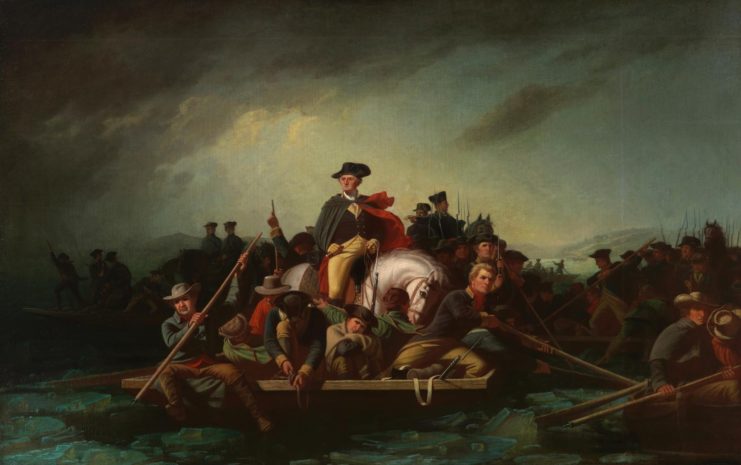
Washington Crossing the Delaware, by George Caleb Bingham, 1856–1871

True, since then Washington had been reinforced, bringing his effective strength up to 7,600, but most of those enlistments would be up by month’s end, hence the army a phantom by early January, if it still existed at all.

There are moments so grim that what previously seemed like lunacy suddenly makes perfect sense, the wildest option the only option still available. In that sense, on the 25th of December 1776, for General Washington the discerning finger of logic was pointing directly, and emphatically, across the river at Trenton.

To bring that logic to life, the general had opted for a sophisticated, three-pronged attack, a plan that even in good weather with well-trained troops might prove challenging, better yet in difficult winter conditions with men on the brink of starvation. Nevertheless, the plan was for three separate columns to converge on Trenton simultaneously, one of the most difficult things in warfare to accomplish.

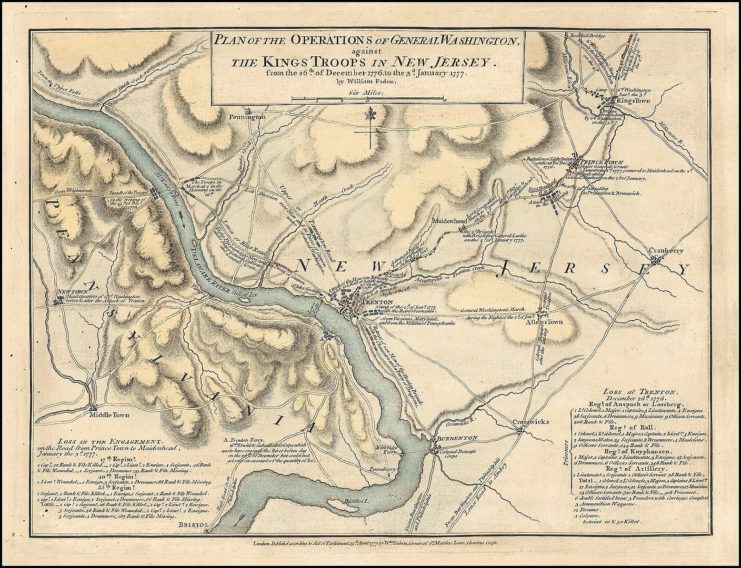
Map of Delaware River area depicting route George Washington and his Army made during the crossing by William Faden

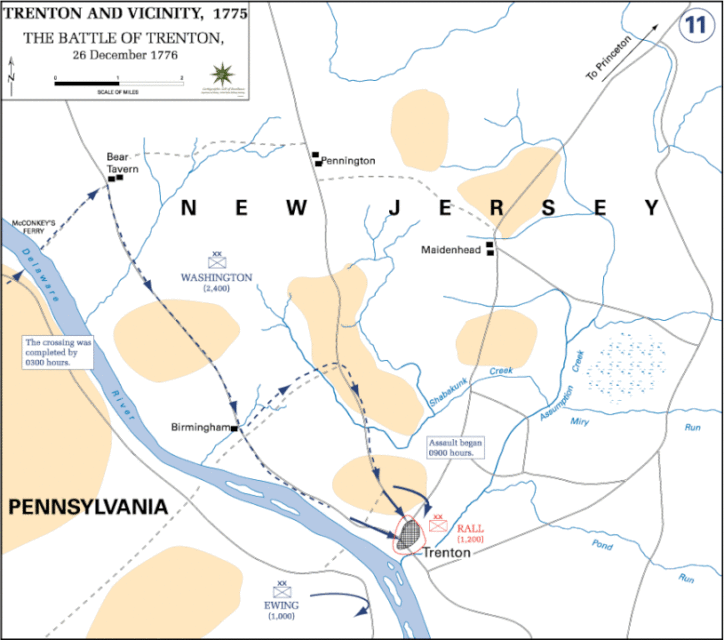
The main column – 2,400 men – was to crossover the Delaware at nightfall, be entirely across – artillery, horses, and all – by midnight, then march nine miles south to Trenton. At the village of Birmingham, north of Trenton, the main column was to split, one branch under General Sullivan continuing south along the River Road directly into town, the other under General Nathanael Greene, looping north and entering simultaneously from the opposite direction.

But hold on, there was more. Additionally, General Ewing was to cross the river directly opposite Trenton with 700 men and seize the bridge over Assunpink Creek south of town, preventing a Hessian retreat in that direction. Lastly, a force of 1500 men under General Cadwalader was to crossover farther south at Bristol, at once creating a diversion and blocking any British reinforcements advancing from Philadelphia.

The attack on Trenton proper was to step-off at first light, December 26. Indicative of the do-or-die nature of the mission, the password was “Victory or Death.”

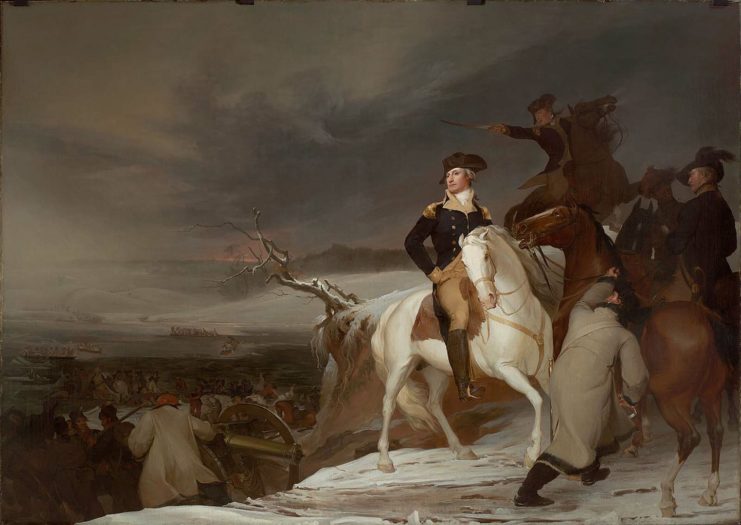
The Passage of the Delaware, by Thomas Sully, 1819

On paper the plan looked splendid, but war-plans often look splendid on paper. Unfortunately, due to the brutal winter storm then blowing-in and heavy ice-flows in the river, neither Ewing nor Cadwalader would fulfill their assignments. Unknown to Washington, he was on his own.

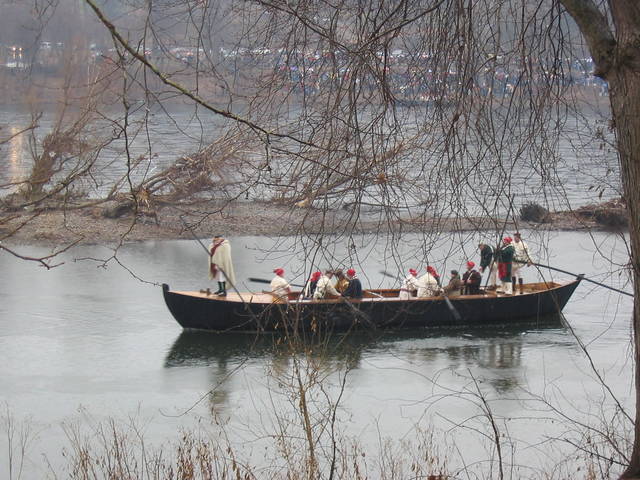
Typically, the crossing got started late. The troops were taken over in Durham boats from the nearby Durham Iron Works. Built to transport ore downriver, they were large, black boats, sixty-to-forty feet in length, with an exceedingly shallow draft – perfect for Washington’s mission.

The troops were poled over, often forty men standing, the artillery and horses on larger ferries. John Glover’s regiment of sturdy Marblehead fisherman supplied the knowhow and muscle, even so, the entire army was not across until 3:00 AM, dangerously behind schedule.

John Greenwood, a sixteen year old from Boston, was one of the first over, and recalled: “We had to wait for the rest and so began to pull down the fences and make fires to warm ourselves, for the storm was increasing rapidly. After a while it rained, hailed, snowed, and froze, and at the same time blew a perfect hurricane.

Through the howling winds and blinding snow of a true nor’easter, the column started toward Trenton, Washington riding the line, tirelessly encouraging his troops forward. As temperatures plummeted, bloody footprints marked the route southward. Two exhausted men staggered from the column and collapsed, only to be discovered later, frozen to death. Going was painfully slow, but somehow the column finally gained Birmingham where it divided, as planned.

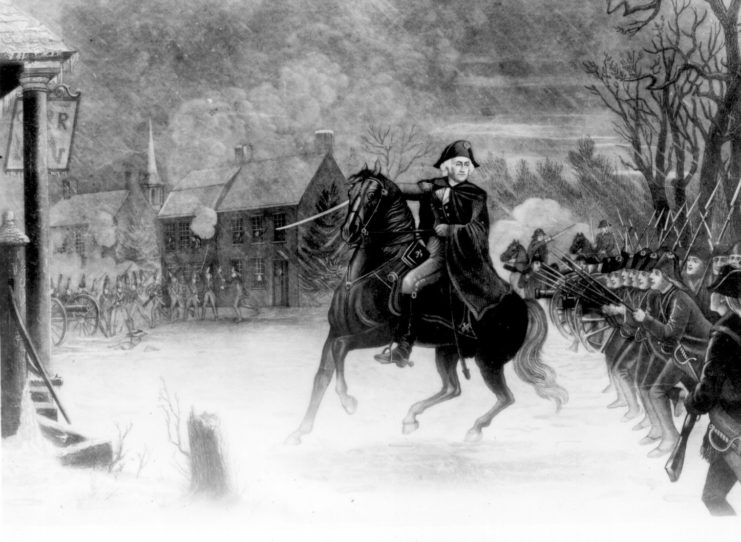
The engraving George Washington at the Battle of Trenton by the Illman Brothers in 1870

Washington rode north with Greene, as Sullivan continued along the River Road. It was well passed sunrise before both columns finally found Trenton. Somehow, almost amazingly, they had not been spotted, the raging storm having provided cover. Suddenly a rider appeared from General Sullivan, advising Washington that, due to the sloppy weather, his men’s muskets were inoperable. But retreat, now, was impossible. Fiercely determined, Washington told the courier to return and tell Sullivan: “Use the bayonet. I am resolved to take Trenton.”

Around 8:00 o’clock, just north of Trenton, Washington split Greene’s force into three attacking detachments and, on horseback, led the center attack forward himself. Heavy snow was still flying as a Hessian lookout spotted the approaching Americans and shouted, “Der Feind!” (the Enemy!).

Shots rang-out as Hessian infantry fired, then retreated before the weight of the American advance. More Hessian infantry rallied, attempting to repulse the Americans on the north side, momentarily leaving the River Road undefended. As Washington’s assault entered Trenton, the sound of cannon-fire became suddenly audible from the south – somehow, despite all the adversity, the twin attacks had coordinated almost perfectly, and Ewing’s boys were firing their artillery from across the river. Sullivan, after chasing-off a Hessian picket-post, advanced into Trenton unopposed.

The Battle of Trenton, December 26, 1776

Trenton was then a small town, about 100 houses – now mostly deserted of inhabitants – built on two central streets, King and Queen. Myth has it the Hessians had been drinking and partying heavily on Christmas, hence sleeping or hungover as Washington’s troops attacked, but this is folklore.

The three Hessian regiments – 1,500 combined strength – were under command of Colonel Johann Rall, a veteran commander with a sound, if uninspiring reputation. They had arrived on December 14, eschewed defensive fortifications, but had patrolled regularly on the lookout for raiding parties. The Hessians – fierce warriors with a reputation for barbarity from the German principality of Hesse-Cassel – had a low opinion of American fighters and leadership, hence they expected minor, aggravating raids, but hardly a major blow.

Now, faced with an overwhelming blow, near panic ensued.

American artillery quickly unlimbered at both ends of town and began sweeping the streets, as Continental troops advanced. Rall formed two of his regiments at the bottom of King Street, but they were quickly broken under intense artillery fire.

Fearing encirclement, the Hessian leader attempted to lead an advance, but this, too, was blown apart. Street fighting ensued, but the Hessian’s weapons fouled due to the snow, and many were cut down in the streets and alleyways. Rall eventually led two regiments to an orchard north of town where he tried to flank Washington’s troops. But this effort was spotted and shredded by enfilading musketry and artillery fire. Rall, riddled with bullets, tumbled from the saddle

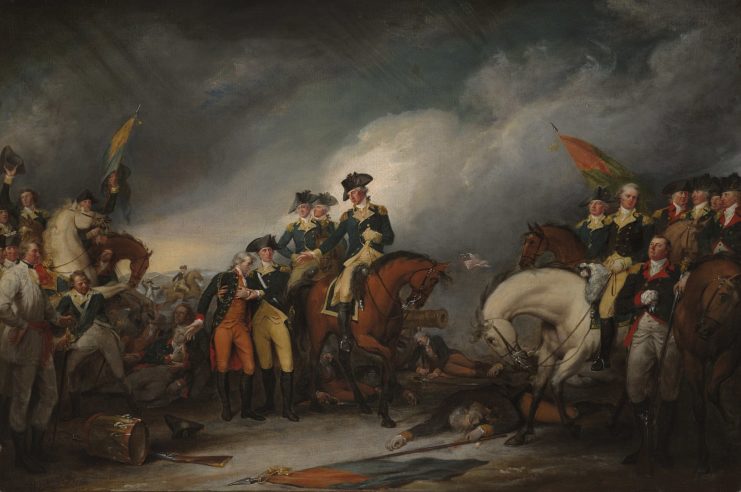
Overwhelmed, many Hessians ran for the hills, but most were eventually surrounded and forced to surrender. It was all over in less than an hour.

The painting The Capture of the Hessians at Trenton, December 26, 1776 by John Trumbull

The Hessians suffered 22 killed (including Rall), 83 wounded, and 896 taken captive, while the Americans suffered only 5 wounded and two dead – the two who had frozen to death on the march. Additionally, falling into American hands was over 2,000 small arms, barrels of ammunition, numerous cannon, horses, and the Hessian’s entire supply of food, drink, shoes, and clothing.

Amazing as these totals were, they fail to grasp in any meaningful sense the true impact the engagement had on the country. It would not be overstatement to suggest that news of Washington’s victory utterly electrified an American public previously benumbed by the war. Of Trenton, author Mercy Warren wrote: “From the state of mind bordering on despair, courage was invigorated, every countenance brightened.”

Reenactors cross the river in Durham boats. Photo: Luke Jones from Yucca Valley / CC BY-SA 2.0
Reenactors cross the river in Durham boats. 

Coupled with Washington’s return to Trenton less than a week later, his daring nighttime escape from Cornwallis’s clutches, then victory over the British at Princeton the following day, the American cause, like Lazarus rising from the dead, seemed virtually overnight to have returned from life-support to the land of the living. Indeed, Frederick The Great – who certainly knew something of war – called Washington’s campaign “the most brilliant of any recorded in the annals of military achievement.”

Yet perhaps the most insightful comment was delivered nearly a century later, when British historian, Sir George Otto Trevelyan wrote, “It may be doubted when so small a number of men ever employed so short a space of time with greater and more lasting effects upon the history of the world.” Unbeknownst to them at the time, George Washington, and his small band of starving, freezing, yet willing compatriots, had just changed the world.

Friday, July 24, 2020

U.S Army Uniform goes to the traditional "Pinks and Greens"

I wish they had this style uniform when I was in the service, rather than what I had issued when I was in.  We called what we had "The Bus Driver Uniform".

 Look kinda like that.....
  If we really wanted to look good, we had to buy the "Dress Blues" and to really make it pop. get the belt with it.  We were issued "the Garrison cap", and I never cared for it and I purchased a "Service" cap
 My Service Hat on top of the Center Helmet

 and it was an acceptable option under regulations and I had a copy of the regulations in case while I was wearing it someone tried to give me crap about wearing it(Yes it did happen twice) and I put the copy of the regulation inside of the service cap.  I did spend the extra money to get the better quality cloth from clothing sales than what was issued to me when I was in basic, it was a little darker in color and better weave and when I went in front of the Soldier of the month boards for promotions and stuff like that, it helped me look sharp. When promotions points are high in your MOS, you do what you can do to get what you can get the extra recognition to help your career.   It is nice to see the military services going back to the traditional uniforms of our past.  Tradition is important to a military organization, it reminds us of our past, of what the unit has done, of it past glories and of what is capable of and the standards that it has set so the soldiers will strive to meed the goals of the unit, especially during "the suck" it will let them dig way down and embrace the standard because others have already have already done it and they don't want to let their unit down, it is "esprit de corp" and it will let a group of people do the impossible if necessary.

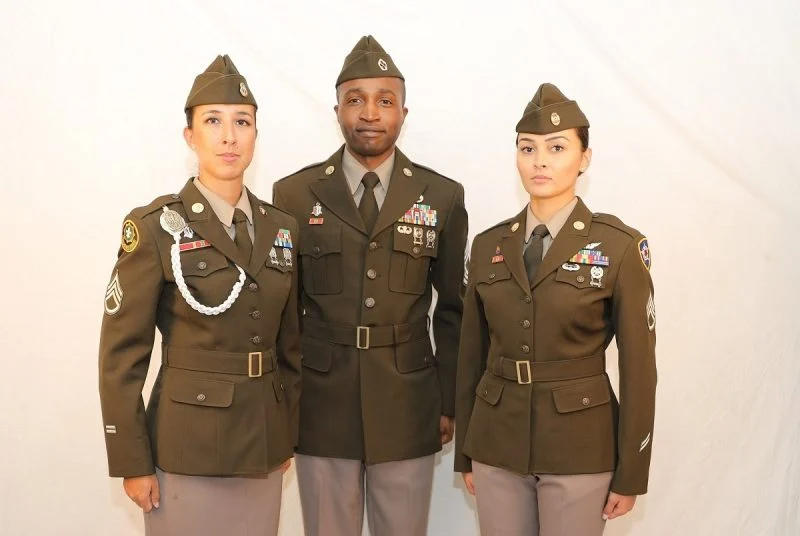
Soldier models pose in the final prototypes of the proposed "pinks and greens
The US Army uniform is getting a ‘glow-up’ it has been confirmed, with the new duds looking rather like the old WWII ‘pinks and greens’, but with a modern flavor.
The Army has made no secret of the fact that the new issue uniform is based on what grampa was wearing back in ’45 and expects it to be standard issue to all new soldiers enrolled in 2021.
US Army Product Manager, Lt. Col. Jonathan Allen, said the new uniform was a response to the fact that the current options available to the military were not suited for ‘everyday business environments’, and that the army was keen to set, ‘a more appropriate standard for professionalism in an office setting.’
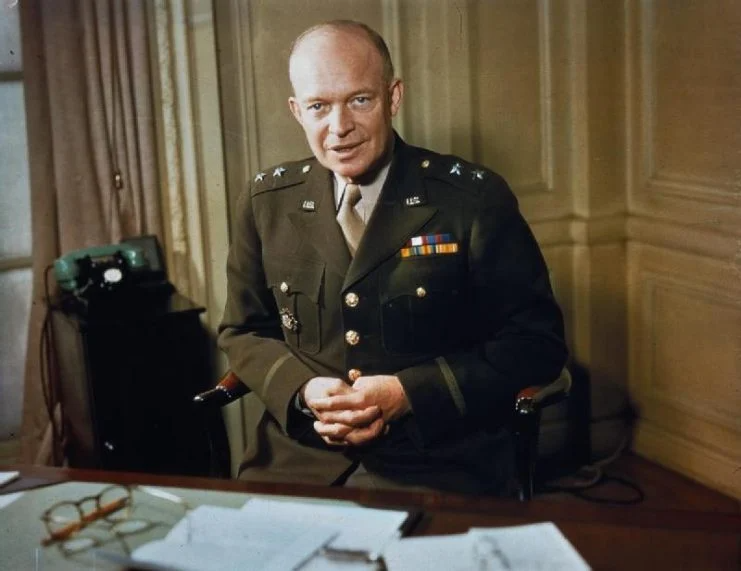
Dwight Eisenhower, at his desk, 1942.
Beginning in January 2021, soldiers completing basic training will receive the new pinkish-brown trousers and olive-green jackets. Before then the new look will be rolled out to recruiters and drill sergeants in October this year.
It is being sold as a cost-neutral change which will have no impact on US taxpayers and will not hit enlisted soldiers in the pocketbook either.
850 of the new service green uniforms have been distributed to senior leadership, the Army Band and others for their comments on the new style/old style uniform

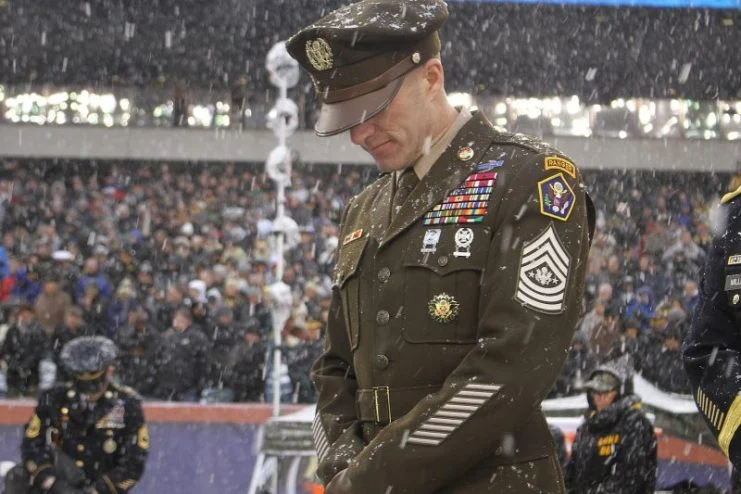
Sergeant Major Daniel Dailey told reporters that the US Army had been cautioned against referring to their new dress uniforms as ‘pinks and greens’. ‘We’re calling them Army Greens,’ he said, ‘pinks and greens is a World War II nickname.’
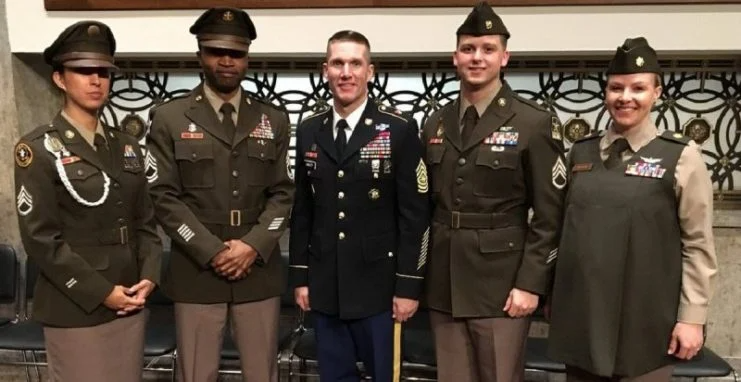
The new “Army greens” will be a general service uniform while the blue Army Service Uniform (center) will return to its former use as a ceremonial and parade uniform
The new Army Greens are expected to be adopted by all 1.1 Million soldiers within the next eight years, which might seem like a long time, but to get from recruiters to the National Guard and Army Reserve Dailey said would take time.
‘We also have to give soldiers time,’ said Dailey, ‘to receive that money in their clothing allowances so they can pay for that uniform prior to it being required.’
In the meantime, the Army Service Uniform, the blue ASU the new Army Greens will replace will be retained as a traditional dress uniform.
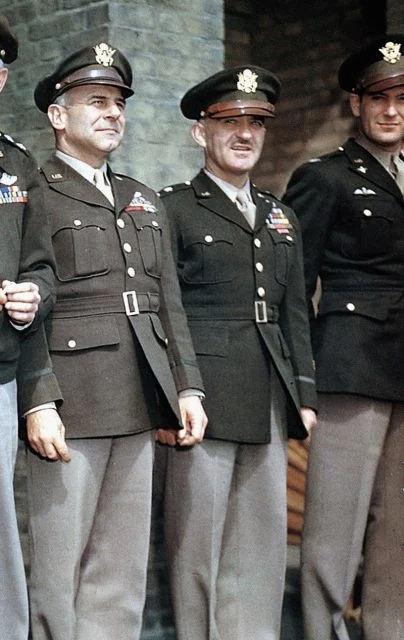
World War II U.S. Army officers wearing the “pinks and greens” uniform.World War II U.S. Army officers wearing the “pinks and greens” uniform
The famous forebear, the ‘pinks and greens’ uniform was brought in in the 1920s and included a Sam Browne belt up until 1942.
In 1944 a field jacket was introduced, which was adopted by Dwight Eisenhower and nicknamed the Ike jacket as a result. A new version of the Ike jacket is also being considered by the Army, along with an option for a leather flying jacket.
At the end of WWII, the US Army was eight million strong and a source of immense pride for a nation emerging as a global power. Sadly, ten years after the end of the war there was a huge surplus of the uniforms as the Army slimmed down.
The new “Army greens” will be a general service uniform while the blue Army Service Uniform (center) will return to its former use as a ceremonial and parade uniform.
The change from the ‘pinks and greens’ to the dress green service uniform came quickly when in 1958 it was ‘deauthorised’ for US Army officers and the National Guard in 1959. Part of the reason for the change was that the uniforms were being used as cheap work clothes for labourers and agricultural workers.
In some states surplus uniforms were even being used to clothe prison inmates, driving the need for change.
SMA Dailey wore the Army’s proposed ‘Pink and Green’ daily service uniform, modeled after the Army’s standard World War II-era dress uniform.
However, seven decades on from WWII the abiding memory of the ‘pinks and greens’ remains one of pride, and the new uniform has received a warm welcome throughout the service, with many commentators welcoming the return of a classic.
Whatever Sergeant Major Dailey says the new ‘glow-up’ will invite comparisons with the famous WWII uniform, taking the Army back to when its status back home in the USA was riding as high as it ever has.
That the new iteration of the uniform could possibly capture some of the pride of 1945 is undoubtedly a target within Army sights.