Webster

The Constitution was made to guard the people against the dangers of good intentions." --American Statesman Daniel Webster (1782-1852)


Showing posts with label historical stuff. Show all posts

Tuesday, September 30, 2025

"Try To Fight A Gurka"


I ran across this article and I really liked it.  My friend Old NFO likes to feature Gurkha's in his Military Science Fiction.  He portrays them as fierce warriors, steadfast soldiers, totally honorable and incorruptible and loyal to their officers and the ideals.  I have known about Gurkha's since I started reading about WWII as a kid and the knife was legendary.


The kukri is effective as a chopping weapon, due to its weight, and slashing weapon, because the curved shape creates a "wedge" effect which causes the blade to cut effectively and deeper. Because the blade bends towards the opponent, the user need not angle the wrist while executing a chopping motion. Unlike a straight-edged sword, the center of mass combined with the angle of the blade allow the kukri to slice as it chops. The edge slides across the target's surface while the center of mass maintains momentum as the blade moves through the target's cross-section. This gives the kukri a penetrative force disproportional to its length. The design enables the user to inflict deep wounds and to penetrate bone.

Utility

While most famed from use in the military, the kukri is the most commonly used multipurpose tool in the fields and homes in Nepal. Its use has varied from building, clearing, chopping firewood, digging, slaughtering animals for food, cutting meat and vegetables, skinning animals, and opening cans. Its use as a general farm and household tool disproves the often stated "taboo" that the weapon cannot be sheathed "until it has drawn blood".
The kukri is versatile. It can function as a smaller knife by using the narrower part of the blade, closest to the handle. The heavier and wider end of the blade, towards the tip, functions as an axe or a small shovel.


Former Field Marshal Sam Manekshaw of the Indian Army once said: “If a man says he is not afraid of dying, he is either lying or he is a Gurkha.” Correct, but what is a Gurkha?
In 1814, the East India Company began making “excursions” into the Kingdom of Nepal, believing the Nepalis would be pushovers. They were wrong. Not only did their invasion hurt their pockets, but it also cost them dearly regarding personnel.
What malaria or desertion did not claim, the Gurkhas did. By the time the Anglo-Nepalese War ended in 1816 with a truce, the British had learned not to underestimate their foe. Quite the opposite, in fact. Others noticed it also, which is why various countries currently regularly recruit Gurkhas.

Originally from the Nepali district of Gorkha, they now come from all over the country. They are renowned for their service in the British Army and have fought in many contemporary wars forming part of the Coalition Forces in Iraq.
They are willing to serve the British (and other foreign nations) due to poverty – an unfortunate state of affairs that still exists today. “Service” does not do justice to what it is they do, which is why many have gone down in legend.

Gurkha soldiers during the Anglo-Nepalese War.

One such man was Lachhiman Gurung, born on December 30, 1917, in the village of Dakhani, Tahani District, Nepal. He was very poor. So much so that by 1940, he stood a mere 4’11” tall as a result of deprivation and malnutrition. Fortunately, he was tough.
Gurung had repeatedly tried to join the British Indian Army. Being so short and puny even by Nepali standards, the authorities had declined. As WWII progressed, the British needed everyone, so the 23-year-old finally joined the British Indian Army in December 1940. What he lacked in size, he more than made up for regarding sheer determination. He earned himself a place as a rifleman in the 4th Battalion, 8th Gurkha Rifles.
In late April 1945, his battalion crossed the Irrawaddy River into Burma (now Myanmar) with the 89th Indian Infantry Brigade of the 7th Indian Infantry Division. Their mission was to attack Japanese positions north of the Prome-Taungup Road.
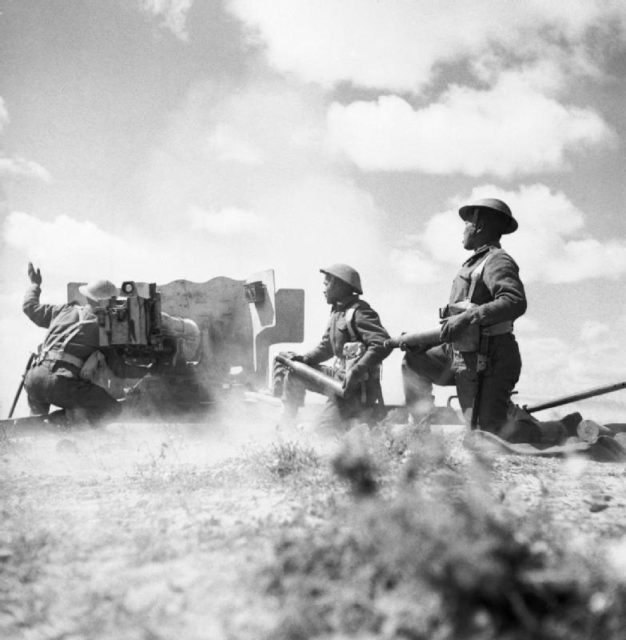


Gurkhas manning a 6-pound anti-tank gun in Tunisia on March 16, 1943
 
The Japanese were taken by surprise and by May 9, were retreating to the village of Taungdaw in northwestern Burma. Lachhiman’s battalion was waiting for them.
Late at night on May 12, most of the 4th Battalion, 8th Gurkha Rifles lay asleep. Rifleman Lachhiman was on guard duty. His small group was in a trench farthest away from the village when the attack came – cutting them off from the other Gurkha positions.
At least 200 Japanese soldiers tried to make their way to Taungdaw. To do so, they first had to pass through Lachhiman’s position. A grenade landed on the edge of his trench. He jumped up, grabbed it, and hurled it back with a satisfying boom!
A second landed in the trench inches away from his foot. He returned that one too. A third landed just outside the trench, so he lunged forward and picked it up as well. As he was about to throw it back, it exploded.
His right hand was pulverized, and his arm shattered while burning shrapnel pummeled his face and right leg. The explosion rocked two other soldiers off their feet sending them crumpling to the ground.
Half-blinded from the blast, his mouth severely bleeding, Lachhiman managed to scream the Gurkha’s ancient battle cry: “Jai Mahakali! Ayo Gorkhali!”
Kali is the Hindu goddess of night, death, time, and destruction. She wears a necklace of severed heads and a skirt of chopped off arms while she tramples her husband (the god Shiva) underfoot. She is not someone to mess with and probably explains why she is the patron goddess of the Gurkhas.
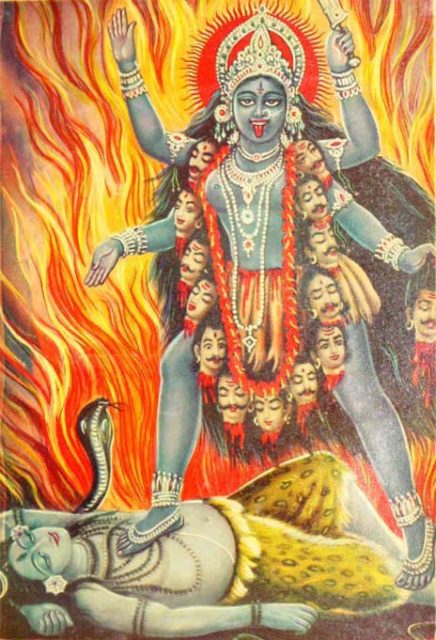
The goddess Kali
 
What Lachhiman shouted translates as “Victory to Great Kali! Gurkhas approach!”
There was only him. All the others were either dead or too badly injured to fight. So he loaded his rifle with his left hand – not an easy task as his standard-issue bolt-action rifle was designed for right-handed use. Despite his wounds, he fired at point blank range each time the Japanese attacked, reloading and repeating the process for four hours.
Exhaustion, shock, and blood loss took their toll, but eventually, his comrades were able to relieve him. For the next three days and two nights, the Gurkhas were on their own, heroically fighting off the Japanese until more Allied troops arrived. The other Gurkhas were inspired by what Lachhiman had done.
When it was over there were 87 Japanese bodies around the trench. Thirty-one of them lay directly in front of the spot Lachhiman had defended single-handedly.
Doctors did their best for him, but could not save his right eye or right hand. Lord Louis Mountbatten, British Admiral of the Fleet, awarded Lachhiman the Victoria Cross (Britain’s highest military award for valor) on December 19, 1945.
Despite his injuries, Lachhiman continued to serve the 8th Gurkhas until 1947 when they were transferred to the newly independent Indian Army. He eventually settled in Britain where he died in 2010 – after successfully fighting the British government for the right for other Gurkha veterans like himself to live in Britain.

                                                                     Monument to the Gurkha Soldier outside the Ministry of Defense Building in London;

Despite his injuries, Lachhiman continued to serve the 8th Gurkhas until 1947 when they were transferred to the newly independent Indian Army. He eventually settled in Britain where he died in 2010 – after successfully fighting the British government for the right for other Gurkha veterans like himself to live in Britain.


                                                                                                    THE GURKHA
                                                                                                     SOLDIER
                                                                                               Bravest of the brave,
                                                                                      most generous of the generous,
                                                                                                  never had country
                                                                                                more faithful friends
                                                                                                          than you.


The treatment of Gurkhas and their families was the subject of controversy in the United Kingdom once it became widely known that Gurkhas received smaller pensions than their British counterparts. The nationality status of Gurkhas and their families was also an area of dispute, with claims that some ex-army Nepali families were being denied residency and forced to leave Britain. On 8 March 2007 the British Government announced that all Gurkhas who signed up after 1 July 1997 would receive a pension equivalent to that of their British counterparts. In addition, Gurkhas would, for the first time, be able to transfer to another army unit after five years' service and women would also be allowed to join--although not in first-line units--conforming to the British Army's policy. The act also guaranteed residency rights in Britain for retired Gurkhas and their families.
Despite the changes, many Gurkhas who had not served long enough to entitle them to a pension faced hardship on their return to Nepal, and some critics derided the government's decision to only award the new pension and citizenship entitlement to those joining after 1 July 1997, claiming that this left many ex-Gurkha servicemen still facing a financially uncertain retirement. An advocacy group, Gurkha Justice Campaign, joined the debate in support of the Gurkhas.
In a landmark ruling on 30 September 2008 the High Court in London decided that the Home Secretary's policy allowing Gurkhas who left the Army before 1997 to apply for settlement in the United Kingdom was irrationally restrictive in its criteria, and overturned it. In line with the ruling of the High Court the Home Office pledged to review all cases affected by this decision.
On 29 April 2009 a motion in the House of Commons by the Liberal Democrats that all Gurkhas be offered equal right of residence was passed by 267 votes to 246. This was the only first-day motion defeat for a government since 1978. Nick Clegg, the Liberal Democrat leader, stated that "this is an immense victory [...] for the rights of Gurkhas who have been waiting so long for justice, a victory for Parliament, a victory for decency." He added that it was "the kind of thing people want this country to do".
On 21 May 2009 Home Secretary Jacqui Smith announced that all Gurkha veterans who retired before 1997 with at least four years service would be allowed to settle in the UK. Actress Joanna Lumley, daughter of Gurkha corps Maj. James Lumley who had highlighted the treatment of the Gurkhas and campaigned for their rights, commented, "This is the welcome we have always longed to give".
A charity, The Gurkha Welfare Trust, provides aid to alleviate hardship and distress among Gurkha ex-servicemen.
On June 9, 2015, a celebration called the Gurkha 200, held at The Royal Hospital Chelsea and attended by members of the royal family, commemorated the bicentennial of the Gurkha Welfare Trust by paying tribute to Gurkha culture and military service
.

Wednesday, November 15, 2023

The Critical Failure that created GPS.

 I saw this article in a 3rd party email and it was a really neat article and a back story.  I am still very busy with work.  I like to blog, but I like to sleep more, LOL.


Navigation Technology Satellite 1

The product of Air Force and Navy programs, the Navigation Technology Satellite 1 launched in 1974.

Credit: Naval Research Laboratory

In a word, I had failed. My presentation to demonstrate a new satellite-based navigation system had been disapproved at the highest level of the Pentagon. The long table in front of my raised platform was populated with more generals, admirals and senior civilians than I had ever addressed. I was a very new colonel and the program director for the U.S. Air Force’s Project 621B. It was August 1973, and I had just briefed a system design I had inherited, requesting approximately $150 million for a full-scale demonstration. I didn’t have time to contemplate my failure. Malcolm Currie, the undersecretary of the Defense Department controlling the military’s research and development funding, had chaired the meeting. Currie immediately asked me to join him alone in his third-floor Pentagon office.


As a U.S. Air Force colonel in 1973, Brad Parkinson inherited Project 621B–a demonstration that led to the creation of the Global Positioning System. Credit: Courtesy of Brad Parkinson

About four months earlier, I had spent 2.5 hr. with him alone in my tiny office at Los Angeles AFB—an astonishing meeting, given the disparity in rank. I explained the tremendous value of a worldwide 3D positioning system. With a Stanford Ph.D. in guidance and control, I understood both the design and technology intimately. The system design could use refinement, but I had felt it would do for a demonstration.

In his office, Currie told me he strongly supported such a system, but he wanted an updated design that would satisfy the needs of all military services, suggesting I use the best technology I could find. He said he felt such a proposal could be approved.

We called that disapproval “Black Thursday,” but in a way, it was Golden Thursday. It led to the Global Positioning System (GPS).

I had been allowed to recruit a superb cadre of young Air Force officer-engineers. All had advanced degrees from outstanding schools. I resolved to call a redesign meeting, far away from potential opponents of change. We held that meeting in the Pentagon over the Labor Day weekend of 1973. The sole attendees were eight of my officer-engineers and two Aerospace Corp. engineers.

Nine years before that, Aerospace Corp. President Ivan Getting had advocated for a new satellite-based navigation system and persuaded the Air Force to fund a classified study of alternatives. This concluded with a description of about a dozen different satellite system designs and capabilities. The most difficult design required four satellites in the user’s view and predicted worldwide 24/7, three-dimensional accuracies of about 10 m (33 ft.). It would use orbiting, hardened atomic clocks. This would become GPS.

A competing Naval Research Lab (NRL) concept, Timation, was also included in the earlier study, six years before the NRL filed for a patent. The patent was finally issued to the Navy in 1974. (Evidently, the NRL was unaware of the earlier secret Air Force study.) That patent described a two-dimensional system that required an atomic clock in each user’s receiver. It was deemed too expensive and inadequate for general use, characteristics that ruled out the NRL concept in our redesign meeting.

Our weekend’s effort was outlined in a decision coordinating paper that summarized the new proposal. Civil use would be enabled by promulgating the details of a “clear” signal. From its inception, we intended to make GPS available for civil use, but with no guarantee on availability.

I then made repeated briefing trips to persuade the decision-makers not to say “no.” By mid-December 1973, I received approval for a $150 million program to demonstrate what we were by then calling GPS.

We went into a wartime development environment and launched the first operational GPS satellite in 44 months. By 1979, all seven types of user equipment had been tested and demonstrated in 11 different vehicles and circumstances. GPS had proven every claim that we had made for accuracy and coverage. It demonstrated bomb delivery and military vehicle location accuracy that far exceeded anything in the military’s inventory.

GPS was clearly a much better “mousetrap,” but the Air Force apparently did not want GPS. The service zeroed out the GPS budget for a series of years in the early 1980s. Fortunately, civilian leadership in the Pentagon and the White House overruled and restored the funding.

Even with the six-satellite test constellation, applications for time transfer to nanoseconds and the Precision Land Survey had begun by 1980. With 24 satellites, GPS was finally declared operational in December 1990. Demonstration of GPS’ value during the wars in Bosnia and Iraq completely reversed the views of the operational military. For the last 30 years, the 2nd Space Operations Sqdn. has been a fully dedicated GPS operator and steward for both civilian and military users worldwide.

Three events greatly accelerated GPS use. In 1983, then-President Ronald Reagan guaranteed GPS to the civilian world. In 2000, then-President Bill Clinton officially abandoned any deliberate degradation of accuracy. During the same period, integrated digital circuits drove down costs and greatly increased capability. Today a $5 GPS receiver can simultaneously receives more than 60 channels of GPS as well as the European, Russian and Chinese versions of global navigation satellite systems (GNSS). Typical accuracies are a few meters.

These three foundations assured civil GPS availability with full accuracy and with both the signals and receivers virtually free. They accelerated GPS adoption. Essentially every element of the U.S. critical infrastructure now depends on GPS. In 1978, I had forecast many applications, but the markets and manufacturers have far exceeded our dreams. The annual economic benefit has been estimated at well over a trillion dollars, without accounting for safety-of-life benefits. The farm tractor market alone is now $2 billion per year, with driverless control accuracies to a few inches.

However, the ubiquitous dependence on GPS has created concerns. A UK study estimated the economic impact to the country of a five-day disruption to GNSS would be £5.2 billion ($6.5 billion).

Perhaps the greatest technical reason for concern is that the received GPS signal power is tiny—just 1/10th of a millionth of a billionth of a watt (10-16 watts). (This signal comes from 45-watt satellite transmitters located 11,000 nm away.) Consequently, the weak GPS signal is vulnerable to deliberate or inadvertent interference. Some users have sought augmentations by using satellites at lower altitudes or ground-based radionavigation systems. Such efforts are understandable, but the U.S. National Space-Based Positioning Navigation and Timing (PNT) Advisory Board has cautioned: “No current or foreseeable alternative to GNSS [primarily GPS] can deliver equivalent accuracy, integrity and worldwide 24/7 availability.” They advocate protecting the signal and toughening the user’s receivers to mitigate interference.

The single most effective toughening against GPS interference and false signals is the use of multi-element digital antenna arrays (DAA), which create “nulls” in the direction of jammers to greatly reduce their effectiveness. In 1975, I anticipated the jamming issue and enlisted the Air Force’s avionics laboratory to develop a GPS receiver that would demonstrate all the receiver techniques to counter jamming and spoofing. They partnered with Collins Radio, and by 1978 they demonstrated a GPS receiver that could operate while flying directly over a 10-kW jammer.

Unfortunately, State Department International Traffic in Arms Regulations (ITAR) preclude use of DAAs with more than three antenna elements for nonmilitary applications. While well-intentioned, the underlying design and technology of DAAs have been published extensively over the last 50 years, rendering this ITAR restriction ineffective in preventing their proliferation. For example, Turkish company Tualcom currently offers a 16-element GPS antenna for any application or customer worldwide. Tualcom says it increases jam resistance by a factor of over 100,000. And with the advent of cheap digital components, arrays of up to 91 elements with about 1 m diameter have been considered.

The purpose of the ITAR restrictions—to withhold knowledge and technology from potential enemies—is totally futile, since both theory and implementation are widely available worldwide. By disallowing our use of these technologies, the government simply denies access to them by U.S. civil aviation and other key users. Unlimited DAA use could make these applications nearly immune to hostile or inadvertent interference. The ITAR restrictions certainly do not limit potential enemies. There is some evidence that the Russians are employing DAAs in the drones that are overflying Ukraine.

The world now has three other GPS clones. Civilians can freely use up to 10 signals on four frequencies from the four GPS-like constellations. Fifty or more navigation signals are typically accessible. All these developments would benefit from DAAs. These foreign systems clearly have a goal of surpassing the U.S. GPS.

Despite vulnerabilities, worldwide GPS applications continue to proliferate because of the economic productivity, safety and usefulness they offer. Many billions of cell phones routinely provide users with location to a few meters.

The 50th anniversary of GPS’ initial approval is an occasion for celebration but also a time to prepare for the future. The most important step is for the U.S. government to rescind all restrictions on DAAs. These restrictions are totally ineffective in preventing widespread proliferation of the best technology to toughen GPS against all forms of signal interference. Failure to rescind the restrictions will simply widen the gap, with other countries continuing to advance the well-understood state of the art and condemning U.S. aircraft to susceptibility to GPS jamming.

Perhaps the ultimate tribute to GPS is that knowledge of position is “taken for granted,” and billions of people worldwide use the system each day. Engineers accept anonymity as part of our profession; such widespread use is the cherished payoff for us developers. But “taken for granted’ will be misplaced if the U.S. does not remove the fetters on our receiver industry.

Brad Parkinson is co-director of the Stanford University Center for Position, Navigation and Time

Wednesday, October 14, 2020

The 8 worst Military Leaders in History.


There is something about putting an inspiring leader in charge of an operation and a disaster


General Norman Schwartzkopf

I am using General Schwartzkopf as an example of an inspiring leader, he was "My General" when we went to war in the Gulf and he was adamant that we would not make the mistakes that we made in  Vietnam.  he was a veteran of that war and swore that we would not make the same mistakes again, his attitude was that "we are entrusted with the Sons and Daughters of America and we will not squander them, we also have the prestige of the United States of America on the Line."  We were fighting the "Vietnam Syndrome", it was a buzzword that was bandied about whenever Military action was mentioned, usually by the left, I heard the word a lot.  One of the changes was,  they went away from the "individual replacement policy" so there was no more *FNG*'s, you were there for the duration.  You went to war with your unit, your unit went in, and your unit would leave, we had gone to the Regimental system trying to bring stability to the system so there wasn't so much "churn",  Also there were no " kill zones" where each service had their own area of responsibility, that went away, everything was shared, nothing was split.  If a Marine unit called for assistance, it wasn't Marine air that answered, it was Army air kinda thing.  and vice versa.  What ever was available was on call to the FAC's.  We went in to win, no graduated response. total "Shock and Awe".  Saddam Hussain expected his battle tested army to win because they have been fighting Iran for 8 years, but we were on another level, and he couldn't defend against the combined arms.

*Fucking New Guys*   The new guy in a unit, the life expectancy of a newbie was really bad, if he happen to survive the first 2 weeks and glom in with a couple of veteran soldiers, he had a chance to survive his 1 year in Vietnam and rotate home, this was the crime of the rotation system.  Something that was changed by the "Regimental System" instituted in the 1980's to prevent such things of a new guy being alone and and going to war and possibly dying alone without knowing his buddies. 

Publius Quintilius Varus

A relative of the Roman Emperor Augustus, Publius Quintilius Varus served as military governor of Syria before being transferred to crush a rebellion in Germany. He was lax regarding discipline and training and held his position due to nepotism, not skill.

In 9AD, Varus led his forces through the Teutoburg Wald, a forested region full of rebels. He did not keep his troops alert or ready for battle and allowed many civilians to travel with them.

Ambushed by Germanic tribes in the forest, Varus and his army were cut off and surrounded. Over the course of the extended battle, a tenth of all the legions then serving Rome were lost.

Unable to find a way out of the situation Varus committed suicide in the field rather than be captured. Many of his officers followed suit, leaving their troops leaderless.


King Edward II

One of the least capable monarchs to sit on the throne of England, Edward II was a weak and indecisive leader. Unable to keep his nobles in line, he invaded Scotland without the backing of the influential, Thomas of Lancaster, his cousin. At Bannockburn, his subordinates squabbled over leadership roles before assaulting the Scots on the ground of his enemy’s choosing. The English, who had been so strong a generation before, were utterly routed. 

Edward retained the throne for 20 years as a result not of his skill but due to the equally inept opposition of Thomas of Lancaster, a man even more petulant and ineffective than himself.


Detail of Edward's tomb. Photo Credit
Detail of Edward’s tomb. 

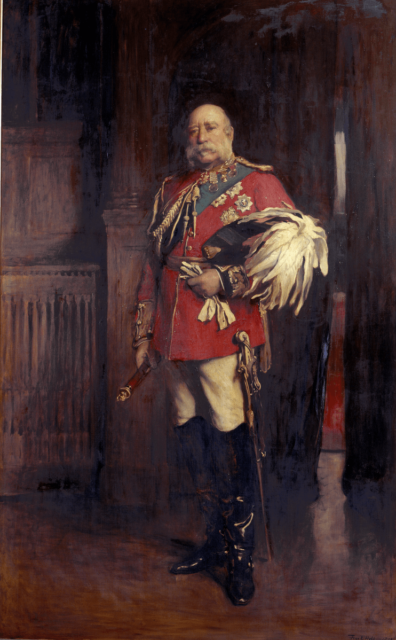
The Duke of Cambridge

A British aristocrat and relative of Queen Victoria, the Duke of Cambridge was Commander-in-Chief of the British Army throughout much Victoria’s reign, leaving the post in 1895. Conservative to the point of incompetence, the Duke disliked all forms of reform. As wars in Europe and America proved that modern technology was changing the face of battle, the Duke refused to accept that change.

To the Duke, leading was just something people did, and he condemned any officer who studied the art of military command. Thanks to him, 50 times more military literature was written in the German language as it was in English by 1900. The British suffered an enormous intellectual disadvantage.

The Anti-Reformer: HRH Prince George, Duke of Cambridge, George William Frederick Charles (26 March 1819 – 17 March 1904)

George Armstrong Custer

No account of history’s worst leaders would be complete without the infamous General Custer.

A veteran of the American Civil War, Custer was a braggart and self-publicist who repeatedly refused to follow orders. He wore a flashy uniform of his own design. When not on campaign, he courted politicians and newspapers, building up his reputation.

While Custer was brave, he was also headstrong. When he was not given command of the campaign he was sent on in 1876, he followed his own path. Ignoring the advice of scouts and refusing to wait for the rest of the army to catch up, he split his small force and led a few hundred US cavalrymen against thousands of Sioux and Cheyenne warriors.

It was a disaster. Custer and his men were massacred with no gain. The resulting legend as a glorious last stand was a tribute to Custer’s popularity in the press, not his ability as a commander.

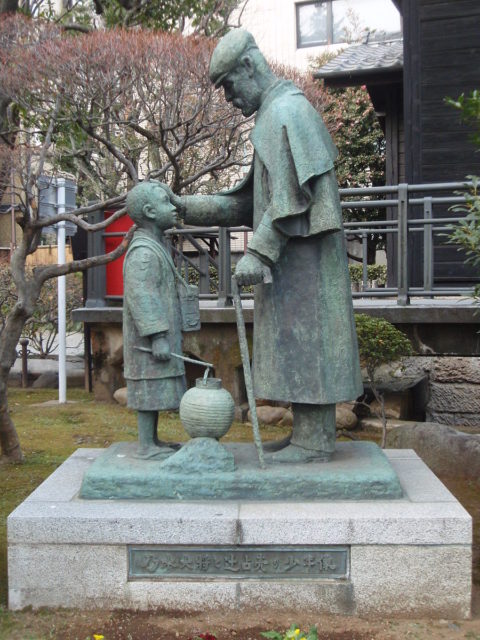
General Nogi Maresuke

Statue of General Nogi and Tsujiurauri-boy
Statue of General Nogi and a boy. 

General Nogi is rare among disastrous military commanders in that he recognized his failings.

In 1904, during the Russo-Japanese war, Nogi was put in charge of the Japanese effort to take Port Arthur. He began by sending thousands of men against the Port’s defenses. However, he had mistaken concrete and steel fortifications for windowed glass houses and his men were massacred. This single assault cost 16,000 Japanese casualties, and the numbers grew over the following months.

Despite calls for him to be sacked, Nogi remained in charge until the Port was captured. He never recovered from the shock and shame of all those losses. He spent huge amounts of money supporting wounded soldiers and later committed suicide in atonement for his failings.

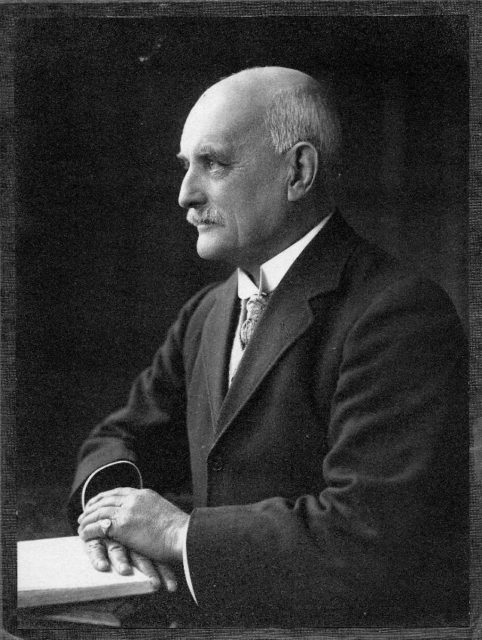
Major-General Aitken

Arthur Aitken
Arthur Aitken

In charge of a British expedition to East Africa early in the First World War, Aitken was a disaster as a leader. A racist leading Indian troops against German opponents, he showed scorn for his men and constantly underestimated the enemy. He lost the element of surprise by sailing close to the coast, acted so slowly the Germans had plenty of time to prepare, and at first refused to bombard his target because he wanted to take it in one piece. The result was a crushing failure known as the Tanga fiasco.

General Hajianestis

Greek general Georgios Hatzianestis (1863 – 28 November 1922)

When Greece went to war with Turkey in 1921, they appointed General Hajianestis to lead the campaign. A politician rather than a soldier, Hajianestis used his yacht at Smyrna as his headquarters, so he could command in comfort and visit local restaurants.

Hajianestis was mad as well as decadent. He spent periods of time lying still, convinced he was dead. At other times he believed his legs were made of glass and would shatter if he got out of bed. Even when sane, his orders were a contradictory mess.

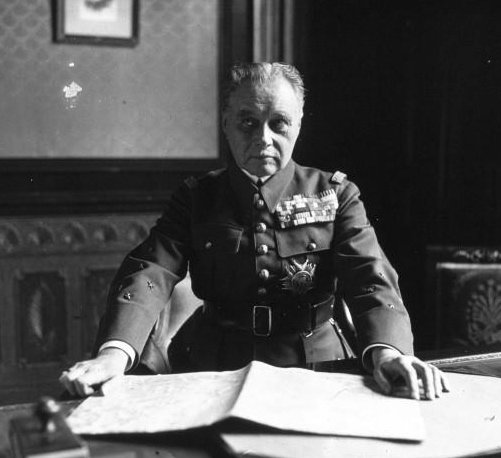
General Maurice Gamelin

gamelin
Maurice Gamelin

Before the Second World War, French General Maurice Gamelin was admired by allies and opponents. A First World War veteran and head of the French General Staff, he modernized and mechanized the army.  The French Tanks were one on one better than the German Tanks, but they used them in support of infantry whereas the Germans used the Tanks as a Separate and distinct arm of the Wehrmacht.  

Not all of Gamelin’s modernizing efforts were effective. He oversaw the creation of the Maginot Line, a hugely costly and flawed defense system which would only work if the German’s did not think to outflank it, and they Did....through the Ardennes....and the Low country.

Gamelin had neurosyphilis, symptoms of which include lapses in concentration, memory, judgment and intellect. He suffered from paranoia and delusions of grandeur. His flawed planning and conservative leadership let Germany take the initiative throughout the start of World War Two. Opportunities were missed, the French were driven back, and the Battle of France was lost. Gamelin sacked twenty front line commanders rather than take the blame but was ultimately captured by the Germans.

Wednesday, August 26, 2020

South Korean Soldiers in Vietnam during the War

I remember My Dad talking about the South Koreans in Vietnam, some background, My Dad spent 2 tours in Vietnam, he was "El-CID" his first tour with the 25 Infantry Division and a CID agent attached as a corp asset his second tour.   In 1968 he told me more than once while he was over there that the Koreans were very effective and deadly and took no shit from Charlie and was feared for their combat effectiveness, he commented that the Capital division was particularly effective for its size.   He told me about driving up there to trade beer and Rations with the Korean CID agents in II Corp in 1972, he commented that their rations were "spicy" that's how he developed his taste for Kimche and other delicacies that he passed on to me :).  They were virulently anti communist and had no compunction about going bayonet to bayonet with the VC and the NVA.   I also dug into it that in the beginning that they were very effective in the beginning of the war but toward the end of the war, they were not so effective and switched from offensive to defensive operation and some atrocities were tied to their participation and blamed on the Koreans, he did tell me and  that there were a difference, if an American patrol or convoy got shot at and people were killed or wounded near a village we wouldn't do nothing about it by our rules of engagement, with the Koreans, it was different, if their people were wounded or killed near a village , the Koreans would go and wipe out the village, people, pigs, water buffaloes, everything for harboring the VC or the NVA.  They operated by different rules then we did and for that reason were feared.   They also shipped all the expended  artillery brass back to Korea where it was reused by their industry apparently.  They were Staunch allies as friends and brutal mother fuckers as enemies.


On the night of February 13-14, 1967, the 11th Company of the 2nd South Korean Marine Brigade was occupying a position near the village of Trah Bin Dong in Quang Ngai province, South Vietnam. Its oval-shaped base was dotted by bunkers and trenches; the lines of thick barbed wire to the front were laced claymore mines. In front of the tough South Korean marines lay a line of hills from which the communists attacked Highway 19 and coastal Highway 1. Rather than go into the hills after the communists, the South Korean marines set a trap—with themselves as bait.
The communists regularly harassed the South Koreans but did not attack them directly until that night. Two Vietcong regiments, the 1st and 21st, came out of the hills under cover of heavy mortar fire and hit the base from all directions. The South Koreans delivered devastating return fire from their bunkers with machine guns and mortar rounds dropped at point-blank range. As the communists closed, the outnumbered South Koreans fought hand to hand, refusing to surrender their positions. Some marines dismantled their heavy machine guns rather than let them fall into enemy hands. One wounded man refused to be taken alive and pulled the pins on a pair of grenades as the communists entered his bunker.
Led by their commanding officer, Captain Chung Kyong Gin, the South Korean marines eventually pulled back and allowed several hundred Vietcong to break into the camp. Chung sent two squads to plug the gap. He then ordered the rest of the marines to fix bayonets and close with the now trapped enemy, killing more than 100 inside the camp. By 0730 hours, the marines had cleared their base and chased the communists back into the jungle. American Marine Douglas A-4 Skyhawks punished them as they withdrew.
In all, 254 communists were killed in the assault compared to 15 South Koreans deaths. For his outstanding leadership, Chung was awarded South Korea’s highest honor. In the aftermath of the fight, word of the 11th Company’s deeds spread throughout South Vietnam. Even South Vietnamese President Nguyen Van Thieu stopped by for a visit. The entire company was promoted one rank. Later, the Koreans received a Presidential Unit Citation for their actions at Trah Bin Dong.

In 1964, as the communist effort in Vietnam grew more intense, the South Vietnamese government made a formal request to the Republic of Korea for military assistance. Actually, the ROK government had offered to send help as early as 1954 but was turned down. The first Korean units arrived in Vietnam in February 1965 in a brigade group called Dove Force. These included engineers, a MASH unit, military police, a navy LST, liaison staff, and other support personnel. Dove Force was deployed to the Bien Hoa region of South Vietnam, where it engaged in counterinsurgency activities. Engineering units built schools, roads and bridges. Medical teams treated over 30,000 South Vietnamese civilians.
As the communist presence in South Vietnam grew and the situation in the countryside worsened, the United States sought to spread the burden to other allied nations. Accordingly, the administration of President Lyndon B. Johnson asked the South Korean government if it would be willing to contribute a combat division. After meeting with President Johnson in June 1965, Korean President Park Chung Hee agreed to his request. There was considerable negotiation and haggling between American and South Korean authorities over several issues. The South Koreans insisted that their troops answer only to their own officers. The two sides eventually agreed that South Korean officers would exert tactical control over their units but would subordinate themselves to the senior American officer in a combat zone. South Korean units would also ultimately answer to General William Westmoreland, overall commander of U.S. forces in Vietnam.
The South Korean government sought several other concessions, including combat pay for their soldiers (at American expense), military equipment for South Korean reserve units, and a guarantee of American force levels in Korea. American authorities agreed to the terms, and on August 19, 1965, the South Korean assembly authorized the deployment of combat troops to Vietnam. The deployment began that autumn and included the Capital (Tiger) Division and the 2nd Marine Brigade, the Blue Dragons. By the end of the year, more than 18,000 South Korean troops were in country.
In 1966, the South Vietnamese government requested more troops from the Republic of Korea. After further negotiations, the 9th (White Horse) Division was deployed to Vietnam as well, bringing the total strength of South Korean forces in Vietnam to nearly 45,000 men. On the recommendation of General Westmoreland, Chae Myung Shin, the commander of the Capital Division, formed a corps headquarters under his command out of Nha Trang. General Lew Byong Hion (later the South Korean ambassador to the United States) took command of the Capital Division.

South Korean divisions were organized along similar lines as the Americans. They featured three regiments, four artillery battalions, an engineering battalion, and several supporting units such as MPs, signals, and reconnaissance. The first South Korean combat formation in Vietnam, the Capital (Tiger) Division, was formed in 1948 and saw extensive action during the Korean War. The Capital Division survived the initial North Korean onslaught, fought on the Pusan Perimeter, and later participated in General Douglas MacArthur’s celebrated counterattack.
Upon the insistence of Korean President Park Chun Hee, soldiers deploying to Vietnam would be volunteers. Both he and the military wanted to demonstrate to the Americans and the world, through the army, that South Korea had come of age and was no longer wholly dependent on the Americans for its defense. The very best of the army were plucked from their units and assigned to the Capital Division. Enlisted personnel were given special incentives to volunteer, including higher pay and credit for three years of military service. President Park personally selected senior officers.
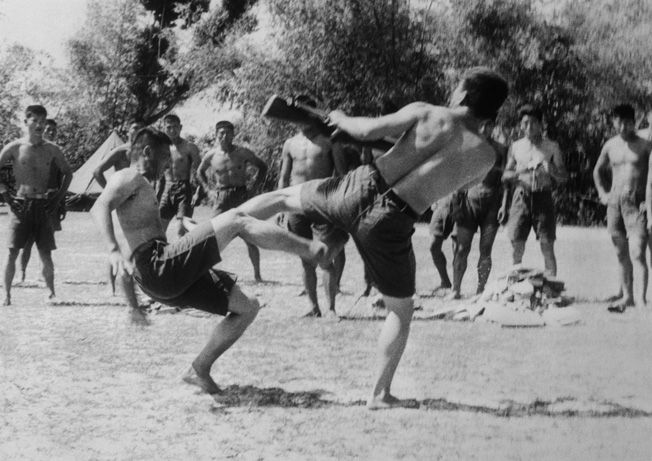
Korean soldiers were highly motivated. Because of their own struggle with Stalinist North Korea, they hated communists. They were also tough. Each man was trained in the art of tae kwon do, with 30 minutes’ practice forming an integral part of morning physical training. They were also subjected to harsh discipline. Two soldiers who raped a Vietnamese woman were executed before their company.
The South Korean soldier was also feared by the Vietcong. Time magazine reported in 1966, “Captured Vietcong orders now stipulate that contact with the Koreans is to be avoided at all costs—unless a Vietcong victory is 100 percent certain.”


Koreans in the 2nd Marine Brigade, the Blue Dragons, practice Tae Kwon Do during a morning exercise near Qui Nohn, South Vietnam, in April 1966.
The South Koreans felt better able to conduct counterinsurgency operations than the Americans. Despite the language barrier, Korean soldiers were dealing with people they considered fellow Asians whose culture they understood better. They shared Buddhism and similar dietary habits; both consumed rice prodigiously. Korean soldiers did their best to interact with the local population. They attended Buddhist religious services, ran medical clinics, and repaired damage inflicted on people’s homes. Even so, a 1968 evaluation conducted by the Americans criticized some aspects of the South Koreans’ pacification efforts, saying they were too focused on pursuing the Vietcong at the expense of building civil organizations.
South Korean troops did not always conduct themselves correctly. As in any war, civilians in South Vietnam suffered grievously. In one notorious incident, South Korean troops searching the village of Tho Lam murdered 46 civilians after a booby trap killed four of their comrades. South Korean documents indicate that as many as 8,000 Vietnamese civilians were killed by their troops from 1965 through 1973. In an interview given in 2000, General Chae admitted that his men killed civilians but blamed it on what he called “battlefield rage” and “the uncertainties of war.”

The first year of operations for the South Koreans was a huge success. The Capital Division established government sovereignty over large swaths of the province, opening up Highway 19 and Highway 1 north to Phu Cat Mountain. In the field, they killed more than 3,000 Vietcong and captured nearly 600 in return for 290 South Koreans killed. In conjunction with the American 1st Cavalry Division and ARVN (Army, Republic of Vietnam) forces, the Capital Division gradually pushed NVA (North Vietnamese Army) forces off the mountain, securing it by the end of the year. The U.S. Army called the attack “extraordinarily thorough and effective.”
To the south, the Blue Dragon Brigade moved from its initial area around Cam Ranh Bay down the coast to Tuy Hoa in Phu Yen Province, a rice-producing region of about 70,000 people. Tuy Hoa had been infiltrated by elements of the North Vietnamese 95th Regiment, which relied on the farmers for food and shelter. The Blue Dragons worked for several weeks with the 1st Brigade of the American 101st Airborne Division. In Operation Van Buren, the American paratroopers and South Korean marines spent a month clearing Tuy Hoa of communist infiltrators. Over 33 days, 54 Americans and 45 South Koreans were killed, in exchange for 679 communists. Together, they secured the harvest of 30,000 metric tons of rice. At the conclusion of the operation, the American paratroopers left and the South Koreans took sole responsibility for the area.
Like the Capital Division and the Blue Dragon Brigade, the 9th (White Horse) Division saw its share of combat in South Vietnam. The 9th Division gained its nickname in 1952 after its successful action against communist forces at the Battle of White Horse Mountain. In 1966, the White Horse Division was deployed to the Ninh Hoa region, Dar Lac Province, where Highway 1 met Highway 21. In addition to maintaining a presence in the province and opening up Highways 1 and 19, the White Horse Division contributed its 29th Regiment to the defense of the Ninh Hoa airbase and the 30th Regiment to the defense of Cam Ranh Bay. The 28th Regiment was deployed to Tua Hoa.
The White Horse Division was busy in 1967. In addition to its normal counterinsurgency activities, the division participated in several offensive operations, including Operation Oh Jac Kyu, a surprise attack against the 95th NVA Regiment in Phu Yen Province. The operation spoiled a planned communist offensive. Later that year, the White Horse and Capital Divisions conducted operation Hong Kill Dong, also in Phu Yen Province, and fought dozens of actions against the communists. In one engagement on July 27, the South Koreans killed 32 Vietcong. Two days later, the South Koreans killed another 18. In three weeks’ time, South Korean forces swept the province and killed more than 400 NVA and Vietcong. The White Horse Division had similar success the next year in Operation Baek Ma 9. In one notable battle fought on October 25 (the anniversary of the division’s founding), the White Horse soldiers killed more than 200 Vietcong without a single loss to themselves.

About that time, General Westmoreland asked the South Korean Army to contribute a battalion to the U.S. Army’s Operation Lincoln, an effort to seal off the Cambodian border. After some haggling, in which Chae got the United States to agree to send new radio sets and supplies, Chae detached the 3rd Battalion (Tiger Regiment) for the task.
In June, the 3rd Battalion left its base along the coast and took up positions along the Cambodian border. Two companies were arrayed across the front, with a third held in reserve. Each company built a well-fortified base featuring interlocking fields of fire, inner and outer trenches. The bases were stocked with three days’ worth of ammunition. The 3rd Battalion operated there for the rest of July, conducting hundreds of reconnaissance missions and ambushes.
In early August 1967, the 9th Company was occupying a position a few miles from the border, where it had also been reinforced by an American armored platoon (1st Platoon, 1st Company, 69th Armored Regiment). The recon elements encountered signs of Vietcong movement in the area, including footprints. The next day, they found four dead Vietcong, killed by a booby trap set by the South Koreans. The 9th Company stayed on alert that night with its 2nd Platoon manning the trenches. After midnight, soldiers reported sounds of movement in the jungle. Not long afterward, a mine exploded. The 2nd Platoon’s leader reported the signs of movement, but the company commander was skeptical that these represented a major Vietcong attack and took no action.


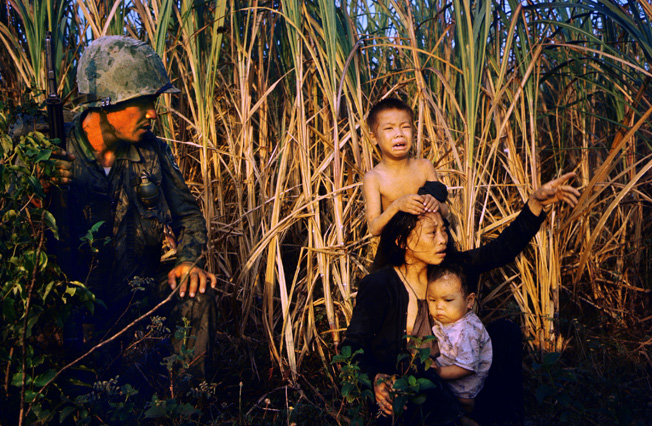
A soldier in the Korean 9th (White Horse) Division encounters a frightened Vietnamese woman and her children on patrol north of Bon Son in 1966.
Just before 0100 hours, the wood line came alive with small arms and machine-gun fire. The base was also subjected to a heavy mortar barrage, which wounded two platoon leaders and hit the command post, wounding Captain Kang. The old company commander, Captain Lee, who was still with the 9th, took command. After directing artillery fire against several suspected enemy concentrations, Lee ran from the CP, joined his men in the trenches, and ordered them to fight to the death. The Vietcong emerged from the woods and attempted to envelop the base, with the main blow falling on 3rd Platoon in the base’s southern sector.
As the Vietcong closed, South Korean soldiers tossed grenades and fixed bayonets. American tanks lashed away at the enemy, pouring fire into their ranks as they moved across no-man’s-land. The combined fire turned back the communists. The Vietcong tried again minutes later, but met a similar fate. At 0400 hours, they shifted their axis of attack against 2nd Platoon, which was facing west northwest and managed to advance as far as the barbed-wire perimeter. By dawn, the enemy was in full retreat, pursued by the 10th and 11th Companies. Lee and his men counted 184 communist bodies and several prisoners.

While the Vietnam War is often remembered as a purely American effort, U.S. forces were not alone. They were accompanied by units from allied nations such as Australia, New Zealand and, most importantly, South Korea. Throughout the Vietnam War, South Korean troops were an integral part of the American effort in South Vietnam, conducting pacification and counterinsurgency operations and fighting countless pitched battles against Vietcong and NVA troops. South Korean units were as tough and professional as any in the United States Army or Marines, and came to be justly feared by the communists. More than 300,000 Korean troops passed through Vietnam at some point, and more than 5,000 were killed.

Saturday, April 18, 2020

The Last Naval Battle of WWII

I had run across this story a while back from a website called "Navy General Board", and it has a lot of historical stuff from the age of sail to present that Old AFSarge would like and old NFO has experienced.  It has been in draft form for a while, I decided to dust it off, I am working on another blogpost but it ain't ready and I already had a couple of days of no posting on my blog because real life has kept me really busy,  So with out further Ado....

What was the last naval battle of World War II? When was the last battle between sailing ships? When was the last time that the United States boarded an enemy ship in combat? Would you be surprised if all three of those things occurred simultaneously? In today’s article, we look at one of the most bizarre naval battles of all time.
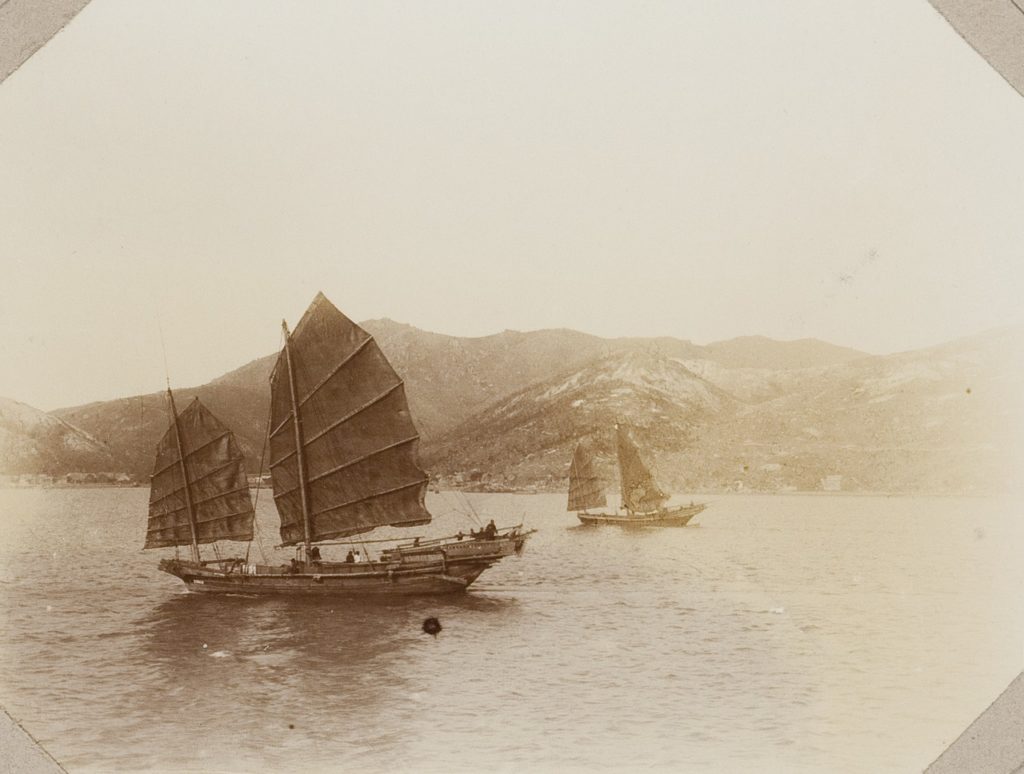
Navy Lieutenants Livingston Swentzel Haimen and Stuart Pittman were traveling to Shanghai, China from Haimen, China. They were each in command of a Chinese junk. All together, the ships were manned by seven Americans and twenty Chinese soldiers.
last naval battle of world war 2
A typical Junk . The basic design has remained largely unchanged for hundreds of years.
The journey was largely uneventful until August 21, 1945 when they spotted another junk off in the distance. Upon noticing the American ships, the mystery Junk immediately came about and opened fire. This junk was crewed by five Japanese officers and seventy-eight enlisted men. It was also heavily armed with a 75mm pack howitzer, six machine guns, and over one hundred rifles. The Japanese opened fire with the howitzer first and then followed up with machine gun fire.
The first howitzer round struck Swentzel’s junk, cutting down its foremast. The crew began to panic, but Swentzel took over the helm and rallied his men. Both of the American junks had radio equipment and Swentzel was able to coordinate with the other junk and prepare for a counterattack. Luckily, the American ships were armed as well. Between the two ships, they had two bazookas, one .50 caliber heavy machine gun, one .30 caliber light machine gun, several rifles, and grenades.
last naval battle of world war 2
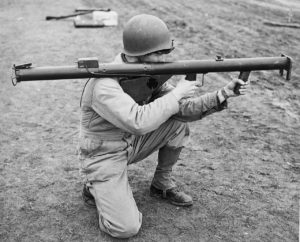
A standard M1 Bazooka of the United States Military. This was the heaviest weapon available to the crews of the Allied Junks.
An American soldier using a Bazooka on a firing range. The weapon had a 3.5lb warhead and a range of about 400 yards (Effective range: 150 yards) at best.

Running up the American flag, Swentzel was able to bring his ships within 100 meters of the Japanese junk. Pressing the attack, the Americans opened fire with their bazookas while the Japanese returned fire with their howitzer. As the ranges decreased, the machine guns also opened fire. Within forty-five minutes, the Americans had exhausted all of their bazooka ammunition, but managed to silence the Japanese howitzer. Machine gun ammunition was also running low. After considering his options, Swentzel brought his junk alongside the Japanese junk and gave the order, “Prepare to board!”
last naval battle of world war 2
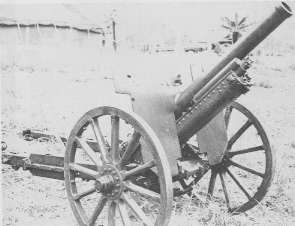
A Japanese Type 1935 75mm mountain gun. This was likely the type of weapon used by the Japanese junk.


As the American junk closed with the Japanese junk, the Americans and Chinese tossed several hand grenades on the enemy ship’s deck. The blasts cut down any remaining Japanese soldiers, leaving only the wounded behind. The junks finally came alongside one another and allied boarders leapt aboard armed with rifles, knives, and any other tools available. They quickly subdued the remaining Japanese solders on deck and moved to secure the rest of the ship.Japanese soldiers were still resisting below decks. Several more hand grenades were tossed into the hatches. This appears to have finally convinced the Japanese holdouts to surrender.
When the smoke cleared, the Japanese ship was littered with the dead and wounded. Of the eighty-three Japanese crewmembers, forty-four were killed and another thirty-five were wounded. The Allies fared much better. Of Swentzel’s crew, only four lost their lives and six were wounded.
The American and Chinese took over the ship. The Japanese survivors were treated and secured. The American ships decided to return to Haimen to turn the Japanese prisoners over to the Chinese authorities.
Swentzel was later awarded the Navy Cross for relentlessly pressing the attack against overwhelming odds. His actions were in accordance to the highest traditions of the United States Navy. Between combat by sailing ships and the boarding of a hostile vessel, Swentzel’s actions likely mirrored the traditions of the Navy at its founding. The last naval battle of World War II was in many ways its most remarkable

Thursday, September 12, 2019

Russia declassifies documents relating to the Ribbentrop-Molotov Non aggression Pact of 1939

I have blogged a lot about Stalin and Hitler because I like History, and I believed that both formed a pact for their own reasons, Hitler wanted to invade Poland, then turn his attention to France without worrying about Stalin being froggy at his back.  Stalin signed the pact, besides getting a chunk of Poland, they also had a free hand with the Baltic republics with the world distracted by other events.  And he also needed to buy time to rebuild the Red Army after the purges of 1937.  This was verified when during the "Winter War" when the Soviets invaded little Finland and got their noses bloodied by the Finns when the poor performance of the Red Army was shown to all the world.  The signing of the pact shocked the world because National Socialism and Communism were not compatable and people were expecting a clash of Titans.


Prior to World War II, the USSR Soviets and the  Nazis signed a non-aggression pact. Historians say that the agreement cleared the path for WWII to begin. The Defense Ministry in Russia has just declassified documents relating to that agreement.
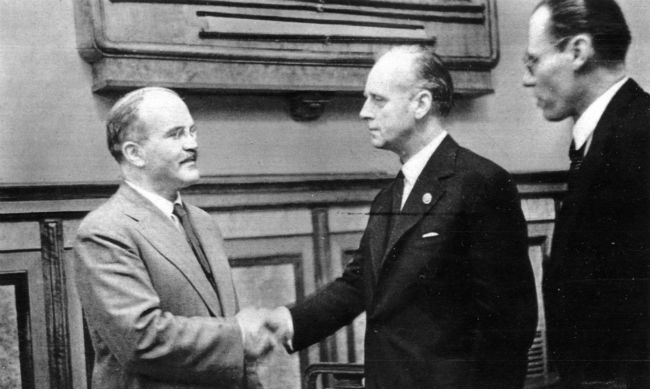
The Molotov-Ribbentrop Pact was signed on August 23, 1939. Along with the non-aggression pact The two countries agreed to separate Finland, Estonia, Lithuania, Latvia, Romania and Poland into two “spheres of influence” controlled by the USSR and Germany.
This ensured that The Red Army would not interfere in Germany’s invasion of Poland which began the war.
The Nazi-Soviet Pact was a  pact between Nazi Germany and the USSR. Also known as the Molotov-Ribbentrop Pact, the agreement was signed in Moscow on 23 August 1939. Also known as the  non-aggression pact.
The Defense Ministry decided not to release the documents in chronological order. They say that the order the documents are released in will give readers “the most complete picture” of how the two sides came to sign the agreement.
The Ministry highlighted a 31-page memo from a Red Army chief of general staff, Boris Shaposhnikov. According to the ministry, this document will change the prevailing views of why Russia signed the pact.
The 1938 memo discusses the Soviet’s need to prepare for battle both against Germany and Poland and also against Japan. It raises concerns about the vast number of troops, tanks and warplanes that the Germans could deploy against the USSR on the Belarussian-Ukrainian border.
President Vladimir Putin, speaking in 2014, said that the Molotov-Ribbentrop Pact was the Soviet response to being isolated by the Western countries and having its peace efforts rebuffed by the West.
Alexander Dyukov, of the Russian Academy of Science, called Shaposhnikov’s dispatch a key to studying military history. Sergei Kudryashov, a researcher with the German Historical Institute in Moscow, found the document to be uninformative and only interesting in how it illustrated Soviet understanding of the conditions just before the war.
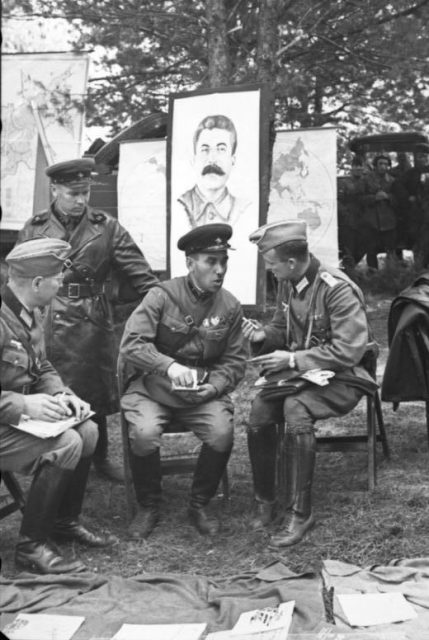
German and Soviet soldiers meet in jointly occupied Brest.

The Defense Ministry said that the motivation behind releasing the documents was for the purpose of protecting the truth and to keep others from trying to revise history.
The USSR had attempted to come to terms with Britain and France for a collective security agreement against Germany. By 1939, with the likelihood of reaching an agreement with the two countries, Moscow felt the need to change their policy in order to avoid fighting Germany on their own.
Joseph Stalin fired his foreign minister, Maksim Litvinov, a Jew who sought collective security. Litvinov was replaced with Vyacheslav Mikhaylovich Molotov who almost immediately began negotiating with the Nazi foreign minister, Joachim von Ribbentrop.
Stalin continued to negotiate with France and Britain until he finally decided to sign the pact with Germany. He hoped to avoid conflict with Germany until the Red Army could be built back up following a purge of officers in 1937.
For Hitler’s part, a nonaggression pact with the Soviet Union freed him to invade Poland with no resistance from the Red Army. Following the occupation of Poland, Germany would be free to engage France and Britain without opening another front with the Soviets.
Publicly, the pact prevented either side from attacking the other, from assisting any country that attacked the other, not to join any group that threatened the other.
And to consult with each other in any matters that affect the two parties, and to solve all differences between the two countries through negotiation and arbitration. The pact was to last 10 years with an automatic renewal for 5 more years unless either party gave notice to terminate a year before it expired.
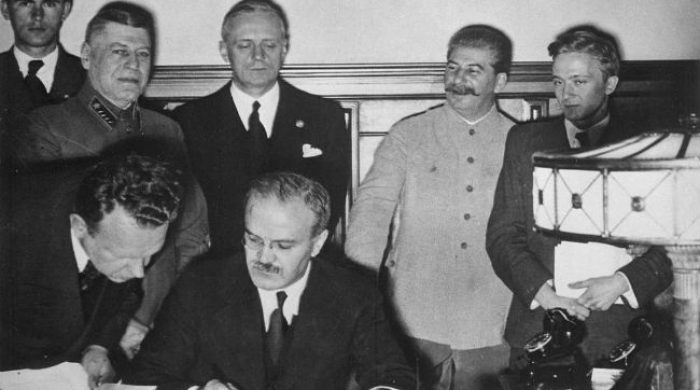
Russian foreign minister Vyacheslav Molotov (left) and German foreign minister Joachim von Ribbentrop (second from right) signed the non-aggression pact on 23 August 1939.
Secretly, a protocol was attached to the pact which divided eastern Europe into spheres of interest controlled by Germany and the Soviet Union. Two additional points were added which clarified borders and renounced Germany’s rights to Lithuania in exchange for a sum of money from the Soviets.
The pact ended on June 22, 1941, when the Nazis attacked the Soviets in Operation Barbarossa.
The Soviet Union’s borders in eastern Europe roughly followed those set in the Molotov-Ribbentrop pact until the 1990s. At that time, changes within the USSR made it impossible for the central government to stop the Baltic states from declaring independence.