Webster

The Constitution was made to guard the people against the dangers of good intentions." --American Statesman Daniel Webster (1782-1852)


Showing posts with label Honor. Show all posts

Wednesday, March 25, 2026

"The Honor Deficit"

  I remember reading way back at the turn of the last century that the people that graduated from our elite schools were imbued with a sense of duty, (besides making money) of a sense of altruism, a sense to do what's is good for the country also, to temper their judgement and decisions as to not hurt the country in their pursuit of fame and fortune, and most did just that, and those that didn't were shunned by high society.  But now how things have changed, our "elites" work at cross purposes to the needs of the country, like they want us to fail, not realizing that if we fail, they will also, somehow believing that they money and power will protect them, but it won't...Where could they go...Europe?   That place is more of a dumsterfire than we are, the middle East?...nope China has a lot of influence there as does the Mullah's.  Short sighted they are, their fortunes are tied in with this country, and they have forgotten it.   The word is "Honor", most of them mock that word now, it used to mean something, but now it is an old word, archaic word of a bygone era, and few of them follow the edicts of it, like the word of "integrity", another word that has lost its meaning.  I don't know how its going to end, but it seems that the seamier the politician, the more popular he/she is.

    I shamelessly clipped this from Michael Smith...

Through nearly 50 years of management and leadership experience, I have come to believe the most important aspects of leadership—and relationships more broadly—come down to four basic things: honor, credibility, competence, and trust. These are the four cornerstones of true leadership.

Honor is the supreme core value among equals. It is the foundation upon which everything else rests. My definition of honor consists of three basic elements: honesty, loyalty, and service.

First, honesty. No value can exist without honesty as its foundation. Truth is essential to every relationship—political, professional, or personal. Once honesty is compromised, everything built upon it begins to decay. A leader who is not committed to the truth cannot maintain the confidence of those he leads for long.

Second, loyalty. Honesty begets loyalty. Loyalty is unwavering commitment to purpose, obligations, and ideals. It does not mean blind allegiance to personalities or factions. True loyalty is loyalty to principles and to the mission at hand. It means standing by commitments even when circumstances become difficult.

Third, service. There are times when things must be done simply because they need to be done. Service means recognizing that leadership is not primarily about status or recognition but about responsibility. Necessary things are done without regard for recompense, reward, or applause. The leader serves the mission and the people—not the other way around.

Credibility and competence are equally essential. Credibility combines honor with action. A leader must do what he says he will do and live up to his commitments, even when keeping them becomes inconvenient or costly. Words are easy. Promises are easy. Credibility is built only when those promises are honored in difficult circumstances.

Credibility cannot exist without competence. A leader who lacks competence cannot sustain credibility no matter how sincere his intentions may be. True leaders make personal commitments to learn as much as possible about the problems they face, the situations they encounter, and the people they lead. Continuous learning, self-discipline, and the desire to improve are the basic elements of competence. Leadership requires the humility to understand that mastery is never complete.

Trust is the final product of these qualities working together. Honor establishes the moral foundation. Competence ensures that decisions are grounded in knowledge and ability. Credibility proves that words and actions align. When these elements come together consistently over time, trust naturally follows.

It is my belief that honor—or the lack of it—is one of the key factors behind many of the social, political, and economic struggles facing America today, and perhaps much of the Western world.

For most of human history, leadership was judged first through the lens of honor. A person’s word was expected to mean something. Reputation mattered. Among peers, the loss of honor could be more devastating than the loss of office or influence. A leader who could not be trusted with the truth was not simply criticized; he was discredited.

Modern public life operates very differently.

One aspect of the United Kingdom’s parliamentary system that I admire is the tradition of open debate in the House of Commons. Members of Parliament must stand before their political opponents and defend their positions directly. Prime Minister’s Questions forces leaders to answer criticism in real time before the entire chamber. The exchanges can be theatrical and combative, but they also create a moment of accountability where argument, wit, and knowledge are tested publicly.

Contrast that with what now passes for debate in much of American political life.

Today, most “debate” does not occur between political opponents at all. It occurs through media intermediaries. Politicians repeat rehearsed talking points to cable news hosts, sympathetic podcasts, or carefully curated social-media audiences. Instead of persuasion, the goal is performance, to produce a thirty-second clip that energizes supporters and generates attention.

The audience is no longer fellow legislators or serious critics. The audience is the tribe.

When that shift occurs, the incentives change dramatically. A politician who embarrasses himself before thoughtful critics may still receive applause from his own supporters. Loyalty to faction becomes more important than loyalty to truth, logic and evidence become secondary to messaging and narrative.

The result is a public conversation increasingly detached from reason. Arguments are replaced with slogans. Complex issues are reduced to emotional cues designed to trigger outrage or applause. Truth itself becomes negotiable depending on which side of the political divide happens to be speaking.

In such an environment, honor inevitably declines.

Honor requires commitment to truth even when that truth is inconvenient. It requires the willingness to admit errors and the discipline to engage opponents honestly rather than caricature them for political advantage. Above all, it requires the understanding that leadership carries obligations that extend beyond the immediate demands of political victory. Those expectations once formed an informal code of conduct among leaders. They did not eliminate disagreement—far from it—but they imposed certain boundaries on behavior. Debate was expected to be fierce, but it was also expected to be grounded in argument, evidence, and reason.

Without those boundaries, public life begins to resemble something closer to an MMA fight than governance.

The deeper danger is not merely political dysfunction. It is the erosion of trust across society. When leaders abandon honor, credibility collapses. When credibility collapses, trust disappears, then institutions that once held a society together begin to fracture. A healthy republic ultimately depends on more than laws and procedures. It depends on the character of the people who operate within those institutions. Honor, credibility, competence, and trust are not abstract ideals, they are practical requirements for leadership in any human endeavor—from running a company to governing a nation.

When those values weaken, the entire system becomes unbalanced and begins to spin apart.

Restoring them will not come from better messaging strategies or more sophisticated political marketing. It will come only when citizens demand more—and when leaders once again understand that their reputation, and their honor, must matter more than the next election.


Tuesday, September 30, 2025

"Try To Fight A Gurka"


I ran across this article and I really liked it.  My friend Old NFO likes to feature Gurkha's in his Military Science Fiction.  He portrays them as fierce warriors, steadfast soldiers, totally honorable and incorruptible and loyal to their officers and the ideals.  I have known about Gurkha's since I started reading about WWII as a kid and the knife was legendary.


The kukri is effective as a chopping weapon, due to its weight, and slashing weapon, because the curved shape creates a "wedge" effect which causes the blade to cut effectively and deeper. Because the blade bends towards the opponent, the user need not angle the wrist while executing a chopping motion. Unlike a straight-edged sword, the center of mass combined with the angle of the blade allow the kukri to slice as it chops. The edge slides across the target's surface while the center of mass maintains momentum as the blade moves through the target's cross-section. This gives the kukri a penetrative force disproportional to its length. The design enables the user to inflict deep wounds and to penetrate bone.

Utility

While most famed from use in the military, the kukri is the most commonly used multipurpose tool in the fields and homes in Nepal. Its use has varied from building, clearing, chopping firewood, digging, slaughtering animals for food, cutting meat and vegetables, skinning animals, and opening cans. Its use as a general farm and household tool disproves the often stated "taboo" that the weapon cannot be sheathed "until it has drawn blood".
The kukri is versatile. It can function as a smaller knife by using the narrower part of the blade, closest to the handle. The heavier and wider end of the blade, towards the tip, functions as an axe or a small shovel.


Former Field Marshal Sam Manekshaw of the Indian Army once said: “If a man says he is not afraid of dying, he is either lying or he is a Gurkha.” Correct, but what is a Gurkha?
In 1814, the East India Company began making “excursions” into the Kingdom of Nepal, believing the Nepalis would be pushovers. They were wrong. Not only did their invasion hurt their pockets, but it also cost them dearly regarding personnel.
What malaria or desertion did not claim, the Gurkhas did. By the time the Anglo-Nepalese War ended in 1816 with a truce, the British had learned not to underestimate their foe. Quite the opposite, in fact. Others noticed it also, which is why various countries currently regularly recruit Gurkhas.

Originally from the Nepali district of Gorkha, they now come from all over the country. They are renowned for their service in the British Army and have fought in many contemporary wars forming part of the Coalition Forces in Iraq.
They are willing to serve the British (and other foreign nations) due to poverty – an unfortunate state of affairs that still exists today. “Service” does not do justice to what it is they do, which is why many have gone down in legend.

Gurkha soldiers during the Anglo-Nepalese War.

One such man was Lachhiman Gurung, born on December 30, 1917, in the village of Dakhani, Tahani District, Nepal. He was very poor. So much so that by 1940, he stood a mere 4’11” tall as a result of deprivation and malnutrition. Fortunately, he was tough.
Gurung had repeatedly tried to join the British Indian Army. Being so short and puny even by Nepali standards, the authorities had declined. As WWII progressed, the British needed everyone, so the 23-year-old finally joined the British Indian Army in December 1940. What he lacked in size, he more than made up for regarding sheer determination. He earned himself a place as a rifleman in the 4th Battalion, 8th Gurkha Rifles.
In late April 1945, his battalion crossed the Irrawaddy River into Burma (now Myanmar) with the 89th Indian Infantry Brigade of the 7th Indian Infantry Division. Their mission was to attack Japanese positions north of the Prome-Taungup Road.


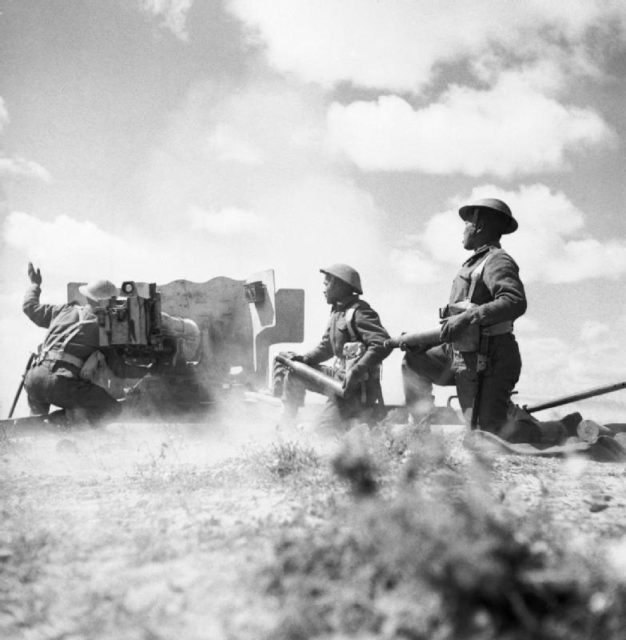
Gurkhas manning a 6-pound anti-tank gun in Tunisia on March 16, 1943
 
The Japanese were taken by surprise and by May 9, were retreating to the village of Taungdaw in northwestern Burma. Lachhiman’s battalion was waiting for them.
Late at night on May 12, most of the 4th Battalion, 8th Gurkha Rifles lay asleep. Rifleman Lachhiman was on guard duty. His small group was in a trench farthest away from the village when the attack came – cutting them off from the other Gurkha positions.
At least 200 Japanese soldiers tried to make their way to Taungdaw. To do so, they first had to pass through Lachhiman’s position. A grenade landed on the edge of his trench. He jumped up, grabbed it, and hurled it back with a satisfying boom!
A second landed in the trench inches away from his foot. He returned that one too. A third landed just outside the trench, so he lunged forward and picked it up as well. As he was about to throw it back, it exploded.
His right hand was pulverized, and his arm shattered while burning shrapnel pummeled his face and right leg. The explosion rocked two other soldiers off their feet sending them crumpling to the ground.
Half-blinded from the blast, his mouth severely bleeding, Lachhiman managed to scream the Gurkha’s ancient battle cry: “Jai Mahakali! Ayo Gorkhali!”
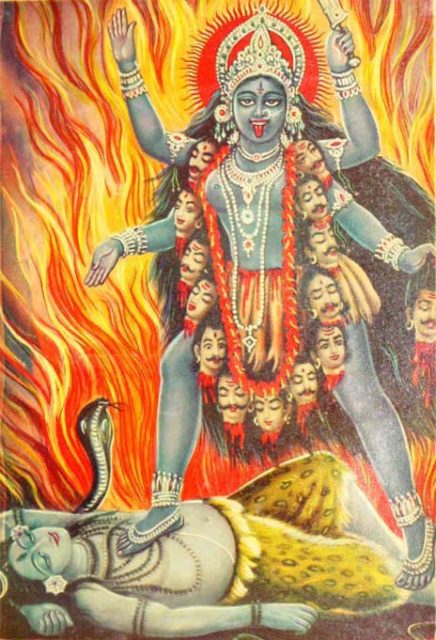
Kali is the Hindu goddess of night, death, time, and destruction. She wears a necklace of severed heads and a skirt of chopped off arms while she tramples her husband (the god Shiva) underfoot. She is not someone to mess with and probably explains why she is the patron goddess of the Gurkhas.
The goddess Kali
 
What Lachhiman shouted translates as “Victory to Great Kali! Gurkhas approach!”
There was only him. All the others were either dead or too badly injured to fight. So he loaded his rifle with his left hand – not an easy task as his standard-issue bolt-action rifle was designed for right-handed use. Despite his wounds, he fired at point blank range each time the Japanese attacked, reloading and repeating the process for four hours.
Exhaustion, shock, and blood loss took their toll, but eventually, his comrades were able to relieve him. For the next three days and two nights, the Gurkhas were on their own, heroically fighting off the Japanese until more Allied troops arrived. The other Gurkhas were inspired by what Lachhiman had done.
When it was over there were 87 Japanese bodies around the trench. Thirty-one of them lay directly in front of the spot Lachhiman had defended single-handedly.
Doctors did their best for him, but could not save his right eye or right hand. Lord Louis Mountbatten, British Admiral of the Fleet, awarded Lachhiman the Victoria Cross (Britain’s highest military award for valor) on December 19, 1945.
Despite his injuries, Lachhiman continued to serve the 8th Gurkhas until 1947 when they were transferred to the newly independent Indian Army. He eventually settled in Britain where he died in 2010 – after successfully fighting the British government for the right for other Gurkha veterans like himself to live in Britain.

                                                                     Monument to the Gurkha Soldier outside the Ministry of Defense Building in London;

Despite his injuries, Lachhiman continued to serve the 8th Gurkhas until 1947 when they were transferred to the newly independent Indian Army. He eventually settled in Britain where he died in 2010 – after successfully fighting the British government for the right for other Gurkha veterans like himself to live in Britain.


                                                                                                    THE GURKHA
                                                                                                     SOLDIER
                                                                                               Bravest of the brave,
                                                                                      most generous of the generous,
                                                                                                  never had country
                                                                                                more faithful friends
                                                                                                          than you.


The treatment of Gurkhas and their families was the subject of controversy in the United Kingdom once it became widely known that Gurkhas received smaller pensions than their British counterparts. The nationality status of Gurkhas and their families was also an area of dispute, with claims that some ex-army Nepali families were being denied residency and forced to leave Britain. On 8 March 2007 the British Government announced that all Gurkhas who signed up after 1 July 1997 would receive a pension equivalent to that of their British counterparts. In addition, Gurkhas would, for the first time, be able to transfer to another army unit after five years' service and women would also be allowed to join--although not in first-line units--conforming to the British Army's policy. The act also guaranteed residency rights in Britain for retired Gurkhas and their families.
Despite the changes, many Gurkhas who had not served long enough to entitle them to a pension faced hardship on their return to Nepal, and some critics derided the government's decision to only award the new pension and citizenship entitlement to those joining after 1 July 1997, claiming that this left many ex-Gurkha servicemen still facing a financially uncertain retirement. An advocacy group, Gurkha Justice Campaign, joined the debate in support of the Gurkhas.
In a landmark ruling on 30 September 2008 the High Court in London decided that the Home Secretary's policy allowing Gurkhas who left the Army before 1997 to apply for settlement in the United Kingdom was irrationally restrictive in its criteria, and overturned it. In line with the ruling of the High Court the Home Office pledged to review all cases affected by this decision.
On 29 April 2009 a motion in the House of Commons by the Liberal Democrats that all Gurkhas be offered equal right of residence was passed by 267 votes to 246. This was the only first-day motion defeat for a government since 1978. Nick Clegg, the Liberal Democrat leader, stated that "this is an immense victory [...] for the rights of Gurkhas who have been waiting so long for justice, a victory for Parliament, a victory for decency." He added that it was "the kind of thing people want this country to do".
On 21 May 2009 Home Secretary Jacqui Smith announced that all Gurkha veterans who retired before 1997 with at least four years service would be allowed to settle in the UK. Actress Joanna Lumley, daughter of Gurkha corps Maj. James Lumley who had highlighted the treatment of the Gurkhas and campaigned for their rights, commented, "This is the welcome we have always longed to give".
A charity, The Gurkha Welfare Trust, provides aid to alleviate hardship and distress among Gurkha ex-servicemen.
On June 9, 2015, a celebration called the Gurkha 200, held at The Royal Hospital Chelsea and attended by members of the royal family, commemorated the bicentennial of the Gurkha Welfare Trust by paying tribute to Gurkha culture and military service
.

Tuesday, June 24, 2025

"When It Is Your Time"

 I was looking for something else and ran across this and thought it was worthy of a repost.  This cuts to something that is a core to what makes us as honorable men, we fight for our country, for our family, and our comrades, and if necessary we will cash that blank check because to refuse will be an insult to what makes us men.  The phrase "A brave Man dies but once but a coward does a thousand times" is truth in those words.  We always know when the time comes we face it with steel in our spine and go as honorable men should.  Because all men die, it is the truth of our existence, how we die is the decision we make.


  I decided to repost it because it is a really good post.  
I had "borrowed"this from a fellow blogger, "Stormbringer" A.K.A. Sean Linnae.  His blog is still on my blogroll although he hasn't posted since 2020, I still leave him on my blog roll, hoping that he will return.


  or in the 13th warrior when the Norsemen recited this:


"Lo there do I see my father. Lo there do I see my mother and my sisters and my brothers. Lo there do I see the line of my people, back to the beginning. Lo, they do call to me, they bid me take my place among them, in the Halls of Valhalla, where the brave may live forever."


“So live your life that the fear of death can never enter your heart. Trouble no one about their religion; respect others in their view, and demand that they respect yours. Love your life, perfect your life, beautify all things in your life. Seek to make your life long and its purpose in the service of your people. Prepare a noble death song for the day when you go over the great divide.

Always give a word or a sign of salute when meeting or passing a friend, even a stranger, when in a lonely place. Show respect to all people and grovel to none.

When you arise in the morning give thanks for the food and for the joy of living. If you see no reason for giving thanks, the fault lies only in yourself. Abuse no one and no thing, for abuse turns the wise ones to fools and robs the spirit of its vision.

When it comes your time to die, be not like those whose hearts are filled with the fear of death, so that when their time comes they weep and pray for a little more time to live their lives over again in a different way. Sing your death song and die like a hero going home.”


~ Chief Tecumseh (Poem from 
Act of Valor)

Friday, March 21, 2025

"Honor In The Quiet Man"


I happen to see this article in the "Art of Manliness".  When I was younger, I definitely didn't get this movie, but as I got older, I find that I like the older movies in general because they don't have the flashy CGI and they actually have to have a storyline and good actors and actresses.  This movie is one of my staples because I am a huge John Wayne fan and I have a picture I got from a street vendor before I joined the Army in 1985.


        Kinda surprised I still have it, It has been in my bonus room since the late 90's.   My wife has told me that I was born in the wrong century because my mannerisms and manners are archaic and I don't mind, to me manners and chivalry are timeless qualities.    

       Well back to this article, I have watched this movie several times and the author to me was correct about the premise of the movie, and it is different movie for John Wayne than his usual.  


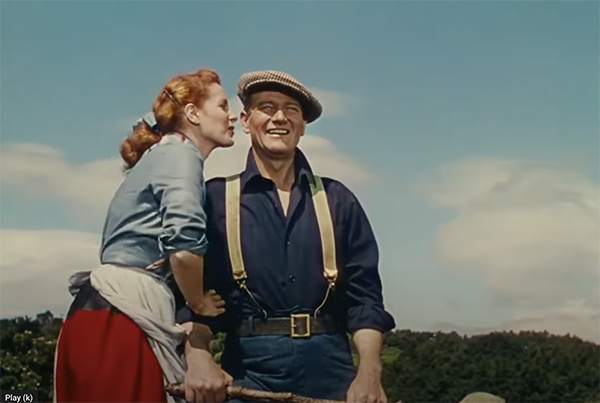
A woman whispers to a smiling man wearing a beret and suspenders, reminiscent of "The Quiet Man," in an outdoor setting under a clear blue sky.

It’s St. Patrick’s Day.

Like a lot of Americans with Irish ancestors, I semi-celebrated the holiday growing up. Our family would eat corned beef and potatoes and decorate the house with shamrocks and pots of gold.

We’d also watch St. Patrick’s Day-themed movies. There was Darby O’Gill and the Little People, of course, starring a crooning Sean Connery.

And then there was John Ford’s 1952 Irish epic romantic comedy The Quiet Man, starring John Wayne and Maureen O’Hara. As a kid, this movie bored me to tears. But my mother loved it so we had to watch it.

When I watched The Quiet Man again as an adult, I enjoyed it more. I started making a viewing a St. Patrick’s Day tradition, and I’ve watched it every year for the past seven or so years.

At first, I couldn’t quite pinpoint why I’d grown to love this movie. Yes, it’s refreshing to see John Wayne play a role that doesn’t involve a cowboy hat and a rifle. Maureen O’Hara is stunning and talented. Barry Fitzgerald is hilarious as Michaleen Oge Flynn. The picturesque scenes of the Irish countryside are charming and pastoral and make me want to live in a cottage with a thatch roof. And, of course, there’s the epic fight scene at the end of the movie.

But I sensed there was something more to the appeal of the film than that.

A few years ago, I finally figured out what that something was:

The Quiet Man represents a near-perfect meditation on the anthropological evolution of honor.

The Story of The Quiet Man

Image5

To understand the theme of honor in The Quiet Man, it helps to know the basics of the story:

Having killed an opponent in the ring, former boxer Sean Thornton (John Wayne) has sworn off fighting for good and hopes to make a fresh start by moving from America to Ireland.

On his first day in the quaint Irish village of Innisfree, Sean spots Mary Kate Danaher (Maureen O’Hara) herding sheep. It’s love at first sight.

Sean purchases his family’s old cottage, outbidding local squire Will Danaher (Victor McLaglen), who also happens to be Mary Kate’s domineering older brother. Will instantly resents him, setting up the film’s central conflict.

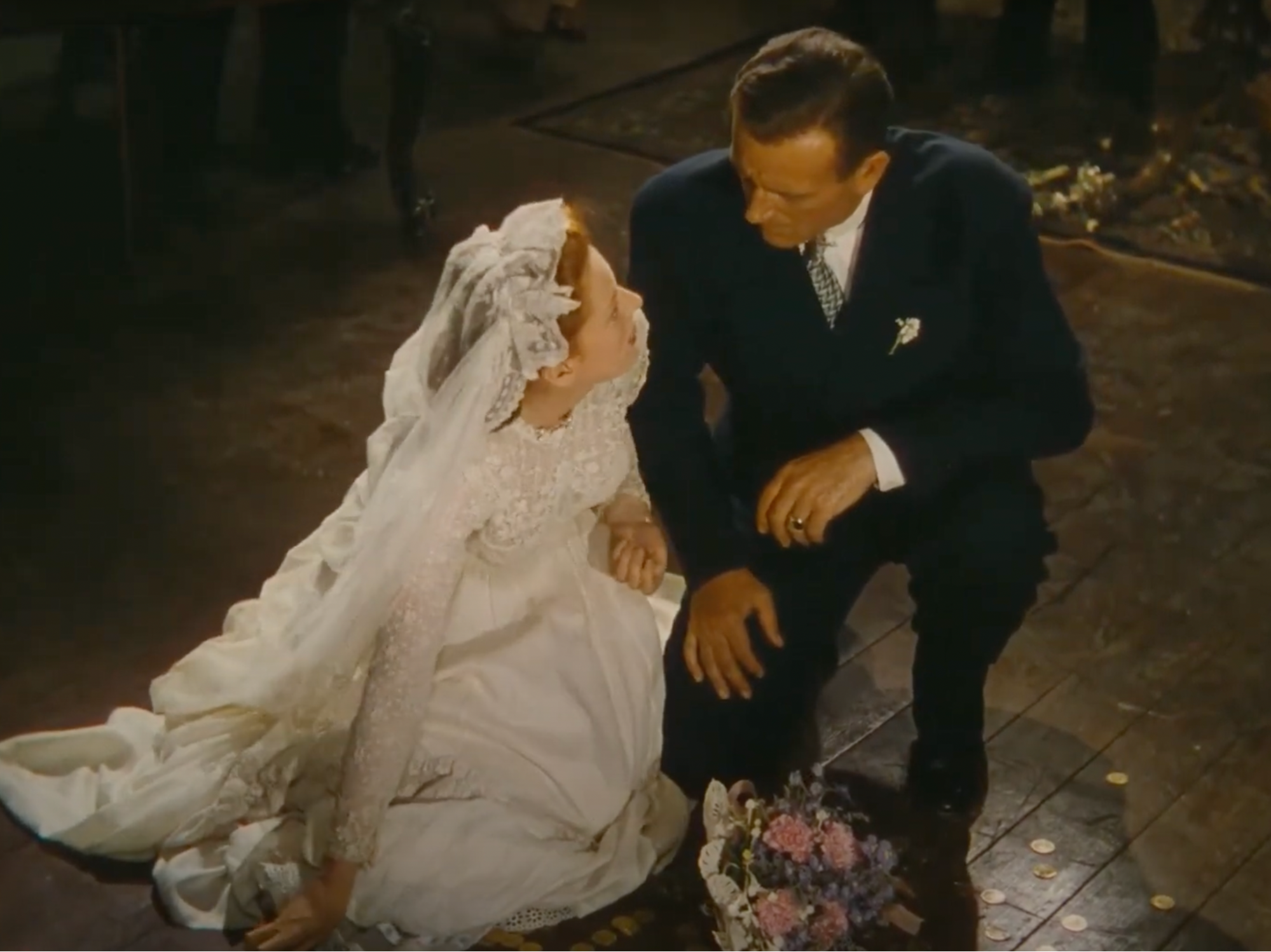
Despite Will’s objections, Sean courts and marries Mary Kate. But their wedding night turns disastrous when Will refuses to hand over Mary Kate’s dowry. Feeling the snub unimportant, Sean lets the slight go; he’s got plenty of money as a successfully retired prizefighter. But to Mary Kate, the dowry is important, and deep tensions ensue.

When Sean refuses to fight for what’s rightfully hers, Mary Kate is humiliated. Without her dowry, she doesn’t consider herself truly married, and she refuses to consummate the union. The village whispers about Sean’s manhood, and their marriage deteriorates.

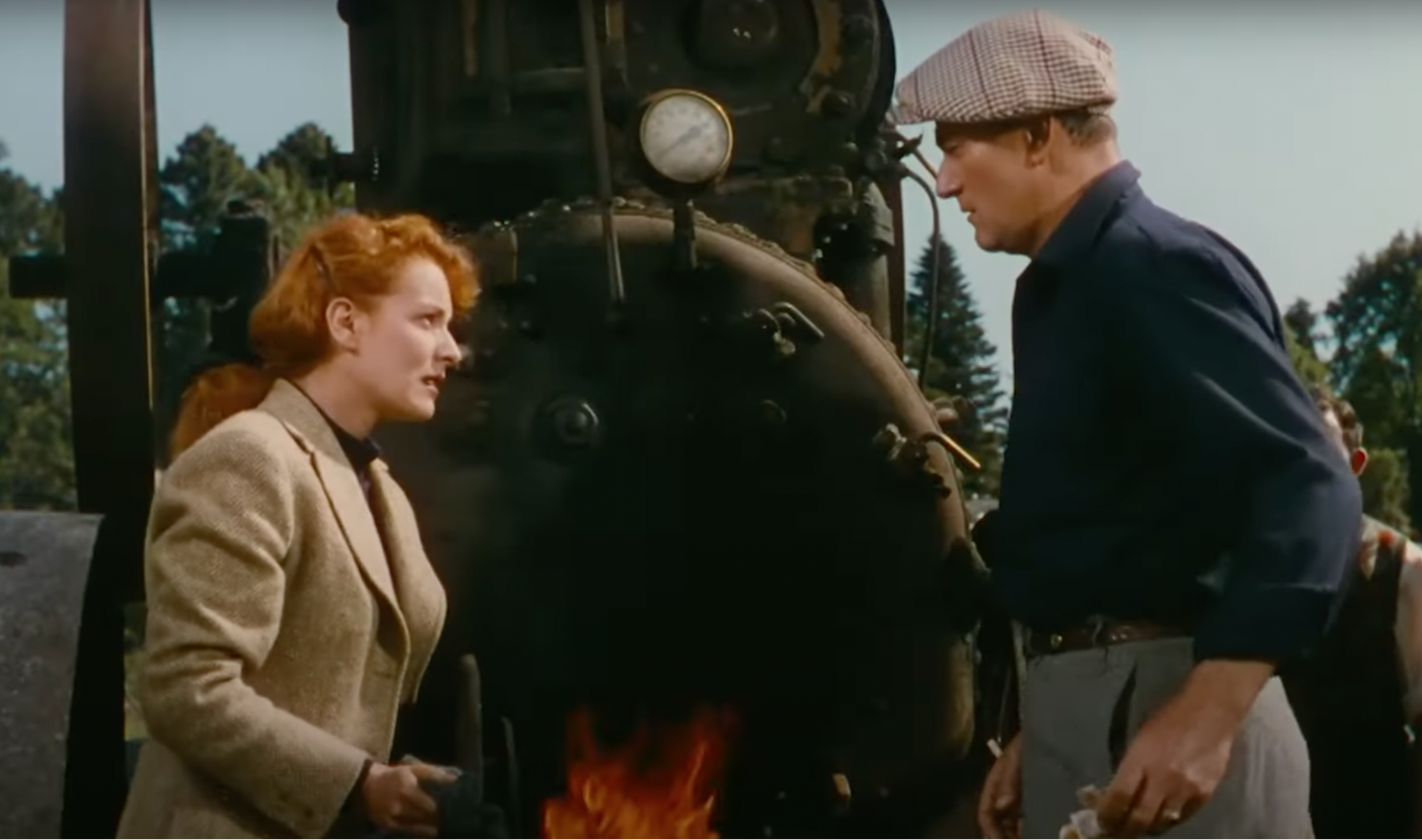
Frustrated, Mary Kate tries to flee by train, forcing Sean’s hand. In the film’s most dramatic moment, he drags her through town to confront Will, demanding that he either give him the dowry or take back his sister. “No fortune, no marriage,” he declares. Will throws him the money, and, with Mary Kate’s help, Sean tosses it into a boiler to burn. Mary Kate proudly walks home.

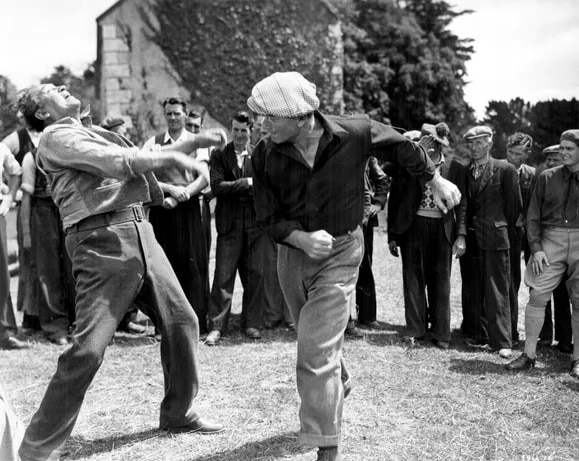
Enraged, Will sucker punches Sean, sparking an epic brawl that spills across the countryside. The brawl, though heated, is filled with camaraderie and grudging respect and resolves the men’s feud. By the end, Will, Sean, and Mary Kate reconcile, and Sean finally comes to peace with his past.

What Is Honor?

If you’ve been reading the site for a while now, you know that we did an in-depth series on the nature and history of honor over a decade ago. Here’s the TLDR summation of it:

While for most of us living in the modern West, honor is about integrity and being true to a set of personal ideals, anciently, honor meant something very different. It was not only personal, but social. 

Anciently, honor was about your reputation within a group of equal peers.

Anthropologists who have studied this ancient form of honor have found it’s premised on three elements: 1) a code of honor with genuine standards that must be met to have the full status of personhood, 2) an exclusive group of equals who live by that code, and 3) the very real threat of shame for those who fail to measure up to it.

Ancient honor is an all-or-nothing game. You either have the respect of your peers, or you don’t. Bringing dishonor upon yourself by failing to meet the group’s minimum standards means exclusion from the group, as well as shame.

A Clash of Honor Cultures

Image1

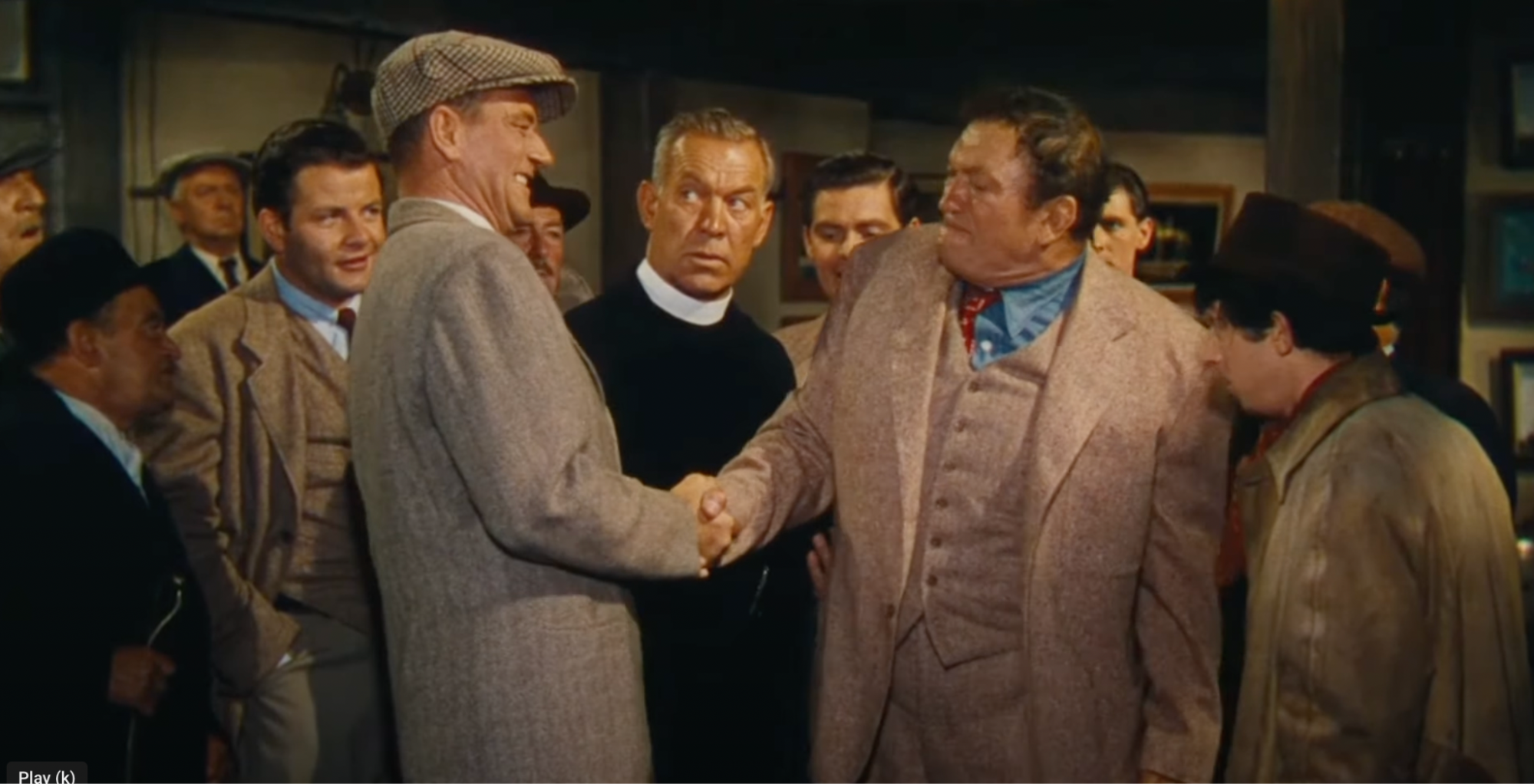
The Quiet Man is compelling because it sets up a clash between the modern and ancient senses of honor.

Sean Thornton represents the modern sense of honor. For him, honor is about being true to his values. He doesn’t care about what others think so long as he lives by his inner code.

Part of Thornton’s personal code is that he won’t ever fight again. To Sean, maintaining this principle of self-restraint is a matter of personal integrity, regardless of what others might think of him.

Another part of his individualistic American code touches on love and marriage. For Sean, if two people love each other, that’s all that matters. You don’t need the approval of family and community.

But in Innisfree, Sean encounters a society still operating under the ancient code of honor, where reputation and standing within the community matter deeply. Will Danaher and Mary Kate embody this traditional understanding.

Will symbolizes the ancient code of manly honor. He’s boisterous, loud, and domineering because that’s how you gain status in his town. He cares deeply about his reputation and is willing to resort to violence to defend it. For Will and other men who follow the ancient code, might makes right.

There’s a scene that captures this clash between modern and ancient honor perfectly, in which Sean accuses Will of lying.

For us moderns like Sean, his insult isn’t a huge deal. You call things as you see them. If you’re wrong, you can argue about it and maybe figure out the misunderstanding. At worst, the person accused will get angry, walk away, and no longer have anything to do with you.

But for Will, who lives under the ancient code of honor, accusing someone of lying is a really, really big deal — one of the gravest insults you could levy at a man. Publicly challenging a man’s honesty — an act sometimes described as “giving the lie” — was a serious affront, even if the accusation was true.

In honor cultures, an accusation of lying had to be met with a violent defense of one’s reputation. And that’s exactly what Will Danaher undertakes.

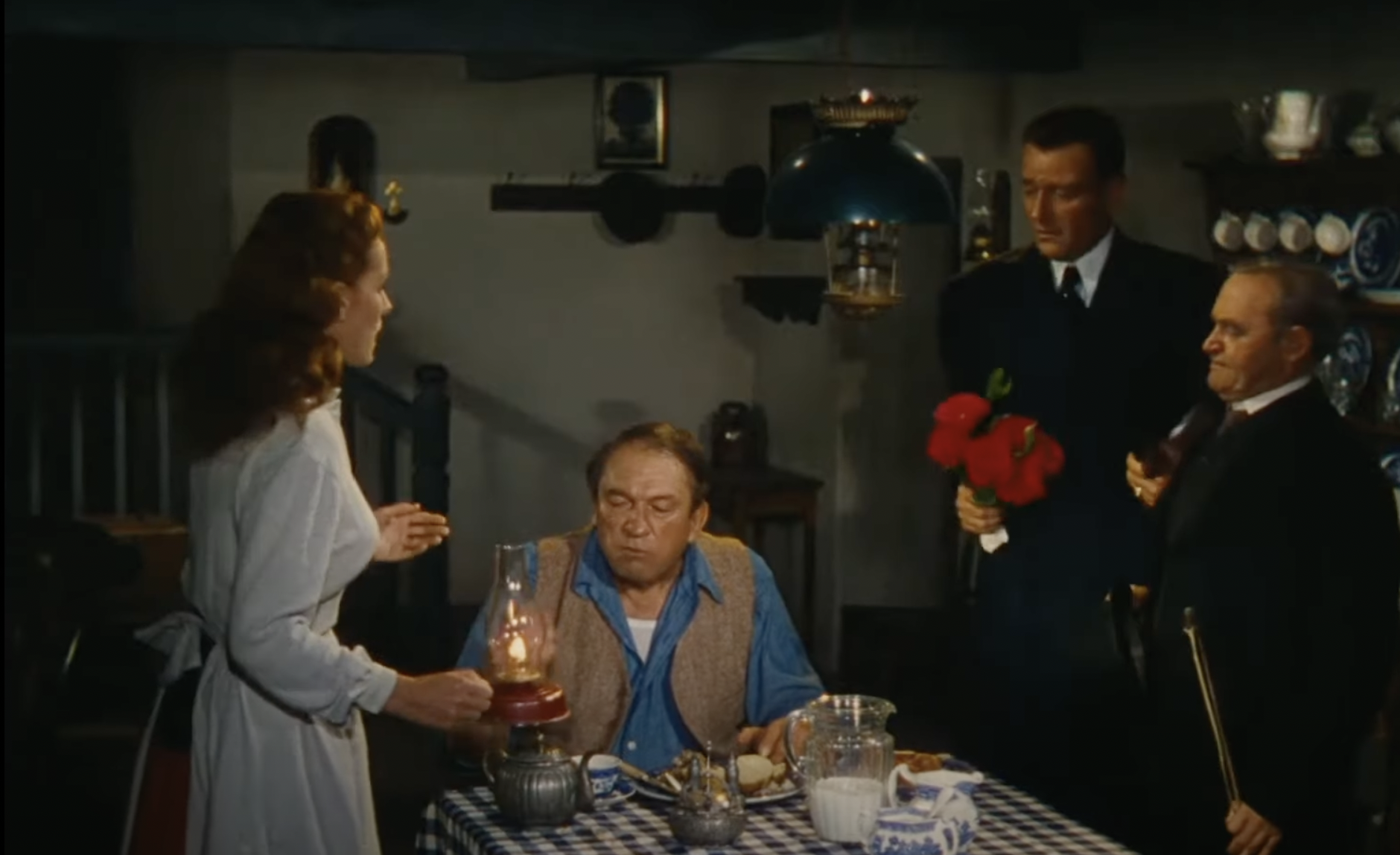
When the conflict over the dowry comes to a head, Will demands that Sean fight him over it because that’s what you do when you have a conflict in a traditional culture of honor. Sean refuses, so the entire town questions his manhood. They shame him.

A Woman’s Honor

Image6

Will isn’t the only character representing the ancient code of honor. Mary Kate does as well.

Typically, in ancient honor cultures, a woman’s honor is tied up with her chastity. We still see vestiges of that today; while it no longer carries currency in some circles, accusing a woman of being loose still registers for many as a gross insult.

For Mary Kate, her chastity isn’t the issue. Rather, it’s her dowry. In Innisfree, the dowry isn’t just money. It represents a woman’s independence from her childhood home. Unlike Sean, she doesn’t just see it as money but as a symbol of her honor and status as a mature woman. Her refusal to consummate the marriage without it isn’t born out of spite or greed but springs from a deep-seated belief that she cannot truly be Sean’s wife unless she enters the union on equal terms.

Mary Kate’s honor is also social. She refuses to be seen as a woman who has been dishonored in the eyes of the community. When Sean fails to confront Will, she sees it as a betrayal. Her insistence that Sean fight for her dowry isn’t about money but about proving his commitment to her. She wasn’t asking Sean to fight for her money but for her honor. Because Sean refused, she had to deal with the shame of being married to a coward and of not having her status and standing as a full adult woman.

Sean, with his modern sense of honor, is completely flabbergasted. His values clash with his wife’s deeply rooted, traditional code of honor.

Synthesizing Honor Cultures

Image4

The conflict resolves when Sean finally realizes that his modern sense of personal honor must find a way to coexist with the ancient communal honor of Innisfree. He realizes that while his personal values matter, they can’t exist in isolation from the community he now calls home. When in Innisfree, you have to do as the Innisfree-ans do.

Sean ultimately fights Will Danaher not because he seeks violence for violence’s sake but because he wants to be a part of the community and a part of Mary Kate’s family. The fight isn’t about money or revenge but rather serves as a ritual that enacts Innisfree’s code of honor. The fight actually serves as a way to create a relationship.

While it may seem foreign to us, Mary Kate claims her honor in the town when Sean drags her across the countryside to her brother and demands the dowry. To her and to the village, Sean is finally acting like a husband and getting Mary Kate out from under the thumb of her domineering brother.

Image3

Sean synthesizes his idea that love isn’t about money with his wife’s idea that it represents honor by accepting the dowry . . . but then burning it. Even without the money in hand, Mary Kate is able to walk with her head held high because she now has her full standing and status as an adult woman.

Conclusion

What makes The Quiet Man endure as a classic isn’t just its sweeping Irish landscapes. Nor the interpersonal conflicts. It’s the competing notions of honor on display.

The film is set in the 1920s, when traditional, social notions of honor were giving way to more modern, individualistic ones. When the movie was released in 1952, there still existed pockets in the West in which the ancient code of honor persisted, and viewers would have recognized vestiges of it in their own lives.

Even today, while the traditional code of honor has largely disappeared in the West, remnants of it remain, and we still experience tensions between the old and new notions of honor. As much as we’re encouraged to pay exclusive adherence to our internal scorecards, and not care what anyone else thinks, we yearn for the status and affirmation of our peers. Such tensions represent the deepest kind of drama, and account for the extra interest burbling beneath the movie’s general plot and the reason that viewers, past and present, have been drawn to the film. 

So this St. Patrick’s Day, after you’ve had your fill of corned beef and potatoes, queue up The Quiet Man, and reflect on how you’re balancing modern and traditional notions of honor in your own life.

All the while, still chuckling at Michaleen Oge Flynn’s witty one-liners

Thursday, July 4, 2019

The Signers of the Declaration of Independence

Something to think about, people take things for granted and the people in question were educated and "comfortable".  They pledged their sacred honor for this and some lost everything on a matter or principle.


What happened to the signers of the Declaration of Independence?
This is the Price They Paid: 


Have you ever wondered what happened to the 56 men who signed the Declaration of Independence?
Five signers were captured by the British as traitors, and tortured before they died. Twelve had their homes ransacked and burned. Two lost their sons in the revolutionary army, another had two sons captured. Nine of the 56 fought and died from wounds or hardships of the revolutionary war.
They signed and they pledged their lives, their fortunes, and their sacred honor.
What kind of men were they? Twenty-four were lawyers and jurists. Eleven were merchants, nine were farmers and large plantation owners, men of means, well educated. But they signed the Declaration of Independence knowing full well that the penalty would be death if they were captured.
Carter Braxton of Virginia, a wealthy planter and trader, saw his ships swept from the seas by the British Navy. He sold his home and properties to pay his debts, and died in rags.
Thomas McKeam was so hounded by the British that he was forced to move his family almost constantly. He served in the Congress without pay, and his family was kept in hiding. His possessions were taken from him, and poverty was his reward.
Vandals or soldiers or both, looted the properties of Ellery, Clymer, Hall, Walton, Gwinnett, Heyward, Ruttledge, and Middleton.
At the battle of Yorktown, Thomas Nelson Jr., noted that the British General Cornwallis had taken over the Nelson home for his headquarters. The owner quietly urged General George Washington to open fire. The home was destroyed, and Nelson died bankrupt.
Francis Lewis had his home and properties destroyed. The enemy jailed his wife, and she died within a few months.
John Hart was driven from his wife’s bedside as she was dying. Their 13 children fled for their lives. His fields and his gristmill were laid to waste. For more than a year he lived in forests and caves, returning home to find his wife dead and his children vanished. A few weeks later he died from exhaustion and a broken heart. Norris and Livingston suffered similar fates.
Such were the stories and sacrifices of the American Revolution. These were not wild eyed, rabble-rousing ruffians. They were soft-spoken men of means and education. They had security, but they valued liberty more. Standing tall, straight, and unwavering, they pledged: “For the support of this declaration, with firm reliance on the protection of the divine providence, we mutually pledge to each other, our lives, our fortunes, and our sacred honor.”

Tuesday, September 4, 2018

"Come and Fight a Gurkha"

I ran across this article and I really liked it.  My friend Old NFO likes to feature Gurkha's in his Military Science Fiction.  He portrays them as fierce warriors, steadfast soldiers, totally honorable and uncorruptible and loyal to their officers and the ideals.  I have known about Gurkha's since I started reading about WWII as a kid and the knife was legendary.

The kukri is effective as a chopping weapon, due to its weight, and slashing weapon, because the curved shape creates a "wedge" effect which causes the blade to cut effectively and deeper. Because the blade bends towards the opponent, the user need not angle the wrist while executing a chopping motion. Unlike a straight-edged sword, the center of mass combined with the angle of the blade allow the kukri to slice as it chops. The edge slides across the target's surface while the center of mass maintains momentum as the blade moves through the target's cross-section. This gives the kukri a penetrative force disproportional to its length. The design enables the user to inflict deep wounds and to penetrate bone.

Utility

While most famed from use in the military, the kukri is the most commonly used multipurpose tool in the fields and homes in Nepal. Its use has varied from building, clearing, chopping firewood, digging, slaughtering animals for food, cutting meat and vegetables, skinning animals, and opening cans. Its use as a general farm and household tool disproves the often stated "taboo" that the weapon cannot be sheathed "until it has drawn blood".
The kukri is versatile. It can function as a smaller knife by using the narrower part of the blade, closest to the handle. The heavier and wider end of the blade, towards the tip, functions as an axe or a small shovel.


Former Field Marshal Sam Manekshaw of the Indian Army once said: “If a man says he is not afraid of dying, he is either lying or he is a Gurkha.” Correct, but what is a Gurkha?
In 1814, the East India Company began making “excursions” into the Kingdom of Nepal, believing the Nepalis would be pushovers. They were wrong. Not only did their invasion hurt their pockets, but it also cost them dearly regarding personnel.
What malaria or desertion did not claim, the Gurkhas did. By the time the Anglo-Nepalese War ended in 1816 with a truce, the British had learned not to underestimate their foe. Quite the opposite, in fact. Others noticed it also, which is why various countries currently regularly recruit Gurkhas.

Originally from the Nepali district of Gorkha, they now come from all over the country. They are renowned for their service in the British Army and have fought in many contemporary wars forming part of the Coalition Forces in Iraq.
They are willing to serve the British (and other foreign nations) due to poverty – an unfortunate state of affairs that still exists today. “Service” does not do justice to what it is they do, which is why many have gone down in legend.
Gurkha soldiers during the Anglo-Nepalese War.
One such man was Lachhiman Gurung, born on December 30, 1917, in the village of Dakhani, Tahani District, Nepal. He was very poor. So much so that by 1940, he stood a mere 4’11” tall as a result of deprivation and malnutrition. Fortunately, he was tough.
Gurung had repeatedly tried to join the British Indian Army. Being so short and puny even by Nepali standards, the authorities had declined. As WWII progressed, the British needed everyone, so the 23-year-old finally joined the British Indian Army in December 1940. What he lacked in size, he more than made up for regarding sheer determination. He earned himself a place as a rifleman in the 4th Battalion, 8th Gurkha Rifles.
In late April 1945, his battalion crossed the Irrawaddy River into Burma (now Myanmar) with the 89th Indian Infantry Brigade of the 7th Indian Infantry Division. Their mission was to attack Japanese positions north of the Prome-Taungup Road.


Gurkhas manning a 6-pound anti-tank gun in Tunisia on March 16, 1943
 
The Japanese were taken by surprise and by May 9, were retreating to the village of Taungdaw in northwestern Burma. Lachhiman’s battalion was waiting for them.
Late at night on May 12, most of the 4th Battalion, 8th Gurkha Rifles lay asleep. Rifleman Lachhiman was on guard duty. His small group was in a trench farthest away from the village when the attack came – cutting them off from the other Gurkha positions.
At least 200 Japanese soldiers tried to make their way to Taungdaw. To do so, they first had to pass through Lachhiman’s position. A grenade landed on the edge of his trench. He jumped up, grabbed it, and hurled it back with a satisfying boom!
A second landed in the trench inches away from his foot. He returned that one too. A third landed just outside the trench, so he lunged forward and picked it up as well. As he was about to throw it back, it exploded.
His right hand was pulverized, and his arm shattered while burning shrapnel pummeled his face and right leg. The explosion rocked two other soldiers off their feet sending them crumpling to the ground.
Half-blinded from the blast, his mouth severely bleeding, Lachhiman managed to scream the Gurkha’s ancient battle cry: “Jai Mahakali! Ayo Gorkhali!”
Kali is the Hindu goddess of night, death, time, and destruction. She wears a necklace of severed heads and a skirt of chopped off arms while she tramples her husband (the god Shiva) underfoot. She is not someone to mess with and probably explains why she is the patron goddess of the Gurkhas.
The goddess Kali
 
What Lachhiman shouted translates as “Victory to Great Kali! Gurkhas approach!”
There was only him. All the others were either dead or too badly injured to fight. So he loaded his rifle with his left hand – not an easy task as his standard-issue bolt-action rifle was designed for right-handed use. Despite his wounds, he fired at point blank range each time the Japanese attacked, reloading and repeating the process for four hours.
Exhaustion, shock, and blood loss took their toll, but eventually, his comrades were able to relieve him. For the next three days and two nights, the Gurkhas were on their own, heroically fighting off the Japanese until more Allied troops arrived. The other Gurkhas were inspired by what Lachhiman had done.
When it was over there were 87 Japanese bodies around the trench. Thirty-one of them lay directly in front of the spot Lachhiman had defended single-handedly.
Doctors did their best for him, but could not save his right eye or right hand. Lord Louis Mountbatten, British Admiral of the Fleet, awarded Lachhiman the Victoria Cross (Britain’s highest military award for valor) on December 19, 1945.
Despite his injuries, Lachhiman continued to serve the 8th Gurkhas until 1947 when they were transferred to the newly independent Indian Army. He eventually settled in Britain where he died in 2010 – after successfully fighting the British government for the right for other Gurkha veterans like himself to live in Britain.

                                                                     Monument to the Gurkha Soldier outside the Ministry of Defense Building in London;

Despite his injuries, Lachhiman continued to serve the 8th Gurkhas until 1947 when they were transferred to the newly independent Indian Army. He eventually settled in Britain where he died in 2010 – after successfully fighting the British government for the right for other Gurkha veterans like himself to live in Britain.


                                                                                                    THE GURKHA
                                                                                                     SOLDIER
                                                                                               Bravest of the brave,
                                                                                      most generous of the generous,
                                                                                                  never had country
                                                                                                more faithful friends
                                                                                                          than you.


The treatment of Gurkhas and their families was the subject of controversy in the United Kingdom once it became widely known that Gurkhas received smaller pensions than their British counterparts. The nationality status of Gurkhas and their families was also an area of dispute, with claims that some ex-army Nepali families were being denied residency and forced to leave Britain. On 8 March 2007 the British Government announced that all Gurkhas who signed up after 1 July 1997 would receive a pension equivalent to that of their British counterparts. In addition, Gurkhas would, for the first time, be able to transfer to another army unit after five years' service and women would also be allowed to join--although not in first-line units--conforming to the British Army's policy. The act also guaranteed residency rights in Britain for retired Gurkhas and their families.
Despite the changes, many Gurkhas who had not served long enough to entitle them to a pension faced hardship on their return to Nepal, and some critics derided the government's decision to only award the new pension and citizenship entitlement to those joining after 1 July 1997, claiming that this left many ex-Gurkha servicemen still facing a financially uncertain retirement. An advocacy group, Gurkha Justice Campaign, joined the debate in support of the Gurkhas.
In a landmark ruling on 30 September 2008 the High Court in London decided that the Home Secretary's policy allowing Gurkhas who left the Army before 1997 to apply for settlement in the United Kingdom was irrationally restrictive in its criteria, and overturned it. In line with the ruling of the High Court the Home Office pledged to review all cases affected by this decision.
On 29 April 2009 a motion in the House of Commons by the Liberal Democrats that all Gurkhas be offered equal right of residence was passed by 267 votes to 246. This was the only first-day motion defeat for a government since 1978. Nick Clegg, the Liberal Democrat leader, stated that "this is an immense victory [...] for the rights of Gurkhas who have been waiting so long for justice, a victory for Parliament, a victory for decency." He added that it was "the kind of thing people want this country to do".
On 21 May 2009 Home Secretary Jacqui Smith announced that all Gurkha veterans who retired before 1997 with at least four years service would be allowed to settle in the UK. Actress Joanna Lumley, daughter of Gurkha corps Maj. James Lumley who had highlighted the treatment of the Gurkhas and campaigned for their rights, commented, "This is the welcome we have always longed to give".
A charity, The Gurkha Welfare Trust, provides aid to alleviate hardship and distress among Gurkha ex-servicemen.
On June 9, 2015, a celebration called the Gurkha 200, held at The Royal Hospital Chelsea and attended by members of the royal family, commemorated the bicentennial of the Gurkha Welfare Trust by paying tribute to Gurkha culture and military service.