Webster

The Constitution was made to guard the people against the dangers of good intentions." --American Statesman Daniel Webster (1782-1852)


Showing posts with label Armor. Show all posts

Wednesday, March 22, 2023

The Failed MBT 70 Project

 I touched on this a bit when I was doing my "Red Storm Rising" posts a few years ago and I had discussed the "M1 Tank", The failed MBT 70 project was touched on that posting, the United States and West Germany had different ideas on Armor development and Tank usage. THe end results are that both nations built the 2 best MBT's in the world.   I shamelessly snagged this from "SOFREP".


(Image source: Wikimedia Commons)

World War II came and went, and defeated Germany had been divided into two, with the eastern half falling under the influence of the communist Soviet Union and the western region working alongside the United States.

When tensions grew, and the Cold War era took hold in the late 1940s, western allies perceived the communist region’s rising power as an imminent threat. More potent main battle tanks were developed in case eastern forces decided to attack using their own war machines. This eventually became a race between the two sides to build the most innovative, powerful tanks.

When Russia introduced its T54/55 series, American and West German forces unveiled the MBT (main battle tank) M60 “Patton” and Leopard 1 as the former tank’s capable rival. Soon, however, US intelligence discovered the development of the Soviet Union’s advanced T-62 MBT equipped with powerful arms modifications, and they decided it was time to sprint ahead of the competition.

Subsequently, then-Defense Secretary Robert McNamara proposed an unprecedented “super tank” and initiated the joint battle tank program between the US and West German forces. During this period, the North Atlantic Treaty Organization (NATO) member states lacked cohesion on common military equipment, which McNamara saw as needing improvement.

MBT70 Prototype
MBT-70 prototype undergoing a speed test at Aberdeen Proving Ground. (Image source: Wikimedia Commons)

By 1963, Germany and the US signed a memorandum of understanding that guaranteed both nations equal input in the tank’s design and features. This turned out to be the first big misstep in the program as engineers from both sides later couldn’t agree even on the smallest details, such as which system of measurement use.

“As testing continued, they realized they had another big problem. Because the driver would be located inside a turret that would be rotating in battle, the tank’s designers had come up with the solution of mounting the driver inside his own contra-rotating cupola within the turret. Regardless of the direction the turret was facing, the cupola would automatically face forward. The drivers, however, accustomed to being located in a stationary position at the front of a tank’s hull, were becoming disoriented and suffering from motion sickness.” via Defense Media Network, 2016.

Dubbed MBT-70 by the Americans and KPz-70 by the Germans, the designed super tank comprised promising, ahead-of-its-time features, which caused its eventual cancellation.

Couldn’t Agree on the Design

The main design of the super tank includes a steel-layered tungsten alloy armor and an inner protective shell capable of buffering Soviet ammunition.

But negotiations on the overall design of the tank were riddled with disagreements. Both superpowers had different requirements and standards, not to mention the language barrier. It was almost impossible for the US and German forces to meet halfway.

Nonetheless, prototypes for each side’s versions were produced, with the American MBT-70 powered by a Continental 12-cylinder air-cooled diesel engine that could generate up to 1,470 horsepower and the German KPz-70 powered by a Daimler-Benz MB-873 diesel engine that was later replaced by an MTU diesel engine capable of producing 1,500 hp. Both tanks could speed up to 43 miles per hour within a 400-mile range, making the MBT-70 prototype the world’s fastest MBT at the time.

Designers aimed to hydro-pneumatically lower the height of the MBT-70 compared to its predecessors, seeking to develop a tank with an extremely low profile on the battlefield. As a result, the prototype of the US-German tank was  29.9 feet (9.1 meters) in length, 11.6 ft (3.53 m) in width, and 8.6 ft (2.62 m) in height. The low-profile objective, however, significantly sacrificed the space in the interior, leaving no room for its driver in the hull. Instead of adjusting the compact lower structure of the tank, designers opted to place the driver along with the rest of the crew—in the turret.


While, at this time, this concept may sound ingenious, putting the driver in a revolving turret was just not viable. Why? For obvious reasons, this causes extreme disorientation, and you don’t want to be throwing up when it’s “go time” on the battlefield. Despite adding a “special cupola,” which designers would ensure the driver faces forward regardless of the turret’s direction in an attempt to emulate the driver being the hull, this concept was eventually discarded.

Another radical concept that caused significant technical issues was the tank’s weapons system. Both MBT-70 versions were fitted with a 20mm anti-aircraft cannon and a 7.62mm general coaxial purpose machine gun, The trouble began when they looked at a main weapon. While the German 120mm smoothbore gun looked promising, the American 152mm XM-150E5 main gun mounted on an M551 Sheridan had serious problems. For one thing, the rounds swell when soaked, essentially making them unusable. Moreover, the incorporation of the 152mm Shillelagh guided missile system also gave the engineers headaches. It was an exciting concept—if successful, the MBT-70 would be among the first tanks to be armed with guided missiles. The main problem was that the recoil from firing the Shillelagh completely threw off the missile optics, basically rendering it useless as a precision-guided weapon.

fires MGM-51 missile
MBT-70 prototype test firing an MGM-51 missile (Image source: Wikimedia Commons)

With Problem after problem, the development of the super tank spiraled out of control over the years. Despite efforts to alter and modify the machine, the increasingly high cost and expanding tonnage of the MBT-70 finally prompted everyone involved to abandon the project entirely.

By 1970, the promising yet ambitious super tank collaboration between the US and West German forces had been canceled. The introduction of the USSR’s T-62 and T-64 into service a few years prior also prompted the western allies to have a dependable tank in mass production ASAP, and the MBT-70 apparently was not going to be that tank.

It didn’t go all to waste, though. Yes, the super tank may have never seen the light of day on the battlefield, but this jointly constructed armored vehicle had significantly contributed to future MBT capabilities, notably the development of “XM1,” which would eventually become the famed M1 Abrams family of tanks we have today. Meanwhile, West Germany moved on by developing what later became the Leopard 2.

Both countries produced 14 prototypes of the failed tank throughout the program, with some still being displayed in museums. They serve as a reminder of a once-promising concept that never saw the battlefield. Still, through all of the frustrations, the project managed to help pave the way for future main battle tanks.


Sunday, July 3, 2022

The U.S. Army's new Light Tank

 I don't know about the "Light Tank" system, It has to have the ability to kill the MBT of our enemies and I'm not sure that the 105 mm has the ability to penetrate the new reactive armor on the tanks that the Russians and Chinese are fielding unless they have specialized ammo for that gun and that will add to the cost and complexity of the logistic support. The light tank will be easier to deploy with the combat teams and getting lifted with air assets than the 70 ton M1A2 Abrams. 

    I got this article off "The SandBoxx


The U.S. Army has selected the Griffin II as its first new tank since the Cold War.


But will the new platform give the Army a lightweight but heavily armed vehicle that can support the infantry? Or like the history of light tanks suggests, it will be a liability on the battlefield? That depends on how you view the future of tanks – and the weapons that destroy them.

At the least, America buying a new tank is notable. The backbone of the Army’s armored fleet – the M1 Abrams – dates back to the late 1970s. Although much upgraded since then, it is essentially the same vehicle that was designed to take on waves of Soviet tanks pouring through the Fulda Gap.

The Army awarded a $1.1-billion contract to General Dynamics Land Systems (GDLS) for the new vehicle. GDLS’s Griffin II design weighs 40 tons – about half the weight of a 70-ton M1A2 Abrams – and has a four-person crew. It has a 105-millimeter cannon, rather than the 120-millimeter gun found in Western main battle tanks like the M-1, Germany’s Leopard 2, and Israel’s Merkava 4.

The new tank borrows much from the M1A2, including its fire control system and a turret that resembles that of the Abrams.

The new tank is part of the Army’s Mobile Protected Firepower (MPF) program, which aims to develop a tank to bolster Infantry Brigade Combat Teams and allow for better destruction of enemy tanks and bunkers. The two contenders for the award were GDLS and its Griffin II – whose chassis is based on the Austro-Spanish ASCOD armored vehicle — and BAE, whose design traced back to the 1980s-proposed M8 Buford.

“GDLS offered a new, lightweight chassis with a high-performance power pack and an advanced suspension, combined with a turret featuring the latest version of the fire control system found in the Abrams main battle tank,” noted Defense News.

The Army plans to buy 504 light tanks by 2035, as part of a program that may eventually total $17 billion in procurement and sustainment costs, according to Army officials.

The disadvantages of light tanks

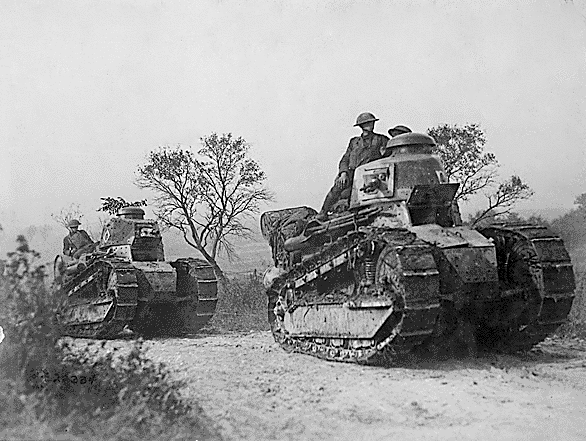
French Renault Light tank
French Renault FT tanks operated by the US Army in France. The light tanks had a crew of only two and were mass-produced during World War I. (Wikimedia Commons)

Tanks should support infantry. In fact, that’s why the tank was invented back in the First World War, as a means to destroy the machine guns and barbed wire that had decimated infantry attacking across No Man’s Land. But tanks, like battleships, are compromises between three requirements: firepower, protection, and mobility. You can favor one or perhaps two of those factors, but only at the cost of the third.

And the Army’s MPF light tank sacrifices protection, given that it weighs only 40 tons. Even if it mounts an Active Protection System to shoot down incoming anti-tank rockets, the tank would seem likely to have protection closer to an infantry fighting vehicle like the M2 Bradley than a main battle tank like the Abrams.

Then there is the troubled history of the light tank concept. The major powers all used light tanks in World War II. The tanks included the U.S. M3 and M5 Stuart, the German Panzerkampfwagen I, and the Soviet T-70. They had smaller cannons and lighter armor, but they were cheaper to build than medium and heavy tanks.

The problem was that in combat, they often faced heavier enemy tanks. During the disastrous Battle of Kasserine Pass in February 1943, the M5 found itself outmatched by heavier, better-armed, and better-armored German PzKpfw III and IV tanks and anti-tank guns. General Patton “issued a directive that light tanks were only to be used for reconnaissance and flank security in view of their weakness in dealing with current German tanks and anti-tank guns,” notes author Steven Zaloga in his book on the Stuart tank. Against heavy German Tiger and Panther tanks, the results could be imagined.

Related: Could the Panther tank once again be seen in Europe?

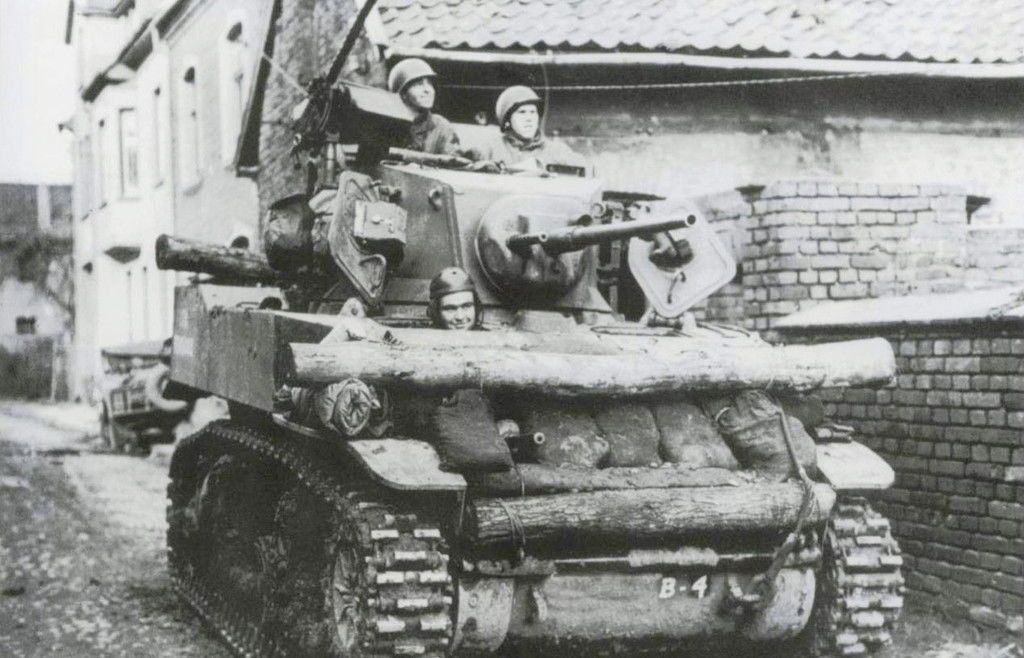
M5A1 light tank during WWII
The M5A1 light tank. Here the crew has added logs to the chassis to increase the vehicle’s protection. (The Museum of American Armor)

By 1944, the U.S. Army had concluded that the “poor armor protection of the M5A1 resulted in a higher rate of crew casualties than in medium tanks, with a medium tank crew having about a one-in-five chance of becoming a casualty when their tank was knocked out, compared to a one-in-three chance in light tanks,” according to Zaloga.

The Stuart was eventually replaced by the somewhat more successful M24 Chaffee, some of which were air-dropped to the doomed French garrison at Dien Bien Phu. After World War II came the infamous M551 Sheridan, an air-droppable light tank built out of aluminum and armed with a powerful 152-millimeter cannon that could fire Shillelagh infrared-guided anti-tank missile. Deployed to Vietnam in 1969, the recoil of the gun was so hard that it knocked out the vehicle’s electronics.

This doesn’t mean that the new Griffin II light tank will be unsuccessful. But U.S. tanks already face a variety of deadly threats, including new Chinese and Russian tanks such as Russia’s T-14 Armata, as well as anti-tank missiles, long-range artillery, and missile-armed drones that have proved devastating in the Russia-Ukraine war.

Some experts are already writing obituaries for the tank. That’s premature because there is no substitute for a vehicle that combines firepower, protection, and mobility. Yet, it does suggest that the modern battlefield is a heavy burden for a light tank.


Friday, November 15, 2019

The U.S. Army has a Unmanned Tank..

Unmanned tanks have been a staple of SciFi for generations.  Now fantasy is reality.  I remembered reading about unmanned tanks and BOLO's


The US Army has a new robotic tank. Called the Ripsaw M5, the remote-controlled drone replaces the manned Ripsaw MS2 tank which could hit a maximum of 60 miles per hour with its 600 horsepower engine.
The M5 is intended to be used alongside manned tanks and other combat units. It is configurable to be used for support, combat, and surveillance missions.
It can carry an R80D Skyraider quacopter drone which can reach an airspeed of 31 miles per hour, carry up to 4.4 pounds and stay in the air for up to 50 minutes. The Skyraider has optical and infrared cameras.
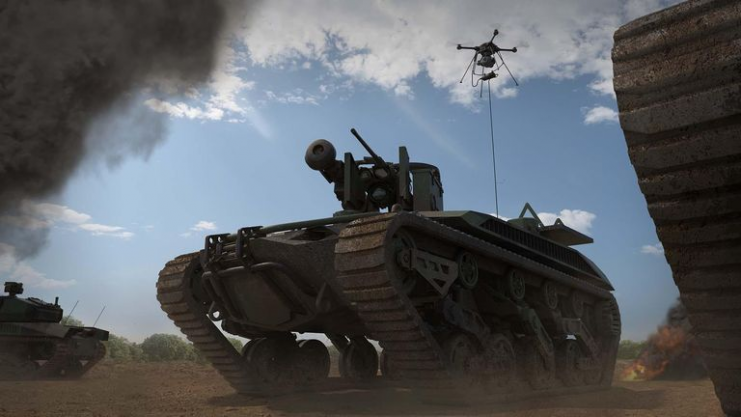
tank
Ripsaw M5 armed with the CROWS-J anti-tank missile launcher and launching a R80 Skyraider tethered UAV.
The M5 also carries an SUGV unmanned ground robot with a manipulator arm that can climb stairs. It can be used to explore buildings and to peep around corners with a retractable surveillance turret.
Officially called a “Robotic Combat Vehicle,” the M5 is heavily armored and can be outfitted with a variety of cannons. This gives it the option of using the standard 30-millimeter Mk. 44 Bushmaster II autocannon to engage enemy infantry, trucks and armored vehicles. A Javelin anti-tank missile launcher can be outfitted instead to engage enemy tanks. An anti-aircraft missile launcher is also available.

The M5 contains a 360° surveillance turret with optical and night-vision cameras. The turret is the Kongsberg MCT-30 Protector turret which is the same turret used on the Stryker Dragoono infantry combat vehicle.


The M5 can be used to clear mines, destroy improvised explosive devices, or breach obstacles. It has the option to be outfitted with a plow, ground-penetrating radar, or a launcher which can launch ground-clearing charges.
This is the latest in the Ripsaw remote operated tanks. The first was developed by Mike and Geoff Howe, brothers who were stars of the 2010 reality show “Howe & Howe Tech.

The M5 is manufactured by Textron Systems. They debuted the M5 at the 2019 Association of the United States Army exposition in Washington D.C.
Textron Systems CEO Lisa Atherton said that she is confident that the M5 is the “ideal wingman” for the US Army and that the company is prepared to quickly get these vehicles into the field where they are needed.
Mike Howe said that he and his brother founded Howe & Howe Tech in order to safeguard the United States military fighters.
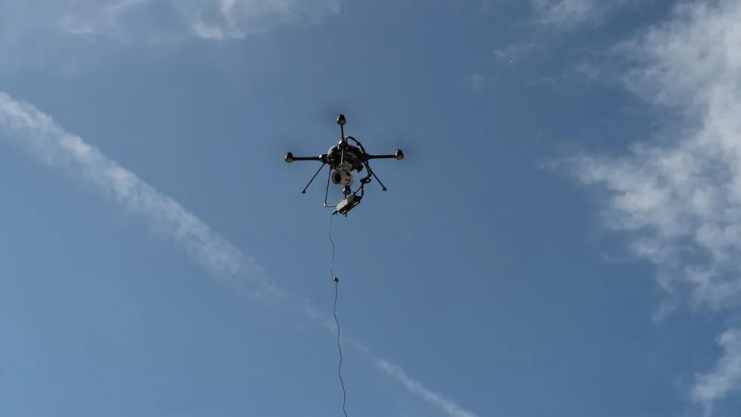
drone
A tethered FLIR R80D SkyRaider drone deployed from a Ripsaw M5(Textron Systems)

The M5 uses sensors from Textron Systems’ partner, FLIR Systems’ Government and Defense business unit. FLIR Systems Representative David Ray stated that his company’s cameras, drones and ground robots provide a tactical edge to the US forces by providing the latest in technology.
The M5 could be used alongside a Bradley infantry fighting vehicle to go ahead and trigger mines or IEDs before the soldiers reach them. It could be used to observe the enemy while the Bradley maneuvers to catch them unaware. If the soldiers are forced to retreat, the M5 could provide cover fire while they escape.

The US Army tested the original Ripsaw designed by the Howe brothers from 2010 to 2017 but never bought them in any significant volume. Textron Systems bought Howe & Howe Tech in October 2018.

Thursday, June 20, 2019

Heavy Tanks from WWII


I ran across this article and hung on to it.  Some of this I knew about, some was new to me.  It was interesting that the Armor development people were trying to do.


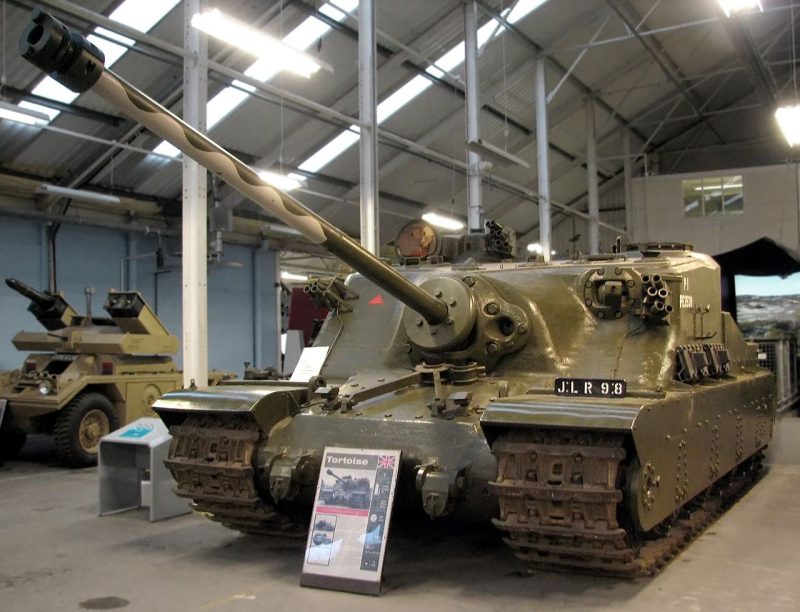
The Tortoise at The Tank Museum  Hohum CC BY-SA 3.0
The Tortoise at The Tank Museum 
 

During World War I, tank warfare was still very much in its infancy. The priority at the time was about getting this new technology to work more reliably and to develop tactics that would allow them to be used to their full advantage.
Through the inter-war years, with tighter peacetime budgets and a major economic slow down, the desire to build “big” tanks became subdued, but not forgotten.
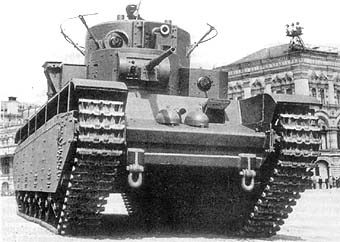
Mechanized warfare slowly developed throughout the 1920s and 30s with increasingly better armor, weapons and suspension. But there was an urge to build an unrealistic fighting machine, and the Soviet Union took the tank concept to a whole new level with their 50 ton T-35.
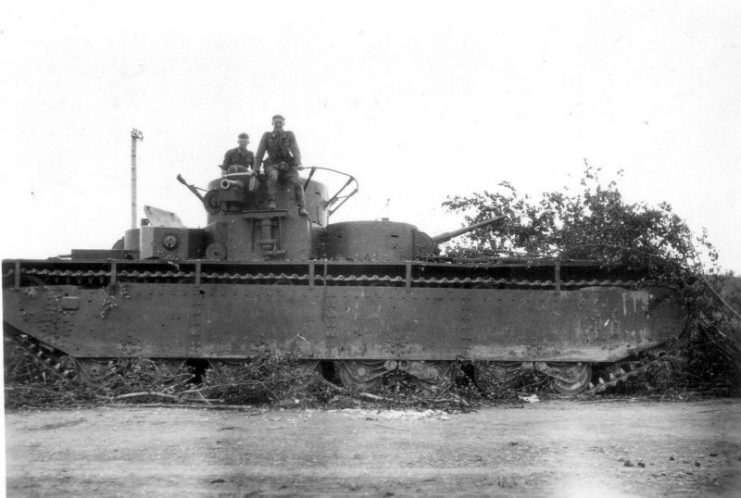
First production T-35A tank on parade in Red Square.
It was an attempt to build something resembling a mechanized fort, bristling with a ridiculous amount of guns. It had 5 turrets with a 76 mm main gun, two 45 mm cannons, and six medium machine guns. Each one carried a crew of 11 men.
Around 60 were built and when World War II broke out, they were used against the invading Germans in 1941. However, these tanks quickly broke down or were destroyed. Though this particular monster tank proved a failure in combat, it did have a certain shock value and was a useful propaganda tool.
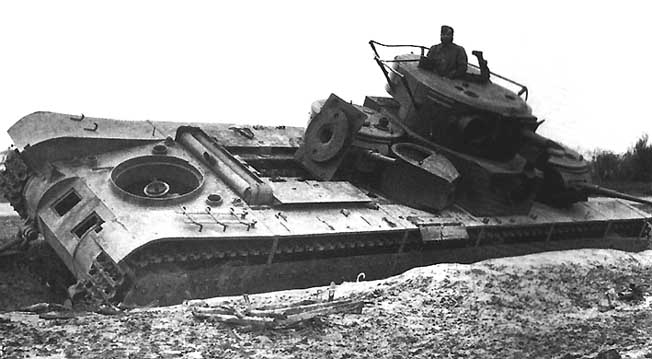
T-35 with semi-conical turrets
With the advent of World War II, there were many category of tanks that changed and evolved as the war progressed.
Two distinct categories of heavy tanks started to emerge. The first was the alpha male of heavy tanks (50 to 80 ton range). We will define this as any common mechanized vehicle, with a large caliber main gun, that saw proper service in reasonable numbers during WWII. This narrows the heavy tank category to a very exclusive club of just three tanks: the German Tiger I and II and the Soviet KV-2.
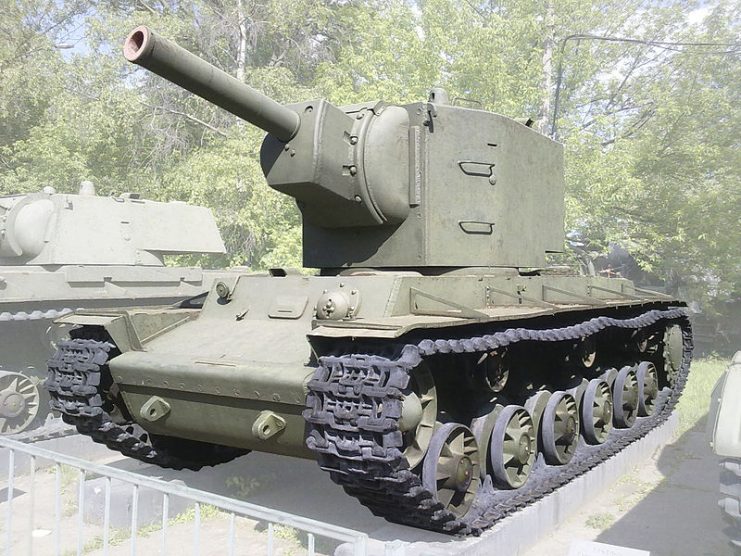
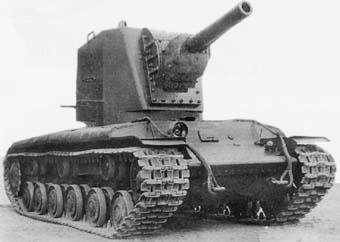
KV 2 Moscow – Gandvik CC BY-SA 3.0
KV 2 Moscow –
The other category we will consider will be the super heavy tanks, again just confined to three tanks in total: one each from America, Great Britain and Germany. None of these saw active service, but went far beyond the drawing board stage.
It should be noted that for super heavy tanks, this article excludes tanks like the mighty non-turreted Elephant (68 ton) and JagdTiger (72 ton) tank destroyer because they were only built in small numbers. Likewise the multi-turreted 50 ton T-35M has been excluded as only 60 were built and most were destroyed or put out of service shortly after the Soviet Union entered the war.
German troops posing on a captured T-35, unknown date
Type: Tiger I (Panzer VI)
  • Nationality: Germany
  • Introduced: 1942
  • Weight: 55 tons
  • Crew: 5
  • Speed Across Country: 12 mph
  • Weaponry:
    • 1 x 88 mm Gun
    • 2 x Machine Guns
  • Maximum Armor: 110 mm
  • Height: 10 ft
  • Length: 21 ft
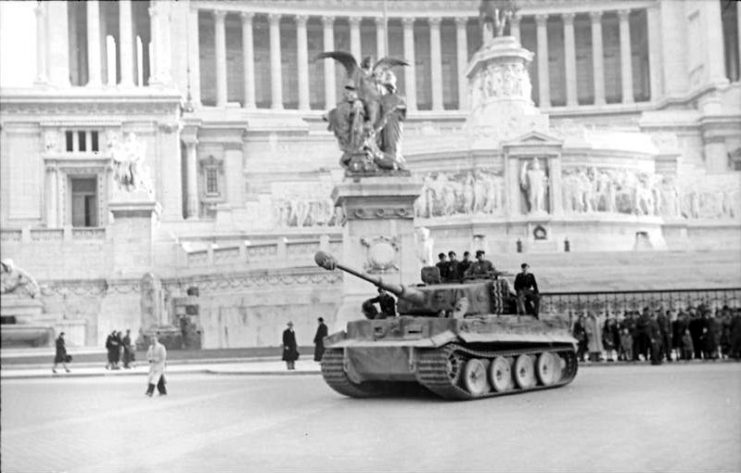
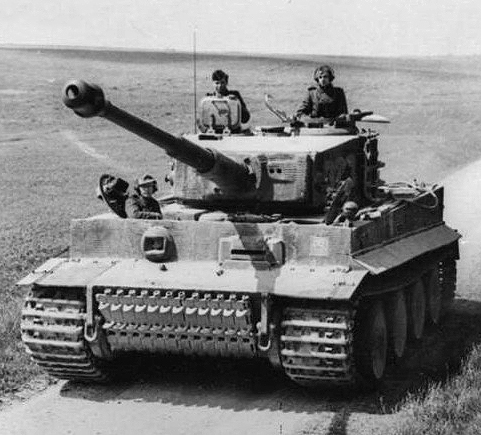
When the Tiger I started to enter service with the German army in late 1942, it was not just its size and weight that made it impressive. It sported the legendary 88 mm gun that could defeat any Allied armor at a reasonable range. It was capable of destroying a T34/76 from nearly a mile away.
German Tiger I tank in front of the Altare della Patria in Rome in 1944. Photo: Bundesarchiv, Bild 101I-310-0880-38 / Engel / CC-BY-SA 3.0
German Tiger I tank in front of the Altare della Patria in Rome in 1944. Photo: Bundesarchiv, 
Though the Tiger I’s armor was not sloped, it was incredibly thick. Soviet tanks had to advance to close range to have a chance of penetrating its frontal armor. British and American tanks had to outflank a Tiger and then get in close to have any chance of defeating its armor. So when a Tiger was spotted on the Western Front, it was so feared that a whole advance could be held up until enough tanks could be brought up to attack it in mass.
Tiger I in northern France, March 1944 Photo by Bundesarchiv Bild 101I-299-1805-16, Nordfrankreich, Panzer VI (Tiger I).2
Tiger I in northern France, March 1944 Photo by Bundesarchiv Bild
But the Tiger did have its drawbacks. It was mechanically unreliable due to its weight and rushed development. Also, there was never enough of them to go around, with only 1,350 ever produced.
Type: Tiger II (Panzer VIB)
  • Nationality: Germany
  • Introduced: 1944
  • Weight: 70 tons
  • Crew: 5
  • Speed Across Country: 10 mph
  • Weaponry:
    • 1 x 88 mm Gun
    • 2 x Machine Guns
  • Maximum Armor: 185 mm
  • Height: 10 ft
  • Length: 24 ft
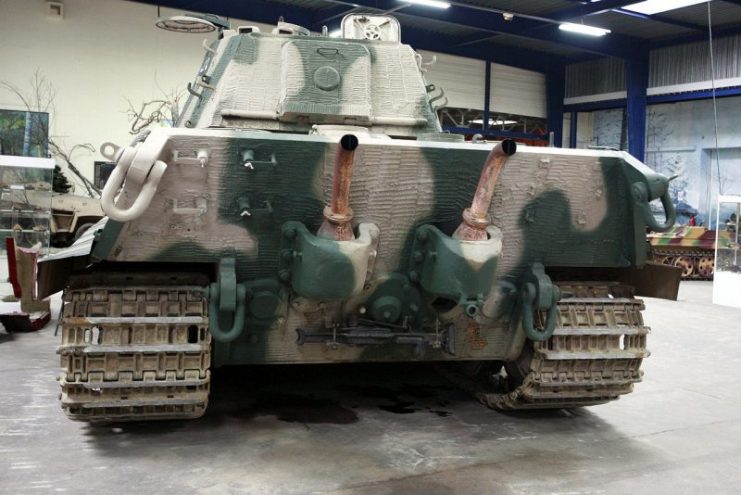
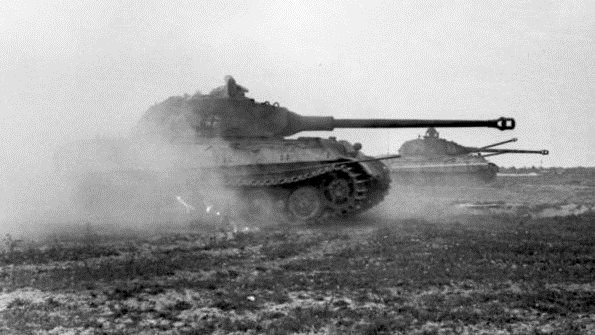
The next logical progression for the Germans was the much improved Tiger II, often referred to as the King Tiger. It had an improved 88 mm gun and even thicker armor, but this time it was sloped. Even the latest Soviet tanks had to treat it with respect.
Tiger II. On display at Saumur Général Estienne museum. Photo by Rama CC BY-SA 2.0 fr
Tiger II. On display at Saumur Général Estienne museum.

But its gigantic weight (70 tons) put a tremendous strain on its engine, which only produced 10 horse power to the ton. Compare this to the sprightly American M36 tank destroyers that had a ratio of 18 horse power to the ton while being armed with a 90 mm cannon.
Ultimately the Tiger II suffered from the same drawbacks as its predecessor: unreliability and scarcity. Only 485 were built.
Tiger IIs Photo by Bundesarchiv, Bild 101I-721-0397-34 / Wagner / CC-BY-SA 3.0
Tiger IIs Photo by Bundesarchiv, Bild
Type: KV-2
  • Nationality: USSR
  • Introduced: 1941
  • Weight: 52 tons
  • Crew: 6
  • Speed Across Country: 9 mph
  • Weaponry:
    • 1 x 152 mm Howitzer
    • 3 x Machine Guns
  • Maximum Armor: 110 mm
  • Height: 12 ft
  • Length: 23 ft
The last tank in our exclusive 50-plus ton category is the Soviet KV-2, a slow moving, well armored tank with a gigantic tall turret that housed a 152 mm howitzer. Originally it was designed to overcome and defeat enemy fortifications, but it was rapidly pressed into service as a battle tank when Germany invaded the Soviet Union in 1941.
The KV-2 heavy artillery tank’s 152 mm howitzer was housed in an enormous turret. This prototype differs from the production version in several ways. It was called the Dreadnought by its crews

Though the gun had poor penetrative capabilities, the mighty kinetic force of the round could blow off turrets or literally shake apart a tank. But it was clumsy in combat, had a slow rate of fire, and its high silhouette made it a very easy target.
Most were destroyed shortly after the German invasion. When the Germans captured the sole factory where it was built, the Soviets made no attempt to resume production elsewhere due to the inherent shortcomings of the design.

Super Heavy Tanks

Type: Tortoise (A-39)
  • Nationality: UK
  • Introduced: Prototype 1945
  • Weight: 79 tons
  • Crew: 6
  • Speed Across Country: 4 mph
  • Weaponry:
    • 1 x 94 mm Gun
    • 3 x Machine Guns
  • Maximum Armor: 228 mm
  • Height: 10 ft
  • Length: 33 ft
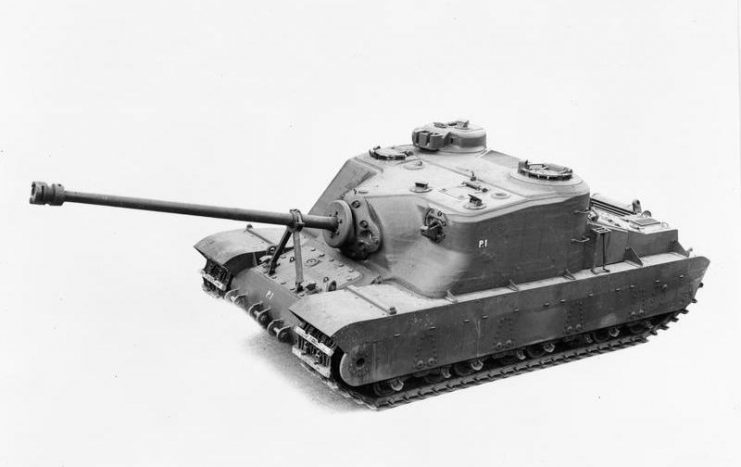
The Tortoise was the lightest (78 tons) and had the smallest main gun (94 mm) of the three super heavy tanks in this article. But it came the closest of them all to actually being produced, with 6 pre-production tanks being made.
The Assault Tank A39 Tortoise
It was designed in 1945 for the same purpose as the American T-28: to help clear German fortifications, such as the Siegfried Line, that the Allies would encounter as they advanced into Germany itself. Therefore the priority was on firepower and armor, with mobility being the least of its designers’ worries.

Its 14.5 kg projectile could have quite a devastating effect on bunkers and emplacements. It could even knock out a German Panther tank from 3,500 feet away.
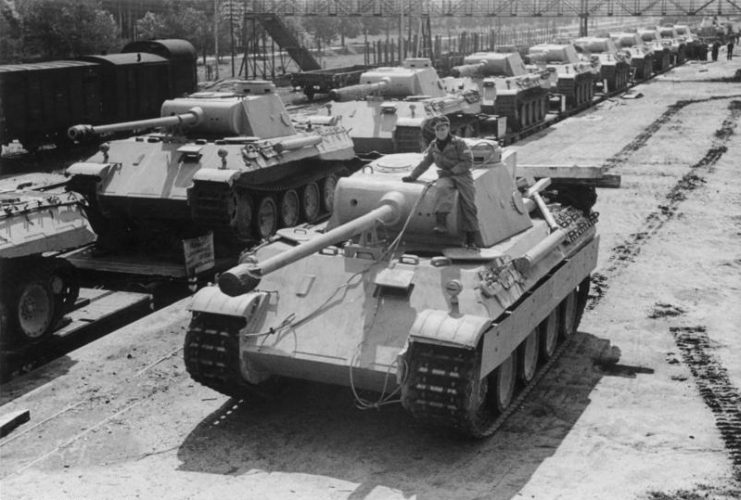
Panther tanks are loaded for transport to frontline units, 1943 Bundesarchiv, Bild 183-H26258 CC-BY-SA 3.0
Panther tanks are loaded for transport to frontline units, 1943 Bundesarchiv, Bild
The Tortoise was underpowered, but again, speed was not its priority. It used a Merlin engine which produced 600 horsepower, resulting in only 7 horsepower per ton. This was appalling when you consider a Panther had a power to rate ratio of 15 horsepower per ton. Also, the Tortoise’s range was just 87 miles, and it consumed nearly 1.5 gallons of fuel per mile.
Twenty-five Tortoises were ordered, but only six had been delivered by 1946 before the project was cancelled, as there was no longer was a need for it.
In tests it proved reliable and had good gunnery characteristics. But its weight and size caused great logistical problems.
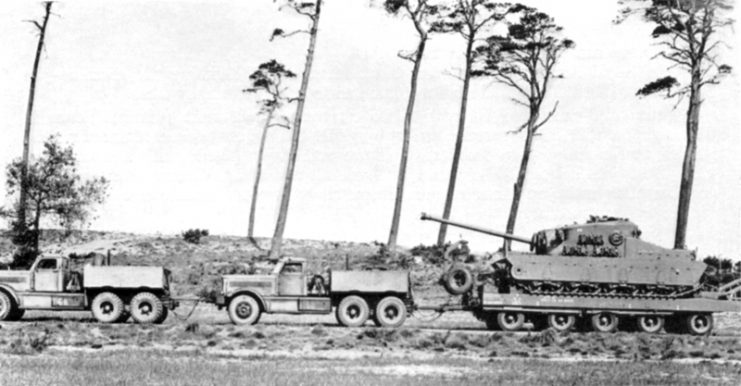
The A39 Tortoise being towed on an 80-ton trailer by two Diamond T’s during trials in BAOR, 1948
The A39 Tortoise being towed on an 80-ton trailer by two Diamond T’s during trials in BAOR*
, 1948                                  *British Army On the Rhine
Type: T28
  • Nationality: USA
  • Introduced: Prototype 1945
  • Weight: 86 tons
  • Crew: 6
  • Speed Across Country: 4 mph (Estimated)
  • Weaponry:
    • 1 x 105 mm
    • 1 x Machine Gun
  • Maximum Armor: 305 mm
  • Height: 9 ft
  • Length: 36 ft
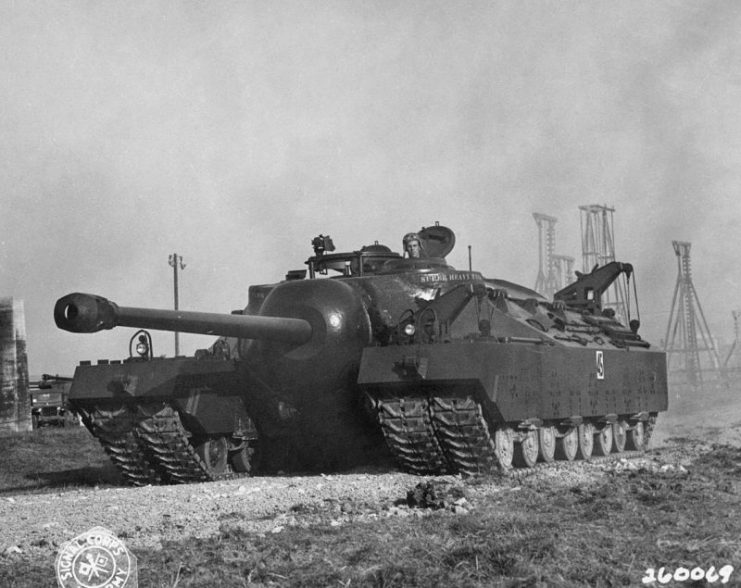
As for the American T28, it was slightly heavier and had a bigger gun. But it had significantly thicker armor, up to 80 mm thicker at the front. It was later to be reclassified as the Super Heavy Tank T28. Like the Tortoise, it had no turret and had to aim its gun by moving the whole body of the tank.
T28 Tank
T28 Tank

The T28 had a protracted design phase which ran from March 1944 to March 1945. Work did not start on producing the actual tank until August 1945. As the war in Europe had ended and the war in the Pacific would very soon end, the original order for twenty-five tanks was reduced to five, and then again to just two tanks.
The T28 was put through tests and trials until October 1947 when the project was deemed obsolete and cancelled. Apart from having the same logistical problems as the Tortoise, the T28 proved very expensive to maintain.
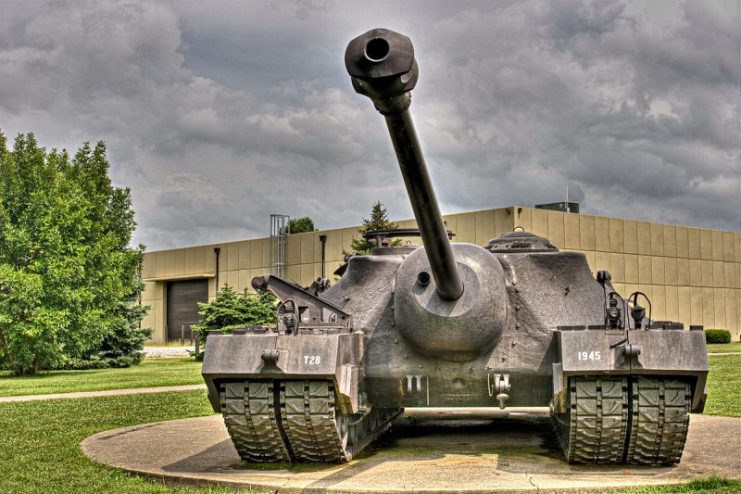
This old experimental Tank is parked outside of the Patton Museum Fort Knox Kentucky. Only 2 were made. Photo: Randen Pederson / CC-BY-SA 2.0
This old experimental Tank is parked outside of the Patton Museum Fort Knox Kentucky. Only 2 were made.


Type: Maus (Panzer VIII)
  • Nationality: Germany
  • Introduced: Prototype 1944
  • Weight: 188 tons
  • Crew: 6
  • Speed Across Country: 3 mph (Estimated)
  • Weaponry:
    • 1 x 128 mm Gun
    • 1 x 75 mm Gun
    • 1 x Machine Gun
  • Maximum Armor: 240 mm
  • Height: 12 ft
  • Length: 33 ft
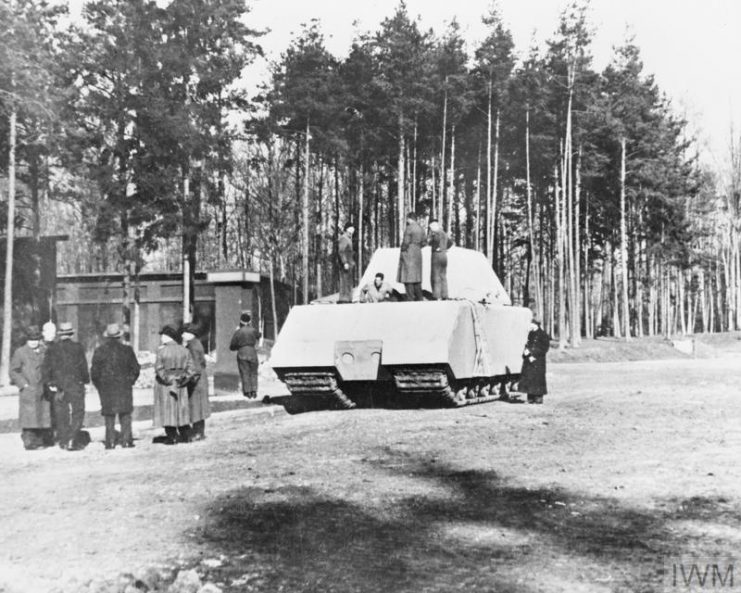
The German Panzer VIII “Maus” was by far the heaviest (188 tons) and best armed (128 mm main gun with a coaxial 75 mm gun) of the three super heavy tanks. It is by far the heaviest tank ever built. Despite its enormous size it had an extremely cramped interior.
Panzer VIII Maus
Panzer VIII Maus

Only two were ever built, one of which was incomplete. It was designed as a “breakthrough” tank at a time when Germany was fighting a defensive war.
On the plus side the armor was incredibly thick, ranging from 240 mm on the front to 180 mm on the sides and rear. An unusual characteristic compared to other tanks was that its roof armor was also amazingly thick—an incredible 220 mm—in response to the devastating attacks on tanks by Allied ground attack aircraft such as the British Hawker Typhoon and the Soviet II-2 Sturmovik.
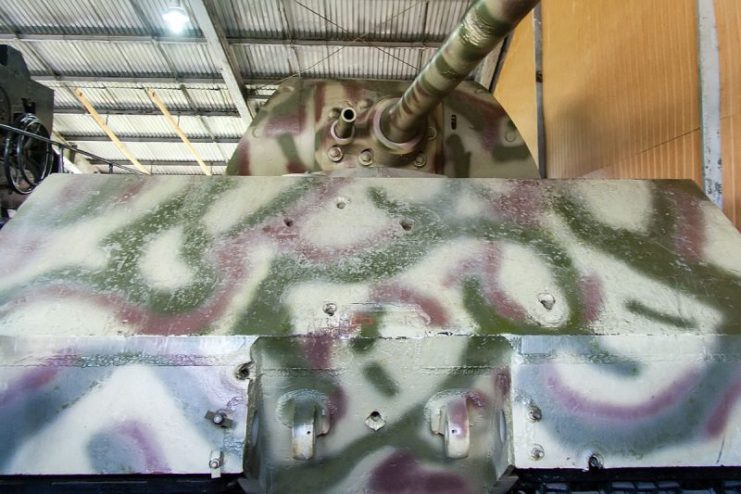
Front view of thePanzerkampfwagen VIII Maus at Kubinka Museum. Photo: Mike1979 Russia / CC-BY-SA 3.0
Front view of thePanzerkampfwagen VIII Maus at Kubinka Museum.

The Maus’s main armament was the 128 mm KwK 44 L/55 which fired a massive 28 kg projectile that could penetrate 148 mm of sloped armor at 6,600 feet (1.25 miles). This meant it could easily defeat the frontal armor of a Soviet JS-2, American M-26 Pershing, British A-34 Comet, or even the Germans’ own Tiger I.
A “King Tiger” (Tiger II) with its maximum armor of 185 mm could withstand a hit down to 3,000 feet. But that still meant it could be destroyed by a Maus from half a mile away.
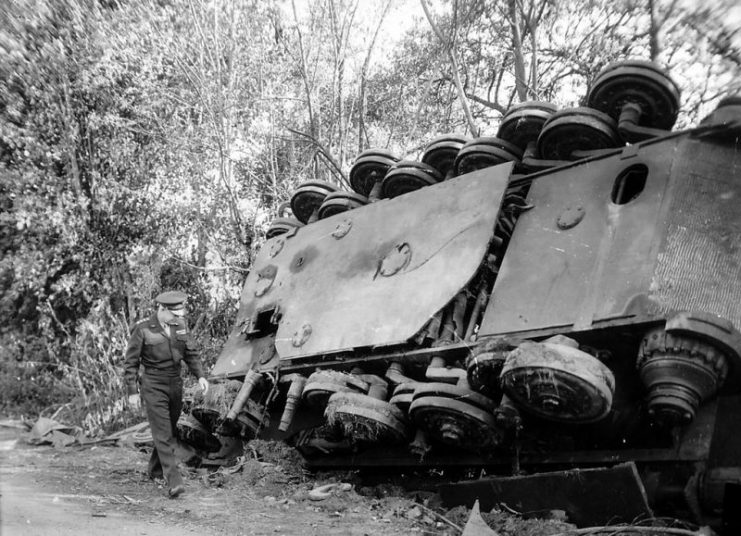
SHAEF commander Gen. Eisenhower walks by an overturned Tiger II. The overlapping, non-interleaved steel-rim roadwheel arrangement is visible.
But all this came at a cost. The Maus had a slow rate of fire. Its prohibitive size and enormous weight restricted its off-road ability. On roads it often churned up the surface as it went along, making the road unserviceable for other vehicles.
Most railways, tunnels and bridges in the country could not take its weight. On those few that could take the weight, the tank’s giant bulk restricted it.
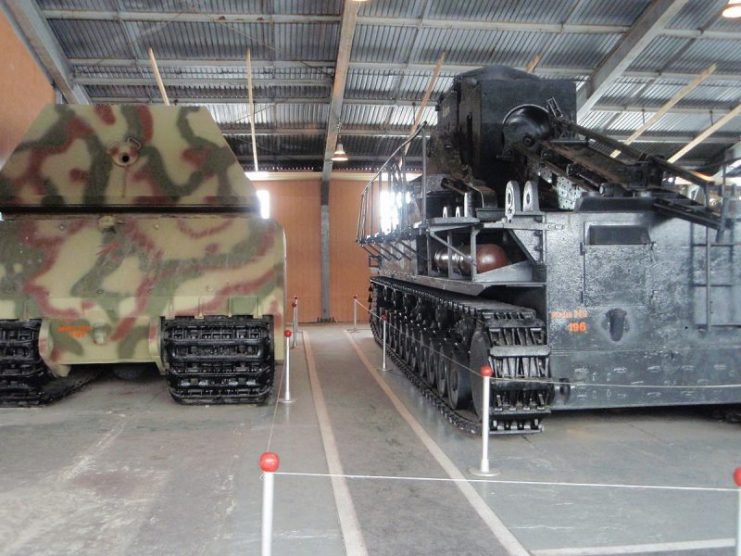
Rear view of the Panzerkampfwagen VIII Maus at Kubinka Museum.

Its monster weight pushed engine and suspension technology and innovation to its limit. In fact it was a step too far. The tank was notoriously unreliable and it was unlikely that any of its problems could have been fully resolved, even given more development time.

After the war it was realized that the super heavy tank concept was simply unrealistic because of all the drawbacks related to its size and weight. As for the heavy tanks, they were deemed unable to keep up with the fast pace of modern warfare.
In 1957 the Fourth Tripartite Conference on Armour recommended that all medium and heavy tanks be replaced with a single new class, the Main Battle Tank (MBT). This led to the German Leopard II, American M1 Abrams, British Challenger II, and Russian T-80 MBTs of today.

Friday, September 7, 2018

Panther Tank


I consider the Panther Tank the all around best German Tank, it had the armor to stand up to the T34/85 and of course the undergunned American Tanks like the Sherman. The later tanks like the Pershing were better armed and of course the American Tank destroyers were better armed.  The British Shermans called the "Firefly" had the excellent British 17 pounder gun(76 mm) The Panther was developed in response to the T34 tank that the Germans ran across right after they started Operation Barbarossa and to their shock discovered that their Panzer Mark III and Panzer Mark II's were woefully undergunned and the few Panzer Mark IV's had the 50 MM gun and it had problems.  The Germans had to use the legendary 88 to take out the better armed Soviet Tanks. 


The German Panther tank was deployed during the Second World War in the European Theater, between the years 1943 and 1945. It saw action on both the Eastern and Western fronts, and is widely hailed as one of the best tanks designed and produced during the conflict.
The Panther was the third most-produced German armored fighting vehicle, after the Sturmgeschütz III assault gun/tank destroyer at 9,408 units, and the Panzer IV tank at 8,298 units.
They proved to be extremely popular, and as a result more than 6000 Panthers were built for the German military. More surprisingly, however, is the fact that nine of these tanks were built by the British Army between 1945 and 1946. This alone is a testament to the high quality of these remarkable war machines

There were three main version of the Panther – versions D, A and G – with each new version incorporating significant improvements. There were also the artillery spotter, recovery, and Commander versions.
The full name was the Panzerkampfwagen V Panther and it had the ordnance inventory designation of Sd.Kfz. 171. However, on 27 February 1944, Hitler ordered that the Roman numeral “V” be deleted from the designation.
This wan’t the only way in which Hitler was directly involved with the tank’s design. The Panther was originally meant to weigh 30 tons, but the Nazi Leader demanded extra armor and a heavier gun and so it ended up weighing almost 50 tons.


Bundesarchiv_Bild_183-J24359,_Rumänien,_Kolonne_von_Panzer_V_(Panther)
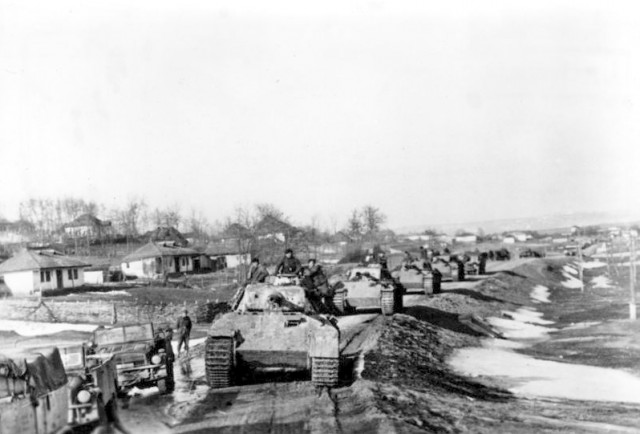
Panther tanks of the Großdeutschland Division advance in the area of IaÅŸi, Romania in 1944 .Bundesarchiv – 
Hitler later ordered a Panther II which would feature more armor while still maintaining the same gun, one prototype of which prototype was captured by the Americans. The project was quietly cancelled in mid-1943.
Although weighing a great deal, they could still move at a considerable pace. The later models had a top speed of 46km/h, roughly as fast as the Tiger and slightly faster than the Sherman tank.
These powerful tanks could be used to devastating effect on the battlefield. One of the top German Panther commanders was SS-Oberscharführer Ernst Barkmann of the 2nd SS-Panzer Regiment “Das Reich”. By the end of the war, he had some 80 tank kills claimed.
The Panther tank uses an engine very similar to the one used in the Tiger Tank, with an average life of 1500 hours. The Panther tank came into service after the Tiger tank, the Panther being first used in combat in July 1943 in Kursk whereas the Tiger was first used in Leningrad in December 1942.


Nordfrankreich, Panzer V (Panther) mit Infanterie
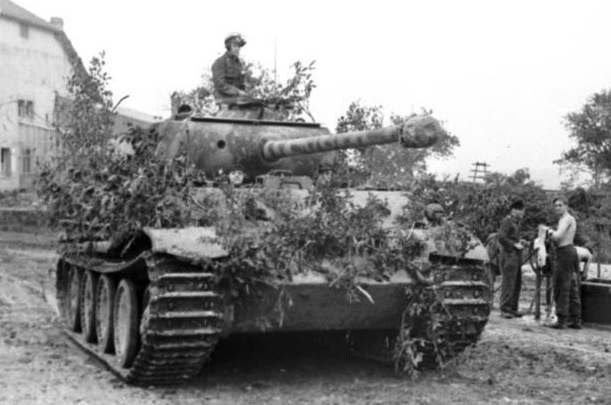
Panther tank with bush camouflage in Northern France, 1944. Bundesarchiv – 

Panther tanks were captured on certain occasions and put to use by Germany’s enemies. At least two Panthers were commandeered by the Polish resistance in the early days of the Warshaw uprising, although they were immobilized after several days due to lack of fuel, and were then set on fire.
Russian troops also captured several Panthers, turning them against the Nazis along the Eastern Front. They abandoned them once the tanks broke down, however, as they were deemed too complicated and too difficult to repair.
The Panther had a 7.5 cm main gun that could carry 40 rounds of anti-tank ammo and 39 high explosive shells. It also had two MG 34 machine guns with 5100 rounds of ammunition. The tank needed a crew of at least five men, including a commander, driver, gunner, loader, radioman and machine gunner.

Bundesarchiv_Bild_101I-244-2323-06A,_Ostfront-Süd,_Panzersoldaten
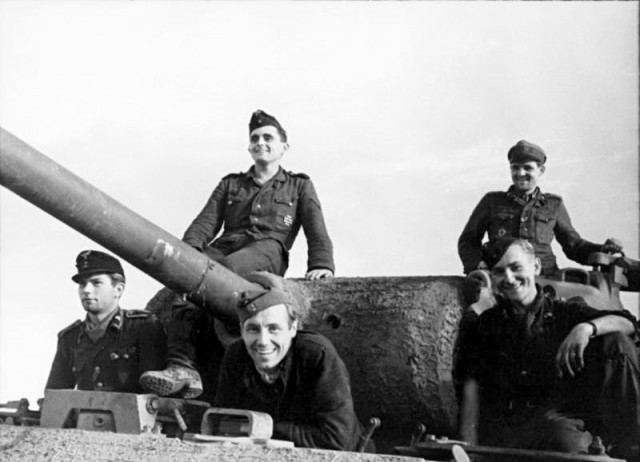
A Panther crew. Bundesarchiv – 
The Panthers saw a great deal of action during their years in service. At their peak in September 1944 there were 552 Panthers operational on the Eastern Front, out of a total of 728. Later, during the Battle of the Bulge, the Germans used 400 Panther Tanks, five of which were disguised to look like American M10 Tank Destroyers. They did this by welding on additional plates and applying US-style camouflage paint and markings.
There are thought to be five surviving Panthers in running order, two of which were built by the British Army. There are a lot more non-runner Panthers out there in museums, as monuments or in the hands of private collectors.
The last operational report dated March 15, 1945, lists 361 operational out of 740 Panther tanks.
 Postwar Use :
Although a technologically sophisticated vehicle, the Panther's design had a very limited influence on postwar tank development. The French postwar AMX 50 tank prototype was indirectly influenced by it through the Entwicklung series, but never entered series production. It is claimed that the Panther was arguably a forebear to the modern main battle tank.
The Panther itself also saw some limited use outside the German military, both before and after 1945.


 British officers ride on a captured Panther tank in Italy June 1944, with early "letterbox" hull gun aperture

During the war, the Red Army employed a number of captured Panthers. These were repainted with prominent Soviet emblems and tactical markings to avoid friendly fire incidents. Unlike captured Panzer IVs and StuGs, the Soviets generally only used Panthers and Tigers that had been captured intact and used them until they broke down, as they were too complex and difficult to transport for repair. Panzer IVs and StuGs, on the other hand, were so numerous in terms of spare parts and easy to repair that they could be used over a much longer period in combat conditions.
During March–April 1945, Bulgaria received 15 Panthers of various makes (D, A, and G variants) from captured and overhauled Soviet stocks; they only saw limited (training) service use. They were dug down, with automotive components removed, as pillboxes along the Bulgarian-Turkish border as early as the late 1940s. The final fate of these pillbox Panthers is unknown, but sources indicate that they were replaced and scrapped in the 1950s.
In May 1946, Romania received 13 Panther tanks from the USSR. They were initially used by the 1st Armoured Brigade, but in 1947 the equipment was ceded to the Soviet-organized "Tudor Vladimirescu Division", which was transformed from a volunteer infantry division into an armoured one. The Panther tank was officially known as T-V (T-5) in the army inventory. These tanks were in poor condition and remained in service until about 1950, by which time the Romanian Army had received T-34-85 tanks. All of the tanks were scrapped by 1954. The tanks were different models: Ausf A, Ausf D, and Ausf G.They were shown to the public in 1948, during the 1 May parade in Bucharest, painted with Romanian markings. Until 1950, the T-V (T-5) was the heaviest tank available to the Romanian Army.
 Batalion ZoÅ›ka armored platoon on a captured German Panther, 2 August 1944.

During the Warsaw Uprising, the Polish Home Army captured and used two Panther tanks. One, nicknamed Magda, was used by Batalion Zośka's armored platoon under the command of Wacław Micuta to liberate the Gęsiówka concentration camp.
One captured vehicle (named "Cuckoo") also saw service with the British Coldstream Guards for some time.
Germany sold Japan a single Panther along with a Tiger in September 1943; by the time it was ready in 1944, it was impossible to ship due to Allied naval interdiction.
In 1946, Sweden sent a delegation to France to examine surviving specimens of German military vehicles. During their visit, the delegates found a few surviving Panthers and had one shipped to Sweden for further testing and evaluation, which continued until 1961. The tank is on display in the Deutsches Panzermuseum in Munster.
After the war, France was able to recover enough operable vehicles and components to equip the French Army's 503e Régiment de Chars de Combat with a force of 50 Panthers from 1944 to 1947, in the 501st and 503rd Tank Regiments. In 1947, the French War Ministry wrote an evaluation of them entitled Le Panther 1947. These remained in service until they were replaced by French-built ARL 44 heavy tanks.
The last 'production' Panthers were produced at the factory by German staff just after the end of World War II under the supervision of the Royal Electrical and Mechanical Engineers (REME) using available components. 9 Panthers and 12 Jagdpanthers were produced and shipped back to Britain for post-war trials. A complete Panther and a complete Jagdpanther produced this way are now at the Bovington Tank Museum, Dorset, with brass plates on them, explaining their history.

Wednesday, January 11, 2012

Army continues upgrading M1 Tanks

I remembered seeing the M1 for the first time on a training area on Hohenfels in Germany.  Anybody that has been in Germany has been to Honenfels or Graf or Wildflicken.  We have seen the M1 Tanks and they are impressive.  I am glad to see the Army upgrading the M1.  Every time in the past, we would go into battle unprepared.  We learned the lessons of the Kasserine Pass where a bunch of American tanks had their asses handed to them by superior German tanks or at the outbreak of the Korean war with Task Force Smith where the American Shermans had problems with the North Korean T34/76 and T34/85 and the IS-2(Josef Stalin) Heavy Tank
      The M1's saw their baptism of fire in the first Gulf war and devastated their Iraqi counterparts.  The T-55/62 and the T72M were no match for the M1's.  No matter what other weapon system is deployed, nothing kills a tank like another tank.  In my opinion if we had our own armor rather than relying on the pakastani's or indians during the Battle of Mogadishu we would have been better served.
     The M1 has built a fearsome reputation since its initial deployment to the first Gulf War, in the past we always had the inferior tank at the start of any war, with the M1 we finally had a tank that was state of the art.
     With the Chinese stirring up problems, the possibility of us facing off against a heavy division of the opponents is possible.  Upgraded Strykers cannot face off tanks.


The Army won’t be sized for big-time wars anymore. American units are going to begin coming home from Europe. There’s a food fight in the works over what roles and missions, including heavy units, sluice down into the Guard and Reserves.
But all that stuff is tomorrow or beyond. Today, the Army is making hay while the sun shines — it’s going forward with its plan to continue improving its flaship M1 Abrams main battle tank.
On Friday, General Dynamics Land Systems announced it had received a $60 million contract to continue work upgrading the Army’s M1A1-variant Abrams tanks to the M1A2 Systems Enhancement Package (SEP) V2 configuration — the king of the jungle. Here’s how GD described them in its announcement:
The most technologically advanced digital tank, the M1A2 SEP V2 includes improved color displays, day and night thermal sights, commander remote operated weapon station (CROWS II), a Thermal Management System (TMS) and a tank-infantry phone.  The M1A2 SEP V2 maximizes the fighting ability of the tank on today’s battlefield while preparing the platform for tomorrow’s challenges. The original order was made under a multi-year contract awarded in February 2008, which authorized the upgrade of 435 M1A1 tanks that have been in the Army’s inventory for more than 20 years.  General Dynamics is continuing the conversion of the tanks in the Army’s active component to the M1A2 SEP V2 configuration.
The question about where those tanks will ultimately end up could become one of DoD’s central questions over the coming year. Everybody loves big, heavy, old-fashioned, rolling-thunder units, ripping up the mud with their treads and shooting the hell out of their targets downrange, but they could start to seem pretty expensive in the austerity Army. There’s a school of thought, broached at last year’s Association of the United States Army trade show and elsewhere, that the Army should move many or most of its active tank units into the Guard and Reserves.
In keeping with the new doctrine of “reversibility,” transferring heavy brigades to the reserve component is the best compromise under the circumstances, advocates might say. If the United States needs to go fight another major land war — which Joint Chiefs Chairman Gen. Martin Dempsey seems to think is quite possible — it will be able to call up heavy units just in case. They won’t be ready as quickly as they might be today, but at least they’d be there. (Besides, what’re the odds of a big force-on-force armor engagement anytime soon in the 21st century?)
On the other hand, although “reversibility” is the new DoD-level buzzword, the Army-level buzzword has long been “balance.” Dialing back some active brigades to zero is exactly the kind of thing Chief of Staff Gen. Ray Odierno and Dempsey, during his brief stint as chief, both warned about. The Army has got to be able to keep its ability to do everything, they argue — with a lower end strength, maybe, but at least in proportion to the rest of the service.
The answers aren’t at all clear, but with hundreds of billions in reduced budget growth hanging over its head, the Army may not have much longer before it must start deciding.