Webster

The Constitution was made to guard the people against the dangers of good intentions." --American Statesman Daniel Webster (1782-1852)


Showing posts with label Naval History. Show all posts

Saturday, January 23, 2021

The C.S.S. Stonewall, the Last Ironclad of the Confederacy. And a ship that would sail under 6 flags

I ran across this little tidbit of History following another rabbit hole and compiled an article, the pics are compliments of "DuckDuckGo"

Patterned as she was on the revolutionary French Battleship Gloire, on paper she seemed formidable. She was 194 feet in length, 31.5 feet at the beam, drew 15.75 feet of water and displaced 1560 tons. Her hull was protected by 4.5 inches of armor amidships tapering to 3.5 inches at the bow and stern. Up to 24 inches of hardwood backed this iron carapace. A casemate forward sheathed in 5.5 inches of iron housed a pivot mounted, breech loading, 300 pounder Armstrong gun. A fixed turret aft covered in 4 inches of armor contained two 70 pounder breech loading Armstrong guns. In keeping with naval tactics at the time, she was also equipped with a ram. Steam powered with a top speed of 10.8 knots, twin screws coupled with twin rudders made her remarkably maneuverable for a ship of her size and displacement. Unfortunately, her bunkers held only 280 tons of coal limiting her ability to steam for prolonged distances. For longer voyages she was fitted with a bowsprit and two square rigged masts. Steam power, thick armor and modern guns made her a ship to be feared.

 In reality she was poorly constructed, leaked badly, drew too much water and wallowed dangerously in heavy seas. Several months of extensive repairs were required to make her truly sea worthy. Only then would she begin to live up to her reputation.

Her name was Sphynx; her sister ship was called Cheops. Ostensibly they were being constructed by Jean-Lucien Arman, one of France's most respected shipbuilders, for the Egyptian Navy, but that was a ruse. In 1863 the Confederate States of America were being slowly strangled by the Union blockade. The Confederacy had sufficient industry to cobble together a few ironclads that performed surprisingly well in riverine warfare and in coastal waters. These warships had an impact far greater than their numbers. Ocean going ironclads capable of breaking the blockade that was choking the Confederacy were beyond her capability however. Accordingly, Confederate Secretary of the Navy Stephen Mallory sent agents to Europe to procure ironclad warships that would splinter the mostly wooden hulled Union Navy. His agents, John Slidell and James Bulloch, had some success in England obtaining the famous or infamous, depending upon your point of view, CSS Alabama, among others. As the American Civil War drug on however, Britain became an increasingly difficult partner. Turning to France, Napoleon III agreed to provide warships but since this act was against French neutrality laws, only if their ultimate destination remained secret, hence the fiction of Sphynx and Cheops. A shipyard clerk scuttled that subterfuge by going to the United States Minister in Paris and informing him of their true destination. When the United States officially protested, the sale was cancelled. Albeit illegally, the devious shipbuilder, Arman, was able to sell the Cheops to Prussia and the Sphynx to Denmark, who were currently involved in the Second Schleswig War.

Renamed the Saerkodder (Strong Otter), she left Bordeaux on 21 June 1864, sailing with a Danish crew. The voyage to Copenhagen revealed numerous sea-keeping problems and construction flaws. A very disappointed Danish government demanded repairs and a steep reduction in price. Negotiations between the Danes and Arman became contentious, drawn out and finally broke down. By this time the war between Denmark and Prussia had ended and Danish interest in the Saerkodder ended with it.

The Sphynx / Saerkodder kept returning to Arman. The scheming shipbuilder approached Bulloch regarding Confederate interest. By this point in the war only a few southern ports were still open, most had been captured or were closed by blockading Union warships. Desperate times called for desperate (and expensive) measures. The CSS Virginia had sown panic in the north during her all too brief career. An even more powerful ironclad might do the same. It was slim hope, but it was hope. Accordingly, Arman was able to broker a deal through his agent, Arnous de la Rivière, to resell the Saerkodder to the Confederate States for 450,000 francs. Thus, on 07 January 1865 the Confederate States Navy acquired its first and only European built oceangoing ironclad. Now called Olinda to maintain the fiction of legality, she sailed from Copenhagen toward the English Channel with a makeshift crew, under a Danish captain, and with Captain Thomas Jefferson Page, CSN, onboard. The plan was to rendezvous with the blockade runner City of Richmond at sea to take on supplies and her permanent crew, primarily sailors from the CSS Florida which had been seized 04 October 1864. A severe gale forced Olinda to take shelter in Kristiansand, Norway and drove the City of Richmond into Cherbourg, France. The two ships finally met on 24 January 1865 near the island of Houat off the coast of Brittany. The crews transferred and in a brief ceremony at sea the Danish flag was hauled down and the Confederate ensign raised. Thus, the Olinda became the CSS Stonewall, in honor of General Stonewall Jackson, mortally wounded at Chancellorsville. Before she could cross the Atlantic however, additional supplies, full bunkers of coal and repairs to damage caused by the gale were necessary. Stonewall first took refuge in Á Coruña, Spain and then on 12 February 1865 moved to El Ferrol which had better repair facilities. The United States government argued that Stonewall should be considered a pirate vessel and offered no assistance. Spain ignored those diplomatic protests and ship and crew were offered every courtesy in accordance with neutrality law.


Steaming from El Ferrol on 24 March 1865 Stonewall was confronted by the steam screw frigate USS Niagara and the steam screw sloop of war USS Sacramento. These ships were under the overall command of a naval officer with the unfortunate name of Commodore Thomas T. Craven. In spite of an untried ship and an untested crew Captain Page eagerly sought battle. Although Niagara was larger than Stonewall and both of his ships were faster, threw a greater weight of shell [1] and were manned by veteran crews, Commodore Craven, based solely on Stonewall's reputation, took council of his fears and declined to engage the Confederate ironclad. For his inaction Commodore Craven was later tried by Courts Martial.

The non-battle off Ferrol was a great disappointment to her citizens who were hoping to witness something like the epic duel between the USS Kearsage and the CSS Alabama. Instead the Union ships used their greater speed to remain out of range. Unable to engage their reluctant enemies, Stonewall made way for Lisbon, Portugal, arriving on 28 March 1865 to take on supplies and coal. Before crossing the Atlantic she made one last stop at Tenerife (01 April 1865) to take on coal and resupply. Departing Tenerife she sailed for Nassau in the Bahamas arriving on 06 May 1865. There her crew learned of the surrender at Appomattox. Resolved to capitulate on his own terms, Captain Page steamed to Havana, Cuba. On 19 May 1865 [2] Captain Page sold the Stonewall to the Spanish Captain General of Cuba for sixteen thousand dollars in order to pay off his crew. In July 1865 Spain transferred the Stonewall to the United States for the same amount. Moved to the Naval Shipyard in Washington, DC Stonewall was decommissioned and sat in lay up for nearly three years until the Japanese expressed an interest in her.


Preparing for war with the Imperial Japanese government during the Meji Restoration [3] the Tokugawa Shogunate offered the United States $30,000 down and $10,000 upon delivery of the vessel. The offer came at an opportune time for in 1868 the United States was rapidly demobilizing its army and navy which, during the Civil War, had become the largest in the world. The victorious Union had a surplus of vessels, among them the vessel described above, the former ironclad ram CSS Stonewall, which were being decommissioned and hurriedly laid up as their crews were discharged. The United States also had huge war debts to pay off. The offer was accepted and manned by a Japanese crew with a small American training crew onboard the Stonewall became the Kotetsu (Ironclad) and set sail for Japan.

During the time it took to sail from the Washington D.C. Navy Yard where she was berthed to the port of Shinagawa in Tokyo Bay the Boshin War between the Tokugawa Shogunate and the Imperial Japanese (Meiji) government erupted. In keeping with International Neutrality Laws the American Resident Minister, Robert B. Van Valkenburg, voided the sale and ordered the vessel placed under United States flag. Fatefully in February 1869 that decision was reversed and the transfer completed but to the Meiji government rather than the Tokugawa Shogunate who had purchased her.

Kotetsu became the flagship of the Imperial fleet and commanded by Captain Shiro Nakajimo immediately sailed with a squadron of seven warships to the island of Hokkaido. Kotetsu was instrumental in the 25 March 1869 victory over Shogunate forces at the naval battle of Miyako Bay. The Imperial fleet, including Kotetsu, supported the invasion of Hokkaido which led to the conclusive attack on the Shogunate stronghold of Hakodate. Thanks in no small part to the efforts of Kotetsu, the most modern and most powerful warship in the Imperial fleet, the remaining forces of the Tokugawa Shogunate surrendered to Meiji forces on 25 May 1869. Japan became an empire and America became a kingmaker.

Renamed Azuma (East) on 07 December 1872, ironically, Azuma played a major role in the suppression of the Saga rebellion, the Satsuma uprising and the expedition to Formosa (Taiwan) in 1874. Azuma was decommissioned on 28 January 1888 but continued to serve as a training and barracks ship for another ten years. After serving under French, Danish, Confederate, Spanish, American and Japanese flags she was broken up and scrapped in 1908.

Had the Stonewall and the other warships [4] ordered by the Confederacy been completed and delivered in a timely fashion they might have been a factor in the outcome of the American Civil War. As it was the Stonewall never fired a shot in anger as a Confederate States Ship. As the Kotetsu however she played a prominent role in the outcome of the Boshin War, thus ending the 268-year reign of the Tokugawa Shogunate, launching Meiji rule, setting Japan on the course to Empire and eventual conflict with the nation that provided her.

Saturday, September 19, 2020

The Discipline in the day of sail

 The Inspiration for this post was a movie...This one, 

 Its a Staple in my DVD collection...
Well I was watching it and I got to wondering exactly how they kept order on a British ship of War, I could go go to the source and ask ,Old NFO he would know, he is from the the time period before he got his aviator wings you know, LOL but anyway I started going down the rabbit hole again....

Clip from the Movie

By the end of the 18th century, the wooden walls of England, as her Navy was so often called, was comprised of one of the largest fleets of ships ever amassed.

These ships needed a strong, willing, and dedicated crew to man them. This meant discipline and lots of it.

Each ship operated as a semi-independent city, with internal hierarchies, justice, and responsibilities. When a sailor broke one of the laws aboard, his punishment was often swift, brutal, and sometimes even fatal.

The simplest reprimands were often denying privileges and rations. Physical punishments were also very common.

Here are three of the most common corporal punishments dished out by 18th and 19th century Royal Navy Law. CANING

The least severe of all, it was usually reserved for boys and Midshipmen. At the time, ship’s boys could range in age from 12-18 years old. They were servants and assisted the older sailors, bringing them food.

They even worked as a “powder monkey”, running gunpowder from the magazine up to their cannon during combat.

Midshipmen, on the other hand, were the most junior officers, tasked with learning the trades of the sailors, as well as leadership and the sciences of navigation, gunnery, and tactics.

A rattan cane, similar to what would be carried by a boatswain, and used for Caning. By No machine-readable author provided. Neitram assumed (based on copyright claims). - No machine-readable source provided. Own work assumed (based on copyright claims)., CC BY-SA 3.0, https://commons.wikimedia.org/w/index.php?curid=520582
A rattan cane, similar to what would be carried by a Boatswain, and used for Caning. 

Usually, they would bend over a cannon, or whatever was closest at hand. They would be whipped with a rattan cane, essentially a thin but stiff piece of reed.


Caning of the Midshipman


The maximum sentence was 12 strokes, enough to hurt for about two weeks. This could be prescribed either as an immediate punishment, for misbehaving in a minor way or come after a more formal hearing, for more troubling cases.

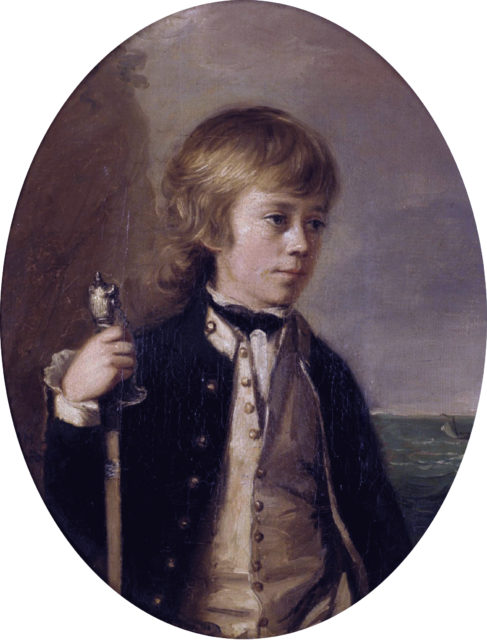
Henry William Baynton, aged 13 years, 6 months, midshipman in the Cleopatra 1780. Image Source: Wikimedia Commons/public domain
Henry William Baynton, aged 13 years, 6 months, a Midshipman in the Cleopatra 1780.

Caning certainly was not a pleasant experience, but it was not the worst the Navy had to offer.

Once they reached 18, more severe punishments could be administered, as after that they would be treated as adults.

Caning has never been officially outlawed but decreased in practice during the 20th century.

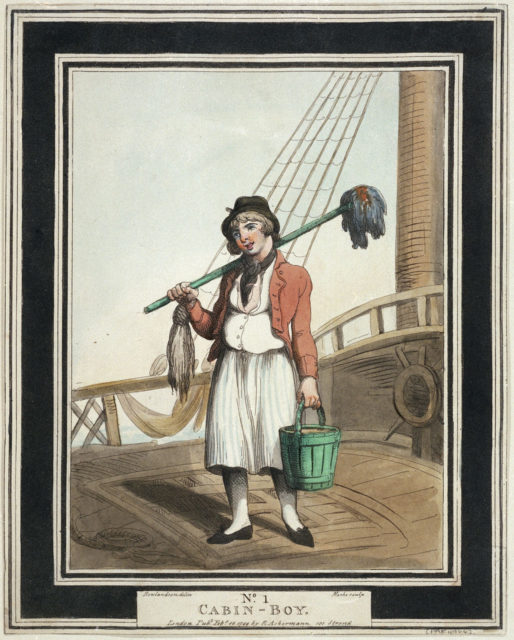
A Cabin boy, from 1799. Young boys like this performed many of the simpler tasks on board ship. Image Source: Wikimedia Commons/public domain
A Cabin Boy, from 1799. Young boys like this performed many of the simpler tasks on board ship

Flogging was by far the most common of the three. While flogging was essentially just whipping the offending individual, in the Navy it took on its own traditions and variations

Flogging by the gangway was used for nearly all noncapital offenses. A grating would be rigged upright, and the sailor would have his shirt removed.

He would then have his wrists lashed to the grate, and the Boatswain would proceed to whip him with a Cat O’ Nine Tails. This was a whip made out of 9 strands, with small knots on the end.

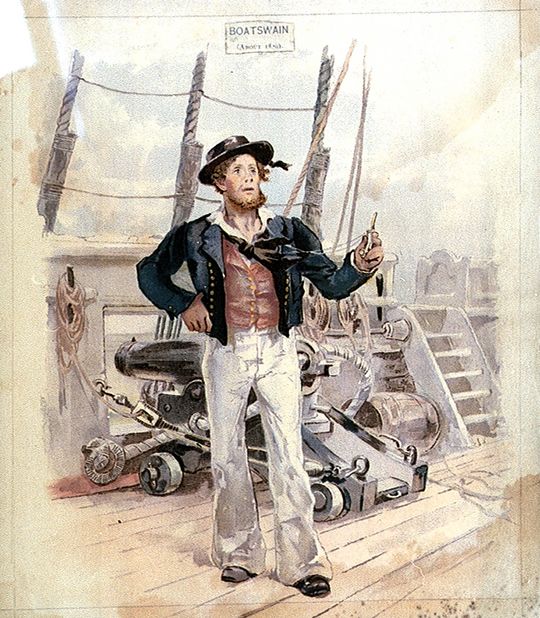
A Boatswain in the Royal Navy in the 1820s. An American Boatswain would've looked very similar. Image Source: Wikimedia Commons/public domain
A Boatswain in the Royal Navy in the 1820s. Boatswains were tasked with maintaining discipline and order on board and were tasked with doling out punishment.

This was done in front of the whole crew, following a formal hearing where the sailor could speak up in his defense. It could be used for anything from drunkenness to desertion and was often used preemptively. Captains would issue a slew of floggings just after leaving port, to encourage the men to behave for the rest of the voyage.

There was also running the gauntlet, usually sentenced for theft from a shipmate. The sailor would have to walk slowly through two lines of his shipmates, who would whip him with small multi-tailed whips. This allowed the crew to show their solidarity against theft and effectively ostracized the offending individual.  Often it was worse than the physical pain when in the tight-knit crew of a sailing ship.

Finally, there was flogging around the fleet, for the most severe offenses which did not warrant death. A sailor would be brought into port, and flogged on every Royal Navy ship present.

This was often fatal, and sailors could have been whipped dozens of times by the end of it. Finally outlawed in 1806, flogging as a general practice, though, was not suspended in peacetime until 1881. Even now, it is still technically not completely removed from possible punishments.


The final and obviously most severe punishment was death by hanging at the yard-arm. This was the ultimate punishment for desertion or mutiny against the fleet.

Naval ships could not suffer the possibility of rebellion going unchallenged. The likelihood of death by slow hanging was a real deterrent. Being a capital punishment, sailors could not be sentenced to hanging without an official Court Martial. Here, they were given an opportunity to plead their case in front of a panel of high-ranking officers. If found guilty, their punishment was gruesome.

Their hands and feet would be bound, to prevent any possibility of escape. Then a noose would be placed around their neck.

That line would run through a tackle, or pulley, hanging from the yard-arm (a large pole going across the mast). A team of sailors would then solemnly and slowly haul on that line until the sailor’s body was hanging right below the yard-arm. This was done as a powerful deterrent, and the entire crew was made to watch, and understand what was happening.

The last hanging performed by the Royal Navy was in 1860.

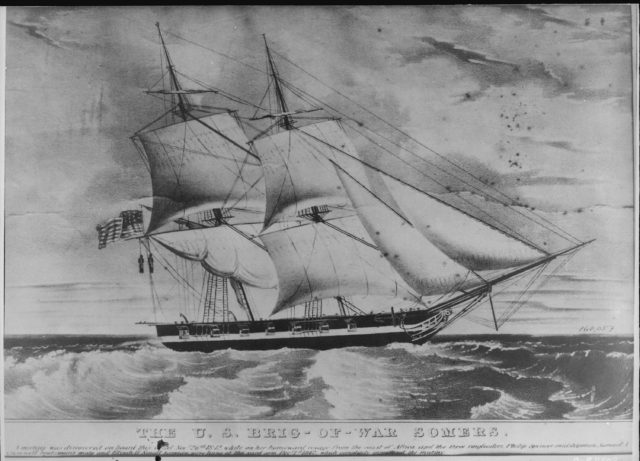
The English weren't the only ones to hang by the yardarm, this American ship, the Somerset, is shown with two offenders hanging off of her mainmast in 1842. Image Source: Wikimedia Commons/public domain
The English were not the only ones to hang by the yardarm, this American ship, the Somerset, is shown with two offenders hanging off of her mainmast in 1842.

The end of the 18th and beginning of the 19th century saw some of the most severe punishments from the Royal Navy.

The Navy was larger than it had ever been. The sailors were mostly pressed into service. The Royal Navy needed a way to ensure they would not rebel or refuse their duty. Corporal punishment was viewed as the only effective deterrent for ill-disciplined sailors and boys.

I didn't see keelhauling though in this list....It was not practiced in the American or British Navies, although it is said that the Dutch and the Pirates did make use of that practice although finding concrete evidence of it is daunting.

Tuesday, September 8, 2020

A New age of Warfare and advent of the Ships of Iron.

Iron Ships of War

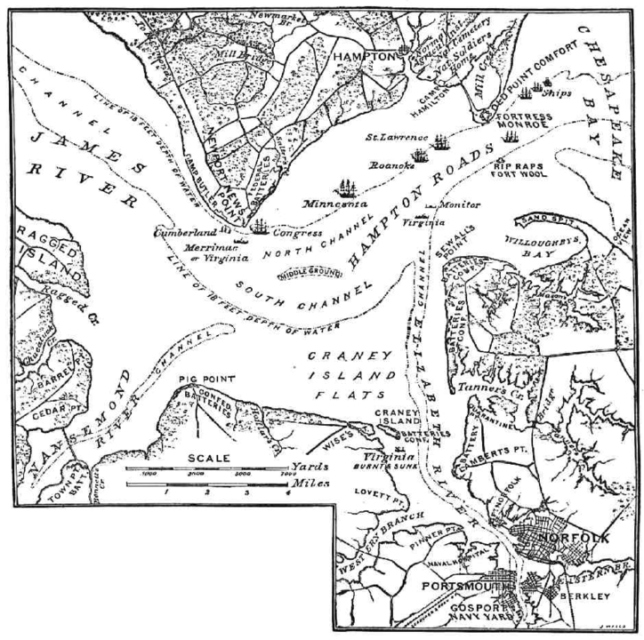
It was March 8, 1862, a Saturday. On the waters of Hampton Roads off Newport News, Virginia – where the Chesapeake Bay empties into the Atlantic Ocean – the Federal warships Cumberland and Congress bobbed easily on a light chop.
The sky was blue, the day warming, the morning uneventful. Drying wash flapped on a light breeze, harmonicas offered-up pleasant tunes, as sailors went about their usual duties. Then, abruptly, around 12:30 in the afternoon, all that changed.
Across the Bay, far to the south, emerging from the Elizabeth River at Norfolk, something odd, something never seen before, had just been spotted. Heads turned, fingers pointed, as binoculars and telescopic glasses were quickly yanked from their cases. A trail of black smoke could be seen rising from a smokestack, below that what appeared to be an enormous hull moving very slowly, bearing WNW.
“I wish you would take the glass and have a look over there, sir,” said the quartermaster of the watch. “I believe that thing is a-comin’ down at last.”
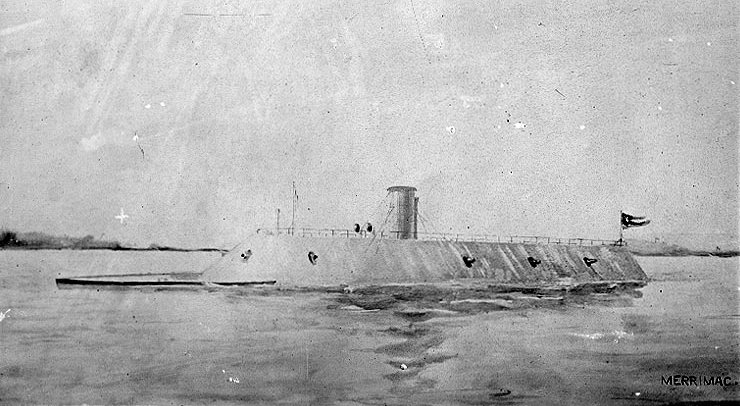
CSS Virginia (ex-USS Merrimack)
General Quarters was sounded. Drums beat the rhythm as men scurried cross decks, pulling down laundry, racing to the guns, preparing for battle. Truthfully, there was no rush. It would take almost an hour before the hulking mass would be near enough to spot the gun tubes that lined its casemate, or the iron that covered its hull.
At that point there was no doubt, however, it was the rechristened USS Merrimack, clearly identifiable now by the Confederate, seven-star, blue naval jack flying from her stern. The Confederates had renamed her Virginia, but everyone – friend and foe alike – still called her Merrimack.
She had been joined by several vessels of the Confederacy’s James River Squadron – Raleigh, Beaufort, Jamestown, Patrick Henry, along with the tug, Teaser – all of them smaller, and far less formidable than the Merrimack.
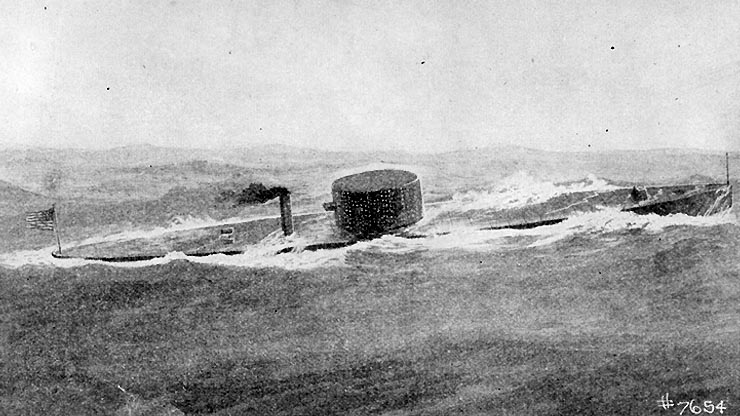
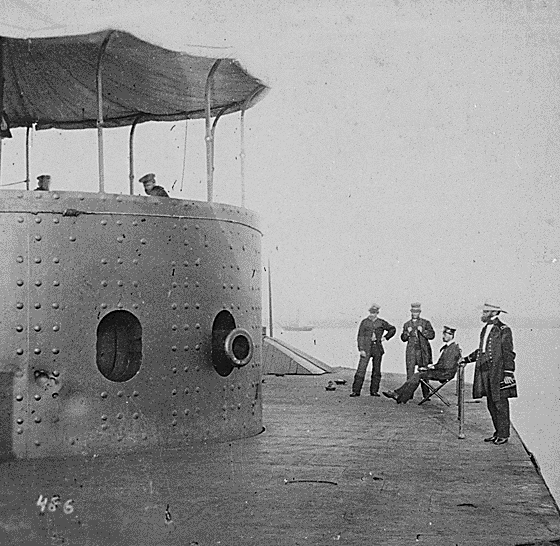
USS Monitor
USS Monitor
The Merrimack had been a frigate under construction at the Federal Navy’s yard in Norfolk at the beginning of the war. That yard was then put to the torch when the Navy decided to abandon Norfolk to the Confederacy, but much of the Merrimack survived the flames. Salvaged and retooled as an ironclad, the vessel, now a lumbering, iron monster with sloping sides, and a formidable collection of guns, looked far more like some leviathan risen from the deep, than any recognizable vessel of the day.
As Cumberland and Congress cleared decks for action, the other wooden ships of the North Atlantic Blockading Squadron – St. Lawrence, Roanoke, and Minnesota attempted to get underway and escape as quickly as possible. Cumberland, a powerful sloop-of-war, was the flagship of the Home Fleet, a wood-and-sail vessel of the Raritan-class. She had been recently streamlined and refitted with twenty-two 9” Dahlgren smoothbore cannon, one 10” Dahlgren, and a 70 lb. naval rifle – a daunting array of weaponry.
But the Virginia – now armed with three 9” Dahlgren guns on each broadside, a Brooke rifle fore and aft, and an additional Brooke rifle on each broadside – appeared unimpressed. The ironclad churned-on slowly but steadily, straight at Congress, a wood and sail frigate bearing 48 32 pounder guns, and four 8” smoothbore cannon.
Map of events of the Battle of Hampton Roads
The crews of both Federal warships looked-on in amazement as the Virginia closed to within two hundred yards. “The Congress then fired a full broadside point-blank. Nine hundred pounds of hurtling metal smashed fully home. In horror the gunners saw the balls ricochet into the air likes pebbles off a roof.”
The Virginia was not only unscathed by the broadside, but unfazed. Hardly a metal plate had been rattled loose. The ironclad then came about and unleashed a four-gun broadside, tearing Congress to pieces. Below decks, smoke billowed, men screamed, and blood pooled like water. The era of the wooden warship – an era that had reigned for at least five thousand years – had just been brought to an abrupt and frightful end. The age of the iron warship had dawned.
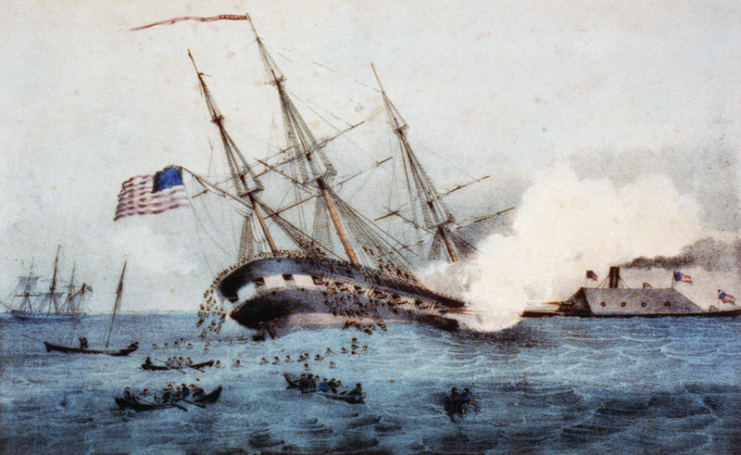
As Congress took on water, Virginia came about, then headed straight for the Cumberland. Attached to her prow was an iron ram – a weapon not used widely since the days of Greece and Rome – with which she intended to dispatch the Federal sloop-of-war. The ironclad fired one shot with its forward gun which exploded below decks, then rammed Cumberland dead on the bow.
Sinking of Cumberland by the ironclad Virginia
Mayhem reigned onboard the Federal sloop as the ironclad backed away full astern, turned slightly, and found a comfortable position just off Cumberland’s shattered bow where she raked the Federal warship with impunity. The Cumberland soon went-up in smoke and flames. That accomplished, the ironclad returned to the wounded Congress, which was trying to limp away to safety.
But Virginia caught her easily and turned broadside. Raking the frigate from stem-to-stern, the ironclad simply tore her to shreds, and the Congress eventually blew to pieces when her magazines took fire
By day’s end the Federal squadron had been virtually annihilated. Both Congress and Cumberland were on the bottom, while the other three Federal vessels had run aground in their haste to escape. For those looking on, it appeared the Confederacy had developed a superweapon.
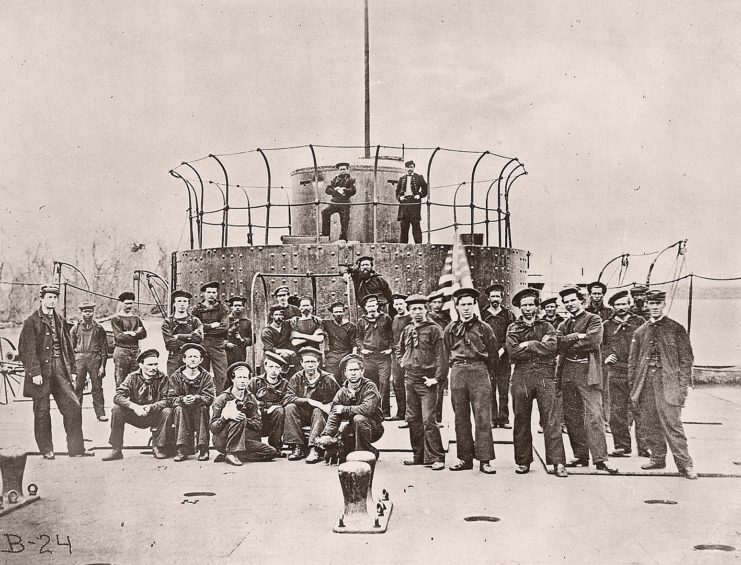
Photo of crew members aboard the USS Monitor
Thus, as the Virginia returned to its berth that evening –intent on returning the following morning to finish-off the stranded Federal squadron – it appeared the Confederacy had engineered a new weapon that would, not only break the Federal naval blockade, but revolutionize naval warfare entirely.
As the Virginia slipped away on the evening tide, however – and unknown to everyone present – another ironclad was then steaming-up Bay. As if Neptune, with an eye for high drama, had written the script himself, this ironclad finally cut its engines, dropped anchor, and took-up a position in defense of the stranded Minnesota. It was, of course, the USS Monitor.
The brainchild of Swedish engineer John Ericsson, his design was so radical that initially the navy board hardly knew what to make of it. The Monitor was only 172’ in length, 41’ abeam. On the deck sat a small pilot house, a revolving turret sporting 2 11” Dahlgren naval rifles, and nothing more. Constructed on New York’s East River in just over 100 days, having received reports of the Virginia's imminent completion, Monitor had shoved-off for Virginia in early March.
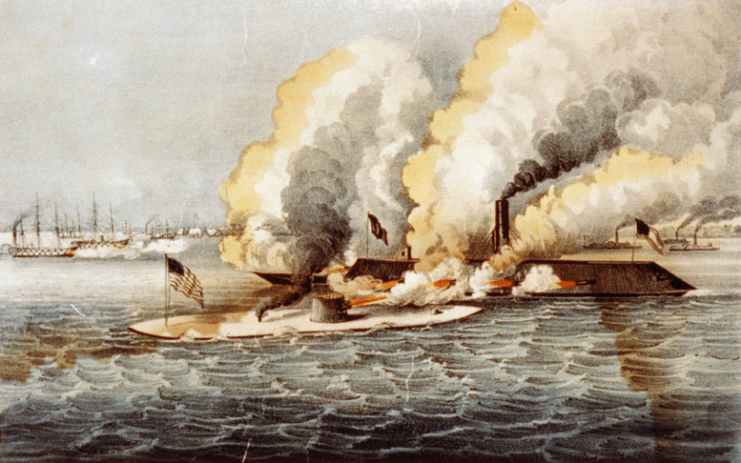
Ironclads engaged in terrific combat by Currier and Ives
Meanwhile, in Washington, President Lincoln, along with his cabinet, having received telegraphed reports of the prior day’s calamity, sat in benumbed silence. No one had the slightest idea what to do. Lincoln was reportedly so overwrought he could barely speak.
Secretary of War Edwin Stanton finally broke the silence, railing: “The Merrimack would sink every vessel in the navy, capture Fort Monroe, cut off Burnside in the Carolina sounds, retake Port Royal, and lay New York and Boston under ‘contribution.’” Then he threw-open a window, half-expecting to see the Merrimac steaming-up the Potomac River, presumably to open fire on the White House. According to Gideon Welles, then Secretary of the Navy, it was “the worst day of the war.”
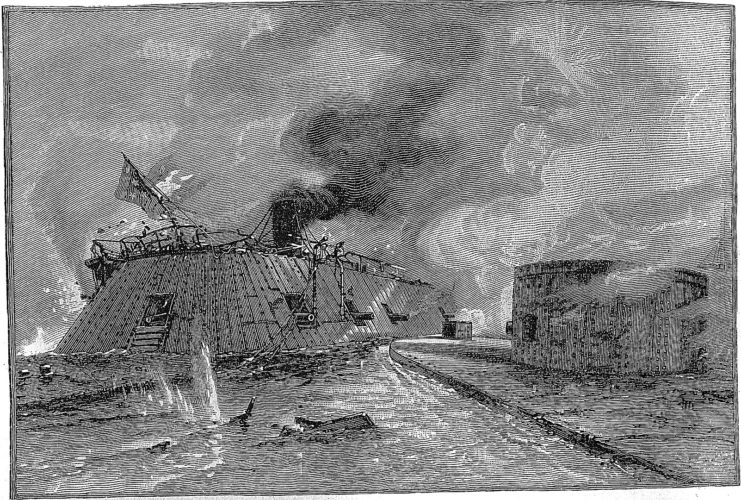
The heart of battle, from an 1871 wood engraving published by A.S. Barnes & Co.
The morning following the Virginia's frightening debut, March 9, the Confederate ram again journeyed across the Bay with the intention of destroying the stranded Minnesota, only to discover the tiny Monitor bobbing in the water like “a cheese on a raft,” gamely prepared to give battle. Much like a heavyweight fight, crowds jammed and jostled along the shoreline to watch as the spectacle unfolded.
The Virginia opened the engagement with a broadside that flew high, and the Monitor returned fire, striking Virginia, but doing little damage. Then, for hours-on-end, the combatants circled at close quarters, repeatedly scoring hits, but neither able to strike a decisive blow. Virginia attempted to ram, but the more maneuverable Monitor dodged away, unharmed.

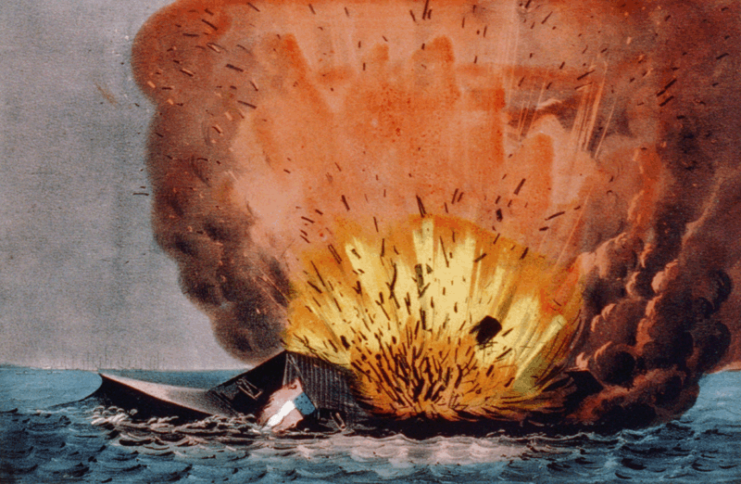
Destruction of the rebel monster Merrimac off Craney Island, May 11, 1862, by Currier and Ives
Damage was done to both vessels, but nothing disabling. In fact, at one point during the confrontation, the Virginia's guns fell oddly silent. Catesby Jones, the ironclad’s commander, inquired as to the pause. From the gundeck Lieutenant Eggleston responded wryly, “I find that I can do her as much damage by snapping my thumb at her every two minutes and a half.”
A shot finally struck the Monitor’s pilot house, momentary blinding the captain, and the vessel withdrew momentarily to make a change in command. It soon returned to combat, however, only to discover the Virginia's – thinking its foe had given-up the fight – departed. Both sides subsequently claimed victory, but there is little question the first clash of iron warships had ended in a draw.
Stereograph of Monitor after the battle, July 1862
Regardless of wins and losses, however, every wooden warship then in existence had been instantly rendered obsolete, naval blueprints altered forever. And while Virginia's had made a fine showing, it would be the gritty little Monitor with its low silhouette and revolving gun turret, that would inspire naval concepts of the future.
Indeed, it would not be overstatement to suggest that every battleship of the 20th Century – from Dreadnaught to Bismarck to Missouri – had direct bloodlines back to John Ericsson’s innovative design, and that on March 9, 1862 a page in the book of naval warfare had been emphatically turned.

Friday, September 28, 2018

Some of the German subs that didn'tsurrender immediately after the war.

This ties in with the article that I posted last week about Germany and it rolls with some of the articles that I have posted about Postwar Germany.


German U-boats were the scourge of the high seas in the Second World War. The Atlantic was always a contested battleground with the threat of a wolf pack nearby.
These insidious machines managed to escape the crippling naval limitations imparted by the Treaty of Versailles. After the end of the First World War, Germany was limited to six battleships of no more than 10,000 tons, six cruisers, and twelve destroyers.
The torpedo is the weapon most commonly associated with submarine warfare, and rightfully so. But the U-boat also came with a deck-gun, which was often used to deadly effect when the U-boat breached the surface.
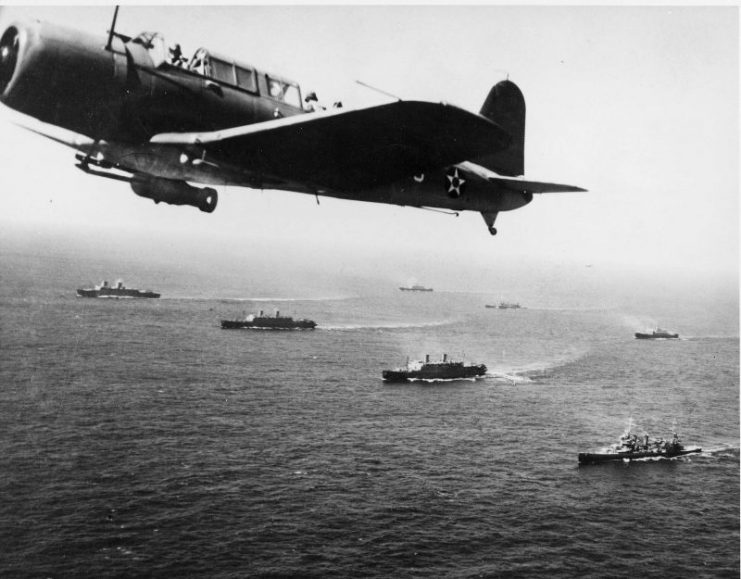
Convoy escorts and anti-submarine aircraft, November 1941
The eminence of the U-boat was enough to make even staunch Winston Churchill admit that the German U-boat was the only thing that he truly feared. Even so, the primary missions of U-boats were to disrupt supply lines by attacking convoys carrying reserve weapons, troops, and especially food supplies.
The total tally of ships sunk during the Second World War by U-boats included nearly 3,000. Of these, 2,845 were merchant ships and less than 200 were warships.
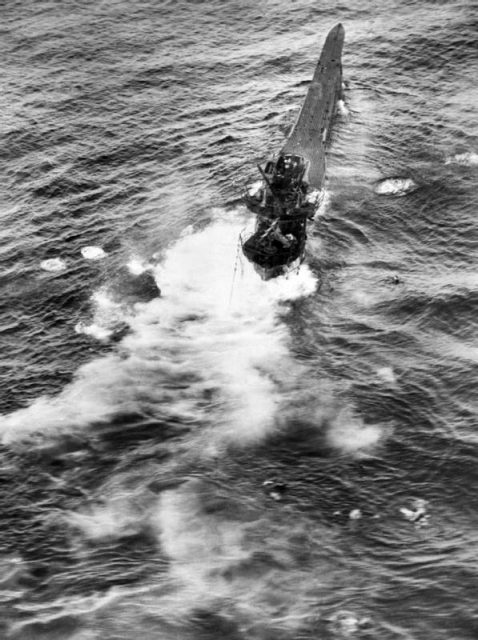
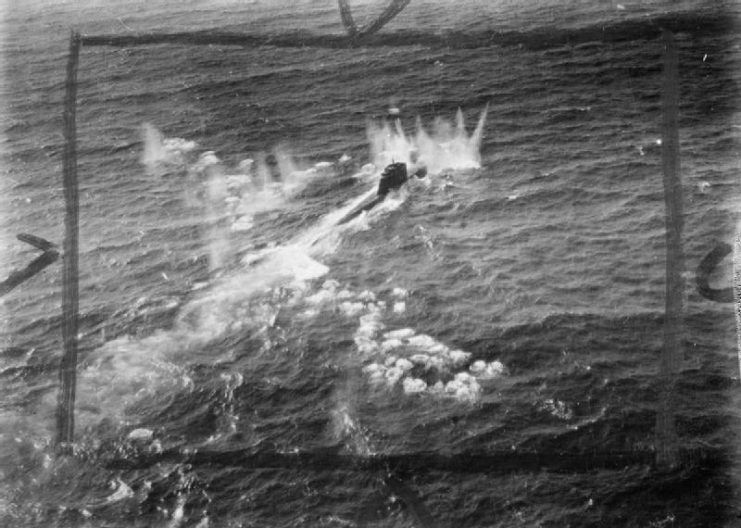
Oblique aerial photograph taken from Short Sunderland Mark III, EK586 ‘U’, of No. 10 Squadron RAAF during an attack on German type VIIC submarine U 426 in the Bay of Biscay.
The U-530 was a Type IXC/40 submarine and considered an improvement on its smaller predecessors. It required a full complement of 48 soldiers to run smoothly. It had six torpedo tubes and a full armament of 22 torpedoes. It also came standard with an anti-aircraft gun, SK C/32 naval gun, and 180 rounds of ammunition. In terms of communications, it sported a FuMO 61 Hohentwiel U Radar Transmitter.

The U-530 joined the 10th flotilla and later on the 33rd flotilla. The crew of the U-530 was active through several patrols, where they racked up two kills and did serious damage to a third ship before being one of the final U-boats to surrender in July 1945.
An Argentine Navy boarding party inspects German u-boat U-530, July 1945.
The crew ignored the order to surrender from Admiral Karl Donitz, who had taken control after the death of Adolf Hitler. Instead, they traveled to Argentina and surrendered on the 10th of July at Mar del Plata. The reason behind the captain’s insubordination still isn’t known, but several mysteries float around the submarine’s final journey.
For example, the journey took two months longer than it should have. When the U-boat finally reached its destination, the crew had no identification, the submarine’s log had disappeared, as had the deck gun.
A German type XXI submarine, U-2502, comes under cannon fire from a De Havilland Mosquito FB Mark VI during an attack on four surfaced U-boats and an M-class minesweeper escort in the Kattegat by 22 Mosquitos of the Banff Strike Wing. U-2502 received only slight damage, but a type VIIC submarine was sunk, a type XXIII seriously damaged and the minesweeper left burning.

The rumor mill churned out a story that endures to this day: that the U-530 had taken a peculiar detour to spirit Hitler and Eva Braun to safety. It was then accused of sinking a Brazilian cruiser, although that accusation would later be disproved when the cause was found to be an accident aboard the cruiser.
Upon surrendering, the U-530’s crew was immediately interned prior to being sent back to Germany. The fate of the U-530 was sealed by a torpedo from an American Submarine which used it for target practice.
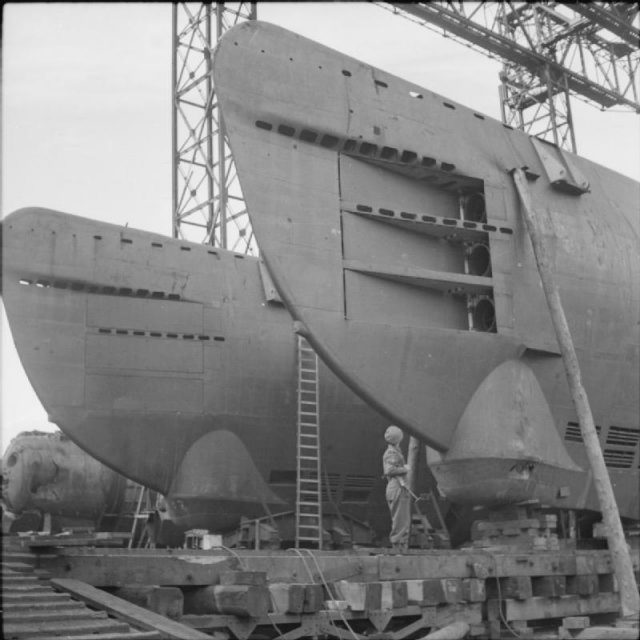
A soldier of the 7th Cameronians is dwarfed by half-completed U-boats in the docks at Bremen, 28 April 1945.
However, the U-530 was not the last of the U-boats to surrender.
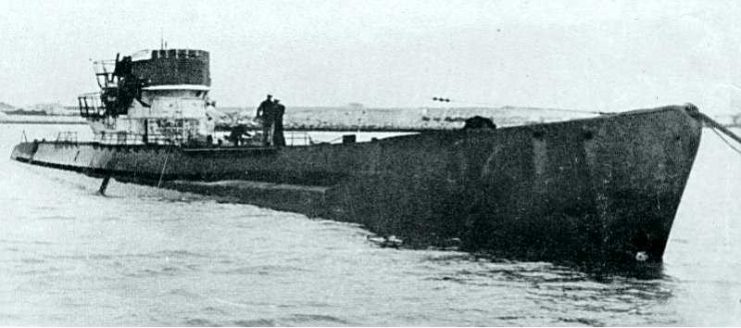
The U-977 was a Type V11C U-boat with a displacement of 769 tons, five torpedo tubes with 14 torpedoes, and a naval gun with 220 rounds of ammunition. It was not as powerful as the U-530.
With the war winding down and the threat of meeting a terrible end at the hands of victorious Allied forces, the captain headed off to Argentina on August 17th, 1945. The escape route saw the U-977 travel from Norway to Bristol, through heavily defended Allied waters.
The U-boat traveled underwater for 66 days, making a total of 99 days at sea, before they arrived at Mar del Plata on the Argentinian coast to surrender to the Argentinian authorities.
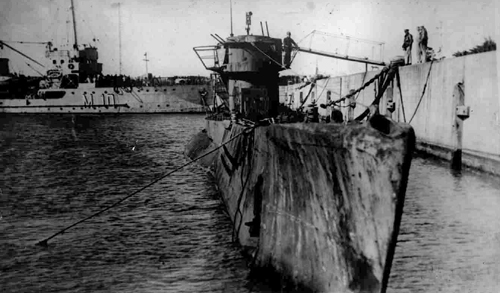
Germany submarine U-977 in Mar del Plata

Rumors, not unlike those that swirled around the U-530, circulated around that the U-977 had also served as a transport for top Nazi authority figures, including Hitler and Eva Braun, as well as Nazi gold. Regardless of the veracity of the claim, the U-977 suffered a similar fate to the U-530 and was sunk to the bottom of the ocean, courtesy of the US Navy.
   The War ended but the effect of the U-Boats on warfare in WWII far exceeding their numbers and manpower.