Webster

The Constitution was made to guard the people against the dangers of good intentions." --American Statesman Daniel Webster (1782-1852)


Showing posts with label Duty. Show all posts

Tuesday, October 20, 2015

Robert A Heinlein Speech to the USNA 1973

I am a huge fan of Robert A Heinlein, his book "Star-ship trooper" is still to me the best military SCIFI out there....with apologies to Peter whom to me writes some really good books in his own right.  I really like the part of Star-ship trooper that to be a citizen and to vote was to first serve.  Only serving do you understand the responsibility of being a citizen and what it entails.    This speech was given to the United States Naval Academy in 1973 during the aftermath of the first hippie movement. 
   
    I shamelessly clipped this in its entirety from Matt Bracken via twitter/Facebook  I had read the entire thing and it did resonate with me, the thought of patriotism and willing to sacrifice for the greater good...and not in the feel good hippie bullcrap kind of way.


Robert Heinlein, speech at the Naval Academy on patriotism, 1973.
(To the Brigade at large:)
Why are you here?
(To a second plebe:)
Mister, why are YOU here?
Never mind, son; that's a rhetorical question. You are here to become a naval officer. That's why this Academy was founded. That is why all of you are here: to become naval officers. If that is NOT why YOU are here, you've made a bad mistake. But I speak to the overwhelming majority who understood the oath they took on becoming midshipmen and look forward to the day when they will renew that oath as commissioned officers.
But why would anyone want to become a naval officer? In the present dismal state of our culture there is little prestige attached to serving your country; recent public opinion polls place military service far down the list.
It can't be the pay. No one gets rich on the pay. Even a 4-star admiral is paid much less than top executives in other lines. As for lower ranks, the typical naval officer finds himself throughout his career just catching up from the unexpected expenses connected with the last change of duty when another change of duty causes a new financial crisis. Then, when he is about fifty, he is passed over and retires... but he can't really retire because he has two kids in college and one still to go. So he has to find a job... and discovers that jobs for men his age are scarce and usually don't pay well.
Working conditions? You'll spend half your life away from your family. Your working hours? 'Six days shalt thou work and do all thou art able; the seventh the same, and pound on the cable.' A forty-hour week is standard for civilians - but not for naval officers. You'll work that forty-hour week, but that's just a starter. You'll stand a night watch as well, and duty weekends. Then with every increase in grade your hours get longer - until at last you get a ship of your own and no longer stand watches. Instead you are on duty twenty-four hours a day... and you'll sign your night order book with: 'In case of doubt, do not hesitate to call me.'
I don't know the average week's work for a naval officer but it's closer to sixty than to forty. I'm speaking of peacetime, of course. Under war conditions it is whatever hours are necessary - and sleep you grab when you can.
Why would anyone elect a career which is unappreciated, overworked, and underpaid? It can't be just to wear a pretty uniform. There has to be a better reason.
As one drives through the bushveldt of East Africa it is easy to spot herds of baboons grazing on the ground. But not by looking at the ground. Instead you look up and spot the lookout, an adult male posted on a limb of a tree where he has a clear view all around him - which is why you can spot him; he has to be where he can see a leopard in time to give the alarm. On the ground a leopard can catch a baboon... but if a baboon is warned in time to reach the trees, he can out-climb a leopard. The lookout is a young male assigned to that duty and there he will stay, until the bull of the herd sends up another male to relieve him. Keep your eye on that baboon; we'll be back to him.
Today, in the United States, it is popular among self-styled 'intellectuals' to sneer at patriotism. They seem to think that it is axiomatic that any civilized man is a pacifist, and they treat the military profession with contempt. 'Warmongers' - 'Imperialists' - 'Hired killers in uniform' - you have all heard such sneers and you will hear them again. One of their favorite quotations is: 'Patriotism is the last refuge of a scoundrel.' What they never mention is that the man who made that sneering remark was a fat, gluttonous slob who was pursued all his life by a pathological fear of death.
I propose to prove that that baboon on watch is morally superior to that fat poltroon who made that
wisecrack. Patriotism is the most practical of all human characteristics. But in the present decadent atmosphere patriots are often too shy to talk about it - as if it were something shameful or an irrational weakness. But patriotism is NOT sentimental nonsense. Nor is it something dreamed up by demagogues.
Patriotism is as necessary a part of man's evolutionary equipment as are his eyes, as useful to the race as eyes are to the individual. A man who is NOT patriotic is an evolutionary dead end. This is not sentiment but the hardest of logic.
To prove that patriotism is a necessity we must go back to fundamentals. Take any breed of animal - for example, tyrannosaurus rex. What is the most basic thing about him? The answer is that tyrannosaurus rex is dead, gone, extinct.
Which brings us to the second fundamental question: Will homo sapiens stay alive? Will he survive?
We can answer part of that at once: Individually h. sapiens will NOT survive. It is unlikely that anyone here tonight will be alive eighty years from now; it approaches mathematical certainty that we will all be dead a hundred years from now as even the youngest plebe here would be 118 years old by then - if still alive.
Some men do live that long but the percentage is so microscopic as not to matter. Recent advances in biology suggest that human life may be extended to a century and a quarter, even a century and a half - but this will create more problems than it solves. When a man reaches my age or thereabouts, the last great service he can perform is to die and get out of the way of younger people.
Very well, as individuals we all die. This brings us to the second half of the question: Does homo sapiens AS A BREED have to die? The answer is: No, it is NOT unavoidable. We have two situations, mutually exclusive: Mankind surviving, and mankind extinct. With respect to morality, the second situation is a null class. An extinct breed has NO behavior, moral or otherwise.
Since survival is the sine qua non, I now define 'moral behavior' as 'behavior that tends toward survival.' I won't argue with philosophers or theologians who choose to use the word 'moral' to mean something else, but I do not think anyone can define 'behavior that tends toward extinction' as being 'moral' without stretching the word 'moral' all out of shape.
We are now ready to observe the hierarchy of moral behavior from its lowest level to its highest. The
simplest form of moral behavior occurs when a man or other animal fights for his own survival. Do not belittle such behavior as being merely selfish. Of course it is selfish... but selfishness is the bedrock on which all moral behavior starts and it can be immoral only when it conflicts with a higher moral imperative. An animal so poor in spirit that he won't even fight on his own behalf is already an evolutionary dead end; the best he can do for his breed is to crawl off and die, and not pass on his defective genes.
The next higher level is to work, fight, and sometimes die for your own immediate family. This is the level at which six pounds of mother cat can be so fierce that she'll drive off a police dog. It is the level at which a father takes a moonlighting job to keep his kids in college - and the level at which a mother or father dives into a flood to save a drowning child... and it is still moral behavior even when it fails.
The next higher level is to work, fight, and sometimes die for a group larger than the unit family - an extended family, a herd, a tribe - and take another look at that baboon on watch; he's at that moral level. I don't think baboon language is complex enough to permit them to discuss such abstract notions as 'morality' or 'duty' or 'loyalty' - but it is evident that baboons DO operate morally and DO exhibit the traits of duty and loyalty; we see them in action. Call it 'instinct' if you like - but remember that assigning a name to a phenomenon does not explain it.
But that baboon behavior can be explained in evolutionary terms. Evolution is a process that never stops. Baboons who fail to exhibit moral behavior do not survive; they wind up as meat for leopards. Every baboon generation has to pass this examination in moral behavior; those who bilge it don't have progeny. Perhaps the old bull of the tribe gives lessons... but the leopard decides who graduates - and there is no appeal from his decision. We don't have to understand the details to observe the outcome; baboons behave morally - for baboons.
The next level in moral behavior higher than that exhibited by the baboon is that in which duty and loyalty are shown toward a group of your kind too large for an individual to know all of them. We have a name for that. It is called 'patriotism.'
Behaving on a still higher moral level were the astronauts who went to the Moon, for their actions tend toward the survival of the entire race of mankind. The door they opened leads to hope that h. sapiens will survive indefinitely long, even longer than this solid planet on which we stand tonight. As a direct result of what they did, it is now possible that the human race will NEVER die. Many short-sighted fools think that going to the Moon was just a stunt. But those astronauts knew the meaning of what they were doing, as is shown by Neil Armstrong's first words in stepping down onto the soil of Luna: 'One small step for a man, one giant leap for mankind.' Let us note proudly that eleven of the Astronaut Corps are graduates of this our school. And let me add that James Forrestal was the FIRST high-ranking Federal official to come out flatly for space travel.
I must pause to brush off those parlor pacifists I mentioned earlier... for they contend that THEIR actions are on this highest moral level. They want to put a stop to war; they say so. Their purpose is to save the human race from killing itself off; they say that too. Anyone who disagrees with them must be a bloodthirsty scoundrel - and they'll tell you that to your face. I won't waste time trying to judge their motives; my criticism is of their mental processes: Their heads aren't screwed on tight. They live in a world of fantasy.
Let me stipulate that, if the human race managed its affairs sensibly, we could do without war. Yes - and if pigs had wings, they could fly. I don't know what planet those pious pacifists are talking about but it can't be the third one out from the Sun. Anyone who has seen the Far East - or Africa - or the Middle East - knows or certainly should know that there is NO chance of abolishing war in the foreseeable future. In the past few years I have been around the world three times, traveled in most of the communist countries, visited many of the so-called emerging countries, plus many trips to Europe and to South America; I saw nothing that cheered me as to the prospects for peace. The seeds of war are everywhere; the conflicts of interest are real and deep, and will not be abolished by pious platitudes. The best we can hope for is a precarious balance of power among the nations capable of waging total war - while endless lesser wars break out here and there. I won't belabor this. Our campuses are loaded with custard-headed pacifists but the yard of the Naval Academy is not one place where I will encounter them. We are in agreement that the United States still needs a navy, that the Republic will always have need for heroes - else you would not be here tonight and in uniform.
Patriotism - Moral behavior at the national level. Non sibi sed Patria. Nathan Hale's last words: 'I regret that I have but one life to give for my country.' Torpedo Squadron Eight making its suicidal attack. Four chaplains standing fast while the water rises around them. Thomas Jefferson saying, 'The Tree of Liberty must be refreshed from time to time with the blood of patriots'' A submarine skipper giving the order 'Take her DOWN!' while he himself is still topside. Jonas Ingram standing on the steps of Bancroft Hall and shouting, 'The Navy has no place for good losers! The Navy needs tough sons of bitches who can go out there and WIN!'
Patriotism - An abstract word used to describe a type of behavior as harshly practical as good brakes and
good tires. It means that you place the welfare of your nation ahead of your own even if it costs you your life. Men who go down to the sea in ships have long had another way of expressing the same moral behavior tagged by the abstract expression 'patriotism.' Spelled out in simple Anglo-Saxon words 'Patriotism' reads 'Women and children first!'
And that is the moral result of realizing a self-evident biological fact: Men are expendable; women and children are not. A tribe or a nation can lose a high percentage of its men and still pick up the pieces and go on... as long as the women and children are saved. But if you fail to save the women and children, you've had it, you're done, you're THROUGH! You join tyrannosaurus rex, one more breed that bilged its final test.
I must amplify that. I know that women can fight and often have. I have known many a tough old grandmother
I would rather have on my side in a tight spot than any number of pseudo-males who disdain military service. My wife put in three years of active duty in World War Two, plus ten years reserve, and I am proud - very proud! - of her naval service. I am proud of every one of our women in uniform; they are a shining example to us men.
Nevertheless, as a mathematical proposition in the facts of biology, children, and women of child-bearing age, are the ultimate treasure that we must save. Every human culture is based on 'Women and children first' - and any attempt to do it any other way leads quickly to extinction.
Possibly extinction is the way we are headed. Great nations have died in the past; it can happen to us. Nor am I certain how good our chances are. To me it seems self-evident that any nation that loses its patriotic fervor is on the skids. Without that indispensable survival factor the end is only a matter of time. I don't know how deeply the rot has penetrated - but it seems to me that there has been a change for the worse in the last fifty years. Possibly I am misled by the offensive behavior of a noisy but unimportant minority. But it does seem to me that patriotism has lost its grip on a large percentage of our people. I hope I am wrong... because if my fears are well grounded, I would not bet two cents on this nation's chance of lasting even to the end of this century. But there is no way to force patriotism on anyone. Passing a law will not create it, nor can we buy it by appropriating so many billions of dollars. You gentlemen of the Brigade are most fortunate. You are going to a school where this basic moral virtue is daily reinforced by precept and example. It is not enough to know what Charlie Noble does for a living, or what makes the wildcat wild, or which BatDiv failed to splice the main brace and why - nor to learn matrix algebra and navigation and ballistics and aerodynamics and nuclear engineering. These things are merely the working tools of your profession and could be learned elsewhere; they do not require 'four years together by the Bay where the Severn joins the tide.'
What you do have here is a tradition of service. Your most important classroom is Memorial Hall. Your most important lesson is the way you feel inside when you walk up those steps and see that shot-torn flag framed in the arch of the door: 'Don't Give Up the Ship.' If you feel nothing, you don't belong here. But if it gives you goose flesh just to see that old battle flag, then you are going to find that feeling increasing every time you return here over the years... until it reaches a crescendo the day you return and read the list of your own honored dead - classmates, shipmates, friends - read them with grief and pride while you try to keep your tears silent.
The time has come for me to stop. I said that 'Patriotism' is a way of saying 'Women and children first.' And that no one can force a man to feel this way. Instead he must embrace it freely. I want to tell about one such man. He wore no uniform and no one knows his name, or where he came from; all we know is what he did.
In my home town sixty years ago when I was a child, my mother and father used to take me and my brothers and sisters out to Swope Park on Sunday afternoons. It was a wonderful place for kids, with picnic grounds and lakes and a zoo. But a railroad line cut straight through it.
One Sunday afternoon a young married couple were crossing these tracks. She apparently did not watch her step, for she managed to catch her foot in the frog of a switch to a siding and could not pull it free. Her husband stopped to help her. But try as they might they could not get her foot loose. While they were working at it, a tramp showed up, walking the ties. He joined the husband in trying to pull the young woman's foot loose. No luck.
Out of sight around the curve a train whistled. Perhaps there would have been time to run and flag it down, perhaps not. In any case both men went right ahead trying to pull her free... and the train hit them. The wife was killed, the husband was mortally injured and died later, the tramp was killed - and testimony showed that neither man made the slightest effort to save himself. The husband's behavior was heroic... but what we expect of a husband toward his wife: his right, and his proud privilege, to die for his woman. But what of this nameless stranger? Up to the very last second he could have jumped clear. He did not. He was still trying to save this woman he had never seen before in his life, right up to the very instant the train killed him. And that's all we'll ever know about him.
THIS is how a man dies. This is how a MAN . . . lives!
'They shall not grow old as we that are left grow old;
age shall not wither them nor the years condemn;
At the going down of the sun and in the morning, we shall remember them''

Monday, October 29, 2012

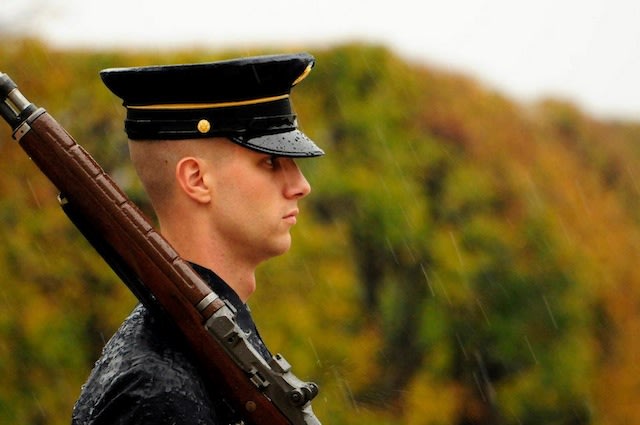
Tomb Guards will remain on Duty...


Sentinel at the Tomb of the Unknowns in Arlington, VA. (U.S. Army Photo)
WASHINGTON—Hurricane Sandy is expected to slam the East Coast and the federal government is shut down—but the U.S. servicemen who guard the outdoor Tomb of the Unknowns at Arlington National Cemetery will remain on duty.
"They will not abandon their post," an employee who answered the Arlington Cemetery's phone confirmed to Yahoo News. He identified himself as "George," but was not authorized to speak on the record to the media.
The tomb, located just outside Washington, D.C., holds the remains of unidentified soldiers from World War I, World War II and Korea.

The elite sentinels selected to guard it have kept watch continuously at the site since 1948


This info compliments of Wiki

Tomb of 1921

Tomb as of November 11, 1922. The Tomb of 1931 would occupy this same location.
On March 4, 1921, the United States Congress approved the burial of an unidentified American serviceman from World War I in the plaza of the new Memorial Amphitheater. On November 11, 1921, the unknown soldier brought back from France was interred inside a three-level marble tomb. The marble came from a Yule Marble Quarry located near Marble, Colorado. The marble for the Lincoln Memorial and other famous monuments were quarried there.[5] The top two levels are six marble sections each and the bottom at least nine blocks with a rectangular opening in the center of each level through which the unknown remains were placed through the tomb and into the ground below. A stone other than marble covers the rectangular opening.[6][7][8]

Tomb of 1931

The World War I Unknown is below the marble sarcophagus. Other Unknowns are beneath the white slabs on the ground (World War II, right; Korean War, left). A Vietnam War Unknown was under the middle slab until 1998, when he was identified.
Since 1921, the intent was to place a superstructure on top of the Tomb but it was not until July 3, 1926, however, that the Congress authorized the completion of the Tomb and the expenditure of $50,000 (with a completed cost of $48,000). A design competition was held and won by architect Lorimer Rich[nb 1] and sculptor Thomas Hudson Jones. An appropriation from Congress for the work was secured and on December 21, 1929, a contract for completion of the Tomb itself was entered into. The Tomb would consist of seven pieces of marble in four levels (cap, die, base and sub-base) of which the die is the largest block with the sculpting on all four sides.[6][9]
In late January 1931, the 56 ton die of Yule marble (quarried 3.9 miles south of Marble, Colorado by the Vermont Marble Company) was lifted out of the quarry. (Only the die block is addressed for no data is available as to the other three levels). The quarrying involved 75 men working one year. When the block was separated from the mountain inside the quarry it weighed 124 tons. A wire saw was then brought into the quarry to cut the block down to 56 tons. On February 3, the block reached the marble mill site (in the town of Marble) where it was crated, then shipped to Vermont on February 8. The block was sawn to final size in West Rutland, Vermont and fabricated by craftsmen in Proctor, Vermont before it was shipped by train to Arlington National Cemetery, Virginia[10] where it was carved by the Piccirilli Brothers under the direction of the sculptor Thomas Jones.[6][11] (The brothers also carved the Lincoln statue for the Lincoln Memorial). The Tomb was dedicated in April 1932.[12]
The Tomb[nb 2] was placed at the head of the grave of the World War I Unknown. West of this grave are the crypts of Unknowns from World War II (south) and Korea (north). Between the two lies a crypt that once contained an Unknown from Vietnam (middle). His remains were positively identified in 1998 through DNA testing as First Lieutenant Michael Blassie, United States Air Force and were removed. Those three graves are marked with white marble slabs flush with the plaza.
The Tomb has a flat-faced form and is relieved at the corners and along the sides by neo-classical pilasters set into the surface with objects and inscription carved into the sides. The 1931 symbolism[11] of the objects on the north, south and east sides changed over time.[6][9]
North and South panel with 3 wreaths on each side represent (in 1931) "a world of memories" but later the six major battles engaged in by American forces in France; Ardennes, Belleau Wood, Chateau-Thierry, Meusse-Argonne, Oisiu-Eiseu, and Somme. Each wreath has 38 leaves and 12 berries.
East panel that faces Washington, D.C., are three Greek figures representing Peace, Victory, and "American Manhood" but later "Valor" instead of "American Manhood"
Western panel is inscribed the words (centered on the panel):
HERE RESTS IN
HONORED GLORY
AN AMERICAN
SOLDIER
KNOWN BUT TO GOD
Tomb Dimensions[nb 3] as of 2004[13] (xxx)* 1931 die block dimension coming out of the quarry.[10]
Level Length Width Height Cubic Feet Tons
Cap 12'-5.4" 6'-6.7" 1'-3.3" 100.69 8.56
Die 12'-3.0" (14'-0")* 6'-6.4" (7'-4.8")* 5'-2.1" (6"-0")* 385.43 (621.6)* 32.76 (52.84)*
Base 13'-10.0" 7'-11.9" 1'-11.1" 198.64 16.88
Sub-Base 14'-10.4" 9'-0.2" 1'-10.9" 255.81 21.74

The Unknown of World War I

The World War I Unknown arriving at the Washington Navy Yard, 1921 (colorized)
On Memorial Day, 1921, four unknown servicemen were exhumed from four World War I American cemeteries in France. U.S. Army Sgt. Edward F. Younger, who was wounded in combat, highly decorated for valor and received the Distinguished Service Cross in "The Great War" selected the Unknown of World War I from four identical caskets at the city hall in Châlons-en-Champagne, France, on October 24, 1921.[8] Younger selected the World War I Unknown by placing a spray of white roses on one of the caskets. He chose the third casket from the left. The chosen Unknown was transported to the United States aboard the USS Olympia. Those remaining were interred in the Meuse Argonne Cemetery, France.[8]
The World War I Unknown lay in state in the Capitol Rotunda from his arrival in the United States until Armistice Day, 1921. On November 11, 1921, President Warren G. Harding officiated at the interment ceremonies at the Memorial Amphitheater at Arlington National Cemetery. During the ceremony, the World War I Unknown was awarded the Victoria Cross by Admiral of the Fleet Lord Beatty, on behalf of King George V of the United Kingdom.[14] (The United Kingdom Victoria Cross was placed with the soldier. Earlier, on March 4, 1921, the British Unknown Warrior was conferred the U.S. Medal of Honor by General of the Armies John Pershing.) In 1928, the Unknown Soldier was presented the Silver Buffalo Award for distinguished service to America's youth by the Boy Scouts of America.[15]

The Unknowns of World War II and Korea

The Korean War Unknown joins the two candidates from World War II aboard the USS Canberra
On August 3, 1956, President Dwight D. Eisenhower signed a bill to select and pay tribute to the Unknowns of World War II and the Korean War. The selection ceremonies and the interment of these Unknowns took place in 1958. The World War II Unknown was selected from remains exhumed from cemeteries in Europe, Africa, Hawaii, and the Philippines.[16]
Two Unknowns from World War II, one from the European Theater and one from the Pacific Theater, were placed in identical caskets and taken aboard the USS Canberra, a guided-missile cruiser resting off the Virginia Capes. Navy Hospital Corpsman 1st Class William R. Charette, then the U.S. Navy's only active-duty Medal of Honor recipient, selected the World War II Unknown. The remaining casket received a solemn burial at sea.[16]
Four unknown Americans who died in the Korean War were disinterred from the National Cemetery of the Pacific in Hawaii. Army Master Sergeant Ned Lyle made the final selection.[16]
Both caskets arrived in Washington on May 28, 1958, where they lay in the Capitol Rotunda until the morning of May 30, when they were carried on caissons to Arlington National Cemetery. President Eisenhower awarded each the Medal of Honor, and the Unknowns of World War II and the Korean War were interred in the plaza beside their World War I comrade.[16]

The Unknown of Vietnam

The designation of the Vietnam Unknown has proven to be difficult. With improvements in DNA testing it is possible, though unlikely, that the recovered remains for every unknown soldier killed in the Vietnam War will be identified.
The Vietnam Unknown service member was designated by Medal of Honor recipient U.S. Marine Corps Sgt. Maj. Allan Jay Kellogg, Jr., during a ceremony at Pearl Harbor, Hawaii, May 17, 1984.
The Vietnam Unknown was transported aboard USS Brewton to Alameda Naval Base, California. The remains were then sent to Travis Air Force Base, California, May 24. The Vietnam Unknown arrived at Andrews Air Force Base, Maryland, the next day.
The Tomb guards stood at death watch for the entire day as thousands of people braved the dreary weather to pay their respects.
The presidential wreath was brought forward toward President Reagan during the interment ceremony for the Unknown Serviceman of the Vietnam Era at the Tomb of the Unknowns on May 28, 1984.
Many Vietnam veterans and President Ronald Reagan and Mrs. Nancy Reagan visited the Vietnam Unknown in the U.S. Capitol. An Army caisson carried the Vietnam Unknown from the Capitol to the Memorial Amphitheater at Arlington National Cemetery on Memorial Day, May 28, 1984.
President Reagan presided over the funeral, and presented the Medal of Honor to the Vietnam Unknown, and also acted as next of kin by accepting the interment flag at the end of the ceremony. The interment flags of all Unknowns at the Tomb of the Unknowns are on view in the Memorial Display Room.

Identification of the Unknown

In 1994, Ted Sampley, a POW/MIA activist, determined that the remains of the Vietnam Unknown were likely those of Air Force 1st Lt. Michael Joseph Blassie, who was shot down near An Loc, Vietnam, in 1972. Sampley published an article in his newsletter and contacted Blassie's family, who attempted to pursue the case with the Air Force's casualty office without result. In January 1998 CBS News broadcast a report based on Sampley's investigation which brought political pressure to support the identification of the remains.[17] The body was exhumed on May 14, 1998. Based on mitochondrial DNA testing, Department of Defense scientists confirmed the remains were those of Blassie. The identification was announced on June 30, 1998, and on July 10, Blassie's remains arrived home to his family in St. Louis, Missouri; he was re interred at Jefferson Barracks National Cemetery on July 11.[18][nb 4]

Redesignation of the crypt

The crypt that once held the remains of the Vietnam Unknown has been replaced. The original inscription of "Vietnam" and the dates of the conflict has been changed to "Honoring and Keeping Faith with America's Missing Servicemen." as a reminder of the commitment of the Armed Forces to fullest possible accounting of missing service members.

Tomb Guards

Guard at the Tomb of the Unknowns in 2011.
It is considered one of the highest honors to serve as a Sentinel at the Tomb of the Unknowns. Fewer than 20 percent of all volunteers are accepted for training and of those only a fraction pass training to become full-fledged Tomb Guards. This attrition rate has made the Tomb of the Unknown Soldier Guard Identification Badge the second least-awarded decoration of the United States Military (the first being the Army Astronaut Badge).[19]
The soldier "walking the mat" does not wear rank insignia, so as not to outrank the Unknowns, whatever their ranks may have been. Non-commissioned officers (usually the Relief Commander and Assistant Relief Commanders), do wear insignia of their rank when changing the guard only. They have a separate uniform (without rank) that is worn when they actually guard the Unknowns or are "Posted".
The duties of the sentinels are not purely ceremonial. The sentinels will confront people who cross the barriers at the tomb, or are disrespectful or loud.[20][21][22]

Weapons

Over the years there have been several different types of weapons used by the Tomb Guards. The changes in weapons reflect the changes in the Army, including M1903 Springfield rifle, M1 Garand and M14 rifles, M1911 .45 ACP and M9 9mm Beretta pistols. Tomb Guards currently carry M14 rifles, which are unloaded and affixed to ceremonial rifle stocks (hand-made by Tomb Guards). These rifles are cleaned daily and kept ready for use at all times.[23]

Walking the Mat

There is a meticulous routine which the guard follows when watching over the graves:[24]
  1. The soldier walks 21 steps across the Tomb. This alludes to the twenty-one gun salute,[25] which is the highest honor given to any military or foreign dignitary in America. His weapon is always on the shoulder opposite the Tomb (i.e., on the side of the gallery watching the ritual).
  2. On the 21st step, the soldier turns and faces the Tomb for 21 seconds.
  3. The soldier then turns to face the other way across the Tomb and changes his weapon to the outside shoulder.
  4. After 21 seconds, the first step is repeated.
This is repeated until the soldier is relieved of duty at the Changing of the Guard.
The mat is usually replaced twice per year: before Memorial Day and before Veterans Day. This is required because of the wear on the rubber mat by the special shoes worn by Tomb Guards. The sentinels have metal plates built into the soles and inner parts of their shoes to allow for a more rugged sole and to give the signature click of the heel during maneuvers. The sentinels wear sunglasses because of the bright reflection from the marble surrounding the Tomb and the Memorial Amphitheater.
On the ground not covered by the mat, a wear pattern in the tile can be seen that corresponds to the precise steps taken during the changing of the guard. On the mat itself, footprints worn in by standing guard are also visible.

Changing of the Guard

Changing of the Guard at the Tomb of the Unknowns. Assistant Relief Commander at left, Guard passing orders in center, and Guard receiving orders at right. The tomb is behind the Assistant Relief Commander.
A Tomb Guard in full uniform in August 2006
During the day in summer months from April 1 to September 30, the guard is changed every half hour. During the winter months, from October 1 to March 31, the guard is changed every hour. After the cemetery closes to the public (7 p.m. to 8 a.m. April through September, and 5 p.m. to 8 a.m. October through March), the guard is changed every 2 hours. The ceremony can be witnessed by the public whenever Arlington National Cemetery is open.[26][27]
The guard change is very symbolic, but also conducted in accordance with Army regulations. The relief commander or assistant relief commander, along with the oncoming guard, are both required for a guard change to take place. The guard being relieved will say to the oncoming guard, "Post and orders remain as directed." The oncoming guard's response is always, "Orders acknowledged."

Dedication

A civilian guard was first posted at the Tomb on November 17, 1925 to prevent, among other things, families from picnicking on the flat marble slab with views of the city. A military guard was first posted on March 25, 1926. The first 24-hour guard was posted on midnight, July 2, 1937. The Tomb of the Unknowns has been guarded continuously, 24 hours a day, 7 days a week, since that time[28] . Inclement weather,[29] [30] terrorist attacks,[31] et cetera, do not cause the watch to cease.[32]
The Tomb Guards, a special platoon within the 3rd U.S. Infantry Regiment (The Old Guard) work on a team rotation of 24 hours on, 24 hours off, for five days, taking the following four days off. A guard takes an average of six hours to prepare his uniform – heavy wool, regardless of the time of year – for the next day's work. In addition to preparing the uniform, guards also conduct physical training, Tomb Guard training, participate in field exercises, cut their hair before the next work day, and at times are involved in regimental functions as well. Tomb Guards are required to memorize 16 pages of information about Arlington National Cemetery and the Tomb of the Unknown Soldier, including the locations of nearly 300 graves and who is buried in each one.[33]
A special Army decoration, the Tomb of the Unknown Soldier Guard Identification Badge is authorized for wear after passing a detailed test of 100 questions (from a pool of more than 300), a uniform test with two gigs (errors) or fewer (measured to the 1/64"), and a test on the guard changing sequence. After serving honorably for a period of nine months, and having passed the sequence of tests, a Tomb Guard is permanently awarded the Badge. Since the first award on February 7, 1958, fewer than 600 soldiers have completed training and been awarded this Badge, including three women. A small number of Tomb Guard Identification Badges have also been retroactively awarded to soldiers who served as Guards before 1959. Those numbers make the Badge the second rarest award currently issued in the United States Army; only the Army Astronaut Badge is rarer.[nb 5]
The badge was designed in 1956 and first issued to members of the Honor Guard at the Tomb of the Unknowns on February 7, 1958. The badge was first issued only as a temporary wear item, meaning the soldiers could only wear the badge during their tenure as members of the Honor Guard. Upon leaving the duty, the badge was returned and reissued to incoming soldiers. In 1963, a regulation was enacted that allowed the badge to be worn as a permanent part of the military uniform, even after the soldier's completion of duty at the Tomb of the Unknowns.

Damage and repair to the Tomb Monument

The crack can be seen underneath the words "An American" and above the word "Soldier."
President George W. Bush lays a wreath at the Tomb of the Unknown Soldier on Memorial Day.
Cracking and erosion are causing concerns for the long-term preservation of the Tomb Monument. A November 1963 report first recorded horizontal cracking of the monument's marble die block. Though this was the first time that the damage was documented, the report made it clear that the cracks had become visible some time before that date.[34]
In 1963–1964, there were two cracks—referred to as "primary" and "secondary"—extending approximately 34 feet around the die block. By 1974, they had extended to 40 feet. They grew another 4.6 feet over the next 15 years. Inspection has determined that the cracks have increased horizontally since 1990. Analysis also indicates that the cracks are not surficial but extend partially through the block and will eventually extend all the way through.[34]
The 1990 report documented deterioration of the marble's surface. As much as 2.85 mm of the marble surface has been lost through weathering. The study projected that before 2010, the Tomb Monument will have been eroded enough to have a negative effect on the experience of the visitors and concludes the only solutions are to enclose or replace the monument.[34]
Several options have been considered to deal with the damage. Officials at Arlington National Cemetery determined that proper repair can return the Tomb Monument to an acceptable appearance. However, because the cracks will continue to lengthen and widen, continuous grouting, regrouting, touch-up, monitoring, and maintenance would be required. Therefore, a report commissioned by Arlington National Cemetery and published in June 2006 confirmed the Cemetery's conclusion that "replacement of the three pieces of the Tomb Monument is the preferred alternative". A final decision was scheduled to be made on September 30, 2007.[34]
The National Trust for Historic Preservation objects to the plan to replace the authentic Tomb Monument. The Trust expressed concern that Arlington National Cemetery seeks to replace the existing monument with marble from the original quarry, which experts agree is likely eventually to crack.[35]
The Trust has observed that the Cemetery’s own 1990 report recommended that the monument be repaired and that the Cemetery, in fact, commissioned Oehrlein Architects to repair the stone. In 2007, Mary Oehrlein informed Congressional staff members that: "The existing monument can easily be repaired, as was done 17 years ago, using conventional conservation methods to re-grout the cracks. Once repaired, the fault lines would be virtually invisible from the public viewing areas."[36][37]
On September 26, 2007, U.S. Senator Daniel Akaka announced that an amendment crafted together with Senator Jim Webb will be added to the National Defense Authorization Act for Fiscal Year 2008 (H.R. 1585) that would require a report on the plans of the Secretary of the Army and the Secretary of Veterans Affairs to replace the monument at the Tomb of the Unknowns. The secretaries would be required to advise Congress on the current efforts to maintain and preserve the monument. Additionally, they would have to provide an assessment on the feasibility and advisability of repairing rather than replacing the Tomb Monument. Finally, if the secretaries choose replacement, they would have to report those plans and detail how they intend to dispose of the current monument. Once the report is provided, the secretaries are prevented from taking action to replace the monument for at least 180 days. The Akaka-Webb amendment was included in the bill by unanimous consent of the Senate.[38] An amendment to the Fiscal Year 2008 Defense Authorization Bill authorized a review of the monument's condition. The bill also authorized repair, but not replacement, of the monument.[39] Final passage of the National Defense Authorization Act for 2008 (H.R. 4986) was signed by President Bush on January 28, 2008.
October 21, 2011: Completed repair of the cracks in the Tomb.
In 2003, retired Glenwood Springs, Colorado, car dealer John Haines donated a large slab of marble to the Arlington National Cemetery to replace the existing marble. Haines paid $31,000 for the marble slab.[40] The block though was not removed from the quarry because imperfections were found and was rejected. The heart of the block was used for a statue of President George H.W. Bush.[41] In 2005, a flawless replacement was quarried and brought down to the area where quarried blocks are kept awaiting transport to the customer. However, the marble has sat unused. "It's not doable. A citizen can't just give us any piece of marble and say, 'This is what we'll use to replace the tomb'", said Thurman Higginbotham, deputy superintendent of Arlington.[40] Haines's marble was cut from the same Yule Quarry where the original gold-veined marble for the Tomb of the Unknowns was mined nearly 80 years ago. The tomb replacement piece was cut after a nearly five-year search for an unflawed piece that would look like the original.[40] Arlington officials estimate the cost of replacing the tomb's marble at $2.2 million: $80,000 of that for seeking bids, $90,000 for buying and transporting the marble and the remainder for sculpting. Haines's donated marble includes free shipping that he arranged himself.[40]
In June 2009 Arlington National Cemetery and The Army Corps of Engineers announced that the monument was to be repaired, not replaced.[42] In 2010, the cracks were filled but the repairs lasted only a few months.[43] As of June 2011, the cemetery was struggling to repair the cracks in the monument, one of which measured 28.4 feet long, with another at 16.2 feet.[44] In September 2011, the cracks were filled again[43] and an October 21, 2011, inspection by the Army Corps of Engineers and other experts pronounced the repairs a success.[45]

Changing of the guard sequences

Sequence 1

Changing of the Guard Sequence.jpg

Sequence 2

Changing of the Guard Sequence 2.jpg

See also


Thursday, October 25, 2012

The Charge of the light Brigade

I was surfing my blogroll and Stormbringers blog had a positing about the charge of the light brigade.  I remembered reciting the poem to my 11 grade English class back in 1983.  I still know the words even now.  They speak of duty in the face of certain death.  They knew that their charge was suicidal, but they went anyway.   They went down in history and became immortal.


INTO THE VALLEY OF DEATH . . .


On this day in 1854 during the Battle of Balaclave, Major General the Earl of Cardigan led 600+ sabre-armed cavalrymen straight into the valley between the Fedyukhin Heights and the Causeway Heights, - famously dubbed the "Valley of Death" by the poet Tennyson - against several well-prepared Russian artillery batteries of over fifty guns with excellent fields of defensive fire. Although they reached the Russian lines under withering direct fire and scattering some of the gunners, the badly mauled brigade was forced to retreat immediately, producing no decisive gains and very high British casualties.

This action - the epitome of military disasters - was brought about by the poor written communication skills of Lord Raglan, overall commander, who intended to send the Light Brigade to pursue and harry a retreating Russian artillery battery near the front line, a task well suited to light cavalry. This in mind, Raglan issued the following order to Cardigan, by courier:

"Lord Raglan wishes the Cavalry to advance rapidly to the front, follow the enemy, and try to prevent the enemy carrying away the guns. Troop Horse Artillery may accompany. French Cavalry is on your left. Immediate."


Timeline of the Charge - from Forgotten Heroes: The Charge of the Light Brigade (2007)


The charge was from left to right, with the Russian batteries at the extreme right.


The Light Brigade set off down the valley with Cardigan out in front leading the charge. Almost at once Nolan was seen to rush across the front, passing in front of Cardigan. It may be that he then realised the charge was aimed at the wrong target and was attempting to stop or turn the brigade, but he was killed by an artillery shell and the cavalry continued on its course.

Cardigan never looked back, did not see what was happening to the troops behind him. He reached the Russian guns, took part in the fight, and then returned alone up the valley without bothering to rally or even find out what had happened to the survivors. He afterwards said all he could think about was his rage against Captain Nolan, who he thought had tried to take over the leadership of the charge from him.

Despite withering fire from three sides that devastated their force on the ride, the Light Brigade was able to engage the Russian forces at the end of the valley and force them back from the redoubt, but it suffered heavy casualties and was soon forced to retire. The surviving Russian artillerymen returned to their guns and opened fire once again, with grape and canister, indiscriminately at the mêlée of friend and foe before them

Cardigan survived the battle. After riding back up the valley, he considered he had done all that he could and then, with considerable sang-froid, left the field and went on board his yacht in Balaclava harbour, where he ate a champagne dinner.


The Charge Of The Light Brigade
by Alfred, Lord Tennyson

Memorializing Events in the Battle of Balaclava, October 25, 1854

Half a league half a league,
Half a league onward,
All in the valley of Death
Rode the six hundred:
‘Forward, the Light Brigade!
Charge for the guns’ he said:
Into the valley of Death
Rode the six hundred.

‘Forward, the Light Brigade!’
Was there a man dismay’d ?
Not tho’ the soldier knew
Some one had blunder’d:
Theirs not to make reply,
Theirs not to reason why,
Theirs but to do & die,
Into the valley of Death
Rode the six hundred.

Cannon to right of them,
Cannon to left of them,
Cannon in front of them
Volley’d & thunder’d;
Storm’d at with shot and shell,
Boldly they rode and well,
Into the jaws of Death,
Into the mouth of Hell
Rode the six hundred.


The 11th Hussars strike the Russian Battery with the 17th Lancers


Flash’d all their sabres bare,
Flash’d as they turn’d in air
Sabring the gunners there,
Charging an army while
All the world wonder’d:
Plunged in the battery-smoke
Right thro’ the line they broke;
Cossack & Russian
Reel’d from the sabre-stroke,
Shatter’d & sunder’d.
Then they rode back, but not
Not the six hundred.

Cannon to right of them,
Cannon to left of them,
Cannon behind them
Volley’d and thunder’d;
Storm’d at with shot and shell,
While horse & hero fell,
They that had fought so well
Came thro’ the jaws of Death,
Back from the mouth of Hell,
All that was left of them,
Left of six hundred.

When can their glory fade?
O the wild charge they made!
All the world wonder’d.
Honour the charge they made!
Honour the Light Brigade,
Noble six hundred!


The Valley of Death, photographed some time after the Battle of Balaclava - cannonballs still litter the battlefield.


The Charge of the Light Brigade has also come to epitomize the valour of warriors in carrying out their orders, even in the face of certain destruction.


"Honor them