I posted this back in 2020, I am presently out of town, my employer sent me on a roadtrip. so I preloaded my scheduler thingie.
I ran across this on Farcebook and I remembered the incident and it infuriated me. I was at North Georgia College and I heard about the Soviets shooting an American Officer then Soviets being Soviets, trying to blame the Americans. I still remember the KAL 007 where the Soviets shot down the Korean jetliner then said that it was an "CIA plane" and we had proof that from intercepts that the Soviets knew that the plane was a civilian plane and the Soviets were being Soviets and duplicitous. I knew about the "SMLM" missions because I lived in Germany in the 1970's and the Soviets had their "SMLM" counterpart delegation in "Bunde" in the British sector and the American Sector they had their Main office in Karlsruhe and a satellite location in Frankfurt. I know because I saw a guy in a Soviet Officer uniform in the Stars and Stripes in Frankfurt ( Soviets delegations had full access to the PX system, this is part of the reason that getting assigned to the Delegation was a prime assignment so they could send western goods back to the motherland for barter for other things) and he said "hi" to me and my being polite responded in kind as I was buying another book. I asked my dad who was "El-Cid" in Frankfurt at that time about that and he explained what that guy was and his purpose was and that he was a legal "spy" for the Soviet Military.
That Card on the lower right of the Pic, we all got them when we got "in Country" we were supposed to call a number if we saw this vehicle traveling around in Germany. Especially near any maneuver or Training areas.
When I returned to Germany in 1986 as a GI and joined my unit at the Big Red One at Cooke Barracks, we immediately started border missions inside the (1K Zone) under the auspices of 2ACR who had the authority to run the area immediately behind the border between East Germany/West Germany and Czechoslovakia. It was good duty, It was sobering to see the little M151 jeep loaded with a footlocker with claymore mines, LAAW rockets, extra ammo, grenades and so forth. 2ACR were Speedbumps for GSFG if they crossed the Fulda Gap and they knew it and we were to buy time for the other troops to get out of garrison to stop the Soviets before they got to the Rhine. During this tour I spent 90 days in Wobeck by Helmstedt. Then I spend the rest of my time at Stuttgart until 1991 with a detour in the Gulf.
14 years ago I bought a copy of a book and talked to the author, his name is James Holbrooke and Here is the Potsdam Missionslink on Amazon It was interesting reading about the adventures on "that side of the fence and the "souped up Bronco's they used"
I clipped this story off Farcebook and it is a worthy story of remembrance.
Fort Huachuca, AZ. - When Major "Nick" Nicholson and his driver, Staff Sergeant Jessie Schatz headed out to patrol an area in Ludwigslust, East Germany on the morning of March 24, 1985, there was nothing unusual about their mission. They were in uniform, driving a vehicle marked with the distinctive plates of the U.S. Military Liaison Mission (USMLM) and they were unarmed. As members of this unique organization, the two men were basically licensed spies, authorized by a 1947 treaty with the Soviet Union which allowed all parties of the occupation to maintain communications and exchange intelligence in the occupied zones of East and West Germany. Originally, the agreement was designed to coordinate efforts and keep tabs on German disarmament and demilitarization. As the Cold War progressed, however, the liaison teams remained in place, keeping tabs on each other rather than the Germans. The Soviets had their own liaison mission which operated on the same principles inside the American, British, and French zones of occupation.
On this particular day, however, something went very wrong. The 2-man team was following a convoy of Soviet tanks returning from target practice -- a very typical activity for a USMLM team. At some point, the two Americans left the convoy and headed for a tank shed off the main road. Seeing no guards, they drove to within 200 yards of the shed. Major Nicholson left the vehicle to take some photos, leaving SSG Schatz with the vehicle to provide security. After a few minutes, Nicholson got back in and they drove closer, this time to within 10 yards. With the driver watching, he got back out and approached the shed to look in a window. That was when Schatz noticed a young Soviet sentry emerging from the woods. Nicholson was turning to get back in his vehicle when the first shot rang out, narrowly missing his driver's head. The Soviet sentry, a young sergeant named Aleksandr Ryabtsev, aimed again and fired two more shots.
One of them hit the major, and dropped him. Rising to an elbow, he shouted: "Jessie, I've been shot!" Then he collapsed. Schatz reached for his first aid kit, showing the Red Cross emblem to the sentry, and attempted to assist his teammate. The sentry kept the AK-47 trained on Schatz, however, trapping him in the vehicle for over an hour. By the time anyone bothered to check for a pulse, Major Nicholson didn't have one. The Soviets refused to accept any blame, changing their story regularly and contradicting themselves repeatedly. In the final analysis by the U.S. Army investigators, Nick's death was "officially condoned, if not directly ordered" by the Soviet leadership.
This incident caused immediate political furor, with both sides blaming the other. Major Nicholson's body was eventually released, and he was buried with full military honors in Arlington National Cemetery. All 13 of his USMLM team members were present at his funeral. He was posthumously awarded the Legion of Merit and the Purple Heart, and in an unprecedented move, promoted to Lieutenant Colonel upon approval of the President. Three years later, the Soviet Union expressed "regret" over Nicholson's death. Ironically, by the time LTC Nicholson was inducted into the MI Hall of Fame in June 1991, the two divided sides of Germany had been reunited (Oct 3, 1990), and six months after his induction, the Soviet Union would officially be dissolved (Dec 26, 1991). The veterans of the Cold War, America's longest war, deserve to be recognized, honored, and remembered. LTC Arthur D. "Nick" Nicholson, Jr: we thank you for your service.
The "U-2" is still flying after its successor the Very famous "SR-71" was retired in the 1990's I believe.
The famous "Dragon Lady will finally be retiring. I am of 2 minds, part of me says that Satellites can do the same job but safer, and the other half says that you need something with a fast response time, and I guess they have drones for that now...
I got this from a 3rd party email from my work.
A U-2S flies with the avionics tech refresh upgrade in the cockpit for the first time.
Credit: Lockheed Martin
A final upgrade for the Lockheed Martin U-2S is moving forward after the U.S. Air Force and the company’s Skunk Works unit completed a first flight of an avionics technology refresh in the cockpit.
In addition to refreshing the displays, communication suite and navigation system in the U-2S cockpit, the program also installs a new mission computer that is compatible with the Air Force’s open mission systems (OMS) standard.
The OMS-compliant computer will allow the Air Force to install the latest version of the Raytheon Advanced Synthetic Aperture Radar System (ASARS)-2, according to budget justification documents. Despite the latest upgrades, the Air Force currently plans to retire the U-2S fleet by the end of fiscal 2026.
But the new electronics will help pilots fly missions for the remainder of the fleet’s operational life.
“The successful first flight of the U-2 Avionics Tech Refresh [ATR] is a significant moment in our journey to rapidly and affordably field new capabilities,” said Sean Thatcher, the U-2 Avionics Tech Refresh program manager at the Skunk Works.
The ATR and ASARS upgrades are scheduled to complete flight testing in the first half of 2024, according to budget documents released in March. The first two ASARS-2C radars are then scheduled to be fielded in July 2024.
I saw this pop up in my feed, I never heard about this and there have been "Rumors" that the Soviets have flown against the Allies in North Korean planes before but this was strictly Soviet planes, I wonder if some Soviet Aviation front commander had to go in front of "The Boss" and explain what he was thinking. Sure Stalin wanted to support Communism all over the world, but a direct clash with the West wasn't what he wanted or had in mind and to have several fighters shot down to boot especially by an inferior plane had to irk the Soviets. After reading this article, I almost think he should have gotten "The Blue Max" for what he accomplished.
Former US Navy Grumman F9F Panther pilot E Royce Williams was recently awarded the Navy Cross by Secretary of the Navy (SECNAV) Carlos Del for his solo dogfight with seven Soviet Mikoyan Gurevich MiG-15 pilots during the Korean War.
On November 18, 1952, Retd. Capt. Williams, who was then a Lieutenant in the US Navy, took off in his F9F-5 from the USS Oriskany, along with three other pilots from his fighter squadron, VF-781, into the stormy skies over the Sea of Japan.
“We started to rendezvous with each other as we climbed out of the clouds,” Williams recalled. “And that’s when we heard from the combat information center that there were inbound bogeys from the north,” he said.
US Intelligence reports assessed that the MiGs were seeking retribution for a major airstrike earlier that day (in which Lt. Williams had also participated), on an industrial complex in northeastern North Korea, only around eight kilometers from the Soviet border.
During the Korean War, Navy Lt. Royce Williams went head-to-head with 7 Soviet fighters and not only survived but left the fight with multiple confirmed kills. (Task & Purpose photo composite/Wikimedia Commons/US Navy via Twitter).
The bogeys were detected on radar roughly 80 nautical miles (148.16 kilometers) in the north-northeast. There appeared to be seven Soviet MiG-15 fighters that had taken off from a Soviet base in Vladivostok.
Soon after, Williams’ flight was directed toward the bogeys. During this time, one of the jets suffered a fuel pump problem which forced it to break off and return to the aircraft carrier bringing his wingman with him as an escort, leaving Williams and his wingman to defend the carrier against incoming MiGs.
The F9Fs had broken out in the clear at 12,000 feet and were climbing past 16,000 feet when Williams spotted the enemies’ contrails (line-shaped clouds produced by aircraft engine exhaust) some seventy kilometers from the carrier. He estimated that the Soviet fighters were flying 30,000 feet higher.
Williams kept ascending and radioed back to the Oriskany that he had sighted the MiGs split into a three-plane and a four-plane group. The CIC onboard Oriskany radioed Williams not to engage when suddenly the MiGs opened fire with their 23mm and 37mm cannon, and the battle was on!
The engagement became one of the most incredible feats in aerial combat and arguably the longest aerial duel in US military history.
Williams radioed back to the CIC, ensuring his cannons were armed and ready to fire. “We are already engaged!”
The attacking aircraft were indeed swept-wing MiG-15s, which surpassed Williams’ Panther in speed, maneuverability, climb rate, and the weapons range.
A Soviet Air Forces MiG-15UTI two-seater trainer over Duxford Air Festival 2017 (Wikipedia)
While the US Navy had scored some early kills against the MiGs, their mission had now changed to one which primarily entailed ground attack sorties.
The aerial combat was generally limited to the western half of the Korean peninsula, where the US Air Force (USAF’s) F-86 Sabres would patrol the approaches from China known as ‘MiG Alley,’ which indicated to Williams that the planes he was engaging were most likely launched from the Soviet Union.
MiG-15 (left) and F-86 Sabre (right) on display at the Steven F. Udvar-Hazy Center, National Air, and Space Museum (Wikipedia)
The four-plane formation of MiGs came at Williams and his wingman from the right side and opened fire. Williams pulled into a hard climbing left turn, came around on the “Number Four MiG,” and fired a short burst at its rear fuselage.
The MiG went down smoking, and Williams’ wingman followed it, leaving the former alone to face six remaining Soviet fighters.
As the two MiG formations climbed for altitude to make attacking dives, Williams found himself on the tail of one and downed the second aircraft. After this, he had to be careful while firing shots, as the Panther carried less ammunition than the MiGs.
“In that moment, I was a fighter pilot doing my job. I was only shooting what I had,” said Williams.
The remaining five MiGs now began taking turns climbing and then making passes at Williams, who could only engage a Soviet jet when it passed in front of him or rapidly turned to engage them head-on.
“I was engaged mentally at the time. A lot of it was awareness of where they were and how I had to maneuver to avoid them. They were taking turns. I decided that if I concentrated on shooting them down, I’d become an easy target. So, my initial goal was to look for defensive opportunities when they made mistakes,” he said.
F9F-5s USS Lake Champlain in 1953. (Wikipedia)
Williams then fired at another MiG, forcing it to a bank (inclined turn) out of the fight, and the wingman of that aircraft turned towards him, who fired a long burst as the two jets passed close to each other, with the Soviet plane crashing into the sea.
The three remaining MiGs of the other group easily accelerated away from Williams and gained altitude to dive for another firing run.
Williams saw their left wings emerge as they reversed course and managed to fire a burst as the MiGs flashed past but failed to score any hits. The three MiGs pulled away again to make another firing run.
Williams then saw a MiG locked on him from behind. He made a tough wings-vertical right turn with contrails spinning off his wingtip fuel tanks, and the MiG flashed past his tail.
Two F9F-2Bs over Korea. (Wikipedia)
Eventually, the enemy formations were torn apart, allowing Williams to track an individual MiG as the pilot dived in to attack. Some rounds appeared to hit, but he could not follow up as he had to avoid getting locked on from behind.
“I was firing at every MiG that passed within gun range as they came by,” said Williams.
Finally, the leader of the group and his wingman turned to the right, and Williams went after the section leader of the plane he had shot, who pulled up into the sun, and Williams lost him.
After that, Williams saw the leader and his wingman come around for a diving attack. “I turned into them and fired at the leader. He turned away, and the wingman rolled down on me, and we went past belly-to-belly as I raked him with a long burst. He caught fire and went down,” he explained.
The section leader then came around, and Williams turned into him and fired at him practically point-blank, and he also went down.
The flight leader came around again, and Williams fired, and parts came off his aircraft as he went away.
The Panther had also suffered a lot of damage of its own.
“I was turning, and one guy hit me with the 37mm cannon that knocked out my hydraulics,” said Williams.
With no ammunition and a plane that could barely fly, he turned back toward the Oriskany, using his remaining flight controls to maneuver the aircraft.
Diving low into the clouds, Williams thought of ejecting but decided to keep flying, knowing full well that in that weather, he could not have survived in the time it would have taken to find him.
Also, he found that his aircraft was uncontrollable below 170 knots which made the approach dangerous, considering the Panther’s normal landing speed was 105 knots.
A F9F lands on the USS Oriskany in November 1952 (Wikipedia)
As Williams approached the aircraft carrier, several escorting destroyers fired on him, mistaking him for an enemy aircraft.
Aboard Oriskany, the deck was ordered cleared for what was going to be a crash landing. “I told them I couldn’t fly slower than 170 knots and I could see the ship visibly speed up as she turned into the wind,” Williams said.
Eventually, the Oriskany’s captain turned the ship away from the wind, allowing Williams to make a straight-in approach.
Lt. Royce Williams observes some of the damage his F9F-5 Panther sustained in combat with 7 Soviet MiG-15s on November 18, 1952. (US Naval Institute/via Twitter)
On deck, there were 263 holes counted in Williams’ Panther, although he never saw it again.
The jet was supposedly pushed off the deck into the sea, with the gun camera footage being taken away for analysis.
Navy Admiral Robert Briscoe informed Williams, then commander of Naval Forces Far East, that while it was confirmed he had shot down three and possibly four MiGs, he was not to discuss the engagement with anyone, ever.
The US Navy and National Security Agency also did not keep a record of this incident because the US was concerned that acknowledging the incident might drag the Soviets into the Korean War.
Therefore, it was not mentioned in the declassified American archives for the Korean War.
Meanwhile, Williams continued to serve in the Navy for an additional 23 years, flying 110 sorties during the Vietnam War.
He retired in 1975 with a display case full of awards, including the Silver Star, two Distinguished Flying Crosses, and the Legion of Merit with combat “V.”
He kept the dogfight a secret from everyone, including his wife Camilla and his pilot brother, until the early 2000s, when the Korean War archives were formally declassified.
Four decades later, following the disintegration of the Soviet Union, records began to come out from Moscow confirming the aerial battle.
The dogfight was covered in a chapter in a 2014 book by Russian historian Igor Seidov, “Red Devils Over the Yalu: A Chronicle of Soviet Aerial Operations in the Korean War.”
However, according to that book, four MiGs were brought down by a single American aircraft, one was shot up and crashed while returning, and the seventh was never located.
I ran across this story on Quora and thought it was pretty neat. and I shamelessly Cut and pasted it. It reminded me of my days in Germany during the Cold War the way "The Game" was played.
RC-135s were present supporting operations in Vietnam, the
Mediterranean for Operation El Dorado Canyon, Grenada for Operation
Urgent Fury, Panama for Operation Just Cause, and Southwest Asia for
operations Desert Shield, Desert Storm, Enduring Freedom and Iraqi
Freedom. RC-135s have maintained a constant presence in Southwest Asia
since the early 1990s.
‘One day a Soviet Tu-95 Bear recon bomber overflew the Alaska mainland. It wasn’t the first time.
‘The radar station notified Alaskan Air Defense Command (AADC) of the
intrusion. There was only one minor problem, AADC was asleep at the
wheel and had no fighters on alert.
This print is available in multiple sizes from AircraftProfilePrints.com – CLICK HERE TO GET YOURS. RC-135S Cobra Ball 55th Wing, 45th Reconnaissance Squadron, 61-2663 – Offutt AFB, NE – 2015
‘So AADC called SAC at Eielson AFB
in Fairbanks to see if they had any aircraft available to respond.
Well, it just so happened that they had a Boeing RC-135 training in the
area (close enough to give backend specialist a chance to monitor the Soviets for training), but over the Alaskan mainland.
‘The RC was diverted to do the intercept. The RC snuck up on the Bear
from low rear and then pulled up alongside. It was a surprise to the
Soviets. They were even more surprised when the RC backend crew asked
them in Russian if they were lost. Of course, they were (uh huh). So, in
Russian they were told where they were from, their unit, where they
were, how to get home, and cheerfully escorted out of US airspace.’
Benitez concludes;
‘Once got home, our unit painted a red star on the nose area and
renamed the RC-135 (reconnaissance) to an FC-135 (fighter/interceptor).’
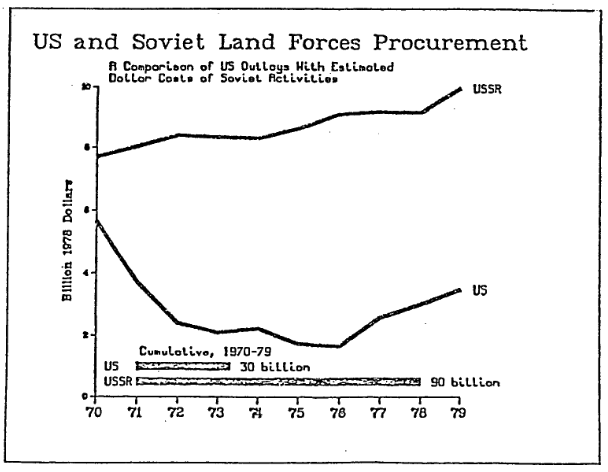
I remember reading all the reports from all the Newsweek and other publications and plus the stuff that my Dad brought home from the U.S Army and they had talked about the sheer numbers of Soviet Tanks and that they would come through the "Fulda_Gap" like cockroaches in a New York City apartment. I remember the graphs and reports about the sheer numbers of tanks that were available to GSFG for the conquest of Western Europe. I recall reading a document that was unclassified by the Kremlin after the Soviet Union Fell, that the KGB calculated that any chance the Soviets had to conquer Western Europe was pretty much gone by 1983 due to the new spending from the Reagan Military buildup and the infusion of training, parts and equipment that the U.S Military was getting as well as NATO was getting.
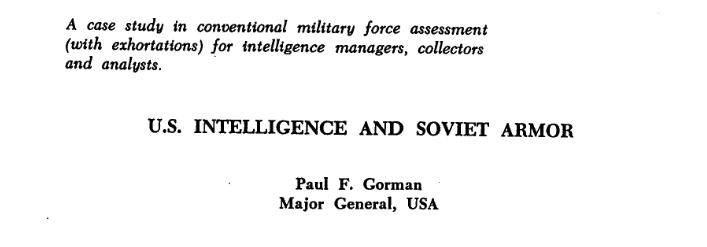
In 1980, the U.S. Army had a terrifying vision: an armada of Soviet
tanks sweeping across Western Europe, all the way to the English
Channel. And the U.S. Army feared it had no weapons that could stop this
vision from becoming a reality.
“In the arms likely to dominate
the outcome of a future battle for Central Europe — armored fighting
vehicles and counterweapons — the U.S. Army, then, probably will remain
qualitatively and quantitatively inferior,” wrote U.S. Army Major
General Paul Gorman in a secret 1980 study that wasn’t declassified until 2014.
Throughout the Cold War, the United States accepted that its forces
in Europe would be outnumbered by a massive Soviet war machine that by
1980 comprised 50,000 tanks — or five times the American tank arsenal.
But U.S. leaders had always comforted themselves with the thought that
Soviet numbers could be offset by superior American technology, training
and tactics.
But by the end of the 1970s, when American military power had ebbed
to its post-Vietnam low, Pentagon planners worried that the Soviet Union
had achieved superiority in tank quality as well as quantity. In
particular, they warned that the new T-72 outclassed the M60A1 and M60A3
— essentially upgrades of the 1950s M48 Patton — that were the backbone
of the American tank arsenal at the time.
Even the first M1 Abrams tanks entering service — armed with the
105-millimeter cannon instead of the later 120-millimeter cannon — would
have difficulty knocking out the more heavily armed T-72.
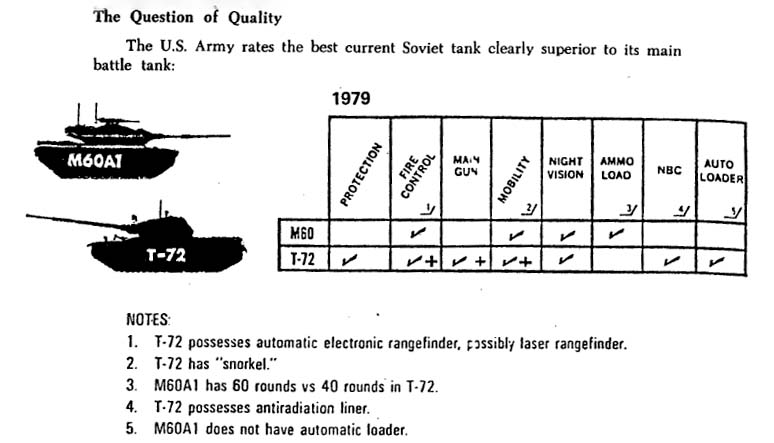
“The U.S. Army rates the best current Soviet tank clearly superior to its main battle tank,” the Army report warned.
It assessed the T-72 as superior to the M60A1 by virtue of superior
firepower and armor protection. The T-72 was also believed to have
numerous advanced features that the M60 lacked, including an “automatic electronic rangefinder, possibly laser rangefinder,”
an autoloader to increase rate of fire, a snorkel to cross rivers
without needing bridging equipment, and an anti-radiation liner to
protect the crew from nuclear weapons. The Army did at least credit the
M60 with carrying 60 rounds of main gun ammunition versus 40 for the
T-72.
Nor could salvation be found in the anti-tank guided missiles that
had begun entering service in the 1970s. Tests and mathematical modeling
by the Army’s Ballistic Research Laboratory estimated that U.S. TOW and
Dragon anti-tank missiles and the M-735 tungsten core round for the
105-millimeter cannon had a probability of kill (pK) as high as 77
percent against the front armor of a Soviet T-62 tank. But against the
T-72, that probability dropped to as low as 22 percent, with even the
upcoming M-774 depleted uranium round only having a 50 percent chance to
kill a T-72 according to the worst-case models.
T-72A tank from above
That meant defense against a tank-centric Soviet invasion of Europe
would be difficult until the 120-millimeter-armed M1 arrived in the
mid-1980s.
“Whether one uses informed U.S. or
Soviet calculations, the conclusion is that NATO can expect, through
1984, no advantage over the Soviets in quality of armor or antiarmor
weapons, and only a modest redressing of its present quantitative
disadvantage,” the study concluded.
XM1 Abrams prototype, 1979..
But were these dire predictions justified? It’s hard to be sure.
While U.S.- and Soviet-made armor did clash in the 1973 and 1982
Arab-Israeli wars, a climactic — and perhaps apocalyptic — battle
between American and Soviet armies never happened. Still, the
much-vaunted T-72 seemed more of a paper tiger in the 1982 Lebanon War,
when Israeli Merkava tanks armed with 105-millimeter guns disposed of them. And pitted against the Abrams in the First Gulf War, Iraqi T-72s seemed almost pitiful.
While Moscow could try to blame these debacles on the incompetency of
their allies, or the fact that they were using inferior export models
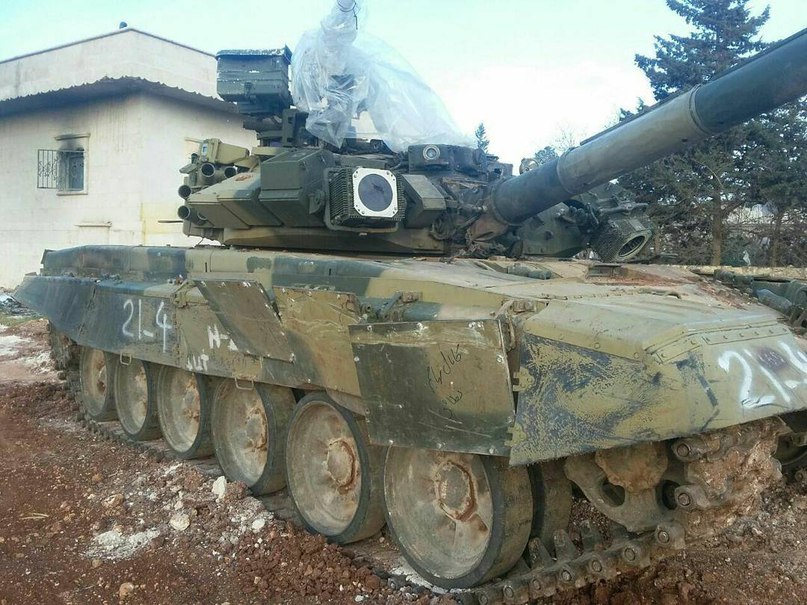
of Soviet equipment, that 1970s generation of T-72 tanks and MiG-23 fighters was not impressive in action. Even Syrian-manned T-90s may have been knocked out by U.S-made TOW anti-tank missiles supplied to Syrian rebels in 2016 and 2017.
Russian-sourced T-90 in Syria after being disabled by a TOW missile (Kremlin photo)
As the Nazis with their Tiger and Panther tanks could attest, merely having the most powerful tanks doesn’t guarantee victory. Well-trained crews, flexible command and control, reliable logistics, and plentiful airpower are more important than the thickness of a tank’s armor.
In the end, that 1980 U.S. Army study seems less about the
superiority of Soviet tanks, and more about the fact that U.S. tank
design atrophied between 1945 and 1980. With defense dollars and
priorities focused on nuclear weapons and chasing guerrillas through
Asian jungles, tanks had become far from the most vital component of
U.S. military power. It wasn’t until the M1 Abrams arrived in the 1980s
that the U.S. could claim to have a cutting-edge tank, and arguably the
best in the world. On the other hand, many Soviet tanks tended to
resemble the 1950s T-55 (itself descended from the World War II T-34),
which suggests that changes in tank design tend to be evolutionary
rather than revolutionary.
Mark IV tank, World War I.
Nonetheless, compare a Little Willie tank
from World War I to an Abrams, and it’s obvious that tanks do change as
technology progresses. Tanks inevitably change just as warfare does,
and just as inevitable are the cries that the enemy’s tanks are
superior. Fears that the Soviets had better tanks in 1980 are echoed
today by warnings that the M1 and other Western tanks are inferior to
the T-14 Armata,
with its active protection system to shoot down anti-tank rockets,
sophisticated sensors and data networking, and powerful 125-mm cannon
housed in an unmanned turret while the crew remains safely cocooned
inside the thickly armored hull.
For its part, the U.S. and other nations are developing new designs
as well. The U.S. Army, for example, wants a family of armored vehicles
that will include robot tanks. France and Germany are exploring a joint European tank that might feature a 140-millimeter cannon.
No doubt there will be Russian experts that will claim their tanks
are inferior with these platforms enter service — and demand that the
Kremlin fund the design of newer, better models (regardless of whether
the T-14 has even entered production yet).
I am still using my "old" laptop, I haven't ordered the new one yet, I need to, but just pulling the trigger and spending the money that I really don't want to. Does that makes sense? Also My Dads Memorial service is tomorrow, so I may not be back online tomorrow, depends on how I feel. I will be glad for the closure if nothing else. My brother came back from Astan so we were able to plan the memorial service.
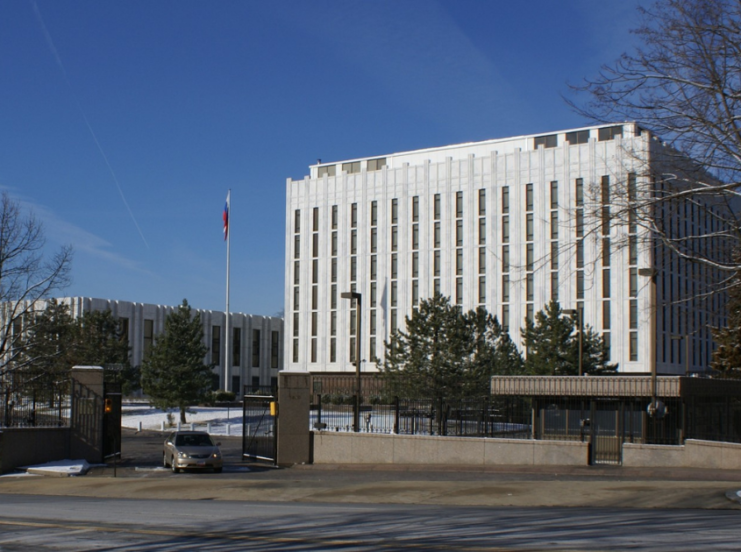
I remembered when the Soviets got this primo real estate compliments of the Carter State Dept and people were really pissed especially after the Russians had bugged and infiltrated our embassy so effectively and made us look like chumps.
The U.S. and U.S.S.R. were no strangers to spying on each other, as
they had been playing a cat-and-mouse game of espionage since the
beginning of the Cold War. Operation Monopoly, where the U.S. tried to
literally undermine the Soviet embassy, was one of the more audacious
attempts on the American side.
Since
the 1920s, the Soviets had spies integrated in many facets of the U.S.
military and politics. WWII was a particularly busy time for Soviet
intelligence agencies, as they were under direct orders from Moscow to
gather as much information as possible on U.S. and British war plans, as
well as any advances they were making in technology.
In fact, Soviet spies were embedded so deep that they were aware of the U.S.’ most secretive plans, like the Manhattan Project, leading to the Soviet development of the atomic bomb, and sparking the Cold War
This continued after WWII, but the two superpowers were now capable
of mutual destruction, forcing them to use more inventive ways to get
the upper hand over each other. One of the most critical points of
attention was their embassies. This was a place where important and top
secret conversations were made by the enemy on their own soil.
Naturally, eavesdropping on embassies became a priority for both the
Soviets and the U.S.
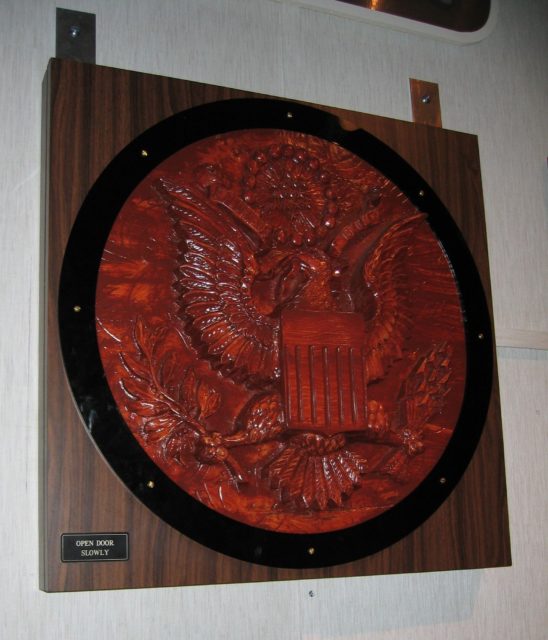
A replica of a bugged U.S. great seal on display at the National Cryptologic Museum in 2005
One of the earliest known forms of this was “The Thing”
in 1945. The Thing was a listening device planted within a wooden
plaque of the Great Seal of the U.S., which was given to the American
ambassador at the time by the Soviet Union, as a gesture of the
friendship the nations established during WWII. The ambassador hung it
on the wall of his office, not knowing it was secretly listening. The
device was remotely powered by electromagnetic energy from an outside
source to keep it hidden.
It was accidentally discovered six years later in 1951 by a radio operator in the British embassy.
In
1964, the U.S. discovered 40 bugs in their embassy, and in 1984, they
realized their typewriters were secretly transmitting what they typed to
the Soviets.
In
the 1970s, the Soviets were planning to build themselves a new embassy
in Washington, on a plot of land selected by the State Department. Much
to the dismay of U.S. intelligence services like the FBI, CIA, and NSA,
the land chosen for them was on the second-highest point in Washington,
giving the Soviet embassy a prime location to spy on the White House.
Knowing
this, U.S. secret services planned to bug the new embassy from top to
bottom to listen for important information and to detect if the Soviets
were spying on them.
Before Soviet architects arrived, the FBI
ordered the trees around the construction site to but cut down and any
evidence like sawdust and tree stumps removed. This was to provide an
unobstructed view of the location. Next, the FBI secretly purchased a
three-bedroom house situated quite literally across the road so they
could observe the embassy around the clock.
Russian Embassy in Washington
However, the main event was Operation Monopoly, a plan to dig a
tunnel straight under the Soviet embassy. This tunnel would allow U.S.
intelligence services to tap into and listen to Soviet communications
and calls.
The FBI selected a contractor, and work began while the
embassy was under construction. The FBI had to exercise extreme caution
to keep the tunnel a secret, by carefully removing dirt, and adding
high-tech monitoring equipment as they went.
Where did the tunnel
begin? This is still a matter of debate, with many people claiming to
know, suggesting it’s in places like the FBI-owned house across the
road, while others believe it begins in an even closer house on Fulton
Street. A local espionage enthusiast has monitored this house for years
and has never seen anyone come or go, even during holidays like
Halloween.
The workers involved in Operation Monopoly had to work
tirelessly to keep a constant ingress of water out. As well, despite
having detailed plans of the embassy’s layout, they were not sure where
the tunnel was in relation to the building.
The Soviets were
highly experienced at counter-espionage, having perfected it over the
previous decades. This made it incredibly hard for the Americans to
successfully spy on the embassy. The Soviets used thick slabs of marble
on the walls instead of a conventional marble-epoxy-marble method, to
prevent bugs from being placed in the glue.
They also would check
every window frame and sheet of metal for bugs before they were placed
in the building. On top of this, they bored 30–40 feet deep holes around
the site to check for tunnels.
Photo
double agent Robert Hanssen, who started working for the FBI and then
defected to the KGB while pretending to work for the FBI
The
embassy’s construction-to-use lasted from 1977 to 1994, and in this
time, the U.S.’s repeated and extremely expensive attempts to tunnel
under and monitor the embassy had failed. Thanks to this obvious lack of
success, they suspected there may have been a traitor in the project in
the early 1990s, and began an investigation.
It was discovered in
2001 that there was indeed a rat in the ranks, an FBI agent named
Robert Hanssen, who was sending top secret information to the Soviets in
exchange for money.
He revealed U.S. double agents to the KGB,
some of whom were eventually executed, and also revealed the plans about
the multi-million dollar and decades-long tunnel project under the
Soviet embassy.
Hanssen had revealed the existence of the tunnel in 1989, long before
1994 when the embassy was fully occupied, meaning the Soviets were never
at serious risk of having important information secretly recorded. This
also means the U.S. continued tunneling for years without knowing the
plan was exposed, making it a complete waste of time and resources
When the tunnel “officially” became known to the public in 2001, the
Russian government pretended to be shocked about the incident, which was
something they had actually known about for over 10 years.
Operation
Monopoly was clearly a complete failure, and it shows the extent of the
lack of trust between the U.S. and U.S.S.R. during the Cold War, and
how that distrust continued long after the supposed “end” of the Cold
War in the early 1990s, with the collapse of the Berlin Wall. As a
result, somewhere in Washington, an underground tunnel with an unknown
beginning or end still sits there today
I ran across this article from Business Insider and I thought it was a fascinating read and I also saw
Old NFO's war chariot flying over one of them. I remember the Kirov Battle Cruisers being a big subject on all of my "Soviet Power" and projection publications that I still have. The ships were a huge power projection for the Kremlin.
With the possible exception of the aircraft carrier Admiral Kuznetsov, no ships in the Russian navy are as important or held in higher regard than Kirov-class nuclear-powered battlecruisers.
At 827 feet long and with a displacement of more than 24,000 tons, they are the largest surface combat ships in the world that are not aircraft carriers, and their massive armament of missiles makes them among the most powerful warships ever built.
Arriving in the late stages of the Cold War, the Kirovs were seen as a major threat — so much so that all four of the US Navy's Iowa-class battleships were reactivated and rearmed in part to deal with them.
A nuclear battlecruiser
The Soviet Kirov-class nuclear-powered guided-missile cruiser Frunze in March 1986. Defense Intelligence Agency
The Kirovs were not the first nuclear warships. The US Navy had nine nuclear cruisers and three nuclear-powered aircraft carriers in service by the time the first battlecruiser, Kirov, was commissioned into the Soviet navy in 1980.
But their sheer size and massive armament set them apart from their nuclear and conventional US counterparts. They were so large that Western observers designated them "battlecruisers," the first ships to receive that designation since World War II.
Five of the ships were planned but only four were built. Three of them, Kirov, Frunze, and Kalinin, entered service before the breakup of the Soviet Union, after which they were renamed Admiral Ushakov, Admiral Lazarev, and Admiral Nakhimov, respectively.
The fourth ship, Pyotr Velikiy (Russian for "Peter the Great"), was commissioned in 1998, almost a decade after its launch.
The Soviets designated them "heavy nuclear-powered guided-missile cruisers," and like most of the Soviet fleet, they were intended to counter the threat of US Navy carrier groups and nuclear submarines, the biggest priorities for the Soviet navy in the event of war.
Because they had nuclear propulsion, their range was limited only by mechanical problems, food supplies, and crew comfort. That extended range allowed them to pose a greater threat to carriers than other surface ships in the fleet.
The weapons systems and cruise-missile and surface-to-air-missile launchers aboard the Soviet Kirov-class nuclear-powered guided-missile cruiser Kalinin in April 1991. US Navy
While American supercarriers are larger, no other warship is as well armed as the Kirovs.
The primary armament is 20 P-700 supersonic anti-ship missiles, each of them carrying a 1,600-pound high-explosive warhead. They could also carry low-yield nuclear warheads.
The ships also have a layered anti-air defense suite, consisting of 96 S-300F and 40 9K33 Osa surface-to-air missiles, along with six Kortik close-in weapon systems.
Each Kortik has two 30 mm Gatling guns capable of firing more than 4,000 rounds a minute and eight 9M311 anti-aircraft missiles, with an additional 144 9M311s in storage.
Ten torpedo tubes can fire Type 53 torpedoes as well as RPK-2 Vyuga and RPK-6 Vodopad anti-submarine missiles. A single double-barreled AK-130 130 mm gun and multiple anti-submarine rocket launchers are also present, as is a hangar and landing pad for three Ka-25 or Ka-27 helicopters.
There are slight variations among the four ships. Admiral Ushakov, for instance, had two single-barreled AK-100 100 mm guns and a twin SS-N-14 Silex anti-submarine missile launcher. Even with their differences, they were still considered some of the most heavily armed vessels on the seas.
President Ronald Reagan, elected the same year Kirov was commissioned, worried about the increased Soviet naval power and pledged to bring the total number of US Navy vessels to 600.
Part of the plan involved reactivating all four Iowa-class battleships and arming them with Harpoon and Tomahawk missiles, as well as Phalanx close-in weapons system.
Time in service
The Soviet Kirov-class nuclear-powered guided-missile cruiser Frunze underway with a US Navy P-3B Orion overhead in October 1985. Corbis via Getty Images
The first three Kirovs were commissioned in 1980, 1984, and 1988. Although they saw limited service with the Soviet navy's Pacific and northern fleets, they were a source of anxiety for NATO naval commanders.
After the Soviet Union collapsed, Russia could not afford to keep all the battlecruisers operational.
Admiral Ushakov was taken out of service in 1990 after an accident with its rector, and Admiral Lazarev was permanently docked in 1999. Both are set to be scrapped this year.
Admiral Nakhimov was commissioned in 1988 but was rarely deployed after the dissolution of the Soviet Union, and in 1997 it entered the Sevmash shipyard in Severodvinsk for upgrades.
As the newest battlecruiser, Pyotr Velikiy is more modern and is the only vessel of the class in active service.
As the flagship of Russia's Northern Fleet, Pyotr Velikiy has operated in Europe, South America, Asia, and Africa. In 2009, it captured 10 pirates off the coast of Somalia in what is perhaps the most uneven match in naval history.
Modernization
The Russian navy Kirov-class battlecruiser Pyotr Velikiy in the port of Severomorsk, in February 2016. Lev Fedoseyev\TASS via Getty Images
Despite the Kirovs' fall from grace, the Russian navy is attempting to revive their glory days with a complete refit of Admiral Nakhimov, which began in earnest in 2014. The battlecruiser will receive new weapons, radars, and other electronics.
The specifics of Nakhimov's new arsenal are not known, but the 3M22 Zircon hypersonic missile, reportedly capable of reaching speeds up to Mach 9, is expected to be a large part of it. Smaller than a P-700, Admiral Nakhimov could be able to carry as many as 60 Zircons.
Admiral Nakhimov's upgraded arsenal could also include Kalibr cruise missiles and dual-purpose Oniks land-attack and anti-ship missiles.
Weapons that will be included after the refit are the Fort-M surface-to-air missile system, the Pantsir-M CIWS, and the Paket-NK and Otvet anti-submarine missiles.
Russian officials have said they expect Admiral Nakhimov to be delivered to the Navy by late 2022. It will be the most powerful warship in the entire Russian navy and one of the most powerful in the world.


.jpg.webp)
.png)

.jpg)






 Russian Embassy in Washington