Webster

The Constitution was made to guard the people against the dangers of good intentions." --American Statesman Daniel Webster (1782-1852)


Showing posts with label Battlecruisers. Show all posts

Thursday, March 18, 2021

Why Soviet Nuclear Powered Cruisers Spooked the United Stated into Bringing back its Battleships.

 I ran across this article from Business Insider and I thought it was a fascinating read and I also saw 

Old NFO's war chariot flying over one of them.   I remember the Kirov Battle Cruisers being a big subject on all of my "Soviet Power" and projection publications that I still have.  The ships were a huge power projection for the Kremlin.  


With the possible exception of the aircraft carrier Admiral Kuznetsov, no ships in the Russian navy are as important or held in higher regard than Kirov-class nuclear-powered battlecruisers.

At 827 feet long and with a displacement of more than 24,000 tons, they are the largest surface combat ships in the world that are not aircraft carriers, and their massive armament of missiles makes them among the most powerful warships ever built.

Arriving in the late stages of the Cold War, the Kirovs were seen as a major threat — so much so that all four of the US Navy's Iowa-class battleships were reactivated and rearmed in part to deal with them.

A nuclear battlecruiser

Soviet navy Kirov battlecruiser Frunze
The Soviet Kirov-class nuclear-powered guided-missile cruiser Frunze in March 1986. 
Defense Intelligence Agency

The Kirovs were not the first nuclear warships. The US Navy had nine nuclear cruisers and three nuclear-powered aircraft carriers in service by the time the first battlecruiser, Kirov, was commissioned into the Soviet navy in 1980.

But their sheer size and massive armament set them apart from their nuclear and conventional US counterparts. They were so large that Western observers designated them "battlecruisers," the first ships to receive that designation since World War II.

Five of the ships were planned but only four were built. Three of them, Kirov, Frunze, and Kalinin, entered service before the breakup of the Soviet Union, after which they were renamed Admiral Ushakov, Admiral Lazarev, and Admiral Nakhimov, respectively.

The fourth ship, Pyotr Velikiy (Russian for "Peter the Great"), was commissioned in 1998, almost a decade after its launch.

The Soviets designated them "heavy nuclear-powered guided-missile cruisers," and like most of the Soviet fleet, they were intended to counter the threat of US Navy carrier groups and nuclear submarines, the biggest priorities for the Soviet navy in the event of war.

Because they had nuclear propulsion, their range was limited only by mechanical problems, food supplies, and crew comfort. That extended range allowed them to pose a greater threat to carriers than other surface ships in the fleet.

Soviet navy Kirov battlecruiser
The weapons systems and cruise-missile and surface-to-air-missile launchers aboard the Soviet Kirov-class nuclear-powered guided-missile cruiser Kalinin in April 1991. 
US Navy

While American supercarriers are larger, no other warship is as well armed as the Kirovs.

The primary armament is 20 P-700 supersonic anti-ship missiles, each of them carrying a 1,600-pound high-explosive warhead. They could also carry low-yield nuclear warheads.

The ships also have a layered anti-air defense suite, consisting of 96 S-300F and 40 9K33 Osa surface-to-air missiles, along with six Kortik close-in weapon systems.

Each Kortik has two 30 mm Gatling guns capable of firing more than 4,000 rounds a minute and eight 9M311 anti-aircraft missiles, with an additional 144 9M311s in storage.

Ten torpedo tubes can fire Type 53 torpedoes as well as RPK-2 Vyuga and RPK-6 Vodopad anti-submarine missiles. A single double-barreled AK-130 130 mm gun and multiple anti-submarine rocket launchers are also present, as is a hangar and landing pad for three Ka-25 or Ka-27 helicopters.

There are slight variations among the four ships. Admiral Ushakov, for instance, had two single-barreled AK-100 100 mm guns and a twin SS-N-14 Silex anti-submarine missile launcher. Even with their differences, they were still considered some of the most heavily armed vessels on the seas.

President Ronald Reagan, elected the same year Kirov was commissioned, worried about the increased Soviet naval power and pledged to bring the total number of US Navy vessels to 600.

Part of the plan involved reactivating all four Iowa-class battleships and arming them with Harpoon and Tomahawk missiles, as well as Phalanx close-in weapons system.

Time in service

Soviet navy Kirov battlecruiser Frunze
The Soviet Kirov-class nuclear-powered guided-missile cruiser Frunze underway with a US Navy P-3B Orion overhead in October 1985. 
Corbis via Getty Images

The first three Kirovs were commissioned in 1980, 1984, and 1988. Although they saw limited service with the Soviet navy's Pacific and northern fleets, they were a source of anxiety for NATO naval commanders.

After the Soviet Union collapsed, Russia could not afford to keep all the battlecruisers operational.

Admiral Ushakov was taken out of service in 1990 after an accident with its rector, and Admiral Lazarev was permanently docked in 1999. Both are set to be scrapped this year.

Admiral Nakhimov was commissioned in 1988 but was rarely deployed after the dissolution of the Soviet Union, and in 1997 it entered the Sevmash shipyard in Severodvinsk for upgrades.

As the newest battlecruiser, Pyotr Velikiy is more modern and is the only vessel of the class in active service.

As the flagship of Russia's Northern Fleet, Pyotr Velikiy has operated in Europe, South America, Asia, and Africa. In 2009, it captured 10 pirates off the coast of Somalia in what is perhaps the most uneven match in naval history.

Modernization

Russia navy Kirov battlecruiser Pyotr Velikiy Murmansk
The Russian navy Kirov-class battlecruiser Pyotr Velikiy in the port of Severomorsk, in February 2016. 
Lev Fedoseyev\TASS via Getty Images

Despite the Kirovs' fall from grace, the Russian navy is attempting to revive their glory days with a complete refit of Admiral Nakhimov, which began in earnest in 2014. The battlecruiser will receive new weapons, radars, and other electronics.

The specifics of Nakhimov's new arsenal are not known, but the 3M22 Zircon hypersonic missile, reportedly capable of reaching speeds up to Mach 9, is expected to be a large part of it. Smaller than a P-700, Admiral Nakhimov could be able to carry as many as 60 Zircons.

Admiral Nakhimov's upgraded arsenal could also include Kalibr cruise missiles and dual-purpose Oniks land-attack and anti-ship missiles.

Weapons that will be included after the refit are the Fort-M surface-to-air missile system, the Pantsir-M CIWS, and the Paket-NK and Otvet anti-submarine missiles.

Russian officials have said they expect Admiral Nakhimov to be delivered to the Navy by late 2022. It will be the most powerful warship in the entire Russian navy and one of the most powerful in the world.

Saturday, May 12, 2018

Battlecruisers....

I have blogged extensively about Battlecruisers, like I said, this is funny coming from an Army guy, what can I say.  I was fascinated by combat ships since I was a kid.  I will add the most famous battlecruiser in the world, the HMS Hood.  People forget that the Hood was a battlecruiser, and she exemplifies the attributes of a battlecruiser and the weaknesses that ultimately sank her  when she went up against the biggest battleship the Germans had, The SMS Bismark.   I had fun doing research on this post :)

HMS HOOD
Their capabilities allowed them to fill three roles. They could work with the dreadnoughts in the main battle fleet, adding extra firepower. They could form the heart of smaller squadrons, or they could act independently, their speed and firepower enabling them to contribute to the war without support from other ships.


HMS Shannon, a Minotaur-class armoured cruiser, 1908–09.

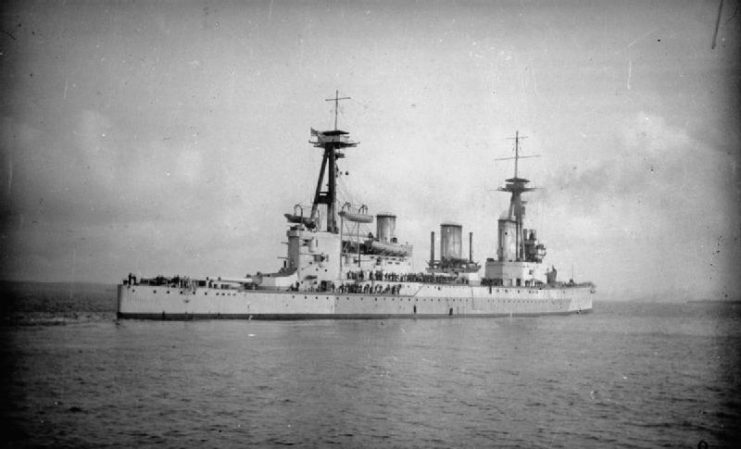
In 1909, the Royal Navy was the first to launch battlecruisers. The faith the British placed in the ships was reflected in their names – the HMS Indomitable, Inflexible, and Invincible. They had a displacement of 17,250 tons, similar to the original HMS Dreadnought, but thinner armor to allow for greater speed. Each one carried eight 12-inch guns, just short of the ten 12-inch guns carried by most dreadnoughts.
The first batch of battlecruisers was followed by another set of three carrying similar weapons. Then a process of escalation began, as the designers tried to fit them with ever-greater firepower. The HMS Tiger, a unique battlecruiser laid down in 1912, carried eight 13.5-inch guns. The Renown and Repulse, launched at the height of the war in 1916, had six guns each, but they were powerful 15-inch weapons.
By 1917, the Royal Navy had built 12 battlecruisers, more than any other nation.


HMS Tiger at anchor, 1916–17.

Britain’s first battlecruisers were designed and begun in secret, during the naval arms race. Even when they were launched, not every nation rushed to imitate Fisher’s innovation. By the start of the war, only Britain, Germany, and Japan had battlecruisers in action.
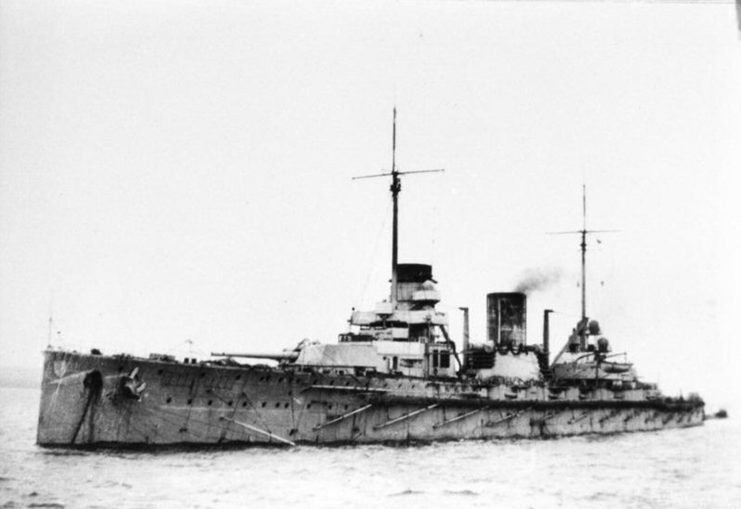
SMS Moltke
The First German battlecruiser was completed in 1910, and several more were produced during the years that followed. While sticking with the broad outline laid out by Fisher, the Germans brought a slightly different approach to battlecruisers. They placed less emphasis on speed and firepower, giving their battlecruisers instead better armor than the British ones. Their first battlecruisers carried 11.1-inch guns although ships built later had the 12-inch guns the British had started with.
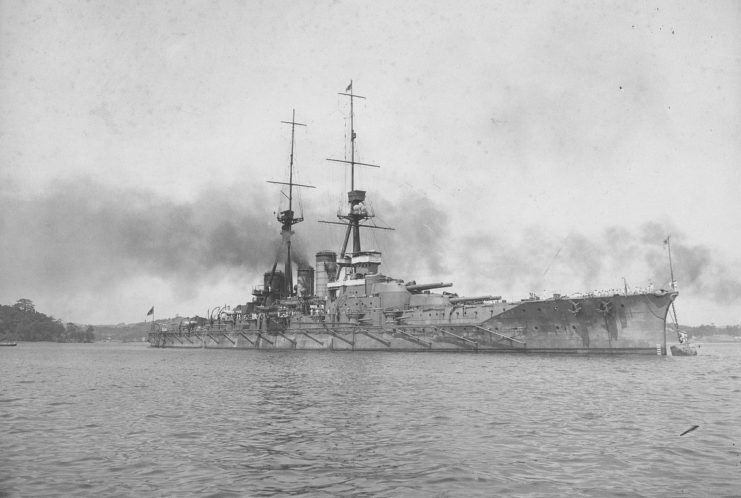
The Japanese could not afford to produce as many ships as other powers, so they chose to focus on quality over quantity. Their Kongo-class battlecruisers had their design changed to incorporate 14-inch guns. They also had slightly heavier armor than the British ships. The first Japanese battlecruiser was built in Britain while they were allies; later ships were produced in Japan.


Imperial Japanese Navy battlecruiser Haruna at Yokosuka, Japan.

At first, the battlecruisers were successful. At the Battle of Heligoland Bight in August 1914, they turned the tide of battle in favor of the British by sinking three German light cruisers. While on detached service in the Falklands in late 1914, the HMS Inflexible and Invincible sank two less-powerful German cruisers, confirming their role as destroyers of light ships.
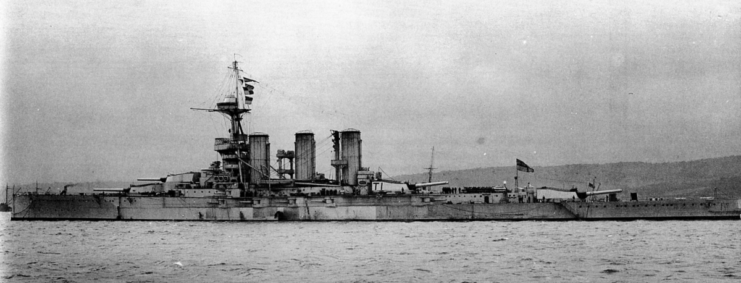
German battlecruisers were sent out on some successful independent expeditions. They bombarded towns on the British east coast, raising concerns among the British public about the Royal Navy’s ability to protect them. The Germans gave a battlecruiser, the SMS Goeben, to the Ottoman Empire. It contributed to bringing the Turks into the war and helped them fight against British and Russian fleets.


Goeben in port, date unknown.

However, the successes concealed problems with the battlecruiser design.
One of the biggest issues was that the captains of the ships regarded them as suitable ships of the line. With their large size, heavy armament, and impressive label, commanders mistakenly tried to use them in straight fights against dreadnoughts and other battlecruisers. Their armor, reduced to increase their speed, was not designed to withstand the sort of guns those ships carried.
In May 1916, the Battle of Jutland laid the truth bare for all to see. Single salvos of shells proved enough to sink three British battlecruisers, the Indefatigable, the Invincible, and the Queen Mary. Each was blown apart and sent into the depths. On the German side, the Lützow was sunk, and other battlecruisers limped home.

 SMS Seydlitz steaming home severely damaged after Jutland
A combination of good seamanship and precautions introduced to contain explosions stopped more from being lost.
Battlecruisers had faced a major battle, and their weakness had been exposed.


British battlecruiser HMS Indefatigable underway in coastal waters just before the Battle of Jutland.

Fortunately, another machine emerged to serve part of the role filled by battlecruisers. The growth of naval aviation created an alternative way of providing reconnaissance for battle fleets.
No more battlecruisers were lost during WWI, as both sides learned the lessons of Jutland and used them appropriately. The Royal Navy used the Royal Navy Air Service with Sopwith Pups and also non Rigid Airships to provide reconnaissance for the Home Fleet during the blockade. 


Following the war, there was still some interest in building battlecruisers, although with a different design. Then the Washington Naval Treaty of 1922 brought a halt to the naval arms race, and interest in battlecruisers evaporated. By the time naval power began to grow again, designers had moved on to improved options.
Ultimately, battlecruisers were too vulnerable for ships of their size and firepower.