From everything that I read about the Japanese Soldier in WWII was that they were fanatical, dedicated, would sacrifice everything for the goals set by their commanders, they were imbued by a form of "bushido" or Martial spirit or the samurai spirit. Please realize that my descriptions are very simple, I could go on for pages if I wanted to do a deep dive. I respected the Japanese Soldier of WWII for what he could do, I did not admire them They were often cruel to the people they captured, but that was to me part of the draconian disciplinary system of the Japanese Army, where the lower enlisted were beaten by their NCO's for the smallest infractions, and they were frequently treated with disdain by their officers. They viewed the west as "weak" especially the United States, the Pacific War was brutal compared to the European war, it matched the savagery of the Eastern front, and in some cases exceeded it because there was no quarters given by either side. The Americans learned to be very wary of accepting "surrendering" japanese soldiers because it was frequently a ruse to kill more Americans, and if there were any wounded Americans, captured, they were almost always bayoneted by the Japanese. Like I said, very savage. compared to the War in the European Theater. The Americans had no compunctions of using flame throwers and other weapons on japanese positions during the island hopping campaigns. It was a very different war.
I got this off "Quora"
n "Nemesis" The Battle for Japan 1944–45’ by Max Hastings, a British army officer is quoted as making the observation that the Japanese were first class soldiers fighting in a third-rate army.
The soldiers of the Imperial Japanese Army were brave, well trained and highly disciplined. They would rather die than surrender and, consequently, fought to the death to avoid the dishonour of being captured. However, technologically the IJA was backward compared to the other key armies of WWII. It lacked a decent tank nor a doctrine of how to use the ones they did have. In open ground warfare where there was space to maneuver the IJA was hopelessly outclassed, as Slim in Burma and the Red Army in Manchuria before and at the end of the war, proved. Moreover, senior IJA leadership were often appallingly incompetent in sending their forces into battle in adverse circumstances and this manifested especially in the manner in which logistical challenges were fatally underestimated, as noted in the question. This stemmed principally from a shocking underestimation of their enemies. It was frequently assumed that the lightly burdened, fast moving Japanese soldiers would overcome their enemies quickly - as they had done in Malaya and early on in Burma- and capture all the supplies they required from their defeated enemies. But by 1943, the offensive weaknesses of the IJA had been more fully recognized, its initial victories notwithstanding. It became clear that whilst the Japanese soldier was a formidable and ferocious enemy when defending in place behind fixed defensive positions, he was much less so out in the open when attacking.
Unfortunately for the Japanese army, in all three battles mentioned (and others besides) its enemies failed to cooperate by collapsing, forcing the Japanese soldiers to retreat with little food and in difficult conditions. The wounded who could not keep up were either killed or left to kill themselves with grenades, hopefully taking a pursuing Allied soldier with them. In Guadalcanal, on the Kokoda Trail and at Imphal/Kohima, the disastrous result of their offensive failures resulted in mass starvation amongst retreating Japanese soldiers as well as death from disease. Hundreds of thousands of Japanese soldiers in the Pacific were bypassed and left to rot on scores of islands and atolls as the United States Navy juggernaut continued its inexorable and innovative island-hopping advance towards Japan’s home islands.
A stark example of the hopelessly unrealistic ambitions of senior Japanese commanders, and their inability to comprehend logistical challenges, was the idiotic plan to disrupt British plans to retake Burma by attacking Imphal and Kohima in northeastern India. The brainchild of General Renya Mutaguchi commanding 15th Army, it would compel Japanese forces to traverse some of the wettest and most rugged country in Asia where annual rainfall sometimes reached 800 inches, with only a tenuous logistical lifeline, mounted against an enemy with overall numerical superiority and command of the air. It also came at a time when Japanese fortunes elsewhere had taken a decided turn for the worst. Mutaguchi proved a complete incompetent but his plan was approved in Tokyo after the most cursory examination of its feasibility by higher command, possibly because Burma was considered very much a sideshow.
The result was a battle in which the Japanese soldiers fought for many weeks with their usual ferocity but with decreasing prospects of success. Worst of all the 15th Army’s already weak logistical lifeline was disrupted by Allied air attacks, and they began to starve. After Mutaguchi refused pleas from subordinates to retreat, one divisional commander took it upon himself to order his division to do so. The incompetent army commander finally had no option but to order a general retreat. But by this time the monsoon had set in, tracks and trails had become all but impossible to navigate and thousands of Japanese soldiers died of starvation, disease and/or their wounds. The despised Mutaguchi was eventually fired.
One key consequence of this calamity was that the Japanese forces available to contest Field Marshal Bill Slim’s masterful campaign to retake Burma were greatly weakened , and even their fighting spirit in the later stages of the campaign was significantly diminished.
Logistics undoubtedly proved an Achilles heel for the IJA throughout the war.
Only one that I knew about was Rommel, I'm sure there were others
While most WWII generals led from the safety of the rear, a defiant few fought on the front lines. One even landed in the first wave of D-Day at age 56, armed only with a pistol and a cane.
That man was U.S. Army Brigadier General Theodore Roosevelt Jr. As the deputy commander of the 4th Infantry Division, he had repeatedly petitioned his superiors to let him lead the assault, arguing his presence would steady the men. His request was finally granted, and Roosevelt stepped off his landing craft onto Utah Beach under heavy fire. When he realized the landing craft had drifted a mile off course, he personally scouted the area and redirected incoming regiments, declaring, "We'll start the war from right here!" He survived the assault but died of a heart attack in Normandy a month later. Here is some details"General Roosevelt", He had big ties with my division, the 1st Infantry Division.
German Field Marshal Erwin Rommel built his reputation on abandoning his headquarters to ride with his vanguard. During the 1940 invasion of France, he commanded the 7th Panzer Division—nicknamed the "Ghost Division" because even the German High Command often lost track of its location. Rommel drove right alongside his lead tanks, sometimes personally helping soldiers operate anti-tank guns or bridging equipment. In North Africa, he continued this aggressive style, directing battles from a forward command vehicle or flying low over the desert in a Fieseler Storch observation plane to spot British positions.
German Field Marshal Erwin Rommel studies a map in his forward command vehicle during the North African campaign in 1942. Source: Wikimedia Commons.
U.S. Major General Maurice Rose commanded the 3rd Armored Division, nicknamed the "Spearhead" division, and lived up to the name by riding in a jeep at the very front of his armored columns. Rather than managing the advance from a rear command post, Rose preferred to be close enough to hear small arms fire. In March 1945, his hands-on approach cost him his life. While moving forward to locate a cutoff unit in Germany, his command group unexpectedly encountered a column of German Tiger tanks in the dark. Rose was shot and killed while reaching for his weapon to surrender, making him the highest-ranking American killed by enemy fire in the European Theater.
I ran across this article and I really liked it. My friend Old NFO likes to feature Gurkha's in his Military Science Fiction. He portrays them as fierce warriors, steadfast soldiers, totally honorable and incorruptible and loyal to their officers and the ideals. I have known about Gurkha's since I started reading about WWII as a kid and the knife was legendary.
The kukri is effective as a chopping weapon, due to its weight, and slashing weapon, because the curved shape creates a "wedge" effect which causes the blade to cut effectively and deeper. Because the blade bends towards the opponent, the user need not angle the wrist while executing a chopping motion. Unlike a straight-edged sword, the center of mass combined with the angle of the blade allow the kukri to slice as it chops. The edge slides across the target's surface while the center of mass maintains momentum as the blade moves through the target's cross-section. This gives the kukri a penetrative force disproportional to its length. The design enables the user to inflict deep wounds and to penetrate bone.
Utility
While most famed from use in the military, the kukri is the most commonly used multipurpose tool in the fields and homes in Nepal. Its use has varied from building, clearing, chopping firewood, digging, slaughtering animals for food, cutting meat and vegetables, skinning animals, and opening cans. Its use as a general farm and household tool disproves the often stated "taboo" that the weapon cannot be sheathed "until it has drawn blood". The kukri is versatile. It can function as a smaller knife by using the narrower part of the blade, closest to the handle. The heavier and wider end of the blade, towards the tip, functions as an axe or a small shovel.
Former Field Marshal Sam Manekshaw of the Indian Army once said: “If a man says he is not afraid of dying, he is either lying or he is a Gurkha.” Correct, but what is a Gurkha? In 1814, the East India Company began making “excursions” into the Kingdom of Nepal, believing the Nepalis would be pushovers. They were wrong. Not only did their invasion hurt their pockets, but it also cost them dearly regarding personnel. What malaria or desertion did not claim, the Gurkhas did. By the time the Anglo-Nepalese War ended in 1816 with a truce, the British had learned not to underestimate their foe. Quite the opposite, in fact. Others noticed it also, which is why various countries currently regularly recruit Gurkhas.
Originally from the Nepali district of Gorkha, they now come from all over the country. They are renowned for their service in the British Army and have fought in many contemporary wars forming part of the Coalition Forces in Iraq. They are willing to serve the British (and other foreign nations) due to poverty – an unfortunate state of affairs that still exists today. “Service” does not do justice to what it is they do, which is why many have gone down in legend.
Gurkha soldiers during the Anglo-Nepalese War.
One such man was Lachhiman Gurung, born on December 30, 1917, in the village of Dakhani, Tahani District, Nepal. He was very poor. So much so that by 1940, he stood a mere 4’11” tall as a result of deprivation and malnutrition. Fortunately, he was tough. Gurung had repeatedly tried to join the British Indian Army. Being so short and puny even by Nepali standards, the authorities had declined. As WWII progressed, the British needed everyone, so the 23-year-old finally joined the British Indian Army in December 1940. What he lacked in size, he more than made up for regarding sheer determination. He earned himself a place as a rifleman in the 4th Battalion, 8th Gurkha Rifles. In late April 1945, his battalion crossed the Irrawaddy River into Burma (now Myanmar) with the 89th Indian Infantry Brigade of the 7th Indian Infantry Division. Their mission was to attack Japanese positions north of the Prome-Taungup Road.
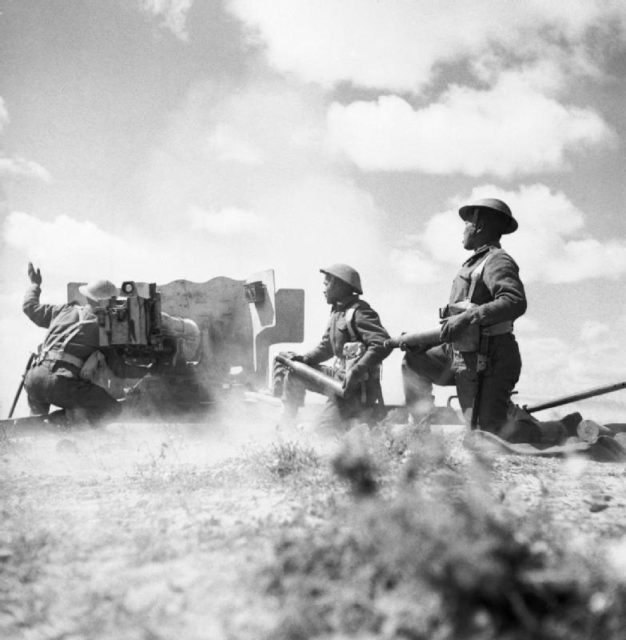
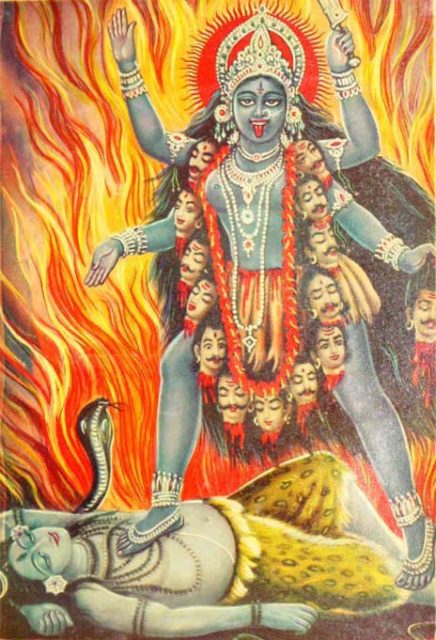
Gurkhas manning a 6-pound anti-tank gun in Tunisia on March 16, 1943The Japanese were taken by surprise and by May 9, were retreating to the village of Taungdaw in northwestern Burma. Lachhiman’s battalion was waiting for them. Late at night on May 12, most of the 4th Battalion, 8th Gurkha Rifles lay asleep. Rifleman Lachhiman was on guard duty. His small group was in a trench farthest away from the village when the attack came – cutting them off from the other Gurkha positions. At least 200 Japanese soldiers tried to make their way to Taungdaw. To do so, they first had to pass through Lachhiman’s position. A grenade landed on the edge of his trench. He jumped up, grabbed it, and hurled it back with a satisfying boom! A second landed in the trench inches away from his foot. He returned that one too. A third landed just outside the trench, so he lunged forward and picked it up as well. As he was about to throw it back, it exploded. His right hand was pulverized, and his arm shattered while burning shrapnel pummeled his face and right leg. The explosion rocked two other soldiers off their feet sending them crumpling to the ground. Half-blinded from the blast, his mouth severely bleeding, Lachhiman managed to scream the Gurkha’s ancient battle cry: “Jai Mahakali! Ayo Gorkhali!” Kali is the Hindu goddess of night, death, time, and destruction. She wears a necklace of severed heads and a skirt of chopped off arms while she tramples her husband (the god Shiva) underfoot. She is not someone to mess with and probably explains why she is the patron goddess of the Gurkhas. The goddess KaliWhat Lachhiman shouted translates as “Victory to Great Kali! Gurkhas approach!” There was only him. All the others were either dead or too badly injured to fight. So he loaded his rifle with his left hand – not an easy task as his standard-issue bolt-action rifle was designed for right-handed use. Despite his wounds, he fired at point blank range each time the Japanese attacked, reloading and repeating the process for four hours. Exhaustion, shock, and blood loss took their toll, but eventually, his comrades were able to relieve him. For the next three days and two nights, the Gurkhas were on their own, heroically fighting off the Japanese until more Allied troops arrived. The other Gurkhas were inspired by what Lachhiman had done. When it was over there were 87 Japanese bodies around the trench. Thirty-one of them lay directly in front of the spot Lachhiman had defended single-handedly. Doctors did their best for him, but could not save his right eye or right hand. Lord Louis Mountbatten, British Admiral of the Fleet, awarded Lachhiman the Victoria Cross (Britain’s highest military award for valor) on December 19, 1945. Despite his injuries, Lachhiman continued to serve the 8th Gurkhas until 1947 when they were transferred to the newly independent Indian Army. He eventually settled in Britain where he died in 2010 – after successfully fighting the British government for the right for other Gurkha veterans like himself to live in Britain.
Monument to the Gurkha Soldier outside the Ministry of Defense Building in London;
Despite his injuries, Lachhiman continued to serve the 8th Gurkhas until 1947 when they were transferred to the newly independent Indian Army. He eventually settled in Britain where he died in 2010 – after successfully fighting the British government for the right for other Gurkha veterans like himself to live in Britain.
THE GURKHA SOLDIER Bravest of the brave, most generous of the generous, never had country more faithful friends than you.
The treatment of Gurkhas and their families was the subject of controversy in the United Kingdom once it became widely known that Gurkhas received smaller pensions than their British counterparts. The nationality status of Gurkhas and their families was also an area of dispute, with claims that some ex-army Nepali families were being denied residency and forced to leave Britain. On 8 March 2007 the British Government announced that all Gurkhas who signed up after 1 July 1997 would receive a pension equivalent to that of their British counterparts. In addition, Gurkhas would, for the first time, be able to transfer to another army unit after five years' service and women would also be allowed to join--although not in first-line units--conforming to the British Army's policy. The act also guaranteed residency rights in Britain for retired Gurkhas and their families. Despite the changes, many Gurkhas who had not served long enough to entitle them to a pension faced hardship on their return to Nepal, and some critics derided the government's decision to only award the new pension and citizenship entitlement to those joining after 1 July 1997, claiming that this left many ex-Gurkha servicemen still facing a financially uncertain retirement. An advocacy group, Gurkha Justice Campaign, joined the debate in support of the Gurkhas. In a landmark ruling on 30 September 2008 the High Court in London decided that the Home Secretary's policy allowing Gurkhas who left the Army before 1997 to apply for settlement in the United Kingdom was irrationally restrictive in its criteria, and overturned it. In line with the ruling of the High Court the Home Office pledged to review all cases affected by this decision. On 29 April 2009 a motion in the House of Commons by the Liberal Democrats that all Gurkhas be offered equal right of residence was passed by 267 votes to 246. This was the only first-day motion defeat for a government since 1978. Nick Clegg, the Liberal Democrat leader, stated that "this is an immense victory [...] for the rights of Gurkhas who have been waiting so long for justice, a victory for Parliament, a victory for decency." He added that it was "the kind of thing people want this country to do". On 21 May 2009 Home Secretary Jacqui Smith announced that all Gurkha veterans who retired before 1997 with at least four years service would be allowed to settle in the UK. Actress Joanna Lumley, daughter of Gurkha corps Maj. James Lumley who had highlighted the treatment of the Gurkhas and campaigned for their rights, commented, "This is the welcome we have always longed to give". A charity, The Gurkha Welfare Trust, provides aid to alleviate hardship and distress among Gurkha ex-servicemen. On June 9, 2015, a celebration called the Gurkha 200, held at The Royal Hospital Chelsea and attended by members of the royal family, commemorated the bicentennial of the Gurkha Welfare Trust by paying tribute to Gurkha culture and military service.
Everyone knew about the German "Volksturm" with this picture being Iconic for the group.
Well the Japanese had the same kinda thing, and most people didn't know about it. I remember seeing pictures in my WWII books of Japanese soldiers teaching Japanese civilians how to use bamboo spears to attack the American soldiers after they set foot on the homeland. I also know after a few incidents of this plus of the bloodbath of Okinawa, we would have had to eradicate the Japanese as a people and a culture to beat them. and anything less than an unconditional surrender would mean fighting the japanese in 20 years after they rearmed and got smarter and we had demobilized as we tend to do after a major conflict. Hitler Germany taught that little lesson. So when I hear about the revisionist talk about that we should have not used the A-bomb on the Japanese I know that they don't really know history and that they are apologist for the Soviet Union Er the Marxist movement.
I shamelessly clipped this from "American Rifleman"
Japanese women were expected to be combatants in the Volunteer Fighting Corps. These ladies train with a Nambu Type 11 light machine gun (6.5x50 mm Arisaka). It is highly unlikely that even an old Type 11 LMG would have been available to the Japanese militia.
Photo courtesy of author’s collection.
“The bulwark of this Volkssturm in Japan proper is the Second National Army, which in peacetime consists of a large group of untrained males of military age. With the small amount of training now being given this group and with the formal registering on its rolls of all 17- and-18-year-olds since November 1944, the use of civilians in the defense of the Japanese homeland begins to assume increasing military importance.”
—Secret U.S. Military Intelligence document from the Pacific Theater of Operations, March 1945
While the Allied concept of “unconditional surrender” of Axis forces in Europe was sound, the prospects of a national Japanese surrender seemed unlikely. Before anyone knew anything about the war-ending potential of the atomic bomb, American military planners had to prepare to overcome a fanatical defense of the Japanese home islands—a battle during which the Japanese military appeared ready to sacrifice their entire population to protect their homeland.
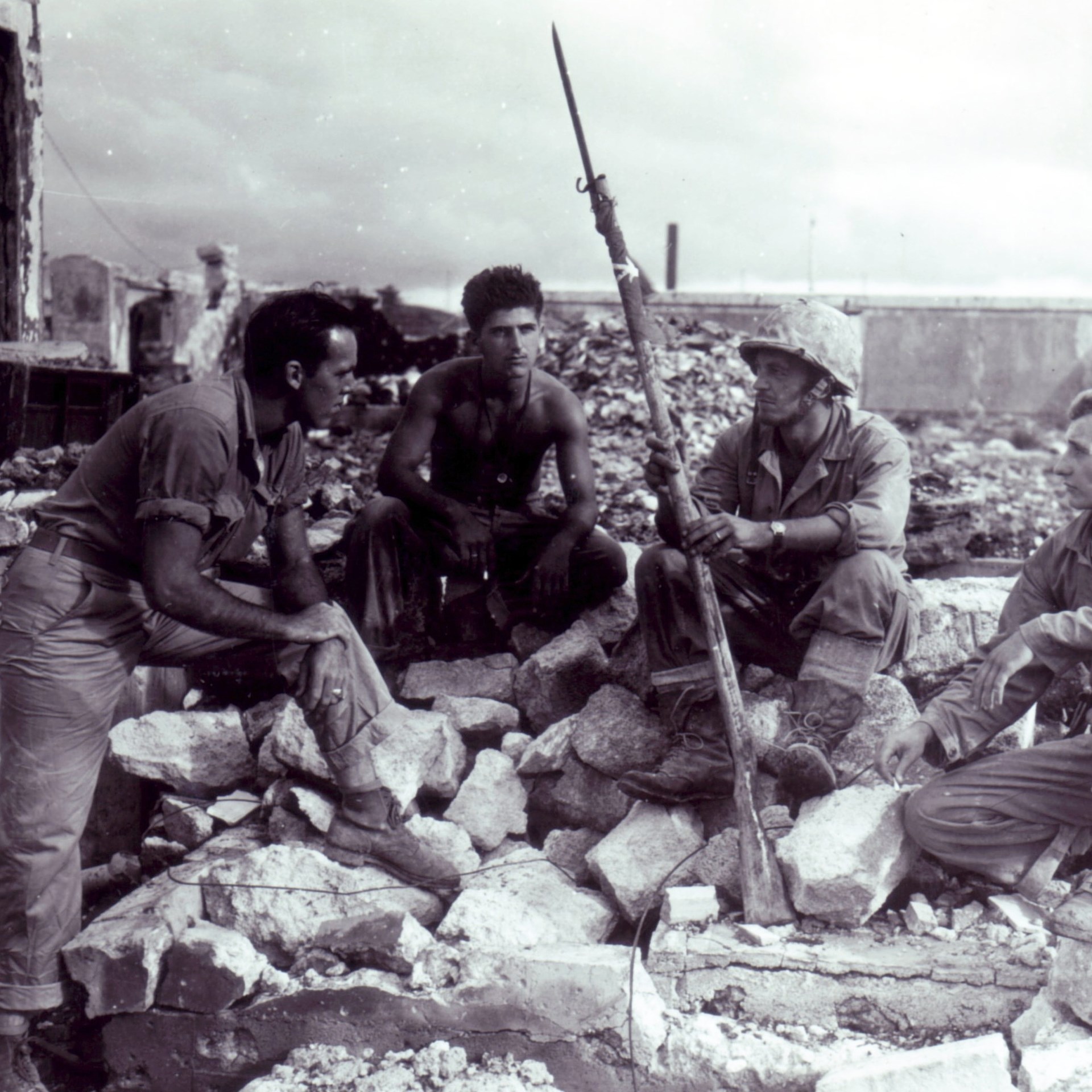
As firearms became more and more scarce, the Japanese turned to the most basic weapons: spears were constructed using standard rifle bayonets or simply a sharpened metal rod. American troops first encountered these on Saipan and sometimes referred to them as “Banzai Sticks.” Photo courtesy of National Archives and Records Administration (NARA).
But while the Japanese spirit was willing, their physical resources were growing weak. The emperor’s forces struggled to provide enough firearms and ammunition to their combat troops. To train and supply a large civilian militia with effective modern small arms would require extreme ingenuity to match the traditional Japanese willingness to sacrifice. Consequently, the Japanese would develop some of the crudest firearms of World War II.
Setting The Stage For Operation Downfall Allied leaders concluded that they could not wait for a blockade and intensive bombings to bring about a Japanese surrender—a massive invasion of the home islands was necessary. Meanwhile, a timeline was set for the defeat of Japan within one year of the surrender of Germany. The larger plan, dubbed “Operation Downfall,” was divided into two parts: Operation Olympic and Operation Coronet.
Olympic was to be the invasion of Kyūshū, scheduled for Nov. 1, 1945. Coronet was the second phase, with a massive force planned to invade Honshu in March 1946. All the main preparations were made without any knowledge of atomic bombs, and until the successful A-bomb test (July 16, 1945), it would have been folly to plan for the intervention of any secret weapon. A massive amount of brute force was the Allied recipe for success.
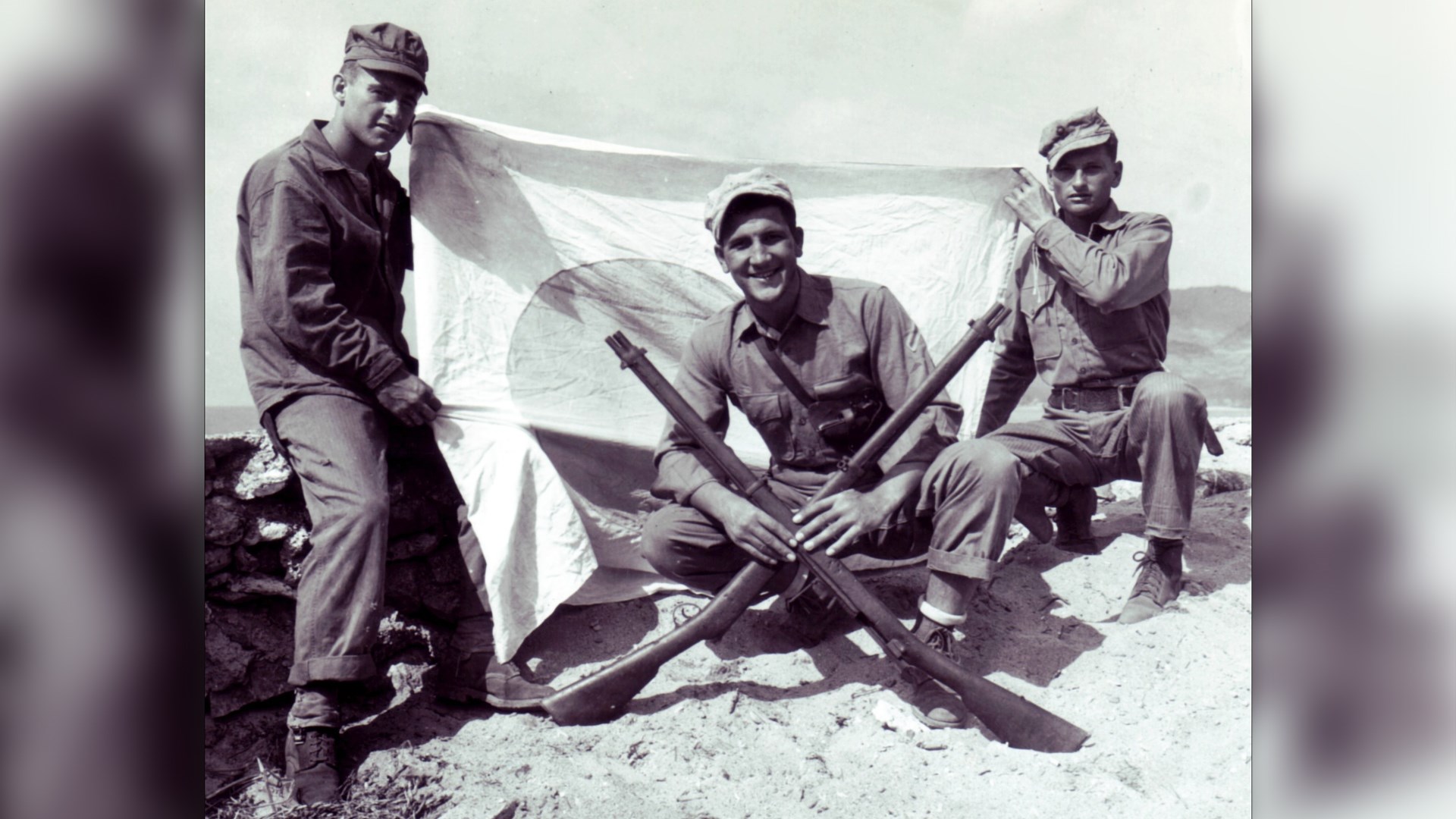
Marines pose with Japanese Type 22 Murata rifles (11 mm) captured on Okinawa. These obsolete rifles were issued to the Japanese Volunteer Fighting Corps. The Type 22 entered service in 1889 and was the first Japanese military rifle to use smokeless powder. Photo courtesy of National Archives and Records Administration (NARA).
As American forces progressed in the island-hopping campaign, reaching islands closer to Japan proper, they encountered more Japanese civilians in the combat zone. These encounters provided a clearer picture of what Allied forces could expect when they invaded the Japanese home islands. American intelligence began to understand the scope of the Japanese militia, and the militarists plans for "The Glorious Death of One Hundred Million."
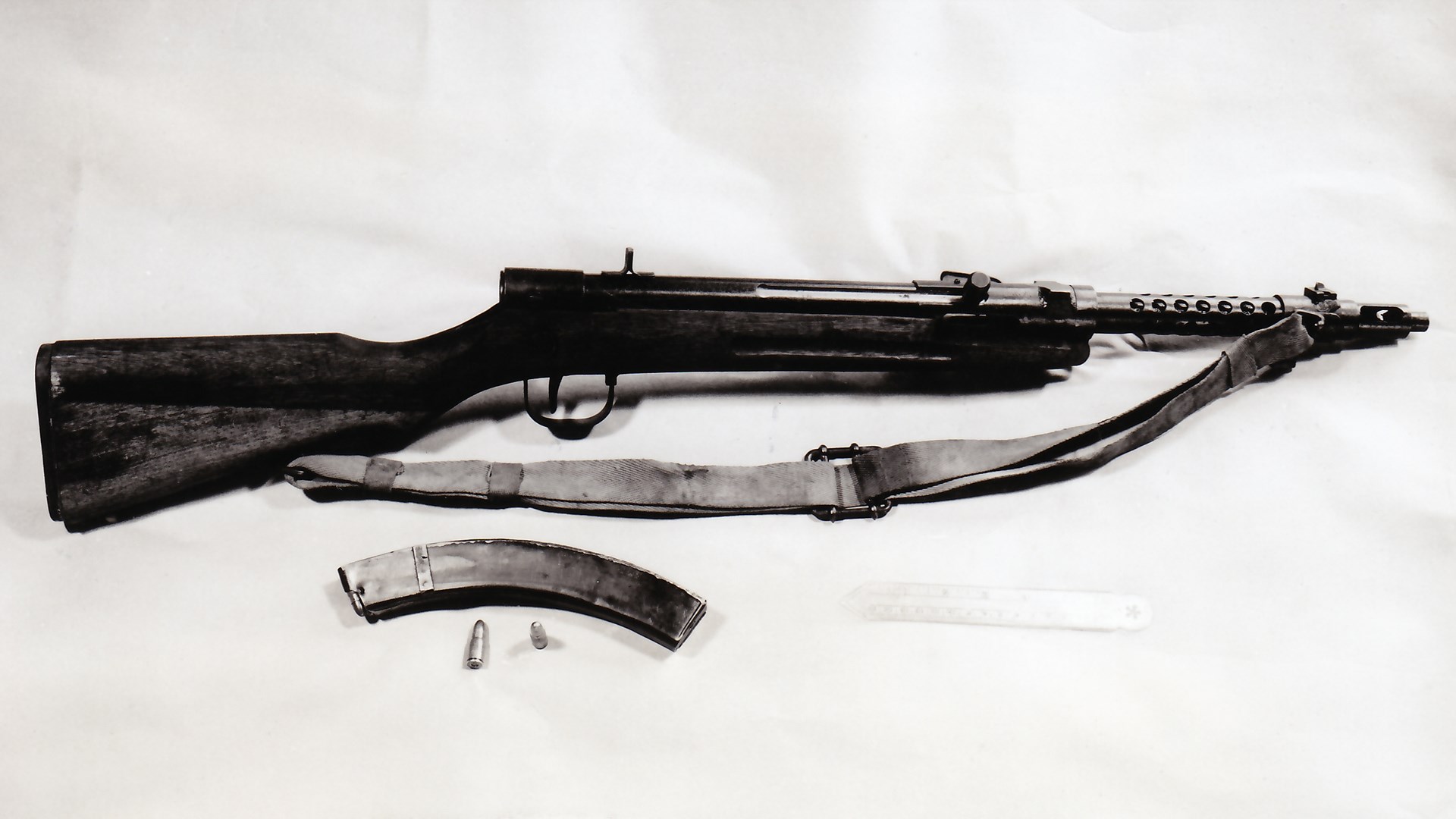
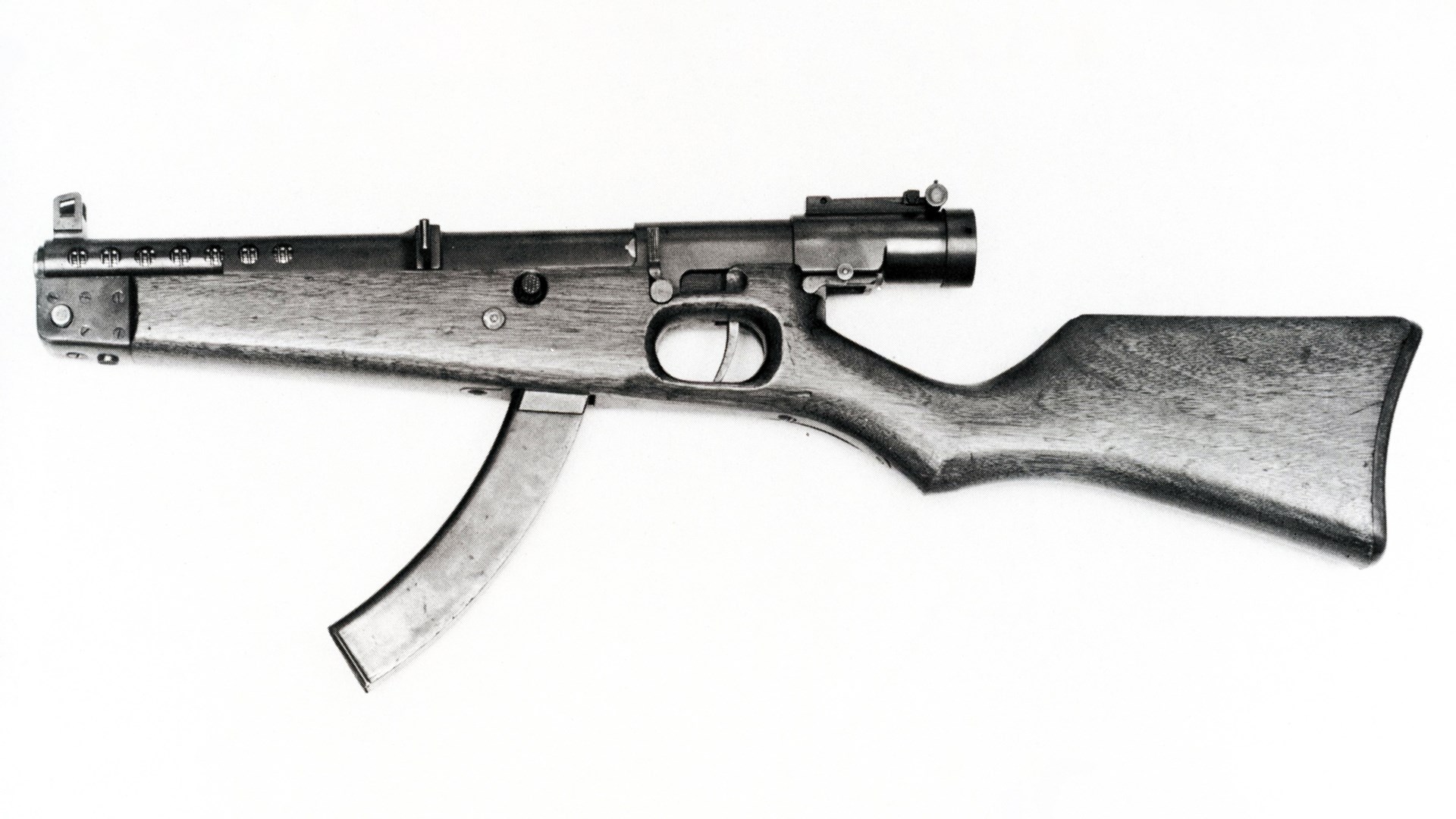
The Japanese Type 2 submachine gun (8x22 mm Nambu) is blowback-operated and fires from an open bolt. Photo courtesy of National Archives and Records Administration (NARA).
In a March 28, 1945, Military Research bulletin, American intel resources reported on the “employment of Japanese civilians in local defense:”
“It has long been the policy of the Japanese Army, even in peacetime, to keep close check upon all Japanese males of military age, not only as to whereabouts and amount of military training received but also as to education and occupational skills. This policy has been facilitated by assigning every fit male to a reserve component of the Army at the time of his conscription examination. In peacetime, those picked for conscript training, released after two years of active service, became members of the First Reserve. Those picked for a short term of replacement training formed the Conscript Reserve.
Both trained groups automatically entered the First National Army on reaching the age of 37. All other males 17-40 (now 17-44) who were not declared "unfit" became members of the Second National Army, a large body of untrained militia subject to call in emergency.
Japan has declared her intention to employ this reservoir of civilian manpower in local defense of the homeland and overseas areas, While It is true that Japanese civilians have not been used too effectively in the areas already attacked (see Bulletin 10), the following factors indicate that the employment of this Japanese "people’s army" will become more important as the war nears Japan Proper:
Greater numbers of Japanese nationals will be encountered
The Army has had greater experience in handling civilians
The individual's determination to fight will increase as the threat to the homeland becomes more imminent
The available numbers, the past employment, and preparations made by the Japanese for the use of these civilian fighters, and the general methods of employment are discussed below.
It must be remembered that the Japanese Army will also continue to use natives as far as possible for military labor and as auxiliary forces, but this study is concerned only with the less variable use of Japanese nationals residing in operational areas.”
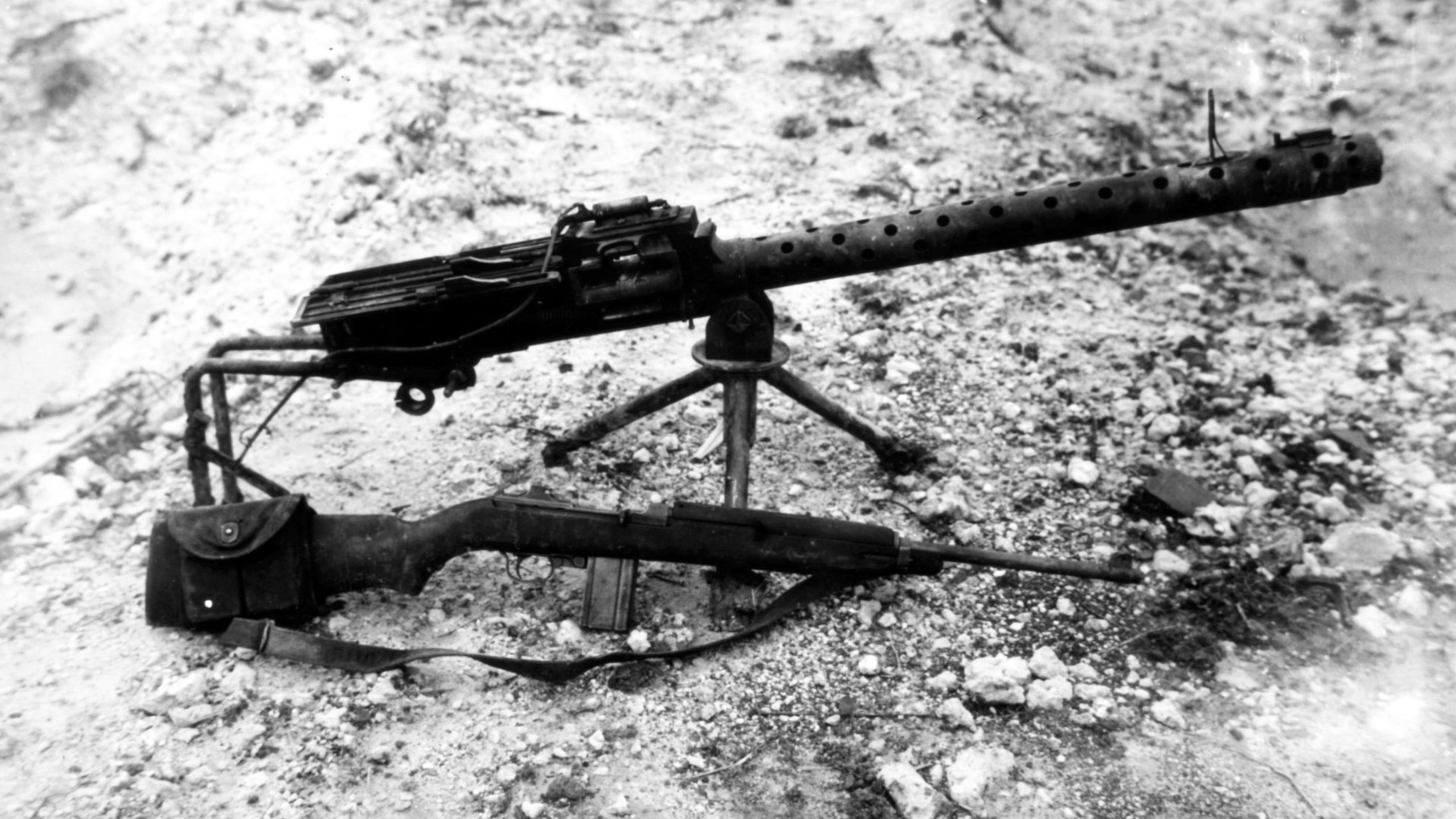
A Japanese (Navy) Type 97 aircraft machine gun adapted for ground use. This gun was a licensed copy of the British Vickers Type E machine gun and was chambered in .303 British. Note the extremely crude front sight, tripod and wire spade grips. The cyclic rate was up to 900 rounds per minute. Photo courtesy of National Archives and Records Administration (NARA).
The report concluded that 17,450,000 men aged 15-59 were available as militia troops in the Japanese home islands.
“The proportion of the above numbers actually available as effective fighting men will be limited by several factors, including local administrative problems and the ability of the Japanese to arm and equip the personnel present in areas under attack.”
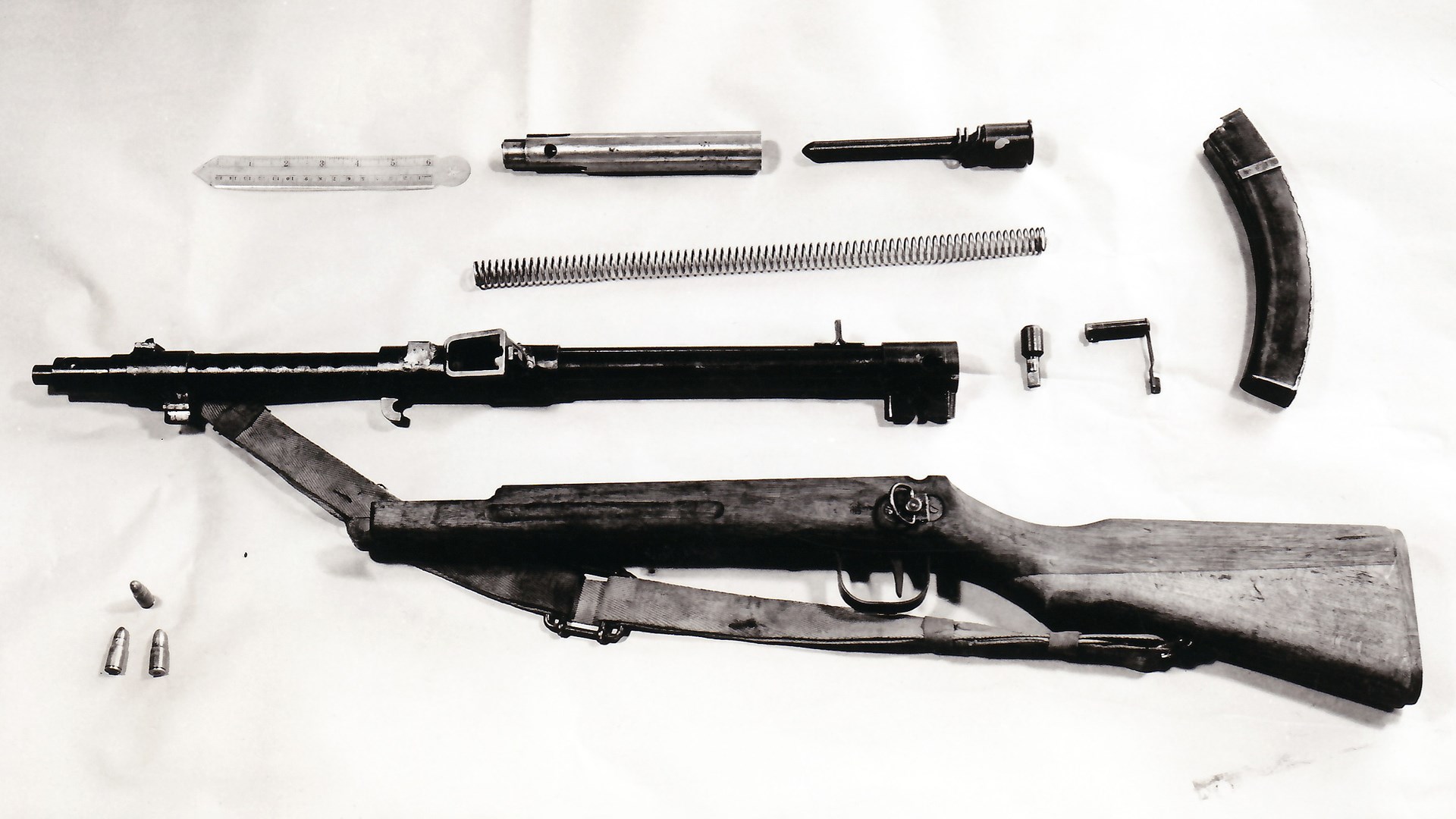
The Japanese Type 100/44 submachine gun (8x22 mm Nambu). Japan showed little interest in submachine guns during the 1930s, and few of the original Type 100 were available in the early war years.
Relaxed Japanese Manufacturing Standards U.S. troops in the field captured various new and modified Japanese wfirearms. Of particular interest were the modifications to the Japanese Model 99 (1939) Pattern 7.7 mm Rifle. These were detailed in an Ordnance intelligence report, produced in late 1944:
“A Japanese 7.7mm rifle of the Model 99 (1939) pattern, recovered in the Ormoc area, is of extreme interest as it Indicates a possible relaxation in the standard of manufacture. The points of variance between this and other rifles of the same model previously recovered are as follows:
The wire monopod has been omitted.
The anti-aircraft lead arms on the back sight have been removed. Also, instead of the sight being machined in one piece, the sight base is now welded to the mount.
The bolt knob is smaller and cylindrical in shape, instead of the usual oval ball.
The safety knob is no longer knurled on its rear face, but is left square, just as it was when it was cut off the lathe.
The wooden stock is much inferior in quality to that usually fitted.
According to a recently captured document, Japanese ordnance chiefs have expressed grave concern at the lack of essential ordnance supplies. With a view to remedying this condition, it was decided that the manufacture of certain items was to cease, while others were to be modified so that an intensified effort could be made to speed up production.”
The Type 100/44 represented a simpler, easier to build variant of Japan’s primary homegrown submachine gun. Weight was 9 lbs., 11 ozs. (loaded). Ammunition feed was via a 30-round box magazine, with an 800-round-per-minute cyclic rate. About 9,000 of the Type 100/44 SMGs were made. Photo courtesy of National Archives and Records Administration (NARA).
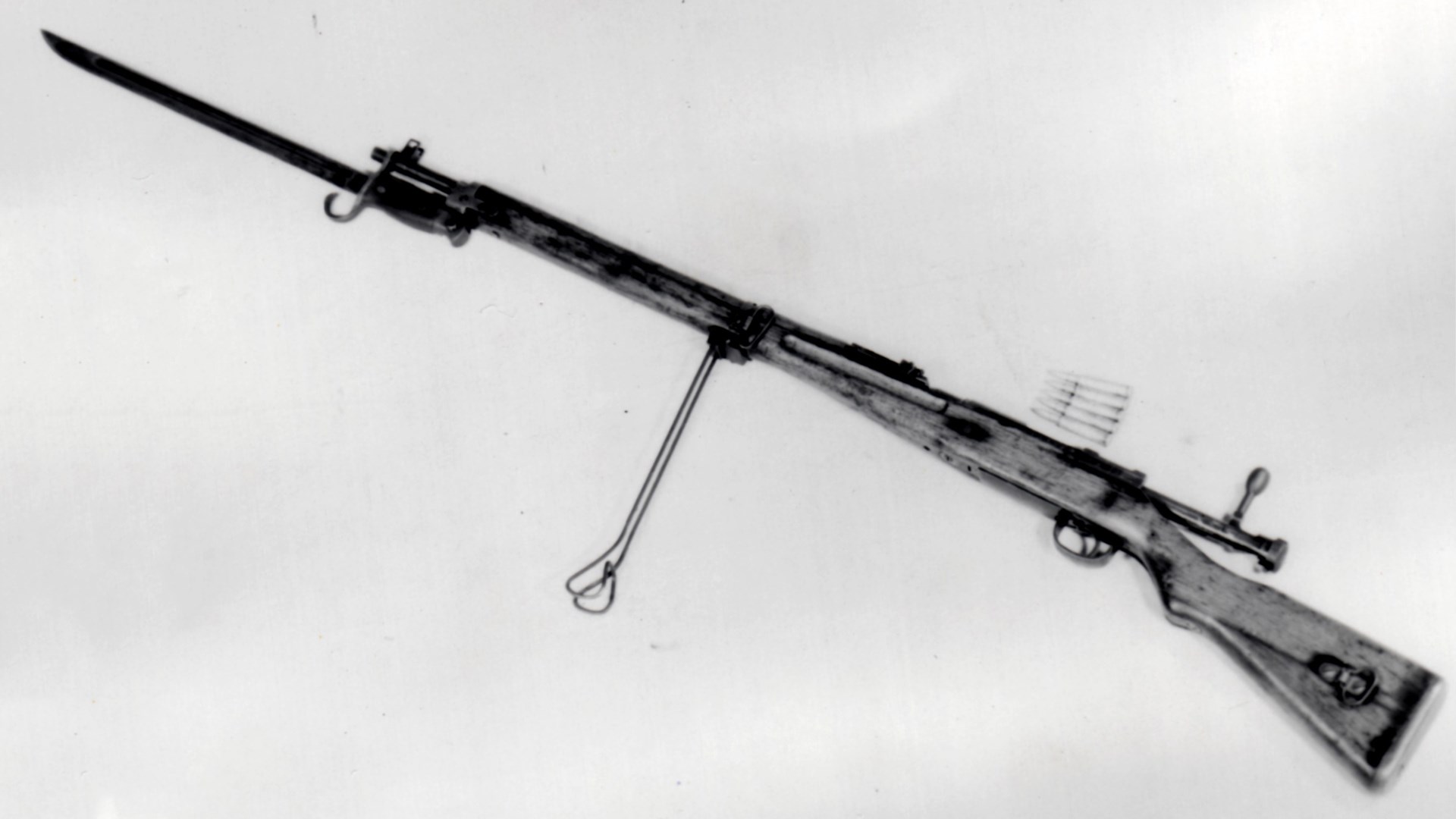
The Type 99 7.7 mm Substitute Rifle In 1943, the Japanese decided to simplify the standard Type 99 rifle and make a “substitute standard” small arm. These modifications included eliminating the sling, cleaning bar and bolt cover, while substituting inferior steel for parts like the bolt and barrel. The simplification eliminated the chromium plate in the barrel, used an inferior grade of wood for the stock, and revised the sight to a range of only 300 meters. This was called a Substitute Type 99 Rifle.
The Japanese Type 99 rifle (7.7x58 mm Arisaka). In the late-war period, Type 99 rifles were often found with particularly crude, short-cut finishing. Photo courtesy of National Archives and Records Administration (NARA).
Japanese rifle collectors have uncovered a tremendous amount of information about the nuances of late-war Japanese arms production. Type 99 rifle collectors have described wide variations in the “Substitute Rifle,” including no serial or series number, unnumbered parts, mismatched parts, front sights missing guards, rear sights missing wings, alternate shapes to the bolt handle and varying types of butt plates.
The Type 2 submachine gun weighed about 9¾ lbs., loaded, and used 30- or (rarely) 50-round magazines. The cyclic rate was 600 rounds per minute. Fewer than 200 are thought to have been made. Photo courtesy of National Archives and Records Administration (NARA).
During April 1945, Japan made a significant change in its civil defense forces, designating them as civilian militia, and by June, conscription laws had been enacted even while the militia was renamed the Volunteer Fighting Corps (Kokumin Giyū Sentōtai). By the end of June, more than 25 million Japanese men were deemed “combat capable” by their hopeful government, but very few of them could be equipped with firearms of any kind. The Volunteer Fighting Corps did not see action during the war, but an early precursor, the local home guard on Okinawa, was equipped with obsolete rifles, most notably the Type 22 Murata rifles (11 mm). In the home islands, all that was available in the short term were spears, swords, axes, clubs and crossbows. Hand grenades were the most plentiful of modern weapons.
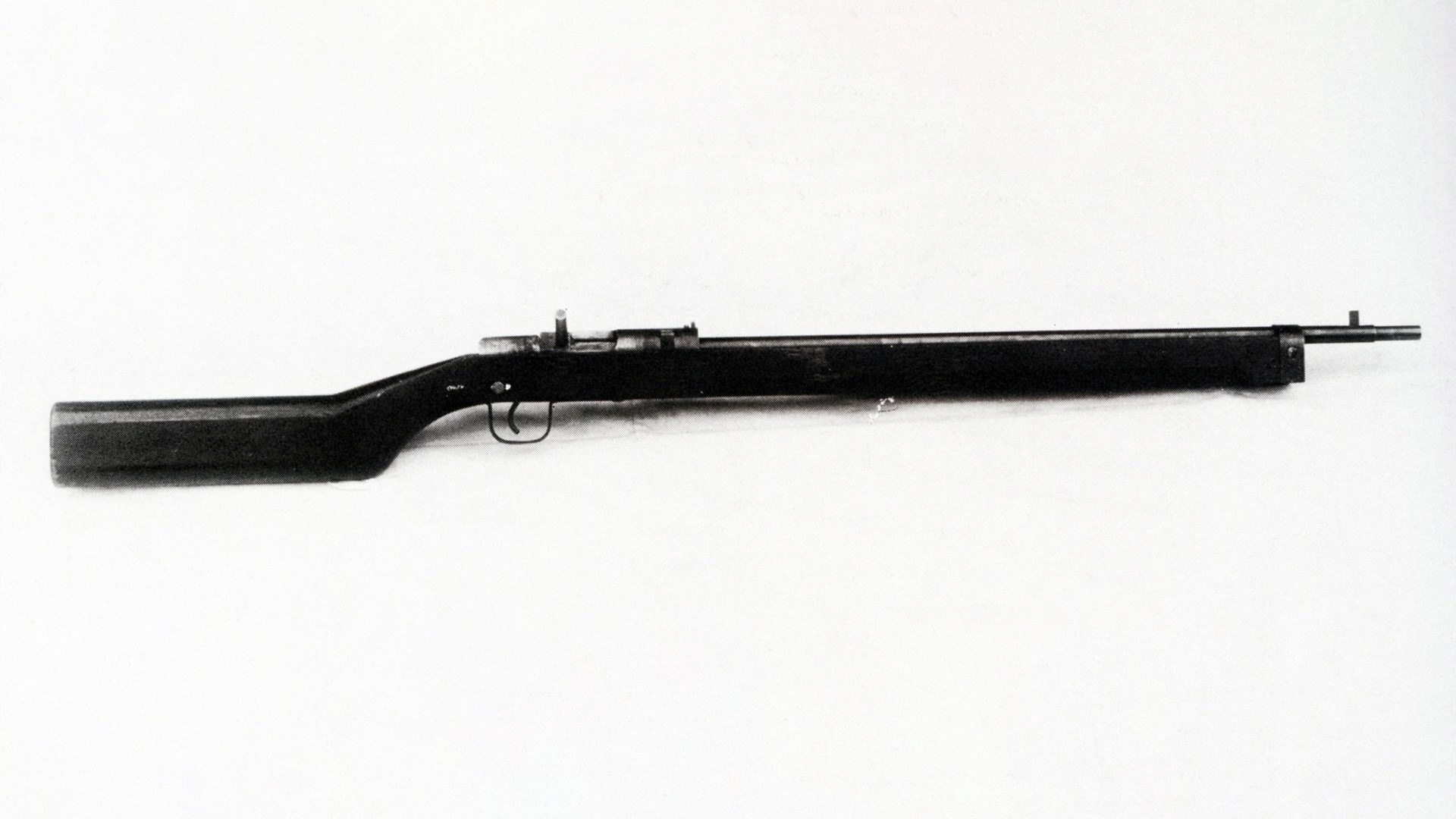
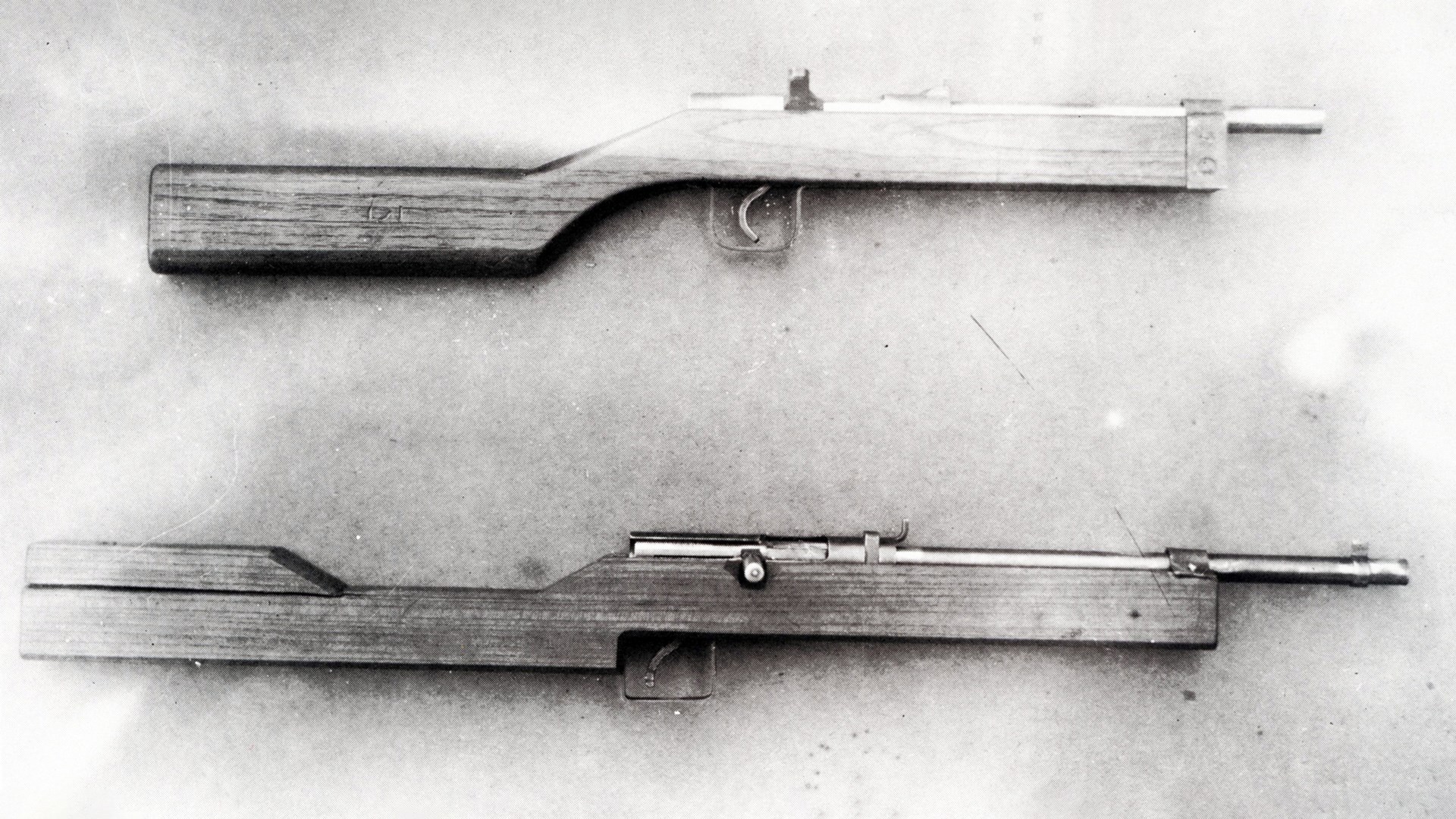
The Japanese "Simple Rifle:" Crude Weapons For The Massed Militia Preparing for the invasion they knew would come, the Japanese embarked on a quick program of simple weapons development to equip their mostly untrained militia. The resulting firearms are some of the rarest guns of the entire war. The following descriptions (and photos) come from a series of U.S. Ordnance Technical Intelligence reports compiled during the first few months of 1946.
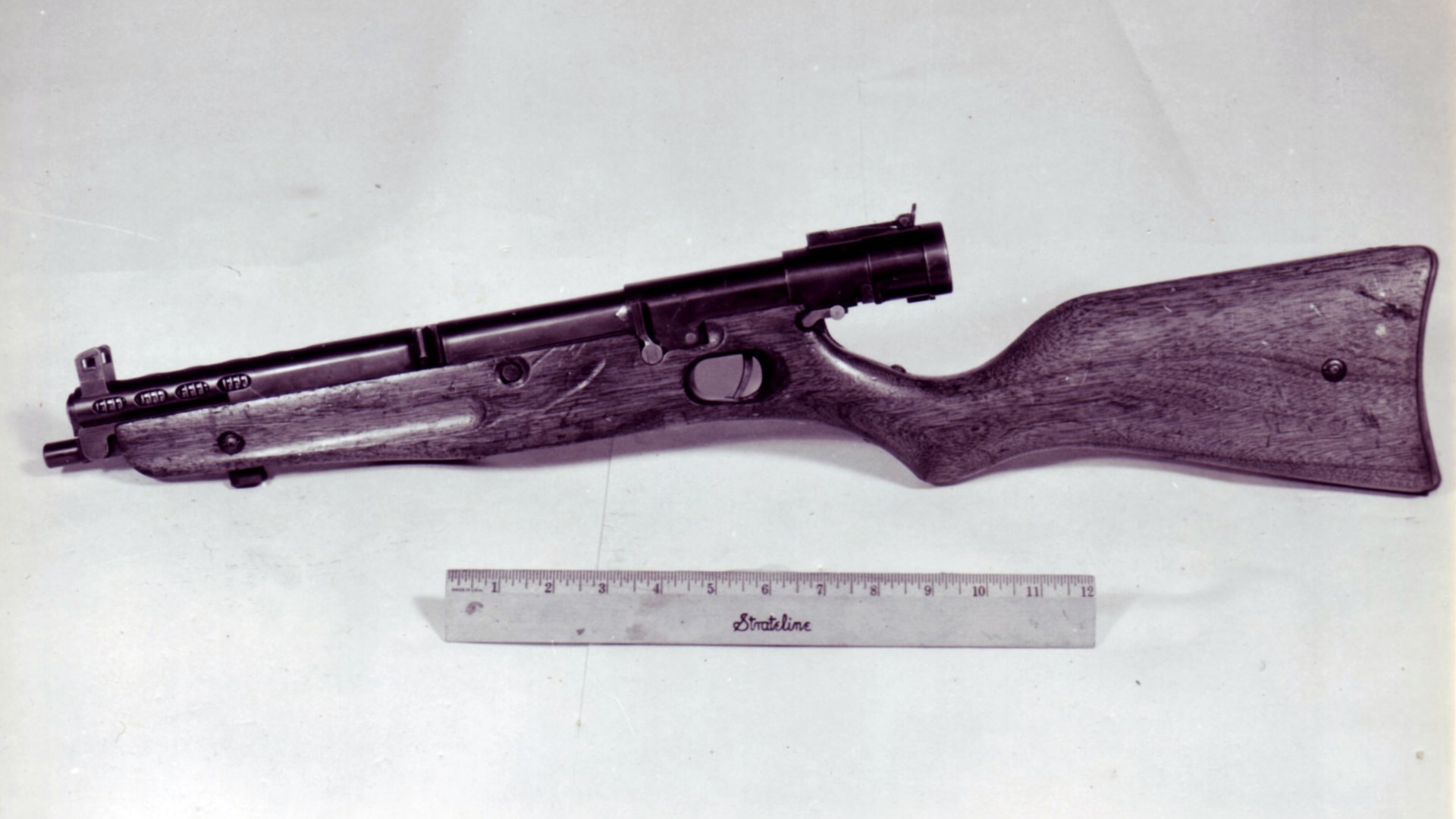
Simple 7.7 mm & 8 mm Rifles A very simple rifle that would fire the standard 7.7 mm ammunition was attempted. The length of the barrel was 50 cm, and it was so simple in construction that it, as well as the other parts, could be made on an ordinary lathe. It was a bolt-action, single-shot piece that was intended to equip front-line defense troops in an invasion. However, as the ammunition proved too powerful, it was decided to make the rifle shorter and to use standard 8 mm 14th Year Type pistol ammunition, which proved much more satisfactory.
The original Japanese Simple Rifle: chambered for use with standard 7.7 mm rifle ammunition, the cartridge proved far too powerful for the weapon. The barrel was about 50 cm long. Photo courtesy of National Archives and Records Administration (NARA).The second generation of Japanese Simple Rifles were even more crude—however, as they were chambered for the standard 8 mm pistol ammunition, these single-shot firearms were acceptable for use with the civilian militia. Photo courtesy of National Archives and Records Administration (NARA).
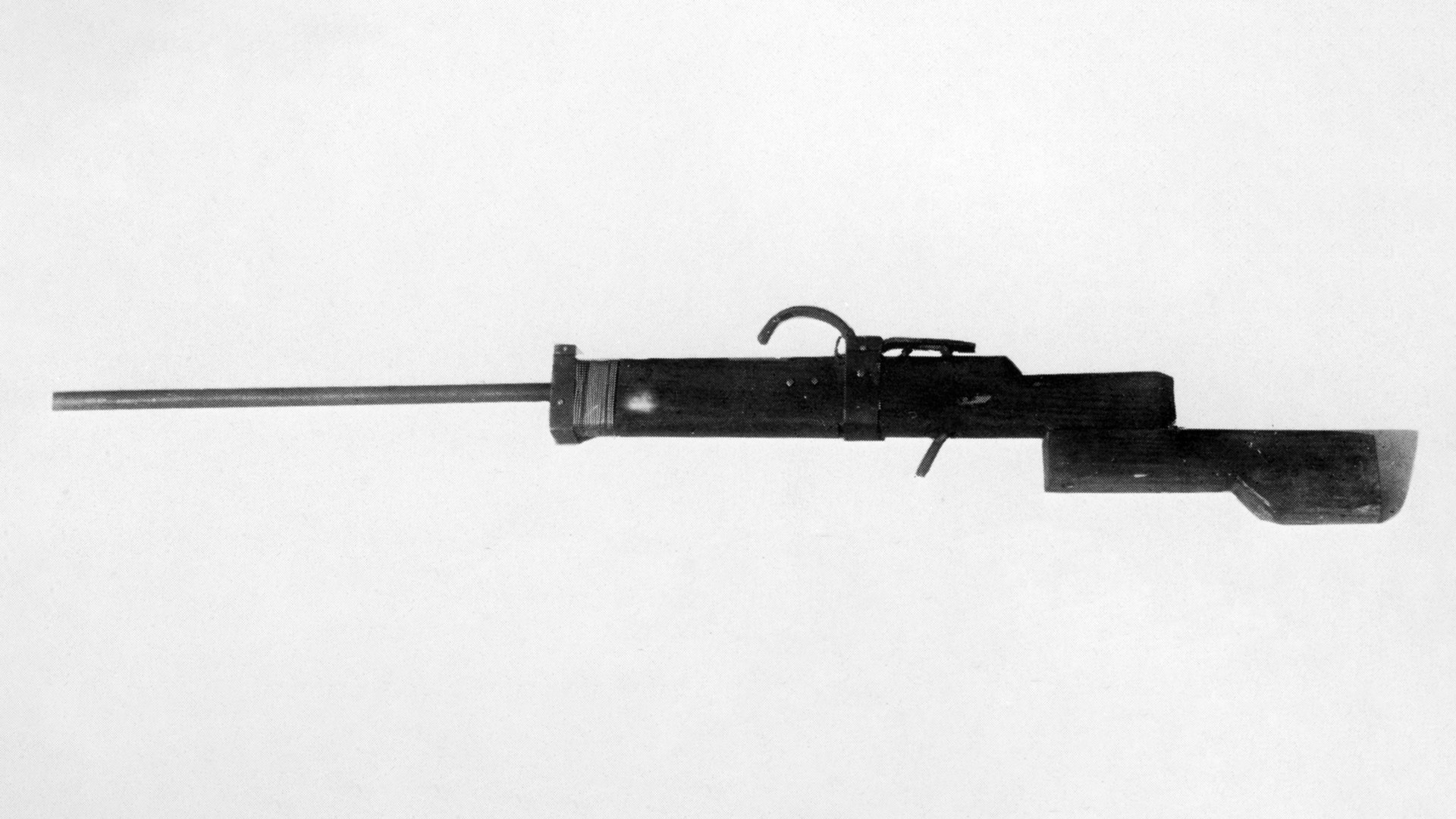
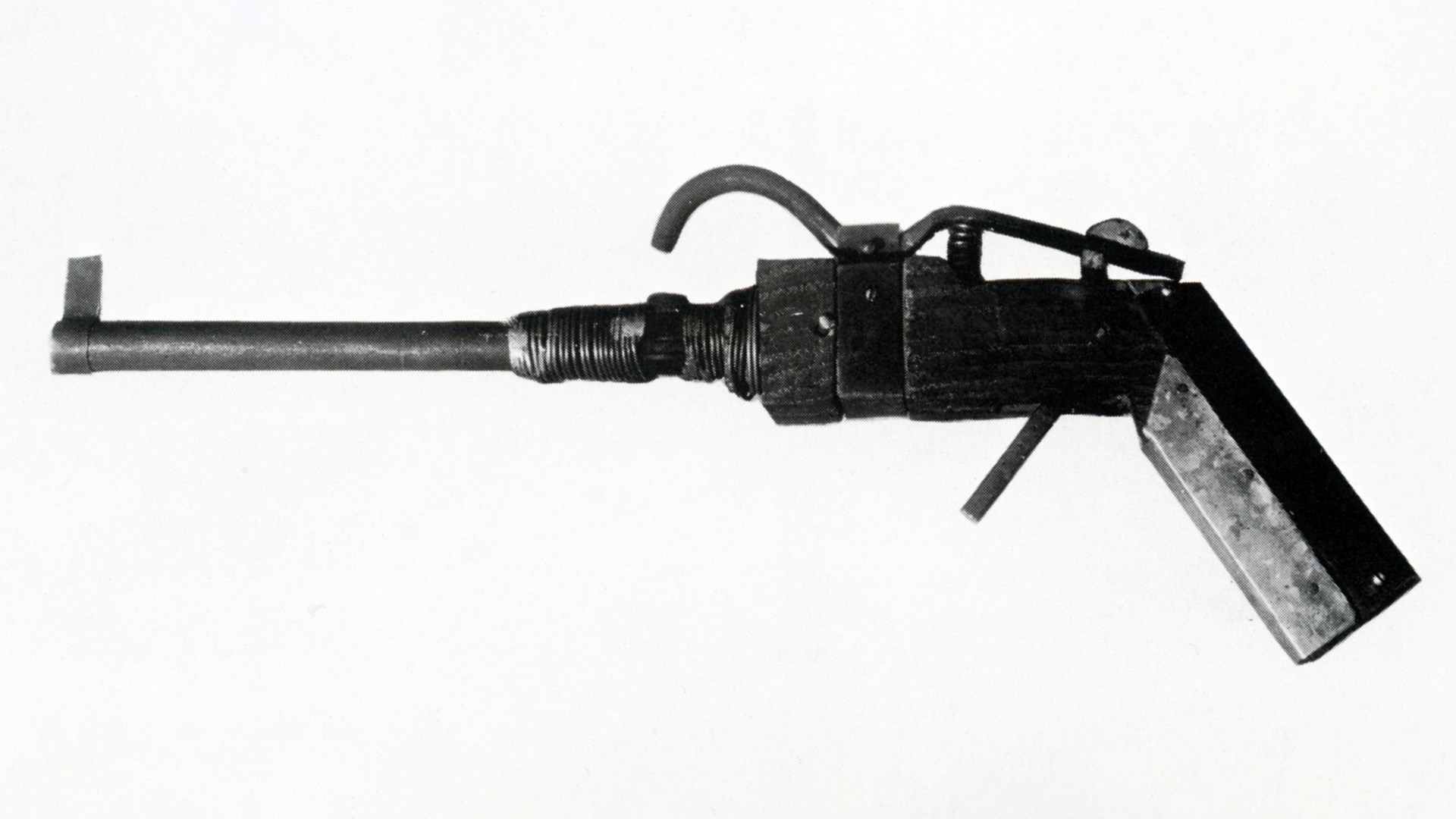
National Rifle & Pistol For Civilian Defense This rifle was developed for the purpose of equipping volunteer defense troops and was a type that could be made by any small factory or smithy shop. The construction was simple as an ordinary piece of pipe (13 mm diameter) formed the barrel. It was loaded with 3 to 5 grams of blackpowder, and the projectile was made from ordinary bar stock cut in sections about 15 mm in length. It was fired by the hammer striking a primer-igniter cap that was placed over a small flash hole on top of the barrel. A pistol version of this firearm was also produced.
The Japanese National Rifle for Civilian Defense—a simple blackpowder weapon with a smoothbore barrel made from pipe. Photo courtesy of National Archives and Records Administration (NARA).The Japanese National Pistol for Civilian Defense—a crude blackpowder weapon that fired a 13 mm ball. Photo courtesy of National Archives and Records Administration (NARA).
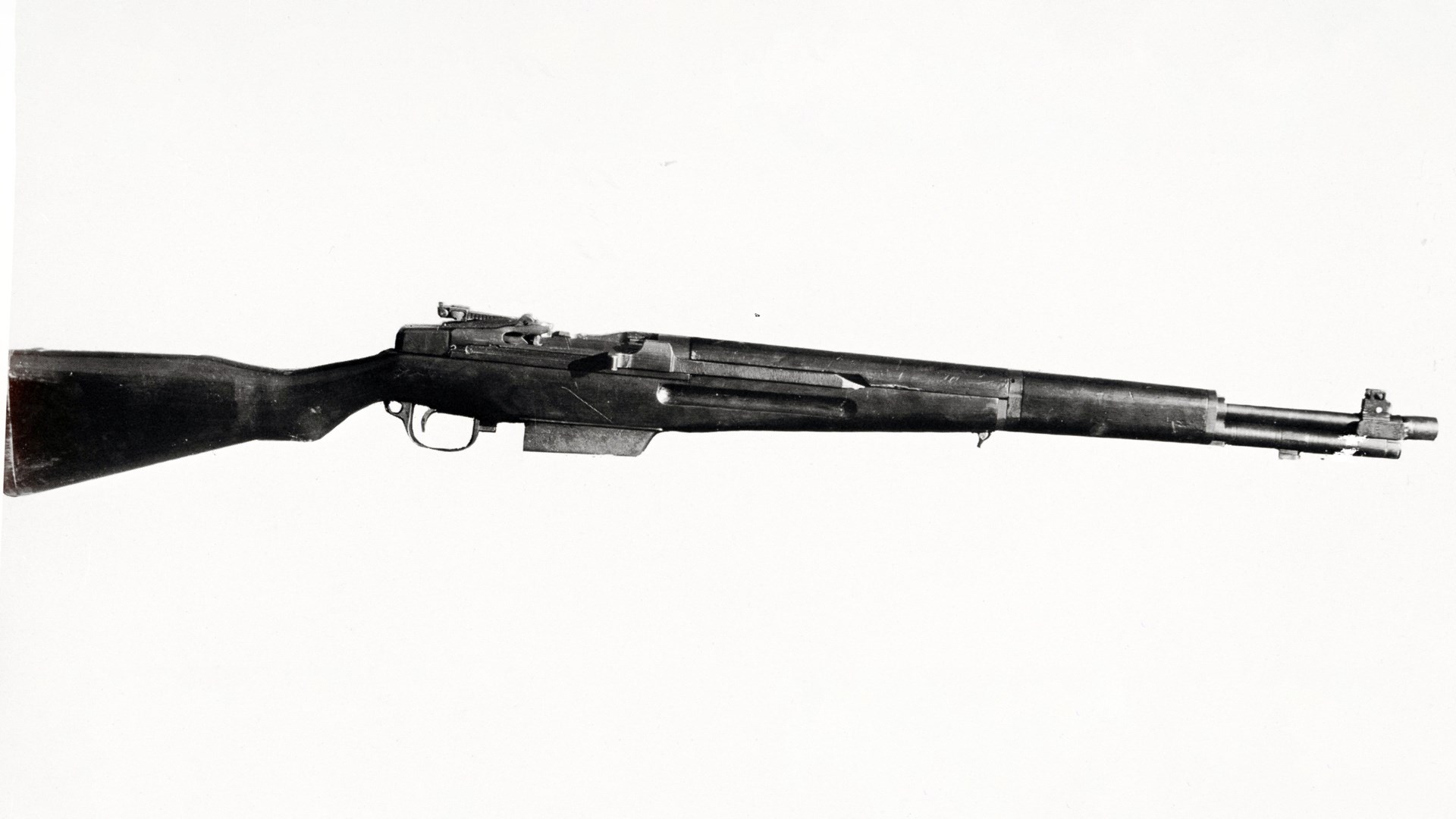
Type 5 Semi-Automatic Rifle (Garand copy) The need for a semi-automatic rifle for the Japanese army was recognized in 1922, but the development of such a firearm was not begun until 1931 when several models were made; all proved unsatisfactory. This study lasted until 1937, at which time research was temporarily discontinued.
In March 1941, the inquiry was again started because of the progress on semi-automatic rifles in foreign countries. At this time, the 1st Section and the Kokura Army Arsenal designed several types of recoil and gas-operated rifles. The results of tests showed that none of the models were entirely satisfactory in operation, and because of the unforeseen difficulty in manufacturing such a rifle, research was again stopped.
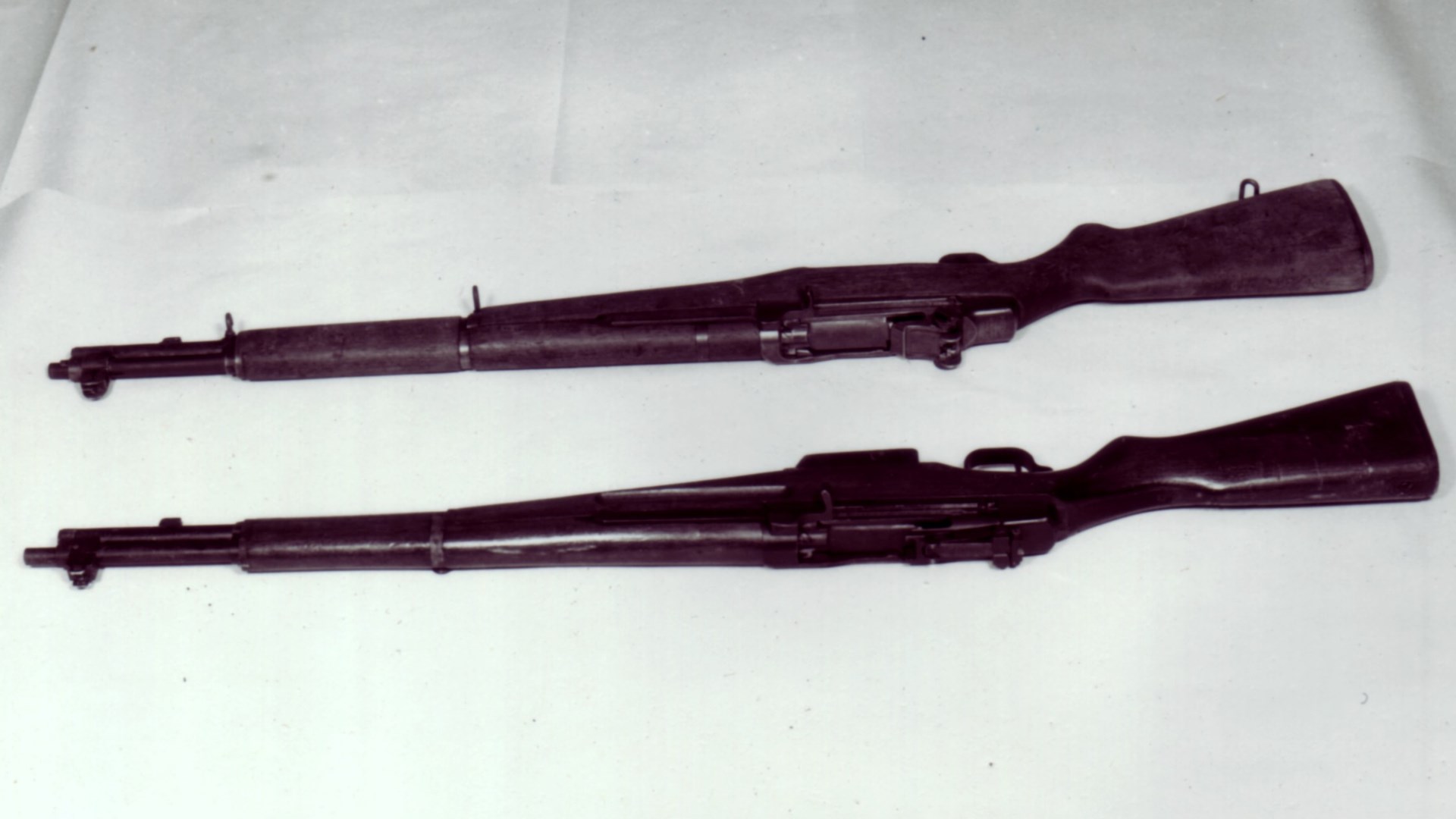
About March 1944, there was a strong demand to develop a semi-automatic rifle, especially from the paratroop command. At that time, the Navy introduced a semi-automatic rifle copied from the U.S. M1 (Garand) Rifle that used the standard Japanese 7.7 mm ammunition. In April 1945, models were finished and tested. Although the test results were not entirely satisfactory due to breakage of parts, loading and feeding difficulties, they were considered good enough to adopt the gun. The rifle was standardized as the Type 5.
The Type 5 semi-automatic rifle. Weight was a little over 9 lbs., and length was 42.2".The Type 5 (sometimes called the Type 4) semi-automatic rifle (7.7x58 mm Arisaka). It is estimated that about 125 of these “Japanese Garands” were completed at the Yokosuka Naval Arsenal in late 1944/early 1945. Few surviving examples exist today. Photo courtesy of National Archives and Records Administration (NARA).
World War II finally ended after the atomic bomb attacks on Hiroshima (August 6) and Nagasaki (August 9). While the casualties from the two nuclear blasts were horrific, they pale in comparison to projected number of deaths if dozens of Allied infantry divisions assaulted Japan and Japanese militarist plans to sacrifice the entirety of their population to stop them came to fruition. Armed with bamboo spears and an odd assortment of crude firearms, the Japanese Volunteer Fighting Corps would have inflicted their share of casualties on the invaders, but the utter and tragic destruction of Japan and its people would certainly have followed.
My honest opinion, especially back then, the British commanders were either brilliant or incompetent, there were no in-betweens with them, partially because of their "class system", they pulled their officers from what is called their Gentry or upper-class, and no matter how incompetent, they made sure that unless there was actual cowardice they would cover it up. Cowardice they would not tolerate. I to this day still am flummoxed by the surrender, and to this day the Australians and New Zealanders still are a bit pissy because it was a huge chunk of their menfolks that got marched into captivity by the Japanese and many didn't return.
Lieutenant-General Arthur Percival’s surrender of Singapore to the Japanese in 1942 was the largest surrender of British forces in history and he was therefore bound to come in for a great deal of criticism, not helped by the fact that he was personally not very prepossessing and certainly not the ideal of a General Officer in public opinion.
General Percival
Percival joined the British Army as a private in 1914 and rose to the rank of (temporary) Lieutenant Colonel by the end of the war. In the process he garnered a DSO (with a later second award), a Military Cross and a Croix de Guerre. These are significant medals and so he was obviously no slouch in military matters, especially as he was not a regular soldier. After the war, having taken a regular commission, he attended Staff College and was earmarked for accelerated promotion.
Percival knew Malaya previously, having been posted there as the Chief of Staff to the General Officer Commanding Malaya in the late 1930s. Whilst in this role, Percival correctly assessed the possibility that the Japanese might make an attack on Malaya (and thus Singapore) via Thailand or, contrary to the orthodox view, by landings on the eastern seaboard of the peninsula during the northeast monsoon from October to March.
Funds to rectify the situation were not forthcoming and inter-service rivalry led to the poor placement of RAF airfields in Northern Malaya. This in turn meant that troops had to be dispersed in penny-packets in order to defend them.
In April 1941, Percival was appointed GOC Malaya which meant that he had some seven months to prepare his command before the Japanese attack. He later wrote:
In going to Malaya I realised that there was the double danger either of being left in an inactive command for some years if war did not break out in the East or, if it did, of finding myself involved in a pretty sticky business with the inadequate forces which are usually to be found in the distant parts of our Empire in the early stages of a war.
In this assessment, he was correct. Percival had on hand some 70,000 men (plus 15,000 support troops) with his main force consisting of forty-nine infantry battalions of decidedly mixed quality. The Australian Official Historian later wrote:
Only one of the Indian battalions was up to numerical strength, three had recently arrived in a semi-trained condition, nine had been hastily reorganised with a large intake of raw recruits, and four were being re-formed but were far from being fit for action. Six of the United Kingdom battalions (in the 54th and 55th Brigades of the British 18th Infantry Division) had only just landed in Malaya, and the other seven battalions were under-manned. Of the Australian battalions, three had drawn heavily upon undertrained recruits, new to the theatre. The Malay battalions had not been in action, and the Straits Settlements Volunteers were only sketchily trained.
Partly trained or newly arrived troops contributed to Percival’s problems
He possessed no armour (the Japanese had around 200 tanks) and what tanks and other material were dispatched to Malaya were diverted to Russia or Egypt. Essentially, Malaya was given a low priority and the campaign was over so quickly, a little over two months, that little could be done to redress the situation.
The RAF presence was small and under-equipped with obsolete fighters and the Royal Navy’s Force Z also suffered a catastrophic defeat with the loss of the Prince of Wales and the Repulse.
Obsolete Brewster Buffalo fighters
The premise of the Singapore Strategy was that a strong fleet would be despatched to the Far East, based on Singapore, to deter the Japanese. In the event, Force Z consisted of only two capital ships and lacked any air cover - it’s assigned aircraft carrier having run aground in the Caribbean.
This distinctly second rate response was due to the unexpected fall of France in 1940. The Chiefs of Staff reported:
The security of our imperial interests in the Far East lies ultimately in our ability to control sea communications in the south-western Pacific, for which purpose adequate fleet must be based at Singapore. Since our previous assurances in this respect, however, the whole strategic situation has been radically altered by the French defeat. The result of this has been to alter the whole of the balance of naval strength in home waters. Formerly we were prepared to abandon the Eastern Mediterranean and dispatch a fleet to the Far East, relying on the French fleet in the Western Mediterranean to contain the Italian fleet. Now if we move the Mediterranean fleet to the Far East there is nothing to contain the Italian fleet, which will be free to operate in the Atlantic or reinforce the German fleet in home waters, using bases in north-west France. We must therefore retain in European waters sufficient naval forces to watch both the German and Italian fleets, and we cannot do this and send a fleet to the Far East.
HMS Repulse hit by a Japanese bomb - the failure of the Singapore Strategy
Thus the odds were stacked against Percival even though, on paper, he had a superior force and held the defensive advantage.
However, as was common to all the Allied powers at the start of the war, the British severely misjudged the fighting capabilities of the Japanese. In addition, Percival did not grip his subordinates. His relations with Heath (III Indian Corps) and Bennett (Westforce) were not good, nor was the relationship between these two subordinates. Percival also clashed with his immediate superior, Wavell.
Percival appears to have lacked the required ruthlessness to prevail during a crisis. Although he was neither incompetent nor a coward, he was not suited to this role and the hand he was dealt was poor. Even so, his forces performed very poorly against the Japanese and he must take some responsibility for that. It is interesting to speculate of what Montgomery or Auchinleck or Slim would have made of the task.


 Monument to the Gurkha Soldier outside the Ministry of Defense Building in London;