Webster

The Constitution was made to guard the people against the dangers of good intentions." --American Statesman Daniel Webster (1782-1852)


Showing posts with label airplane stuff. Show all posts

Friday, January 16, 2026

Boeing Warned of MD-11 Parts Failure Risk in 2011, NTSB Finds


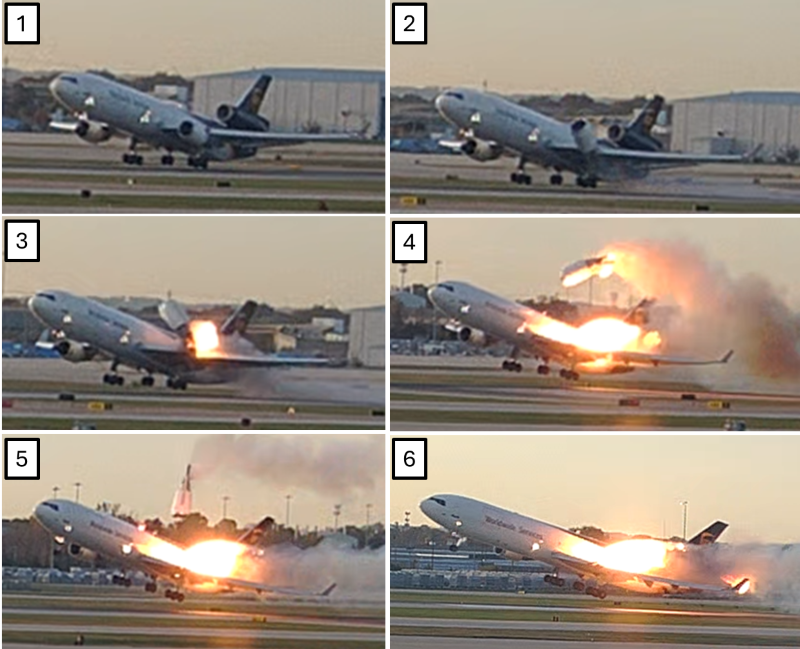
Still images from airport security footage shows UPS Flight 2976's left engine separating and moving over the aircraft as the MD-11 rotates 

screenshots of the incident

The part that failed and triggered the engine separation at the heart of last November’s fatal crash of a UPS MD-11 was flagged for inspections by Boeing in 2011, but the manufacturer concluded that a worst-case failure scenario would not “result in a safety of flight condition,” the NTSB said Jan. 14.

In a mid-investigation update, the board revealed that a February 2011 Boeing service letter targeted the part, a bearing race that is part of the MD-11 engine-to-pylon mounting assembly, for repetitive inspections. The service letter detailed four failures of the part, which is part of a spherical bearing assembly, on three different airplanes.

In each case, the collar-like bearing race suffered fatigue cracking and split along its circumference. “Specifically, each failure had initiated at the design recess groove on the interior surface of the bearing race,” the NTSB update said.

“According to the service letter, a review of the spherical bearing failure by Boeing determined it would not result in a safety-of-flight condition,” the NTSB said.

But investigators found the same failure pattern on the McDonnell-Douglas-designed UPS MD-11’s No. 1 (left) engine bearing race, the report revealed.

Boeing’s letter instructed operators to inspect the bearing as part of routine, repetitive pylon mount inspections, normally every 60 months. It also updated the MD-11 maintenance manual to reflect the new inspections. Boeing also recommended installing a different bearing that does not include a groove. But it does not caution against using an airworthy grooved bearing to replace an unserviceable one of the same design.

“Investigators are reviewing” what if any steps UPS took as well as “the correspondence history” between Boeing and the FAA leading up to the 2011 letter.

Boeing purchased McDonnell-Douglas in 1997 and assumed responsibility for the continued operational safety of the former manufacturer’s in-service fleet.

It is not clear if UPS integrated the checks into its maintenance program, NTSB said.

On Nov. 4, 2025, the UPS MD-11, operating as Flight 2976, had its No. 1 engine separate from the aircraft during its takeoff roll while departing on Louisville International Airport’s runway 17 Right. The severed engine passed over the MD-11’s left wing before the aircraft rotated.

Once airborne, the MD-11 could not climb beyond about 100 ft. above ground level. It crashed about 0.5 nm from the runway end, into an industrial area. All three crewmembers and 11 people on the ground were killed.

Boeing immediately urged operators to ground their MD-11s—a move the FAA mandated.

Friday, May 5, 2023

Preliminary Report from the Waterbomber crash in Australia

 This was supposed to "drop" yesterday, but somehow I got the scheduler thingie off by a day.


   I clipped this off my 3rd party news I get in my email.

Boeing 737 firefighting tanker

Credit: Gene Blevins/ZUMA Wire/Alamy

SINGAPORE—The pilots of a Coulson Aviation Boeing 737-300 firefighting tanker tried to pull the aircraft out from a retardant drop before accelerating the engines, resulting in the aircraft clipping a ridgeline and then crashing. 

Both pilots survived the Feb. 6 incident in Western Australia. 

In a preliminary report released by the Australian Transport Safety Bureau (ATSB), the aircraft—call signed Bomber 139—was carrying out its third sortie for the day to suppress bushfires at Fitzgerald River National Park. The 737 was guided by two airborne observers, known as bird-dog aircrafts, to the drop site. 

Bomber 139 commenced the first drop at 400 ft., only releasing three-quarters of the tank, with the engines running at 70% N1, which is defined as the rotational speed of the engine’s low-pressure compressor. 

Following the checklist for the second drop, the co-pilot said the drop speed would be performed at 118 kt. During the second drop, the aircraft descended through 400 ft. at about 110 kt. with engines at 30%, or at high idle.

The captain started to advance the throttle levers two seconds before the aircraft’s rate of descent peaked at about 1,800 ft./min. and started to pitch the nose up. The pitch preceded the acceleration of the engines, which the ATSB said in their report resulted “in a reversal of the rate of descent, but also a decay of the airspeed.” 

By that time, at a radio altitude of about 28 ft. with the flaps at 40 deg., an increasing aircraft nose-up pitch attitude resulted in the angle of attack exceeding 20 deg., which triggered the stick shaker. 

The aircraft struck the ridgeline at an elevation of 222 ft., with the engines at 85-89% N1. The ATSB said Bomber 139 “only attained a positive rate of climb just before impact with terrain.” The agency said the co-pilot reported that “their focus of attention was likely on the airspeed indicator and radio altimeter” at the time.

After making contact with the ridgeline, the aircraft cleared a line of foliage before colliding with the ground a second time, stopping about 577 ft. from its initial point of contact. 

Chart

Accident sequence distances and elevations. Credit: ATSB

Following the collision, the pilots issued an all-stations mayday call and exited the aircraft via the pilot’s left-side window.

The ATSB will continue investigations focusing on communication procedures between the 737 and the bird-dog. Its probe will also examine the pilot’s crew resource management as well as the standards and safety margins for the 737 retardant drop.

As part of immediate measures, Coulson Aviation issued an operations bulletin to increase its minimum drop height from 150 ft. to 200 ft. and increase the target drop airspeed from 133 k


                                                 I pulled this off "youtube"


                                                 This was off a News Report.

Tuesday, January 10, 2023

Did Ethiopian Officials Use Boeing Problems to mask their own?

 I got this from a 3rd party source, it touched on something that I remember reading about a while ago, especially with 3rd world carriers, I recall reading somewhere "ICAO" commissioned a survey after the accident of "Bhoja Air" and the anonymous survey asked the pilots and First Officers about how they got their ratings and 1/3 of the pilots and FO's stated that they were encouraged to "offer incentives" to get help get their ratings and the results stunned the people that saw the report.  They expected a certain amount of "lubrication" I suppose, but to have that high of a percentage surprised them.   Now to have the Ethiopians throw the 737 under the bus(pardon the pun) and totally ignore indemic problems with their state airline shows a certain blindness and I recall that to own an airline is a big deal to a country, it is a prestige thing and to besmirch the airline is to besmirch the country and that just ain't done to the hand that feeds you.  As Londo Mollari said from Babylon 5 commented....


An aviation accident report is supposed to answer more questions than it raises, fostering lessons learned that often apply far beyond the specific chain of events at the center of the probe.

Here, Ethiopia’s final report on the March 2019 crash of Ethiopian Airlines Flight 302 (ET302) falls short. Ethiopian investigators do a thorough job detailing Boeing’s now well-documented—and accurate—737 MAX development missteps set the stage for two fatal accidents.


They do an even better job ignoring numerous red flags that point to major issues within government-owned Ethiopian Airlines’ flight training protocols and the country’s ability to conduct adequate safety oversight.

Two fatal 737-8 crashes—ET302 and Lion Air Flight 610, in October 2018—had similar accident sequences. A poorly designed system—the 737 MAX’s maneuvering characteristics augmentation system (MCAS)—activated erroneously, confusing and overwhelming the pilots. The one major difference: the ET302 crew had the benefit of specific instructions issued after the Lion Air accident that explained MCAS, warned of the Lion Air crash’s specific failure scenario, and provided instructions on how to counteract it.

Had the pilots followed that protocol, they probably would have saved the airplane—though the report says nothing of the sort. Instead, its probable-cause statement pins the accident solely on MCAS’s uncommanded, unneeded nose-down inputs. 

The NTSB, in comments on a draft of the ET302 final report released after the probe was completed, pulls no punches in assessing the Ethiopians’ analysis. 

Yes, NTSB concluded, MCAS “should be part of the probable cause for this accident.” But there is more to the story.

“We believe that the probable cause also needs to acknowledge that appropriate crew management of the event, per the procedures that existed at the time, would have allowed the crew to recover the airplane even when faced with the uncommanded nose-down inputs,” the U.S. agency wrote.

In their final report, Ethiopian investigators contend the crew was overwhelmed by a series of alerts and warnings triggered by the same problem—a faulty angle-of-attack sensor—that activated MCAS roughly 1 min., 30 sec. after takeoff. They also claim instructions from Boeing on how to counteract MCAS were confusing.

That may be true.

But it doesn’t explain why the pilots failed to execute routine checklists—or even acknowledge flight deck prompts—in response to several warnings triggered after takeoff but before the first MCAS activation. 

The final report is largely silent here, too. Instead, it claims two alerts on the pilots’ primary flight displays did not activate, despite overwhelming evidence to the contrary.

According to the French BEA investigation agency, damning parts of the cockpit voice recorder transcript were edited to help mask the pilots’ confusion and lack of basic crew resource management (CRM). 

“During this [initial flight] phase ... the coordination and the communication between the captain and the [first officer] were very limited and insufficient,” the BEA wrote in its own comments. “There was no discussion nor diagnosis with respect to the nature of the events on board. The situational awareness, problem solving, and decision making were therefore deeply impacted.”

BEA also agrees with the NTSB’s probable-cause analysis.

“The BEA believes that the crew’s inadequate actions and the insufficient [CRM] played a role in the chain of events that led to the accident, in particular during the first phase of the flight, before the first MCAS activation,” the agency wrote in its comments on the draft report.

“It is regrettable that the report does not include a thorough analysis of the reasons for the behaviors observed, in relation with their training, their experience and the company organization with regard to the training and knowledge acquisition principles,” BEA added.

Perhaps Ethiopian aviation safety officials have addressed these issues behind the scenes, getting to the bottom of why ET302’s pilots performed so poorly. Were they simply bad at their jobs, or—more likely—were they victims of inadequate training and safety oversight? And if it’s the latter, what has Ethiopian Airlines and the Ethiopian Civil Aviation Authority done to mitigate these risks?

The ET302 report touches on none of this. From an aviation safety improvement standpoint, that is truly regrettable.


Saturday, April 21, 2018

Conflicts that demonstrated the Value of Ground Attack Aircraft.

I was a GI in the U.S Army in the 1980's, we had rolled out AirLand Battle in the late 1970's to counter the huge numbers of Soviet Tanks that were threatening to roll down the Fulda Gap.  Airland battle was designed to use American air power especially the A-10 and the Apache helicopters to strike the 2nd and 3rd echelons of Soviet forces and disrupt them and prevent them from supporting the first echelon that was attacking the NATO forces and prevent them from getting overrun by superior numbers.

For a century, ground attacks by armed aircraft have added an extra dimension of devastation to the battlefield. In some wars, ground attack aircraft have been less than effective. In Vietnam in particular, the Americans were unable to turn aerial bombardments into a strategic advantage. But some wars have shown beyond a shadow of a doubt what aerial attacks can do.
Italo-Turkish War (1911-1912)
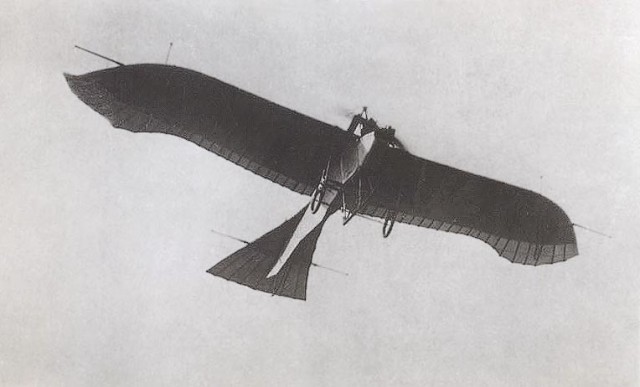
The first ever attack on ground troops by an airplane took place on 1 November 1911, during a war between Italy and the Ottoman Empire. Giulio Gavotti, an Italian lieutenant, flew an Etrich Taube monoplane above Ottoman forces in Libya, taking with him a bag of grenades. With these he attacked two targets – the oasis at Tagiura, and the Ottoman military camp at Ain Zara.
Gavotti’s flight was a challenging one – he had to screw the detonators into the grenades and drop them by hand while still piloting the plane. It was also ineffective – no-one was injured by his attacks.

Yet Gavotti had proven that aircraft could reach behind lines to attack enemy troops unawares. His innovation startled the Ottoman troops, leading to a political protest, and set an example that others would follow with far more destructive effect.

RumplerTaubeInFlight
Etrich Taube monoplane.

First World War (1914-1918)
The First World War saw the first real developments in aerial warfare, led by innovators such as Oswald Boelcke. Planes started out as reconnaissance craft, and this shaped aerial combat for most of the war, with an emphasis on fighting between pilots.
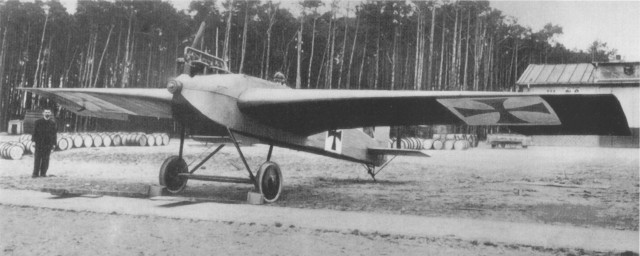
By the late stages of the war, the potential for aircraft to attack the ground was appreciated. Increasing specialization in design led to aircraft such as the German Junkers J-1. Equipped with extra armor, the J-1 was able to safely descend for low-level attacks on infantry, the pilot protected from their bullets by his plane’s armored belly. J-1s supported the great German offensives of spring 1918, offensives which almost turned the tide of war.

Junkers J 1 all metal "technology demonstrator" pioneer aircraft, at FEA 1, Döberitz, Germany in late 1915, undergoing flight preparations (Wikipedia)
Junkers J 1 all metal “technology demonstrator” pioneer aircraft, at FEA 1, Döberitz, Germany in late 1915, undergoing flight preparations.
The J-1 showed that ground attack aircraft could be as devastating to morale as to the bodies of the men they attacked. Norman Gladden described seeing the approach of a German attack plane in 1917: “Never before, despite my capacity for fear, had I felt myself so long in the grip of a terror so absolute.”
Spanish Civil War (1936-1939)

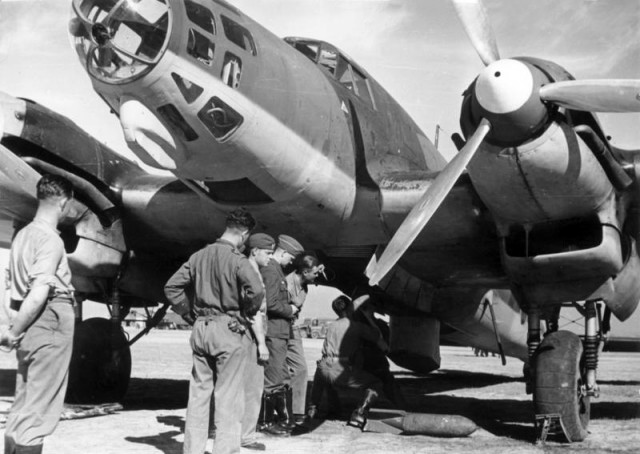
He-111E of the Condor Legion, 1939 (Bundesarchiv)
He-111E of the Condor Legion, 1939. By Bundesarchiv – CC BY-SA 3.0 de
In the lead up to the Second World War, Germany and Italy threw their backing behind right-wing Nationalists forces in the Spanish Civil War. This was partly an opportunity to fight their enemies by proxy, as America would later do in Vietnam. For the Germans, in particular, it was also an opportunity to test new equipment.
German air support, including the mixed ground and air troops of the Condor Legion, proved useful for the Nationalists in battles such as the Battle of Toledo. Technological and industrial superiority allowed them to rain down death upon improvised Republican forces. They bombarded strategic civilian targets, as in the infamous bombing of Guernica, but the war also created an appreciation of the tactical use of air attacks against troops. Ground attack aircraft were refined and combined with forward observers to create the flying artillery that would prove vital in 1939.
Second World War (1939-1945)


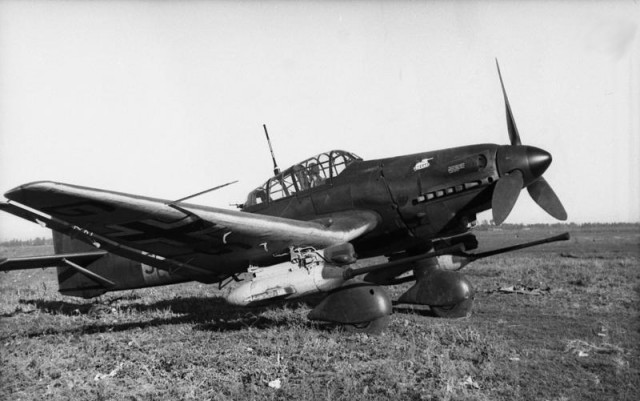
Ju 87 G-1 "Kanonenvogel" with its twin Bordkanone BK 3,7, 37 mm underwing gun pods. (Bundesarchiv)
Ju 87 G-1 “Kanonenvogel” with its twin Bordkanone BK 3,7, 37 mm underwing gun pods. By Bundesarchiv – CC BY-SA 3.0 de
Unsophisticated, ungainly and yet utterly terrifying, the Junkers 87 Stuka was the leading air element in the German Blitzkrieg. Its noise and ferocity shattered enemy morale and savaged Polish ground forces during the invasion of 1939.
Air superiority also brought the Germans their initial victories in the west. On 13 May 1940, in an unprecedented display of aerial power, nearly 1,500 German aircraft attacked fortified French forces defending the west back of the River Meuse. By the end of the day the Germans were across the river and the French heading into full retreat. Ground attack aircraft such as the Stuka and the Henschel Hs 123s supported the German forces as they raced across Frances, attacking Allied units before they could even reach the front.
It was only when they gained superiority in the air that the Allies were able to beat the Germans on the ground. Field-Marshal Rommel, one of the greatest German commanders of the war, was injured on 17 July 1944 by a strafing attack.
Six-Day War (1967)


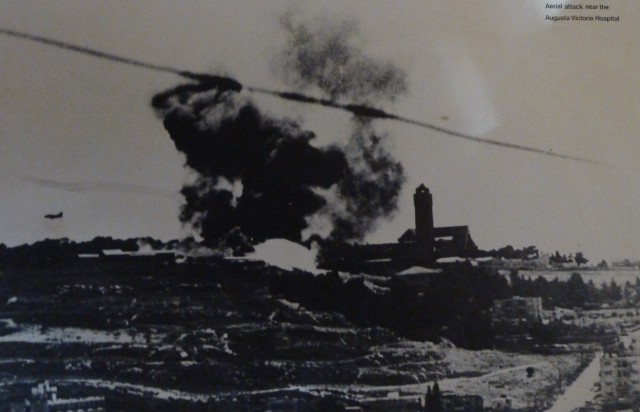
An Israeli airstrike near the Augusta-Victoria Hospital (Wikipedia)
An Israeli airstrike near the Augusta-Victoria Hospital
The Six-Day War vastly increased Israel’s territory and ensured its reputation as a military power. This incredible victory over Egypt, Jordan and Syria was in large part down to air power.
By destroying enemy planes while they were on the ground, the Israelis swiftly ensured dominance in the air. Safe from aerial attack, their air force set to supporting the ground offensive. A training plane altered to make it suitable for ground attacks, the Potez Magister proved a particularly potent weapon. The Mitla Pass was left jammed full of the burnt wrecks of Egyptian fighting vehicles.
Arab nations would learn from the Six-Day War and prepare anti-aircraft measures. But the absolute devastation left by air power would remain an icon of Israeli strength.

Gulf War (1990-1991)  This was my war, I saw the devastation of the Iraqi armor and trucks after the A-10's and B52's got done with them, in many cases  the Iraqi's were at 50% strength due to losses by coalition air forces.


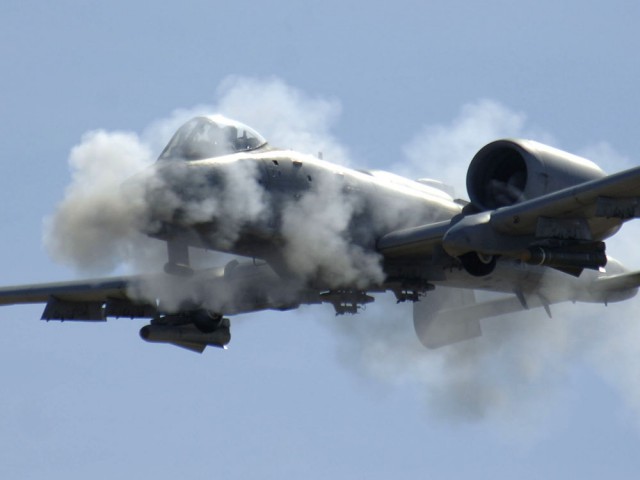
An A-10 Thunderbolt II, fires the 30 mm gun at a low angle strafe, as part of the 2006 Hawgsmoke competition, Thursday, March 23, 2006, at the Barry-Goldwater Range, Gila Bend Air Force Auxiliary Field. There are four parts of the competition. Each team has four members in which they have 100 bullets each to use toward the target. This year's competition coincides with the 30th anniversary of the Warthog. Twenty squadrons from around the world come together to gain the honor of the "best of the best" in ground attack and target destruction. (U.S. Air Force photo/Senior Airman Christina D. Ponte)
An A-10 Thunderbolt II, fires the 30 mm gun at a low angle strafe.
The Gulf War brought aerial bombardment onto TV screens. The world watched live as the American-led coalition leveled Iraqi defenses before a single boot set foot on Iraqi soil. By the time ground fighting started, the Iraqi forces have been severely weakened,

The center of this was Operation Desert Storm, a three-stage bombing campaign targeting Iraqi air defenses, command and communication facilities, and then military targets. With Iraq’s armed forces defanged, coalition aircraft were able to move into a support role. Armored columns were smashed on their way to the battle zone. Iraqi ground forces stood no chance against the vast aerial advantage of their enemies.  The Republican Guard forces fought long and well against the Americans, but their T-72s were outclassed by the American M1A1 tanks and Bradleys followed by the Apache's and A-10's that supported the American advance.  The tank battles rivaled Kursk in the number of armor used by both sides.

Tuesday, November 3, 2015

Airshow Part 1

I would have had this post up earlier but I had problems....nothing like having all this rain expose a problem with my house electrical system....House is 18 years old and I guess water goes where water goes....Somehow I had a surge or something go through my GCFI wall unit, and wipe out the backyard light fixture.  I had to run drop cords from half of the house to the other half to get the fridge going and the router and tv.   Priorities I suppose...   Well I replaced the GCFI outlet, got power back to the rest of the house but for some reason I can't get the new GCFI to reset and restore the circuit on my exterior part of the house.....Rain.....ain't it fun.....
     But I digress, we went to the airshow and saw a few things.....For starters the venders....here were a couple of them..
 and another one...
   The location was falcon field south of Atlanta, it is a business/general aviation airport.
  We walked around...and there were crowds everywhere....it was billed as a 2 day event but most people came on day 1 because of the 100% chance of rain on the second day and people estimated about 8000 to 10,000 people there.
  There was the Oracle airplane doing stunt flying....and he was good, the pilot was doing corkscrews, rolls, loops, and seeing an airplane hovering for 2 minutes was very impressive.
  The F4U corsair then took off and he started performing loops and many other acrobatics...very impressive especially for th older airframe.
 Just seeing the plane doing all the acrobatics  almost what she might have done in war..very impressive....

  I was having a hard time focusing the camera on my phone to get these pics.
 I also saw my favorite plane...the SBD Dauntless...the plane that in my opinion was instrumental in the defeat of the Japan in the pacific war...the Japanese never recovered from the loss of their 4 strike carriers and most of their experienced air crews.
I have blogged extensively about The Battle of Midway 
     You can see the diving brakes deployed....this is what made the SBD(Slow But Deadly) as she was known to her crew so effective.
     Also there was the ever popular  "Sasquatch" from the Jacklinks commercials...
they also had an airplane there that participated...
We also saw the A10 there....you know the plane that the Air Force top brass has been trying to get rid of and every body else especially the grunts love the plane..
I have seen the destruction that the A10 did to the Iraqi forces in Desert Storm....a lot of grunts can't understand the animosity that the AF brass have with the airframe....but that is a discussion for another time with people that are more knowledgeable than I am.


The kid had a good time as you can tell...

   I will post a second part in a day or so involving the "Blue Angels".   Yes they were there....:)

Thursday, February 27, 2014

WHat ever happened to those fuel tanks we dropped over Vietnam?

I got this email from my Dad and it had a bunch of pics on what the Vietnamese did with the drop-able fuel tanks that our fighters dropped all over that countryside,   I have heard of the local people making creative uses of the stuff that is discarded by U.S. Forces.


 In case you were wondering what happened to all those fuel tanks our aircraft jettisoned over Southeast Asia ……


Tuesday, February 4, 2014

Traveling in the Pan-Am Clipper, Circa 1939 *Edited* and fixed

NOTE: I got an email from OldNFO about missing links and pics.  I hope I fixed the problem and I added some more stuff.

 This is for Momma Fargo,*Mwah* she took me to task for having a dirty car.  She told me that I need to clean it,  After hanging my head in mock shame I spent some time cleaning the car after the adventures of last week and the snow and ice.  .I washed the road sand, snow leftovers off the car, truck and the bike...guess it will rain tomorrow. 


I remember flying in a Pan-Am 747 from Europe to America.  The Iconic Pan-Am logo was the closest airline to a state sponsored airline that ever was in the United States.  What rules there were, seemed to apply to all the other airlines except Pan-Am.  The airline started by Juan Trippe became a worldwide icon, the Pan-Am logo was recognized the world over.  it even made it into a movie from the future.
When people traveled back until even the 70's, flying was considered a big deal, you would dress in your Sunday go to meeting clothing.  The last time I flew Delta, I saw a 20 something year old  woman in bedroom slippers, looked like a bathrobe and hair curlers.  My how times have changed.  Pan-Am still has a mystique about it, it was a link to a different time where there were more stringent standards on behavior, and dress and how one acted in public.

     Pan American World Airways, commonly known as Pan Am, was the principal and largest international air carrier in the United States from 1927 until its collapse on December 4, 1991. Founded in 1927 as a scheduled air mail and passenger service operating between Key West, Florida, and Havana, Cuba, the airline became a major company credited with many innovations that shaped the international airline industry, including the widespread use of jet aircraft, jumbo jets, and computerized reservation systems. It was also a founding member of the International Air Transport Association (IATA), the global airline industry association. Identified by its blue globe logo, the use of the word "Clipper" in aircraft names and call signs, and the white pilot uniform caps, the airline was a cultural icon of the 20th century. In an era dominated by flag carriers that were wholly or majority government-owned, it was also the unofficial flag carrier of the United States. During most of the jet era, Pan Am's flagship terminal was the Worldport located at John F. Kennedy Airport in New York.
    
At its peak in the late 1960s and early 1970s, Pan Am advertised under the slogan, the "World's Most Experienced Airline" It carried 6.7 million passengers in 1966, and by 1968, its 150 jets flew to 86 countries on every continent except for Antarctica over a scheduled route network of 81,410 unduplicated miles (131,000 km). During that period the airline was profitable and its cash reserves totaled $1 billion. Most routes were between New York, Europe, and South America, and between Miami and the Caribbean. In 1964 Pan Am began a helicopter shuttle between New York's John F. Kennedy, LaGuardia and Newark airports and Lower Manhattan, operated by New York Airways. Aside from the DC-8, the Boeing 707 and 747, the Pan Am jet fleet included Boeing 720Bs and 727s (the first aircraft to sport Pan Am — rather than Pan American — titles). (The airline later had Boeing 737s and 747SPs (which could fly nonstop New York to Tokyo), Lockheed L-1011 Tristars, McDonnell-Douglas DC-10s, and Airbus A300s and A310s.) Pan Am owned the InterContinental Hotel chain and had a financial interest in the Falcon Jet Corporation, which held marketing rights to the Dassault Falcon 20 business jet in North America. The airline was involved in creating a missile-tracking range in the South Atlantic and operating a nuclear-engine testing laboratory in Nevada. In addition, Pan Am participated in several notable humanitarian flights.
At its height Pan Am was well regarded for its modern fleet and experienced crews: cabin staff were multilingual and usually college graduates, frequently with nursing training. Pan Am's onboard service and cuisine, inspired by Maxim's de Paris, were delivered "with a personal flair that has rarely been equaled."


 If
If If 


 Boeing Clipper


Clipper passengers took their meals at real tables, not their seats.
For most travelers in the 21st century, flying is a dreary experience, full of inconvenience, indignity, and discomfort.
That wasn't the case in the late 1930s, when those with the money to afford trans-oceanic flight got to take the Boeing Model 314, better known as the Clipper.
Even Franklin Roosevelt used the plane, celebrating his 61st birthday on board.
Between 1938 and 1941, Boeing built 12 of the jumbo planes for Pan American World Airways.
The 314 offered a range of 3,500 miles — enough to cross either the Atlantic or Pacific —and room for 74 passengers onboard.
Of course, modern aviation offers an amazing first class experience (and it's a whole lot safer), but nothing in the air today matches the romanticism of crossing the ocean in the famed Clipper.
Thanks to the Pan Am Historical Foundation for sharing its photos. The foundation is currently working on a documentary about Pan American World Airways and the adventure of the flying boat age. Find out more here.

The Model 314's nickname Clipper came from an especially fast type of sailing ship, used in the 19th century.

The ship analogy was appropriate, as the Clipper landed on the water, not runways.


The Boeing Company

Here's a diagram of the different areas of the plane.

The Boeing Company
[Source: Boeing]

On Pan Am flights, passengers had access to dressing rooms and a dining salon that could be converted into a lounge or bridal suite.

The Boeing Company

The galley served up meals catered from four-star hotels.

The Boeing Company

If you want to sit at a table to eat with other people these days, you have to fly in a private jet.

The Boeing Company

There was room for a crew of 10 to serve as many as 74 passengers.

The Boeing Company

On overnight flights, the 74 seats could be turned into 40 bunks for comfortable sleeping.

The Boeing Company

The bunk beds came with curtains for privacy.

On the 24-hour flights across the Atlantic, crew members could conk out on these less luxurious cots.

Unlike some modern jets that come with joysticks, the Clipper had controls that resembled car steering wheels.

Navigating across the ocean used to require more manpower in the air.

The lavatory wasn't too fancy, but it did have a urinal — something you never see in today's commercial jets, where space is at a premium.

The ladies lounge had stools where female passengers could sit and do their makeup.

The Clipper made its maiden trans-Atlantic voyage on June 28, 1939.

The Boeing Company

But once the US entered World War II, the Clipper was pressed into service to transport materials and personnel.


In 1943, President Franklin Roosevelt celebrated his 61st birthday on board.


The Pacific Clipper (civil registration NC18602) was a Boeing 314 Clipper flying boat famous for having completed Pan American World Airways' first around the world flight. The flight of the then-named California Clipper began December 2, 1941 at the Pan Am base on Treasure Island, California for its scheduled passenger service to Auckland, New Zealand. Renamed the Pacific Clipper, it landed at Pan American's LaGuardia Field seaplane base at 7:12 on the morning of January 6, 1942.
NC18602 made scheduled stops in San Pedro, California, Honolulu, Hawaii, Canton Island, Suva, Fiji and Nouméa, New Caledonia en route to Auckland when Pearl Harbor was attacked.
Cut off from the United States due the bombing of Pearl Harbor on December 7, 1941 and commanding a valuable military asset, Captain Robert Ford was directed to strip company markings, registration and insignia from the Clipper and proceed in secret to the Marine Terminal, LaGuardia Field, New York.
Ford and his crew successfully flew over 31,500 miles to home via
At Surabaya, Captain Ford had to refuel with automobile grade gasoline. "We took off from Surabaya on the 100 octane, climbed a couple of thousand feet, and pulled back the power to cool off the engines," said Ford. "Then we switched to the automobile gas and held our breaths. The engines almost jumped out of their mounts, but they ran. We figured it was either that or leave the airplane to the Japs."
On the way to Trincomalee, they were confronted by a Japanese submarine, and Ford had to jam the throttles forward to climb out of range of the submarine's guns. On Christmas Eve, when they took off, black oil began gushing out of the number 3 engine and pouring back over the wing. Ford shut down the engine and returned to Trincomalee. He discovered one of the engine's cylinders had failed.
When Captain Ford was planning his flight from Bahrain, he was warned by the British authorities not to fly across Arabia. Ford said, "The Saudis had apparently already caught some British flyers who had been forced down there. The natives had dug a hole, buried them in it uphttps://www.blogger.com/blogger.g?blogID=1444550425694584077#editor/target=post;postID=5659745135881723280 to their necks, and just left them." Ford flew right over Mecca because the Saudis did not have anti-aircraft guns.
A Pan American airport manager and a radio officer had been dispatched to meet the Clipper at Leopoldville. When Ford landed they handed him a cold beer. Ford said, "That was one of the high points of the whole trip." After NC18602 had completed its harrowing flight to safety, Pan Am renamed the aircraft the Pacific Clipper. The name change was mainly for publicity purposes, arising from the first newspaper articles having wrongly identified the aircraft. NC18602 remained the Pacific Clipper from 1942 throughout the remainder of its career. Purchased by the US Navy in 1946, it was subsequently sold to Universal Airlines but was damaged in a storm and ultimately salvaged for parts


BOEING B-314 ~ 12 Produced

NC-18601

Honolulu Clipper
January 1939Pacific service. Remained with Pan Am during the War. Crashed into Navy vessel taking it under tow and had to be sunk on November 14, 1945 in Pacific.
NC-18602

California Clipper
January 1939Pacific service. Sold to the U.S. Navy in 1942. Sold to World Airways after the War and was scrapped in 1950.
NC-18603

Yankee Clipper
February 1939Atlantic service. Purchased by the U.S. Navy in 1942, but operated by Pan Am. Crashed and sank in River Tagus near Lisbon, Portugal on February 22, 1943
NC-18604

Atlantic Clipper
March 1939Atlantic service. Purchased by the U.S. Navy in 1942, but operated by Pan Am. Salvaged for parts.
NC-18605

Dixie Clipper
April 1939Atlantic service. Purchased by the U.S. Navy in 1942, but operated by Pan Am. Sold after the War to World Airways and scrapped in 1950.
NC-18606

American Clipper
June 1939Atlantic service. Sold to the U.S. Navy in 1942. Sold to World Airways after the War and was scrapped in 1950.
NC-18607(A)
NC-18608(A)
April 1941Ordered by Pan Am. Both were sold to the British Purchasing Commission and used by BOAC. 18607 became G-AGBZ Bristol and 18608 became G-AGCA Berwick After the War they were sold to World Airways - 1948.
NC-18609(A)

Pacific Clipper
May 1941Pacific service. Temporarily named California Clipper to replace 18602 that was being moved to Atlantic service, but within months was permanently named Pacific Clipper. Purchased by the U.S. Navy in 1946. After the War it was sold to Universal Airlines. It was damaged in a storm and subsequently salvaged for parts.
NC-18610(A)April 1941Ordered by Pan Am. Sold to the British Purchasing Commission and used by BOAC; became G-AGCB Bangor After the War it was sold to World Airways - 1948.
NC-18611(A)

Anzac Clipper
June 1941Pacific and Atlantic service. Sold to the U.S. Navy in 1942. Sold to American International Airways after the War in 1947 and then to World Airways in 1948; sold again in 1951 and destroyed in Baltimore, Maryland in late 1951.
NC-18612(A)

Capetown Clipper
August 1941Atlantic service. Sold to the U.S. Navy in 1942. Sold to American International Airways in 1947. Was sunk at sea by the U.S. Coast Guard on October 14, 1947
Epilogue: After World War II, 7 of the remaining B-314's were purchased by a start-up airline called New World Airways. By the early 1950's, all of the B-314's that had survived the War had been scrapped.  Pan-Am unfortunately didn't survive in today's  business climate,  Pan-Am folded in 1991. 
In his book, Pan Am: An Aviation Legend, Barnaby Conrad III contends that the collapse of the original Pan Am was a combination of corporate mismanagement, government indifference to protecting its prime international carrier, and flawed regulatory policy. He cites an observation made by former Pan Am Vice President for External Affairs, Stanley Gewirtz:
"What could go wrong did. No one who followed Juan Trippe had the foresight to do something strongly positive … it was the most astonishing example of Murphy's law in extremis. The sale of Pan Am's profitable parts was inevitable to the company's destruction. There were not enough pieces to build on".
—Stanley Gerwitz