Webster

The Constitution was made to guard the people against the dangers of good intentions." --American Statesman Daniel Webster (1782-1852)


Showing posts with label Cool airplanes. Show all posts

Tuesday, October 4, 2022

Convair B-58 Hustler "Beautiful....And Deadly"


 I snagged this off a source from work, it had some information on this airplane I didn't know about.some of the issues with the plane.  I always thought it was futuristic for its time.
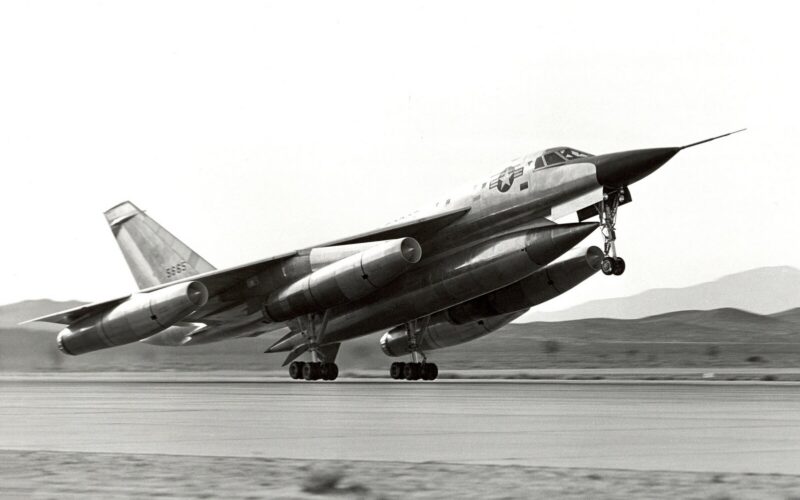


The B-58 Hustler was a true icon of the Jet Age, with its polished aluminium skin, a futuristic design and the ability to carry multiple nuclear bombs into the Soviet Union at Mach 2.

A massive technological undertaking, the B-58 was a marvel of engineering for its day. It first flew just a decade after the end of WWII.

However for all of its impressive looks and specifications, the B-58 was marred with trouble, virtually from the outset. A terrifyingly high-crash rate and the massive costs involved with operating a Mach 2 bomber would result in its demise.

The pace of technical development in military aviation during World War Two was hectic. Every major nation began that conflict with conventional piston-engine fighters and bombers. By the end of the war, the first jet fighters and bombers were in service and even the first rocket fighters had seen operational use.

But in the ten years following the war, the pace of change became frenetic, with east and west vying to produce aircraft that could fly faster and higher than ever before.

The Convair B-58 Hustler had its origin in that period when anything seemed possible and each new generation of combat aircraft brought staggering advances in performance.

In 1945, the front-line bomber of the US 8th Air Force was the Boeing B-17G Flying Fortress, capable of a cruising speed of 180mph while carrying a bomb load of 4,500lbs of bombs.
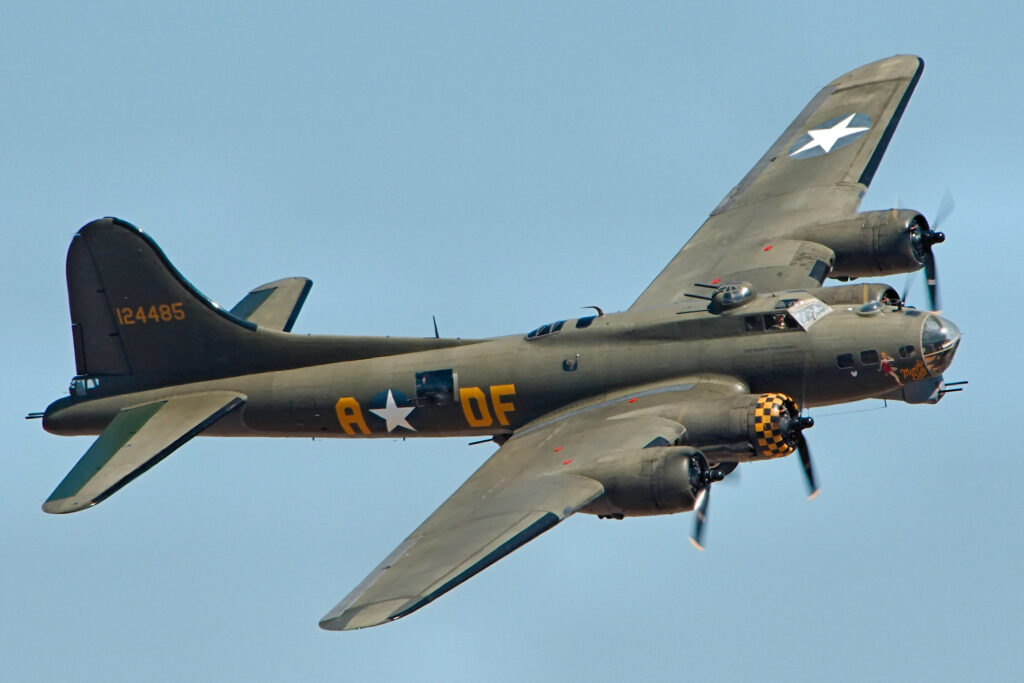
The B-17G was around not long before the first flight of the B-58
A Boeing B-17G “Sally B”.

Just seven years later, in 1952, Convair unveiled a mock-up of a new delta-wing jet bomber designed to cruise at supersonic speed while carrying nuclear weapons.

Convair began a design study on the feasibility of a delta-wing supersonic intercontinental bomber as early as October 1946 with the Generalized Bomber Study (GEBO), funded by the USAAF.


The delta-wing configuration was felt to offer significant advantages at extreme speed and Convair were the only US aircraft manufacturer who had produced a delta-wing military aircraft, the XF-92 interceptor.

This never entered production, but it did provide Convair with valuable data on the performance of delta-wing aircraft.

The Convair XF-92
Convair learned a lot of lessons from the XF-92 program

Convair studied, literally, thousands of possible configurations before announcing an extremely advanced concept in late 1950: this involved a parasite bomber that would be carried into the air beneath a B-36 bomber.

The parasite aircraft was a small, two seat bomber powered by two non-afterburning General Electric J53-GE-X25 turbojet engines and was planned to be able to cruise at supersonic speed and reach and altitude of 50,000 feet.

Rather than a bomb bay, the aircraft carried a jettisonable bomb pod under its fuselage. The US Air Force liked the design of the supersonic bomber, but not the parasite concept: it was felt that this would be expensive to produce and maintain and might be vulnerable to enemy attack while the two aircraft were conjoined.

In December 1951, the design was refined as a stand-alone delta-wing bomber powered by two afterburner-equipped turbojet engines and providing space for a crew of three: a pilot, a navigator/bombardier and a defence systems operator.

The new design retained the jettisonable bomb pack carried under the fuselage and included the ability for in-flight refuelling. To dissipate the heat generated by high-speed flight, the aircraft’s skin was a novel sandwich of honeycombed fiberglass between outer aluminium and steel plates.

Rather than being rivetted, which was the standard approach at that time, these plates were glued together. Further modifications to the design were undertaken and when a mock-up was revealed in late 1952, if featured four General Electric J79-GE-1 turbojets in pods under the wings which featured sweep-back of 60˚.
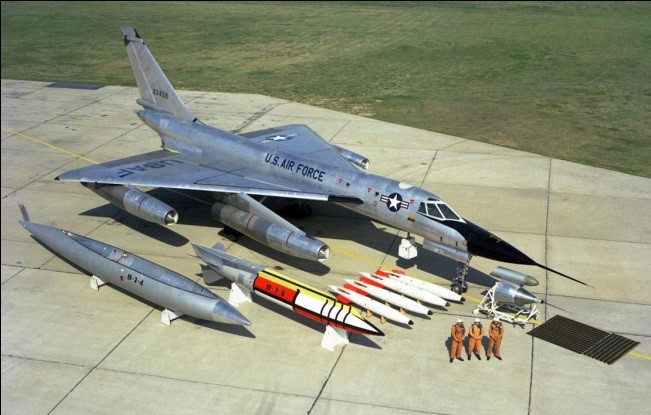
The Delta wing design of the B-58
The B-58’s design was extremely advanced for the 1950s.

In December 1952, the new aircraft was given the designation B-58 and the name Hustler.

Generally, new aircraft ordered by the US Air Force are produced as prototypes and these are extensively tested to refine the design before the new aircraft goes into volume production.

Such was the urgency with which this project was viewed that it was agreed to skip the prototype phase: the first 30 B-58 aircraft off the production line would be used for testing and to resolve any problems. This was a risky decision for an aircraft of such radical design.

By August 1954, the design had matured into its final configuration. The engines were mounted in four separate pods beneath the wings, the fuselage was redesigned according to the new modified transonic area rule for supersonic speeds (leading to the “coke-bottle” shape) and the bomb pack was shortened and modified to contain fuel as well as the bomb load.


The bomb pod could also be replaced with a photo-reconnaissance pod including a Fairchild KA-56 panoramic camera. Due to the B-58s speed, the only defensive armament was a single General Electric M61 Vulcan 20 mm rotary cannon in the tail, remotely-controlled by the Defensive Systems Officer.
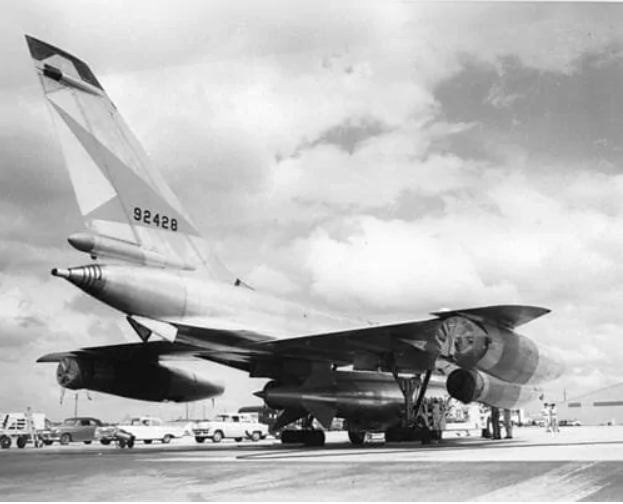
B-58 had a 20mm cannon in the tail.
The B-58 had a 20mm cannon for defense in the tail.

In December 1955, a contract was issued by the US Air Force for an initial production run of 13 aircraft and 31 bomb/photo-reconnaissance pods.

The first B-58s were handed over to the US Air Force in 1960, and it soon became apparent that the new aircraft had truly phenomenal performance. It was the first supersonic bomber and the first bomber to reach Mach 2, making it faster than most fighters in service at the time. It was able to fly above the range of most Russian Surface-to-Air Missiles (SAMs).


It also climbed like a rocket (it could dash-climb to 85,000 feet) and was as manoeuvrable as many smaller, lighter, aircraft. B-58s quickly set a number of speed and altitude records. One B-58 flew from Los Angeles to New York and back in under five hours. Another flew non-stop from Tokyo to London and maintained an average speed of over 1,000mph.

In service, it also quickly became apparent that the B-58’s composite skin and small size made it very difficult to detect on the radar equipment available in the 1960s.

On paper, the B-58 looked like the first of the next generation of combat aircraft. From the cockpit, things looked less impressive. Its stall and spin characteristics were unforgiving and maintaining the correct angle of attack was critical at all stages of flight.


Pilots had to fly the B-58, with extreme care, from the moment it began to taxi until engines were finally switched off. Inherently challenging flight characteristics were exacerbated by unresolved design issues.

For example, losing the power of an engine at high speed could cause the aircraft to yaw so severely that it could break-up in flight.

Lots of testing was done for the B-58's ejector seats.
The B-58’s ejection capsule underwent a lot of testing for maximum crew survivability.

The fuel transfer system was also eccentric and not always reliable. A failure of this system while at high speed presented the crew with an unpleasant decision: bale out at supersonic speed, which they were unlikely to survive, or allow the aircraft to slow but then its changed centre of gravity might make it uncontrollable at subsonic speed.

The first B-58 crashes happened even before the aircraft was handed over to the US Air Force. In December 1958, a B-58 on a test flight was lost following an electrical problem which caused a loss of control. The pilot was killed but both other members of crew survived.

In November 1959 a B-58 being flown by a Convair civilian crew out of Carswell AFB crashed during a test-flight, killing both crewmembers (no Defensive Systems Officer was carried on this flight). An accident investigation suggested that fuel transfer problems had made the aircraft unstable in flight.

Four months later, another B-58 on a test flight out of Carswell AFB broke up in the air after a loss of control during normal flight. One of the crew was killed but the other two survived ejection.


In April 1960 another B-58 suffered structural damage after encountering a hailstorm while at supersonic speed.

All three civilian crew members were killed. All four of these crashes involved very experienced test pilots and crews and ominously, two involved a “loss of control in normal flight.” It was clear even at this early stage that the B-58 was a very challenging aircraft to fly, and the accident rate increased when the first B-58s were handed over to the US Air Force.

In June 1961, a B-58 named The Firefly set a new speed record for a flight between New York and Paris. A few days later, the same aircraft (with a different crew) was performing low-level aerobatic manoeuvres in front of a large crowd attending the Paris Air Show.
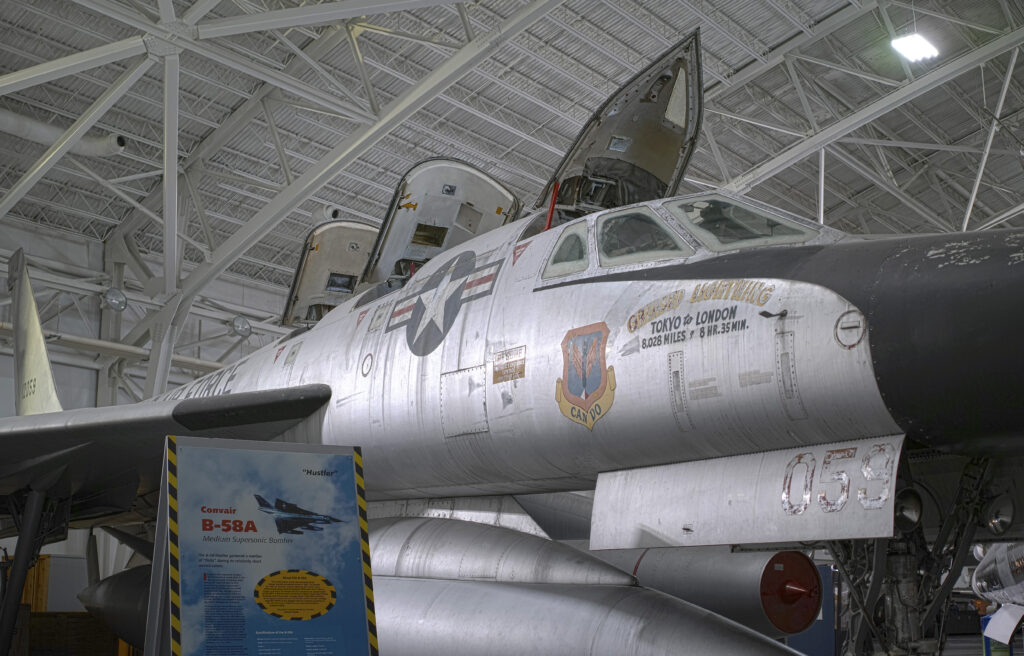
 

B-58 "Greased Lightning"
B-58 “Greased Lightning” also set a speed record between Tokoyo and London. Photo Credit – Aaron Headly

The pilot appeared to lose control after entering low cloud and the aircraft crashed close to Le Bourget airport, killing all three crew members. In June 1965, another B-58 was scheduled to take part in the Paris air show.

It arrived late and carrying more fuel than anticipated. The pilot was given the option of making an immediate heavy landing or diverting to another airport.

He chose the former option and the B-58 undershot and crashed short of the runway, killing the pilot. The other two crew members survived


These two very public crashes were only the tip of the iceberg. In all, 116 B-58s were delivered to the US Air Force. Twenty-six were lost to crashes, a loss rate of 22% over the ten years that the B-58 was in service that caused the death of 36 US Air Force personnel.

This loss rate was higher than almost any other US combat aircraft, but it wasn’t its fearsome reputation for crashes that finally doomed the B-58. One significant problem was cost: it was estimated that the US Air Force could operate six wings of B-52 bombers for the same cost as just two wings of B-58s.

But what really killed the B-58 was something that happened just as it was entering service.

Since 1958, CIA pilots had been flying U2 reconnaissance aircraft over the Soviet Union. This aircraft was capable of flying at 70,000 feet, well above the range of Russian SAMs or interceptors.

Then, on 1st May 1960, Francis Gary Powers was shot down in a U2 over Russia by a new S-75 Dvina (NATO name, SA-2 Guideline) SAM. Suddenly, it became clear that the altitude at which the B-58 could fly would not make it safe from Soviet Air Defences.

An S-75 Dvina
An S-75 Dvina. Photo Credit – www.konflikty.pl

In addition, the first Intercontinental Ballistic Missiles (ICBMs) became operational in 1959 and the first Submarine Launched Ballistic Missiles (SLBMs) in 1960. US Air Force Strategic Air Command began to consider whether these missiles were a more effective way of delivering nuclear weapons to hostile territory than conventional bombers?


Just as it entered service, the very role for which the B-58 had been designed began to seem irrelevant.

The specialized nature of its design also made it difficult to use the B-58 in other mission types. In contrast its contemporary the B-52, also designed as a nuclear bomber, proved to be a very effective conventional bomber.

From 1966, B-52s were dropping 8,000 tons of bombs every month in support of US forces in Vietnam. The specialised high-altitude, high speed B-58 simply wasn’t suitable for such missions, though in 1967, the US Air Force did undertake testing of the B-58 for low-level, conventional bombing missions.
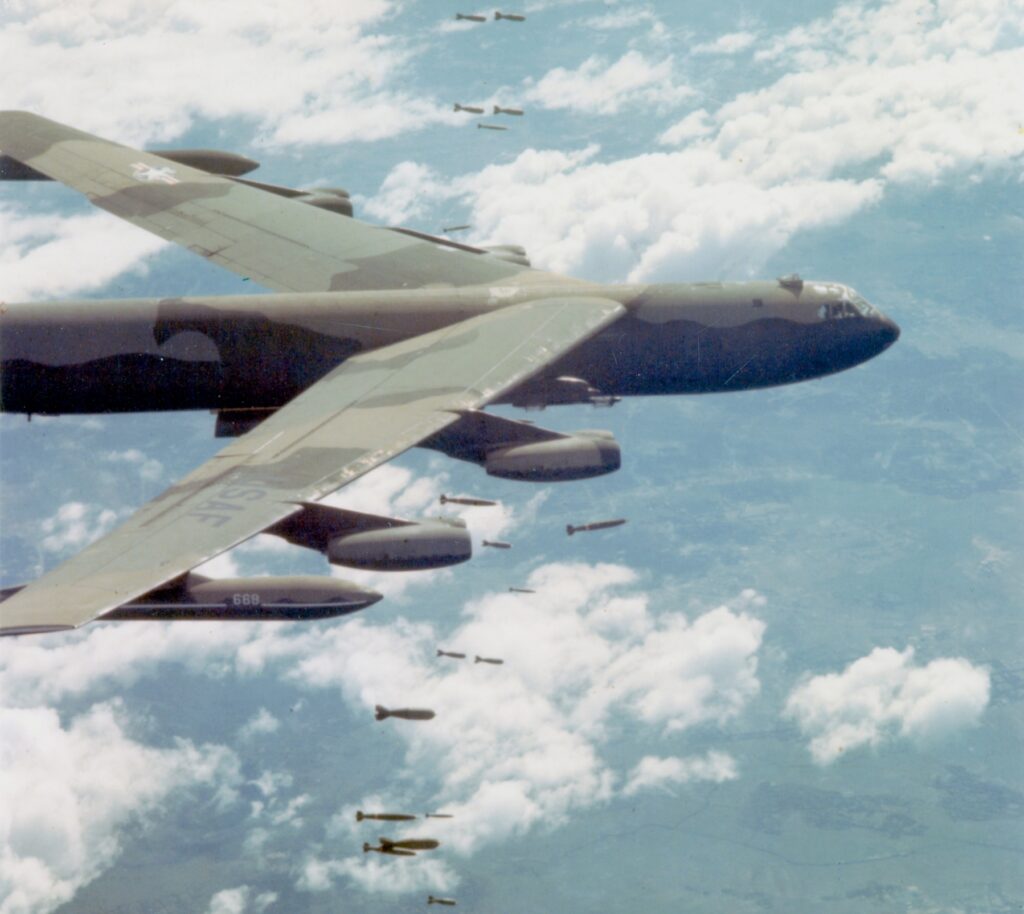
The B-52 was far less advanced than the B-58
The B-52 dropping a bomb load in Vietnam.

However, the aircraft’s difficult handling made it unsuitable in this role and none were ever used in the conflict in Vietnam.

Demise

A combination of a high accident rate, changing operational circumstances, an inability to undertake non-nuclear missions, high costs and operational problems meant that the last B-58 was retired by the US Air Force in early 1970, after less than ten years in service.

This was a bold design intended to fulfil a particular niche in bombing requirements. However, the introduction of more effective Soviet air defence capabilities plus the arrival of ICMBs and SLBMs just as the Hustler entered service removed the operational need it was designed to fulfil. By the time that it entered service, the B-58 was the answer to a question non-one was asking.

Specifications

  • Crew: Three
  • Length: 96 ft 10 in (29.51 m) 
  • Wingspan: 56 ft 9 in (17.30 m)
  • Height: 29 ft 11 in (9.12 m)
  • Wing area: 1,542 sq ft (143.3 m2)
  • Empty weight: 55,560 lb (25,202 kg)
  • Max takeoff weight: 176,890 lb (80,236 kg)
  • Powerplant: 4 × General Eletric J79-GE-5A afterburning turbjojet, 10,400 lbf (46 kN) thrust each dry, 15,000 lbf (67 kN) with afterburner
  • Maximum speed: 1,146 kn (1,319 mph, 2,122 km/h) at 40,000 ft (12,000 m)
  • Range: 4,100 nmi (4,700 mi, 7,600 km)
  • Service ceiling: 63,400 ft (19,300 m)
  • Rate of climb: 17,400 ft/min (88 m/s)
  • Guns: 1× 20mm T171 Cannon
  • Bombs: 1× Mark 39or B53 or 4× B43 or B61 Nuclear bombs; maximum weapons load was 19,450 lb (8,822 kg)


Thursday, August 25, 2022

Profile in the E-3 Sentry (AWACS)

 This post was supposed to drop yesterday, but I ran into problems, For some reason, "Blogger" decided to unpublish a bunch of my older posts that I did years ago and the common thread seemed to be "Barky The LightBringer" or "Obummer"  and "Obungler"and the religion of Islam. and I didn't even use the election of 2012 or the election of 2016 as a reference.   For those of y'all that have been reading my post for many years, know that I spent a LOT of time on that subject, it was a happy hunting ground for me and many other bloggers, kinda like shooting fish in a barrel for us.  Well I had to spend a lot of time appealing the decisions and got most of them restored except for 3 of them.


Back in 2017 I did a bunch of of  "Red Storm Rising" post, and I really enjoyed writing them, it was a lot of fun for me.  The book is one of my all time favorite books, and I considered Tom Clancy a "Warrior Bard" and anybody from the Military community in the 1980's and 90's knew who Tom Clancy was.   Anyway this popped up in my "Aviation News feed, it is a profile on the E-3 and I thought it was pretty good and I shamelessly "Nicked it".

Credit: U.S. Air Force

[Editor’s Note: More profiles of major military aircraft programs are available to Aviation Week Intelligence Network subscribers at awin.aviationweek.com.]

The E-3 Sentry Airborne Warning and Control System (AWACS) is an airborne early warning and control (AEW&C) aircraft based on the Boeing 707-320B commercial airliner. The aircraft is powered by four Pratt & Whitney TF33-PW-100A jet engines supplying 20,500 lbf. (91.2 kN) or General Electric CFM56-2 turbofans supplying 24,000 lbf. (106.8 kN) of thrust at sea level each.

Program History

Features

The E-3 carries a pulse-doppler mechanically scanned S-band radar in a 30-ft. rotating dome suspended 11 ft. above the fuselage by a pair of struts. This radar is the AN/APY-1 or APY-2, depending on the E-3 variant. The U.S. Air Force (USAF) quotes the radar’s effective range at “more than” 217.2 nmi (402.3 km).

The “rotodome” also contains an identification friend-or-foe (IFF) antenna and antennas for the aircraft’s datalinks. Originally, the E-3 used the Link 4A (TADIL-C) datalink to communicate with fighter aircraft. To facilitate a 360-deg. field of view, the dome is hydraulically rotated at 6 rpm. When not operating the dome rotates at 1/24 of this speed to heat the lubricant and prevent it from congealing.

The E-3 can operate beyond 29,000 ft. (8,840 m). USAF also says the E-3 can operate more than 5,000 nmi (9,260 km) from its base. This estimate goes for aircraft equipped with the TF33. Boeing, for its part, quotes an endurance of six hours at a mission radius of 870 nmi (1,610 km).

The E-3 uses an IBM CC-1 mission computer. Most of the avionics are air cooled, though the radar transmitter has a liquid cooling system. Nine Situation Display Consoles (SDCs) are carried for operators, yielding a typical aircrew of 13. Later variants carry additional consoles and can deploy with more operators.

The aircraft features a refueling slipway above the cockpit to enable in-flight refueling by a boom-type refueler.


Variants

EC-137D

The EC-137D was the designation for E-3 prototypes, two of which were built by and retained by Boeing. These were later upgraded to the E-3B standard.

E-3A [Block 10/15]

E-3A aircraft come in two configurations, the “Core” Block 10 and the “Standard” Block 15. Block 15 features the APY-2 radar, an upgraded APY-1 with sea-search capability. Counting the prototypes, the first 25 E-3s are Block 10s. All aircraft produced thereafter carry the APY-2.

E-3B [Block 20]

The E-3B is a modernized E-3 variant upgraded to the Block 20 standard. Block 20 includes five new Situation Display Consoles (SDCs), the IBM CC-2 computer, radio teletype capability and maritime surveillance capability for the APY-1. Five new UHF radios and one HF radio also were fitted, and the UHF radios included feature HAVE QUICK frequency-hopping capability. Block 20 and Block 25 modifications began in 1984.

E-3C [Block 25]

The E-3C is a further upgrade standard similar to the E-3B, but for aircraft with the APY-2.

E-3D

The E-3D is the E-3 variant procured by the United Kingdom. It features CFM56-2 engines, the APY-2 and the Loral EW-1017 ESM system.

E-3F

The E-3F is the E-3 variant procured by France. Like the E3-3, it uses the CFM56-2 and carries the APY-2. It was not initially equipped with an ESM system but received one after delivery.

E-3G [Block 40/45]

E-3s receiving Block 40/45 modifications are known as E-3Gs.

KE-3

The KE-3 is a tanker/cargo derivative of the E-3. It does not feature any elements of the E-3 mission system but has a ventral refueling boom, wingtip drogue pods, a cargo door and a cargo floor. These aircraft are powered by the TF-33.

RE-3A

The RE-3A is a signals intelligence derivative of the KE-3. It features the Tactical Airborne Surveillance System (TASS), a sensor system mounted in two large rectangular fairings on either side of the forward fuselage. These fairings are similar in shape to those seen aboard the USAF RC-135V and RC-135W Rivet Joint. Other small antennas also are present on the underside of the airframe.

RE-3B

The RE-3B is a more advanced derivation of the RE-3B.

Upgrades

Block 30/35

The first significant series of E-3 modifications brought aircraft to the Block 30/35 standard. The new Block includes electronic support measures (ESM) capability, the Joint Tactical Information Distribution System (JTIDS) to support the Link 16 datalink, GPS and new computers. These features improve location accuracy for targets passed over Link 16 or Link 11 by a factor of 200.

The main Block 30/35 contract was awarded to Boeing in May 1987. Other upgrades, including GPS capability, were added later. In 1994 Boeing was awarded a $16.8 million contract from NATO and a $127 million contract from the U.S. to procure ESM integration kits for their E-3s. The first Block 30/35 upgrades were completed in October 1995, and the program was finished in 2001.

Radar System Improvement Program (RSIP)

The RSIP program began at the direction of USAF in 1989. It was intended to increase the sensitivity of the E-3 radar system and would bring USAF and NATO APY-1 and APY-2 radars to a common standard. The upgrades improved the electronic countermeasures (ECM) resistance of the system, replaced operators’ consoles, introduced a new radar processor and included new software. NATO joined the program in 1994 as operational test and evaluation of the upgrades was well underway. The UK also joined the program in 1996 when it awarded a contract to Boeing to upgrade all seven of its E-3Ds.

Full rate production began in 1997, with the first kits delivered in 1998. The U.S. installed the kits at Tinker AFB during regularly programmed depot maintenance cycles. NATO kits were installed by Daimler-Benz Aerospace (later EADS and now Airbus) in Germany. In February 2002, France awarded a $133 million contract to Boeing for its own RSIP kits.

Extend Sentry

Starting in October 1994, the Air Force began a series of E-3 upgrades intended to allow the aircraft to serve to 2025. This predominately included obsolescence management and maintainability improvements

Diminishing manufacturing sources Replacement of Avionics for Global Operations and Navigation (DRAGON)

DRAGON is an E-3 upgrade program jointly pursued by NATO and the USAF. It is intended to replace the E-3’s analog cockpit avionics with a glass cockpit and improve compliance with air traffic management mandates from ICAO and the FAA. This includes ADS-B (Out) capability, a new weather radar, an enhanced ground proximity warning system (EGPWS) and Mode 5 IFF. DRAGON has been pursued concurrently with Block 40/45, and the USAF received the first modified aircraft in January 2017. The upgrades reduce the minimum flight crew from four to three by eliminating the navigator.

Block 40/45

The Block 40/45 upgrade brings E-3s to a common E-3G standard and represents an all-around modernization of the E-3 mission system. The upgrades were pursued concurrently with the E-10, the Boeing 767-based replacement for the E-3 and E-8 J-Stars. Block 40/45 testing began in 2006. The upgrade program cost approximately $2.6 billion. It became vitally important after the E-10 program was terminated in 2010.

The upgrade includes the Telephonics AN/UPX-40 IFF system, which provides enhanced clutter rejection over the old system. It also includes new MIDS JTRS Link 16 radios. Most critically, it replaces the computing backend for the aircraft. The flight computer is replaced with a Red Hat Linux-based system and the operator stations are replaced with new Microsoft Windows-based consoles.

Block 40/45 also includes the Internet Protocol Enabled Communications (IPEC) program. IPEC fields an INMARSAT based satellite communications capability on the E-3, enabling full internet connectivity in flight. USAF uses this for IP chat, email and air tasking order and airspace control order dissemination. Aircraft with IPEC carry a rectangular SATCOM antenna just aft of the wing center section.

AWACS Communications Integration Program (ACIP)

ASIP will field a Mobile User Objective System (MUOS) and Second Generation Anti-Jam Tactical UHF Radio for NATO (SATURN) radio capability to the USAF E-3 fleet. The FY23 budget provides $95.2 million for ASIP from FY23 through FY25.

Production and Delivery History

The first E-3s were delivered to the USAF in March 1977. Production terminated in 1992.

United States

Initial operating capability (IOC) for the U.S. E-3 fleet was declared in April 1978. The last aircraft were delivered to the Air Force in 1984. Thirty-four were procured in total. On Sept. 22, 1995, a USAF E-3 77-00354 crashed in Alaska. Of the remaining 33 aircraft, 31 remain in service. Twenty-seven of these are based at Tinker AFB, Oklahoma under Air Combat Command, while the remaining four are based at Kadena AB, Japan, and Elmendorf AFB, Alaska, under Pacific Air Forces.

The FY15 USAF budget request reduced the active inventory from 31 to 24 aircraft, but the inventory was restored in budgets from FY17 through FY19. The see-sawing inventory disrupted the Block 40/45 upgrade program but in FY19 a contract was awarded for the seven remaining Block 30/35 aircraft.

The FY23 Air Force budget proposal decreases modernization funding in view of the Air Force decision to procure a replacement AEW&C aircraft. This includes terminating Block 40/45 funding from FY23 through the FYDP.

The Air Force included $227 million in RDT&E funds for an E-3 replacement in its FY23 budget request. The funds will be used to procure a prototype, which the Air Force says will be delivered in 2027. Another prototype would be bought in FY24 with a production decision in FY25. The Air Force formally selected the Boeing E-7A Wedgetail on April 26, 2022. All prior sales of E-7s have been conducted through Direct Commercial Sales rather than Foreign Military Sales – meaning different intellectual property, financial and other regulations would apply to a prospective USAF acquisition.

The Wedgetail is a Boeing 737-700 carrying Northrop Grumman’s L-band Multi-role Electronically Scanned Array (MESA). This electronically scanned radar is a generational leap over the APY-1/2 capability and is fully mature, having served with the Royal Australian Air Force for over ten years.

This lengthy development phase is interesting in light of the maturity of the E-7 capability and of new Air Force plans to dramatically cut the E-3 fleet in the near term. The FY23 budget request envisions divestment of 15 of the Air Force’s 31 E-3s in FY23 and FY24. The Air Force previously intended to keep its 33 E-3s in service until 2035. It is unclear if Congress will authorize E-3 divestment since it will generate a capability gap spanning the rest of the decade, if not longer. Rep. Tom Cole (R-Okla.), for example, said at a May 13, 2023, House Appropriations defense subcommittee hearing that the E-3 retirement plan was a “big risk” and one that “is not wise to take.” For more on the replacement plan, see Aviation Week’s program profile on the E-7 .

Also noteworthy is a lone ex-RAF E-3D bought by the U.S. Navy in June 2021. This E-3D will have its mission equipment removed and will be used by the Navy as a trainer for E-6B Mercury flight crews. Procuring a dedicated trainer will increase the operational availability of the E-6B fleet by reducing the requirement for these aircraft to fly training sorties. For more information on the E-3D acquisition and the E-6 fleet, see Aviation Week’s program profile on the E-6.

NATO

The North Atlantic Treaty Organization (NATO) decided in December 1978 to acquire a joint AEW&C capability. It opted to procure 18 E-3As. The first was delivered in January 1982, and all were delivered in E-3A Block 15 configuration. One of these was lost in an accident in 1995 and another was parted out for spares in 2015. One each was retired in 2017 and 2018, leaving 14 in service as of June 2022.

In October 1980, NATO formed its Airborne Early Warning and Control Force. The command controls NATO’s E-3 fleet and controlled the RAF E-3D force before its retirement. The aircraft fly out of forward operating sites in Greece, Italy, Norway and Turkey. NATO’s E-3s began flight operations in 1982.

The Force is managed by a group of sixteen NATO countries comprising the NAEW&C Programme Management Organization (NAPMO). As of 2022, the NAPMO members are Belgium, the Czech Republic, Denmark, Germany, Greece, Hungary, Italy, Luxembourg, the Netherlands, Norway, Poland, Portugal, Romania, Spain, Turkey and the United States. The UK was never a full NAPMO member but contributed its E-3Ds to the force. France is a NAPMO observer, and coordinates to maintain the interoperability of its E-3 fleet.

In December 2019, NAPMO signed a $1 billion contract with Boeing for a Final Lifetime Extension Program to bring the service life of the NAEW&C force to 2035.

Saudi Arabia

In 1981, Saudi Arabia signed a contract to acquire five E-3As and six KE-3 aerial refueling aircraft. The contract included an option for an additional four KE-3s, which was exercised in 1984. All aircraft were delivered by the end of 1987. Of the KE-3s, four were converted to RE-3As. Three of these later received the more extensive KE-3B upgrade. Another KE-3 was retired, leaving only five of these in service.

Starting in August 2001, Boeing applied mission computer upgrades to the Saudi E-3 fleet. The $60 million contract included related hardware and software changes and was completed in 2003. In September 2007, the Kingdom contracted for the installation of JTIDS terminals. The same year, it requested access to the RSIP upgrade – a contract was awarded in 2008.

From 2009, the fleet began receiving new MIDS/LVT sets, new crypto equipment and new radios. Finally, in 2019, a Foreign Military Sales (FMS) contract was awarded for UPX-40 sets for the fleet. While the Royal Saudi Air Force has not brought its fleet to the Block 40/45 standard outright, its aircraft now have many of its capabilities.

United Kingdom

In 1986, the UK released a solicitation for proposals for an AEW&C aircraft to fill the gap left by the imminent cancellation of the Nimrod AEW3 program. AEW3 would have been an AEW&C derivative of the Nimrod maritime patrol aircraft, with air search radars mounted to the nose and tail. By September 1986 the E-3 was the only remaining alternative to the Nimrod, and it was selected in December. Six were to be procured for the Royal Air Force (RAF), with the CFM56-2 engines. An option for a seventh was exercised in late 1987. The first aircraft was delivered in March 1991, with deliveries complete in May 1992. Britain’s E-3s were equipped with probes to support the probe and drogue refueling system used by its air force and with new radio equipment.

The UK’s 2021 Integrated Defence Review included a decision to retire the E-3D force ahead of the incoming Boeing E-7A Wedgetail, its replacement. Retirement of the aircraft by the end of 2021 created a capability gap, as the E-7 will not enter RAF service until 2023.

France

France ordered three E-3Fs in February 1987 in a similar configuration to the British aircraft. This includes the refueling probes and radio upgrades. Later that year the French government exercised an option for a fourth aircraft. The aircraft were delivered from May 1991 to February 1992.

In June 2022, only four E-3s are still operational. These four all received Block 40/45 upgrades starting in 2014 under a 2010 FMS contract, while the three remaining aircraft were retired.

Chile

Chile has signed a contract with the UK to procure three retired E-3Ds to replace the Chilean air force’s lone IAI Phalcon (known in Chile as the Cóndor). The Phalcon is a modified Boeing 707-385C. The E-3Ds are likely to enter service by the end of 2022.

Wednesday, March 2, 2022

"AN225 The DREAM" destroyed by the Russian Invasion

 I had clipped this off the daily reports I get off my work email from various 3rd party sources, not my 
employer.  If this is true, it is a shame and another strike against the Russians for their invasion of the Ukraine.  I had Blogged about the AN 225 before back in 2014.


Ukrainian aircraft maker Antonov deferred comment after multiple officials and news outlets reported that the An-225 Mriya heavy airlifter was destroyed during fighting at an airport near Kyiv.

The world’s largest aircraft had been parked at Antonov International Airport near Kyiv when the Russian invasion began on Feb. 24. The airport has been the scene of continued fighting since a Russian air assault attacked the base later that day. 

“Currently, until the An-225 has been inspected by experts, we cannot report on the technical condition of the aircraft. Stay tuned for further official announcement,” Antonov said in a tweet on Feb. 27.

Radio Liberty, a U.S. government-funded media outlet, reported on Feb. 27 the An-225 had been destroyed during fighting at the airport, citing two anonymous sources within Antonov. 

A video purportedly showing a destroyed hangar on the base circulated on social media, which also claimed that the An-225 had been destroyed when a bomb hit the facility. The video could not be verified, but several government channels–including the Twitter accounts of the Ukrainian government and the deputy prime minister–echoed the information that the An-225 had been destroyed. 

Despite the reports, Antonov itself seemed unsure about the aircraft’s current status.

 The An-225 was built by the Soviet Union to ferry the Buran space shuttle, but was converted into an outsized cargo lifter for Antonov International Airlines. Its nickname, which means “Dream” in Ukrainian, spoke to the national and even international interest in the unique six-engine aircraft throughout its service life.


                                                       AN225 "The Dream"

Saturday, November 7, 2020

11 Amazing F-16 Paint Jobs.

 This showed up in my work email 2 months ago and I kept meaning to post it in my blog, but I kept forgetting to snag it.  When I started at my present employer, I was employed as a "AMPT" or I painted Airplanes, I had painted cars at Ford Motor Company and my hydrostatic paint experience was key for my getting hired at my present employer....Whooda thunk that.  I no longer paint airplanes, I am just a regular A&P mechanic now but I can still grab a Devilbis paint gun if necessary to paint or touch up an airplane.  

1. "Ghost"

An F-16 Fighting Falcon with a "ghost" paint scheme departs Hill Air Force Base, Utah, for Nellis Air Force Base, Nev., June 3., 2020. The paint scheme is intended to replicate an adversary’s fighter jet.

An F-16 Fighting Falcon with a "ghost" paint scheme departs Hill Air Force Base, Utah, for Nellis Air Force Base, Nev., June 3., 2020. The paint scheme is intended to replicate an adversary’s fighter jet.

Some of the baddest — meaning the way they used it in the '90s — F-16 paint jobs aren't just for show. They are actually meant to prepare pilots for future threats they might face in unfriendly skies. The “Ghost” paint scheme, used by the 64th Aggressor Squadron (AGRS) at Nellis Air Force Base, is one of them.

What is an AGRS, you ask? Aggressor squadrons act as the bad guys in Air Force training scenarios, and the Air Force wrote that the “Ghost” scheme was “intended to replicate an adversary’s fighter jet.”

Which adversary could that be? Russia, most likely, as the scheme closely resembles that of the Sukoi Su-57.  Interesting side note: the 64th AGRS chose this paint scheme through a crowd-sourced vote hosted on Facebook by Brig. Gen. Robert Novotny, commander of the 57th Wing at Nellis Air Force Base.

“Social media gives me a chance to connect directly with the folks who have a similar passion for military aviation,” Novotny said in a press release at the time.

2. “Splinter” (Blue)

An F-16 Fighting Falcon fighter jet assigned to the 64th Aggressor Squadron (AGRS) takes off from Nellis Air Force Base, Nevada, Aug. 8, 2019.

An F-16 Fighting Falcon fighter jet assigned to the 64th Aggressor Squadron (AGRS) takes off from Nellis Air Force Base, Nevada, Aug. 8, 2019.

Much like with “Ghost,” the “Splinter” paint scheme was also inspired by “real world threats,” said Capt. Ken Spiro of the 64th AGRS when the design was unveiled in 2016. This time, the scheme took cues from the Su-35S, according to The Aviationist

These paint jobs don’t happen overnight: It took nearly three weeks to finish the first version of this one.

“With this new paint scheme we have to paint one color at a time,” said Jeffrey Dezell, who, as the head of the M1 Support Services corrosion shop, was in charge of painting the jet. “It’s more labor intensive and takes longer to complete. It’s a one of a kind paint job that no one has done before.”

3. “Wraith”

An F-16 Fighting Falcon fighter jet assigned to the 64th Aggressor Squadron (AGRS) performs an aerial maneuver during Aviation Nation 2019 at Nellis Air Force Base, Nevada, Nov. 16, 2019.

An F-16 Fighting Falcon fighter jet assigned to the 64th Aggressor Squadron (AGRS) performs an aerial maneuver during Aviation Nation 2019 at Nellis Air Force Base, Nevada, Nov. 16, 2019.

For those who prefer a more subtle look, the Wraith is here for you. The all-black paint scheme was inspired by,  you guessed it, a Russian fighter jet, and in all likelihood, the MiG-29, according to The Aviationist. Here again, Novotny used Facebook to crowd-source input on the paint job. However, this time the crowd only got to vote on the name, not the paint itself. Still, I’d say they chose the right one.

4. "P-47"

The 149th Force Support Squadron takes a group photo at Joint Baes San Antonio-Lackland, June 4th, 2017.

The 149th Force Support Squadron takes a group photo at Joint Base San Antonio-Lackland, June 4th, 2017.

Some outfits never go out of style, and this WWII-inspired paint job is one of them. At least, the 149th Fighter Wing seemed to think so in 2017, when the wing celebrated the 70th birthday of the Air Force by painting one of its F-16s in the 1944 paint scheme of the 396th Fighter Squadron. Back in WWII, the squadron flew P-47 Thunderbolt fighters over Europe. If it looked anything like this jet, it looked damn good doing it.

5. "NASA"

EC96-43508-10 The single-seat F-16XL (ship #1) makes another run during the Cranked-Arrow Wing Aerodynamic Project (CAWAP) at Dryden Flight Research Center, Edwards, California. The modified airplane features a delta ''cranked-arrow'' wing with strips of tubing along the leading edge to the trailing edge to obtain pressure distribution data. The first flight of CAWAP occurred on November 21, 1995, and the test program ended in April 1996. March 4, 1996

EC96-43508-10 The single-seat F-16XL (ship #1) makes another run during the Cranked-Arrow Wing Aerodynamic Project (CAWAP) at Dryden Flight Research Center, Edwards, California. The modified airplane features a delta ''cranked-arrow'' wing with strips of tubing along the leading edge to the trailing edge to obtain pressure distribution data. The first flight of CAWAP occurred on November 21, 1995, and the test program ended in April 1996. March 4, 1996

It’s a bird, it’s a plane, no, it’s an F-16 ... if you look closely enough. NASA used this unusual F-16XL High Lift jet for its Aero-Dynamic Flow Studies in High Speed Research in 1993. NASA was trying to help produce a high-speed civilian airliner, and the cranked-arrow wing design of the F-16XL provided a nice platform for testing a technology called supersonic laminar flow control. The transport idea didn’t work, but the XL experiments helped hone the art of computer modeling aerodynamic phenomenology, NASA wrote. Most importantly for our purposes, it looks cool.

6. “Thunderbird”

U.S. Air Force Maj's. Blaine Jones, Thunderbird 5, lead solo, and Jason Curtis, Thunderbird 6, opposing solo, perform the Inverted Opposing Knife-Edge Pass during a practice show at the U.S. Air Force Academy, Colo., May 27, 2014.

U.S. Air Force Maj's. Blaine Jones, Thunderbird 5, lead solo, and Jason Curtis, Thunderbird 6, opposing solo, perform the Inverted Opposing Knife-Edge Pass during a practice show at the U.S. Air Force Academy, Colo., May 27, 2014.

No F-16 photo list is complete without the freedom-loving paint job of the Thunderbirds, the Air Force’s premier fighter demonstration team. First formed in 1953, the Thunderbirds have gone through multiple paint schemes and aircraft over the past 67 years, but they’ve flown the F-16 since 1982. How does the Air Force keep these planes looking so good? Windex. Lots of Windex.

"These jets are cleaned head to toe two or three times a day with wax and Windex," said Thunderbirds crew chief Staff Sgt. Nathan Kearns in 2010. "We wipe off every little bug smear."

7. "Viper"

U.S. Air Force Maj. Garret "Toro" Schmitz, F-16 Viper Demonstration Team pilot and commander, flies at Shaw Air Force Base, S.C., Aug. 20, 2020. Schmitz utilized the afterburner of the F-16 for a fast takeoff during the Viper Demonstration performance.

U.S. Air Force Maj. Garret "Toro" Schmitz, F-16 Viper Demonstration Team pilot and commander, flies at Shaw Air Force Base, S.C., Aug. 20, 2020. Schmitz utilized the afterburner of the F-16 for a fast takeoff during the Viper Demonstration performance.

The F-16 was officially named the "Fighting Falcon" in 1980, but nobody calls it that. How come? Former Air Force flight test engineer Eileen Bjorkman explained why in her 2014 article about the jet for Air & Space magazine:

Pilots had dubbed the jet the “Viper” after the fighter spacecraft in the TV series “Battlestar Galactica.” Many pilots wore “Viper Pilot” name tags. Leadership demanded the pilots remove the tags, but the unofficial nickname stuck.


 he Air Force's F-16 Viper Demonstration team decided to take the name literally. Earlier this year, the crew gave it a snake scale pattern, complete with scales on the tail flash that match those on the team patch.

“The team’s goal behind the paint job was to keep it subtle, subdued, but true to the nature of the Viper Demo Team,” explained Maj. Garret “Toro” Schmitz in an email to Task & Purpose.

Bravo, Viper Demo Team, bravo.

8. “Splinter" (Black)

An F-16 Fighting Falcon, assigned to the 18th Aggressor Squadron, flies over Denali National Park, Alaska, Aug. 17, 2020. Stationed at Eielson Air Force Base, the 18th Aggressor Squadron is one of two Aggressor Squadrons in the Air Force. Their mission is to know, teach and replicate enemy tactics, techniques and procedures.

An F-16 Fighting Falcon, assigned to the 18th Aggressor Squadron, flies over Denali National Park, Alaska, Aug. 17, 2020. Stationed at Eielson Air Force Base, the 18th Aggressor Squadron is one of two Aggressor Squadrons in the Air Force. Their mission is to know, teach and replicate enemy tactics, techniques and procedures.

We had to bring an aggressor squadron back in at some point, and this black-grey-white entry used by the 18th AGRS was just too good to pass up. It’s a variant of the blue “splinter” scheme we listed earlier, but updated to prepare for new threats in the Arctic Circle, explained Lt. Col Brian Ford, the 354th Maintenance Group deputy commander, in a 2017 article about the paint job.

“Typically, to fully repaint an aircraft it takes about a week to two weeks,” said Tech. Sgt. Augustus White, the 354th Maintenance Squadron structural maintenance repair section NCO in charge. “This process takes a lot of man-power so we run a three shift operation to get it done.”

9. “Ace in the Hole”

An F-16C Fighting Falcon from the Texas Air National Guard's 111th Fighter Squadron flies with a special paint job in honor of the squadron?s 90th anniversary. All the colors and markings have specific meanings, reflecting the unit?s nine-decade history.

An F-16C Fighting Falcon from the Texas Air National Guard's 111th Fighter Squadron flies with a special paint job in honor of the squadron's 90th anniversary. All the colors and markings have specific meanings, reflecting the unit's 90-year history.

Some paint jobs are just really pretty, and this 2007 scheme from the 111th Fighter Squadron is one of them. A unit of the Texas Air National Guard, the 111th was celebrating its 90th anniversary and chose to paint its flagship in the colors and symbols of its history, the Air Force wrote. Here is the breakdown:

  • The rudder is painted like a JN-4 Jenny, a biplane the squadron flew in the 1920s.
  • The wings and flaps recall the paint schemes of the pre-World War II era.
  • The “N5 A” was the insignia the squadron’s P-51 Mustangs sported during WWII, in which the 111th shot down 44 enemy aircraft.
  • The blue fuselage represents the Korean War, where the squadron shot down two enemy aircraft. The “Ace in the Hole” and star on the tail replicate the markings of the 111th’s F-84s during that conflict.

The 111th has since reorganized into a reconnaissance squadron that flies the MQ-9 Reaper, but its 2007 paint job is still one of the best out there.

10. “Makos” 

A Mako shark-painted F-16 of the Florida-based 482nd Fighter Wing (Dec. 16, 2016)

A Mako shark-painted F-16 of the Florida-based 482nd Fighter Wing (Dec. 16, 2016)

Florida has carnivorous Mako sharks, and you know what else it has: the 93rd Fighter Squadron, which calls itself the “Makos” after the local fast-moving predator. The shortfin Mako can swim as fast as 25 miles per hour, with bursts of 40+ miles per hour, the Florida Fish and Wildlife Conservation Commission wrote.

It’s an apt namesake for the 93rd, whose F-16s can reach Mach 2 (1,500 mph) and pull up to nine Gs, exceeding the G-force capability of any other current U.S. fighter aircraft, the Air Force wrote in 2015

This jet shows how stylish the F-16 can be with the right splash of paint. Also, notice the FM written on the tail, which stands for “Florida Makos.”

11. “Tiger”

Starboard-side view of F-16C, serial 87-0241, in-flight over western Colorado. Following the traditions of the NATO/ EuroTiger Meet, the Colorado ANG painted this F-16C in dramatic "tiger" markings for the Tiger Meet of the Americas.

Starboard-side view of F-16C, serial 87-0241, in-flight over western Colorado. Following the traditions of the NATO/ EuroTiger Meet, the Colorado ANG painted this F-16C in dramatic "tiger" markings for the Tiger Meet of the Americas.

If you couldn’t already tell, animal patterns look great on F-16s, so our last entry for today is of a Colorado Air National Guard F-16C sporting tiger stripes for the Inaugural Tiger Meet of the Americas held at Buckley Air Force Base in 2001. 

The American Tiger Meet mirrors the NATO/European Tiger Meet, which brings together military aviators from regional countries to foster camaraderie, teamwork and tactics familiarization, the Air Force wrote in 2001. If you want some more Tiger fighter plane pics, just check out this Wikipedia page about it.

      Personally I liked #9 the best "The Ace in the Hole"  It is the Old School Prewar design.