Webster

The Constitution was made to guard the people against the dangers of good intentions." --American Statesman Daniel Webster (1782-1852)


Showing posts with label Helmets. Show all posts

Saturday, November 16, 2019

Which WWII Helmet design was better?


My 1980's M-1 pattern Helmet, the same style since WWII.  I have blogged about Helmets before.  It is a very identifying way to show who a soldier belonged to.

The question of how effective helmets were and which were most effective initially arose in World War I. This was one of the first wars to feature airplanes, heavy use of artillery, tanks, and massive trench warfare.
The helmet became particularly important as huge artillery pieces were used to soften positions in rolling barrages before soldiers stormed the trenches.
Artillery could use various types of shells like anti-personnel and fragmentation shells that could rain metal on the heads and shoulders of soldiers in the trenches.


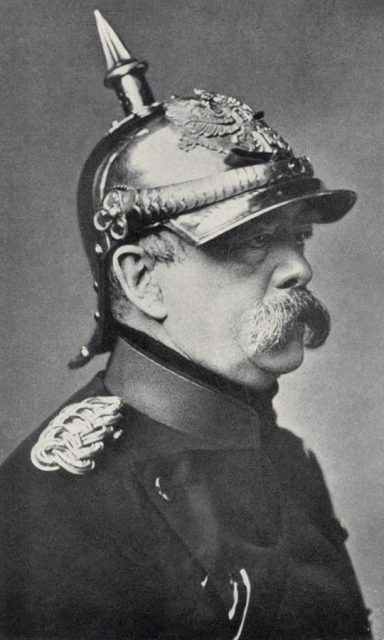
Otto von Bismarck wearing a cuirassier officer’s metal Pickelhaube.
 
The Germans started the war largely using their Pickelhaube or spiked helmets. These were visually impressive, but they were hard boiled leather and did little to stop bullets and shrapnel. The spikes actually made the soldiers easier to identify and target.
The German scientist Dr. Friedrich Schwerd designed the Stahlhelm, a helmet made of heated steel that covered the head and neck much better. It was loosely based on the sallet from the medieval period.
 
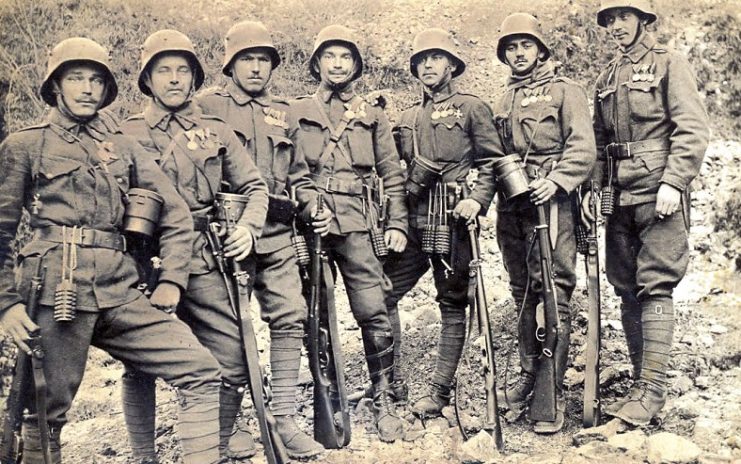
.Austro-Hungarian soldiers at the Isonzo front with Stahlhelms.
Austro-Hungarian soldiers at the Isonzo front with Stahlhelms.
 
After the Stahlhelm’s adoption by stormtrooper units and the general army at the Battle of Verdun, casualties due to shrapnel dramatically decreased, some historians estimating by as much as 70%.
Through 1940 and World War II, minor modifications were made to increase the durability and efficiency of the helmet while lowering the cost. The helmet became the distinctive feature of the German army through the war.
                             
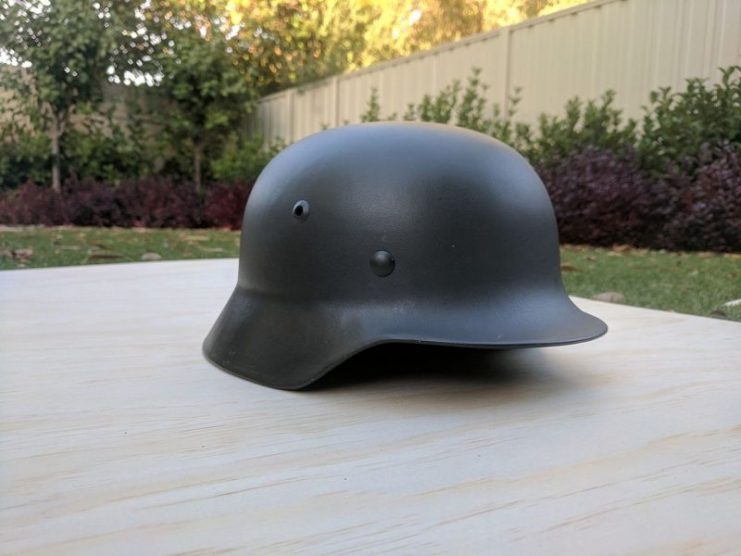
German Stahlhelm from World War II. Photo by DavidC88888888 CC BY-SA 4.0
German Stahlhelm from World War II. 
 
 Variations of the helmet are still in use today. It was a simple but effective tool for dealing with the shrapnel of modern warfare and set a high bar for other models.
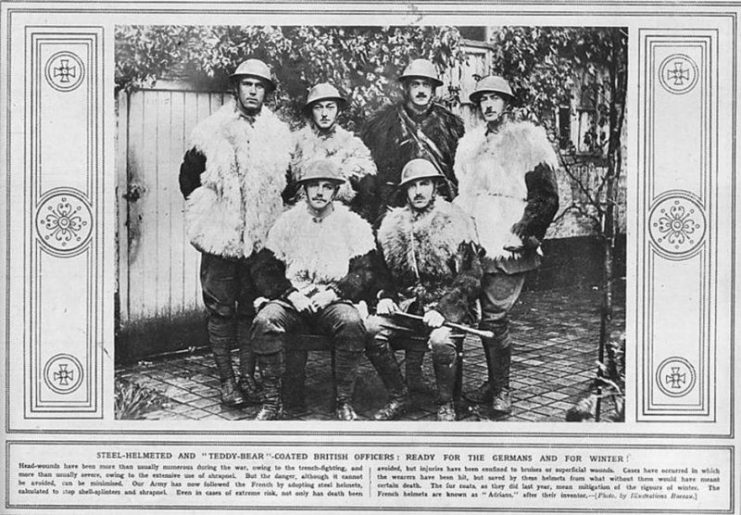
The French and British both saw the need for a helmet and fielded their own models in 1915. The British inventor John Leopold Brodie produced the most effective helmet.
Illustrated War News Nov 1915, a picture of officers wearing new Brodie helmets.
It was constructed in one piece by pressing one thick sheet of steel. This made it more durable and cheaper to build than both the French and German models. It was loosely based on the medieval kettle hat and has a distinctive wide brim.
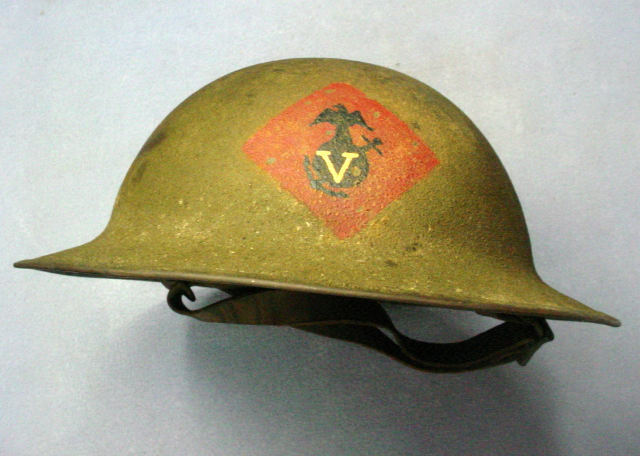
This was also used in the interwar period and part of World War II. Improvements included adding a better liner for the helmet and a stretchy chin strap until it was replaced by the M1 during World War II.
M1917 helmet worn by members of the 13th Marine Regiment (United States).
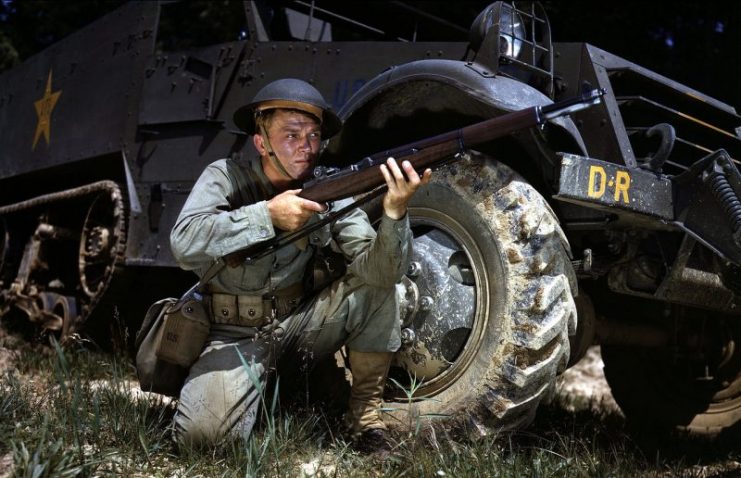
The M1 consisted of a hard outer shell that removed the wide brim of the Brodie, which soldiers complained was too sharp and light-reflective. It also had inner netting that could be adjusted to fit the helmet. It included two hooks for chin straps.
U.S. Army Infantryman in 1942 wearing a Brodie helmet.

There are no direct studies of which helmet was “best” and it often comes down to a matter of taste. The wide-brimmed Brodie tends to lose out to the Stahlhelm’s sleek look. A more definitive factor is how long they were in use.
The British Brodie was phased out in favor of the M1 and models based on it.
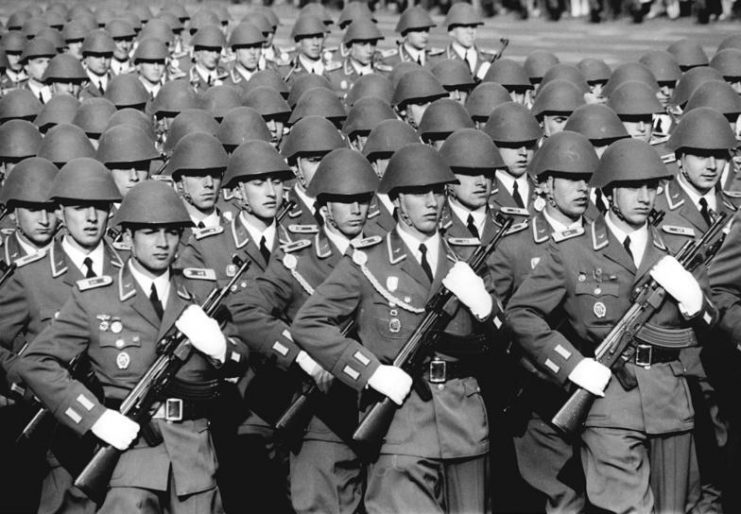
The Stahlhelm is still in use today which suggests it still has substantial value. The Stahlhelm has a harder shell as its production used a different process to make it tougher (but also more difficult to produce).
M1956 East German Stahlhelms. Photo Bundesarchiv, Bild 183-N1007-0009 / CC-BY-SA 3.0
M1956 East German Stahlhelms. Photo Bundesarchiv, Bild 
The M1 made a trade-off in that it has a slightly less hard shell than the Stahlhelm but has much better lining and padding inside the helmet. This helped paratroopers or anybody else receiving a concussion from bumping their head or having debris from artillery land on them.
Not only did it reduce head trauma, it also helped to save the soldier from shrapnel wounds.
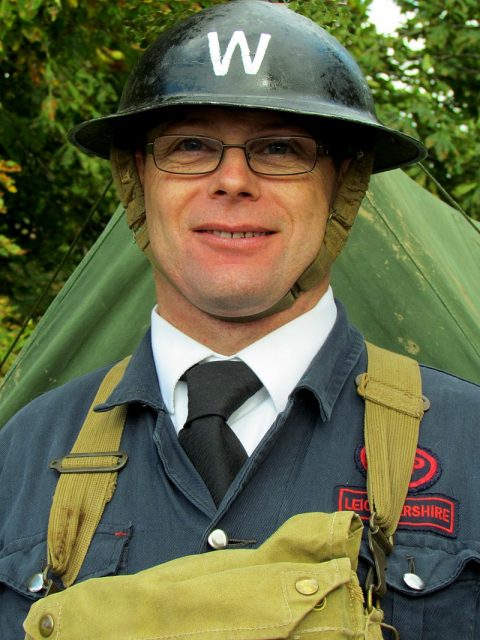
Air Raid Warden Village at War Weekend 2012, Stoke Bruerne, Northamptonshire. Photo by ozz13x CC BY 2.0
Air Raid Warden Village at War Weekend 2012, Stoke Bruerne,

Given the start of the helmet as a way to avoid shrapnel wounds in World War I, and the tendency of wars after World War II to be more low-intensity counterinsurgencies, the helmet that provides a good balance of protection from artillery as well as bumps seems the more useful.
In the final analysis, the Stahlhelm gets the advantage in World War II due to its harder shell, but ultimately loses out to the M1 which has a more useful balance of features relating to the different needs arising after World War II.


Saturday, May 25, 2019

Helmet Art from Vietnam

I have blogged before about Helmets and "Lucky Talismans" and helmets in general.  I remembered when I first got my helmet at my first dury station in Germany I immediately stuck my "LPS" bottle in the band around the helmet like I remembered seeing all the GI's doing during Vietnam.


 My squad leader told me "You can't do that crap any more".  So I had to take it out.  Oh well...


The Vietnam War tested the United States in new and horrid ways. Unprepared for guerilla tactics, dense jungles, and unwilling to interpret their foes’ actions as anything other than the working of Moscow’s efforts to expand Communism, the nation spent years in a conflict with no seeming end in sight.


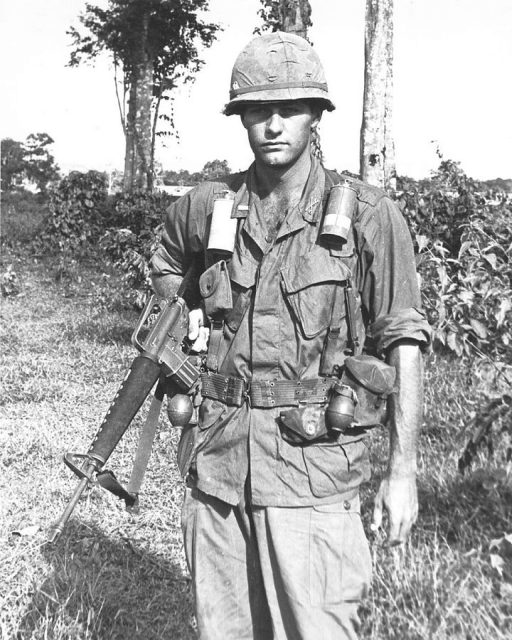
1st Lieutenant Thomas K. Holland, Troop D, 1st Squadron, 9th Cavalry, Vietnam.Date between 1966 and 1971
1st Lieutenant Thomas K. Holland, Troop D, 1st Squadron, 9th Cavalry, Vietnam.
Date between 1966 and 1971
Conscripted troops were constantly cycled through the war to prepare a generation for World War III, while politicians and commanders continually failed to understand the lessons learned in America’s previous guerilla campaigns.


For the troops on the ground, Vietnam was a humid hell filled with enemies and a people barely considered human. Part of any soldier’s equipment at the time included a helmet, called a steel pot by the troops and officially known as the M-1 helmet.


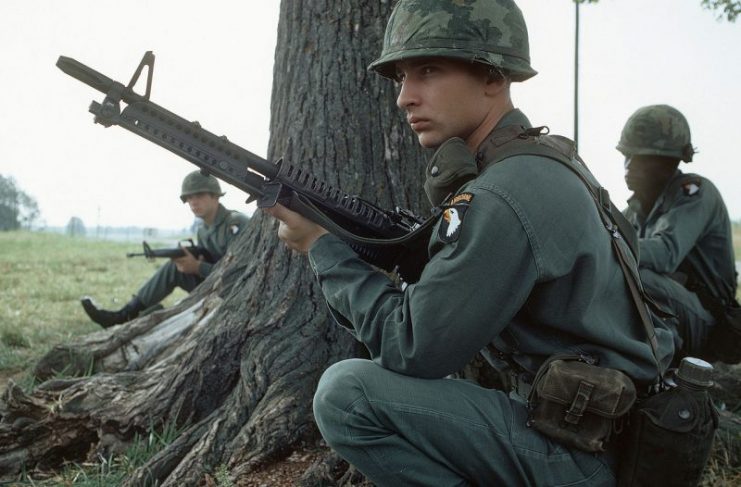
U.S. soldiers in 1972 wearing M1 helmets
The soldiers of Vietnam, being products of a time when the nation’s youth struggled to assert their individuality, started doodling on their helmets to express themselves.


Such antics were not new, as handfuls of soldiers did something similar during World War II. During Vietnam their work grew more prominent and noticeable. It also garnered more attention as outrage against the conflict, both among the troops and at home, increased.


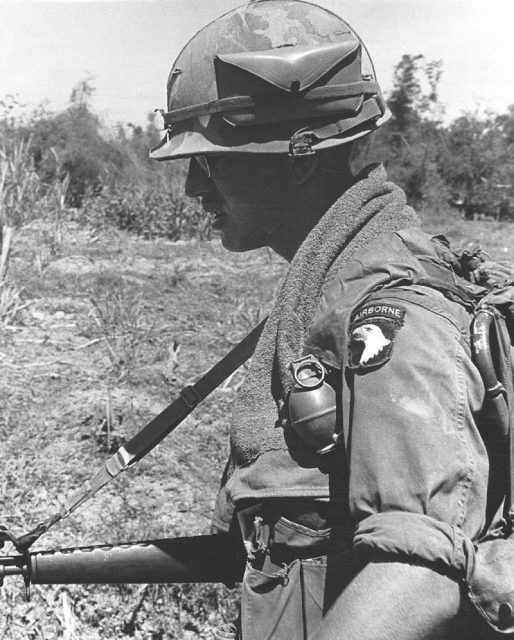
LT James F. Gregory, Platoon leader takes his men into a northern village, Company B, 1st Battalion (Airborne), 501st Inf., 101st Airborne. Division, Vietnam.
Such artwork drew media attention as early as June 18, 1965. Appearing in an Associated Press article by Pulitzer Prize-winning photographer Horst Faas, the photo caption noted Larry Wayne Chaffin of the 173rd Airborne Brigade, sporting a simple line across the bridge of his helmet: “WAR IS HELL.”


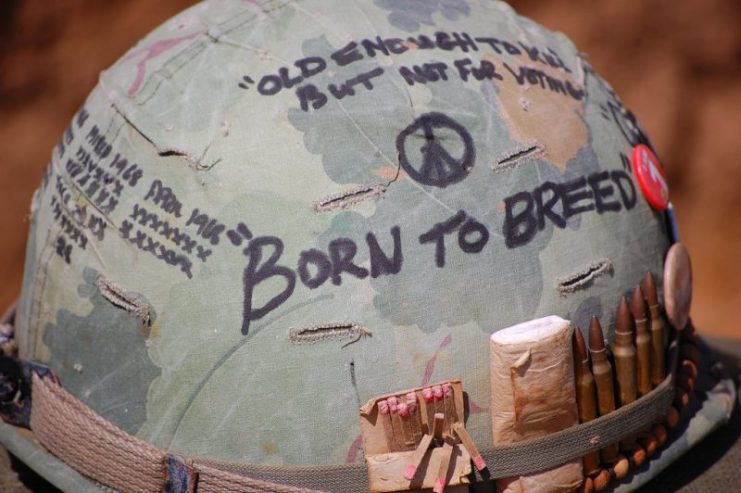
Vietnam Helmet “Born to Breed”. Photo: Lemsipmatt CC BY 2.0
Vietnam Helmet “Born to Breed”.
 
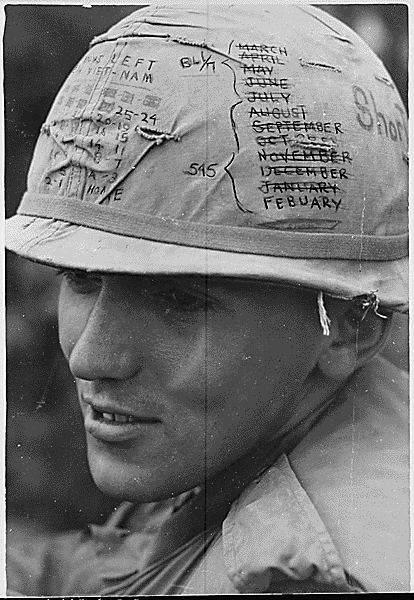
Simple calendars were a popular doodle, with soldiers jotting down the months of their tour and then crossing them off as time passed and they managed to live another thirty days. Such “short-timer” calendars were common among conscripts as they waited out their tours of duty.
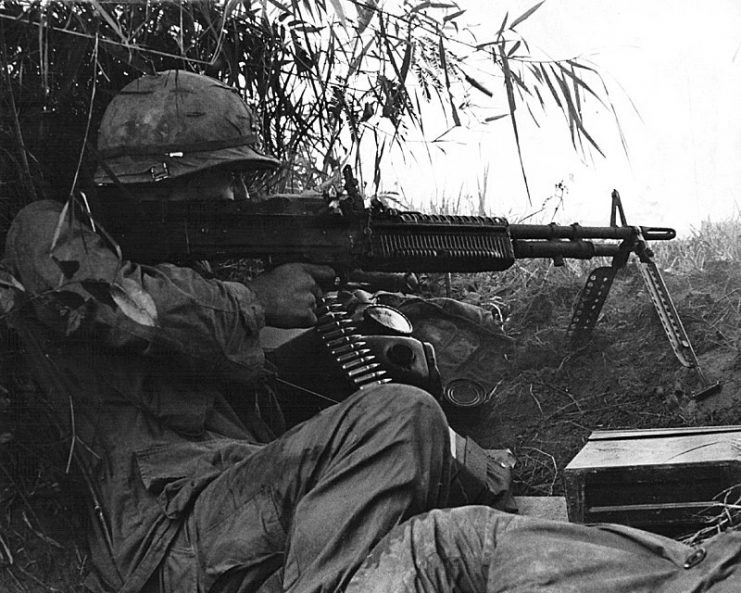
Sergeant Gerald Laird firing a machine gun, Company A, 1st Battalion, 502nd Infantry, 101st Airborne Division, Vietnam.
The media, latching on to the potential anti-war messages of such art, made sure to showcase it as the conflict continued. 
 
 
One photograph from 1966 showed John Wayne signing a soldier’s helmet. Many photos recorded phrases and remarks written on soldier’s helmets, ranging from mottos such as “In God We Trust” to satirical musings like “Born to Kill Die.”
Vietnam….A Sky Trooper from the 1st Cavalry Division (Airmobile) keeps track of the time he has left on his ‘short time’ helmet, while participating in Operation Pershing, near Bong Son.
Not all such writings made it to the news. Years later on a web forum, one veteran told the story of his art:
“My personal helmet ‘graffiti’ was the moniker ‘Teenage Killer.’ As a recruit in Marine boot camp, we were repeatedly told a story of Eleanor Roosevelt reportedly telling someone she had found Marines to be “over-sexed, under-paid, teenage killers.”
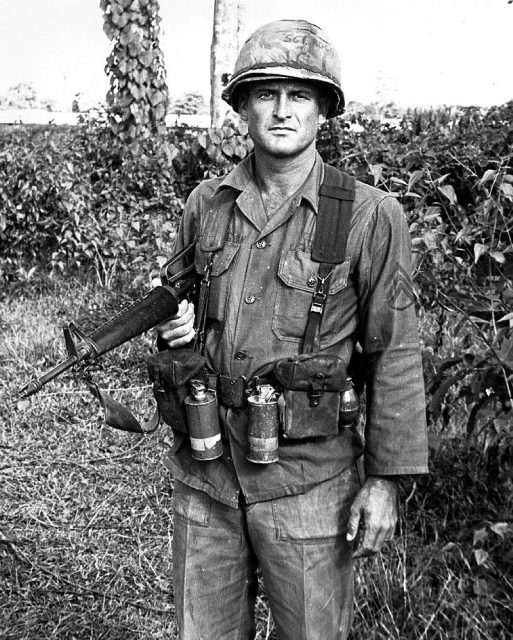
SSGT Russell C. Fordham, D Trp., 1st Sqdn., 9th Cav., Vietnam.
“One night, outside Da Nang, after imbibing a bottle of ‘Panther piss’, the phrase popped into my head and was promptly Magic-Markered onto the side of my ‘piss-pot’.
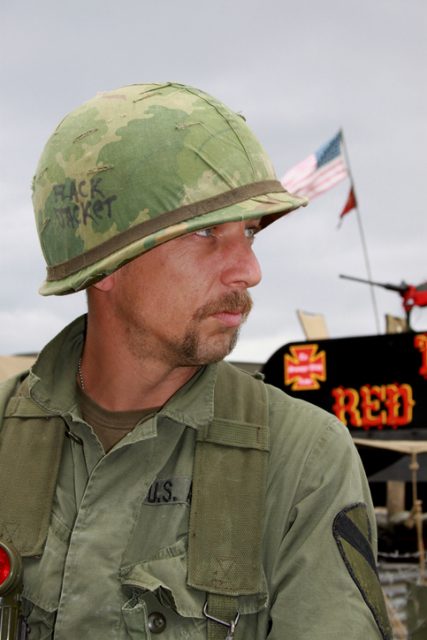
Vietnam Aircavalry soldier ,with stars and stripes behindhim.Re-enactor.
Vietnam Aircavalry soldier ,with stars and stripes 
 
“It was greeted with mixed reviews by the higher-ups and I was ‘asked’ to make myself scarce when photographers were in the area. Sometime later, I was ordered to remove the ‘offensive’ phrase from my helmet cover. This was accompanied by a new helmet cover.
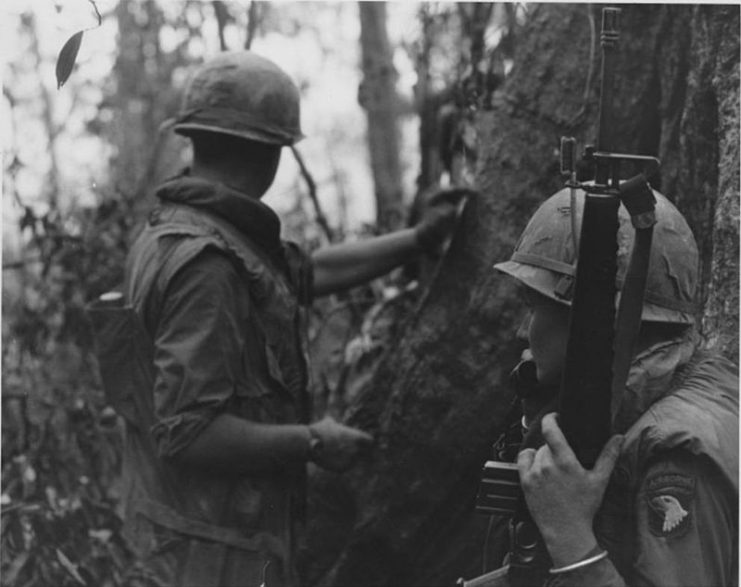
Troopers on patrol in Vietnam; radioing for communication.
“I ignored the order, and the new cover, and was given an Article 15. With a grin, the 1st Sgt replaced my ‘salty’ with a new greenie.”
From what I can tell, this happened after Vietnam because the mural is based on the movie "Apocalypse Now" was made in 1979.  I thought it was pretty cool art work.

Whether considered graffiti, artwork, or simply bored doodlings of young men forced to be soldiers in a land far from home, a soldier’s helmet was as much his life as his rifle.

Whether their writings veered toward the crude, satirical, devout, or rambling, such works allowed them to express themselves as they fought a conflict for motivations more than likely lost on a bunch of overgrown kids stuck in the jungle.
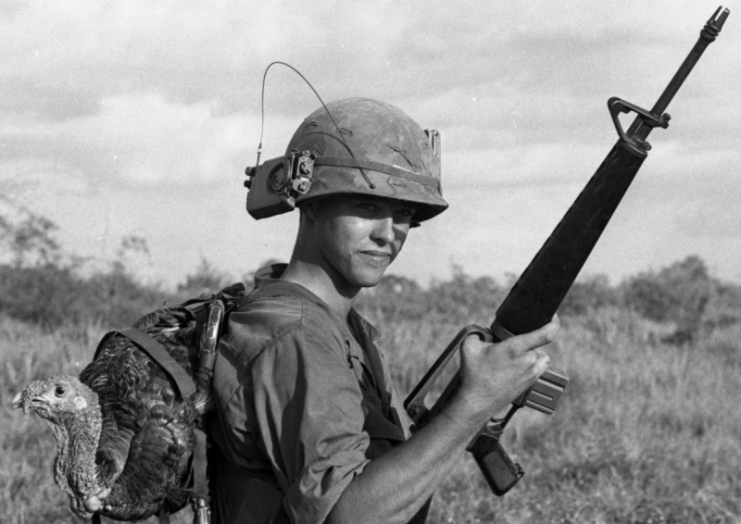
The turkey that found its way by helicopter to the 9th Infantry Division was destined for the nearby Bear Cat base camp. It was one of 57,000 sent in to provide as many as possible of the half-million Americans in Vietnam with the traditional holiday feast. Note Radio in Helmet band.

 Helmets were something personal for each solder, and especially in Vietnam the Helmet art became famous.

Friday, August 28, 2015

Helmet liners....M1 to Desert Storm....

I was surfing the internet and ran across this article about M1 helmet liners.  After reading it, I decided to drag my Army helmets out and see where they fell on this list.  


  The article is compliments of History Online..'

The M1 helmet was a unique and practical solution, compared to its contemporaries.
A separate lining system had many advantages. Being light weighted it could be used without the steel shell for guard or ceremonial duties, whilst the shell itself could also double up as a wash basin in the Field


An early liner made from compressed card.
The first liners were from the Hawley company. Distinctive in form and desirable to collectors, the Hawley liner mimicked the shell in form, and was made of compressed cardboard painted a light shade of khaki green in the inner. It was covered by a similar coloured cloth stretched over its outer surface and tucking under the rim into a bevel, a key characteristic of all Hawley liners.


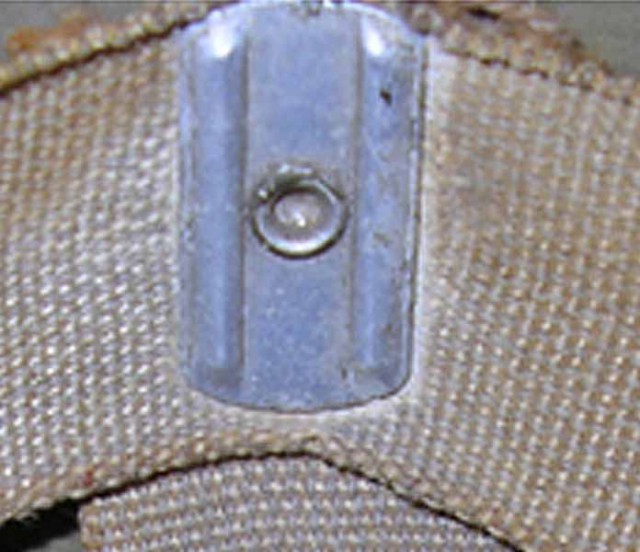
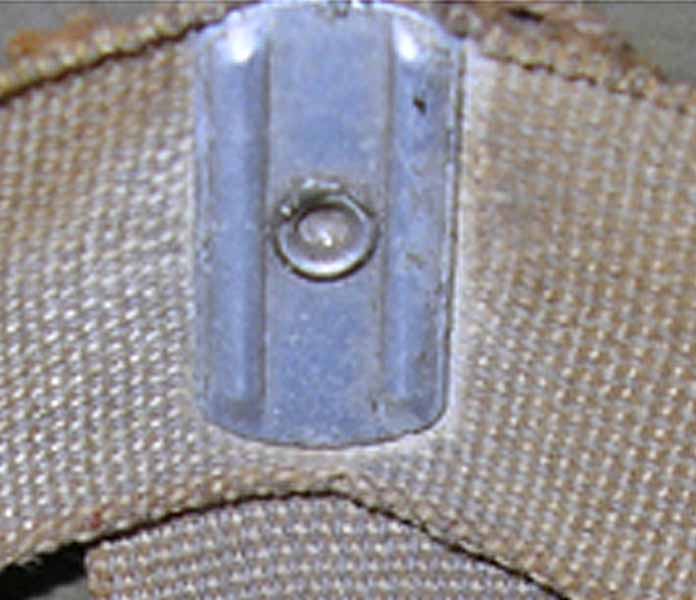
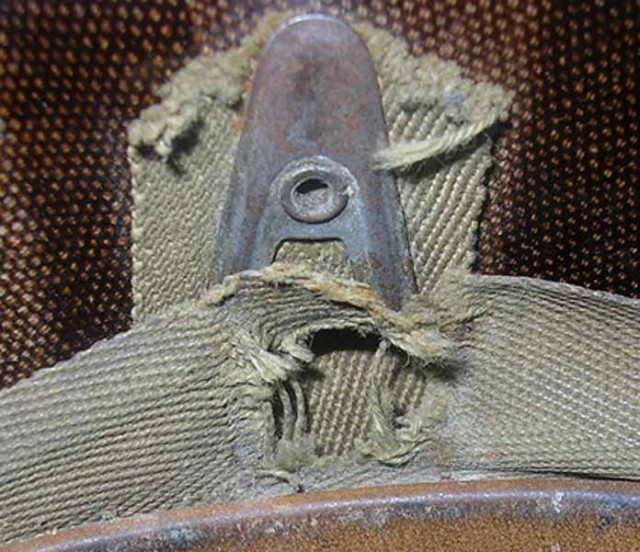
White rayon was initially used for the webbing, attached to the liner by rectangular aluminium washers. An adjustable and removable rayon sweatband was also clipped into position using poppers, and featured a leather lined forehead section.
Later Hawley examples featured light khaki herringbone twill webbing with ‘A’ washers. An improved sweatband was now fully faced in lea and clipped onto the webbing.
Due to their fragility and susceptibility to damp and humid conditions the Hawley liner was replaced in favour of what collectors termther Low Pressure liners.
M1 HELMET LINERS M1 HELMET LINERS
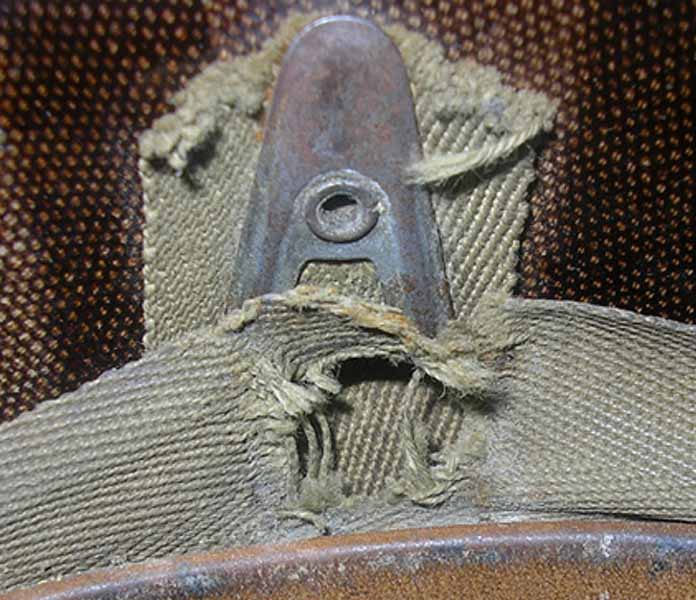
A composite showing different washers.
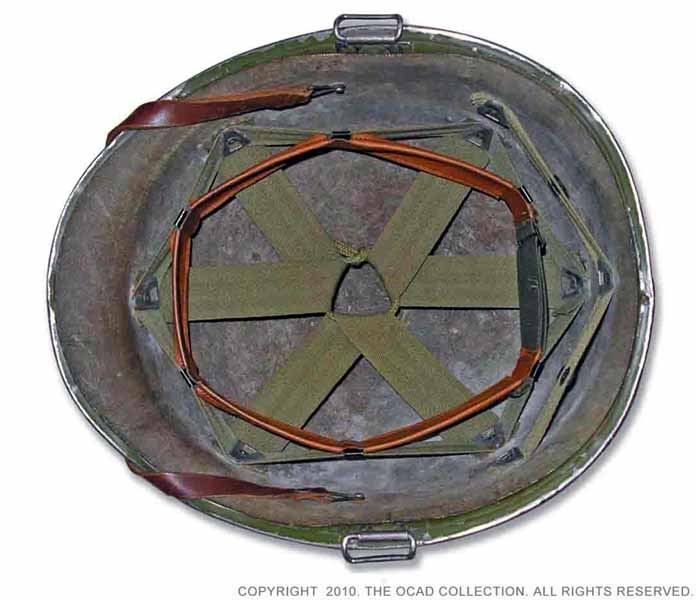
Low Pressure liners were made by the companies Hood and St Clair and were constructed of rubber fibre. The outer surface was painted olive drab and featured an air vent above the frontal rivet, a feature of all subsequent wartime liners. The air vent was also used to attach officer rank insignia. The interior was left unpainted. The material thickness is also notable thinner than all other liner variations. The webbing was as that used on later pattern Hawleys.
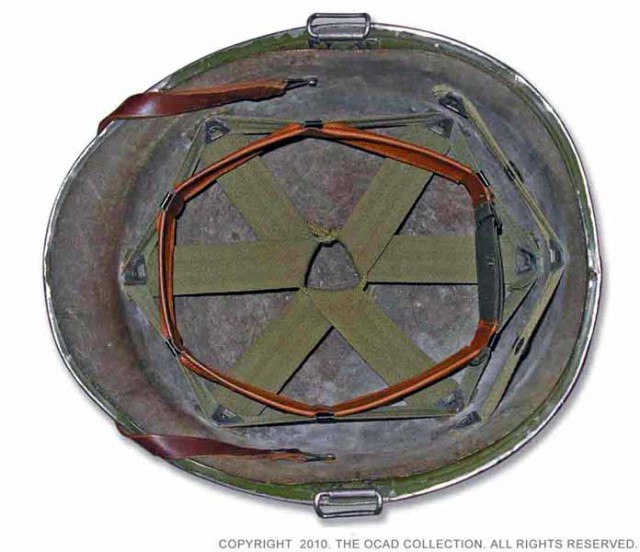
M1 HELMET LINERS
The dull finish of this liner is much different from the classic tortoiseshell look.
Similar to their cardboard cousins, the Low Pressure liner was soon also found to be inadequate for military use, with many later being refurbished as kid’s toys.
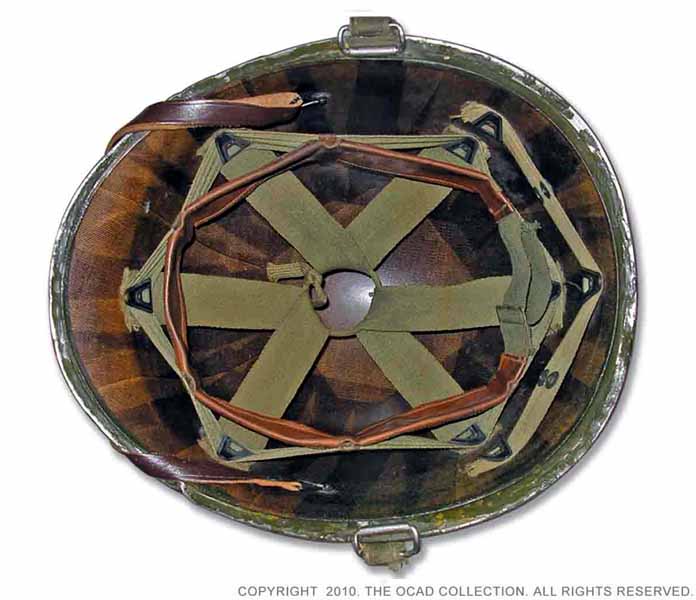
By late mid-war the High Pressure liners had generally replaced the older patterns and were manufactured by a host of companies. Such liner bodies were hard and made up of a composite fibre material, which could take some flexing but would split under increased pressure. As with all M1 liners their shape was a clone of the steel shell and fitted snugly into place. However it is not uncommon to see scuff marks or scratches, especially on the exposed rivet heads.
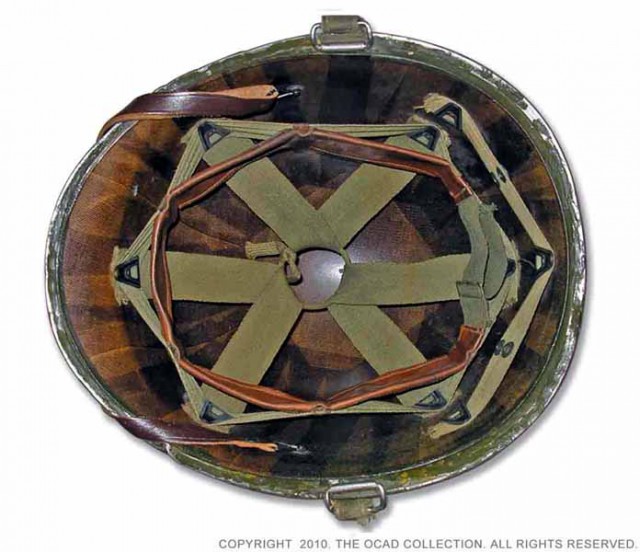
M1 HELMET LINERS
This liner’s tortoiseshell patterned interior has a classic look about it and is much sought after.
The outside surface of the HP liner was OD, reflecting the colour of the shell, but in some rare cases liners have been found where they were left unpainted. The inside of the body was left unpainted and has a ‘Tortoise-shell’ look.
It is not uncommon to find liners sporting regimental and or divisional crests and markings or even the outer surface painted in another colour; such as white for medics, military police (“Snow-drops”) or snow camo etc.
     Chinstraps were made from brown leather and featured a green metal adjusting clip, which later changed to black. After WWII the colour of the liner’s webbing also changed
to a darker green shade.
   Aside from the early examples made by Hawley, Hood and St. Clair, liners were also manufactured by Capac; Firestone; Inland; International Moulded Plastics; MSA; Seaman and Westinghouse. At the end of the war these companies resumed their peacetime role, with Capac supplying a limited number of liners for the Korean War period.


A Vietnam War period linerThe Vietnam War era liner was made from a thicker fibre that was more orange in appearance. It lacked an air vent and separate chinstrap, while the webbing arrangement was simplified. Instead of the helmet sitting low over the nape of the neck it was worn more level on the head. The M1 was finally replaced during the 1980s.

      Using this guide, I looked at my "old" helmet..
   I had this helmet before I joined the Army...this was my "play Army" helmet.  I really don't know where I got it from but I remember having it when I was "knee high to a grasshopper" to use a "southernism".

  I got the cover later on...I just had the "steel pot and liner sans cover."  It looks like a variation of the "Vietnam War helmet.
    
   This Helmet was what I was first issued when I got into country, I had this one for a week in Germany.
  Looks brand new....I never wore it.  I was sent back to C.I.F.(Central Issue Facility) to get more issue and they gave me this one...
  This the helmet that I was issued in 1986.  The cover was the "Woodland Camo" pattern at the time, I got the "Choco chip" pattern when I went to the Gulf.  They never asked me for the "steel pot" that I was initially issued and I hung onto it.  When I cleared C.I.F after my first tour, I turned in a "spare".  When you are stuck working in C.I.F  for 30 days you have opportunities...I snagged a "damaged" one while I was there and turned it in to clear C.I.F. and kept "mine".  When I went to my second duty station in Germany, I took the TA-50 and kept it in a dufflebag.  By this time I had purchased my own web gear and other stuff from Clothing sales and had modified it for me.  When I cleared C.I.F. for return to the world in 1991, I turned in the gear I was issued and never used.  I knew all the tricks that the C.I.F people used so I knew what to look for.  I also had a letter that my C.O wrote for all the G.I's out-processing, about "Fair wear and Tear" and the regulations that allowed for it. This kept us from having charges against our pay or having to go to clothing sales and buy new stuff to turn in so we could clear C.I.F.  He cared about the mission but he also made sure that the troops were taken care the best he could.  He was an outstanding officer and we would follow him to hell and back.   
        This is the webbing of the helmet.  it wasn't really comfortable...so many GI's would buy the circular foam padding from clothing sales to make the helmet more comfortable especially for long periods of wear.
    

In the U.S. military, the PASGT helmet was most commonly known by its wearers as simply the "Kevlar". The nickname has since been adopted for usage with other helmets. The PASGT helmet was also referred to by its wearers in the U.S. military as the "K-pot", similar in name to the colloquial nickname "steel pot" for the steel M1 helmet, which was in widespread U.S. military usage from the 1940s, to the 1970s, including the Vietnam War. The PASGT helmet was also, but less commonly, known by its wearers as the "Fritz" helmet for its resemblance to the Stahlhelm, which was the standard helmet used by the German military forces in the First and Second World Wars.

    All GI's had something on their helmet kinda like a "lucky Talisman".  I put this stripper clip guide on it when I first got in country and left it on....It is still there.  
I had found a piece of camo netting during a field exercise early in my career, it was green on one side and brown on the other and I stuck it in my gear.  When I would go on field exercises or alerts, I would pull out the camo piece and put it on the helmet and use the helmet band to hold it in place.  .  Well we got ready to go to the Gulf and they gave us the choco-chip helmet cover.  No DCU's, just the helmet cover ( We didn't get the Desert Combat Uniform until the war was over, so we fought the war in BDU's.  As I understand it later, the Iraqi's feared us because of the green uniform.  We had faced down their trainers in Europe, we were well trained and equipped and we had won.) Well when I got the Choco-chip cover, I changed out the "Woodland Camouflage",then I pulled out my piece of camo net and stuck it on my helmet, brown side out.  I know...it looked goofy but it is what I wore.  I was trying to break up the round outline of my helmet.  I also had some brown camo netting on the foregrip of my M16 Rifle.  Strange things G.I's do in a war zone.