Webster

The Constitution was made to guard the people against the dangers of good intentions." --American Statesman Daniel Webster (1782-1852)


Showing posts with label soviet. Show all posts

Thursday, October 23, 2025

The Best Propaganda Movie Ever Made

 I am reading Red Storm Rising.....again, LOL  I kinda touched on the subject on Monday's Music.


This movie was mentioned in "Red Storm Rising", as one of the movies used to inflame the passions of the Russian against the Invaders.  The movie is a production of the 1930's and the director was  Sergei M. Eisenstein. The characters are right out of a John Ford Movie,  The stand alone heroic figure in Prince Alexander Nevsky, the 2 buffoonish sidekicks and the expected love interest.   The German invaders are arrogant and mostly faceless behind helmets designed by Eisenstein.  The invading Germans have already partitioned Russia amongst themselves, one knight was made "Prince of Pskov", and in a horrible example of pacification, would throw babies on bonfires and kill anybody that resisted.    The battle was a truly epic affair on a frozen lake and the German knights attacked with casual disregard for tactics and the Russian peasants supurbly lead by Alexander Nevsky defeated the Germans in a cannae like maneuver then vanquished the leader in a one on one battle.  The rest of the movie resolved the love interests and liberated Pskov,  Alexander hoist a bunch of children onto the saddle as they ride in and disregarding any love interest, he started a sermon standing by himself and talking about what happens to those that invade Russia.  Alexander plays the strong father figure and he emulated Joseph Stalin mannerism, this was by design since Stalin commissioned the movie.


ALEXANDER NEVSKY

     In the 13th century, Russian lands suffer from foreign invasions.  The opening shows an undulating field with relics of a battle: moldering uniforms, human skulls with helmets and a horse's skeleton.  In 1242, attacks come from the East by Mongols and from the West by Teutonic Knights of the Holy Roman Empire.  The first sight of Alexander (Nikolai Cherkasov) is as a fisherman.  A courier arrives with news that neighboring Pskov has been conquered by Teutonic knights.  A Mongol governor in an impressive carriage escorted by soldier’s approaches.  Soldiers force the fishermen to kneel and answer questions.  When the soldiers consider the attitude of a young fisherman insolent, they whip him and a skirmish starts, but stops as Alexander approaches.  Alexander was known to the Mongols for having chased a Swedish army away.

     The Mongol ruler is looking for Alexander to propose for him to join his forces with the rank of captain.  Nevsky diplomatically refuses and replies: "Die in your homeland, don't leave it".  He intends to fish, build ships and trade.  Nevsky warns his followers that the Germans are a more dangerous enemy.  The scene shifts to Novgorod, busy with trade, the last unconquered city in Russia.  A pretty maid Olga (Vera Ivashova) is shopping for fabrics.  Two friends who have recently fought in battle, Vasily and Gavrilo (Nikolai Okhlopkov and Andrei Abrikosov) are looking at weapons made by Ignat, a Master Armorer (Dmitriy Orlov).They talk about wanting a peaceful life with a wife and family, and recognize Olga.  They are both attracted to Olga, and Gavrilo approaches speaks to her asking permission to send a matchmaker to her father.

    Gavrilo is serious and devoted, while Vasily is jolly and garrulous.  Vasily says he is just as interested, and asks Olga to choose between the two, but she smiles and says she needs time to think it over.  In the square in front of the church, a wounded warrior speaks to the crowd, giving news of the conquest of neighboring Pskov by the Germans, and telling of their bloody oppression.  More inhabitants join the crowd as various individuals give speeches.  Rich merchants want to purchase their liberty, but the common people want to resist.  Olga, Gavrilo, and others say they want Alexander as their leader to fight.  Despite opposition from the boyars and merchants of Novgorod, urged on by the monk Ananias, the crowd in Novgorod to decides to battle the invaders.

     Visitors from Pskov are present and wholeheartedly approve.  It is arranged for emissaries, led by Gavrilo to call on Prince Aleksandr Nevsky, who had led the battle against the Swedes, to organize a defense.  Nevsky is busy with fishing when the emissaries arrive, He first asks to be dressed in his prince costume, and receives the envoys.  He agrees to lead, but not for defense, as he prefers to attack.  He takes charge with the condition they all fight for Russia and not for themselves. Putting aside petty differences and issues, an army is raised from peasant volunteers.  The scene shifts to Pskov.  Pskov is burning, conquered with the help of the traitor Tverdilo.  The marauding occupation forces distribute the loot.

     The Grand Master of the Teutonic Order (Vladimir Yershov) speaks: a blond, cold, arrogant man of regal bearing and extreme pride.  The Teutonic knights feel invincible and have just a smug smile for the Russian women who witness helplessly how their fathers and sons are killed at the least sign of resistance.  When a prominent Pskov elder speaks in protest, he is bound in ropes. Before he is led to hang over the large fire, his daughter Vasilisa ( Aleksandra Danilova) pleads for his life but she is yanked off him and he is led to his death.  As punishment for resistance offered, children are ripped from their mothers arms and thrown in the fire while high dignitaries of the church look on.  Back in Novgorod, Nevsky arrives, and the inhabitants promise to make weapons and armor for a thousand fighters.  Vasilisa puts on a helmet and armor.  In scenes at the invaders camp, the invaders attend religious services and boast of wanting to bait the "Russian bear".

     On the Russian camp, Nevsky's plans are described. He decides to battle on the ice.  His men know the territory but the Germans, who are heavier, will break through the ice...Olga promises to marry whoever proves the more valiant of her two suitors, each of whom is given command of an important sector.  The night before the battle, the Russian troops gather on shore, and the old man tells a funny fable about how a hare trapped a wolf.  In the battle with the Germans, Nevsky uses his fisherman's knowledge of the ice as well as his experience of their military tactics to defeat them.  Battle scenes follow: masterful, repetitive, with people advancing, swinging weapons around, people riding horses, people getting bopped on heads, some arrows flying.  The Germans have heavier steel weapons, and more horses but the Russians have poles, hooks and axes of greater reach.  Close-ups of the battle concentrate on Vasily, Gavrilo, a blond youth, an old man, and Vasilisa, who come to rescue each other from time to time.

Wave after wave of advancing Germans are defeated, so they regroup and move in again.  After some give and take, the entire German fighting force forms a sort of fort surrounded by a shield wall, and sallies from the inner protected area take a heavy toll on the Russians.  In a wedge attack, Gavrilo breaks the shield wall, the fight continues inside the formerly protected area, and when attacked in a pincers movement from outside, they are forced to regroup and mass towards the West side of the lake, where the ice is thinner.  The turning point of the battle comes when Gavrilo battles single handedly against the Grand Master, a duel with ordinary fighters from both camps surrounding and watching

The old man who came to the battle is killed by treachery by Tverdilo after feigning surrender, and only because his iron shirt was too short and the knife pierced him in the open part of his neck.  In the disordered rout of the Germans, most knights are killed or drowned as the thin ice cracks and breaks.  At the end of the battle, heaps of corpses are plunged in cosmic light under an endless horizon.

    At nightfall, Olga and other women search with torches for survivors.    A devoted falcon sits on his master's dead body while a crow waits for the right moment to pick out the eyes of the deceased.  The song after the battle as Olga is looking for her suitors is emotionally devastating.  Olga finds Vasily and Gavrilo, wounded and unable to walk without help, and holds them up as they walk very slowly back.  In the early morning, victors and vanquished file into the walled area of the town, first the dead, then the prisoners, and finally the victors Slain heroes are conveyed on sleds, burning candles in their hands.  The most striking is the blond youth, shown on the screen in profile from head to hands.  The wind is blowing and his blond hair is dancing in the wind, in tune with the flicker of the candle flame.

     At the end, Nevsky displays his generosity, as he pardons and frees the foot soldiers and keeps the knights as prisoners for ransom.  Only the bearded traitor Tverdilo and a traitorous cleric who played organ are turned over to the mob.  We see the gloomy faces of the angry Russians who had lost their relatives in the battle, and when they start tearing the traitor apart.  The trials have ended. The time for celebrations arrives.  Vasily publicly states that neither he nor Gavrilo was the bravest in battle: that honor goes to Vasilisa, and that after her came Gavrilo.  Vasilys mother (Varvara Massalitinova) objects that her son has never been second to anyone, but Vasily respectfully insists.  Gavrilo and Olga are united, while Vasily chooses Vasilisa as his bride to be, with her consent amply expressed in body language, and his mother acquiescing with broad smiles.  Nevsky gives a final warning: He who comes to Russia with sword in hand will die by the sword.

Eisenstein made Alexander Nevsky, his first completed film in 10 years, during the Stalin era, at a time of strained relations between the Soviet Union and Nazi Germany. The film contains elements of obvious allegory that reflect the political situation between the two countries at the time of production. Some types of helmets worn by the Teutonic infantry resemble mock-ups of Stahlhelms from World War I. In the first draft of the Alexander Nevsky script, swastikas even appeared on the invaders' helmets. The film portrays Alexander as a folk hero and shows him bypassing a fight with the Mongols, his old foes, in order to face the more dangerous enemy.

The film also conveys highly anti-clerical and anti-Catholic messages. The knights' bishop's miter is adorned with swastikas, while religion plays a minor role on the Russian side, being present mostly as a backdrop in the form of Novgorod's St. Nicholas Cathedral and the clerics with their icons during the victorious entry of Nevsky into the city after the battle.

The film stemmed from a literary scenario entitled Rus, written by Pyotr Pavlenko, a Soviet novelist who conformed to socialist realist orthodoxy. The authorities could rely on Pavlenko, in his role of "consultant", to report any wayward tendencies on Eisenstein's part.

Alexander Nevsky stresses as a central theme the importance of the common people in saving Russia, while portraying the nobles and merchants as "bourgeoisie" and enemies of the people who do nothing, a motif that was heavily employed.

Teutonic knights take over Pskov

While shooting the film, Eisenstein published an article in the official newspaper of record Izvestia entitled "Alexander Nevsky and the Rout of the Germans". He drew a specific parallel between Nevsky and Stalin. As a result, the Kremlin requested an advance screening and, without Eisenstein being consulted, his assistants showed the footage to the General Secretary. During the process of this screening, one of the reels, which featured a scene depicting a brawl among the populace of Novgorod, disappeared. Whether it was left behind in the editing room inadvertently or whether Stalin saw the footage and objected to it, the filmmakers decided to destroy the reel permanently, since it had not received Stalin's explicit approval. Stalin was reported to be very happy with the cut of the film he was shown.

The picture was released in December 1938, and became a great success with audiences: on 15 April 1939, Semen Dukelsky – the chairman of the State Committee for Cinematography – reported that it had already been viewed by 23,000,000 people and was the most popular of the films made in recent times.

After 23 August 1939, when the USSR signed the Molotov–Ribbentrop Pact, which provided for non-aggression and collusion between Germany and the Soviet Union, Alexander Nevsky was removed from circulation. However, the situation reversed dramatically on 22 June 1941 after the Axis invasion of the Soviet Union, and the film rapidly returned to Soviet and western screens.

I pulled this off "Wiki"

Literature

Wednesday, October 22, 2025

"The Cuban Missile Crisis" Krushchev Last Bluff?


 I have a book in my collection called The Pentovsky Papers , In this book the person had a low opinion of Nikita Khrushchev, as I recall it, he used the words "Wore the uniform as a potato sack".  Nikita Khrushchev was sent to Stalingrad where Colonel Penkovsky was a Lt of mortermen at the time and Khrushchev was a political commissar who enforced  Stalins order Order Number 227 of "no Retreat" and was quite brutal about it according to Lt Pentovsky.  If you want to get an idea of how Kruschev was, watch Bob Hoskins play him in "Enemy At The Gate", as I understand it, he did a pretty accurate job of it.


   I will try to publish the other thing I am working on tomorrow.   Yes it is Soviet related.


On a routine U-2 reconnaissance flight over Cuba, to see what sort of mischief Fidel Castro was up to, the plane’s cameras caught images of the construction of missile launch pads for offensive missiles.

In October of 1962, the world held its breath as two nuclear superpowers squared off. Was this going to be the beginning of World War three and a nuclear nightmare? Did Khrushchev really have the nuclear capability that Tass claimed he had, or was it just a bluff? Fortunately, through many backdoor meetings, the issue was resolved without a missile being launched.

There have been many books, articles and narratives that have been written that describe the events and the backdoor negotiations that resolved the issue. What was at issue was that Soviet Premier Nikita Khrushchev feared that the United States had a commanding arsenal of nuclear tipped missiles aimed at the Soviet Union. To even the odds Khrushchev developed a plan to place Soviet offensive missiles and technical support soldiers in Cuba.

The ships that brought the weapons and support equipment carried false shipping documents of the cargo they carried which enable the Soviet and Cuban soldiers to get a jump start that would have in place alongside their defensive missiles offensive missiles all aimed at the United States.

Through many backdoor communications between Attorney General Robert Kennedy and Soviet Ambassador Anatoly Dobrynin, an agreement was forged to remove the Soviet missiles from Cuba and the United States at some future date would remove the 30 Jupiter-C missiles from Italy and the 15 Jupiter-C missiles from Turkey.

Khrushchev appeared too easily to back down and give up an advantage he supposedly had. If the Soviet Union was producing nuclear tipped missiles “like sausages” then he should have had a better bargaining chip. Only a few weeks earlier Tass reported that the Soviet Union had sufficient powerful rockets carrying nuclear warheads based within the Soviet Union that it did not need to search for sites beyond their borders. If the Soviet Union had such nuclear capability why did Khrushchev back down?


Joseph Stalin and Nikita Khrushchev(1936)


During World War Two, Joseph Stalin was anxious to get his hands on western weapons technology. His numerous T-34 tanks were winning the battlefield. But in aircraft the West’s technology was leaving the Soviet Union far behind. The incident that gave him any hope to catching up with western technology was the arrival of three B-29 bombers that had diverted to Vladivostok because of battle damage after a raid on Japan. Here was the golden opportunity to reverse engineer the planes and create the Soviet Union’s own version.

The first flight of the Tupolev TU-4 was on May 19, 1947. While Stalin now had a heavy bomber to carry the nuclear weapons that were being developed, he was still far behind the curve. The United States rolled out the massive intercontinental heavy bomber, the XB-36, on September 8, 1945. First flight was August 8, 1946, about ten months before the TU-4 flew. And while the TU-4 would have been classified as a heavy bomber in World War Two, its normal bomb load was usually 6 – 2205 lbs (13,230 lbs.) general-purpose bombs. In comparison the B-36 bomb load was 76,000 pounds. Stalin had a bomber that could possibly dominate Western Europe, but the TU-4 was becoming obsolete in comparison to the B-36. And any bombing mission against the United States would be a one-way trip since the TU-4 did not have the fuel capacity for a round trip and the Soviet Union did not have a long-range fighter escort to protect the bombers from American defensive fighters. The vaunted Mig-15 was a short-range defensive fighter only.

More ominous was the all jet powered XB-47, which rolled out of the factory on September 12, 1947, with its maiden flight on December 17, 1947, just 7 months after the first flight of the TU-4. Beginning in 1953 the reconnaissance version RB-47B’s routinely overflew western Soviet airspace taking pictures of airfields and other military installations. Also Great Britain’s Royal Air Force would routinely “borrow” thèse reconnaissance planes for its flights over the western territories of the Soviet Union as far as Moscow. At first these flights were uncontested, since the Soviet Air Force’s Mig-15 could not operate effectively at the higher altitudes. However, with the appearance of the Mig-17 in 1953, the Soviet Air Force could operate at such altitudes and routinely shot at and even downed an RB-47.

With Stalin’s death in March of 1953, Nikita Khrushchev came to power. The West knew very little about Khrushchev other than he was short, portly and wore ill-fitting suits. Likewise, Khrushchev knew very little about the United States and President Eisenhower.


His first face-to-face meeting with a representative of the American government was on July 24, 1959 at an exhibit put on by the American Consulate in Moscow, on the modern American Kitchen. There he squared off against Vice President Richard Nixon. In the ensuing “The Great Kitchen Debate”, Khrushchev and Nixon discussed the relative merits of America’s technology to create a modern kitchen, which would ease the burden on American housewives. Khrushchev countered by saying that the Soviet kitchens were built to last and don’t need to be continuously upgraded.

His second meeting was in September 15 – 27, 1959, when he invited himself and his son, Sergei, to visit the United States and meet with President Eisenhower. While in America, he was again escorted by Richard Nixon. While he was able to visit Hollywood (but not Disneyland) and would have loved to tour a defense plant, his greatest discoveries were at Iowa State University test farms. There he saw professors working directly with farmers to improve their crops. His attempt to create a similar program in the Soviet Union failed due to the professors wanting to stay at their desks in the comfort of the universities and not go into the field and get their hands dirty working with the farmers.

With John F. Kennedy’s defeat of Richard Nixon in the 1960 presidential race, Khrushchev now had to become familiar with a new president.


On October 4, 1957, the Soviet Union launched Sputnik 1 into orbit around the earth. This was the first manmade object to be placed into orbit around the earth. Khrushchev hailed this as the technological superiority of the Soviet Union over the United States. He followed up Sputnik 1 with Sputnik 2 on November 3, 1957.

America’s answer to Sputnik 1 was spectacular launch failures of the US Navy’s Vanguard on December 6, 1957 and on February 5, 1958. The Vanguard rocket was developed from a research rocket giving the illusion that the satellite was to be used for peaceful purposes. With the Navy’s failure to launch Vanguard into orbit President Eisenhower authorized the US Army to use the Redstone/Jupiter-C missile to launch Explorer 1 into orbit on January 31, 1958. Finally, Vanguard made a successful launch on St. Patrick’s Day, March 17, 1958. Vanguard has the last laugh since it was able to transmit data for 5 years and is still in orbit while the Sputniks and Explorers have long since burned up upon re-entry into the atmosphere.

In a further embarrassment to the United States, the Soviet Union using an R-7 missile launched Cosmonaut Yuri Gagarin into earth orbit on April 12, 1961. Once again Khrushchev proved to the world the technological lead the Soviet Union had over the United States.

In response to these Soviet achievements the fear of a missile gap existed between the United States and the Soviet Union. President Eisenhower convened a committee chaired by Ford Foundation Chairman H. Rowan Gaither. The Gaither Report of November 7, 1957, stated that the United States was in danger of falling behind the Soviet Union and suggested that the United States begin a massive investment in strategic weapons, early warning radars ands civil defense measures. The report stated that the Soviet Union “will probably achieve a significant ICBM delivery capability with megaton warheads by 1959”.

A CIA document “Special National Intelligence Estimate, Number 11-10-57, The Soviet ICBM Production” estimated that the Soviet Union would have at least ten ICBMs available between mid-1958 to mid-1959, with 100 more ICBMs by 1960 or 1961 with 500 available by 1962. In comparison by the end of 1960 the United States had 97 Atlas Missiles, 54 Titan 1 missiles, and 30 Snark missiles deployed.


Soviet Missiles


The missiles available to Khrushchev were the R-7 (SS-6, Sapwood), R-12 (SS-4, Sandal) and the R-14 (SS-5, Skean). Only the R-7 could be based in the Soviet Union. The R-12 and R14 were intermediate range ballistic missiles and were to be based in Cuba.

R-7 Missile (SS-6 Sapwood)

The R-7 missile was a first generation ballistic missile. It had a range of approximately 9,000 miles and could carry a 3-5 megaton nuclear warhead. As a first generation missile, it took 22-24 hours to prep a cold missile before it could be fired. Because of the caustic nature of its fuel, it could only be held on the launch pad for 24 hours. After 24 hours the missile would have to be refurbished mostly with new seals that were damaged by the caustic nature of the fuel. If an attempt were made to launch a missile that had been sitting on the launch pad longer than 24 hours there would be a good chance of a spectacular failure, contaminating the area with nuclear materials from the warhead.

Sources differ on the number of launch pads available to launch an attack against the United States. Thirty launch pads were planned but only 5 were ever constructed.

R-12 (SS-4 Sandal) and R-14 (SS-5 Skean) Missiles

The R-12 and R-14 were liquid fueled, intermediate range, ballistic missiles. They had a range of 1200 miles for the R-12 and 2700 miles for the R-14. The R-12 carried a one-megaton warhead and the R-14 a two-megaton warhead. It took one to three hours to prep a cold missile. These missiles based in Cuba could target almost anywhere in the United States. Forty launchers were planned – 24 for the R-12 and 16 for the R-14. These missiles, so close to home, posed a real threat to the United States.

United States Missiles


The missiles available to the United States were the Jupiter-C, Thor, Atlas, Titan and Polaris. The SM-62 Snark had been removed from service.

SM-78 Jupiter-C Missile

The Jupiter-C missile was a liquid fueled, intermediate range ballistic missile with a range of about 1850 miles carrying a one-megaton nuclear warhead. The missiles were somewhat portable in that it was possible to move to them to different prepared sites. There were 15 of these missiles deployed in Turkey and 30 were deployed in Italy.

SM-75 Thor Missile

Like the Jupiter-C missile the Thor missile was a liquid fueled intermediate range ballistic missile with a range of about 2000 miles. It carried a 1.44-megaton warhead. Under Project Emily, 84 of these missiles were based at Royal Air Force bases in Great Britain in semi harden sites. These missiles could be launched in 15 minutes. During the Cuban Missile Crisis, 59 missiles were ready to be launched by Royal Air Force crews.

SM-65 Atlas Missile

The Atlas missile was America’s first intercontinental ballistic missile, a slightly improved first generation missile over the Russian R-7. It was liquid fueled and had a range of 5500 miles carrying a nuclear warhead. It was stored in a semi protective coffin and the last models could be ready to be raised and fired in 15 minutes. There were 139 Atlas missiles available.

SM-68A Titan 1 Missile

The Titan 1 missile was America’s second intercontinental ballistic missile. It was built as a backup to the Atlas missile and like the Atlas it was liquid fueled and had a range of 5500 miles with a nuclear warhead. It was housed in an underground silo, but had to be raised to the surface to launch. During the Cuban Missile Crisis there were 45 Titan 1 missiles aimed at the Soviet Union.

UGM-27 Polaris Missile

The UGM-27 Polaris missile was a submarine-launched nuclear ballistic missile. This was a second-generation ballistic missile. It used solid fuel making it safer to handle and did not need to be fueled prior to launch. It had a range of 1000 miles and carried a 600-kiloton nuclear warhead. One notable characteristic of the missile was that it could be launched while the submarine was submerged. Sixteen missiles were carried in specially built submarines of the George Washington class. There were five submarines in this class

The Polaris A1 missile was succeeded by the Polaris A2 missile, similar to the A1 but with a range of 1500 miles. Sixteen of these missiles were carried in the new Ethan Allen class submarines. At the time of the Cuban Missile Crisis four of these submarines were available.

These submarines could hide anywhere in the vast oceans. There were a total of 144 Polaris missiles available.


Soviet Union: 45 (not all deployed)

United States (and Great Britain) 432

Perhaps this was the major reason he chose to end the crisis. Khrushchev was trying to bluff Kennedy and the world but had to back down due to the simple fact he did not have sufficient missiles that could target North America versus the massive firepower that could be brought to bear against the Soviet Union. His earlier bluffs and posturing gave the world an image of the Soviet Union’s over whelming technology lead over the United States and Western Europe. But when Kennedy called his bluff he had to back down.


Within two years, Khrushchev was out of power, when on October 14, 1964, the Presidium and the Central Committee each voted to accept Khrushchev’s “voluntary “ retirement from his offices. Brezhnev was elected First Secretary

Tuesday, January 3, 2023

Soviet Era Cruise Missiles used to attack Russia from the Ukraine


The Tu-141

The Tu-141 was designed as a reconnaissance system that could see hundreds of kilometers behind enemy lines.

Credit: Piotr ButowskI

On Dec. 5, Russia planned a series of air strikes against Ukraine’s energy infrastructure, similar to others it had conducted periodically. Tupolev Tu-95MS bombers and Tu-22M3 bombers—from Russia’s Engels and Dyagilevo air bases, respectively—were preparing to attack that day.

But at 6:04 a.m. local time, according to a recording from a city surveillance camera at Engels, explosions rocked the air base.

Located just east of the Volga River, Engels houses the 121st Heavy Bomber Aviation Regiment, which includes 16 Tu-160 and about 20 Tu-95MS strategic bombers. Initial social media posts said that a fuel truck standing next to the aircraft had been hit and that two Tu- 95MS bombers were destroyed in the explosion.

A satellite image published by Planet shows one Tu-95MS aircraft next to what appear to be burn marks and firefighting foam.

The strike was likely the handiwork of a Ukrainian Tupolev Tu-141, a Soviet-era reconnaissance uncrewed aircraft system (UAS) that was refashioned into a cruise missile.

But how could Ukraine hit targets hundreds of miles from its borders, deep in Russian territory? In addition to the strike at Engels, another took place at Dyagilevo air base, located near Ryazan, southeast of Moscow. The 43rd Center for Combat Application and Training of Aircrew for Long-Range Aviation there includes several Tu-95MS and Tu-22M3 bombers as well as Tu-134 and Antonov An-26 training aircraft.


Leaked photos posted on the internet on the evening of Dec. 5 picture a Tu-22M3 bomber at Dyagilevo with a damaged rear part of the fuselage, engines and tailplanes. Judging from the RF-34110 registration, the aircraft belonged to a unit in Shaykovka.

In the photo, an APA-80 vehicle—a generator providing power to the aircraft—stands next to the Tu-22M3 bomber, which has a heavy Kh-22 or Kh-32 missile suspended under the wing. This indicates the aircraft was being prepared for a combat flight.

On Dec. 6, again at 6 a.m. local time, another strike on a Russian airfield took place, this time at the Kursk-Khalino air base, and the fire it caused burned for hours.

The 14th Fighter Aviation Regiment, with Sukhoi Su-30SM fighters, is stationed in Kursk, about 100 km (62 mi.) from the Ukrainian border. A group of Su-35S fighters and Su-25 attack aircraft also are deployed there. This attack was the most successful of all.

Ukraine’s preemptive strikes on airfields did not prevent Russia from launching an air strike against Ukraine in the early afternoon of Dec. 5. The Russian Defense Ministry reported that “the massive strike was carried out despite the attempts of the Ukrainian side to disrupt the combat work of Russian long-range aviation.” All 17 designated targets were hit by air-launched and naval missiles.

The Ukrainian Defense Ministry says Russia fired 70 missiles that day, of which “more than 60” were shot down. Eight Engels-based Tu-95MS strategic bombers, flying over the Caspian Sea and over the Rostov Oblast in Russia, fired 38 Kh-101/Ch-555 cruise missiles, while ships from Russia’s Black Sea Fleet fired 22 Kalibr cruise missiles. Tu-22M3 bombers flying over the Black Sea attacked with three Kh-22 missiles, while tactical aircraft fired six Kh-59 missiles and one Kh-31P.

Ukraine has not confirmed that its armed forces carried out the attacks against these Russian long-range aviation bases. Then again, it did not confirm the Oct. 8 attack on the Kerch Bridge connecting Crimea with Russia or other attacks. But there is little doubt Ukraine was behind the attacks.

“[Ukraine] attempted to strike with Soviet-made jet drones against Dyagilevo and Engels airfields,” the Russian Defense Ministry said in a statement. “Ukrainian drones flying at low altitude were intercepted.”

Three Russian soldiers were killed and four injured by “pieces from Ukrainian drones,” the ministry said. The reference to “Soviet-made jet drones” points to one specific type: the Tu-141 Strizh (Swift) UAS. It is the only UAS available in Ukraine with the capability to perform such an attack.

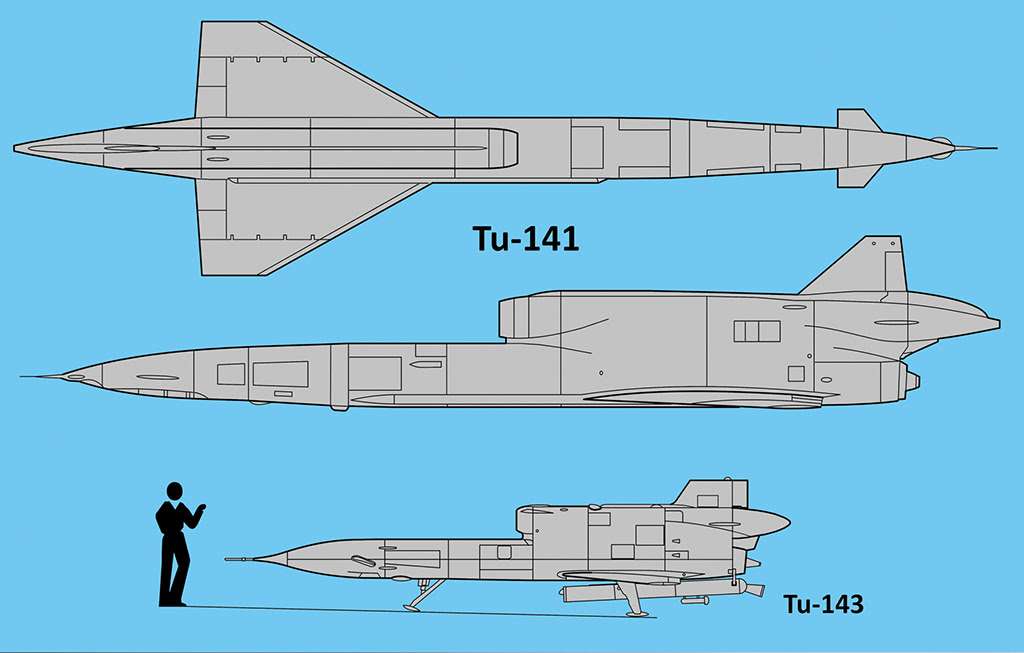
The Tu-141, part of the VR-2 Strizh reconnaissance system, is a theater-level UAS for reconnaissance missions as far as several hundred kilometers behind the front line. Its design began in 1968, along with the similar but much smaller Tu-143. The Tu-141 made its first flight in December 1974. From 1978 to 1990, a manufacturing facility in Kharkiv, Ukraine, produced 152 of the aircraft. A plant in Kumertau, Russia, produced 950 of the smaller Tu-143s.

The Tu-141 takes off from a wheeled platform with the help of rocket accelerators. It has a range of 1,000 km along a preprogrammed route, with several turning points and altitude changes, overcoming air defenses at low altitude, from 50 m (165 ft.), at a speed of 1,100 kph (685 mph).

To convert the reconnaissance UAS into a cruise missile, the Ukrainians would have had to replace the guidance system. The missile is likely guided by inertial navigation, perhaps with updates via satellite navigation. This is the simplest variant. They likely also installed a warhead in place of reconnaissance equipment. The Tu-141 weighs 5,370 kg (12,000 lb.), which makes it possible to estimate the weight of the combat load as 500-1,000 kg.

Tu-141s have been used by Ukraine on other missions in this war, so it would not be surprising for Ukraine to have used them to hit military airfields deep in Russia. On March 10, an “unknown object,” which turned out to be a Ukrainian Tu-141, crashed in Zagreb, the capital of Croatia; undoubtedly the aircraft’s navigation failed. On March 11, another Ukrainian Tu-141 crashed or was shot down over Crimea. On May 6, the remains of a smaller Tu-143 Reys were found in the Kharkiv region. On June 28 and then on July 3, Ukrainian Tu-143 drones unsuccessfully attacked targets in the Kursk region.

The Russians appear to have used a Tu-143 Reys on April 11, probably as a decoy target to initiate Ukrainian air defenses.

However, Russia’s assertions do not constitute proof that the attacks on Russian military airfields were conducted by Tu-141 Strizh UAS.

Ukraine also recently declared that it was close to implementing its own long-range uncrewed system. The country has the qualifications and technical capabilities to build an advanced uncrewed system, including a strike one. Its design and production facilities can manufacture airframes and engines, as well as mission equipment and air-launched weapons.

The Ukrainian strike on military airfields deep in Russia will change the nature of this war—all previous attacks had been in close proximity. The ease with which these missiles flew several hundred kilometers over Russian territory and attacked strategic air bases, which are part of the Russian nuclear triad, certainly has to be concerning to the Russians.

The attack on Ryazan also is of great psychological importance. Just look at the map: The route from northern Ukraine to Dyagilevo is not much different from the route to Moscow.

 
Tupelov aircraft
Views of the Tu-141 and Tu-143 shown at scale. Credit: Piotr Butowski

General characteristics

  • Crew: none
  • Length: 14.33 m (47 ft 0.25 in)
  • Wingspan: 3.88 m (12 ft 8.5 in)
  • Height: 2.44 m (8 ft 0 in)
  • Wing area: 10.0 m2 (108 sq ft) 
  • Gross weight: 6,215 kg (13,702 lb)
  • Powerplant: 1 × Tumansky KR-17A , 19.6 kN (4,409 lbf) thrust

Performance

  • Maximum speed: 1,100 km/h (683 mph, 594 kn)
  • Cruise speed: 1,000 km/h (620 mph, 540 kn)
  • Range: 1,000 km (620 mi, 540 nmi)
  • Service ceiling: 6,000 m (19,700 ft)
  • The Tu-141 was a follow-on to the Tupolev Tu-123 and is a relatively large, medium-range reconnaissance drone. It is designed to undertake reconnaissance missions within a 1,000 kilometres (620 mi) radius, flying at transsonic speeds. It can carry a range of payloads, including film cameras, infrared imagers, EO imagers, and imaging radar.
  • As with previous Tupolev designs, it has a dart-like rear-mounted delta wing, forward-mounted canards, and a KR-17A turbojet engine mounted above the tail. It is launched from a trailer using a solid-propellant booster and lands with the aid of a tail-mounted parachute.

  •                               Tu-141 Strizh at Central Air Force Museum, Monino, Russia