Webster

The Constitution was made to guard the people against the dangers of good intentions." --American Statesman Daniel Webster (1782-1852)


Showing posts with label Vietnam War. Show all posts

Friday, September 26, 2025

"The Missing and the Dead"


I am working on a "Car" post, will go up tomorrow.(Hopefully)

   I get emails from the "CherriesWriter- A Vietnam War website, I been gettinig them for years and I have used their stuff before.  I had in the past used my Dad to "proof" some of their stuff, and my other research and give me background.  it also has given me more understanding into what made my Dad, who he was if you know what I mean.

     For my employer, I am part of their Honor Guard, we render honor to fallen active and veterans of the armed services, including MIA's.  It does me proud when an MIA is finally identified and is able to go home fulfilling our Nations promise that no one is left behind.

    I shamelessly "clipped" this one from my email.

   I was reading this and the first thing I thought of was "Was the chain of command this incompetent?"  Who leaves a mortar platoon unprotected by themselves without a rifle platoon and their crew served weapons? did anybody get sacked for this?  I was a lower enlisted swine and even I knew that this was a shit sandwich from the word "go".  Reasons like this was why the all volunteer Army came into being, the Volunteer Army, you didn't have a shitload of draftee cannon fodder you can grind up, you had to be frugal with the resources, "Abbygate not withstanding" that is a rant I wrote after our shameful withdrawal.


Site logo image

CherriesWriter - Vietnam War website

Read on blog or Reader

The Missing and the Dead


Wednesday, April 30, 2025

The Fall of Saigon 50 Years Later

 I have blogged a lot about "The Vietnam War", it defined my Dads Generation and it also defined mine to an extent because we felt the effect of it.  I am a product of the 80's U.S. Army and an Army brat, those that know what that is know what that is.  I have more in kinship with the Vietnam war soldiers than the soldiers of the GWOT and Afghanistan partly because the experiences of the Army of the 1980's were paid for by the Army of Vietnam and sure we had some really cool gear but mostly if you stood a Soldier from Vietnam together from a soldier from the first Gulf war, the gear and rifle are similar, whereas the soldier from the GWOT looked a lot different.

         Soldiers from an U.S Army unit head out after being airlifted in to interdict the NVA during one of the many operations that seemed to define the war.


    Soldiers from an Army Airborne unit pose together. after the end of the ground war.    You can tell, our gear are similar, our training was similar but we had incorporated "Airland Battle" and this new tactic is how we introduced what became known as "Hyperwar" to the world because of the speed we took down the 4th largest military in the world.


Fall of Saigon—50 Years Later


Vietnam is marking the 50th anniversary of the fall of Saigon today, commemorating the end of the Vietnam War. A military parade in Ho Chi Minh City—the former South Vietnamese capital of Saigon—is expected to draw more than 13,000 people, including delegations from several countries. US officials are not on the guest list, a mutual diplomatic decision despite improved relations in recent decades.


The anniversary marks the day North Vietnamese forces captured the city, ending nearly two decades of war and unifying the country under communist rule. Although American combat troops withdrew in 1973, thousands of personnel remained. On April 30, 1975, the US launched the largest helicopter evacuation in history—airlifting about 7,000 Americans and South Vietnamese civilians. The operation began with a coded broadcast of Bing Crosby’s “White Christmas” over Armed Forces Radio. The war's end also prompted a large migration: Today, more than 1.3 million Vietnamese immigrants live in the US.


At the war’s peak, about 543,400 US troops were stationed in the country. The US continues to honor Vietnam veterans through a 13-year commemoration set to conclude on Veterans Day. See photos here.


Friday, December 13, 2024

"The Guns of the TET Offensive"

 The "TET" offensive was a truce agreed to by all sides and the communist broke the truce and attacked all the cities in the south of Vietnam hoping to cripple or better off knock the South Vietnamese out of the War, they failed and virtually wiped the "Viet Cong" out as a fighting force and the North Vietnamese took over all the fighting in the south, I think this was the intent all along.

This is my first post in a while, I have been super busy with "Meatspace", I will try to 'splain in a day or three, lol.  

   I shamelessly clipped this from "American Riflemen".


tet_lede_2-full-usmc-m16-hue-2-68-ii.jpg
Images courtesy of author.

On Jan. 30, 1968, forces of the Viet Cong and the North Vietnamese People’s Army launched a series of attacks throughout South Vietnam. The well-coordinated offensive coincided with the Tết holiday, the Vietnamese celebration of the New Year. [W]e remember the Vietnam battles of early 1968 as the “Tet Offensive,” an event that many have described as a turning point in America’s involvement in Vietnam.  


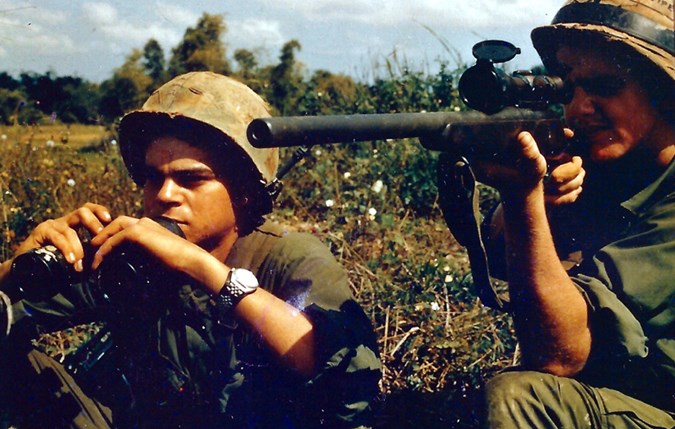
Sniper team of the 5th Marine Regiment at work during January 1968. The Winchester Model 70 rifle proved highly effective in the hands of USMC marksmen.


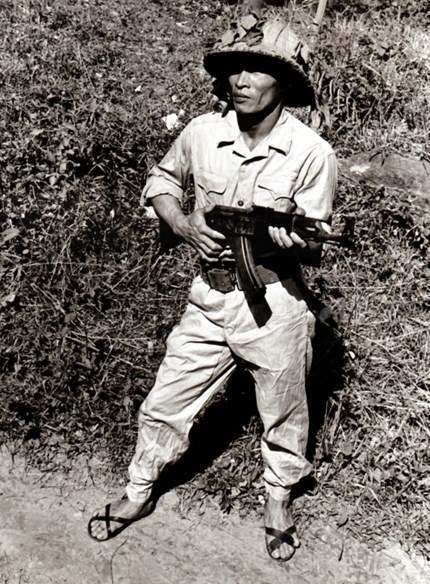
The 1st Marine Division set up this identification photo of a typical Viet Cong guerilla armed with a Chinese Type 56 rifle (copy of the Soviet AK-47). Simple and reliable, the AK-47 and its many variants have proven to be a perfect weapon for insurgents.

During the offensive, a force of more than 80,000 Viet Cong guerillas and NVA regulars attacked more than a hundred communities throughout South Vietnam, including 36 of the 44 provincial capitals. Saigon, the southern capital, was heavily hit.   


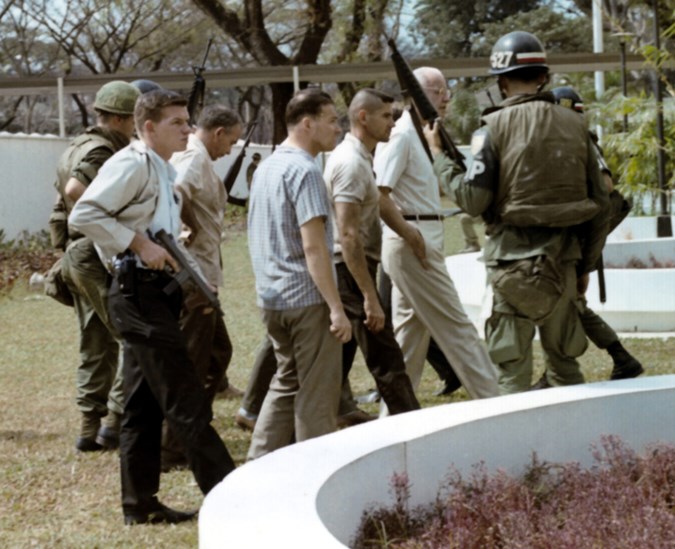
The Berretta M12 9 mm SMG fired its first shots in anger during the defense of the U.S. Embassy in Saigon during the opening stages of the Tet offensive. This photo shows men of the U.S. ambassador’s security detail, in the days following the initial VC attacks. M16 rifles and an M1 Carbine can be seen in the background.


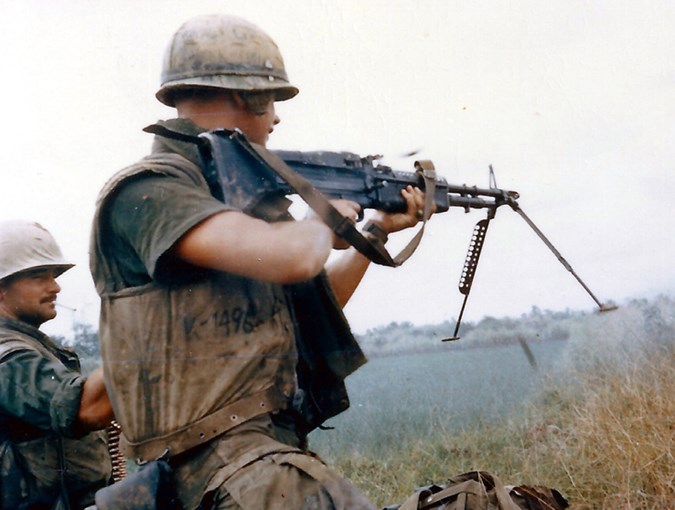
A Marine cuts loose with the 23-lb. M60 machine gun while his assistant keeps the disintegrating link ammo belt loading smoothly.

The initial attacks included an assault on the U.S. Embassy in Saigon by 20 Viet Cong sappers, which killed five American troops and prompted significant coverage by American news reporters—far out of proportion with the actual importance of the embassy battle. The entire VC assault force was annihilated on the embassy grounds within a few hours. Many news reports remained focused on the attack on the building symbolizing America’s presence in South Vietnam.


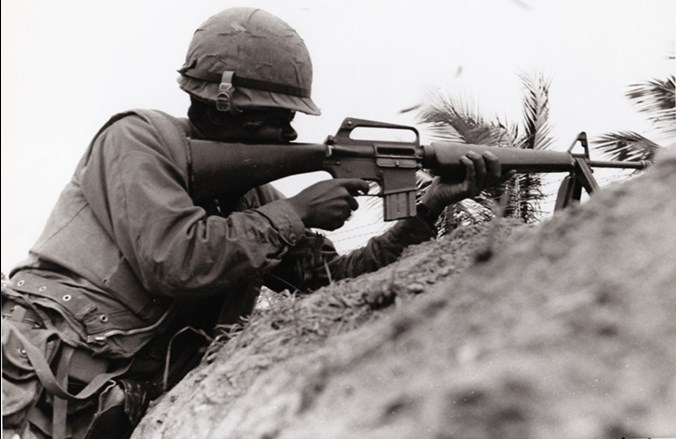
The M16 was still relatively new to the Marine Corps at the beginning of 1968. This Leatherneck uses his with a bipod during the battle for Hue in February 1968.


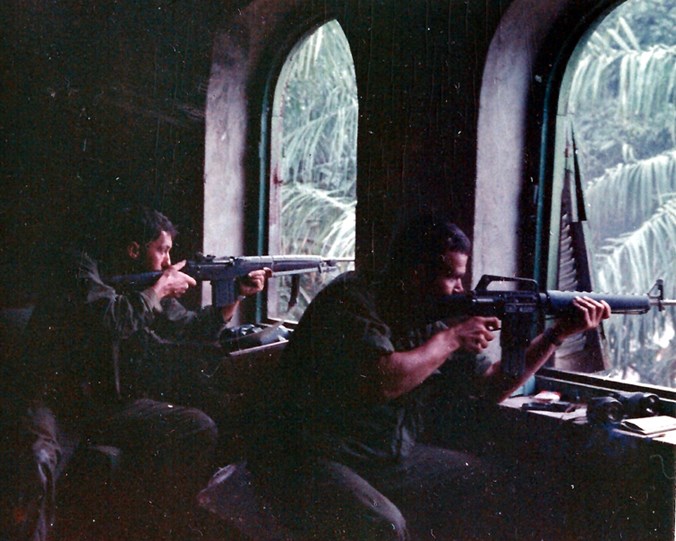
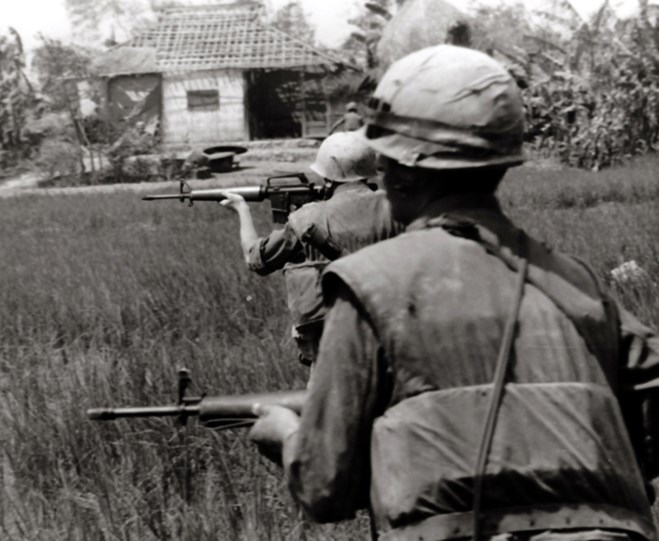
Brothers in Arms: Marines equipped with M14 and M16 rifles engage Viet Cong snipers during the battle for Hue, Feb. 1968.


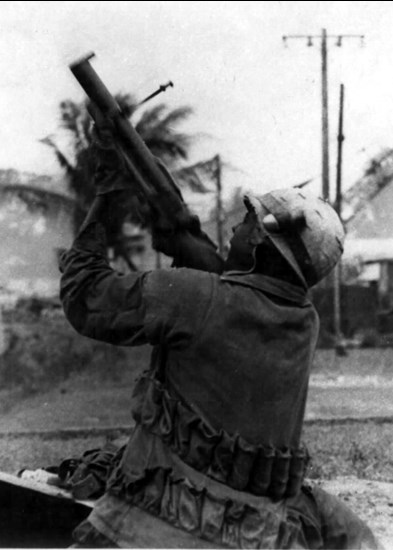
The M79 40 mm Grenade launcher, sometimes called “Thumper” by U.S. troops. Seen here as used by a grenadier of the 1st Marine Division in the battle for Hue, March 1968.


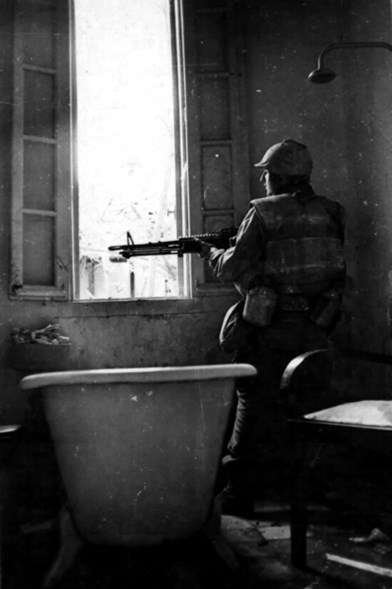
A Marine M60 gunner during the house-to-house fighting in Hue City during February 1968.

Communist forces occupied much of the ancient city of Huế. Relatively close to the DMZ, Hue was strangely unprepared for the assault. Four U.S. Army battalions, three weakened USMC battalions, and eleven ARVN battalions fought hard for more than a month to drive the enemy out. In the end, Huế was almost completely destroyed, and thousands of its residents were massacred in brutal reprisals by the communists. The troops from the North showed their true selves at Huế.


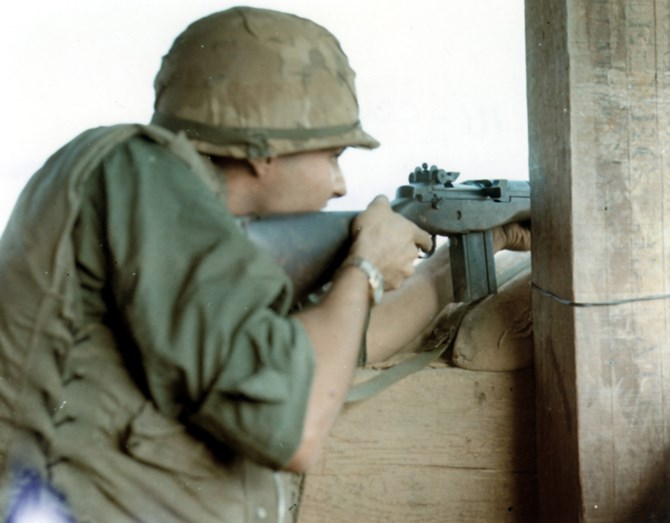
A G.I. of the 12th Aviation Battalion engages the enemy with his M14 rifle at Long Binh, Feb. 1, 1968. In early 1968, the M14 could be found in certain Army units and was still common in the Marine Corps.


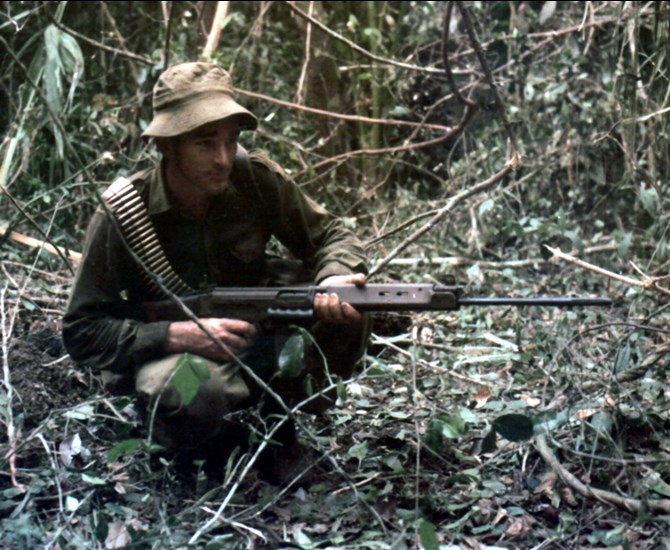
A soldier of the Royal Australian Regiment, equipped with a semi-automatic L1A1 rifle (chambered in 7.62x51 mm NATO) at Bien Hoa during February 1968. The L1A1 “SLR” was standard equipment for the Australian infantryman in Vietnam, and well-liked for its reliability and stopping-power.

Throughout South Vietnam, the fighting was intense from January to June of 1968. At the U.S. combat base at Khe Sahn, in northwestern Quảng Trị Province, two regiments of Marines were surrounded and besieged by three divisions of the North Vietnamese Army. From Jan. 21 until April 6, the Marines held out against relentless NVA attacks. Continuous air strikes and more than 150,000 artillery rounds helped keep the attackers at bay, but ultimately it was the Leathernecks’ resolve that kept Khe Sahn in American hands.


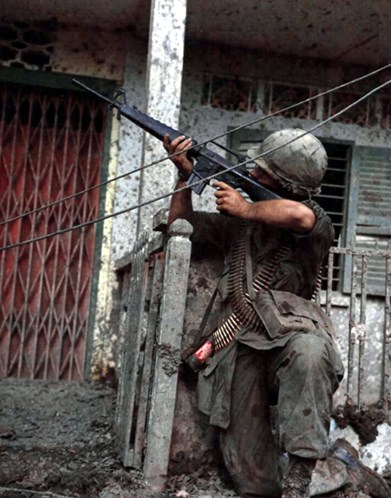
Tet Phase II: A G.I. of the 9th Infantry Division targets VC snipers in the outskirts of Saigon during the second round of attacks in May 1968. The rifleman carries extra ammo belts for his squad’s M60 machine gun.


Marines suppress VC positions during Operation Napoleon Saline during early March 1968.

Despite the initial surprise and limited gains, Tet proved to be a tactical disaster for communist forces, who suffered more than 100,000 casualties through all three phases of the offensive. The Viet Cong were essentially eliminated as a fighting force, and no popular uprising was generated in South Vietnam. The NVA suffered heavily and its aggressiveness was blunted as their leaders realized they lacked the resources to sustain such attacks in the face of American firepower.


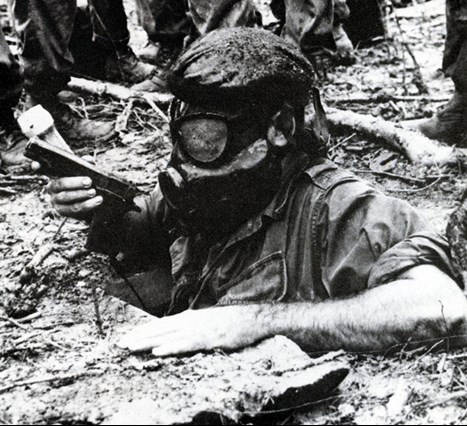
A “tunnel rat” descends into a Viet Cong tunnel. Some tunnel experts considered the powerful .45-cal. M1911 to be “too much gun” in the tight confines in the battle below ground.


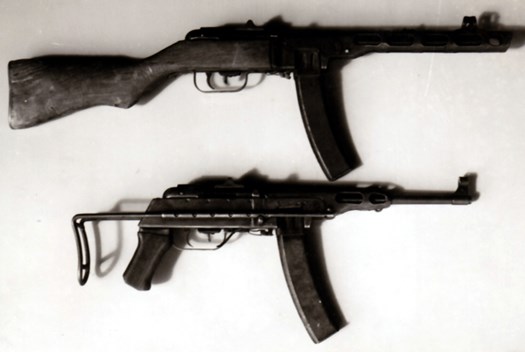
The Chinese Type 50, a copy of the Soviet PPSh-41 submachine gun, chambered in 7.62×25 mm Tokarev. Its cyclic rate is high, normally in excess of 1,000 rpm. The Type 50 only accepts 35-round box magazines. Bottom: K-50M, a North Vietnamese design that shortened and lightened the PPSh-41/Type 50 design, adding a pistol grip and a retractable wire stock. Some of these SMGs were still in service with the Viet Cong during the Tet offensive.  

Despite these battlefield setbacks, Tet became an important strategic victory for North Vietnam. At home, America’s commitment to Vietnam began to wane. Politicians waffled. Anti-war protests grew larger, and the news media regularly stoked the fires of discontent.   

 
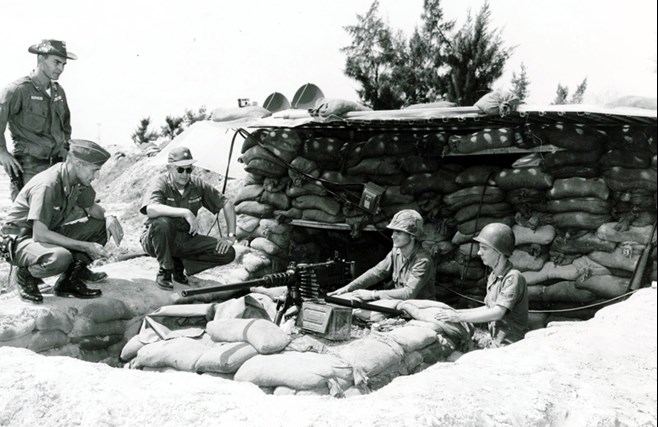
Defensive fire: Air Force security troops manning a Browning .50 cal. M2 machine gun, set up for airbase defense.


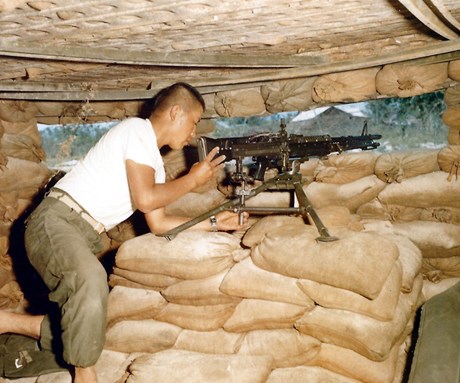
A Marine adjusts his M60 “Pig” mounted on a M122 tripod inside a sandbag bunker.

On Feb. 27, 1968, CBS Anchorman Walter Cronkite broadcasted the following in a special report on Vietnam: “To say that we are closer to victory today is to believe, in the face of the evidence, the optimists who have been wrong in the past. To suggest we are on the edge of defeat is to yield to unreasonable pessimism. To say that we are mired in stalemate seems the only realistic, yet unsatisfactory, conclusion.”


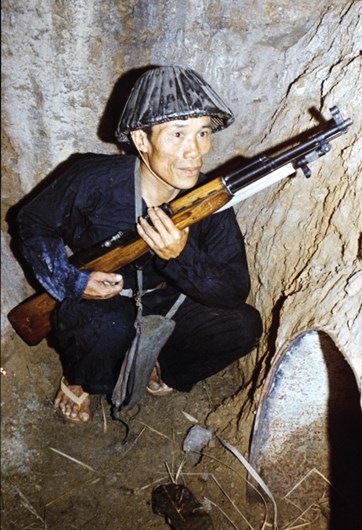
Uncle Ho: Viet Cong guerilla posing with an SKS carbine (or the Chinese Type 56 semi-automatic carbine copy). The SKS provided another excellent rifle for VC and NVA troops.


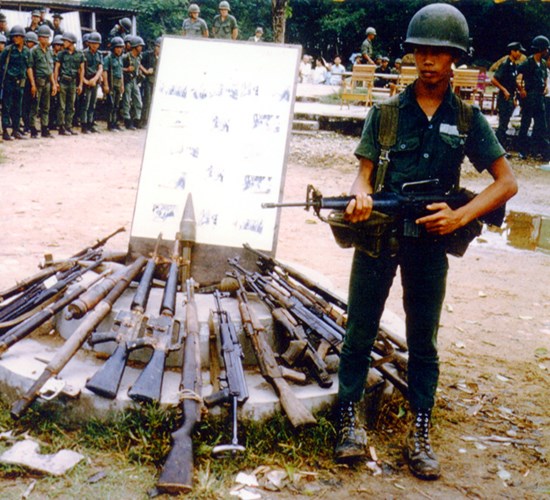
An ARVN trooper guards a typical VC weapons cache—featuring various AK-47s, M16 rifles, the venerable M1 Garand, and even an antique black-powder cannon.

After Tet, President Johnson watched his approval rating fall from 63 to 47 percent. Americans grew distrustful of the Pentagon’s Vietnam reports and criticism of U.S. military leaders created a much-discussed “credibility gap.”


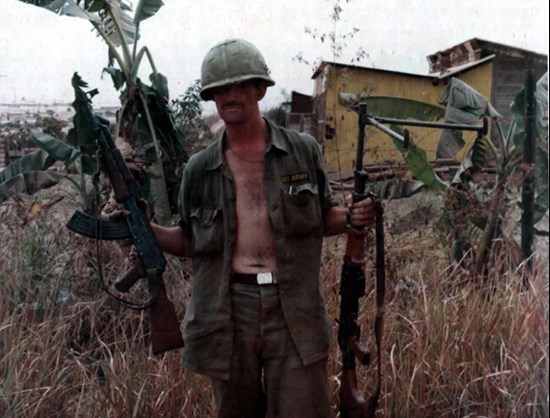
A G.I. of the 9th Infantry Division shows off captured VC weapons early in the Tet offensive at Long Binh. In his right hand is the AK-47, and in his left the RPD squad automatic with its distinctive “club foot” stock. The RPD was the standard light machine gun of most VC units. Chambered in 7.62x39 mm, it fires full-auto only (at about 750 rounds per minute) using a non-disintegrating 100-round belt in a drum container.


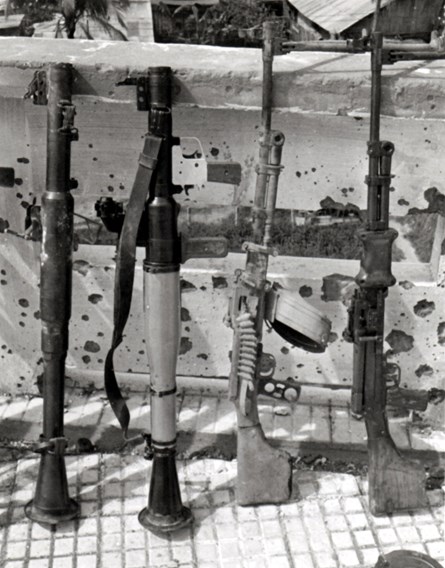
Captured VC support weapons: (left) the RPG-7, and (right) the RPD light machine gun. The RPG gave VC units an easily portable rocket launcher that provided potent anti-tank capability and also handy “artillery piece” for use against buildings and fortified positions.


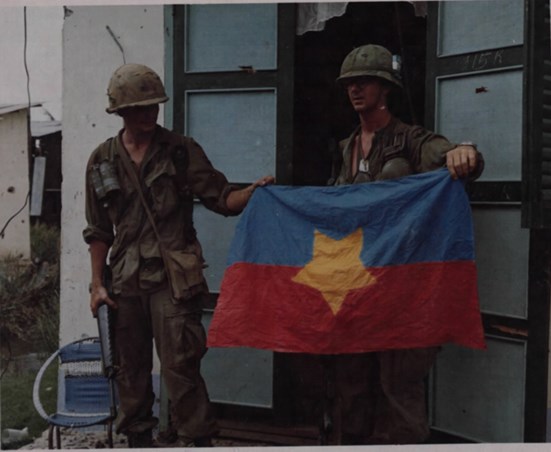
Tet Phase II: G.I.s of the 9th Infantry Division display a Viet Cong flag captured in the Saigon suburbs as Tet’s bloody second phase ends in late May 1968.

None of this did anything to help American troops in Vietnam who, regardless of inaccurate news reports and flinching politicians, never failed to overcome the enemy on, over and below his own turf. Advanced American firepower, coupled with traditional G.I. ingenuity and courage held the line during the Tet Offensive, and turned back the largest communist attack of that long and bitter war.

Friday, May 24, 2024

Vietnamese Activist are furious that LA county is making April 30th "Jane Fonda" Day.

 I can't believe that someone on the Los Angeles Government was so tone deaf but to make "Jane Fonda " day the same day Saigon fell effectively ending the long running Southeast Asian war was an accident.  I believe this was by design, there are a lot of Marxist in that government and Marxist always do things by historical dates.  April 30th was a highwater mark for the communist movement, they had forced a major American ally to surrender and humiliate America in the process.  THis was an opportunity to use symbolism again to close a loop and in a round about way humiliate the Imperialist Americans again using the hated symbol of "Hanoi Jane" and on the same day that Saigon Fell?   Perfecto!!!.  


jane-fonda-north-vietnamRichard Shotwell/Invision/AP, History/Universal Images Group via Getty

19 May 2024736

3:00

Vietnamese activists in L.A. are furious over the county’s declaration of April 30 as “Jane Fonda Day.”

Only days after county officials announced the homage to the 86-year-old actress, members of the Vietnamese community were outraged.

Activists immediately retaliated against the celebration by dubbing the month as “Black April,” referring the fall of Saigon, according to the Los Angeles Times.

Fonda, who has been denigrated as “Hanoi Jane” for decades, is notorious not just for opposing the U.S. war effort but for actually traveling into North Vietnamese territory and giving aid and comfort to the Chinese-backed enemy.

“She may be a very strong activist for climate change, but besides that, we also view her as being a person who was very cruel to the rights of the South Vietnamese people during the antiwar protests,” said L.A. resident Phat Bui, chairman of the Vietnamese American Federation of Southern California.

Bui also sent a letter to county officials to change the date and added that choosing “such a date can inflict so much pain to our community and to the Vietnam War veterans.”

U.S. forces fled the South Vietnamese Capitol on April 30, 1975. Members of L.A.’s Vietnamese community gather every April 30 to memorialize that dark day.

Republican State Sen. Janet Nguyen blasted the county, saying Fonda Day was “alarming and profoundly disrespectful to over half a million Vietnamese Americans in California.”

Rep. Michelle Steel, also a Republican, also blasted the county.

“To elevate Hanoi Jane over the Vietnamese Community, Americans who sacrificed their lives, and the loved ones they lost to communism, is deeply offensive to the freedom-loving Vietnamese Americans who bear such tragic and painful memories of the Vietnam War,” Steel said.

With all the pressure over the offensive choice of dates, the county’s board of supervisors agreed to move the date and is now considering April 8 instead. The board also insisted that the choice of April 30th for Fonda’s honors “was unintentional.”

Fonda, who spent many years refusing to apologize for her aid to the Communists, did relent later in life. In 2013, she admitted to making a huge mistake posing for her infamous photos alongside North Vietnamese soldiers in 1972.

“I made one unforgivable mistake when I was in North Vietnam, and I will go to my grave with this,” she said at the time, adding, “I don’t know if I was set up or not.” “I was an adult. I take responsibility for my actions…”

She has also said she often apologizes to American Vietnam veterans whenever she meets them.

Saturday, September 9, 2023

"How Well Trained were the NVA during the Vietnam War.

 I saw his on Quora while taking a break at work and thought it was a good article.

Many of us know about this battle, the battle of Ia Drang was the first major engagement between the US Army and PAVN (better know as NVA during Vietnam war). A few months after the battle, Lt Gen Harold G Moore, back then he was Lt Col, wrote his observation of NVA’s tactics in After Action Report Battle of Ia Drang:

THE PAVN ENEMY

He appeared to be well trained. He was aggressive. He was equipped with automatic weapons and plenty of ammunition. He carried 3 – 5 Chinese potato masher hand grenades.

He was an expert at camouflage and used every bit of cover and concealment to perfection.

He was a deadly shot. In caring for my man who had been killed and wounded, I was struck by the great number who had been shot in the head and upper part of the body-particularly in the head. He definitely aimed for the leaders-the men who were shouting, pointing, talking on radios. He also aimed for the men carrying radios. He also appeared to concentrate on men wearing insignia of rank-particularly NCO with stripes on their arms.

When attacking, the PAVN units confronting us used mass assault tactics preceded in some cases by light mortar and anti-tank rocket fire. He also used encircling maneuvers with 50-70 men groups. He employed his machine guns extremely well and thoroughly understood the value of grazing fire. At night, he infiltrated small numbers up to the friendly positions. These enemy set up on top of grassy anthills, in trees, and good close in firing positions. He was expert at probing our defensive perimeter at night and went to great efforts to try to force friendly into firing

He fought to the death. When wounded, he continued fighting with his small arms and grenades. He appeared fanatical when wounded and had to be approached with extreme care

He also appeared fanatical in his extreme efforts to recover bodies of his dead and wounded and their equipment.

A favorite tactic of the PAVN enemy we faced seemed to be an aggressive small unit encircling maneuver. Another was a rapid assault by 6-10 PAVN on 2 or 3 friendly.

(Note : I left out a few irrelevant parts like his food of rice and fish sauce, his green uniform, pitch helmet and how he used B40 anti tank weapon)

As the US military learned about their tactics, so did the NVA. He learned so well that his force would be decimated by superior fire power from the US force, if he was caught on the open ground. As a result he developed a maneuver, which could be called as “ Hill trap maneuver. Hamburger Hill, anyone? Basically, he fortified a fixed location in order to lure the US force into a battle.

Lt Gen William R. Peers, commander of 4th Division, later wrote in After Action Report Battle of Dak to

“The enemy had prepared the battlefield well. Nearly every key terrain feature was heavily fortified with elaborate bunker and trench complexes. He had moved quantities of supplies and ammunition into the area. He was prepared to stay. Enemy fighting positions were characterized by extensive preparation against the effects of artillery and air.”

It became evident the NVA had been preparing the battle for some time. Expanded trails, roads and well constructed defensive positions with over head cover, and signs of usage of draft animals all pointed to undeniable facts the enemy had lured the Allied forces onto the ground of their choosing.

The enemy used the tactic of pinning down assaulting American force from bunkers then attacked with another unit to the rear or flanks. The enemy had learnt to close on, hug, the American perimeter to keep from being destroyed by artillery and aerial bombing.

Brigadier General Leo H. Schweiter of 173rd Airborne Brigade wrote his observations in After Action Report Battle Hill 875

During the Battle of DAK TO, the 173d Airborne Brigade was opposed by large determined NVA units which were exceptionally well equipped and supplied. The enemy continued to elect to choose the time and place in which decisive engagements would be fought. Only when and where the tactical situation, terrain, battlefield preparation and relative strengths of opposing forces favored enemy action were significant contacts initiated.

The NVA presses the attack in contacts apparently attempting to hug the US forces to avoid the US artillery and air support. Air and artillery are of great value as blocking fires, but can be used as close in support only at a high risk to friendly forces.

Enemy Fortifications and Tactics: The NVA utilized reinforcing trenches and tunnels to their bunkers which provided protection from direct fires. Their bunkers had extensive overhead covers (5-8 feet) allowing them to display determined resistance to air and artillery preparation fires, and enabling them to survive and put up a strong defense after bombardment. The NVA will also attack from these fortified positions.

The NVA used tree positions to their advantage even when pressing the attack. The use of this technique gives them the capability of preventing resupply or evacuation mission from being flown by placing automatic weapons fire on the LZ from trees.

The NVA demonstrated a tactic designed to encircle a portion of a unit with the objective of defeating it in detail. When a friendly unit encountered a fortified position it could expect a sharp assault from the flanks or rear. The NVA continually probed friendly flanks or rear elements in an attempt to exploit this tactic. Upon discovery, enemy flanking forces would break contact if it appeared that their attack would be unsuccessful. In addition, this tactic allowed the NVA to "hug" friendly forces, thus practically nullifying the effect of heavier fire power provided by artillery and TAC Air.

The NVA soldiers were camouflaged very effectively over their entire body and were often very difficult to see unless moving, especially in the heavy undergrowth.

So in the conclusion: sorry for another long post. However I think we can put the myth of “the NVA could only throw endless human wave attacks" to rest.

Wednesday, August 23, 2023

The Concept of "Firebases" from Vietnam


I got this in my email from "Vietnam Cherries", I get tidbits from them about the Vietnam War,  and sometimes I would post them on the blog.   

A firebase in Vietnam, wherever in Vietnam, would be well-known to whoever habituated one anywhere.  There were several thousand firebases during the conflict, manned by many units and many men, but they were all the same. Similar to the 19th-century fort concept, fire support bases in Vietnam could reinforce each other across long distances with powerful effects. Read the article to learn more about these firebases.


(The cartoon is from my "Stash".)   

By DAVID T. ZABECKI

Vietnam was a non-linear war. There were no front lines with enemies on one side and friendlies on the other. Tactical problems could become very complex, with the enemy potentially in any or all directions. It was vital to be able to observe and fire 360 degrees all-around.

Although atypical of most 20th-century warfare, those conditions were not necessarily unique to military history. Perhaps the closest American experience was the Indian Wars of the 19th century—with isolated forts established to control certain areas and provide security to overland travel routes and civilian settlements in the sector.

One solution to the Vietnam War tactical problem was the fire support base (or firebase). Most 19th-century forts were isolated and had to be self-sufficient. Thanks to 20th-century technology, the firebases used by the allies in Vietnam could communicate with each other instantly and could be resupplied and reinforced by air.

WHAT WAS A FIREBASE?

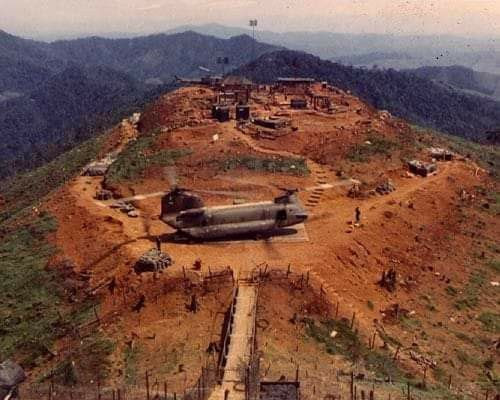
The fire support base was a combined infantry-artillery position that sometimes included armor. Depending on the planned duration of the position, firebases could be dug-in heavily and reinforced with engineer assets.

Perhaps the greatest strength of the firebases was their ability to cover each other with mutually supporting fires over great distances. It is a long-standing principle of firepower that massing fires is the most effective way to use artillery.

Through the 19th century, the only way to mass fires was to physically group the guns together on the ground. Between World Wars I and II, improved communications combined with innovative advances in fire direction control techniques made it possible to mass fires instantly on enemy targets from many widely-dispersed guns.

Firebases could reinforce the fires of their own internal guns with the guns of any or all other firebases within artillery range. It was a powerful multiplier effect.

HOW WERE FIREBASES SET UP?

The size, composition, and positional duration of a firebase depended on the planning factors of mission, enemy, terrain, and troop availability. Some firebases were very large and held positions for months or longer. Other firebases were relatively small and remained in position for days or weeks. A smaller firebase might consist of a company of infantry with a two-gun artillery platoon in the center of the position. A larger firebase might consist of two or three infantry companies, or possibly an entire battalion.

The artillery would consist of an entire six-gun battery. Instead of being positioned in the normal staggered line, the guns were deployed in a star position, with the base piece at the center and the other five guns forming the points of the star to provide rapid and effective fire in any direction. Smaller firebases with two or four howitzers deployed their guns when possible in square or triangle formations.

Firebases on flatter terrain were usually round, and those on ridges generally were rectangular due to terrain. Most larger firebases contained a helicopter landing pad for resupply and medical evacuation. When a firebase deployed forward, the guns often were moved by air.

FIREBASES USED IN ATTACK AND DEFENSE

The firebases were not merely passive defensive positions. Infantry patrols aggressively pushed out from the perimeter, day and night, but usually stayed within the guns’ maximum effective range fan—roughly 11,000 meters for 105mm howitzers and 14,000 meters for 155mm howitzers. When a patrol made contact, it could call for fire support not only from the guns of its own firebase but those of any other firebase in range.  

The firebases, of course, invited attack. One gun inside the firebase usually fired illumination rounds to deprive attackers of the cover of darkness. Other guns delivered fires where needed outward from the perimeter. Firing close to friendly troops could be complex because of the large bursting radius of HE ammunition. The solution to that problem was the M-546 Antipersonnel Round for the 105mm howitzer. Popularly called the “Beehive Round,” it fired 8,000 steel flechettes, triggered by a time fuze set to detonate just outside the perimeter. A green star cluster hand flare fired just before the Beehive warned troops on the perimeter to take cover.

Between 1961 and 1973, U.S. and allied forces established more than 8,000 fire support bases in Vietnam; only a small fraction existed at any given time.

Some of the war’s fiercest battles were fought over firebases, including Firebase Ripcord in Thua Thien Province (July 1-23, 1970); Firebase Mary Ann in Quang Tin Province (March 28, 1970); and Firebase Gold in Tay Ninh Province (March 21, 1967). Neither the VC nor the NVA ever managed to overrun a U.S. forces firebase.