Webster

The Constitution was made to guard the people against the dangers of good intentions." --American Statesman Daniel Webster (1782-1852)


Showing posts with label France. Show all posts

Tuesday, September 15, 2020

The Franco-Prussian War of 1871 and some background.


I Remembered hearing about the Franco-Prussian War of 1871 when I was reading a book about "Louis Pasteur" and he was embarrassed and angry about how the French had their butts handed to them by the Prussians.  He also visited his son who was wounded fighting the Prussians near Paris if memory serves.   I started doing some research on the cause of the war and down the rabbit hole I went :) 


Throughout the centuries, the European continent has hosted many wars of conflict, laying waste to its countryside, and killing thousands of its citizens. These outbreaks of violence came about over religion, power, and petty disagreements in wars lasting over one-hundred years in some cases. Even though the human suffering was horrific during these battles, warfare was conducted in an almost elementary approach with strategy as an afterthought. This approach begins to change with the founding and successful expansion of the Prussian Empire across central Europe. The Prussians brought new methods and techniques to the art of warfare through its professional application of strategy as a science and an art. The Prussian Empire during the 1871 war with the French was controlled by the then Prime Minister Otto von Bismarck even the Emperor of Prussia referred to Bismarck due to the power arrangements of the empire. Bismarck had the goal of uniting all Germans under one flag and destroying the threat the French posed from the West.


The adversaries of the Prussian Empire were their neighbors to the west; the second French Empire led by the elderly Napoleon III the nephew of Napoleon. The French, up until the late 18th Century relied on its ability in win wars employing strategy called élan. Using this strategy the French believed that they were superior in their ability to mass its infantry on the enemy and win the day. The French believed so much in élan that it led to a false state of security in matters of defense and innovation.


Napoleon III

The concept of strategy or statecraft by using Ends, Ways, and Means shows a clear difference of approach on how both sides tried to impose their will on the other side in both wars. Both the French and the Prussians through some of the elements of Diplomatic,Information, Military, and Economic (DIME) as Statecraft also demonstrate the art and science of strategy. The goals of the Prussian Empire were the unification of all Germans under one flag and turn it forever into a powerhouse of Europe. This was the Ends for Bismarck, the Prussians, and the ultimate objective in Central Europe. Bismarck had been executing his Ends by taking a systemic approach that fell very much in the realm of science, as a strategy leading up to the Battle of 1871, later becoming the Franco-Prussian War. Bismarck‘s strategy as a science gains further creditability with his usage of DIME as a statecraft even before the fighting starts. Bismarck understood the need to apply diplomatic pressure on France, and at the same time, attempt to cast the country as the villain of Europe.
Otto Von Bismark

Bismarck used diplomatic pressure by attempting to put a low nobility German Prince on the vacant Spanish throne. Prince Leopold, a prince from the royal House of Hohenzollern would be the instrument used by Bismarck to execute the diplomatic phase of DIME. If the Prussians could get Leopold on the Spanish throne, they could essentially box the French in on all sides. This action almost created a potential trading block allied to the Prussians. 


On July 2, 1870, that the Spaniards were about to crown Leopold, this led to an outcry in France. The French were caught sleeping to the threat and acted very slowly to recognize the danger being created by Bismarck. Further endangering the French to this maneuver was the fact Napoleon III tried to look the other way and not engage. The citizens of France immediately took to the streets throughout France in protest. This action caused French society to consider this an insult to France leading to the population and political leaders demanding war to protect their honor. French military leaders were also worried about the possible influence that Prussia may be able to bring in Spain with a fellow compatriot of theirs on the throne. The Prussians were truly using diplomatic actions and strategy of science by turning the tables on the French by making them confront the possibility it will be them facing a two front war by boxing them in between Spain and Germany. This action was a stroke of pure genius by Bismarck even before any fighting begins against the French. Bismarck’s actions caused so much pressure on French leadership that Napoleon III looked weak and out touch with reality. The French press and politicians vilified the Emperor for allowing their country to be slighted by Bismarck and the Prussians. 

The Kaiser in response to the fury caused decided to attempt a sort of reconciliation with Napoleon III by sending the French leader a letter offering peace. The crafty old Bismarck intercepted the letter and changed the wording blaming the French for causing upheaval. This letter became famously know as Ems Depesche, Bismarck actions were the information piece of using statecraft in DIME. This aroused nationalist outrage in Germany and France causing the French to declare war on the Prussians. By using the information actions within DIME, Bismarck forced Napoleon III hand.


The Emperor of France looked like fool and a laughing stock in European circles of power because the Prussian got the best of him. Napoleon III realized his position and his country appeared weak and it was his time to try his hand as strategy as a science. Since he did not want a war, he tried to check the Prussians growing power by using back door political moves, and at the same time quiet the growing opposition in the streets of Paris. These secretive moves would be the Emperor’s ends and ways to achieve the ends and ways, on statecraft of diplomatic and, informational actions to further his cause. He first dealt with his critics at home by trying to roll back the powers of the Parliament. When this body of politicians tried to check his moves toward more power, he simply jailed the leaders of the movement. The Catholic

Church was another obstacle in the quest of power by the Emperor and again he jailed Church leaders and drove the rest out of the country. Both groups became targets of an informational campaign to align them with the communist threat, and to show the French people that they were political agents and enemies of the Republic.

With the streets of Paris now cleared, Napoleon attempted to demonstrate his foreign diplomatic prowess by purchasing the Duchy of Luxembourg from the then owner, the King of the Netherlands. With the purchase of the Duchy, the Emperor wanted this land as a buffer from the ever-growing threat of the Prussians. This land grab also put the Prussians at a huge strategic disadvantage by funneling them and their efforts into deadly killing zones once war did begin with the French. 

Bismarck quickly met this challenge by simply putting intense pressure on the Dutch Royals not to sell the Duchy of Luxembourg to the French. The Prussians communicated the danger of selling this land through diplomatic channels by threatening hostilities if the sale took place. The Dutch quickly got the message from the Prussian that their existence might be in jeopardy if the sale took place. Using attempted diplomatic strategy would have been a masterstroke of genius by Napoleon if it could have succeeded. By using this type of strategy, the French leader failed to appreciate the ability of Bismarck to checkmate his moves with his own strategy. Bismarck showed just how cunning he could be by releasing the messages on the possible sale of Luxembourg from the Dutch to the French with revised sentences. The changing and doctoring of the messages showed that Napoleon and the French people are not be trusted in Europe. The Prussians appeared to be the victims of further French aggression, marginalizing their efforts for German unification. With just a few faked sentences and threatening messages added from Bismarck he achieved his prewar Ends, Ways, and Means through information warfare aided by technology.

The disaster caused by the Prussians exposing the attempted sell of the Duchy of Luxembourg caused major domestic problems for Napoleon at home. He had to send Soldiers into the streets of Paris again and have them fire on protestors marching on his palace. The French labor unions and communist parties also did battle with Napoleon’s troops exposing further damage caused by the attempted failed purchase of Luxembourg. These violent uprisings caused a knee jerk response by Napoleon by jailing and exiling thousands of innocent French citizens.

The French people were demanding war, and seeing the chance to look like the bold leader when Napoleon declared war of the Prussians. Napoleon had several goals for his ends, ways, and means to deal for the last time with Prussians. Most important was to look strong, check the growing Prussian Empire, and maybe win a small war. Napoleon attempted to use the strategy of the military inside DIME and was met with disaster due to no planning for the war. The ultimate task for the French would have been to fight a war using the military and to put the citizens on a war footing by using their economic means to attack the Prussians. The French found out it is much easier to chant shout slogans like on to Berlin as a strategy than to execute the mission. 

The French failure in the 1871 War with the Prussians goes back several years without a clear strategy of preparations in the mobilization of its military. The mobilization of armies clearly failed in the realm of strategy as a science. No longer could militaries win wars by just valor and élan, however, this was the approach the French tried to use and failed.

French Soldiers 1871

The French failed to invest in weapons technology and found themselves vastly outgunned and outranged by their enemy even before the battles had begun. The Prussians simply killed the French in the rear areas of the battlefield by using their advanced artillery. There were not any safe areas for the French to regroup, refit and rest during the fighting. They had no safe places except the French capital of Paris to adjust their strategy of art. The distances to the front caused further delays and false starts due to the poor communication nodes that the French failed to update as technology advanced.

The movement of troops to the front lines depended on the railroad first getting them to cantonment areas to form into battle formations. Often times, these areas turned into nothing more than masses of men drinking themselves into a state of drunkenness. Discipline further eroded due to reserve troops arriving with no clear chain of command and lacking training for modern warfare. The French had become little more than a peasant army that was over seven-five percent illiterate as the fighting started. This was due to a system set up previously that allowed a person of means to avoid any responsibility to defend his homeland of France.


French Officer Corp

Just the opposite of the uneducated peasants was a very educated officer corps in France that could have executed to a certain degree the strategy of science and art when deploying to their borders. Like many segments of French society during this time to include Napoleon and French politicians failed to grasp the needs and obligations of modern warfare. They failed to invest in new technologies of the day and adopt strategies that they could achieve. The only true strategy the French used was the need to rush to the border and attack with their faith in Elan. This strategy might have worked in previous war were only valor and fixed bayonets were needed but not in 1871. The French were facing an enemy in the Prussians that adopted a learning approach to execute both phases of science and art in in modern strategy. 


Prussian and Bavarian Soldier 1871

The Prussians took a vastly different approach on how to best execute their strategy of uniting all Germans and to neutralize the threat posed by France. They had become a learning organization that fostered technologies that enabled them to better execute the strategy as a science and art through prewar planning and education. Such advancements as providing medical care, hot meals, and railroads usage allowed the Prussians to see their dreams of a homeland for all Germans become a reality.


Prussian "War Kitchen" as part of a medical train.


Providing something as simple as a hot meal to the troops in war provided a positive outcome on the fighting spirit and morale of the men doing the killing for Prussia. The Prussians knew this due to doing research and promoting strategy as a science by developing mobile kitchens. These kitchens were able to provide returning and arriving troops to the front a hot meal. The kitchens were also mobile enough to follow near to the troops for any major operation. The French had no such things as mobile kitchens to feed their troops on the battlefield. As the French Soldiers learned quickly by starting a fire to warm a meal, it almost certainly invited enemy artillery to attack them in their cantonment areas. Along with hot meals, the Prussians understood the need to have proper medical care for the troops fighting. They were the first in Europe to embrace the concept of marking medical wagons with the now excepted Red Cross emblem signify medical. Military doctors were given complete control of all medical operations when it came to the care of the wounded. The French did none of these actions in regards to medical operations on the battlefield.


Prussian Train Ambulance

Without any true strategy for fighting the Prussians, the French charged to the border without much guidance are even strategy. They learned quickly that it was not logical or even safe to race to the border with just their infantry. These mad dashes to the border allowed for the capture of the city of Saarbrucken for one day by the French. The French had to retreat across the border due to their inability of orders for advancement arriving and the failure to move the strategy as art. They failed to understand the early need for combined arms to wage war and left many troops isolated on the battlefield.


Battle of Sedan and the Humiliation of France.


During the unorganized retreat from the border, the French moved into fortified depots on the false assumption that could reorganize and wage war again. The Prussians quickly demonstrated the art of strategy by encircling these French holdouts and decimating them until surrendering. Napoleon III became one of the thousands of prisoner of war when the fortress town of Sedan fell to the Prussians.
Napoleon III conversing with Otto Von Bismark after his Capture at Sedan.


The result of these failures on the battlefield allowed for Bismarck to dictate the terms of the peace to the French. He quickly moved back into strategy as a science by ensuring that the threat from France would be forever neutralized. This included the partition and loss of the lands Alsace-Lorraine and the demand of payment from the French for the sum of five billion francs.

By successfully demonstrating both the understanding and the need to embrace the strategy of both science and the art phases, the Prussians won the war in 1871. In doing so, they were able to unite all Germans under the new German Empire. Additionally they neutralized the threat from the French to their new German Empire. The lack of strategy for both planning and fighting doomed the French to defeat for many years to come.


    The new German Empire reputation was greatly burnished by the abject humiliation of France and the new country became a force to be reckoned with especially by England who had viewed the defeat of France with some interest and the New German empire started having expansionist goals outside of its borders of Europe and that greatly impacted Great Britain who was at the Zenith of her power and the Germans started building a Navy to challenge the Royal Navy on the High Seas.  The defeat of France indirectly set the seeds of WWI 50 years later.


    This new Blogger interface of sucks...it is a pain to manipulate pictures and import them.*Bleh*


Sunday, February 9, 2020

How France Helped Argentina during the Falkland War.

I ran across  this article on the Falkland war, I have blogged before about the Falkland war, and I knew that France had supplied many weapons to the Argentinians, including the Exocet that had a lethal reputation that was proven during the resulting Falkland war.  Even back then when I was a sophomore in High School during the Falkland War, I had a wishy washy image of the French and wondered if they were helping the Argentinians because the French have a history with the British and it wasn't sunshine and rainbows.  After reading this article it kinda confirmed the initial impressions.  I also had the same opinion because the French supplied the Iraqi's.  I wondered if they played both sides against the middle because it would help France if the United States was lessened by a bloody battle/war in the Persian Gulf against Saddam Hussain. Yes I know that the French had the Foreign legion here to help and they did exceedingly well from what I know.  But the French had sacrificed the legion before in Vietnam and the surrounding areas due to the Indochina War and Algeria due to politics. 


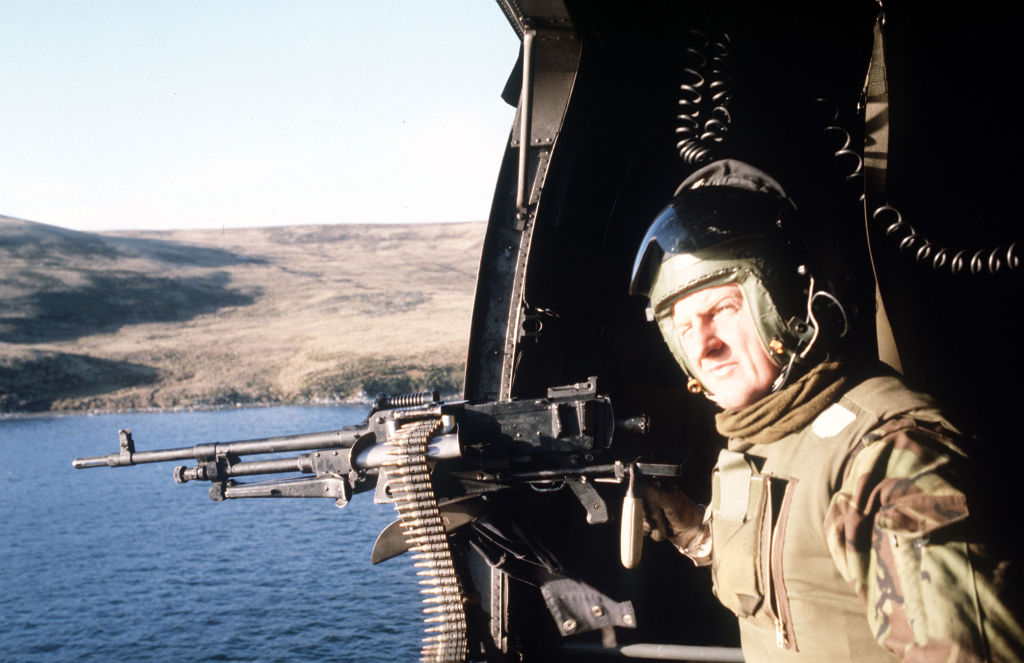
A crewman mans a General Purpose machine gun mounted in the hatchway of a helicopter on patrol over San Carlos Water during the Falklands conflict.   (Photo by PA Images via Getty Images)
A crewman mans a General Purpose machine gun mounted in the hatchway of a helicopter on patrol over San Carlos Water during the Falklands conflict. (Photo by PA Images via Getty Images)
During the 1982 Falklands War, the British were able to reclaim their territory from invading Argentinian forces.
During the war, the British received support from France but formerly secret documents show that the French may have been working both sides of the conflict.
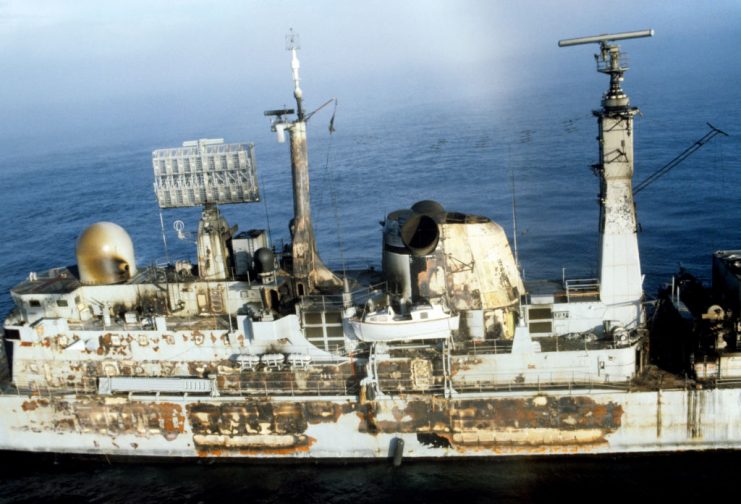
In May of that year, the Argentine forces used Exocet missiles during an airstrike that killed 32 people. The missiles were fired at the British ships HMS Sheffield and Atlantic Conveyor.


HMS Sheffield after being hit by an Argentine Exocet missile in the South Atlantic. (Photo by Martin Cleaver – PA Images/PA Images via Getty Images)
HMS Sheffield after being hit by an Argentine Exocet missile in the South Atlantic. 
The missiles were sold to Argentine by France prior to the war before it seemed likely the two countries would enter into combat with each other.
When the war began, France embargoed weapons sales and support for Argentina. They also allowed the British to use French ports in West Africa and provided them with information on the weapons and planes that they had sold to Argentina.
French President Francois Mitterrand made the decision to aid the British. While the UK’s Secretary of State for Defence Sir John Nott praised France as being the UK’s “greatest ally,” members of the French government were not pleased with their president’s decision.
The French ambassador to London, Emmanuel de Margerie, wrote a scathing description of Margaret Thatcher as “Victorian, imperialist, and obstinate” with a “tendency to get carried away by combative instincts.”
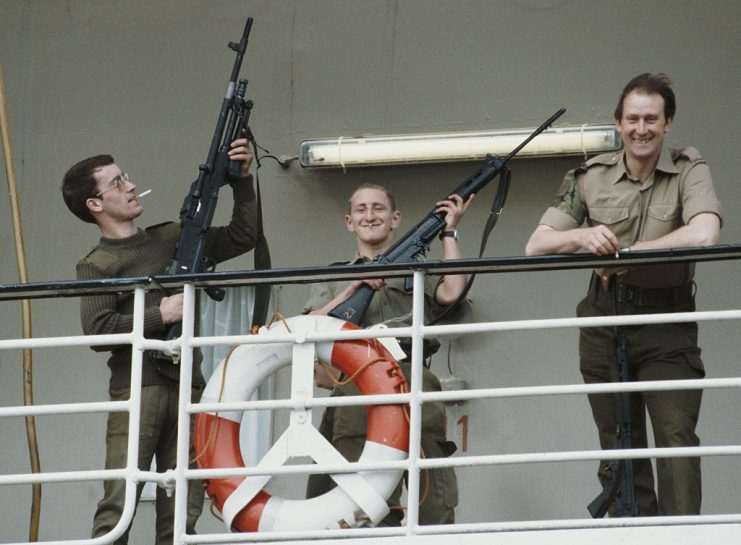
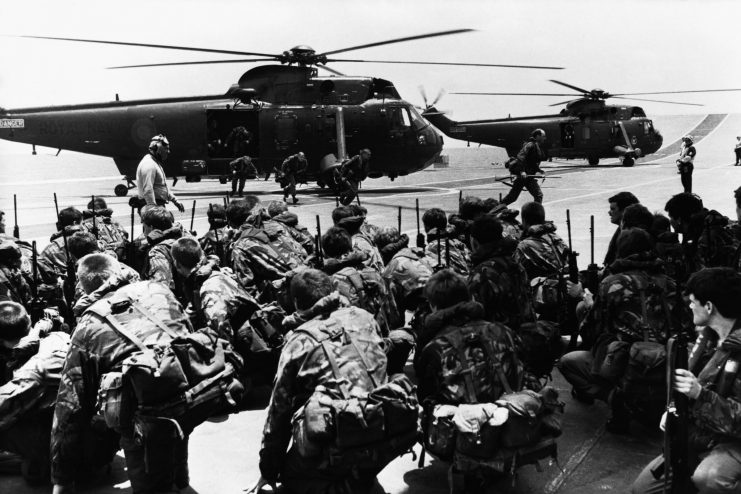
A group of British soldiers show of their rifles as they stand on the deck of the RMS Queen Elizabeth 2 (QE2) before the ship departs for the Falklands, from Southampton docks on Wednesday, May 12, 1982. The QE2 took part in the Falklands War during 1982, carrying troops and volunteer crew to the South Atlantic conflict, with her decks converted into three helicopter landing pads. (Photo by Bryn Colton/Getty Images)A group of British soldiers show of their rifles as they stand on the deck of the RMS Queen Elizabeth 2 (QE2) before the ship departs for the Falklands, from Southampton docks on Wednesday, May 12, 1982. The QE2 took part in the Falklands War during 1982, carrying troops and volunteer crew to the South Atlantic conflict, with her decks converted into three helicopter landing pads.French official Bernard Dorin decried Britain’s “superpower arrogance” and their “profound contempt for Latinos.” He made these claims in a document titled, “The Falklands: Lessons from a Fiasco.”
A BBC investigation has uncovered evidence that, even though the embargo was in place, a team from France worked with the Argentine troops in the Falklands during the war. The team allegedly tested the missile systems to ensure they would fire.

Three of the missiles failed and the team repaired the issue which allowed the missiles to be used against British troops.
During the war, 659 Argentinian and 253 British troops were killed.
The Falklands War began when Argentinian troops invaded the Falkland Islands on April 2, 1982. The Falklands are a British territory located in the southwest Atlantic Ocean off the coast of Argentina.
Argentina has long claimed rights to the islands, which they call Malvinas. Argentina inherited the islands from the Spanish crown in the early 1800s.

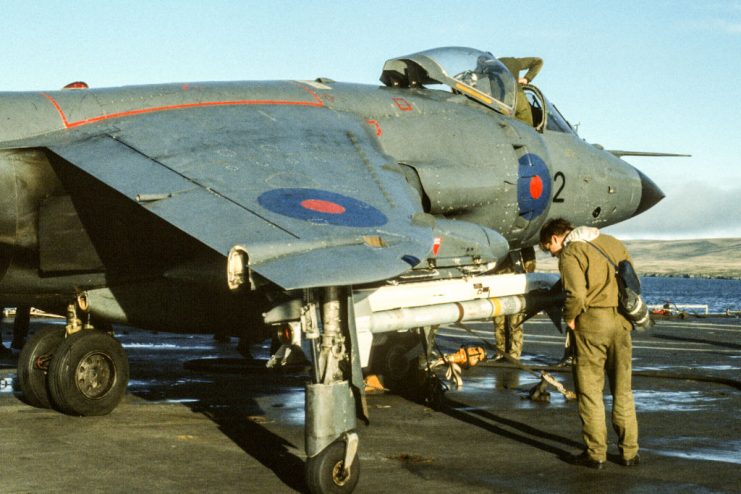
Sidewinder missile on an 800 squadron Sea Harrier aircraft landing on HMS Fearless L10 during the Falklands War 1982. It was unable to land at the damaged Sheathbill air strip, the pilot was Lt-Cdr Neil Thomas. (Photo by Terence Laheney/Getty Images)
Most of the residents of the Falklands are of British descent. Britain claims rights to the islands based on their long-term administration of them and on the principle of self-determination for the islanders.
Argentina did not believe that the UK would respond with force if they invaded the islands. But, despite being 8,000 miles away, British Prime Minister Margaret sent a force of warships and hastily refitted merchant ships to reclaim the British territory.

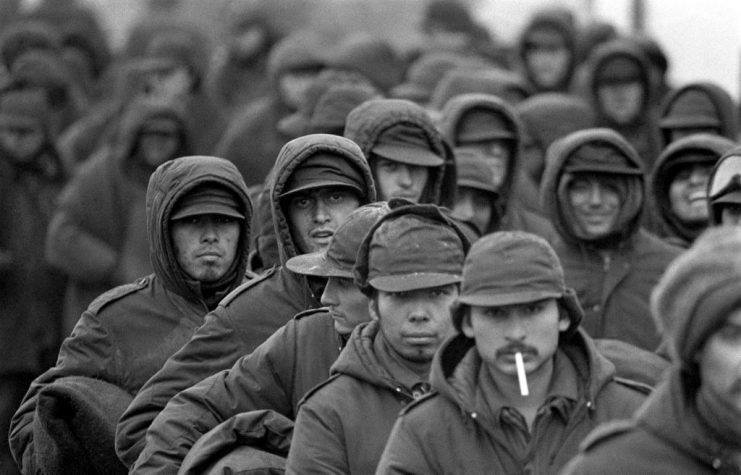
A hint of a smile on some of the faces of these Argentinian prisoners of war at Port Stanley, capital of the Falkland Islands, waiting to be repatriated via Montevideo. . (Photo by PA Images via Getty Images)
The British submarine HMS conqueror sank the Argentine cruiser General Belgrano on May 2, 1982. 300 crew were lost with the ship. After that, the Argentine military kept their ships in port.
But the Argentine air force was still a threat to the British. Their aircraft sank several British warships, including the HMS Sheffield with an Exocet Missile, whom the Frigate's Friend or Foe system wasn't updated to classify the Exocet as "Foe"

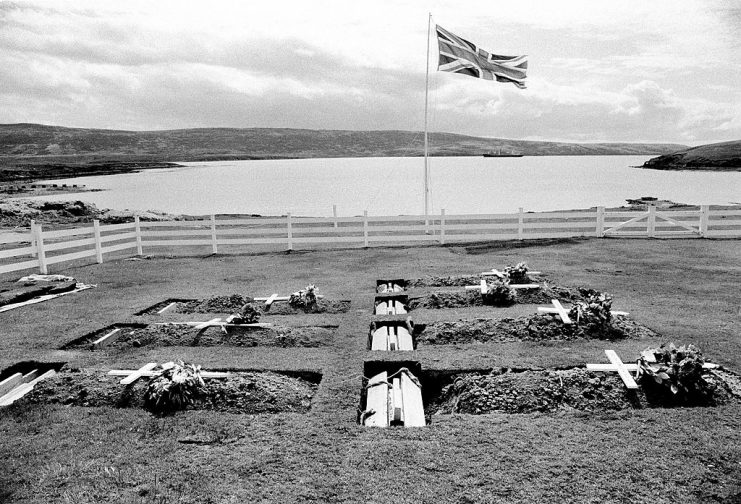
The Blue Beach War Cemetery in Port San Carlos in the Falkland Islands, October 1982. In the foreground (right) is the grave of Lieutenant-Colonel H. Jones (1940-1982), who was posthumously awarded the Victoria Cross. (Photo by Tom Stoddart/Getty Images)
Still, the British were able to land on the Falklands on May 21, 1982. The conscripted Argentinian troops had plenty of time to dig in and fortify their defenses but they were not trained well enough to defend against the oncoming British forces.
On June 11, 1982, the battle for the capital, Stanley, was underway and the Argentinians surrendered on June 14, 1982

Tuesday, May 15, 2012

Greece unable to form government


By Dina Kyriakidou and Paul Taylor
ATHENS/PARIS (Reuters) - Attempts to form a government in Greece collapsed on Tuesday, jolting financial markets at the prospect that leftists opposed to the terms of an EU bailout could sweep to victory in a June election and tip the euro zone deeper into crisis.
The turmoil in Athens sent shock waves around other troubled members of the 17-nation European single currency area. The euro slipped below $1.28, world stocks slid and Spanish and Italian bond yields rose above the danger level of 6 percent as investors scurried for shelter in safe haven German Bunds.
The tremors from Greece, compounding worries about Spain's debt-laden banking system, ended any honeymoon for new French President Francois Hollande, thrusting the growing risks to the euro zone to the top of the agenda for his first meeting with German Chancellor Angela Merkel hours after he took office.
In his inaugural address, the Socialist president called for a European pact to revive growth and temper German-driven austerity measures, seeking to change the direction of euro zone economic policy.
"I will propose to our partners a pact that will tie the necessary reduction of our public debt to the indispensable stimulation of our economies," Hollande declared, saying Europe needed "projects, solidarity and growth".
The French leader's aircraft was struck by lightning shortly after takeoff from a military airport near Paris en route for Berlin, forcing him to turn back and take a substitute plane.
In Athens, President Karolos Papoulias abandoned efforts to broker a compromise on a cabinet of technocrats to steer the country away from bankruptcy, nine days after an inconclusive general election. A caretaker government will now be formed pending a new vote probably in mid-June.
"We resisted in every way," said Alexis Tsipras, leader of the hard-left SYRIZA party, which surged to second place in last week's election on an anti-austerity platform and blocked any deal with pro-bailout mainstream parties.
"We made the decision to not betray your hopes and your expectations," said Tsipras, emboldened by opinion polls showing his party could top the poll in a second vote. "Now it's time to complete it: We will consign in the dustbin of history all the spent forces of the past.
Euro zone finance ministers dismissed talk of Greece leaving the single currency area as "propaganda and nonsense" on Monday. But with hostility to EU/IMF-imposed austerity rising in Greece, speculation about a possible state bankruptcy and euro exit is rattling financial markets and won't go away.
IMF chief Christine Lagarde said it was important to be technically prepared for the possibility of Greece leaving the euro zone, warning that such a move would be "quite messy" with risks to growth, trade and financial markets.
Finnish Prime Minister Jyrki Katainen openly discussed the prospect, telling broadcaster MTV3: "If Greece were to leave the euro it would probably not cause a significant financial crisis that would have happened a couple of years ago.
"But on the other hand, we would have other problems. What kind of impact would it have on European economic development, on Spain's, Italy's economies, would market begin to speculate about other euro countries leaving? Naturally it would have an impact on the stability of Greek society."
MORE TIME?
Averting an immediate default, Greece made a key payment to bondholders who rejected an earlier debt exchange, a move likely to upset the vast majority of creditors who accepted just cents on the euro in a historic bond swap in March.
The outgoing government opted to pay 435 million euros ($552 million) of a May 15 bond to investors who had refused to exchange their debt, despite having insisted that those who rejected the swap would get nothing.
Sworn in with all the pomp of the French Republic, Hollande won support from Germany's opposition Social Democrats (SPD), who vowed to use their parliamentary blocking power to delay ratifying a European budget discipline treaty until Merkel accepts accompanying measures to boost growth and jobs.
Hollande's inauguration with military honors, capped by an open-topped motorcade ride up the Champs Elysees to the Arc de Triomphe in a torrential downpour, marks a potential turning point in the euro zone's debt crisis.
EU officials hope his election will revive proposals for radical steps to overcome the debt crisis such as issuing joint euro zone bonds, which Merkel has so far blocked.
Some policymakers believe it could also lead to heavily indebted member states that are in the grip of a recession being given more time to meet their EU budget balancing targets.
Markets and policymakers are watching the dialogue between the conservative German chancellor and the centre-left French leader for signs that they can overcome their differences on Merkel's drive for austerity and lead the euro zone together.
In Berlin, the Social Democrats, invigorated by their victory over Merkel's Christian Democrats (CDU) in a major regional election on Sunday, said growth measures must go beyond the structural economic reforms advocated by the chancellor.
"That is not our definition of growth nor that of the Socialists in France," said SPD Chairman Sigmar Gabriel.
A senior Merkel ally, CDU parliamentary whip Peter Altmaier, said that while he expected no concrete decisions to be taken at the first Merkel-Hollande meeting, he was confident the euro zone's two most powerful economies would reach a joint position on growth measures in time for an EU summit next month.
"It is important that we study each others' proposals. But I am sure that we will be able to agree a common Franco-German approach by the end of June at the latest," Altmaier told Reuters in an interview.
Despite the SPD's threat, Altmaier said he expected the German parliament to approve the European fiscal compact before the summer recess, which requires some opposition votes to provide the necessary two-thirds majority.
"HOMER" AFTER "MERKOZY"?
Merkel and former French President Nicolas Sarkozy, who left office on Tuesday, had dominated euro zone crisis management since the debt turmoil began in late 2009, earning the nickname "Merkozy" for their sometimes disputed leadership.
Her relationship with Hollande, which one French pundit has already dubbed "Homer" perhaps due to its Greek challenge, may initially be cool as they are from opposing political families.
But the chancellor has promised to welcome the Socialist "with open arms" and the two calm, methodical leaders may be better suited temperamentally than the calculating Merkel and the impetuous, hyperactive Sarkozy.
Hollande has said he will press Berlin to lift its veto on issuing common euro zone bonds to harmonize borrowing costs within the currency area, or to allow the European Central Bank to lend directly to governments.
Both ideas are "red lines" for the centre-right German government, although Merkel has not ruled out euro zone bonds as a long-term prospect if Europe takes more steps towards a tighter political and fiscal union.
Surprisingly strong first quarter growth figures for Germany relieved pressure on shares and the single currency on Tuesday, but worries about the deepening impact of the euro area crisis and a possible Greek exit kept demand for safe-haven assets strong.
The German economy grew 0.5 percent in the first three months of the year, well ahead of forecasts due to a big rise in exports, but weakness elsewhere in the region meant the euro zone stagnated in the first quarter.
(Additional reporting by Catherine Bremer and Brian Love in Paris, Noah Barkin and Andreas Rinke in Berlin, Jan Strupczewski in Brussels and Richard Hubbard in London; Writing by Paul Taylor; Editing by Giles Elgood and Janet McBride)