Webster

The Constitution was made to guard the people against the dangers of good intentions." --American Statesman Daniel Webster (1782-1852)


Showing posts with label Red China. Show all posts

Thursday, September 28, 2023

Creating a "hellscape if China invades Taiwan.

 I pulled this from a 3rd party email...I was surprised that this information was freely available, I kinda thought they would not tip their hand to a potential adversary, unless they are going to try to "warn them off".

RQ-28 drone

The U.S. Army has ordered 1,000 RQ-28 drones from Skydio and plans to award a competitive follow-on contract next spring for thousands more.

Credit: Defense Innovation Unit

A new operational concept within the U.S. Indo-Pacific Command proposes to use a horde of drones to turn the Taiwan Strait into a “hellscape” if China attempts to invade Taiwan.

To realize that vision, the Defense Department has created several new efforts to solve the industrial, bureaucratic and command-and-control issues posed by unleashing thousands of drones simultaneously into the air, water and land around the roughly 100-nm channel between mainland China and Taiwan.

  • The concept’s plans draw on Ukraine lessons
  • DARPA supports Replicator with new autonomy program

The multiple projects, including the Pentagon’s recently announced Replicator and DARPA’s Rapid Experimental Missionized Autonomy (REMA) programs, seek to enhance and accelerate the programs of record already underway by each of the armed services to field tens of thousands of drones—including uncrewed air vehicles (UAV), uncrewed surface vessels (USV) and uncrewed ground vehicles—in the next several years.

As the Army leadership prepares to address the Association of the U.S. Army’s Annual Meeting that begins Oct. 9, the service’s acquisition officials are working behind the scenes to offer several ongoing drone acquisition programs for the Pentagon’s new fast-tracking and capability upgrade efforts, such as Replicator and REMA.

Speaking to reporters on Sept. 20, Doug Bush, the Army’s assistant secretary for acquisition, logistics and technology, said the service is working with the Office of the Secretary of Defense to understand how the existing programs could be included in the Replicator effort, but added that he hopes such a move would result in additional funding for the ongoing programs.

“In the unmanned aircraft space—[which is] especially where I think we could go faster—we’re limited by funding at this point,” Bush said. “But I think we’ve got some good systems that with more funding and some help on accelerating the process, the Army absolutely could contribute to the overall Replicator efforts.”

Heeding lessons from the Russia--Ukraine war, the Army already plans to award a contract next spring for up to 12,000 small quadcopter drones under the Short-Range Reconnaissance (SRR) program. Meanwhile, efforts continue to field thousands of Air-Launched Effects (ALE) as part of the Future Attack Reconnaissance Aircraft ecosystem of sensors and munitions. That ecosystem includes the tube-launched ALE-Small, which includes uncrewed aircraft systems (UAS) such as the Anduril Altius, and ALE-Large, a more secretive project that is known to involve at least UAS such as the L3Harris Technologies Red Wolf.

The Army programs would add to thousands of more drones of all sizes and performance levels in development or production across the U.S. military. In the conflicts in Iraq and Afghanistan of the last two decades, only dozens of uncrewed systems were in operation at any single time. In the decade ahead, thousands of drones could perform missions simultaneously. The transition is being informed by ongoing experiments such as the Navy’s Task Force 59 and the Air Force’s Task Force 99.

Lessons from those experiments have been folded into Hellscape, an operating concept developed over several years in secret. Adm. John Aquilino, commander of Indo-Pacific Command, revealed the idea in cryptic fashion on Aug. 28 at the Emerging Technologies for Defense Conference and Exhibition.

“The components in Indo-Pacom have been experimenting for the past 5-10 years with many of those unmanned capabilities. Those will be an asymmetric advantage,” Aquilino said. “So operational concepts that we’re working through are going to help amplify our advantages in this theater. There is a term, ‘Hellscape,’ that we use.”

The concept appears to mark a departure from operating concepts focused on employing limited numbers of expensive and exquisite weapon systems against an array of enemy targets. Naval attacks by Ukraine’s military have shown the power of weaponizing thousands of disposable, commercial drones against enemy formations, as well as targeting enemy ships in the Black Sea with large numbers of crude USVs that function like an overwhelming salvo of guided torpedoes.

Any invasion of Taiwan by China would require transporting an amphibious invasion force across the strait. The transit would expose dozens or even hundreds of large ships to drone attacks from the time they are loaded in port until the troops attempt to disembark along the Taiwanese coast. Modern naval ships are equipped with a range of defensive countermeasures to thwart a limited number of attacks from drones, torpedoes and anti-ship missiles. But the Hellscape concept proposes a way to overwhelm those countermeasures with dozens or hundreds of simultaneous drone attacks.

uncrewed surface vesselThousands of commercial drones, including such uncrewed surface vessels as the Saildrone Explorer, that share a common autonomy “brain” are envisioned by the newly unveiled Replicator concept. Credit: Petty Officer 2nd Class Jeremy Boan/U.S. Navy

“I think [Hellscape] is creating a chaotic, unpredictable situation in the Taiwan Strait using unmanned systems—mostly surface systems, but maybe also some undersea systems and ones that are relatively inexpensive,” Bryan Clark, a former Navy submariner and now the director of the Center for Defense Concepts and Technology at the Hudson Institute, told Aviation Week.

“They’re taking the cue . . . from what the Ukrainians have done and [asking], ‘Can we apply that model in the Taiwan Strait?’ Because you’ve got a similar, kind of, fish-in-a-barrel sort of opportunity,” Clark added.

The concept may not be unique to the Indo-Pacific Command. Seeking to bolster asymmetric defensive capabilities against a Chinese amphibious invasion, the 2023 National Defense Report published on Sept. 12 by Taiwan’s defense ministry calls for buying 7,000 commercial drones and 700 military-grade UAVs in the next five years.

Similarly, the U.S. Defense Department unveiled the Replicator concept in late August, calling for fielding thousands of “attritable” drones across all domains within 18-24 months. Many details of the concept are still being worked out, but early descriptions by defense officials suggest  the concept’s purpose is not about creating a new program of record. Instead, the goal is to create a new acquisition process that can support the speed and flexibility needed to make Indo-Pacific Command’s Hellscape possible.

“Let’s be crystal clear: Replicator is not a new program of record. We’re not creating a new bureaucracy,” Deputy Defense Secretary Kathleen Hicks said on Sept. 6 at the Defense News Conference. “And we will not be asking for new money in [fiscal 2024]. Not all problems need new money; we are problem solvers, and we intend to self-solve.”

The first priority for Replicator is to develop a new software platform. To overcome the Chinese military’s advantage in numbers, Replicator aims to focus initially on developing a capability for all-domain, attritable autonomy (ADA2), Hicks said. Details remain scarce, but her comments indicate that such a common software suite could be rapidly integrated on different types of drones, whether they are designed to fly, float or drive.

Two weeks after Hicks unveiled the Replicator concept, DARPA revealed a new program with goals similar to the ADA2 effort. REMA, launched on Sept. 12, proposes to develop a hardware adapter for different types of commercial drones and create a common mission autonomy suite that can be hosted on that adapter. Moreover, the goal of the REMA program is to produce the initial version of adapter and software system within 18 months, which aligns with the schedule for fielding the Replicator concept.

The drones that are equipped with the REMA software would have special abilities unavailable on standard commercial drones. If a control or communications link to the drone is lost, the REMA autonomy software would allow them to continue performing some aspects of their mission by making their own decisions. Software updates and upgrades could be developed, tested and released to all of the REMA adapter-equipped drones in monthly cycles.

“REMA sounds like it’s pretty much aligned with this idea,” Clark said. “We want to make the [Replicator] vehicles as commoditized as possible, and we’re going to focus our technology development effort on the application layer that rides on top of their control software.”

Meanwhile, the armed services are continuing to develop military-grade drones. The SRR program awarded a contract to Skydio last year to deliver 1,000 RQ-28A quadcopters. A follow-on award is expected next spring for up to 12,000 more drones, with Skydio, Teal and Vantage Robotics competing for the order.

Thursday, August 31, 2023

Russia Pulling out of the Joint Venture Commercial Airplane with China.

 I am still working scads of overtime and it will continue until late October so bear with me.


The Russians are pulling out of the "CR929" program...I wonder how the plane will perform compared to Boeing and Airbus.  My gut feeling is that the plane will be much cheaper, but not as reliable as the Boeing and Airbus offerings...but 3rd world airlines will buy it trying to get something on the cheep and those countries that are beholdin to the Red Chinese will buy them also.

CR929

Russia has confirmed it is exiting its CR929 joint venture with China.

Credit: Imaginechina Limited/Alamy

When Russia invaded Ukraine 18 months ago, Russia’s aviation industry was immediately identified as a target for Western sanctions: Flight connections were cut, and support and parts supply stopped. Moscow refused to return hundreds of commercial aircraft that Western lessors wanted back.

Although it is difficult to obtain much reliable information about the true state of spares supply and the safety of in-service aircraft, details that have been leaked are worrying and show that keeping Russia’s airliner fleet safely operational is becoming more challenging by the day. The long-term structural consequences of Russia’s isolation are also reverberating across commercial aircraft programs that involve some international cooperation. The latest victim is the CR929 widebody project with China.

  • Western sanctions are impeding Russia's capabilities
  • Further delays affect the MC-21 and Superjet programs

United Aircraft Corp. (UAC) CEO Yury Slyusar earlier this month confirmed for the first time that UAC is no longer a partner in the CR929 joint venture. Although the decision has been made, undoing the joint venture will likely take considerable time, since it involves changing agreements between the governments of China and Russia.

Beijing has not commented on the change of plans. The CR929 has accumulated years of delays and is not expected to enter service until well after 2030 due to lengthy negotiations about sharing work and intellectual property. For months, reports indicated that China had decided to pursue the widebody on its own. Keeping a sanctions-ravaged partner on board would make the project even more difficult.

Russia still hopes to remain involved. Slyusar says Russian industry plans to continue with the program as a normal supplier and builder of the composite wing, PD-35 engines and other subsystems for the aircraft. Although China is not participating in international sanctions against Russia—Comac could, in theory, engage in an industrial partnership with a Russian aerospace company—it is unclear how Western suppliers could take part, given the level of integration work, cooperation and information-sharing in aircraft programs. Potential Western suppliers affected include Eaton, Honeywell, Liebherr, RTX, Safran, Thales, Zodiac Aerospace and an engine manufacturer. In addition to the Russian PD-35, China plans to use the indigenous Aero Engine Corp. of China CJ-2000 engine in development. For many systems, the CR929 would initially rely on Western specialists.

China and Russia formed the China-Russia Commercial Aircraft International Corp. (CRAIC) in 2017, following years of preparatory work. The aircraft is to be offered in three versions, seating between 250 and 320 passengers in typical configurations.

Separately, deliveries of Yakovlev’s Irkut MC-21 will slip further than expected by the Russian government, which is financing the program. “We hope that the first six aircraft will be handed over to Aeroflot in the beginning of 2025,” Anatoly Gaidansky, Yakovlev’s first deputy general director, acknowledged in a podcast with the Moscow Aviation Institute on Aug 13.

Under production plans that Moscow approved in mid-2022, Yakovlev was expected to hand over the MC-21s in 2024 and roll out 270 of them through 2030.

These six MC-21s were initially scheduled to arrive at Aeroflot subsidiary Rossiya Airlines by the end of 2022. The government has extended the deadline for two more years to give the manufacturer additional time to substitute imported components after Western suppliers withdrew from the program.

The MC-21 program gained approval for the Russian PD-14 turbofans and a Russian-made composite wing in December 2022 but still needs to replace many other Western systems, including actuators, avionics and air conditioning, Gaidansky explained.

He said the MC-21 prototype with 70% substituted Western-made equipment would fly beginning in December 2023. The fully import-substituted version, dubbed MC-21-310RUS, is to make its first flight in April 2024 and then receive its supplemental type certificate by the end of that year.

Meanwhile, Aeroflot CEO Sergey Alexandrovsky confirmed in an interview to Russia’s Vedomosti daily newspaper that the airline plans to firm up orders for the first 18 MC-21-310RUS and 34 import-substituted Sukhoi Superjet New (SJ-100) regional jets in September through the Avia Capital Service leasing company. Aeroflot Group placed a preliminary order for 89 SJ-100s, 210 MC-21s and 40 Tupolev Tu-214 aircraft last September.

The group expects to receive the first two SJ-100s by year-end, but those deliveries are also at risk due to the protracted certification process. According to UAC’s Slyusar, deliveries might not start until 2024, which means the manufacturer needs more time to complete the SJ-100 development. The first partially substituted SJ-100 is expected to fly in September. It should be followed by another prototype that will test only Russian-made PD-8 engines and another aircraft in a fully Russian-made configuration. The SJ-100 is planned to be certified before year-end.

Thursday, November 17, 2022

How China May Resurrect a 1950's fighter as a UCAV

 I have been busy with work and "Meatspace" so I wasn't able to post like I wanted to.  So y'all are getting another aviation related post.  I read this and I figured that the Chinese are watching the current dustup in the Ukraine and the effect that Drones and remotely piloted vehicles are having and when they finally decide to pull the trigger and invade Taiwan, I can see a lot of remotely piloted vehicles and aircraft being utilized to absorb the ordinance that the Taiwanese will throw at the Red Chinese to thwart the invasion and remain free.

Here is the information on the "Shenyang J-6"

The heyday of the Shenyang J-6 Farmer – a Chinese copy of the MiG-19, the first mass-produced supersonic fighter – appeared to expire decades ago, as the People’s Liberation Army Air Force (PLAAF) began restocking with hundreds of fourth- and fifth-generation fighters. 

But some military analysts now think the J-6 – and contemporaries such as the MiG-21-derived J-7 and the indigenous J-8 and Q-5 fighters – still may play a critical role in a Taiwan conflict, but this time in a theorized role as a cheap, potentially reusable vanguard of uncrewed combat air vehicles (UCAVs). 

For several years, the U.S. Air Force has been experimenting and demonstrating different concepts for low-cost, attritable aircraft, ranging from artificial intelligence-piloted Kratos XQ-58 UCAVs to missionized versions of Boeing QF-16 target drones. China, however, arguably invented the concept in the early 1960s, fashioning a “disposable" 100-flight-hour design for the J-6, which would then require a depot maintenance cycle to remain airworthy.

The concept may have reflected the limits of China’s nascent aerospace manufacturing capability in the 1960s and 1970s, but it appears to have come full circle as part of a new warfighting concept that prizes quantity in some cases as much as quality. 

The theory that China could use expired, second-generation jet fighters as armed drones has been going around in defense circles for several years, but new research by an analyst at the Mitchell Institute for Aerospace Studies may reveal where and how the PLAAF’s horde of converted UCAVs could be employed in a Taiwan scenario. 

Media reports already had identified 32 hardened shelters at three bases on China’s east coast across from Taiwan. In fact, China has constructed another 94 hardened shelters at a total of five bases within range of Taiwan, Daniel Rice, a Mitchell Institute non-resident fellow, writes in a newly published paper. The additional 94 shelters are sized to house as many as three UCAVs each, or up to 294 converted fighters.

In addition to the shelters at all five bases (namely, Longtian, Luocheng/Huian, Shantou, Shuiman and Zhangzhou), satellite imagery indicates significant new infrastructure, including the construction of buried fuel depots and hardened storage facilities, Rice says. 

“With the large number of seemingly unused hardened, underground and concealed shelters identified at the airfields, it is possible that the PLAAF could pre-position a variety of UCAVS in operation against Taiwan,” Rice writes. 

Requiring less maintenance than crewed fighters, a fleet of hundreds of converted UCAVs can be stored inside the hardened shelters for long periods. In the event of a conflict with Taiwan, the PLAAF can roll them out to execute an initial assault on Taiwan. All five bases lie within the combat radius of the Q-5, J-6, J-7 and J-8. 

“UCAVs make it possible for the PLAAF to use relatively cheap, capable, low-risk airframes as a first-in asset to either strike or soften Taiwan’s air defense systems,” Rice says. 

Operating reusable UCAVs also may address persistent PLAAF concerns about the risk of pilot defections. “In more recent years, concerns over defections and a lack of trust between PLAAF commanders and pilots may be one of the reasons why incursions into Taiwan’s [air defense identification zone] have occurred only infrequently toward the centerline with Taiwan,” Rice writes. 

A strategy of concealment creates operational opportunities. During large-scale exercises in 1996, the PLAAF deployed fighters based elsewhere to front-line bases. After the converted UCAVs complete the initial assault on Taiwan’s air defense, a second wave of crewed fighters could re-occupy the hardened shelters, allowing the PLAAF to carry out sustained attacks with 4.5- and 5th-generation fighters, Rice says, referring to this strategy as the “Cicada concept.” 

Counters emerge to any new technology. Hardened shelters can be targeted with penetrating missiles. Runways can be deactivated with well-placed precision munitions. But Rice notes that runways also can be repaired within hours, and defeating 126 hardened shelters may consume a significant portion of Taiwanese or allied missile stocks. Moreover, the Chinese may have constructed other hidden facilities, in addition to the five bases identified by Rice. 

“This implies more [U.S.] strike capacity may be needed than is currently planned,” Rice concludes. 

Saturday, July 2, 2022

China Test a New Surface to Air Missile with good mid air hit probabilities....and we learn Proper Pronouns.

 We are in deep trouble, China is positioning herself as the preeminent power for the 21st century, they have been spending a lot of money upgrading their military with the debt we have financed them with all the crap we have bought from them. They are expecting a conflict with the United States in the next 20 years and they want to be ready, or sooner when they decide to seize Taiwan because we are bound by treaty to defend the Taiwanese in case the Red Chinese attack. 

      And what are we doing....Making sure that the proper pronouns are used...


 Proper etiquette as ordained by Official U.S. Navy sources....Just in time for Pride Month.   

   If I sound like I'm picking on the Squids, I'm not, they are just the most visible symbol..for the moment, all the services have this problems...even the vaunted Marines.

    The U.S.Army are having a lot of problems meeting "Recruiting" goals, The reasons giving come from the lack of physical conditioning of the recruits, to lack of interest, I'm sure that after being programmed since grade school to hate the United States, encouraging Citizens to sign up to defend her is kinda hard I suppose. so blame your liberal school systems...but by Gaia, the kids will know the proper pronouns as to not misidentify the 57 different genders...or something like that.

    It will take 20 years to erase the rot from our Military institutions, if we get that much time before China gets froggy and jumps.


                                   Chinese H-9 surface-to-air missile launcher

Chinese H-9 surface-to-air missile

DOHA, Qatar—China’s People’s Liberation Army (PLA) has performed a ballistic-missile defense (BMD) test, hitting a missile in its mid-course phase. 

China’s Ministry of National Defense says “the test reached its desired objective” and was of a defensive nature—not aimed at any particular country. 

The June 19 test would be China sixth of the BMD, following ones in 2010, 2013, 2014, 2018 and 2021. All tests were mid-course missile intercepts, with the exception of the 2014 test, for which no details were provided.

While the PLA did not reveal which missile interceptor was used, it is highly possible that it was the HQ-19. Based on the H-9 surface-to-air missile, the HQ-19 uses a dual-purpose exosphere kinetic-kill vehicle for ballistic-missile and satellite targets and has an estimated range between 1,000 km (621 mi.) and 3,000 km. It is often compared to the U.S Terminal High Altitude Area Defense BMD system. 

China conducted its first anti-satellite test in 2007, destroying a 750-kg (1,650-lb.) satellite using a multistage solid-fuel missile tipped with a kinetic-kill vehicle. 

Given the maturity of China mid-course BMD, the next steps would be the development and validation of terminal-stage BMD and finally integrating such technology into its massive Type-055 missile destroyers, giving the PLA greater standoff missile-defense capability.


Thursday, May 6, 2021

China's 2nd Aircraft Carrier Holds First Drills of 2021.

I have posted about the 2nd Chinese Aircraft Carrier, China has been flexing their muscles for the past 20 years, they view themselves and the 21st century as "Their" century.  You throw in communism  with a huge helping of mandarism and you get the modern Chinese government.  They look at the long road and they want to avenge slights from centuries past.  Also they want to expand their economic reach, far beyond their borders.  They flat own ports in the United States, huge swaths of Africa and Asia outside of Mainland China, and they have been building manmade island for their military to lay claim to the resource rich South China Sea.  They have been arguing with the Philippines over the Spratley Island, and they have their eyes on Taiwan, and with the Xiden Whitehouse in thrall to the Chinese, the Taiwanese are swinging in the wind, and they know it.  We have seen how they have treated the people of Hong Kong despite treaties to the contrary.   Life is cheap over there when you are a vassal of the state.  


China's 2nd aircraft carrier group holds 1st drill in 2021 in S.China Sea, 'training for combat preparedness'

Global Times

By Liu Xuanzun Published: May 02, 2021 12:10 PM Updated: May 02, 2021 02:39 PM

An aircraft carrier group led by China's second aircraft carrier, the Shandong, is conducting a series of exercises in the South China Sea in its first known voyage of the year, almost immediately after the country's first carrier, the Liaoning, left the region, and Chinese analysts said on Sunday that the move highlighted the fact that the two aircraft carriers that China currently operates are actively training for combat preparedness.

The Chinese People's Liberation Army (PLA) Navy recently organized the Shandong aircraft carrier group for exercises in waters in the South China Sea, Senior Captain Gao Xiucheng, a spokesperson from the PLA Navy, said in a statement on Sunday.

The drill is a regular series of exercises organized based on the annual work schedule, and is fully legitimate and legal, Gao said, noting that it will contribute to boosting the service's capability to safeguard China's sovereignty, security and development interests as well as regional peace and stability.

"We hope the outside world can view [the Shandong's exercise] objectively and rationally. The PLA Navy will continue to organize similar exercises according to the plan regularly in the future," Gao said.

This is the first time the Shandong has embarked on exercises made aware to the general public in 2021, observers said.

As China's second aircraft carrier which entered service in December 2019 and underwent further trials and training sessions in 2020, the Shandong is gaining furtherly enhanced combat capability, a Beijing-based military expert told the Global Times on Sunday, requesting anonymity.

The spokesperson said that the Shandong is in a group, and this means the aircraft carrier could practice coordinating with other vessels including destroyers and frigates like in real combat, instead of acting alone and testing its own technical parameters like during trial phases, the expert said.

Gao did not announce which ships other than the Shandong are included in the group.

Analysts pointed out that the Shandong's latest exercises come immediately after the end of exercises by another Chinese aircraft carrier, the Liaoning, also in the South China Sea.

The Liaoning carrier group recently conducted routine drills and training in waters around Taiwan and related waters in the South China Sea, Senior Colonel Wu Qian, a spokesperson at China's Ministry of National Defense, said at a regular press conference on Thursday.

According to Japan's Ministry of Defense Joint Staff, the Liaoning left the region as it had returned to the East China Sea on April 26 via the Miyako Strait.

Having two aircraft carriers means the PLA Navy can deploy these large warships more often, according to the anonymous expert, who noted that when one undergoes maintenance, the other can take its place.

The recent, consecutive exercises by the Liaoning and the Shandong show that China's aircraft carriers are actively training for combat preparedness in order to deal with any potential threat the country is facing, analysts said.

"China's aircraft carriers are not 'homebodies,' and long distance voyages are bound to become norm," Wu said.

Saturday, December 12, 2020

The Chinese are learning to use our "Wokeness" against us.


Our enemies are using "our Wokeness" against us like I figured they would, I wonder and highly suspect that Chinese intelligence is paying or financing the activities of Antifa and other groups, because it is in their interest to weaken the United States.  President Trump was the first President in 20 years to stand up to the Chinese and not cave to them.  the Chinese view the 21st century as "Their Century" and they want the West and the United States to pay for what they perceive as their humiliations from the opium wars and other things from the 19th century to the present time.  You mix marxism with mandarism and you get the CCP in a nutshell.  The Chinese have been targeting the United States for the past 20 years, I remember when Bill Clinton sold the Chinese Missile guidance technology for a "Donation" to the Clinton Foundation, and the media didn't bat an eye because he was a democrat and the media back then covered for the democrats.  Now we have the Chinese stealing our technology from our universities, and they have been targeting our politicians, especially the democrats, apparently Dianne Feinstein had one on her staff and Eric Swalwell (D-Chinese) has been caught up in a honeytrap and he has the audacity to blame the GOP and President Trump...


Most Americans probably missed a bizarre event at the United Nations this month. At a U.N. Human Rights Council review on November 9, China joined several other nations in condemnation of America’s alleged racism and xenophobia. These nations included Western states like Australia and Switzerland, as well as well-known human rights respecters like Iran and Syria. China’s representative on the council, Jiang Duan, offered nine recommendations to the United States. All the points appeared plagiarized from Black Lives Matter.

  1. "Root out systemic racism, address widespread police brutality and combat discrimination against African and Asian Americans.
  2. Urge politicians to respect people’s right to life and right to health, and stop politicizing and stigmatizing the COVID-19 pandemic.
  3. Take holistic measures to eliminate rich-poor polarization and social inequality.
  4. Combat the increasingly severe religious intolerance and xenophobic violence.
  5. Stop incarcerating migrants, including migrant children, and guarantee the rights of migrants.
  6. Address proliferation of guns and guarantee people’s right to life.
  7. Lift unilateral coercive measures immediately and refrain from infringing upon human rights of people of other countries.
  8. Stop torture in anti-terrorist operations, halt military intervention in other countries and stop killing civilians in military operations.
  9. Stop interfering, out of political purposes, in other countries’ internal affairs under the pretext of human rights."
  10. China tells us to embrace open borders, neuter police, enact racial wealth redistribution, impose gun control, and eradicate our “racist” heritage to achieve a perfect human rights record. The Communist state has a . . . well, let’s call it a less than stellar human rights record. It’s a little hard to take seriously on this matter a state that operates actual concentration camps, but it’s also difficult to take the U.N. as anything other than an expensive joke. It’s an organization that does little to stop actual human rights abuses while lecturing Western nations on proper gender pronouns and the mythical wage gap.As should be obvious to any person with a room temperature IQ, China does not actually care about “systemic racism.” Neither does it care about Donald Trump’s tough immigration policies. It just uses these common left-wing tropes to deflect from its own human rights abuses. Point nine gives China’s game away. The ChiComs just want America to butt out of their affairs; they hope wokeness proves an effective weapon to accomplish that. Our chief global adversary is beginning to learn that wokeness may prove a valuable tool to undermining American power. China formally endorsed Black Lives Matter this summer. Yet even then, the Chinese fumbled this response. One government spokesman said “all lives matter,” which infuriated left-wing activists. The same spokesman had earlier tweeted “I can’t breathe” in response to George Floyd’s death. The Chinese aren’t fully up to date with woke demands, but the UN list shows they’re learning quickly.


At the same time, the Chinese actively suppress ethnic minorities and BLM at home. But that doesn’t matter to their propaganda goal. Many western liberals will likely fall for this nonsense if it means they can own Trump, conservatives, or “racists.” Many liberals and media outlets turned into enthusiastic China cheerleaders during the coronavirus outbreak just to stick it to Trump. The same could easily happen if China continues to “clap back” at America’s alleged “systemic racism” and police violence.  There will likely come a day when Chinese representatives point to police shootings, slavery, lynchings, or some other American sin when asked about their concentration camps and ethnic cleansing. The ChiComs will say America is far worse due to these crimes and our media will prove helpless to rebut these accusations. BLM claims America’s sins are worse than those of any other country; our liberals and journalists will never dispute that. Thus, China could easily come out looking like the real human rights champion thanks to our own ideological insanities.Wokeness is a vulnerability to America and the West. French President Emmanuel Macron, of all people, understands this. He recently accused English-language media of “legitimizing violence” against France with arguments that the nation’s “racism” and “Islamophobia” is responsible for Islamic terrorism, not the jihadis themselves. Macron’s education minister attacked intersectionality—a product of left-wing American universities—for encouraging Islamist separatism and undermining French values.Like China, al-Qaeda and ISIS have also shown support for BLM. America’s enemies get that wokeness is a weakness and love to exploit for their own advantage. 

Wokeness is a threat to our national security and it’s about time our elites recognized this.

Saturday, July 1, 2017

When Red China Snagged a Soviet Tank

I was surfing around and ran across something about the Chinese snagging a Soviet tank during an abortive border incursion during the Sino-Soviet split.  The Chinese uses the captured tank


For a template to improve their domestic tank industry.  The resulting Type 69 which I saw a lot of in the Persian Gulf War because the Chinese sold a boatload of them to Saddam Hussain so he could replace what has been destroyed in the resulting fight with the Iranians during the the Iran–Iraq War which also contributed to Iraq's defeat in the Persian Gulf War. Iraq's military was accustomed to fighting the slow moving Iranian infantry formations with artillery and static defenses, while using mostly unsophisticated tanks to gun down and shell the infantry and overwhelm the smaller Iranian tank force; in addition to being dependent on weapons of mass destruction to help secure victories. Therefore, they were rapidly overwhelmed by the high-tech, quick-maneuvering US forces using modern doctrines such as AirLand Battle, that we had developed to counter and disrupt the Soviet armored formations.

In 1900, Russia signed the Convention of Peking which gave them Outer Manchuria and other Chinese lands. When both countries became communist, their nagging border dispute was swept under the rug, especially since China needed Russian technological expertise.
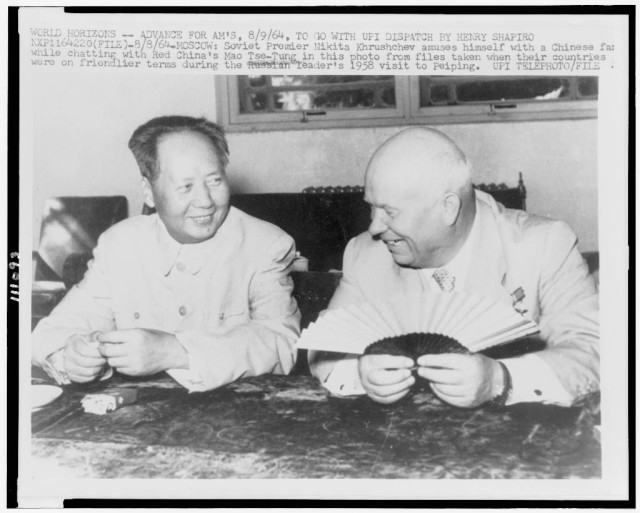
At least till Nikita Kruschev ruined it. In February 1956, he hosted the 20th Congress of the Communist Party and denounced Joseph Stalin as a monster, demanding reforms.
Mao Zedong, China’s head honcho, was shocked. He thought of Stalin as a comrade-in-arms. Worse, he believed that Kruschev was also attacking him, for Mao felt that purges and summary executions were necessary for China’s transition from its feudalist past.

Then in 1958, Kruschev wanted to install long wave radio stations along China’s coast to help guide Soviet submarines.
Mao was suspicious but agreed on the condition that China be given nuclear weapons. Kruschev balked, even though Chinese scientists had already received blueprints for an atomic bomb from their Russian counterparts.

When Kruschev visited the US in 1959, Mao accused him of sucking up to capitalists. Things came to a head in 1962 when China used the Cuban Missile Crisis as an opportunity to occupy India’s Aksai-Chin region, and the USSR sided with India. But when Kruschev pulled Soviet missiles out of Cuba, Mao had had enough, and the official friendship between the two nations ended.


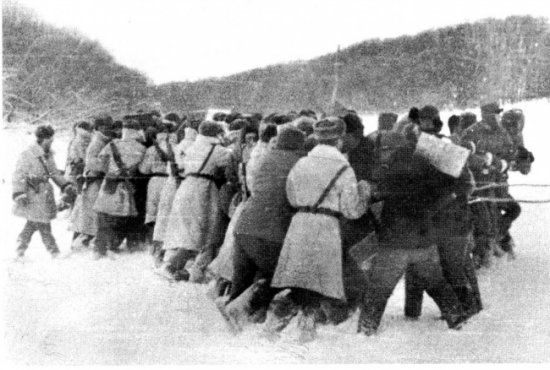
Soviets and Chinese using sticks against each other during the Sino-Soviet split
Soviets and Chinese using sticks against each other during the Sino-Soviet Split

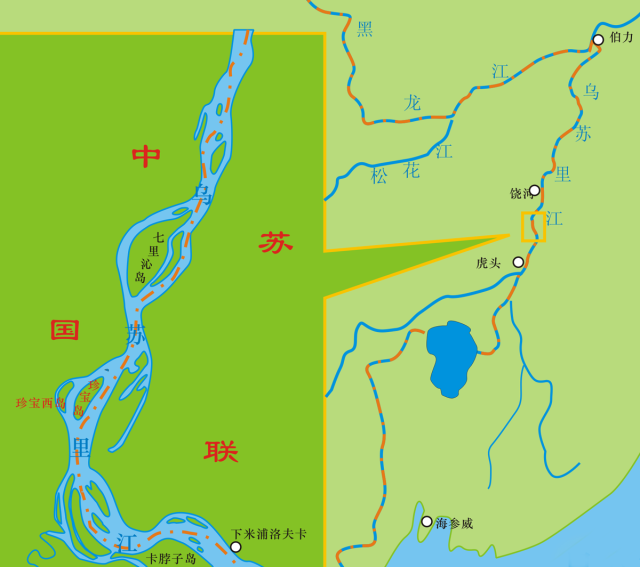
In 1964, Mao claimed that the Treaty of Beijing had been unfair. He demanded a return of territories under Soviet control, including Zhenbao (Treasure) Island, which the Russians called Damanski.


Mao (left) and Kruschev (right) together in 1958
To mitigate increasing tensions, Kruschev agreed to hand over Zhenbao and other lands, but Mao screwed it up a few months later. During a speech, he jokingly said that he’d present Russia with a bill for their occupation of Siberia, the Far East, and Kamchatka. Kruschev was furious, so he nullified his agreement with Mao.
Chinese and Soviet troops began massing on the disputed border. Though technologically inferior to Russia, Mao was convinced that China’s superior numbers would far outweigh Russian technology. He was right.
When Arkady Nikolayevich Shevchenko (former Under Secretary General of the UN) defected to the US in 1978, he admitted that the USSR was terrified of China’s numbers. Shevchenko claimed that if Mao attacked, the Kremlin was going to launch nuclear missiles.
But Nikolai Vasilyevich Ogarkov, Marshal of the Soviet Union, cautioned against it. He knew they couldn’t nuke China without consequences to themselves. But while the Soviets thought of self-preservation, Mao did not.
Mao just couldn’t grasp how dangerous nuclear weapons really were, calling them “America’s Paper Tigers.” He was convinced that China’s vast size and numbers protected it from any possibility of nuclear annihilation. Still, he took no chances, so on October 16, 1964, China detonated its first atomic bomb in their test area.


The Chinese proposal to redefine the Sino-Soviet border with Zhenbao (Damanskii) Island on the Chinese side. "中国" on the left is China, while "苏联" on the right is the Soviet Union
The Chinese proposal to redefine the Sino-Soviet border with Zhenbao (Damanskii) Island on the Chinese side. “中国” on the left is China, while “苏联” on the right is the Soviet Union. Zhuwq – CC BY-SA 3.0
Things only got worse from there. According to the official Chinese version, some of their civilians were attacked by Soviet troops in border regions. Others who peacefully protested illegal Soviet occupation were allegedly run over by Soviet tanks.
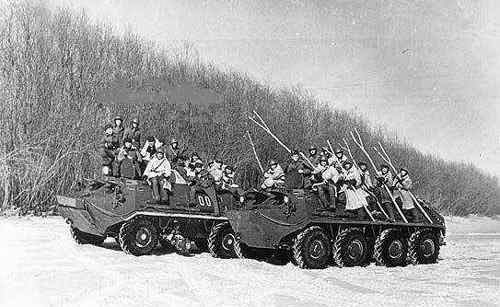
The Soviets claim that Chinese soldiers began haranguing Soviet border posts, some by waving Mao’s “Red Book” at their faces. To de-escalate tensions, Soviet border guards were ordered to use sticks to push Chinese nationals back across the border.
The Chinese retaliated by using longer sticks, resulting in ridiculous jousts. Later, they sent martial artists and wrestlers to the border, since neither side wanted outright war nor to lose face.


Soviets armed with sticks to minimize damage against the Chinese
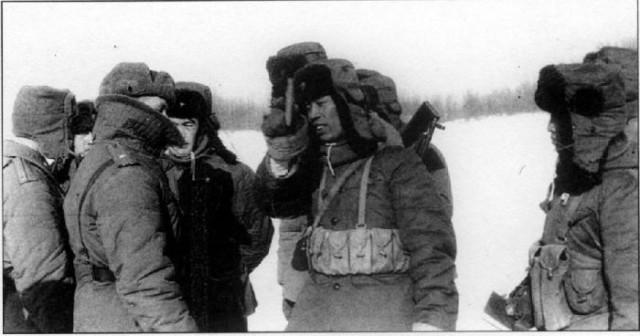
It all came to a head on March 2nd, 1969. In supposed revenge of murdered Chinese civilians, members of the People’s Liberation Army (PLA) attacked Soviet border guards on Zhenbao Island – killing 59 and injuring 94. The Soviets counter-attacked on March 15th by shelling the PLA on the Chinese side of the Ussuri River.
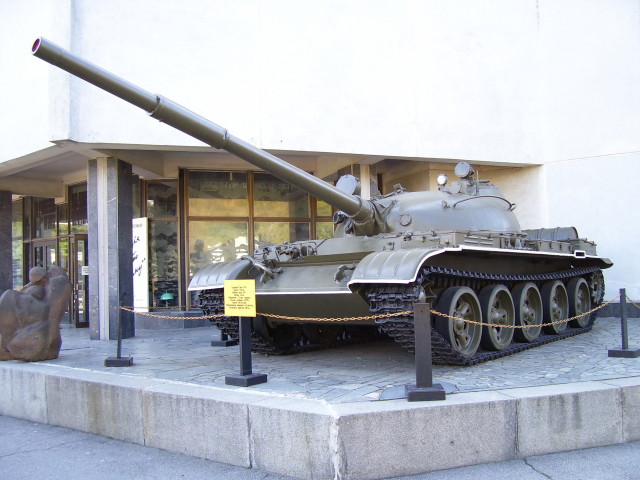
To take Zhenbao back, they sent in four of their newest weapons – the still-secret T-62. As they crossed the narrow frozen river, one ran over a landmine. The other three didn’t bother turning. They simply reversed back to the Soviet side.
A PLA soldier approached the damaged tank, opened the hatch, and found himself staring at the barrel of a pistol held by an injured Russian. The man fired, but his gun jammed, allowing the Chinese soldier to throw a grenade in. The Chinese wanted to tow the tank away, but sniper fire from the Soviet side prevented that.


Chinese border guard (on the right) waving Mao's "Red Book" in front of a Soviet border guard
Chinese border guard (on the right) waving Mao’s “Red Book” in front of a Soviet border guard
The following day, the Soviets returned to claim their dead, which the Chinese allowed. But when they tried to retrieve their tank, the Chinese fired, forcing them to retreat. On March 21st, the Soviets sent over a demolition team but were again beaten back by the Chinese.
With the Soviets gone, the Chinese navy was called in to help pull the tank onto the Chinese side. They arrived on March 28th, but were shelled, so the Chinese tried another tactic.
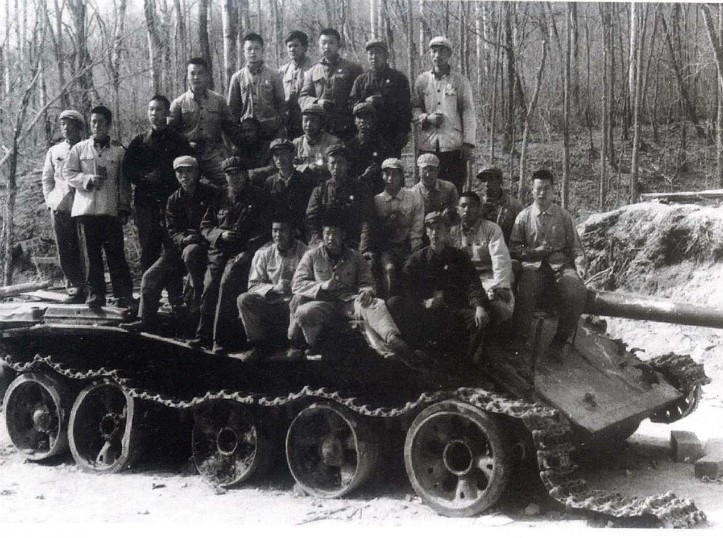
Using the tank and sniper fire as cover, engineers began dismantling the T-62. They were still at it on April 2nd when the ice began to melt. The Soviets took advantage of this by firing at the ice around the tank till it sank. Satisfied, they retreated.


A T-62 tank at the Museum of The History of Ukraine in WWII in Kiev, Ukraine
A T-62 tank at the Museum of The History of Ukraine in WWII in Kiev, Ukraine. Gutsul – CC BY-SA 3.0
They ignored the Chinese navy who continued their efforts to salvage the tank but whose suits were ill-equipped for the freezing temperatures, causing many to die of hypothermia. By April 29th, the Chinese pulled the rest out and sent it to a tank factory in Lyshuen.
But the Soviets hadn’t given up on their tank. In mid-May, a Chinese saboteur was caught near the factory with a bag full of explosives. Under questioning, he admitted to working for the Soviets who wanted him to destroy the factory and the T-62. He was executed, of course.


The PLA capturing the T-62 tank
The tank didn’t turn the balance of power in China’s favor, but it accomplished something far more important. Mao realized that he couldn’t fight the Capitalist West and the Soviets at the same time, which led to a thaw in Chinese-US relations.
Only in 1991 was Zhenbao Island returned to China, but it was only in 2003 that the two nations finally delineated their borders

Sunday, December 15, 2013

Russian upgrading their military capability.

I decided to change up from the Hitler themes and the second amendment to Russia, whom has seem a resurgence lately in their military capability and funding at the insistence of their premier Putin that I believe has the aspirations and ambitions of the Tzars of old.  Russia has been revamping their military with new aircraft, upgraded tanks, air defense systems, I honestly believe that they are concerned about their far eastern areas especially with the massive illegal Chinese populations in the area with a massive Red China that has been upgrading their military for the past 20 years using our massive trade imbalance to help finance it.   The same China that has declared an ADIZ farther out in defiance of international law, the same red China that tried to crowd an American Warship this week in the same area.  The same Red China that has territorial disputes with the Philippines over the Spratley islands.          China I have heard is having domestic issues and a good way to solve them is have an international excursion and get the medial controlled masses a distraction.   There are dangerous times afoot and we have the Obungler White house that has brought incompetence to the rarefied heights not seen since the Carter administration and their *detente* program with the Soviets and other countries that didn't like Americans.  
Putin is using the huge natural gas and oil that is present in Russia to help finance the buildup.  He also if memory serves, has browbeat Europe in the past because they are depend on the gas and oil to keep their economy going.  I pulled part of this off Aviationweek and other websites.


December 16, 2013
Credit: Sukhoi
A massive modernization push is imminent for Russian aerospace defense: The air force alone could receive 4.5 trillion rubles ($136 billion) over 10 years, about one-quarter of the overall drive to upgrade Russia's Soviet-era weaponry.
The money will help replace about 70% of the air force fleet by 2020 and position it to acquire the Sukhoi T-50—a fighter advanced enough to rival the F-35 Joint Strike Fighter—as well as a stealthy, long-range bomber, and to overhaul its surface-to-air missile stockpile. However, analysts caution that the plan's financial scope may be unrealistic.
For now, the investments are on track. During a series of briefings by military officials and defense manufacturers in late November, Russian President Vladimir Putin approved the procurement program adopted in 2010. The meetings amounted to the first public audit of the program to ensure that the investments are on track—a domestic show of support for the Russian defense industry, despite the country's economic stagnation.
The list includes accelerating replacement of old aircraft in the air force fleet. Putin has announced that the military will have received 86 new and, modernized fixed-wing aircraft and more than 100 new helicopters this year, and will take delivery of up to 120 fixed-wing aircraft and 90 helicopters in 2014. In 2011 and 2012, just 263 new aircraft were delivered to the military units.
By 2020, the air force aims to have a total of 1,600 new aircraft, renewing about 70% of its fleet.
So far, the air force's orderbook consists of Sukhoi Su-34 fighter-bombers and Su-30M2/SM and Su-35 multirole fighters. In 2014, the air force plans to rearm one air regiment with the Su-34s, according to Defense Minister Sergey Shoigu. A training air base in Borisoglebsk is to be reequipped with Yakovlev Yak-130 jet trainers; 18 of the type were delivered in 2013, out of 55 ordered.
According to the head of the United Aircraft Corp. (UAC), Mikhail Pogosyan, the Sukhoi T-50 will start official evaluation tests with the air force in 2014. The first phase of these trials is expected to be completed in 2015, he says. The five prototypes involved in the preliminary test program have logged more than 450 flights. The Russian defense ministry issued technical requirements for the future long-range bomber to the corporation in September. “We are now at the stage of drawing up the contracts to start the full-scale development of this aircraft beginning next year,” Pogosyan says.
    
The air force expects the stealthy bomber aircraft, to be developed under the PAK DA program, to replace its current strategic bomber fleet of Tupolev Tu-160 Blackjacks, Tu-95 Bears and Tu-22M3 Backfires by 2025-30. Meanwhile, the veteran bombers are being upgraded with new avionics and airborne weapons. UAC completed factory testing of the upgraded versions of the Tu-160 and Tu-95 and is handing them over for the official trials.
The procurement program also calls for enhanced air transport capabilities for the air force. In November, UAC completed the first phase of official tests of the Il-76MD-90A, a much modernized Ilyushin Il-76 heavy transport aircraft. During this phase, the aircraft completed 38 flights, including tests at the maximum takeoff and landing weights (210 tons and 170 tons, respectively). The air force has 39 transports on order; the modifications will be done in Russia, although the older variants were manufactured in Uzbekistan. Pogosyan has promised that deliveries will start next year. The UAC has begun development of medium transport aircraft as a joint program with India and completed the detailed design of a new light transport, Pogosyan says.
Meanwhile, the aerospace defense troops are being reequipped with the S-400 (SA-21 Growler) long-range air defense and anti-ballistic missile systems. Two units of these surface-to-air missiles (SAM) were delivered this year and three more are to be deployed in 2014, Putin says.
S-400 manufacturer Almaz-Antey is working on a next-generation system, the S-500, that will undergo intensive trials in 2014-15, says the company's chief designer, Pavel Sozinov.
The aging S-300PT and PS (SA-10 Grumble), the most common air defense missiles in the force, will be replaced by new S-350 Vityaz medium-range mobile SAMs unveiled this summer. Sozinov says official trials will be conducted during 2014 and deliveries could start in 2015-16.
The aerospace defense troops' missile capabilities will be supported by expansion of the early-warning radar network. The service operates three Voronezh modular radar stations and plans to deploy seven more in the next five years.
Defense experts are quite skeptical of the rearmament program's feasibility, however. “Even if the program is properly financed, it is unlikely to be fully implemented, as the required modernization of defense industry facilities and the respective regulatory environment lag behind,” says Konstantin Makienko, deputy director of the Center for Analysis of Strategies and Technologies, a Moscow-based defense think tank.
    

TOR M2E firing a 9M331 interceptor. The missile is capable of defeating aerodynamically maneuvering targets at ranges of seven to 10 km.
Russia’s Almaz-Antey defense corporation has developed an advanced version of the Tor-M2 air defense system (NATO reporting name SA-15 Gauntlet), utilizing a new interceptor missile that has improved performance, doubled the ammunition capacity and enabled firing on the move capability. According to Sergei Druzin, head of research and development at Almaz-Antey, the enhanced version represents a “unique air defense system in its class with an astounding precision and range.”
The Tor system is a low- to medium-altitude, short-range surface-to-air missile system designed for intercepting aircraft, cruise missiles, precision-guided munitions, unmanned aerial vehicles and ballistic targets.
Tor-M1K and Tor-M2U variants, armed with 9M331 missiles, are currently in service with the Russian army. The new system, equipped with new 9M338 missiles, was successfully tested at the end of October 2013. “We carried out five launches targeting highly maneuverable drones. Three of the targets were hit head-on, while the other two were destroyed by shrapnel from exploding warheads. It is an excellent result, astounding precision,” Druzin said.
In addition, the smaller size of the 9M338 compared with its predecessor has allowed the carrying capacity of the launcher to be doubled, from eight to 16 missiles. The official said the improved Tor-M2 systems and 9M338 missiles have been approved by a state commission for mass production. “We can now start producing these missiles in quantities that would meet the demand of the Russian army,” Druzin said. The Tor M2E missile system has also been exported to Azerbaijan, Belarus, Ukraine, China, Venezuela and Iran. Earlier versions (M1) were also exported to Greece, Cyprus and Egypt.
According to Druzin, the next step in the improvement of the system would be for launching missiles at acquired targets while on the move. “The [mobile] launcher currently stops for two or three seconds to launch a missile, but it could be done on a move, without stopping,” Druzin said.
The export version known as TOR M2E is also armed with the 9M331 interceptor, is designed as a short range air defense system, capable of intercepting air breathing and maneuvering targets at ranges of 1-12 km and altitudes from ground level (10 meters) to 10 km. Cruise missiles and drones could be killed at ranges of 1.5 km to 7 km maximum with precision guided weapons intercepted at a minimum distance of 50 meters and maximum range of six kilometers. Maximum target speed is 700 m/sec (2,520 km/h). A Tor M2E can engage four targets simultaneously, having up to eight missiles airborne. (four actively guided).
The export variants are also expected to be offered with the new interceptor.
The improved TOR M2 is claimed to offer 'firing on the move', enabling the unit to launch its missiles instantly upon stopping. Existing TOR M2K systems require about three minute set-up time.
The improved TOR M2 is claimed to offer ‘firing on the move’, enabling the unit to launch its missiles instantly upon stopping. Existing TOR M2K systems require about three minute set-up time.
9M331 missiles are loaded in two stacks of four missiles each.