Webster

The Constitution was made to guard the people against the dangers of good intentions." --American Statesman Daniel Webster (1782-1852)


Showing posts with label Desert Storm. Show all posts

Friday, January 17, 2020

29 years ago Desert Storm Started.

This didn't post like I wanted to....Was supposed to drop in the morning.

    Today 29 years ago, Desert Shield became Desert Storm.  On 17th January Apache's snuck across the berm and wasted several Iraqi EW radar sites and opened the corridor for the masses of airplanes to strike targets all over Iraq.  The Navy fired Tomahawk Missiles from the Persian Gulf at the same time, this was the shock and awe of Desert Storm,  We had the entire Armed forces operating in concert.  I remember we felt like it was a "great Crusade" to liberate Kuwait.  We were in full MOPP4 and geared up in case the Iraqi's counterattacked.  Saddam Hussein had promised the "Mother of all Battles" and we went in fully expecting a lot of casualties.


Soldiers, sailors, airmen and marines of the United States Central Command:
This morning at 0300 we launched Operation Desert Storm, an offensive campaign that will enforce the United Nations resolutions that Iraq must cease its rape and pillage of its weaker neighbor and withdraw its forces from Kuwait. The President, the Congress, the American people and indeed the world stand united in their support for your actions.
You are a member of the most powerful force our country, in coalition with our allies, has ever assembled in a single theater to face such an aggressor. You have trained hard for this battle and you are ready. During my visits with you, I have seen in your eyes a fire of determination to get this job done quickly so that we may all return to the shores of our great nation. My confidence in you is total. Our cause is just! Now you must be the thunder and lightning of Desert Storm. May God be with you, your loved ones at home, and our country.
   He had some detractors but we soldiers knew that he had our best interest in heart and we were fiercely loyal to him.  He was one of the officers that learned the lessons of Vietnam and vowed not to repeat them.  We were told that there was a "duration" policy, no rotation back to the world, there would be no "FNG" syndrome or any screwy Rules of engagement or the "Squad Leader in the Sky Syndrome" that was prevalent during the Vietnam War. 

Tuesday, June 11, 2019

A backstory on an Iconic pic from the First Gulf War.

 Sorry about the lack of postings, we came back from vacation and I immediately ran into my heavy work schedule and was unable to post.

I ran across this story on my Facebook feed.  I remembered the picture after I returned from Desert Storm.  I thought it was an iconic pic from that time and this is the backstory on it.


This March 29, 1991, file photo shows Matt Miller cutting a solitary figure on the South Jetties, waving Old Glory as the USS Saratoga enters the St. Johns River before swinging into Mayport Naval Station. (Dennis Hamilton Jr./The Florida Times-Union via AP, File)

JACKSONVILLE, Fla. — As Matt Miller settled under a walkover to the beach at Mayport Naval Station, he apologized to the folded American flag he had carried with him to get to this resting place. It was a cold, misty March night, and he would need to use it as a blanket. Just until first light, just until he could carry out his mission.
He was awakened at 6 a.m. by the rumbling and rattling of a white pickup truck on the road nearby. Military police? No, just someone going by with fishing poles.
Miller refolded the flag, picked up the two pieces of his flagpole and resumed his mission, walking north up the beach. He was nervous: He didn't have permission for what he was about to do, and he feared someone would see him and stop him.
But no one did, so when he reached the big rocks that form the St. Johns River south jetty, he climbed up and started making his way east, into the Atlantic. About 200 yards (182 meters) out, he found the right spot to fulfill his mission: A huge boulder with a natural wide ledge on it. He settled down on the ledge and waited for the USS Saratoga to finally come home from war.
So he was ready several hours later when the aircraft carrier loomed into view, growing impossibly gigantic, a floating city whose thousands of residents manned the rails, with hands folded behind their backs.
Miller, on his ledge out in the ocean, stood as tall as he could. He thrust his right hand into the air as if in greeting, or triumph. In his left hand he held aloft his flagpole, and an east wind unfurled the American flag on it, stretching it out to its full length and width.
Snap.
In a helicopter flying just to the south, Florida Times-Union photographer Dennis Hamilton Jr. captured the moment with his camera. It was an iconic tableau: the Saratoga and its sailors at parade rest, two Coast Guard escorts, a seabird just in the frame, a wave peeling off the jetty toward the beach.

And there on the rocks, a single figure, waving the American flag.

The photo was taken March 20, 1991, and the Saratoga was coming back to its home port after almost eight months in the Persian Gulf during the first Iraq war.
In a Navy town, the Saratoga's homecoming was a big deal. At Mayport, 30,000 people waited to greet the crew and the newspaper had rented a helicopter so that Hamilton, a staff photographer, could get aerial shots of the carrier as it neared the jetties. As the helicopter followed the ship in, Hamilton saw the man with the flag on the rocks.
Can you go lower, he asked the pilot.
He could, and Hamilton got his shot. In those pre-digital days he couldn't immediately see what he had, but he figured this was going to be good.
"You see it through the lens and you think this looks like a good A1 photo, but you never know until you get back and run the print," said Hamilton, who left the paper in 2001. Indeed, the photo was worthy of A1, and ran across the entire front page. It was also turned into a popular poster.


The image has long outlasted that day's news cycle: When Miller meets someone with a connection to the Saratoga, they usually remember that photo. There are many in Jacksonville, still, who have that connection. After all, the aircraft carrier spent 37 years at Mayport, the only home port it knew, and thousands served aboard it at any one time, and many of them had families with them.
"They know the picture," Miller says. "They just don't know me."
 
Matt Miller poses with the nameplate of the USS Saratoga on May 29, 2019, while holding the flag he waved when the ship returned from the Persian Gulf in 1991. Times-Union photographer Dennis Hamilton took the iconic photo from a helicopter of Miller on the jetties waving the flag as the ship came into Mayport Naval Station. (Will Dickey/The Florida Times-Union via AP)
Miller is 60 now, and on a recent hot morning he drove to Mayport Naval Station, carrying that same flag with him. He wore a teal Jaguars Nick Foles number 7 jersey and a Saratoga cap given him by a Saratoga veteran after Miller told him he was that guy in the photo.
This time he didn't have to sneak onto the base: The Navy had readily agreed to allow him to visit the Saratoga's nameplate. At 16 feet (4.8 meters) long and 3 feet (0.91 meters) high, it is just about all of what remains of the carrier, which was decommissioned in 1994 and then scrapped.

Miller took the folded flag and touched it to each of the black letters that spelled out the ship's name. He paused in prayer, then broke into big smile.
Over and over, he said how amazed he was that this was happening, how humbled he was to be there.
And he told his story of that day 28 years ago: How he parked at an Atlantic Beach condominium at 3 a.m., how he left a palm frond on the beach to show him the way back, how he took the long walk by the ocean, fearing that he would be stopped, how he rested near the jetty, wrapped in the flag for warmth.
"I did ask the flag for forgiveness," he said.
He had not thought everything out: He'd brought a sandwich with him, but ate it too soon, and he forgot to carry water, so his thirst grew. And he stumbled over a few times on the slimy rocks of the jetty — quick violent falls.
He had not counted on his mission making the front page, had not figured that anyone other than the sailors on the carrier would see what he had done. But that photo clearly means a lot to Miller, who carries prints of it with him most places he goes. He gives them to Desert Storm veterans he encounters or to those who served on the Saratoga.

He knew thousands would be at the base on that March day to greet the Saratoga, but he wanted his flag to be the one the sailors saw first. Several times he said he felt as if God was calling him to do it, to take the flag through the night to the jetty. "All glory goes to God," he said.
As for himself? Miller says he was just someone who was at the right time and the right place, doing the right thing.

Thursday, January 17, 2019

28 years ago it started....

28 years ago, Desert Storm started.  I remember the January 15 deadline for Saddam withdrawing from Kuwait via UN Resolution.  Saddam blew off the deadline, in my mind he truly believed that we wouldn't attack, because we were a paper tiger and the decadent West can't handle casualties from the "Mother of All Battles"from his  battle tested Army and with the exception of a few soldiers from the Vietnam conflict the American Army and armed forces were "green". Saddam had the worst timing possible.  If he had waited a couple of years he probably could have seized Kuwait and got away with it.  The wall had come down, the soviet were not threatening anymore , there was discussion of drawdown and demobilization from certain members of congress that was in a hurry to spend the :Peace Dividend".   Saddam didn't take into account changes in our doctrine, from the Red flag exercises, where we used the old Caesar saying, "I want our training to be bloody battles and our battles to be bloodless training".  The American Armed forces after 10 years of flush spending from the Reagan military buildup.  We had trained with "Airland Battle", where we were trained to decimate the soviet 2nd and 3rd echelons of battle.  We would use our air forces to go after the 2nd and 3rd while the ground forces fought the 1st echelon.  The Army was well trained, the Airforce was well trained and the Navy and Marines were well trained., well equipped, and highly motivated.  Especially since we were told "For the duration + 6 months," this told us that we were here to start it and finish it. no rotation policy like they did in Vietnam, General Schwartzkopf forbid it, he saw the destructive influence such a policy had on the U.S. Military.   The Iraqi's with the exception of the Republican Guard was a conscript Army and they were tired from war after 8 years with Iran.  The equipment they had was worn out and poorly maintained.
  The Air War started on January 17th at 3:30 in the morning we were woke up and told to "stand to" in full MOPP Gear level 4.  We suited up as fast as we could because we were convinced that the Iraqi's would counterattack with Chemical weapons.  We had no reason to doubt this because they have done it before to the Iranians and to the Kurds.  We had a couple of M-8 alarms but we really didn't have any real faith in the equipment.  To assist us, we had a real live chicken in a cage.  We were told that if there are any chemicals in the air, the chicken will keel over first before we got affected.  Granted we spent a lot of money building up the force in the 10 years, but the NBC gear wasn't as advanced as some of the other stuff.

                                                   Czech Chemical Detection vehicle
      The Czech Military(The former communist adversary sent over all their Chemical detection equipment and soldiers to help out.  I thought that was ironic former Warsaw Pact adversaries joining us to defeat the same stuff that they trained for.  We had the Chicken for several weeks then he just vanished..I figured that someone scarfed it up and cooked it.
       After the Apache's took out the Sam sites clearing the way for the massive air strikes to punish the Iraqi Capital,

As the Air Force methodically went after the Iraqi C3 Nodes, the Command, Control and Communications Nodes.  We had spent the buildup logging the location of every single one and waited until the Air War kicked off and we went after the logistic and infrastructure during the air war.  We also started going after the Republican guard which was the center of gravity for the Saddam regime.  The air War went on for 6 weeks until the ground war kicked off and whatever C3 nodes that survived the air war we blew up so they couldn't coordinate their ground forces when we crossed the berm.
This was me and my brother after the War was over.  We both were over there.

  The Iraqi's would throw SCUD missiles at us and the Israeli's to provoke the Israeli's into attacking  and fracturing the coalition against them.  It was a close thing, the Israeli's did launch a few times and Dick Cheney calling the PM of Israel and assuring them that we were doing everything possible to hunt them down.  After the war we found out that the SCUDs could be set up and launched in less than 30 minutes.  Much quicker than the original estimates that the Soviets had.   Our casualties were very low especially compared to the pasting the Iraqi's took.  I lost a couple of friends in this war and it was due to "Blue on Blue" which is called "Friendly Fire" but it was anything but friendly..The legality of the new generations of weapons exceeded the capability of "positive target Identification" which usually was "Mark 1 eyeball.  The United States hasn't operated large formation of troops and tanks since WWII and the weapons were far more lethal.
     I have Blogged a bit about Desert Storm from my experiences and what I have learned later on after the War. 

Thursday, June 7, 2018

General H Norman Schwartzkopf Letter to the Troops

I did some research on this one after I had posted yesterday General Ike's speech to the troops on the eve of D-Day landing and I had mentioned the speech in a response to my friend we got from General Schwarzkopf before the Storm started.  I remember we felt like it was a "great Crusade" to liberate Kuwait


Soldiers, sailors, airmen and marines of the United States Central Command:

This morning at 0300 we launched Operation Desert Storm, an offensive campaign that will enforce the United Nations resolutions that Iraq must cease its rape and pillage of its weaker neighbor and withdraw its forces from Kuwait. The President, the Congress, the American people and indeed the world stand united in their support for your actions.
You are a member of the most powerful force our country, in coalition with our allies, has ever assembled in a single theater to face such an aggressor. You have trained hard for this battle and you are ready. During my visits with you, I have seen in your eyes a fire of determination to get this job done quickly so that we may all return to the shores of our great nation. My confidence in you is total. Our cause is just! Now you must be the thunder and lightning of Desert Storm. May God be with you, your loved ones at home, and our country.

   He had some detractors but we soldiers knew that he had our best interest in heart and we were fiercely loyal to him.  He was one of the officers that learned the lessons of Vietnam and vowed not to repeat them.  We were told that there was a "duration" policy, no rotation back to the world, there would be no "FNG" syndrome or any screwy Rules of engagement or the "Squad Leader in the Sky Syndrome" that was prevalent during the Vietnam War. 

Saturday, April 21, 2018

Conflicts that demonstrated the Value of Ground Attack Aircraft.

I was a GI in the U.S Army in the 1980's, we had rolled out AirLand Battle in the late 1970's to counter the huge numbers of Soviet Tanks that were threatening to roll down the Fulda Gap.  Airland battle was designed to use American air power especially the A-10 and the Apache helicopters to strike the 2nd and 3rd echelons of Soviet forces and disrupt them and prevent them from supporting the first echelon that was attacking the NATO forces and prevent them from getting overrun by superior numbers.

For a century, ground attacks by armed aircraft have added an extra dimension of devastation to the battlefield. In some wars, ground attack aircraft have been less than effective. In Vietnam in particular, the Americans were unable to turn aerial bombardments into a strategic advantage. But some wars have shown beyond a shadow of a doubt what aerial attacks can do.
Italo-Turkish War (1911-1912)
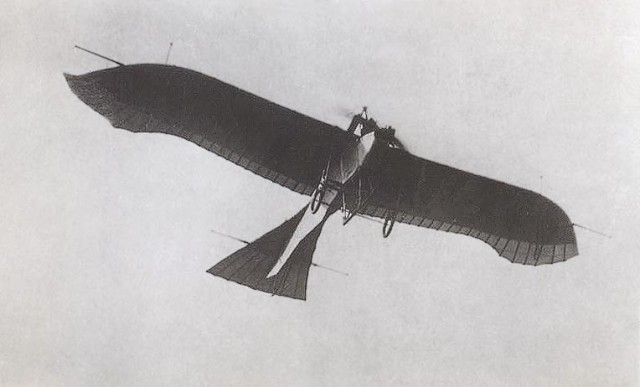
The first ever attack on ground troops by an airplane took place on 1 November 1911, during a war between Italy and the Ottoman Empire. Giulio Gavotti, an Italian lieutenant, flew an Etrich Taube monoplane above Ottoman forces in Libya, taking with him a bag of grenades. With these he attacked two targets – the oasis at Tagiura, and the Ottoman military camp at Ain Zara.
Gavotti’s flight was a challenging one – he had to screw the detonators into the grenades and drop them by hand while still piloting the plane. It was also ineffective – no-one was injured by his attacks.

Yet Gavotti had proven that aircraft could reach behind lines to attack enemy troops unawares. His innovation startled the Ottoman troops, leading to a political protest, and set an example that others would follow with far more destructive effect.

RumplerTaubeInFlight
Etrich Taube monoplane.

First World War (1914-1918)
The First World War saw the first real developments in aerial warfare, led by innovators such as Oswald Boelcke. Planes started out as reconnaissance craft, and this shaped aerial combat for most of the war, with an emphasis on fighting between pilots.
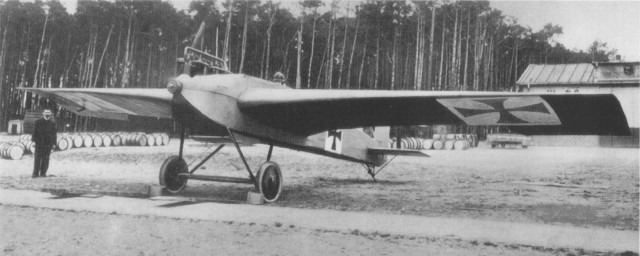
By the late stages of the war, the potential for aircraft to attack the ground was appreciated. Increasing specialization in design led to aircraft such as the German Junkers J-1. Equipped with extra armor, the J-1 was able to safely descend for low-level attacks on infantry, the pilot protected from their bullets by his plane’s armored belly. J-1s supported the great German offensives of spring 1918, offensives which almost turned the tide of war.

Junkers J 1 all metal "technology demonstrator" pioneer aircraft, at FEA 1, Döberitz, Germany in late 1915, undergoing flight preparations (Wikipedia)
Junkers J 1 all metal “technology demonstrator” pioneer aircraft, at FEA 1, Döberitz, Germany in late 1915, undergoing flight preparations.
The J-1 showed that ground attack aircraft could be as devastating to morale as to the bodies of the men they attacked. Norman Gladden described seeing the approach of a German attack plane in 1917: “Never before, despite my capacity for fear, had I felt myself so long in the grip of a terror so absolute.”
Spanish Civil War (1936-1939)

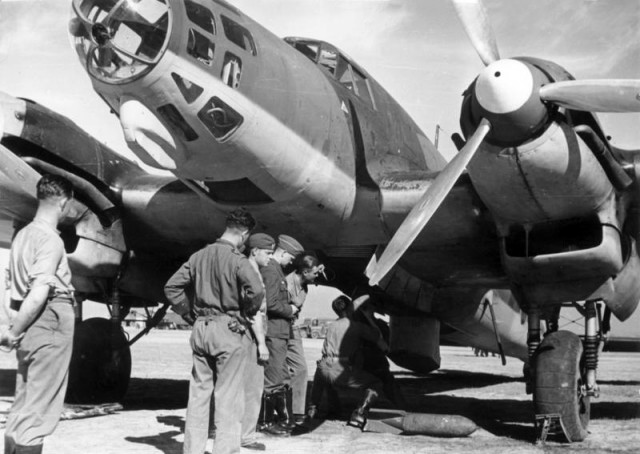
He-111E of the Condor Legion, 1939 (Bundesarchiv)
He-111E of the Condor Legion, 1939. By Bundesarchiv – CC BY-SA 3.0 de
In the lead up to the Second World War, Germany and Italy threw their backing behind right-wing Nationalists forces in the Spanish Civil War. This was partly an opportunity to fight their enemies by proxy, as America would later do in Vietnam. For the Germans, in particular, it was also an opportunity to test new equipment.
German air support, including the mixed ground and air troops of the Condor Legion, proved useful for the Nationalists in battles such as the Battle of Toledo. Technological and industrial superiority allowed them to rain down death upon improvised Republican forces. They bombarded strategic civilian targets, as in the infamous bombing of Guernica, but the war also created an appreciation of the tactical use of air attacks against troops. Ground attack aircraft were refined and combined with forward observers to create the flying artillery that would prove vital in 1939.
Second World War (1939-1945)


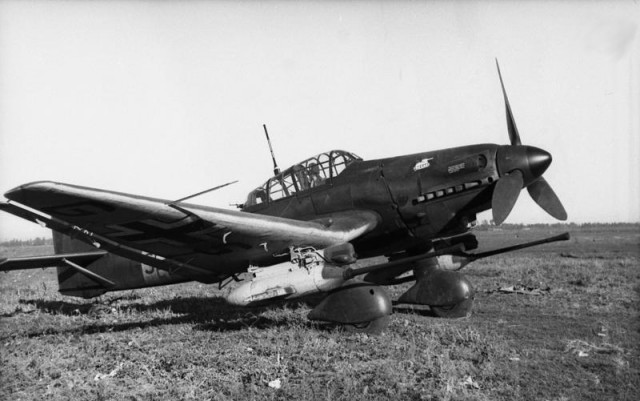
Ju 87 G-1 "Kanonenvogel" with its twin Bordkanone BK 3,7, 37 mm underwing gun pods. (Bundesarchiv)
Ju 87 G-1 “Kanonenvogel” with its twin Bordkanone BK 3,7, 37 mm underwing gun pods. By Bundesarchiv – CC BY-SA 3.0 de
Unsophisticated, ungainly and yet utterly terrifying, the Junkers 87 Stuka was the leading air element in the German Blitzkrieg. Its noise and ferocity shattered enemy morale and savaged Polish ground forces during the invasion of 1939.
Air superiority also brought the Germans their initial victories in the west. On 13 May 1940, in an unprecedented display of aerial power, nearly 1,500 German aircraft attacked fortified French forces defending the west back of the River Meuse. By the end of the day the Germans were across the river and the French heading into full retreat. Ground attack aircraft such as the Stuka and the Henschel Hs 123s supported the German forces as they raced across Frances, attacking Allied units before they could even reach the front.
It was only when they gained superiority in the air that the Allies were able to beat the Germans on the ground. Field-Marshal Rommel, one of the greatest German commanders of the war, was injured on 17 July 1944 by a strafing attack.
Six-Day War (1967)


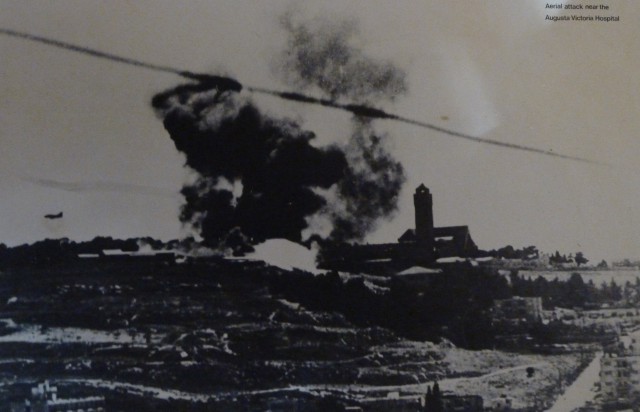
An Israeli airstrike near the Augusta-Victoria Hospital (Wikipedia)
An Israeli airstrike near the Augusta-Victoria Hospital
The Six-Day War vastly increased Israel’s territory and ensured its reputation as a military power. This incredible victory over Egypt, Jordan and Syria was in large part down to air power.
By destroying enemy planes while they were on the ground, the Israelis swiftly ensured dominance in the air. Safe from aerial attack, their air force set to supporting the ground offensive. A training plane altered to make it suitable for ground attacks, the Potez Magister proved a particularly potent weapon. The Mitla Pass was left jammed full of the burnt wrecks of Egyptian fighting vehicles.
Arab nations would learn from the Six-Day War and prepare anti-aircraft measures. But the absolute devastation left by air power would remain an icon of Israeli strength.

Gulf War (1990-1991)  This was my war, I saw the devastation of the Iraqi armor and trucks after the A-10's and B52's got done with them, in many cases  the Iraqi's were at 50% strength due to losses by coalition air forces.


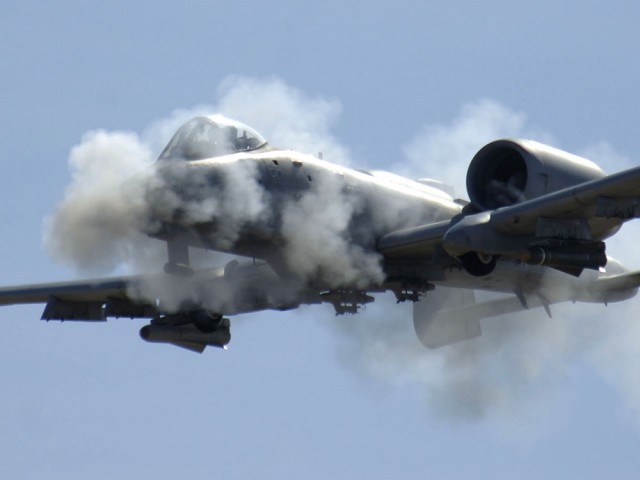
An A-10 Thunderbolt II, fires the 30 mm gun at a low angle strafe, as part of the 2006 Hawgsmoke competition, Thursday, March 23, 2006, at the Barry-Goldwater Range, Gila Bend Air Force Auxiliary Field. There are four parts of the competition. Each team has four members in which they have 100 bullets each to use toward the target. This year's competition coincides with the 30th anniversary of the Warthog. Twenty squadrons from around the world come together to gain the honor of the "best of the best" in ground attack and target destruction. (U.S. Air Force photo/Senior Airman Christina D. Ponte)
An A-10 Thunderbolt II, fires the 30 mm gun at a low angle strafe.
The Gulf War brought aerial bombardment onto TV screens. The world watched live as the American-led coalition leveled Iraqi defenses before a single boot set foot on Iraqi soil. By the time ground fighting started, the Iraqi forces have been severely weakened,

The center of this was Operation Desert Storm, a three-stage bombing campaign targeting Iraqi air defenses, command and communication facilities, and then military targets. With Iraq’s armed forces defanged, coalition aircraft were able to move into a support role. Armored columns were smashed on their way to the battle zone. Iraqi ground forces stood no chance against the vast aerial advantage of their enemies.  The Republican Guard forces fought long and well against the Americans, but their T-72s were outclassed by the American M1A1 tanks and Bradleys followed by the Apache's and A-10's that supported the American advance.  The tank battles rivaled Kursk in the number of armor used by both sides.

Thursday, October 12, 2017

Fragging?...facts and Fiction?

I got the idea after reading this article from this Website.  I will add my personal opinions and what has happened since then.   I remembered being a little kid during the Vietnam War, My dad did 2 tours, in 1968 and 1972 and I remembered the hippies and other leftist spitting on my Dad when he came back in 72.  I also remember the societal pressure about wearing uniforms, like it was something to be scorned.  I grew up on Military posts and even we were not immune to the culture war that the left had waged on the GI's.   I remembered the TV shows and they always showed the military as corrupt, inept and one step above the Keystone Cops.  As I got older, I remembered my dad watching the TV as South Vietnam fell and I didn't understand the funk he was in for quite a long time.   I also remembered shortly after that in kid years the Axe Murders in Korea.   I also started hearing the term "Hollow Army".  I didn't ask my dad about it because anytime I asked him about the Army, I got a lot of static and I didn't bother him and so I never really asked.   I found out later what it was.  The late 70's was a bad time to be in the service, the institution wasn't respected by the country that it was tasked to defend.   I remembered the humiliation that we felt when the Iranians seized our embassy and we couldn't do anything about it and the resulting debacle at Desert One and the shame we felt as a nation.  It felt like we were going nowhere as a country except more humiliation as the Soviet Union became more aggressive.

 In 1980 Ronald Reagan was elected and he expressed open pride in the United States and he immediately pushed through several large budget increases to bring the services back up to bar after years of neglect after the Vietnam war.  We had gone to a volunteer service, not drafted and the pay was increased after several public embarrassments of servicemen having to be on food stamps to support their families because the pay and benefits were so bad.  By the mid 1980's the service were flush with funds for training, equipment and confidence.  Grenada was a positive boost to our morale despite all the problems that were uncovered.  I joined in 1985 and went to basic in Fort Lost in the Woods in Misery.(Fort Leonard Woods in Missouri).  I remembered hearing about the "fragging" and other disciplinary issues the Army was having at the tail end of Vietnam and the aftermath.  My dad was an MP his first tour in Vietnam and was "El CID" the tour in 1972  He did talk about that kind of stuff with his fellow Soldiers, I was a little kid but I did hang around and listen.  While I was in basic, they covered in great detail what would happen if we disobeyed the UCMJ and we would be in Leavenworth making gravel for the Colonels driveway.   I remembered wondering when I went in would I see the same kind of stuff in the service that I remembered reading about and remembering what my dad talked about.   It was a totally different environment than I expected, total professionalism, we trained hard and had excellent morale.  This was reinforced when I got sent to Germany to the Stuttgart area.  We expected the Soviets to run through the Fulda gap like cockroaches in New York Apartment.
 I spent a lot of time inside the 1KM zone during my first tour and the Officers and NCO's were top notch, we trained really hard and we were implementing the new "Airland" battle that the Army was rolling out to disrupt the Soviet echelons if they attacked.
We trained hard for an attack that never came, the Soviet Union collapsed due to economic problems.  We tested our tactics and procedures on the Iraqi's as we evicted them out of Kuwait and punished them.  Iraq had the distinction of having rotten timing, if they had waited a couple of years then grabbed Kuwait, we may not have been able to do "Desert Storm".  After the Soviet Union basically collapsed, the Military was under a lot of pressure to cut back the force for the "Peace dividend" that the politicians were expected to spend on social projects.   I and many of my fellow soldiers got sent to the Gulf and we completed the mission.  After I got out, I went from job to job, my Military Occupational Specialty had no civilian counterpart.  In finally settled down and got married and got hired by Ford Motor Company, and   I was in a store looking at books and ran across this one and bought it.
     You can buy your own copy off Amazon, it is very good.


 I bought this book and read it, and it totally engrossed me, it explained how the Officers that won in the desert what their experiences were, how their peers transformed a shattered military with non existent morale and worn out equipment changed the culture, mindset and ultimately changed how we fight.  The book talked about how America changed and this reflected in the quality of men and women that were enlisting and decided to serve.
    This were a couple of the reviews of the book.    
  Freelance journalist Kitfield relies heavily on personal accounts in this story of the officers who reshaped the U.S. Army and Air Force after the experience of Vietnam and then led our troops in Operation Desert Storm. In the 1970s the U.S. began to adjust to a professional military after depending on the Selective Service system. In the 1980s, increased defense budgets enabled the modernization of arsenals and the stockpiling of supplies and equipment, while cumbersome higher command systems were simplified. By the time of Iraq's invasion of Kuwait in 1990, America's military leaders were eager to demonstrate what 20 years of reform had wrought. This is a highly favorable account of that effort.
Copyright 1994 Reed Business Information, Inc.
From Library Journal
The transformation of the American armed forces from the dispirited shell-shocked military at the close of the Vietnam era to the superbly trained, highly motivated, and universally respected victors in the Persian Gulf War is as dramatic a tale as any in American military history. Kitfield, an award-winning journalist on defense issues, follows the careers of dozens of army, navy, air force, and marine officers from their early service years in Vietnam to their success as commanders in the defeat of the Iraqis. While organizational and technical issues play a role, the book concentrates on the human aspect of this startling redirection of the U.S. military. A useful supplement to Michael Gordon's The Generals' War (LJ 12/94) and Al Santoli's overlooked Leading the Way (LJ 9/15/93), this is an essential addition to Vietnam and Persian Gulf War collections. Strongly recommended for academic and public libraries.

     As we draw down after the Wars in Iraq and still fighting the war in Afghanistan, we have had no incidence of "fragging" that I am aware of.  I do know that a muslim soldier shot up a tent full of officers right before the invasion of Iraq in 2003, other than that I am not aware of any.   I get into arguments that state that we need to "bring back the Draft".  I say "NO", You get a far better quality of recruit when people volunteer  vs getting drafted.  This helps a lot with mindset and discipline, you get far less resentment and hostility from someone that enlisted vs getting told to "Report or else".
     I ran across this article and I really liked it so I snagged it.  


During its long withdrawal from South Vietnam, the U.S. military experienced a serious crisis in morale. Chronic indiscipline, illegal drug use, and racial militancy all contributed to trouble within the ranks. But most chilling of all was the advent of a new phenomenon: large numbers of young enlisted men turning their weapons on their superiors.
The Vietnam War was one of the least popular in American history. It was also the least “popular” with the GI’s who were sent to fight it. By the late 1960’s, news of GI unrest was being carried on TV and in newspapers around the country and Vietnam vets were speaking at anti-war demonstrations.
But word of the GI resistance in Vietnam itself trickled back more slowly – the soldiers flashing peace signs and Black Power salutes, the group refusals to fight, anti-war petitions and demonstrations, and even the fragging of officers. What we’ve read in the newspapers, however, has just been bits and pieces. Seldom have we had a chance to hear the whole story from the GI’s themselves.

These battle weary troops from the 1st Air Cav. had just staged a “combat refusal” at Firebase Pace.
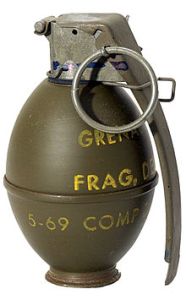
The dictionary defines “fragging” as the term used to describe the deliberate killing or attempted killing by a soldier of a fellow soldier, usually a superior officer or non-commissioned officer (NCO).  Fragging often consisted of throwing a grenade into a tent where the target was sleeping or in the shitters.  The word was coined by U.S. military personnel during the Vietnam War when such killings were most often attempted with a fragmentation grenade, sometimes making it appear as though the killing was accidental or during combat with the enemy.
The high number of fragging incidents in the latter years of the Vietnam War was symptomatic of the unpopularity of the war with the American public and the breakdown of discipline in the U.S. Armed Forces. Documented and suspected fragging incidents totaled nearly eight hundred from 1969 to 1972; resulting in 86 deaths and 714 injuries.  In 1971, army testimony before Congress cited the following: 126 incidents in 1969, 271 in 1970, and 333 in 1971. I couldn’t find a count for 1972, but it’s unlikely fragging suddenly ceased.
So why purposely try to kill a soldier with a higher rank?
Most fragging was perpetrated by enlisted men against leaders. Enlisted men, in the words of one company commander, “feared they would get stuck with a lieutenant or platoon sergeant who would want to carry out all kinds of crazy ‘John Wayne’ tactics, who would use their lives in an effort to win the war single-handedly, win the big medal, and get his picture in the hometown paper.” Harassment of subordinates by a superior was another frequent motive. The stereotypical fragging incident was of “an aggressive career officer being assaulted by disillusioned subordinates.” Several fragging incidents resulted from alleged racism between African American and white soldiers. Attempts by officers to control drug use caused others. Most known fragging incidents were carried out by soldiers in support units rather than soldiers in combat units.
Soldiers sometimes used non-lethal smoke and tear-gas grenades to warn superiors that they were in danger of being fragged if they did not change their behavior. A few instances occurred—and many more were rumored—in which enlisted men collected “bounties” on particular officers or non-commissioned officers to reward soldiers for fragging them.
In short, for all the tales of soldiers assaulting gung-ho officers they feared would get them killed, a more likely explanation is that fragging was the work of rear-echelon misfits with anger management and substance issues who sulked after getting chewed out and decided to have their revenge. The nature of the war as such likely contributed only indirectly — its unpopularity discouraged enlistment and compelled the military to accept more trouble-prone recruits. The prevalence of drugs couldn’t have helped either — one study of soldiers returning from Vietnam found one-fifth had been addicted to narcotics.

Contrary to Hollywood’s take on Vietnam, most of the drug and discipline problems were in rear echelon bases – not in the bush. The combat units largely remained cohesive. Boredom, poor morale and lack of discipline were a combustible mix. For fear of being fragged some leaders turned a blind eye to drug use and other indiscipline among the men in their charge.
After the Tet Offensive in January and February 1968, the Vietnam War became increasingly unpopular in the United States and among American soldiers in Vietnam, many of them conscripts. Secondly, racial tensions between white and African-American soldiers and marines increased after the assassination of Martin Luther King in April 1968. With soldiers reluctant to risk their lives in what was perceived as a lost war, fragging was seen by some enlisted men “as the most effective way to discourage their superiors from showing enthusiasm for combat.”
  • On the evening of October 22, 1970, Company L of the 3rd Battalion, 1st Marine Regiment was engaged in anti-infiltration operations in the “Rocket Belt,” an area of more than 500 square kilometers ringing the Da Nang Airbase. The company was set up in bunkers at an outpost on Hill 190, to the west of Da Nang. Assigned to guard duty that night, Private Gary A. Hendricks settled into his position on the perimeter and made himself comfortable. Too comfortable, it turned out. A bit later, when Sergeant Richard L. Tate, the sergeant of the guard, discovered Hendricks sleeping on post, he gave the private a tongue lashing but took no further action. Shortly after midnight the next day, Hendricks tossed a fragmentation grenade into the air vent of Sergeant Tate’s bunker. The grenade landed on Tate’s stomach and the subsequent blast blew his legs off, killing the father of three from Asheville, North Carolina, who had only three  weeks left on his tour of duty. The explosion injured two other sergeants who were also in the bunker.
  • Journalist Eugene Linden, in a 1972 Saturday Review article, described the practice of “bounty hunting” whereby enlisted men pooled their money to be paid out to a soldier who killed an officer or sergeant they considered dangerous. One well-known example of bounty hunting came out of the infamous Battle of Dong Ap Bai, aka Hamburger Hill, in May 1969. After suffering more than 400 casualties over 10 merciless days of attacks to take the hill, the 101st Airborne Division soldiers were ordered to withdraw about a week later. Shortly thereafter, the army underground newspaper in Vietnam, GI Says, reportedly offered a $10,000 bounty on the very aggressive officer who led the attacks, Lt. Col. Weldon Honeycutt. Several unsuccessful attempts were reported to have been made on the colonel’s life.
  • In April 1971, Democratic leader Mike Mansfield of Montana emotionally spoke to the issue on the floor of the Senate. Mansfield related details of the death of 1st Lt. Thomas A. Dellwo, of Choteau, Mont. “He was not a victim of combat. He was not a casualty of a helicopter crash or a jeep accident. In the early morning hours of March 15, the first lieutenant from Montana was ‘fragged’ as he lay sleeping in his billet at Bien Hoa. Lt. Richard Harlan was also killed in the incident.  He was murdered by a fellow serviceman, an American GI. Private E-2 Billy Dean Smith was charged with killing the officers but was acquitted in November 1972.
  • On 21 April 1969, a grenade was thrown into the company office of K Company, 9th Marines, at Quảng Trị Combat Base, RVN; First Lieutenant Robert T. Rohweller died of wounds he received in the explosion. Private Reginald F. Smith pleaded guilty to the premeditated murder of Rohweller and was sentenced to 40 years’ imprisonment; he died in custody on 25 June 1982.
Why use a grenade?

If you shoot someone, there’s a lot of more forensic evidence. And the Army is pretty fanatical about keeping track of ammunition. A bullet can be traced to a particular lot number or a particular gun. You can’t associate a grenade firing pin with a particular grenade.
With a grenade, it splinters into thousands of tiny fragments. Trying to piece that together, there’s no way you’re going to get evidence off of that. Avoiding getting fingerprints on the spoon [the lever on a grenade that is held down to prevent it from going off] is pretty easy — just don’t touch the spoon with the tip of your finger.
Also, with a gun, you have to be there to shoot it. Whereas with a grenade, you have a certain amount of lead time. You could set it up as a booby trap if you wanted to, with a trip wire, or set it against a piece of furniture. There are many more ways you can make a grenade deadly that you can’t make a gun.
In Vietnam, it was really not that hard to get your hands on grenades. There were lax standards, which meant that there were crates of grenades available. You’d make your stop by the ammunition bunker, and platoon members could grab a couple or as many as they thought they needed.
  • Here’s an example of a shooting in a base camp:  Sp4 Enoch ‘Doc’ Hampton, an African American soldier, was respected and well-liked by his fellow soldiers, he was top notch and knew how to take care of them in the field. The First Sergeant, Clarence Lowder, whom they called “Top did everything by the book. When on stand down at the basecamp, Top continuously harassed Doc for the length of his ‘picked out’ hair, threatening Article 15’s if he didn’t immediately get his hair cut. That night at chow, Doc Hampton said he was going to the orderly room to see the First Sgt. “Either I’ll come out alone,” he said, “or neither of us is coming out.”
    Hanusey, the clerk, was working in the orderly room when Doc came through the doorway. “His face was cold, stone cold,” Hanusey said. “He looked like a man in the movies who was about to kill.” The barrel of Doc’s M-16 was pointed downward, his feet planted firmly apart. Slowly he raised the barrel and fired a full clip into Top. The sergeant’s back exploded as pieces of flesh and blood spattered all over the orderly room. Then Doc walked out and headed to the company latrine where he barricaded himself for a possible shoot-out with arriving MP’s.  Surprisingly, his fellow soldiers also armed themselves and quickly formed a perimeter around the latrine to protect their brother in arms and preventing the MP’s from reaching Doc. The siege was short-lived when a single shot sounded from the latrine…Enoch ‘Doc’ Hampton took his own life.
How many soldiers were arrested for fragging?
Only a few ‘fraggers’ were identified and prosecuted. It was often difficult to distinguish between fragging and enemy action. A grenade thrown into a foxhole or tent could be a fragging, or the action of an enemy infiltrator or saboteur. Enlisted men were often close-mouthed in fragging investigations, refusing to inform on their colleagues out of fear or solidarity. Only about 10 percent of all fragging incidents actually ended up being adjudicated.  Although the sentences prescribed for fragging were severe, the few men convicted often served fairly brief prison sentences.
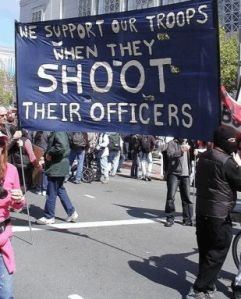
For every actual fragging incident, there was an untold number of threats of fragging. These threats were made in various forms, such as the surreptitious placement of a grenade or grenade pin, or perhaps the detonation of a nonlethal gas or smoke grenade, in the potential victim’s quarters or work areas. Officers who survived fragging attempts often did not discover the identity of their attackers, and as a consequence they lived in constant fear the attacks would be repeated. According to Captain Barry Steinberg, an Army judge who presided over a number of fragging courts-martial, once an officer had been threatened with fragging, he was intimidated to the point of being “useless to the military because he can no longer carry out orders essential to the functioning of the Army.”
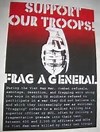
Twenty-eight soldiers were arrested in Vietnam and tried for fragging a superior officer. Ten were convicted of murder and served sentences ranging from ten months to thirty years with a mean prison time of about nine years.
In summary, eighty percent of the murders happened at base camps, not in the field; (b) 90 percent of the assaults took place within three days after an argument with the victim; (c) offenders typically felt they had been unfairly treated; (d) 88 percent of attackers were drunk or high when they did it; (e) on average they had been in Vietnam for six months; (f) 26 of the 28 were volunteers, not draftees; (g) only five had graduated from high school; and (h) many were loners or had psychological problems.
But since the start of the wars in Iraq and Afghanistan, the military has charged only one Soldier with killing his commanding officer, a dramatic turnabout that most experts attribute to the all-volunteer military.

Friday, April 7, 2017

The Army During Desert Storm

I ran across this from the Facebook group called "I survived the 80's Army-Vetted Page".  Basically when you apply for admission into the group, the admins actually check your background and your profile to make sure that you were in the service.  Apparently there was an older group that didn't do that and allowed a lot of drama from posers and wannabe's.  
I am out of the country and this is loaded in my scheduler thingie...
 

  Desert Storm to me was a Nexis, I viewed everything as before Desert Storm and After Desert Storm.  Maybe I am weird...most likely I AM weird.  I saw a lot of good things and some bad things, but it is the nature of such things, and I would do it all over again.

My uniform in a Museum
Here is a PDF that is 87 pages of the U.S. Army in the Gulf.  If I recall the document was written in 2005.  

Wednesday, March 1, 2017

An iconic photo of the First Gulf War


It has been 26 years since the end of Gulf War 1, The event that changed my life forever, it is an event that I have called "before the Storm" and "After the Storm".  My life and those like mine are forever impacted by that war.  That being said, I would do it all over again in a new york minute.  I remembered a photo that came across the wire and you know if you see a photo and it sears it into your soul..well this one was one of the ones for me.
This photo relates to the 24th Infantry Division, where a few Bradleys were hit by tank fire, this photo shows the price of war and it was a personal meaning for me.  I lost a friend of mine we called him "woody", that was his nickname, I had met him back in 1986 at "Planet Gerp" as we called our kasern in Germany.  The place is gone, after the Germans took the Kasern back after we pulled out of Germany in 1992.  We both went to different assignments during the normal Army PCS moves.  Well to make a long story short, I found out after the war ended that "Woody" died there, his Track was hit by a hellfire missile fired by an Apache Helicopter then I saw this picture and it epitomized the pain for me. 
     I will give a bit of background on this, After the war ended, a large percentage of the casualties we suffered were called "Blue on Blue", the lethality of the missiles and guns we used exceeded our ability to ID targets.  This was the first time the Army used Armor and Infantry in a large scale since WWII.  Our weapons have gotten more lethal but we still relied on the Mark I "eyeball" for Target Identification.  The technology for ID hasn't paced the range and accuracy of the stuff we used on the First Gulf war.  The U.S Army used the AIRLAND concept that we had developed to counter the Soviet Echelon formation and their doctrine and it worked very well, we crushed the 4th largest Army using this doctrine.  We called it "Shock and Awe" and it was warfare like nobody else had ever seen before.
    I will include some more pics and a link to the story and background.  Anybody that has walked the ramparts in defense of this country will have stories like this, it is a common thread of our experience and it is part of the bonds of the brotherhood, the shared sacrifice and loss that we have suffered. 


Here is the Link and the Story plus other pics of them meeting, follow the links

UNIONTOWN, Pa. – Twenty-four slow, burning years have passed since Sgt. Ken Kozakiewicz got wrecked to his soul.
Raw from a battle that ended moments before, dazed from the two missiles that smoked his Bradley Fighting Vehicle and weary from traversing an ungodly expanse of Iraq desert, Kozakiewicz did what any man would.
He read the name on the dead soldier’s identification card, looked away from the bloody body bag and wailed.
Kozakiewicz’s helpless, primal howl became the signature image of Operation Desert Storm. The picture, taken by David Turnley, showed war’s wicked truth and is considered one of military history’s most provocative photos.


Kozakiewicz, his broken left hand in a sling, had been guided into a medical evacuation helicopter after the Jalibah Airfield rout Feb. 27, 1991. The battle was among the final objectives of a dominant campaign to expel Iraq dictator Saddam Hussein’s army from neighboring Kuwait.

Kozakiewicz and Cpl. Mike Tsangarakis were about to be whisked away. Then a body bag was loaded onto the helicopter floor. Kozakiewicz demanded the dead soldier’s name.
A medic reluctantly handed Kozakiewicz the ID for 20-year-old Pvt. Andy Alaniz. In the center of the photo, Tsangarakis lifted his head bandages to glimpse the sack at his feet.
“I was just dumbfounded,” Kozakiewicz recalled Friday. “I said, ‘You’ve got to be kidding me. He just got married. There’s no way.’
“Then it hit me like a ton of bricks.”

The vulnerable moment was seen around the world, running on the cover of Parade magazine. For 24 years, the photo has embarrassed Kozakiewicz but buoyed Alaniz’s high school sweetheart, who became a 19-year-old, pregnant widow.
“I don’t see my husband in a body bag,” Catherine Alaniz-Simonds said Friday. “I see a man crying. I see my husband surrounded by people that loved him. This picture shows the true meaning of war. Not everybody came home.”


Operation Desert Storm was a television show to most Americans.
For the first time, we watched a war as it happened. CNN showed airstrikes live and aired the latest news around the clock. We could see missiles fired from a safe distance, and a sensational fireworks display.
The United States dominated the Iraqi forces. Setbacks were rare. Even so, the Pentagon censored news reports that depicted death or military suffering.
Back home, few realized the cost of war until the haunting photo of Kozakiewicz, Tsangarakis and Alaniz’s body bag appeared on Parade magazine’s cover June 9, 1991.
“Some of us were taken, and some of us weren’t, but everybody rolled the dice where they were going to come out,” said Staff Sgt. Kary Varnell, part of the 24th Infantry Division that swept the Jalibah Airfield. “Were they going to come out alive or mangled?


Tuesday, January 17, 2017

26 years ago today...Desert Storm


I had another post in mind for today and I realized that today was the day that the "Shield" became the "Storm".  This was the day we unleashed hell on the Iraqi's in Kuwait and in Iraq.
 We had benefited from 10 years of development, new equipment,  good funding and training and more training. Our Morale was really high, and it showed. The Army had developed "Airland Battle" to disrupt the Soviet echelons especially in the 2nd and 3rd echelons, and the Iraqi's were trained like a Soviet Pattern Army,. The Navy and Air force had also benefited from good training, doctrine, equipment and excellent morale.  Gone was the days of the Post Vietnam Military, the hollow Army was gone, gone was the days of the Navy and Air force cannibalizing equipment to maintain readiness and make deployment goals, We had pride in ourselves and our country.   There was a fear that we didn't learn the lessons from Vietnam, according to the pundits.  Well we had a bunch of leaders that were in Vietnam and vowed that this first major deployment of the U.S Military since Vietnam wouldn't be the same way.  We would go all in or we wouldn't go.  And we succeeded.  The defeat of the Iraqi's was massive.  Saddam Hussain had the crappiest timing since the Argentinians tried to take the Falkland Islands from the British.  Had they waited 1 more year Britain wouldn't have the Navy or the forces to take the island back.  Well Saddam was the same way, before he rolled into Kuwait, there was rumblings of cutting us back since the Cold war was over and the huge Military wasn't needed anymore.  Had he waited a year or 2 we couldn't have mounted the force we did.  Funny how things work out. 


I don't normally make a big deal about my veteran service,I have met awesome people and done things that seen things and witnessed history in the making, and I would go back in time and do it all over again. But this is the day when the War started and it changed my life forever. I view everything in my life as "before the Storm" and"After the Storm". I honestly believe that it has made me a better person and more understanding the duties of a citizen of the Republic. This is to my fellow Veterans, don't matter the service or the time and to those that still walk the ramparts.

Wednesday, March 23, 2016

Another class and a museum display

I have taken a class for a couple of days so I can save some time while I am healing up. 

There are a few differences from this plane and the A319/A320 series.  The motors are the same, we still will be using the CFM 56 series, the same that we use on the Boeing 737 aircraft.  There are software upgrades and a few other things.  I am enjoying the class, although being on dayshift is different, I keep expecting my skin to burst into flames.

   There also was a call for veterans at my employer to loan some items from Desert Storm, so I loaned them my uniform, LBE and a few other things for the Museum. 
It looked weird seeing my uniform on a mannequin.
Some of my other stuff.   Like I said, it looks strange seeing this stuff under glass.  I have had all this stuff in my bonus room and didn't really think much of it, but other people really think it is neat.
  My prayer rug.....I used this next to my cot, there is something about putting your feet on carpet....even in a desert.

Thursday, December 27, 2012

General H Norman Schwarzkopf passes on...

General Schwarzkopf was the General that was responsible for the success of Desert Storm, We in the storm called him "our General",  From everything that I read, he and the other officers that were the product of Vietnam war, vowed not to repeat the mistakes that hamstrung the American war effort.  I remember several of them, He would not do the incremental increase that marked the Vietnam effort.  Schwarzkopf wanted to have overpowering force to apply on the Iraqi's.  He wanted an entire armored corp in theater when the Shield became Storm.  That is why VII corp was brought in from Europe, and that is how my unit found itself still in BDU's in a desert war.  We in VII corp were very recognizable from the stateside units, they were the desert chocoships and our stuff was Forest green.  Another belief was the what we called " the duration effect"   We were told that there would be no rotation of units, we would be there for the duration.  There would be no individual soldier rotating out also.  You would go to war with your buddy, no FNG's like Vietnam.  There were no ROE restrictions, no Navy/Air force segregated kill box.  All the assets were available to the commander for the sole purpose of completing the mission.  General Schwarzkopf was responsible for our pride as a military and finally throwing the "Vietnam effect" on our national policy.     May the vikings raise their meade glasses as another warrior arrives in Vahalla.


WASHINGTON (AP) — Retired Gen. H. Norman Schwarzkopf, who topped an illustrious military career by commanding the U.S.-led international coalition that drove Saddam Hussein's forces out of Kuwait in 1991 but kept a low public profile in controversies over the second Gulf War against Iraq, died Thursday. He was 78.
Schwarzkopf died in Tampa, Fla., where he had lived in retirement, according to a U.S. official, who was not authorized to release the information publicly and spoke on condition of anonymity.
A much-decorated combat soldier in Vietnam, Schwarzkopf was known popularly as "Stormin' Norman" for a notoriously explosive temper.
He served in his last military assignment in Tampa as commander-in-chief of U.S. Central Command, the headquarters responsible for U.S. military and security concerns in nearly 20 countries from the eastern Mediterranean and Africa to Pakistan.
Schwarzkopf became "CINC-Centcom" in 1988 and when Saddam Hussein invaded Kuwait three years later to punish it for allegedly stealing Iraqi oil reserves, he commanded Operation Desert Storm, the coalition of some 30 countries organized by then-President George H.W. Bush that succeeded in driving the Iraqis out.
At the peak of his postwar national celebrity, Schwarzkopf — a self-proclaimed political independent — rejected suggestions that he run for office, and remained far more private than other generals, although he did serve briefly as a military commentator for NBC.
While focused primarily in his later years on charitable enterprises, he campaigned for President George W. Bush in 2000 but was ambivalent about the 2003 invasion of Iraq, saying he doubted victory would be as easy as the White House and Pentagon predicted. In early 2003 he told the Washington Post the outcome was an unknown:
"What is postwar Iraq going to look like, with the Kurds and the Sunnis and the Shiites? That's a huge question, to my mind. It really should be part of the overall campaign plan," he said.
Initially Schwarzkopf had endorsed the invasion, saying he was convinced that former Secretary of State Colin Powell had given the United Nations powerful evidence of Iraqi weapons of mass destruction. After that proved false, he said decisions to go to war should depend on what U.N. weapons inspectors found.
He seldom spoke up during the conflict, but in late 2004, he sharply criticized then-Defense Secretary Donald Rumsfeld and the Pentagon for mistakes that included inadequate training for Army reservists sent to Iraq and for erroneous judgments about Iraq.
"In the final analysis I think we are behind schedule. ... I don't think we counted on it turning into jihad (holy war)," he said in an NBC interview.
Schwarzkopf was born Aug. 24, 1934, in Trenton, N.J., where his father, Col. H. Norman Schwarzkopf Jr., founder and commander of the New Jersey State Police, was then leading the investigation of the Lindbergh kidnap case, which ended with the arrest and 1936 execution of German-born carpenter Richard Hauptmann for stealing and murdering the famed aviator's infant son.
The elder Schwarzkopf was named Herbert, but when the son was asked what his "H'' stood for, he would reply, "H." Although reputed to be short-tempered with aides and subordinates, he was a friendly, talkative and even jovial figure who didn't like "Stormin' Norman" and preferred to be known as "the Bear," a sobriquet given him by troops.
He also was outspoken at times, including when he described Gen. William Westmoreland, the U.S. commander in Vietnam, as "a horse's ass" in an Associated Press interview.
As a teenager Norman accompanied his father to Iran, where the elder Schwarzkopf trained the country's national police force and was an adviser to Reza Pahlavi, the young Shah of Iran.
Young Norman studied there and in Switzerland, Germany and Italy, then followed in his father's footsteps to West Point, graduating in 1956 with an engineering degree. After stints in the U.S. and abroad, he earned a master's degree in engineering at the University of Southern California and later taught missile engineering at West Point.
In 1966 he volunteered for Vietnam and served two tours, first as a U.S. adviser to South Vietnamese paratroops and later as a battalion commander in the U.S. Army's Americal Division. He earned three Silver Stars for valor — including one for saving troops from a minefield — plus a Bronze Star, a Purple Heart and three Distinguished Service Medals.
While many career officers left military service embittered by Vietnam, Schwarzkopf was among those who opted to stay and help rebuild the tattered Army into a potent, modernized all-volunteer force.
After Saddam invaded Kuwait in August 1990, Schwarzkopf played a key diplomatic role by helping to persuade Saudi Arabia's King Fahd to allow U.S. and other foreign troops to deploy on Saudi territory as a staging area for the war to come.
On Jan. 17, 1991, a five-month buildup called Desert Shield became Operation Desert Storm as allied aircraft attacked Iraqi bases and Baghdad government facilities. The six-week aerial campaign climaxed with a massive ground offensive on Feb. 24-28, routing the Iraqis from Kuwait in 100 hours before U.S. officials called a halt.
Schwarzkopf said afterward he agreed with Bush's decision to stop the war rather than drive to Baghdad to capture Saddam, as his mission had been only to oust the Iraqis from Kuwait.
But in a desert tent meeting with vanquished Iraqi generals, he allowed a key concession on Iraq's use of helicopters, which later backfired by enabling Saddam to crack down more easily on rebellious Shiites and Kurds.
While he later avoided the public second-guessing by academics and think tank experts over the ambiguous outcome of Gulf War I and its impact on Gulf War II, he told the Washington Post in 2003, "You can't help but... with 20/20 hindsight, go back and say, 'Look, had we done something different, we probably wouldn't be facing what we are facing today.'"
After retiring from the Army in 1992, Schwarzkopf wrote a best-selling autobiography, "It Doesn't Take A Hero." Of his Gulf war role, he said, "I like to say I'm not a hero. I was lucky enough to lead a very successful war." He was knighted by Queen Elizabeth II and honored with decorations from France, Britain, Belgium, Kuwait, Saudi Arabia, United Arab Emirates, Qatar and Bahrain.
Schwarzkopf was a national spokesman for prostate cancer awareness and for Recovery of the Grizzly Bear, served on the Nature Conservancy board of governors and was active in various charities for chronically ill children.
"I may have made my reputation as a general in the Army and I'm very proud of that," he once told the AP. "But I've always felt that I was more than one-dimensional. I'd like to think I'm a caring human being. ... It's nice to feel that you have a purpose."
Schwarzkopf and his wife, Brenda, had three children: Cynthia, Jessica and Christian.