Webster

The Constitution was made to guard the people against the dangers of good intentions." --American Statesman Daniel Webster (1782-1852)


Showing posts sorted by relevance for query NASA. Sort by date Show all posts

Tuesday, May 22, 2012

Commercial Spacecraft launch to take supplies to space station

NASA is busy doing muslim outreach and private companies are continuing the search for space.  


The first-ever commercial spacecraft bound for the International Space Station blasted into orbit early Tuesday, marking a historic step in opening space to private enterprise.
The test flight of SpaceX's Dragon capsule came three days after a last-second scrub of a launch attempt.
"Every bit of adrenalin in my body released at that point," said SpaceX founder Elon Musk. "It's obviously an extremely intense moment."
And the rocket worked perfectly.
"Today marks the beginning of a new era in exploration," said NASA Administrator Charles Bolden after the SpaceX launch.
NASA has worked closely with SpaceX to prepare for the flight, which will be co-managed by the company and flight directors at Johnson Space Center responsible for the space station.
SpaceX has a $1.6 billion contract with NASA to fly at least 12 unmanned resupply missions to the station, and Tuesday's launch was part of a plan to test the rocket and spacecraft for safety and reliability.
The Dragon spacecraft nonetheless carried more than 1,000 pounds of nonessential food and scientific experiments.
If all goes well the solar-powered spacecraft will attempt to dock with the station on Friday.
Two-week turnaround
About two weeks later, the Dragon will undock from the station and, four hours later, begin a 30-minute fall to Earth before splashing into the Pacific off the West Coast of the United States.
Based in Hawthorne, Calif., SpaceX has a large rocket test facility in the North Central Texas city of MacGregor and is considering building a spaceport near Brownsville.
NASA is counting on the private company to help keep the six-person crew aboard the space station well supplied, especially after the retirement of its space shuttle fleet last summer.
"This is also absolutely critical to the space station," said Bill Gersten­maier, who oversees human spaceflight for NASA. "This cargo resupply is absolutely needed for station to meet its research potential and to move forward."
$400 million invested
NASA, without a system of its own to transport supplies and astronauts into orbit, is now reliant on its international partners from Russia, Europe and Japan.
The agency is seeking hundreds of millions of dollars from Congress to help spur private American companies, such as SpaceX, to build rockets and spacecraft that can both fly food and eventually crew into orbit.
That's why Tuesday's launch, coming after NASA has invested about $400 million into SpaceX, marks an important inflection point in the commercialization of space. A successful mission will validate those who support increased NASA funding for private U.S. spaceflight ventures.
Even those who have questioned whether NASA should become so reliant on commercial companies, such as U.S. Sen. Kay Bailey Hutchison, R-Texas, complimented the company on its launch.
"This launch has been a long time coming, and I am happy to see this very challenging mission begin," the senator said.
"There are many crucial milestones to be reached and capabilities to be demonstrated during this flight, all of which we hope leads to a demonstrated ability to provide cargo service to the International Space Station," Hutchison said.
CAPE CANAVERAL, Fla. (AP) — Opening a new, entrepreneurial era in spaceflight, a ship built by a billionaire businessman sped toward the International Space Station with a load of groceries and other supplies Tuesday after a spectacular middle-of-the-night blastoff.
The launch of the Falcon 9 rocket and its unmanned Dragon capsule marked the first time a commercial spacecraft has been sent to the orbiting outpost.
Tracing a fiery arc across the night sky, the rocket lifted off just before 4 a.m. and smoothly boosted the capsule into orbit. The capsule is expected to rendezvous with the space station within days, delivering a half-ton of provisions for its six crew members.
It is considered just a test flight — in fact, the capsule was packed with only nonessential items, in case something went disastrously wrong — but if all goes well with this mission and others like it, commercial spaceships could be carrying astronauts to and from the space station in three to five years.
"Falcon flew perfectly!!" billionaire entrepreneur Elon Musk, founder of the SpaceX company, said via Twitter. "Feels like a giant weight just came off my back."
Musk later told reporters: "For us, it's like winning the Super Bowl."
Up to now, flights to the space station were something only major governments had done.
The White House offered congratulations.
"Every launch into space is a thrilling event, but this one is especially exciting," said John Holdren, President Barack Obama's chief science adviser. "This expanded role for the private sector will free up more of NASA's resources to do what NASA does best — tackle the most demanding technological challenges in space, including those of human spaceflight beyond low-Earth orbit."
NASA is looking to the private sector to take over flights to the space station now that the space shuttle has been retired. Several U.S. companies are vying for the opportunity.
"The significance of this day cannot be overstated," said a beaming NASA Administrator Charles Bolden. "It's a great day for America. It's actually a great day for the world because there are people who thought that we had gone away, and today says, 'No, we're not going away at all.'"
Flight controllers applauded when the Dragon reached orbit nine minutes into the flight. Then they embraced once the solar panels on the craft popped open. Many of the SpaceX controllers wore untucked T-shirts, jeans or shorts, a stark contrast to NASA's suit-and-tie shuttle crowd.
A previous launch attempt, on Saturday, was aborted with a half-second left in the countdown because of a bad valve in one of Falcon's nine engines.
Another important test comes Thursday when the Dragon draws close to the space station. It will undergo practice maneuvers from more than a mile out. If all goes well, docking will occur on Friday. Musk will preside from the company's Mission Control in Hawthorne, Calif.
Since the shuttle's retirement last summer, American astronauts have been hitching rides to the space station aboard Russian rockets, and Russian, Japanese and European ships have been delivering supplies.
SpaceX has spent more than $1 billion on the project.
Musk, the 40-year-old entrepreneur who helped create PayPal and runs the electric car company Tesla Motors, has poured in millions of his own fortune, and NASA has contributed $381 million in seed money in a venture that has been likened to the public-private collaboration that built the Internet and won the West.
Even Musk's rivals were rooting for a successful flight.
"The shuttle may be retired, but the American dream of space exploration is alive and well," said Mark Sirangelo, chairman of Sierra Nevada Corp.'s space systems, which is developing a mini-shuttle to carry space station crews in a few years.
The Dragon capsule will stay at the space station for a week and then splash down in the Pacific, bringing back experiments and equipment. None of the other cargo ships now in use are designed to return safely; they burn up on the way down.
Two more Dragon supply missions are planned this year, regardless of what happens this week.
The rocket also blasted into orbit around the Earth the ashes of more than 300 people, including Mercury astronaut Gordon Cooper and actor James Doohan, who played Scotty on "Star Trek." The ashes were in a section of the rocket that was jettisoned during the climb into space.
___
Online:
SpaceX: http://www.spacex.com
NASA: http://www.nasa.gov/offices/c3po/home/
Celestis Inc.: http://www.celestis.com

Wednesday, December 12, 2012

The Mayan Calender..? NASA releases "told you so" video

NASA released a "I told you so" video related to the Mayan calender stating that the world will end in December.    They were planning on releasing it the day afterwards, but decided to release it early.  NASA
decided to release it early to quell peoples fear about the coming holocaust and the end of the world as we know it.(See REM video at the end of the posting)

Dec. 21, 2012, has long been rumored to be the day of the Mayan apocalypse, when Earth comes to its inglorious end. The good folks at NASA want you to know that isn't going to happen.
In fact, NASA is so confident that it recently published a video that appears as if it were intended to be aired on Dec. 22. Titled "The World Didn't End Yesterday," the four-minute clip explains how the idea of the Mayan apocalypse was a huge hoax and how the rumors began. A commenter on YouTube jokes, "The correct title for this video: Told ya so!—Love, NASA."
Time magazine reports that the space agency has been besieged with questions from citizens worried that their lives are about to end. NASA is taking the fears seriously, not because there is any danger, but because irrational fears can sometimes lead to irrational and dangerous actions.
NASA's official site features an area dedicated to debunking the claims. "The world will not end in 2012," NASA writes. "Our planet has been getting along just fine for more than 4 billion years, and credible scientists worldwide know of no threat associated with 2012."
NASA experts go on to explain the origins of the hoax. "The story started with claims that Nibiru, a supposed planet discovered by the Sumerians, is headed toward Earth. This catastrophe was initially predicted for May 2003, but when nothing happened the doomsday date was moved forward to December 2012 and linked to the end of one of the cycles in the ancient Mayan calendar at the winter solstice in 2012—hence the predicted doomsday date of Dec. 21, 2012."
Nibiru, by the way, is not a real planet. If it were, NASA says the agency "would have been tracking it for at least the past decade, and it would be visible by now to the naked eye."
Translation: The world isn't going to end. You still have to finish your holiday shopping. You still have to come up with something fun to do on New Year's Eve. Sorry


Friday, January 27, 2012

Apollo 1, The fire that shocked NASA,

This article was from Scientific American, Today was the 45 Anniversary of the fire that killed the crew of Apollo 1.  As an aviation junkie and space nut, this was a subject that in my younger years was hard to get information on.  There was scads of information on Apollo 11, a lot of info on Apollo 13 (and a movie) but little was known about Apollo 1.  Apollo 13 the movie with Tom Hanks did mention the crew and it was discussed a bit.  This was the first real mention of the Apollo 1 fire.

GPN-2003-00057
The Apollo 1 Command Module after the fire that claimed the lives of Gus Grissom, Ed White, and Roger Chaffee. Credit: NASA.
NASA s Apollo program began with one of the worst disasters the organization has ever faced. A routine prelaunch test turned fatal when a fire ripped through the spacecraft s crew cabin killing all three astronauts. Today marks the 45th anniversary of the Apollo 1 fire, a tragic and preventable accident. There were warning signs, similar accidents that had claimed lives both in the United States and abroad. The Apollo 1 crew could have been saved from a gruesome death.
Plugs Out
Gallery_Image_6447
L-R: Roger Chaffee, Ed White, and Gus Grissom training for their Apollo 1 flight. Credit: NASA.
The commander for Apollo 1 was Gus Grissom, one of the original Mercury astronauts whose first spaceflight was marred by his capsule s sinking after splashdown. He flew again in Gemini in a spacecraft he named Molly Brown. Senior pilot on the Apollo 1 crew was Ed White, a Gemini veteran who made America s first spacewalk in 1965. Rounding out the crew was pilot Roger Chaffee, a talented rookie more than capable of holding his own with his experienced crew mates. He was a notoriously good guy who took pains to thank everyone for their contributions to Apollo right down to the janitors.
By the end of January 1967, the crew was going through their final prelaunch tests; barring some major setback, they would make the first manned Apollo flight on February 21. One routine test NASA had done since Mercury was the plugs out test, a final check of the spacecraft s systems.
Apollo_One_CM_arrival_KSC
The spacecraft - Command Module 12 - arrives at the Kennedy Spaceflight Centre clearly destined for Apollo 1. Credit: NASA.
The spacecraft was fully assembled and stacked on top of its unfuelled Saturn IB launch vehicle on pad 34. The umbilical power cords that usually supplied power were removed the plugs were out and the spacecraft switched over to battery power. The cabin was pressurized with 16.7 pounds per square inch (psi) of 100 percent oxygen, a pressure slightly greater than one atmosphere. With everything just as it would be on February 21, the crew went through a full simulation of countdown and launch.
A full launch-day staff of engineers in mission control also went through the simulation. The White Room, the room through which the astronauts entered the spacecraft, remained pressed next to the vehicle. A crew of engineers monitored the spacecraft and were just feet away from the astronauts.
Bondarenko_valentin
Grissom, White, and Chaffee suited up and entered the Apollo 1 command module at 1pm and hooked into the spacecraft s oxygen and communications systems. For the next five and a half hours, the test proceeded with only minor interruptions. Grissom s complaint of a smell like sour buttermilk in the oxygen circulating through his suit was resolved after a short hold, and a high oxygen flow through the astronauts suits tripped an alarm. But these were minor problems and didn t raise any red flags in mission control.
The real problem was communication. Static made it impossible for the crew and mission control to hear one another. An increasingly frustrated Grissom began to question how they were expected to get to the Moon if they couldn t talk between a few buildings.
GPN-2000-001159
The Apollo 1 official crew portrait. L-R: Ed White, Gus Grissom, Roger Chaffee. Credit: NASA.
Just after 6:31 that evening, the routine test took a turn. Engineers in mission control saw an increase in oxygen flow and pressure inside the cabin. The telemetry was accompanied by a garbled transmission that sounded like fire. The official record reflects the communications problem. The transmission was unclear, but the panic was obvious as an astronaut yelled something like they re fighting a bad fire let s get out. Open er up or we ve got a bad fire let s get out. We re burning up. The static made it impossible to hear the exact words or even distinguish who was speaking.
But flames visible through the command module s small porthole window left no doubt about what the crew had said. Engineers in the White Room tried to get the hatch open but couldn t. It was an inward opening design, and neither engineers outside the spacecraft nor the astronauts inside were strong enough to force it open. The men in mission control watched helplessly as the scene played out on the live video feed.
S66-24522
The Apollo 1 crew in a less formal setting. L-R: Gus Grissom, Ed White, Roger Chaffee. Credit: NASA.
Just three seconds after the crew s garbled report of a fire, the pressure inside the cabin became so great that the hull ruptured. Men wrestling with the hatch were thrown across the room as flames and smoke spilled into the White Room. Many continued to fight their way towards the spacecraft but were forced to retreat as the smoke grew too thick to see through. In mission control, the telemetry and voice communication from Apollo 1 went completely silent.
An hour and a half later, firemen and emergency personnel succeeded in removing the bodies; Ed White was turned around on his couch reaching for the hatch. Over the next two months, the spacecraft was disassembled piece by piece in an attempt to isolate the cause of the fire. The full investigation lasted a year.
Apollo 1 recovery training
The Apollo 1 crew floats around during water egress training. Credit: NASA.
The Apollo 1 accident review board determined that a wire over the piping from the urine collection system had arced. The fire started below the crew s feet, so from their supine positions on their couches they wouldn t have seen it in time to react. Everything in the cabin had been soaking in pure oxygen for hours, and flammable material near the wire caught fire immediately. From there, it took ten seconds for spacecraft to fill with flames.
The crew s official cause of death was asphyxiation from smoke inhalation. Once their oxygen hoses were severed they began breathing in toxic gases. All three astronauts died in less than a minute. Many who had tried to save them were treated for smoke inhalation.
The Chamber of Silence
9600918
Astronaut Frank Borman's official Gemini era portrait. Borman was the astronaut's representative on the Apollo 1 accident review board. Credit: NASA.
The fire that claimed the lives of Grissom, White, and Chaffee is eerily similar to one that killed cosmonaut Valentin Bondarenko in 1961. Bondarenko was known to his colleagues as a congenial and giving man with great athletic prowess who worked tirelessly to prove he deserved the honour of flying in space.
Part of the cosmonauts training was done in an isolation chamber designed to mimic the mental stresses spaceflight. The room, which the men called the Chamber of Silence, was spartan to say the least. It was furnished with a steel bed, a wooden table, a seat identical to what they would have in the Vostok capsule, minimal toilet facilities, an open-coil hot plate for warming meals, and a limited amount of water for washing and cooking. The chamber was pressurized to mimic the capsule s environment in space. In this case, the oxygen concentration was 68 percent.
07pd0180
Ed White III touches his father's name on the Apollo 1 panel of the Space Mirror Memorial at the Kennedy Space Centre visitor complex. Credit: NASA.
During the test, cosmonauts would exercise mental agility with memory games using a wall chart with coloured squares. They would keep busy by reading or colouring subjects were supplied with some leisure material. The silence was frequently interrupted by classical music to see how the subjects reacted to a pleasurable shock. Aside from these distractions, sensory deprivation inside the chamber was absolute. The room was mounted on thick rubber shock absorbers that muffled any vibrations from movement outside, and the 16-inch thick walls absorbed any sound. The cosmonauts communicated with doctors by lights. A light told the subject to apply medical sensors to his body, and a light outside the chamber signaled to doctors that they could begin their tests. A different light would signal the end of the isolation test.
The environment was designed to challenge the cosmonauts mental stability and adaptability. But the hardest part was that no subject knew beforehand how long his test would last. It could run anywhere from a few hours to weeks.
070127_apollo1_crew_02
The Apollo 1 crew walks across the gantry before entering the spacecraft on January 27. Credit: NASA.
Bondarenko was the 17th cosmonaut to go into the Chamber of Silence and on March 23, his ten day test came to an end. A light signaled that technicians outside had started depressurizing the chamber to match the atmosphere outside. It was a routine part of the test, but this time it was interrupted by a fire alarm.
While he waited to leave the chamber, Bondarenko removed his biomedical sensors and wiped the adhesive off with rubbing alcohol on a cotton pad. In his haste to leave, and exhibiting the lack of concentration expected after ten days of mental testing, he didn t look where he threw the pad. It landed on the hot plate s coil. Cosmonaut Pavel Popovich theorized that he had been standing next to it at the time. Many subjects left the small heater on all the time to warm up the chilly room.
Dummy in Vostok seat Associated PressA dummy rides in a Vostok capsule seat. Credit: Associated Press.
A fire sparked and spread in an instant; everything, including Bondarenko, was saturated with a high concentration of oxygen. Technicians wrenched the door open and exposed the chamber to air, killing the fire instantly, but the damage was done. Doctors pulled a huddled and severely burnt Bondarenko from the room. It s my fault, he whispered when doctors reached him, I m so sorry no one else is to blame. The severity of the fire was immediately obvious. Bondarenko s wool clothes had melted onto his body and the skin underneath had burned away. His hair had caught fire. His eyes were swollen and melted shut.
In Moscow, surgeon and traumatologist Vladimir Julievich Golyakhovsky got a frantic call at his office; the severely burned patient was on his way. Ten minutes later, a team of men in military uniforms arrived carrying the blanket-wrapped cosmonaut. They were accompanied, Golyakhovsky later recalled, by an overwhelming smell of burnt flesh.
GPN-2000-001834
The damage to the Apollo 1 crew cabin, after the bodies were removed and before the disassembly began. Credit: NASA.
Bondarenko pleaded for something to kill the pain. Golyakhovsky obliged and gave the patient a shot of morphine in the soles of his feet. It was the one unscathed part of his body thanks to his heavy boots, and the only place the doctor could find a vein. There was nothing he could do to save the man s life. Bondarenko died the next morning. The official cause was shock and severe burns.
Lessons at Home
Parallels between the Apollo 1 crew s and Bondarenko s deaths are obvious, but how each space agency dealt with the deaths was very different. Grissom, White, and Chaffee were each given very public funerals in accordance with their respective military traditions. Bondarenko s death was kept secret, his identity covered by a pseudonym. Not until 1986 did the world hear the true story of his death. This has bred speculation that had the Soviet system been more open, NASA would have know about the dangers of training in a pressurized pure oxygen environment and could have saved the Apollo 1 crew. Former cosmonaut Alexei Leonov even suggested that the CIA knew about Bondarenko since the US had pierced the Iron Curtain before the accident.
But this is unlikely. And besides, NASA wouldn t need to look to the Soviet Union to know the dangers of testing in a pressurized oxygen environment. There were enough incidents in the US to make the danger very clear. Four oxygen fires in the five years before the Apollo 1 accident were proof enough.
ap1-apollo_1_noID_mc800x666
The Apollo 1 spacecraft nearing the end of the disassembly. Sometime towards the end of March, 1967. Credit: NASA.
On September 9, 1962, a fire broke out in a simulated spacecraft cabin at Brooks Air Force Base. The cabin was pressurized to 5psi with pure oxygen. Both subjects were protected by pressure suits. Neither sustained burns, but both were treated for smoke inhalation.
Two months later on November 16, four men had been inside the US Navy s Air Crew Equipment Laboratory for 17 days in an environment pressurized to 5psi of 100 percent oxygen when an exposed wire arced and started a fire. It spread rapidly over the men s clothing and hands for 40 seconds before they were rescued. All were treated for severe burns, and this was the only instance in which the source of the fire was identified.
Two Navy divers were killed on February 16, 1965 in a test of the Navy s Experimental Diving Unit, which was pressurized to 55.6psi to mimic conditions at a depth of 92 feet. It was a multi-gas environment: 28 percent oxygen, 36 percent nitrogen, and 36 percent helium. Somehow, the carbon dioxide scrubbers that were designed to remove the toxic gas from the air caught fire. Pressure inside the chamber rose making it impossible for technicians outside to open the door and remove the men.
funeral
Gus Grissom's funeral procession. Credit: NASA.
A 1966 oxygen environment fire came frighteningly close to anticipating the Apollo 1 accident. A fire broke out during an unmanned qualification test of the Apollo Environmental Control System on April 28. The cabin was pressurized to 5psi of 100 percent oxygen, just like the spacecraft would be in flight. The fire was blamed on a commercial grade strip heater inside the cabin and the incident was consequently dismissed. The commercial material would not be onboard any manned flights. The board that investigated the accident made no mention of the hazardous environment.
A Lack of Imagination
Apollo_1_patch
The Apollo 1 mission patch. Credit: NASA.
These accidents weren t secret. NASA knew the dangers of a pressurized oxygen environment, which has prompted conspiracy theorists to suggest that the space agency intentionally put the Apollo 1 crew in danger. But this was hardly the case. In truth, no one at NASA gave much thought to a fire in the spacecraft.
In the early 1960s when Apollo was in its preliminary stages, a dual gas system (likely oxygen and nitrogen) was proposed for the crew cabin. This would have been safer in the event of fire, but more difficult overall. A mixed gas environment requires more piping and wiring, which in turn adds weight. Pure oxygen was simpler, lighter, and was already familiar to NASA. The dual-gas idea was scratched.
NASA did address the possibility of a fire in the spacecraft, but only developed procedures for an event in space when the nearest fire station was 180 miles away. Apollo, like Mercury and Gemini, had no specific fire fighting system on board. The 5psi of oxygen in space was considered too thin to feed a significant fire. Anything that could spark in that environment could be taken care of with a few well aimed blasts from the astronauts water pistol.
grissom-funeral-life-cover-1967
Grissom's, White's, and Chaffee's death are the cover story of Life Magazine's February 10 issue. Credit: Life.
There was no procedure for a fire on the ground. With so many engineers on hand for every test, it was assumed that the astronauts would safe so long as fire extinguishers were nearby. But more importantly in the case of Apollo 1 is the plugs out test s status: it wasn t classified as dangerous.
Frank Borman, a Gemini veteran who would go to the Moon on Apollo 8, served as the astronaut s representative to the Apollo 1 accident investigation board. He made this point about the plugs out test s status abundantly clear. I don t believe that any of us recognized that the test conditions for this test were hazardous, he said on record. Without fuel in the launch vehicle and all the pyrotechnic bolts unarmed, no one imagined a fire could start let alone thrive. Borman himself hadn t thought twice when he went through the plugs out test before his Gemini 7 mission. He was confident in NASA and its engineers and stated on record that he would have gone through the Apollo 1 test had he been on the crew.
A1prayer
The Apollo 1 crew expressed their concerns over the Apollo spacecraft in a joke crew portrait. They said a little prayer, and gave the picture to the manager of the Apollo Spacecraft Program Office Joe Shea in 1966. Credit: NASA.
Borman alluded to the Apollo 1 crew s shared confidence. There had been problems with Apollo w development, and every astronaut had the right to refuse to enter a spacecraft. Although there are sometimes romantic silk-scarf attitudes attributed to this type of business, in the final analysis we are professionals and will accept risk but not undue risks, explained Borman. The Apollo 1 crew felt the dangers were minimal.
With that statement, Borman identified what he considered the crux of the problem and the real reason, however indirect, behind the death of the crew. We did not think, he said, and this is a failing on my part and on everyone associated with us; we did not recognize the fact that we had the three essentials, an ignition source, extensive fuel and, of course, we knew we had oxygen.
LC34plaque2A plaque commemorating the Apollo 1 crew on what's left of launch pad 34. Credit: Christopher K. Davis (via Wikipedia).
Gus Grissom serendipitously wrote his memoirs during the Gemini program. He addresses the inherent risk of spaceflight in the book s final passage. There will be risks, as there are in any experimental program, and sooner or later, inevitably, we re going to run head-on into the law of averages and lose somebody. I hope this never happens but if it does, I hope the American people won t feel it s too high a price to pay for our space program. None of us was ordered into manned spaceflight. We flew with the knowledge that if something really went wrong up there, there wasn t the slightest hope of rescue. We could do it because we had complete confidence in the scientists and engineers who designed and built our spacecraft and operated our Mission Control Centre… Now for the moon.
Though tragic, their deaths were not in vain. The substantial redesigns made to the Apollo command module after the fire yielded a safer and more capable spacecraft that played no small role in NASA reaching the moon before the end of the decade. It is a fitting tribute to the crew that the plaque on the pad where they perished reads ad astra per aspera a rough road to the stars.

Sunday, January 9, 2022

Boeing is trying a revolutionary a Revolutionary airplane design.


I snagged this from one of the articles I get in my email from work that talks about Aviation, and I thought it was facinating concept and the thought of them "using a MD80's series tail or a B 717 to finish the design  is what caught my eye.


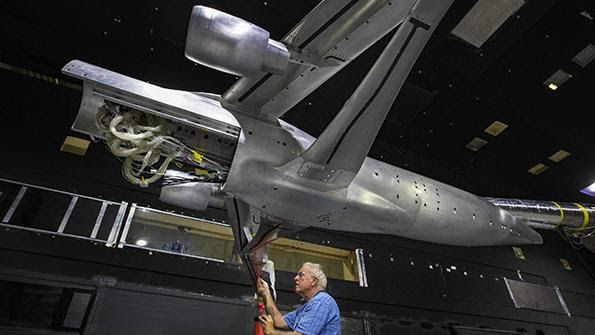
TTBW high lift tests, NASA Langley Research Center, Hampton, Virginia

Researchers completed TTBW high-lift tests, including stability and control checks and ground-effects evaluations, in September at NASA Langley Research Center’s 14 X 22-ft. subsonic wind tunnel in Hampton, Virginia.

Seventy years ago, Boeing was secretly preparing to gamble on whether to spend two-thirds of its post-war net profits on a radical new jet-powered long-range transport demonstrator—the Model 367-80.

The company’s May 1952 decision to approve the project, dubbed the Dash 80, became a defining moment in aviation history. Targeting the airline and military air tanker markets, the turbojet-powered aircraft would evolve into the 707/KC-135, establishing the blueprint for virtually every modern swept-wing transport with podded engines developed to this day as well as laying the foundation for Boeing’s 700-series jet airliner dynasty.

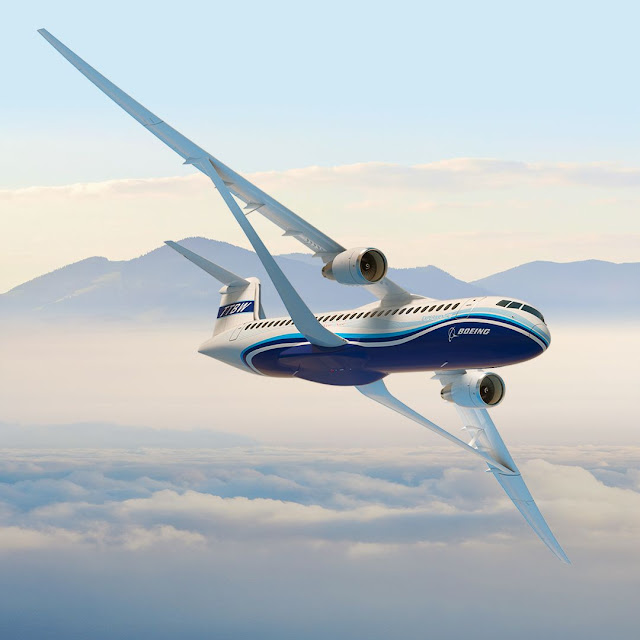
Fast-forward to early 2022 and Boeing is once more preparing to propose a new, potentially game-changing configuration. Although the concept is not yet aimed specifically at a new product, the high-aspect-ratio transonic truss-braced wing (TTBW) is targeted instead at a NASA demonstrator X-plane intended to prove airframe technology for a future highly efficient single-aisle airliner by the mid-2030s.

While other advanced configurations, such as the blended wing body (BWB), are in the frame for the X-plane—also known as the sustainable flight demonstrator (SFD)—Boeing’s TTBW proposal is widely expected to be the front-runner. Not only has Boeing been working on the configuration with NASA for more than a decade, but it is also actively soliciting suppliers to bolster broader industry participation in its bid.

For Boeing, the timing of the competition for the X-plane has assumed even more importance than the research opportunity it presents. Hit by the 737 MAX groundings, the market downturn caused by the COVID-19 pandemic and delays to deliveries of the 787 and 777X, Boeing has had to put near-term plans for all-new commercial aircraft development projects on the back burner. The X-plane therefore offers a chance to continue with tests of key technologies that could play a role in future single-aisle programs semi-independently of the company’s market-driven product-development strategy.

But as Boeing deliberates over its next market moves, ranging from long-term 737 replacements to a potential twin-aisle midsize family, the competition is stirring. The SFD has become increasingly timely in the face of Airbus’ plans to develop an all-new sustainable 100-plus-seat airliner in the 2030s.

TTBW showing areas of reduced drag indicated in areas of green and blueGreen- and blue-colored areas indicate areas of reduced drag in this computational fluid dynamic flow simulation of the TTBW conducted by NASA and Boeing in early 2021

 If all goes according to plan, the new X-plane—which likely will be the largest purpose-built experimental aircraft in the seven-decade-old X series—is expected to begin flight tests in late 2026 and will help mature design, structures and systems technology timed for full-scale development in the early 2030s. The X-plane also forms a key part of NASA’s Sustainable Flight National Partnership (SFNP) plan with industry, researchers and academia, which will support the push toward new airliner technology across a broader front that includes developments in smaller engine cores, electrified aircraft propulsion and high-rate composite aircraft manufacturing.


“In 2022, we expect to put out a request for proposal [RFP] for the design and build of the flight demonstrator, and this is really a big, big deal,” says Rich Wahls, strategic technical advisor for the Advanced Air Vehicles Program at NASA’s Aeronautics Research Mission Directorate. “When was the last time we did a transport-class [aircraft-level] architecture change?” he asks. “My mind goes back to when Boeing did the Dash 80 with swept wings and underslung jet engines. That’s what we’re looking at here—a large-scale honest-to-God, prove-it kind of aircraft that would demonstrate key aspects that you can only do in flight.”

In the run-up to the RFP, NASA awarded study contracts for demonstrator plans to five unidentified companies and is working in parallel with two others on risk-reduction studies—one for the BWB and another with Boeing on the TTBW. “We’ve had wind tunnel tests [of the TTBW] that have gone on since 2013, and there have been aeroelastic tests, high-speed performance tests and low-speed integration tests,” Wahls says. “Often you take these concepts, and as you dig down to the next layer of detail, the benefit goes away. So far, it’s not going away on the truss-braced wing or really on the blended wing. We haven’t found that thing that completely stops either yet.”

Clarifying NASA’s role in the further advancement of sustainable concepts, Wahls adds: “We’re not about product development and doing the next airplane. Industry has their next baseline airplanes on their drawing boards. We’re trying to identify those technologies that are just beyond their risk threshold, both financially and technically, then use those as demonstrations. If successful, we bring them forward into that next generation. If they had enough confidence to put them on the next airplane, then we would have to start looking beyond that. So we’re trying to accelerate insertion of advanced technology into these game-changing architectures across all these projects we’re doing.”

Following a planned first flight in late 2026, NASA says the SFD research campaign will last six months and be completed in 2027. Design, ground test and flight research data from the SFD will be used to measure the winning contractor’s “vision system” performance relative to a set of midterm performance objectives set out by NASA for future subsonic transport aircraft in the 2025-35 time frame.

These targets call for technology readiness levels of 5 to 6 (ready to transition to production development) for an aircraft capable of cumulative noise levels of 32-42 dB below Stage 4 and landing and takeoff nitrogen oxide (NOx) emissions 80% below the International Civil Aviation Organization’s CAEP/6 standards. The requirements also call for cruise NOx emissions to be 80% lower relative to a 2005 best-in-class benchmark, and aircraft fuel and energy consumption levels to be 50-60% lower relative to the same 2005 standard.

As its name suggests, the TTBW configuration is all about maximizing wing efficiency and at the same time opening the aperture for a wide variety of potential future propulsion options, ranging from advanced turbofans and open rotors to hybrid engines and even a tail-mounted boundary-layer-ingesting fan. First developed in 2010 under the Boeing and NASA Subsonic Ultra Green Aircraft Research program to study ultraefficient airliner concepts for the 2035 time frame, the TTBW has continued to evolve into a flexible and practical configuration.

Despite many tweaks over the past decade, the design continues to hinge on the benefits of a high-aspect-ratio wing to minimize drag. The increased span lowers lift-induced drag because the wing is slender, while its reduced thickness ratio decreases profile and transonic drag due to its thinness. The wing is braced by trusses to minimize the weight penalty of the longer span.

The X-plane was originally designed with an unswept wing to cruise at a fuel-saving speed of Mach 0.75, but Boeing is basing its X-plane proposal on a revised wing configuration revealed in early 2019. The newer design is optimized around a 20-deg. swept wing to enable a higher Mach 0.8 cruise speed more typical of current jet airliners. The increase in sweep angle necessitated a redesign of the truss, which has increased chord at the fuselage and forward sweep at the trailing edge and tapers toward the junction with the wing. A small jury strut that connects the truss to the wing has also been moved farther outboard and closer to its junction with the wing. The changes have allowed the truss to generate lift, further maximizing performance.


With an aspect ratio of 19.6, the 170-ft.-span wing of any production TTBW version also will incorporate a 777X-like wing-fold feature. The fold, which is positioned outboard of the truss attachment point, is designed to enable the TTBW to use smaller gates, like those used by the 118-ft.-span 737. For the SFD bid, Boeing expects to modify the fuselage of a donor MD-80 or 717, but it is unclear if these precise wingspan dimensions will be reproduced for the demonstrator, which is also unlikely to include the folding feature.

Boeing is, meanwhile, canvassing industry for potential risk-share involvement in the modification of the T-tail fuselage into the X-plane. The company declined to comment on details of the plan, saying it would be premature to discuss its proposal prior to NASA’s RFP. Boeing did add, however, that it “enthusiastically supports NASA’s vision for a public-private partnership to enhance aviation sustainability under the umbrella of the Sustainable Flight National Partnership, which focuses industry and government on the critical challenges for products being introduced in the 2030s.”

Details of the proposed modification plan seen by Aviation Week show that a significant number of changes and additional systems and structure will be required to transform a McDonnell Douglas-heritage fuselage into the basis for the new X-plane. The biggest of these will involve the design and build of a composite wing with full-span slats and single-slotted flaps. The wing, which will be joined at the centerline above the fuselage, also will incorporate low- and high-speed ailerons.

To meet the required design length of the demonstrator, Boeing plans to remove an unspecified number of fuselage frames as well. This suggests the preferred donor fuselage may be from an MD-80 rather than the shorter DC-9-30-series-size 717. The fuselage will be reinforced with internal bracing from the wing to the existing structure, too, and will utilize the in situ carry-through torque boxes for the nose and main landing gears. The existing gear will be supported by a new pylon and enclosed in a new fairing.

Other changes will include the relocation of the tail-mounted engines to an inboard underwing mounting, where they will be attached with a new pylon and enclosed in purpose-built nacelles and inlets. The engine’s existing thrust reversers will be locked out while the nacelle will feature a purpose-designed anti-ice system.

Several key system changes also will be required, including the development of a fly-by-wire flight control system for the wing-control surfaces. Flight control functions will be hosted in a triplex vehicle management system controlled from a two-crew flight deck that will be modified with an additional flight control computer interface. Among the system changes will be the rerouting of the engine bleed air ducts through the fuselage to the environmental control system packs and the addition of an extra central hydraulic system to augment the existing configuration.

Changes to the interior will include installation of a full flight-test instrumentation suite and accommodation for flight-test personnel as well as provision for a set of pallets for center of gravity ballast.


 It will be interesting if Boeing is able to pull this off, I have seen one of their X planes,not this one mind you, but a different kind when I was in California, she was in Storage.  I want Boeing to pull this off because it can revolutionize the aviation industry...again.


Tuesday, January 1, 2013

Private Space Travel to increase


Private Space Travel to Make Giant Leaps in 2013

Private companies building new spaceships to soar through orbital and suborbital space are looking forward to an action-packed year in 2013, with new flight tests, launches, wind tunnel tests and rocket technology trials all planned during the new year.  
Of the many spacecraft being developed only one has already flown in space, the Dragon capsule built by Space Exploration Technologies (SpaceX) in Hawthorne, Calif.The unmanned cargo ship has flown in space three times so far, and carried supplies to the International Space Station twice in 2012 — first in May during a test and then again October.
SpaceX’s next cargo flight to the station is set for May 2013. But a new astronaut-carrying version of Dragon is also in the works. The crewed capsule will be different from its robotic predecessor in several key areas, with SpaceX set to advancing technology for the new ship in 2013.

SpaceX’s new Dragon
“Dragon Version 2 won’t look like [today’s Dragon]. I think it looks pretty cool. Dragon one, we didn’t really know what we were doing so that’s why Dragon looks similar to things that have happened in the past,” SpaceX founder Elon Musk told an audience during a talk at the UK’s Royal Aeronautical Society in London on Nov. 21. Musk described Dragon version 2 as having “legs that pop out” and added that it uses parachutes and its eight SuperDraco thrusters for a “propulsive landing”. [SpaceX’s Dragon at the Space Station (Photos)]
The SuperDraco thrusters, located around the base of the Dragon, also act as the pusher launch abort system to move the capsule (and crew) clear of its rocket during a launch emergency.
While Musk was unavailable for to discuss SpaceX’s plans for 2013, company officials did provide SPACE.com details on its expected activities.
In March the company will review its Dragon pad abort test that is planned for later in the year December; in May SpaceX will perform its human certification plan review for the capsule; in June the crewed Dragon on-orbit and entry design review is expected to occur; July would then see an in-flight abort test review;
A safety review is slated for October; and before the December pad abort test, November will see a flight review of an upgraded version of SpaceX’s Falcon 9 rocket, which launches Dragon capsules into orbit.
NASA needs private space taxis
SpaceX is developing the seven-person Dragon 2 capsule to compete for NASA’s International Space Station (ISS) crew transportation contract. NASA’s commercial crew program is helping industry develop competing space transportation systems to win this ISS contract. Ed Mango is the commercial crew program manager.
“2013 will be a huge year for us. In the first couple of months we’ll kick off work for our certification contract and we’ll award that shortly,” Mango told SPACE.com.
Companies selected for the certification contract will get $10 million each and have 15 months to demonstrate, with data, that their rockets and spacecraft can be considered for the space station transport mission. “The [contract winners] are not just making spacecraft and launch vehicles they are also doing it to meet a NASA mission, our mission to the [ISS],” Mango said. [NASA’s Private Space Taxi Plan (Video)]
In the second half of 2013, NASA will start the bidding process for its commercial crew contract that will lead to the certification of one transportation system to take astronauts to the space station. That contract will not be awarded until early 2014, and a few years later NASA astronauts could travel to the station on the successful launch system.

Private spaceship contenders
In theory, while any U.S.company can bid for those two contracts, Mango suggested that the three companies that have won funded space act agreements under the commercial crew program will be the likely contenders. Those three companies are: SpaceX; Boeing; and Sierra Nevada Corporation.
Boeing’s spacecraft is the Commercial Space Transportation 100 (CST-100) capsule and is designed to launch atop the Atlas 5 rockets built by the United Launch Alliance’s (ULA). The CST-100 capsule can carry up to seven astronauts and, like Dragon 2, it is expected to land on land. Its design includes airbags to cushion landing, as well as a pusher abort system.
Sierra Nevada’s Dream Chaser space plane is based on NASA’s HL-20, a spacecraft the agency studied 25 years ago. It is also designed to launch on an Atlas 5 rocket.
In 2012 a Dream Chase prototype was used for a captive carry flight test using a helicopter. In the first half of 2013 an unmanned Dream Chaser will fly low speed approaches and landing tests at NASA's DrydenFlightResearchCenterin California. [Dream Chaser Space Plane in Photos]
“These flight tests are similar to the approach and landing tests that NASA conducted on the Space Shuttle prior to the first launch of the Shuttle.  The [Dream Chaser] program is also continuing significant hardware testing throughout 2013 to continue to advance the design of our subsystems," John Roth, Sierra Nevada Space Systems vice president of business development told SPACE.com.
Because the Atlas 5 is the launcher for CST-100 and Dream Chaser, the rocket’s provider ULA is heavily involved with the Boeing and Sierra Nevada work.
“We’re contracted to support Boeing and Sierra Nevadato support their milestones, we’re directly supporting almost all of them,” George Sower, ULA’s Human launch Services vice president, said in an interview.
In 2013, ULA will be continuing to develop the dual engine Centaur upper stage its Atlas 5 needs for launching these manned spacecraft. For satellite launches, the unmanned Atlas 5 has only used a single engine powered Centaur. In April and May, ULA will test ducting to provide propellant for the new Centaur’s two engines. ULA is also planning wind tunnel tests to understand the different aerodynamics of having Boeing’s capsule and Sierra’s winged Dream Chaser on top of the Atlas 5.
Rise of suborbital space planes
While the orbital commercial human spaceflight providers are aiming for operational missions after 2015, the suborbital tourism companies are seeking revenue flights well before then. These suborbital spacecraft are designed to launch beyond the Earth’s atmosphere, but not to enter orbit around the planet. Instead, they will return to Earth to be readied to fly again.
In 2013, XCOR Aerospace is building its Lynx I, which will not fly beyond the 62-mile (100 kilometers) border line between the atmosphere and space. This Lynx rocket plane is a prototype for the planned Lynx Mark 2, which will fly into suborbital space.

“We’re looking at 2013 as the time for our test flight program and in early 2013 we’ll get started. For the Lynx Mark 1, our prototype craft, we’ll be doing test fights throughout the year from early 2013 and then go into commercial flights,” XCOR spokesman Bryan Campen told SPACE.com.
After 2013, the Lynx Mark 2, which will fly higher than 62 miles, will be manufactured in Floridaat or near the KennedySpaceCenter, XCOR officials said. The company is also setting up its new headquarters and research center in Midland, Texas.
Virgin Galactic’s SpaceShipTwo
After 22 gliding tests between October 2010 and August 2012, Virgin Galactic’s SpaceShipTwo has been edging closer to having its hybrid solid rocket motor added and making its first rocket powered flight. In May 2012 Virgin Galactic was awarded an experimental launch permit by the U.S. Federal Aviation Administration, which oversees commercial human spaceflight. At the time Virgin Galactic was anticipating a rocket-powered SpaceShipTwo flight by the end of the year.
By Sept. 20, the SpaceShipTwo rocket motor had been fired on the ground 17 times. On Oct. 19, Virgin Galactic released an image of the oxidizer tank being fitted to the first SpaceShipTwo, called the VSS Enterprise.
The oxidizer flows through the hollow center of the solid fuel rocket and when ignited will burn with the fuel to generate thrust. The first rocket-powered SpaceShipTwo flight is now expected in 2013.