Webster

The Constitution was made to guard the people against the dangers of good intentions." --American Statesman Daniel Webster (1782-1852)


Showing posts sorted by relevance for query eagle claw. Sort by date Show all posts

Sunday, July 22, 2018

Operation "Eagle Claw"

I was in High school in Alabama when the Hostages were seized in 1979 and how impotent the United States appeared to be.  We as a nation was humiliated by the seizure of the Embassy  against all international Law.  We were further humiliated when "Desert One" happened, it showed how poor shape the United States Armed forces were in after Vietnam and the resulting "Hollow Army" as it was called.  I remembered the shame we felt as a nation when the hostage rescue failed from a myriad of reasons and plain bad luck, Murphy ran amuck with the planning and execution of the mission.  I remembered President Jimmy Carter on national TV apologizing for the failure of the mission. 
I had a lot of bad things to say about President Jimmy Carter, but he took full responsibility for the debacle which shows good character.  After this Jimmy Carter asked congress to massively increase the Military budget.  After the 1980 elections when President Ronald Reagan pushed for even a bigger increase in the budget because of the poor state of the U.S Armed Forces.  Back in 1980 I as a kid supported Jimmy Carter because he was from my State of Georgia.  Jimmy Carter was a good man but a poor president and his economic policies were a disaster. 
The April 24th Op is a major event in the history of the United States’ Special Forces operations not just because it was among the first missions of the Delta Force, but because its widespread failure would be a moment of profound humiliation for the United States.
Following the Iranian revolution, which saw the overthrow of Shah Mohammad Reza Pahlavi and an end to his 22 years of autocratic leadership over Iran, the Iranian Hostage Crisis, on the 4th day of November 1979, ensued.
A group of militant students who supported the Iranian revolution had stormed the US embassy in Tehran, capturing the building and taking 52 American diplomats and citizens hostage for 444 days, in what would become the longest hostage crisis in history, and widely described by western media as an entanglement of vengeance and mutual incomprehension.

Iran hostage crisis – Iraninan students comes up U.S. embassy in Tehran.1979
In the state-sanctioned act, the Iranian assailants demanded the return of Shah Reza, who had been taken to America for cancer treatment. Reza had been accused of committing crimes against the people and was summoned by Iran’s new leader, Ruholla Khomeini, to stand trial.

Two American Hostages During the Crisis.
The hostage incident was initiated by Iran to spite America for her alleged complicity in Reza’s atrocities. Jimmy Carter was less than pleased by the event, and would succinctly declare that America would never yield to blackmail. The hostage-taking, to America, was an egregious violation of international law.

Ayatollah Khomeini in front of his house at Neauphle-le-Chateau in a media conference.Photo: Sa.vakilian CC BY-SA 3.0
After 6 months of failed attempts at diplomatic negotiations, the United States, on April 16th, 1980, under President Jimmy Carter, approved a military action. The president, having broken diplomatic associations with Iran, ordered the Pentagon to draw up a plan in a bid to storm Iranian soil in a covert rescue mission codenamed Operation Eagle’s Claw.


The Shah of Iran in the 1970's

The US military spent about 5 months in planning the op. The aircrew trained in Florida and Andersen Airfield in Guam. Based on the plan, 3 USAF MC-130 aircraft would fly an assault group of about 118 Delta Force soldiers from Masirah Island to a remote spot located 200 miles southeast of Tehran; this location was codenamed Desert One. The MC-130s were accompanied by 3 EC-130s which served as fuel transport.
Under the cover of night, 8 US Navy RH-53D Sea Stallion helicopters, would fly from the USS Nimitz, which was sailing in the Arabian Sea, to rendezvous with the assault team where they would all fly to Desert Two, another location 65 miles from the target zone, Tehran.

RH-53Ds of HM-16 on the USS Nimitz before repainting.
Once the force was in place it would be show time; the team would be flown the rest of the way into Tehran where they would break into the embassy, neutralize the security, and rescue the hostages. All through the raid, an E-3 AWAC would keep a lookout on Iranian airspace, while establishing command and control communications between Washington, the Carrier Force, and the mission commander.

US Army Rangers 75th Regiment.
They would then fly to Manzarinyeh Air Base, which by that time would have been secured by US Army Rangers. At Manzarinyeh, USAF C-141 Starlifters would fly the hostages and assault team out of Iran, while the Rangers would stay behind to destroy all used equipment including the helicopters before flying out themselves.

A U.S. Marine Corps McDonnell F-4N Phantom II aircraft (BuNo 150480) of Marine fighter-attack squadron VMFA-323 Death Rattlers on the aircraft carrier USS Coral Sea (CV-43) in April 1980. Sailors are applying black-red-black identification stripes for the (later aborted) attempt to rescue U.S. hostages from Iran, code named “Operation Eagle Claw” (or “Evening Light”).
This was an extremely complex plan that required a lot of synergy among all the units involved because Tehran was a city well inside Iran’s airspace and far away from any friendly territory. Furthermore, it was hard to get good intelligence about the forces inside the embassy. As a matter of fact, there was no room for any deviation from the stipulated plan as even the slightest mistake was bound to jeopardize the mission.

The first part of the mission went according to plan, with the arrival of the first MC-130 aircraft carrying Combat Control Team (CCT), mission equipment and fuel on board to Desert one. The team’s task at this point was to establish the airstrips and marshal the other aircraft when they arrived. But this was the only successful part of the mission because following the arrival of the other MC-130 aircraft, everything began to fall apart.

A photo of the “Desert One” landing site, a piece of desert in Iran used by U.S. forces as a refueling point in an attempt to rescue U.S. hostages in Iran. On 24 April 1980 a U.S. Navy Sikorsky RH-53D Sea Stallion (BuNo 158760, visible at right) collided with a U.S. Air Force Lockheed EC-130E Hercules (s/n 62-1809, wrecked in the foreground) during refueling after the mission was aborted. Both aircraft were destroyed, eight crewmen died. In the background is one of the five intact, but abandoned RH-53Ds. Original caption: “Wreckage at Desert One, Iran (April 1980) where eight Americans died.”
First, a passenger bus was spotted on a highway crossing the landing zone, and because this was supposed to be a covert op, the CCT was forced to stop and detain the passengers of the bus. A tanker truck was also found speeding close to Desert One.  The truck, apparently smuggling fuel, was blown up after refusing to stop, causing the death of the passenger.
The rest of the C-130 aircraft arrived and waited for the helicopters. The RH-53 helicopters took off from Nimitz but along the way, one helicopter—Bluebeard 6—was grounded and abandoned. The crew reported a damaged rotor blade as the cause of the malfunction. The remaining helicopters ran into a severe sandstorm known as Haboob. This would scatter the flight formation, with Bluebeard 5 also abandoning the mission.
The scattered helicopters would arrive at Desert One individually, running 50-90 minutes behind schedule. Bluebeard 2 arrived last but had indications of a broken hydraulic system which consequently made it unfit for the mission. With just five helicopters left and even more losses anticipated, the on-scene commander, Col. James H. Kyle, requested a mission abort.

Three RH-53 Sea Stallion helicopters are lined up on the flight deck of the nuclear-powered aircraft carrier USS NIMITZ (CVN-68) in preparation for Operation Evening Light, a rescue mission to Iran.
The new focus was now on getting the assault team back on the MC-130s while the Bluebeards refueled on the Nimitz. During this procedure, tragedy struck.

US burned helicopter in Operation Eagle Claw
Bluebeard 3 was blasted by a desert storm, putting the pilot in a frenzied bid to maneuver his helicopter to stability. In the process, the helicopter’s main rotor blade collided with the wing-root of an EC-130 which was loaded with fuel. Both aircraft exploded, and in the ensuing inferno, 8 servicemen lost their lives – 3 US marines and 5 USAF aircrew.
The USAF pilot and co-pilot survived with severe burns. In the desperate evacuation of the rest of the team, classified files associated with the mission were burned, but the helicopters were abandoned in the desert. With that, Operation Eagle’s Claw, the nadir of the whole hostage rescue affair, came to an end.

Sand Storm of Tabas was cause of Operation Eagle Claw fail. This photo show the remaining aircraft burned.Photo: Tasnim News Agency CC BY 4.0
The failed rescue op resulted in some rather undesirable consequences. Firstly, the hostages were scattered across Iran, to make another rescue mission impossible. Also, the US government received heavy criticism from governments around the world for making such blunders in a very critical situation. As a matter of fact, experts believe that Jimmy Carter’s failure with Operation Eagle Claw was a major reason he lost the presidential election the following year.
Additionally, the failure brought attention to deficiencies in the US special operations system. The Joint Chiefs of Staff led an investigation which birthed the Holloway Report. The report cited failings in mission planning, command and control, and inter-service operability.

CH-53Ds Landing.
It revealed that training was usually conducted in a compartmentalized manner, taking place in scattered locations. Also, there was poor selection and training of aircrew, and it was said that not enough helicopters were put into the mission to counter any unforeseen issues or problems that jeopardized the mission. The hopscotch method of ground refueling which was chosen over air refueling was also criticized.
In reaction to these findings, the US military established United Special Operations Command, and the Air Force Special Operations Command. The lessons learned prompted the creation of the Night Stalkers (the 160th Special Operations Aviation Regiment) for the training of Army pilots in low-level night flying and aerial refueling.

Operation Eagle Claw Memorial in Arlington National Cemetery
A second rescue operation was planned, but it was never implemented. However, on 20th January 1981, just after Carter’s tenure, all 52 hostages were allowed to go back home.
To America, Operation Eagle Claw was a profound humiliation which exposed their flaws and vulnerabilities. But to Khomeini and his people, it was a plan foiled by divine intervention.
Operation Eagle Claw was the mission that marked the beginning of a change in America’s Special Operations.


Sunday, January 5, 2025

President Carter's bungling made the United States look like a "Paper Tiger "


I was in High school in Alabama when the Hostages were seized in 1979 and how impotent the United States appeared to be.  We as a nation was humiliated by the seizure of the Embassy  against all international Law.  We were further humiliated when "Desert One" happened, it showed how poor shape the United States Armed forces were in after Vietnam and the resulting "Hollow Army" as it was called.  I remembered the shame we felt as a nation when the hostage rescue failed from a myriad of reasons and plain bad luck, Murphy ran amuck with the planning and execution of the mission.  I remembered President Jimmy Carter on national TV apologizing for the failure of the mission. 
I had a lot of bad things to say about President Jimmy Carter, but he took full responsibility for the debacle which shows good character.  After this Jimmy Carter asked congress to massively increase the Military budget.  After the 1980 elections when President Ronald Reagan pushed for even a bigger increase in the budget because of the poor state of the U.S Armed Forces.  Back in 1980 I as a kid supported Jimmy Carter because he was from my State of Georgia.  Jimmy Carter was a good man but a poor president and his economic policies were a disaster. When 1984 rolled around, I was 18 years old, just turned 18, and voted for "President Reagan" in the 1984 Elections.

I shamelessly clipped it from "The Federalist"

Kevin Hermening was a 20-year-old sergeant with the Marine Security Guard protecting the U.S. Embassy in Tehran when all hell broke loose. On Nov. 4, 1979, Iranian students serving the Islamic Revolution stormed the compound and held more than 50 American citizens — including Hermening — hostage. 

“We had 12-gauge shotgun and .38 caliber revolvers, and that was it,” Hermening told me this week during an interview on the “Vicki McKenna Show.” “We were way outnumbered.” The U.S. acting ambassador and the attaches gave the orders to the Marine security forces to lay down their weapons, the Wausau, Wisconsin, financial services professional said.  

“There was nothing that was going to be done to shoot our way out of it,” Hermening recalled of the chaotic day, now 45 years in the world’s rearview mirror but still so present in U.S. foreign affairs. 

The Marine and 51 others would spend the next 444 days as hostages of an unholy war that made the world’s greatest superpower look like a chump on the world stage (The revolutionaries released 13 hostages in the opening weeks of the Iran Hostage Crisis, including all of the women taken as well as the black captives — billed as “oppressed minorities” by the Iranian oppressors).

As fond to fawning remembrances of James Earl Carter flow from the pages of the corporate press following Sunday’s passing of the 39th president, many of the glowing obituaries are leaving out or glossing over some critical details. While Jimmy Carter in many ways may have been a good man, he was an absolutely lousy president.

Hermening, 444 days a hostage, has a decidedly different take on the former president than the sanguine scribes in the accomplice media. He remembers an incompetent commander-in-chief, the leader of the free world who led with his heart instead of his head. And the world, Hermening said, has suffered much because of it ever since. 

‘A Gun to Their Heads’

It was cool and drizzly on the day the embassy fell, Hermening told Disabled American Veterans in a post published on Nov. 1, 2023. He said he had been at the embassy working on plans for the upcoming Marine Corps birthday ball. 

A riot was brewing outside. 

“Looking out onto the front grounds, I saw hundreds of Iranians already gathering and thousands more smashing through and eventually opening the front gate,” he told DAV.org. 

The hostages were routinely terrorized by the Islamic revolutionaries. Iranian jihadists had months before ousted the West-backed Shah Mohammad Reza Pahlavi, the Shah of Iran, who had fled in January that year. The leadership gap was filled by the Ayatollah Ruhollah Khomeini, the exiled Shi’a religious leader who had returned from Paris to lead the terror-steeped Islamist revolution fueled by deep-seated hatred for the United States —  and the West in general.

The American Embassy hostages were often awakened in the night with a gun to their heads. Their captors would pull the trigger of the unloaded weapons in mock executions, the DAV.org post recalled. 

“Army Col. Charles Scott, chief of the Defense Liaison Office at the embassy, was beaten severely during an interrogation, and three of his teeth were broken off at the gum line — injuries that went untreated until after they were released,” the publication noted. 

‘Warned for Months’

Over the past 45 years, Hermening has often pondered the failures of the Carter administration and the weak president behind the foreign policy disaster. 

“The problem is that back in Washington, D.C., the reports being given to the president of the United States were severely flawed, because the State Department officials in Tehran were giving the information of how unstable it was,” Hermening told me in the radio interview.  

The White House disregarded the intelligence from the ground. Carter allowed the Shah of Iran to receive medical care in the United States despite now-declassified documents out of Tehran warning that the embassy would be seized and the Americans inside would be taken captive if the Carter administration allowed the Shah refuge in the United States. 

“Iran experts inside the State Department had warned for months that to do so would create huge problems for U.S. policy and even endanger diplomats in Iran but Carter’s senior advisers one-by-one lined up in favor of admitting the Shah,” a retrospective on the hostage crisis from the National Security Archive at George Washington University states. The shah, after all, was an old pal and a very well-paid ally in the Cold War against communism. 

More incredulously, Hermening said, was that the “delusional Department of State” about a week before the seizure of the embassy was authorizing family members of diplomats and senior military officers to come to Tehran. 

‘Wrong-Headed Approach’

As the weeks dragged into months, Carter’s Pentagon planned a rescue mission. The botched operation, launched on April 24, 1980, ended with the deaths of eight U.S. service members and not a single hostage rescued. It arguably was one of the more impotent moments in U.S. military history, undertaken by a notoriously weak administration. 

Hermening and his fellow hostages would be held by their terrorist captors for another nine months. They were finally released on Jan. 20, 1981, the day Carter’s successor, Ronald Reagan, was sworn into office. 

“As he and Reagan sat uncomfortably with one another in a limousine on the way to Reagan’s inauguration, Carter got a call from National Security Agency Director Bobby Ray Inman telling him that the hostages would not be allowed to leave Iran until after Reagan was sworn in,” presidential historian Tevi Troy recently wrote in a column for City Journal. “The Iranians would not give Carter even the small victory of seeing the hostages released on his watch.”

Some insist the hostages are alive because Carter placed their lives above America’s image in a Cold War world. Hermening said that’s conjecture at best. One thing he said he’s sure of all these years later is that the Democrat’s weakness has cost the United States dearly. 

“…[Y]es, of course, I’m glad I’m here. I’m glad I’m alive. I’m glad we returned home, save the eight heroes who perished [in Operation Eagle Claw] during the aborted rescue mission in April of 1980,” the former hostage said. “But President Carter put the interests of 50 people ahead of the interests of the entire country, and that is the wrong-headed approach.” 

“I understand the humanitarian side of that, but it’s not great leadership because we have been seen as a "Paper Tiger" by the most radicalized elements of the Middle East and their followers across the globe now for 45 years. And it started with President Jimmy Carter’s failed leadership in Washington,” Hermening continued. 

A Legacy of Foreign Policy Fecklessness

As Troy noted in his remembrance of Carter, one of the 39th president’s primary weaknesses was that “he had a hard time distinguishing between friends and enemies.” 

“Perhaps this fault explains why, after he left the White House, Carter gained a reputation as an ex-president for coddling dictators, whether in Haiti, Syria, or North Korea,” the historian wrote. 

The Iran hostage crisis emboldened despots around the world, particularly the communists. Soviet Union-backed Marxists seized power in Africa and Asia as the U.S. weakly watched. Reagan would ultimately win the Cold War and bring back respect for the lone-standing world power through strength, but the worldview damage from the Carter years lives on. 

The Algiers Accords, brokered with and without the Carter administration, freed the hostages, but they also pushed the U.S. to stay out of Iran’s business — even when Iran has rattled its sabers at what it has vilified as “the Great Satan.” And the U.S. signed off on a special tribunal to resolve disputes over frozen Iranian assets.  One of the big payouts arrived in the final year of the second term of President Barack Obama, whose naive foreign policy was often drawn from the book of Carter. Remember the pallets of cash, including the $400 million ransom for the release of American prisoners, Obama’s team secretly airlifted to Tehran?  

The Wall Street Journal reported in August 2016:

Revolutionary Guard commanders boasted at the time that the Americans had succumbed to Iranian pressure. “Taking this much money back was in return for the release of the American spies,” said Gen. Mohammad Reza Naghdi, commander of the Guard’s Basij militia, on state media.

Biden’s Hero

Hermening said he finds it interesting that Carter, who died Sunday at 100, lived long enough to see his legacy as the “worst president our country ever had” eclipsed by the presidency of the soon-to-be departing President Joe Biden. The 46th president’s Iran Hostage Crisis moment came in the first year of his presidency amid the catastrophic U.S. withdrawal from Afghanistan, in which 13 U.S. service members were murdered in a terrorist attack. The House Foreign Affairs Committee Republicans’ report, “Willful Blindness: An Assessment of the Biden-Harris Administration’s Withdrawal from Afghanistan and the Chaos that Followed,” found, among other failures, that “the Biden-Harris administration prioritized the optics of the withdrawal over the security of U.S. personnel on the ground.”

As one of his last acts of a dismal presidency, Biden has called for a national day of mourning for his hero, Jimmy Carter. The federal government will be closed on Thursday, Jan. 9, the same day as Carter’s funeral. As the Milwaukee Journal Sentinel noted this week in a Carter-Wisconsin connection piece, Biden, a young senator in 1976, was the “first elected official outside Georgia to endorse Carter for the presidency that year.” 

“I think Carter is the guy who can win,” Biden said at a campaign stop in Madison, according to the publication. He described the Georgia peanut farmer as “a good old boy who understands what’s happening in the industrial states.”

In his message to Congress on the death of the 39th president, Biden mused that Carter’s “commitment to a more just world was at the heart of his foreign policy,” He of course mentioned nothing of the debacle in Iran, the hostages, or America’s badly damaged image because of Carter’s foreign policy weakness. 

Hermening, one of the hostages Biden failed to note, said Carter and some of his successors never understood the fundamentals of good foreign policy, that  “you don’t have to use your power, you just have to let people know you’re willing to use it.” 

“And they knew that President Carter was not really willing to use it, much like we’ve seen happen quite often over the last 40 years,” the retired Marine sergeant told me. 

Tuesday, June 22, 2021

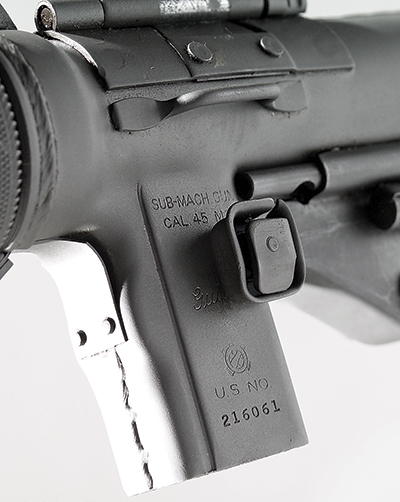
The M3 and M3A1 "Grease Gun"

 I remembered the first time I saw a "Grease Gun". We had gone to our sister division, the 1st Armored and their track people were issued the M3A1 "Grease Gun".  We all from the 1st Infantry Division (Fwd) in Germany all had the M16A1, Later A2 version but they had the "Grease Gun", and it was strange to see modern American Soldiers with a weapon from WWII, but hey we were using the M2 "Ma Deuce", can't improve perfection.

greasegun.jpg

This article was first published in American Rifleman, September 2005

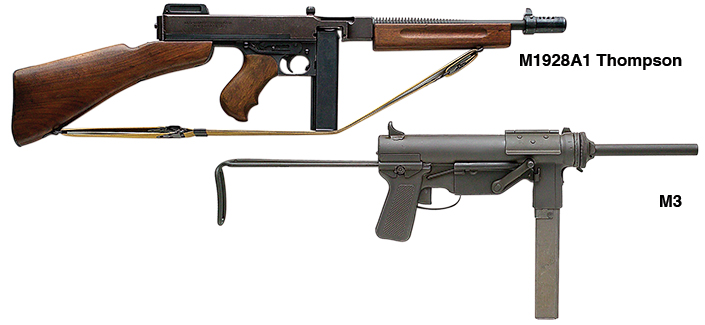
At the time of America’s entry into World War II, the standard U.S. military submachine gun was the famous Thompson M1928A1.While a reliable and effective submachine gun, the Thompson had several disadvantages as a military arm. Among its biggest drawbacks was the fact it was expensive and time-consuming to manufacture. To address that, the U.S. Army Ordnance Department initiated the development and adoption of a simplified version of the Thompson that featured many manufacturing shortcuts. The new variant, standardized as the “U.S. Submachine Gun, Cal. .45, M1,” dispensed with the unnecessary and over-engineered Blish locking system of the M1928A1 Thompson. The Cutts compensator was also eliminated, and the cocking handle was moved from the top of the receiver to the right side. The M1 Thompson was followed by the even more simplified M1A1 variant, which featured a fixed firing pin instead of the separate hammer-actuated firing pin of its predecessor. 

While the M1 and M1A1 Thompsons could be manufactured much more cheaply and quickly than the M1928A1, they still required a substantial amount of machining work. The Ordnance Department recognized that the basic Thompson design had been simplified as much as possible, and a totally new type of submachine gun would be required to meet burgeoning wartime demand. Both our allies and adversaries had previously addressed that issue by developing and adopting submachine guns that made extensive use of stamped and welded sheet-metal parts rather than costly and time-consuming forged steel components. The German MP40 outwardly resembled its MP38 predecessor, but it was welded together from stamped sheet-metal components. The British developed and standardized the Sten submachine gun, which took the use of stamped and welded parts even further. While less aesthetically pleasing than traditional arms made of wood and forged steel, such submachine guns offered an attractive combination of reduced production time and lower manufacturing cost.

The U.S. Army Ordnance Department considered several designs for low-cost/high production-rate submachine guns fabricated from stamped and welded sheet metal. A design developed in large part by George Hyde, with the assistance of General Motors’ Inland Manufacturing Division, was given the prototype designation of T-15. It was chambered for the standard .45 ACP cartridge and featured a sliding wire stock, which substantially reduced its length when retracted. Army Ordnance Col. René Studler was an ardent proponent of the new submachine gun and was instrumental in its subsequent adoption. The T-15 prototype was refined and superseded by the T-20. Unlike the selective-fire T-15, the T-20 only fired in the full-automatic mode. 

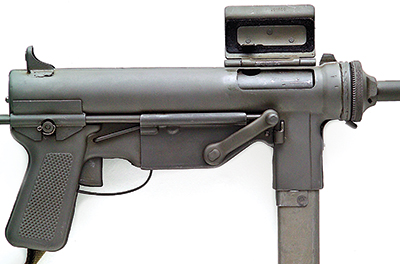
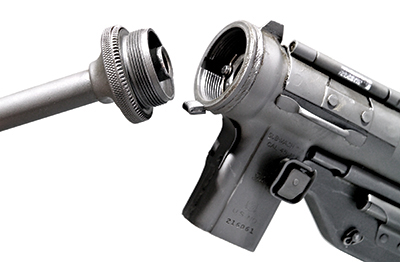
The T-20 had number of advantages as compared to most other submachine guns, including the fact that its internal parts were fully enclosed, which reduced the possibility of the mechanism being clogged by dirt, mud or sand. In addition, it was designed with rather generous dimensional tolerances to allow functioning even when subjected to extreme dust or mud conditions. The bolt traveled along two steel guide rods, which prevented contact with the inside of the receiver and resulted in increased reliability and smoothness of operation. The gun could be quickly disassembled, and the barrel and bolt were easily removed. It did not have a conventional safety, but the ejection port cover prevented accidental firing when closed.

The T-20 prototype was extensively tested at Aberdeen Proving Ground and proved to be more reliable in the mud and dust tests than any other submachine gun ever tested by the U.S. Army. In addition to the Army’s Infantry Board, the new submachine gun was evaluated by the Airborne Command and Armored Forces Board. These latter two organizations were especially interested due to its compactness, which had obvious advantages for airborne use or in the cramped confines of a tank.

After conclusion of rigorous testing, the T-20 was recommended for adoption in December 1942 as the “U.S. Submachine Gun, Caliber .45, M3.” Official approval came on Jan. 11, 1943. Shortly after formal adoption, a contract was awarded to General Motors’ Guide Lamp Division for 300,000 M3 submachine guns. The Guide Lamp plant, located in Anderson, Ind., had extensive experience in the fabrication of stamped metal components, so it was a logical choice to manufacture the new submachine gun. 

Following initial price adjustments, the contract price for each M3 submachine gun, less the bolt assembly, was set at $18.36. Production of the bolt was subcontracted to the Buffalo Arms Co. at a price of $2.58, which brought the total per-unit cost of an M3 to $20.94. This was about half the cost of the simplified M1A1 Thompson. The M3 also had the great benefit of a much faster production rate than the Thompson. Other than the bolt, the only major component of the M3 that required any degree of machining was the barrel, which was rifled by the efficient cold swaging method. The exterior metal surfaces were Parkerized,  a provision was made for a cylindrical oiler on the left side of the receiver, and the sling swivels were welded on the gun. In order to keep costs down and simplify logistics, the same oiler and sling used with the M1 Carbine were standardized for use with the M3 as well. The front end of the wire stock was threaded to allow its use as a cleaning rod.

The M3 fired fully automatically at the rate of about 400 r.p.m. from a 30-round detachable box magazine. This relatively slow rate of fire aided in controlling it and permitted an experienced user to easily fire single shots with proper trigger manipulation.

The M3 and M3A1 submachine guns, also known as “grease guns” due to their similarity in appearance to the mechanic’s tool, served an important role not only in World War II, but in many later conflicts. Although troops often initially disliked them, the firearms’ performance soon won them over.


Less than six months after its adoption, the first M3 submachine guns  came off of Guide Lamp’s assembly line in May 1943. This was a very brief period of time as compared to most other military arms, which are typically in development for a number of years. Despite the simplicity of the stamped and welded sheet-metal construction, there were the normal production glitches. One of the most troubling problems was that the heat generated from welding together the two stamped receiver halves tended to warp the metal. This and other production difficulties were eventually corrected, but production lagged behind initial projections. It was envisioned that some 20,000 M3 submachine guns would be produced by July 1943, but the actual production was only 900 guns by that date. This delay in delivery of sufficient quantities resulted in contracts for additional M1A1 Thompsons until the supply of M3s could meet the demand.

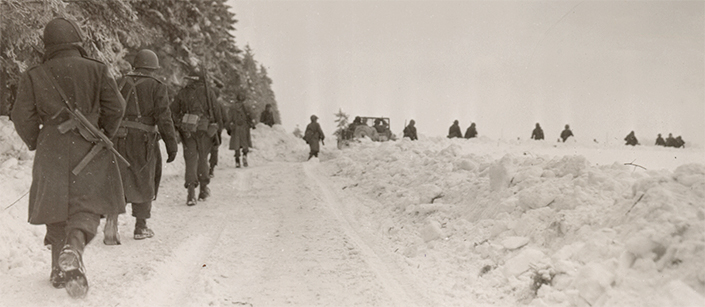
When its production problems were solved, M3 manufacture rapidly increased, and the gun began to be issued to the using services. Among the first combat operations in which the M3 saw use was in the hands of some paratroopers of the 82nd and 101st Airborne Divisions during the Normandy drop as part of the D-Day invasion. Initially, many soldiers who were issued “grease guns” were not impressed with them and were reluctant to give up their trusted Thompsons. However, as the M3 began to see combat use, its reliability and lighter weight were seen as positive attributes, and most G.I.s, albeit grudgingly, came to accept the roughly hewn grease gun as a worthy successor to the finely crafted Thompson.

Another problem with some of the M3s became evident in early 1944 when complaints were forthcoming from training camps regarding the propensity of the side-mounted cocking handle to break. This was caused primarily by the use of low-grade steel and improper heat treatment. Other less serious problems were reported regarding the barrel ratchet pad and the durability of the rear sight. Also, the magazine release could be accidentally depressed, so a metal guard was developed to correct that problem. These various deficiencies were rectified as soon as they were identified, and later production versions of the M3 grease gun were quite reliable in service.

Even though the M3 was an uncomplicated design, it was believed that it could be simplified and improved even further. Guide Lamp was directed by the Ordnance Department to come up with an improved design. The firm developed an even more simplified grease gun, designated as the M3E1. Six prototype models were fabricated and tested in April 1944. The most significant changes to the M3E1 included:

  1. Elimination of the side-mounted cocking handle, to be replaced by a recess in the bolt that permitted the bolt to be withdrawn by merely inserting a finger and pulling it to the rear. This required an enlarged ejection port.

  2. Strengthening of the rear sight by welding support ribs to both sides. This feature had previously been added to later production M3 submachine guns.

  3. Elimination of the separate oiler on the left side to be replaced by a larger internal oil reservoir housed in the grip.

  4. Modification of the wire stock to allow its use as a wrench to remove the barrel and also permit it to be utilized as a magazine
    loading tool. 


After testing, the M3E1 was found satisfactory and it was standardized on Dec. 21, 1944, as the “Submachine Gun, Caliber . 45, M3A1.” Upon standardization of the M3A1, the M3 was reclassified as “Limited Standard.” This meant the M3 would no longer be manufactured, but those already in service would remain in use. Since the new M3A1 was adopted and put into production very late in the war, the M3 was the only variant to see any significant combat service in World War II. A total of 606,694 M3 and 15,469 M3A1 submachine guns were manufactured during World War II.

Several interesting accessories were developed for use with the grease gun. During World War II, the Office of Strategic Services (OSS)—forerunner of today’s Central Intelligence Agency (CIA)—required a silenced or suppressed submachine gun for certain clandestine operations. A suppressor for the grease gun was developed by Bell Laboratories with High Standard Mfg. Co. and Guide Lamp as subcontractors. One thousand of these suppressors were reportedly produced and saw limited use during and after the Second World War.

There was also a request for a conversion kit to permit the grease gun to fire 9 mm rather than the standard .45 ACP round. This would allow it to be used by partisans and OSS operatives who had only British or captured German ammunition. The design of the grease gun made it easy to switch from .45 to 9 mm by simply replacing the barrel, bolt and inserting a magazine adapter to allow use of the British Sten magazine. It was originally envisioned that some 25,000 of the 9 mm conversion kits would be manufactured, but only about 500 are believed to have been made in late 1943 and early 1944. Virtually all of these 9 mm conversion kits were made for the M3 rather than for the M3A1.

A funnel-shaped flash hider that clamped on the end of the barrel was developed. The flash hider, designated as the T-34, was made only in prototype numbers during World War II, but it was put into production in the early 1950s and standardized as the “Hider, Flash, M9.”

Initially, the three-cell canvas magazine pouches made for the 30-round Thompson SMG magazines were used with the grease gun magazines. However, a slightly different three-cell pouch was subsequently manufactured and widely issued for the grease gun magazines.

In early 1945, it was recommended all Thompsons in use be replaced by the M3/M3A1, but this was not accomplished before the end of World War II. In fact, limited numbers of Thompsons remained in the U.S. military inventory until the late 1950s, although the number on hand was far exceeded by the number of grease guns. World War II ended with the M3/M3A1 firmly established as the U.S. military’s front-line submachine gun, and it saw extensive service during the Korean War. As was the case previously, the grease gun proved that production cost and cosmetic considerations had no bearing as to the utility or effectiveness of a combat arm.

In order to augment the supply of submachine guns, a contract was awarded to the Ithaca Gun Co. circa 1954 for the manufacture of 70,000 M3A1s. Production did not get under-way until 1955, by which time the pressing need for additional submachine guns had passed. The Ithaca contract was cancelled after 33,227 M3A1s had been manufactured. Except for markings, the Ithaca M3A1 was virtually identical to the World War II Guide Lamp M3A1.

Several foreign nations adopted submachine guns that were almost direct copies of the grease gun or were at least heavily based on it. These nations included China, Argentina and Portugal.

Following the Korean War, the M3 and M3A1 submachine guns remained a mainstay of the U.S. military arsenal. Grease guns saw some use by American troops in the early years of the Vietnam War, and large numbers were supplied to various friendly indigenous personnel during the course of the conflict. The grease gun continued as part of the U.S. military’s arsenal and has been used in virtually all U.S. military conflicts since World War II. Some silenced M3A1 submachine guns were utilized in several post-Vietnam military operations including Operation Eagle Claw, the ill-fated rescue attempt of the American hostages in Iran in the spring of 1980.

M3 and M3A1 submachine guns remained in service in the U.S. armed forces, mainly as armament for armored vehicle crewmen. They saw use during the Gulf War in the early 1990s, and limited numbers of grease guns are reportedly still being utilized in the Iraq and Afghanistan campaigns even today.

Original M3 and M3A1 grease guns are surprisingly uncommon on the collector market today as compared to other U.S. submachine guns, such as the Thompson and Reising. Their long tenure of service meant that the vast majority remained in Uncle Sam’s inventory, thus, few were properly registered and available for sale on the civilian market. Today, an original registered and transferable grease gun will typical sell for as much as, or more than, a World War II Thompson.

From the time of its inception, the M3 submachine gun was often considered a cheaply made and inferior replacement for the finely crafted Thompson. However, the grease gun was a portent of things to come regarding military arms. The finely crafted designs of previous eras were correctly viewed as unnecessary extravagances in wartime, when cost, rate of production and reliability trumped aesthetic considerations. The grease gun may have been ugly in the eyes of some, but it was inexpensive to make and functioned very well. The fact that its venerable predecessor—the Thompson submachine gun—has been long relegated to being a museum piece while the ugly duckling grease gun is still seeing some use in combat zones today speaks volumes as to the excellence of its humble design.