There is a quote that I like to keep in mind when the apparatus of the state start getting "too big for their britches" as they say here in the south.

In the late 1930's Stalin in his paranoia sent millions to the gulags for "crimes against the State", he eviscerated the officer corp of the Red Army and they paid the price during the "Winter War" and the early parts of the "Great Patriotic War" I don't know how different the Soviet Union would have been if Trotsky had replaced Lenin instead of Stalin. Would be an interesting Alternative history story. Personally I still considered Trotsky a Godless Communist and the world is better off without him and those like him, but he is a figure of history.
This is a Quora thing again
In 1917, a world war allowed an exiled Leon Trotsky to return and seize Russia. As WWII erupted, Stalin was terrified a 60-year-old man 6,700 miles away would do it again.
Even isolated in a heavily guarded compound in Coyoacán, Mexico, Trotsky remained the single greatest existential threat to the Soviet regime.
Trotsky was not just a dissident. He was the co-architect of the 1917 Bolshevik Revolution and the charismatic founder of the Red Army. To the Old Bolsheviks—the original revolutionaries—Trotsky, not Stalin, was Vladimir Lenin’s logical heir. Stalin’s ascent to power was built on bureaucratic maneuvering, and he spent the 1930s executing almost all of the original revolutionary leaders during the Great Purge to cement his control.
Stalin’s narrative required a chief villain to justify the endless show trials and executions. He framed Trotsky as the mastermind of a global fascist conspiracy seeking to destroy the USSR. As long as Trotsky lived and wrote, he actively dismantled this narrative. From his Mexican exile, Trotsky published works like The Revolution Betrayed, exposing Stalin as a totalitarian usurper who had corrupted Marxist ideals. Even more dangerously, Trotsky founded the Fourth International, a rival communist organization designed to foment global revolution and bypass Moscow entirely.
With the outbreak of World War II validating Stalin's fears of global destabilization, he finally ordered the assassination.
Brute force failed to penetrate Trotsky's defenses. In May 1940, a Soviet-backed hit squad of twenty men, led by Mexican muralist David Alfaro Siqueiros, stormed the compound and riddled Trotsky’s bedroom with machine-gun fire, but Trotsky and his wife survived by hiding under their bed.
Realizing a frontal assault was useless against the "fortress," Stalin’s intelligence agency, the NKVD, switched to infiltration. They dispatched Ramón Mercader, a Spanish communist who spent months seducing a woman in Trotsky’s inner circle. Mercader slowly earned the guards' trust, posing as a sympathetic businessman. On August 20, 1940, Mercader was finally allowed alone into Trotsky’s study under the guise of asking for feedback on an article. While the 60-year-old revolutionary read the paper, Mercader struck him in the back of the head with a cut-down ice axe.
On the afternoon of August 20, 1940, Ramón Mercader, a young Spaniard in the hire of the GPU, Joseph Stalin’s secret police, seized the moment. Under the alias of Canadian businessman “Frank Jacson,” he had infiltrated Leon Trotsky’s household in Coyoácan, a borough of Mexico City, several months earlier. As Trotsky leaned over his desk, Mercader viciously struck him on the right side of the head with a pickax, its handle cut down to hide it more easily under a raincoat. The wound inflicted was three inches deep. Reeling, the old revolutionary found the strength to fight back against the assassin. Trotsky prevented Mercader from inflicting another, fatal blow and battled for his life until his bodyguards arrived. With Mercader beaten unconscious and the police called, he collapsed into the arms of his wife, Natalia Sedova. The next day, Trotsky succumbed to his wounds, dead at the age of 60.
With his nemesis murdered and Mercader, the murderer, denying any Soviet involvement (he would eventually serve 20 years in a Mexican prison), Stalin could feel a deep satisfaction. The individual, who, more than any other, symbolized opposition to Stalinism, had been eliminated. Mercader’s vile act closed the long, bitter conflict between the two men. From the fictionalized version in Unforgiving Years, the excellent novel by Victor Serge, his one-time comrade, to the 1972 movie, The Assassination of Trotsky, where Richard Burton portrayed him, the lurid details of Trotsky’s death have often commanded more attention than his extraordinary life. Trotsky’s struggle against Stalin and Stalinism, the subject of this article, was a crucial part of his life’s final decade.
Born Leon Davidovich Bronstein to a family of Jewish farmers in Ukraine in 1879, Trotsky came of age among the revolutionary movements operating in the ultra-repressive atmosphere of the Russian Empire. At the age of eighteen, he enthusiastically embraced Marxism. The remainder of his life, one can say, without exaggeration, was based around a single, ultimate goal: worldwide workers’ revolution. During his early involvement in Russian socialist politics, Trotsky clashed with Vladimir Lenin over how a revolutionary party should be organized (such clashes would later serve Stalin well when he depicted Trotsky as hostile to Lenin’s ideas). During the 1905 Revolution, after the formation of the first soviets (radical councils representing the working masses), Trotsky, only twenty-six at the time, served briefly as Chairman of the St. Petersburg Soviet. After his trial and life sentence to Siberia for his revolutionary activities, he escaped and resumed life as a radical intellectual in Vienna, capital of the multinational Habsburg Empire. Trotsky's Results and Prospects (1906) outlined his brilliant conception of "permanent revolution," a Marxist theory of how a bourgeois-democratic revolution in Imperial Russia would inevitably transform into a socialist revolution that would engender revolution far beyond Russian territory. A long period of exile following Tsar Nicholas II’s crackdown on left-wing radicals ended when he returned in May 1917 to a Russia aflame with revolution. Joining the Bolsheviks a few months later, Trotsky worked closely with Lenin. Together, they prepared the overthrow of the ruling Provisional Government which kept the country in the disastrous world war. Henceforth, throngs of people uttered their names together—“Lenin and Trotsky.” As a member of the Bolshevik-led Military Revolutionary Committee, Trotsky played a decisive role in the insurrection in Petrograd (formerly St. Petersburg), events he would later chronicle in his famed History of the Russian Revolution. The following March, he negotiated the punitive Treaty of Brest-Litovsk forced on the Bolsheviks by Imperial Germany. In the Russian Civil War (1918-1921), he organized and led the Red Army to an impressive victory over counterrevolutionary forces.
Trotsky also witnessed the tremendous setbacks of the early 1920s to revolutionary hopes. Under the New Economic Policy (NEP) set in motion by Lenin in 1921, the Bolsheviks had to concentrate on economic recovery after the severe wartime measures. The working class had been ravaged by three years of civil war. Many workers who survived the conflict had moved into administrative positions in the Soviet government or relocated to the countryside. Internationally, the USSR stood alone. The proletarian revolution Trotsky had expected to spread and take hold elsewhere had been stymied. The radical Left underwent terrible defeats in 1919 in Germany and Hungary. There was the “Red Scare” in the United States in the same period. Benito Mussolini, a former socialist, acquired power in Rome in 1922 and his Fascist dictatorship became a fierce enemy of the Bolsheviks. More defeats soon followed in Germany, Estonia, and Bulgaria in 1923-25.
After Lenin died in January 1924, the question arose immediately about who would be the next leader of the Union of Soviet Socialist Republics. Trotsky was one of the most recognizable figures associated with the October Revolution—admired, hated, and emulated within and outside the USSR. Although history rightly remembers Joseph Stalin as Trotsky’s chief rival and later mortal enemy, in the early 1920s Stalin passed unnoticed by many observers. He had been a “barely perceptible shadow,” as Trotsky put it. One of the classic histories of the Bolshevik Revolution, Ten Days That Shook the World, written by the American radical, John Reed, hardly mentions Stalin. Gregori Zinoviev and Lev Kamenev, not Stalin, emerged as Trotsky’s principal opponents in the immediate aftermath of Lenin’s death. These two men, who had been with Lenin for years, felt threatened by Trotsky’s popularity and his military record. A mistake, fateful for all three, though, had already been made. In 1922, Lenin, appreciating his organizational talents, chose Stalin for the position of General Secretary of the Communist Party. This gave him authority over party membership and appointments. Stalin quickly accrued enormous power and influence in the party over the next few years. Once Lenin, who, in his last months, sorely regretted his choice of Stalin, was no longer in the picture, Stalin sided with Zinoviev and Kamenev in their opposition to Trotsky.
As Trotsky later recognized, Stalin took advantage of the situation not only to appoint his own people but also to advance his own ideas about the future of the USSR. In 1924, he introduced the notion of “socialism in one country.” A socialist society could be built, Stalin contended, in the Soviet Union alone, regardless of the international context. The concept appealed to many Bolsheviks confronting the isolation of the globe’s only Marxist state. Stalin went on to directly counter this idea to Trotsky’s emphasis on "permanent (i.e. world) revolution." Thanks to Stalin, “Trotskyism” soon became a term of opprobrium for elitism, factionalism, and a lack of connectedness to the masses of workers and peasants.
During the mid-1920s, Trotsky responded to these developments by calling for a restoration of workers’ democracy within the Communist Party. While he had advocated centralization during the Civil War, he had done so out of necessity. As the de facto leader of what became known as the Left Opposition, Trotsky assailed the growing bureaucratization of political life, the retreat from the old ideal of revolutionary internationalism, and the transformation of Marxism into “Marxism-Leninism,” a dogma not to be questioned. He gathered many supporters such as Karl Radek, Christian Rakovsky, and Victor Serge. Further support came from unexpected quarters. After Stalin maneuvered them out of positions of authority, Kamenev and Zinoviev threw in their lot with Trotsky in 1926. This Joint Opposition, never the most robust alliance, did not hold. Young “activists” violently broke up Opposition meetings with methods reminiscent of Mussolini’s Fascist squads. Stalin, wielding his power like a club, expelled Trotsky and his followers from the party in late 1927. Prophetically, Trotsky denounced Stalin as the “gravedigger of the Revolution.” Sent into “internal exile” in Kazakhstan for a year, he was then deported to Turkey in February 1929.
In Prinkipo, a suburb of Istanbul, Trotsky wrote his autobiography, My Life. In that book is this remarkable description of Stalin, by then the sole ruler of the Soviet Union:
"He is gifted with practicality, a strong will, and persistence in carrying out his aims. His political horizon is restricted, his theoretical equipment primitive. His work of compilation, The Foundations of Leninism, in which he made an attempt to pay tribute to the theoretical traditions of the party, is full of sophomoric errors. His ignorance of foreign languages compels him to follow the political life of other countries at second-hand. His mind is stubbornly empirical and devoid of creative imagination. To the leading group of the party (in the wide circles he was not known at all) he always seemed a man destined to play second and third fiddle. And the fact that today he is playing first is not so much a summing up of the man as it is of this transitional period of political backsliding in the country."
This period was not to be nearly as “transitional” as Trotsky believed. With his opponents removed, Stalin enacted the collectivization of agriculture and state-directed industrialization, programs once championed by the Left Opposition, but now brutally implemented with a staggering toll of lives. He was not yet ready, though, to implement, to quote Trotsky, the “physical liquidation of the old revolutionaries, known to the whole world.” Stalin would bide his time for a number of years. And he could do so while watching his enemy live a refugee’s existence.
Trotsky did not hesitate to label the Stalin dictatorship “totalitarian,” a concept still relatively new in political thought. Thus, Stalinism, the counterrevolutionary system and ideology Stalin represented, preoccupied him. In this form of totalitarianism, a bureaucracy, a privileged caste, at the top of which Stalin perched like an absolute monarch, lorded it over the working class. Trotsky likened Stalinist domination to “Thermidor,” the term used to denote the end of the radical phase of the French Revolution and the shift to reactionary politics. As late as 1933, he thought, however, the Soviet system could be reformed by working through the structures of the Communist Party. The Left Opposition might dislodge Stalin from within without directly challenging state power. Trotsky held to this position until Adolf Hitler became chancellor of Germany in January 1933. Germany was a country with a modern urban, industrial society he had long regarded as vital to the prospects for socialism. Trotsky decried the impact of Stalin’s policies in this catastrophe. The Soviet leadership had tied the hands of the German Communist Party and hindered a united front against the Nazi Party by construing moderate socialists as the real threat. Subsequently, Hitler crushed the mighty German workers’ movement with hardly a fight. This disaster forced a profound shift in Trotsky’s thinking.
After Hitler took power, Trotsky concluded that reform of the Stalin regime had to be abandoned. Ousting Stalin by working through the channels of the Communist Party was no longer possible. This much more radical perspective culminated in his 1936 The Revolution Betrayed. Proletarian revolt would have to topple Stalin and the bureaucracy. This revolution, Trotsky made clear, would resemble the European upheavals of 1830 and 1848 more than the October Revolution. It would be a political revolution, not a social one. Collective ownership and control of the means of production (e.g. land, factories, mines, shipyards, oilfields), railways, and banks, as well as the planned economy, would remain. Trotsky’s designation of the USSR as a “degenerated workers’ state” highlighted his conviction that Stalin had betrayed and degraded the original, liberatory aspects of the Bolshevik Revolution. Still, much could be salvaged from the damage done by Stalinism.
The vision Trotsky held in The Revolution Betrayed of political institutions in a liberated, post-Stalin USSR may surprise some. He called for free elections, freedom of criticism, and freedom of the press. While the Communist Party would benefit most from this open atmosphere, it would no longer possess a monopoly on power. As long as political parties did not try to restore capitalism, they could operate, recruit, and compete for power. Stalin’s downfall would also signal new life for the trade unions. Trotsky imagined a restored involvement of workers in economic policy. Science and the arts might flourish once more. The state, no longer bound to the calamitous Stalinist policies, could return to the satisfaction of workers’ needs, like housing. Stratification would yield to the reinvigorated aim of “socialist equality.” Youth, in whom Trotsky placed so much hope, “will receive the opportunity to breathe freely, criticize, make mistakes, and grow up.”
These thoughts Trotsky put to paper only months before he would be compelled to move again. For eight years, Trotsky had traversed what he called a “planet without a visa,” a planet torn apart by the worst economic crisis in the history of capitalism. Since Stalin expelled him and Natalia from the USSR, the beleaguered revolutionaries had found temporary sanctuary in Turkey, France, and Norway. Granted refuge by the leftist Cardénas government of Mexico, their arrival in Coyoácan in January 1937 was greeted with derision and menace by the country’s pro-Stalin Communist Party.
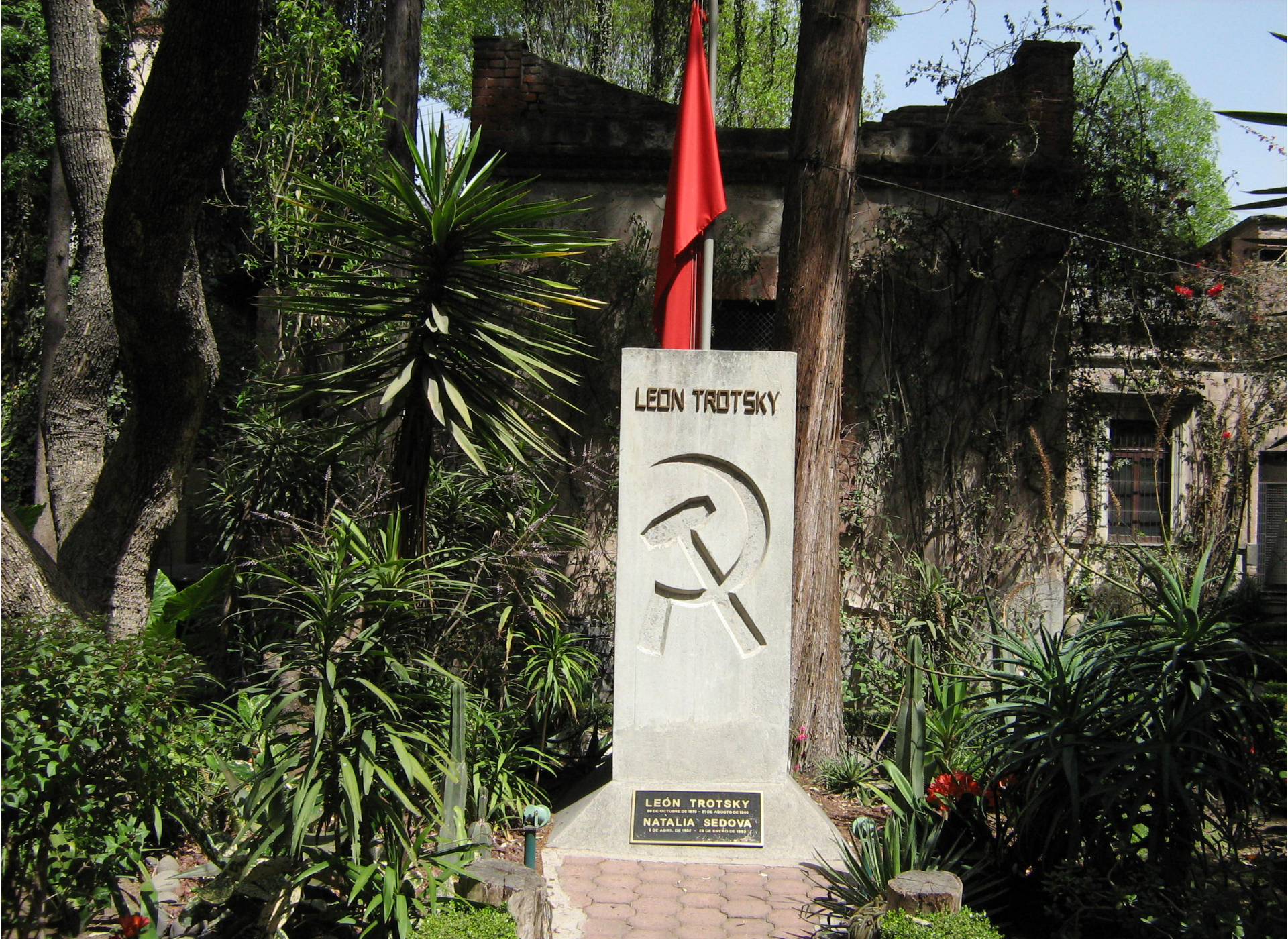
Photograph of Trotsky and Sedova’s Tomb, in the Garden of Their House in Coyoácan, in Mexico City. Credit: Gunther Schenk.
Stalin not only hunted Trotsky but anyone close to him from country to country. In Barcelona, in June 1937, his assassins abducted Trotsky’s former collaborator, Andrés Nin, a leader in the POUM (Workers’ Party of Marxist Unification), the organization of militants made famous by George Orwell’s Homage to Catalonia. Nin disappeared at a critical moment in the Spanish revolutionaries’ struggle against Francisco Franco, never to been seen again. Thirteen months later, in Paris, Rudolf Klement, who had once worked as Trotsky’s secretary, sat down for breakfast. Klement was kidnapped, presumably by GPU agents. They seized him and left his food on the table untouched. A few weeks after he vanished, a body, missing its head and legs, washed up on the Seine. It was not enough to just kill Klement; decapitation and dismemberment were required to incite extra terror.
Stalin’s agents also infiltrated the circle around Trotsky’s son, Leon Sedov. Despite a difficult relationship with his father, Leon worked tirelessly for him in Paris. He communicated with Left Oppositionists still holding on inside Russia, edited the Bulletin of the Opposition, the most significant forum for Trotsky’s analyses of the contemporary world, and wrote an exposé of the Show Trials then taking place in the USSR. Mark Zborowski, Ukrainian-born and known to Trotsky’s supporters under the false name “Étienne,” soon worked his way into Sedov’s circle. Zborowski became Sedov’s personal assistant, helping with his correspondence and eventually taking care of the publication of the Bulletin. Thanks to “Étienne,” the GPU could count on seeing many of the articles from the latter before they even appeared in print. And Zborowski delivered to them vital information about Sedov’s health. When Sedov checked himself into a private clinic in Paris run by Russian emigres complaining of an appendicitis, the Soviets knew. He died there under mysterious circumstances in February 1938, five months before Klement disappeared. To this day, the cause of death has not been conclusively determined. In a moving tribute to his son, Trotsky told of the terrible grief he and Natalia felt. “Together with our boy has died everything that still remained young within us.” Their other son, Sergei Sedov, had remained in Russia after his parents’ expulsion and always kept politics at arm’s length. That did not save him. He vanished and, it is believed, was shot in October 1937.
This systematic killing overlapped with the monstrosity of Stalin’s Show Trials. These abhorrent mockeries of justice had their roots in the murder of Sergey Kirov, Stalin’s party boss in Leningrad. Kirov was gunned down in December 1934. Likely, Stalin himself was responsible for the assassination. The murder gave him the pretext for systematically and publicly purging the Communist Party. As the most visible aspect of the Purges, the Show Trials started with the Trial of the Sixteen in August 1936. Old Bolsheviks, such as Zinoviev and Kamenev, stood accused of conspiring against the Soviet government. Shockingly, they confessed, confessed to submitting to Trotsky’s demands to assassinate Stalin and several of his subordinates. Following their death sentences, several successor trials ensued through 1938. The “physical liquidation of old revolutionaries, known to the whole world” was at hand. Trotsky knew that a combination of torture, threats to family members, and promises of freedom, if confessions were given, allowed the travesties to occur. When he read the infamous sentence uttered by Stalin’s Prosecutor-General, Andrey Vyshinsky—“I demand that these dogs gone mad should be shot—every one of them!”—Trotsky knew this was no idle threat.
Vyshinsky’s words became murderous reality in the USSR in the late 1930s and '40s. The violence swept away both supporters and opponents of Stalin and Stalinism. Radek and Rakovsky, former allies of Trotsky who later submitted to Stalin, were killed. So, too, was Nikolai Bukharin, one of Bolshevism’s leading theoreticians, a sharp critic of Trotsky and the Left Opposition, and a onetime backer of Stalin. Others were murdered in labor camps, the infamous Gulags, or in prisons. Among the thousands of victims were the Marxist economic thinker, Isaak Ilich Rubin, and the great historian of the Left and former director of The Marx-Engels Institute, David Ryazanov. Isaac Babel, whom Trotsky once termed the “most talented of our younger writers,” confessed to working as a spy and terrorist mastermind for Trotsky. The secret police put him to death in January 1940. In this period, the Soviet Union was perhaps the most dangerous place in the world for independent-thinking Marxists, an astounding thing to say, given the records of the fascist regimes. For their contributions to the butchery, Stalin rewarded Genrikh Yagoda and Nikolai Yezhov, chiefs of the GPU during these years, by having them shot.
From the Show Trials, ever more outlandish tales about Trotsky were spun. The stories relayed by the accused placed him at the center of a massive, worldwide anti-Soviet conspiracy. Turning his calls for an anti-Stalin revolution against him, Vyshinsky pilloried Trotsky, the inveterate adversary of fascism, as the master fascist, as the string-puller and puppet-master. Besides links to the Gestapo, Soviet investigators claimed to have uncovered Trotsky’s connections to Mussolini, the government of Imperial Japan, and the capitalist democracies. Reminiscent of Nazi anti-Semitic theories, “Trotskyism” metamorphosed into a truly demonic apparition during the Show Trials. Yet Trotsky fought back vigorously.
Countering the way Stalin’s handpicked historians distorted the Soviet past, Trotsky had already authored The Stalin School of Falsification. His adherents, many of whom by this point referred to him, with affection, as the “Old Man,” founded the Fourth International outside of Paris in September 1938. Its aim was to provide a revolutionary alternative to the Moscow-led Third or Communist International (Comintern). This Fourth International would bolster radical, anti-Stalinist working-class parties and unions around the world. When it came to repudiating the preposterous charges raised in the Show Trials, he received considerable help. Frida Kahlo, with whom Trotsky had an affair in 1937, and Diego Rivera were his tireless defenders in Mexico City. In the United States, a Committee for the Defense of Leon Trotsky formed. Similar organizations were founded elsewhere. The American Committee set up a Commission of Inquiry, chaired by John Dewey, the famous Pragmatist philosopher. Only one of the members, Alfred Rosmer, a syndicalist and early supporter of the October Revolution, could be described as a Trotsky supporter. Traveling to the Mexican capital, the Commission held thirteen sessions in April 1937. Trotsky, speaking in his quite imperfect English, responded to every accusation leveled by the Stalinists. He cast a powerful impression on those present, including the liberal Dewey, no admirer of his politics. In September 1937, the Commission issued its findings, clearing Trotsky of all the charges.
The following years were dark, awful times for Trotsky, Natalia, and their inner circle. Losing two sons and innumerable comrades and friends to Stalin did not break his spirit, but the losses threw a shadow over everything he had done. With the Japanese in China, Hitler moving into Austria, and threatening Czechoslovakia, and Mussolini dreaming of a Roman Empire in the Mediterranean, the prospect of a new world war soon overtook him. Almost a year before it started, Trotsky spoke of an impending Second World War as a “new slaughter which is about to drown our whole planet in blood.”
Trotsky had good reason to utter such things. And he knew that Stalin’s response to German expansion in Eastern Europe would be critical. Following the Munich Agreement of September 1938, Trotsky expected the Soviet government to seek an agreement with Hitler. Stalin’s 1937-38 purge of the Red Army, including some of its most capable commanders, like Mikhail Tukhachevsky, had so seriously weakened the USSR that a military confrontation with Nazi Germany had to be avoided at all costs. Whatever anti-Nazi sentiments issued from the Kremlin, Trotsky thought, were not worth the paper they were written on. In the aftermath of the Show Trials, he believed an even more important reason would drive Stalin to come to an agreement with Berlin: survival. The Stalin regime was too despotic and unpopular to weather the storm of total war. According to Trotsky, a settlement with Nazi Germany might secure some stability for the dictatorship.
When Vyacheslav Molotov, the Soviet foreign minister, and Joachim von Ribbentrop, his German counterpart, signed a Non-Aggression Pact between the two nations on August 23, 1939, Trotsky was scarcely surprised. Earlier that year, he had declared that Stalin’s name will be a “byword for the uttermost limits of human baseness.” This damning statement received confirmation with Stalin’s next move—dividing up Poland with Hitler.
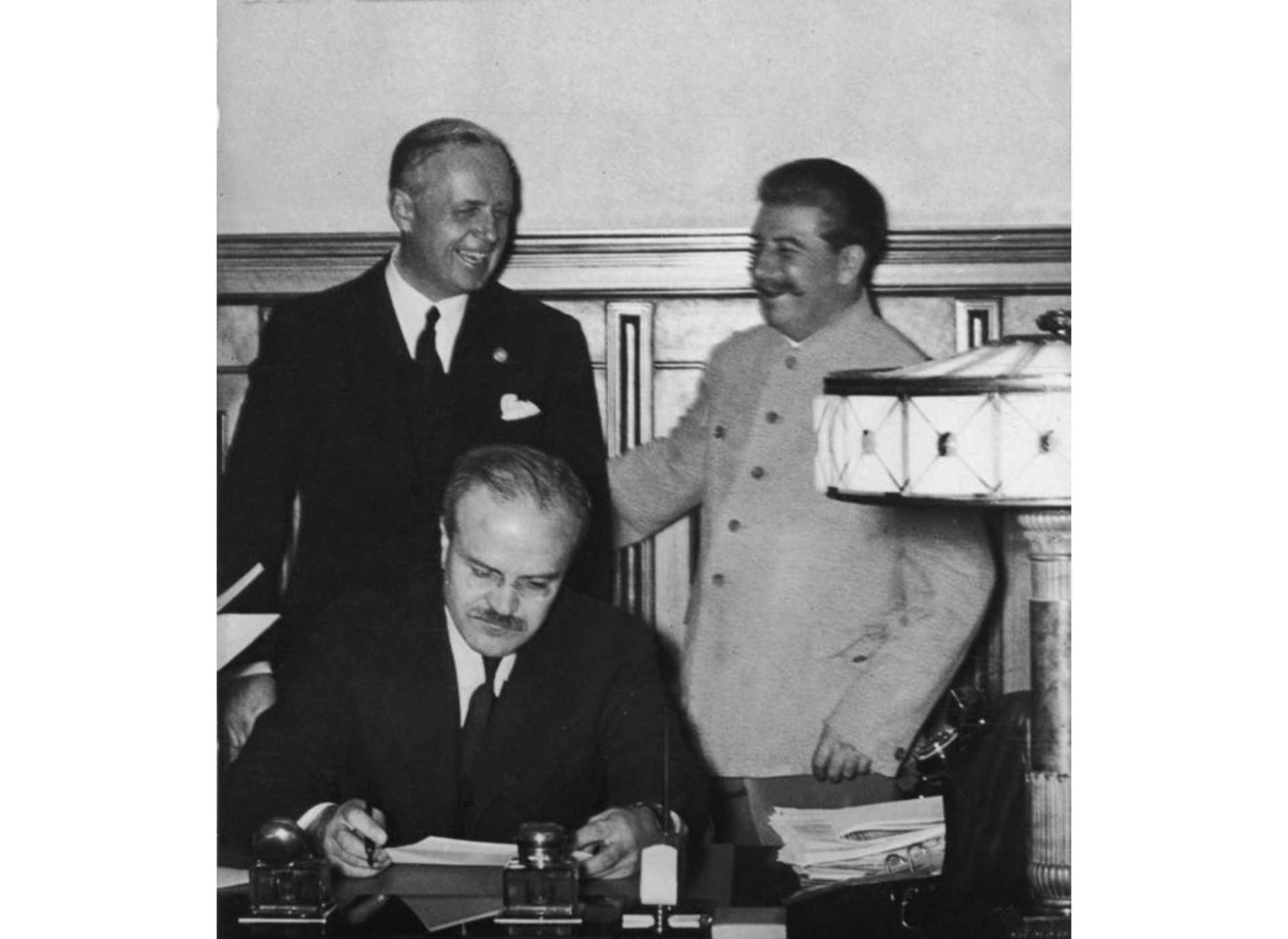
Standing: Joseph Stalin with Nazi Foreign Minister Joachim von Ribbentrop; Seated: Soviet Foreign Minister Vyacheslav Molotov-at the signing of the Nazi-Soviet Non-Aggression Pact. Credit: Hulton Archive/Toronto Star.
Trotsky’s struggle against Stalin entered a new and final phase with the start of World War II just a week later. In a steady stream of articles and interviews, he condemned the role of the Soviet Union, a state that, at least in its rhetoric, had sided with the colonized against imperialism. The betrayal of the principles of Red October had reached a new level of treachery. Perhaps Stalin, Trotsky surmised, now seemed content with partitioning Eastern Europe with the German fascists. Whatever the motives, he dubbed Stalin Hitler’s “quartermaster,” a lackey who reacted to his senior partner’s moves.
The Soviet attack on Finland in November 1939, the beginning of the Winter War, made him wonder how far Stalin was willing to go to create a sphere of interest for himself. While he again damned Soviet aggression, Trotsky, at the same time, despised Marshal Mannerheim, the right-wing Finnish leader rallying his people. Still, Trotsky, true to his Marxism, hoped that “sovietization” in Poland and Finland might free workers and peasants in both countries from the dominance of capitalists and landlords. Yet socialism, he realized, ultimately could not be built on the tips of the Red Army’s bayonets.
This was a huge dilemma for Trotsky. How could one support social revolution in areas under Soviet control without giving any ground on his anti-Stalinism? An even bigger problem posed itself. What if Hitler repudiated the pact and attacked the USSR? Trotsky had no doubt Hitler would do so at the earliest opportunity. His answer was absolutely unequivocal. Socialists and workers everywhere must rally to the defense of the Soviet Union. The achievements of the Bolshevik Revolution had to be defended.
This position, which alienated many of his adherents, coexisted with another claim—the new world war would mean the end of the Stalin regime. Trotsky predicted that the workers and peasants of the USSR, their revolutionary energies revitalized, would put an end to the Stalinist bureaucracy. The revolution he outlined in The Revolution Betrayed would itself form part of a gigantic wave of revolutionism engulfing the Axis powers and the capitalist democracies. Like Stalin, Hitler and Mussolini would meet the severe justice of the proletariat. Trotsky argued that capitalism, stricken for a decade by mass unemployment, immigration quotas, tariff wars, and the constriction of trade, had entered its “death agony” as well. Defiantly, he announced, “from the capitalist prisons and the concentration camps will come most of the leaders of tomorrow’s Europe and the world!” One outcome Trotsky envisioned resulting from this world revolution would be a Socialist United States of Europe. The latter, in turn, would form part of a World Federation of Socialist Republics. This would have amounted to the greatest geopolitical revolution in human history with socialism becoming a truly global societal form.
Trotsky held to this radical perspective even as Stalin signed a commercial agreement with Hitler in February 1940, then seized Bessarabia and Bukovina from Romania, and annexed Lithuania, Latvia, and Estonia. He clung to it as his own health deteriorated and, as he had long feared, Stalin’s assassins closed in on him. At the end of February, Trotsky wrote a final testament, fearing death was near. “Life is beautiful,” he said. “Let the future generations cleanse it of all evil, oppression and violence, and enjoy it to the full.” Three months later, radical evil appeared very much alive and on the move.
On May 1, a day long associated with the Left and labor militancy, 20,000 Mexican Communists marched in the capital and shouted: “Out with Trotsky!” Trotsky and Natalia had already assumed their lives were in jeopardy. With its electrified wires, alarms, and enforced doors, their house in Coyoácan looked more like a fortress than a home. As Trotsky tried from afar to keep pace with Hitler’s invasion of France and the Low Countries, launched on May 10, a plot to kill him took shape. It was led by the painter David Alfaro Siqueiros, once a friend of Rivera, but now a convinced Stalinist. On the night of May 23, Siqueiros’s men broke into the home and fired over 200 shots. Miraculously, Trotsky and Natalia survived. So did their grandson, Esteban Volkov, who had been living with them.
Trotsky proclaimed in defiance, “in the annals of history Stalin’s name will forever be recorded with the infamous mark of Cain.” When the May attempt failed, the GPU decided to go with Mercader. In August, after delays and missteps, he fulfilled his deadly mission. Among the papers next to where Trotsky struggled against his assassin was a long, unfinished manuscript, a biography of Stalin he penned to expose his enemy. The blood spilled in the study confirmed what was etched in ink on the book’s pages. Indeed, with Trotsky’s murder, Stalin demonstrated his most terrifying talent. He was a hangman whose noose could reach across oceans.
In retrospect, it is astonishing just how confident were Trotsky and his supporters (not least those in the United States such as James P. Cannon) in a coming proletarian revolution that would sweep away the Stalin regime. Trotsky’s expectation that World War II would lead to the toppling of Stalin and the restoration of a true workers’ state in the U.S.S.R. never, of course, materialized. In fact, the victory of the Red Army during the “Great Patriotic War” against the Axis states only solidified Stalin’s rule. For many, Marxism became irrevocably defined by and identified with Stalinism. Victory did not mean in this case, though, validity for the system Stalin molded. Trotsky’s critiques of Stalin the person and Stalinism the phenomenon remind us of that.