Webster

The Constitution was made to guard the people against the dangers of good intentions." --American Statesman Daniel Webster (1782-1852)


Showing posts sorted by relevance for query RADAR. Sort by date Show all posts

Tuesday, February 16, 2021

The Story of Operation "Biting"

 I recall this raid in my history, my specialty in the Army was ELINT, the British were having a battle with the Germans over Radar. Radar stands for RAdio Detection And Ranging.  The Germans were using Radar beams to guide their bombers over targets in England and the British were working countermeasures, also the Germans were using Radar to identify the British night raids that were trying to attack the German homeland at night so it was turning into a war of technology, the first of its kind.


Parachutes and radar are long-established elements of war. But they both came into their own with Operation Biting. This British raid from the skies took place on the 27th February 1942.

Brave men landed in the northern French commune of Bruneval with the aim of stealing Nazi radar components. They faced incredible odds but came out the other side in triumph.

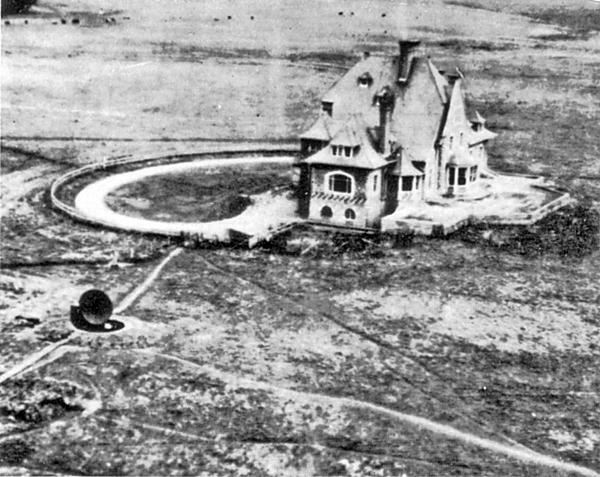
The Germans had set up a radar installation called “Wurzburg”, which Churchill’s experts wanted to get their hands on. At the time an invisible conflict was going on; “The Battle of the Beams”

As described on the Combined Operations website, the game was to jam your enemy’s kit so they didn’t see you coming. Radar expert Dr Reginald Victor Jones was in charge at the British end.

Lord Mountbatten set the plan for Operation Biting in motion. The lead up to the mission had been perilous in itself. Resistance operatives risked their lives gathering intelligence on Bruneval’s beachside location. Photographs of the target were taken from a Spitfire. This was way before the days of cameraphones, so the pilot really needed to master the art!

Low level oblique of the “Würzburg” radar near Bruneval, France, taken by Sqn Ldr A.E. Hill on 5 December 1941. Photos like this enabled a raiding force to locate, and make off with, the radar’s vital components in February 1942 for analysis in Britain

The recently-formed 1st Parachute Brigade, 2nd Battalion C Company were assigned to the momentous task. They’d been in existence only a matter of weeks. And reaction to their involvement wasn’t exactly positive. As Bruce Crompton explains on his ‘Amazing War Stories’ podcast, “Many in the corridors of power thought the Parachute Forces were a folly, a drain on vital war resources. However Churchill was determined…”

Commanded by Major John Frost, the team were assembled and trained rigorously in (typically co-operative!) British weather. High levels of secrecy were maintained.

As described on the Combined Operations website, the game was to jam your enemy’s kit so they didn’t see you coming. Radar expert Dr Reginald Victor Jones was in charge at the British end.

The men had to fly at night. Yet they remained in the dark over what exactly they were doing. Combined Operations writes, “The parachute unit, for example, believed the War Cabinet wanted them to demonstrate techniques and capabilities for raiding a headquarters building behind enemy lines.”

The Brigade, comprised of 120 men, were traveling by Whitley bomber. They would be dropped 600 ft. The drop was straight through the floor, with a risk they’d receive bumps and bruises before they even left the plane! The men were expected to display ABI, or “Airborne Initiative”, meaning no matter how bad thing got, they did their duty.

Once on the ground they operated in 3 sections. One to take the beach, another to serve as rearguard and reserve. Flight Sgt Charles Cox was part of the third group, who were responsible for raiding the Wurzburg. Offshore was Don Preist of the TRE (Telecommunications Research Establishment), studying Nazi transmissions and collecting data in case Operation Biting didn’t come off.

An early snag was well and truly hit when the beach unit, commanded by Lt Euen Charteris, found themselves 2.5 km out from their destination.

They faced the prospect of running toward Bruneval. The route took them through a village brimming with Germans. Thankfully the night gave them the cover they needed, though one enemy soldier was dispatched after joining them in a jog… the unfortunate soul figured they were Nazis.

Meanwhile, Cox and company were at the radar disc. Hitler’s forces were prepared for the parachutists’ arrival and hot metal flew everywhere. It also became clear the kit couldn’t be pried away with tools. Brute strength was used to dismantle the parts. These were then put on trolleys, with accounts of the loot being ridden down slopes to the escape route.

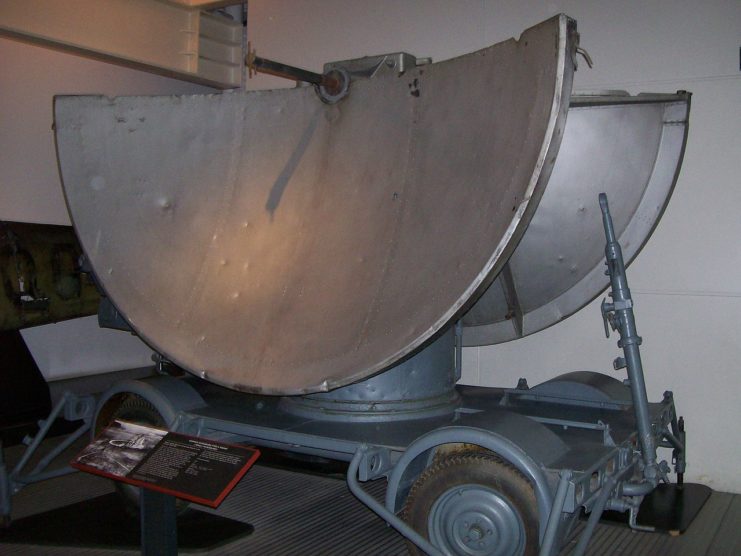
The Würzburg mobile radar at the Imperial War Museum, London. Image by Ekem CC BY-SA 3.0
The Würzburg mobile radar at the Imperial War Museum, 

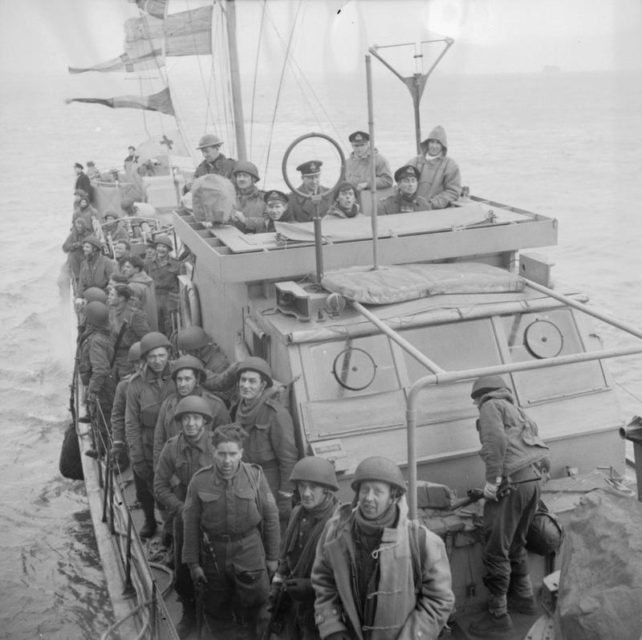
Lt Charteris reached the coast and the mainly Scottish team engaged with the enemy in a fight to the finish. Boats were supposed to be waiting for them but these had been forced to hold off while German vessels prowled the waters. Eventually help arrived, and the Brigade were sped away to Portsmouth.

Sadly while casualties were low, 2 men died. One of those was Lt Charteris. The Germans lost 5 men. 6 of the group became prisoners of the Nazis. The Brits captured soldiers of their own and brought them back to extract further information.

The men of C Company on their arrival on Portsmouth, the morning after the raid.

The Parachute Regiment’s ParaData website calls Operation Biting “a small but exciting taste of success at a time when the war was going badly.” It was a victory for Churchill in the media and in the national consciousness. The deadly radar-grabbing mission put Paras on the map and ushered in a new age of technological warfare.

Sunday, June 11, 2017

The ZSU-23-4 and the SA-6 (Red Storm Rising)

I am bringing out 2 mainstays of the Soviet Air defense umbrella that were designed to stay with the armored formations.   We would study the Soviet Army and their Air Defense we had to look for were the SA-4/SA-6/SA-8 and the "ZSU",  those were high on the priority list, for if we went to war, we wanted to know where those were since we would be using combined air basically Helicopters and A-10's to counter the huge formation of Soviet armor descending down the Fulda gap.  These systems were designed to keep up with the Soviet formations in the field to protect them from our Air power, the Soviets had multiple systems that would overlap each other and provide complete coverage from low level attacks to the high atmosphere.    I am continuing my "Red Storm Rising" theme, in the book, the SAM systems were a major threat to the A-10's and the "Frisbee's" stealth fighters that were trying to slow and stem the Soviet advance.  In the book, the Soviet General had commented "We have done well with our technology, we can kill men instantly with missiles."


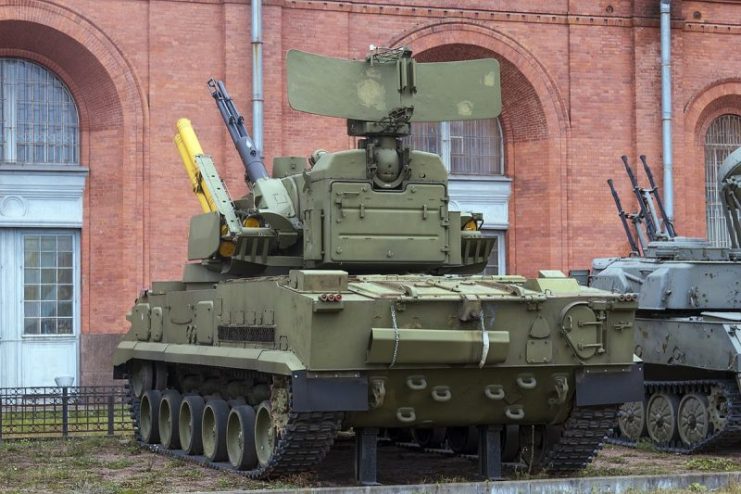
The ZSU-23-4 "Shilka" is a lightly armored Soviet self-propelled, radar guided anti-aircraft weapon system (SPAAG)

The acronym "ZSU" stands for Zenitnaya Samokhodnaya Ustanovka (Russian: Зенитная Самоходная Установка), meaning "anti-aircraft self-propelled system"; the "23" signifies the bore diameter in millimeters; the "4" signifies the number of gun barrels. It is named after the Shilka River in Russia. Afghan soldiers nicknamed it the "sewing machine" due to the sound of firing guns. It is also referred to by its nickname of "Zeus" which is a play on the first part of the name.

 T72M and a ZSU-23-4
The development of the ZSU-23-4 "Shilka" began in 1957 along with ZSU-37-2 "Yenisei" and the vehicle was brought into service in 1965, replacing all ZSU-57-2s in air defense units toward the beginning of the 1970s. The ZSU-23-4 was intended for AA defense of military facilities, troops, and mechanized columns on the march; originally, the more powerful guns of "Yenisei" were judged to be effective at covering the inner dead-zone of Soviet surface-to-air missile systems despite the increased weight of the vehicle, but commonality prevailed. Initially, tank regiments should have had the anti-aircraft artillery battalion of "Shilka" (consisting of two batteries, four ZSU-23-4s in each). At the end of the 1960s, one battery was equipped with ZSU-23-4s and the other with ZSU-57-2s. Motorized rifle and tank regiment standard anti-aircraft batteries consisted of two platoons later (one platoon was equipped with four ZSU-23-4s and another with four mobile surface-to-air missile systems 9K31 Strela-1 or 9K35 Strela-10). The ZSU-23-4 combined a proven radar system, the non-amphibious chassis based on GM-575 tracked vehicle, and four 23 mm autocannons. This delivered a highly effective combination of mobility with heavy firepower and considerable accuracy. The ZSU-23-4 outclassed all NATO anti-aircraft guns at the time, and it is still regarded as posing a major threat for low-flying fixed-wing aircraft and helicopters.
The system was widely fielded throughout the Warsaw Pact and among other pro-Soviet states. Around 2,500 ZSU-23-4s, of the total 6,500 produced, were exported to 23 countries. The Soviet Union's successor states continue to manufacture and supply variants of the ZSU-23-4, notably the Ukrainian "Donets" and Polish "Biala" variants.
ZSU-23-4 graphic.

ZSU-23-4 at Yad la-Shiryon Museum, Israel.
ZSU-23-4 units saw active service in the Yom Kippur War (1973) and other Arab-Israeli conflicts, the Iran–Iraq War (1980–1988), and the First Gulf War (1990). During the 1973 Yom Kippur War, the system was particularly effective against the Israeli Air Force. Israeli pilots attempting to fly low in order to avoid SA-6 missiles were often shot down by ZSU-23-4s as in Operation Doogman 5. During the Soviet-Afghan War ZSU-23-4 units were used widely and to great effect against mujahideen positions in the mountains, the ZSU-23-4's guns being able to elevate much higher than the weapons on BMPs, BTRs, T-55s, or T-62s. They were also used to suppress defensive positions around the presidential palace during the initial coup in Kabul at the start of the Soviet-Afghan war. The Russian Army used the ZSU-23-4 for mountain combat in Chechnya.
Initially fielded by the loyalist forces of the Syrian Arab Army as a fire support vehicle, a number of them were captured by different factions in the Syrian Civil War and they are normally fielded in a fire support role by all sides. There were no or at most very limited, attempts by the different opposing forces to use the Shilka in its original anti aircraft role against loyalist and international air forces operating in the area.

The radar-guided ZSU-23-4 "Shilka" SPAAG, with its four 23 mm (0.90") autocannons, was a revolutionary SPAAG, proving to be an extremely effective weapon against enemy attack aircraft and helicopters under every weather and light condition. The ZSU-23-4 has a very high density, rate and accuracy of fire, as well as the capability for each of the four autocannons to fire its own type of projectile from separate belts. While it is technically possible that each cannon shoots different type of ammunition, there were two types commonly used in late 1970s: OFZT incendiary fragmentation and BZT armour-piercing tracer, which were to be loaded in 3:1 ratio—three OFZT, then one BZT, every 10th BZT round equipped with so-called "copper remover" and marked. Operators were strongly discouraged from shooting from a single barrel.

The appearance of the "Shilka" caused significant changes in NATO tactics in aircraft use at low altitude over the battlefield. Despite its present obsolescence as a modern short-range anti-aircraft weapon, the ZSU-23-4 is still deadly for enemy light armoured vehicles, infantry and firing points as an infantry-support vehicle. With its high rate of accurate fire, the ZSU-23-4 can even neutralize tanks by destroying their gun sights, radio antennas, or other vulnerable parts. ZSU-23-4s, especially late models, have excellent performance and good systems reliability.
Based on the GM-575 tracked vehicle chassis, which used components from the PT-76 light amphibious tank, the ZSU-23-4 mounts an armored turret holding four liquid-cooled 23 mm (0.9") 2A7 autocannons linked to an RPK-2 "Tobol" radar (NATO designator: "Gun Dish"). The vehicle weighs 19 tonnes (late modifications up to 21 tonnes), has a movement range of 450 km (280 mi) and a top speed of 50 km/h (31 mph). Additional firepower of late modifications can be supplied by a roof-mounted pod of six short-range SA-18 SAMs, or side mounted SA-16s.
The crew numbers four: driver, commander, gunner and radar operator. The driver's compartment is located in the nose part of the vehicle. The fighting compartment is in the center, and the engine compartment is in the rear part of the vehicle.

Each water-cooled 23 mm 2A7 autocannon has a cyclic rate of 850–1,000 rounds per minute for a combined rate of fire of 3,400–4,000 rounds per minute. The welded turret has a race ring transplanted from a T-54 medium tank with a 1,840 mm (6') diameter. The 360° rotating turret is fully stabilised and capable of firing on the move. The turret rotation and autocannon elevation mechanisms provide very good speed and guidance accuracy. The hydraulically driven aiming mechanisms have been proven to be very reliable. Manual aim is used against ground targets. The quad automatic anti-aircraft gun AZP-23 "Amur" has a range of elevation from -4° to +85°. The GRAU designation for ZSU-23-4 turret with 23 mm (0.9") AZP-23 "Amur" quad automatic gun is 2A10. An armoured plate inside the turret protects crew members from fire and explosive gas during intense firing.

Ammunition capacity is 2,000 rounds stowed aboard (520 rounds per each upper autocannon and 480 rounds per each lower autocannon) loaded in 50-round or shorter belts.  A typical loading of each ammunition belt contains 40 OFZT and 10 BZT rounds. They can be fired to a maximum horizontal range of 7 km (4.3 mi), and a vertical range of 5.1 km (3.2 mi). The effective vertical range is 1.5 km (0.93 mi) at a direct range to target of 2.5 km (1.6 mi) and target speed of 250 m/s (up to 500 m/s if a modern fire control system is used). The usual autocannon burst consists of 3–10 projectiles and target lead angle is calculated for each burst (fire without adjustment) by computer. In attacking targets on the ground, its effective range is around 2.5 km (1.6 mi). The short range of its 23 mm autocannons and relatively low explosive effect of its small-calibre projectiles mean it is less able to engage threats such as jet attack aircraft and cruise missiles than modern systems like the 9K22 Tunguska armed with more powerful 30 mm autocannons and integrated missile armaments. A special 23 mm round with composite projectiles was developed for a modern variant of SPAAG (ZSU-23-4M4) to be used against cruise missiles.

 The RPK-2 "Tobol" a.k.a. 1RL33 radar operates in the J band and can detect aircraft up to 20 km (12 mi) away. It has excellent target tracking capability and is relatively hard to detect by the enemy. However, the radar picks up many false returns (ground clutter) under 60 m (200 ft) of altitude. The radar antenna is mounted on collapsible supports in the top rear of the turret. There is an optical alignment sight. The RPK-2 radar proved to have good protection against enemy passive electronic radar counter-measures. Nevertheless, the radar system of the ZSU-23-4 has a short detection range during target search, depending on weather conditions (mainly dependent on rain and snow conditions). It is hard to automatically track the target at ranges less than 7–8 km (4.3-5.0 mi) because of the high angular speed of the target at close distances. The radar needs to be reset quite often because of the unstable parameters of electronic cathode-ray tubes of the target selection system. The absence of an automatic laser range finder requires a skillful commander and gunner.

Soviet doctrine supplied the vehicle since 1965 in an anti-aircraft artillery battery of two, four-vehicle platoons for anti-aircraft defence of motor rifle and tank regiments. At the end of the 1960s one platoon was equipped with ZSU-23-4 SPAAGs while another one was still equipped with ZSU-57-2 SPAAGs. ZSU-57-2 was completely replaced with ZSU-23-4 by the beginning of the 1970s. In the 1970s, Soviet motor rifle and tank regiments were equipped with an anti-aircraft missile artillery battery consisting of two platoons, one equipped with four ZSU-23-4 SPAAGs and the other with four 9K31 Strela-1 (SA-9 Gaskin) or later with four 9K35 Strela-10 (SA-13 Gopher) short-range surface-to-air missile systems which cover the dead zones of 2K12 Kub (SA-6 Gainful) surface-to-air missile systems belonging to the divisional level. Since the 1980s Soviet motor rifle and tank regiments were equipped with an anti-aircraft artillery battalion of three batteries (one was equipped with ZSU-23-4 or 9K22 Tunguska SPAAGs, the second one was equipped with 9K35 Strela-10 (SA-13 Gopher) short-range surface-to-air missile systems and the third battery with 9K38 Igla man-portable surface-to-air missiles on IFVs or APCs.
The ZSU-23-4 is very vulnerable to enemy anti-tank missiles, cannons and heavy machine guns; the armor is thin (not exceeding 15 mm) and the exposed wheels, tracks, radar, and gun barrels can easily be damaged in combat. Firing positions of ZSU-23-4 SPAAGs are typically placed near the forward edge of the battle area (FEBA) but behind the main forces, usually 600–1000 m behind objectives when on the defensive or 400–600 m behind the leading tanks on the offensive. ZSU-23-4 SPAAGs are divided evenly along the troop columns on the march.
At first each ZSU-23-4 operated in combat autonomously, without target marking from regimental or divisional air defense. In 1978, the PPRU-1 (mobile reconnaissance and control post) was passed into service of the Soviet Army. The PPRU-1 ("Ovod-M-SV") vehicle is based on MT-LBu armored tracked chassis and it was intended for control of motor rifle or tank regimental anti-aircraft unit equipped with ZSU-23-4 SPAAGs and 9K31 "Strela-1M" mobile surface-to-air missile systems. The PPRU-1 is equipped with "Luk-23" radar and an automatic fire control system associated with the divisional air defense system.
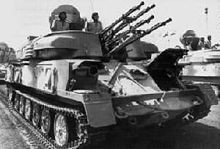
ZSU-23-4 photo.
The guns are useful against low-flying aircraft and lightly protected ground targets. Due to its effectiveness against ground targets, ZSU-23-4s have been used in urban environments (e.g., Afghanistan, Abkhazia, Chechnya, Syria and Lebanon). This is primarily because the guns can elevate much higher than a tank or APC cannon, enabling armored units equipped with ZSU-23-4s to return fire against ambushes from above.
A small number of ZSU-23-4 SPAAGs are still in use by the Russian Naval Infantry (specifically the 61st and 175th brigades of the Northern Fleet and the 336th brigade of the Baltic Fleet).

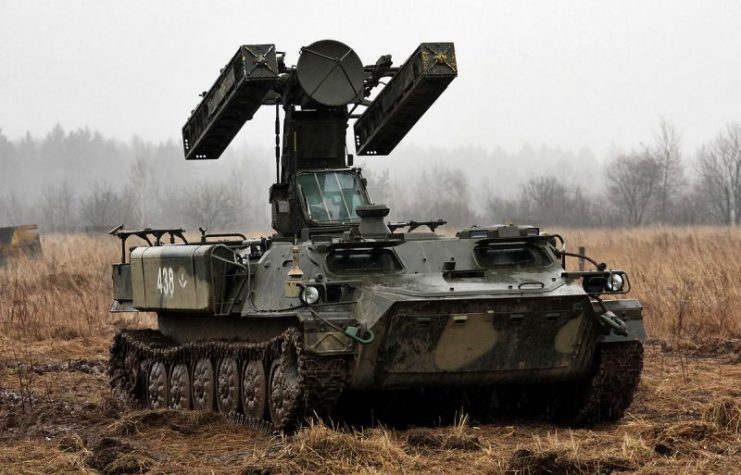
   You noticed that both systems share the same chassis...


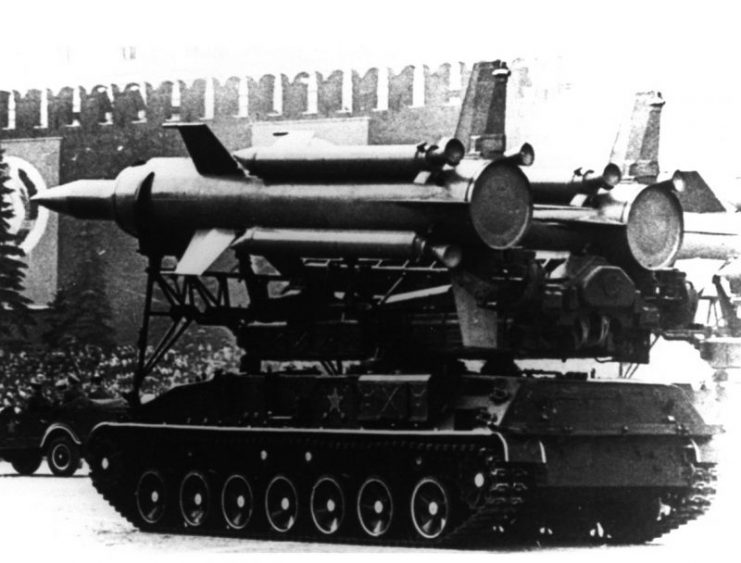
The 2K12 "Kub" (Russian: 2К12 "Куб"; English: cube) (NATO reporting name: SA-6 "Gainful") mobile surface-to-air missile system is a Soviet low to medium-level air defence system designed to protect ground forces from air attack. "2К12" is the GRAU designation of the system.
Each 2K12 battery consists of a number of similar tracked vehicles, one of which carries the 1S91 (SURN vehicle, NATO designation "Straight Flush") 25 kW G/H band radar (with a range of 75 km (47 mi)) equipped with a continuous wave illuminator, in addition to an optical sight. The battery usually also includes four triple-missile transporter erector launchers (TELs), and four trucks, each carrying three spare missiles and a crane. The TEL is based on a GM-578 chassis, while the 1S91 radar vehicle is based on a GM-568 chassis, all developed and produced by MMZ.

The development of the 2K12 was started after 18 July 1958 at the request of the CPSU Central Committee. The system was set the requirements of being able to engage aerial targets flying at speeds of 420 to 600 m/s (820–1,170 kn) at altitudes of 100 to 7,000 m (330 to 22,970 ft) at ranges up to 20 km (12 mi), with a single shot kill probability of at least 0.7.
The systems design was the responsibility of the now Tikhomirov Scientific Research Institute of Instrument Design (NIIP). In addition to NIIP several other design bureaus were involved in the creation of the Kub missile system including the now JSC Metrowagonmash (former MMZ)which designed and produced the chassis of the self-propelled components. Many of the design bureaus would later go on to co-operate in the development of the successor to the 2K12 "Kub", the 9K37 "Buk"
First trials of the missile system were started at the end of 1959 to discover a series of problems:
  • low power for the missile radar seeker and badly designed nose cone,
  • missile air inlets design failure,
  • low quality of heat shield inside the afterburner chamber (titanium was replaced by steel).
Those failures resulted in some 'orgchanges': In August 1961 Toropov was replaced by Lyapin as the Chief Designer of Vympel and in January 1962 Tikhomirov was replaced by Figurovskiy as the Chief Designer of NIIP. Still, the work wasn't intensified. Before 1963 only 11 of 83 missiles fired had the seeker head installed, only 3 launches were successful.
Kub downed its first ever air target on February 18, 1963, during the state trials at Donguz test site, Orenburg Oblast. It was an Ilyushin Il-28 bomber.
The system entered an extended testing period between 1959 and 1966, after overcoming the technical difficulties of producing the 2K12 "Kub" the system was accepted into service on 23 January 1967 and went into production that same year.
It is sometimes claimed that the SA-N-3 Goblet naval system is a version of the 3M9 but this is not the case, as the M-11 Shtorm is a separate system and, unusually for Russian surface-to-air missiles, has no land-based variant.

The 2K12 system shares many components with the 2K11 Krug (SA-4) system. In many ways they are designed to complement each other; 2K11 is effective at long ranges and high altitudes, 2K12 at medium ranges and intermediate altitudes.
The system is able to acquire and begin tracking targets using the 1S91 "Самоходная установка разведки и наведения" (SPRGU - "Self-propelled Reconnaissance and Guidance Unit" / NATO: "Straight Flush" radar) at 75 km (47 mi) and begin illumination and guidance at 28 km (17 mi). IFF is also performed using this radar. It can only guide one or two missiles to a single target at any time. The missile is initially command guided with terminal semi-active radar homing (SARH), with target illumination provided by the "Straight Flush" radar. Detonation is via either the impact or proximity fuze. On the latest models, this vehicle is also fitted with an optical tracking system which allows engagement without the use of the radar (for active RF emissions stealth reasons, or due to heavy ECM jamming) in which case the effective altitude is limited to 14 km/46000 ft. The optical tracking method also allows engagements to altitudes below that where the radar is able to track targets. Maximum target speed is around Mach 2 for head-on engagements and Mach 1 for tail-chase engagements. Top speed of the missile is approximately Mach 2.8.
In contrast to the elaborate Patriot missile or even the simpler Hawk system fielded by US forces, most of the system rides on two tracked self-propelled vehicles, rather than towed or mounted on trucks, and either the launcher or control vehicle can be set to launch in only 15 minutes after changing location.

The fairly large missiles have an effective range of 4–24 km (2.5–15 miles) and an effective altitude of 50–14,000 m (164–45,931 ft). The missile weighs 599 kg (1,321 lb) and the warhead weighs 56 kg (123 lb). Top missile speed is approx. Mach 2.8. The combined propulsion system 9D16K included solid fuel rocket motor which, when burned out, forms the combustion chamber for a ramjet in a pioneering design putting this missile far ahead of its contemporaries in terms of propulsion.
The missile was fitted with a semi-active radar seeker 1SB4, designed by MNII Agat, which was able to track the target by Doppler frequency since the start. Later upgrades (3M9M3 missile) could do this before the start. Chief Designer of the seeker head was Yu.N. Vekhov, since 1960 – I.G. Akopyan.
In 1977 a new version, the 3M9M1 (DoD designation SA-6B) was created with three missiles fitted onto a different chassis (the same as that of the 9K37 "Buk" (NATO reporting name "Gadfly" / DoD SA-11 ), the 2K12 effective replacement) with an integrated "Fire Dome" missile guidance radar. For comparisons between the 2K12, 9K37, see the 9K37 Buk entry.
An earlier incremental upgrade saw the 2K12 missiles replaced with the 2K12E versions and this system was known as Kvadrat ("Квадрат", meaning square). This name was derived from the most common arrangement pattern of the military vehicles of the 2K12 complex, when the 1S91 radar is located at the center and 4x2P25 TELs at the vertices of a square around the radar.

SURN 1S91 vehicle included two radar station – a target acquisition and distribution radar 1S11 and a continuous wave illuminator 1S31, in addition to an IFF interrogator and an optical channel.
While 1S31 antenna was installed on the upper section of the superstructure and the 1S11 on the lower, they could turn around independently. To make the height of the vehicle lower the central cylinder was able to hide inside the prime mover.
The acquisition range of the radar was reported as 50 km (31 mi) for the Phantom II type target.
Total weight of the 1S91 vehicle with a crew of 4 was 20.3 tonnes and 2P25 vehicle with 3 missiles and a crew of 3 was 19.5 t.

 "Spoonrest, and a "Thin Skin" with a "Fansong SA-2" system in the background.
The 2K12 can also be used at a regimental level, if used as such it can be accompanied by a number of additional radar systems for extended air search at longer range and lower altitude, to supplement the 1S91 "Straight Flush". These systems include the:

  • P-40 "Long Track", an E band early warning radar (also used by the SA-4 and SA-8), with a 370 kilometres (230 mi) range.
  • P-15 "Flat Face A", a UHF early warning radar (also used by the SA-3, with a 150 kilometres (93 mi) range.
  • "Thin Skin" or "Side Net" E band height finding radar (also used by the SA-2, SA-4 and SA-5, range 240 km/148 miles)
  • "Score Board" IFF radar
The "Spoon Rest" and "Thin Skin" are mounted on a truck, "Long Track" on a tracked vehicle (a modified AT-T) and "Flat Face" on a van. It is unknown what kind of mounting the "Score Board" has.
Without the P-40 "Long Track" mobile radar vehicle, the 2K12 is unable to track aircraft at high altitudes.



Saturday, May 20, 2017

Roland and the SA-8 "Red Storm Rising"

  This is a continuation of my "Red Storm Rising" post that I was doing.   In the book, the SAMS were a major target for the Tanks and TOW systems that were used to protect the NATO forces.  In the book, the A10 was a major nemesis of Soviet Armor and the mobile SAM system were used to try to protect the advance of the Armored formations.    I actually do have experience with the "Roland" system.   During Frankonian Shield  and more information was here.
     This was my first field problem and it was a big exercise, we had Americans, Germans, French,  that I knew of.  We were running around the countryside doing our thing and we were in one of these...
   We were on a hilltop and we were DFing equipment and the Germans put some tanks and infantry on the hill we were at along with a couple of Roland Missile systems to protect the tanks.   I had a few minutes so I walked over to say "hi" and practice my real bad German, I was already trying to learn the language.   I was speaking to the "Herr Feldwebel" or the NCO in charge and he was showing how it worked.  He had me climb in and set in the seat and turn the system on and it used a joystick on the side to turn and a turnwheel at the tip of the joystick and that is used to fine tune the radar on the target.  Well I was moving it around there was a blip and the NCO hit a button and I guess it interrogated the IFF system and it came back "French",


well the French was aggressors and they had launched a push for the hill and the one next to us.  Well I got a lock on the helicopter and he hit a button and it was registered a "kill".  Man that was some real neat stuff, let me tell you. 


Well the French got upset I suppose and sent in more Helicopters to take out the tanks and Rolands on the hill we were on.  Well the Germans called in the Phantoms,
Well Helicopters cannot operate when Jets are around and they left.  so the French assault on our hill failed.   We were cut off for 3 days surrounded by the French and it was great being away from our first sergeant trying to sneak up on us.   Needless to say, this really set the bar high for subsequent field problems.  This one was still one of my favorite exercises.    The Soviets used an integrated SAM system to protect their Armored Formations with overlapping systems going from low to the Ground up to the high altitudes that bombers like to fly.  


The Roland is a Franco-German mobile short-range surface-to-air missile (SAM) system. The Roland was also purchased by the U.S. Army as one of very few foreign SAM systems.
Roland was designed to a joint French and German requirement for a low-level mobile missile system to protect mobile field formations and fixed, high-value targets such as airfields. Development began in 1963 as a study by Nord Aviation of France and Bölkow of Germany with the system then called SABA in France and P-250 in Germany. The two companies formed a joint development project in 1964 and later (as Aérospatiale of France and MBB of Germany) founded the Euromissile company for this and other missile programs. Aerospatiale took primary responsibility for the Roland 1 day/clear-weather system while MBB took primary responsibility for the Roland 2 all-weather system. Aerospatiale was also responsible for the rear and propulsion system of the missile while MBB developed the front end of the missile with warhead and guidance systems. The first guided launch of a Roland prototype took place in June 1968, destroying a CT-20 target drone and fielding of production systems was expected from January 1970. The test and evaluation phase took much longer than originally anticipated with the clear-weather Roland I finally entering operational service with the French Army in April 1977, while the all-weather Roland II was first fielded by the German Army in 1978 followed by the French Army in 1981. The long delays and ever-increasing costs combined with inflation meant Roland was never procured in the numbers originally anticipated.

The Roland SAM system was designed to engage enemy air targets flying at speeds of up to Mach 1.3 at altitudes between 20 meters and 5,500 meters with a minimum effective range of 500 meters and a maximum of 6,300 meters. The system can operate in optical or radar mode and can switch between these modes during an engagement. A pulse-doppler search radar with a range of 15–18 km detects the target which can then be tracked either by the tracking radar or an optical tracker. The optical channel would normally be employed only in daylight against very low-level targets or in a heavy jamming environment.
The Roland missile is a two-stage solid propellant unit 2.4 meters long with a weight of 66.5 kg including the 6.5 kg multiple hollow-charge fragmentation warhead which contains 3.5 kg of explosive detonated by impact or proximity fuses. The 65 projectile charges have a lethal radius of 6 meters. Cruising speed is Mach 1.6. The missile is delivered in a sealed container which is also the launch tube. Each launcher carries two launch tubes with 8 more inside the vehicle or shelter with automatic reloading in 10 seconds.
For defense of fixed sites such as airfields the shelter Roland can be integrated in the CORAD (Co-ordinated Roland Air Defense) system which can include a surveillance radar, a Roland Co-ordination Center, 8 Roland fire units and up to 8 guns.
  • Roland 1 – This is the fair-weather daylight-only, version used by the French and Spanish armies on the AMX-30R chassis.
  • Roland 2 – This is the all-weather version employed on the AMX-30R and Marder chassis and also as a shelter mount in either a static location or mounted on a 6×6 or 8×8 all-terrain truck. Euromissile, MaK, IBH and Blohm and Voss of Germany in 1983 proposed the Leopard 1 tank chassis as a carrier for the Roland system to appeal to those countries who already used the Leopard I tank.
MARDER(IFV)
 Germany was to buy 12,200 missiles 340 Roland 2 fire units installed on the Marder (IFV) chassis to fully replace the towed Bofors 40 mm guns systems and Contraves Super Fledermaus fire control systems in service with the Bundeswehr Corps-level air defense regiments. Each regiment would have 36 fire units in 3 batteries of 12. Eventually 140 fire units were procured and equipped 3 regiments with one assigned to each army corps. The Luftwaffe had a requirement for 200 Roland 2 shelter systems mounted on MAN 8×8 trucks for the close-in defense of airfields and as mobile gap-fillers for the MIM-23 HAWK SAM systems. 95 systems were eventually procured from the mid-1980s with 27 of those used to defend American air bases in Germany. In 1998–99 10 Roland LVB systems were installed on MAN 6×6 trucks to be air-transportable in the Transall C-160 for the German rapid reaction forces. The German Navy also procured 20 truck-mounted shelter systems for defense of naval bases. In February 2003 the Bundeswehr cancelled a planned upgrade of Roland and announced it would phase-out all of its Roland systems. This was completed by the end of 2005. The Luftwaffe and Navy have also withdrawn Roland and it is no longer employed by Germany. The German Army will replace Roland with the new and much more capable development: LFK NG). A battery of German systems have been passed on to Slovenia.


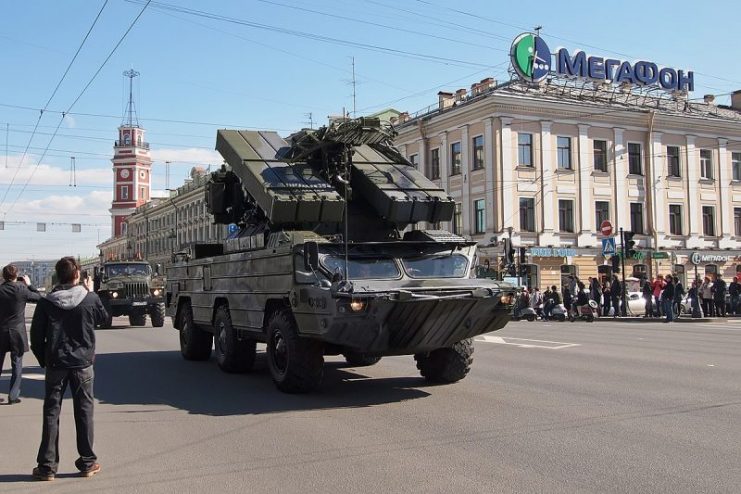
he 9K33 Osa (English: wasp) is a highly mobile, low-altitude, short-range tactical surface-to-air missile system. "9K33" is its GRAU designation. Its NATO reporting name is SA-8 Gecko. Its export version name is Romb.

The SA-8 was the first mobile air defense missile system incorporating its own engagement radars on a single vehicle.
All versions of the 9K33 feature all-in-one 9A33 transporter erector launcher and radar (TELAR) vehicles which can detect, track and engage aircraft independently or with the aid of regimental surveillance radars. The six-wheeled transport vehicles BAZ-5937 are fully amphibious and air transportable. The road range is about 500 km.
The 1S51M3-2 radar system on the SA-8 TELAR received the NATO codename Land Roll. It was derived from the naval `Pop Group' radar system but is smaller since it does not require the elaborate stabilisation system. An improved system designated the SA-8B `Gecko' Mod 1, was first seen in Germany in 1980. It had improvements added to the launcher configuration, carrying six missiles in ribbed containers. The system is reported to be of the frequency-agile monopulse type. It consists of an elliptical rotating surveillance antenna mounted on top of the array, operates in H band (6 to 8 GHz) and has a 30 km acquisition range against most targets. The large pulsed J band (14.5 GHz) engagement antenna is mounted below it in the centre of the array and has a maximum tracking range of about 20 km.
Mounted on either side of the tracking radar antenna is a small J band parabolic dish antenna to track the missile. Below that is a small circular antenna which emits an I band uplink capture beam to gather the missile shortly after launch. The final antennas in the array are two small white rectangular ones, one on either side of the array mounted alongside the I band. These are used for command uplink to the missile. This twin antenna system permits the 'Land Roll' radar to control up to two missiles simultaneously against a single target. Furthermore, the two missiles can be guided on different frequencies to further complicate ECM. There is also a tubular device fitted to and above the tracking radar; this is a 9Sh33 electro-optical tracker. It can be used to track the target when the main tracking radar is jammed by ECM.
A 9K33 battery comprises four 9A33B TELAR vehicles and two 9T217 transloader vehicles on BAZ-5939 chassis with reload missiles and a crane. A reload time of five minutes has been reported per TELAR.
In addition to the TELARs, each regiment is also assigned a single radar collimation vehicle 9V914 (initially on the BAZ-5938 chassis but more often found on the ZiL-131 truck). This vehicle assists in the alignment of the TELAR's radar systems, ensuring accurate target tracking and engagement.

Engagement range for the early versions is approximately 2–9 km (1.3-5.6 miles) and engagement altitudes of between 50–5000 m (164-16,400 ft). The 9M33M2 "Osa-A" missile extends the ranges out to 1500-10000m (1-6.2 miles) and engagement altitudes to 25–5000 m (82-16,400 ft). The 9M33M3 missile greatly enhances the altitude engagement envelope to 10–12000 m (33-42,500 ft), and as such are also able to fly further (about 15 km/9 miles) but the system is not able to engage targets at longer ranges, due to other factors such as the radar tracking of the missiles. The system is designed for use primarily against jet aircraft and helicopters in any kind of weather.
The 9M33 missiles are 3.158 m (10.3 ft) long, weigh 126 kg (278 lb) and use command guidance. There is also a backup low-light optical tracking system for heavy ECM environments. The latest 9M33M3 missiles have an increased total weight of 170 kg (375 lb) in order to provide the extended range coverage and larger warhead. Propulsion is provided by a dual-thrust solid fuel rocket motor. Both versions feature a missile speed of around Mach 2.4 (peaking at around Mach 3) for a maximum target engagement speed of around Mach 1.4 for the original missile and Mach 1.6 for the M2\M3 missiles. The warhead for the initial and M2 versions weighs 19 kg (42 pounds), increased to 40 kg (88 lb) in the M3 version to improve performance against helicopters. All versions have impact and proximity fuzes.
There have been unconfirmed reports of other possible versions of the missile with both infra-red and semi-active radar terminal homing seekers.
Each TELAR is able to launch and guide two missiles against one target simultaneously. Kill probability is quoted as being 0.35-0.85 for the Osa and 0.55-0.85 for the Osa-AK and Osa-AKM (presumably depending upon target aspect, speed, maneuverability and radar cross section). Reaction time (from target detection to launch) is around 26 seconds. Time to prepare for engagements from being in transit is around 4 minutes and missile reloading takes around 5 minutes. Each battery of four TELARs is usually accompanied by two reload vehicles carrying 18 missiles in sets of three, with a crane mounted on the reload vehicles to assist in moving the missiles.
When launched the booster motor burns for two seconds, this permits the radar to gather and control it at very short ranges (about 1.6 km). The sustainer motor has a 15-second burn, bringing the missile to a top speed of about Mach 2. Once launched the missile is command-guided for the whole flight, and the warhead is detonated by its proximity fuze or possible command. The warhead is said to have a lethal radius of 5 m at low altitude against a F-4 Phantom size target.

  • 1S51M3 ("Land Roll") - C band target acquisition radar, H band conical scan target tracking radar and two J band pulse mode fire control radars (range 35 km/22 miles for acquisition, 30 km/19 miles for tracking and 25 km/16 miles for guidance). Mounted on the TELAR.

  • P-40 ("Long Track") - E band early warning radar (also used by the SA-4 and SA-6, range 175 km/108 miles), mounted on a tracked vehicle (a modified AT-T).

  • P-15 ("Flat Face A") or P-19 ("Flat Face B") or P-15M(2) ("Squat Eye") - 380 kW C band target acquisition radar (also used by the SA-3 and SA-6, range 250 km/155 miles), mounted on a ZiL-131 truck.

  • PRV-9 or PRV-16 ("Thin Skin") - E band height finding radar (also used by the SA-4 and SA-6, range 240 km/148 miles), mounted on a KrAZ-255B truck.


Type Surface-to-air missile
Place of origin Soviet Union
Service history
In service 1971-present
Used by See list of present and former operator
Production history
Designer MKB "Fakel"
Designed 1960-1972
Manufacturer Znamya Truda Plant
Produced 1970-1988
Variants 9M33, 9M33M1, 9M33M2, 9M33M3, 9A33BM3
Specifications (9K33M3)
Weight 170 kg
Length 3158 mm
Diameter 209.6 mm
Warhead Frag-HE
Detonation
mechanism
Contact and proximity

Propellant Solid propellant rocket motor
Operational
range
15 kilometres (9.3 mi)
Flight altitude 12,000 metres (39,000 ft)
Boost time 2 s boost, then 15 s sustain
Speed 1020 m/s
Guidance
system
RF CLOS
Steering
system
dual-thrust rocket motor.
Accuracy 5 m
Launch
platform
9P35M2


Thursday, June 28, 2018

Soviet Post War Self Propelled AAA

I decided to post an article on Soviet equipment, my specialty was Soviet Sam systems and how they operated and their doctrine.  I found it fascinating because the Soviet mobile units would accompany their echelon forces to protect them from opposing air units.  The Soviets remembered what the

German Stuka dive bombers did to their armored formations during WWII.  This article probably would have accompanied my "Red Storm Rising" articles that I did a while back.


Soviet Sam Performance Envelope.(Unclassified)

To counter the helicopters and planes of both current and anticipated enemies, the Soviet military planners of the Cold War built their air defense forces around three principles – mobility, mass, and integration.
Integration was achieved by incorporating the weapons into units at all levels. Mass was achieved by building vast numbers of them. And mobility was achieved by installing them on vehicles, creating a wide range of self-propelled anti-aircraft weapons.

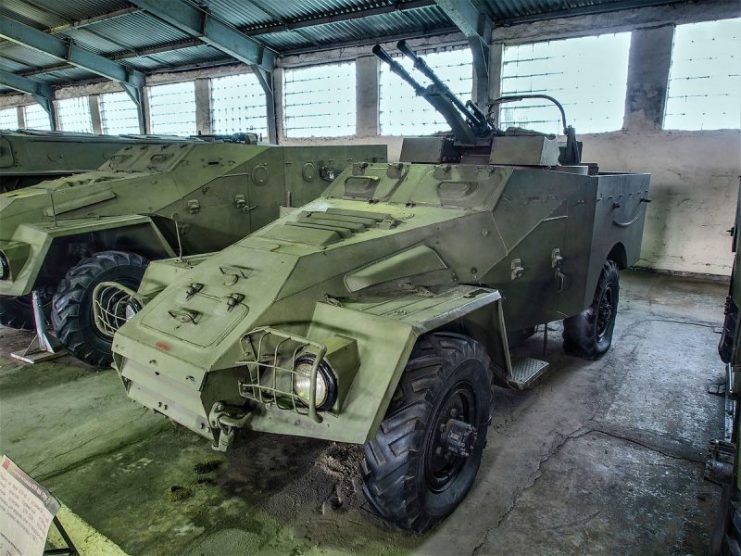
BTR-40A
This was one of two early specialist anti-aircraft vehicles built by mounting weapons on armored personnel carriers (APCs). The BTR-40A was an adaptation of the BTR-40 APC, with a simple turret installed above the troop compartment. A pair of 14.5mm KPV machine guns were mounted in the turret, which had an elevation of up to 80°.

BTR-40A (ZTPU-2) in the Kubinka Tank Museum.
Though it could theoretically take on aircraft, the BTR-40A wasn’t very effective in this role. The manually operated turret was slow to reverse and the simple sights were ineffective. To make things worse, the gunner had little armor to protect him.

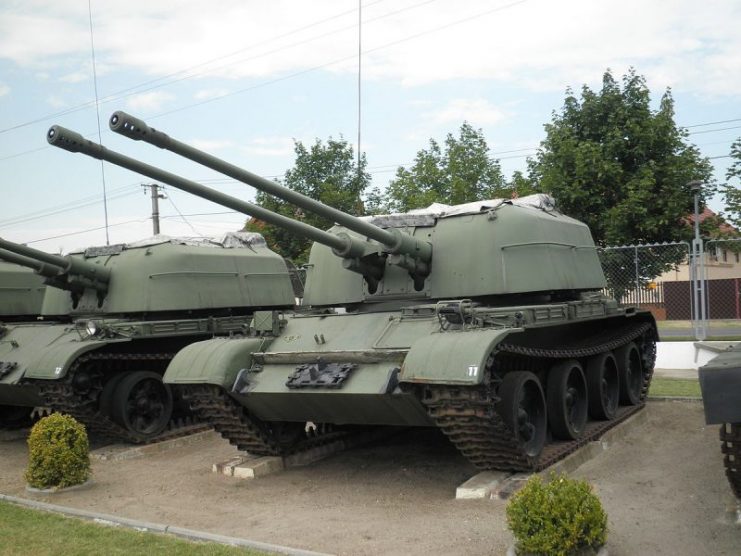
ZSU-57-2
Brought into service in 1955, the ZSU-57-2 had a chassis based on the T-54 tank, but with fewer wheels and weaker armor. It carried two air-cooled 57mm S-68 guns. These were mounted in an open-top turret that left the gunner vulnerable to fire from above, with only a tarpaulin over his head to keep out rain and snow.
ZSU-57-2 self-propelled anti-aircraft gun.
However, it did have three significant improvements over previous air defense vehicles. Firstly, its powered turret led to faster traverse and elevation, giving the gun more chance of keeping up with its targets. Secondly, more advanced optical sights, later fitted with a rangefinder, gave a better chance of accurately targeting an enemy. Thirdly, its range was twice that of the BTR-40A.
Still, this vehicle had its limits. A lack of radar made it useful only in clear weather.

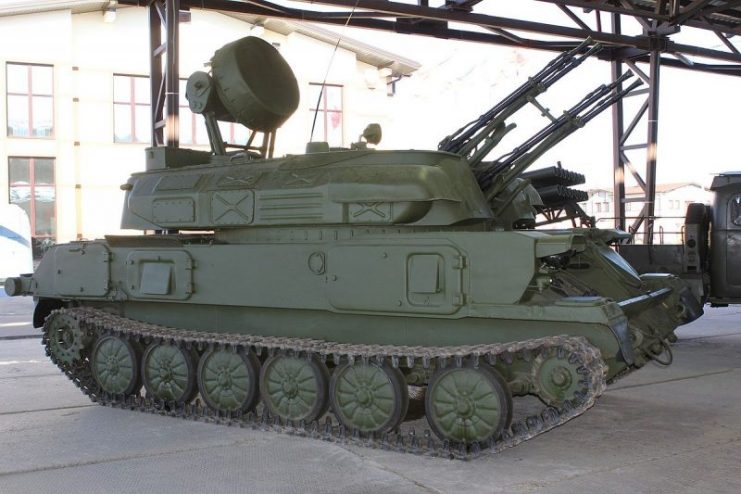
ZSU-23-4 Shilka

In 1964, the ZSU-57-2 was replaced by the far more effective ZSU-23-4.  Now this was the "Big Kahuna for us Army guys, the ZSU was very capable with the radar able to target the Cobra's/Apache/A-10 and help protect the lead elements.  The emphasis was to take out the Air Defense assets first so the American air can loiter around the armored formation and savage them.  Our Air was part of our Airland Battle to offset the numerical superiority of the Soviet forces.  The ZSU was like so many self-propelled anti-air vehicles, this was based on the chassis of another vehicle – the ASU-85 anti-tank gun. Unlike its predecessor, it had a fully enclosed turret as well as nuclear, biological and chemical (NBC) protection for its crew. Infra-red equipment let it operate effectively at night.


ZSU-23-4 Shilka.
This vehicle had four water-cooled 2A7 23mm guns. These gave it a shorter range but higher rate of fire, increasing the chances of hitting a target. A computer-operated Gun Dish radar improved its ability to find and track targets regardless of the weather.
The vacuum tubes in the analog fire-control computer caused some problems for the crew, as they generated lots of heat. An improved version released in 1966 had better ventilation, reducing the problems with overheating. Later models provided both better computers and better cooling.

SA-4 Ganef
The Soviet Army had been one of the first to fully embrace the potential of rocketry. In 1965, the SA-4 Ganef became its first self-propelled weapon to make use of this in air defense, carrying an elevated turntable loaded with two missiles. It had no onboard fire control, instead relying on a radio link to a radar vehicle to line up a shot before the missiles took over with semi-active radar homing.
Soviet SA-4 Ganef.
With a maximum range of 55km and a 135kg high explosive warhead, these missiles seriously increased the reach and impact of Soviet anti-aircraft fire.
Another version of the missiles came in later, exchanging a shorter range for better low altitude performance. These missiles were often fielded together because of their different strengths.
The SA-4 had a new chassis of its own, rather than one borrowed from other designs. It was fitted with infra-red driving lights and NBC protection, like most Soviet fighting vehicles of the mid-to-late Cold War.
A battery of SA-4s was accompanied by TZM transloader vehicles carrying spare missiles and cranes to load them. It took 10-15 missiles to reload.

SA-8 Gecko
The SA-8 entered the Soviet army in 1970. It was the Soviets’ first self-contained surface-to-air missile system, with the tracking radar and missiles based in the same vehicle.
SA-8 Gecko. By Andrew Zorin
The controlling radar was mounted in the center of the vehicle. A pair of small antennae let the equipment guide two separate missiles at once. Pairs of missiles were carried on rails to each side of the radar, and the vehicle carried a total of four missiles. Reload vehicles using the same chassis carried 18 missiles each and a crane with which to load them. There were usually two reloaders for every four SA-8.
SA-13 Gopher
The SA-13 came into service in 1976, following a troubled development. Its chassis was based on the MT-LB APC, with the machine gun turret removed. A launcher lay on top of the cargo compartment, where it could be laid down flat while on the move.
9K35 Strela-10 combat vehicle.
The launcher carried four 9K35 Strela-10 missiles. Another eight were stored inside the vehicle for reloading. The Strela-10 had a range of 5km and a maximum speed of nearly Mach 2. A more sophisticated missile with a heavier warhead and proximity fuse was introduced in 1981. The SA-13 could also fire the older, less sophisticated Strela-1.
The Strela-10 missiles were initially directed by a range-only Hat Box radar system, to make sure that targets could be reached. In-built infra-red heat-seeking systems within the missiles then took over.

2S6
A 2S6. Photo: Mike1979 Russia 
Arriving in 1982, the 2S6 combined guns with rocketry for greater firepower, carrying four SA-19 Grison missiles and a pair of 2A38 30mm cannons. Two radar systems allowed it to identify and track targets. Stabilizing equipment let the gunner fire the guns while on the move, but the missiles could only be fired when the vehicle was still. It had light armor that could keep out shell splinters and small arms fire.
The main production version of this vehicle, the 2S6M, arrived four years later. It had twice as many missiles, better missiles and guns, and superior fire control systems.  The 2S6 was considered the replacement for the venerable but formidable ZSU-23-4 but with improvements in firepower to deal with the newer American ground support aircraft like the A-10


The SA-6 GAINFUL (2K12 KUB/KVADRAT) is a two stage, solid-fuel, low-altitude SAM. Although it is frequently reported that a naval version of the missile is the SA-N-3 GOBLET, this is evidently not the case. The 3M9 KUB self-propelled surface-to-air tactical low-altitude anti-aircraft missile system is intended for destruction of aircraft, missiles, cruise missiles and assault helicopters at low to medium altitudes.
The SA-6 low altitude surface to air missile uses radio command guidance immediately after launch, switching to semi-active radar homing in the terminal phase. In the event of jamming or radar shut down the SA-6 may be guided optically and acquire its target after launch. It has radio command guidance with semi-active radar terminal homing.
 The SA-6 system is still an efficient weapon, although service is seriously limited by ageing electronics. The original system design and technology are very demanding in operation, maintenance and repair. Highly appreciated SAM system capabilities, namely vehicles mobility and missile performance, suffer from aging radar electronics and lack of superior command and control network interface. RETIA, a.s. has proposed an SA-6 upgrade that would include the SURN radar vehicle , missile launchers 2P25 and replace of 3M9 missiles including new loading vehicle. This upgrade would prolong system lifetime, increase combat efficiency and decrease operators load. The integrated logistic support is proposed to allow efficient use of upgraded system for the whole lifetime.

.