I ran across this article on the Falkland war, I have blogged before about the Falkland war, and I knew that France had supplied many weapons to the Argentinians, including the Exocet that had a lethal reputation that was proven during the resulting Falkland war. Even back then when I was a sophomore in High School during the Falkland War, I had a wishy washy image of the French and wondered if they were helping the Argentinians because the French have a history with the British and it wasn't sunshine and rainbows. After reading this article it kinda confirmed the initial impressions. I also had the same opinion because the French supplied the Iraqi's. I wondered if they played both sides against the middle because it would help France if the United States was lessened by a bloody battle/war in the Persian Gulf against Saddam Hussain. Yes I know that the French had the Foreign legion here to help and they did exceedingly well from what I know. But the French had sacrificed the legion before in Vietnam and the surrounding areas due to the Indochina War and Algeria due to politics.
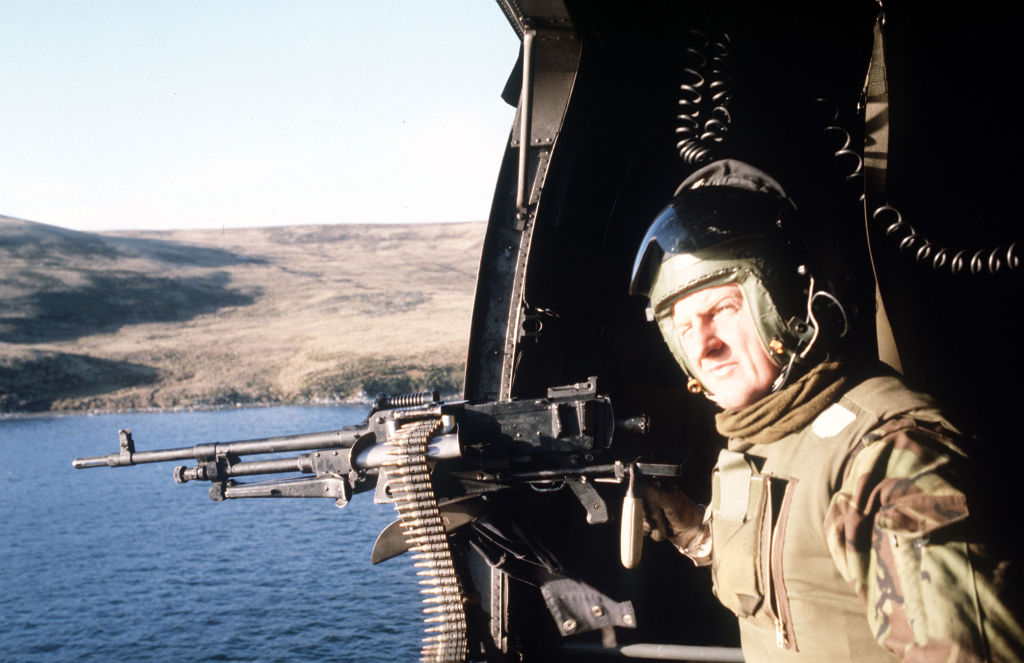
A
crewman mans a General Purpose machine gun mounted in the hatchway of a
helicopter on patrol over San Carlos Water during the Falklands
conflict. (Photo by PA Images via Getty Images)
During the 1982 Falklands War, the British were able to reclaim their territory from invading Argentinian forces.
During
the war, the British received support from France but formerly secret
documents show that the French may have been working both sides of the
conflict.
In May of that year, the Argentine forces used Exocet
missiles during an airstrike that killed 32 people. The missiles were
fired at the British ships HMS Sheffield and Atlantic Conveyor.
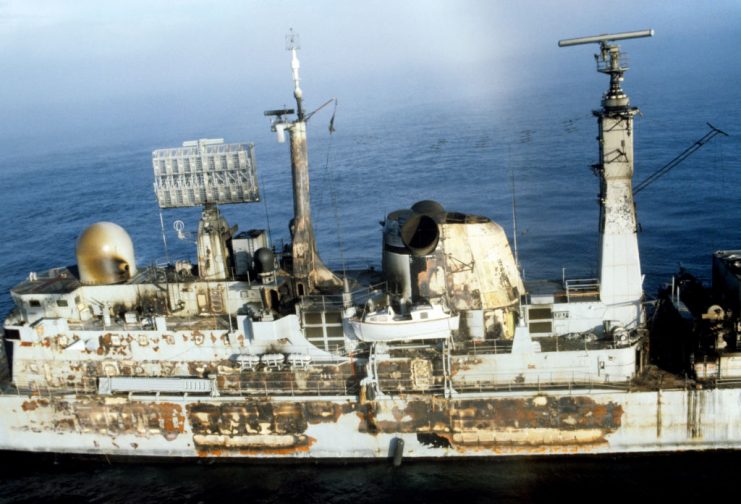
HMS
Sheffield after being hit by an Argentine Exocet missile in the South
Atlantic. The missiles were sold to Argentine by
France prior to the war before it seemed likely the two countries would
enter into combat with each other.
When the war began, France
embargoed weapons sales and support for Argentina. They also allowed the
British to use French ports in West Africa and provided them with
information on the weapons and planes that they had sold to Argentina.
French
President Francois Mitterrand made the decision to aid the British.
While the UK’s Secretary of State for Defence Sir John Nott praised
France as being the UK’s “greatest ally,” members of the French
government were not pleased with their president’s decision.
The
French ambassador to London, Emmanuel de Margerie, wrote a scathing
description of Margaret Thatcher as “Victorian, imperialist, and
obstinate” with a “tendency to get carried away by combative instincts.” A
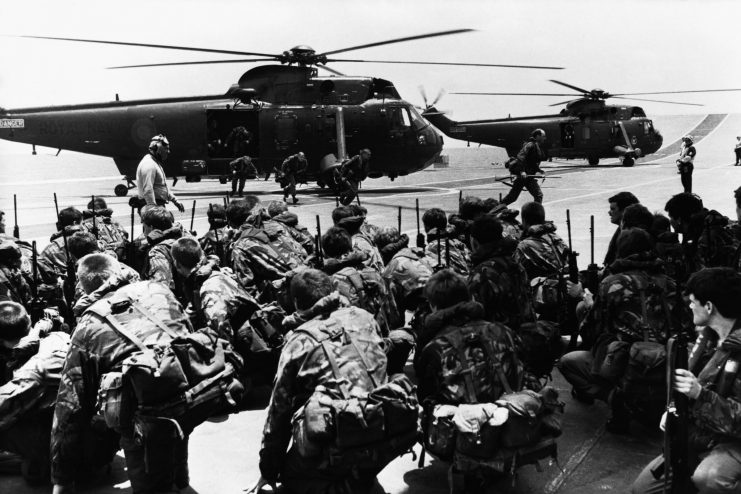
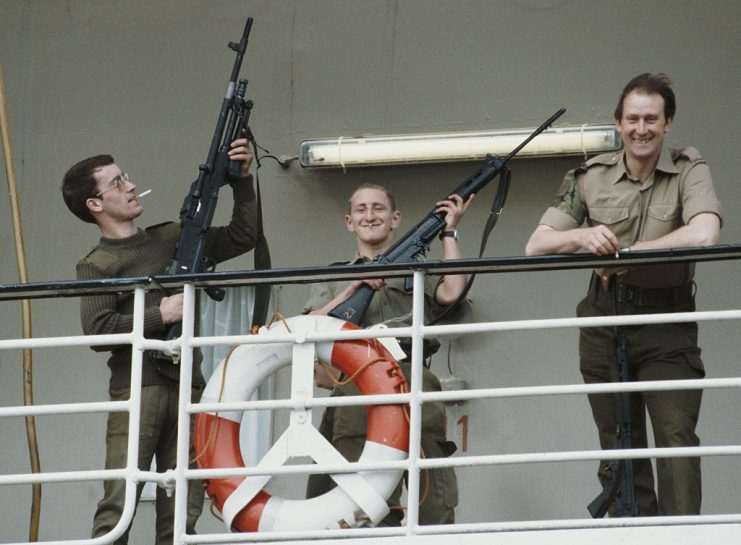
group of British soldiers show of their rifles as they stand on the
deck of the RMS Queen Elizabeth 2 (QE2) before the ship departs for the
Falklands, from Southampton docks on Wednesday, May 12, 1982. The QE2
took part in the Falklands War during 1982, carrying troops and
volunteer crew to the South Atlantic conflict, with her decks converted
into three helicopter landing pads.French official Bernard Dorin decried Britain’s “superpower
arrogance” and their “profound contempt for Latinos.” He made these
claims in a document titled, “The Falklands: Lessons from a Fiasco.”
A
BBC investigation has uncovered evidence that, even though the embargo
was in place, a team from France worked with the Argentine troops in the
Falklands during the war. The team allegedly tested the missile systems
to ensure they would fire.
Three of the missiles failed and the team repaired the issue which allowed the missiles to be used against British troops.
During the war, 659 Argentinian and 253 British troops were killed.
The
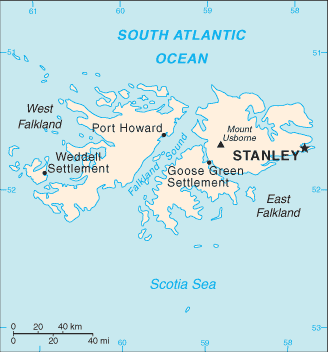
Falklands War began when Argentinian troops invaded the Falkland
Islands on April 2, 1982. The Falklands are a British territory located
in the southwest Atlantic Ocean off the coast of Argentina.
Argentina
has long claimed rights to the islands, which they call Malvinas.
Argentina inherited the islands from the Spanish crown in the early
1800s.
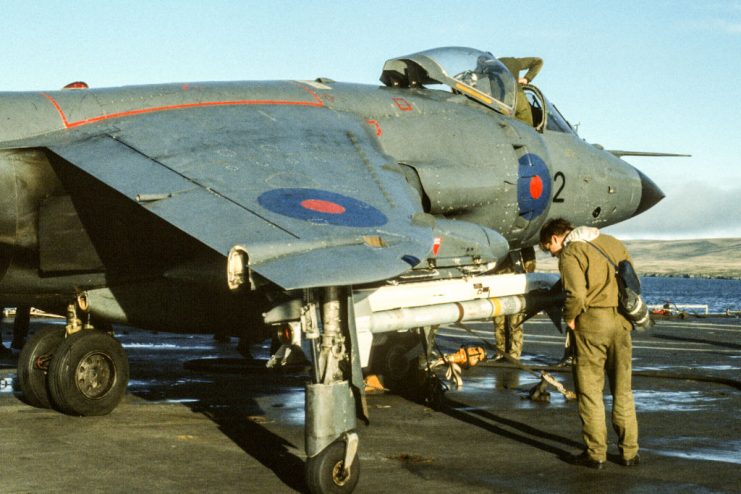
Sidewinder
missile on an 800 squadron Sea Harrier aircraft landing on HMS Fearless
L10 during the Falklands War 1982. It was unable to land at the damaged
Sheathbill air strip, the pilot was Lt-Cdr Neil Thomas. (Photo by
Terence Laheney/Getty Images)Most of the
residents of the Falklands are of British descent. Britain claims rights
to the islands based on their long-term administration of them and on
the principle of self-determination for the islanders.
Argentina
did not believe that the UK would respond with force if they invaded the
islands. But, despite being 8,000 miles away, British Prime Minister
Margaret sent a force of warships and hastily refitted merchant ships to
reclaim the British territory.
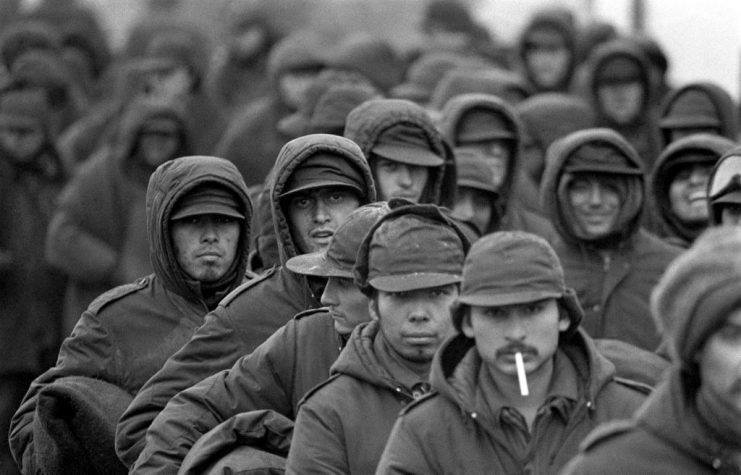
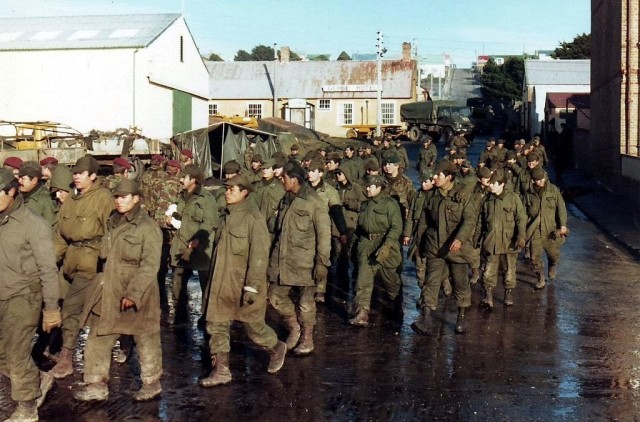
A
hint of a smile on some of the faces of these Argentinian prisoners of
war at Port Stanley, capital of the Falkland Islands, waiting to be
repatriated via Montevideo. . (Photo by PA Images via Getty Images)The
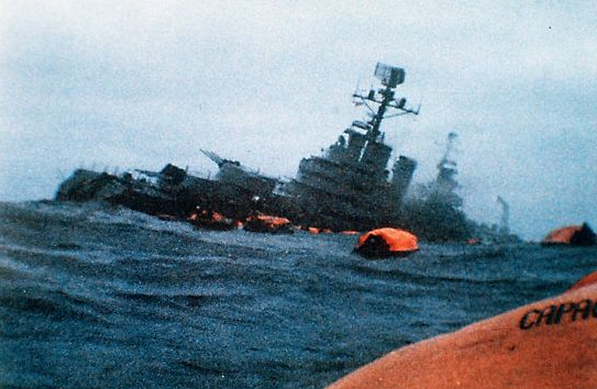
British submarine HMS conqueror sank the Argentine cruiser General
Belgrano on May 2, 1982. 300 crew were lost with the ship. After that,
the Argentine military kept their ships in port.
But the Argentine air force was still a threat to the British. Their aircraft sank several British warships, including the HMS Sheffield with an Exocet Missile, whom the Frigate's Friend or Foe system wasn't updated to classify the Exocet as "Foe"
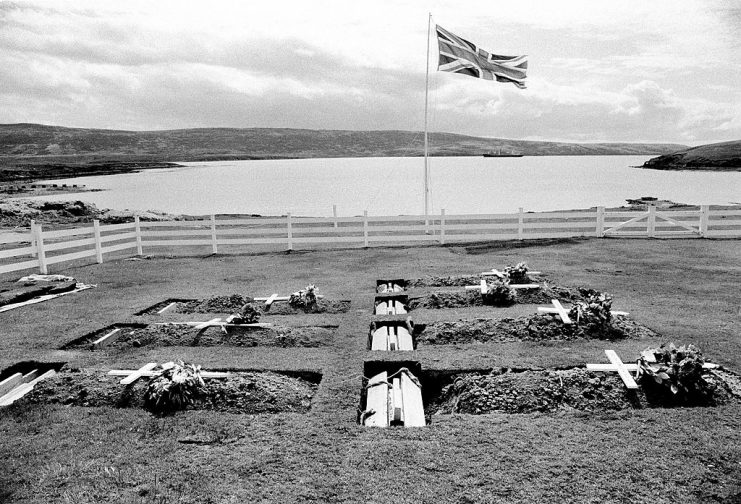
The
Blue Beach War Cemetery in Port San Carlos in the Falkland Islands,
October 1982. In the foreground (right) is the grave of
Lieutenant-Colonel H. Jones (1940-1982), who was posthumously awarded
the Victoria Cross. (Photo by Tom Stoddart/Getty Images)Still,
the British were able to land on the Falklands on May 21, 1982. The
conscripted Argentinian troops had plenty of time to dig in and fortify
their defenses but they were not trained well enough to defend against
the oncoming British forces.
On June 11, 1982, the battle for the capital, Stanley, was underway and the Argentinians surrendered on June 14, 1982
Tuesday, October 31, 2017
I have Blogged several times in the past about the Falkland War, it was the first war to me that I really paid attention to. I was a sophomore in High school and also in JROTC and we used the lessons of the Falklands as lessons, especially with logistics and what is called "The Intangibles" in this case morale and fighting spirit. By all rights the British should have lost the war, they were operating on shoestring logistics string, their military was worn out by years of neglect because the British government had other priorities rather than their NATO commitment. It was a malaise that had affected all of the west. The United States had started to rearm under President Reagan after years of neglect and Britain had just elected Margaret Thatcher, the "Iron Lady", and she was trying to bring back the British after years of failed socialist policies.
The Falklands War is looked back on by many as a foregone conclusion.
Lasting only ten weeks, and it resulted in a clear British victory. But
this war between Argentina and Britain could have gone either way. As
Major-General John Jeremy Moore, commander of the British land forces in
the war, put it, “It was a very close-run thing.”
Before
the war, Britain was reducing its commitment to the Falklands and
nearby South Atlantic territories. Many Falkland Islanders had lost
their British citizenship in the 1981 British Nationality Act. More
important militarily, British naval power was being withdrawn from the
region. Ice-breaking ship HMS Endurance, the only Royal Navy
ship permanently stationed in the South Atlantic, was about to be
scrapped. Wider cuts, including the impending loss of two aircraft
carriers, indicated a retreat by Britain’s navy.
Argentina
had a huge advantage in manpower. During the initial invasion, the
Argentines committed 600 ground troops against a British garrison of 85
Royal Marines, 25 members of the Falkland Islands Defence Force (FIDF),
and around a dozen retired members of the FIDF.
With their homeland so much closer, the Argentines were more easily able to get troops into the combat zone.
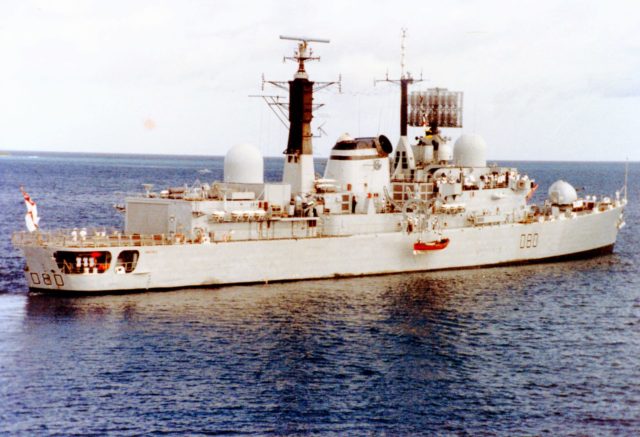
HMS Sheffield, which was sunk during the conflict. Nathalmad – CC BY 3.0
Faced
with overwhelming odds, the British put up little defense. Sir Rex
Hunt, the British Governor, negotiated a surrender within 12 hours of
the invasion. Though a group of Royal Marines initially remained
uncaptured, they destroyed their weapons and surrendered rather than
risk civilian lives in a fruitless fight.
In less than a day, the Argentines had gained control of the islands, and so the advantage of holding defensive positions.
Given
the distance from Britain to the Falklands, the Chiefs of Staff of both
the British Army and the Royal Air Force believed that retaking the
islands was unrealistic. Lack of political confidence could have led to
an instant Argentine victory, if not for the strong views of others, in
particular, British Prime Minister Margaret Thatcher.
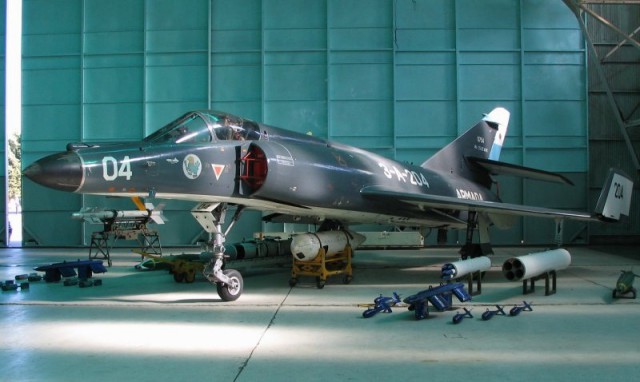
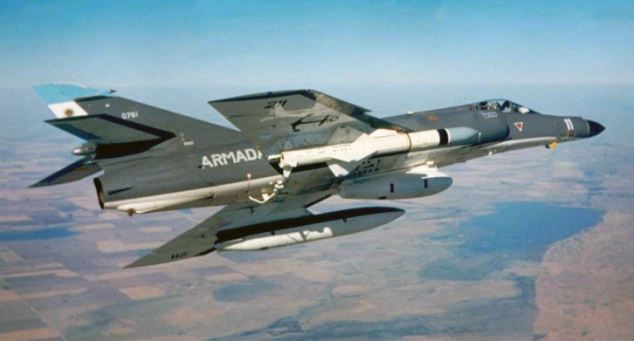
French-built Super Étendard of the Argentine Naval Aviation. Martin Otero – CC BY 2.5The
Falklands War was enough of a conventional conflict for bombing raids
to be important, against both enemy ships and land-based targets. Again,
geography gave the advantage to the Argentine forces. Bombers could
reach the Falklands from Argentina and hit their targets in a single
run. Reaching the Falklands from the UK involved a complex refueling
operation, in which around a dozen aircraft set out for every one that
got as far as the target.
The British forces suffered several setbacks.
An attempt to retake South Georgia, another of the islands seized by
Argentina, led to failure on 21 April. Elite troops were landed, but had
to be picked up again due to extreme weather, and two helicopters were
lost in the operation.
Plans to attack the air base at Tierra del
Fuego, on the Argentine mainland, were abandoned before they even began,
and a similar mission led to a British helicopter crew surrendering
themselves to Chilean authorities.
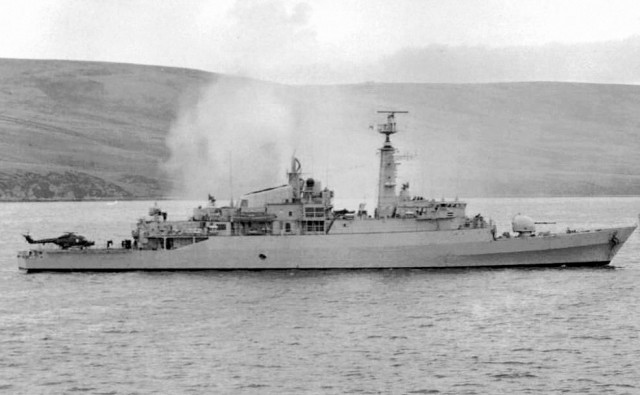
HMS Antelope smoking after being hit, 23 May 1982.In
the Falklands, the British Royal Navy suffered its first losses of
ships since the Second World War, nearly four decades earlier. The HMS Sheffield was lost on 10 May, HMS Ardent on 21 May, HMS Antelope on 24 May, HMS Coventry and MV Atlantic Conveyor, a cargo vessel carrying helicopters and other important supplies, on 25 May. The loss of the Atlantic Conveyor was particularly significant, as it forced the army to advance on Port Stanley by foot.
Superior
morale helped bring the British victory, but even in this, the sides
were closer than expected. When the British attacked Mount Longdon on
the night of 11 June, they expected little resistance due to poor
morale.
The spirit of the Argentine defenders was strong, and
instead of an easy victory the attackers faced a grueling twelve-hour
battle, from which Brigadier Julian Thompson almost called the retreat.
The
war was fierce and brutal, often fought at close quarters with bayonets
and grenades. During the fighting at Two Sisters, Private Oscar Ismael
Poltronieri held up a whole British company with gunfire, for which he
won the Heroic Valour in Combat Cross, Argentina’s top medal for
courage.
The Battle of Goose
Green was the first major British victory of the war, but it was almost
blown by a news report. The BBC World Service, hearing of plans for the
attack, reported them to its global news audience. This almost led to
the assault being called off. It could easily have led to stronger
resistance at Goose Green, if not for the fact that the Argentinians
believed the report was a British bluff.
British Royal Marines arriving at Goose Green.
If
the British were expecting an easy win at Goose Green, then they were
mistaken. Argentine troops put up a strong defense, stalling the initial
assault. The first attempt to give the attack fresh energy failed, and
its leader, Lieutenant-Colonel “H” Jones, was killed in the fighting.
Conducting
a war so far from home, the British could not easily be resupplied. By
the end of the war, they were low on food and ammunition, many down to a
handful of bullets. If the Argentine forces had held out a little
longer, the British troops would have run out of resources with which to
fight.
If not for a failure of
discipline, the Argentine forces would have held out long enough to wear
down the British. Their Army Code forbade surrender while they retained
50% of their men and 25% of their ammunition, and on 14 June they were
specifically ordered not to surrender.
They surrendered that very day, rather than face the poorly supplied but fierce looking British.
I had posted several months ago about the Falkland war and the sinking of the HMS Sheffield after she was hit by an exocet missile from the Argentinian Air force. The post is Here. I saw this post and it was talking about the Argentinian point of view of the conflict and I learned a few things I didn't know about before.
The Falklands War is often perceived, from the British perspective,
as a victory that confirmed the British imperial status in the post-WWII
world. Even though the war was criticized by the British public as
unnecessary, it won the Conservative Party government a second term in
Government for it was indeed a clear and decisive British victory.
On
the other side, the Argentinian public deemed the war unnecessary as
well; it was forced upon them by the ruling military junta. The conflict
which started on 2nd of April 1982, lasted for 74 days and claimed the
lives of 649 Argentinians military personnel, 255 British military
personnel, and 3 Falklands civilians. It proved to be a stand-off
between the British recapturing lost territory and a dictatorship with
expansionist tendencies.
Argentina had for long wanted to claim
the Falklands (or the Las Malvinas, as the Argentinians called it),
South Georgia and the South Sandwich Islands, which had all been under
British rule since 1833 and populated by British settlers who were loyal
to the crown.
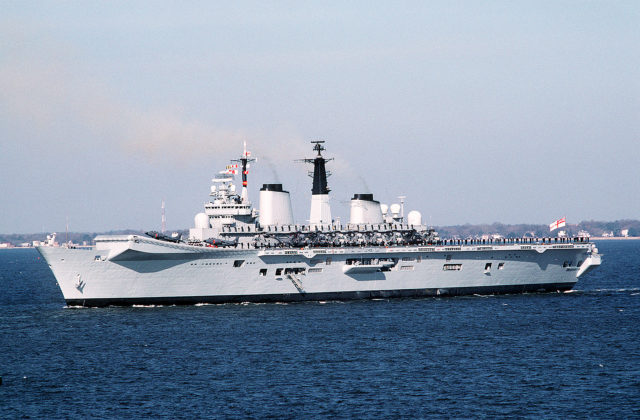
The HMS Invincible, pictured here in 1990, which took part in the conflict.In
Argentina, a military junta under the name National Reorganization
Process was the government in the period of 1976-1983 and ruled with an
iron hand, dealing with political with imprisonment and execution. The
man behind the junta, who was the main advocate of the attack, was
Admiral Jorge Anaya. He estimated that the British would not pursue a
military conflict, but would rather choose a diplomatic solution, in
which the Argentinians could further promote the idea of sovereignty
over the archipelago.
The campaign was designed and executed in
the midst of devastating economic stagnation in Argentina, which
provoked civil unrest. To divert the civilian attention from the fall of
living standard and the inflation climb of 600%, a military government
did what it does best – mobilize the population towards a general
nationalistic sentiment for the islands, several hundred kilometres from
the Argentinian coast, that were under British colonial rule.
They called it the illegal usurpation of Las Malvinas.
The preparations for war included a power shift in the military junta,
from its initial leader, General Roberto Viola, to General Leopoldo
Galtieri, on whose behalf Admiral Anaya organised the Argentinian Navy
to participate in the attack.
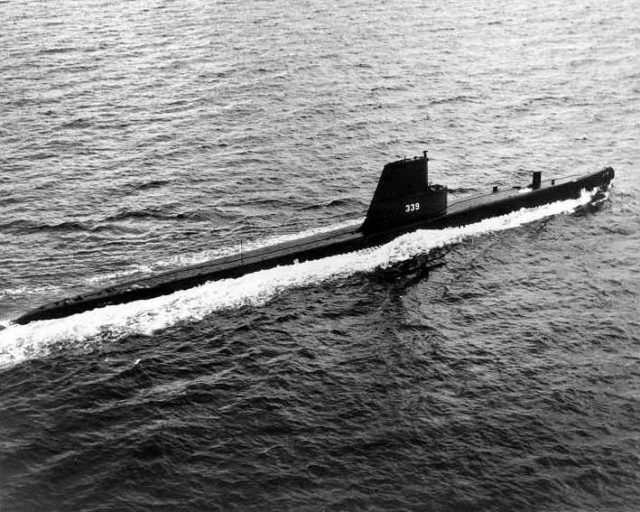
The Argentinian Submarine ARA Santa Fe, which was crippled during the conflict and scuttled by the British.Before
the invasion took place, the Argentinan junta helped CIA suppress the
communist elements in Nicaragua by funding the Nicaraguan counter
rebels, or the Contras. This is why the Argentinians had reasons to
believe that the US would keep a neutral stance if an invasion were to
take place.
Also, Admiral Anaya relied on the fact that the US
objected the use of force by the British during the Suez crisis in 1956.
On top of that, in 1981, Britain accepted the independence of it former
colony, Rhodesia, which was an example of how Britain was slowly
renouncing its colonial past.
Argentinians
were mainly influenced by the events of Indian annexation of the island
of Goa, in 1961. The annexation was condemned by the international
community but was later accepted as an irreversible act.
Argentine POWs at Port StanleyOn
March 19th, 1982, the Argentinians launched an invasion of the South
Georgia and the South Sandwich Islands, 165 kilometres from the coast of
Patagonia. Following the initial invasion, they started to disembark on
the shores of the Falklands Islands on April 2nd.
Concerning the
occupation of South Georgia and the South Sandwich Islands, the British
deployed two submarines, but it wasn’t until the invasion of the
Falklands that they had taken the matter seriously.
The war was
never officially declared although both sides did declare the Islands
areas a war zone and officially recognized that a state of war existed
between them. Hostilities were limited almost exclusively to the
territories under dispute and the area in the South Atlantic where they
lay.
Argentina’s original intention was to mount a quick,
symbolic occupation, followed rapidly by withdrawal, leaving only a
small garrison to support the new military governor. This strategy was
based on the Argentinean assumption that the British would not respond
militarily.
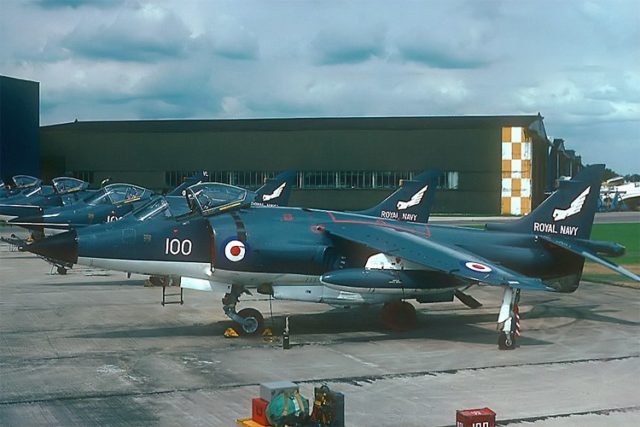
Royal Navy Sea Harrier.Argentinian
assault units were indeed withdrawn to the mainland in the days
following the invasion, but strong popular support and the rapid British
reaction forced the Junta to change their plans and reinforce the
islands since they could not afford to lose the islands once the British
came out to fight.
When the conflict broke out, the UN called for
peace talks, the immediate end to the hostilities and urged both
parties to resolve the conflict diplomatically. The US feared that
Argentina would ask the Soviet Union for help, and so they stood firmly
on the side of the British.
On the South American mainland, Chile
actively helped Great Britain with intelligence support. The support was
evident, and Argentina was forced to keep some of its best trained and
best-equipped mountain troops on the Chilean border to counter the
possible military intervention by the neighboring British ally. The
intervention never took place, but the Argentinians were on high alert
throughout the war.
British forces landed on the islands, after
which a war for aerial domination commenced. Several intense dogfights
occurred during the war. The British were using Harriers as their main
combat airplane while Argentina used Mirage III fighter jets, which were
purchased from France several years before the war.
The Mirage
was not good enough for the Argentinian air force to successfully engage
the far more nimble RAF fighters. Other than the Mirage, Argentine Air
Force used American A-4 Skyhawks, Israeli Daggers, the Israeli version
of the Mirage fighter, and English Electric Canberras.
The most significant naval incident of the war was the sinking of the ARA Belgrano,
an Argentinean WWII-era light cruiser, by the nuclear-powered submarine
HMS Conqueror on May 2nd, 1982. 323 men aboard the ARA Belgrano lost their lives.
The retaliation for this loss occurred two days after, when a British Type 42 Destroyer, HMS Sheffield, was bombed by a naval air strike. The British lost 20 men with another 24 others severely injured.
ARA Belgrano sinking on May 2nd, 1982. After
the British victory on land, their terms for the Argentinian surrender
proved to be much harsher than originally expected by the Junta, but
Argentina accepted them on 14th of June 1982. Argentinean troops
withdrew from the islands, leaving them in British hands.
The
relations between the two countries were strained for a while, until
their official normalization in 1989. Argentina continues to debate the
sovereignty of the Falklands to this day. In 2013, a referendum was held
on the Falkland Islands, after which the majority stated that they wish
to stay under the British crown.
The Falklands conflict remains
the largest air-naval combat operation between modern forces since the
end of the Second World War.
I ran across this tidbit and did a bit of digging and got the Article, Go to page 3 of the Article and read it. I had blogged before about the Falkland War several times, I was in high school and I thought the British had a better claim to the island than the Argentinians did. I still have that opinion now. I had made the statement that if Argentina had waited 7 or 8 more months, Britain could have not mounted a force to retake the island, the new austerity measures that were being considered would have grounded her VSTOL aircraft Carriers HMS Hermes and HMS Invincible. Another charge against the BBC was his autobiographical account of the Falklands War, Admiral Woodward blamed the BBC World Service for disclosing information that led the Argentines to change the retarding devices on the bombs. The World Service reported the lack of detonations after receiving a briefing on the matter from a Ministry of Defence official. He describes the BBC as being In more concerned with being "fearless seekers after truth" than with the lives of British servicemen.
.
The Battle of Goose Green in 1982 was part of the Falklands War between Britain and Argentina. It was especially notable for two things – the high casualty rate and how the British Broadcasting Corporation (BBC) committed treason.
The Falkland Islands, South Georgia, and the South Sandwich Islands are British territory lying much closer to Antarctica than they are to Britain.
They are also closer to Argentina – which is why the Argentines claim them despite everyone else saying otherwise.
On April 2, 1982, they decided to do something about it by invading the Falkland Islands. The following day, South Georgia and the South Sandwich Islands were next – which made everyone go, “Huh!?”
The combined territory comes to barely 1,507 square miles. Being so close to Antarctica they barely habitable.
About the only people not scratching their heads were the British and the Argentines.
To understand this, here is a quick history lesson. Various European nations claimed them until Britain came along in 1690 and said, “Mine!” Spain did the same in 1713, but to make a long story short, their empire collapsed.
Among the territories they lost was Argentina. Though no longer Spanish, Argentines believe they are the successors of Spain’s claim. They were content to let things be till 1982. So why then?
It was because their military government needed a distraction. The country’s economy sucked. Ditto with its human rights record.
Solution? Distract the people with patriotism and do so before the upcoming so-called elections. But how? Hola, Falklands War!
While Britain was no push-over, the Argentine government gambled on three things: the islands have no strategic value; they have virtually no resources, and they are home to only a tiny population of mostly Brits.
Goose Green
The government also considered the British economy. It was not doing too well in the early 1980s, so the hope was that the Brits would be too distracted and too tight-fisted to do anything about an invasion.
Sure, they would scream and stamp their feet, but that would be it.
The Argentines were not at all worried about the UN. The country was constantly being targeted for its human rights violations, so what was another ding from the international community? People would simply get used to it – just like they did with Tibet.
It did not turn out that way, of course. Britain responded quickly with amphibious landings in San Carlos Water on East Falkland on May 21.
Most of the Argentine forces were around Port Stanley, some 50 miles to the east, with others ensconced at Goose Green and Darwin – armed with machine guns, 35 mm cannons, mortars, and artillery.
Goose Green could be ignored. It is a tiny community in Lafonia in East Falkland along the Choiseul Sound. It was also too far away to threaten the ongoing landings at San Carlos – which were not going well.
Colonel Piaggi of the Argentinians.
The British had lost a number of ships from aerial attacks, so they needed to fortify the positions they already held. What was meant to be a counter-invasion to take back the Falklands, had instead become a defensive maneuver.
While the Argentine government became popular with its people, things were different in Britain. Some of its population felt the Falklands were not worth fighting and dying for. Therefore to rally the nay-sayers, a bit of PR was needed.
British politicians were particularly worried because the UN Security Council was already talking about a cease-fire. If passed, British troops would be stuck as time and geography were not on their side. All Argentina had to do, on the other hand, was wait.
Britain could not. If it was to take the Falklands back quickly, it had to go on the offensive.
Suddenly, Goose Green looked attractive
Colonel H. Jones
If Britain could take that, it would have access to a large swathe of East Falkland. A ceasefire then would still be annoying, but at least Britain would have a bigger slice of the island with which to annoy Argentina.
Enter Brigadier Julian Howard Atherden Thompson, commander of 3 Commander Brigade. His job was to take on the Argentines around Goose Green and Darwin.
The area was protected by Task Force Mercedes under Lieutenant-Colonel Ítalo Ángel Piaggi, made up of the 12th Infantry Regiment (IR12) and 3rd Company. Defended by 20 mm Rheinmetalls, two radar-guided Oerlikon 35 mm anti-aircraft guns, and a battery of three OTO Melara Mod 56 105 mm pack Howitzers, Thompson’s job would not be easy.
To make it even more challenging, his men could not be flown in. Most of their helicopters had been aboard the Atlantic Conveyor – which was destroyed by Argentine missiles on May 25.
The plan, therefore, was to land troops at San Carlos Bay and have them walk for two days until they reached Goose Green.
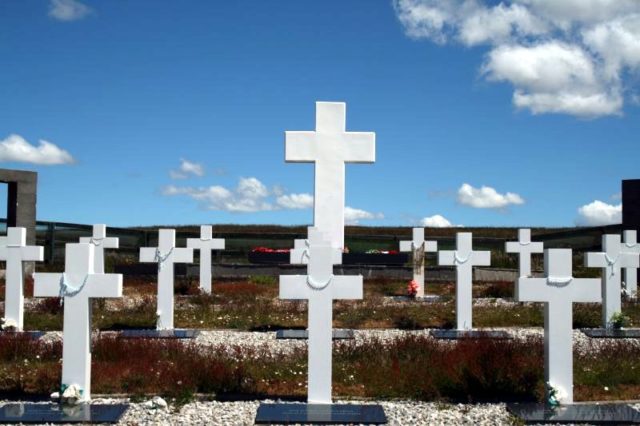
Cemetery north of Darwin where most Argentinian casualties of Goose Green are buried
On May 26, the 2nd Battalion of the Parachute Regiment (2 Para) under Lieutenant-Colonel Herbert Jones started to do just that. The Argentines were in for a surprise!
Or so Jones thought until he turned on his radio.
He had tuned into the BBC World Service, which was happily telling the world that the 2nd Para was poised to launch a surprise attack on Goose Green. So much for surprises!
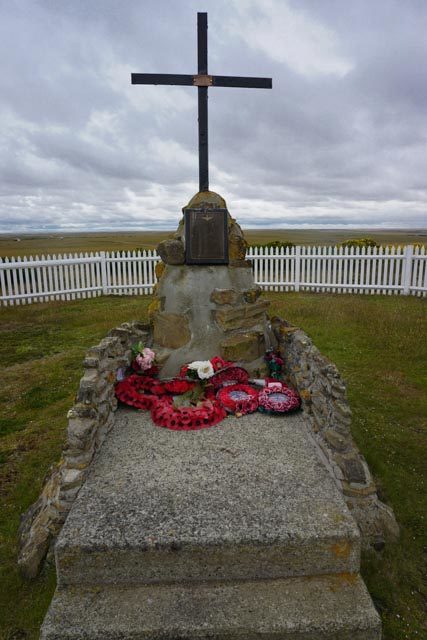
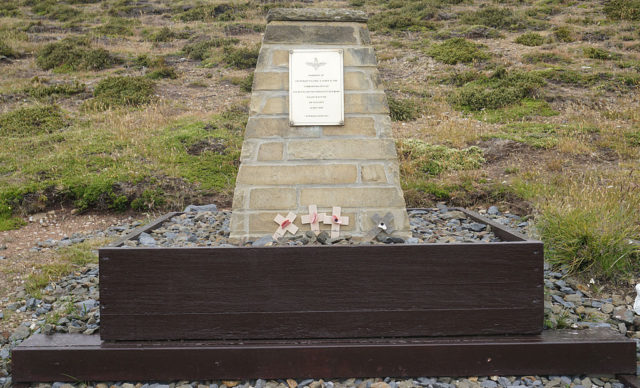
Memorial to 2 Para Group, west of Darwin Photo Credit
Now what!? The 2 Para knew they were greatly outnumbered. Their only advantage lay in surprise, but that clearly went the way of the dinosaurs.
After a healthy round of cussing, Jones vowed to sue the BBC for treason. Ditto with the War Cabinet. Oh, and the entire Thatcher government.
Piaggi was listening to the same broadcast and shook his head in disbelief. Did the British really think he was that stupid!? Hah!
They were obviously going to attack somewhere else and were using the announcement as a diversion. So he told his men to relax.
The spot where Lieutenant Colonel Herbert Jones died, now a memorial
They were still doing just that when 2 Para attacked. Jones had gambled that Piaggi would think as he did and it paid off.
Piaggi surrendered on May 29 – which, by an interesting coincidence, happens to be Argentine National Army Day.
Thus ended the Battle of Goose Green but it came at a hefty price.
Jones and 17 other Britons died at the cost of 45 to 55 Argentines.
Back in Britain, there was fury over the incident as politicians were rightly accused of wasting British lives for a propaganda stunt.
I saw this article on "Bongino Reports" and I read it and some of the commenters criticized the article, I think for the politics rather than the accuracy. I recognized quite a few things like the similarities between Saddam and Kuwait and the invasion in 1990 that brought on Desert Storm and also The Falkland Islands and Argentina, where Argentina had a lot of internal issues and the junta there invaded the Falkland Islands in 1982 for 2 reasons, the first one was because they believed that the British wouldn't do anything because they were seen as weak and divided and the second was that Argentina had a lot of internal issues and wanted to use the invasion to distract the people and get them behind the Junta. They failed on both accounts. The Venezuelans see the United States as weak and distracted, and focused on Russia and Ukraine, and we have taken the eye off South America, and I believe that this will bite us in the ass. What does everyone else think?
Venezuela Readies for War While Joe Biden Sleeps – The
United States is a zombie empire abroad and a banana republic at home.
On the world stage, Washington went from being the first among equals
following the end of the Cold War; the sine qua non of the world system
that it had helped to foster, to today being a cancerous growth to an
international order trending toward multipolarity—specifically, a tripolar system in which China and Russia triangulate against the United States.
Everywhere American decline, while still reversible (if a new American leadership can be elected
in 2024), is seen and felt. Whereas the post-Cold War order was
purportedly predicated upon the abandonment of territorial wars of
aggrandizement and resource conflicts, the post-2022 world appears defined by such struggles. It began with Russia in Ukraine. The failure of the Western nations to either stop the Russian invasion of Ukraine or to find a peaceful settlement to the conflict has ensured that there will be no going back to the pre-2022 peace.
Thanks to the listlessness of the Western powers and the dearth
of decent leadership in those states (notably in America), every larger
power that has a geopolitical axe to grind with its smaller, less
powerful neighbors will seek to settle those disputes through the
injudicious use of force.
Using the Russian example in Ukraine (and possibly the Chinese example in Taiwan), autocrats everywhere are sharpening their knives as they ready to carve up their respective spheres of influence.
It is not just in the distant steppes of Eurasia or the deserts
of the Middle East and North Africa where this terrible trend is
occurring. It is right in the backyard of the United States. The
kleptocratic socialist dictatorship under Nicolas Maduro in Venezuela has failed to thrive economically, politically, or socially. This, despite the fact that it possesses one of the world’s largest, easily accessible oil reserves. Heavily sanctioned by their American neighbor to the north and led by an incompetent ruling class, Venezuela has imploded.
To arrest this implosion, Venezuela’s corrupt leadership wants to maximize their nation’s oil production output. Yet, PDVSA, Venezuela’s state-owned oil conglomerate, has proven unable to achieve
the increased output quotas that the Maduro government has commanded of
them. With the situation in Venezuela worsening for Maduro, the
socialist dictatorship still has a large—and modernizing—military that it could deploy to change the outlook of the country’s oil production profile.
No, this won’t be done by discovering new sources of oil within
Venezuela’s borders. It will be accomplished instead by annexing their smaller neighbor, Guyana.
The situation in South America looks eerily similar to the
situation that had occurred in the run up to Saddam Hussein’s unlawful
invasion of Kuwait in 1990. Just as in the Iraqi invasion of Kuwait, a
larger oil-producing state (Venezuela, in this case), seeks to expand
both its territory and its control over the region’s vast oil wealth.
Caracas has set for itself this objective, as Saddam did, to break out
of Western sanctions, to improve Venezuela’s economy, and to enhance
Venezuela’s geopolitical bargaining power in the wider region. Just as
in 1990, when few believed that Saddam would invade Kuwait, few are
paying attention to the situation between Venezuela and Guyana.
This is especially true in Washington, which refuses to accept that
the United States shares a massive land border with Latin America, as
well as cultural connections via immigrants from the region, and deep
financial and trade ties. A succession of Democratic and Republican
administrations and congresses have obsessed about Ukraine’s borders or
the Middle East at the expense of America’s region of the world.
During the last 20 years, Latin America has steadily
destabilized. Many countries there have turned away from the United
States and sought closer ties with US rivals, such as China,
Russia, and Iran, too. These trends are now coalescing into a dangerous
admixture where Venezuela has the time, resources, and willpower to
invade their prosperous, smaller, and militarily weaker neighbor.
In 2018, Brazil intercepted a detailed invasion plan that the Venezuelan military had concocted to take the oil rich Essequibo Island. The island is the crux of a major border dispute that has ripped at the heart of Venezuela-Guyana relations. Venezuela’s President Nicolas Maduro argues
that Guyana has ceded control of this disputed, oil-rich territory to
ExxonMobil. Caracas believes this is a violation of Venezuela’s
sovereignty and risks depriving Venezuela of the oil it needs to create
prosperity for its ailing economy.
At the time that Brazil leaked the Venezuelan war plan, most in
Washington were reassured that the Brazilians would make bold moves to
deter any Venezuelan invasion of Guyana. But that was when the
Right-wing, pro-American Jair Bolsonaro was running Brazil.
Since that time, Brazil has been roiled by the economic and societal damage that the COVID-19 pandemic created in the region as well as by a recent controversial election in which Bolsonaro was kicked from office and replaced by his socialist predecessor, President Luiz Inácio Lula da Silva.
And under Lula’s command, there is little hope that Brazil’s sizable
military could be counted on to stop a Venezuelan invasion of Guyana.
In fact, given that Lula of Brazil and Maduro of Venezuela share
many ideological beliefs, the Americans are going to find that they’ve
got no partner on the ground in South America who could reliably
intervene to prevent what will surely be a destructive invasion of a
major oil-producing state, like Guyana.
What’s more, Venezuela’s leadership thinks the Americans are
distracted and weak. There will be little deterring Venezuela from
initiating a territorial war for control over Guyana’s vast oil wealth.
The ramifications to the world from this pending war will be
devastating. The new international system will be built upon competition
and territorial aggrandizement by larger powers against their weaker
neighbors. Any invasion of Guyana, a leading oil producer in the Western
Hemisphere—especially by another global oil producer, like
Venezuela—will cause the international price of oil to skyrocket.
It will be yet another drag on the American economy as consumers
feel the pinch at the pump at a time when our finances are already
stretched. This will further empower Venezuela, a country that is both
inimical to the United States and is disturbingly close to the Russian
Federation. It will also likely bring both China and Iran deeper into
Latin America—none of which bode well for American security in its own
hemisphere.
Washington must prepare for a Venezuelan invasion of Guyana. Other
than the Colombians, the United States has no friends in the region upon
which it can rely to prevent such a devastating conflict. And the
Colombians are not powerful enough to prevent the coming conflict.
More dangerously, with Washington overextended in Eurasia and the
Middle East, it cannot even muster the resources needed to put the fear
of God into Maduro’s forces. American leaders must refocus their
attention to this region now before a major resource war erupts in our
backyard. Unless the United States can rally an international coalition
to deter Venezuela soon, a major war will have erupted right on the
United States’ doorstep with catastrophic consequences.
Is anyone in the Biden Administration paying attention? Maybe they could send Vice-President Kamala Harris to make another nonsensical speech that aggravates everyone and solves nothing.
This post started as a continuation of the post from yesterday when I was talking about the collision of the U.S.S John Kennedy and the U.S.S Belknap and the resulting fire with the aluminum superstructure. I thought the H.M.S Sheffield suffered the same fate, but I was in error. What caused the Sheffield sinking was a lucky hit in the place where it can do the most good against the ship, and training and policies.
I was in the 10th grade when the Falkland war started, and I with my JROTC classmates supported the British over the Argentinians. Britain had the island and Argentina invaded it. We believed that Argentinians started the war because the Military Junta was having a lot of problems and wanted to distract the public and focus them in an external enemy. It worked for a bit until the war turned against Argentina, then the resulting junta lost power and a civilian government took over. It was different for Britain though, despite the loss and casualties, this war restored the British faith in themselves as a nation and gave them pride again. The funny thing was that like Saddam Hussein in 1990 the Argentinians had rotten timing, the British Tory government was considering some austerity measures and scrapping the British carriers were an option, if Argentina had waited a year, the British wouldn't have the forces to retake the island. I pulled the info off Wiki and the pics were compliments of "google".
An explosion during construction killed two dockyard workers and damaged a section of hull which was replaced with a section from an identical ship, Hércules, being built for the Argentine Navy., That is some Irony there considering that the Argentinians will factor in the loss of the Sheffield , The first of a new class of Royal Navy destroyers, Sheffield spent its first years trialing its new systems and the Sea Dart missile system, particularly as the intended Sea Dart trials ship, HMS Bristol, suffered serious fires and problems with its steam systems restricting its use in the late 1970s. It was not until 1980 that Sheffield became effective, with Sea Dart and partial installation of electronic warfare Abbey Hill systems. The ship was part of the task force sent to the Falkland Islands during the Falklands war. She was struck by an Exocet air-launched anti-ship missile from a Super Etendard aircraft belonging to the Argentine Navy on 4 May 1982 and foundered on 10 May 1982.
Sheffield was first detected by an Argentine Naval AviationLockheed SP-2H Neptune (2-P-112) patrol aircraft at 07:50 on 4 May 1982. The Neptune kept the British ships under surveillance, verifying Sheffield's position again at 08:14 and 08:43. Two Argentine Navy Super Étendards, both armed with AM39 Exocets, took off from Río Grande naval air base at 09:45 and met with an Argentine Air ForceKC-130H Hercules tanker at 10:00 hours. The two aircraft were 3-A-202, piloted by mission commander Capitán de Fragata (Commander) Augusto Bedacarratz, and 3-A-203, piloted by Teniente (Lieutenant) Armando Mayora.
At 10:35, the Neptune climbed to 1,170 metres (3,840 ft) and detected a large and two medium-sized contacts at the coordinates 52°33′55″S57°40′55″W.
A few minutes later, the Neptune contacted the Super Étendards with
this information. Flying at very low altitude at approximately 10:50,
both Super Étendards climbed to 160 metres (520 ft) to verify these
contacts, but failed to locate them and returned to low altitude. 25
miles (40 km) later they climbed again and, after a few seconds of
scanning, the targets appeared on their radar screens.
Both pilots loaded the coordinates in their weapons systems, returned to
low level, and after last minute checks, launched their AM39 Exocet
missiles at 11:04 from 20 to 30 miles (32 to 48 km) away from their
targets. The Super Étendards did not need to refuel again from the
KC-130, which had been waiting, and landed at Río Grande at 12:04.
Supporting the mission were an Argentine Air Force Learjet 35 as a decoy and two IAI Daggers as the KC-130 escorts
At approximately 10:00 on 4 May, Sheffield was at defence watches, second degree readiness, one of three Type 42 destroyers operating as a forward ASW picket for the task force, south-east of the Falklands. On some task force ships (including Sheffield) the threat from the type 209 submarine was seen as higher priority than the threat from the air. Sheffield's radar operators had difficulty distinguishing Mirage and Super Etendard aircraft, and the destroyer may have lacked effective IFF or radar jamming. HMS Glasgow, operating at high readiness, detected two Super Etendard 'Agave' (Exocet-capable) targets on 965M main surveillance radar, 40 nautical miles (74 km) out and immediately communicated the warning codeword 'Handbrake' by UHF and HF to all task force ships. Sheffield had assessed the Exocet threat overrated for the previous two days, and assessed another as a false alarm (as did HMS Invincible). Sheffield apparently did not hear the incoming aircraft and missiles, detect them on its electronic support measures (ESM) sets, or see a radar contact on its screens swept by its own radar. No detections were reported via data link from Glasgow. Sheffield failed to go to action stations, launch chaff, prepare the 4.5" gun and Sea Dart missiles, or indeed take any action or even inform the captain Sheffield had relieved her sister ship Coventry as the latter was having technical trouble with her type 965 radar. Sheffield and Coventry were chatting over UHF. Communications ceased until an unidentified message was heard flatly stating, "Sheffield is hit.
Sheffield picked up the incoming missiles on her type 965 radar (an interim fitting until the Type 1022
set was available); the operations officer informed the missile
director, who queried the contacts in the ADAWS 4 fire control system. Critically, the Sheffield did not have an ECM jammer fitted
and lacked other critical ECM equipment, and failed to go to action
stations or a heightened state of readiness, or to do anything to
prepare weapons or the decoy system. The launch aircraft had not been
detected as the British had expected, and it was not until smoke was
sighted that the target was confirmed as sea skimming missiles. Five
seconds later, an Exocet hit Sheffieldamidships, approximately 8 feet (2.4 m) above the waterline on deck 2, tearing a gash in the hull.The other missile splashed into the sea a half mile off her port beam.
The flagship, HMS Hermes, dispatched the escorts Arrow and Yarmouth to investigate, and a helicopter was launched. Confusion reigned until Sheffield's Lynx helicopter unexpectedly landed aboard Hermes carrying the air operations officer and operations officer, confirming the strike.
Such was the lack of warning that there was no time to engage in
defensive manoeuvres, leading to a change in British policy whereby any
Royal Navy vessel that suspected it might be under missile attack would
turn toward the threat, accelerate to maximum speed and fire chaff
to prevent a ship being caught defenseless again. The codeword used to
start this procedure was 'handbrake', which had to be broadcast once the
signal of the Agave radar of the Super Étendard was picked up.
The initial Ministry of Defence (MOD) Board of Inquiry on the sinking of the Sheffield concluded that, based upon available evidence, the warhead did not detonate.
However, some of the crew and members of the task force believed that
the missile's 165 kilograms (364 lb) warhead had detonated. This was supported by a MOD re-assessment of the loss of Sheffield, which reported in summer 2015. In a paper delivered to the RINA Warship Conference in Bath in June 2015, it was concluded that the Exocet warhead did indeed detonate inside Sheffield,
with the results supported by analysis using modern damage analysis
tools not available in 1982 and evidence from weapon hits and trials
conducted since the end of the Falklands campaign.
Regardless, the impact of the missile and the burning rocket motor set Sheffield
ablaze. Some accounts suggest that the initial impact of the missile
immediately crippled the ship's onboard electricity generating systems,
but this only affected certain parts of the ship, which caused
ventilation problems. The missile strike also fractured the water main,
preventing the anti-fire mechanisms from operating effectively, and
thereby dooming the ship to be consumed by the raging fire. The Royal
Navy Court of Inquiry suggested the critical factors leading to loss of Sheffield were:
Failure to respond to HMS Glasgow's detection and
communication of two approaching Super Etendards by immediately going to
action stations and launching chaff decoys;
Inadequate operator training, in particular simulated realistic low-level target acquisition.
Slow response of the available 909 Sea Dart tracking radar and its
operator limited the possible response. The spread of the fire was not
adequately controlled due to the presence of ignitable material
coverings and lack of adequate curtains and sealing to restrict smoke
and fires. Captain Salt's handing of the ship during the four hours over
which the fires were fought were not faulted, nor was his decision to
abandon ship due to the risk of fires igniting the Sea Dart magazine,
the exposed position to air attack of HMS Arrow and Yarmouth assisting the firefighting, and fact that the combat capability of the destroyer was irredeemably lost.
As Sheffield's crew were waiting to be rescued, Sub-lieutenant Carrington-Wood led the crew in singing "Always Look on the Bright Side of Life" from Monty Python’s Life of Brian.
Over the six days from 4 May 1982, five inspections were made to see
if any equipment was worth salvaging. Orders were issued to shore up the
hole in Sheffield's starboard side and tow the ship to South Georgia. Before these orders were effected, however, the burnt-out hulk had already been taken in tow by the Rothesay-classfrigateYarmouth.
The high seas that the ship was towed through caused slow flooding
through the hole in the ship's side, which eventually sank her. The ship
sank at 53°04′S56°56′W on 10 May 1982, the first Royal Navy vessel sunk in action since World War II. Twenty of her crew (mainly on duty in the galley area and in the computer room) died as a result of the attack. The wreck is a war grave and designated as a protected place under the Protection of Military Remains Act 1986.
The sinking of Sheffield is sometimes blamed on a superstructure made wholly or partially from aluminium, the melting point and ignition temperature of which are significantly lower than those of steel. However, this is incorrect as Sheffield's superstructure was made entirely of steel.
The confusion is related to the US and British Navies abandoning aluminum after several fires in the 1970s involving ships that had aluminum superstructures. The sinking of the Type 21 frigatesAntelope and Ardent,
both of which had aluminum superstructures, probably also had an
effect on this belief, though these cases are again incorrect and the
presence of aluminum had nothing to do with their loss.
The fires on Sheffield and other ships damaged by fire caused a later shift by the Royal Navy from the nylon
and synthetic fabrics then worn by British sailors. The synthetics had a
tendency to melt on to the skin, causing more severe burns than if the
crew had been wearing non-synthetic clothing.
The official report into the sinking of Sheffield, disclosed in 2006 under UK Freedom of Information laws after an extensive campaign by ex-RN personnel, severely criticized the ship's fire-fighting equipment, training and procedures and certain members of the crew.
I read this on Yahoo News. I remember Margaret Thatcher going toe to toe with the Soviets and she was known as the "Iron Lady". The Iron Lady would support Ronald Reagan when he was making points against the Soviets. I also remember that she went to war to get the Falklands back from Argentina who had horrible timing, if they had waited several more months the Ark Royal the aircraft carrier used by the British to great effect would have been decomissioned as part of the austerity measures as the conservatives were trying to cut cost to repair the damage done by decades of labour rules to the economy. The resulting war gave the British their pride as a nation back from the doldrums of the 60's and 70's. To make the call to recapture the Falklands was gutsy because Britain almost didn't have the force projection to make the mission successful. She made it despite the various naysayers that said that Britain should accept the inevitable decline in its empire and the associated prestige and national pride. I still think it was her finest hour.
From Yahoo News:
Margaret Thatcher, the first woman ever to serve as prime minister of Great Britain and the longest-serving British prime minister of the 20th century has died at age 87.
"It is with great sadness that Mark and Carol Thatcher announced that
their mother Baroness Thatcher died peacefully following a stroke this
morning," Lord Timothy Bell said today. "A further statement will be
made later."
Thatcher had significant health problems in her later years, suffering several small strokes and, according to her daughter, struggling with dementia.
In Dec. 2012, she was underwent an operation to remove a bladder growth, longtime adviser Tim Bell told The Associated Press.
But during her long career on the political stage, Thatcher was known as
the Iron Lady. She led Great Britain as Prime Minister from 1979 to
1990, a champion of free-market policies and adversary of the Soviet
Union.
Many considered her Britain's Ronald Reagan.
In fact, Reagan and Thatcher were political soul mates. Reagan called
her the "best man in England" and she called him "the second most
important man in my life." The two shared a hatred of communism and a
passion for small government. What America knew as "Reaganomics" is
still called "Thatcherism" in Britain.
Like Reagan, Thatcher was an outsider in the old boys' club. Just as it
was unlikely for an actor to lead the Republicans, the party of Lincoln,
it was unthinkable that a grocer's daughter could lead the
Conservatives, the party of Churchill and William Pitt -- that is, until
Thatcher. She led the Conservatives from 1975 to 1990, the only woman
ever to do so.
Personal Life
Thatcher was born Margaret Hilda Roberts on Oct. 13, 1925 in Grantham,
England. She attended Somerville College, Oxford, where she studied
chemistry, and later, in 1953, qualified as a barrister, specializing in
tax issues.
She married Denis Thatcher on Dec. 13, 1951, and their marriage lasted
for nearly 52 years until his death in June 2003. The couple had twins,
Mark and Carol, in 1953.
When Thatcher was elected to Britain's House of Commons in 1959, she was
its youngest female member. In 1970, when the Conservatives took power,
she was made Britain's secretary of state for education and science. In
1975, she was chosen to lead the Conservatives, and she became the
prime minister in 1979.
WATCH: May 4, 1979: Margaret Thatcher Becomes Prime Minister
Her policies were controversial. She took on the nation's labor unions,
forcing coal miners to return to work after a year on strike.
"We should back the workers and not the shirkers," she said in May 1978.
She pushed for privatization, lower taxes, and deregulation. And she
sought to keep Britain from surrendering any of its sovereignty to the
European Union.
FULL COVERAGE: Margaret Thatcher Thatcher receives standing ovation at Conservative Party Conference in October 1989. REUTERS/Stringer/FilesThatcher's admirers say she rejuvenated Britain's faltering economy.
Her critics say the rich got richer and the poor were left behind.
In the inner cities, Thatcherism brought a violent backlash. There were calls from her own party to change course.
But Thatcher resisted.
"You turn if you want to," she said in October 1980. "The lady's not for turning."
She had courage in abundance. In 1982, when Argentina invaded the Falkland Islands, she took Britain to war -- and won.
In 1984, she narrowly escaped being killed when the IRA bombed her hotel
during a party conference. The morning after, she convened the
conference on schedule -- undaunted.
She recognized Mikhail Gorbachev as a man who could help to end the Cold War, commenting famously, "I like Mr. Gorbachev. We can do business together."
Ronald Reagan
thought so, too. Together, Thatcher and Reagan savored victory in the
Cold War as their proudest achievement. But while Alzheimer's forced
Reagan to retire from public life, Thatcher kept on long after leaving
Downing Street.
She became Baroness Thatcher, a symbolic leader for a party that struggled to find a worthy successor.
By the time of President Reagan's funeral in 2004, Lady Thatcher had
already suffered several strokes. She was a silent witness at her
friend's farewell, but she had the foresight to record a eulogy for
Reagan several months earlier.
"As the last journey of this faithful pilgrim took him beyond the
sunset, and as heaven's morning broke, I like to think -- in the words
of Bunyan -- that 'all the trumpets sounded on the other side," she
said
 A
group of British soldiers show of their rifles as they stand on the
deck of the RMS Queen Elizabeth 2 (QE2) before the ship departs for the
Falklands, from Southampton docks on Wednesday, May 12, 1982. The QE2
took part in the Falklands War during 1982, carrying troops and
volunteer crew to the South Atlantic conflict, with her decks converted
into three helicopter landing pads.French official Bernard Dorin decried Britain’s “superpower
arrogance” and their “profound contempt for Latinos.” He made these
claims in a document titled, “The Falklands: Lessons from a Fiasco.”
A
group of British soldiers show of their rifles as they stand on the
deck of the RMS Queen Elizabeth 2 (QE2) before the ship departs for the
Falklands, from Southampton docks on Wednesday, May 12, 1982. The QE2
took part in the Falklands War during 1982, carrying troops and
volunteer crew to the South Atlantic conflict, with her decks converted
into three helicopter landing pads.French official Bernard Dorin decried Britain’s “superpower
arrogance” and their “profound contempt for Latinos.” He made these
claims in a document titled, “The Falklands: Lessons from a Fiasco.”