Webster

The Constitution was made to guard the people against the dangers of good intentions." --American Statesman Daniel Webster (1782-1852)


Showing posts sorted by relevance for query compounded interest. Sort by date Show all posts

Tuesday, July 30, 2019

The Magic of Compounded Interest

We are pretty good about living under our means.  That is why I have a 20 year old F-150, Hey it works well and the occasional repair is much better than a note.  The spousal unit drives a 10 year old Edge, we don't carry a balance on our credit card..we have only 1.  I do new hire tours at my place of employment and I explain the magic of compounded interest in their financial future.  I use a phrase a good friend of mine used when I first met him 10 years ago.

 My Friend goofing off, this was about 10 years ago

 "Nobody takes better care of a old you than a young you, take advantage of the 401K match and every time you get a raise, you bump up your your percentage. so when you retire, you ain't shopping for cat food to supplement  your social security"  I get some strange looks but they remember that and that is the intent.  If you have financial freedom, you have a lot of options.


This meme is kinda tongue in cheek, but there is truth to this picture.  When you waste your money on frills or bad habits, you lose whatever you spent on the bad habits.  This stuff does you no good for you and it is the death of a 1000 cuts.  Each by itself don't mean much but when combined it adds up quickly, and then factor years of buying this stuff and you wonder why you are broke.
compound interest formula and benefits
  
“Compound interest is the Eighth Wonder of the World. He who understands it, earns it; he who doesn’t, pays it.”
Albert Einstein supposedly said that. Lots of quotes get attributed to him that he didn’t actually say, and this may be one of them; I personally don’t see the guy who imagined riding a light beam to figure out the Theory of Relativity waxing poetic about compound interest.
But even if Einstein really didn’t say compound interest was the Eighth Wonder of the World, it’s still a good point. Compound interest is pretty dang awesome. It’s a powerful concept — one that can mightily strengthen, or weaken, your finances. The man who understands it will have a tool to increase his net worth; the man who doesn’t will go through life stuck in a paycheck mentality.
My son recently opened up a savings account, and it offered me the chance to explain compound interest to him. It didn’t go well. It’s one of those financial concepts that’s so simple that you take it for granted. Consequently, when you’re forced to explain it to a child, you realize you don’t have as much of a grasp on it as you thought you did. Einstein also supposedly said, “If you can’t explain it to a six-year-old, you don’t understand it yourself.” Again, even if he didn’t say that, it’s a good point.
If your dad never sat you down to talk compound interest, you’re in luck; having honed my explanation on Gus, I’ll now pass it along to you.

What Is Compound Interest?

To understand compound interest, it’s useful to understand simple interest first.
Simple interest is calculated on the principal or the original amount of a deposit or loan. It’s really, well, simple to figure out.
Let’s say you take out a loan for $10,000 at a simple interest rate of 5%. The duration of the loan is four years.
To calculate the interest that’ll accumulate on the loan, you’d use the following formula:
Principal x interest rate x term of the loan
Plugging in our numbers, it would be:
$10,000 x .05 x 4 = $2,000
So that $10,000 loan will cost you $2,000 in simple interest.
Car loans, home mortgages, and student loans use simple interest. A loan you take from a family member or friend will likely use simple interest (if they charge you interest at all).
Now that you understand simple interest, we can move to compound interest.
Compound interest is calculated on the principal amount and — this is key — also on the accumulated interest of previous periods. It’s interest on interest.
Here’s what the compound interest formula looks like:
P (1 + r/n) (nt) – P
[P = Principal; r = annual interest rate in percentage terms; n = number of compounding periods for a year; t = number of years money is invested or borrowed]
Yeah, it looks confusing, but let’s plug in our numbers from the simple interest example to see what we’d pay if the interest was compounded.
So we got a $10,000 loan that compounds annually at 5%. The duration of the loan is 4 years. What would we pay in interest? Let’s look at the progression of the math:
$10,000 (1+.05/1)(1×4) – $10,000 →
$10,000 (1+.05/1)(4) – $10,000 →
$10,000 (1.21550625) – $10,000 →
$12,155.0625 – $10,000 = $2,155.06
So on a four-year loan that’s compounded annually, we’d pay $2,155.06 in compound interest. That’s $155.06 more than a loan issued on simple interest. Calculating interest on the interest already accrued on a principal can really add up. And add up fast as we’ll see in an example below.
If you’d rather not do the math yourself, there are plenty of compound interest calculators online.
Credit cards calculate balances on compound interest. Instead of compounding annually, credit card companies compound monthly. The high interest rates of credit cards coupled with their monthly compounding is why pretty much every single personal finance guru out there says “Don’t carry a balance on your credit cards!” You end up paying a lot for that extended credit. For example, a credit card balance of $10,000 carried at an interest rate of 20% (compounded monthly) would result in total compound interest of $2,193.91 over one year, or about $183 per month. Imagine what you could do with an extra $183 a month.
Compound interest can work in your favor, though. Big time. When you sock your money into a savings account, banks typically pay compound interest daily on the money you keep with them. Granted, the interest rate you get is pretty crappy — somewhere between .03% and 1% depending on the bank — but when you compound at that rate daily and you keep that money in there for a long time, things can add up.
If you invest in an index fund, you can leverage the power of compound interest by re-investing your earnings into buying more of the index fund which will allow you to earn even more, which you then re-invest, and so on and so forth.

Compounding Periods Have a Big Effect on Earnings

Looking at the compound interest formula, you’ll likely notice that the frequency of compounding periods can have a big effect on your earnings or how much you have to pay in interest. The more compounding periods, the more interest that is accrued. You’ll earn more in interest from a bank that compounds daily compared to a bank that only compounds monthly; you’ll pay more in interest on a loan that compounds monthly compared to one that compounds annually.
So when looking at interest rates for a savings account or loan, make sure to pay attention to how often interest is compounded.

Time Is Your Friend
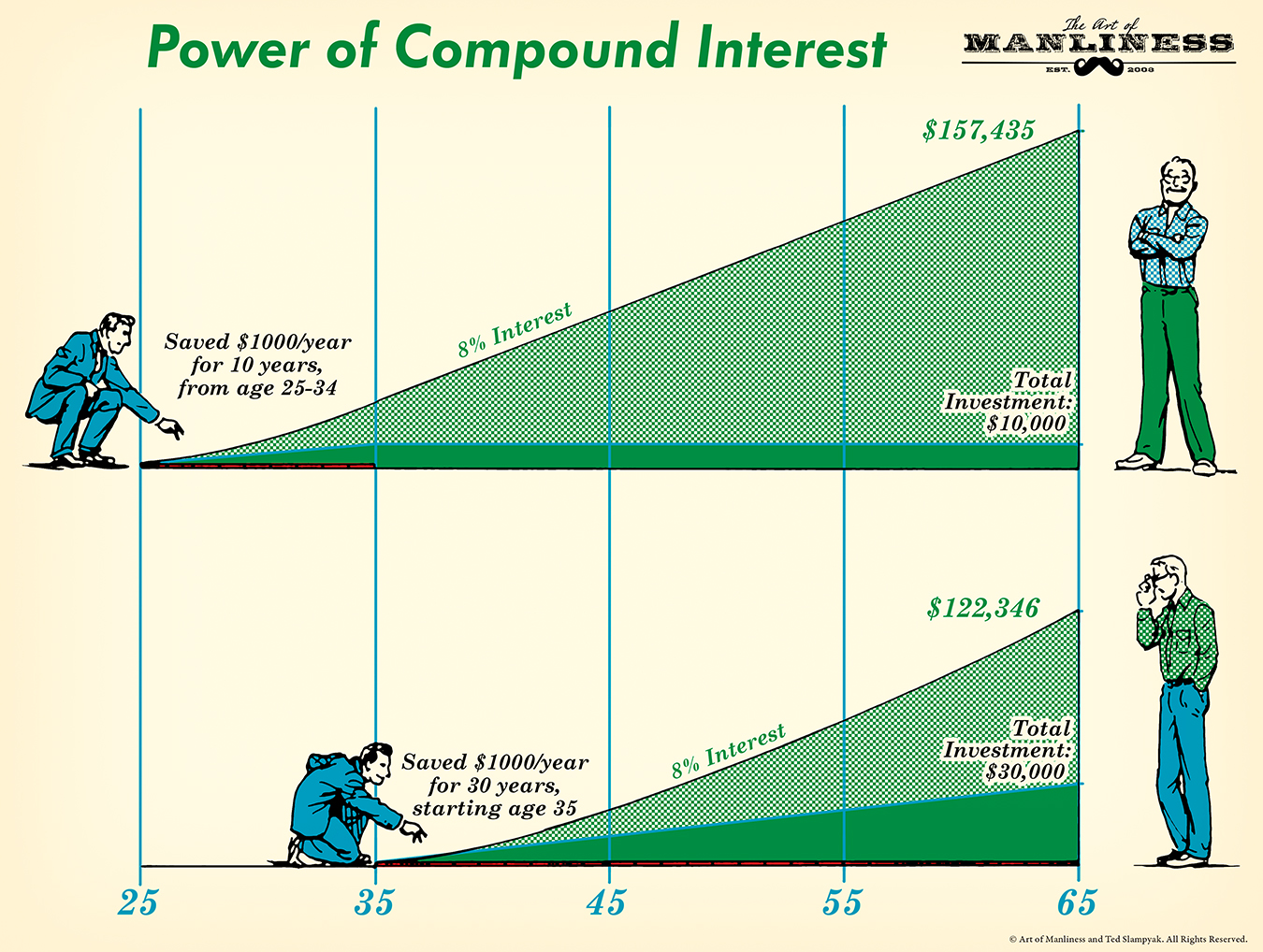

The real magic of compounding reveals itself over long periods of time. The longer you let your money sit in an account and compound itself, the more money you make.
This is the big point I’ve been trying to make to my son. What’s helped flip on the light bulb in his head is this example from personal finance expert Beth Kobliner:
If you were to save $1,000 a year from age 25 to 34 in a retirement account earning 8% a year, and never invest a penny more, your $10,000 investment would grow to $157,435 by age 65. But if you don’t start saving until you’re 35 years old and then invest $1,000 a year for the next 30 years (that’s a total investment of $30,000), you’ll have only $122,346 by age 65. The bottom line: Start early, so your money has enough time to pile up.
Understanding this concept has helped turn Gus into a tightfisted Scrooge McDuck. “Man, imagine how much interest I can earn since I’m starting at seven years old!” At the beginning of each month, he loves to check his savings account to see how the interest he earns is going up little by little thanks to the magic of compound interest.

Use the Power of Compound Interest to Your Advantage

Understanding compound interest can really help you move ahead with your personal finances. Knowing that credit card companies compound the interest on your balance on a monthly basis should act as an incentive to pay off credit card debt as quickly as possible. Knowing that you can make money from your money should act as an incentive to sock away as much dough as you can and to not touch it for as long as you can.
The key is to get started today. If you’ve got credit card debt, start paying it off now so compound interest doesn’t devour you. If you don’t have a savings or retirement account, start one today so you can leverage the power of this Eighth Wonder of the World.
Now that we have a basic understanding of compound interest, we can start exploring things like APR and APY. We’ll do that in a future article.
    My Blog buddy Peter talked about financing and housing cost in his Blogpost.  It kinda inspired this posting.

Wednesday, August 26, 2026

"What to do if you receive a Sudden Financial Windfall"


We talk about this at work, what would we do, we throw in $10 each month towards the dept "Retirement account".  One guy buys "mega millions lottery tickets.  We all sign agreement, rules and responsibility. Fun to dream though.  I have fully funded my retirement for years and am getting close to retirement, so even though I don't hit the lottery, I still will be "ok" 

  I have discussed the "Magic of compounded Interest" several times on my blog.  The only thing that concerns me is that the government looking for more sources of revenue because they have a spending problem seizes my retirement "in the interest of fairness" or some other felderkarb, but that is a story for another time.  this posting is about what do you do?    Me, I would tell no one, sit on the money, change no spending habits although my house is paid off as I paid cash for my truck and the spousal unit's Edge is paid off.   I do have a financial adviser and an accountant.  and I do have a lawyer, LOL  I would incorporate myself and be anonymous as much as possible to avoid the grifters, keep working so if people think that "hey if he won money, then why is he still working that blue collar job?  I would have better security around me though, on the house, car, ete,ete.  depending on the windfall, I would consult some security professionals.  I'm not blind to the evils of the world.   Trying to be a "gray man" would be difficult (Sorry Jim) in this world, scammers do a lot of research on their marks before they try to either scam them or rob them.    It is fun to dream.

     I shamelessly clipped this from "Art of Manliness"


A loved one dies, and you receive a substantial inheritance.

You sell your business for a hefty price.

Maybe you even win the lottery.

Great news, right?

Well, it certainly can be. But suddenly coming into money can also be a problem you never thought would be a problem. 

We’ve all heard stories of lottery winners who end up bankrupt or families who inherit a lot of money only to find themselves back in debt a few years later. What causes people to squander a financial windfall? 

When it comes to dealing with this situation, AoM podcast guest and behavioral finance expert Daniel Crosby recommends the book Sudden Money by financial advisor Susan Bradley. According to Bradley, people bungle receiving a financial windfall for two big reasons.

The first is that emotions cloud people’s thinking, leading to poor decision-making.  

If you inherit some money, you might be dealing with guilt and grief, which may cause you to unwisely give your money away as quickly as possible. 

If your windfall came from selling a business that you spent years of your life building, you might feel depressed due to losing your sense of purpose and be tempted to spend your way out of your funk.

Besides dealing with the emotions that can accompany coming into a lot of money quickly, the other pitfall of sudden wealth is not knowing how to manage that much money. 

If you’ve made $75,000 a year for most of your career and suddenly inherit $300,000 after the death of your parents, you might not know what to do with such a large lump sum.

Where do you put it? How do you invest it? What sort of taxes do you have to worry about?

Below, we offer some expert-backed advice on how to manage a financial windfall so that it remains a blessing rather than a curse. 

Create a No-Decision Zone

As soon as you get a financial windfall, you’ll be tempted to start spending it immediately. Many people will also give you ideas about what you should do with your newfound money. 

But these immediate decisions are typically based on fleeting emotions that can steer you the wrong way. 

In Sudden Wealth: Blessing or Burden?, authors David Rust and Shane Moore highlight a family that won the lottery. Feeling over-the-moon happy, they quit their jobs and immediately bought cruise tickets for 72 (72!) of their family members, friends, and acquaintances. It wasn’t until they returned from their cruise that they realized that the money they won wouldn’t last as long as they thought it would and that they’d soon be running out of financial runway. 

In her book, Susan Bradley highlights individuals who made similar impulsive decisions after getting a windfall. For example, when one man unexpectedly came into some money, he immediately decided to relocate. While the move was to a nice locale, in the process he cut himself off from friends and family. He ended up like Daniel Plainview in There Will Be Blood — a bitter recluse in a gilded cage.

To avoid making emotionally-driven financial decisions concerning your windfall, Bradley recommends creating a “No-Decision Zone.”

During this time, you’ll park your money in a money market account and let it sit there untouched for months or even up to a year.

The No-Decision Zone does several things. 

First, it allows for any strong emotions you might be experiencing after getting the windfall to cool off so you can make better decisions. 

Second, it gives you an excuse to deter ne’er-do-well relatives or acquaintances who might come knocking on your door to discuss “business opportunities” or ask for a “loan.” You can just tell them, “Sorry, I can’t do anything for you. I’m not making any decisions about this money right now.” 

Third, it gives you time to establish goals and talk to a financial advisor about managing your financial windfall. 

Your No-Decision Zone can last as long as you need it to. Don’t be in a rush to start using your money, and don’t let other people rush you. That’s how mistakes happen. 

Find a Financial Advisor

After you’ve put your financial windfall into a money market account, look for a financial advisor, particularly one who specializes in helping people who’ve come into financial windfalls. 

You’ll want to find a fee-only financial advisor. You pay this person a flat fee or by the hour for their advice and service. They don’t make their money selling you financial products like insurance. There’s less conflict of interest with fee-only financial advisors. 

A financial advisor can help you navigate tax issues that might come with your newfound wealth. A big mistake that many people make in getting a financial windfall is that they spend it all without setting aside money for taxes. When the tax bill comes due, they have to dip into their retirement fund to get the cash to pay the taxman. Don’t be that guy! Depending on the type and amount of your financial windfall, your financial advisor may refer you to a tax specialist and attorney. 

Build a Strong Financial Base

When you talk to your financial advisor, they’ll likely examine your overall financial picture to see how this windfall can improve your financial life. The first thing they’ll want to check is whether you’ve secured your financial base. 

If you haven’t yet secured your financial base, you can use the windfall to do so by doing these two things:

Fund Your Emergency Fund. An emergency fund is money for when the s**t hits the fan. Direct a portion of your windfall towards your emergency fund. Depending on the amount of your windfall, aim to fund six months to a year of living expenses.

Pay Off Non-Mortgage Debt. A financial windfall is a great opportunity to become antifragile. Pay off your high-interest credit card and car loan debt first, followed by student loans. 

Those two things will go a long way in leveraging your financial windfall to your advantage since you’re reducing the downside in your life. Always reduce downside when you can. 

If you still have money left over after funding your emergency fund and paying off your non-mortgage debt, work with your financial advisor to set aside some of the windfall in your retirement account. If you don’t have a retirement account, a financial windfall is a great time to start one!

Set Aspirational Goals Based on Reality

After you’ve secured your financial base with your windfall, you can start getting aspirational. I talked to AoM podcast guest Nick Maggiulli about what he’d recommend after you’ve taken care of your financial base. Even though he’s the Just Keep Buying guy, Nick doesn’t necessarily recommend plowing all your windfall into investments. “If you’ve paid off your debt, have a fully funded emergency fund, and a solid retirement savings, ask yourself what your stretch goals in life are. What are your aspirations? What are the things that could give you deep fulfillment in your life, and how can you use this money to get there?” he advised. 

Bradley recommends the same thing. She calls it creating your “Bliss List.” 

Your bliss list could include: 

  • Paying off your mortgage
  • Remodeling your home
  • Fully funding your kid’s college education
  • Starting a business
  • Taking a bucket list vacation
  • Buying a dream car
  • Taking a sabbatical from work
  • Going back to school yourself
  • Early retirement
  • Donating to organizations that are important to you

The sky’s the limit with your Bliss List. Don’t hold back!

After you’ve made your list, prioritize its entries in order of importance to you. 

Then work with your financial advisor to reality check your goals. If you received a $300,000 inheritance from your parents, you might be able to pay off your mortgage, and that’s about it. If funding your kids’ college education and taking a bucket list vacation are also important to you, you’ll have to make trade-offs. Maybe instead of completely paying off your mortgage, you pay down $150k’s worth, split $100k between college funds for your two children, and use the remaining $50k to spend a year traveling the world. 

If you want to take a sabbatical from work or retire early due to a significant financial windfall, your financial advisor, along with a tax advisor, can help you generate an investment plan that will help you ensure you’ve got enough money to make up for the fact that you’ll no longer be receiving a paycheck. 

A financial windfall can transform your life. The biggest mistake is making decisions too soon after coming into sudden wealth due to volatile emotions. Create a No-Decision Zone and don’t do anything with your newfound money for a while. During that time, find a financial advisor, secure your financial base, and make a plan to put your windfall to good use.


Sunday, November 22, 2020

If I can pay off my debt by controlling my spending, so can other people.....

A bit of background, I have posted about Finance and the magic of compounded interest on my blog before, we live below our means, in the case of economic downturns we are able to weather them without too much trouble.  Even though I am running on a 30 hours a week with the commensurate reduction of pay, it is a minor nuisance not a catastrophe.  I learned this after my assembly plant shut down, it was a shock, I remember getting hired on and being told "Welcome to the last job that you will ever have until you retire"


   Well 13 years later, I was walking out of there for the last time, as the plant was shutting down.  I have blogged before about the Taurus  and my time at Atlanta Assembly, and it was a shot to the gut when I left the plant, I was having to scratch until I got hired by my present employer.  The experience was an eye opener for me, Ford gave me a good severance package, but it still was a shock,  I learned from that experience to never take anything for granted.

      I saw this finance article and it resonated with me so I shamelessly clipped it and decided to post it.  


On Monday, Rep. Alynna Pressley, D-Mass, claimed canceling student debt represents a “racial justice issue.” The following day, I submitted a contrary piece of evidence: I paid off my mortgage — with a balance far exceeding the average American’s student loan balance — seven years early.

At a time many Americans remain unemployed or underemployed, I recognize the economic hardship millions of families face, through circumstances (i.e., a global pandemic) not of their own making. Given the recent growth in coronavirus cases, extending the suspension on student loan payments past its current Dec. 31 expiration date seems an entirely fair and reasonable move.

But as someone who specifically decided against going to an Ivy League school due to the additional debt that would rack up, I recognize that incurring student debt ultimately represents a choice. Indiscriminately negating the effects of those choices does an injustice to those students who made tough decisions — working their way through school or starting out at a community college to save money — to avoidtaking on massive amounts of student debt in the first place.

Likewise, my decision to pay off my mortgage as soon as possible also represented a choice. The real experience of spending the past four-plus years running my own business further motivated the drive to become debt-free as soon as I could. Can I obtain, and retain, clients? Will I have enough money to pay the bills? Those were just a few of the many questions about the uncertainty of entrepreneurship.

Numerous Small Decisions

Paying off my mortgage early came in part due to luck. I got a very fortunate break when I went on a game show nearly eight years ago, the winnings from which put my savings into overdrive. But even with that lucky break, achieving such a milestone came down not to any single big decision, but to many small ones, most of which involved four words: I can’t afford it.

That attitude meant skipping dinners out, or paying bills at restaurants and bars with cash to discourage over-spending. It meant not traveling to the 2012 Olympics in the city I had lived in and loved, because doing so would have depleted most of my emergency fund. And it meant second-guessing, and ultimately forgoing, a lavish vacation with my game show winnings.

I’ll admit that I occasionally took this attitude to extremes, like the time many years ago I woke up to a frigid apartment and found the thermostat read 48 degrees. (I did turn the heat on immediately.) But as with many goals, I wouldn’t have accomplished mine without focusing on the main priority (paying off my mortgage), and subsuming other financial goals to that bigger picture.

Our society’s focus on instant gratification has in many respects made acts of self-sacrifice a lost art. Congress has shown such little discipline in failing to set spending priorities that our nation faced trillion-dollar deficits well before the coronavirus ever hit our shores. Even after the pandemic fades, and the restrictions on social life ease, a renewed appreciation of self-sacrifice would serve American society well — provided we leaven it with the proper perspective.

The Opposite of ‘More’

Unlike some contrarian millennials, I don’t plan to embrace the “Financial Independence, Retire Early” mantra and settle back into a work-free lifestyle. While I recognize the pull of an independent lifestyle — it’s why I started my own business — I can’t envision myself retiring now, and possibly not ever. I find the work I do mentally stimulating, and enjoy the vast majority of it, so why should I quit?

That said, both the maturity that comes with entering one’s fifth decade and the financial independence of a debt-free lifestyle have led me to an important lesson: the opposite of “more” is often not “less,” but “enough.” That could mean not taking an additional client or project, because the extra work isn’t worth the time and hassle when money isn’t an issue. It could also mean overcoming one’s inherent desire to save every penny and forcing oneself to splurge and travel more (and yes, I had to practically force myself to do this several years ago; I eventually learned my lesson — and am glad I did.)

Most importantly, I look forward to giving back in both time and treasure to the people and causes that matter to me. That means taking more time to spend with friends, and hopefully (post-pandemic) travel with them too. It also means increasing my charitable contributions now that I don’t have a mortgage payment.

Security Through Sacrifice

If financial advisor Suze Orman calls money a vehicle to provide security, then paying off a mortgage (or student loan debt) provides a much-needed safety blanket to sleep easier in insecure times. Ticking that accomplishment ticked off the financial to-do list means I have eaten my proverbial vegetables — providing a chance to savor dessert. The rent-free and mortgage-free lifestyle should give provide time and space to enjoy many of the things I wanted to experience in prior years but felt uncomfortable doing so.

Therein lies hope for all of us, as this year we’ll all remember and yet want to forget slowly winds to a close. While we all wish the pandemic would have disappeared months ago, it will in time recede, and we can enjoy the things we’ve longed for over the past eight months. Just as soon as the sun rises in the east every morning, sticking to a course of action will in time prove to be its own reward.

Thursday, August 7, 2025

"Why A Health Saving Account is an Underrated Wealth Builder"


I have one through my job and I recently found out last year that I could invest the excess money that isn't used in the market.  I wish I had known about this much sooner.  The money I am investing since I will be sixty soon, I can use to when I retire to pay my medicare part B and D out of this money rather than my checking account and since it is a medical expense it is tax free.  When I turn 67 I can withdraw the money out of this without penalty and only pay taxes on any profit, not the principle.  It is a great way to lower your tax liability through the years and spread it out and shield it and let it grow through the magic of "Compounded Interest".  

    No I am not a wealth management, but I did stay at a Holiday Inn Express sometime in my life.

    I shamelessly clipped this from "Art of Manliness"

   P.S.  Still working on the rant, probably will go up this weekend.

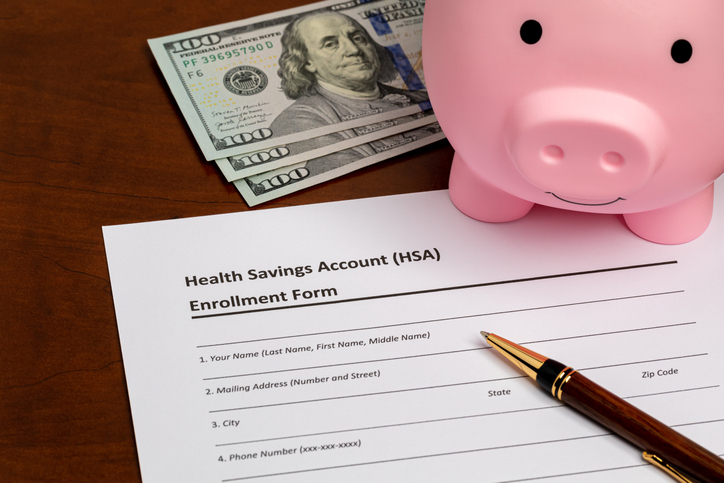
A Health Savings Account enrollment form sits on a desk next to a pen, three $100 bills, and a pink piggy bank—ready to help you build wealth for your six-figure future.


You’re hunched over the kitchen table, flipping through your job’s benefits packet. You see something about a Health Savings Account. Looks like a boring place to stash medical cash. You shrug and skim past.

That could be a big mistake — not marking that little checkbox could cost your future self a six-figure windfall.

If you’re looking for an easy way to maximize your money, allow me to introduce you to a stealth wealth builder: the health savings account or HSA.

I’ve had an HSA since Kate and I first got married. But it wasn’t until fairly recently that I started to realize what an underrated finance tool this thing is.

Today, I’m going to walk you through the benefits of a health savings account and why you might consider opening one up.

HSA Basics

A Health Savings Account is a special kind of savings account designed for medical expenses — but it does a lot more than that. An HSA lets you set aside money tax-free, grow it in the stock market tax-free, and use it for healthcare costs now or decades down the line (yes, tax-free!).

To qualify for an HSA, your health plan needs to have a high deductible — the amount you pay out of pocket before your insurance starts covering costs. As of 2025, the IRS defines a high deductible as at least $1,650 if you’re single or $3,300 for a family. The out-of-pocket max can’t exceed $8,300 or $16,600, respectively.

You can use HSA funds to pay the deductible and any other qualifying medical expenses your insurance doesn’t cover.

You can contribute up to $4,300 a year to your HSA as an individual or $8,550 for a family. If you’re 55 or older, tack on another $1,000. The IRS updates these numbers every year.

HSAs often get confused with FSAs. FSA stands for flexible spending account. FSAs let you set aside pre-tax money from your paycheck to cover qualified out-of-pocket healthcare costs, like copays, prescriptions, and medical supplies. Because the money isn’t taxed, it lowers your taxable income and saves you money. But here’s the catch with FSAs: most FSAs have a “use it or lose it” rule, so you need to spend the funds within the plan year or risk forfeiting what’s left.

This is a big difference between HSAs and FSAs: with HSAs, the money doesn’t vanish if you don’t spend it. It’s yours; it rolls over forever, and you can invest it in the stock market.

Why the HSA Is an Awesome Wealth-Building Tool

The tax savings are huge. The big reason the HSA is such an excellent wealth builder is that it functions like a legal tax shelter.

It offers three big tax benefits:

First, contributions you make to the account are deductible. When you put your money into an HSA, you lower your taxable income. So if you invest $8,550 into your HSA, you reduce your taxable income by $8,550 for the year.

Second, the investments you have in your HSA grow tax-free.

Third, if you use the funds in your HSA for medical expenses, the withdrawals aren’t taxed. So you can pay for braces, doctor appointments, and prescriptions tax-free with money that hasn’t ever been taxed.

All those tax savings really add up and keep money in your pocket where it belongs.

It is possible to use the money in your HSA for non-medical expenses, but that’s not an advisable move, as you’ll have to pay taxes on the amount you used and pay a 20 percent penalty. So, for example, it you withdrew $3,000 from your HSA to pay for a car repair, you’d have to pay income tax on that $3,000 plus an additional $600 (20% penalty). Don’t do that!

The HSA is an inflation-busting healthcare savings builder. An HSA can be a great tool to save on taxes on your immediate healthcare expenses. But where it becomes really powerful is in its ability to help you pay for healthcare expenses decades down the road, when they will likely be higher.

If you’re young and healthy, you probably won’t have to tap into your HSA all that much. This means the money invested in your HSA can take advantage of the power of compounding and grow tax-free for years. This allows you to build an inflation-proof (an HSA can be invested, and investments typically grow faster than inflation) healthcare war chest for the period in your life when medical expenses rise the most: elderhood. Fidelity estimates that a 65-year-old couple will spend $330,000 on medical costs in retirement. That doesn’t even count long-term care. An HSA gives you a way to prep for that monster bill using pre-tax dollars and tax-free market returns.

You can turn an HSA account into a stealth retirement account. An HSA can provide immediate tax savings and help you grow your money for long-term healthcare costs tax-free.

But here’s another cool thing about HSAs: you can turn them into a retirement account when you turn 65.

Once you reach that age, the 20 percent penalty that normally applies to non-medical HSA withdrawals disappears. At that point, you can tap the account for anything — travel, groceries, a new fly rod — and the distribution is simply added to your ordinary income for the year, just like pulling money from a traditional IRA.

The tax-free treatment for qualified medical expenses, however, still applies, so it’s usually smartest to keep using the HSA for healthcare and let other accounts fund your lifestyle. But it should give you some peace of mind knowing that you have another retirement account you can tap into in your golden years.

An HSA is portable and inheritable. You can’t lose your HSA if you change jobs or health insurance plans. It stays with you no matter where life takes you.

When you die, your spouse can take it over tax-free. If it goes to someone else (like a child or grandchild), it’s taxed but not penalized — same as an inherited IRA.

How to Get the Most Out of Your HSA

I hope by now you can see how awesome HSAs are. If it’s an option for you, I definitely recommend opening one up. You can do so through a provider like Fidelity or your employer’s chosen custodian and start contributing funds either directly or through payroll deductions.

Once you’ve got an HSA going, you can get the most out of it as a wealth-building tool by doing the following:

Invest the balance once you’ve cleared the provider’s cash threshold. Most HSAs require you to have a minimum amount in cash. Once you hit that minimum, invest the rest in index funds. This will help your money grow faster.

Do all that you can to leave the money in your HSA alone. That means paying for as many of your medical expenses as you can out-of-pocket. If you’re young and healthy, that likely won’t be too much of an issue. If you or a family member has a chronic health condition, it will be harder. Do what you can based on your situation.

The reason you want to leave the money in your HSA alone is that it allows your money to grow tax-free.

When you do pay for medical expenses out-of-pocket, hold on to those receipts. You can reimburse yourself (tax-free!) from your HSA decades later.

So if you paid $1,000 out-of-pocket for an ER visit in 2025, you can reimburse yourself that $1,000 expense from your HSA tax-free in 2045. During that time, the money in your HSA has been growing tax-free. That $1,000 you would have spent in 2025 from your HSA might be worth $3,000 in 2045 — letting you keep the investment gains and still get reimbursed, effectively turning a medical bill into a wealth-building opportunity.

Hopefully, by now, you can see that an HSA is more than just an account to pay for this year’s doctor’s visits. When used strategically, it’s a long-game wealth builder that saves you in taxes and gives you options down the road.

Sunday, February 11, 2024

"What if the government Abolished your 401K? "


This is another rant coming on....I see another group of government affiliated Economist making noise about going after the "Hoi Pelloi" 401K's again...I have"ranted before" about government being interested in our 401K's
       I will rant some more after this article....


What if the government abolished your 401(k)? Economists say accounts aren't worth it


The federal government should stop allowing pre-tax contributions to retirement savings, abolishing the 401(k) and Individual Retirement Account, two economists from opposing ideological camps argued in a research brief in January.

Allowing people to shelter their retirement money from taxes is a policy that largely favors the well-heeled, they said. Congress could use that money, nearly $200 billion a year in lost tax dollars, to shore up the underfunded Social Security program.

Their suggestion created a stir. One social media post has drawn more than 700,000 views.