As soon as it was announced that Elon Musk was going to be the world's first Trillionaire, the usual suspects were immediately calling for the government to seize his money in the name of "fairness" because it wasn't "fair" that he had all this money and the "poor, downtrodden,teachers, starving children" or whatever cause de jour the left wanted to insert to score points with the sheep of their base as they bleet" not fair" and demand that the government "do something" as they stamp their feet, not realizing the dangers they are setting or the precedents that will be set, but they don't care. they will have forgotten all about it by the time the damage has taken affect when the confiscation starts, with the California style "assumed value tax" that will be used to target the billionaires and millionaires in the name of fairness, but the tax goes after the assumed value of your house, your 401K, your 65 Mustang in the garage, the signed Jersey from "Larry Csonka" in your mancave and you go broke having to pay the tax that basically breaks the middle class and the people that are bleeting earlier, most of them are on some kind of government assistance anyway and will not be affected in anyway. WHat is being proposed is illegal for the moment via "Eisner V. Macomber", until the donks pack the courts and get it overturned...
Every time Elon Musk’s net worth climbs to some new astronomical figure, the same chorus appears on cue. “No one should have that much money.” “Tax him.” “Seize it.” “Make him pay his fair share.” Now that Musk is officially the world’s first trillionaire, the volume has only increased. On the Bernie Scale of political bitching, this is clearly an 11.5 on a scale of 0-10.
To many on the political left, his fortune is treated as self-evident proof of a broken system. Their conclusion is not merely that Musk has too much money. Their conclusion is that government should take it.
What strikes me is how few people stop to ask a simple question: as compared to what? Compared to what institution? Compared to what steward? Compared to what demonstrated record of competence? The argument assumes that government would somehow produce more value with that money than Musk does. That assumption deserves far more scrutiny than it is getting.
I understand the immediate objection. Government and private enterprise have different missions. SpaceX is not running a military. Tesla does not maintain interstate highways. Starlink is not administering Medicare. Fair enough. Yet all organizations consume resources and produce outcomes, and whether public or private they can still be evaluated on efficiency, innovation, responsiveness, and the value they create for the people they serve.
On that basis, the comparison becomes uncomfortable for the advocates of confiscation.
SpaceX lowered launch costs so dramatically that it effectively rewrote the economics of access to space. The company routinely lands and reuses rockets that government agencies once treated as disposable and accomplished what many experts declared impossible. Tesla drove an entire global automotive industry to accelerate electric vehicle development years ahead of schedule. Starlink has brought high-speed internet to remote areas where traditional providers either could not or would not go while keeping communications operating in disaster zones and war zones. Meanwhile, the Biden administration spent billions on rural broadband initiatives and produced bupkis to show for it and with his purchase of Twitter, he singlehandedly saved free speech while government tried to censor it.
One can dislike Musk personally and criticize his politics, his social media habits, his management style, or his ego. The question remains whether the value created by those enterprises exceeds the value that would have been created had the money remained in government hands.
At this point, critics usually raise what they believe is a devastating counterargument: Musk benefited from government contracts, subsidies, and tax incentives.
That is true. SpaceX has received NASA contracts. Tesla benefited from electric vehicle incentives. Various Musk companies have done business with government agencies.
The interesting thing is that this objection strengthens the pro-Elon argument.
SpaceX was not handed money to do nothing. It was paid to perform services that government had been purchasing for decades from traditional aerospace contractors. The relevant question is whether taxpayers received more value for those dollars. Looking at launch costs, launch frequency, technological innovation, and mission success, the answer appears to be yes. Musk’s companies demonstrate what can happen when private-sector incentives are applied to problems government has struggled to solve efficiently.
Imagine if the federal government had been given the capital that ultimately flowed into Tesla, SpaceX, and Starlink. Does anyone seriously believe Washington would have done better?
The government cannot even maintain a website without spending enough money to buy a small island nation. Remember the Obamacare portal launch? The federal government spent years and hundreds of millions of dollars creating Healthcare.gov only to unveil a spectacular failure. Cost overruns are so routine in federal projects that they barely qualify as news anymore. The Pentagon has failed repeated audits. California’s high-speed rail project has consumed billions while producing little beyond artist renderings, revised timelines, and fresh requests for funding. The federal government currently carries debt measured in tens of trillions of dollars and annual deficits that would have been considered catastrophic only a generation ago.
This is the institution that many people believe should take control of even more resources because Elon Musk has become too wealthy.
Again, compared to what?
The argument ultimately reveals a deeper philosophical divide. Many people view wealth as a fixed pie. If one person has more, someone else must necessarily have less. Wealth, in this framework, is not created but redistributed. The reality is that most modern wealth is generated through value creation.
Musk did not become wealthy because he loaded pallets of cash onto a truck and drove away with them. His wealth exists largely because investors believe his companies are worth enormous sums based on their future earnings and future contributions. If Tesla vanished tomorrow, humanity would still possess factories, vehicles, software, patents, engineering knowledge, and the infrastructure built around them. If SpaceX vanished tomorrow, humanity would still possess launch facilities, rockets, satellites, manufacturing capabilities, and decades of accumulated technical knowledge. The wealth represented by Musk’s fortune is largely a reflection of productive assets and productive capacity.
Government, by contrast, does not create wealth in the same manner. It acquires resources through taxation, borrowing, regulation, and monetary expansion. Some of those resources are used wisely. Many are not. A trillionaire is not necessarily evidence of economic failure. A government that spends trillions it does not have, borrows against future generations, loses track of enormous sums of money, fails audits, and routinely delivers projects years late and billions over budget may be a far better candidate for public concern.
None of this means government serves no purpose. A functioning civilization requires courts, law enforcement, national defense, infrastructure, and the rule of law. The question is not whether government should exist. The question is why so many people instinctively trust government with resources that it did not create while distrusting the entrepreneurs who did.
Since Elon Musk became the world’s first trillionaire, critics have demanded that government take a larger share of his wealth. They call it fairness. To rational people, it looks like punishment.
Musk’s success is an embarrassment to the self-styled contemporary Soviets who insist government can outperform private enterprise if only it is given enough money, authority, and control. Decades of evidence suggest otherwise. Waste, fraud, abuse, and inefficiency are not accidental defects of large bureaucracies. They are recurring features of systems spending other people’s money with limited accountability. That is precisely why the Founders limited government through enumerated powers in the first place. They understood that the public treasury is a temptation that must be restrained.
Before attempting to confiscate Musk’s wealth—or anyone else’s—the advocates of such policies should first demonstrate that government can produce a trillion dollars worth of value with the resources it already controls.
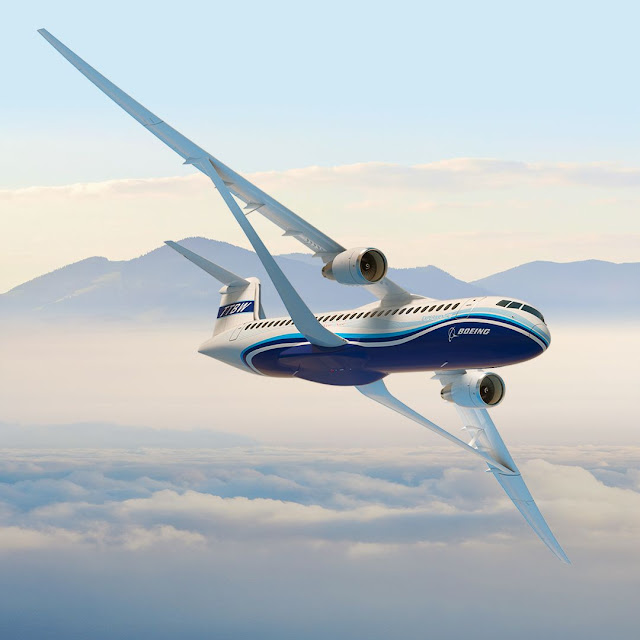
I have blogged before about "The Truss Wing" Concept that NASA is developing, another step forward when a former
Delta Airline MD-90 left Victorville to be a donor aircraft for this project. I do wish that Boeing would work on the "797 NMA" also. it is like they are putting all their eggs in the MAX basket and surrendering a huge share of the market to Airbus. The "Boeing 757" is a unique airplane and there is nothing else in the world that can do what she does, you can load it down with passengers and cargo and "weight optimized" issues that force a plane to fly with empty seats don't happen with a 757 like what happens with the "A321" series of airplanes although the NEO version has stronger engines and it is the closest to falling in the catagories that the B757 have. The 757 is getting long in the tooth and eventually they will retired as is the nature of airplanes. I wish that Boeing hadn't quit making the plane but they did to focus in the 787 and "Boeing MAX" development.
MD-90 ferry flight
Credit: NASA/Carla Thomas
A former Delta Air Lines MD-90 is being prepared for conversion into Boeing’s X-66A transonic truss-braced wing (TTBW) experimental aircraft after arriving at Palmdale, California, on Aug. 15 following a short ferry flight from nearby Victorville.
The aircraft, which has been in storage since its retirement from the Delta fleet in 2020, will be modified for NASA’s Sustainable Flight Demonstrator (SFD) project with a new strengthened center fuselage crown section to support the 145-ft. span, high aspect ratio transonic wing. To be mounted above the fuselage, the new wing will have an increased span of 46 ft. compared to the aircraft’s original low-mounted wing and will be structurally braced by trusses that also generate lift.
The low drag wing design alone is expected to reduce fuel burn by up to 10% compared with the conventional cantilevered wings on today’s single aisles. NASA, which launched the SFD project in January, says that when combined with advanced propulsion, composite structures, and other technologies, the TTBW is expected to reduce fuel consumption and emissions by at least 30% for an aircraft entering service in the 2030s.
The goal of the SFD program is to validate the benefits of the TTBW concept at the aircraft level and, if successful, is expected to form the basis for a next generation airliner family to succeed the 737 in the 2030s. Boeing has outlined a possible future family of single-aisle TTBW aircraft, the VS-1 and VS-2 (for Vision System). The smaller VS-1 seats 130-160 passengers while the 180-210-seat VS-2 has a bigger wing and engines.
Based on a configuration developed by Boeing and NASA over more than a decade of collaborative studies under the Subsonic Ultra Green Aircraft Research (SUGAR) program, the X-66A conversion will begin with removal of the MD-90’s existing tail-mounted International Aero Engines V2500s. The forward fuselage will then be shortened by around 14 frames to balance the airframe around the new center of gravity. Additional airframe and system spares will be available from a second MD-90, which was ferried to Palmdale in July.
The X-66A will be powered initially by a pair of Pratt & Whitney PW1100G geared turbofans and, for later tests, is expected to be re-engined with the CFM Open Fan—now in development under the GE Aerospace-Safran RISE program.
The conversion program will take several years with flight tests scheduled to take place at NASA Armstrong Flight Research Center at Edwards Air Force Base in 2028. Although the basic modification could likely be achieved over a shorter timescale, Boeing plans to use the X-66A program for in-depth preparation for a follow-on new development program. The design will therefore go beyond a traditional experimental X-plane to include certifiable features such as a production-like fuel system and fail-safe engine pylon, wing truss, and fuselage structures.
Although Boeing does expect some fuel to be stored in the center of the X-66A wing, the overall thin cross section means the fuel system will likely be augmented with auxiliary belly tanks, a feature previously developed for the MD-90
Sorry about not getting my "Monday Music" up, I was overcome by events. I will try to post it day after tomorrow...
I had "Blogged"about the SST before, and i saw this article and shamelessly clipped it.
In November 1962, the British and French governments announced a deal that caused great distress in the boardrooms of American planemakers.
The two countries announced plans to jointly build a new airliner, one that would be able to fly at more than twice the speed of sound. The aircraft – to be called ‘Concorde’ – would be the most advanced civilian aircraft in the world, showing that European aircraft manufacturers could create the most bleeding-edge designs.
US president John F Kennedy rose to this sudden challenge; the Anglo-French Concorde would have competition. America would create its own rivals to the European design, building a giant, passenger-carrying jet capable of flying faster than a rifle bullet.
The state-sponsored project selected two designs for further selection, one from airliner giant Boeing and another from Lockheed. But the programme became mired in political turmoil, environmental protests and spiralling costs. Neither of ‘America’s Concordes’ ever flew.
The announcement of the Anglo-French Concorde concerned the US (Credit: Getty Images)
Today, however, supersonic flight is back on the agenda in the US, after more than 45 years in limbo. Lockheed recently announced a collaboration with Nasa to design a quieter supersonic jet that may, one day, carry passengers. So, what can be learned from the story of America’s failed Concorde rival?
In the 1960s, Boeing and Lockheed were two of the most experienced aircraft manufacturers in the world. Boeing had revolutionised air travel with ever-more-reliable jet airliners. Lockheed had designed the first aircraft capable of flying at more than twice the speed of sound, the F-104 Starfighter, and was working on even faster military designs.
To be beaten in the supersonic airliner arena by the British and the French was one thing – to be shown a clean pair of heels by the Russians was another
Even before Concorde was announced, American aircraft companies were seriously looking at the feasibility of a supersonic passenger plane, or a Supersonic Transport (SST). One company, Douglas Aircraft, produced a concept in 1961 for an airliner that could fly at three times the speed of sound (Mach 3). Douglas not only believed that such an aircraft could be flying by 1970, but that there would be a market for hundreds of aircraft.
Concorde, it turned out, was not the only reason to focus American attention. On the other side of the Iron Curtain, the Russian design bureau Tupolev was also creating a supersonic transport and airliner, the Tu-144. To be beaten in the supersonic airliner arena by the British and the French was one thing – to be shown a clean pair of heels by the Russians was another.
The quest for a supersonic airliner became almost as important to the US as the race to the Moon. “You look back to that time and there really was a lot of technological advancements in aeronautics,” says Peter Coen, Nasa’s supersonic project manager at Langley Research Center in Virginia. “Whether it was a consideration of the market and what type of aircraft might be needed, or whether it was a case of one-upping Russia and Europe.”
The Lockheed L-2000 was one of two designs that underwent more detailed testing (Credit: San Diego Air & Space Museum)
President Kennedy’s carrot to Lockheed and Boeing was that the government would pick up 75% of the cost of the programme if either could produce a design that could rival Concorde. Both companies had done private research – “paper studies” as they’re known – on supersonic transport since the late 1950s. Most of these studies mirrored the Russian and European research, creating delta-winged aircraft.
As aircraft started being fitted with jet engines, and travelling at far faster speeds, the standard design that had served propeller-driven aircraft for decades was no longer desirable; straight, plank-like wings created too much drag. With a too-powerful jet engine, these wings would snap off. The triangular shape of delta wings provided a stability that could withstand the stresses of enormous speed – aircraft like the French Mirage III fighter and the Russian MiG-21 had already proven the delta shape could easily go to Mach 2 and beyond.
Lockheed chose the delta layout for their design, intended to fly at 2,000mph (3,200km/h) while carrying 270 passengers. Boeing’s design was supposed to be able to fly at Mach 2.7 (1,800mph), carry more than 270 passengers, and be able to fly more than 4,200 miles (6,700 kilometres).
When we were building Concorde, we were pushing technology as far as it could possibly go at the time. They were pushing for something that was just too difficult – Kit Mitchell
Boeing chose what’s known as ‘variable geometry’ – or swing wings, as they became known – in their initial design. The wings would be straight at low speeds, improving the aircraft’s handling at take-off and landing, and then swing back closer to the aircraft’s body as it picked up speed. And the US government must have been impressed – after a great deal of further testing, Boeing’s concept was chosen as the winner on 1 January 1967. But the 2707’s progress was anything but smooth.
Kit Mitchell was the principal scientific officer at the then Royal Aeronautical Establishment (RAE) in the 1960s, and worked on Concorde. He says the Boeing 2707’s main problem was that it was trying to do too much, and that so much of the technology needed to do it was still in its infancy.
The fact that the 2707 was supposed to fly hundreds of miles an hour faster than Concorde “had huge implications”, says Mitchell.
“When we were building Concorde, we were pushing technology as far as it could possibly go at the time. They were pushing for something that was just too difficult.”
The 2707 project was Boeing’s major priority during the late 1960s (Credit: Boeing)
Mitchell says that the 2707’s extra speed would have caused enormous challenges for every single part of the aircraft. At such speed, the aircraft experiences enormous heating – parts of Concorde’s metal skin heated to well over the boiling point of water; the very tip of the nose could be as hot as 127C when cruising at Mach 2. “Everything – from the sealants, to the electrical wiring, to the windows, you name it, had to especially designed for a ‘hot’ airplane.
“A lot of this was unknown territory.”
But few could criticise Boeing for not throwing enough resources at the design. Mike Lombardi, Boeing’s resident historian, says: “To put into context just how ambitious this was, when Boeing was working on supersonic transport, the company was also designing what would be the 747 Jumbo Jet, and the 737 airliner had just entered service. There was the space programme to get a man on the Moon, which Boeing was heavily involved in, and there were some military projects as well.
“We were going to the Moon and building the 747, and 2707 was still the number one project at Boeing.
“Joe Sutter, who was in charge of building the 747, said how difficult it was to get engineers to design that airplane because they were all committed to supersonic transport.”
The design team literally had to go back to the drawing board – Mike Lombardi, Boeing
National pride was at stake. But the political will wasn’t enough to solve the enormous design challenges to get Boeing’s swing-wing giant into the air. Some military jets had already been designed to use the technique, but these were small, carrying two crewmembers at most. Scaling that up to something that could carry almost 300 people was a huge challenge. “The problem Boeing had was that it meant a tremendous amount of extra weight,” says Lombardi. “The bearings had to be really heavy, and the weight became almost prohibitive. The design team literally had to go back to the drawing board.”
Even when the designers moved to a delta wing shape, says Mitchell, they still couldn’t solve some of the weight problems which meant the aircraft was very fuel hungry and couldn’t get from the US to Europe on internal fuel. “That’s the same problem the Concorde prototype and pre-production models had too, however. We had to keep refining the design, and the production model was the first one that could actually cross the Atlantic.”
Wings were not the only problem. The sonic boom the 2707 would create as it broke the sound barrier would be another issue. “Once it became apparent just how disturbing that was,” Coen says, “it put paid to the idea of supersonic flight over the US.”
A full-size mock-up of the delta-winged Boeing 2707 was built in Seattle (Credit: Boeing)
This would be the same issue that would affect Concorde. Dozens of Concordes had been ordered by airlines as the Anglo-French project gathered speed – including US airlines such as Pan Am and TWA – but these orders melted away as it emerged that the environmental constraints would limit the aircraft’s use to flying over the ocean, far away from populated areas. (It’s why British and French Concordes only flew to destinations on the east coast of the US.)
“The model that most airlines use means that they can’t have an airplane that they can only use on a few routes,” says Coen – if you’re going to use expensive supersonic aircraft, then you have to use them on as many routes as possible so they pay for themselves.
Fuel was relatively cheap when the 2707 was being designed in the 1960s, but Boeing’s design burned so much of it that the sheer costs of it might have offset the traditional argument in favour of supersonic transports – that they take less time to fly between airports so each aircraft can carry out more flights per year.
What ended up killing the project, and eventually Concorde itself, was the amount of fuel you had to burn – Mike Lombardi
“What ended up killing [Boeing’s design], and eventually Concorde itself, was the amount of fuel you had to burn. It became prohibitive,” says Lombardi. “There was the recession of 1971, and the cost of oil started to rise. But even if it hadn’t ended then, the oil crisis of 1973 would have killed it. It would have ended up being a disastrous project if it had still gone ahead.”
Boeing became a household name because of the aircraft that did make it into the air – the ones which took ordinary people on holidays near and far. But even if the 2707 failed to make it into the air, Lombardi says there were silver linings.
Nasa and Lockheed will collaborate on a new supersonic demonstrator (Credit: Nasa)
“The 2707 had a lot of effect on the development of the 747, he says. “The thinking was that all the world’s airlines would want supersonic transport, and no-one would buy these subsonic airliners. So Boeing had to plan that some time in the 1970s they would have to turn all these 747s into cargo freighters. It turns out that we only needed to start doing that a few years ago.”
And despite the project’s failure, some of the things Boeing learned made its way into other experimental vehicles the aerospace giant built in the following decades, including some of the unmanned vehicles built in recent years, such as the High Speed Civil Transport project during the 1990s. And the super-critical wing, a design tweak now routinely used on modern airliners to limit shockwaves and reduce drag, came out of the 2707 project.
Lockheed’s ill-fated L-2000 design will live on, in a way, thanks to the collaboration with Nasa and Lockheed to fly an experimental demonstrator to research the supersonic aircraft of the future. Perhaps, in years to come, a US-built supersonic airliner will finally take to the skies – with no pesky Concorde to get in the way this time…
My Inner Geek is "Squeeeing" on this one, The fact that something that was made in the 70's is still working using far less computing power than the smart watch that the average person is using says something about the durability of the technology and the smarts of the people running NASA back then.
An artist concept depicting one of NASA's twin Voyager spacecraft.
Credit: NASA/JPL-Caltech
NASA’s Voyager 2, approaching the 46th anniversary of its launch to the outer Solar System, is once again transmitting and receiving data following a July 21 loss of communications due to an inadvertent command that prompted the probe to point its antenna away from Earth.
The resumption of communications through NASA’s Deep Space Network (DSN) follows a “shout” command transmitted by the agency’s Jet Propulsion Laboratory 37 hr. before the science and data flow back to Earth was officially confirmed on Aug. 4 at 12:29 a.m. EDT, according to updates from the mission team.
Voyager 2 launched on Aug. 20, 1977, and its companion Voyager 1 launched Sept. 5, 1977, on missions to explore Jupiter and Saturn and their moons. With their primary missions complete, they now explore beyond the Solar System on different trajectories, with Voyager 2 now more than 12.3 billion mi. (19.9 billion km) from Earth and Voyager 1 almost 15 billion mi.
The Voyager 2 “shout” signal that triggered the restoration of communications followed an Aug. 1 report from the mission team that it was able to detect a “carrier” signal from the probe after the July 21 communications loss. The signal, however, was too faint for the extraction of data.
Up until the success of the “shout,” it appeared that communications between Voyager 2 might not be restored until an Oct. 15 reset. Voyager 2 is programmed to execute periodic resets to correct its orientation and align its antenna with the Earth and the DSN ground stations at Goldstone in California, Madrid, Spain, and Canberra, Australia.
My apologies, I have been working a lot of overtime, in the summer is our busy time. Unless it is absolutely broke or unsafe to fly it is flying because of the demand for air travel. Other Airlines are having similar demands placed on them. Like I have stated before, I like to blog, but I like sleep more.
LE BOURGET—Pratt & Whitney’s selection to power the NASA X-66 transonic truss-braced wing (TTBW) sustainable flight demonstrator may be the opening the company needs to break back into the future Boeing single-aisle market, says Christopher Calio, Raytheon Technologies' president and chief operating officer.
The engine-maker’s PW1100G geared turbofan will power the high-wing X-66 later this decade and is the first engine from the Pratt & Whitney stable selected for any Boeing-built narrowbody since the final 757s were delivered in the early 2000s. The competing GE Aerospace and Safran joint venture CFM International has, by contrast, enjoyed exclusivity on the 737 since the development of the 737-300 some 40 years ago.
“We’ve always said we would love at some point to take our technology and offer it to both of the narrowbody OEMs—that's the position our competitor has today,” Calio says, referring to CFM’s availability as an alternative to the PW1100G on the Airbus A320neo family. “That affords [CFM] a lot of privileges as a result. So we would love to find a way to get back in. Our view is [the TTBW is] a great way to get back in working with Boeing in the commercial engine space in the commercial narrowbody market,” he adds.
However, Calio is also realistic that much needs to be done before Pratt can be fully competitive. “First of all the focus right now is on getting through our issues on the GTF for Airbus and our customers. So make no mistake, we are not taking our eye off that ball, but longer term—in 12 to 15 years—you’ve got to invest. You can't just wake up in 2030 and go ‘hey, we'd love to get back on the Boeing aircraft.’ You have got to be investing along the way in some of these enabling technologies.”
Pratt is currently developing the enhanced PW1100G Advantage version, but has several technology programs under way to reduce fuel burn on the basic architecture by a further 10% or more over the coming decade.
“Dave [Calhoun, Boeing CEO] says any new product will have to be 20-30% more efficient. A lot of that comes from the engines and I think what we've learned as part of the GTF when we rolled it out is just as much as you've got to go drive the efficiency gains, the things you do to get those efficiency gains is you've got to make sure that industrially you can support it. To me, that's just as important. Not only does that does the technology have to be there for those gains, but the manufacturing and support has to be in lockstep,” Calio says.
I started this theme back in November of 2019?...With a couple of interruptions it has been consistent...Dang.
Saw this meme and *rescued it from farcebook*, why? because I am a humanitarian, that's why.
I
am continuing my string of "bugaloo" songs. This discussion was
started in the "Monster Hunter Nation, Hunters Unite", back in November
of 2019? it is a Facebook group with enthusiast of the ILOH
"International Lord of Hate" A.K.A Larry Correia.
We were talking about what song would we use if we looked out of our
window or glanced at our security camera and saw this.....
One
of the alphabet bois lining up to take down your house...What would be
your "Valhalla" song and you would set it up to play as you load up
magazines set up the Tannerite Rover, turn on the water irrigation system and fill it with gasoline instead of water and prepare yourself.
I
figured it would scar the alphabet boys if they come busting in and
hearing a song that is related to a series and a movie that took on a life of its own, of a group that refused to behave and "Aim to Misbehave" and we listen to good music
unlike the crap they listen to now
sipping their soi latte's and comparing notes on the latest soyburger
recipes and who wears the best manbuns in the team.
Firefly is an American space Westerndrama television series, created by writer and director Joss Whedon, under his Mutant Enemy Productions label. Whedon served as an executive producer, along with Tim Minear.
The series is set in the year 2517, after the arrival of humans in a
new star system, and follows the adventures of the renegade crew of Serenity, a "Firefly-class" spaceship. The ensemble cast portrays the nine characters who live on Serenity. Whedon pitched the show as "nine people looking into the blackness of space and seeing nine different things."
The show explores the lives of a group of people, some of whom fought on the losing side of a civil war, who make a living on the fringes of society as part of the pioneer
culture of their star system. In this future, the only two surviving
superpowers, the United States and China, fused to form the central
federal government, called the Alliance,
resulting in the fusion of the two cultures. According to Whedon's
vision, "nothing will change in the future: technology will advance, but
we will still have the same political, moral, and ethical problems as
today."
Firefly premiered in the U.S. on the Fox network on September 20, 2002. By mid-December, Firefly had averaged 4.7 million viewers per episode and was 98th in Nielsen ratings. It was canceled
after 11 of the 14 produced episodes were aired. Despite the relatively
short life span of the series, it received strong sales when it was
released on DVD and has large fan support campaigns. It won a Primetime Emmy Award in 2003 for Outstanding Special Visual Effects for a Series. TV Guide ranked the series at No. 5 on their 2013 list of 60 shows that were "Cancelled Too Soon".
Greg Edmonson
composed the musical score for the series. He stated that he wrote for
the emotion of the moment. A reviewer averred that he also wrote for the
characters, stating: "Edmonson has developed a specialized collection
of musical symbolism for the series." To help illustrate the collection, the reviewer gave leitmotifs,
or "signatures", various names, noting that "Serenity" recalls the
theme of the show and is used when they return to the ship, or when they
were meeting in secret; it was "the sound of their home". The slide
guitar and fiddle used in this piece are portable instruments that fit
the lifestyle of the crew: "the music they make calls up tunes played
out in the open, by people who were hundreds of miles away yesterday.
'Serenity' conjures the nomadic lifestyle the crew leads and underlines
the western aspect of the show."
Another emotional signature was "Sad Violin" used at the end of the
Battle of Serenity Valley but also to set up the joke when Mal tells
Simon that Kaylee is dead in the episode "Serenity". The most memorable use of "Sad Violin" is at the end of "The Message", when the crew mourned the death of Tracey. This was also the last scene of the last episode the actors shot, and so this was seen by them and Edmonson, as Firefly's farewell. To denote danger, "Peril" was used, which is "a low pulse, like a heartbeat, with deep chimes and low strings". The reviewer also noted character signatures. The criminal Niska
has a signature: Eastern European or Middle Eastern melodies over a low
drone. Simon and River's signature was a piano played sparsely with a
violin in the background. This contrasts with the portable instruments
of "Serenity": the piano is an instrument that cannot be easily moved
and evokes the image of "the distant house and family they both long
for." The signatures were mostly established in the first pilot,
"Serenity", and helped enhance the narrative.
In every episode, the musical score
intensified my experience of this intelligent, remarkable show. Using
and combining all these signatures, Greg Edmonson brought out aspects of
Firefly's story and characters that were never explicitly revealed in the other elements of the series.
Whedon's use of music in his television shows has been regarded as
"filmic", in that he has been argued to use it to remind viewers at
"pivotal moments" of earlier events, resulting in a tighter continuity
throughout the season.
The musical score expressed the social fusion depicted in the show. Cowboy guitar blended with Asian influence produced the atmospheric background for the series. As one reviewer stated:
Old music from the future—the music of roaring campfires and racous
cowboys mixed with the warm, pensive sounds of Asian culture and,
occasionally, a cold imperial trumpet, heralding the ominous structural
presence of a domineering government. Completely thrilling. —Steve Townsley
The show's theme song, "The Ballad of Serenity", was written by Joss Whedon and performed by Sonny Rhodes.
Whedon wrote the song before the series was greenlit, and a preliminary
recording performed by Whedon can be found on the DVD release. The
soundtrack to the series was released on CD on November 8, 2005, by Varèse Sarabande. Fox Music released a 40-minute soundtrack in September 2005 as a digital EP. "The Ballad of Serenity" was used by NASA as the wake-up song for astronaut Robert L. Behnken and the other crewmembers of STS-130 on February 12, 2010
The Clip of the song actually used in the opening credits of the series and later, of the movie.
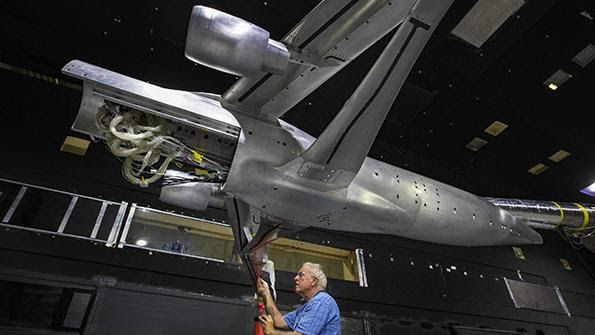
I snagged this from one of the articles I get in my email from work that talks about Aviation, and I thought it was facinating concept and the thought of them "using a MD80's series tail or a B 717 to finish the design is what caught my eye.
Researchers
completed TTBW high-lift tests, including stability and control checks
and ground-effects evaluations, in September at NASA Langley Research
Center’s 14 X 22-ft. subsonic wind tunnel in Hampton, Virginia.
Seventy years ago,Boeingwas
secretly preparing to
gamble on whether to spend two-thirds of its post-war net profits on a
radical new jet-powered long-range transport demonstrator—the Model
367-80.
The
company’s May 1952 decision to approve the project, dubbed the Dash 80,
became a defining moment in aviation history. Targeting the airline and
military air tanker markets, the turbojet-powered
aircraft would evolve into the 707/KC-135, establishing the blueprint
for virtually every modern swept-wing transport with podded engines
developed to this day as well as laying the foundation forBoeing’s
700-series jet airliner dynasty.
Fast-forward to early 2022 andBoeingis
once more preparing
to propose a new, potentially game-changing configuration. Although the
concept is not yet aimed specifically at a new product, the
high-aspect-ratio transonic truss-braced wing (TTBW) is targeted instead
at aNASAdemonstrator
X-plane intended to prove airframe technology for a future highly efficient single-aisle airliner by the mid-2030s.
While other advanced configurations, such as the blended wing body
(BWB), are in the frame for the X-plane—also known as the sustainable
flight demonstrator (SFD)—Boeing’s
TTBW proposal is widely expected to be the front-runner. Not only hasBoeingbeen working on the configuration withNASAfor
more than a decade, but it is also actively soliciting suppliers to bolster broader industry participation in its bid.
ForBoeing, the timing of the competition for the X-plane has assumed even more importance than the research opportunity it presents.
Hit by the 737 MAX groundings, the market downturn caused by the COVID-19 pandemic and delays to deliveries of the 787 and777X,Boeinghas
had to put near-term plans for all-new commercial aircraft development
projects on the back burner. The X-plane therefore offers a chance to
continue with tests of key technologies that could play a role in future
single-aisle programs semi-independently of
the company’s market-driven product-development strategy.
But asBoeingdeliberates over its next market moves, ranging from long-term 737 replacements to a potential twin-aisle
midsize family, the competition is stirring. The SFD has become increasingly timely in the face ofAirbus’ plans to develop an all-new
sustainable 100-plus-seat airliner in the 2030s.
Green-
and blue-colored areas indicate areas of reduced drag in this
computational fluid dynamic flow simulation of the TTBW conducted byNASAandBoeingin
early 2021
If all goes according to plan, the new X-plane—which likely will be the
largest purpose-built experimental aircraft in the seven-decade-old X
series—is expected to begin flight tests in late 2026 and will help
mature design, structures and systems technology
timed for full-scale development in the early 2030s. The X-plane also
forms a key part ofNASA’s
Sustainable Flight National Partnership
(SFNP) plan with industry, researchers and academia, which will support
the push toward new airliner technology across a broader front that
includes developments in smaller engine cores, electrified aircraft
propulsion and high-rate composite aircraft manufacturing.
“In 2022, we expect to put out a request for proposal [RFP] for the
design and build of the flight demonstrator, and this is really a big,
big deal,” says Rich Wahls, strategic technical advisor for the Advanced
Air Vehicles Program atNASA’sAeronautics
Research Mission Directorate. “When was the last time we did a transport-class [aircraft-level] architecture change?” he asks. “My mind goes back to whenBoeingdid
the Dash 80 with swept wings and underslung jet engines. That’s what
we’re looking at here—a large-scale honest-to-God, prove-it kind of
aircraft that would demonstrate key aspects that you can only do in
flight.”
In the run-up to the RFP,NASAawarded study contracts for demonstrator plans to five unidentified companies and is working
in parallel with two others on risk-reduction studies—one for the BWB and another withBoeingon
the TTBW. “We’ve had
wind tunnel tests [of the TTBW] that have gone on since 2013, and there
have been aeroelastic tests, high-speed performance tests and low-speed
integration tests,” Wahls says. “Often you take these concepts, and as
you dig down to the next layer of detail,
the benefit goes away. So far, it’s not going away on the truss-braced
wing or really on the blended wing. We haven’t found that thing that
completely stops either yet.”
ClarifyingNASA’s
role in the further advancement of sustainable concepts, Wahls adds:
“We’re not about product development and doing
the next airplane. Industry has their next baseline airplanes on their
drawing boards. We’re trying to identify those technologies that are
just beyond their risk threshold, both financially and technically, then
use those as demonstrations. If successful,
we bring them forward into that next generation. If they had enough
confidence to put them on the next airplane, then we would have to start
looking beyond that. So we’re trying to accelerate insertion of
advanced technology into these game-changing architectures
across all these projects we’re doing.”
Following a planned first flight in late 2026,NASAsays
the SFD research campaign will last six months and be completed
in 2027. Design, ground test and flight research data from the SFD will
be used to measure the winning contractor’s “vision system” performance
relative to a set of midterm performance objectives set out byNASAfor
future subsonic transport aircraft in the 2025-35 time frame.
These targets call for technology readiness levels of 5 to 6 (ready to
transition to production development) for an aircraft capable of
cumulative noise levels of 32-42 dB below Stage 4 and landing and
takeoff nitrogen oxide (NOx) emissions 80% below theInternational
Civil Aviation Organization’s CAEP/6 standards. The requirements
also call for cruise NOx emissions to be 80% lower relative to a 2005
best-in-class benchmark, and aircraft fuel and energy consumption levels
to be 50-60% lower relative to the same 2005
standard.
As its name suggests, the TTBW configuration is all about maximizing
wing efficiency and at the same time opening the aperture for a wide
variety of potential future propulsion options, ranging from advanced
turbofans and open rotors to hybrid engines and even
a tail-mounted boundary-layer-ingesting fan. First developed in 2010
under theBoeingandNASASubsonic
Ultra Green Aircraft Research program to study ultraefficient airliner
concepts for the 2035 time frame, the TTBW has continued to evolve into a
flexible and practical configuration.
Despite many tweaks over the past decade, the design continues to hinge
on the benefits of a high-aspect-ratio wing to minimize drag. The
increased span lowers lift-induced drag because the wing is slender,
while its reduced thickness ratio decreases profile
and transonic drag due to its thinness. The wing is braced by trusses
to minimize the weight penalty of the longer span.
The X-plane was originally designed with an unswept wing to cruise at a fuel-saving speed of Mach 0.75, butBoeingis
basing
its X-plane proposal on a revised wing configuration revealed in early
2019. The newer design is optimized around a 20-deg. swept wing to
enable a higher Mach 0.8 cruise speed more typical of current jet
airliners. The increase in sweep angle necessitated
a redesign of the truss, which has increased chord at the fuselage and
forward sweep at the trailing edge and tapers toward the junction with
the wing. A small jury strut that connects the truss to the wing has
also been moved farther outboard and closer to
its junction with the wing. The changes have allowed the truss to
generate lift, further maximizing performance.
With an aspect ratio of 19.6, the 170-ft.-span wing of any production TTBW version also will incorporate a777X-like
wing-fold feature.
The fold, which is positioned outboard of the truss attachment point,
is designed to enable the TTBW to use smaller gates, like those used by
the 118-ft.-span 737. For the SFD bid,Boeingexpects
to modify the fuselage of a donor MD-80 or 717, but it is unclear if
these precise wingspan dimensions will be reproduced for the
demonstrator, which is also unlikely to include the folding feature.
Boeingis,
meanwhile, canvassing industry for potential risk-share involvement in
the modification of the T-tail fuselage into the X-plane.
The company declined to comment on details of the plan, saying it would
be premature to discuss its proposal prior toNASA’s RFP.Boeingdid
add, however, that it “enthusiastically supportsNASA’s
vision for a public-private partnership to enhance aviation
sustainability
under the umbrella of the Sustainable Flight National Partnership,
which focuses industry and government on the critical challenges for
products being introduced in the 2030s.”
Details of the proposed modification plan seen by Aviation Week show
that a significant number of changes and additional systems and
structure will be required to transform a McDonnell Douglas-heritage
fuselage into the basis for the new X-plane. The biggest
of these will involve the design and build of a composite wing with
full-span slats and single-slotted flaps. The wing, which will be joined
at the centerline above the fuselage, also will incorporate low- and
high-speed ailerons.
To meet the required design length of the demonstrator,Boeingplans
to remove an unspecified number of fuselage frames
as well. This suggests the preferred donor fuselage may be from an
MD-80 rather than the shorter DC-9-30-series-size 717. The fuselage will
be reinforced with internal bracing from the wing to the existing
structure, too, and will utilize the in situ carry-through
torque boxes for the nose and main landing gears. The existing gear
will be supported by a new pylon and enclosed in a new fairing.
Other changes will include the relocation of the tail-mounted engines to
an inboard underwing mounting, where they will be attached with a new
pylon and enclosed in purpose-built nacelles and inlets. The engine’s
existing thrust reversers will be locked out
while the nacelle will feature a purpose-designed anti-ice system.
Several key system changes also will be required, including the
development of a fly-by-wire flight control system for the wing-control
surfaces. Flight control functions will be hosted in a triplex vehicle
management system controlled from a two-crew flight
deck that will be modified with an additional flight control computer
interface. Among the system changes will be the rerouting of the engine
bleed air ducts through the fuselage to the environmental control system
packs and the addition of an extra central
hydraulic system to augment the existing configuration.
Changes to the interior will include installation of a full flight-test
instrumentation suite and accommodation for flight-test personnel as
well as provision for a set of pallets for center of gravity ballast.
It will be interesting if Boeing is able to pull this off, I have seen one of their X planes,not this one mind you, but a different kind when I was in California, she was in Storage. I want Boeing to pull this off because it can revolutionize the aviation industry...again.