Webster

The Constitution was made to guard the people against the dangers of good intentions." --American Statesman Daniel Webster (1782-1852)


Showing posts sorted by relevance for query truss. Sort by date Show all posts

Sunday, January 9, 2022

Boeing is trying a revolutionary a Revolutionary airplane design.


I snagged this from one of the articles I get in my email from work that talks about Aviation, and I thought it was facinating concept and the thought of them "using a MD80's series tail or a B 717 to finish the design  is what caught my eye.


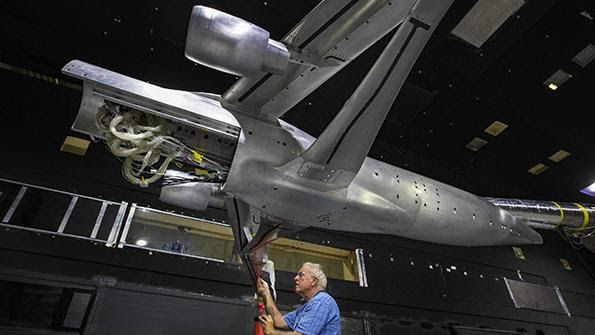
TTBW high lift tests, NASA Langley Research Center, Hampton, Virginia

Researchers completed TTBW high-lift tests, including stability and control checks and ground-effects evaluations, in September at NASA Langley Research Center’s 14 X 22-ft. subsonic wind tunnel in Hampton, Virginia.

Seventy years ago, Boeing was secretly preparing to gamble on whether to spend two-thirds of its post-war net profits on a radical new jet-powered long-range transport demonstrator—the Model 367-80.

The company’s May 1952 decision to approve the project, dubbed the Dash 80, became a defining moment in aviation history. Targeting the airline and military air tanker markets, the turbojet-powered aircraft would evolve into the 707/KC-135, establishing the blueprint for virtually every modern swept-wing transport with podded engines developed to this day as well as laying the foundation for Boeing’s 700-series jet airliner dynasty.

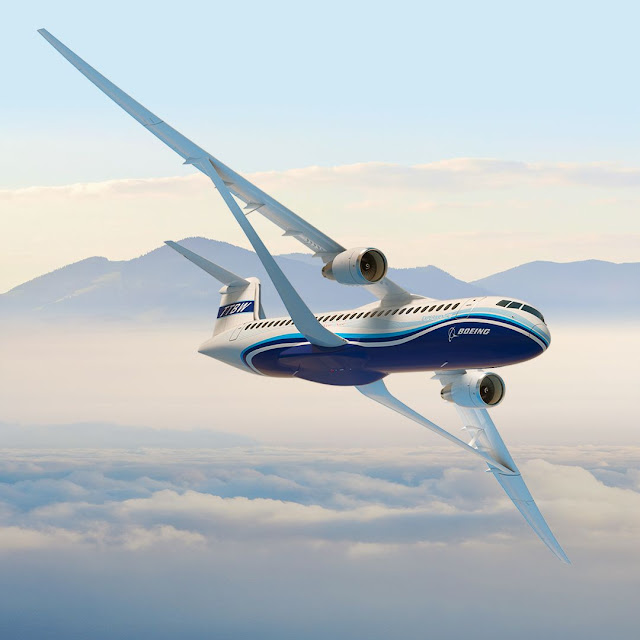
Fast-forward to early 2022 and Boeing is once more preparing to propose a new, potentially game-changing configuration. Although the concept is not yet aimed specifically at a new product, the high-aspect-ratio transonic truss-braced wing (TTBW) is targeted instead at a NASA demonstrator X-plane intended to prove airframe technology for a future highly efficient single-aisle airliner by the mid-2030s.

While other advanced configurations, such as the blended wing body (BWB), are in the frame for the X-plane—also known as the sustainable flight demonstrator (SFD)—Boeing’s TTBW proposal is widely expected to be the front-runner. Not only has Boeing been working on the configuration with NASA for more than a decade, but it is also actively soliciting suppliers to bolster broader industry participation in its bid.

For Boeing, the timing of the competition for the X-plane has assumed even more importance than the research opportunity it presents. Hit by the 737 MAX groundings, the market downturn caused by the COVID-19 pandemic and delays to deliveries of the 787 and 777X, Boeing has had to put near-term plans for all-new commercial aircraft development projects on the back burner. The X-plane therefore offers a chance to continue with tests of key technologies that could play a role in future single-aisle programs semi-independently of the company’s market-driven product-development strategy.

But as Boeing deliberates over its next market moves, ranging from long-term 737 replacements to a potential twin-aisle midsize family, the competition is stirring. The SFD has become increasingly timely in the face of Airbus’ plans to develop an all-new sustainable 100-plus-seat airliner in the 2030s.

TTBW showing areas of reduced drag indicated in areas of green and blueGreen- and blue-colored areas indicate areas of reduced drag in this computational fluid dynamic flow simulation of the TTBW conducted by NASA and Boeing in early 2021

 If all goes according to plan, the new X-plane—which likely will be the largest purpose-built experimental aircraft in the seven-decade-old X series—is expected to begin flight tests in late 2026 and will help mature design, structures and systems technology timed for full-scale development in the early 2030s. The X-plane also forms a key part of NASA’s Sustainable Flight National Partnership (SFNP) plan with industry, researchers and academia, which will support the push toward new airliner technology across a broader front that includes developments in smaller engine cores, electrified aircraft propulsion and high-rate composite aircraft manufacturing.


“In 2022, we expect to put out a request for proposal [RFP] for the design and build of the flight demonstrator, and this is really a big, big deal,” says Rich Wahls, strategic technical advisor for the Advanced Air Vehicles Program at NASA’s Aeronautics Research Mission Directorate. “When was the last time we did a transport-class [aircraft-level] architecture change?” he asks. “My mind goes back to when Boeing did the Dash 80 with swept wings and underslung jet engines. That’s what we’re looking at here—a large-scale honest-to-God, prove-it kind of aircraft that would demonstrate key aspects that you can only do in flight.”

In the run-up to the RFP, NASA awarded study contracts for demonstrator plans to five unidentified companies and is working in parallel with two others on risk-reduction studies—one for the BWB and another with Boeing on the TTBW. “We’ve had wind tunnel tests [of the TTBW] that have gone on since 2013, and there have been aeroelastic tests, high-speed performance tests and low-speed integration tests,” Wahls says. “Often you take these concepts, and as you dig down to the next layer of detail, the benefit goes away. So far, it’s not going away on the truss-braced wing or really on the blended wing. We haven’t found that thing that completely stops either yet.”

Clarifying NASA’s role in the further advancement of sustainable concepts, Wahls adds: “We’re not about product development and doing the next airplane. Industry has their next baseline airplanes on their drawing boards. We’re trying to identify those technologies that are just beyond their risk threshold, both financially and technically, then use those as demonstrations. If successful, we bring them forward into that next generation. If they had enough confidence to put them on the next airplane, then we would have to start looking beyond that. So we’re trying to accelerate insertion of advanced technology into these game-changing architectures across all these projects we’re doing.”

Following a planned first flight in late 2026, NASA says the SFD research campaign will last six months and be completed in 2027. Design, ground test and flight research data from the SFD will be used to measure the winning contractor’s “vision system” performance relative to a set of midterm performance objectives set out by NASA for future subsonic transport aircraft in the 2025-35 time frame.

These targets call for technology readiness levels of 5 to 6 (ready to transition to production development) for an aircraft capable of cumulative noise levels of 32-42 dB below Stage 4 and landing and takeoff nitrogen oxide (NOx) emissions 80% below the International Civil Aviation Organization’s CAEP/6 standards. The requirements also call for cruise NOx emissions to be 80% lower relative to a 2005 best-in-class benchmark, and aircraft fuel and energy consumption levels to be 50-60% lower relative to the same 2005 standard.

As its name suggests, the TTBW configuration is all about maximizing wing efficiency and at the same time opening the aperture for a wide variety of potential future propulsion options, ranging from advanced turbofans and open rotors to hybrid engines and even a tail-mounted boundary-layer-ingesting fan. First developed in 2010 under the Boeing and NASA Subsonic Ultra Green Aircraft Research program to study ultraefficient airliner concepts for the 2035 time frame, the TTBW has continued to evolve into a flexible and practical configuration.

Despite many tweaks over the past decade, the design continues to hinge on the benefits of a high-aspect-ratio wing to minimize drag. The increased span lowers lift-induced drag because the wing is slender, while its reduced thickness ratio decreases profile and transonic drag due to its thinness. The wing is braced by trusses to minimize the weight penalty of the longer span.

The X-plane was originally designed with an unswept wing to cruise at a fuel-saving speed of Mach 0.75, but Boeing is basing its X-plane proposal on a revised wing configuration revealed in early 2019. The newer design is optimized around a 20-deg. swept wing to enable a higher Mach 0.8 cruise speed more typical of current jet airliners. The increase in sweep angle necessitated a redesign of the truss, which has increased chord at the fuselage and forward sweep at the trailing edge and tapers toward the junction with the wing. A small jury strut that connects the truss to the wing has also been moved farther outboard and closer to its junction with the wing. The changes have allowed the truss to generate lift, further maximizing performance.


With an aspect ratio of 19.6, the 170-ft.-span wing of any production TTBW version also will incorporate a 777X-like wing-fold feature. The fold, which is positioned outboard of the truss attachment point, is designed to enable the TTBW to use smaller gates, like those used by the 118-ft.-span 737. For the SFD bid, Boeing expects to modify the fuselage of a donor MD-80 or 717, but it is unclear if these precise wingspan dimensions will be reproduced for the demonstrator, which is also unlikely to include the folding feature.

Boeing is, meanwhile, canvassing industry for potential risk-share involvement in the modification of the T-tail fuselage into the X-plane. The company declined to comment on details of the plan, saying it would be premature to discuss its proposal prior to NASA’s RFP. Boeing did add, however, that it “enthusiastically supports NASA’s vision for a public-private partnership to enhance aviation sustainability under the umbrella of the Sustainable Flight National Partnership, which focuses industry and government on the critical challenges for products being introduced in the 2030s.”

Details of the proposed modification plan seen by Aviation Week show that a significant number of changes and additional systems and structure will be required to transform a McDonnell Douglas-heritage fuselage into the basis for the new X-plane. The biggest of these will involve the design and build of a composite wing with full-span slats and single-slotted flaps. The wing, which will be joined at the centerline above the fuselage, also will incorporate low- and high-speed ailerons.

To meet the required design length of the demonstrator, Boeing plans to remove an unspecified number of fuselage frames as well. This suggests the preferred donor fuselage may be from an MD-80 rather than the shorter DC-9-30-series-size 717. The fuselage will be reinforced with internal bracing from the wing to the existing structure, too, and will utilize the in situ carry-through torque boxes for the nose and main landing gears. The existing gear will be supported by a new pylon and enclosed in a new fairing.

Other changes will include the relocation of the tail-mounted engines to an inboard underwing mounting, where they will be attached with a new pylon and enclosed in purpose-built nacelles and inlets. The engine’s existing thrust reversers will be locked out while the nacelle will feature a purpose-designed anti-ice system.

Several key system changes also will be required, including the development of a fly-by-wire flight control system for the wing-control surfaces. Flight control functions will be hosted in a triplex vehicle management system controlled from a two-crew flight deck that will be modified with an additional flight control computer interface. Among the system changes will be the rerouting of the engine bleed air ducts through the fuselage to the environmental control system packs and the addition of an extra central hydraulic system to augment the existing configuration.

Changes to the interior will include installation of a full flight-test instrumentation suite and accommodation for flight-test personnel as well as provision for a set of pallets for center of gravity ballast.

 It will be interesting if Boeing is able to pull this off, I have seen one of their X planes,not this one mind you, but a different kind when I was in California, she was in Storage.  I want Boeing to pull this off because it can revolutionize the aviation industry...again.


Sunday, August 20, 2023

NASA Continues Developmemt on the Truss Wing.

 I have blogged before about "The Truss Wing" Concept that NASA is developing, another step forward when a former

Delta Airline MD-90 left Victorville to be a donor aircraft for this project.  I do wish that Boeing would work on the "797 NMA" also.  it is like they are putting all their eggs in the MAX basket and surrendering a huge share of the market to Airbus.  The "Boeing 757" is a unique airplane and there is nothing else in the world that can do what she does, you can load it down with passengers and cargo and "weight optimized" issues that force a plane to fly with empty seats don't happen with a 757 like what happens with the "A321" series of airplanes although the NEO version has stronger engines and it is the closest to falling in the catagories that the B757 have.  The 757 is getting long in the tooth and eventually they will retired as is the nature of airplanes. I wish that Boeing hadn't quit making the plane but they did to focus in the 787 and "Boeing MAX" development.


MD90 ferry flight

MD-90 ferry flight

Credit: NASA/Carla Thomas

A former Delta Air Lines MD-90 is being prepared for conversion into Boeing’s X-66A transonic truss-braced wing (TTBW) experimental aircraft after arriving at Palmdale, California, on Aug. 15 following a short ferry flight from nearby Victorville. 

The aircraft, which has been in storage since its retirement from the Delta fleet in 2020, will be modified for NASA’s Sustainable Flight Demonstrator (SFD) project with a new strengthened center fuselage crown section to support the 145-ft. span, high aspect ratio transonic wing. To be mounted above the fuselage, the new wing will have an increased span of 46 ft. compared to the aircraft’s original low-mounted wing and will be structurally braced by trusses that also generate lift.

The low drag wing design alone is expected to reduce fuel burn by up to 10% compared with the conventional cantilevered wings on today’s single aisles. NASA, which launched the SFD project in January, says that when combined with advanced propulsion, composite structures, and other technologies, the TTBW is expected to reduce fuel consumption and emissions by at least 30% for an aircraft entering service in the 2030s.

The goal of the SFD program is to validate the benefits of the TTBW concept at the aircraft level and, if successful, is expected to form the basis for a next generation airliner family to succeed the 737 in the 2030s. Boeing has outlined a possible future family of single-aisle TTBW aircraft, the VS-1 and VS-2 (for Vision System). The smaller VS-1 seats 130-160 passengers while the 180-210-seat VS-2 has a bigger wing and engines.

Based on a configuration developed by Boeing and NASA over more than a decade of collaborative studies under the Subsonic Ultra Green Aircraft Research (SUGAR) program, the X-66A conversion will begin with removal of the MD-90’s existing tail-mounted International Aero Engines V2500s. The forward fuselage will then be shortened by around 14 frames to balance the airframe around the new center of gravity. Additional airframe and system spares will be available from a second MD-90, which was ferried to Palmdale in July.

The X-66A will be powered initially by a pair of Pratt & Whitney PW1100G geared turbofans and, for later tests, is expected to be re-engined with the CFM Open Fan—now in development under the GE Aerospace-Safran RISE program.

The conversion program will take several years with flight tests scheduled to take place at NASA Armstrong Flight Research Center at Edwards Air Force Base in 2028. Although the basic modification could likely be achieved over a shorter timescale, Boeing plans to use the X-66A program for in-depth preparation for a follow-on new development program. The design will therefore go beyond a traditional experimental X-plane to include certifiable features such as a production-like fuel system and fail-safe engine pylon, wing truss, and fuselage structures. 

Although Boeing does expect some fuel to be stored in the center of the X-66A wing, the overall thin cross section means the fuel system will likely be augmented with auxiliary belly tanks, a feature previously developed for the MD-90

Sunday, July 16, 2023

Truss Braced Wing Concept

 My apologies, I have been working a lot of overtime, in the summer is our busy time.  Unless it is absolutely broke or unsafe to fly it is flying because of the demand for air travel.  Other Airlines are having similar demands placed on them.  Like I have stated before, I like to blog, but I like sleep more.

   I had "Blogged Last year about this concept" it is an intriguing design.


TTBW

Credit: Boeing

LE BOURGET—Pratt & Whitney’s selection to power the NASA X-66 transonic truss-braced wing (TTBW) sustainable flight demonstrator may be the opening the company needs to break back into the future Boeing single-aisle market, says Christopher Calio, Raytheon Technologies' president and chief operating officer.

The engine-maker’s PW1100G geared turbofan will power the high-wing X-66 later this decade and is the first engine from the Pratt & Whitney stable selected for any Boeing-built narrowbody since the final 757s were delivered in the early 2000s. The competing GE Aerospace and Safran joint venture CFM International has, by contrast, enjoyed exclusivity on the 737 since the development of the 737-300 some 40 years ago.

“We’ve always said we would love at some point to take our technology and offer it to both of the narrowbody OEMs—that's the position our competitor has today,” Calio says, referring to CFM’s availability as an alternative to the PW1100G on the Airbus A320neo family. “That affords [CFM] a lot of privileges as a result. So we would love to find a way to get back in. Our view is [the TTBW is] a great way to get back in working with Boeing in the commercial engine space in the commercial narrowbody market,” he adds.

However, Calio is also realistic that much needs to be done before Pratt can be fully competitive. “First of all the focus right now is on getting through our issues on the GTF for Airbus and our customers. So make no mistake, we are not taking our eye off that ball, but longer term—in 12 to 15 years—you’ve got to invest. You can't just wake up in 2030 and go ‘hey, we'd love to get back on the Boeing aircraft.’ You have got to be investing along the way in some of these enabling technologies.”

Pratt is currently developing the enhanced PW1100G Advantage version, but has several technology programs under way to reduce fuel burn on the basic architecture by a further 10% or more over the coming decade.

“Dave [Calhoun, Boeing CEO] says any new product will have to be 20-30% more efficient. A lot of that comes from the engines and I think what we've learned as part of the GTF when we rolled it out is just as much as you've got to go drive the efficiency gains, the things you do to get those efficiency gains is you've got to make sure that industrially you can support it. To me, that's just as important. Not only does that does the technology have to be there for those gains, but the manufacturing and support has to be in lockstep,” Calio says.

Thursday, March 2, 2023

"Balloon Shootdown reveals new insight into U.S. and Chinese Capabilities.

I shamelessly snagged this off my work email, it was in the "Aviation Intelligence" reports I get. and It was full of some good information and worthy of "Nicking".

Chinese balloon over Modoc, Illinois

A photo of the Chinese balloon over Modoc, Illinois, on Feb. 3 reveals potentially breakthrough design features for ultra-long-endurance, lighter-than-air systems.

Credit: Frank Melliere

More than two years before a U.S. Air Force F-22 shot down a Chinese spy balloon off the coast of South Carolina on Feb. 4, Zheng Zhenfeng, an employee for Taiwan’s weather service, photographed a similar object floating high above Taipei, Taiwan, on Sept. 26, 2021.

Zheng’s boss, Zheng Mingdian, is certain the two events are connected, revealing a perhaps yearslong, high-altitude spying campaign by the People’s Liberation Army across the world using a new form of lighter-than-air technology.

  • Japan, Taiwan and U.S. targeted by Chinese surveillance balloons
  • Opaque fabric points to possible innovation


“The high-altitude spying balloons in the news have been around a long time, and [my] weather-agency colleagues took [pictures of] them two years ago,” Zheng Mingdian, executive director of Taiwan’s weather service, wrote on Facebook on Feb. 4. “Before that, there were photo records elsewhere, too, for many years.”

The bizarre five-day, 2,000-mi. journey across the U.S. of China’s apparent spy balloon revealed three important new insights: A Raytheon AIM-9X Sidewinder-armed F-22 can shoot down a floating object above 60,000 ft., U.S. officials believe Beijing has waged a yearslong aerial spying campaign with high-altitude balloons, and some experts think the Chinese vessel reveals a potential breakthrough of ultra-long-endurance, lighter-than-air technology.

The Lockheed Martin stealth fighter’s capability to down a high-altitude balloon had never been tested or possibly even conceived, but the brazen violation of U.S. airspace prompted President Joe Biden on Feb. 1 to order a shoot-down attempt, White House officials say. Some criticized the decision to allow the balloon to cross the U.S. landmass, but military officials insisted the balloon’s surveillance capabilities posed no threat to national security. Military analysts also gained ample time to study the alleged spycraft’s behavior and emissions, while the fighter-pilot community ran simulations to determine the best way to attack the unfamiliar target.

“I don’t know that they’ve tested [the] AIM-9 at that altitude,” says Gen. Glen VanHerck, the head of North American Aerospace Defense Command. “I’m not aware of any engagements against a high-altitude balloon such as this.”

The F-22 from the 27th Fighter Sqdn. did not act alone on Feb. 4. Another F-22 flew armed and ready as backup in case the first shot missed. A high-altitude balloon—even a 200-ft.-tall balloon—presents a challenging target for a heat-seeking missile, with a dim thermal signature and a helium gas void within the envelope. The F-22 appeared to aim instead for a 70-100-ft.-long (20-30-m) horizontal truss dangling from a single line beneath the balloon—VanHerck compared its length to an Embraer ERJ 135 or ERJ 145. Ground-based civilian photography revealed that the structure carried 16 solar panel arrays and three inboard stations or pods.

The heat generated by the electronic systems appeared to be enough to provide a targeting lock for the imaging infrared seeker in the AIM-9X. The height of the target—60,000-65,000 ft.—still required the missile to ascend several thousand feet from a launch point at 58,000 ft., a senior defense official says. The result was a perhaps unlikely first air-to-air kill against a balloon by the U.S. Air Force’s premier fighter.

“I’m really incredibly proud of everybody that took part in this, but the F-22 was remarkable,” VanHerck says.

Two U.S. Navy ships—the amphibious landing ship USS Carter Hall and the survey ship USNS Pathfinder—are mapping and collecting pieces of the debris from the balloon that now lie scattered over an approximately 1 mi. X 1-mi. box about 50 ft. below the surface roughly 6 mi. off the South Carolina coast.

Balloon recovery

Sailors assigned to Explosive Ordnance Disposal Group 2 recovered the high-altitude surveillance balloon off the coast of Myrtle Beach, South Carolina, Feb. 5. Credit: Mass Communication Specialist 1st Class Tyler Thompson/U.S. Navy

In the age of hourly satellite overflights and relentless cyberattacks, an inflated surveillance system slowly drifting over Alaska, Canada and the continental U.S. appeared at first to stand as an unusual—inexplicable, even—one-off event. But the story quickly grew as reports emerged of similar balloon sightings around the world, including an ongoing balloon flight over South America, previous incidents in East Asia that had gone unexplained and a newly discovered trial of previous balloon flights over U.S. territory, including Guam, Hawaii, Texas and Florida. Instead of a singular provocation, a pattern has developed of Chinese spy flights by slow-moving high-altitude balloons, which had gone apparently undetected by U.S. surveillance systems.

“I will tell you that we did not detect those threats, and that’s a domain awareness gap that we have to figure out,” VanHerck says.

Although the previous overflights above U.S. soil had been missed, the intelligence community kept track of China’s spying balloon campaign in other parts of the world. Congress was briefed about the program in August, White House spokeswoman Karine Jean-Pierre says.

“There has been a program that has been in effect,” Jean-Pierre adds. “We have kept Congress abreast on that. But I don’t have anything more to say or to share.”

In fact, the evidence for such a spy effort has been available in the public domain for several years, but the shock of the U.S. overflight helped bring it back into focus. In addition to high-altitude balloon sightings over Taiwan in September 2021 and March 2022, Japanese government officials reopened reviews of similar publicly reported overflights of Japan in June 2020 and 2021.

When a similarly spherical white balloon flew near Miyagi prefecture in northeast Japan in 2020, photos of the object showed a perhaps earlier version of the technology that entered the U.S. on Jan. 31. In that case, the dangling support truss supported 24 solar panel arrays, payloads and a crosswise boom. The latter appeared to include a set of outboard-mounted propellers. It was not clear if the propulsive devices were being used to steer the balloon or the structure housing the payload.

By contrast, images of the latest balloon captured by photographers on the ground with telephoto zoom lenses appear to show a major evolution in the design of the payload module, including one-third fewer solar panels, three inboard payload modules and no clear evidence of any propellers.

Such long-distance visual evidence contrasted with remarks by John Kirby, the National Security Council spokesman. “It had propellers,” Kirby says. “It had a rudder, if you will, to allow it to change direction.” Civilian photos provided no signs of a rudder aboard the balloon, and it is not clear how such a control surface would help steer a spherical, slow-speed object. Kirby also may have been speaking metaphorically about a rudder.

In any case, members in the high-altitude balloon community have identified potentially significant technology advances exhibited by the Chinese vessel.

The few examples of ultra-long-distance, high-altitude balloons, such as Google’s canceled Loon project, share a few common traits: a pumpkin-shaped, superpressure envelope, internal ballonet and translucent fabric.

The final item in that list is essential for regulating the temperature—and therefore pressure—inside the helium envelope. A translucent fabric allows most light to pass through the balloon without heating the helium gas inside.

But the Chinese balloon appeared to use an opaque fabric over a pumpkin-shaped helium envelope. If confirmed, China’s program may have been the first successful design to use a helium envelope covered by a fabric that reflects the Sun’s energy rather than letting it pass through, says Dan Bowen, a former balloon systems engineer at Project Loon. The result suggests a breakthrough by creating a more efficient system to regulate temperature without adding too much structural weight.

“I’m sure the rest of the world will quickly investigate this,” Bowen says in an analysis released on Stratospheric Balloon Science, his YouTube channel.

The most advanced ultra-long-endurance, high-altitude balloons seldom use propellers for directional control. Instead, such aircraft pump regular air into an internal ballonet envelope to descend or release the air to climb, Bowen says. Altitude adjustments are made to find wind currents moving in other directions. The system provides a limited capability for directional control.

U.S. researchers have worked on similar technology with the Strat-OAWL (stratospheric optical autocovariance wind lidar) device, which Ball Aerospace flew on DARPA’s Adaptable Lighter-Than-Air (ALTA) balloon in 2019. ALTA was aimed at demonstrating a high-altitude, lighter-than-air vehicle capable of windborne navigation over extended ranges and, according to DARPA, could navigate without independent propulsion by changing altitudes in excess of 75,000 ft. 

A key element of ALTA was development of a Winds Aloft Sensor, which in the case of the DARPA project could send real-time stratospheric wind measurements back to the ground. The Ball Strat-OAWL system, which dates back as far as 2004 to proof-of-concept hardware efforts, is designed to measure winds from aerosol backscatter at the 355-nanometer or 532-nanometer wavelengths.

Meanwhile, the debris recovery effort also may help answer questions about the capabilities of the Chinese balloon’s alleged surveillance payload. The decision to allow the balloon to cross the U.S. before shooting it down was based on a military assessment that the onboard sensors provided no threat, Kirby says.

“The time that we had to study this balloon over the course of a few days last week we believe was important and will give us a lot more clarity not only on the capabilities that these balloons have, but what China’s trying to do with them,” he says

Wednesday, October 4, 2023

"Why Boeing Needs to develop a new Commercial Plane

 I snagged this off a 3rd party email at my work,  The overtime is fixing to come to a stop so I will be able to catch my breath...YAY!

Boeing’s X-66 braced-wing aircraft design

Credit: Boeing

There is no denying that Boeing has lost share to Airbus in the narrowbody/single-aisle aircraft market. Once the world’s preeminent OEM in that market, it now possesses less than 40% of narrowbody/single-aisle orders versus No. 1 Airbus. While the longevity of Boeing’s 737 is impressive, the aircraft is now a bit of an anachronism. For pilots, operating the aircraft is like driving around in a 1968 Chevy Impala with a dashboard that has a tape deck and ashtray.

Consider this: The 737 is the only commercial aircraft being manufactured now without fly-by-wire controls—a staple in modern aircraft control system design. All the while Airbus continues to gain narrowbody market share, given the capability and popularity of the A220 on the low end and the A321 on the high end.

Despite some recent improvements to the 737, it is a disappointment to the broader commercial aerospace industry that Boeing has effectively shelved plans for a new clean-sheet model anytime soon. Last November, the company delayed the prospect of developing an aircraft with 20-30% efficiency gains until the mid-2030s, citing limited technology that is accessible now. However, this is far from true. In fact, conservative projections indicate that a clean-sheet model could be roughly 40% more efficient than current aircraft.

However, to capture greater capability and fuel efficiency, commercial OEMs will need to incorporate more recent innovations in aircraft design and technology that can drive enhanced performance. An unducted turbofan, fueled by more environmentally friendly sustainable aviation fuel (SAF), is efficient and clean enough to yield the level of performance expected for a next-generation aircraft. The aircraft could likely feature a high-wing configuration, enabling natural fuel pressure and larger unducted turbofan engines.

High-wing aircraft often provide increased stability, given that the center of gravity is below the wing, which allows the fuselage to act almost as a pendulum and increase lateral stability. While this configuration is not more efficient, high wings offer more ground clearance, which helps protect the engine in cases of uneven terrain and allows for larger, more efficient engines under the wing. Additionally, an enhanced airframe featuring a higher-aspect-ratio high-wing configuration (possibly featuring lift-generating truss braces) and a more aerodynamic fuselage comprising more composite materials could contribute roughly 10% greater efficiency to a new aircraft.

While noisy and somewhat cumbersome, an open-rotor/unducted turbofan engine could contribute approximately 30% of these savings through lower fuel burn. Open-rotor engine technologies have the potential to lower fuel burn and CO2 emissions substantially relative to turbofan engines with the same amount of thrust. To achieve higher propulsive efficiencies with a turbofan engine, the bypass ratio must be increased with a larger fan diameter, but this increases weight and drag of the aircraft. On the other hand, the lack of a nacelle expands the area of air on which the blades can work.

Given the capability and efficiency gap between shorter-haul narrowbody aircraft and longer-haul widebody aircraft, a clean-sheet model of this caliber should make sense in the still-underserved middle of the market. An aircraft family featuring 150-300 seats and 3,000-6,000-nm range could open the door for narrowbody upgauging (operators seeking more capable aircraft) and widebody downgauging (carriers looking for smaller, more efficient aircraft to service shorter routes). Additionally, a new midsize aircraft could unlock previously untapped demand. For instance, Boeing boasts that its 787 model opened 235 previously unserved routes. Given the versatility of a midsize aircraft in straddling short- and long-haul markets, such a model could open up a similar quantity of new routes. Altogether, this could spur demand for about 6,500 aircraft over the next two decades.

While development of a clean-sheet midsize model could take 7-8 years and require a collective investment of $15-20 billion, the returns could be significant and industry-shifting. Assuming a list price of $75 million per aircraft and 20-25% gross margins (in line with Boeing legacy platforms), Boeing stands to amass a collective gross profit of $100-120 billion, well above the required initial investment. Aside from the financial incentives, this will give Boeing an opportunity to regain its once-distinguished reputation. Furthermore, it would demonstrate that the company is still a design powerhouse with the potential to bring cutting-edge, environmentally conscious aircraft to market.

Monday, July 22, 2013

More surprises from the Asiana Boeing 777 Crash


   I am ripping this off of Aviation week magazine, it is one of the things I read to keep up in the world of Aviation.  Since for me, that is where the money is.  I have worked on 777 and they are a very complicated and very well built airplane.  the beating that this one took and most of the people survived is a testiment to the engineering and skills of Boeing Commercial Aircraft.

    
July 15, 2013
Credit: Justin Sullivan
While NTSB investigators look closely into the actions of the flight crew for potential causes behind the July 6 Asiana Airlines Boeing 777-200ER accident, safety experts working on the other side of the cockpit door are already learning valuable new design lessons for crash survivability.
Although all but two of the 307 passengers and crew survived the ordeal, more than 180 were injured, several of them critically. Therefore, while looking into why the crash occurred in the first place, the investigation is focusing just as closely on why these injuries and deaths were sustained, and it has already unearthed troubling concerns about the functionality of the aircraft's main exit escape slides.
Video and eyewitness accounts testify to the violence of the aircraft's brief passage along San Francisco International Airport's Runway 28L before coming to an abrupt halt to the south side of the strip, adjacent to the touchdown zone markers some 1,500 ft. from the threshold. Although the aircraft did not cartwheel in the same devastating way as in the 1989 DC-10 crash in Sioux City, Iowa, it was massively damaged by an initial impact with the seawall and the displaced runway threshold, during which parts of the main landing gear and the entire empennage were ripped away. Traveling at over 100 mph, the aircraft departed the runway at the touchdown markers where it became partially airborne again, pirouetting in a complete 360-deg. circle around its nose section.
     During this high-speed ground loop, the aft end of the tailless fuselage momentarily pitched up at around 40 deg., causing passengers and crew in the back section of the cabin to fall vertically as much as 100 ft. when the aircraft came to a rest with its nose pointed back toward the runway. Despite this pummeling, the fuselage structure remained substantially intact with the extensively damaged wings appearing to have borne the brunt of the impact loads. Although the forward two-thirds of the fuselage was gutted by the post-crash fire, the overall structural integrity of the cabin section was not immediately compromised by the impact itself, with significant buckling only evident in two zones: forward of the wing root and aft by Section 47/48 where the empennage was broken off.
     The NTSB says the fire was caused by oil leaking from a ruptured tank onto the damaged remains of the No.2 (starboard) Pratt & Whitney PW4090 engine, which was ripped from its wing mountings and lay beside the fuselage. The left engine was detached during the initial ground roll and came to rest on the north side of the runway, just under 2,000 ft. from the threshold. While the fire makes it more difficult for investigators to assess the post-crash condition of the forward and mid-cabin sections, the intact aft cabin is yielding information about the survivability design aspects of seats, interior paneling, overhead bin structures, seat tracks, cabin floors, exits and escape slides.
      Images released by the NTSB of the aft cabin, close to the buckled section by Doors L4 and R4, show how the seating, cabin floor and ceiling in some areas, were significantly damaged and dislodged. Already weakened by the initial impact and loss of belly skin and structure below Section 47/48, the bulk of the aft cargo hold and lower lobe structure beneath the floor of the aft cabin appears to have been either ripped away by the slide along the runway or crushed by the vertical impact that ended the ground loop.
Nevertheless, despite massive damage, investigators say the surprisingly small number of fatalities and relatively intact interior present a very survivable picture, with much of the internal trim, ceiling panels and sidewalls still in place. This is partly thought to be due to Boeing's internal design concept, in which the tie rods supporting the arch of the secondary support structure (which holds the interior of the cabin ceiling panels and overhead bins to the fuselage monocoque) transfer loads above 46,000 lb. and withstand loads of up to 9g. Tie rods were built to absorb up and down loads, while truss-type sway bracing structure support the ceiling laterally. The seats are designed to meet the 16g crash load certification standard, while the seat tracks were originally designed to cope with stresses of 9g.
  
    
However, San Francisco hospitals that dealt with the injured report an unusually high number of spinal injuries, the worst of which include crushed vertebrae and torn ligaments, testifying to the excessive lateral and vertical loads sustained during the accident. Although safety experts say assuming the crash position would have limited jolting to the spine, passengers appear to have received little or no warning of the impact. According to Randy Scarlett, board director of the California Brain Injury Association, “there were significant spinal cord and traumatic brain injuries with the first wave of patients. More subtle concussions and spinal cord injuries were in the second wave of those patients coming to San Francisco General [Hospital].” Scarlett expects that while 80% will fully recover, “20% will be affected for a significant time in their lives.”
Commenting on the safety implications, former NTSB Chairman Jim Hall questions the adequacy of the current 16g dynamic seat standard. “I believe that it is time to update aviation seat standards to take a stronger G force, especially in light of the many recent spinal and head injuries,” he says. The regulation requiring all newly developed transport aircraft to use 16g-capable seats was issued by the FAA in 1988, superseding rules at the time which mandated a static 9g standard with no occupant injury criteria.
From a systems perspective, investigators are focusing on the performance of the safety systems, door operation and emergency inflatable slide deployment. “We're taking a very close look at survival factor issues, including emergency doors and exits, and to see if there were any malfunctions,” says NTSB Chairman Deborah Hersman. The most serious of these occurred during the evacuation, when two cabin crew were “pinned” against the cabin side by escape slides that inflated inside the aircraft at Doors 1R and 2R. At least one flight attendant had to be rescued by the relief first officer who helped deflate the device. “We need to understand why that happened, and if it happened inadvertently,” says Hersman.