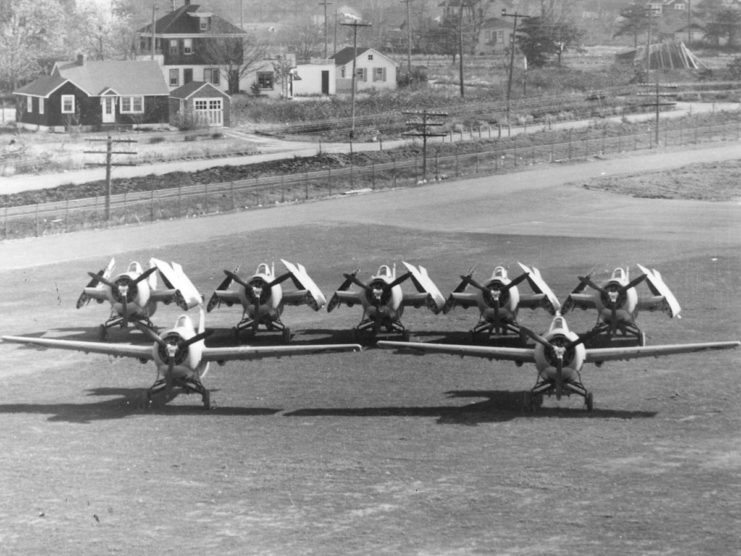
I figured I would do a post on a fighter that to my mind never really got it's accolades because she was overshadowed by her more powerful sibling the F6F Hellcat. I always liked the simple lines of the Wildcat, and in the hands of a good pilot, she could hold her own against the newer fighters that the Japanese had and she went toe to toe with the most feared Japanese fighter, the legendary "Zero".
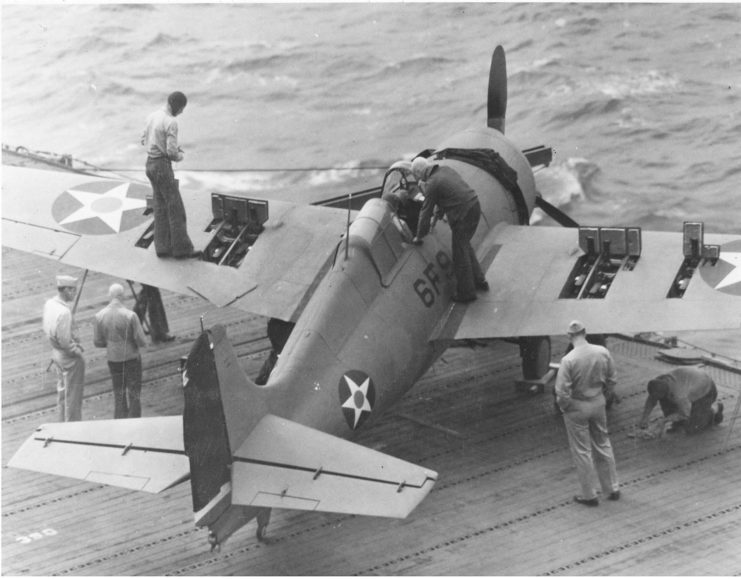
This is a prewar/early WWII version. The "Red" meatball in our national insignia was removed shortly after the war started. There was fear of target misidentification in the haze of combat since the Japanese used the "meatball" on their national insignia.
Despite its slightly odd origins, the Grumman F4F Wildcat was one of the most valuable fighter planes in the US arsenal of WWII.
Go to the Museum of Naval Aviation in Pensacola, they will let you "touch" the airplane...The museum is well worth the visit.
The design for the Wildcat started out as a biplane, as they were still around for many years between the world wars. It was redesigned as a monoplane in 1936, but retained many of the features of its previous design, giving the Wildcat its distinctive, slightly squat look.
Another of the Wildcat’s visually distinctive features was its entirely riveted fuselage. It gave it an industrial look that was at odds with the canvas-covered planes of WWI. Welded or flattened rivets were beginning to be used to make the planes of the 1930s and 40s more aerodynamic.
The Arrestor hook shown lowered was to snag the Arrestor cable that was strung across the deck of the carrier to show the plane down and stop it before it crashed into the other airplanes that were in front of the carrier
The Wildcat was designed and commissioned as a carrier-borne fighter. The relatively new and distinctive use of aircraft carriers was increasingly important, as the world’s most powerful militaries started to use air power for victory at sea. The limited space available for taking off and landing and storage of planes on ships created new design challenges. It meant a different sort of fighter was needed at sea.
Although the Wildcat would become a symbol of American air power, it was first purchased by the French, who placed an order in early 1939.
Later that year, the US Navy followed suit. In August 1939, they placed their first order for F4Fs with Grumman.
XF4F-3 prototype Wildcat in flight, 21 July 1939.
With the fall of France, the F4Fs destined to join the French Navy were diverted to Britain reaching Britain’s Fleet Air Arm in July 1940.
Like the Curtiss P-40, the F4F was given different nicknames by the British and Americans. Most people remember it by its more dynamic American name, the Wildcat. Initially known to the British as the Martlet, in January 1944, they too adopted the Wildcat name.
The F4F packed quite a punch due to its extensive arsenal. It carried six machine-guns in its wings and could also carry two bombs or six rockets. Its firepower made it popular with the crews flying it.
Less popular with pilots was the F4F’s handling. It was considered a tricky fighter to control both on the ground and in the air. For the pilot who could master it, the F4F was well worth the effort, as it was very maneuverable, a vital asset in the fast-moving action of dog fights.
One of the main features of the F4F-4 were the Sto-Wing-design folding wings, a Grumman patented design.
The F4F had a maximum speed of 332 miles per hour. It was not one of the fastest planes of the war, but neither was it the slowest.
The F4F could fly to around 34,700 feet, climbing at 2,000 feet per minute toward its top altitude.
The F4F was a tough plane to bring down. It had a self-sealing fuel tank and armor plating that gave it greater endurance than many of its opponents. The self-sealing tank was particularly crucial to the survival of a plane. Without it, a bullet through the fuel tank could turn it into a fireball or force a plane to crash due to lack of fuel. Self-sealing meant that it took a cannon shot to inflict such devastation.
Capt Thatch had developed the "Thatch Weave" to help the Wildcat fighters in their dogfights against the more nimble, but much more fragile Zero.
Wildcat of VF-6 testing out machine guns aboard USS Enterprise, 10 April 1942.
The first Martlets in British service joined No.804 Squadron in the Orkney Islands, north of Scotland. They were used to control routes from the North Sea to the Atlantic. In December 1940, two Martlets shot down a German plane, making them the first American-built, British-piloted aircraft to do so in WWII
The first F4Fs to go to sea in wartime were Martlets of No.802 Squadron. Operating from on board HMS Audacity on September 20, 1941, they shot down a German Focke-Wolf 200 which was following their convoy.
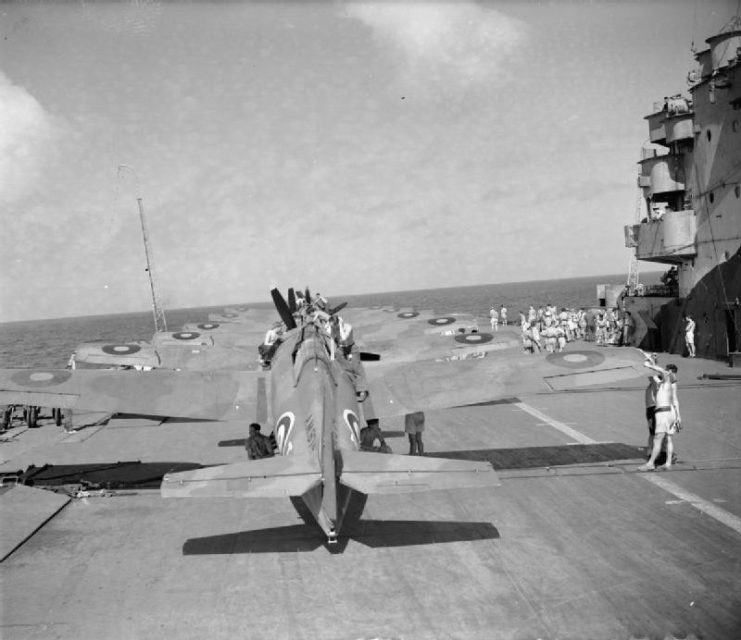
Martlet fighters on the flight deck of HMS Formidable, 1940s.
The F4F was involved in the extensive action in and around the Mediterranean. The Royal Naval Fighter Unit deployed Martlets over the Western Desert in Africa, where they fought Italian planes in the fall of 1941. They tangled with the Italians again in August the following year while escorting supply ships around Malta. Further south, Martlets fought against Vichy French planes over Madagascar in May 1942.
By the time America joined the war in December 1941, the F4F was the most common plane on American aircraft carriers. It was also popular among US Marine Corps units based on land. Until the arrival of the Hellcat in 1943, it was the US Navy’s only carrier-borne fighter. It played a critical role in many of the Navy’s most important actions.
One of the most important land bases that Wildcats operated from was Henderson Field on Guadalcanal. The site of the first offensive operations of America’s Pacific war, it was where many Wildcat successes occurred. One eight-plane flight achieved 72 aerial victories in the space of only 16 weeks.
The leader of the group, Captain Joe Foss, was one of the most successful pilots ever to get behind the controls of a Wildcat. During the fighting at Guadalcanal, he destroyed 26 Japanese planes, five of them in one day. For his remarkable achievements, he was awarded the Congressional Medal of Honor.
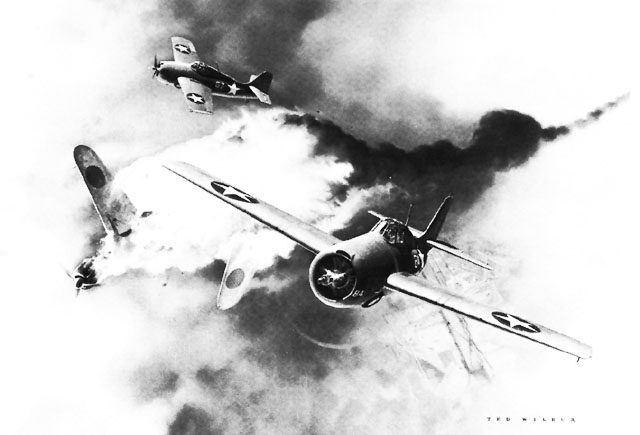
Watercolor of U.S. Marine Captain Joe Foss shooting down a Zero over Guadalcanal in October 1942.
Despite its many successes, the Wildcat struggled against Japanese Zeros. The US Navy phased it out in favor of the F6F Hellcat in 1943.
Wildcats of Taffy 3 taking off to strafe the Japanese fleet attacking it, the Japanese fleet included the IJN Yamato, the largest battleship ever built. According to reports, the Japanese were stunned by the resistance and the Americans throwing themselves at the enemy with such abandon, the fighting spirit of the Americans forced the Japanese to withdraw thereby saving General McAuthur's beachhead in Leyte Gulf
The last Wildcat victory of the war took place over Norway in March 1945. Wildcats of the British No.822 Squadron shot down four German Messerschmitt Bf109s
I shamelessly clipped this from Tom Kratman and farcebook a couple days ago. I thought it was a pretty good post. I have blogged a bit about "Battleships" in the past on my blog.
In Starship Troopers Heinlein listed as one of the branches possibly open to Rico, "Combat Ecology." I've always thought that referred not to saving the interstellar snail darter, but the relationship between weapons systems and tactics that advance some groups and depress or eliminate the use of others.
Hence, this very thoughtful peace from Quora on, though the author didn't phrase it that way, the combat ecology of the battleship:
Could a modern navy build a new class of battleships, or would such vessels be obsolete?
Eric Husher, former Senior Balkan Intelligence Analyst (1992-1996)
Answered Feb 12 · Upvoted by Olan Prentice, Veteran at United States Navy
The short answer is ‘no,’ as I will explain.
I think one of the more pernicious myths is that ‘the battleship was made obsolete by the aircraft carrier and has no function today.’ You see this in book after book, but a closer examination of the facts indicates otherwise.
It is important to understand a few things about battleships before talking about ‘obsolescence’ or aircraft carriers, and the FIRST thing to know is that battleships are the direct descendants of the ‘line of battle’ of Nelson’s time. In other words, they were NEVER intended to operate alone, or as ‘a pair,’ but as a SQUADRON of no fewer than four, and preferably more, with the squadron being considered the minimum necessary to conduct all maneuvering evolutions. Squadrons would be combined to produce fleets, and it was the squadron that was used as the minimum tactical unit for battleships. This ‘understanding’ held true until WW2, when events forced navies to use battleships otherwise, and with invariably poor results.
The next thing to know is that battleships were not just intended to deliver powerful blows (like modern warships), but to RECEIVE and WITHSTAND powerful blows as well (unlike modern warships), and thus, could not just ‘stand in the line,’ but STAY in the line regardless of multiple hits. It was this dual function that produced the international naval armaments race prior to WW1, as newer and stronger forms of armor and design were developed, and at the same time, newer and more powerful naval guns were successively produced to defeat that armor. Such ships produced from the 1880’s until the end of the ‘battleship era’ at the conclusion of WW2, were rapidly made obsolete by these rapid advances, such that a battleship might only have a useful life of less than ten years before being superceded by a much more powerful version, and of course, this was a VERY expensive proposition. As well, the logistics tail necessary to produce a battleship, its armor, engines and weaponry was likewise very expensive and quite specialized in nature and with little application outside the production of more battleships. Consider the equipment necessary to found, forge, and roll out enormous plates of armor steel as much as 16″ thick, and you get some idea what I am talking about.
This ‘process’ and ‘race’ by nations to create the ‘ultimate’ battlefleet found its ultimate expression just before WW1 with the invention and production of the ‘dreadnoughts;’ heavily plated with armor belts up to 14″ thick, oil-fired turbine engines to produce a minimum speed of 20 knots, and an ‘all-big gun’ armament of eight or more guns firing 11″ to 15″ diameter shells as much as 20 KM to hit their targets. These dreadnought battleships, and their dreadnought battlecruiser escorts proved their worth and lived up to their reputations in WW1, but because they WERE so expensive to produce, and any losses would represent such a loss of national treasure, there was a fair bit of concern as to how boldly they might be used. The Germans in particular (because they were outnumbered by the British navy), were loath to ‘commit’ their fleet in anything other than an opportunity whereby they might outnumber the British by trying to isolate a squadron or two of British ships that they might then destroy with their own numbers. The British attempted numerous times to achieve the same effect, but at the end of the day, there were really only three significant clashes between the behemoths, at the Falklands, Dogger Bank, and of course, Jutland.
The ‘performance’ of the battleships in the clashes can be considered not just by the amount of hits achieved, and damage inflicted, but by the number of times these ships were hit and did NOT simply explode or immediately sink, but in fact ‘stayed in the line’ and returned home in some cases wounded, but alive. The German battlescruisers were each hit by as many as 28 heavy shells of 12″, 13.5″ and 15″ shells, yet CONTINUED to fight and return damage of their own (three British battlecruisers were sunk that day, in return for the loss of but one German battlecruiser).
Such was the concern over the capabilities and expense of these ships, that after the war, long thought was given to the need to restrict the building of further battleships, and the reduction in the number of existing battleships both as a means of ‘improving the chances for a lasting peace,’ but more importantly, to protect the nations from bankruptcy. The goal of these various treaties and negotiations was to produce national fleets that were much smaller than those of the Great War and prior, with the leading nations restricted to no more than two or three battleship squadrons, depending on the nation involved (the US got three squadrons, as did the Brits, but the Japanese were only allowed two, the French and Italians one each, and the Germans NONE).
By the middle of the 1930’s, many of these battleships were becoming quite elderly, and replacements were designed on much more modern principles, with serious thought given to the threat of air-power. It is concurrent with this period that the first fleet aircraft carriers became fully operational. Because of the reduced size of the battleship fleets available, some nations, particularly the Japanese considered that the only way to achieve the kind parity necessary to fight on an equal footing was through increasing the size, firepower and armor of any new ships built. This was the origin of the ‘Yamato’ class super-battleships. Other countries like the US and Britain were similarly concerned, but with more modest ideas, such as the American ‘North Carolina’ class, and the British ‘Rodney’ class. Other nations were concerned with the rise of such threats as the German ‘pocket battleships’ of the ‘Graf Spee’ class (which in reality were not much more than rather slow heavy cruisers), producing a couple new battlecruisers of the ‘Dunkerque’ class, but generally speaking, none of these materially increased the sizes of the fleets concerned, and with the restrictions on battleship production, all navies turned to the ‘Heavy Cruiser’ as their means for fleet expansion, and just as was the case prior to WW1, produced yet another ‘arms race’ to produce the most capable heavy cruisers possible within the treaty tonnage regulations.
The result of all of this was two-fold; the remaining battleships were now even MORE precious than they were during WW1, and many of the ‘tasks’ previously assigned to battleship or battlecruiser squadrons were now assigned to the heavy cruisers, and all the while the aircraft carriers became more capable and more dangerous, with the actual ‘threat’ being brought home by the British at Taranto, and the Japanese at Pearl Harbor.
NOTE: At this early point in WW2, battleships were now being deployed in pairs, not squadrons, both because of the lack of available battleships, and the concurrent loss of OPPOSING battle squadrons. This was the case for the Bismarck’s first and final cruise, opposed by a battleship and a battlecruiser (Hood), the latter of which was sunk by the German guns, but the Bismarck after escaping further attacks by the British battleship, was tracked down first crippled by aircraft torpedoes, and then finished off by a combined squadron of battleships, heavy cruisers and destroyers. Bismarck was ALONE. The Italians had a number of sorties with their battleships, invariably in pairs, and they accomplished little when faced by a similar number of British battleships and cruisers accompanied by aircraft carriers, and it was this that became the key to the future, the combined ‘task force.’
In the Pacific, the severe blow against the US battleship fleet by the Japanese as well as the British loss of a battleship and battlecruiser (again, operating ALONE and without air support) meant that there were essentially too many areas to cover to allow for the kind of ‘squadron operations’ for which the battleships were designed, and instead, the fast battleships were deployed singly, or in pairs as escorts for carrier task forces, and the heavy cruisers took up the tasks that once would have been assigned to battleships. As such the battleships were not really intended to provide ‘surface support,’ though of course that would be readily available in the event of a surface attack, but instead to use their formidable air defenses to cover the carrier from air attack, and in this role, the American battleships eventually ruled supreme. On the Japanese side, while they would often provide a ‘Kongo’ class battleship to escort carrier groups, the Japanese never assembled the kind of ‘task forces’ made so effective by the Americans. Part of the reason for this was the Japanese did NOT want to expose their battleships to situations where they might be lost individually, but preferring to keep them ‘in reserve’ for what they hoped would be a climactic ‘final battle’ in which they WOULD be used in squadrons against a weakened American fleet.
But here comes the interesting and notable part. When the Japanese finally DID deploy their battleships in squadrons (Leyte Gulf to the battle of Samar), they were duly attacked by swarms of American aircraft, HUNDREDS of American aircraft, equipped with 500 and 1000 lb bombs and torpedoes too. But only ONE of the Japanese battleships (‘Musashi’) was STOPPED by the aircraft, and only after receiving 19 torpedoes, and 17 heavy bomb hits over three continuous hours of air strikes before she was sunk! ANY of these kind of hits would have stopped, or even sunk most modern warships, and in the MEANTIME, the REST of the Japanese battleships and cruisers proceeded to their destination and point of attack. Yes, these ships were eventually driven off by hundreds more American planes, but no more battleships were lost in this quadrant, and they RETURNED to Japan for further use. Further South, a PAIR of Japanese battleships accompanied by heavy cruisers managed to escape the attentions of the American aircraft and proceeded down Surigao Straight by night, with the idea of attacking the American landing force from the rear. Unfortunately, they were met by… TWO SQUADRONS of American battleships, in a classic ‘line of battle,’ and after a number of broadside salvoes, BOTH Japanese battleships were SUNK, the cruisers were damaged and several destroyers likewise sunk. ‘See the difference?’
In a different scenario, that also involved waves of carrier aircraft flying against battleships, the example of the ‘Marianas Turkey shoot’ otherwise known as the ‘Battle of the Philippine Sea’ provides yet another example of the relative inability of aircraft against battleships. In this case, the American fleet was steaming North for the preliminaries of the invasion of the Philippines, and this brought the last big effort by the Japanese carrier forces to bear. However, while their primary targets were the big American carriers, in order to GET to them, they had to fly over an American battleship squadron and cruiser/destroyer task force in a ‘ring’ formation that stretched over tens of miles. As the waves of Japanese attack planes flew over, they were MOWN down by battleship anti-aircraft fire using ‘proximity fuses,’ and hundreds of Japanese planes were shot down before they ever arrived in the vicinity of the American carriers. Once again, battleships operating as a squadron at sea are a devastating force to contend with.
So what HAPPENED at the end of WW2? Why were no new battleships built, if they were such powerful warships? TWO things happened; the first being the atomic bomb, which was used in several tests against anchored fleets to see ‘what would happen,’ and the results were pretty devastating, even though many of the battleships so employed actually SURVIVED the tests. The second was the fact that, other than the United States and the UK, no one else HAD any battleships to speak of, let alone ‘squadrons.’ Britain finished ONE new battleship after the war (Vanguard), and the French had one, and finished another (Richelieu and Jean Bart), but their industries were largely destroyed by the war, and Britain’s economy was destroyed by the war, all heavy industry in Europe was destroyed by the war, and the Soviet Union was likewise devastated. At the same time, the US at this point now had 12 modern fast battleships, and a bunch of old ones (soon to be decommissioned), and an untouched industrial base and economy too. In other words, there was NO ONE ‘available’ to provide any naval competition, and with the Brits rapidly decommissioning and scrapping its battleships, soon to be followed by France, there was simply no CHALLENGE to the mighty American battlefleet. But battleships are expensive to maintain, and expensive to man, and as we already had an unrivalled fleet of aircraft carriers, there seemed to be no further USE for the battleships, and one by one they were put into mothballs, scrapped, or turned into ‘memorials.’ At the same time, the steel industries, now no longer needed to produce battleships, quickly scrapped the heavy and expensive equipment needed to build them, and by the mid-1960’s there was no longer the CAPABILITY to ‘build battleships,’ even if we wanted to. It is for this reason the last and most modern class of American battleship, the ‘New Jersey’ class, have REMAINED in operational condition, and in fact, they have been dragged out of mothballs and recommissioned several times since WW2, including Korea, Vietnam, and their last deployment was for the First Gulf War. That is not an ‘indication’ that battleships or the battleship concept is any way ‘obsolete,’ because regardless of whether a weapon delivery system consists of a heavy shell, or a bomb, torpedo or even missile, the fact STILL remains that these are ALL designed to deliver a large explosive against a warship, even if the delivery ‘method’ is different. In EVERY case, the battleship REMAINS ‘standing in the line’ if hit by ANY such, not just once or twice, but again and again, and that can NEVER be considered ‘obsolete.’
I shamelessly snagged this from "SOFREP" I have been working the Overtime and my off time is limited compared to normal.
Battleships were not just some boats amidst the vast ocean. During
conflicts, they were the stronghold of the soldiers who were fighting
alongside and onboard these ships.
In the United States,
particularly in the US Navy, the construction of its first-ever
battleship happened in 1892 with the making of USS Texas, although the
first battleship under that designation was the USS Indiana.
By the 20th century, the US Navy made the United States the world’s
fifth strongest power at sea which rose from its 12th rank in 1870.
Also, no American battleship has been lost at sea, although there were
four that sank during the Pearl Harbor attack. The last decommissioned
battleship for the US Navy was in 1992. With that, let’s have a look at
some of the legendary ships that the US built:
The USS Texas
USS Texas, photochrom print c. 1898 (Wikipedia)
As
mentioned above, the USS Texas was the first battleship of the United
States, just before the USS Maine. In the Spring of 1898, the USS Maine
(ACR-1) was destroyed by an explosion after losing a war in Havana
Harbor. The United States, at that moment, declared war on Spain. USS
Texas was one of the ships sent against the Spanish in the Atlantic
Ocean. Together with one other ship, Texas destroyed the Spanish fort
located at Cayo del Tore in a span of 75 minutes. The Spanish ships
tried to run the American blockade, but Texas worked and attacked four
of their ships simultaneously, inflicting heavy damages on each of them
and giving them no choice but to run on the ground. After that, USS
Texas also assisted against the rest of the Spanish fleet. This helped
towards the end of the war.
USS Iowa (BB-61) in WWII, Korean War, and the Persian Gulf War
The
USS Iowa entered the scene of World War II in 1943 when she carried
President Franklin Roosevelt across the Atlantic to North Algeria to
attend a conference with Prime Minister Winston Churchill of the United
Kingdom and Joseph Stalin of the Soviet Union. This battleship class
comprising Iowa, Wisconsin, New Jersey, and Missouri were “Post Treaty”
ships made after the restrictions of the Washington Naval Conference
treaty were discarded when Japan attacked the U.S. in December 1942.
These were the fastest battleships ever built and arguably the most
lethal in terms of their armaments and targeting systems. The record
for the biggest battleships ever built belongs to the Japanese, who
built the Yamato and Musashi in secret and in violation of the treaty
terms. Size is not everything and if you want to read how the Iowa class
ships probably would have trounced the Yamato class battleships in a
fight, you can read that here.
USS Iowa 1952. (Unknown author, Public domain, via Wikimedia Commons)
During
the Korean War, Iowa was decommissioned into the US Navy reserve fleets
known as the “mothball fleet” after becoming involved in raids
conducted on the North Korean coast. She was reactivated in 1984 and
operated in both the Atlantic and Pacific fleets as part of the 600-ship
Navy plan.
In the Gulf war, USS Iowa was part of Operation
Earnest Will. She set sail across the Suez Canal and towards the Persian
Gulf, which was one of the battlefields of the Gulf War. She carried a
number of Tomahawk and Harpoon missiles and escorted oil tankers of
Kuwaiti towards the international waters.
She was decommissioned
in 1990 and is now a museum ship that can be visited in Los Angeles,
California. It is a testament to the utility and quality of this
battleship class that they enjoyed a service lifespan of almost half a
century.
USS Jersey (BB-16) The Original
The USS New Jersey (BB-16) in camouflage coat. (DoD/Navy Dept. (War Dept.), Public Domain via Wikimedia Commons)
USS
Jersey (B-16) was part of the Second Occupation of Cuba, as well as the
Jamestown Exposition in 1907. At the end of 1907, she joined the Great
White Fleet and sailed more than 50,000 miles around the world in 1909.
She then spent the next five years training officers in gunnery. In
1914, USS Jersey took part in the occupation of Veracruz within the
gates of the Mexican Revolution. In World War I, she was considered
obsolete and unsuited to take on more modern battleships and was
utilized as a training ship and then transported American soldiers back
when the war ceased. USS Jersey was decommissioned in 1920.
She
was then slated to be used as a target in aerial bombing practice, which
was a very new thing. Aircraft dropped a variety of bombs on her
ranging from 600 lbs up to 2,000 lbs. The battleship considered too old
for combat surprised everyone when she absorbed four 600 lb bombs, a
hit from a 1,000 lb bomb, and numerous near misses to crack her hull
before she finally sank.
The nation of Japan was helpless before the invading force. They were
outnumbered, and the enemy was about to land on the shores of the
Imperial Home Islands. There was nothing left but to fight to the death
against the savage invaders. But then, suddenly and without warning, a
great wind came and destroyed the enemy fleet. The enemy, Mongols under
Kublai Khan, had been destroyed by a sudden typhoon, a “Divine Wind” or
“Kamikaze,” as it came to be known in Japanese history. In the year
1281, Japan had been saved by this help from above.
Nearly 700
years later, in 1944, the same situation faced Japan. It was not Mongols
this time, but an enormous military force led by the United States that
was threatening to invade Japan. The Western Allies had begun their
inexorable advance against Japan three years earlier at New Guinea and
Guadalcanal, and they were now more than halfway across the vast
Pacific, aiming directly for Japan itself. In desperation, some Japanese
leaders looked to another “Divine Wind” again to save them. This time,
the Kamikaze would not be a typhoon, but swarms of suicide planes that
were to be unleashed at the advancing allies.
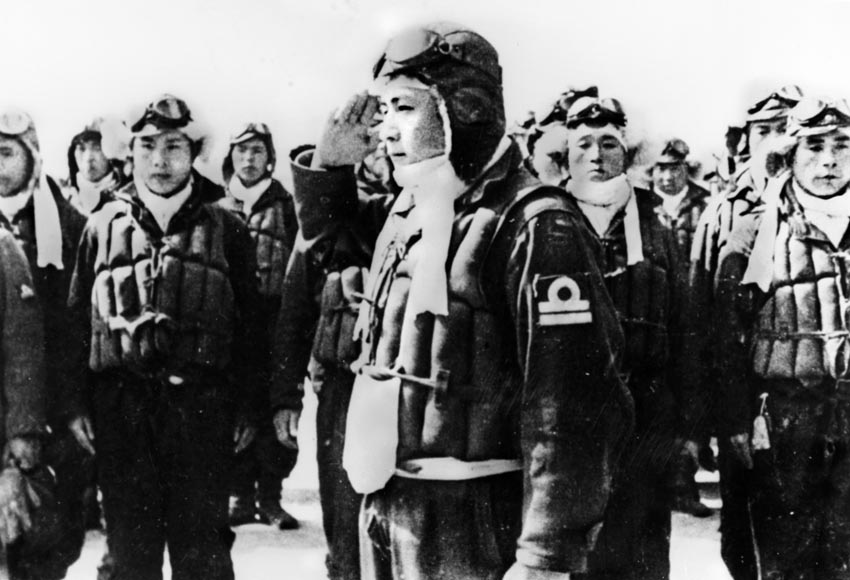
A
kamikaze pilot salutes as he receives his orders for a “divine wind”
mission. It is estimated that over 1,200 pilots (out of 2,314) lost
their lives on such missions.
The concept of
individual suicide was accepted within Japanese society, particularly
among those descended from the warrior, or Samurai, class. Suicide was
generally accepted as the way to atone for failure, and ritual suicide,
also known as seppuku and harakiri, was common among the military of
Japan. It would appear repeatedly during the Pacific war, beginning at
Guadalcanal and lasting to, and even after, Japan’s surrender.
But
mass suicide was something else. Throughout the war, individual
Japanese, particularly pilots whose planes were too badly damaged to
return to base and being culturally unable to accept a surrender to the
enemy, would fly their damaged aircraft into some enemy target, be it a
ship or a ground target. These men were presumed to have been granted a
direct passage to an honored place in heaven for their actions.
Suicide as a doctrinal military tactic, however, did not enter
Japanese military policy until October 1944. By then, the Americans were
invading the Philippines and the Palau Islands, threatening to cut off
Japanese lines of supply from the Far East. Without those supplies,
Japan could not sustain its war effort much longer. All attempts to stop
the American advance had so far failed, and, as in 1281, Japan was
growing increasingly desperate. Once again, the accepted solution was
the Kamikaze.
The origins of the modern Kamikaze are traced to
Luzon, in the Philippines, in October 1944. The Americans were about to
invade those islands, and the Japanese were preparing to meet that
invasion. Captain Rikihei Inoguchi of the Imperial Japanese Navy Air
Forces was at Clark Field discussing attack plans against the
approaching American invasion force. As a senior staff officer of the
1st Air Fleet, he had been assigned the job of organizing the air
defenses of the Philippines.
While speaking with Commander Asaichi
Tamai, commanding the 201st Air Group, he was joined suddenly by Vice
Adm. Takijiro Ohnishi, the recently appointed commander of Japanese
Naval Air Forces in the Philippines. Joined by some squadron leaders,
the group sat down to listen to Admiral Ohnishi’s instructions.
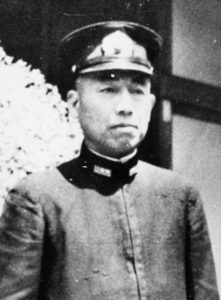
Admiral
Ohnishi was himself a pilot and a long-time advocate of naval aviation
in Japan. He had helped plan the Pearl Harbor attack and had been a
protégé of Admiral Isoroku Yamamoto. As a staff officer, Ohnishi had
long been involved in discussions in Tokyo over the use of suicide
operations, arguing against them. But the continued defeats in the
Pacific and the loss of vital resource territory seemed to have changed
his opinion by the time he was appointed to command the 1st Air Fleet in
the Philippines.
Admiral Ohnishi began by stating the obvious:
Japan’s situation was critical. He then explained that the Imperial
Japanese Navy was about to launch an all-out attack on the American
fleet off Leyte. But the Japanese fleet had no air cover of its own; the
1st Air Fleet on Luzon would have to provide that air cover. He had
orders to protect the fleet for at least one week, keeping the American
aircraft carriers from launching strikes that would cripple or destroy
the oncoming Japanese fleet.
The problem was that the 1st Air
Fleet had only 30 serviceable aircraft on Luzon. How could such a small
force hold back the hundreds, perhaps thousands, of American planes
coming to Leyte Gulf?
Admiral Ohnishi presented his solution. He
told the assembled pilots and staff officers, “In my opinion, there is
only one way of assuring that our meager strength will be effective to a
maximum degree. That is to organize suicide attack units composed of
Zero fighters armed with 250-kilogram bombs, with each plane to
crash-dive into an enemy carrier…What do you think?”
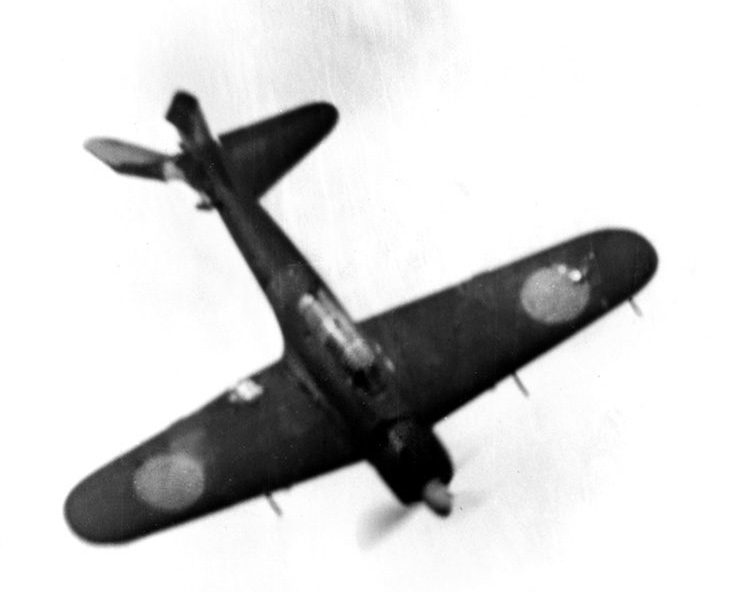
Despite
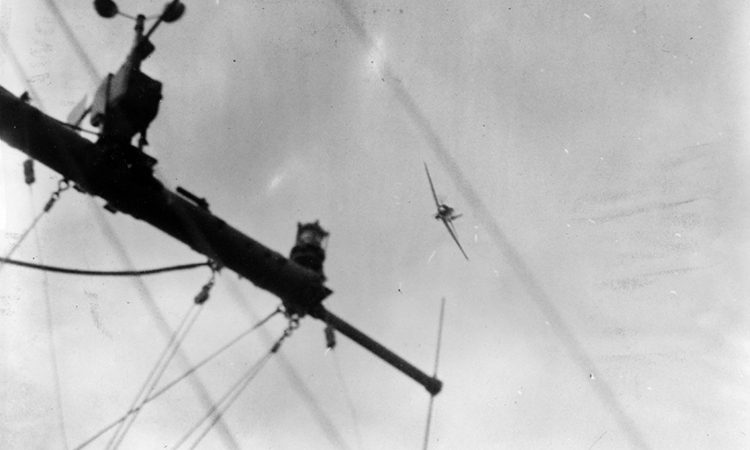
a broken elevator and wings riddled with bullet holes, a Mitsubishi A6M
“Zeke” Kamikaze plane makes its death plunge toward the carrier USS
Essex off Okinawa, May 14, 1945. Japan’s efforts to cripple the American
invasion of Okinawa brought about the mass employment of suicide
missions.
Silence initially replied to the
admiral’s proposal. Captain Inoguchi remembered, “No one spoke for a
time, but Admiral Ohnishi’s words struck a spark in each of us. Indeed,
‘body-crashing’ (taiatari) tactics had already been used by Navy pilots
in air-to-air combat against big enemy bombers, and there were many
fliers in the combat air units who had urged that the same tactics be
employed against enemy carriers.”
The group then discussed whether
a fighter plane armed with a 250-kilogram bomb would be enough to
disable or even sink an American aircraft carrier. They acknowledged
that accuracy would be greater with a pilot guiding the weapon,
including his own plane, to the target. Commander Tamai, the senior
flying officer present, agreed that the plane and bomb together would be
enough to at least disable any American aircraft carrier it hit.
Commander
Tamai then held a meeting with his pilots, and came back to say, “The
201st Air Group will carry out his proposal. May I ask that you leave to
us the organization of our crash-dive unit?” The Japanese Kamikaze
program of 1944 had begun.
Commander Tamai assembled his enlisted
pilots and explained the new proposal to them. Every one of the 23
pilots joyfully agreed to participate in the Kamikaze program. Returning
to his staff, Commander Tanai and Captain Inoguchi discussed how best
to organize the unit. They wanted an officer, preferably a graduate of
the Japanese Naval Academy at Etajima, to lead the first attack.
After
some discussion, Lieutenant Yukio Seki was selected as the attack
leader. When approached by Inoguchi and Tamai, Lieutenant Seki
responded, “You absolutely must let me do it.”
Discussions
followed regarding the force’s organization. A name was suggested, and
soon the new unit was called Shimpu, another Japanese word for Kamikaze.
Admiral Ohnishi approved the plans, organization, and men for the new
unit.
On the morning of October 20, 1944, the Shimpu attack group
ate breakfast and then assembled for their final instructions. Admiral
Ohnishi gave them a speech encouraging them to succeed, and the 24
pilots were prepared to go. But that was easier said than done.
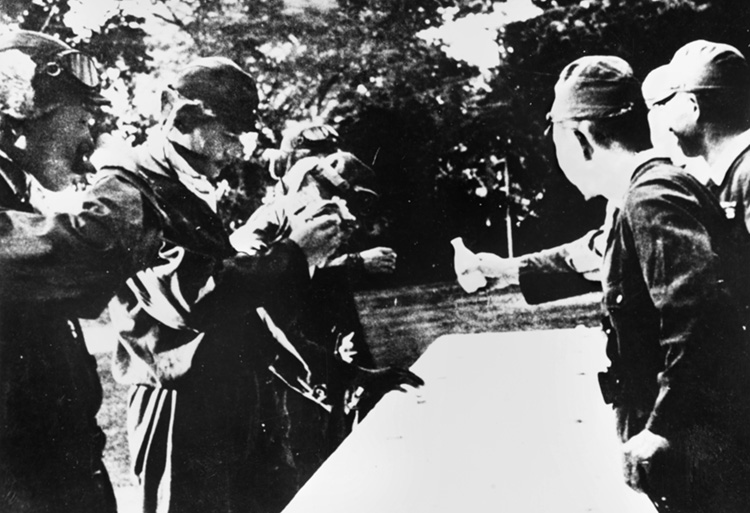
Admiral
Takijiro Ohnishi (right), commander of the Kamikaze Special Attack
Force, dispenses ceremonial cups of sake to suicide pilots about to take
off.
The initial missions had to be aborted:
mechanical failure grounded aircraft, enemy combat air patrols kept the
Japanese grounded, and bad weather prevented takeoff. It wasn’t until
the morning of October 25 that Lieutenant Seki and his group finally
launched their mission.
The Shimpu encountered a support carrier
group known to the Americans as “Taffy 3.” These Americans had already
been attacked by Imperial Japanese Navy surface forces days earlier in
Leyte Gulf. Now, one of the Shimpu group dove out of the sky at the
escort aircraft carrier USS Kitkun Bay (CVE-71).
Sailor Ron
Vaughn, an 18-year-old lookout on Kitkun Bay, spotted the plane as it
climbed, rolled, and plunged down on his ship, aiming for its flight
deck. The ship’s antiaircraft guns opened fire and damaged the plane as
it dove. One round crumpled the tail section, causing it to veer off
course. But the plane hit the water close aboard, damaging the ship and
causing scores of casualties.
Another Shimpu pilot dove on the USS
Kalinin Bay (CVE-68) and hit the deck of the carrier; two others were
driven off by the antiaircraft fire.
American fighter pilots
immediately raced to the scene to defend their home carriers. Despite
their efforts, three more Shimpu planes attacked the escort carrier USS
St. Lo (CVE-63) from above; the first Japanese plane was shot down by
fire from the St. Lo.
The second suffered the same fate, but this
aircraft drew the American’s attention away from the third aircraft,
which was following the ship and simply pulled up, nosed over, and
crashed into the vessel. Witnesses remembered that the plane sliced
through the flight deck, igniting fuel and ammunition in the hanger area
below that deck. One sailor insisted that he saw a bomb drop from the
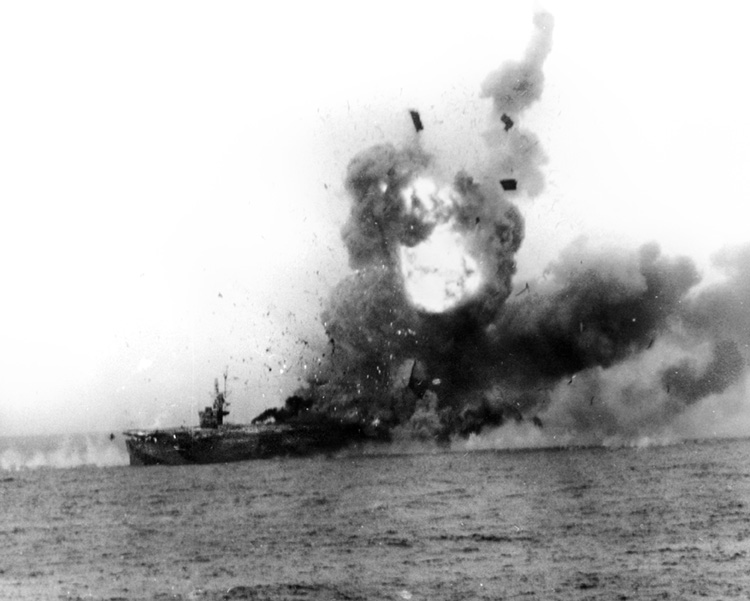
aircraft an instant before the plane crashed into the ship.
The
impact doomed the St. Lo. Explosions rocked the ship from bow to stern.
Damage-control sailors raced around to save their ship, but it was no
use. Thirty minutes after she was hit, the St. Lo sank. With her went
140 American sailors. She was the first “official” kill of the Kamikaze
attack force.
Admiral Ohnishi committed suicide after Japan’s surrender.
Meanwhile,
the Kalinin Bay was hit again and severely damaged; the USS White
Plains (CVE-66) and USS Kitkun Bay were both narrowly missed. Although
all these three ships were damaged, casualties remained few.
Ashore,
the Japanese awaited the results of the first Kamikaze attack.
Commander Tadashi Nakajima was at his base on Cebu Island when three
Mitsubishi A6M Zero fighter planes landed there. Out of the first to
land came Chief Warrant Officer Hiroyoshi Nishizawa, who ran up to
Commander Nakajima and made his report: Of the five Kamikazes and four
escorts, he reported, Lieutenant Seki had hit a carrier, and a second
Kamikaze hit the same ship, which soon sank. The third Kamikaze struck
another carrier, setting it afire. The fourth plane crashed into a light
cruiser which “sank instantly.” The fifth Kamikaze disappeared. Three
of the four escorts managed to return to Cebu.
The report was a
fiction. In fact, only the USS St. Lo was sunk, with the Kitkun Bay and
White Plains damaged. No light cruiser was struck on October 25. This
report, inaccurate as it was, was forwarded to Tokyo, which accepted it
at face value and broadcast it to the Japanese nation as a great victory
by the newly established Kamikaze Corps.
Believing a great
success had been achieved from a small group of aircraft, the Kamikaze
program continued on October 26. For the expenditure of five Kamikazes
and two escorts, the light carrier USS Suwannee (CVE-27) was slightly
damaged. Earlier, the USS Santee (CVE-29) had been damaged by a Kamikaze
that approached so swiftly that no guns had been able to fire before it
slammed into the ship.
By now, the standard operating procedure
for the launching of Kamikazes had been established. First, they would
await a report from a search plane that would locate, identify, and
report on an American carrier group. Often, these reports were
inaccurate, and a mission would have to be aborted when no ships were
found by the Kamikaze pilots. Each Kamikaze flight had at least two
escorting fighters to assist them in getting past the American combat
air patrols that protected the American carrier battle groups.
Weather
was, of course, always a factor. How many Kamikazes were assigned to
any one mission depended upon the conditions reported by the scouts.
Approaching their targets, the Kamikazes would increase their speed to
make their approaches while the escorting fighters protected them from
the combat air patrol. The signal, “All Planes Attack!” was given by the
flight leader’s raised arm, and each pilot picked his own target, then
plunged down toward it.
The deeds of the “Kamikaze Special Attack
Corps,” one of the names for the new Kamikaze force, had by now reached
Tokyo. Emperor Hirohito had responded to this new tactic with a message
to his naval aviators through Admiral Ohnishi. The message read, “Was it
necessary to go to this extreme? They certainly did a magnificent job.”
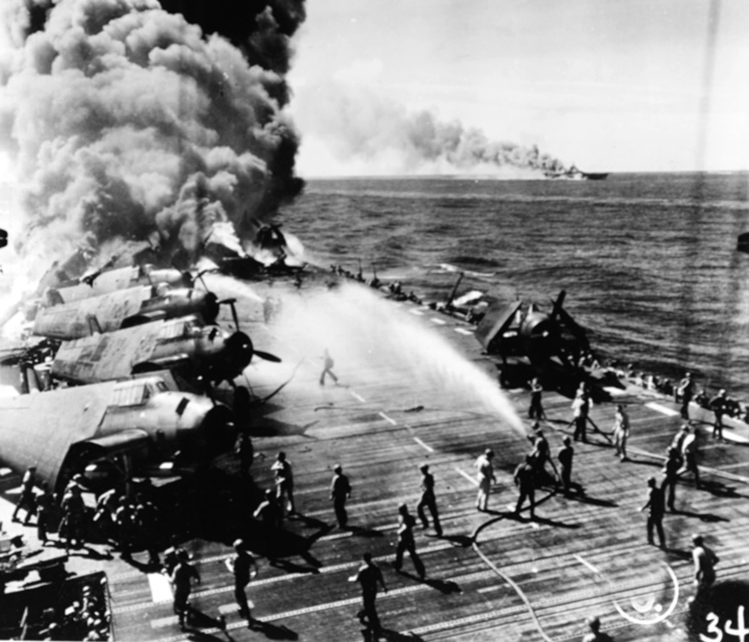
Crewmen
aboard the carrier USS Belleau Wood off the Philippines pour water on
aircraft and burning flight deck after a Kamikaze strike, October 30,
1944. The carrier USS Franklin, also hit by a suicide plane, burns in
the distance.
Captain Inoguchi, who was with
Admiral Ohnishi in Manila, felt that the first sentence of the Emperor’s
words were something of a criticism of Ohnishi’s new project, and
Ohnishi appeared quite upset upon reading this message. But he remained
determined to gain the Emperor’s favor by increasing his success.
Kamikaze
strikes continued against American ships throughout the Philippine
Campaign, including the invasion of Luzon and the clearing of the
southern Philippines.
Meanwhile, the idea spread throughout the
Imperial Japanese Navy and was taken up by the Imperial Japanese Army,
as well. One of the chief reasons for this was the lack of skilled
pilots. At the outbreak of the war, Japanese pilots had been the best of
the best. But over the three years that the war had thus far
progressed, attrition had whittled down those expert pilots to a
precious few, many of whom where now busy training their replacements.
But
the training of new pilots took time and fuel, neither of which the
Japanese had in abundance. A Kamikaze pilot, though, did not need the
in-depth training that a pre-war fighter pilot needed. He only needed to
be able to take off, fly a distance, and crash into an enemy ship. Even
formation flying was optional, although helpful.
As one historian
has written, “Loss of aircraft and veteran pilots and shortages of fuel
led to a reliance on suicidal Kamikaze units by 1944, made up of
largely green, ill-trained aviators and a mélange of planes.”
The
Kamikaze idea had by now spread far and wide among the Japanese
military. Soon Kamikaze Corps were being established in Japan itself.
Those forward bases under attack by the advancing Americans were often
provided with some “Special Attack Units.” Soon this title was expanded
to other suicidal methods of defeating the enemy.
One such method
was known as the “Kaiten”—a manned suicide torpedo that was intended to
sneak into American-held harbors and sink enemy ships at anchor. Then
came the “Ohka” (Cherry Blossom)—a human-piloted bomb released from a
carrying aircraft over the target and flown into that target by the
pilot.
The
first major warship sunk by the Kamikazes was the carrier USS St. Lo,
which was hit off Samar in Leyte Gulf, October 25, 1944. One hundred
forty Americans died.
There were also suicide
explosive speedboats (“Shin’yo” or Sea Quake)—small plywood craft filled
with explosives and driven by a crew of one or two into enemy ships as
they approached the shore of a Japanese base. Hundreds of these were
later captured unused in the Philippines and Okinawa.
At the war’s
end, near Okinawa, even the Imperial Japanese Navy’s super-battleship,
the IJN Yamato, was turned into a form of Kamikaze. (See WWII Quarterly,
Spring 2020.) But none of these other efforts achieved either the fame
or the success of the Imperial Japanese Navy’s “Kamikaze Special Attack
Corps.”
Some ships just seemed to draw the attention of the
Kamikazes. One such ship was the Australian heavy cruiser HMAS
Australia. Perhaps because her appearance different from that of
American ships, she was hit repeatedly, although her near-identical
sister ship, HMAS Shropshire, who often sailed alongside her, was never
hit. Some called her “the Kamikaze Magnet.”
HMAS Australia had
been in the war since the early days of 1939 and had earned herself an
enviable battle record. But she just couldn’t seem to shake the
Kamikazes. She was first targeted in Leyte Gulf on October 21, 1944,
leading some Australians to claim that she was the first victim of the
Kamikazes, and not the USS St. Lo.
That day, the attacking
aircraft was seen to be hit by antiaircraft fire and almost crashed into
the water. But the plane recovered, and despite further heavy
antiaircraft fire, punched into the port side of the heavy cruiser. This
sounds more like a “body-crashing” (Taiatari) tactic than a Kamikaze
attack, but the strike cost the ship her captain, Captain Emile F. V.
Dechaineux, along with five officers and 23 enlisted sailors. Scores of
others were wounded.
The ship returned to the war after repairs in
November, well after the Kamikaze had begun in earnest. In early
January 1945, the HMAS Australia was attacked no less than five times by
Kamikazes. On January 5, she was struck by a Zero, which hit her
amidships; 25 men on the gun crews died and another 30 were wounded.
Damage was slight, and she remained on station with a gunfire support
group off Leyte.
The next day she was hit again, at the middle
smokestack on the starboard side, killing 14 and wounding 26. Damage was
minimal, and she remained on station. January 7 was a quiet day, but
January 8 was not.
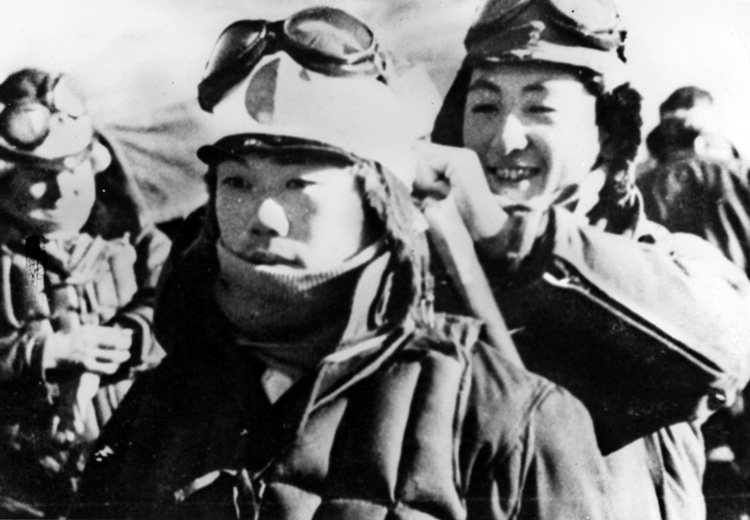
A
solemn Kamikaze pilot has his hachimaki headband, symbolizing manly
courage, attached by a smiling comrade. Ancient Samuri warriors wore a
folded white cloth when going into battle to keep their long hair and
sweat out of their eyes.
A Japanese bomber came
in, chased by four fighters of the combat air patrol. The enemy went
down barely 20 meters off the HMAS Australia’s port side. It skidded
into the cruiser’s hull, but caused no damage or casualties. Less than
20 minutes later, another Japanese bomber appeared and repeated the same
events. But this time, the bomb that the plane was carrying went off
and ripped a large hole in the cruiser’s port side, flooding two
compartments. Once again, there were no casualties. Asked if he wanted
to withdraw for repairs, Captain J.M. Armstrong refused and remained on
station.
By January 9, the Sixth U S. Army was wading ashore on
the main Philippine Island of Luzon, and HMAS Australia was offshore in
support. Eight Kamikazes came in searching for the invasion fleet, and
two headed for the Australia. One of these hit the USS Mississippi
(BB-41) and the other hit the Australia at her foremast, crushing her
forward smokestack and rendering the forward fire room inoperable. With a
hole in her side, her forward fire room out of action, and her speed
reduced, the Australia had had enough. This time she accepted the offer
to retire for repairs, once again with no additional casualties.
Kamikazes
appeared in almost every battle after Leyte. But by far their most
successful and deadly campaign came against the American invasion of
Okinawa. Here, Marines and the soldiers of the Tenth U. S. Army faced a
determined defense, one of whose primary objectives was to draw the
American fleet into a position that would make it vulnerable for attacks
from nearby Japan.
One of the negative by-products of rushing
pilots through an abbreviated training program to qualify them as
Kamikazes was that they had poor ship identification skills. This error
was felt most by the “small boys”—the auxiliary ships that often
accompanied the major fleet units to supply, fuel, and otherwise provide
succor to them when needed.
These included some described by
their titles, including LCS(L)3, or Landing Craft Support (Large) Mark
3. Developed from the original Landing Craft Infantry, or LCI, some had
been modified with rockets, machine guns, 20mm and 40mm guns, and other
assorted armament which, to the untrained Japanese pilot desperately
trying to find a target while avoiding the combat air patrol and
antiaircraft fire, were often mistaken for combat vessels such as
destroyers and even cruisers. As a result, these flat-bottomed,
diesel-powered, 160-foot-long ships often became the targets these
Japanese pilots were seeking.
The U.S. Navy’s Fifth Fleet, under
Admiral Raymond Spruance, was the largest in the world (535 warships),
but its position at Okinawa was exposed. It was committed to the island
for all manner of support and supply duties, which made its ships
stationary targets for the Japanese, who no longer had to guess where
the American fleet could be found.
To protect the fleet, the
Americans had established a series of “radar picket” posts around the
island to give early warning of the Japanese approach. Instead, these
soon presented to the Japanese aviators’ lonely targets, ripe for
attack. The radar-picket destroyers and destroyer escorts were supported
by various “little boys,” which were known at these posts as “pall
bearers,” since they spent so much time picking up survivors out of the
water, making them an inviting target for the Japanese.
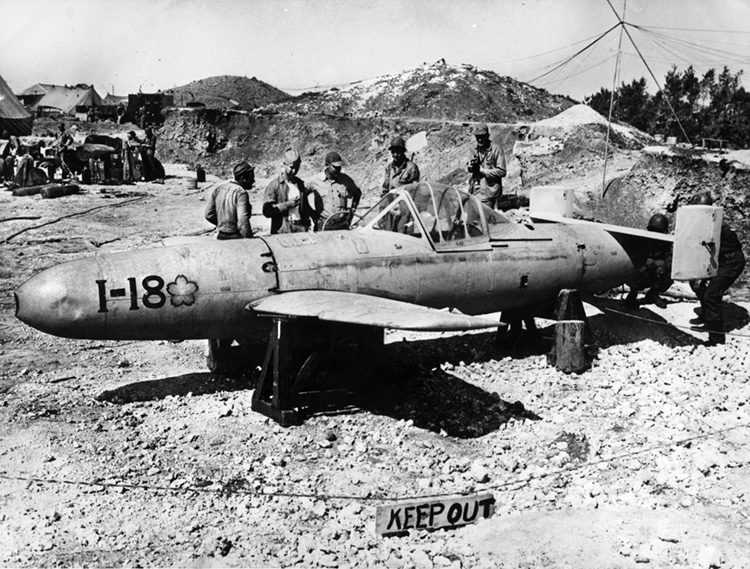
Marines examine a captured Yokosuka MXY-7 Ohka rocket-propelled suicide flying bomb found at the Yontan airfield.
The
Japanese reaction began slowly. On March 20, 1945, the Japanese
Imperial General Headquarters came up with a major offensive involving
Kamikaze pilots called Ten-Goō(“Heavenly Operation”). Tasked with
leading this operation was Vice Adm. Matome Ugaki, commander of the IJN
Fifth Air Fleet.
After gathering every flyable plane he could
find, no matter its obsolescence or original purpose, Ugaki assembled
3,000 of them at bases across Kyushu. The plan, dubbed Operation
Kikusui, was simple: guided by the few experienced pilots Japan had
left, the suicide pilots would be sent out in waves to find the American
ships and destroy them. The veteran pilots would then return to their
bases to pick up another group and repeat the process.
On April 6,
1945, the Japanese struck in force with Kikusui No. 1 against the U.S.
Navy’s Task Force 58 and the British Royal Navy’s Task Force 57, the
latter operating between Formosa and Okinawa. Some 700 planes—half of
them suicide planes—took off and went hunting for the Allied fleets.
The
first to be attacked at Okinawa were the destroyers USS Bush (DD-529)
at picket station number 1, the Colhoun (DD-801) at picket station
number 2, and the Cassin Young (DD-793) at picket station number 3.
Although the three destroyers put up a deadly screen of antiaircraft
fire, enough enemy planes got through to sink both the Bush and Colhoun;
the Cassin Young barely escaped the same fate—for now.
Elsewhere,
the destroyers USS Howorth (DD-592) and Hyman (DD-732) were severely
damaged, while the destroyers USS Leutze (DD-481) and Morris (DD-417)
were knocked out of the war. Destroyer USS Mullany (DD-528) was so badly
damaged that she had to be scrapped. Destroyer USS Newcomb (DD-586) was
also sent home for good, as was the USS Rodman (DD-456).
The list
of sunken ships included LST-447 and support ships Logan Victory and
Hobbs Victory. The minesweeper USS Defense (AM-317) went down as well.
The USS Haynsworth (DD-700) was damaged, as was the USS Feiberling
(DE-640). And this was only one day’s success for the Kamikazes.
The
suicide pilots also tried attacking two American carriers, the
Bennington (CV-20) and Belleau Wood (CV-24), but both ships escaped with
minimal damage.
Both sides suffered badly during Kikusui No. 1.
The Japanese had hit 17 American ships, sunk or knocked 11 out of the
war, and killed over 360 sailors. The Japanese, in turn, had lost over
350 planes and pilots—planes and pilots that could not be replaced.
The
Australian heavy cruiser HMAS Australia, showing damage incurred on
October 21, 1944, was struck so many times by suicide pilots that she
earned the nickname “the Kamikaze magnet.” She was never sunk, however.
The
next day the massive battleship IJN Yamato steamed toward Okinawa and
her doom at the hands of the American pilots from Task Force 58.
The
loss of Yamato did not stop the Japanese from continuing their suicide
attacks on the Allied fleets. After suspending operations for a few days
due to bad weather, on April 11, Kikusui No. 2 was launched—a two-day
assault by 185 suicide planes accompanied by 150 escorts. The carrier
USS Enterprise (CV-6) was the first to feel the enemy’s sting, which
knocked it out of action for two days while repairs were made. The
carrier Essex (CV-9), too, was hit but not sunk.
On April 12,
another dozen ships were hit, with the destroyer USS Mannert L. Abele
(DD-733) and LCS(L)-33 going down. On that same day, the Cassin Young
was in the middle of the fight for her life, as she was targeted during a
heavy Kamikaze raid. Her gunners shot down five aircraft, but a sixth
crashed into her foremast, exploding in midair only 50 feet above the
ship.
Surprisingly, only one man was killed, but 58 were wounded,
many seriously. Although badly damaged, Cassin Young made it to Keramo
Retto under her own power and would return to Okinawa in May after
repairs. She would be attacked again in July, suffering major damage and
loss of life, but she refused to be sunk. (The ship is today on display
at the Charleston Navy Yard in Boston, Massachusetts.)
Each day,
one or more ships were being hit and disabled, if not sunk. The radar
picket posts were the most vulnerable, set far from other support and
usually exposed to the incoming enemy air raids before anyone else. The
raids went on daily throughout April, May, and June, and ship after ship
was lost to the incessant aerial attacks.
CinCPac Admiral Chester
W. Nimitz grew increasingly concerned and pushed Lt. Gen. Simon B.
Buckner, commanding the Tenth U. S. Army, to move quickly to clear
Okinawa of enemy resistance so that he could withdraw his ships from
Japanese target practice. But the Japanese ashore were as determined as
those in the air, and the battle continued well into June.
One the
worst attacks by the Kamikazes was that suffered by the USS Laffey
(DD-724), stationed at radar picket post number 1 on April 16. The first
USS Laffey had been sunk during the naval battles for Guadalcanal. The
current USS Laffey, laid down in 1942, had already established herself
as a worthy successor to her namesake and had participated in the naval
support during the landings in Normandy. On April 16, 1945, she would
prove her worth once again.
Soon after dawn, 50 enemy planes were
closing in on the fleet, and Laffey’s radar picked up four enemy planes
approaching her. Three were shot down by Laffey’s antiaircraft fire, and
the fourth was shot down by the guns on board Lieutenant Howell
Chickering’s nearby LCS(L)-51. Carrier-borne Corsairs were slicing
through the enemy formation, downing as many planes as they could.
The
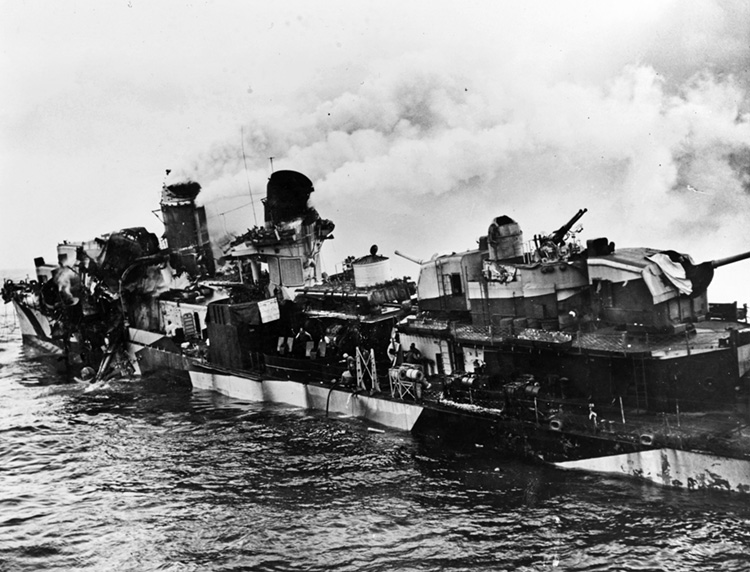
destroyer USS Hazelwood smoulders after being hit by a Kamikaze
attacker off Okinawa, April 29, 1945. Ten officers and 67 men were
killed, including the commanding officer; 36 were missing, presumed
dead.
A fifth plane attacked Laffey, only to be
shot down as well. Then a sixth streaked in, strafing the ship as it
approached. Several casualties resulted from the strafing before this
plane crashed into the ship at the after funnel, jamming the
fire-control radar.
A seventh aircraft smashed into the forward
gun mount and then ricocheted off the ship, leaving no serious damage.
An eighth plane was shot down as it attacked. But a ninth Zero used that
attack to approach undetected and crashed into the starboard 20mm
battery, damaging nearby 40mm batteries, starting a gasoline fire, and
setting off the ammunition.
Almost immediately, a tenth plane hit
the ship’s fantail, knocked out the aft 5-inch gun, and damaged three
20mm antiaircraft guns there. Plane number 11 dropped its bomb first
near the depth-charge rails before crashing into the aft 5-inch gun
mount, already damaged by a previous plane.
Plane number 12
dropped its bomb close aboard, jamming the rudder to a hard-left
position. The Laffey now had no operable guns in the rear of the ship.
The captain, Lt. Cmdr. Frederick J. Becton, now had a ship on fire and
with no guns protecting her stern. The Japanese quickly took advantage
of this weakness, and two more planes came in from astern, crashing
again into the 5-inch mount number 53 and killing several of the crew
who were fighting fires there.
Plane number 15 was shot out of the
sky as it approached from the port quarter. A pursuing combat air
patrol Corsair was so close on his heels that he hit the ship’s mast and
ditched nearby. But this attack knocked out the ship’s radar.
Plane
number 16 was next in line and was shot down over the ship by the
combat air patrol, but not before its bomb shredded the ship’s bow with
shrapnel, knocking out power to 5-inch mount 52, which continued to
operate manually.
Plane number 17 was shot down, and plane number
18 was disintegrated by a shell from mount 52. Plane number 19 was also
shot down, by mount number 51. A twentieth plane came in through the
smoke off the Laffey and dropped its bomb on mount number 53 before
breaking off the ship’s yardarm. It was then splashed by the combat air
patrol.
A
suicide pilot homes in on the carrier USS Enterprise during the battle
for Okinawa, May 14, 1945. The pilot destroyed Big E’s forward elevator,
killed 14, injured 32.
Plane number 21 also
dropped its bomb, knocking out two 20mm antiaircraft mounts before being
shot down by the combat air patrol. A final attacker was also taken out
by the combat air patrol.
The USS Laffey was miraculously still
afloat but in serious trouble. It was down at the stern, the rudder was
jammed, and most of its guns were disabled. Fortunately, the hull and
engines had not been damaged. She had been hit by six Kamikazes, damaged
by two other near misses, struck by three bombs, and had other close
calls. She lost 31 killed and 72 wounded, but the fires were soon under
control and the flooding stopped. She was towed to a repair base off
Okinawa and, after service during the Korean War, would eventually end
up as a memorial at Patriot’s Point, Charleston, South Carolina. Both
LCS(L)s supporting her also survived, although with significant
casualties.
But, like a swarm of angry wasps, the Kamikazes kept
coming. As the battle progressed, their attacks and numbers began to
thin out. Since Okinawa was lost and the next invasion would no doubt be
at Japan itself, the Japanese decided to hoard their remaining Kamikaze
planes and pilots for the final battle.
One of the greatest
tragedies to befall the American fleet was that of the carrier USS
Bunker Hill (CV-17), the flagship of Vice Adm. Marc A. Mitscher’s Task
Force 58. On May 11, the carrier was on station 76 miles east of Okinawa
when a Japanese “Zeke” fighter suddenly appeared out of the cloud
cover.
Having just been refueled with nearly two million gallons
of high-octane aviation fuel, the Bunker Hill was a floating Molotov
cocktail waiting for a spark. The Zeke crashed into the flight deck,
which was brimming with 30 planes waiting to take off; in the hangar
deck below were 48 more that had been fueled and armed.
The
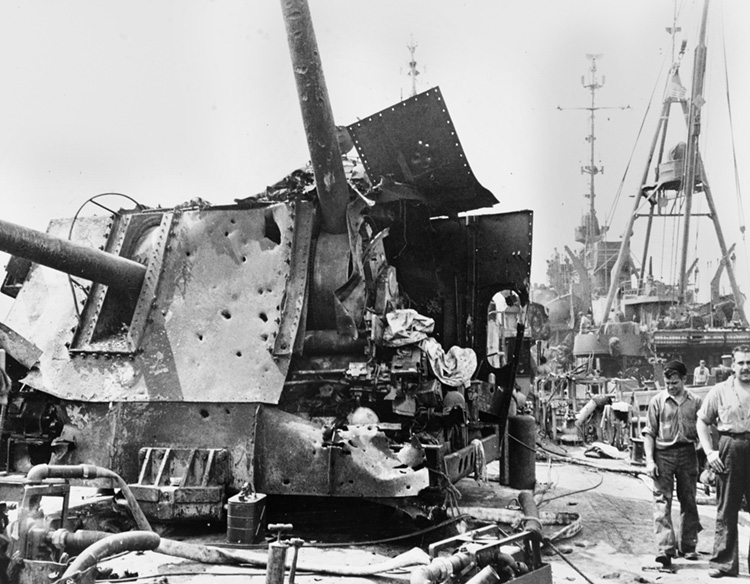
shattered 3.5” gun mount aboard the USS Laffey. The ship was attacked
by 22 Japanese planes on April 16, 1945, and struck by four bombs and
five suicide planes. Thirty-one sailors were killed, 72 wounded.
While
the planes on deck exploded and burned, another Kamikaze dashed in and
slammed into the ship’s control center, known as “the island.” Crewmen
sprang into action in a valiant, but ultimately futile, effort to
contain the blaze. Other ships pulled alongside to aid in the effort but
they, too, stood no chance against the roaring inferno.
In the
end, 346 officers and men out of the ship’s complement of 3,000 lost
their lives, 43 were missing, and another 264 were injured. The charred
wreck of the carrier managed to return for repairs to Bremerton,
Washington, via Pearl Harbor, but it would never fight again.
At
the end of the war, the Japanese themselves compiled a recapitulation of
the record of the “Kamikaze Special Attack Corps.” They recorded that,
of the 2,314 planes dispatched (including escorts), 1,086 returned. For
the 1,228 planes “expended,” they claimed 81 ships sunk and 195 damaged,
for a total of 276 ships.
Postwar records indicate that the
correct figures are 34 ships sunk, including three light carriers and 13
destroyers. Of the 195 ships the Japanese claimed as damaged, they had
actually damaged 288 ships, including 16 fleet aircraft carriers, three
light carriers, and 17 escort carriers. It should be noted that several
ships, like the HMAS Australia and USS Laffey, were hit repeatedly but
not sunk. So, the Japanese claim of a total of 276 enemy ships sunk or
damaged by Kamikazes is understated. In fact, they hit 322 allied ships,
sinking 34. It was not the “Divine Wind” of 1281, but it was a
respectable effort, nevertheless.
But, despite all her efforts to
halt the American invasion of Okinawa, Japan had shot her bolt. Once
Okinawa fell, she had very little chance of preventing a full-scale
invasion of the Home Islands.
As the intelligence officer of the Fifth Fleet put it, “The Japanese are defeated, but we have not yet won the victory.” The Kamakaze and the resistance on Iwo Jima and Okinawa with the suicides of the civilians jumping to their death sealed the fate of the Japanese, and the casualties that the Americans suffered prompted President Truman to use the Atomic Bombs to force a surrender.