I am an Army veteran so we can make jokes at the Air Force. They DO
treat their people way better and that is a fact.....although I and other
veterans do consider them........well pampered comes to mind. We will give them a hard time but woe to any civilian that tries to give them or anybody in the military any crap, unless they walked in our boots, they didn't earn the right to give any of us any grief. I piled on some people that tried to talk crap praising the Marines and talk shit about the other service and I told them, "unless you are in the green weenie, you can't say crap about the other services, the marines will shut you down faster than I am, so you need to chill out with that shit before your mouth writes a check your ass can't cash".
I will also add another one that had made the rounds a few times and
I had seen a copy of this at the flight operations hut at Katterbach
Germany(Near Ansbach)
Classic Quotes - A Little Military Humor
At this command, we have written in large, black letters: DNR (Do Not
Resuscitate) on the back of our security badges." Maj (CENTCOM)
"'Leaning forward' is really just the first phase of 'falling on your face.'" Marine Col (MARFOREUR)
"I am so far down the food chain that I've got plankton bites on my butt."
"None of us is as dumb as all of us." Excerpted from a brief (EUCOM)
"We're from the nuke shop, sir. We're the crazy aunt in the closet that
nobody likes to talk about ..." Lt Col (EUCOM) in briefings
"Things are looking up for us here. In fact, Papua-New Guinea is
thinking of offering two platoons: one of Infantry (headhunters) and one
of engineers (hut builders). They want to eat any Iraqis they kill.
We've got no issues with that, but State is being anal about it." LTC
(JS) on OIF coalition-building.
"The chance of success in these talks is the same as the number of "R's" in 'fat chance...'" GS-15 (SHAPE)
"His knowledge on that topic is only power point deep..." MAJ (JS)
"Ya know, in this Command, if the world were supposed to end tomorrow, it would still happen behind schedule." CWO4 (EUCOM)
"We are condemned men who are chained and will row in place until we rot." LtCol (CENTCOM) on life at his Command
"Right now we're pretty much the ham in a bad ham sandwich..." GO/FO (EUCOM)
"If we wait until the last minute to do it, it'll only take a minute." MAJ(EUCOM)
"The only reason that anything ever gets done is because there are
pockets of competence in every command. The key is to find them ... and
then exploit the hell out of 'em." CDR (CENTCOM)
"I may be slow, but I do poor work..." MAJ (USAREUR)
"Cynicism is the smoke that rises from the ashes of burned out dreams."
Maj (CENTCOM) on the daily thrashings delivered to AOs at his Command.
"WE are the reason that Rumsfeld hates us..." LTC (EUCOM) doing some standard, Army self-flagellation
"Working with Hungary is like watching a bad comedy set on auto repeat..." LCDR (EUCOM)
"I finally figured out that when a Turkish officer tells you, "It’s no problem," he means, for him." Maj (EUCOM)
"Never in the history of the US Armed Forces have so many done so much
for so few..." MAJ (Task Force Warrior) on the "success" of the Free
Iraqi Forces (FIF) Training Program, where 1100 Army troops trained 77
Iraqi exiles at the cost of, well, way too much...
"Our days
are spent trying to get some poor, unsuspecting third world country to
pony up to spending a year in a sweltering desert, full of pissed off
Arabs who would rather shave the back of their legs with a cheese grater
than submit to foreign occupation by a country for whom they have
nothing but contempt." LTC (JS) on the joys of coalition building
"I guess the next thing they'll ask for is 300 US citizens with
Hungarian last names to send to Iraq..." MAJ (JS) on the
often-frustrating process of building the Iraqi coalition for Phase IV
"Between us girls, would it help to clarify the issue if you knew that
Hungary is land-locked?" CDR to MAJ (EUCOM) on why a deployment from
Hungary is likely to proceed by air rather than sea
"So, what
do you wanna do?"..."I dunno, what do YOU wanna do?"..."I dunno, what do
YOU wanna do?," etc. -- COL (DIA) describing the way OUSD(P) develops
and implements their strategies.
"I'll be right back. I have to go pound my nuts flat..." Lt Col (EUCOM) after being assigned a difficult task.
"I guess this is the wrong power cord for the computer, huh?" LtCol
(EUCOM) after the smoke cleared from plugging his 110V computer into a
220V outlet
"OK, this is too stupid for words." LTC (JS)
"When you get right up to the line that you're not supposed to cross,
the only person in front of you will be me!" CDR (CENTCOM) on his view
of the value of being politically correct in today's military
"There's nothing wrong with crossing that line a little bit, it's
jumping over it buck naked that will probably get you in trouble..." Lt
Col (EUCOM) responding to the above
"Never pet a burning dog." LTC (Tennessee National Guard)
"Ah, the joys of Paris: a unique chance to swill warm wine and be
mesmerized by the dank ambrosia of unkempt armpits..." LCDR (NAVEUR)
[obviously this guy has been to the wrong parts of Paris...]
"'Status quo,' as you know, is Latin for 'the mess we're in...'" Attributed to former President Ronald Reagan
"We are now past the good idea cutoff point..." MAJ (JS) on the fact
that somebody always tries to "fine tune" a COA with more "good ideas"
"Nobody ever said you had to be smart to make 0-6." Col (EUCOM)
"I haven't complied with a darn thing and nothing bad has happened to me yet."
"Whatever happened to good old-fashioned military leadership? Just task the first two people you see."
"Accuracy and attention to detail take a certain amount of time."
"I seem to be rapidly approaching the apex of my mediocre career." MAJ (JS)
"Much work remains to be done before we can announce our total failure to make any progress."
"It's not a lot of work unless you have to do it." LTC (EUCOM)
"Creating smoking holes (with bombs) gives our lives meaning and enhances our manliness." LTC (EUCOM) at a CT conference
"Eventually, we have to 'make nice' with the French, although, since
I'm new in my job, I have every expectation that I'll be contradicted."
DOS rep at a Counter Terrorism Conference
"Once you accept that a dog is a dog, you can't get upset when it barks." Lt Col (USSOCOM)
"That guy just won't take 'yes' for an answer." MAJ (EUCOM)
"Let's just call Lessons Learned what they really are: institutionalized scab picking."
"I can describe what it feels like being a Staff Officer in two words: distilled pain." CDR (NAVEUR)
"When all else fails, simply revel in the absurdity of it all." LCDR (CENTCOM)
"Never attribute to malice that which can be ascribed to sheer stupidity." LTC (CENTCOM)
And to prove that I am an equal opportunity harasser, this one is for the "Marines"
I also shamelessly "clipped" this from American Thinker. The Pics are from my collection of pics I have on my folder saved in the cloud.
I'm going to try to explain what's going on in America right now by
drawing a connection between two news stories. On the surface, they
don't seem to have much to do with each other, but when you really think
about them, it's obvious that there's a common thread.
The first story comes from way back in
November of 2018, when President Trump complained about an "Obama judge"
on the Ninth Circuit ruling against his asylum policy. Trump's
comments angered Chief Justice John Roberts of the Supreme Court, who
gave a speech saying:
We do not have Obama judges or Trump judges, Bush judges or Clinton
judges. What we have is an extraordinary group of dedicated judges
doing their level best to do equal right to those appearing before
them. That independent judiciary is something we should all be thankful
for.
Trump responded
by tweeting: "Sorry Chief Justice John Roberts, but you do indeed have
'Obama judges,' and they have a much different point of view than the
people who are charged with the safety of our country...."
For the Deep State and its sympathizers,
Roberts's statement was a dignified and erudite defense of the
institutions of liberal democracy, while Trump's tweet was a crass
attack on said institutions
Ordinary Americans, who aren't emotionally invested in keeping up the
illusion that all is well on the banks of the Potomac, saw something
different. They saw John Roberts telling a lie and Donald Trump telling
the truth.
Everybody knows that most of what the upper level of
the judicial system does is politics by another name. They know that
most of the time, Obama judges, Trump judges, Bush judges, and Clinton
judges rule differently on politically charged questions. And a large
portion of the American people decide whom to vote for in presidential
elections based mainly on what kinds of judges they want the next
president to appoint.
John Roberts has the audacity to tell
these people that none of this is true and that all judges are really
just doing their best to enforce the same laws in an impartial way.
And
then, right after this creature of the Deep State (not even a Democrat,
but a moderate Republican) has told his lie, Donald Trump does what
most politicians won't do (including Republicans) and tells the truth.
Over
the next few years, when Trump's base continues to believe Trump's
statements in preference to those of the media, the regulatory agencies,
Anthony Fauci, the "moderates" in Congress, or whomever, the elite
classes and the plutocrats and the mainstream press continue to act
surprised, as if there were no reason for anybody to take Trump's word
over theirs about illegal immigration, or the origin of the coronavirus,
or hydroxychloroquine, or election fraud.
Except there was a reason why the Deplorables listened to
Trump instead of the mainstream voices. It is that the mainstream
voices have been lying to them for a long, long time, without even
trying to be subtle. Eventually, the Deplorables noticed, and they
decided to trust someone else.
Now for the second, and more
recent, news item, in which we see our self-appointed betters growing
impatient with plain lying and moving on to censorship, as exemplified
by YouTube's decision, about a week ago, to ban all content questioning the efficacy of COVID vaccines.
You
know who questions the efficacy of COVID vaccines? Scientists. Anyone
who's been following the news for the last year or so knows that while
most scientists studying the vaccines believe that their efficacy is
well above zero, there have been all sorts of disagreements about how
well they actually work. Do they prevent serious symptoms 90% of the
time or only 70% of the time? Do they work at all against the delta
variant? Do their effects fade with time? Is a third dose
necessary? Will people who already have natural antibodies get any
benefit from the vaccines?
The scientific community has debated
all these questions, and attentive news-watchers know that there isn't a
settled consensus. This should surprise nobody, as the vaccines are
new and approved for experimental use only. At this point, it's good that scientists aren't all thinking the same thoughts, because that means that at least some of them are doing their jobs.
However,
the people who run this country (and let's be honest: at this point,
the government agencies and the big corporations are all run by the same
left-leaning plutocrat class) have decided that the Deplorables aren't
allowed to know any of this.
These people know that the
Deplorables don't trust them anymore. So they have to rely on
censorship, because they can't just make their case with logic, and say
things like We all know that the science isn't fully settled yet,
but most of the evidence indicates that the vaccines work most of the
time, and your chances of getting harmed by a vaccine are small compared
to your chances of getting harmed by the virus, so we're recommending
that you get the shot. But if you don't, we won't try to punish you or
shame you, because we still believe in liberty.
That's
the sort of argument that might have worked fifteen years ago. It
doesn't work today, because the Deplorables know that the people saying
it have their heads so far up their own rear ends that they either can't
see or don't care about the obvious untruth of statements like "we do
not have Obama judges or Trump judges."
Instead, they rely on
coercion and censorship. Science takes a backseat to politics, just as
it did way back in the spring of 2020, when scientists did a bunch of
studies on the efficacy of cloth masks, most of which suggested that
they don't work,
and then dropped the whole topic like a hot rock once it became
apparent that most of the people who didn't want to wear masks were
those nasty Trump voters.
So upper-class liberals are left banging their heads on the wall and saying: Why
do these people keep on trusting Donald Trump, even after the events of
January 6, and why won't they believe the FDA when it tells them not to
treat COVID with horse-deworming pills, and why are hospitals having to
shut down because so many of their employees — medical professionals! — are willing to lose their jobs rather than get the vaccine?
The
answer is that all this is happening because people notice when the
elites lie. They notice when the elites engage in censorship. And they
don't un-notice. Also, once they've stopped trusting you, they won't
start again just because you want them to. Instead, they'll trust
somebody else, even if, in your (now irrelevant) opinion, that somebody
else is the worst person in the world for them to trust.
I shamelessly "Nicked" it from The American Thinker, the Pics are compliments of my "Stash" I have on my folder I had saved into the cloud.
Have we ever had a president who in mere months made so many dumb,
intemperate decisions, thereby precipitating major crises? You’d think
that the Afghanistan and border fiascos would suffice for one four-year
term. But the smart money is that we haven’t seen the last of
Biden-manufactured crises. Biden is a nightmare version of Pig-Pen
of the Peanuts comic strip. A perpetual cloud of incompetence,
conceits, corruption, and shabby political motives swirls around him.
As Niall Stanage of the Hill put
it, “President Biden’s biggest vulnerability isn’t any single issue.
It’s the risk that he could be seen as losing control of events.”
The dissolution of the landscape means the Biden administration isn’t
plagued by any one malady anymore but by multiple organ failure.
What’s perilous to the nation isn’t
likely any one crisis, as Fernandez and Stanage alluded to, but some
combination. Afghanistan and the border crises aren’t that combination
-- at least not yet. But both do threaten to be part of a toxic mix
leading to greater crisis during Biden’s term.
Other potential areas ripe for trouble are the economy, a new round
of COVID lockdowns, the 2022 midterm elections, and leftist instigated
unrest. An economic downturn would be a big domino falling, setting off
a chain reaction. The other three areas are likely intertwined. More
in a moment.
Afghanistan wasn’t a one-off, in that what happened
there stays there. Afghanistan again becomes a staging area for Islamic
terrorism, which threatens the homeland. Biden’s surrender there
promises to spin off threats to American interests and national security
elsewhere.
America’s principal adversaries -- Xi, Putin, the mullahs, and Kim Jong-un -- know, like most Americans do, that Biden is in over his head. More, the U.S. is divided and conflicted. Reported the Epoch Times on September 28, compounding homegrown troubles, the PRC is engaging in subversion here through their “3 Warfares” doctrine.
Or Biden may not prosecute a war with the PRC in Asia-Pacific, however necessary to defend America’s vital interests.
Biden appears to be compromised with the Chinese, via the influence-peddling schemes
that he and his family operate. How and when Xi decides to leverage
Biden’s corruption are open to Vegas-style wagering. Could Xi force
Biden to stand down over Taiwan?
The border crisis is a
metastasizing cancer, deliberately so. Two million illegals are
anticipated to cross into the U.S. this year. Then there are the
out-years, ’22, ’23, and ’24 to consider.
The manifold stresses
that this diaspora will place on communities are only in their earliest
stages. This represents an insidious, evolving assault on society.
While Biden’s ham-handedness certainly plays a key role in the border
meltdown, Democrats have long advocated for open borders. This crisis
manifests a perverse and destructive fulfillment.
The four
other areas -- the economy, a new round of COVID lockdowns, the 2022
midterm elections, and leftist instigated unrest -- could precipitate
crises that impact and exacerbate one another.
The economy is a linchpin and crisis watchlist worthy.
Inflation
worries are in the news. Economists tend to split on inflation. Is it
transitory, attributable to supply chain issues arising from last
year’s lockdowns, or will it persist and worsen? Some analysts claim
the global supply chain crisis will abate by next summer. Or will it?
But inflation fears are attributable to more than supply. Biden’s policies and legislative goals point to stagflation, says the New York Post’s editorial board.
Consider conventional energy, which is the lifeblood of modern economies. As
of January 20, 2021, the U.S. was energy independent. Kudos, President
Trump. Energy was affordable. The Biden administration
signaled its hostility to conventional energy development and
production from Day One, shutting down the Keystone XL pipeline (killing
thousands of jobs in the process).
Pander, Biden does, to the
delusional cult of environmental zealots who’ve been prophesizing
climate cooling, warming, or whatever else sounds dire since the early
1970s. Earth doom is always just 10 years away.
Drivers have suffered dramatic gas price hikes since Biden assumed office. As of January 2021, the average national cost of a gallon of gas was $2.249. As of September, the cost has risen to $3.176 per gallon, on average.
Biden’s solution to greater energy demands and spiraling costs is to beg OPEC to up output, a request that has been denied to date. Evidently, ruining the earth’s climate from Saudi Arabia and other OPEC member states is okay.
The mounting cost of energy drives up the cost of everything, including food. Then there’s the Democrats’ $3.5 trillion
run at big government socialism, slyly named the “Build Back Better and
American Families Plan.” Infighting is waylaying the measure, but
desperate Democrats aren’t giving up. They can’t. It’s pivotal to their fortunes.
This
legislation’s profligacy and taxing provisions aren’t only
economy-cripplers, but attacks on private enterprise, society, and
liberty. The Heritage Foundation’s Tommy Binion told the Daily Signal (September 29):
I believe that the reconciliation package, which is the socialist
wish list of today’s Democratic Party, [$3.5 trillion] in spending,
cradle-to-grave welfare, everything they want on climate change,
everything they want on immigration, all packed into one bill, is the
most threatening legislation in our lifetimes.
The last three areas for possible crises -- COVID
lockdowns, the 2022 midterm elections, and leftist instigated unrest may
intertwine.
Democrats appear to be headed for a
shellacking in the 2022 midterms. Losing control of the House and
Senate -- or just the House -- would scuttle their agenda.
Congressional Republicans could roadblock many Biden administration’s
executive actions, provided McCarthy and/or McConnell have the stones to
fight.
Election integrity remains an outsized concern. Will battleground states, in particular, have sufficient election reforms in place next year? The GOP is lawyered-up and ready to litigate and plans for stronger election monitoring challenges, reports Truthout, a vexed left-wing outlet. But the chances for Democrat election chicanery: strong.
With Democrats likely facing awful elections prospects might the Biden administration push COVID lockdowns?
Draconian
blue state lockdowns led the way in crippling the national economy last
year, which had as an aim hurting Trump’s reelection prospects. The
lockdowns were, in part, a pretext to blast out ballots across states
(so much for chain of custody and ballot security). Proof that
Democrats want rigged elections in perpetuity is found in their “For the
People Act of 2021.”
Democrats must be watching Australia’s slamdown of its citizens with covetous eyes. Getting away with lockdowns will be harder, but Democrats aren’t hesitant.
Lastly,
Antifa and BLM stoked urban riots in blue cities last year. Unrest in
2022 would again create a national atmosphere of fear and tension. As
Democrats hoped last year, they’d hope again next year: That “protests against racial injustice” would damage GOP election chances. Or, if not that, some other excuse to foment unrest.
Should
a national crisis emerge, the culprits are likely a convergence of
crises. When has the nation been confronted by so many threats in so
many different ways simultaneously?
“These are the times that try men’s souls,” wrote Thomas Paine.
“The summer soldier and the sunshine patriot will, in this crisis,
shrink from the service of their country; but he that stands it now,
deserves the love and thanks of man and woman.”
The nation of Japan was helpless before the invading force. They were
outnumbered, and the enemy was about to land on the shores of the
Imperial Home Islands. There was nothing left but to fight to the death
against the savage invaders. But then, suddenly and without warning, a
great wind came and destroyed the enemy fleet. The enemy, Mongols under
Kublai Khan, had been destroyed by a sudden typhoon, a “Divine Wind” or
“Kamikaze,” as it came to be known in Japanese history. In the year
1281, Japan had been saved by this help from above.
Nearly 700
years later, in 1944, the same situation faced Japan. It was not Mongols
this time, but an enormous military force led by the United States that
was threatening to invade Japan. The Western Allies had begun their
inexorable advance against Japan three years earlier at New Guinea and
Guadalcanal, and they were now more than halfway across the vast
Pacific, aiming directly for Japan itself. In desperation, some Japanese
leaders looked to another “Divine Wind” again to save them. This time,
the Kamikaze would not be a typhoon, but swarms of suicide planes that
were to be unleashed at the advancing allies.
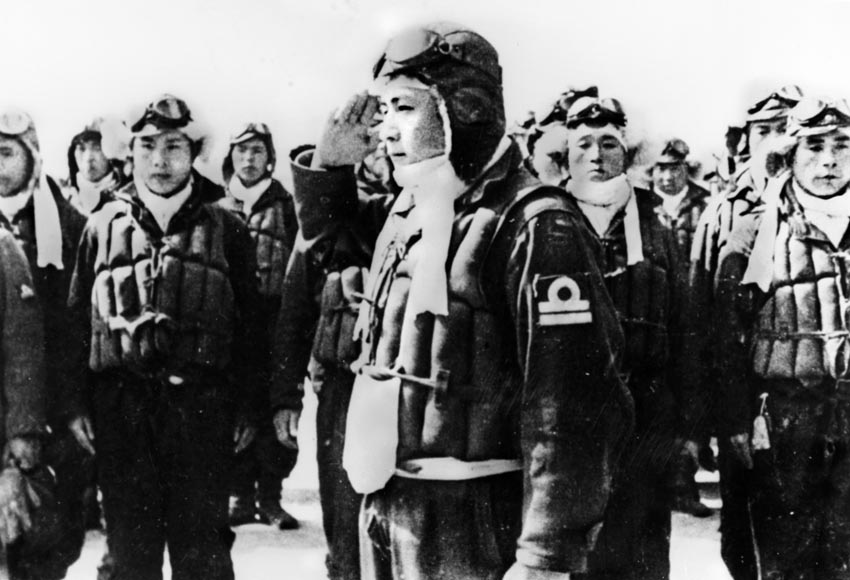
A
kamikaze pilot salutes as he receives his orders for a “divine wind”
mission. It is estimated that over 1,200 pilots (out of 2,314) lost
their lives on such missions.
The concept of
individual suicide was accepted within Japanese society, particularly
among those descended from the warrior, or Samurai, class. Suicide was
generally accepted as the way to atone for failure, and ritual suicide,
also known as seppuku and harakiri, was common among the military of
Japan. It would appear repeatedly during the Pacific war, beginning at
Guadalcanal and lasting to, and even after, Japan’s surrender.
But
mass suicide was something else. Throughout the war, individual
Japanese, particularly pilots whose planes were too badly damaged to
return to base and being culturally unable to accept a surrender to the
enemy, would fly their damaged aircraft into some enemy target, be it a
ship or a ground target. These men were presumed to have been granted a
direct passage to an honored place in heaven for their actions.
Suicide as a doctrinal military tactic, however, did not enter
Japanese military policy until October 1944. By then, the Americans were
invading the Philippines and the Palau Islands, threatening to cut off
Japanese lines of supply from the Far East. Without those supplies,
Japan could not sustain its war effort much longer. All attempts to stop
the American advance had so far failed, and, as in 1281, Japan was
growing increasingly desperate. Once again, the accepted solution was
the Kamikaze.
The origins of the modern Kamikaze are traced to
Luzon, in the Philippines, in October 1944. The Americans were about to
invade those islands, and the Japanese were preparing to meet that
invasion. Captain Rikihei Inoguchi of the Imperial Japanese Navy Air
Forces was at Clark Field discussing attack plans against the
approaching American invasion force. As a senior staff officer of the
1st Air Fleet, he had been assigned the job of organizing the air
defenses of the Philippines.
While speaking with Commander Asaichi
Tamai, commanding the 201st Air Group, he was joined suddenly by Vice
Adm. Takijiro Ohnishi, the recently appointed commander of Japanese
Naval Air Forces in the Philippines. Joined by some squadron leaders,
the group sat down to listen to Admiral Ohnishi’s instructions.
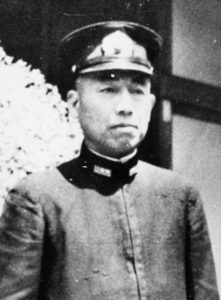
Admiral
Ohnishi was himself a pilot and a long-time advocate of naval aviation
in Japan. He had helped plan the Pearl Harbor attack and had been a
protégé of Admiral Isoroku Yamamoto. As a staff officer, Ohnishi had
long been involved in discussions in Tokyo over the use of suicide
operations, arguing against them. But the continued defeats in the
Pacific and the loss of vital resource territory seemed to have changed
his opinion by the time he was appointed to command the 1st Air Fleet in
the Philippines.
Admiral Ohnishi began by stating the obvious:
Japan’s situation was critical. He then explained that the Imperial
Japanese Navy was about to launch an all-out attack on the American
fleet off Leyte. But the Japanese fleet had no air cover of its own; the
1st Air Fleet on Luzon would have to provide that air cover. He had
orders to protect the fleet for at least one week, keeping the American
aircraft carriers from launching strikes that would cripple or destroy
the oncoming Japanese fleet.
The problem was that the 1st Air
Fleet had only 30 serviceable aircraft on Luzon. How could such a small
force hold back the hundreds, perhaps thousands, of American planes
coming to Leyte Gulf?
Admiral Ohnishi presented his solution. He
told the assembled pilots and staff officers, “In my opinion, there is
only one way of assuring that our meager strength will be effective to a
maximum degree. That is to organize suicide attack units composed of
Zero fighters armed with 250-kilogram bombs, with each plane to
crash-dive into an enemy carrier…What do you think?”
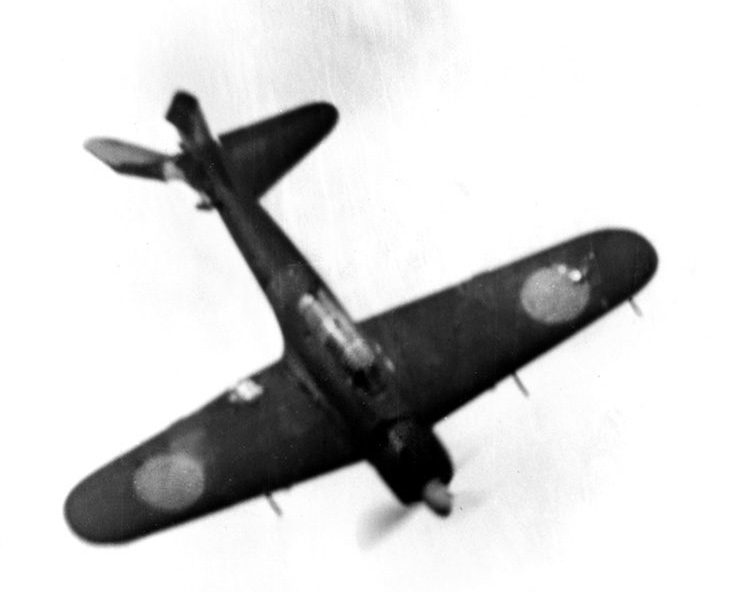
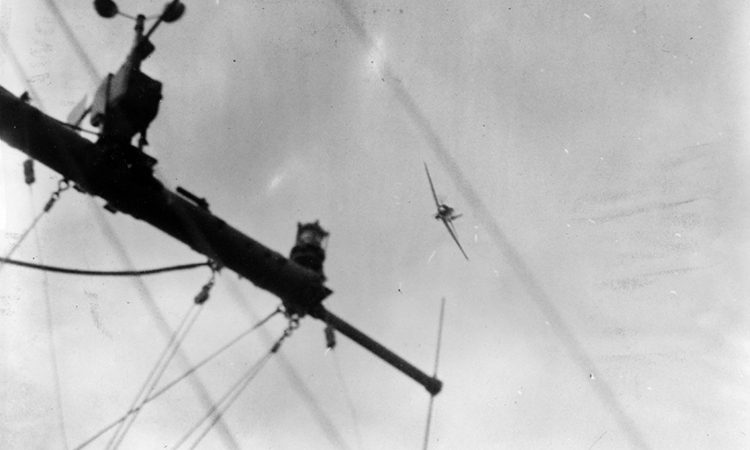
Despite
a broken elevator and wings riddled with bullet holes, a Mitsubishi A6M
“Zeke” Kamikaze plane makes its death plunge toward the carrier USS
Essex off Okinawa, May 14, 1945. Japan’s efforts to cripple the American
invasion of Okinawa brought about the mass employment of suicide
missions.
Silence initially replied to the
admiral’s proposal. Captain Inoguchi remembered, “No one spoke for a
time, but Admiral Ohnishi’s words struck a spark in each of us. Indeed,
‘body-crashing’ (taiatari) tactics had already been used by Navy pilots
in air-to-air combat against big enemy bombers, and there were many
fliers in the combat air units who had urged that the same tactics be
employed against enemy carriers.”
The group then discussed whether
a fighter plane armed with a 250-kilogram bomb would be enough to
disable or even sink an American aircraft carrier. They acknowledged
that accuracy would be greater with a pilot guiding the weapon,
including his own plane, to the target. Commander Tamai, the senior
flying officer present, agreed that the plane and bomb together would be
enough to at least disable any American aircraft carrier it hit.
Commander
Tamai then held a meeting with his pilots, and came back to say, “The
201st Air Group will carry out his proposal. May I ask that you leave to
us the organization of our crash-dive unit?” The Japanese Kamikaze
program of 1944 had begun.
Commander Tamai assembled his enlisted
pilots and explained the new proposal to them. Every one of the 23
pilots joyfully agreed to participate in the Kamikaze program. Returning
to his staff, Commander Tanai and Captain Inoguchi discussed how best
to organize the unit. They wanted an officer, preferably a graduate of
the Japanese Naval Academy at Etajima, to lead the first attack.
After
some discussion, Lieutenant Yukio Seki was selected as the attack
leader. When approached by Inoguchi and Tamai, Lieutenant Seki
responded, “You absolutely must let me do it.”
Discussions
followed regarding the force’s organization. A name was suggested, and
soon the new unit was called Shimpu, another Japanese word for Kamikaze.
Admiral Ohnishi approved the plans, organization, and men for the new
unit.
On the morning of October 20, 1944, the Shimpu attack group
ate breakfast and then assembled for their final instructions. Admiral
Ohnishi gave them a speech encouraging them to succeed, and the 24
pilots were prepared to go. But that was easier said than done.
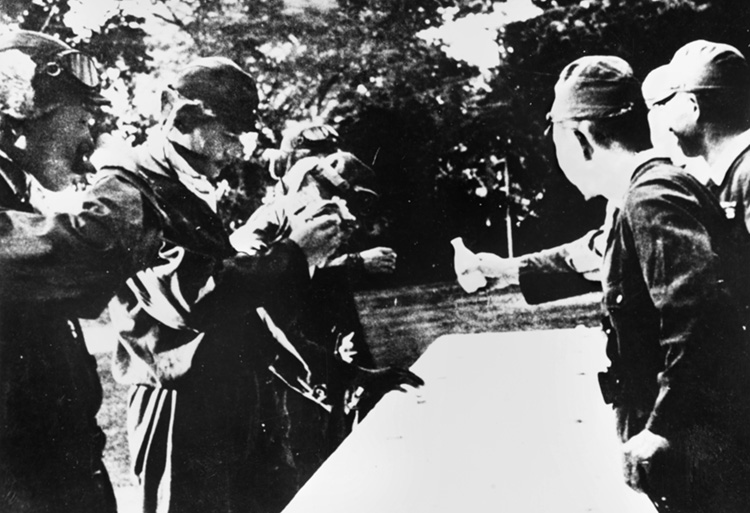
Admiral
Takijiro Ohnishi (right), commander of the Kamikaze Special Attack
Force, dispenses ceremonial cups of sake to suicide pilots about to take
off.
The initial missions had to be aborted:
mechanical failure grounded aircraft, enemy combat air patrols kept the
Japanese grounded, and bad weather prevented takeoff. It wasn’t until
the morning of October 25 that Lieutenant Seki and his group finally
launched their mission.
The Shimpu encountered a support carrier
group known to the Americans as “Taffy 3.” These Americans had already
been attacked by Imperial Japanese Navy surface forces days earlier in
Leyte Gulf. Now, one of the Shimpu group dove out of the sky at the
escort aircraft carrier USS Kitkun Bay (CVE-71).
Sailor Ron
Vaughn, an 18-year-old lookout on Kitkun Bay, spotted the plane as it
climbed, rolled, and plunged down on his ship, aiming for its flight
deck. The ship’s antiaircraft guns opened fire and damaged the plane as
it dove. One round crumpled the tail section, causing it to veer off
course. But the plane hit the water close aboard, damaging the ship and
causing scores of casualties.
Another Shimpu pilot dove on the USS
Kalinin Bay (CVE-68) and hit the deck of the carrier; two others were
driven off by the antiaircraft fire.
American fighter pilots
immediately raced to the scene to defend their home carriers. Despite
their efforts, three more Shimpu planes attacked the escort carrier USS
St. Lo (CVE-63) from above; the first Japanese plane was shot down by
fire from the St. Lo.
The second suffered the same fate, but this
aircraft drew the American’s attention away from the third aircraft,
which was following the ship and simply pulled up, nosed over, and
crashed into the vessel. Witnesses remembered that the plane sliced
through the flight deck, igniting fuel and ammunition in the hanger area
below that deck. One sailor insisted that he saw a bomb drop from the
aircraft an instant before the plane crashed into the ship.
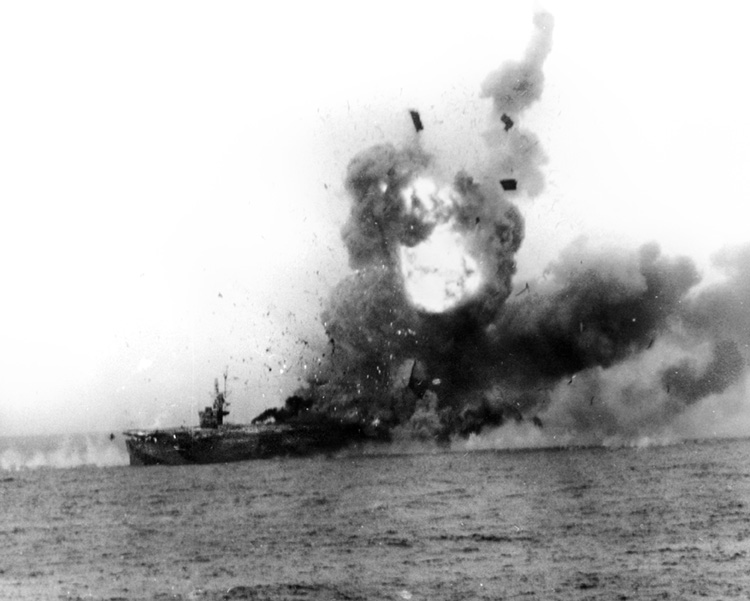
The
impact doomed the St. Lo. Explosions rocked the ship from bow to stern.
Damage-control sailors raced around to save their ship, but it was no
use. Thirty minutes after she was hit, the St. Lo sank. With her went
140 American sailors. She was the first “official” kill of the Kamikaze
attack force.
Admiral Ohnishi committed suicide after Japan’s surrender.
Meanwhile,
the Kalinin Bay was hit again and severely damaged; the USS White
Plains (CVE-66) and USS Kitkun Bay were both narrowly missed. Although
all these three ships were damaged, casualties remained few.
Ashore,
the Japanese awaited the results of the first Kamikaze attack.
Commander Tadashi Nakajima was at his base on Cebu Island when three
Mitsubishi A6M Zero fighter planes landed there. Out of the first to
land came Chief Warrant Officer Hiroyoshi Nishizawa, who ran up to
Commander Nakajima and made his report: Of the five Kamikazes and four
escorts, he reported, Lieutenant Seki had hit a carrier, and a second
Kamikaze hit the same ship, which soon sank. The third Kamikaze struck
another carrier, setting it afire. The fourth plane crashed into a light
cruiser which “sank instantly.” The fifth Kamikaze disappeared. Three
of the four escorts managed to return to Cebu.
The report was a
fiction. In fact, only the USS St. Lo was sunk, with the Kitkun Bay and
White Plains damaged. No light cruiser was struck on October 25. This
report, inaccurate as it was, was forwarded to Tokyo, which accepted it
at face value and broadcast it to the Japanese nation as a great victory
by the newly established Kamikaze Corps.
Believing a great
success had been achieved from a small group of aircraft, the Kamikaze
program continued on October 26. For the expenditure of five Kamikazes
and two escorts, the light carrier USS Suwannee (CVE-27) was slightly
damaged. Earlier, the USS Santee (CVE-29) had been damaged by a Kamikaze
that approached so swiftly that no guns had been able to fire before it
slammed into the ship.
By now, the standard operating procedure
for the launching of Kamikazes had been established. First, they would
await a report from a search plane that would locate, identify, and
report on an American carrier group. Often, these reports were
inaccurate, and a mission would have to be aborted when no ships were
found by the Kamikaze pilots. Each Kamikaze flight had at least two
escorting fighters to assist them in getting past the American combat
air patrols that protected the American carrier battle groups.
Weather
was, of course, always a factor. How many Kamikazes were assigned to
any one mission depended upon the conditions reported by the scouts.
Approaching their targets, the Kamikazes would increase their speed to
make their approaches while the escorting fighters protected them from
the combat air patrol. The signal, “All Planes Attack!” was given by the
flight leader’s raised arm, and each pilot picked his own target, then
plunged down toward it.
The deeds of the “Kamikaze Special Attack
Corps,” one of the names for the new Kamikaze force, had by now reached
Tokyo. Emperor Hirohito had responded to this new tactic with a message
to his naval aviators through Admiral Ohnishi. The message read, “Was it
necessary to go to this extreme? They certainly did a magnificent job.”
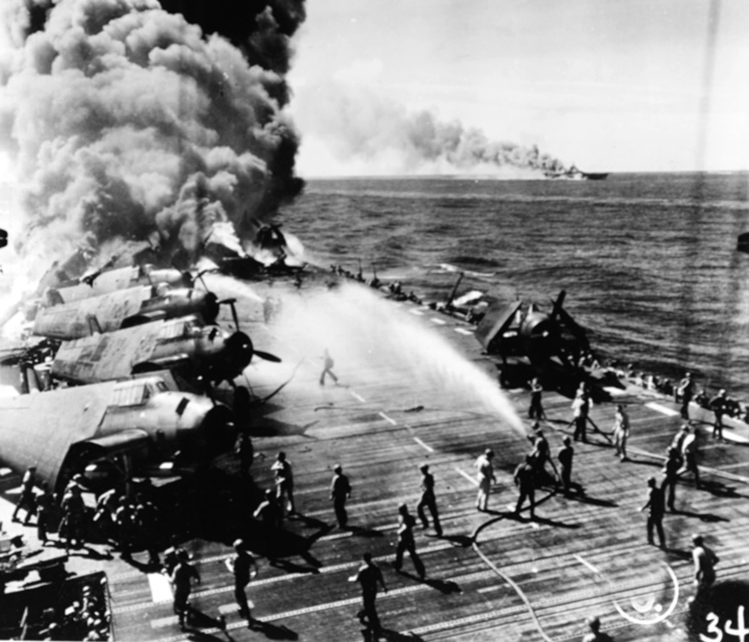
Crewmen
aboard the carrier USS Belleau Wood off the Philippines pour water on
aircraft and burning flight deck after a Kamikaze strike, October 30,
1944. The carrier USS Franklin, also hit by a suicide plane, burns in
the distance.
Captain Inoguchi, who was with
Admiral Ohnishi in Manila, felt that the first sentence of the Emperor’s
words were something of a criticism of Ohnishi’s new project, and
Ohnishi appeared quite upset upon reading this message. But he remained
determined to gain the Emperor’s favor by increasing his success.
Kamikaze
strikes continued against American ships throughout the Philippine
Campaign, including the invasion of Luzon and the clearing of the
southern Philippines.
Meanwhile, the idea spread throughout the
Imperial Japanese Navy and was taken up by the Imperial Japanese Army,
as well. One of the chief reasons for this was the lack of skilled
pilots. At the outbreak of the war, Japanese pilots had been the best of
the best. But over the three years that the war had thus far
progressed, attrition had whittled down those expert pilots to a
precious few, many of whom where now busy training their replacements.
But
the training of new pilots took time and fuel, neither of which the
Japanese had in abundance. A Kamikaze pilot, though, did not need the
in-depth training that a pre-war fighter pilot needed. He only needed to
be able to take off, fly a distance, and crash into an enemy ship. Even
formation flying was optional, although helpful.
As one historian
has written, “Loss of aircraft and veteran pilots and shortages of fuel
led to a reliance on suicidal Kamikaze units by 1944, made up of
largely green, ill-trained aviators and a mélange of planes.”
The
Kamikaze idea had by now spread far and wide among the Japanese
military. Soon Kamikaze Corps were being established in Japan itself.
Those forward bases under attack by the advancing Americans were often
provided with some “Special Attack Units.” Soon this title was expanded
to other suicidal methods of defeating the enemy.
One such method
was known as the “Kaiten”—a manned suicide torpedo that was intended to
sneak into American-held harbors and sink enemy ships at anchor. Then
came the “Ohka” (Cherry Blossom)—a human-piloted bomb released from a
carrying aircraft over the target and flown into that target by the
pilot.
The
first major warship sunk by the Kamikazes was the carrier USS St. Lo,
which was hit off Samar in Leyte Gulf, October 25, 1944. One hundred
forty Americans died.
There were also suicide
explosive speedboats (“Shin’yo” or Sea Quake)—small plywood craft filled
with explosives and driven by a crew of one or two into enemy ships as
they approached the shore of a Japanese base. Hundreds of these were
later captured unused in the Philippines and Okinawa.
At the war’s
end, near Okinawa, even the Imperial Japanese Navy’s super-battleship,
the IJN Yamato, was turned into a form of Kamikaze. (See WWII Quarterly,
Spring 2020.) But none of these other efforts achieved either the fame
or the success of the Imperial Japanese Navy’s “Kamikaze Special Attack
Corps.”
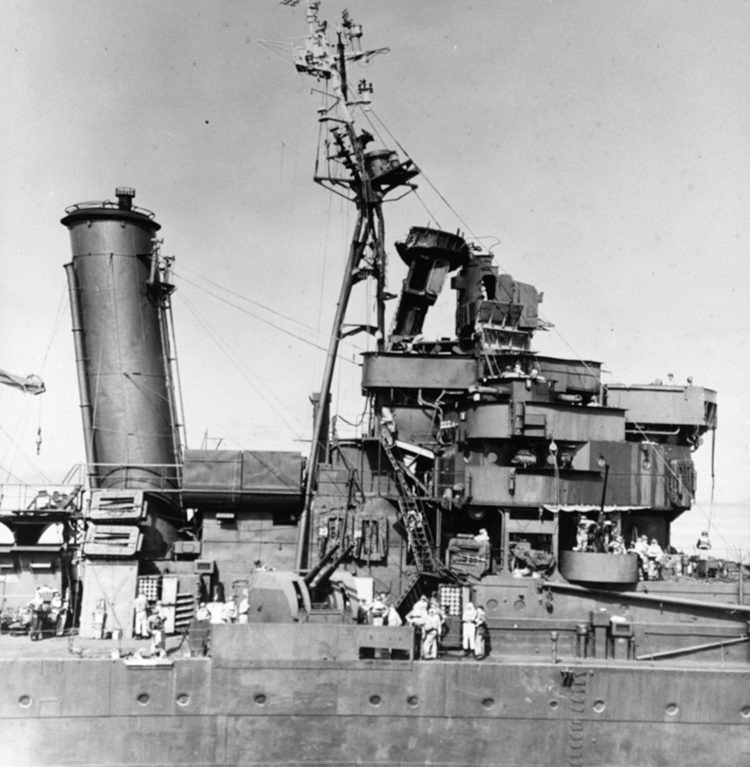
Some ships just seemed to draw the attention of the
Kamikazes. One such ship was the Australian heavy cruiser HMAS
Australia. Perhaps because her appearance different from that of
American ships, she was hit repeatedly, although her near-identical
sister ship, HMAS Shropshire, who often sailed alongside her, was never
hit. Some called her “the Kamikaze Magnet.”
HMAS Australia had
been in the war since the early days of 1939 and had earned herself an
enviable battle record. But she just couldn’t seem to shake the
Kamikazes. She was first targeted in Leyte Gulf on October 21, 1944,
leading some Australians to claim that she was the first victim of the
Kamikazes, and not the USS St. Lo.
That day, the attacking
aircraft was seen to be hit by antiaircraft fire and almost crashed into
the water. But the plane recovered, and despite further heavy
antiaircraft fire, punched into the port side of the heavy cruiser. This
sounds more like a “body-crashing” (Taiatari) tactic than a Kamikaze
attack, but the strike cost the ship her captain, Captain Emile F. V.
Dechaineux, along with five officers and 23 enlisted sailors. Scores of
others were wounded.
The ship returned to the war after repairs in
November, well after the Kamikaze had begun in earnest. In early
January 1945, the HMAS Australia was attacked no less than five times by
Kamikazes. On January 5, she was struck by a Zero, which hit her
amidships; 25 men on the gun crews died and another 30 were wounded.
Damage was slight, and she remained on station with a gunfire support
group off Leyte.
The next day she was hit again, at the middle
smokestack on the starboard side, killing 14 and wounding 26. Damage was
minimal, and she remained on station. January 7 was a quiet day, but
January 8 was not.
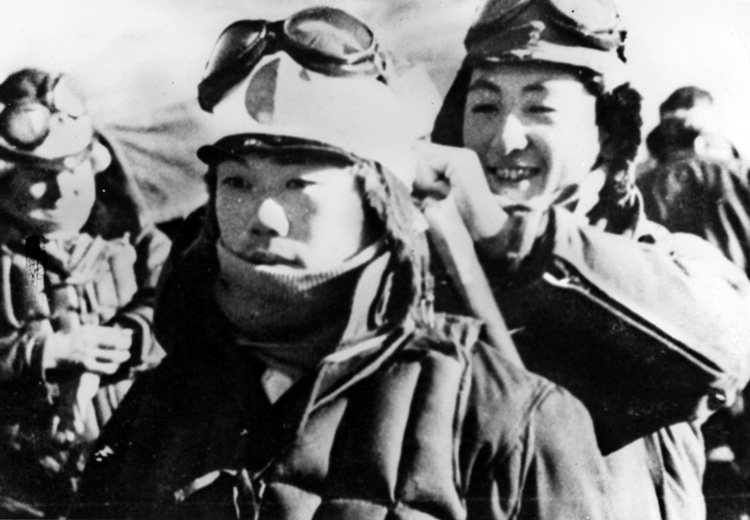
A
solemn Kamikaze pilot has his hachimaki headband, symbolizing manly
courage, attached by a smiling comrade. Ancient Samuri warriors wore a
folded white cloth when going into battle to keep their long hair and
sweat out of their eyes.
A Japanese bomber came
in, chased by four fighters of the combat air patrol. The enemy went
down barely 20 meters off the HMAS Australia’s port side. It skidded
into the cruiser’s hull, but caused no damage or casualties. Less than
20 minutes later, another Japanese bomber appeared and repeated the same
events. But this time, the bomb that the plane was carrying went off
and ripped a large hole in the cruiser’s port side, flooding two
compartments. Once again, there were no casualties. Asked if he wanted
to withdraw for repairs, Captain J.M. Armstrong refused and remained on
station.
By January 9, the Sixth U S. Army was wading ashore on
the main Philippine Island of Luzon, and HMAS Australia was offshore in
support. Eight Kamikazes came in searching for the invasion fleet, and
two headed for the Australia. One of these hit the USS Mississippi
(BB-41) and the other hit the Australia at her foremast, crushing her
forward smokestack and rendering the forward fire room inoperable. With a
hole in her side, her forward fire room out of action, and her speed
reduced, the Australia had had enough. This time she accepted the offer
to retire for repairs, once again with no additional casualties.
Kamikazes
appeared in almost every battle after Leyte. But by far their most
successful and deadly campaign came against the American invasion of
Okinawa. Here, Marines and the soldiers of the Tenth U. S. Army faced a
determined defense, one of whose primary objectives was to draw the
American fleet into a position that would make it vulnerable for attacks
from nearby Japan.
One of the negative by-products of rushing
pilots through an abbreviated training program to qualify them as
Kamikazes was that they had poor ship identification skills. This error
was felt most by the “small boys”—the auxiliary ships that often
accompanied the major fleet units to supply, fuel, and otherwise provide
succor to them when needed.
These included some described by
their titles, including LCS(L)3, or Landing Craft Support (Large) Mark
3. Developed from the original Landing Craft Infantry, or LCI, some had
been modified with rockets, machine guns, 20mm and 40mm guns, and other
assorted armament which, to the untrained Japanese pilot desperately
trying to find a target while avoiding the combat air patrol and
antiaircraft fire, were often mistaken for combat vessels such as
destroyers and even cruisers. As a result, these flat-bottomed,
diesel-powered, 160-foot-long ships often became the targets these
Japanese pilots were seeking.
The U.S. Navy’s Fifth Fleet, under
Admiral Raymond Spruance, was the largest in the world (535 warships),
but its position at Okinawa was exposed. It was committed to the island
for all manner of support and supply duties, which made its ships
stationary targets for the Japanese, who no longer had to guess where
the American fleet could be found.
To protect the fleet, the
Americans had established a series of “radar picket” posts around the
island to give early warning of the Japanese approach. Instead, these
soon presented to the Japanese aviators’ lonely targets, ripe for
attack. The radar-picket destroyers and destroyer escorts were supported
by various “little boys,” which were known at these posts as “pall
bearers,” since they spent so much time picking up survivors out of the
water, making them an inviting target for the Japanese.
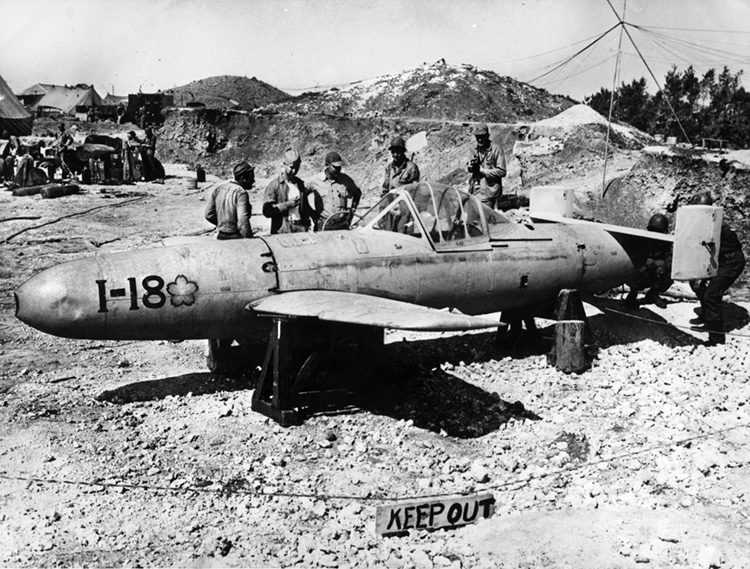
Marines examine a captured Yokosuka MXY-7 Ohka rocket-propelled suicide flying bomb found at the Yontan airfield.
The
Japanese reaction began slowly. On March 20, 1945, the Japanese
Imperial General Headquarters came up with a major offensive involving
Kamikaze pilots called Ten-Goō(“Heavenly Operation”). Tasked with
leading this operation was Vice Adm. Matome Ugaki, commander of the IJN
Fifth Air Fleet.
After gathering every flyable plane he could
find, no matter its obsolescence or original purpose, Ugaki assembled
3,000 of them at bases across Kyushu. The plan, dubbed Operation
Kikusui, was simple: guided by the few experienced pilots Japan had
left, the suicide pilots would be sent out in waves to find the American
ships and destroy them. The veteran pilots would then return to their
bases to pick up another group and repeat the process.
On April 6,
1945, the Japanese struck in force with Kikusui No. 1 against the U.S.
Navy’s Task Force 58 and the British Royal Navy’s Task Force 57, the
latter operating between Formosa and Okinawa. Some 700 planes—half of
them suicide planes—took off and went hunting for the Allied fleets.
The
first to be attacked at Okinawa were the destroyers USS Bush (DD-529)
at picket station number 1, the Colhoun (DD-801) at picket station
number 2, and the Cassin Young (DD-793) at picket station number 3.
Although the three destroyers put up a deadly screen of antiaircraft
fire, enough enemy planes got through to sink both the Bush and Colhoun;
the Cassin Young barely escaped the same fate—for now.
Elsewhere,
the destroyers USS Howorth (DD-592) and Hyman (DD-732) were severely
damaged, while the destroyers USS Leutze (DD-481) and Morris (DD-417)
were knocked out of the war. Destroyer USS Mullany (DD-528) was so badly
damaged that she had to be scrapped. Destroyer USS Newcomb (DD-586) was
also sent home for good, as was the USS Rodman (DD-456).
The list
of sunken ships included LST-447 and support ships Logan Victory and
Hobbs Victory. The minesweeper USS Defense (AM-317) went down as well.
The USS Haynsworth (DD-700) was damaged, as was the USS Feiberling
(DE-640). And this was only one day’s success for the Kamikazes.
The
suicide pilots also tried attacking two American carriers, the
Bennington (CV-20) and Belleau Wood (CV-24), but both ships escaped with
minimal damage.
Both sides suffered badly during Kikusui No. 1.
The Japanese had hit 17 American ships, sunk or knocked 11 out of the
war, and killed over 360 sailors. The Japanese, in turn, had lost over
350 planes and pilots—planes and pilots that could not be replaced.
The
Australian heavy cruiser HMAS Australia, showing damage incurred on
October 21, 1944, was struck so many times by suicide pilots that she
earned the nickname “the Kamikaze magnet.” She was never sunk, however.
The
next day the massive battleship IJN Yamato steamed toward Okinawa and
her doom at the hands of the American pilots from Task Force 58.
The
loss of Yamato did not stop the Japanese from continuing their suicide
attacks on the Allied fleets. After suspending operations for a few days
due to bad weather, on April 11, Kikusui No. 2 was launched—a two-day
assault by 185 suicide planes accompanied by 150 escorts. The carrier
USS Enterprise (CV-6) was the first to feel the enemy’s sting, which
knocked it out of action for two days while repairs were made. The
carrier Essex (CV-9), too, was hit but not sunk.
On April 12,
another dozen ships were hit, with the destroyer USS Mannert L. Abele
(DD-733) and LCS(L)-33 going down. On that same day, the Cassin Young
was in the middle of the fight for her life, as she was targeted during a
heavy Kamikaze raid. Her gunners shot down five aircraft, but a sixth
crashed into her foremast, exploding in midair only 50 feet above the
ship.
Surprisingly, only one man was killed, but 58 were wounded,
many seriously. Although badly damaged, Cassin Young made it to Keramo
Retto under her own power and would return to Okinawa in May after
repairs. She would be attacked again in July, suffering major damage and
loss of life, but she refused to be sunk. (The ship is today on display
at the Charleston Navy Yard in Boston, Massachusetts.)
Each day,
one or more ships were being hit and disabled, if not sunk. The radar
picket posts were the most vulnerable, set far from other support and
usually exposed to the incoming enemy air raids before anyone else. The
raids went on daily throughout April, May, and June, and ship after ship
was lost to the incessant aerial attacks.
CinCPac Admiral Chester
W. Nimitz grew increasingly concerned and pushed Lt. Gen. Simon B.
Buckner, commanding the Tenth U. S. Army, to move quickly to clear
Okinawa of enemy resistance so that he could withdraw his ships from
Japanese target practice. But the Japanese ashore were as determined as
those in the air, and the battle continued well into June.
One the
worst attacks by the Kamikazes was that suffered by the USS Laffey
(DD-724), stationed at radar picket post number 1 on April 16. The first
USS Laffey had been sunk during the naval battles for Guadalcanal. The
current USS Laffey, laid down in 1942, had already established herself
as a worthy successor to her namesake and had participated in the naval
support during the landings in Normandy. On April 16, 1945, she would
prove her worth once again.
Soon after dawn, 50 enemy planes were
closing in on the fleet, and Laffey’s radar picked up four enemy planes
approaching her. Three were shot down by Laffey’s antiaircraft fire, and
the fourth was shot down by the guns on board Lieutenant Howell
Chickering’s nearby LCS(L)-51. Carrier-borne Corsairs were slicing
through the enemy formation, downing as many planes as they could.
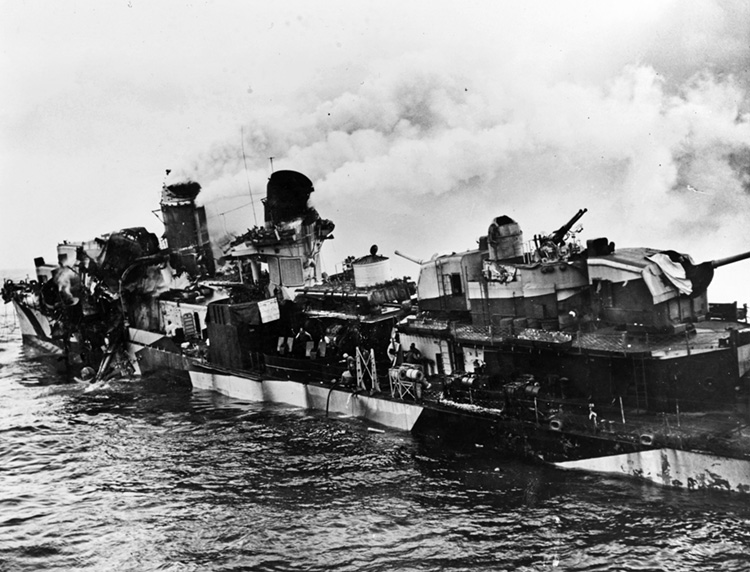
The
destroyer USS Hazelwood smoulders after being hit by a Kamikaze
attacker off Okinawa, April 29, 1945. Ten officers and 67 men were
killed, including the commanding officer; 36 were missing, presumed
dead.
A fifth plane attacked Laffey, only to be
shot down as well. Then a sixth streaked in, strafing the ship as it
approached. Several casualties resulted from the strafing before this
plane crashed into the ship at the after funnel, jamming the
fire-control radar.
A seventh aircraft smashed into the forward
gun mount and then ricocheted off the ship, leaving no serious damage.
An eighth plane was shot down as it attacked. But a ninth Zero used that
attack to approach undetected and crashed into the starboard 20mm
battery, damaging nearby 40mm batteries, starting a gasoline fire, and
setting off the ammunition.
Almost immediately, a tenth plane hit
the ship’s fantail, knocked out the aft 5-inch gun, and damaged three
20mm antiaircraft guns there. Plane number 11 dropped its bomb first
near the depth-charge rails before crashing into the aft 5-inch gun
mount, already damaged by a previous plane.
Plane number 12
dropped its bomb close aboard, jamming the rudder to a hard-left
position. The Laffey now had no operable guns in the rear of the ship.
The captain, Lt. Cmdr. Frederick J. Becton, now had a ship on fire and
with no guns protecting her stern. The Japanese quickly took advantage
of this weakness, and two more planes came in from astern, crashing
again into the 5-inch mount number 53 and killing several of the crew
who were fighting fires there.
Plane number 15 was shot out of the
sky as it approached from the port quarter. A pursuing combat air
patrol Corsair was so close on his heels that he hit the ship’s mast and
ditched nearby. But this attack knocked out the ship’s radar.
Plane
number 16 was next in line and was shot down over the ship by the
combat air patrol, but not before its bomb shredded the ship’s bow with
shrapnel, knocking out power to 5-inch mount 52, which continued to
operate manually.
Plane number 17 was shot down, and plane number
18 was disintegrated by a shell from mount 52. Plane number 19 was also
shot down, by mount number 51. A twentieth plane came in through the
smoke off the Laffey and dropped its bomb on mount number 53 before
breaking off the ship’s yardarm. It was then splashed by the combat air
patrol.
A
suicide pilot homes in on the carrier USS Enterprise during the battle
for Okinawa, May 14, 1945. The pilot destroyed Big E’s forward elevator,
killed 14, injured 32.
Plane number 21 also
dropped its bomb, knocking out two 20mm antiaircraft mounts before being
shot down by the combat air patrol. A final attacker was also taken out
by the combat air patrol.
The USS Laffey was miraculously still
afloat but in serious trouble. It was down at the stern, the rudder was
jammed, and most of its guns were disabled. Fortunately, the hull and
engines had not been damaged. She had been hit by six Kamikazes, damaged
by two other near misses, struck by three bombs, and had other close
calls. She lost 31 killed and 72 wounded, but the fires were soon under
control and the flooding stopped. She was towed to a repair base off
Okinawa and, after service during the Korean War, would eventually end
up as a memorial at Patriot’s Point, Charleston, South Carolina. Both
LCS(L)s supporting her also survived, although with significant
casualties.
But, like a swarm of angry wasps, the Kamikazes kept
coming. As the battle progressed, their attacks and numbers began to
thin out. Since Okinawa was lost and the next invasion would no doubt be
at Japan itself, the Japanese decided to hoard their remaining Kamikaze
planes and pilots for the final battle.
One of the greatest
tragedies to befall the American fleet was that of the carrier USS
Bunker Hill (CV-17), the flagship of Vice Adm. Marc A. Mitscher’s Task
Force 58. On May 11, the carrier was on station 76 miles east of Okinawa
when a Japanese “Zeke” fighter suddenly appeared out of the cloud
cover.
Having just been refueled with nearly two million gallons
of high-octane aviation fuel, the Bunker Hill was a floating Molotov
cocktail waiting for a spark. The Zeke crashed into the flight deck,
which was brimming with 30 planes waiting to take off; in the hangar
deck below were 48 more that had been fueled and armed.
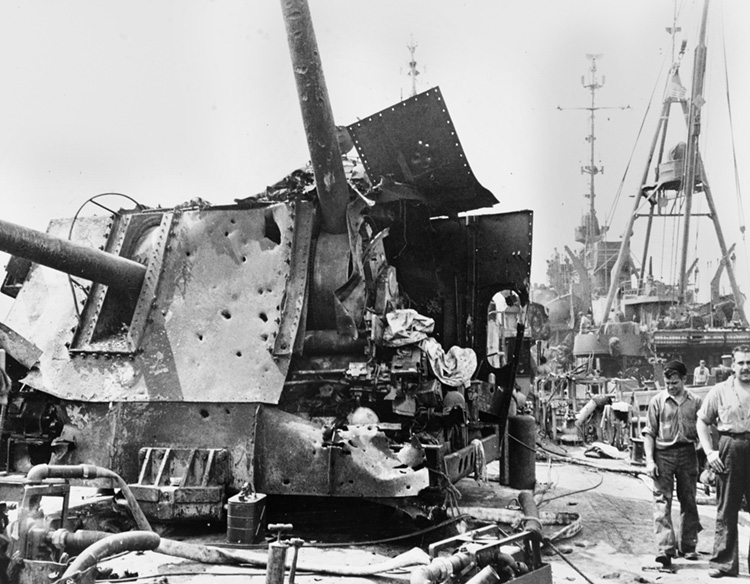
The
shattered 3.5” gun mount aboard the USS Laffey. The ship was attacked
by 22 Japanese planes on April 16, 1945, and struck by four bombs and
five suicide planes. Thirty-one sailors were killed, 72 wounded.
While
the planes on deck exploded and burned, another Kamikaze dashed in and
slammed into the ship’s control center, known as “the island.” Crewmen
sprang into action in a valiant, but ultimately futile, effort to
contain the blaze. Other ships pulled alongside to aid in the effort but
they, too, stood no chance against the roaring inferno.
In the
end, 346 officers and men out of the ship’s complement of 3,000 lost
their lives, 43 were missing, and another 264 were injured. The charred
wreck of the carrier managed to return for repairs to Bremerton,
Washington, via Pearl Harbor, but it would never fight again.
At
the end of the war, the Japanese themselves compiled a recapitulation of
the record of the “Kamikaze Special Attack Corps.” They recorded that,
of the 2,314 planes dispatched (including escorts), 1,086 returned. For
the 1,228 planes “expended,” they claimed 81 ships sunk and 195 damaged,
for a total of 276 ships.
Postwar records indicate that the
correct figures are 34 ships sunk, including three light carriers and 13
destroyers. Of the 195 ships the Japanese claimed as damaged, they had
actually damaged 288 ships, including 16 fleet aircraft carriers, three
light carriers, and 17 escort carriers. It should be noted that several
ships, like the HMAS Australia and USS Laffey, were hit repeatedly but
not sunk. So, the Japanese claim of a total of 276 enemy ships sunk or
damaged by Kamikazes is understated. In fact, they hit 322 allied ships,
sinking 34. It was not the “Divine Wind” of 1281, but it was a
respectable effort, nevertheless.
But, despite all her efforts to
halt the American invasion of Okinawa, Japan had shot her bolt. Once
Okinawa fell, she had very little chance of preventing a full-scale
invasion of the Home Islands.
As the intelligence officer of the Fifth Fleet put it, “The Japanese are defeated, but we have not yet won the victory.” The Kamakaze and the resistance on Iwo Jima and Okinawa with the suicides of the civilians jumping to their death sealed the fate of the Japanese, and the casualties that the Americans suffered prompted President Truman to use the Atomic Bombs to force a surrender.
I am sure that we in our past or recently are driving through a sub
division in suburbia and all the houses are tastefully painted, yards
immaculately manicured...except for one house and guess what you see in
the yard......
You got it....the symbol of tackiness...........the dreaded Pink Flamingos....
I had seen a picture of one and it caught my eye...so I figured I
would do a bit of research on the universal symbol of tackiness and
humor.
Donald Featherstone, the Inventor of the Flamingo
First designed in 1957, the fake birds
are natives not of Florida but of Leominster, Massachusetts, which bills
itself as the Plastics Capital of the World. At a nearby art school,
sculptor Don Featherstone was hired by the plastics company Union
Products, where his second assignment was to sculpt a pink flamingo. No
live models presented themselves, so he unearthed a National Geographic
photo spread. It took about two weeks to model both halves of the bird,
brought into the third dimension by then-revolutionary injection-mold
technology.
A flamingo-friendly trend was the sameness of post-World War II
construction. Units in new subdivisions sometimes looked virtually
identical. “You had to mark your house somehow,” Featherstone says. “A
woman could pick up a flamingo at the store and come home with a piece
of tropical elegance under her arm to change her humdrum house.” Also,
“people just thought it was pretty,” adds Featherstone’s wife, Nancy.
That soon changed. Twenty-somethings of the Woodstock era romanticized nature and scorned plastics (à la The Graduate).
Cast in flaming pink polyethylene, the flamingo became an emblem of
what Nancy delicately calls the “T-word”—tackiness. Sears eventually
dropped the tchotchkes from its catalog.
But then, phoenixlike, the flamingo rose from its ashes (or
rather, from its pool of molten plastic: As demonstrated at the finale
of Waters’ film, flamingos don’t burn, they melt). As early as the
1960s, pop artists including Andy Warhol and Claes Oldenburg had begun
elevating the low brow and embracing mass culture. And then, of course,
By the mid-1980s, the flamingos were
transitioning from a working-class accessory to an elaborate upper-class
inside joke. They furnished colorful substitutes for croquet wickets
and clever themes for charity galas. The bird became a sort of plastic
punch line, and, at worst, a way of hinting at one’s own good taste by
reveling in the bad taste of others.
Back in the 1980's before I joined the U.S. Army, I was a driver with
Domino's Pizza and those were the days of "30 minutes or free." Well
some people would not answer the door forcing the driver to leave, go to
a gas station, find a pay phone...You know, One of these...This was the
time before cell phones.
and call the number on the ticket that was on the box. The scamming bottom feeding, non tipping
customer would immediately trumpet "The Pizza is Free..ain't it?"
Well I got burned the first time by this and it did piss me off, to me
it was dishonorable. Now if the pizza was late due to stuff that was
beyond control, traffic, accident, weather and so on...I had no problem
giving the pizza away. We were not penalized for it.
What I would do is before I left after I had confirmed the address,
I would flip the floormat upside down and memorize something
distinctive about the yard, what kind of cars they had and so forth.
Then head to the payphone and call the customer. After I became a
trainer for the new drivers I would use this as an example when they
would ask me "what do I do when the customer don't come to the door?" I
would tell what I would do with the floormat in front of the door then
head to the phone at the gas station. I would tell the driver trainee
"I would call the customer, and after confirming the address, you live
at 720 maple drive, Yes I know the pizza is past 30 minutes...I do have a
question for you if you please...Do you have the rusty camaro on
cinderblocks in your front yard surrounded by pink flamingo's?.....If
you please, go to your front door, and you will see that your floormat
is upside down. The pizza was on time and the total will be $12.34
cents. I will be there in a few minutes.." I would also tell the trainee that if they try to hustle the driver, you ain't going to get a tip either, it was just how it rolled." I would use this as an
example so the flamingo's were a regular feature of tackiness that I use.
I also used a Fake "Flamingo" as a prank on my Brother and Sister in Law when we went to Florida, you can read about it on the Link
This is the picture that started this strange post...
I normally don't have many songs by newer acts because I consider the new music scene to be "Crap", the older Music like from my decade the 80's to be awesome, and I grew up with the super bands of the 1970's with Wolfman Jack hooking the songs on AFN in Frankfurt Germany in the mid 1970's. It was a good time to experience music, Hey I even liked Disco..
I am still running my backup theme "What songs would I play if Sirius/XM would let me host a segment if songs that I could play over and over again and these songs I can do, especially if I am on my motorcycle, and the song is on my MP3 player, it is easier to replay and you don't wear our the record. My Bugaloo theme will be back in a couple of weeks, it is still fattening up in the pasture after being rode hard like a lady of the evening and the fleet is in.
I decided to roll with "Payphone" by Maroon 5, I don't know where I heard this song at, but for some reason it resonated with me so I got a bootleg copy of it a few years ago when you can get "free MP3" songs on the internet.
"Payphone" is a song by American pop rock band Maroon 5 featuring American rapper Wiz Khalifa. It was released on April 16, 2012, as the lead single from their fourth studio album, Overexposed (2012). The song was written by Adam Levine, Benny Blanco, Ammar Malik, Robopop, Shellback, and Khalifa, and produced by Blanco and Shellback. The song is a pop ballad
and describes a romance that ended abruptly. It has received favorable
reviews from music critics, who praised the catchy melody and named it
"a radio success", but some others dismissed its title and Khalifa's
appearance.
The official music video was directed by Samuel Bayer,
and finds Levine taking down some bank robbers and attempting to become
the "hero" in a hail of bullets as he makes his escape, steals a gun
from a robber, and then gets mistaken for one. Because of this, he must
escape from a fleet of policemen, which he does with ease.
The video was positively received from critics, who considered it an
enjoyable mini-action film. The video was nominated for an MTV Video Music Award for Best Pop Video, but lost out to "What Makes You Beautiful" by One Direction. In July 2012, "Payphone" was named Song of the Summer for 2012 by Idolator.
On the Billboard Hot 100,
the song debuted at the number three spot before peaking at number two.
The song sold 493,000 copies in its first week, becoming the best sales
week for a digital song by a group and also the eleventh-best sales
week overall. It peaked at number one in Canada for eight consecutive
weeks. It also topped the charts in the United Kingdom, making it the
band's first-ever single to do so. "Payphone" was the world's fifth
best-selling single of 2012 with 9.5 million copies sold.
The song was written by Maroon 5's lead singer Adam Levine, along with Ammar Malik, Robopop, Benny Blanco, Shellback, and Wiz Khalifa, while production, programming, additional bass, keys, acoustic guitars and background vocals were provided by Shellback and Blanco. Levine, Blanco, Shellback, and Malik also wrote the band's previous single "Moves Like Jagger".The writing process started when Malik and Robopop constructed a piano
line and demo track that Blanco compiled into a proper melody.They gave it to Levine, who wrote the lyrics.
Blanco also wanted to throw a wrench into the Maroon 5 works by adding
hip-hop flavor to its sound, "I love when things don't make sense, like,
'Holy fuck!' You don't hear him on the song at all. I like when bands
dip into a whole different genre." For this, he commissioned Wiz Khalifa (whose singles "No Sleep" and the then-upcoming "Work Hard, Play Hard", Blanco has produced) to write and rap a verse on "Payphone". In an interview with Rolling Stone,
Blanco told that five minutes before Khalifa arrived at the studio, he
prepared "the sound beds for the finger snap-driven portion of the jam".
However, producer Max Martin, who was the executive producer of Overexposed, adjusted the chorus, because he felt it should be a "little different".
In the United States, the song debuted on the Pop Songs chart at number 21, making it the highest-charting debut by a group since 'N Sync's "Pop" debuted at the same position in June 2001. "Payphone" peaked at number one on the Billboard's Pop Songs chart, becoming their fourth number one. On Pop Songs, the group makes it to back-to-back toppers, as its last entry, "Moves Like Jagger," featuring Christina Aguilera, reigned for six weeks beginning in October. The band had likewise led consecutively with its first two number ones, "This Love" (three weeks) and "She Will Be Loved" (four) in 2004. Wiz Khalifa, featured on the pop edit of "Payphone," scores his first Mainstream Top 40 number one.[29] On the Adult Pop Songs chart, "Payphone" debuted at number 17, the highest-ever debut by a group and the third-highest overall. It also topped the Adult Pop Songs, becoming their fifth leader. On Adult Pop Songs, Maroon 5 - whose number one ledger on the list includes its four Pop Songs leaders plus 2010's "Misery" - ties Nickelback for the most commanding titles among groups in the chart's 16-year history.
"Payphone" sold 493,000 digital downloads in its first week and subsequently debuted at number one on the Hot Digital Songs chart, the best sales week ever for a digital song by a group, surpassing The Black Eyed Peas' "Boom Boom Pow", which topped the chart with sales of 464,000 units in April 2009. It is also the eighth-best sales week overall since Nielsen SoundScan began tracking digital downloads in 2003. The song debuted at number three on the Billboard Hot 100.
It failed to reach number one, peaking at number two on that chart for
six non-consecutive weeks, being blocked from the top spot by Gotye's "Somebody That I Used to Know" and Carly Rae Jepsen's smash hit of the summer, "Call Me Maybe". On its 18th week in the top ten, "Payphone" dropped to number seven on the Billboard Hot 100, making it the first time the song was not a part of the top five.
It also spent its first 19 weeks in the top ten. Over 5 million copies
of the song had been sold in the United States by March 2013, and as of June 2014, it has sold 5,510,000 copies in the US.
On the Canadian Hot 100 chart, the song debuted at number 2, for the issue dated May 5, 2012. The following week, the song fell to number 3, where it remained for a further week.The following week, the song climbed to number 2 and on the chart issue dated June 2, 2012, the song topped the Canadian charts. For the following seven weeks, the song remained at the top,spending a total of eight weeks at the top.
In the United Kingdom, "Payphone" debuted at number one on the UK Singles Chart.
It remained at the top of the chart for two non-consecutive weeks and
became both Maroon 5's and Wiz Khalifa's first chart-topping song in
Britain. It sold over 141,000 copies, which marks the third week in a row that the number one single broke the 100,000 barrier after Gary Barlow and Cheryl Cole. According to the Official Charts Company, the song sold 725,000 copies in the United Kingdom in 2012, becoming Britain's ninth best-selling single of that year. "Payphone" had sold 68,000 digital copies in Italy.
The music video for the song directed by Samuel Bayer, was shot on April 17 and 18, 2012. Levine was spotted shooting the video, making a call from a Los Angeles phone booth, fleeing from the police with model Bregje Heinen and speeding away in a classic sports car.
It is revealed in the video for Levine's role is a bank worker, he
said: "I work at a bank; I have no self-confidence. It's gonna be a very
difficult role for me to play because I'm a cocky motherf**ker." The video for "Payphone" premiered on May 9, 2012 on E! and was released on Vevo on May 10. It was reportedly similar to The Matrix, The Dark Knight and Die Hard, and the high-action FPS video game, Payday: The Heist. The car used in the video, a custom 1967 Shelby Cobra, was a kit-car hand built by car enthusiast Jim Fletcher from Fresno, CA.
The
video begins with a flashforward that starts with a beleaguered Levine
torching his ride and dialing a telephone number at a payphone. Another typical day at a Las Vegas
(seen from the decals on the police cars) bank for Levine is shown
next, which turns into chaos when some bandits enter and take charge
(some of the bank robbers are played by the other members of the band:
guitarist James Valentine, drummer Matt Flynn, bassist Mickey Madden and keyboardist, previously a touring Maroon 5 member, PJ Morton)
– all of this happens while the song plays in the background. Levine
grabs a gun from one of the robbers and threatens to get rid of them. He
and his female co-worker named Sonya (played by Dutch model Bregje
Heinen) escape, though Levine is shot in the arm, but when some cops
mistake him for one of the robbers, Levine tells Sonya to hide in a car
and steals an AC Cobra 427
that belongs to Wiz Khalifa to get away from them. A car chase follows
and when Levine is almost caught by the police, he steers the stolen
convertible onto the wrong side of the road and causes a huge explosion,
which destroys one of the police cars. When he finally reaches his
destination in Los Angeles, he passes by a place where Khalifa, the
owner of the car, performed his rap earlier. After Levine gets out of
the convertible, it also explodes and he enters a booth, injured, with
the titular payphone, probably to call for help (it is also likely that
he is calling Sonya) – this connects to the beginning of the video.
A lyric video for "Payphone" premiered on April 16, 2012 on Maroon 5's Vevo
channel. The clip is in an animated graphic novel style, drawn in
panels. The clip shows the main character, presumably frontman Adam
Levine, looking back on his relationship and heroically fighting
monsters, rescuing old women from muggers, etc. Towards the end, Wiz
Khalifa appears in a hoodie, acting as Levine's crime-fighting sidekick