Webster

The Constitution was made to guard the people against the dangers of good intentions." --American Statesman Daniel Webster (1782-1852)


Wednesday, July 26, 2023

Mothballing the Fleet After WWII

 I saw this purely be accident whyle taking a break at work, so I being the caring individual, shamelessly "clipped" it for my Blog.  I still am working all the crazy hours and will be until Labor day or a bit afterwards.


The US Navy at the end of WWII was the largest on the planet, and would be unaffordable at that size  in peacetime. What followed was the largest warship preservation effort in history.

Phily1961igloos

(WWII Cruisers USS Huntington (CL-107), USS Dayton (CL-105), and battleship USS South Dakota (BB-57) in mothballs at Naval Inactive Ship Maintenance Facility Philadelphia, PA in August 1961. These warships had been in reserve for 14 years and show the characteristic “igloos”.) (official US Navy photo)

siusun bay

(The Suisun Bay, CA facility packed full of mothballed warships after WWII.)

The plan

In September 1945, immediately following the end of WWII, the US Navy put forth it’s first draft of what the peacetime fleet would look like. Using a very broad brush and not differentiating between types and classes, it recommended retaining 30% of it’s ships on active duty, placing 50% into mothballs, and scrapping 20%. Senator David Walsh (D-MA), an expert on naval affairs, calculated in September 1945 that this would require total manning of 500,000 men.

The post-WWII mothballing effort was a juggling act between the need to get men back to civilian life, and the need for their services to lay up the fleet. There couldn’t be warships still on duty without a crew, but, demobilization couldn’t be held up either.

When the Japanese emperor made his surrender announcement in August 1945, the total manpower of the US Navy hovered around 3,000,000 plus another 400,000 non-active reservists, female WAVEs, and recruits still in training.

In early November 1945, about six weeks after the surrender signing aboard USS Missouri, Congress outlined the first demobilization plan for the US Navy. A minimum of 33% of the fleet’s WWII manpower, about a million men, was to be out no later than 15 February 1946; and of this, 327,000 by Christmas 1945 and 865,000 by New Years Eve. By the end of April 1946, 50% of the wartime manpower would be out. By 1 September 1946, the process would be essentially completed with 3,000,000 WWII veterans mustered out, leaving about 490,000 on active duty in January 1947 including new sailors recruited in the meantime.

In November 1945 Congress set a target of 1,079 active-duty warships to be in service at the end of 1946. This was to include WWII-veteran warships and vessels built in the meantime. While it might sound counter-intuitive, the US Navy had to maintain at least a snail’s pace of new commissionings even as relatively fresh ships were mothballed. This would avoid block obsolescence problems (entire generations of ships simultaneously wearing out) down the road, and would also avoid bankrupting shipyards.

Determining active vs reserve

While WWII was still raging, a small office of the US Navy quietly began planning what the postwar battle fleet might look like. This was kept hidden as not to seem arrogant or callous to the American public.With no knowledge of the Manhattan Project, the team estimated that WWII would end in 1946 (in Great Britain, the Royal Navy felt early 1947 was more likely). The team took into account losses to date, ships under construction, current & future technology and tactical trends, and projected losses during the final invasion of Japan. The team estimated the US Navy would finish the war with a surplus of battleships, cruisers, submarines, and convoy escorts, a parity of aircraft carriers, and a shortage of destroyers and amphibious ships. For carriers, destroyers, and landing craft, the terrible kamikaze poundings during the Okinawa invasion were projected to be much worse as Japan would obviously throw everything at the final invasion fleet.

chart

Above is a chart of the intended (1945) postwar disposition of the fleet’s large combatants.

Already during WWII, it had been decided that none of the so-called “standard-style” battleships would be retained on peacetime active duty. All would be placed into reserve or discarded outright. Below is the mothballed USS Tennessee (BB-43), a pre-WWII design, decommissioned in February 1947 and rusting away in reserve on 6 December 1956. None of the “standard-style” battleships were ever reactivated during the Cold War.
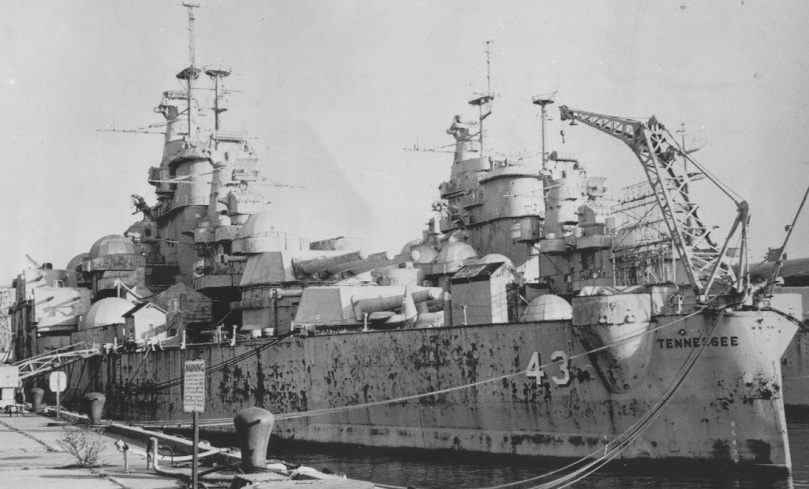
Tenn6Dec1956

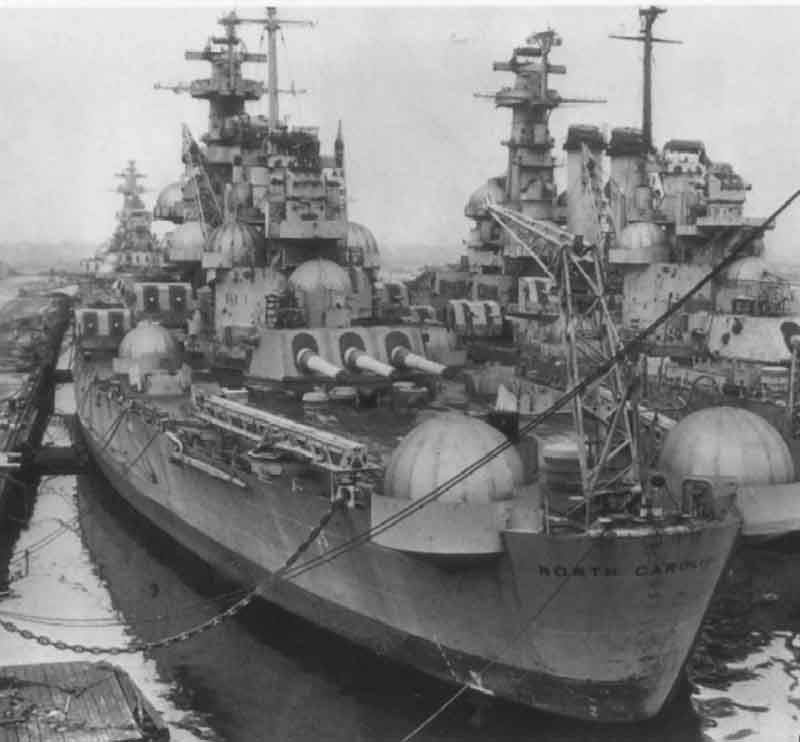
Of the remaining ten, six were called “treaty-style” and finally the four very modern Iowa class. For battleships, which had been eclipsed by aircraft carriers and submarines during WWII, it was planned to retain on active service the four Iowas and two of the six “treaty-style”. The two North Carolina class ships were selected, even though they were older than the four South Dakota class, as mothballing all four South Dakotas would remove an entire block of training and spare parts requirements from the active fleet.
NorCarearly1950s

Battleships are tremendously expensive to operate in peacetime and even this modest plan unraveled. Both North Carolina class ships went into reserve in 1947. Above are USS North Carolina (BB-55) and USS Washington (BB-56) mothballed at Bayonne, NJ in February 1951. Both had been in reserve for four years at that point and have “igloos” covering their 40mm AA gun positions. Ahead of USS North Carolina is the battlecruiser USS Alaska. None of these ships was ever reactivated. USS Washington was scrapped in 1961, USS Alaska in 1960, and USS North Carolina was made into a museum ship.

shangrila

One of Grumman’s “too-late cats”, the F7F Tigercat fighter just missed WWII combat. The Tigercat above was aboard the Essex class carrier USS Shangri-La (CV-38) in February 1946, six months after WWII. Capable of operating upcoming jets, the Essex class large aircraft carriers were considered war-winners and formed the core of the active-duty peacetime navy.
bostonnavyyard1946CVEs

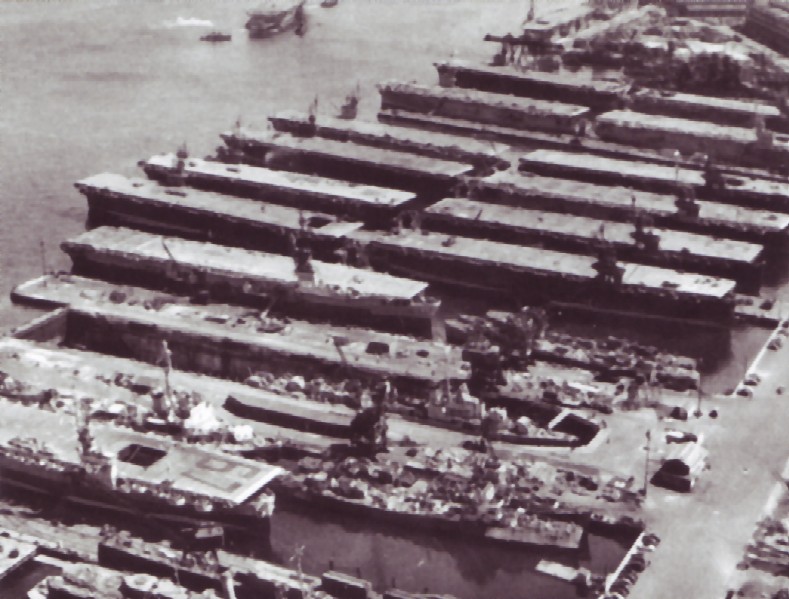
Meanwhile the smaller carriers (CVLs and CVEs) were greatly pared in number. Especially in the case of the CVEs, their primary task had been escorting convoys against u-boat wolfpacks in the Atlantic, and there was simply no real role for them in the late-1940s US Navy. Many of these ships were later pulled out of mothballs for conversion into ASW carriers or aircraft transports. Three were later transferred abroad. Above (lower left) is USS Solomons (CVE-67) along with a huge number of other mothballed CVEs at Boston Navy Yard in 1946. USS Solomons was later the first of the mothballed CVEs to be scrapped.

tinian

An extreme case (above photo) was the escort carrier USS Tinian (CVE-123), which literally went cradle-to-grave in mothballs. Launched about 48 hours after the Japanese surrender, USS Tinian was completed with leftover wartime funds and ran builder’s trials in early 1946. On 30 July 1946, the US Navy quietly declared the ship “accepted” without ceremony, and USS Tinian was sailed straight into the mothball fleet. The unused USS Tinian sat in reserve for a quarter-century before being scrapped in 1971, never having done anything.

dressship1946

The US Navy finished WWII with a huge surplus of cruisers. With the postwar Des Moines class already started, most went into reserve in the late 1940s. USS Augusta (CA-31) decommissioned ten months after the end of WWII. The post-WWII press release above announced the reinstatement of “dress ship” (flying of all pennants and lights on holidays) a custom of the sea which the US Navy suspended after the Pearl Harbor attack in 1941. USS Augusta never returned to service and was later scrapped after 13 years in mothballs.

alaska1945

The two Alaska class battlecruisers were a separate issue. The American concept of battlecruisers differed from the rest of the world. The US Navy designed the Alaskas before WWII as “cruiser-killers”, specifically to hunt down and destroy Japanese fast heavy cruisers. By 1945, their intended prey had already been sunk and their core mission vanished. USS Alaska and USS Guam were almost as expensive as battleships to operate in peacetime. They went into reserve in 1947. Part of the reason they were retained in reserve was political; their Mk8 12″ guns were very expensive to design and build during WWII and were specific only to this class. It would have looked bad to not get return on the taxpayer investment, even if only as a reserve asset. Neither was ever reactivated and both were scrapped in 1960. The photo above shows USS Alaska prior to decommissioning, with her seaplanes already moved ashore.

williamwood

USS William M. Wood (DD-715) was a Gearing class destroyer launched during WWII but still doing sea trials when Japan surrendered. The Gearing class was the best destroyer design of WWII and quite possibly the best all-around warship class in the world in 1945. Fresh, powerful, and modern; destroyers like USS William M. Wood would form the core of the peacetime escorts and continued in active duty.

LSM272in1948

The US Navy’s massive amphibious force, the largest the world had ever seen, was greatly dialed down in size. Never again would there be anything like the “Overlord” landings in Normandy in 1944, and there was neither the need for these ships, nor funds to operate them, in active duty. Additionally, some “minor” types like LCMs, LCVPs, LCTs, etc had been built more or less under the assumption that they were semi-disposable, with lifespans not intended to go much past the defeat of the Axis. Above is the medium landing ship LSM-272 in reserve. After Japan’s 1945 surrender, LSM-272 served the occupation fleet then decommissioned in May 1946. The vessel was used as a makeshift mooring barge by US Navy smallboats at San Diego, CA for a while then scrapped in 1948.

apb58stocktonCA1950s

With less ships overall, there were less ships per auxiliary to support and the number of auxiliaries, both in active service and reserve, was trimmed. The warship above is USS Vanderburgh (APB-48), a Benewah class self-propelled barracks barge, which commissioned about two months before the end of WWII. With a surplus of these types already on duty, the fresh USS Vanderburgh was placed into reserve at the Mare Island, CA mothball fleet in 1947. The 1960s photo shows the typical “igloos” over the Mk4 40mm guns. USS Vanderburgh never returned to service and was scrapped in Portland, OR in 1969.
ussmarkab1

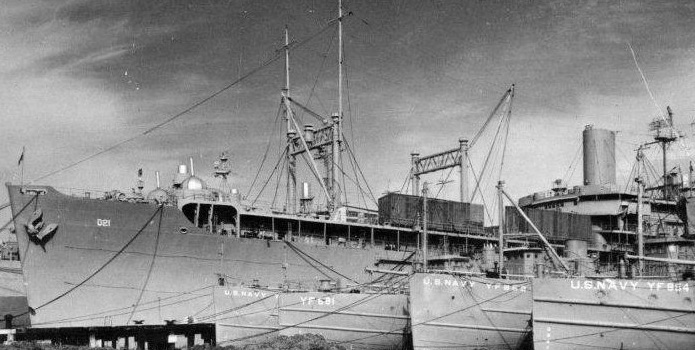
The destroyer tender USS Markab (AD-21) was mothballed at the Orange, TX facility in January 1947. The photo above shows the ship with four mothballed lighters of the Yard & District Craft fleet. The second from right, USS Ensenada (YF-852) was later reactivated and served into the 1980s.
Markab2

(photo by Larry Cote)

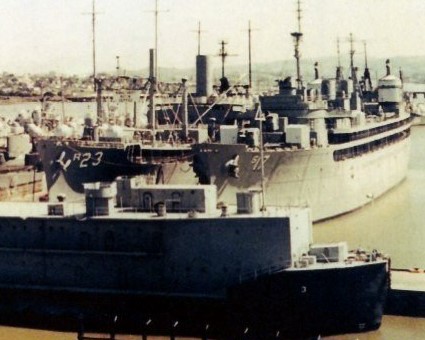
In 1960, USS Markab was reactivated and converted into a repair ship (AR-23), seeing service in the Vietnam War. Decommissioning again in 1969, USS Markab was mothballed at Suisun Bay, CA and scrapped in 1977.

preservation

Little was done to preserve surplus WWII naval warplanes. In the 1940s, aviation technology was “turning a generation” every three years or so – consider that the US Navy started WWII with the laughable Brewster Buffalo but finished it with the Grumman Bearcat, in a span of just over four years. A few select types were preserved, such as the SC-1 Seahawk battleship seaplane being vacuum-sealed after WWII. This was for naught anyways, as by the time the Korean War started in 1950, helicopters had replaced catapult planes aboard cruisers and battleships.

Determining reserve vs scrapped

Once the ships desired for active-duty retention had been identified; the remainder had to be split up between those destined for reserve and those to just be discarded. Some choices were easy.With a surplus of modern types, the US Navy had no need for wartime-emergency obsolete holdovers.

fleet

Above is a graph showing the overall fleet disposition in 1946. This includes all the smaller types, such as landing craft, subchasers, convoy escorts, tugs, barges, and the such.

arkansas

The WWI battleship USS Arkansas (BB-33) was, by 1945, old, slow, and thoroughly obsolete. The US Navy’s oldest frontline battleship at the end of WWII, USS Arkansas was decommissioned and sunk as a nuclear target. The remaining New YorkNevada, and Pennsylvania class battleships were also all quickly decommissioned and disposed of, as they would have no role in any future war. The photo above shows the final second of USS Arkansas‘s life; it is the black splotch on the right side of the test “Baker” mushroom cloud at Bikini in 1946. The atomic bomb picked the battleship up like a toy and piledrived it vertically into the seafloor.
trenton1945

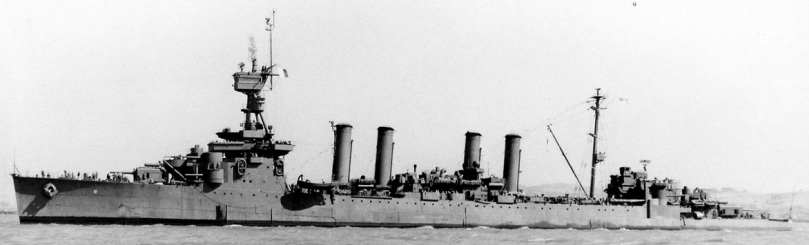
Above is USS Trenton (CL-11) a pre-WWII Omaha class cruiser photographed near the war’s end. Completely obsolete in terms of postwar cruiser tactics, USS Trenton decommissioned three months after the Japanese surrender was signed in 1945 and was sold as scrap for $67,288 in January 1946.

The Sims class destroyers is an interesting example of the rationale used when deciding which ships would be mothballed vs discarded. These destroyers gave excellent service throughout WWII and were always in the thick of battle. By the Okinawa campaign, seven of the twelve Sims class still survived. The US Navy anticipated massive destroyer losses during the planned invasion of Japan, and to that end, it was decided to modernize the remaining seven for service in the invasion and then in the postwar fleet.

The plan was to refit three and then rotate out the other four Sims for their refits. WWII ended while work on the first three was underway. Now with a surplus, not shortage, of destroyers; the US Navy decided to discard the entire Sims class even though there was nothing wrong with them. Eliminating the whole class removed an entire block from the fleet’s training and spare parts burden. The three in refit were given a stop-work order. Literally overnight, the yard workers left one shift trying to get them back to sea as fast as possible, then started the next day’s shift preparing them for scrapping. The other four were expended as nuclear targets at Bikini.

USSRoeAug1945

Above (inboard) is USS Roe (DD-418) two weeks after V-J Day. This shows how the Sims class would have been similar in ability to a Fletcher class (alongside) had the project continued. Instead USS Roe was scrapped.
dolphin

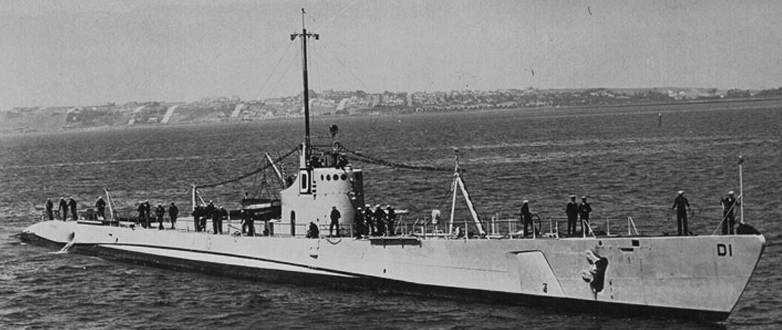
The submarine USS Dolphin (SS-169) commissioned in 1932. USS Dolphin was a “bridge” between the WWI-era subs before, and the SargoTamborGato, and Balao classes later of WWII. A distinguishing trait was a watertight hangar for a smallboat; when USS Dolphin was being designed there was concern that unrestricted submarine warfare might later be classified as a war crime. To that end USS Dolphin was intended to surface, dispatch the smallboat to the target ship, and politely offer them the opportunity to surrender before firing torpedoes. After the savagery of WWII that now seems naive, but was the thinking of that time. USS Dolphin did not sink any ships during WWII but served first as a valuable training submarine at Pearl Harbor, HI; then as an instructional hull for the Navy Submarine School at Groton, CT. A submarine like this had no future and there was no point in keeping USS Dolphin in reserve. One of the first subs to go, USS Dolphin decommissioned 28 days after V-J Day and was scrapped.

With the drawdown of the combatant fleet, much of the yard & district support ships that kept it going joined it in mothballs. But there was a limit to how much could be supported in reserve. Some vessels did not make the cut and were scrapped.

YFD-60inWWII

The little 1,600 ton nameless drydock YFD-60 had only been completed in 1944. With WWII’s end in 1945, YFD-60 and her sister-ship YFD-61 were at the bottom of the totem pole of floating drydocks. Both decommissioned shortly after the war’s end and were discarded, having seen little use. In the YFD-60 photo above is the drydocked Coast Guard cutter USCGC Pamlico (WPR-57); a veteran of WWI, Prohibition rum patrols, and WWII. USCGC Pamlico was also discarded shortly after WWII.

USSZane

Another example, above, was USS Zane. Built as a destroyer (DD-337) in 1919, USS Zane was obsolete in that role even at the start of WWII and was unsuccessfully converted into a mine warfare ship (DMS-14) during the war, and then again to a test ship (AG-109) which proved more useful. When WWII ended the US Navy had any number of newer hulls to use as test vessels, and USS Zane was decommissioned eleven weeks after WWII’s end and scrapped.

yachts

Of the civilian yachts and fishing trawlers emergency-requisitioned at the height of the u-boat attacks, many were returned to their owners even before WWII ended. The cheery clipping above is from a 1945 issue of All Hands, the US Navy magazine. Chevrons or not, many civilian owners were unhappy at the condition their watercraft were returned in.

Scrapping

Haggard

For warships in the discard category, usable spare parts were stripped off. Usually (but not always) the main guns were “demilled” by torching the barrel or cracking the breech. The US Navy’s final step for scrapping a WWII warship was estimating what would be recovered, so that an auction minimum could be calculated. Generally in a destroyer there was about 40 tons of recoverable steel, 1 ton of copper wiring, 1 ton of brass, and 3 tons of lead.

WWII-era forward bases in the Pacific

The WWII US Navy had acquired many forward bases, anchorages, and naval airfields across the Pacific Ocean between 1941-1945. In November 1945, Congress shortlisted nine which would be retained or even expanded for the postwar fleet. They were Adak, AK; Kodiak, AK; Pearl Harbor, HI; Balboa, CZ; Apra Harbor, GU; Subic Bay, Phillipines; Iwo Jima, Okinawa, and Manus Island.

This expensive plan never came to fruition. As time passed and things were re-evaluated, most of these bases dwindled. The two in Alaska and one in the Canal Zone remained but in greatly-reduced scope and importance. Iwo Jima was never a key postwar base and was later abandoned. Manus Island, north of New Guinea, was allocated to Australia and was never a postwar US Navy base at all. By the late 1960s, only Subic Bay, Apra Harbor, and of course Pearl Harbor were still of any real importance.

Congress mandated retention of other WWII forward naval bases in lay-up status; in view of a possible future need. These were Wake Island, Midway Island, Truk, Tern Island, and Eniwetok. None of these played any major role ever again. Truk was quickly abandoned, Tern Island naval airstrip was destroyed by a tsunami in 1946, and the others played very minor roles in the Cold War. Eniwetok was used as the staging area for nuclear tests but otherwise unimportant. Midway was reactivated during the Korean and Vietnam Wars, finally being disestablished in 1978 and permanently abandoned in 1993.

The “roll-up”

Millions of dollars of ashore US Navy property was scattered around the world when WWII ended. Congress demanded a genuine effort to recover the taxpayer’s investment, either through use, sale into the civilian economy, or auction as scrap. The Army-Navy Liquidation Commission was established to ensure this directive was obeyed. Navy ashore equipment was divided into three categories:

  1. No longer needed at it’s current location but able to be economically shipped back to the USA for use, sale, or scrapping.
  2. No longer needed at it’s current location, and uneconomical to ship back to the USA. US Navy commanders were responsible to seek a nearby Army, Marine Corps, or Coast Guard unit in need of the equipment.
  3. Unwanted by any branch of the military and uneconomical to ship back to the USA. Gear in this category was to be first offered for sale to allied foreign navies, then to local civilian authorities, and finally, abandoned.
milliondollarpoint

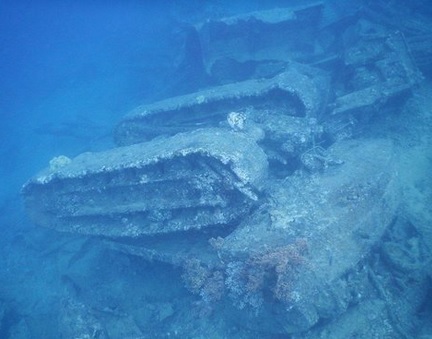
While there was some waste – such as “Million Dollar Point” off Espiritu Santo island where everything from artillery to the construction crane above to unissued Coca-Cola rations was dumped into the ocean – the worldwide “roll-up” was generally an economic success. A case in point was Ulithi. This 85 miles² atoll lagoon could accommodate 1,000 warships including battleships and carriers. Ulithi was the US Navy’s main Pacific forward base. At it’s peak, it briefly displaced Norfolk, VA as the largest naval base on Earth. Ulithi lost it’s importance after Subic Bay was liberated in 1945. As part of the “roll-up”, literally everything at Ulithi was collected and sent back to the USA. The US Navy estimated the total ashore equipment recovered filled the equivalent of six full freighters. By late 1946,  barely a trace of WWII remained.

Lend-Lease returns

Almost none of the ships lend-leased to the Allies were retained in reserve. Some were obsolete, many duplicated the abilities of mothballed US Navy ships, and most had seen rough use during WWII. Many had foreign equipment installed and for some, the US Navy lacked a full bibliography of their maintenance records.

reaper

Above is HMS Reaper, a British lend-leased escort carrier. Before the lend-lease expired, one of the ship’s final missions was operation “Lusty”, the transport of high-technology ex-Luftwaffe planes captured at the end of WWII to the USA for study. On deck are Me-262 jets, a Ta-152, a Fw-190, a Do-335 Pfeil, and a Ju-388. All are encased in plastic to protect them from seaspray. HMS Reaper decommissioned shortly thereafter. The US Navy had no interest in getting the hull back and Great Britain disposed of it.

One of the oddest returnees was USS Milwaukee (CL-5). This obsolete cruiser had been loaned to the Soviet Union during WWII. On 16 March 1949, three and a half years after WWII ended, the Soviets returned the cruiser which they had named Murmansk. With sponsoned casemate guns, obsolete turrets, first-generation radar, and worn-out steam engines; the “four-piper” USS Milwaukee was a floating dinosaur. The cruiser was immediately decommissioned and immediately offered as scrap. However for about 36 hours while the paperwork went up the chain of command, USS Milwaukee was briefly, at least on paper, the senior active-duty cruiser in the US Navy.

milwaukeemurmansk

Planned organization of the reserve fleet and the “divisions” concept

In the US Navy’s numbered fleet system, two “ghost” reserve fleets were formed; the 16th in the Atlantic and 19th in the Pacific.

Each had a number of reserve anchorages. The 16th fleet’s were Boston, MA; Groton, CT; the “Hudson River Group” in NY; Philadelphia, PA; Baltimore, MD; James River, VA; Wilmington, NC; Charleston, SC; the “Florida Group” in that state; Mobile, AL; New Orleans, LA; and Orange, TX. Meanwhile in the Pacific, the 19th fleet had Pearl Harbor, HI; Bremerton, WA; Astoria, WA; Stockton, CA; Suisun Bay, CA; San Francisco, CA; and San Diego, CA.

Not all were the same size, and the facilities were not “balanced” in the sense of having all kinds of warships. For example the Groton, CT facility was almost exclusively submarines, while the Charleston, SC location had a surplus of destroyers.

TonguePoint

(The Tongue Point anchorage of the Astoria, WA facility at it’s peak just before the start of the Korean War.)

At each location, mothballed ships were formed into divisions. Each division numbered four to twelve ships, and was always of the same type and (if possible) the same class. The divisions were to be operated as follows:

  1. For “capital combatants” like large aircraft carriers, newer battleships, large modern cruisers, etc; every ship would have a skeleton crew at the facility assigned to keep the mothballed ship preserved, and also to form the nucleus of a new crew if the ship were reactivated in a national emergency.
  2. For secondary combatants like light cruisers, destroyers, frigates, LSTs, submarines, escort carriers, minesweepers, etc; only one ship in the division would have a skeleton crew, responsible for all the vessels in the division. These men would divide their time between the division’s vessels. The ship with the crew assigned would in theory, be able to be reactivated in about ten days, while the rest would be in “Ready-30” status, to be reactivated in five weeks or less.
  3. For minor assets like yard tugs, subchasers, landing craft, barges, lighters, etc; no skeleton crew would be assigned to the division and it’s upkeep would be the responsibility of the base.

The “divisions” concept did not work out as intended. The US Navy’s budgets in 1947, 1948, and 1949 were much smaller than had been envisioned in 1945, and there simply was not enough money for the skeleton crews. By the time of the Korean War, the idea was unraveling and in the mid-1950s was abandoned.

Wednesday, July 19, 2023

"Time to nominate an FAA Administrator"

 I got this article off my 3rd party news at work.  The last time the Biden administration nominated  was basically a "Diversity Hire"  he was selected purely because he checked off certain boxes that are popular with the democrats and when he went before the senate for confirmation, he was clueless

I don't care who you are, as long as you are competent, and the administrator sets the tone for the agency.


airport checkpoint

Credit: Elijah Nouvelage/AFP/Getty Images

Every flight in the U.S., whether of a FedEx cargo aircraft or an American Airlines passenger airliner, requires a network of experts to load, taxi, take off, navigate and land safely. Every link in the chain must perform its duty skillfully for safe and efficient air travel.

America has excelled at this process for a century, resulting in the U.S. aviation industry comprising 5% of the country’s GDP and sustaining more than 2 million jobs. Aviation is a valuable sector of our economy, and the entire industry rests on the authority of the FAA to set the rules and policies that govern the skies.

The FAA is responsible for the safety of travelers and is vital to our nation’s economy, which is why it is deeply concerning that the agency has not had a permanent, Senate-approved leader—the FAA administrator—for more than 450 days. This vacancy is having a ripple effect not just in aviation but across multiple sectors and industries.

The FAA stands at an important juncture as it navigates an evolving environment. Demand for air travel has returned at an unprecedented pace following the COVID-19 pandemic, and new and evolving aircraft are rapidly being introduced into our National Airspace System. Severe and sometimes chaotic and dangerous disruptions continue to face Americans attempting to fly during holidays. A record number of air travelers and consumers dealt with thousands of canceled flights and tens of thousands of flight delays nationwide over this Fourth of July long weekend. We have also seen near collisions on the runway and emergency landings. To meet these current challenges, the FAA requires modernization and good leadership throughout the agency.

The current FAA Reauthorization Act is set to expire this fall. I have worked with my colleagues to write the legislation to reauthorize the FAA while also using my position on the Senate Appropriations Committee’s subcommittee on transportation, housing and urban development and related agencies to provide the FAA with the right resources. We must conduct proper oversight of the FAA and provide the agency with the tools it needs to evolve and excel.

However, even with new resources and modernized authorities, these are just words on paper without an FAA administrator. The agency is too critical to be guided by interim leaders. We need a confirmed administrator. 

The U.S. has long been a leader in aerospace by leaning into challenges and opportunities. Innovation, fostered with appropriate safety oversight by the government, can help cement the U.S. as a competitor on the global scale.

While Congress can help ensure resources, craft authorizing language and provide the FAA with most of the tools it needs to succeed, the agency must have a leader with a steady hand at the helm.

The White House must act to nominate an individual with extensive experience in transportation and aviation, an understanding of the role the FAA plays in consumer safety and knowledge of the business models by which aviation works in the U.S. and around the world.

I urge the president to put forward an experienced nominee so the FAA can reduce disruptions for air travelers, ensure the safety of our skies and guide us into the next era of aviation. 

Sen. Jerry Moran (R-Kan.) is the ranking member of the Senate Commerce, Science and Transportation Committee’s subcommittee on aviation safety, operations and innovation and sits on the Senate Appropriations Committee’s subcommittee on transportation, housing and urban development and related agencies.

Sunday, July 16, 2023

Truss Braced Wing Concept

 My apologies, I have been working a lot of overtime, in the summer is our busy time.  Unless it is absolutely broke or unsafe to fly it is flying because of the demand for air travel.  Other Airlines are having similar demands placed on them.  Like I have stated before, I like to blog, but I like sleep more.

   I had "Blogged Last year about this concept" it is an intriguing design.


TTBW

Credit: Boeing

LE BOURGET—Pratt & Whitney’s selection to power the NASA X-66 transonic truss-braced wing (TTBW) sustainable flight demonstrator may be the opening the company needs to break back into the future Boeing single-aisle market, says Christopher Calio, Raytheon Technologies' president and chief operating officer.

The engine-maker’s PW1100G geared turbofan will power the high-wing X-66 later this decade and is the first engine from the Pratt & Whitney stable selected for any Boeing-built narrowbody since the final 757s were delivered in the early 2000s. The competing GE Aerospace and Safran joint venture CFM International has, by contrast, enjoyed exclusivity on the 737 since the development of the 737-300 some 40 years ago.

“We’ve always said we would love at some point to take our technology and offer it to both of the narrowbody OEMs—that's the position our competitor has today,” Calio says, referring to CFM’s availability as an alternative to the PW1100G on the Airbus A320neo family. “That affords [CFM] a lot of privileges as a result. So we would love to find a way to get back in. Our view is [the TTBW is] a great way to get back in working with Boeing in the commercial engine space in the commercial narrowbody market,” he adds.

However, Calio is also realistic that much needs to be done before Pratt can be fully competitive. “First of all the focus right now is on getting through our issues on the GTF for Airbus and our customers. So make no mistake, we are not taking our eye off that ball, but longer term—in 12 to 15 years—you’ve got to invest. You can't just wake up in 2030 and go ‘hey, we'd love to get back on the Boeing aircraft.’ You have got to be investing along the way in some of these enabling technologies.”

Pratt is currently developing the enhanced PW1100G Advantage version, but has several technology programs under way to reduce fuel burn on the basic architecture by a further 10% or more over the coming decade.

“Dave [Calhoun, Boeing CEO] says any new product will have to be 20-30% more efficient. A lot of that comes from the engines and I think what we've learned as part of the GTF when we rolled it out is just as much as you've got to go drive the efficiency gains, the things you do to get those efficiency gains is you've got to make sure that industrially you can support it. To me, that's just as important. Not only does that does the technology have to be there for those gains, but the manufacturing and support has to be in lockstep,” Calio says.

Wednesday, July 12, 2023

Carry Concealed Tips for Older Shooters...

 I saw this and this may 'splain the older generations affinity for the .45ACP especially after reading the first suggestion.   I also nicked this off "American Rifleman"

tips-for-older-armed-citizens-f.jpg

As we get older, we must keep in mind that we can still be a target for criminal attack. In fact, we may become even more of a target as the years catch up with us. The crooks see the gray hair, the wrinkles and figure that we will be less likely to resist and less likely to be armed. Age may cause us to have physical problems to deal with, but many of them can be overcome. We owe it to ourselves and our families to be as tough a target as is humanly possible. Here are a few ideas to help older defensive shooters deal with their issues.

1. Use The Most Powerful Handgun That You Can Shoot Quickly And Accurately. 

You may be surprised to learn that this is what I tell all shooters, regardless of their age.  However, you may have found that, due to infirmities, you can no longer manage that .357 Mag. or .45 ACP pistol. This doesn't mean that you should quit. It means that you should scale down to a 9 mm Luger, .38 Spl., .380 ACP, or even .22 LR, depending upon your particular needs and abilities.

These smaller calibers may not be as capable, but they sure do beat fighting with your fists. The lighter the caliber, the more important bullet placement becomes. So, you'll have to practice more and work on delivering the best bullet placement possible. 

2. Consider Changing Carry Positions. 

One of the most common defensive carry techniques is to wear the handgun on your strong-side hip, just behind the hip bone. Unfortunately, with aging, many shooters lose mobility in their joints. To make a draw from this popular position, your shoulder must move up and back, and it must do it quickly. Some folks just have a tough time with this.

A better choice for the aging shooter might be the appendix carry; that is, wearing the handgun on the strong side but in front of the hip bone. The shoulder does not have to move so radically with this technique. The same may be true with the crossdraw carry method. Both carry the handgun on the front side of the body and will be easier to get to and allow for a quick pistol presentation.

3. Dealing With Fuzzy Sights. 

About the time that we hit middle age, the sights on a handgun sure do start to look fuzzy, and a clear sight picture rapidly becomes a thing of the past. Some folks deal with this natural phenomenon by using the close-range portion of their bifocals. However, for all of us, glasses are the answer.

Even if you don't use bifocals, your optometrist can have a corner of your glasses ground so that you can see the sights clearly through that portion of the lens. If you don't feel comfortable discussing your shooting skills with your current optometrist, ask at your local shooting range or gun store until you can get the name of an optometrist who is a shooter. You'd be amazed at how many of these professionals enjoy the shooting sports and understand the needs of aging shooters.

4. Weakness In The Hands And Forearms. 

Some older shooters find that, due to arthritis or some other ailment, they can no longer work the slide on a semi-automatic pistol. In most cases, I have found that they have been doing it wrong in the first place.

Too many shooters want to hold the auto pistol in their hand with the arm almost fully extended. Then they use the thumb and index finger of their support hand, at the very back of the slide, to work the slide and chamber a round. This whole technique looks very much like the way we shot slingshots when we were kids. Regardless of age, this is a very poor technique and is an indication of someone who is a real tenderfoot regarding this business of self-defense.

The closer your hands are to your chest, the more strength you have in your hands and arms. Hold the pistol close to your chest and parallel to your chest, with the muzzle pointed to the side. However, you should be conscious that the muzzle is still pointed in a safe direction at all times.

Put your support hand over the top of the pistol, in the area of the ejection port, and grasp the slide firmly with your whole hand and all of your fingers. At the same time that you pull the slide to the rear with your support hand, you should push forward with your strong hand. The isometric push-pull, along with holding the gun close to the body, utilizes much more of your bodily strength and is a much more positive way to charge your auto pistol.

However, there are those who simply are dealing with issues that make them too weak to run an auto slide. They might consider making the transition to a double-action revolver. The action of loading and unloading a DA revolver requires much less muscle strength. When transitioning to a revolver, however, don't hesitate to have a professional gunsmith smooth up the action to make the double-action trigger pull as easy as possible.

5. Increase Mobility With Exercise. 

The older we get, the more important exercise is to our maintaining our body strength and mobility. If you have health issues, it is critical that you do not start an exercise program without consulting with a physician. Just as with the optometrist, you may find it a bit more comfortable to find a physician who enjoys the shooting sports.

When you start hunting for a doctor who is a member of our shooting fraternity, you will be amazed at just how many of them there are. I don't want to sound "New Age" here, but the fact is that a yoga class, especially one for older folks, is a great way to increase your agility and mobility. However, if you have any doubts about your ability, take the time to consult with a physician.

It is critically important, as the years go by, to continue to refuse to be a victim. Seek the advice of other aging shooters, use your mind to solve your particular problems as they relate to shooting skills, and simply say to yourself, “I am tough, I am an American shooter, and I am not going to give up."

Tuesday, July 11, 2023

Modernizing the Garand.

 I saw this in one of my early "American Rifleman" Issues...Now if I got hold of a mid 50's Garand, I would consider something like this...but to my kayak sunk*sniff*Sniff*  departed WWII Era Garand.....NEVER


modernizing-the-m1-garand-f.jpg

Caution: The following contains images of a modified M1 Garand rifle. While no M1s were permanently altered during the making of this project, collectors with a strong affinity for original-issue military arms may find it offensive. Reader discretion is advised.

Seriously, if the thought of modernizing the M1 Garand is anathema to you, please avoid unnecessary stress by not reading further. The goal here is not to suggest that a historically significant rifle be denigrated, rather it is to propose that John C. Garand’s classic old warhorse can become, with a few judiciously chosen updates, a modern general-purpose rifle.

The M1 was made in such great quantities, nearly 5.5 million, and for such a timespan, 1934 to 1957, that re-routing a few post-Korean War examples with no particular martial history should not pose a conflict for anyone. The late-1953 Harrington & Richardson M1 featured here is a perfect example. After acquiring it, I set about to modify it using off-the-shelf components that would increase its utility while keeping its overall weight to a reasonable limit. All were “bolt-on” and did not require gunsmithing or permanent changes to the rifle. Additionally, they were accomplished using only modest skills along with a few screwdriver bits and Allen wrenches.

As is, the M1 Garand is a highly capable rifle—rugged, hard-hitting, possessed of fine sights and an excellent trigger, and traditional in appearance and format—but with a few carefully considered modifications it can be an even more effective tool for all sorts of applications. In the past, it has been knocked for being (in no particular order): difficult to scope; ammunition-sensitive; finicky to load; heavy; and burdensome to fire unsupported. With the goal of correcting those deficiencies and reconfiguring it into a more useful tool, my first change involved scoping it.
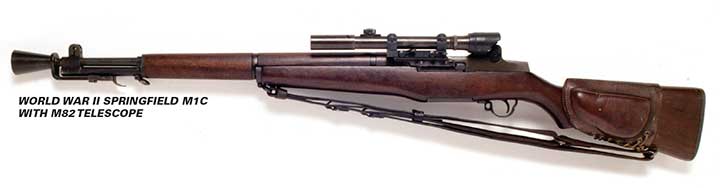
Left-side view on white background of World War II Springfield M1C with M82 telescopic sight and leather sling.

The solution was a relatively recently devised one, and it is offered by more than one maker. Best of all, it gets the shooter on target more precisely without resorting to such tricks as the offset optical axis employed in the U.S. military’s M1C and M1D sniper variants. The model I chose, the M12 Forward Optic Mount ($185) by UltiMAK, replaces the rear handguard with a 15-slot section of Picatinny rail. The U.S.-made unit is machined of 6061-T6 aluminum and matt black anodized. It bolts directly to a standard G.I.-profile barrel with two machined 4140 steel clamps and comes with thorough installation instructions and the Allen wrenches necessary to attach it.

Once mounted, its minimalist profile positions the optical axis of a riflescope or red-dot sight low to, and directly over, the bore—in fact, co-witnessing of the iron sights is possible with the latter. I decided to go with a tried-and-true model of the former from Burris, the 2-7X 32 mm Scout ($429). With the company’s Ballistic Plex compensating reticle, the lower half of the scope’s vertical stadia line offers three short horizontal holdover references that can be calibrated to specific ranges depending on power setting and ammunition choice.

At low power, the optic serves in the both-eyes-open, snap-shooting role popularized by the scout rifle concept, and at higher power it offers excellent longer-range precision aiming nearly twice as powerful as that afforded the average World War II sniper. A set of 1” Low QRW detachable rings ($60) from Leupold preclude the need for an add-on cheek riser and make for quick, tool-less access to the iron sights should it be damaged.

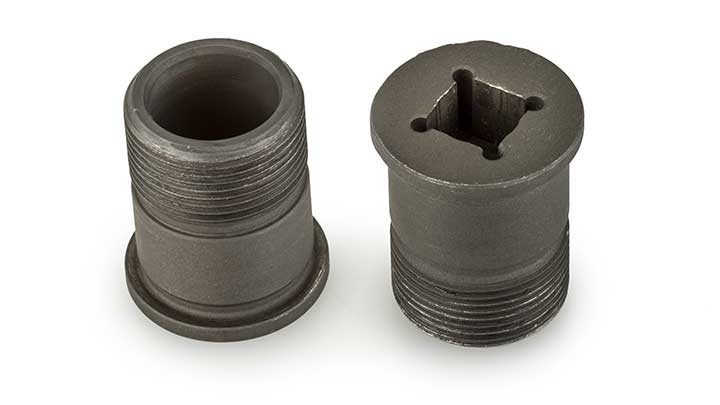
Many modern factory loads exist for the .30-’06 Sprg. that exceed the specifications set for military ammunition originally intended for the Garand. To take advantage of some of them, and to avoid damage to the rifle, a change to the gas system is necessary. A few different concepts have been devised, usually involving modification of the gas plug. I chose the Ported Gas Plug ($40) by Garand Gear, an install-it-and-forget-it solution.
Two Garand gas plugs on white background.

In essence, its hollowed-out base increases the gas cylinder’s overall volume, thereby effectively flattening the pressure curve of propellant gases acting on the piston at the end of the operating rod. Think of it as insurance against a bent operating rod and limited license to explore a wider range of ammunition offerings. Installation simply involves turning out the original gas plug and turning in the new one, which accepts 1/4”-square socket drive bit.

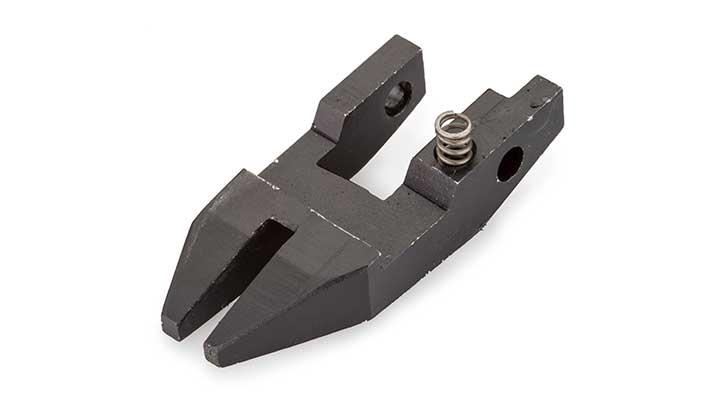
As is often the case with firearm projects, scouring gunshows and online sites is sometimes the only way to acquire all of the pieces of the puzzle. Two of the items detailed here fell into that category. The first was popularized as the “Holbrook device” after the veteran who formalized its manufacture and sale—although homemade versions have existed for many years and instructions on making one can be found online.

This modified operating rod catch simply swaps out with the original but significantly changes the M1’s method of operation in the following ways: A full or empty eight-round en bloc clip can be inserted into the rifle and will “click” into place, but the bolt will not close even on a slowly withdrawn thumb—thus the commercial version’s “thumbsaver” moniker. Then, the first round is loaded into the chamber by pulling back the operating rod handle and letting it fly forward. Also, an empty clip locked into the rifle can be loaded with from one to seven rounds singly. Finally, the device remains in the gun, with the bolt locked back, after the last round is fired and ejects from the rifle only after the clip latch has been manually depressed.

In short, the Holbrook device makes the M1 operate more like an M1A. The second item of uncertain availability is a synthetic stock—something that, at various times, mainstream manufacturers such as Bell & Carlson and Ramline, along with a few boutique makers, have produced for the M1 Garand. But demand has apparently receded to the point that no major maker currently offers a model. Still, I was fortunate enough to find a Bell & Carlson, and its black, pebble-finished lightweight fiberglass construction has transformed my M1 into a stronger, lighter, more weather-resistant and modern-looking rifle than could ever be achieved with walnut or laminates.
M1 Garand Holbrook device on white background.

While a variety of slings are available for the Garand, most were intended either as simple carry straps or as full-on competition rigs for highpower shooting. One that strikes a balance between those roles, and that stands alone for its combination of simplicity and utilitarian elegance, is the 1¼” Rhodesian Sling ($76) by Andy’s Leather. Made of bridle leather and featuring solid brass hardware, it is available in all-black with a Cerakoted buckle. Once adjusted, its front loop section is easily engaged by the user’s support arm triceps, helping to get the rifle on target reasonably quickly and keep it there with amazing stability. It also serves well to carry the somewhat heavy M1 at the shoulder or diagonally across the back without additional adjustment.

Once all the parts were assembled, the modernized M1 Garand detailed here came in at 11 lbs. overall unloaded, which will likely shock those whose primary frame of reference is small-caliber aluminum-and-polymer modern sporting rifles. But it bears repeating that we’re looking at a 24”-barreled rifle chambered in .30-’06 Sprg. that is capable of delivering a 200-gr. bullet with nearly 1,000 ft.-lbs. of energy remaining at 500 yds.

But because the rifle’s mass is so well-distributed along its slender profile, and because of its smooth underbelly, carrying it, even with one hand at the side, it convenient. Indeed, the modernized M1 seems little more burdensome than the original appears to have been for millions of G.I.s. And, if anything, despite its increased capabilities, it still tends more toward “sporting” than “military” in appearance.

When it came to shooting the one profiled here off a bench using bags or from the standing position, recoil was reasonably mild—especially considering the power being sent downrange. After sighting in at 50 yds., at least one five-shot group using 175-gr. SIG Sauer V-Crown Elite Match Grade ammunition could be covered by a nickel.

With no worries about damaging the gun or getting “Garand thumb” while loading it, I was able to concentrate on shooting. And while replicating the exact configuration described here may be, admittedly, nigh impossible, it nonetheless serves to illustrate that the a modernized M1 Garand leverages classic strengths with updated ideas to provide the modern shooter with a rugged, capable general-purpose rifle.

Friday, July 7, 2023

Exploring The Viet Cong Booby Traps

 I have "Blogged" before about Viet Cong Booby Traps before, usually I would run the Vietnam War stuff on my blog past my Dad for accuracy, but since St Peter cut orders for him to report to Fiddler Green a couple of years ago, I can't do that anymore damm, well anyway, I saw this on "Sofrep"  and I thought it was pretty good and I shamelessly nicked it.


Viet Cong booby traps were treacherous devices that destroyed and took countless lives. Read up on their history and impact on warfare.

During the Vietnam War, the Viet Cong (VC), a communist guerrilla force in South Vietnam, employed a variety of booby traps to counter the technological superiority of American and South Vietnamese forces. 

These traps inflicted maximum damage on unsuspecting soldiers, leaving a lasting impact on the battlefield. In this layman’s history, we will explore the development, types, and impact of Viet Cong booby traps.

The Origin Story of Viet Cong Booby Traps

The origins of Viet Cong booby traps go back to guerrilla warfare, where a weaker force strategically targets and disrupts a stronger opponent. With limited resources and firepower, the Viet Cong needed alternative means to counter the American and South Vietnamese forces’ advanced technology and overwhelming military strength.


Necessity Breeds Innovation

The Viet Cong’s resourcefulness and adaptability were crucial in developing booby traps. Unable to match the firepower of their adversaries, they relied on inventive and low-cost methods to inflict damage and instill terror. 

The need to defend their territory, disrupt enemy movements, and demoralize opposing forces fueled the innovation behind these traps.

The Viet Cong bear trap (Source: Wikimedia Commons)

A Viet Cong booby trap was about utilizing readily available local materials. Derived from bamboo, wooden stakes, and basic explosives, guerillas had easy access to materials. This approach allowed them to maximize their limited resources and create deadly devices without relying on external support.

Learning From Historical Precedents

The Viet Cong drew inspiration from historical precedents and existing knowledge of warfare, adapting and refining techniques used in previous conflicts. They incorporated elements of traditional booby traps employed in earlier conflicts, such as their war against the French, and from indigenous methods used in the region.

Types of Viet Cong Booby Traps

Numerous types of Viet Cong booby traps were in circulation during the Vietnam War. While it is difficult to provide an exact count, given the vast range and variations, here are some of the most prominent types:

  • Punji Pit Traps: These traps involved camouflaged pits dug into the ground, often with sharpened bamboo stakes or other spikes at the bottom, intended to impale or injure soldiers who fell into them.
  • Tripwire Explosives: Tripwire-based traps utilized thin wires connected to explosives hidden nearby. When a soldier unknowingly triggered the wire by tripping over it, it would detonate the explosive, causing severe injuries or death.
  • Bouncing Betty Mines: These mines were pressure-activated and launched into the air before detonating. Buried in the ground, they targeted the lower body of soldiers, causing devastating injuries and reducing the chances of survival.
  • Toe-Popper Mines: These small, pressure-activated mines were typically buried just below the surface, designed to injure or disable soldiers. Stepping on them would trigger an explosion, inflicting severe damage to the victim’s foot or leg.
  • Bamboo Whip Traps: Bamboo stakes, often tipped with poison, were bent and secured under tension. When triggered, the stakes would whip out, causing deep puncture wounds and potential infection due to the poison.
  • Snake Traps: Containers or bamboo tubes were the primary tools to hold venomous snakes, each strategically placed to surprise and attack soldiers, causing panic and distraction.
  • Grenade Traps: Hand grenades came with tripwires or other triggering mechanisms designed to explode when disturbed, injuring or killing anyone nearby.
  • Punji Stick Traps: Similar to Punji pit traps, Punji stick traps involved concealed stakes or spikes, often coated with toxic substances, hidden in foliage or along trails to injure or infect soldiers.
  • Rolling Log Traps: Guerillas positioned large logs to roll down hills or slopes upon triggering, aiming to crush or injure soldiers caught in their path.
  • Booby-Trapped Ammo and Supplies: Viet Cong forces sometimes rig ammunition or other supplies to explode when picked up or used by enemy forces, causing unexpected casualties.

The Menacing Damage Caused By Viet Cong Booby Traps

Soldiers caught in booby traps often suffered severe injuries, including loss of limbs, shrapnel wounds, and internal damage. The injuries inflicted by these traps could be debilitating, sometimes leading to long-term disabilities or even death.

Beyond the physical harm, Viet Cong booby traps had a significant psychological impact on soldiers. The constant fear of hidden dangers, the tension of moving through unfamiliar terrain, and the unpredictability of these traps created a pervasive sense of anxiety and vulnerability among troops.


Viet Cong booby traps profoundly impacted the course of the Vietnam War and left a lasting mark on military history. For one, they forced the American and South Vietnamese forces to adapt their strategies and tactics. 

The hidden nature and widespread use of these traps necessitated changes in how troops moved through the terrain, increasing caution and the need for specialized training in identifying and neutralizing booby traps.


Viet Cong Booby Traps and Their Impact on Modern Warfare

Viet Cong booby traps also significantly influenced the evolution of improvised explosive devices (IEDs). The lessons learned from the Vietnam War, including the effectiveness of concealed explosive devices, shaped the development of IEDs in subsequent conflicts. It profoundly impacted modern warfare, as IEDs became a significant threat in armed conflicts worldwide.

(Wikimedia Commons)

Ultimately, Viet Cong booby traps changed history by reshaping military strategies, highlighting the importance of psychological warfare, affecting civilian populations, influencing military training, and contributing to the evolution of explosive devices. 

These traps left an indelible mark on the Vietnam War and influenced subsequent conflicts, emphasizing the need for adaptive and comprehensive approaches to unconventional warfare.


Tuesday, July 4, 2023

Happy Brexit Day

I am still in Florida, but we are returning today to home, I am not looking forward to the drive.  It was great visiting my brother and his family, and I got a bit of reading in.


 Happy 4th of July, our country is 247 years old, still young, but compared to a lot of the countries in the world, we are one of the older ones.  In this we still having a representative form of government is unusual, usually by this time tyranny has set in, although we have lost some freedom, we still are doing better than every else in the world.  Despite the problems, I am grateful that I am an American and I hope the new generation continues to carry the torch forward.


This idealized depiction of (left to right) Franklin, Adams, and Jefferson working on the Declaration was widely reprinted (by Jean Leon Gerome Ferris, 1900


In CONGRESS, July 4, 1776.


The unanimous Declaration of the thirteen united States of America,
"When in the Course of human events, it becomes necessary for one people to dissolve the political bands which have connected them with another, and to assume among the powers of the earth, the separate and equal station to which the Laws of Nature and of Nature's God entitle them, a decent respect to the opinions of mankind requires that they should declare the causes which impel them to the separation."

"We hold these truths to be self-evident, that all men are created equal, that they are endowed by their Creator with certain unalienable Rights, that among these are Life, Liberty and the pursuit of Happiness.
"That to secure these rights, Governments are instituted among Men, deriving their just powers from the consent of the governed, That whenever any Form of Government becomes destructive of these ends, it is the Right of the People to alter or to abolish it, and to institute new Government, laying its foundation on such principles and organizing its powers in such form, as to them shall seem most likely to effect their Safety and Happiness. Prudence, indeed, will dictate that Governments long established should not be changed for light and transient causes; and accordingly all experience hath shewn, that mankind are more disposed to suffer, while evils are sufferable, than to right themselves by abolishing the forms to which they are accustomed. But when a long train of abuses and usurpations, pursuing invariably the same Object evinces a design to reduce them under absolute Despotism, it is their right, it is their duty, to throw off such Government, and to provide new Guards for their future security."

"Such has been the patient sufferance of these Colonies; and such is now the necessity which constrains them to alter their former Systems of Government. The history of the present King of Great Britain is a history of repeated injuries and usurpations, all having in direct object the establishment of an absolute Tyranny over these States. To prove this, let Facts be submitted to a candid world.
"He has refused his Assent to Laws, the most wholesome and necessary for the public good.
"He has forbidden his Governors to pass Laws of immediate and pressing importance, unless suspended in their operation till his Assent should be obtained; and when so suspended, he has utterly neglected to attend to them.
"He has refused to pass other Laws for the accommodation of large districts of people, unless those people would relinquish the right of Representation in the Legislature, a right inestimable to them and formidable to tyrants only.
"He has called together legislative bodies at places unusual, uncomfortable, and distant from the depository of their Public Records, for the sole purpose of fatiguing them into compliance with his measures.
"He has dissolved Representative Houses repeatedly, for opposing with manly firmness of his invasions on the rights of the people.
"He has refused for a long time, after such dissolutions, to cause others to be elected, whereby the Legislative Powers, incapable of Annihilation, have returned to the People at large for their exercise; the State remaining in the mean time exposed to all the dangers of invasion from without, and convulsions within.
"He has endeavoured to prevent the population of these States; for that purpose obstructing the Laws for Naturalization of Foreigners; refusing to pass others to encourage their migrations hither, and raising the conditions of new Appropriations of Lands.
"He has obstructed the Administration of Justice by refusing his Assent to Laws for establishing Judiciary Powers.
"He has made Judges dependent on his Will alone for the tenure of their offices, and the amount and payment of their salaries.
"He has erected a multitude of New Offices, and sent hither swarms of Officers to harass our people and eat out their substance.
"He has kept among us, in times of peace, Standing Armies without the Consent of our legislatures.
"He has affected to render the Military independent of and superior to the Civil Power.
"He has combined with others to subject us to a jurisdiction foreign to our constitution, and unacknowledged by our laws; giving his Assent to their Acts of pretended Legislation:
"For quartering large bodies of armed troops among us:
"For protecting them, by a mock Trial from punishment for any Murders which they should commit on the Inhabitants of these States:
"For cutting off our Trade with all parts of the world:
"For imposing Taxes on us without our Consent:
"For depriving us in many cases, of the benefit of Trial by Jury:
"For transporting us beyond Seas to be tried for pretended offences:
"For abolishing the free System of English Laws in a neighbouring Province, establishing therein an Arbitrary government, and enlarging its Boundaries so as to render it at once an example and fit instrument for introducing the same absolute rule into these Colonies:
"For taking away our Charters, abolishing our most valuable Laws and altering fundamentally the Forms of our Governments:
"For suspending our own Legislatures, and declaring themselves invested with power to legislate for us in all cases whatsoever.
"He has abdicated Government here, by declaring us out of his Protection and waging War against us.
"He has plundered our seas, ravaged our coasts, burnt our towns, and destroyed the lives of our people.
"He is at this time transporting large Armies of foreign Mercenaries to compleat the works of death, desolation, and tyranny, already begun with circumstances of Cruelty & Perfidy scarcely paralleled in the most barbarous ages, and totally unworthy the Head of a civilized nation.
"He has constrained our fellow Citizens taken Captive on the high Seas to bear Arms against their Country, to become the executioners of their friends and Brethren, or to fall themselves by their Hands.
"He has excited domestic insurrections amongst us, and has endeavoured to bring on the inhabitants of our frontiers, the merciless Indian Savages whose known rule of warfare, is an undistinguished destruction of all ages, sexes and conditions.
"In every stage of these Oppressions We have Petitioned for Redress in the most humble terms: Our repeated Petitions have been answered only by repeated injury. A Prince, whose character is thus marked by every act which may define a Tyrant, is unfit to be the ruler of a free people."

"Nor have We been wanting in attentions to our British brethren. We have warned them from time to time of attempts by their legislature to extend an unwarrantable jurisdiction over us. We have reminded them of the circumstances of our emigration and settlement here. We have appealed to their native justice and magnanimity, and we have conjured them by the ties of our common kindred to disavow these usurpations, which, would inevitably interrupt our connections and correspondence. They too have been deaf to the voice of justice and of consanguinity. We must, therefore, acquiesce in the necessity, which denounces our Separation, and hold them, as we hold the rest of mankind, Enemies in War, in Peace Friends."

"We, therefore, the Representatives of the united States of America, in General Congress, Assembled, appealing to the Supreme Judge of the world for the rectitude of our intentions, do, in the Name, and by Authority of the good People of these Colonies, solemnly publish and declare, That these united Colonies are, and of Right ought to be Free and Independent States; that they are Absolved from all Allegiance to the British Crown, and that all political connection between them and the State of Great Britain, is and ought to be totally dissolved; and that as Free and Independent States, they have full Power to levy War, conclude Peace, contract Alliances, establish Commerce, and to do all other Acts and Things which Independent States may of right do. And for the support of this Declaration, with a firm reliance on the protection of divine Providence, we mutually pledge to each other our Lives, our Fortunes and our sacred Honor."

Have you ever wondered what happened to the 56 men who signed the Declaration of Independence?
Five signers were captured by the British as traitors, and tortured before they died.
Twelve had their homes ransacked and burned. Two lost their sons serving in the Revolutionary Army; another had two sons captured.
Nine of the 56 fought and died from wounds or hardships of the Revolutionary War.
They signed and they pledged their lives, their fortunes, and their sacred honor. What kind of men were they?
Twenty-four were lawyers and jurists. Eleven were merchants, nine were farmers and large plantation owners; men of means, well educated. But they signed the Declaration of Independence knowing full well that the penalty would be death if they were captured.
Carter Braxton of Virginia, a wealthy planter and trader, saw his ships swept from the seas by the British Navy. He sold his home and properties to pay his debts, and died in rags.
Thomas McKeam was so hounded by the British that he was forced to move his family almost constantly. He served in the Congress without pay, and his family was kept in hiding. His possessions were taken from him, and poverty was his reward.
Vandals or soldiers looted the properties of Dillery, Hall, Clymer, Walton, Gwinnett, Heyward, Ruttledge, and Middleton.
At the battle of Yorktown, Thomas Nelson, Jr., noted that the British General Cornwallis had taken over the Nelson home for his headquarters. He quietly urged General George Washington to open fire. The home was destroyed, and Nelson died bankrupt.
Francis Lewis had his home and properties destroyed. The enemy jailed his wife, and she died within a few months.
John Hart was driven from his wife's bedside as she was dying. Their 13 children fled for their lives. His fields and his gristmill were laid to waste. For more than a year he lived in forests and caves, returning home to find his wife dead and his children vanished. A few weeks later he died from exhaustion and a broken heart.
Norris and Livingston suffered similar fates. Such were the stories and sacrifices of the American Revolution. These were not wild-eyed, rabble-rousing ruffians. They were soft-spoken men of means and education. They had security, but they valued liberty more. Standing tall, straight, and unwavering, they pledged: "For the support of this declaration, with firm reliance on the protection of the divine providence, we mutually pledge to each other, our lives, our fortunes, and our sacred honor."
They gave you and me a free and independent America. The history books never told you a lot about what happened in the Revolutionary War. We didn't fight just the British.
We were British subjects at that time and we fought our own government!
Some of us take these liberties so much for granted, but we shouldn't. So, take a few minutes while enjoying your 4th of July holiday and silently thank these patriots. It's not much to ask for the price they paid. Remember: freedom is never free!