This will cause problems for our navy, Our carrier striking force has served our interest and kept the peace for many years, now we have a resurgent China and they would love for us to leave the Pacific and let them spread their influence, threaten Taiwan, the Philippines, we have spilled blood together with them, and other nations up to and including Australia.
A carrier-borne J-15 fighter jet …
SHANGHAI (Reuters) - China has carried out its first successful landing of a fighter jet on its first aircraft carrier,
state media said on Sunday, a symbolically significant development as
Asian neighbors fret about the world's most populous country's military ambitions.
The home-built J-15
fighter jet took off from and landed on the Liaoning, a reconditioned
Soviet-era vessel from Ukraine which only came into service in September
this year.
China ushered in a
new generation of leaders this month at the 18th Communist Party
Congress in Beijing, with outgoing President Hu Jintao making a pointed
reference to strengthening China's naval forces, protecting maritime
interests and the need to "win local war".
China is embroiled in disputes with the Philippines and Vietnam over South China Sea islands believed to be surrounded by waters rich in natural gas. It has a similar dispute with Japan over islands in the East China Sea.
It has also warned the United States, with President Barack Obama's "pivot" to Asia, not to get involved.
"We should make
active planning for the use of military forces in peacetime, expand and
intensify military preparedness, and enhance the capability to
accomplish a wide range of military tasks, the most important of which
is to win local war in an information age," Hu said.
China has
advertised its long-term military ambitions with shows of new hardware,
including its first test flight of a stealth fighter jet in early 2011, an elite helicopter unit and the launch of the aircraft carrier.
China is boosting
military spending by 11.2 percent this year, bringing official outlays
on the People's Liberation Army to 670.3 billion yuan ($100 billion) for
2012, after a 12.7 percent increase last year and a near-unbroken
string of double-digit rises across two decades.
Beijing's public
budget is widely thought by foreign experts to undercount its real
spending on military modernization, which has drawn repeated calls from
the United States for China to share more about its intentions.
China's state-run
Xinhua news portal said the J-15 - which can carry multi-type anti-ship,
air-to-air, and air-to-ground missiles - is comparable to the Russian
Su-33 jet and the U.S. F-18. It did not say when the landing on the
carrier took place.
(Reporting by Shanghai Newsroom; Editing by Nick Macfie)
This is a quick post since my work load is heavy on the weekend., I saw this and figured it is good information for everybody out there in the web and in the blogosphere. I will add one to the list of things that they mention. I have USAA insurance and I have a "tow" policy and roadside assistance. I have used it several times and it is worth the $2 and change that is added to my bill. I also have wondered if you lock your keys in your car and you call your spouse whom would have the spare key and fob if they use the fob and the digital signal is transmitted through the phone if it would unlock the car? I have been wanting to experiment with that and haven't done it.
Compliments of Consumer Report.
Every
driver dreads locking keys in a car, and the reality is, it does
happen. What do you do when the keys are safe inside a locked car? Here
are some options help avoid that situation and deal with it, should it
happen to you.
Dial 911. Safety comes first, and
if you don’t feel secure where you’re stranded, you should call 911 to
get help on the way fast. In many cases, the police can unlock the car’s
door. But if they can’t, they will probably call a tow truck, which
will be on your tab, of course. But at least you’ll be safe.
Call for roadside assistance.
Here’s when those annual auto-club fees really pay off. AAA, Allstate,
and other organizations that provide roadside service will help you,
though it could take a while for them to reach you. If you don’t
subscribe to such a service, you might still be in luck. Most new cars
come with roadside assistance during the basic warranty period. Your
owner’s manual should have the details, but of course that’s locked in
the car with the keys. The number to call might be posted on a window
decal. If it isn’t, you can get the details by calling a dealership. To
be prepared, you should store the number in your phone or write it down
on paper and keep it in your wallet or purse. What if you don’t have a
new car or you don’t belong to a service such as AAA? Ask about adding
roadside assistance to your auto-insurance policy. Also, some major
highways are patrolled by trucks offering emergency aid. Keep an eye out
for one.
Call a tow truck. If you have no free
options, most towing services provide lock-out service. Call 411 for
services in your area. Or text the words “tow service” and your location
to GOOGL (46645).
Get a temporary key. A dealer
might be able to make you an inexpensive key that will open the doors
(but not start your car) so that you can retrieve your permanent keys.
You’ll probably need your vehicle identification number (visible through
the lower edge of the driver’s-side windshield) and to prove that you
own the car. Of course, you’ll also need a ride to the dealership.
Keep an extra key handy.
Stash a spare key in your purse, your wallet, or a well-hidden spot on
the car. You can buy a small magnetic box that can hold a key and be
placed on a car’s underside. Or leave a spare with someone who could
rescue you.
Buy a car with benefits. Some cars
won’t lock with the power-lock button if the key is in the ignition and a
door is open. Also, many vehicles from Ford, Lincoln, and Mercury have a
door-mounted keypad that lets you tap in a code to unlock the door. If
you drive a vehicle with a telematics system such as GM’s OnStar,
Hyundai’s Blue Link, or Mercedes-Benz’s Mbrace, you can call a toll-free
number to have your car remotely unlocked. Those systems also offer
free apps that let smart-phone owners unlock the doors. Check automaker
websites for compatible phones and specifics.
Keyless.
If you have lost the key, things get more complicated. You’re going to
need a locksmith, and while the ones we spoke with said they did do
emergency road service, expect to pay about $200 and up for a
replacement key. Keys for some higher-end models can cost several
hundred dollars and can only be purchased and programmed through a
dealer. And that means an expensive trip to the dealer on a flatbed
I understand the issues of free speech, but the first amendment is in place to prevent the government from interfering with the free speech of people. It doesn't protect a person from foolishness or social ridicule. Her job was terminated by her employer due to bad publicity that the company received by her boorish behavior especially while "on the clock". When you are off duty so to speak, that is one thing, but most companies have a code of behavior that they expect their employees to adhere to while "on the clock" as to not bring undue bad publicity and possible loss of income.
Lindsey Stone — the Plymouth woman taking an online beating for posting a
photo of herself flipping the bird at Arlington National Cemetery on
Facebook — has lost her job.
“Lindsey resigned and we accepted her resignation,” LIFE Inc. CEO Diane Enochs told the Herald tonight.
LIFE Inc. of Hyannis — a Cape Cod nonprofit that helps adults with
special needs — announced tonight that Stone, along with the woman who
snapped the offending photo, are not working there.
Ironically, the formal announcement was made on Facebook.
“We wish to announce that the two employees recently involved in the
Arlington Cemetery incident are no longer employees of LIFE. Again, we
deeply regret any disrespect to members of the military and their
families. The incident and publicity has been very upsetting to the
learning disabled population we serve. To protect our residents, any
comments, however well-intentioned, will be deleted. We appreciate your
concern and understanding as we focus on the care of our community,” the
statement reads.
The mortified father of a Plymouth woman under cyber assault for posting
a photo of herself flipping the bird at sacred Arlington National
Cemetery said his only daughter apologizes to anyone she’s offended —
especially soldiers.
The controversial Facebook photo shows Lindsey Stone with her mouth wide
open and giving the finger near what appears to be the Tomb of the
Unknown Soldier and a sign that reads: “Silence and Respect.”
“She’s totally apologetic. She apologizes to anybody she’s offended,”
her father, Peter Stone, told me last night. “She was reacting, I guess,
to the sign instead of the place and didn’t intend it to be what it
turned out to be.
“She had a lack of judgment,” added her father, who learned of the
controversy yesterday. “I think they were just being funny, which is
sad. It’s not how she or the family feels by any means.”
The photo wound up in the blogosphere and has sparked a “Fire Lindsey
Stone” Facebook page that had fetched more than 9,000 likes as of last
night.
Stone and Jamie Schuh, the woman who snapped the photo, have been put on
unpaid leave from their jobs at the Hyannis-based LIFE Inc. — a
nonprofit that helps adults with special needs — while it investigates
the incident.
Well, it's permanent unpaid leave for the both of them now.
And extremely poor judgement it was. No doubt the company considered the
woman to continuing liability to the concern and had to cut her loose.
And head back over to The Other McCain
for a bit on the sordidness of Ms. Stone's actions. Word has it she was
visiting Arlington on a company-paid trip, so that would make it look
like the non-profit was financing the vulgarity. There's no way they
could keep her on, although as bad as it was, for all it's vulgarity,
flipping off the Tomb of the Unknowns is a form of political speech.
Perhaps the outcome would have been different had Ms. Stone visited on
her own time and her own dime. She would at least have had a better case
for keeping her job. Either way, she's paying for her stupidity as much
as her speech.
I liked the original one...I will probably check out the new one and see if it is as good as the original. I was a senior in high school when this movie came out and I was heavily involved on the ROTC program in high school, We were patriotic to the point of jingoistic. We had a president that was proud to be an American and he had helped give us our pride back after the malaise of the Carter Years. We as kids had dreams of leading the revolt against the Soviets if they invaded. Funny kid dreams, Now I am much older and wiser, but I still remember the idealism of that time and I wish we had it back as a nation.
More significantly, and ignominiously, the original story of the Chinese invading America—standing in for the now defunct USSR
from the first film—was scrapped after filming was finished, with the
North Koreans (!!) digitally interpolated...so as not to offend our
Chinese overlords. [‘Red Dawn’ Villains Switched from China to North Korea, ScreenRants.com, November 21, 2011]
Milius had already blasted the upcoming remake, which he deemed completely unnecessary. 24 Frames’ Rachel Abramowitz reported:
"I think it’s a stupid thing to do. The movie is not very
old," says Milius, who’s not involved in the new film but was given a
chance to read the new script. "It was terrible. There was a strange
feeling to the whole thing. They were fans of the movie so they put in
stuff they thought was neat. It’s all about neat action scenes, and has
nothing to do with story."
In the original film, the Soviet Union has invaded the continental
United States, and a group of young men and women (Patrick Swayze,
Charlie Sheen, Jennifer Grey) band together as a guerrilla group,
nicknamed the Wolverines, to fight off the occupiers. In the 2010
edition, directed by Dan Bradley and starring Chris Hemsworth and
Jeffrey Dean Morgan, the villains are the Chinese.
While the new baddies might tap into American fears about a rising China,
to Milius it makes little political sense. “There’s only one example in
4,000 years of Chinese territorial adventurism, and that was in 1979,
when they invaded Vietnam, and to put it mildly they got their [butts]
handed to them,“ says Milius, noting that China built a wall to separate itself from invaders. “Why would China want us? They sell us stuff. We’re a market. I would have done it about Mexico." [ Original 'Red Dawn' director takes aim at the remake, March 26, 2010]
Mexico, eh? Judging by the state of California, Arizona, Texas and,
increasingly, the entire United States, Milius might be onto something.
Read the rest there. Comment on it here. Just remember Milius is known
for writing some of the most gripping dialogue in all of American cinema
history.
But one line uttered with righteous indignation from Patrick Swayze in the original Red Dawn is all that matters: "Because we live here.
Tax policy really tells you a lot about a
government... what politicians' values and priorities are. People can
SAY anything, but in a way, tax policy is putting their money where
their mouths are.
For example, politicians like to talk about
technology, efficiency and transparency. But just take a look at the tax
code to see where they really stand. Estonia's Taxation Act of 2002,
which form the preponderance of that country's tax code, is 43,370
words.
In Canada, the tax code is close to 1 million words. And in the US, the
tax code is so daunting that simply the INSTRUCTIONS for form 1040
shatter the record books at 178,096 words... over four times the
entirety of Estonia's tax code.
And for most taxpayers, it's still virtually impossible to file online.
It's 2012 already, yet taxpayers in most 'advanced' western nations
still have to carry around reams of paper as if we're still using the
telegraph.
Then there are the rates themselves. In places like France, Belgium, and
Germany where the government confiscates the majority of what people
earn, the message those governments are sending is quite clear: citizens
are nothing more than dairy cows for the government to milk.
As I wrote yesterday, tax rates across the board in the United States
are set to increase dramatically in 2013. For example, if you happen to
kick the bucket on or before December 31st, the government will charge a
35% tax on the value of your estate that exceeds $5 million.
If you happen to kick the bucket on January 1st, however, the tax goes up to 55%, and the exemption goes down to $1 million.
Moreover, this exemption is not indexed to inflation. Which means that
the more Ben Bernanke prints, and the more asset prices become inflated,
the more people will fall into this category.
Again, the message they're sending is quite clear-- citizens, even in death, are dairy cows for the government to milk.
Perhaps most shocking is increase in dividend tax rates, set to rise
from 15% to as high as 43.4%. Individuals who start productive
businesses are being heavily penalized. Individuals who save their money
and put it to work investing in other people's businesses are being
heavily penalized. This says a lot about government values.
Ironically, the new government of the People's Republic of China has
decided the REDUCE their tax on dividends. Years ago it was 20%, then
dropped to 10% in 2005. Effective January 1st, though, the dividend tax
rate in China will drop to a mere 5%.
Tell me again... which of these nations is Communist?
When I was doing my commercial driving a few years ago, I saw many things behind the wheel by the other drivers and it scared the crap out of me. Things from talking on cellphones and applying makeup to clipping toenails while driving. The worst I ever saw was a women driving a kia minivan with a low air front tire and she was reading a book on the steering wheel of her van and weaving back and forth.
Distracted
drivers existed well before the advent of cellphones, and will likely
exist long after such devices are shrunk to the size of a thumbnail and
implanted under our skins at birth. In the meantime, many drivers will
try to split their attention to the road with their work -- and one of
the worst such offenders was caught hauling not just a phone or laptop,
but an entire mobile office.
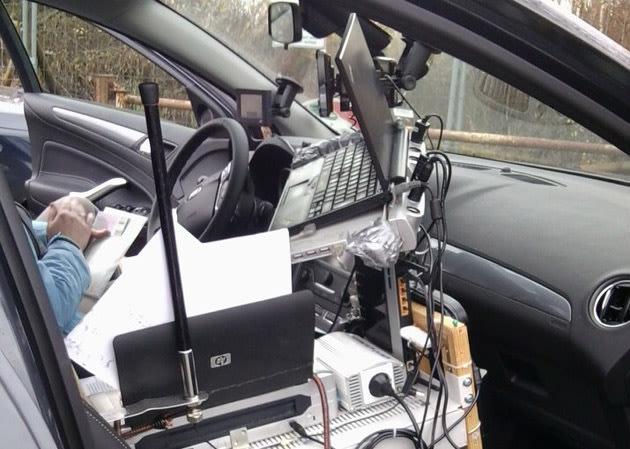
Police in the Saarland region of Germany pulled over a
Ford Mondeo wagon last week for going about 80 mph in a 62-mph zone.
Inside they found a Staples shopping spree in the front seat: a laptop
with docking station, a router and wi-fi antenna tied to a cellular data
stick, a printer and a power inverter to keep it all humming. The
driver had taken some precautions toward distracted driving by mounting
his cellphone to the windshield for hands-free use.
The setup looks messy and dangerous -- but as American police are finding,
writing a ticket for distracted driving requires a tough level of
proof. The German authorities didn't cite the Mondeo driver for any
violations, because they didn't see him playing Michael Scott behind the
wheel. I hope he's not one of those readers who needs to print out his
emails to read them.
I got trapped watching this show on the Military Channel. I am folding clothes and doing other domestic stuff while watching this. I remember watching this for the first time when I was in Germany in 1975 on AFN while my Dad was stationed in Frankfurt. This show became the standard by which all other documentaries are judged. To a 10 year old kid, this show ignited the love of History that I have now. It is fascinating to see the interviews of people that have survived to give their input on the events that have transpired.
The World at War (1973–74) is a 26-episode British television documentary series chronicling the events of the Second World War. At the time of its completion in 1973 it was the most expensive series ever made, costing £900,000.[1] It was produced by Jeremy Isaacs, narrated by Laurence Olivier and has a score composed by Carl Davis. A book, The World at War, was written by Mark Arnold-Forster to accompany it.
Since production was completed, The World at War has attracted huge acclaim and is now regarded as a landmark in British television history.[2] Following the time of its completion, and as the Second World War remained fresh in many people's minds, the producer Jeremy Isaacs was considered ahead of his time in resurrecting studies of military history.[3]
The series focused on, among other things, portrayal of the devastating
human experiences of the conflict; how life and death throughout the
war years affected soldiers, sailors and airmen, civilians, the tragic
victims of tyranny and, above all, concentration camp inmates.
The series has 26 episodes. Producer Jeremy Isaacs asked Noble Frankland, then director of the Imperial War Museum,
to list fifteen main campaigns of the war and devoted one episode to
each. The remaining eleven episodes are devoted to other matters, such
as the rise of the Third Reich, home life in Britain and Germany, the experience of occupation in the Netherlands, and the Nazis' use of genocide. Episode 1 begins with a cold open describing the massacre at the French village of Oradour-sur-Glane by the Waffen SS.
The same event is referenced again at the end of Episode 26 and the
series ends with Laurence Olivier uttering the poignant word,
"Remember".
The mid-war German situation in Southern Russia resulting in the Battle of Stalingrad, and its ultimate German catastrophe.
10
"Wolf Pack: U-Boats in the Atlantic (1939–1944)"
9 January 1974
The submarine war emphasizing mainly the North Atlantic. Tracks the development of both the convoy system and German submarine strategy. Interviewees include Grand Admiral Karl Dönitz and Otto Kretschmer.
German
society and how it changes as its fortunes of war are reversed.
Censorship and popular entertainment, the transformation of German
industry, the recruitment of female and foreign labour, allied bombing,
German dissent—including the 20 July plot, and the mobilisation of the Volkssturm towards the war's end. Interviewees include Albert Speer, Otto John, Traudl Junge, Richard Schulze-Kossens and Otto Ernst Remer.
The successive and increasingly bloody land battles on tiny islands in the expansive Pacific, aimed towards the Japanese heartland. Following the bombing of Darwin, the over-extended Japanese are progressively turned back at Kokoda, Tarawa, Peleliu, the Philippines, Iwo Jima and finally Okinawa.
How the war – both good and bad experiences – was experienced and remembered by its witnesses.
The series was originally transmitted on the ITV
network in the United Kingdom between 31 October 1973 and 8 May 1974,
and has subsequently been shown around the world. It was first shown in
the US in syndication
on various PBS stations in 1975. New York's independent commercial
station — subsequently becoming Secaucus, New Jersey's in 1983 — WOR
aired The World at War series in the mid-seventies (although episodes
were edited both for graphic content and to include sufficient
commercial breaks). PBS station WGBH broadcast the series unedited and in its entirety in the late eighties. The Danish channel DR2
also broadcast the series in December 2006 and January 2007. The
History Channel in Japan began screening the series in its entirety in
April 2007. It repeated the entire series again in August 2011. The
Military History Channel in the UK broadcast the series over the weekend
of 14 and 15 November 2009. The U.S. version of the Military Channel
aired the series in January 2010. In summer 2010, BBC2 in the U.K. transmitted a repeat run of the series. In 2011, the British channel Yesterday started a showing of the series.
Each episode was 52 minutes excluding commercials; as was customary
for ITV documentary series at the time, it was originally screened with
only one central break. The Genocide episode was screened uninterrupted.
The series was also put on 13 Laservision Longplay videodisks by Video Garant Amsterdam 1980, and included Dutch subtitling for the Dutch television market.
Additional episodes
Some footage and interviews which were not used in the original
series were later made into additional hour or half-hour documentaries
narrated by Eric Porter. These were released as a bonus to the VHS version and are included in the DVD set of the series.
Secretary to Hitler
Warrior - Reflections of Men at War (directed by Alan Afriat)
Hitler's Germany: The People's Community (1933–1939)
Hitler's Germany: Total War (1939–1945)
The Two Deaths of Adolf Hitler
The Final Solution: Part One
The Final Solution: Part Two
From War to Peace
Books
The original book The World at War,[5] which accompanied the series was written by Mark Arnold-Forster in 1973. In October 2007 Ebury Press published The World at War, a new book by Richard Holmes, an oral history of the Second World War drawn from the interviews conducted for the TV series.[6]
The programme's producers committed hundreds of interview-hours to tape
in its creation, but only a fraction of that recorded material was used
for the final version of the series. A selection of the rest of this
material was published in this book, which included interviews with Albert Speer, Karl Wolff (Himmler's adjutant), Traudl Junge (Hitler's secretary), James Stewart (USAAF bomber pilot and Hollywood star), Anthony Eden, John Colville (Private Secretary to Winston Churchill), Averell Harriman (US Ambassador to the Soviet Union) and Arthur "Bomber" Harris (Head of RAF Bomber Command)