I didn't know that the NRA and the Ordinance dept didn't have a good relationship and the NRA didn't like the Garand and the early Garand had issues with the gas trap. I have an Garand..or I did if I hadn't lost mine in the great canoe accident recently....It seems to be epidemic....I am in mourning...*sniff* *Sniff*. I shamelessly clipped this from the NRA online magazine because this has a lot of cool information I didn't know.
At one time, the
National Rifle Association
really didn’t like the M1 Garand. Shocking, right? This is certainly no
longer the case, and I’ll give you a little proof. Back in 2008, we did
an article called the
“Top 10 Infantry Rifles”
of all time. This “Top 10” concept was popular then and now. My staff
voted overwhelming for the M1 Garand as the “best infantry rifle of all
time.”
John Cantius Garand appeared on the cover of American
Rifleman twice, once when his rifle was adopted and again after he
retired and received M1 Rifle Serial No. 1,000,000.
I would call John C. Garand a great man, even though he never
thought of himself as such. If it were not for him, the defeat of Nazi
Germany and Imperial Japan would have cost many more American lives.
Simply put, the G.I.s and Marines armed with the “U.S Rifle, Caliber
.30, M1” did nothing less than save the world from unspeakable evil.

John Garand shown at his retirement on the cover of American Rifleman in March 1974.
Today, I happily report that the M1 Garand has been on the cover of
The American Rifleman
more than any other firearm in our entire history. It appeared on the
cover when it was first introduced, then again during the war years,
then again in rifle competitions. We showed it again with John Garand in
his retirement, then again during our coverage of Springfield Armory,
again as a go-to collector’s rifle and in multiple instances as a
standout piece of history, such as Scott Duff’s
article on British Lend-Lease M1 Garands.
So, is it really true that, at one time,
American Rifleman
editors and the National Rifle Association harshly criticized and had
little faith in “greatest battle implement ever devised?” Absolutely,
and the story has roots in the development and early years of the rifle
itself.
There was a time that John C. Garand was able to say
nothing about his rifle, and that started the rift between NRA and the
U.S. Army. Back in the mid-1930s, the man at the helm of
The American Rifleman was
Lawrence Hathaway. Our publication had reported on the U.S. Army
Ordnance Department’s evaluations of semi-automatic rifles long before
the magazine was even called
The American Rifleman, which came about in 1916 after being sold to NRA by James A. Drain for $1.

A rifle design created by Søren Hansen Bang.
In those days, editors and contributors went into incredible
detail describing the guns and how they worked for our members. They
covered novel designs like the Bang rifle, the Liu rifle, the Mondragon,
the
Winchester and
Remington recoil-operated guns. Army Ordnance and NRA editors were on the same page.
They
tested and reported on all these interesting guns for NRA members and
the riflemen of the world. All these people had the right to know about
these new designs, and the world was curious. Everyone knew that the
semi-automatic infantry rifle was the next big thing. The U.S. Army had
been looking at every feasible design since 1900.

Several variations of the first Chinese semi-automatic rifle design, as
created by General Liu Qing En, first superintendent of Hanyang Arsenal.
Despite the veneration of the
U.S. Rifle Model of 1903,
the “Cult of the Springfield” I’ll call it—and the U.S. Marine Corps
stayed in the cult longer than most—this was the most important stories
in rifle development for at least 50 years. Once French chemist Paul
Vielle Introduced
Poudre B to the world in 1886, it was only a
matter of time. A semi-automatic infantry rifle was going to happen for
the U.S. Army. But what rifle would they pick, and when would it happen?
At this time, the U.S. Army Ordnance Department and
American Rifleman editors
were joined at the hip. They were in this together. NRA’s founding
mission is about marksmanship and the national defense, after all. We
reported on the primer-actuated rifle designed by a young, Canadian-born
inventor by the name of Garand back in 1919. The Army gave NRA full
access to the rifle and the story. Why? Because they weren’t going to
adopt it. That inventor eventually got hired to work at the U.S.
Springfield Armory.

The testing of John C. Garand's first primer-actuated rifle.
The U.S. Army had been working on a semi-automatic rifle since
before the turn of the 20th century. All of their efforts in testing the
Bang and the Liu and every other crazy rifle that every crackpot in the
world came up with had been reported in the pages of
The American Rifleman. So began the journey to develop a semi-automatic infantry rifle for the U.S. Army.
The Ordnance Department hired the best commercial gun designer available,
John D. Pedersen,
to work on the concept. Pedersen, a contemporary of John Moses Browning
and John Garand, was very good, indeed. Army Ordnance put them on
separate design tracks and pitted all these great men against each
other. But in the words of the 1980s Movie, “Highlander,” there can only
be one. That one was the “U.S. Semiautomatic Rifle, Caliber, 30 M1.”

The toggle-lock action of Pedersen's .276-cal. rifle shown locked open.
Really, the United States was the only country in the world that
was capable of developing and mass-producing the M1 rifle. It was a
country that had the willpower and the patience to develop the M1.
The American Rifleman reported on it. This was big news. The biggest news.
But
when we look at the first article about the M1 rifle, there are some
clues as to the emerging rift. The author, Col. Drewry, was not on the
magazine staff. He didn’t test guns for NRA members. He was an Army
Ordnance officer.
How did this happen? Well, the story was not written for
The American Rifleman. It was written for the
Infantry Journal.
The American Rifleman was merely allowed to run it. It must have chapped Editor Hathaway’s bunions to no end.
Back then, the most comprehensive evaluations of firearms in the world happened in the pages of
The American Rifleman.
If you made a gun, you sent us a gun. We shoot it, we tear it down, we
describe every bit and piece, how it’s made and how it performs. We
shoot it, and the gun does what it does.

Examples of the comprehensive testing performed by American Rifleman staffers in the early 20th century.
But in this instance, the Army wasn't talking. Fred C. Ness,
American Rifleman
technical editor, did not receive a “U.S. Semiautomatic Rifle, Caliber
.30,” at the Barr Building or later at 1600 Rhode Island Avenue. They
didn't let him take it apart and describe every feature. They didn't
even brief him about it.
The American Rifleman got the Army official story from Col. Drewry.
Meanwhile,
there was a man named Julian S. Hatcher. He graduated from the U.S.
Naval Academy and was commissioned as a lieutenant in the U.S. Army
Ordnance Corps. He started contributing to
The American Rifleman
early and often. He answered questions from NRA members, he described
guns, ballistics, loads and bullet performance. Again, Army Ordnance and
The American Rifleman were joined at the hip through Hatcher.

The lead story page as written by U.S. Army Ordnance's Col. Drewry.
Once the US Army adopted the U.S. Semiautomatic Rifle, Caliber
.30 M1, in 1936, though, that all changed. Then-Major Julian S. Hatcher
went silent. His brother, Major James Hatcher, was running the M1
rifle’s development. Julian Hatcher, who would later become technical
editor of
The American Rifleman, answered question about
knockdown power and cast bullets, but not about the M1 rifle. In the
pages of the magazine, as far as the M1 was concerned, Julian Hatcher
went dark.
Hatcher was the one guy who regularly answered member letters in the pages of
The American Rifleman, and he worked with John C. Garand in the 1920s. He would go on to write the
Book of the Garand.
He and Garand were friends. They shot in the Springfield Armory
weekly pistol league together. Hatcher’s Colt Camp Perry is in the NRA
Museum. I have a Christmas card from Major and Mrs. Julian Hatcher to
Mr. and Mrs. John C. Garand. They were friends and worked together
toward, arguably, the most-important American rifle of all time.

Then-Captain Julian Sommerville Hatcher shown with a semi-automatic rifle of his own design.
From 1935 to 1939, I know for a fact that Hatcher’s name appeared
158 times in 94 different NRA documents and publications. After the
adoption of the M1, not a word written by him was about the M1.
The
M1 Garand was adopted officially in 1936, and there is scant
information about the rifle in the pages of the magazine. Snippets, but
nothing substantive. It must have been incredibly hard on the editors,
who were itching to understand and share this revolutionary new rifle
design with NRA members.
Later, Camp Perry was blessed with a
demonstration of the M1 rifle. Army Ordnance brought it, it shot, but
not very well, and ordnance officials would not let NRA’s representative
fieldstrip the rifle. They wouldn’t let our technical staff look inside
the rifle. Even though that’s what
The American Rifleman staff
did and that’s what they had worked hand-in-hand with Army Ordnance on
for decades at this point, the Army stopped them from taking a peek
anyway.

A group of U.S. congressman shown firing and examining the M1 Garand
design, a courtesy not granted to American Rifleman editors.
The Army Ordnance Department’s secretiveness and their
unwillingness to pull the trigger guard down and let NRA see inside the
M1 led to congressional hearings, sensationalist national news stories
and a feeling that the Army was hiding something about its new rifle.
The Army’s reticence to share information about the M1 opened a door. A
door that
Melvin Maynard Johnson drove a truck through.
While
development of the Garand had occurred, Johnson had worked on a
separate rifle design. When the U.S. Army hid the M1 Garand from the
NRA, Johnson was open and forthright about his new gun. Ness made
Johnson and his rifle a national news story. His rifle had some features
the M1 did not, being able to top off a magazine and a 10-round
magazine capacity, for example. Since the Army hadn’t adopted his rifle,
Johnson could let NRA take it apart and describe every piece.

Melvin Maynard Johnson shown here with several of his early rifle designs.
The Army and NRA were in pretty much open conflict about the M1,
and there were snarky reports throughout this period that illustrate
this war of words. U.S. Army Ordnance even went so far as to run
advertisements discussing the Army’s new M1 rifle in other magazines of
the period, but not
The American Rifleman.
Then came
Camp Perry. At the Small Arms Firing School at Camp Perry that year, the
Army once again demonstrated the M1 rifle. Attendees were allowed to
fire the rifle, but NRA staff was prohibited from taking the gun apart.
Ever heard of waving a red flag at a bull?

Page one of six of Ness' article on the "revolutionary" Johnson rifle.
The flame stoked by the Army’s lack of cooperation led to a lot
of public debate. It led to editorials from newspapers that couldn't
tell an M1 rifle from a badminton racket. It led to congressional
hearings, hearings in which senators and congressmen made the Army a
little uncomfortable.
Meanwhile, NRA’s promotion of the Johnson rifle no doubt helped it go from prototype to production to
limited service with the United States Marine Corps.
If you ever want to find fans of Melvin Maynard Johnson designs, look
no further than the “Super Commandos”—the Canadian and American troops
that formed the U.S. Special Service Force. The “black devils” loved
their “Johnny guns.”
It’s true that the Johnson rifle did have
some good points, but F.C. Ness highlighted it more than was probably
necessary, which only goes to show that there was a deeper purpose to
the whole thing. In one article, Ness spent six pages describing the
Johnson rifle in prototype form.

Due to the attention paid to it by American Rifleman editors, the
Johnson Rifle gained traction and saw limited military service.
For contrast, another new gun appeared in 1936 that some might recognize: the
Winchester Model 70. Yes, the “Rifleman’s Rifle.”
The American Rifleman editors devoted far less space to this iconic design than they gave to the Johnson rifle.
Meanwhile,
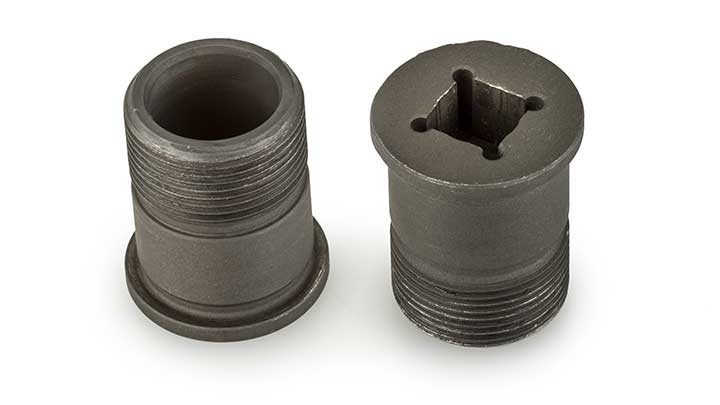
the Army still would not let NRA see inside an M1. The Army knew it had
a problem with the gas trap, but it wasn’t going to admit it to anyone
and certainly not to the NRA. There was a reason for that that extended
beyond Ordnance department pride. From 1936 to 1940, the M1 was not
perfect. It was not the gun that would win World War II.
In 1940,
the Army decided to switch from the gas trap to the gas port and, in
November of that year, made a change it didn’t talk about. That change
was the drilling of a hole in the barrel and the elimination the
unreliable gas trap. The gas-trap system worked better than most
full-power semi-automatic military rifles, but it didn't work well
enough.
It’s important to recognize that, in 1940, it was a very
different world. No Army anywhere had a adopted a semi-automatic design
as its standard service rifle, The French, the Soviets, the Germans and
even the British had experimented. Some even adopted them but never for
general issue.
All the secretiveness and lack of cooperation made
it look as if the Army was hiding something about the M1 rifle. As it
turns out, the Army was, and there were problems beyond the gas-trap
issue. As the prototype rifles turned into production rifles, things
begin to vex engineers at Springfield Armory.
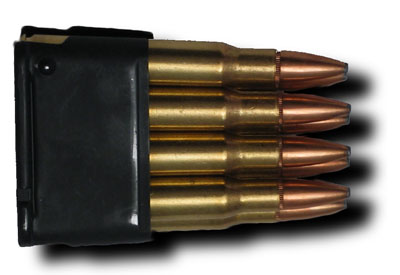
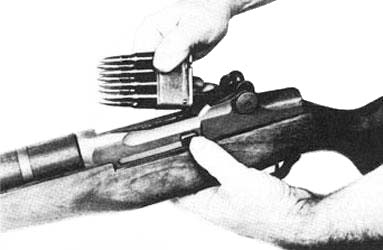
The best known of
these issues is the seventh-round stoppage. As most folks know, you can
stick an M1 en-bloc clip in either way. Ordnance engineers found that if
the top cartridge was on the right, then the seventh cartridge would
also be on the right. This round would jump up out of position and jam
the bullet nose into the receiver.
At the 1939 National matches at Camp Perry, Lt. Col. James L.
Hatcher was doing a demonstration with the M1 Garand. The seventh-round
stoppage hadn't been solved yet, so he and Capt. Rothwell Brown made
sure that all the clips were loaded with a seventh round on the left.
The demonstration went well, but as Julian S. Hatcher wrote in the
Book of the Garand, “a feeling arose that all is not well.”
Hatcher
continued: "At the demonstrations at Camp Perry, civilians were invited
to fire the rifle, but there's always an Army man at the shooter’s
elbow ready to snatch the rifle away and perform some sleight of hand at
the slightest sign of a malfunction … . Moreover, the members of the
NRA staff, to their surprise, found that they were unwelcome whenever
they approached a Garand or wanted to fire it."

Julian S. Hatcher would later become technical editor of American Rifleman.
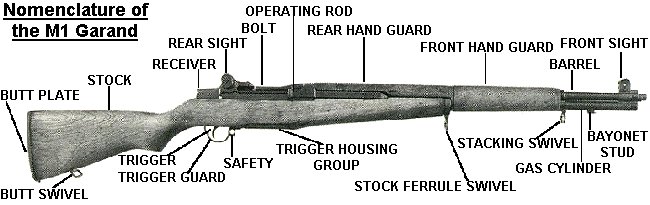
There were other issues. The jumping clip, the sticking operating
rod cam, rear sight trouble, and of course, the M1 needed a new gas
cylinder. By October 1939, the so-called gas port gas cylinder assembly,
with a hole in the barrel, was recommended and adopted. Gas-port rifles
started production early in 1940.
In May 1940, F.C. Ness of
The American Rifleman
obtained an M1 rifle and a single eight-round en-bloc clip. As a gun
writer for the past 29 years, I know when a writer is out to get a gun.
And F.C. Ness was out to get the M1 rifle. But the rifle he received was
not the new gas-port M1 Garand. It was the older “gas-trap” gun that
clearly had issues.

The U.S. Army Ordnance drawing supplied with Col. Drewry's first article.
What's interesting is that, while reporting every stoppage,
including those that occurred when single-loading, and criticizing the
design, he did note that this was not the new “gas-port” system. Ness
knew about the coming gas-port system that would make the M1 Garand into
the reliable battle arm everyone knows today, but he chose to
concentrate on the faults of the “gas-trap” Garand.
There's another aspect to all this that we can recognize today. It’s reasonable to assume that the Germans read
The American Rifleman
magazine at the time. If I had been a potential enemy of the United
States, I sure would have, knowing how much information about U.S. Army
Ordnance testing ended up in the pages of the magazine.
What if
supplying F.C. Ness with a gas-trap model in February 1940 was the plan?
What if the Army knew of Germany’s interest in the M1 rifle? What if
they deliberately planted misinformation by giving F.C. Ness a gas-trap
gun after the Army had already switched over to gas-port Garands?

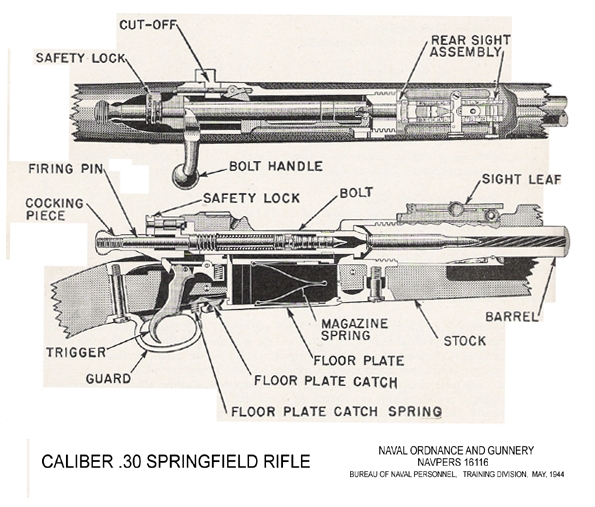
U.S. Army Ordnance-supplied schematics of the M1 Garand.
Another interesting piece of information was the reporting of the
number of M1 rifles being produced. In May 1940, it is said there are
fewer than 25,000 guns. Only about 4,000 a month were reported.
No
one involved is still alive, but this looks to me like the Army was
trying to tell the Germans that the M1 wasn't ready for prime time in
terms of the effectiveness of the rifle or the numbers produced. This is
all pure speculation on my part, though still worth thinking about.
What
is in the record is what Julian Hatcher thought about the secretive
nature of the M1 rifle’s development and what possibly could have
happened:
“Had the association been kept fully and frankly
informed about the rifle, they could have been counted on by the War
Department both for informed and constructive criticism and suggestions,
and also for powerful support of any decisions reached as a result of
Army needs and experience."

John Garand's early prototype of the M1 Rifle shown in 1930.
NRA’s leadership was comprised mostly of Army and National Guard
officers. These were officers like Gen. Milton A Reckord, Adjutant
General of the Maryland National Guard—who would eventually command the
29th Infantry Division during World War II. Think you could trust him? I
do.
But as it stands, the first army in the world to declare a
semi-automatic rifle as its standard-issue arm was the United States
Army, and the M1 rifle became of the greatest military secrets of the
age. How did America do it? Well, Nazi Germany wanted to find out.
The
secret of the M1 Garand certainly wasn’t on the level of the later
Manhattan Project, but our enemies still wanted all the information they
could get. German spies sought out the plans to the M1 rifle. Members
of the Duquesne Spy Ring actually obtained the plans for the M1—the FBI
even filmed one Nazi spy pulling the schematics out of his sock in New
York before the United States ever entered World War II.

Nazi spy Frederick "Fritz" Joubert Duquesne pictured after his capture by the FBI.
Even though these Nazi spies were arrested, I think it is logical
to assume Nazi Germany got the plans to the M1 Garand. After all, they
found the plans for the Norden Bombsight. But the designs they obtained
were not of the M1 Garand as we know it, the Garand that entered the
battlefield in huge numbers during WWII. I believe they got plans to the
gas-trap variant.
In late 1940, the German Ordnance Department solicited a semi-automatic rifle from
Walther and
Mauser
for adoption in 1941. One of the requirements was that they could not
drill a hole in the barrel. Why would they include such a specific
requirement? I would argue that they may have had plans for the M1 rifle
that did not have hole in the barrel. Both the
Mauser G41(M) and the Walther G41(W) had goofy forms of gas-trap operation. Neither worked very well.

The German Gewehr 41, which used a gas-trap operating system rather than a gas port.
Early M1 Garands may have gotten into German intelligence hands
from their Japanese allies following the fall of the Philippines, but
the guns captured there would have been a mix of gas-trap and gas-port
rifles. The Germans eventually drilled a hole in the barrel and came up
with G43 rifle. The Japanese also copied the gas-port M1, and they came
up with the
Type 5.
Before
the capture of these issued M1 Garands in the Philippines, the one
thing that German ordnance seemed pretty serious about was that neither
entrant, Walther or Mauser, was to drill a hole in the barrel. What they
ended up getting was the G41(W) and the G41(M). Both rifles were frail
and finicky, but neither of them had a hole in the barrel.

The Japanese Type 5 was copied later and featured the same gas-port system as later M1 Garands.
At that time, as far as the world knew, the U.S. Rifle, Caliber
.30 M1 didn't have a hole in the barrel. The only scant mention of a
gas-port model was in Ness’ May 1940 article in
The American Rifleman.
The only country in the world that ever figured out a reliable
semi-automatic rifle concept was the United States. When the Germans
went to develop their own, it is my supposition that they went with what
they knew worked. That was the M1 Garand.
By the time that
specification went out in 1940, there were no M1 rifles outside of the
U.S. government. Sure, some were sent to England under the Lend-Lease
Act. Some were sent to the Philippines. As a matter fact, the
M1 rifle's introduction to combat
came during the fighting for the Philippines in 1942. Despite being
mostly gas-trap rifles, from everything we can tell, the M1 performed
pretty well.

A May 1941 issue of American Rifleman shows that NRA and the U.S. Army had reconciled.
With improvements, though, the M1 rifle would perform even
better. It would go on to be the rifle in the hands of young men who
went overseas, fought and died so that the flame of freedom would not be
extinguished. The rifle that went to North Africa, the rifle that went
to Guadalcanal, to Monte Cassino, to Omaha beach, to Tarawa and Iwo
Jima, wasn't the same rifle that the Germans tried to copy. It was not
the same rifle that the army hid from the NRA. It was better.
In
the interim, NRA got over its concerns about the M1 rifle. After Dec. 7,
1941, the NRA was all-in following the “day that will live in infamy.”
NRA and its members went on to train millions of young Americans in
marksmanship during pre-induction training programs.
We wrote manuals on marksmanship. We even did a “how-to” guide
for plant and industrial guards. Our members served both at home and
overseas. A generation of young Americans armed with M1 Garands did
nothing less than save the world—one eight-round en bloc clip at a time.