I will cut and paste an article that I saw on History online. I had stated many of the same arguments when people had stated that "Truman should not have dropped the bomb." This prism point of view is made in todays time, not the time 70 years ago. 70 years ago was 4 generation ago and a lot has changed. Back then war wasn't fought for a limited political objective and it was fought to the death, there was no quarter given. The only place that the war was more brutal than the Russian front was in the pacific ocean. The code of "Bushido" had all defeated enemies as sub human not worthy of respect. To the Japanese military and civilians, they were expected to give their all including their lives for service to the emperor of Japan. Japan had attacked us at Pearl Harbor under a sneak attack, and the war followed was a war that was brutal by modern standards and civilians were not excluded. This was total war, the population was totally engaged, from the rationing to the movies and everybody worked in some form on the home front. Some of the pictures are from the article...others I got out of my stash or googled.

The
bombing of Hiroshima and Nagasaki was apocalyptically awful. 70 years
ago today, an estimated 90,000 people were immediately killed when
Little Boy detonated 1,950ft above Hiroshima – 50,000 more would die by
the end of the year. Two days later, Nagasaki was struck by ‘Fat Man’,
killing approximately 80,000 people. It was, as the Allies threatened
during the Potsdam Conference, ‘prompt and utter destruction’.
Just
four months into his presidency, President Harry Truman was tasked with
making one of the most important decisions in human history. He chose
to put an atomic full stop on six long years of unprecedentedly bloody
conflict – here are five reasons why he made the right decision.
1. Imperial Japan was fanatical and barbarous in the absolute extreme.
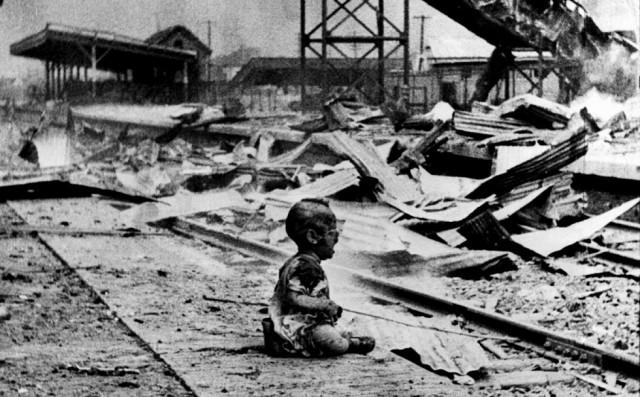
Imperial
Japan was a militaristic and dictatorial theocracy whose generals had
fatal contempt for their enemies and a total disregard for Japanese
lives. At the root of the country’s fanaticism was Emperor Hirohito, the
celestial figurehead whom the zealous masses were expected to worship
and even die for. The true rulers of Japan, however, were the
belligerent top brass of the military.
With
a desire for natural resources and their own lebensraum, the Japanese
colonized Manchuria, northeast China in 1931. In 1937, Chinese
resistance led to the Second Sino-Japanese war, beginning a campaign of
innumerable Japanese atrocities.
The most infamous of these
atrocities occurred in China’s then-capital Nanking on 13 December 1937.
In an appalling act of genocide, the Japanese murdered up to 300,000
people and raped tens of thousands of women over a six-week period.
There
are dozens of eyewitness accounts and photographs that reveal the
sickening details of the massacre. Two survivors reported that thousands
of children, women and the elderly were bound with wire or rope, driven
into four columns and then mown down with ‘about twenty’ machine guns.
Once the bodies had ‘heaped like mountains’, the murderers then
bayoneted the corpses en masse, eventually dousing the pile with
kerosene and setting it ablaze. No one was safe from Japanese bayonets,
not even infants, some of whom were brutally skewered like kebabs.
The
suffering endured by Nanking’s women will leave many readers
incredulous. One Chinese cook gave his account of seeing dozens of
female corpses, the majority of which had ‘their abdomens cut open and
their intestines squeezed out.’ Some of the women had been pregnant,
lying ‘dead together with their fetuses covered with blood’, their
breasts having been ‘either cut off or bayoneted into a mixture of flesh
and blood.’
1300 miles to the northeast of Nanking was the
‘Epidemic Prevention and Water Purification Department of the Kwantung
Army’, better known as Unit 731.
This ghastly facility was host to
a range of lethal human experiments, including thousands of
vivisections without anesthesia. Prior to the surgeons ruthlessly
opening their victims up, they had infected them with various diseases,
which ranged from the bubonic plague and anthrax to syphilis and
cholera. As part of research into gangrene, some victims had limbs
frozen and then thawed, all the while being conscious, of course.
Many
experiments were entirely military minded. Victims would be restrained
and exposed to the effects of grenades, flamethrowers and various
chemical weapons, the latter of which they were readily using in combat
against the Chinese.
In a similar manner to the Americans’ immoral
Operation Ranch Hand programme during the Vietnam War, low-altitude
Japanese planes spread plague-infested fleas over the cities of Ningbo
and Changde, killing thousands of people.
This disagreeable form
of warfare flouted the Geneva protocol, which officially prohibited the
use of ‘asphyxiating, poisonous or other gases, and of bacteriological
methods of warfare’ on 8 February 1928.
There is far too little
space here to fully elaborate on the crimes of Imperial Japan, which can
be reasonably deemed one of the most disgustingly immoral forces the
world has ever seen. The bombs stopped them from perpetrating any
further barbarity – some may say it was vindication.
2. Imperial Japan was utterly averse to surrender and had a fatal contempt for those who weren’t.
The Potsdam Conference 1945
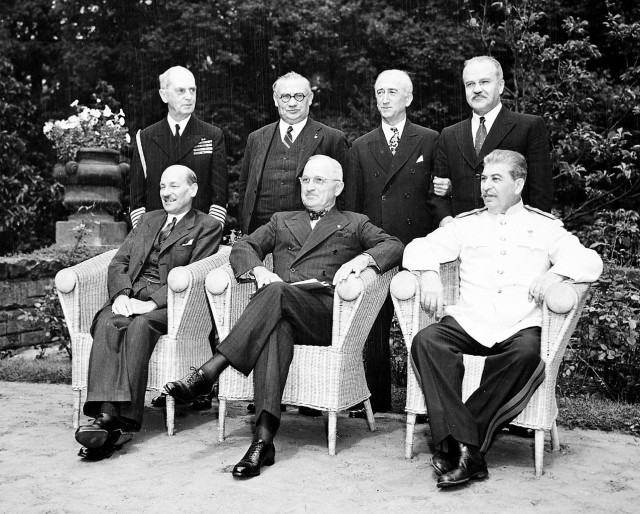
Despite
devastating losses – such as their air power being reduced from 430
planes to around 100 during the day-long ‘Great Marianas Turkey Shoot’ –
the centuries-old Japanese ethos was that suicide, particularly suicide
that killed others, was infinitely nobler than waving the white flag.
Staggeringly
low surrender statistics were common throughout the Pacific Theatre.
During the bloody Battle of Tarawa, only 17 of 3000 Japanese troops
surrendered. At Saipan, the vast majority of the 30,000 strong garrison
died. 22,000 civilians also died in Saipan, which was over two thirds of
the population.
Japanese contempt for surrender caused them to
subject Allied POWs to appalling cruelty. The stories of the Burma
railway’s hellish protracted brutality are well known – 16,000 POWs and
an incalculable number of Burmese and Malay workers died, chiefly from a
range of terrible diseases.
There
are many lesser-known stories of the shocking games the Japanese used
to play with POWs, too. As mentioned earlier, the Japanese had a
penchant for bayoneting people. Robert O’Brien, a New York sailor aboard
the USS Penguin, experienced their predilection first hand.
After
Guam fell on 10 December 1941, O’Brien and his comrades were forced to
run through a gauntlet of Japanese soldiers, who hacked, slashed and hit
them with bayonets and rifle butts. O’Brien survived this sick game but
death surrounded him, including the man directly behind him. Several
men’s scalps had been gored; one man bled to death from a deep cut along
his back. Another man was shot through both ankles, falling to the
ground and having his wounds maliciously stomped on by the Japanese.
Three
years later, on October 25 1944, the Japanese would employ their most
infamously desperate line of defense – the kamikaze pilots. Of the 3860
kamikaze pilots who died, only 19% hit their targets. Their futile
deaths become emblematic of Japanese fanatical resistance.
The most costly instance, however, of Japan’s obstinate refusal to surrender was the Japanese Premier’s use of
mokusatsu. Meaning ‘take no notice of’ or ‘treat with silent contempt’,
mokusatsu was
Kantaro Suzuki’s response to the United States’ demand for
unconditional surrender at the Potsdam Conference. The Potsdam
Declaration stated that if the Allies’ terms were not met, Japan would
face ‘prompt and utter destruction’.
The translation’s accuracy is a point of contention, as
mokusatsu doesn’t
always mean ‘treat with silent contempt’. However, Suzuki was in no
position to mull over the proposition, to bargain with his enemies and
save face. His country had raped, pillaged and caused the death of
millions of people. He was threatened with ‘prompt and utter
destruction’, yet his laconic response to this damningly sincere threat
suggests he didn’t take the declaration seriously and perhaps considered
the far costlier invasion of the mainland to be preferable.
Surrender
wasn’t achieved even after Hiroshima was devastated. It was only
following Fat Man’s 21-kiloton detonation over Nagasaki that the
Japanese finally capitulated.
Even in these desperate times,
Emperor Hirohito tried his utmost to save face for himself and his
battered nation. On 15 August 1945, Hirohito addressed his people for
the first time during his leadership, asking them to ‘endure the
unendurable and bear the unbearable’ and, in what may truly be the
understatement of the 20
th century, stated that the war had
turned ‘not necessarily in Japan’s favour’. Without the sudden atomic
step-up, the Americans would most probably have been forced to execute
Operation Downfall.
3. Operation Downfall, the proposed invasion of Japan, would have resulted in more casualties on both sides.
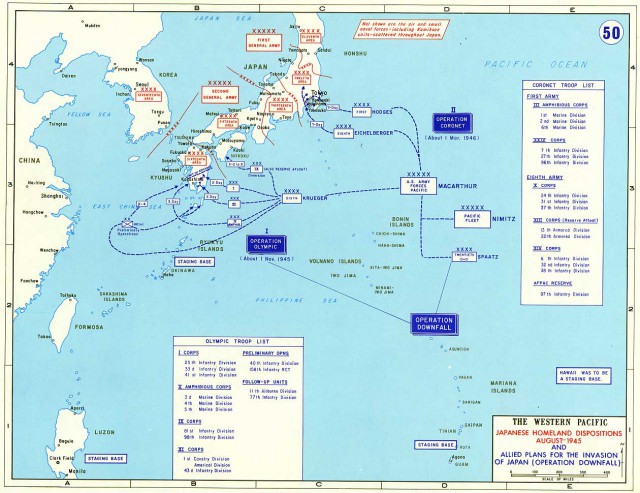
Comprising
Operation Olympic, the invasion of Kyushu (southern island), and
Operation Coronet, the invasion of the Honshu (main island), Operation
Downfall was a very daunting prospect.
It would have been a
campaign of terrible violence, punctuated by conflicts such as the
Battle of Honshu and the Battle of Kyushu, which could have been another
Stalingrad. Japan had defended tiny Pacific islands like Peleliu and
Iwo Jima with great ferocity; defense of the Japanese mainland would
have quite likely introduced the Allies to wholly new levels of fatal
intensity.
It would have made WWII, the most catastrophic war in
history, significantly worse. Over a million Allied casualties were
estimated, for the Japanese this figure rose massively to the tens of
millions.
One can only speculate how the civilians would have
behaved. Revolt was always a possibility, but their lack of knowledge
regarding Japan’s calamitous defeats in the Pacific and the intense
reverence for Hirohito would likely have resulted in widespread loyalty.
Compare
the multi-million casualty estimates of Operation Downfall to the
atomic bombs’ 250,000 – 300,000 Japanese and approximately 20 Allied POW
deaths, and the Manhattan Project almost seems like a humanitarian
effort. This significant disparity alone is a strong justification for
the bombs’ use.
4. It stymied Soviet influence and the creation of another North Korea.
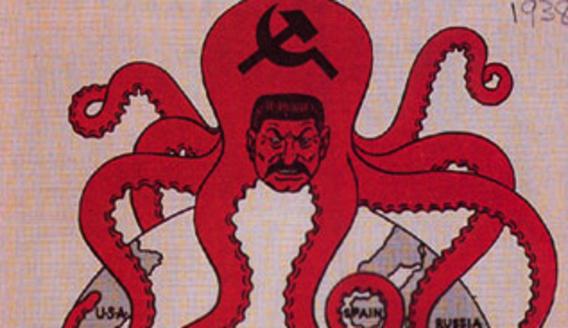
The
bombs hastened Japan’s unconditional surrender, allowing the Americans
to execute their considerable altruistic efforts on their own terms.
Whilst the Marshall Plan was pumping $13 billion ($120 billion today)
into Europe, the United States occupied Japan and established the
Supreme Command of Allied Powers (SCAP) with the intention of creating a
prosperous democracy and key Asian ally.
Led by General Douglas
MacArthur, SCAP paved the way towards free market capitalism, promoted
women’s rights and banned former military officers from political
leadership in the new government. Crucially, MacArthur had the
pragmatism to allow Emperor Hirohito to stay, reducing his position to a
firmly ceremonial one and waiving his ability to wage war. The
consequences of removing such a beloved figure would have likely had a
dire effect on Japanese morale, igniting an array of dissidence. When
Hirohito died in 1989, Japan had the world’s second largest economy.
Now imagine if the Soviet Union’s involvement in Japan’s future was
more than a meager ‘advisory role’, imagine if they had the same clout
as they did in Korea. Russia had invaded Japanese Manchuria on 9 August
1945, swiftly defeating their opposition and moving south, eventually
reaching the Korean peninsula. As agreed at Potsdam, the Soviets began
their occupation of North Korea and, on 8 September, the United States
occupied South Korea, the partition line being along the 38
th parallel.
On
24 July 1948, US-backed Syngman Rhee became the first President of
South Korea. Although his leadership was marred by authoritarianism,
Rhee’s moral ambiguities were dwarfed by the Soviet Union’s leader of
choice – the wretched Kim Il-Sung. North Korea has been under the rule
of the Kim Dynasty ever since, suffering all manner of human
underdevelopment such as poverty, international isolation, awful
infrastructure, one of the world’s worst human rights records and a
famine that resulted in hundreds of thousands of deaths.
Instead
of the rich, pacifist nation that we know today, strong Soviet influence
could have carved Japan up, perhaps rendering Sapporo a Stalinist,
retrograde circus of oppression much like Pyongyang. We could have seen
another East Germany, or perhaps even another Cuban missile crisis. One
can only speculate, but it is demonstrable that America’s devastating
yet presciently decisive action helped establish Japan as the first
‘Tiger economy’, influencing economic reforms in South Korea, Hong Kong,
Singapore and Taiwan, all of which are beacons of prosperity and
development in Asia.
5. The destructive precedent it set wasn’t quite as epochal as many believe – conventional fire-bombings were similarly devastating.
Indeed,
America’s utilization of atomic weaponry irrevocably changed warfare.
Scores of people were seared beyond recognition, their shadow sometimes
scorched onto the surrounding surfaces. Some simply vanished. For many,
death was a more protracted affair, their bodies bleeding, oozing and
generally falling apart as their DNA was mutilated by radiation
poisoning, also known as acute radiation syndrome (ARS).
Despite
all of this, one must not forget the diabolical effectiveness of the
Allies’ conventional weaponry. Low-altitude incendiary bombing killed
many more people than Little Boy and Fat Man. The lowest estimate is
241,000 – which already meets the estimated death toll of the atomic
bombs – and the highest is an enormous 900,000.
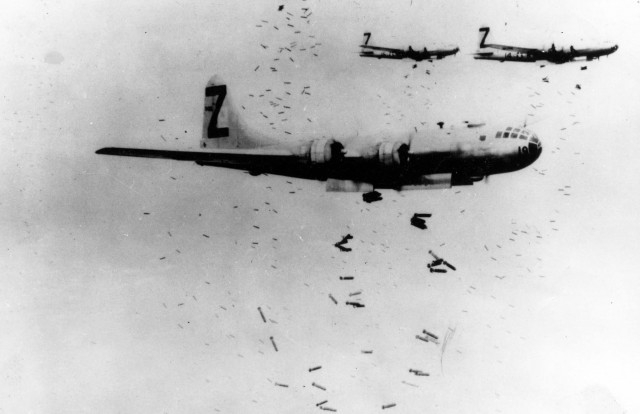
The zenith of this
ghastly destruction was the Operation Meetinghouse raid above Tokyo on 9
March 1945. 2000 tons of incendiaries were dropped on the city,
destroying 16 square miles and killing around 100,000 people. Epic fires
consumed the city, creating a blood-red mist of such putrid fragrance
that the pilots had to wear oxygen masks to avoid vomiting. A US survey
found that the 300 B-29 Superfortresses killed more people during the
raid than at any single moment in history – an astonishing conclusion,
indeed.
The masses that burned in Japan’s ‘paper cities’ have been
barged out of the public consciousness by Hiroshima and Nagasaki, which
were ultimately a mere extension of the Allies’ similarly devastating
conventional-bombing campaign.
Written by Jack Hawkins for War History Online


