I
am continuing my string of "bugaloo" songs. This discussion was
started in the "Monster Hunter Nation, Hunters Unite", back in November
of 2019? it is a Facebook group with enthusiast of the ILOH
"International Lord of Hate" A.K.A Larry Correia.
We were talking about what song would we use if we looked out of our
window or glanced at our security camera and saw this.....
One
of the alphabet bois lining up to take down your house...What would be
your "Valhalla" song and you would set it up to play as you load up
magazines set up the Tannerite Rover, turn on the water irrigation system and fill it with gasoline instead of water and prepare yourself.
I
figured it would scar the alphabet boys if they come busting in and
hearing a song about people having a good time and standing up for
themselves and having the best music from the best decade and playing it Loud will scar the Alphabet Boi's
as they force the stack through the door, because they will be exposed
to good music for the first time unlike the crap they listen to now
sipping their soi latte's and comparing notes on the latest soyburger
recipes and who wears the best manbuns in the team.
Well I decided to go with Lindsey Buckingham, It is a song from his
solo album, he is one of the singers/songwriters/musician from
Fleet-wood Mac. As I have stated many times, I am a big fan of
Fleet-wood Mac, I first heard of them in Germany in 1977 when I was 11
years old and I would catch them on late at night on AFN radio in
Frankfurt and Wolfman Jack
was the DJ, They would play all the "superbands from the 70's" and I
would rock out until I fell asleep. I for many years thought that Wolfman Jack
was a DJ for AFN radio. I found out many years later that his show was
syndicated. I remember this song while I was first entering High
school....I had lost track of the song for many years until I happen to
hear it on XM Sirius on my favorite channel..." The 80's on 8". The
first time I heard it, it was instant recognition. The song is an easy
listening song.. The name of the song is "trouble"....and it is what
the Xiden administration is having right now between Kowtowing to China, Inflation, Illegals crossing the border, Ukraine, Vaxx mandates, Covid Insecurities, and doubling down on them.
Trouble" is a song by Lindsey Buckingham. It was the biggest hit off the album Law and Order, which was released in 1981. It was also Buckingham's first hit as a solo artist.
"Trouble" was the only song on the album that Buckingham didn't play bass or drums on; his Fleetwood Mac bandmate Mick Fleetwood
was brought in to do the drums. Things didn't work out very well in the
recording session, and a taped loop of the drum track, about
four-seconds long, was used over and over for the song. The song is sung in a light falsetto.
The single would become a #9 hit in the US in early 1982. It topped the charts in Australia for 3 weeks.
In the UK, it was released on the Mercury Records label. It entered the UK singles charts on 16 January 1983, rising to a high of number 31, and it remained in the chart for 7 weeks.
The distinctive music video
for "Trouble" features a multi-instrumental "big-band" of male
musicians (six as guitarists, besides Buckingham, and six as drummers,
including Mick Fleetwood). Walter Egan also appears in the music video as the second guitarist from the front. The video also includes Bob Welch, Dwight Twilley, Jimmy Iovine, and Andy Ward (the drummer from Camel).
The song appears in the film Just One of the Guys during the blind date
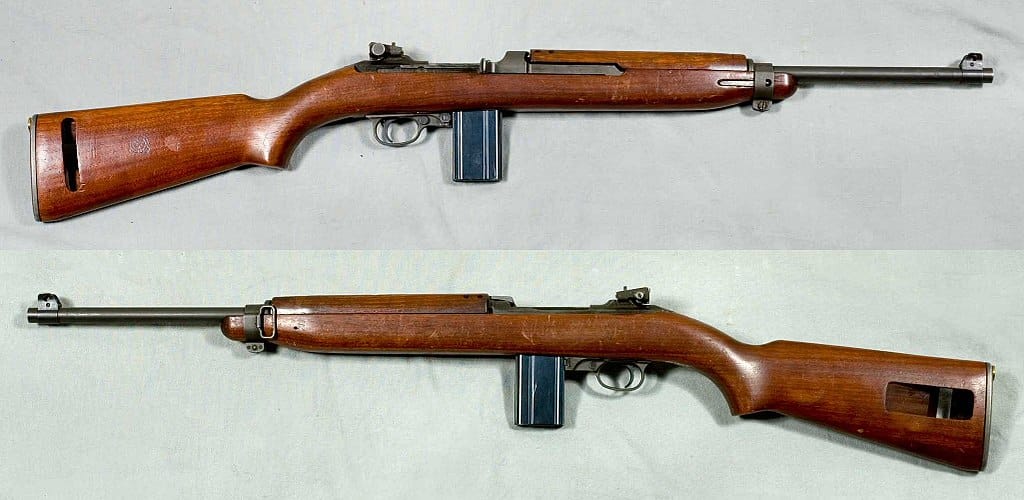
This ties in with a post I did on Wednesday on the M-1 Carbine where it "Talks" about the development of the M-1 Carbine, this continues the story.
World War 2 was a fascinating time for weapon development. We saw the
birth of the general-purpose machine gun, the adoption of an
autoloading rifle, and even the development and mass fielding of
automatic rifles. During this terrible war, we also developed the M1
Carbine, which would go on to become legendary in both performance and
concept.
The M1 Carbine
was a short and light semi-automatic rifle firing the .30 Carbine
cartridge. The design fed from a box magazine that held 15 rounds. Most
of the time, the term carbine applies to a shorter variant of a standard
rifle. However, the M1 Carbine was its own design and not a smaller
variant of any other platform.
The M1 Carbine utilizes a short-stroke gas piston system designed by
David Marshall ‘Carbine’ Williams, who started designing guns while
serving a prison term for murder. Winchester developed the rifle and
cartridge, and the U.S. Army adopted it in October of 1941.
The M1 Carbine was an oddball weapon for the United States to
develop. The main battle rifle for the U.S. at the time was the M1
Garand, a weapon that fired the powerful .30-06 cartridge.
Alongside it served the pistol caliber Thompson submachine gun and the
Browning Automatic rifle. Somewhere in the middle of these weapons sat
the M1 carbine, with its famed .30 carbine cartridge.
It was not quite a battle rifle cartridge and not quite a pistol
cartridge, but rather somewhere in between the two. It offered more
range and velocity than the Thomspon or M3 but couldn’t keep up with the
range and power of the famed M1 Garand. Why exactly would the Army want
such a weapon?
Its purpose was to replace the M1 Garand for all non-combat troops.
The M1 Garand weighed 9.5 pounds and was 43.5 inches long. It’s was a
hassle for artillerymen, truck drivers, armored troops, and mortarmen to
deal with. The M1 Carbine offered a smaller, lighter rifle with more
combat potential than a 1911. It was 35.6 inches long and weighed only
5.8 pounds loaded.
Thompsons were too expensive and hard to come by to equip noncombat
troops with them, and the M1 Carbine offered a $45 dollar solution to
the problem. Plus, M1 Garands were already in short supply at the
beginning of the war, and the nation’s infantrymen needed the extra
range and power the M1 Garand offered.
Upon entering service, the M1 Carbine became an instant favorite
among troops. Troops love cutting weight, and a light and handy rifle is
always appreciated. Warfare in World War II was different than any
other war, and in comparison to previous conflicts, it moved at a
lightning pace. While the .30-06 could reach out well beyond 500 yards,
engagements were often within 300 yards or closer.
The M1 Carbine was accurate and effective out to 300 yards and much
easier to handle in close quarters combat than the big and heavy
recoiling M1 Garand. It offered a longer effective range than the
Thompson, and by falling into its own little niche, it proved to be an
effective option for combat use.
The M1 Carbine became a standard infantry firearm popular with Staff
NCOs, Paratroopers, radiomen, bazooka wielders, and machine-gun teams.
And unintentionally, it became a revolutionary firearm.
The M1 Carbine was revolutionary in three different ways.
While it can’t claim the title of the world’s first assault rifle,
it does get quite close. It lacked selective fire capability until the
M2 Carbine was invented. The cartridge it fired wouldn’t be considered
intermediate by today’s standards, but at the time, it’s hard to
classify it as anything but intermediate when compared to the .45 ACP
and .30-06.
As we’ve discussed, most warfare fought at the time didn’t take full
advantage of the massive, hard-hitting .30-06. The lighter, faster
firing .30 Carbine round proved quite capable for combat in World War
II. And as time progressed, rifle designs would pull from this lesson,
constantly get shorter and lighter. From the M14 to the M16, and later
M4 Carbines, and MK18s as well as guns like the LVAW, smaller and
lighter have become integral elements of modern weapon design. It’s
important to remember that it was the Little M1 Carbine that proved the
concept successful.
Finally, the M1 Carbine can be considered the world’s first Personal
defense weapon, even if the PDW concept didn’t become official until the
1990s. NATO wanted a lighter, shorter weapon that was more capable than
an SMG or a pistol. The M1 Carbine actually managed to fit that bill
nearly 50 years before the term for the concept was invented.
These days most rifles on the battlefields are considered carbines of
one type or another. Rifles have gotten lighter and shorter because
modern tactics and warfighting technology allow them to. That all
started in World War II and the M1 Carbine. It’s easily one of the most
influential weapons in American military history, and it wasn’t even
trying to be.
I remember reading all the reports from all the Newsweek and other publications and plus the stuff that my Dad brought home from the U.S Army and they had talked about the sheer numbers of Soviet Tanks and that they would come through the "Fulda_Gap" like cockroaches in a New York City apartment. I remember the graphs and reports about the sheer numbers of tanks that were available to GSFG for the conquest of Western Europe. I recall reading a document that was unclassified by the Kremlin after the Soviet Union Fell, that the KGB calculated that any chance the Soviets had to conquer Western Europe was pretty much gone by 1983 due to the new spending from the Reagan Military buildup and the infusion of training, parts and equipment that the U.S Military was getting as well as NATO was getting.
In 1980, the U.S. Army had a terrifying vision: an armada of Soviet
tanks sweeping across Western Europe, all the way to the English
Channel. And the U.S. Army feared it had no weapons that could stop this
vision from becoming a reality.
“In the arms likely to dominate
the outcome of a future battle for Central Europe — armored fighting
vehicles and counterweapons — the U.S. Army, then, probably will remain
qualitatively and quantitatively inferior,” wrote U.S. Army Major
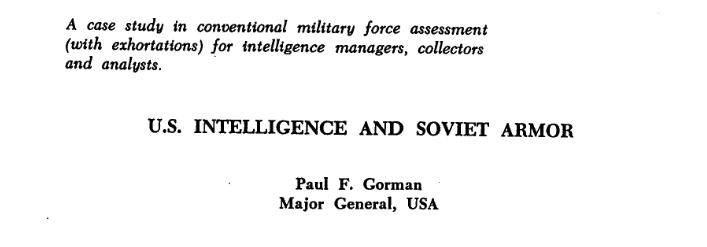
General Paul Gorman in a secret 1980 study that wasn’t declassified until 2014.
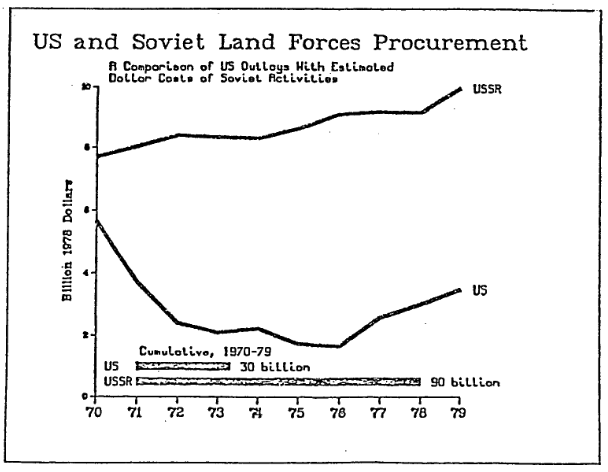
Throughout the Cold War, the United States accepted that its forces
in Europe would be outnumbered by a massive Soviet war machine that by
1980 comprised 50,000 tanks — or five times the American tank arsenal.
But U.S. leaders had always comforted themselves with the thought that
Soviet numbers could be offset by superior American technology, training
and tactics.
But by the end of the 1970s, when American military power had ebbed
to its post-Vietnam low, Pentagon planners worried that the Soviet Union
had achieved superiority in tank quality as well as quantity. In
particular, they warned that the new T-72 outclassed the M60A1 and M60A3
— essentially upgrades of the 1950s M48 Patton — that were the backbone
of the American tank arsenal at the time.
Even the first M1 Abrams tanks entering service — armed with the
105-millimeter cannon instead of the later 120-millimeter cannon — would
have difficulty knocking out the more heavily armed T-72.
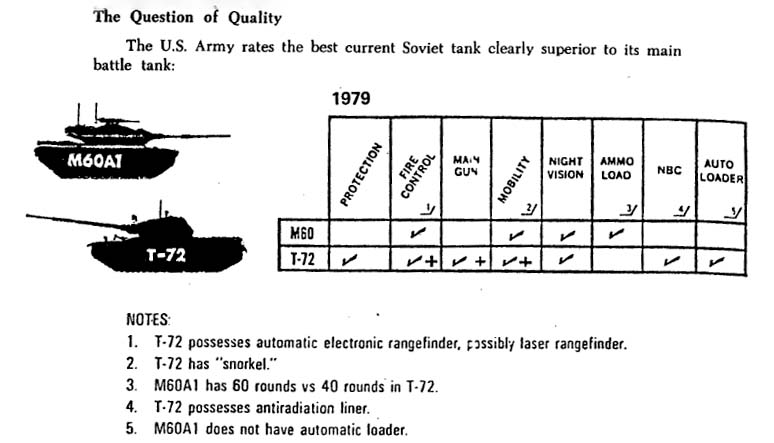
“The U.S. Army rates the best current Soviet tank clearly superior to its main battle tank,” the Army report warned.
It assessed the T-72 as superior to the M60A1 by virtue of superior
firepower and armor protection. The T-72 was also believed to have
numerous advanced features that the M60 lacked, including an “automatic electronic rangefinder, possibly laser rangefinder,”
an autoloader to increase rate of fire, a snorkel to cross rivers
without needing bridging equipment, and an anti-radiation liner to
protect the crew from nuclear weapons. The Army did at least credit the
M60 with carrying 60 rounds of main gun ammunition versus 40 for the
T-72.
Nor could salvation be found in the anti-tank guided missiles that
had begun entering service in the 1970s. Tests and mathematical modeling
by the Army’s Ballistic Research Laboratory estimated that U.S. TOW and
Dragon anti-tank missiles and the M-735 tungsten core round for the
105-millimeter cannon had a probability of kill (pK) as high as 77
percent against the front armor of a Soviet T-62 tank. But against the
T-72, that probability dropped to as low as 22 percent, with even the
upcoming M-774 depleted uranium round only having a 50 percent chance to
kill a T-72 according to the worst-case models.
T-72A tank from above
That meant defense against a tank-centric Soviet invasion of Europe
would be difficult until the 120-millimeter-armed M1 arrived in the
mid-1980s.
“Whether one uses informed U.S. or
Soviet calculations, the conclusion is that NATO can expect, through
1984, no advantage over the Soviets in quality of armor or antiarmor
weapons, and only a modest redressing of its present quantitative
disadvantage,” the study concluded.
XM1 Abrams prototype, 1979..
But were these dire predictions justified? It’s hard to be sure.
While U.S.- and Soviet-made armor did clash in the 1973 and 1982
Arab-Israeli wars, a climactic — and perhaps apocalyptic — battle
between American and Soviet armies never happened. Still, the
much-vaunted T-72 seemed more of a paper tiger in the 1982 Lebanon War,
when Israeli Merkava tanks armed with 105-millimeter guns disposed of them. And pitted against the Abrams in the First Gulf War, Iraqi T-72s seemed almost pitiful.
While Moscow could try to blame these debacles on the incompetency of
their allies, or the fact that they were using inferior export models
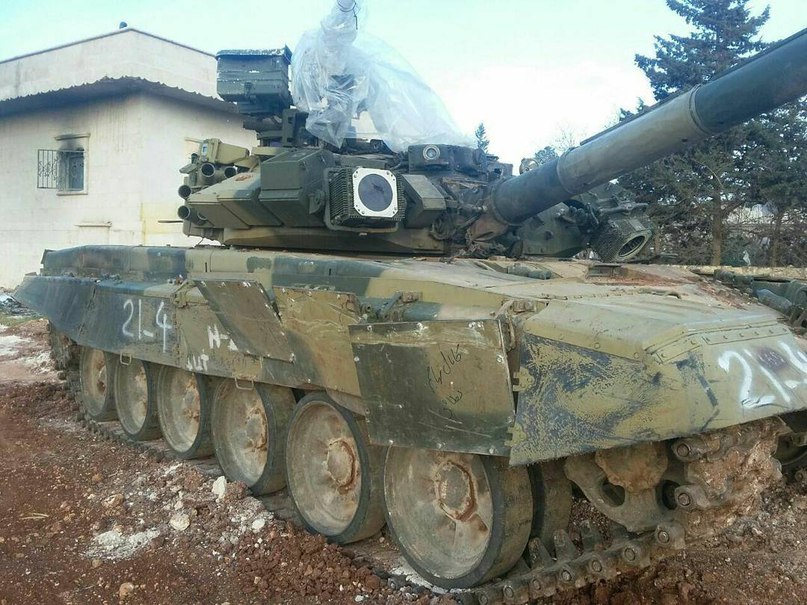
of Soviet equipment, that 1970s generation of T-72 tanks and MiG-23 fighters was not impressive in action. Even Syrian-manned T-90s may have been knocked out by U.S-made TOW anti-tank missiles supplied to Syrian rebels in 2016 and 2017.
Russian-sourced T-90 in Syria after being disabled by a TOW missile (Kremlin photo)
As the Nazis with their Tiger and Panther tanks could attest, merely having the most powerful tanks doesn’t guarantee victory. Well-trained crews, flexible command and control, reliable logistics, and plentiful airpower are more important than the thickness of a tank’s armor.
In the end, that 1980 U.S. Army study seems less about the
superiority of Soviet tanks, and more about the fact that U.S. tank
design atrophied between 1945 and 1980. With defense dollars and
priorities focused on nuclear weapons and chasing guerrillas through
Asian jungles, tanks had become far from the most vital component of
U.S. military power. It wasn’t until the M1 Abrams arrived in the 1980s
that the U.S. could claim to have a cutting-edge tank, and arguably the
best in the world. On the other hand, many Soviet tanks tended to
resemble the 1950s T-55 (itself descended from the World War II T-34),
which suggests that changes in tank design tend to be evolutionary
rather than revolutionary.
Mark IV tank, World War I.
Nonetheless, compare a Little Willie tank
from World War I to an Abrams, and it’s obvious that tanks do change as
technology progresses. Tanks inevitably change just as warfare does,
and just as inevitable are the cries that the enemy’s tanks are
superior. Fears that the Soviets had better tanks in 1980 are echoed
today by warnings that the M1 and other Western tanks are inferior to
the T-14 Armata,
with its active protection system to shoot down anti-tank rockets,
sophisticated sensors and data networking, and powerful 125-mm cannon
housed in an unmanned turret while the crew remains safely cocooned
inside the thickly armored hull.
For its part, the U.S. and other nations are developing new designs
as well. The U.S. Army, for example, wants a family of armored vehicles
that will include robot tanks. France and Germany are exploring a joint European tank that might feature a 140-millimeter cannon.
No doubt there will be Russian experts that will claim their tanks
are inferior with these platforms enter service — and demand that the
Kremlin fund the design of newer, better models (regardless of whether
the T-14 has even entered production yet).
I snagged this from "We are the Mighty", I thought it was pretty good.
It’s no secret that movies get a lot wrong about firearms and the
ways they’re used in a fight. From every 80’s protagonist refusing to
shoulder their rifles when they fire, to the seemingly infinite magazine
capacity in every hero’s gun, filmmakers have long prized what looks coolover what’s actually possible
in their work, and to be honest, it’s hard to blame them. After all,
diving sideways while firing pistols from each hand does look pretty
badass, even if it’s just about the dumbest thing someone could do in a
firefight.
There are, of course, exceptions to the rule when it comes to
Hollywood’s depictions of firefights–movies that manage to offer a
realistic representation of how armed conflicts actually play out while
still giving the audience something to get excited about. These movies
may not be realistic from end to end, but each offers at least one firefight that was realistic enough to get even highly trained warfighters to inch up toward the edges of their seats.
1. Delta’s time to shine: “Sicario”
The border scene in 2015’s Sicario is worthy of study from multiple
angles: as an exercise in film making, this scene puts on a clinic in
tension building, and although some elements of the circumstances may
not be entirely realistic, the way in which the ensuing firefight plays
out offers a concise and brutal introduction to the capabilities boasted
by the sorts of men that find their way onto an elite team like Delta.
Unlike the Chuck Norris depictions of Delta from the past, these men
are short on words and heavy on action, using their skill sets to not
only neutralize opponents, but to keep the situation as contained as
possible. The tense lead up and rapid conclusion leaves the viewer with
the same sense of continued stress even after the shooting stops that
anyone who has ever been in a fight can relate to, despite the operators
themselves who are seemingly unphased. As real special operators will
often attest, it’s less about being unphased and more about getting the
job done–but to the rest of us mere mortals, it looks pretty much the
same.
2. The Gold Standard: “Saving Private Ryan”
When “Saving Private Ryan” premiered in 1998, I distinctly recall my
parents returning home early from their long-planned date night. My
father, a Vietnam veteran that had long struggled with elements of his
service had been excited about the new Tom Hanks, Steven Spielberg
wartime epic, but found the opening scene depicting the graphic reality
of the Normandy invasion of World War II to be too realistic
to handle. My dad, who never spoke of his time deployed, chose to leave
the theater and spent the rest of the evening sitting quietly in his
room.
This list is, in spirit, a celebration of realism in cinema, but
realism has a weight to it, and sometimes, that weight can feel too heavy
to manage. A number of veterans have echoed my father’s sentiments
about the film (he did eventually watch it at home by himself), calling
that opening sequence, often heralded as a masterpiece of film making,
one of the hardest scenes they’ve ever managed to watch.
3. Val Kilmer helps train Green Berets: “Heat”
The dramatic ten-minute shootout in “Heat” has become legendary in
Hollywood for good reason. For six weeks, the film’s production team
closed down parts of downtown Los Angeles every Saturday and Sunday to
turn the city into a war zone, and the actors came prepared to do their
parts. Production brought in real British SAS operatives to train the
actors in real combat tactics at the nearby L.A. County Sheriff’s combat
shooting ranges.
Legend has it that Val Kilmer took to the training so well that the
shot of him laying down fire in multiple directions and reloading his
weapon (without the scene cutting) has been shown at Fort Bragg as a
part of training for American Green Berets. Marines training at MCRD San
Diego have also been shown this firefight from “Heat” as a depiction of
how to effectively retreat under fire.
Owning an M1 Carbine is on my bucket list for owning a rifle, but the cost of a specimen is easily $1200 bucks for a decent unmolested version. I missed the boat I guess on owning one, unless I win the lottery, LOL
I ran across this article from the "Sandboxx", and it had rifles that I never heard of, and I thought it was a really cool"Snapshot of Time".
The M1 Carbine
is a legendary weapon that served our Soldiers, Marines, and Sailors
well throughout numerous conflicts, earning its place in the hearts of
many vets and historians alike. This handy little rifle came out of the Light Rifle Program
that began after Uncle Sam found the M1 Garand was too much gun for a
lot of troops. As a big, full-powered battle rifle, it worked well for
infantry but was cumbersome for truck drivers, artillerymen, radiomen,
and others. Thus, the desire for a light rifle reared its head.
In 1940, the United States launched the Light Rifle trials,
seeking a new weapon that was neither traditional battle rifle nor
submachine gun. The Army demanded a platform that offered more range,
accuracy, and firepower than a handgun while weighing half as much as
the M1 rifle and famed Thompson SMG. In order to make those demands a
reality, the effort also led to the development of the 30 Carbine round
by Winchester. There were several rifles submitted, and oddly enough,
the M1 Carbine wasn’t even a part of the program’s initial trials.
We’ve talked about the M1 Carbine at length before, and you can read all about it in our full feature here. So now, let’s look at the light rifles that couldhave been if the M1 hadn’t won the day.
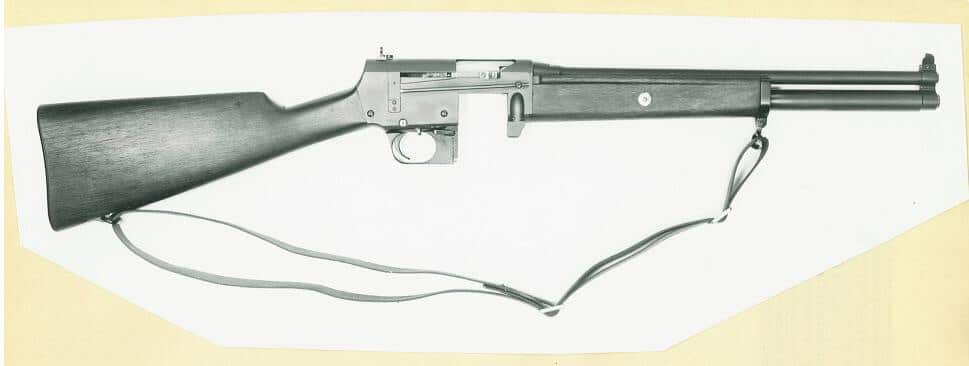
Two Auto-Ordnance carbines were made for the light rifle trials. Both
used the same core design, but the second rifle had a number of
improvements added after the initial trials. These weapons utilized a
short recoil system that’s rather interesting and require a slight
rearward movement of the barrel to function.
Auto-Ordnance designed five-round and thirty-round removable
magazines for the weapon. The barrel was a short 15.6 inches, and the
overall length was only 35 inches.
The first tests destroyed the rifle, and Auto-Ordnance
rebuilt the gun into the second model. The second model featured
selective fire, an optional compensated barrel, and a magazine that
would auto eject when the weapon fired the last round.
The Auto-Ordnance carbine was deemed too complicated for service,
with too many small parts and too many major reliability issues that
couldn’t be resolved.
Thompson Carbine
Another model submitted by Auto-Ordnance was a model of the Thompson
chambered in 30 Carbine. This delayed blowback weapon offered
selective-fire capability and was fed from 20 or 30 round magazines.
The only major differences between the carbine and famed Thompson
Submachine Gun were a quick change barrel, reduced weight, and an
in-line stock.
This weapon performed well and even outperformed the M1 Carbine in accuracy and reliability.
However, this light rifle wasn’t so light. In fact, it was rather
hefty and didn’t meet the weight standards set by the U.S. Army. Plus,
like the Thompson SMG, the price was high for production. Thus, the
weapon didn’t become America’s light rifle.
The Garand Carbine
John Garand, of M1 Garand fame, also designed his own light rifle.
This gas-operated gun was remarkably light at 4.91 pounds and utilized
an 18-inch barrel. The overall length was 34.9 inches, and the weapon
used 5, 20, or 50 round detachable magazines.
Those magazines are mounted to the top of the rifle at an offset
45-degree angle, which forced the iron sights to be offset, and the
charging handle was positioned across the top.
The only benefit this design could offer would be the ability to
obtain a much lower profile when firing from the prone position.
The weapon performed admirably, but the tester didn’t like the
magazine placement. Garand and Springfield revamped the weapon into a
more conventional layout, but the weapon was found to be insufficient at
the end of testing.
Hyde-Bendix
George Hyde designed the Hyde-Bendix rifle. His little carbine was
gas-operated and weighed 5.3 pounds and 33.6 inches long overall. The
rifle performed well and was decently accurate. However, the weapon had a
few flaws, including the need for a stronger operating spring. It was
thought to be simple, however, and functioned well in austere
environments.
Hyde took the weapon back to the factory and made some changes. This
included ditching the pistol grip and swapping out some internal
components… but the newer model proved inferior in function in just
about every way. Heck, it was even heavier. Thus, the Hyde-Bendix rifle
languished.
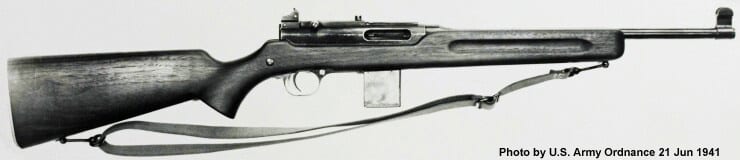
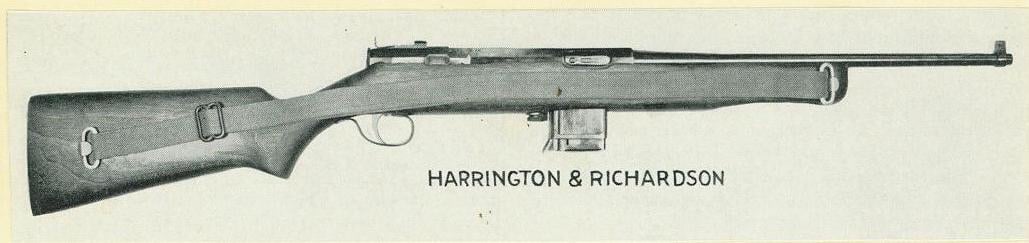
The H&R Light Rifle came from the mind of Eugene Reising. Reising
had great ideas, but often, they were ideas the world simply wasn’t
ready for. He designed the M50 submachine gun, and his Light Rifle was
just the M50 turned into a 30 carbine. The M50 Reising, however, kind of
sucked, and so did the H&R Light Rifle. The first gun used a
delayed blowback system taken directly from the old M50.
H&R’s Light Rifle proved to be accurate and simplistic, but
suffered from bad magazines, ruptured cases, and other issues. H&R
redesigned the weapon to be gas-operated, which helped solve some
problems. However, it never became as reliable as the army needed it to
be.
The Savage Carbine
In the 1940s, Savage did well in the arms industry, and the Savage
carbine got sent to the Light Rifle trials. This short recoil-operated
rifle is mixed with a rotating bolt to provide a novel operating system.
It weighed just 5.45 pounds and utilized a 16-inch barrel with an
overall length of 33 ⅜ inches. Magazine capacities ranged from 5 to 20
rounds in box magazines and 50 round in drums.
The Savage carbine didn’t last long. After 2,882 rounds, the rifle
cracked at the breech. Savage did not receive a second solicitation as
the Army found their carbine too complex with too many small parts.
Turner Carbine
Most of these guns resemble a standard wood stock rifle, maybe a
Thomspon, but the Turner was something else entirely. It looked more
like the inexpensive British Sten gun than any of its competitors. The
Turner Carbine lacked any wooden furniture and wore a perforated metal
handguard and wooden wire stock with a leather butt pad, which would
have made it light and inexpensive to produce.
It turned out big army wasn’t ready for it and requested a more
traditional rifle with a wooden stock. Turner obliged and sent a second
model.
Body guns used a long-stroke gas piston system that acts on a titling
bolt that locks to the side of the receiver. The back of the weapon
featured an Allen screw that allowed the selection of semi and full-auto
modes.
The first variant was thought to be average and rather reliable.
However, the all-metal stock and perforated handguard didn’t inspire
great ergonomics. The second variant proved to be extremely unreliable
and of much lower quality, earning it the ax as well.
Woodhull Carbine
Cute describes the Woodhull light rifle well. In a lot of ways, it
looks like a shrunk-down Browning Automatic Rifle. The big wooden
handguard, the square receiver, and wood stock have that BAR look. In
reality, the Woodhull, made by Frank Woodhull, copied the Winchester
Model 1905. His rifle was 29.8 inches long with a 17.3-inch long barrel,
and the weapon weighed 5.5 pounds.
The Woodhull used a crude and simplistic direct blowback design that
relied purely on the weight of its heavy bolt to keep the breech closed
until the weapon could safely cycle. The requirement for selective fire
had Woodhull install a slot that needed a key to switch from safe to
full auto.
The Woodhull carbine never performed reliably. Even a second variant was submitted, and still, the rifle remained unreliable.
The Light Rifle
The Light Rifle trials ended without a winner. However, the
information from the trials would later have the Army and Winchester
work together to develop what we now know as the M1 Carbine.
Winchester’s rifle was placed against the other competitors and
performed well. Some outperformed the M1, but they were usually too
complicated or too expensive.
The M1 Carbine, on the other hand, checked all the boxes for Army use
and would go on to become an absolute legend. And like most legendary
weapons, it sent a fair number of challengers to scrap heap along the
way
I got this link from Jordan Palka, the information is compliments of "Sportsman's Warehouse" I get nothing out of this, but I figured the information might be useful for my readers.
Rifle Recoil Table
A Guide to Rifle Recoil Energy, Velocity and Level
Recoil (often referred to as "kick") is the force a
rifle exerts against the shooter when it is fired. As a rule of thumb,
the heavier a rifle the lower the recoil. However, perceived recoil --
what the shooter feels -- is influenced by several factors including the
powder load, bullet mass, projectile speed and stock shape. Recoil is
measured by free recoil energy, and recoil velocity. Selecting the
correct rifle and cartridge combination ensures that a shooter can shoot
accurately without discomfort.
Rifle recoil not only impacts how accurately you
shoot, it can also determine how many shots you can shoot in a day, and
simply how much you enjoy using your rifle. You’ll want a lower recoil
rifle for shooting practice, so that you can shoot for longer periods of
time. You’ll also want lower recoil when you’re hunting over long days.
If you’re hunting game where you’ll just need one well-placed shot, and
you’re able to maintain your aim through the heavier recoil, a more
powerful rifle with heavy recoil may be right for you.
The following chart provides a rifle's recoil level based on its recoil score*.
Recoil Score*
Recoil Level
1-2
Low Recoil
3-4
Moderate Recoil
5-10
High Recoil
The following table provides rifle recoil energy,
recoil velocity and recoil score of various rifle cartridges based on
respective projectile weight, projectile velocity, powder charge and
rifle weight.
*Recoil score is calculated as a
function of recoil energy and recoil velocity using a weight average
which is then normalized between 1-10. See below for a detailed
explanation. Recoil energy and recoil velocity figures are taken from
various sources including the recoil nomograph in the Handloader's
Digest 8th Edition, online recoil calculators, or calculated from the
formula provided in the Lyman Reloading Handbook, 43rd Edition.
Calculating Rifle Recoil
We're all familiar with Newton's third law which
states for every action there is an equal and opposite reaction.
Newton's third law explains why when you shoot a gun it kicks. The
bullet explosion exerts an incidental force on the gun which in turn
transfers a reciprocal force onto the shoulder. Mathematically, this
relationship is explained by the equation F(i) = -F(r), where F(i)
represents the 'incident force' (bullet force on the gun) and -F(r)
represents the 'reciprocal force' (gun force on shoulder). This force is
referred to as Recoil, or in industry vernacular "kick". How much kick a
rifle generates when discharged is a function of two measurements:
Recoil Energy and Recoil Velocity.
Recoil Energy
Recoil energy is the kinetic energy transferred to
the shooter when a gun is discharged. It's the propulsive force
generated when the powder charge within a firearm chamber combusts.
Recoil energy is measured in Joules (J) but is more commonly expressed
in foot-pounds of force (ft-lbf). Recoil energy is sometimes referred to
as "free recoil". While similar, the two terms are different. Recoil
energy is the measurement of gross energy produced by the discharge of a
firearm. Free recoil is the measurement of net energy produced by the
discharge of a firearm--or gross energy less recoil energy loss due to
various energy transferring inhibitors such as recoil reducing butt pad;
muzzle break; recoil suppression tube; recoil operated action vs gas
operated action; etc. In other words, free recoil energy is the actual
energy absorbed by the body of the shooter.
Each shooter perceives free recoil energy slightly
different. Some of the factors that influence perceived recoil energy
include but are not limited to: size of the shooter; shooting style and
position; suppression equipment (as previously mentioned); firearm fit;
and other environmental stressors. For example, a 240lb muscular man is
not going to experience the same amount of perceived recoil energy when
shooting a .30-06 Springfield rifle as will a 130lb woman with a smaller
body frame and structure. This isn't because the woman is not as strong
as the man, but simply because the same energy transfer is being met by
the man's greater mass.
Rifle weight is also a very important factor in
determining and managing free recoil. Rifle weight is inversely
proportional to a rifle's recoil. All things being equal, the heavier
the rifle the lower the free recoil energy. Inversely, the lighter the
rifle, the greater the free recoil energy. Therefore, rifles that shoot
heavier rounds are typically manufactured with more weight. If you
purchase a lightweight rifle that shoots heavier rounds, expect it to
pack a punch.
Recoil Velocity
Where recoil energy determines how big of a punch the
shoulder will feel, recoil velocity determines how abrupt of a punch
the shoulder feels. Recoil velocity is the speed at which the stock of
the rifle impacts your shoulder. A rifle that produces high recoil
energy, but low recoil velocity, is going to pack a large slow punch.
Inversely, a rifle that produces low recoil energy, but high recoil
velocity, is going to pack a small fast punch. Recoil velocity is
measured in feet per second (fps).
Recoil Score
If you've never shot a rifle before, or have limited
experience shooting rifles, it can be difficult to conceptualize based
on Recoil Velocity and Recoil Energy measurements alone what it's going
to feel like to shoot a particular rifle. In our opinion, rifles that
generated over 20 lbs of recoil energy when discharged may cause
shooters to develop a sore shoulder. A maximum 15 lbs of recoil energy
and 10 fps recoil velocity is probably the most an average shooter can
comfortably handle for long-term hunting or target shooting. However,
it's the combination of both recoil energy and recoil velocity that
generate the overall impact a shooter feels when shooting a rifle.
Recoil score combines recoil energy and recoil
velocity measurements into a single value. While rifle recoil scores are
subjective, they are useful for gauging the perceived "kick" of one
rifle relative to another. If you've ever shot a .257 Roberts with a
recoil score of 2.37 (low recoil) it's easy to conceptualize how it will
feel to shoot a .338 Lapua Magnum with a recoil score of 5.24 (high
recoil).
Recoil level is calculated as a function of the
weighted average of recoil energy and recoil velocity at a ratio of 7:3,
respectively, to generate a recoil score. The recoil score is then
normalized between 1 and 10 using the normalization equation
xnormalized=(b−a)*((x−min(x)/max(x)−min(x))+a where xnormalized denotes
the measurement to be scaled, min(x) denotes the minimum of the range of
the measurement, max(x) denotes the maximum of the range of the
measurement, b denotes the highest value and a denotes the lowest value.
Recoil level is than assigned on a scale from 1-10 with ranges of 1-2
(low recoil), 3-4 (moderate recoil) and 5-10 (high recoil).
Disclaimer: Sportsman's
Warehouse assumes no responsibility or liability for any errors or
omissions of the information on this page. Although we strive to provide
the most accurate information as we can the information contained in
this page is provided on an "as is" basis with no guarantees of
completeness, accuracy, usefulness or timeliness. There are many
quantitative and qualitative factors that influence rifle recoil and how
it impacts the individual shooter. Do not use this guide as a basis for
purchasing a rifle. It is design for informational purposes only.