Webster

The Constitution was made to guard the people against the dangers of good intentions." --American Statesman Daniel Webster (1782-1852)


Tuesday, February 14, 2023

"The Next Generation Squad Weapons System for the U.S. Army"

 I snagged this off "American Rifleman".  I was wondering what the Army was going to do, I knew that the proliferation of body armor was a concern. The Ballistic properties of the 5.56X45 round has problems with body armor (or hopped up skinnies on Khat, but that is another story).  I personally like the M16 pattern rifles, I carried them into battle and trust it, but I am not blind to the weakness of the caliber.  Well Apparently the Army is trying to get ahead of it for a change and I hope the ordinance dept does a better job with this than they did with the "Initial M16 Rollout".  Only time will tell how it goes.

soldier with rifle

The U.S. Army’s latest multi-billion-dollar, high-tech small arms program is moving forward and, and it represents nothing less than an entirely new direction in U.S. military small arms development.

In April of last year, the Army announced that it had selected the winners of the Next Generation Squad Weapon (NGSW) competition: an infantry rifle and a light machine gun, along with a new cartridge and optical system that the pair would share. The news sent shock waves through the firearm and defense communities.

“We should know that this is the first time in our lifetime, the first time in 65 years, that the Army will field a new weapon system of this nature—a rifle, an automatic rifle, a fire-control system and a new caliber family of ammunition,” said Brig. Gen. Larry Burris, the Soldier Lethality Cross-Functional Team Director, at a press conference for the selection. Then, for emphasis, he added, “This is revolutionary.” For those of us in the civilian world, the announcement prompted questions about how and why our tax dollars are being spent.

The Problem
Two decades of constant combat usage of the U.S. military’s small arms have exposed some deficiencies in the current inventory. These include the effective range of the 5.56 NATO cartridge, the ability of M16-derived systems to deliver suppressive fire, the need for modularity to accommodate modern accessories and the weight that small arms systems add to an already-burdened soldier. The search for solutions to these problems are defined by a defense industry buzzword and a catchphrase: “overmatch” and “near-peer adversaries.” Overmatch is the ability to outperform the range, accuracy and lethality of the weapons used by the enemy of an advanced military with capabilities similar to those of the United States, such as Russia and China, and such militaries are seen as near-peer adversaries (see p. 26).

While the 5.56 NATO has a similar effective range to the Russian 5.45x39 mm and Chinese 5.8x42 mm cartridges (approximately 500 meters), that range would have to be extended for “overmatch.” Additionally, many arms that U.S. soldiers have often found themselves facing use the 7.62x54 mm R cartridge, as fired by PSL and SVD rifles and the PK series of medium machine guns, which have an effective range of approximately 800 meters.

Another factor determining the next cartridge’s performance is the fact that, during the past decade, ballistic body armor technology has improved and is less costly, making it possible for near-peer adversaries to equip their entire front-line forces with protection against conventional projectiles. Additionally, the U.S. military is increasingly encountering body armor in the hands of irregular forces and terrorists.

In 2017, retired Maj. Gen. Robert H. Scales stated the problem succinctly to the Senate Armed Services Committee: “Survival [on the modern battlefield] depends on the ability to deliver more killing power at longer ranges and with greater precision than the enemy.”

In response, the U.S. military has adopted limited numbers of extended-range specialty weapons, incrementally upgraded existing systems with “Product Improvement Programs” and improved ammunition with “Enhanced Performance Round” versions of both the 5.56 NATO and 7.62 NATO cartridges. But the limits of 75-year-old cartridge and arms designs have been reached. As Brig. Gen. William Boruff, Joint Program Executive Officer for Armaments and Ammunition, explained at the NGSW press conference, “the current 5.56 cartridge has been maxed out from the performance perspective.”
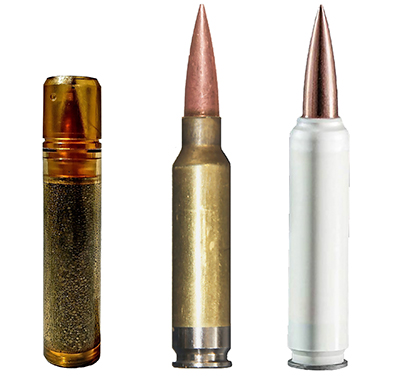
three cartridges considered for the NGSW program
The three cartridges considered for the NGSW program are exemplified by (l. to r.): a cased telescoped round by Textron; a hybrid-case round by SIG Sauer; and a composite-case round by True Velocity. All three were designed to fire the same copper-jacketed 6.8 mm bullet.

The History
From the conclusion of World War II, the U.S. military has sought solutions for increased lethality, greater hit probability and a lighter combat load in its small arms. When the Army announced the NGSW program in 2018, those who were skeptical that the effort would ever result in a finalized and adopted system were justified in their doubt. When the M16 was adopted in the early 1960s, the Army was already in the midst of a “future weapons” program—the Special Purpose Individual Weapon (SPIW). The SPIW program was an extension of Project SALVO, which itself was the result of the Army’s post-World War II analysis of how small arms were used by infantrymen in combat.

Its conclusion, which had already been reached by the Germans during the war, was that the most effective arm for an infantryman to carry was a fully-automatic rifle that fired an intermediate cartridge. The result was a compromise between the light weight and high volume of fire afforded by a submachine gun chambered in a pistol cartridge and the range, accuracy and ballistic payload of a full-size battle rifle. The groundbreaking Sturmgewehr” design was quickly matched post-war by the Soviet Kalashnikov, and the rest of the world was left scrambling to update their arsenals.

Project SALVO worked on the idea that hit probability was increased by the greater number of projectiles you could throw at a target, essentially making a rifle into a long-range shotgun. The search for a lightweight “Small Caliber, High Velocity” rifle led to the adoption of the M16. The SPIW program sought to develop an arm that combined a grenade launcher with a rifle firing small, arrow-like “flechette” projectiles. It was abandoned in the early 1970s, and the M16 soldiered on.

By 1972, the Army was also looking for an arm that could cover the ground between the M16 and the M60 with the Squad Automatic Weapons (SAW) program. The program centered upon a new SAW-specific cartridge firing a 135-grain 6 mm bullet that gave a ballistic performance between the 5.56 mm and the 7.62 mm. While the Army eventually adopted the FN Minimi as the M249, it stuck with using the 5.56 NATO cartridge.

Soon after the M16A2 was adopted, in 1986, the Army began the Advanced Combat Rifle (ACR) program, the goal of which was once again to produce an arm that would increase hit probability on the battlefield. Many of the innovations developed during the SPIW program were examined again, including flechette rounds, duplex projectile loads and burst fire, along with new innovations such as polymer-case telescoping ammunition, caseless molded-propellant cartridges and the advantages provided by sound suppression and optical sighting systems. As no ACR candidate could provide “an enhancement in hit probability of at least 100 percent at combat ranges” over the M16, the program was canceled.

By the 1990s, the newest effort to replace the M16 was the Objective Individual Combat Weapon (OICW) program. The resulting arm combined a 5.56 NATO-firing rifle and a semi-automatic grenade launcher with a computer-assisted sighting system firing air-burst munitions, but it did not result in a practical design. An offshoot of this program was the further development of the Heckler & Koch G36-derived XM8, which was also eventually canceled.

The search for more effective small arms continued into the 21st century. In 2004, the Lightweight Small Arms Technologies (LSAT) program was formed to investigate polymer-case and caseless ammunition technologies. The program also developed a light machine gun prototype to replace the M249. An Individual Carbine competition seeking a replacement for the M4 ran from 2010 to 2014, but it ended without selecting a replacement. Ditto for the Interim Combat Service Rifle program. The M16 and its derivatives, it seemed, were here to stay.
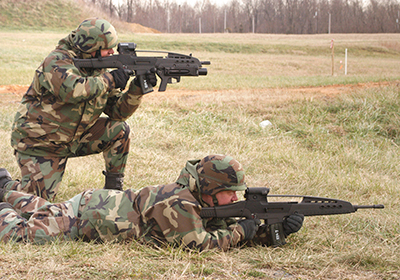
XM8 prototype
Since the adoption of the M16, the Army has sought a replacement. Pictured is testing of the XM8 prototype in the early 2000s.

The NGSW Competition
In many ways, the NGSW program was a ballistics-centric endeavor. Brigadier General Boruff summarized the purpose of the program when he stated it was, “all about energy on target and the longer ranges.” The Army knew the performance it wanted and sought an integrated system of a cartridge that provided those required ballistics, an arm to fire it and a sighting system that would give the average soldier the ability to utilize both to their maximum potential.

The Next Generation Squad Weapons program sought to select a new cartridge, a rifle (NGSW-R) and light machine gun or “automatic rifle” (NGSW-AR) to fire it and a “fire control” optical sighting system (NGSW-FC). Beginning in 2017, the requirements for the systems were announced. These stipulated the allowable size and weight of the new firearms and that they were to fire a cartridge of the submitting competitors’ own design that used a specific 6.8 mm bullet. The arm and cartridge combination were to be effective to 800+ meters. Initial competitors included Desert Tech, MARS/Cobalt Kinetic, FN America, General Dynamics, Textron and SIG Sauer.

The NGSW selection demonstrated a new process of developing, testing and adopting new technology with the Army’s use of “Cross-Functional Teams.” Each weapons system was given a “touch point” analysis by individual soldiers, with more than 1,000 soldiers providing 20,000 hours of feedback. In the Army’s estimation, the NGSW program condensed a process that would typically take eight to 10 years into 27 months.

In August 2019, the selection of three firearm finalists were announced. General Dynamics (its efforts were later taken over by Lonestar Future Weapons Systems) submitted a magazine-fed bullpup design for both the rifle and automatic rifle. The company partnered with Beretta for the design, which used the bullpup layout to incorporate a 20" barrel in a firearm that would yield the ballistics the Army sought at a reasonable pressure, yet maintain an overall length less than the current M4. They partnered with True Velocity ammunition to develop a composite-case cartridge of conventional shape made of polymer and a steel base.

Textron, which had worked with the Army on its LSAT program, submitted a magazine-fed rifle and belt-fed automatic rifle of conventional layout. It partnered with H&K on the firearms’ designs, Winchester Ammunition on the ammunition and Lewis Machine & Tool for the suppressor. Its cartridge featured a “cased telescoped” design, meaning the entire bullet is contained inside a polymer case, which results in reduced weight and overall length.

The last candidates were submitted by SIG Sauer, which ultimately was awarded a 10-year, indefinite-delivery, indefinite-quantity contract capped at $4.7 billion. The initial phase is a $20.4 million dollar contract to provide 25 XM5s and 15 XM250s, along with ammunition, for further development. Eventually, the Army expects to procure 107,000 XM5 rifles and 13,000 XM250 automatic rifles. SIG’s submissions are described below; although note that the components of the NGSW program are still being developed, so the specifications and capabilities stated below are subject to change.
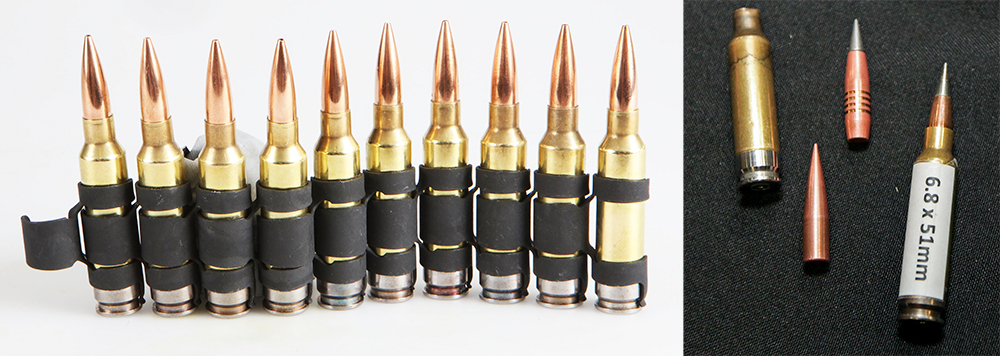
disintegrating-link belt, armor-piercing bullet
The XM250 automatic rifle feeds from a disintegrating-link belt (l.). The 6.8 mm Common Cartridge with its solid copper training/close-range bullet and its armor-piercing bullet (r.) was on display at the Association of the United States Army exposition in October 2022 in Washington, D.C.


The 6.8x51 mm Common Cartridge
As a result of several ballistics studies, the U.S. Army determined that a 6.8 mm-diameter (0.277 cal.) bullet with a weight of approximately 135 grains would be optimal for what it believes will be the conditions of the future battlefield. For the NGSW program, the Army produced a “General Purpose Projectile” that uses a hardened-steel penetrator with a copper jacket and core similar to the M855A1. It was provided to the competing manufacturers who were tasked with developing their own cartridge that used the projectile, met the Army’s ballistic requirements and weighed less than a 7.62 NATO cartridge.

The cartridge SIG developed for its winning NGSW firearms has been designated as the 6.8x51 mm Common Cartridge (CC). As can be inferred from the “51 mm” part of its designation, the cartridge’s case is the same length as the 7.62 NATO, necessitating an “AR-10”-size firearm platform. The case is almost the identical diameter as well, meaning that capacity in a box magazine is the same as the 7.62 NATO cartridge. While the Army hasn’t revealed the exact ballistic performance of the new cartridge, the 6.8 mm CC delivers more velocity than the M855A1 with a bullet more than twice as heavy. The Army claims that the new chambering is superior to both the 6.5 mm Creedmoor and 7.62 NATO at ranges up to 800 meters and that it can defeat Level III body armor with non-armor-piercing ammunition out to 600 meters.

The new cartridge is not to be confused with the 6.8 Remington SPC, another cartridge developed at the behest of the U.S. military. Designed in the early 2000s, the SPC has the same overall length as the 5.56 NATO, meaning that existing M4 and AR-15-type firearms could be adapted to use it.

Since defeating body armor comes down, in large part, to velocity, every effort was made to get the maximum performance out of the new cartridge. The result was a chambering that operates at very high pressure. The Sporting Arms and Ammunition Manufacturers’ Institute (SAAMI) specification for the cartridge is 80,000 p.s.i., or about 30 percent higher than the operating pressure of similar cartridges such as 7.62 NATO or 6.5 mm Creedmoor.
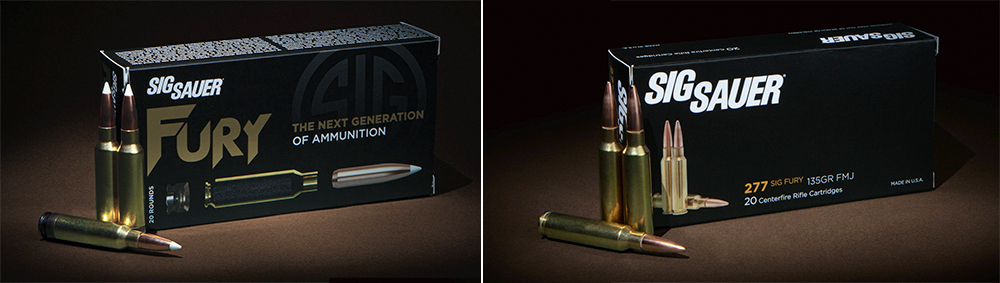
.277 Fury loads
Three .277 Fury loads are currently offered for the civilian market: conventional brass cartridge cases loaded with a 135-grain FMJ or soft-point bullet and hybrid-case cartridges with a 150-grain polymer-tip bullet.


When SAAMI certified the .277 Fury, the civilian version of the 6.8 mm CC cartridge, it included the warning that the cartridge, when loaded to pressures greater than 68,000 p.s.i., would “require cartridge case and/or firearms design that depart from traditional practices.” This is exactly what SIG did, developing a “hybrid” metal case for the cartridge. As the unsupported portion of a brass cartridge case that protrudes from the rear of the chamber and the primer pocket cannot handle these pressures, the SIG design uses a stainless-steel case head married to a brass case body. SIG claims the hybrid case design allows for an additional 350 f.p.s. in velocity over a conventional brass case.
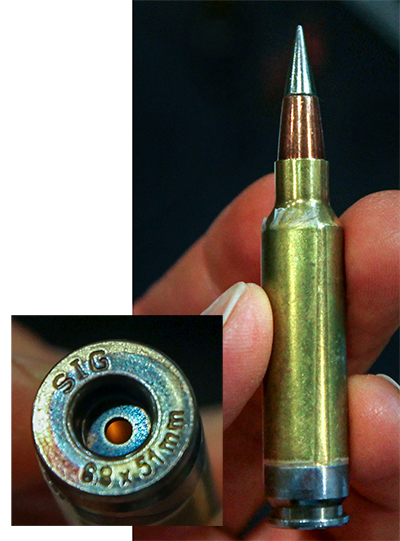
NGSW 6.8 mm Common Cartridge
The brass and stainless-steel hybrid case of the NGSW 6.8 mm Common Cartridge is designed to handle its 80,000 p.s.i. pressure.

In addition to its strength, steel is lighter than brass, so using it in what is the thickest part of the cartridge case keeps the overall weight of the loaded cartridge down. Though being nominally the same overall size, 6.8 mm CC weighs less than a 7.62 NATO cartridge.

The commercial .277 Fury launches a 150-grain bullet at 2,830 f.p.s. from a 16" barrel—or approximately the performance you’d expect from a .270 Win. fired from a 24" barrel. SIG also makes a reduced-power version of the .277 Fury cartridge that uses a conventional all-brass case and presumably operates at less than 68,000 p.s.i. The Army likewise plans to use a reduced-power version of the cartridge for training purposes and close-range combat scenarios where overpenetration is a risk.

SIG Sauer will be producing all of the Army’s 6.8 mm ammunition, using projectiles supplied by the Lake City Army Ammunition Plant, for the next few years. Lake City (a government-owned plant run by private contractor Winchester Ammunition) is building a new facility dedicated solely to producing the 6.8 mm CC ammunition that should be online by 2025 or 2026. By 2030, Lake City will take over as the lead producer of 6.8 ammunition. Lake City’s production of 5.56 NATO and 7.62 NATO will continue at current rates in the near future.
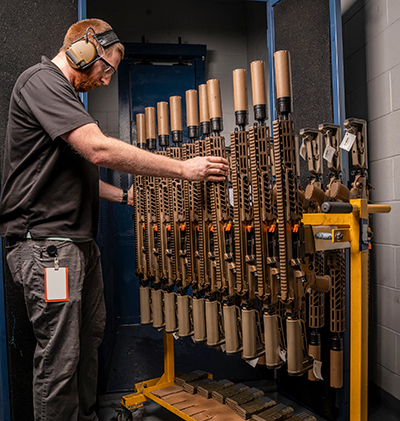
MCX-Spear rifles
Last year, SIG offered a limited run of MCX-Spear rifles for the civilian market in semi-automatic-only format.

XM5 Rifle
In many ways, SIG’s winning firearms were the most conventional NGSW choices. Its rifle prototype, adopted as the XM5, is based on the commercially available MCX, which combines features of the M16 with a short-stroke piston and recoil-spring system that mimics the AR-18. SIG had already scaled up the 5.56 mm MCX to AR-10 size to accommodate a .308 Win.-class cartridge with its MCX-MR, which was a competitor in the Army’s Compact Semi-Automatic Sniper System program.

The XM5’s controls are M16-style rendered bilaterally for full ambidextrous use. The magazine release, bolt release and safety selector are present on both sides of the rifle, along with a bilateral, AR-type, charging handle. Additionally, there is a second non-reciprocating charging handle positioned on the left side of the receiver. The rifle utilizes an M4-style forward-assist device and case deflector. While having a general M4 familiarity, the exterior of the XM5 is also updated. The aluminum-alloy handguard features M-Lok slots, and there are built-in push-button sling swivel sockets on the handguard and receiver.

The XM5 mechanism uses a multi-lug rotating bolt. Function is provided by a short-stroke gas piston with an adjustable gas regulator. The upper and lower receivers are made of aluminum alloy with steel inserts in high-wear locations. Because of the gas-piston design and recoil springs contained within the receiver, the XM5’s stock not only telescopes like an M4 but also folds to the left side, and the rifle can be fired with the stock folded. The barrel has a tapered heavy profile and is held in place by a clamping system that uses two Torx-head screws that allow it to be removed in the field. The rifle is supplied with a two-stage match trigger, uses SR-25-pattern magazines and is capable of both semi- and full-automatic fire.

The XM5 is designed to be used in conjunction with a suppressor. In 2021, the Marine Corps announced that it would be supplying all of its front-line personnel with suppressor-equipped arms, to both make communication on the battlefield easier and to prevent the long-term health effects of loud noise exposure, and the Army seems to be following that lead. The XM5’s suppressor is also made by SIG and is based on its SLX series developed for U.S. Special Operations. The backpressure that a suppressor adds to a firearm can result in increased gases directed back at the shooter. The XM5’s suppressor is engineered to have a “flow-through” design that yields “low toxic fume blowback,” and SIG claims that using the suppressor results in no additional gas being expelled through the rifle’s ejection port. The suppressor is mounted by threading onto the XM5’s muzzle device and is held in place with a locking ring. Due to suppressor usage, the XM5’s 13" barrel keeps the conventionally laid out rifle as compact as possible. With the suppressor installed, the XM5’s overall length is 36", and it weighs 9 lbs., 14 ozs. There is no provision for mounting a bayonet.
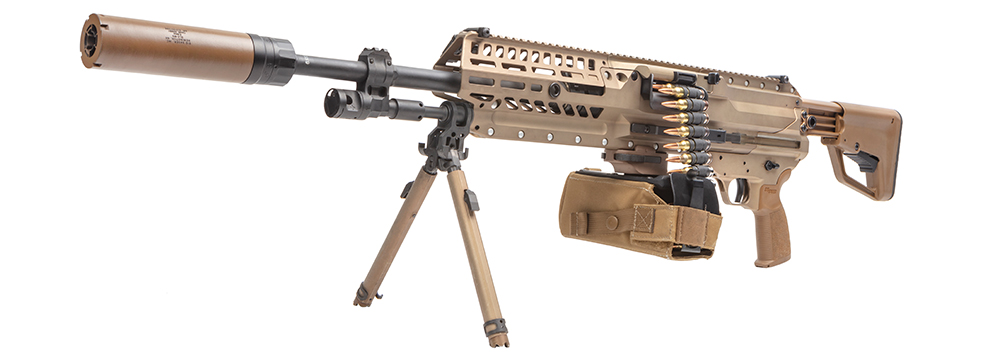
XM250
The XM250 is designed to be used with a suppressor. It feeds from 100-round disintegrating link belts housed in a polymer and canvas pouch that mounts below the receiver.


XM250 Automatic Rifle
 
SIG’s winning automatic rifle design is based on the company’s MG 338, a belt-fed .338 Norma Mag.-chambered machine gun designed for U.S. Special Operations. The XM250 is an air-cooled, belt-fed design that fires from an open bolt. The action is gas-operated with a short-stroke gas piston system and is capable of both semi-automatic and fully-automatic fire. Its rate of fire is between 650 and 750 rounds per minute, depending on the ammunition used.

While SIG has been tight-lipped about the internal features of the XM250, some design features can be inferred from details found in the company’s machine gun patent applications. The XM250 uses the recoil-mitigation system of its .338 big brother, where the rotating bolt operates within a “barrel extension” that is fixed to the barrel and recoils within the outer receiver, with the bolt and barrel extension using separate recoil springs. SIG claims the XM250’s felt recoil is less than an M4. Although the XM250’s 16" barrel is quick-change with the rotation of a collar, unlike the M249 it is not designed to be swapped under combat conditions. The XM250’s barrel-retaining system makes it field-adaptable for other cartridges in the 7.62 NATO class.

The XM250 is fed from 100-round disintegrating-link belts. The belts are housed in a polymer and canvas box that attaches below the gun with a “mag well” connection. Belts can be loaded into the gun whether the bolt is forward or back, in either safe or fire mode and with the feed tray open or closed. Unlike the M249, there is no provision that allows for the use of a detachable box magazine. The XM250 uses a left-side charging handle and has bilateral safety selector switches.

On the top of its receiver and handguard, the XM250 has a full-length Picatinny rail. It uses a feed tray cover that opens to the side to allow for mounting of optical systems without interference when the feed tray is open. Designed to be used with optics, the XM250 also has a set of offset back-up iron sights. The handguard features M-Lok slots, and the XM250’s bipod is made out of titanium to further save weight. The buttstock telescopes to multiple positions to adjust length of pull.

The XM250 is designed to use the same suppressor system as the XM5. Despite its visual bulk, the XM250 with bipod and suppressor weighs 3 lbs., 8 ozs., less than the M249 and is 13 lbs. lighter than the 7.62 NATO M240B. The size and weight of the XM250, along with its ability to fire semi-automatically, suggest that it could be used as a “rifle” in close-quarters engagements or, when combined with the new magnified optic, as a more precise “Designated Marksman Rifle” at longer ranges.
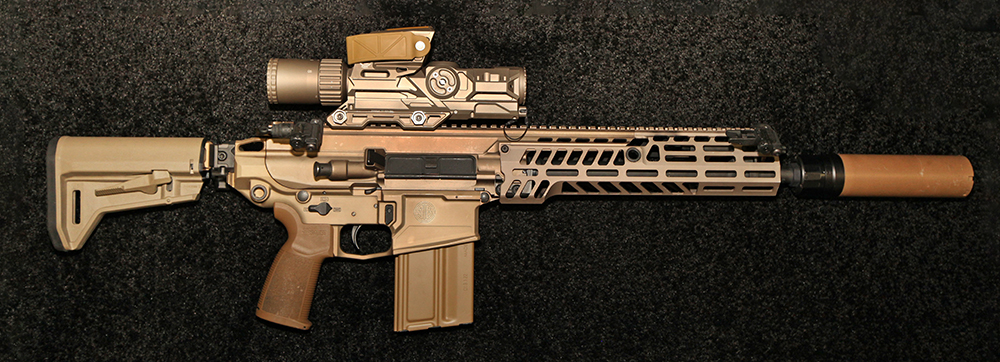
XM5 rifle
Shown atop an XM5 rifle at the AUSA expo in October 2022 in Washington, D.C., the XM157 Fire Control System, produced by Vortex, is a 1-8X riflescope with electronics that can take into account factors such as wind, elevation, inclination and range.


XM157 Fire Control System
The competition for an optical sight, or “Fire Control System,” included submissions from Vortex Optics and L3Harris (the former parent company of EOTech). The winner was Vortex’s offering, which was designated as the XM157.

The Fire Control System is the part of the NGSW program that represents the most radical leap forward in technology and capability. At the heart of the XM157 “Smart Optic” is a conventional 1-8X LPVO (low power variable optic) riflescope with a 30 mm objective lens and etched reticle that can operate without battery power. The “smart” side of the XM157 is information that can be projected as a digital Active Reticle onto a see-through display in the scope’s first focal plane. This allows for a customizable display that can include such information as ballistic drop or wind holds. The system has a built-in laser rangefinder and can compute other environmental factors, such as temperature, elevation, inclination and declination. This information is computed in real time by a unit that sits on top of the main scope’s body and adjusts the digital reticle accordingly. In addition to the rangefinder laser, the unit also contains visible and infrared aiming lasers. Again, some hints at the system’s possible capabilities can be gleaned from recent Vortex patents, such as a system that would allow the optic to display the number of rounds remaining in the magazine of the arm to which it is attached or the ability to display a virtual target for dry-fire practice.

While the XM157 sounds complicated, its function is simple and user-friendly, with all functionality displays seen through the scope. The system has passed all mil-standard optics tests of temperature, water immersion, dust, drops, shock, etc., so it’s as rugged as it is high-tech.

The system is powered by two CR123A batteries that will power the unit for “weeks” according to Vortex. While the actual weight of the system has not been revealed, according to Vortex, it is less than the combination of a conventional LPVO and ballistic computing system (presumably less than 30 ozs.). The entire unit is “modular and upgradeable,” meaning that newer capabilities can be added in the future, such as “augmented reality” modes that will allow soldiers to tag target points and share them wirelessly to other soldiers’ optics systems.

The XM157 will be made entirely in America of U.S.-made components, including the lenses. Vortex is scheduled to supply 250,000 systems over the next decade at the cost of up to $2.7 billion. As is apparent from that quantity, the XM157 is intended to be used not only on NGSW weapons but also on “legacy” platforms, such as the M4.
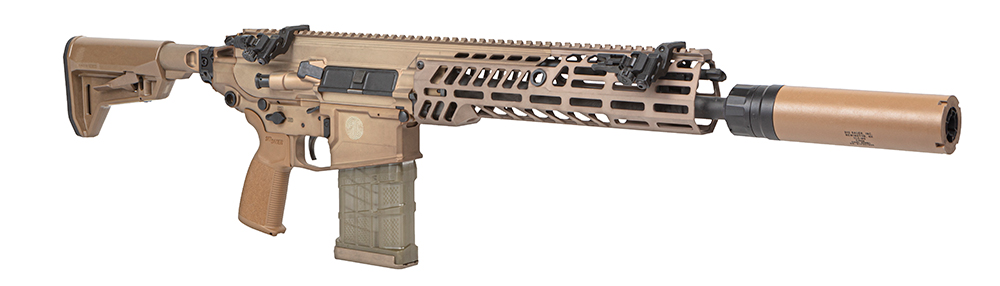
XM5 rifle
The XM5 rifle weighs 9 lbs., 13 ozs. with its suppressor mounted. Though equipped with offset backup iron sights, it is intended to be used with the XM157 optic.


The Reaction
Expectedly, the announcement that the Army was replacing the rifle and cartridge combination that it has used for more than half a century was met with a swift reaction. One of the first criticisms involved weight. When it comes to physics, there’s no free lunch. The Army’s ballistic needs required a cartridge larger than the 5.56 NATO and a weapon larger than an M4 to fire it. A loaded XM5 with the XM157 optic will weigh about 3 lbs., 4 ozs., more than a loaded M4A1 with an M68 optic. With a full combat load, the XM250 outweighs the M249 by about 3 lbs., 8 ozs., while carrying 200 fewer rounds.

This brings up the second criticism of a decreased round count and increased weight for a combat load. The larger diameter of the 6.8 mm cartridge means fewer rounds can be stacked in a magazine of similar size to the current 30-round M4 magazine. According to the Army, the XM5 basic combat load is seven, 20-round magazines, which weighs 9 lbs., 13 ozs., in total. For the XM250, the basic combat load is four 100-round pouches at 27 lbs., 1 oz. For comparison, the M4 carbine combat load, which is seven 30-round magazines, weighs 7 lbs., 6 ozs., and the M249 combat load is three 200-round pouches weighing 20 lbs., 14 ozs., in total. This would result in a real-world total combat weight of 21 lbs. for the XM5 and 43 lbs., 6 ozs., for the XM250, versus 15 lbs., 10 ozs., for the M4 and 39 lbs., 14 ozs., for the M249.

Based on these two points, many critics bring up the specter of the M14, a large and powerful rifle designed for the plains of Germany that found itself in the jungles of Vietnam. But the counterpoint is that the Next Generation Squad Weapons signal a shift in the Army’s small arms doctrine. In a way, the NGSW program is the antithesis of the post-World War II Project SALVO. Increased weight and decreased round count suggests that the Army expects the NGSW weapons and optics system to allow soldiers to eliminate their targets at longer ranges with fewer rounds. 
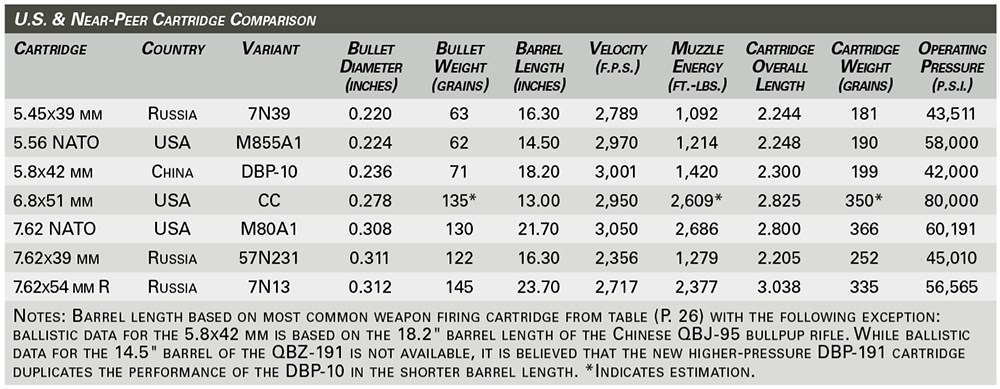
U.S. & Near-Peer Cartridge Comparison chart

Trickle Down
Military innovation eventually trickles down to the civilian world, and, in the case of the NGSW, it has already arrived. The .277 Fury cartridge has been introduced commercially in the SIG Cross bolt-action rifle. A limited-edition, semi-automatic-only version of the XM5, marketed as the MCX-Spear, has also been offered by SIG. In September, the company announced the MCX-Spear LT, a mid-size platform based on the XM5 offered in 5.56 NATO, .300 Blackout and 7.62x39 mm in rifle, short-barreled rifle and pistol configurations.

Innovations that did not win the NGSW competition have also made their way to the civilian world. This spring, SAAMI certified its first composite-case ammunition manufactured by True Velocity. Currently available in .308 Win., there are plans for the company to commercially release 6.5 mm Creedmoor and 5.56 NATO composite-case cartridges in the near future.

Looking Forward
The NGSW weapons are scheduled to complete their operational test by the third quarter of 2023, with the first Army units equipped with the new firearms in the fourth quarter of that same year. The entire roll-out to the “Close Combat Force” (a classification that includes infantrymen, cavalry scouts, combat engineers and forward observers, in addition to special forces) will be dependent on when ammunition production can be ramped up to meet demand. Like the M17 handgun recently adopted, other branches of the U.S. military, such as the Marine Corps, may end up adopting the XM5 and XM250 as well. The M4 and M249 will continue to soldier on with second-line support troops.

The NGSW program marks a radical departure in U.S. small arms doctrine, pushing the envelope of conventional cartridge performance and pairing it with a state-of-the-art optical system that can help soldiers make hits to the limits of their weapons’ potential. In an age of UAVs and precision-guided munitions, the individual combat soldier is expected to become a more precise instrument, and the NGSW program is providing the tools for the job.

It demonstrates that, on an increasingly sophisticated battlefield, the infantryman isn’t being replaced by technology, but adapting to meet new challenges, as no amount of innovation will change the fact that wars are ultimately won by boots on the ground and with rifles that soldiers hold in their hands.

The ultimate judgement about whether the path taken by the NGSW program is correct will come on the battlefield.
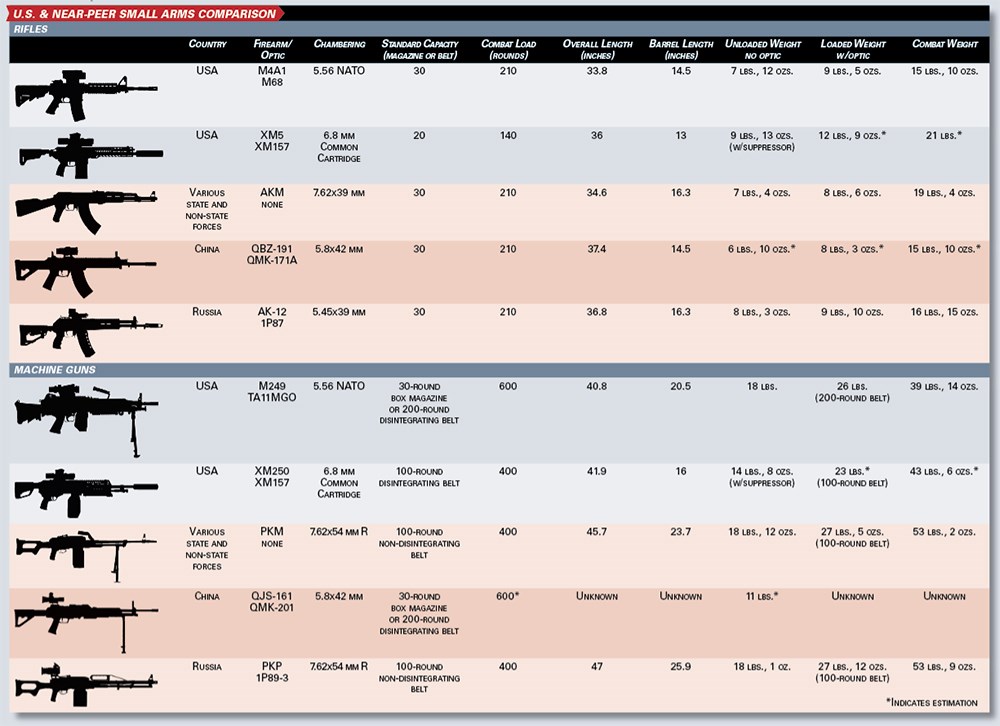
U.S. & near-peer small arms comparison
click here for enlargement

Conflicts in the early decades of the 21st century have highlighted deficiencies in U.S. small arms doctrine. To address these shortcomings, the military’s Next Generation Squad Weapons program settled on a new cartridge, rifle and machine gun. This table places current and future U.S. small arms in the larger context of firearms used by other nations.


Monday, February 13, 2023

Monday Music "Ruby" By Kenny Rogers and the First Edition.


 My Apologies for not posting much this week, Real life had me really busy, I will try to post some stuff tomorrow about it.

 I had decided to do the "Vietnam" songs for a bit because my Dads Birthday was in late January and he would have been 79, yeah I still miss him.

  Vietnam was a taboo subject for a while the wounds that the conflict left on the American Psyche was deep.  We had won the battles but lost the war because we as a nation had lost the will to fight it thanks to the media and the hippies and the antiwar movement that was funded by the communist party and liberal donors.  it took several years before Vietnam could be discussed outside of the veterans.  My Dad is a Vietnam Veteran, he did a tour in 1968 and dealt with the tunnels of Cu-Chi and the Tet Offensive, then he returned in 1972 for a second tour.   For a while especially in the 1970's, the Vietnam vet was portrayed as crazy or dangerous.  The specter of Vietnam dogged every use of the Military or any support during the 1980's, from Grenada, to Beirut, to Honduras and Nicaragua.  The Ghost of Vietnam were finally laid to rest during Desert Storm.

   I decided to go back in to the murky past for this song.  I wanted to do it earlier, but was unable to find any material on it.  But I found some this time.  This song my Dad used to play all the time, and I would hear it on his "Reel to Reel" tape player.

His was either a "Sony" or a "Sanyo".  I recall him telling me that he picked it up at the PX in Saigon.  The sound quality was really good, Nothing from digital media, but there is something about an old fashioned Reel to Reel.    He played this song and others a lot, I inherited some of my music taste from my Dad.  This song struck a chord with the Vietnam War generation, and the later Veterans who have heard this song.  The words can change a bit, but the emotions are the same.
      "Ruby, Don't Take Your Love to Town" is a song written by Mel Tillis about a paralyzed veteran of a "crazy Asian war" (given the time of its release, widely assumed but never explicitly stated to be the Vietnam War) who lies helplessly in bed as his wife "paints [herself] up" to go out for the evening without him; he believes she is going in search of a lover, and as he hears the door slam behind her, he pleads for her to reconsider. The song was made famous by Kenny Rogers and the First Edition in 1969. "Ruby" was originally recorded in 1967 by Johnny Darrell, who scored a number nine country hit with it that year.
   

In 1969, after Kenny Rogers and the First Edition's success with the hits "Just Dropped In (To See What Condition My Condition Was In)" and "But You Know I Love You", Rogers wanted to take his group more into a country music direction. They recorded their version of the song (with Rogers singing the lead) in one take. The record was a major hit for them. It made #1 in the UK on the New Musical Express (#2 on the BBC chart) staying in the top twenty for 15 weeks and selling over a million copies by the end of 1970. In the United States it reached number six on the Hot 100 and number thirty-nine on the country chart and also sold more than 1 million copies by 1979. Worldwide, the single sold more than 7 million copies.
In 1977, now a solo act following the First Edition's split in early-1976, Rogers made re-recordings of this and a number of other First Edition hits for his 1977 greatest hits package Ten Years Of Gold (later issued in the British Isles as The Kenny Rogers Singles Album), which topped the US country charts and was just as successful in the United Kingdom.

An answer song to "Ruby," entitled "Billy, I've Got To Go To Town," was released in 1969 by Geraldine Stevens who had previously recorded successfully under the name Dodie Stevens. Sung to the same melody with an arrangement quite similar to the First Edition version, "Billy" peaked at #117 pop, #57 country. In Stevens' song, Ruby affirms her love for her disabled husband ("Billy" in her song; in "Ruby," he is not named) and pleads in turn for her man to have faith in her fidelity and her commitment to him, even in his crippled condition

     A music video consisting solely of a camera panning back and forth in a bedroom was shown at the end of a Huntley-Brinkley Report during 1969. Chet Huntley set up the video by linking it to the controversial Vietnam War and the sacrifices by U.S. servicemen and their families. Chet Huntley and David Brinkley paused after the video and then signed off in their usual fashion.   I was unable to locate the video despite searching "Youtube" and other web sites.
 

Tuesday, February 7, 2023

The M 1895 Machine Gun.


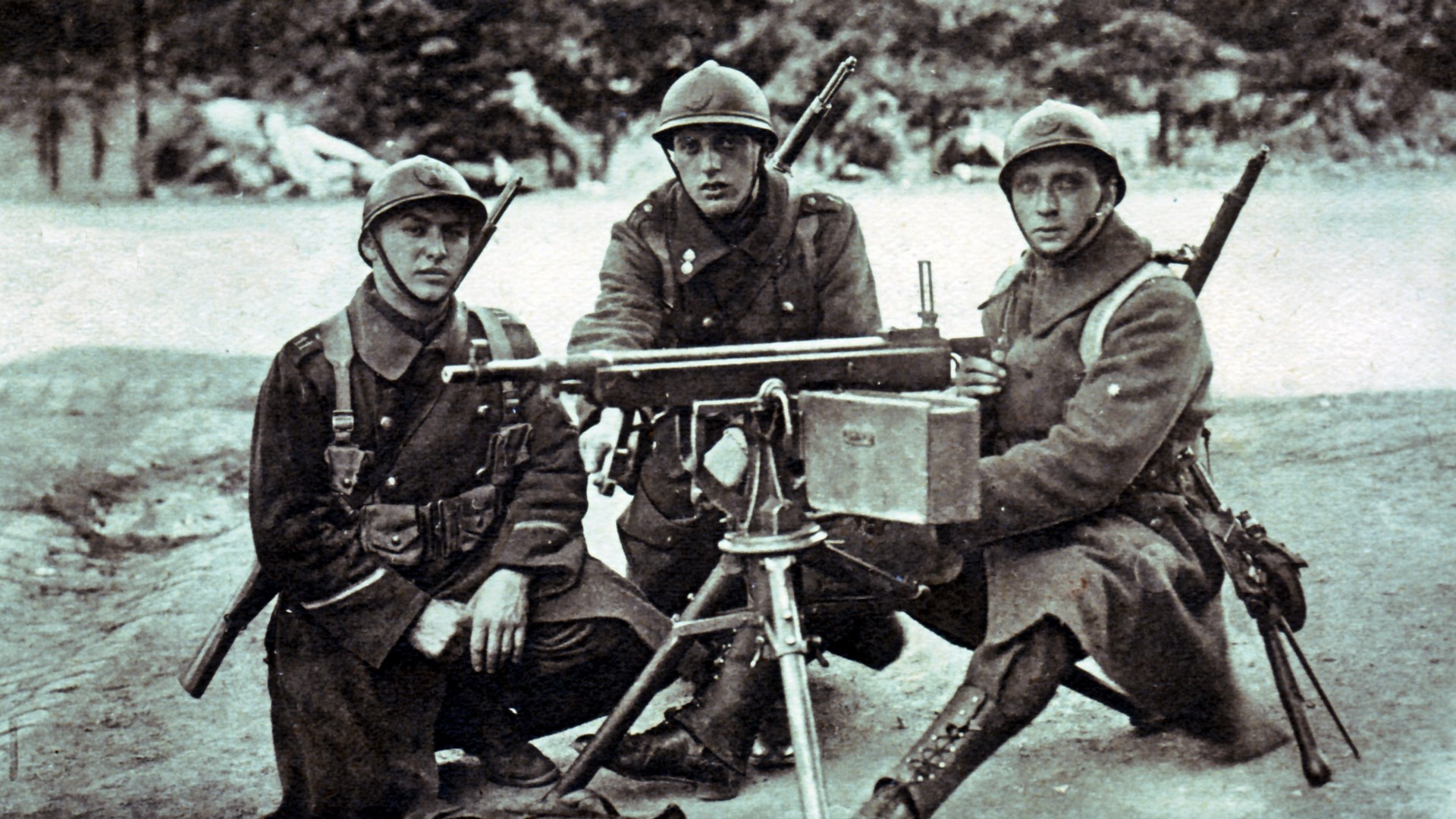
 I saw this article on "American Rifleman" and I have seen pictures of the machine gun before but
I didn't know that John M. Browning developed it before he did his other machine guns.  The article was really well done so I shamelessly "nicked" it for my blog.  


The late 19th century was a productive era in firearm design. The fertile mind of John Moses Browning was beginning to show its genius. In the autumn of 1890, in the big sky country of Ogden, Utah, one of John Browning’s early concepts took shape. The following is a letter to Colt’s Patent Firearms Company from Matthew S. Browning, dated Nov. 22, 1890:

Dear Sirs:

We have just completed our new automatic machine gun & thought we would write to you to see if you are interested in that kind of a gun. We have been at work on this gun for some time & have got it in good shape. We made a small one first which shot a 44 WCF charge at the rate of about 16 times per second & weight about 8#. The one we have just completed shoots the 45 Gov’t charge about 6 times per second & with the mount weighs about 40#. It is entirely automatic & can be made as cheaply as a common sporting rifle. If you are interested in this kind of gun we would be pleased to show you what it is & how it works as we are intending to take it down your way before long. Kindly let us hear from you in relation to it at once.

Yours Very Truly,
Browning Bros.
2461 Washington Avenue
Ogden, Utah

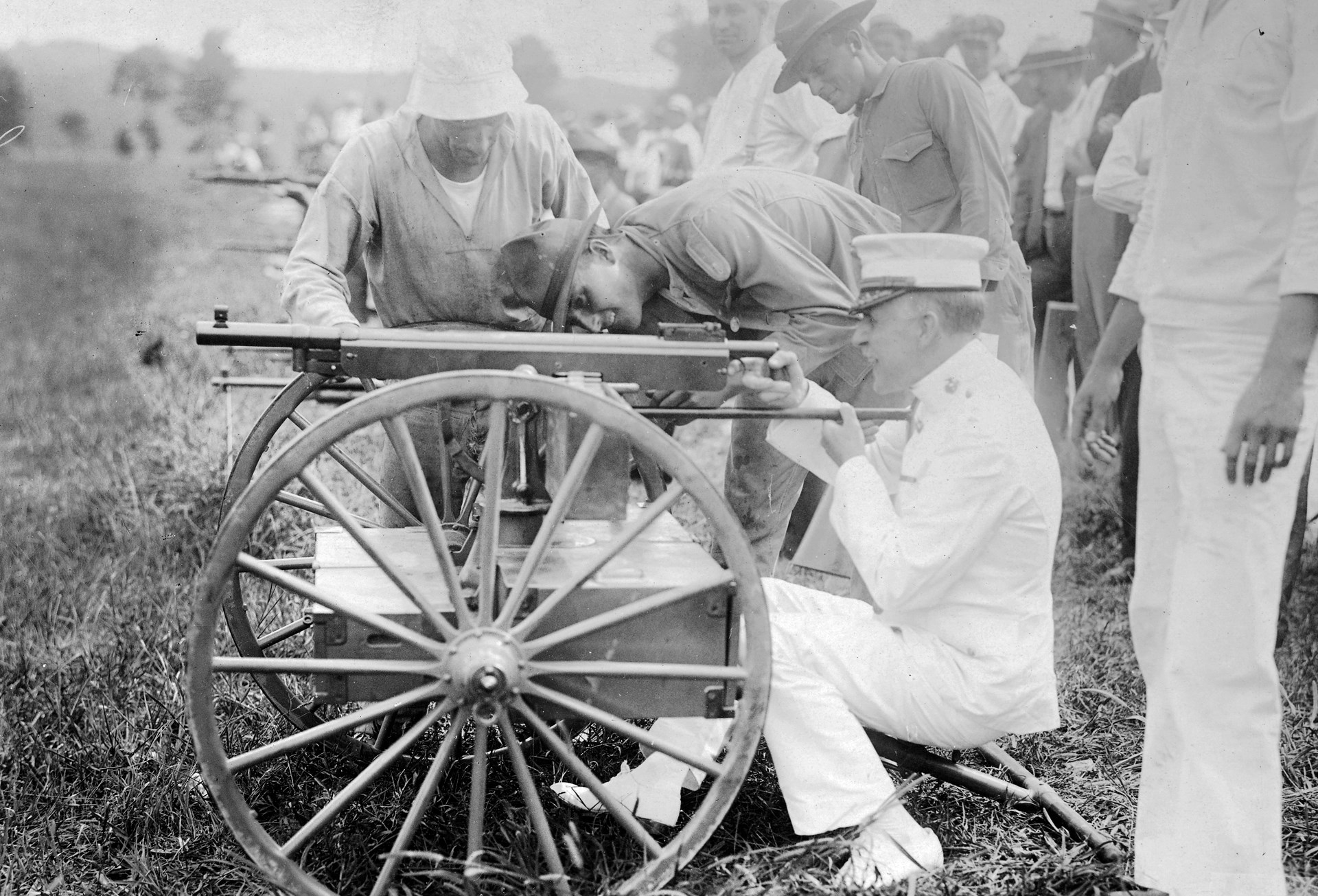
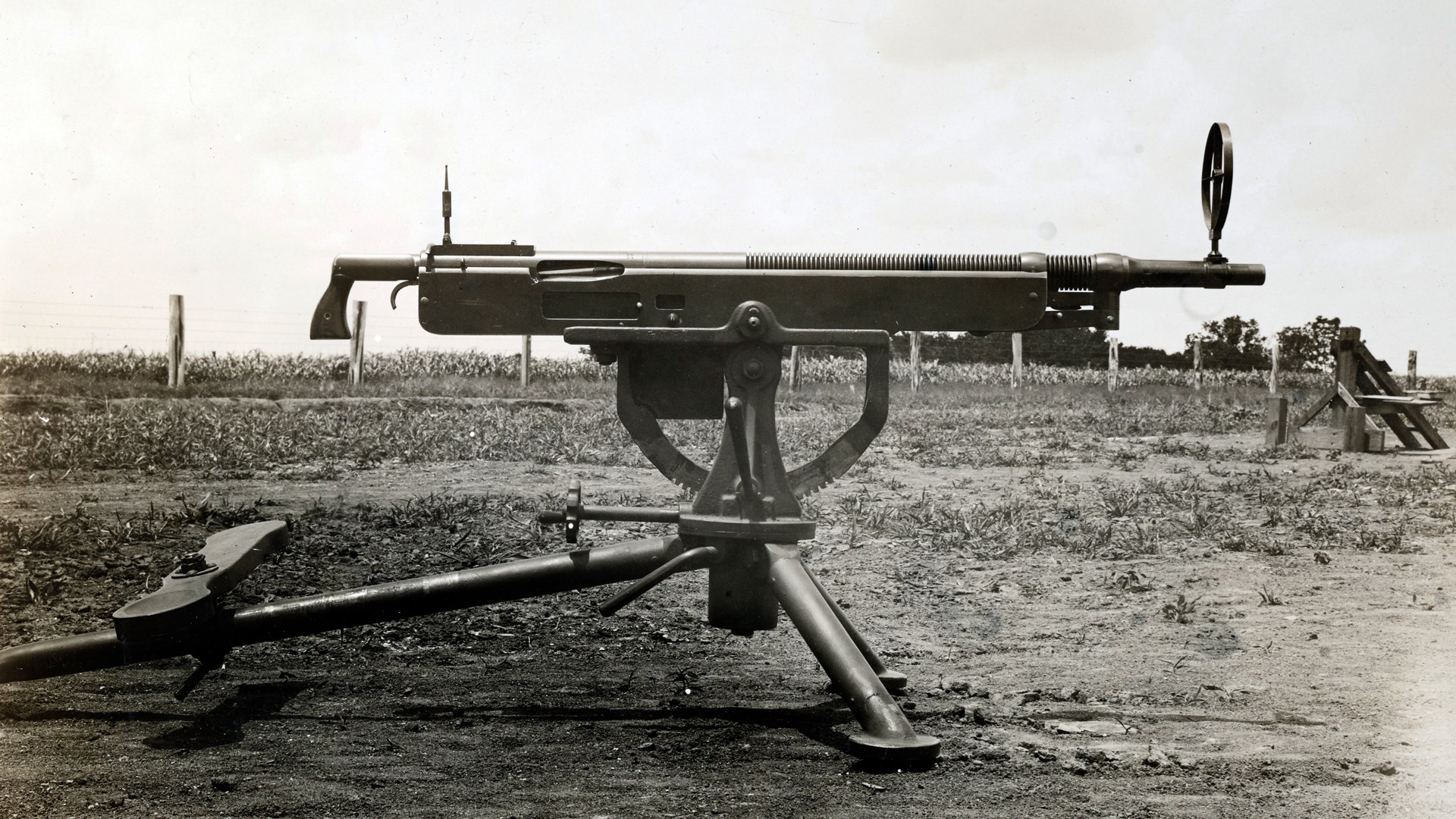
6)	General Barnett tests “Colt’s Automatic Gun” at the Winthrop, Md., range during 1917.

General Barnett tests “Colt’s Automatic Gun” at the Winthrop, Md., range during 1917. Library of Congress photo.

A Hot Potato Digger
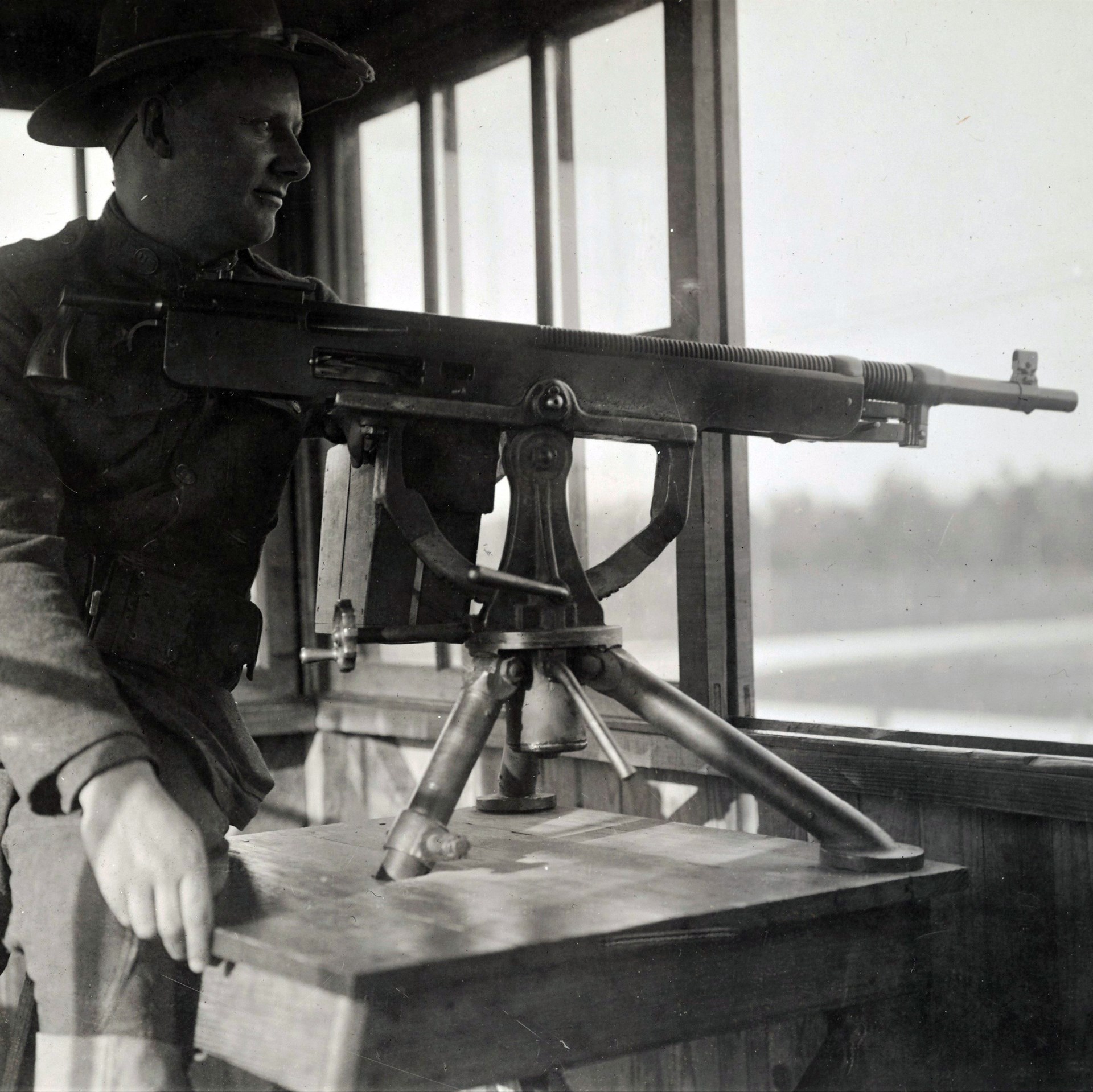
Colt’s sales literature claimed that the hammer supposedly “pumped cool air” into the chamber. Regardless, the M1895 was widely noted to heat up quickly after only a medium-length burst—making it hazardous to leave a live round in the chamber. The chamber needed to be unloaded after almost any sizeable burst, unless the gun was going to remain in continuous action. The heavy barrel was supposed to provide adequate cooling for sustained firing but was ultimately not up to the task. Another drawback was that the M1895 could not be fired from the prone position, as the forward and backward swinging of the gas-actuated loading lever prevented this. The “Potato Digger’s” action demanded a tripod.

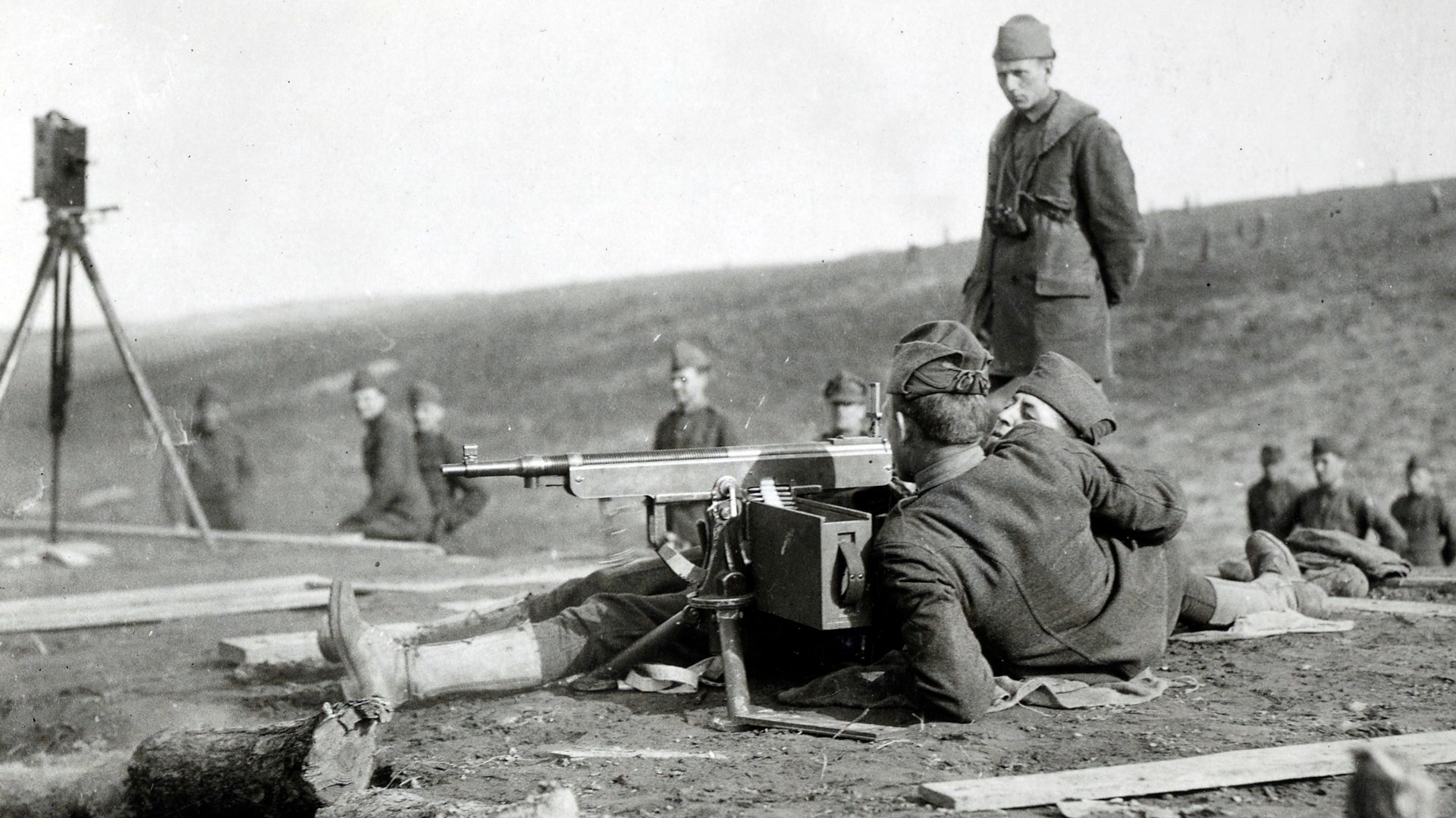
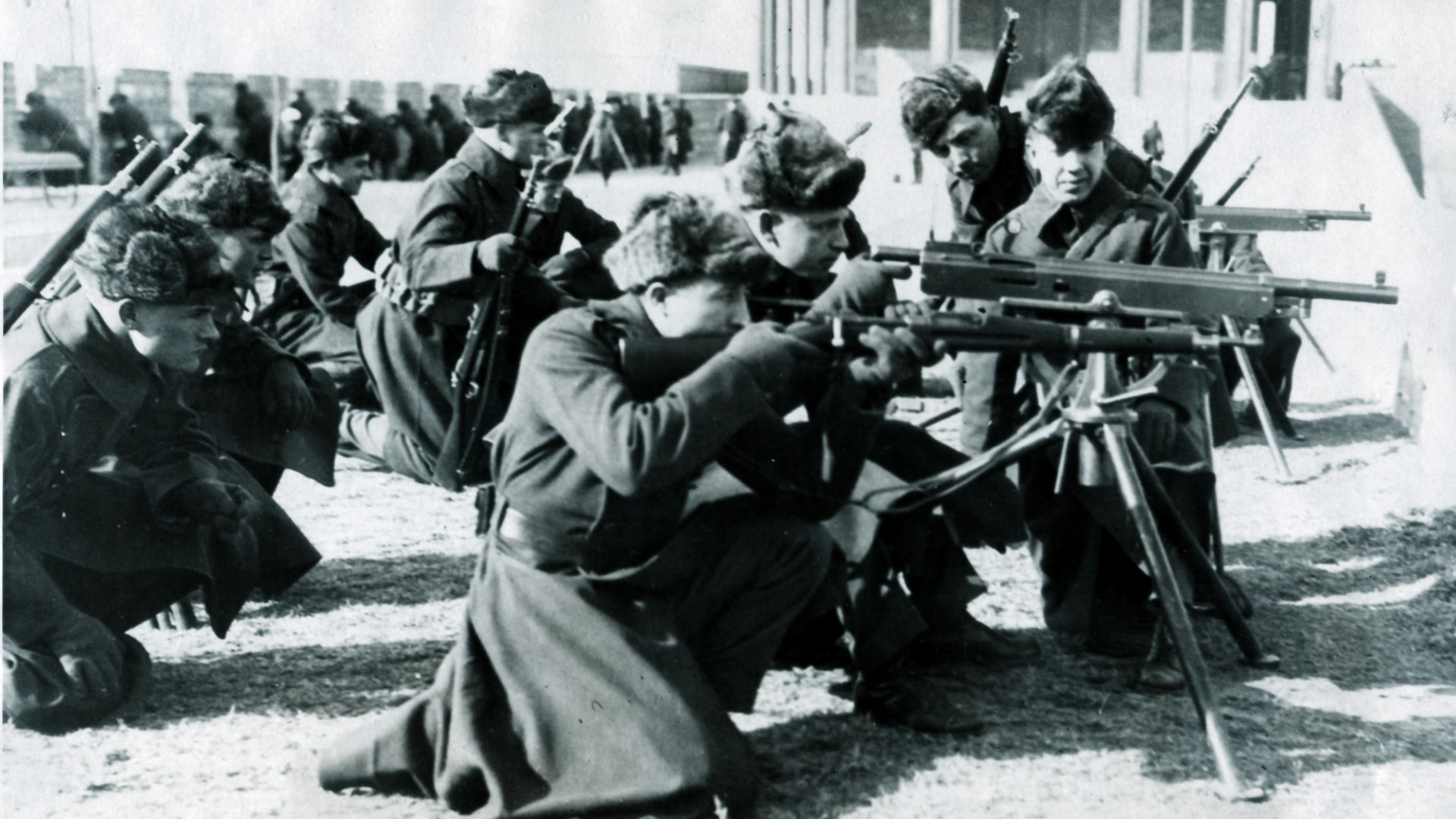
11)	Training the Doughboys: M1895 gunners train at Camp Upton, N.Y. on Long Island during early 1918.M1895 gunners train at Camp Upton, N.Y. on Long Island during early 1918. National Archives photograph.

U.S. Army Pushback
Not everyone was impressed with the new “automatic machine gun” designs that began to appear in the 1890s. There were, of course, those who saw the tremendous firepower potential in these new arms. Unfortunately for John Browning, and for Colt, the manufacturer of his automatic gun, the U.S. Army was quite pleased with its batteries of hand-cranked Gatling guns. Military interest in Browning’s new firearm was quite limited, with some considering it something of a newfangled “fad.” Meanwhile, the Browning gun found some interest from the U.S. Navy, and an order for about 200 examples, chambered in 6 mm Lee Navy followed. 

While the U.S. Navy embraced machine guns before the turn of the 20th century, the U.S. Army was still committed to the Gatling Gun and remained so for nearly another decade. The Army tested many early machine-gun designs, and the Colt gun was regularly in the mix. The Army Ordnance Board reviewed the firearm in June 1895 and wrote: The Colt automatic gun is an ingenious, compact, and relatively light arm. Its continuous automatic firing depends upon the action of the ammunition used. It is easily pointed by hand, and its fire is completely under the operator’s control. Its rapidity of fire during the tests was about 100 rounds in 17 seconds.”

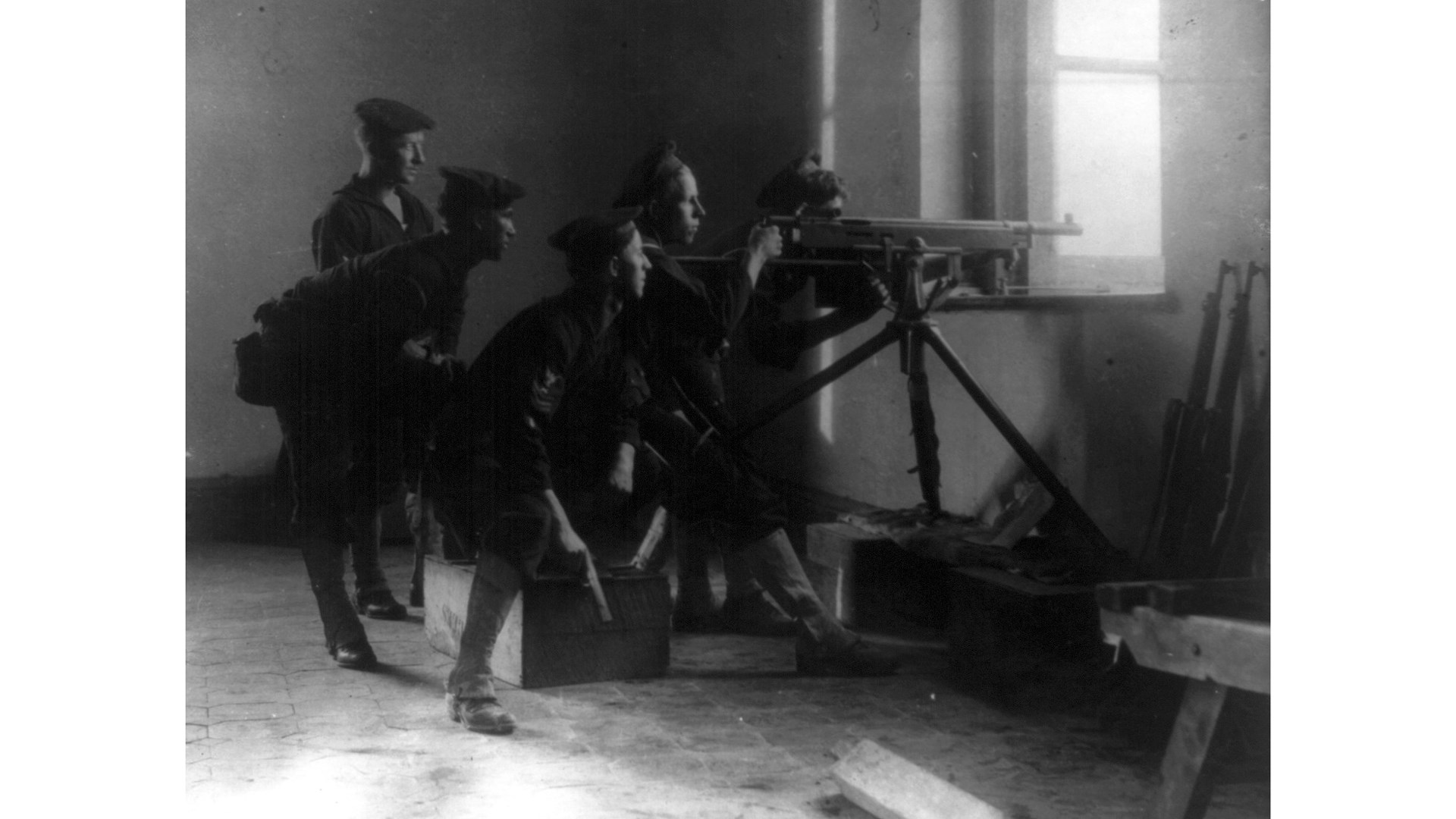
U.S. Navy Bluejackets ashore manning a M1895 (6 mm Lee Navy) during the occupation of Veracruz, Mexico during April 1914.

U.S. Navy Bluejackets ashore manning a M1895 (6 mm Lee Navy) during the occupation of Veracruz, Mexico during April 1914. National Archives photograph.

However, the board concluded: “The board is of the opinion that in its present form, as shown by the tests made this arm is not suitable for ordinary service and has no place in the land armament.”

Born In Navy Service
While the Navy first used the Colt machine gun in combat in Cuba during 1898, it was the Army that gave the M1895 machine gun its designation. Even so, there is no record that the Colt-Browning gun was never officially adopted by the U.S. Army. Two Colt M1895 guns (in 7x57 mm Mauser) were privately purchased by Lt. Col. Roosevelt’s “Rough Riders,” a volunteer cavalry regiment. Roosevelt was not impressed, calling the Colt machine guns “delicate and readily out of order.” Navy Colt MGs received good marks during their use in Cuba during 1898, and later in the Philippines. They proved their worth yet again during the Marine Corps’ defense of the International Legation compound in Peking during the Boxer Rebellion of 1900. South of the border, Colt MGs in 7 mm Mauser were used in the Mexican Revolution, and the U.S. Navy’s Colt guns were brought ashore for the occupation of Veracruz in April 1914.

M1895 machine gun used by Mexican revolutionaries. Pancho Villa’s “Division of the North” is thought to have acquired at least two of these guns.M1895 machine gun used by Mexican revolutionaries. Pancho Villa’s “Division of the North” is thought to have acquired at least two of these guns.

Canadian troops successfully used Colt machine guns (chambered in .303 British) during the Second Boer War during 1900. The Canadians retained their M1895s through the early days of World War I, using them in combat until they acquired Vickers machine guns. 

The first 200 U.S. Navy guns (called the Mark I), originally acquired in 6 mm Lee Navy, were ultimately rechambered in the newly unified Army-Navy .30-40 Krag (renamed the Mark I Modification I). When the official U.S. service ammunition was changed to the .30-’06 Sprg., the Navy once again rechambered their Colt machine guns but strangely retained the Mark I Mod I nomenclature. 

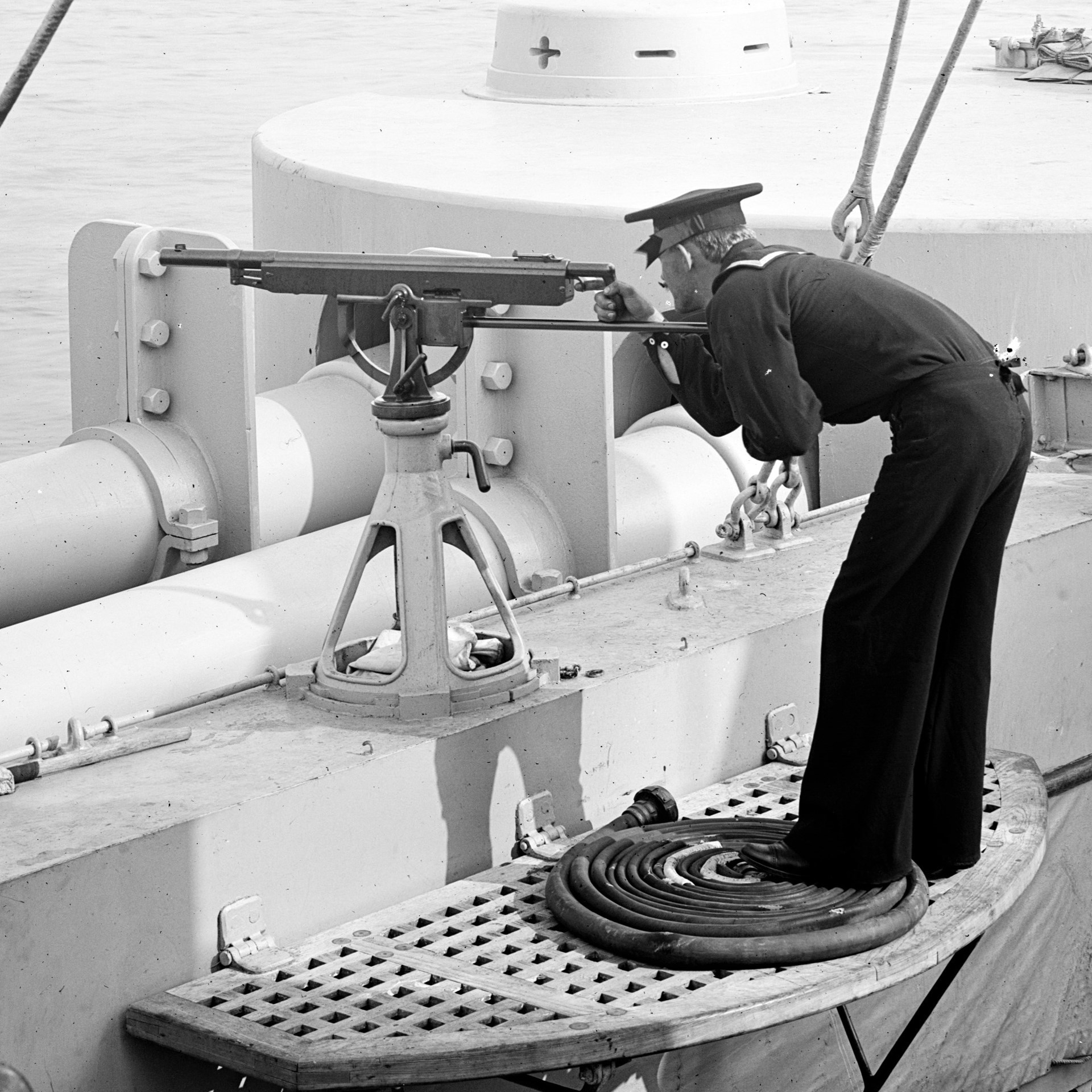
1)	an M1895 pedestal-mounted aboard the pre-dreadnought battleship U.S.S. Iowa (BB-4), launched in March 1896. Four M1895 machine guns were listed as part of the ship’s armament. Library of CongressAn M1895 pedestal-mounted aboard the pre-dreadnought battleship U.S.S. Iowa (BB-4), launched in March 1896. Four M1895 machine guns were listed as part of the ship’s armament. Library of Congress photo.

Almost The Final Straw
The U.S. Army continued to look at machine gun designs, but with an increasingly critical eye. The 1904 Report of the U.S. Chief of Ordnance describes the in-depth and rigorous testing of the M1895 machine gun versus the Maxim-Vickers machine gun. The following comments come from the “Test of automatic machine guns:”

During marching tests several of the ammunition boxes provided with the Colt gun came apart or broke. They are entirely too fragile to withstand service conditions. During the marching tests many cartridges worked loose, and a number worked out of the belts provided with the Colt gun, showing conclusively their unsuitability for service.

The two guns appear to be equally accurate at 500 and 1000 yards. The mount of the Colt was less stable, requiring more frequent adjustments of aim. The endurance of the Vickers gun, when its jacket is kept filled with water, is greatly superior to that of the Colt. The time required to insert a belt in either of these guns and to load it is about 10 seconds.

The radiation of heat from the Colt barrel seriously interferes with sighting after a few hundred rounds are fired from it. After 500 to 1000 rounds are fired continuously from the Colt gun, the heat remaining in the barrel is sufficient to ignite a cartridge in the chamber. The gas lever handle on the Colt gun also becomes so heated as to burn the hands, and as this lever must be operated to insert each belt, this is a serious defect. After firing about 500 rounds the Colt gun becomes so hot that it can only be handled with great difficulty.

After the 1904 tests, and the overall negative opinion of the firearm by the board, it appeared that the Colt M1895 had reached a dead end with the U.S. Army.

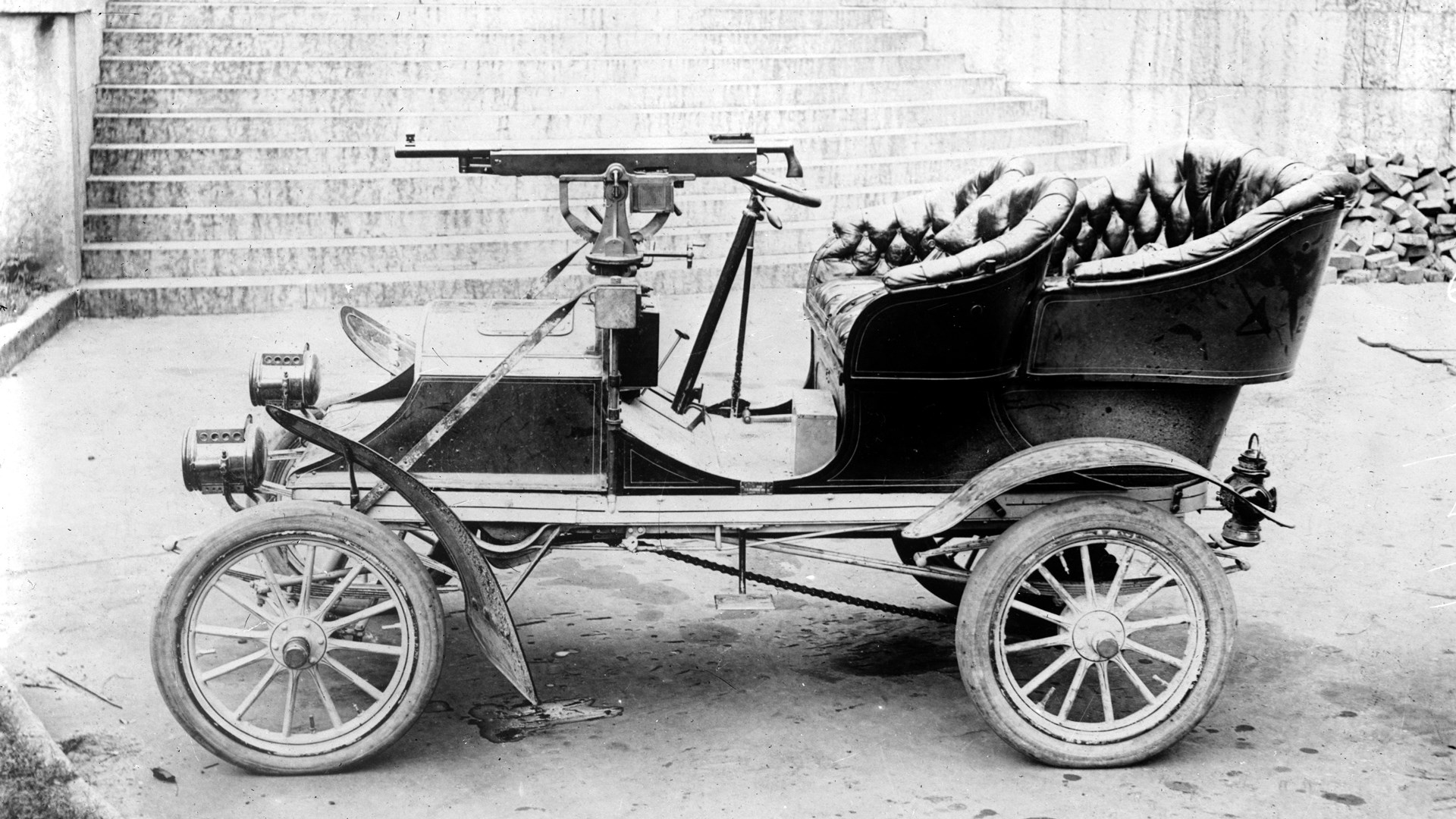
3)	Apparently “road rage” is not a modern concept. This M1895 is seen mounted aboard a Model T Ford. Library of Congress photoApparently “road rage” is not a modern concept. This M1895 is seen mounted aboard a Model T Ford. Library of Congress photograph.

Resurrection In The Great War
As World War I began in August 1914, some of the European powers found themselves in need of machine guns. The Russian Empire purchased nearly 15,000 (chambered in 7.62x54 mm R), first from Colt, then from Marlin-Rockwell, which purchased the manufacturing rights and the factory machinery in 1916.       

The Italians purchased M1895s (chambered in 6.5x52 mm Mannlicher-Carcano) and used them in combat against the Austro-Hungarian Empire. The Belgian Army inherited the Canadians’ Colt guns (.303 British) and purchased new guns chambered for 7 mm Mauser.

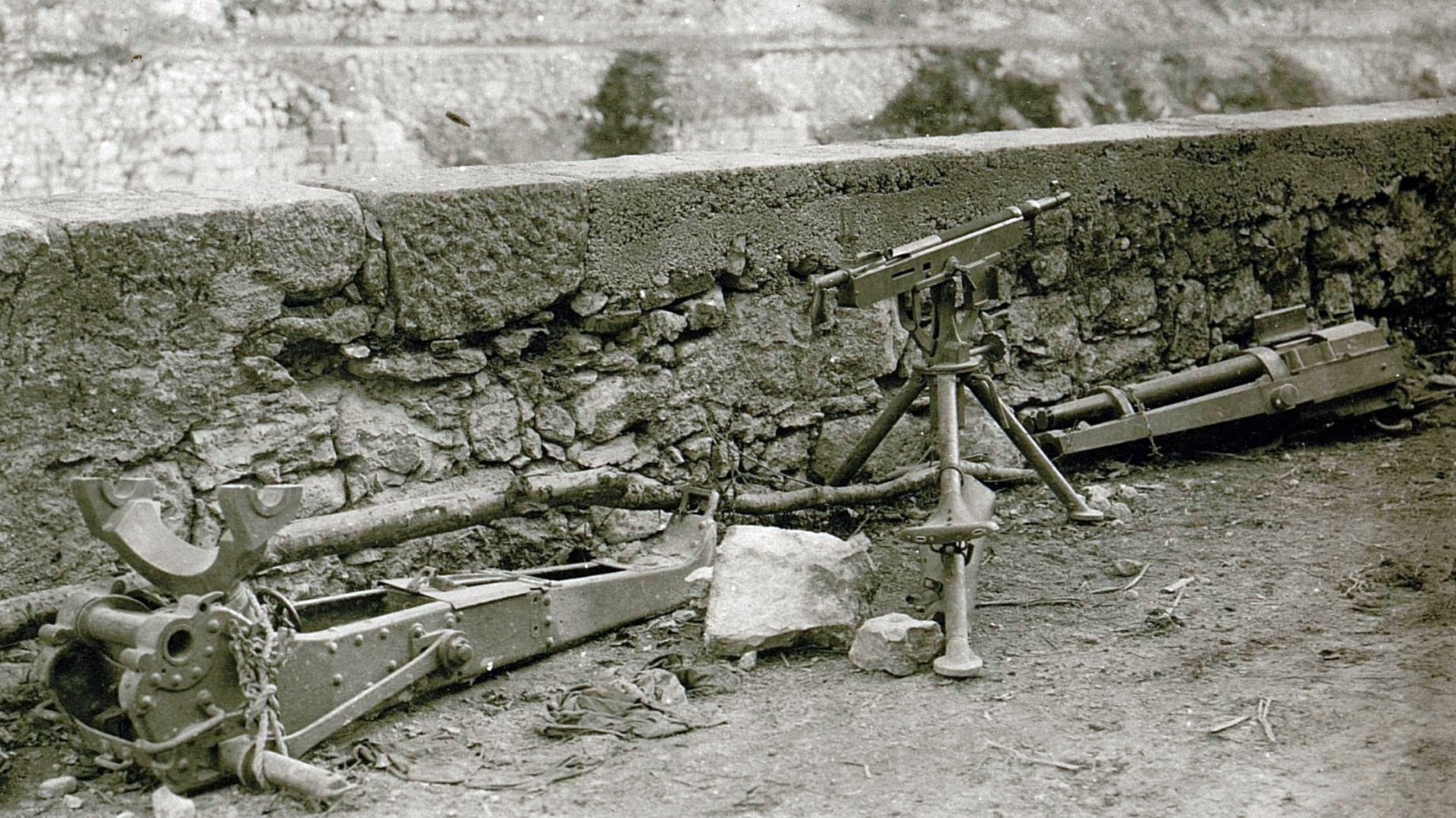
3)	Italian M1895 machine gun captured by the Austrians during World War I.Italian M1895 machine gun captured by the Austrians during World War I. Photograph from author’s collection.

In America, the M1895 was already considered obsolete, but U.S. forces had so few machine guns that 1,500 additional M1895s were built for the Army. These proved useful in training America’s fledgling army in several roles, ranging from infantry units to aerial gunners. Some were mounted aboard U.S. Navy “sub-chasers” protecting Allied convoys from U-boats. Beginning in 1917, Marlin-Rockwell redesigned the M1895, replacing the “potato-digger” arm with a linear gas piston to produce the Marlin Aircraft Model 1918. The Marlin Aircraft machine gun was a synchronized firearm that was mounted on a few U.S. Air Service pursuit and recon aircraft in the fall of 1918. Pilots praised it for its reliability and high rate of fire—ultimately the U.S. Air Service judged it to be the equal of the Vickers aircraft gun. After WWI, the Marlin gun was also mounted in the first American-made tank, the M1917 (the US version of the French FT-17).

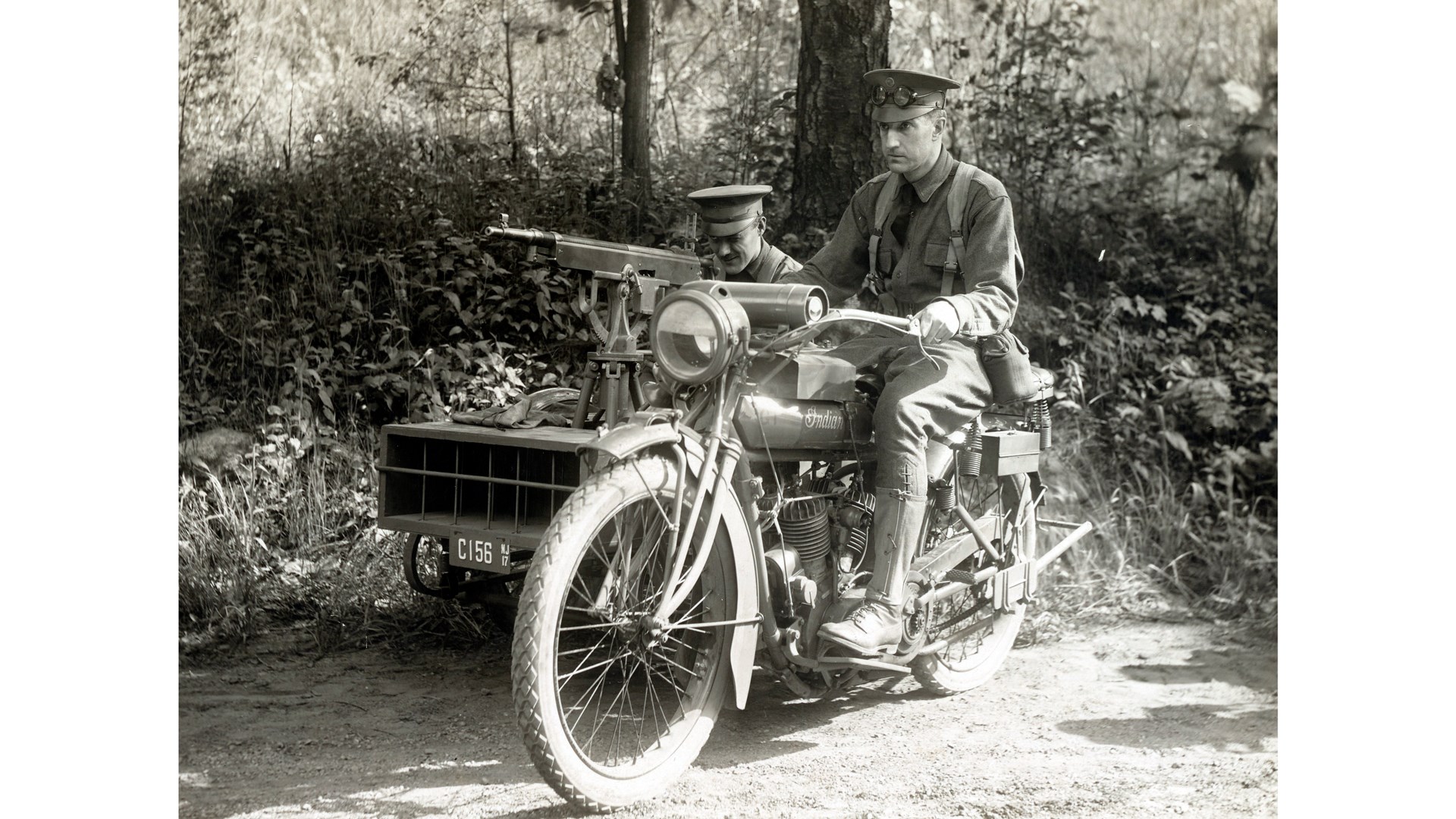
A firearm for a new century of mobile firepower: The M1895 machine gun was often mounted on early motorcycle/sidecar combinations. This is the New Jersey Mobile Battery during 1917. NARAA firearm for a new century of mobile firepower: The M1895 machine gun was often mounted on early motorcycle/sidecar combinations. This is the New Jersey Mobile Battery during 1917. National Archives photograph.

Soldiering On
Even though World War I was ostensibly ended by the November 1918 armistice, the fighting only intensified throughout Eastern Europe. The many M1895s purchased by the Russian Empire, continued their deadly work in the hands of Red and White forces in the Russian Civil War. Once the communists had seized control of Russia, the M1895 continued to fire shots in anger and saw action on both sides in the Ukrainian War of Independence (1917-1921) and the Soviet-Polish War (1919-1921), as well as the Finnish Civil War (1918), the Estonian War of Independence (1918-1920) and the Latvian War of Independence (1918-1920). 

On guard at Fort Oglethorpe Prison, Ga., early 1919.  NARAOn guard at Fort Oglethorpe Prison, Ga., early 1919. National Archives photograph.

Back in the U.S., the M1895s appeared in the second largest armed insurrection in American history, firing shots in the West Virginia “Coal Mine War” (1921). The Colt machine guns were owned by the coal companies and used by the strike-breaking Baldwin-Felts agents.

A small amount of M1895s (7 mm Mauser) were used in the Spanish Civil War (1936-39), and when England stood alone in 1940 and was desperate for arms, M1895s were purchased for the British Home Guard, which used them during World War II.

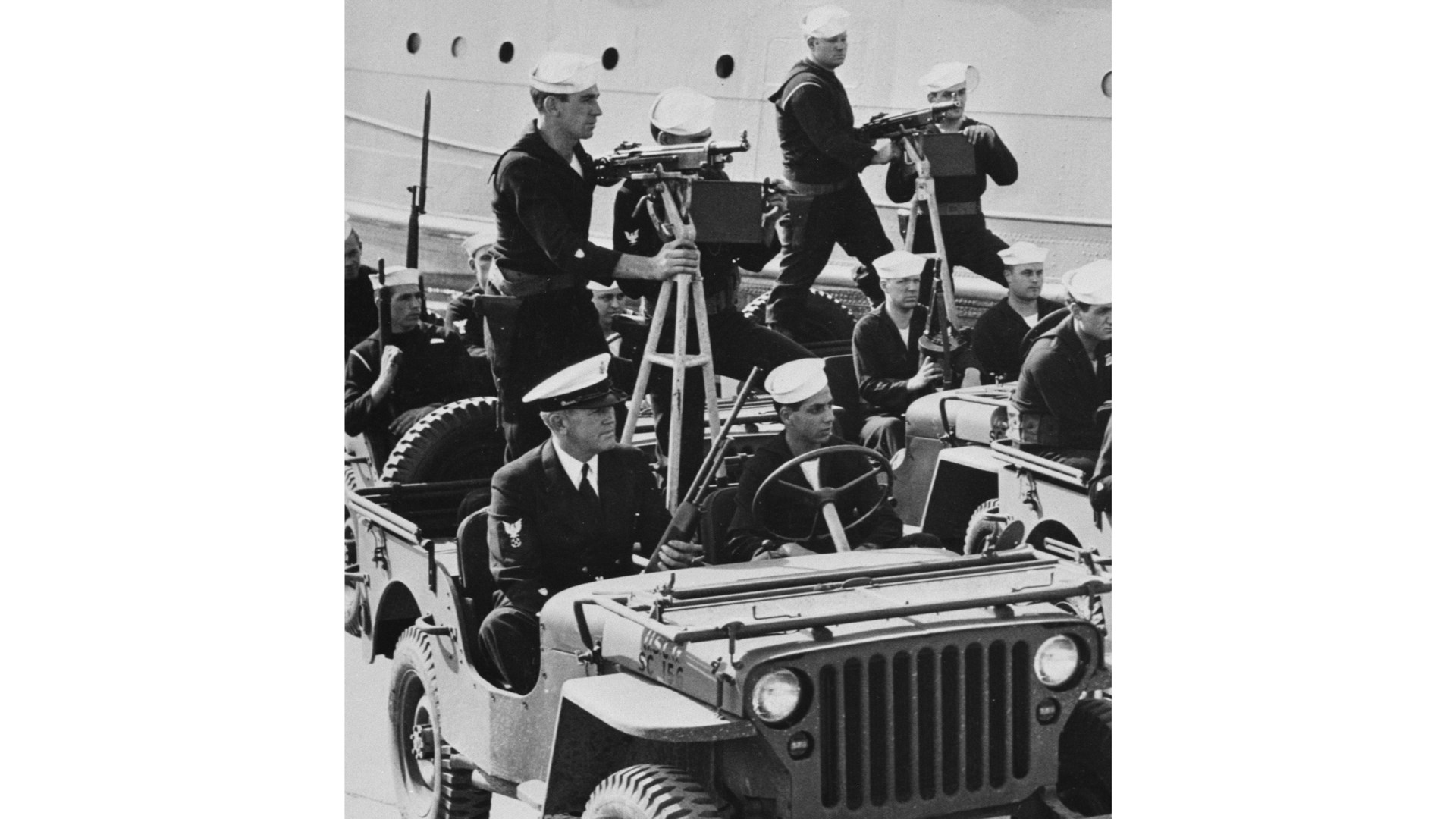
11)	Service in World War II: M1895 guns mounted aboard U.S. Coast Guard Jeeps for stateside shore patrol during 1943. national archives photographService in World War II: M1895 guns mounted aboard U.S. Coast Guard Jeeps for stateside shore patrol during 1943. National Archives photograph.

Surprisingly, a few Jeep-mounted M1895s appear in photos of stateside U.S. Coast Guard shore patrols during WWII. The old potato-digger fought on longer and in more conflicts than its maker ever expected. John Browning’s first machine gun set the stage for his later genius designs that would serve America through two world wars and beyond.

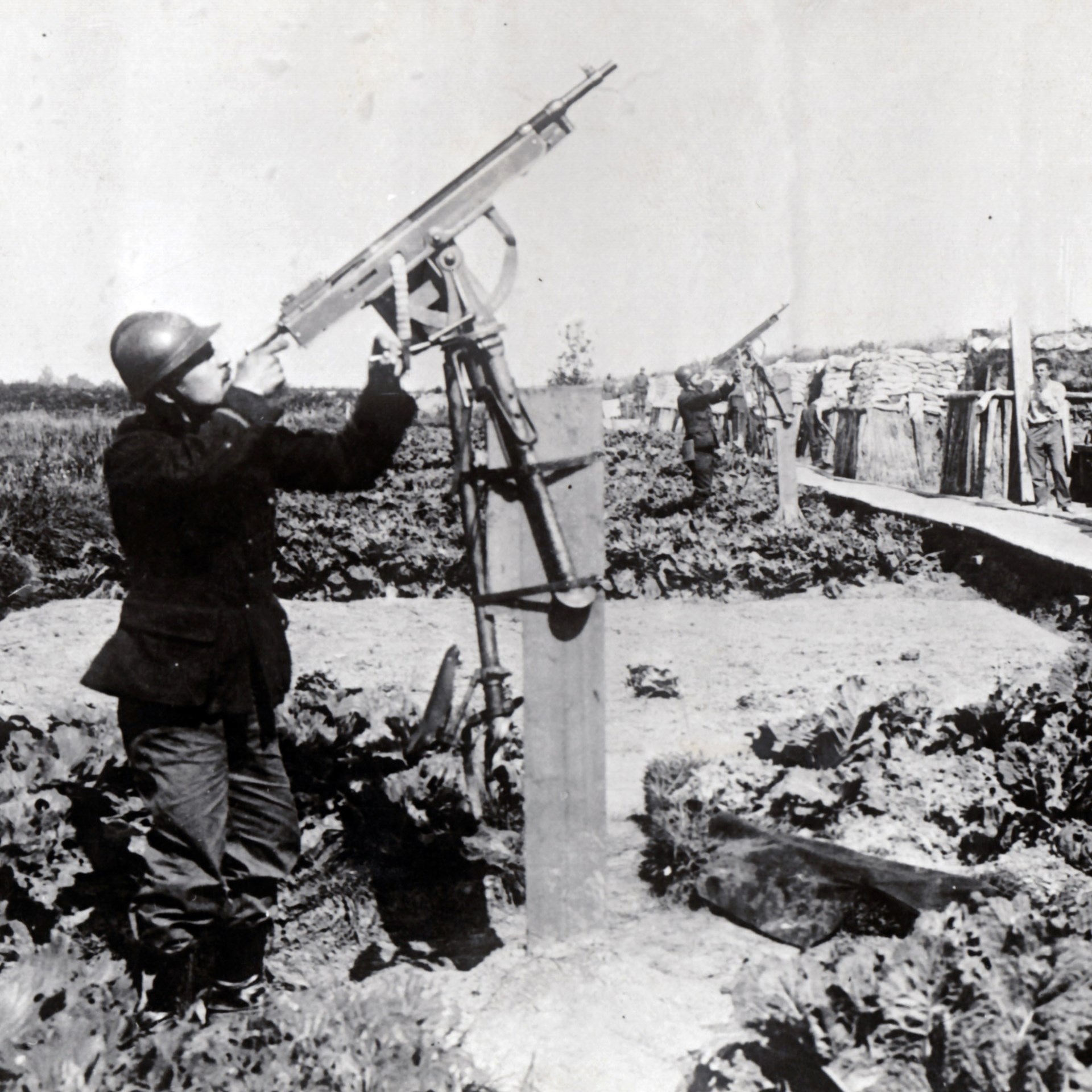
Belgian M1895 guns set up to provide anti-aircraft defense on the Western Front. NARABelgian M1895 guns set up to provide anti-aircraft defense on the Western Front. National Archives photograph.

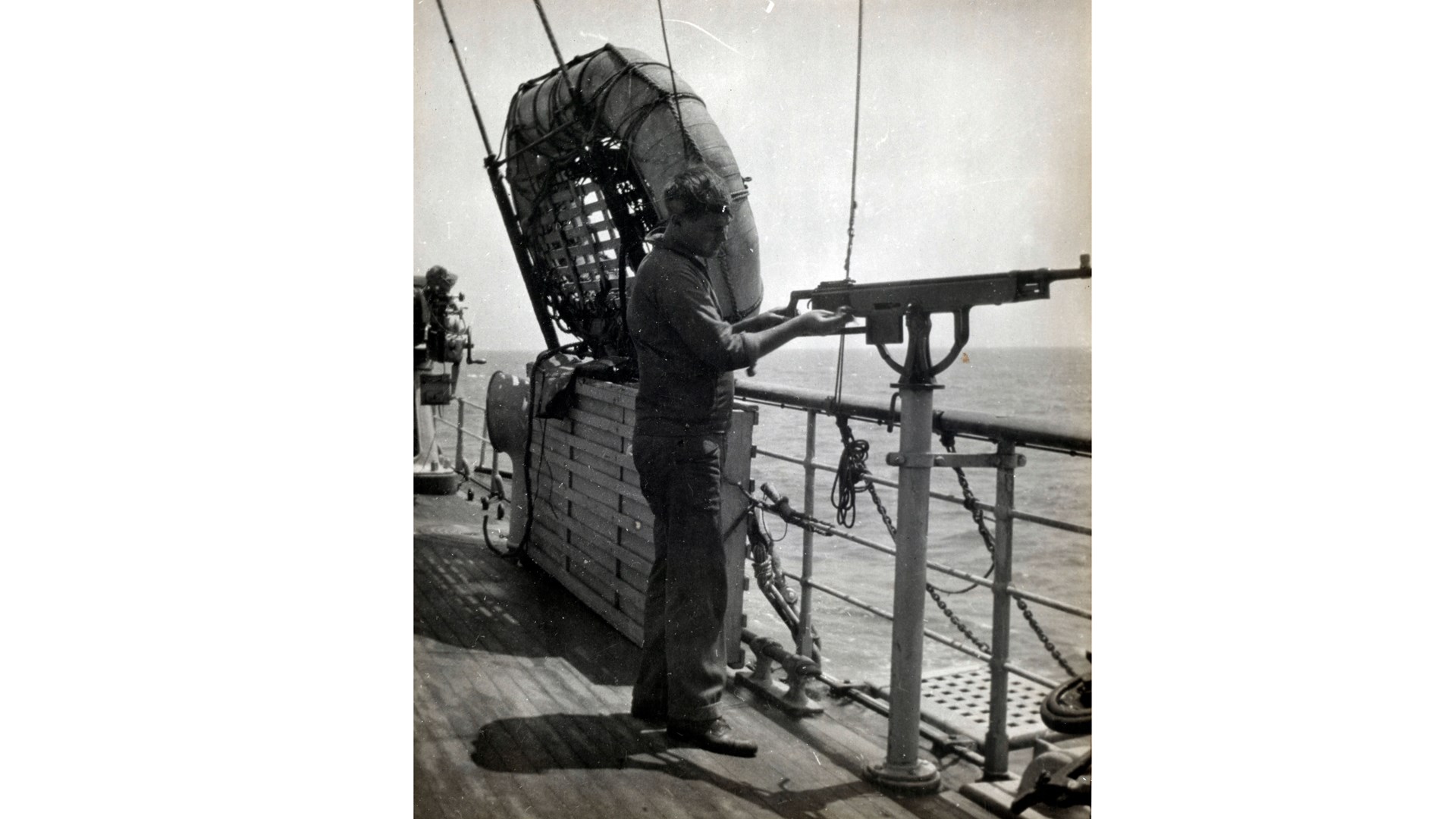
A M1895 in Coast Guard service aboard a converted yacht on anti-submarine patrol during 1918. NARAA M1895 in Coast Guard service aboard a converted yacht on anti-submarine patrol during 1918. National Archives photograph.

M1895 in Belgian service during World War I. Photograph from author’s collection.M1895 in Belgian service during World War I. Photograph from author’s collection.

The potato-digger in training at Fort Lewis, Wash., during 1918. National Archives photograph.The potato-digger in training at Fort Lewis, Wash., during 1918. National Archives photograph.

An aged M1895 serving with the USMC at Hankow, China, during December 1926. Author’s collectionAn aged M1895 serving with the USMC at Hankow, China, during December 1926. Photograph from author’s collection.


Monday, February 6, 2023

Monday Music "19" By Paul HardCastle

 I had decided to do the "Vietnam" songs for a bit because my Dads Birthday was in late January and he would have been 79, yeah I still miss him.

  Vietnam was a taboo subject for a while the wounds that the conflict left on the American Psyche was deep.  We had won the battles but lost the war because we as a nation had lost the will to fight it thanks to the media and the hippies and the antiwar movement that was funded by the communist party and liberal donors.  it took several years before Vietnam could be discussed outside of the veterans.  My Dad is a Vietnam Veteran, he did a tour in 1968 and dealt with the tunnels of Cu-Chi and the Tet Offensive, then he returned in 1972 for a second tour.   For a while especially in the 1970's, the Vietnam vet was portrayed as crazy or dangerous.  The specter of Vietnam dogged every use of the Military or any support during the 1980's, from Grenada, to Beirut, to Honduras and Nicaragua.  The Ghost of Vietnam were finally laid to rest during Desert Storm.

 I first heard of this song while I was a senior in high school, I was big into the JROTC program and I had noticed that there was a lot of "Vietnam" stuff coming out in the movies and in song, I made a comment that finally the country was trying to face down the ghost and the spectre of our involvement in the "Southeast Asean War Games" as I have heard it referred to.  My Dad was a Vietnam War vet and hewas on the "Agent Orange Registry" and other things, he was 77 years old when he passed and for his age is in remarkably good health and the 2nd dose of the clot shot got him.    I remembered the derision that the vets went through when they came back from the war, they didn't want to go, but went because their country sent them anyway because it was their patriotic duty.
      I remembered coming back from when I was sent to Desert Storm and returned and was back in Germany, I was out with some of my friends they were having a beer, I had quit drinking because going to the gulf had "dried me out" and I liked being sober...Funny how that works out.  I did have a taste of the beer to "prove that I had made it back."  I kept having dreams that I was back in the world and would wake up and still find myself in the sandbox.  As I understand it, that was a regular occurrence with many people.   But I digress.  I had a swallow of the Local German Beer "HofBrau" for the taste, when I actually tasted it, it finally proved to me that I was "home" from the war, and I wasn't a cripple or dead or some of that other crap. 

     A person came up to us and called us a "murderer and a baby killer"  Well that wasn't smart...was actually dumb...Here we are a group of GI's that were happy to be alive and this prick shows up and opens his pie hole.  Well I immediately had a flashback to somebody insulting my Dad when he had came back from his second tour of Vietnam and I had rage like I had never had before, and I told him to "f**k off" the dummy threw a punch at me and popped me in the jaw, the red veil descended and I unloaded in this poor guy, I knocked him down with one punch and started to kick the crap out of him.  My friends pulled me off of him.  The bouncer picked this guy up and threw him out.  The others vouched for what had happened and I was able to stay.   I went into the bathroom and drowned my head in cold water to calm down.  I had been in several fights before, but this was one I was proud of.  I didn't like to fight and would look for a peaceable solution if possible.   I later called my Dad from Germany and told him that I "kicked the crap out of a war protestor for him". 

     I have great pride in my Army service and my service in the Gulf, we did a good thing getting Saddam out of Kuwait, I saw Kuwait city after we had liberated it, the Iraqi's had pillaged it.  I also saw some of the vehicles used in the highway of death and they were full of loot from the Kuwaiti's.  Some people called it a "war for Oil" and perhaps it was to an extent, but you notice that we gave it back as soon as we had liberated it?   Which other country would have done that?
     But back to the song "19" by Paul Hardcastle:
"19" is a song by British musician Paul Hardcastle released as the first single from his self-titled third studio album Paul Hardcastle (1985).
Some people believe the song has somewhat of an anti-war message, focusing on America's involvement in the Vietnam War and the effect it had on the soldiers who served. The track was notable for early use of sampled and processed speech, in particular a stutter effect used on the words "n-n-n-n-nineteen" and "d-d-d-d-destruction". It also includes various non-speech samples such as crowd noise and a military bugle call.
"19" features sampled narration (by Peter Thomas), interview dialogue ("I wasn't really sure what was going on") and news reports from Vietnam Requiem, an ABC television documentary about the post-traumatic stress disorder suffered by veterans. In 2009, the song placed at 73 on VH1's 100 Greatest One-Hit Wonders of the 80s.
"19" topped the charts in the UK for 5 weeks, and reached the top 20 in the US, where it also topped the dance chart. For a while, it was the top selling single in 13 countries (helped by the fact that versions of the song were recorded in French, Spanish, German and Japanese), and it received the Ivor Novello award for Best-selling single of 1985. The song's English language release came in 3 different 12" versions ("Extended Version", "Destruction Mix" and "The Final Story"), each with an alternative cover design.


Hardcastle was inspired to create the song after watching Vietnam Requiem, and comparing his own life at 19 to those of the soldiers featured: "...what struck me was how young the soldiers were: the documentary said their average age was 19. I was out having fun in pubs and clubs when I was 19, not being shoved into jungles and shot at."
The title "19" comes from the documentary's claim that the average age of an American combat soldier in the war was 19, as compared to World War II's 26. This claim has since been disputed. Undisputed statistics do not exist, although Southeast Asia Combat Area Casualties Current File (CACCF), the source for the Vietnam Veterans Memorial, shows a large number of deaths (38%) were ages 19 or 20. According to the same source, 23 is the average age at time of death (or declaration of death). The song also comments that while the tour of duty was longer during World War II, soldiers in Vietnam were subject to hostile fire almost every day.
Musically, the song was inspired by electro, particularly Afrika Bambaataa, although Hardcastle also "added a bit of jazz and a nice melody", and beyond the sampling of the documentary narration, the song incorporated pieces of interviews with soldiers. The song's hook, the repetitive ""N-n-n-nineteen", was developed due to the limitations of the early sampling technology used. The E-mu Emulator could only sample for two seconds, so the hook was based around "the only bit of the narrative that made sense in two seconds." Hardcastle wasn't optimistic about the song's chances in the charts. His previous two singles for independent labels had failed to make it into the UK's Top 40 and the musical policy at Radio 1 was felt to be unsupportive of dance music. News interest in the song helped, with the 10th anniversary of the end of the Vietnam War seeing Hardcastle interviewed by Alastair Stewart of ITN.
Tony Blackburn, then breakfast DJ for Radio London was an early supporter of the song and it reached number 1 in the UK and around the world, with Hardcastle producing more mixes of the song to help maintain interest.Although the song did not climb as high in the United States chart, Hardcastle claims "it outsold everybody else for three weeks solid, it only reached number 15, because back then the chart was based on airplay as well as sales." The song was held back in the US by some radio stations refusing to play it, feeling that the song took an anti-American stance, something Hardcastle denies, noting "I had tons of letters from Vietnam vets thanking me for doing something for them."
The success of "19" meant that Hardcastle's manager Simon Fuller, who had recently left Chrysalis Records to set up on his own, was able to use the funds to continue his business. He named the business 19 Management in acknowledgement and the number 19 has become of great significance to Fuller. Fuller went on to become the most successful British music manager of all time and was behind the success of the Spice Girls and American Idol. Hardcastle has continued his connections to 19 Entertainment and in 2009 created the sound for the end card used at the end of 19's television shows.


After the song's unexpected, rapid climb to the top of the UK Singles chart, Chrysalis asked directors Jonas McCord and Bill Couterie to rush a video into production. Due to the lack of a band able to perform the song, the video was primarily composed of clips from the Vietnam Requiem documentary, edited together by Ken Grunbaum. The first version of the video included footage from the television networks NBC and ABC, including a newscast by ABC anchorman Frank Reynolds. After it was aired on MTV in the U.S., NBC and ABC objected to the "bad taste" of using the serious clips in a "trivial" form of "propaganda."McCord and Couterie were forced to produce a new cut incorporating public domain footage, but ABC permitted Reynolds' audio to remain. Couterie asserted at the time that the television networks opposed the video because it involved rock music:

What is the difference between the words in our song and the 7 o'clock news? The only difference is rock'n'roll. And why did they love the documentary and hate the video so much? Every word in the song is from the film, and there was never any argument with the facts. The only difference is the music.
The song's reliance on sampling also caused problems with legal clearance. Grunbaum recalled in 2012 that "there were no precedents for something like this. We ended up having to pay Peter Thomas, the narrator, royalties.".

Saturday, February 4, 2023

The TAO of Boyd, How to Master the OODA loop

 I have studied the OODA loop before, it is taught in the U.S. Military, especially in tactics, how to disrupt "The Other Guy, get inside his OODA loop and beat him".  This article from "The Art of Manliness is more in-dept and has a lot of good links.


Ilustration of the tao of boyd.

.

John Boyd is described by some as the greatest military strategist in history that no one knows. He began his military career as a fighter pilot in the Korean War, but he slowly transformed himself into one of the greatest philosopher-warriors to ever live.

In 1961, at age 33, he wrote “Aerial Attack Study,” which codified the best dogfighting tactics for the first time, became the “bible of air combat,” and revolutionized the methods of every air force in the world.

His Energy-Maneuverability (E-M) Theory helped give birth to the legendary F-15, F-16, and A-10 aircraft.

Perhaps his most significant contribution to military strategy, though, came from a series of briefings he gave. In them, Boyd laid out a way of thinking about conflict that would revolutionize warfare around the world.

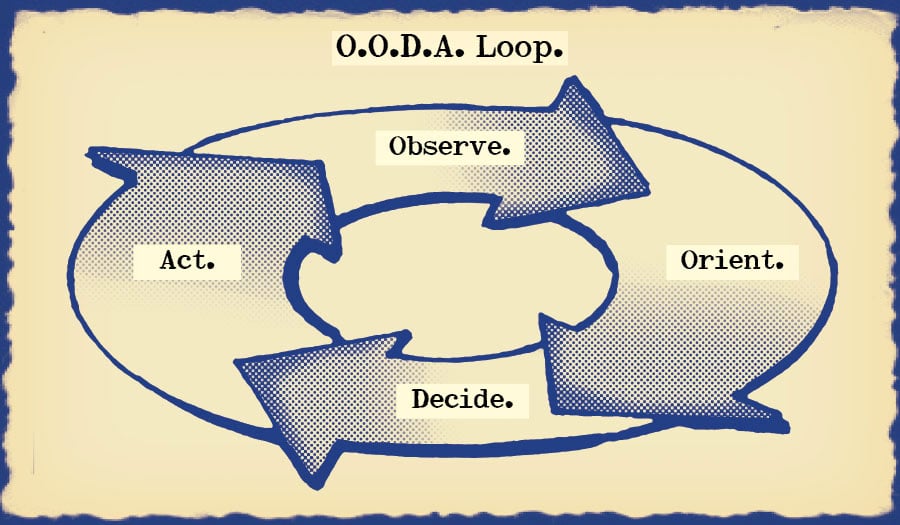
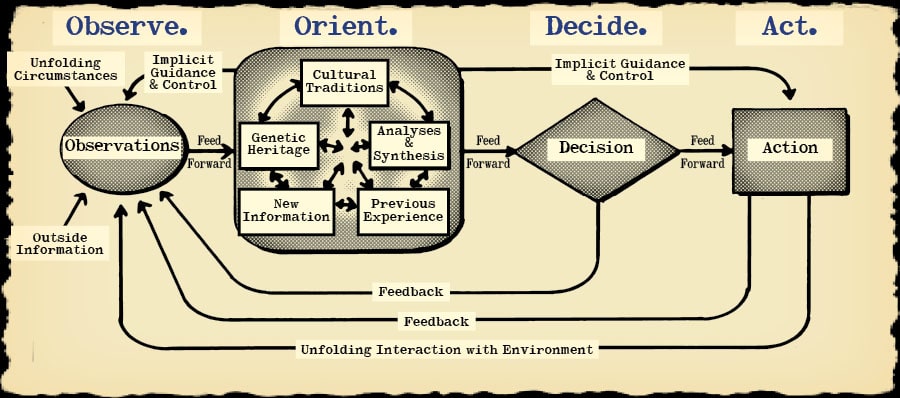
The idea centers on an incredible strategic tool: the OODA Loop — Observe, Orient, Decide, Act. Nation-states around the world and even terrorist organizations use the OODA Loop as part of their military strategy. It has also been adopted by businesses to help them thrive in a volatile and highly competitive economy.

The OODA Loop is an oft-cited, but typically misunderstood idea. If you’ve heard of it, it was most likely presented in a fairly superficial way — as a 4-step decision-making process where the individual or group who makes it through all the stages the quickest, wins. That’s one element of the OODA Loop, but there’s much more to it than that.

The reason the OODA Loop is so frequently misunderstood is that John Boyd never described it in detail in a technical paper. In fact, despite all his contributions to military strategy, he only has one very short paper to his name — “Destruction and Creation.” Instead, he developed and explained the OODA Loop through a series of sometimes five-hour-long briefings. The only notes we have are his briefing slides and a few tape recordings and transcripts that exist of his presentations. (Because he never wrote his ideas down, militaries and businesses often use his ideas without giving him credit. The lack of documentation likely explains why so few people today know about John Boyd.)

As you look through these materials, you quickly learn that a lot of hard thinking and philosophizing went into the development of the OODA Loop. Boyd combined a deep understanding of military history and strategic thinking with a wide range of other intellectual domains and theorems, including quantum mechanics, cybernetics, chaos theory, Popperism, and Neo-Darwinism. For this reason, to truly understand the OODA Loop, one must be familiar with the scientific and philosophical developments that helped create it.

Thus, once you move past the simplified, CliffsNotes version of the OODA Loop, you find that it’s actually pretty heady stuff. It’s not “groundbreaking” in the sense of revealing insight never before conceived; rather, its power is in the way it makes explicit, that which is usually implicit. It takes the basic ways we think, decide, and operate in the world — ways that often get confused and jumbled in the face of conflict and confusion — and codifies and organizes them into a strategic, effective system that can allow you to thrive in the heat of battle. It is a learning system, a method for dealing with uncertainty, and a strategy for winning head-to-head contests and competitions. In war, business, or life, the OODA Loop can help you grapple with changing, challenging circumstances and come out the other side on top.

I have spent the last month diving deep into the OODA Loop — reading everything available on it, from Boyd’s briefing notes to biographies to analyses of the theory by other authors. I also met with Curtis Sprague, a former U.S. Air Marshal and Lead Instructor at the Federal Air Marshal School in Dallas, and an avid student and instructor of the OODA Loop, to get his insights. Below you will find a synthesis of what I have learned. My goal is to provide the most thorough, but also accessible primer on the OODA Loop out there. To begin your journey in mastering the “Tao of Boyd,” read on.

Why We Live in Uncertainty

Ambiguity is central to Boyd’s vision . . . not something to be feared but something that is a given . . . We never have complete and perfect information. The best way to succeed is to revel in ambiguity. —Grant Hammond, The Mind of War: John Boyd and American Security

According to Boyd, ambiguity and uncertainty surround us. While the randomness of the outside world plays a large role in that uncertainty, Boyd argues that our inability to properly make sense of our changing reality is the bigger hindrance. When our circumstances change, we often fail to shift our perspective and instead continue to try to see the world as we feel it should be. We need to shift what Boyd calls our existing “mental concepts” — or what I like to call “mental models” — in order to deal with the new reality.

Mental models — or paradigms — are simply a way of looking at and understanding the world. They create our expectations for how the world works. They are sometimes culturally relative and can be rooted in tradition, heritage, and even genetics. They can be something as specific as traffic laws or social etiquette. Or they can be as general as the overarching principles of an organization or a field of study like psychology, history, the laws and theories of science and math, and military doctrines on the rules of engagement. Because Boyd was more interested in using the OODA Loop as an organizing principle for a grand strategy, he tended to focus on these more abstract types of mental models.

While our paradigms work and match up with reality most of the time, sometimes they don’t. Sometimes the universe pitches us a curveball that we never saw coming and the mental models we have to work with aren’t really useful. If someone runs a red light, or kisses us in greeting instead of shaking our hand, we are surprised and momentarily thrown off our game. If an archaeologist were to uncover evidence that humans rode around on dinosaurs, previous theories on the earth’s history would be thrown into disarray.

Boyd points to three philosophical and scientific principles to show that trying to understand a randomly changing universe with pre-existing mental models only results in confusion, ambiguity, and more uncertainty. Understanding the basics of these principles helps to show how uncertainty and ambiguity are not just errors in human understanding or logic, but are truly built into the framework of the universe — both the worlds outside and inside ourselves. Those three principles are Gödel’s Proof, Heisenberg’s Uncertainty Principle, and the 2nd Law of Thermodynamics:

Gödel’s Incompleteness Theorems. Boyd inferred from Gödel’s Incompleteness Theorems that any logical model of reality is incomplete (and possibly inconsistent) and must be continuously refined/adapted in the face of new observations.

However, as our observations about the world become more and more precise and subtle, a second principle kicks in which limits our ability to observe reality correctly: Heisenberg’s Uncertainty Principle.

Heisenberg’s Uncertainty Principle. In a nutshell, this principle shows that we cannot simultaneously fix or determine the velocity and position of a particle or body. We can measure coordinates or movements of those particles, but not both. As we get a more and more precise measure of one value (velocity or positions), our measurement of the other value becomes more and more uncertain. The uncertainty of one variable is created simply by the act of observation.

Applying this principle to understanding the world around us, Boyd inferred that even as we get more precise observations about a particular domain, we’re likely to experience more uncertainty about another. Hence, there is a limitation in our ability to observe reality with precision.

Take the case of Kodak. Even though the company invented the core technology used in digital cameras today, they were so focused on traditional film that they failed to see that the emerging trend towards digital would ultimately consume the photo industry. By holding to their mental model that traditional film would always be around, they missed the fact that the landscape was rapidly shifting around them, eventually leading to the storied company having to file for bankruptcy.

2nd Law of Thermodynamics. Applying the Second Law of Thermodynamics to understanding reality, Boyd infers that individuals or organizations that don’t communicate with the outside world by getting new information about the environment or by creating new mental models act like a “closed system.” And just as a closed system in nature will have increasing entropy, or disorder, so too will a person or organization experience mental entropy or disorder if they’re cut off from the outside world and new information.

The more we rely on outdated mental models even while the world around us is changing, the more our mental “entropy” goes up.

Think of an army platoon that’s been cut off from communication with the rest of the regiment. The isolated platoon likely has an idea, or mental model, of where the enemy is located and their capabilities, but things have changed since they last talked to command. As they continue to work with their outdated mental model against a changing reality, confusion, disorder, and frustration are the results.

Boyd took insights from Gödel’s Theorems, Heisenberg’s Uncertainty Principle, and the Second Law of Thermodynamics and synthesized them into his own principle for what happens when we try to force old mental models onto new circumstances:

Taken together, these three notions support the idea that any inward-oriented and continued effort to improve the match concept with observed reality will only increase the degree of mismatch. [emphasis mine]

The crux of Boyd’s case for why uncertainty abounds is that individuals and organizations often look inward and apply familiar mental models that have worked in the past to try to solve new problems. When these old mental models don’t work, they will often keep trying to make them work — maybe if they just use an old strategy with more gusto, things will pan out. But they don’t. Business magnate Charlie Munger calls this tendency to use the familiar even in the face of a changing reality the “man with a hammer syndrome.” You know the old saying: “to the man with only a hammer, everything is a nail.” So it is with folks with one or two mental models to work with. Every problem can be solved with their current way of thinking. And so they keep hammering away, confused and disillusioned that their work isn’t producing any results.

These folks never stop to ask, “Maybe I need a different tool?”

The Tao of Boyd: The OODA Loop

It is a state of mind, a learning of the oneness of things, an appreciation for fundamental insights known in Eastern philosophy and religion as simply the Way [or Tao]. For Boyd, the Way is not an end but a process, a journey . . . The connections, the insights that flow from examining the world in different ways, from different perspectives, from routinely examining the opposite proposition, were what were important. The key is mental agility. —Grant Hammond

So how do we overcome this uncertainty or mental entropy? It was a question that John Boyd spent his entire life (up until the day he died) trying to answer.

The OODA Loop was the result.

Most folks who are familiar with the OODA Loop have probably seen this simple diagram:

Illustration of ooda loop.

This is an accurate, but simplified version of John Boyd’s OODA Loop. In fact, Boyd himself often used this basic diagram when explaining the Loop, but he had a much grander vision for it; it was to be the explicit representation of the “evolving, open-ended, far from equilibrium process of self-organization, emergence and natural selection.”

Or put another way, the OODA Loop is an explicit representation of the process that human beings and organizations use to learn, grow, and thrive in a rapidly changing environment — be it in war, business, or life.

At the end of his life, Boyd drew out a much more nuanced and complex diagram that better captures his grand, deep vision of the OODA Loop as a meta-paradigm for intellectual growth and evolution in an ever-shifting and uncertain landscape:

Different processes described in ooda loop.

Much more complex than the simple four-step diagram, huh?

To the uninitiated, Boyd’s full vision of the OODA Loop can look like a bunch of gobbledygook. But once you understand the thinking and philosophizing that went into creating this diagram, you’ll soon realize how incredibly insightful and profound it is.


Below, I take you on a deep journey through John Boyd’s OODA Loop. My goal is to show you that it isn’t merely the simple four-step decision-making tool it is often seen as, but rather is in many respects a tao, or way of thinking, about the world in order to deal with uncertainty (or in other words, life!). Once you understand the Tao of Boyd, you’ll find yourself using it more and more in your daily life.

Observe

If we don’t communicate with the outside world — to gain information for knowledge and understanding — we die out to become a non-discerning and uninteresting part of that world. —John Boyd

The first step in the OODA Loop is to observe. This is the step that allows us to overcome the 2nd Law of Thermodynamics. By observing and taking into account new information about our changing environment, our minds become an open system rather than a closed one, and we are able to gain the knowledge and understanding that’s crucial in forming new mental models. As an open system, we’re positioned to overcome confusion-inducing mental entropy.

From a tactical standpoint, to effectively observe you need to have good situational awareness. You need to always be in Condition Yellow. Condition Yellow is best described as relaxed alert. There’s no specific threat situation, but you have your head up and eyes open, and you’re taking in your surroundings in a relaxed, but alert manner. I recommend reading our thorough guide to developing strong, sharp, discerning situational awareness, but here are a couple things you can start doing now to improve your “A-Game” (as my friend Mike Seeklander calls it):

  • Start keying in on where all the exits are whenever you enter a public building. If, heaven forbid, a person enters with guns blazing, you want to know where their possible entry and exit points are and you want to know where your closest exits are located.
  • Give the people around you the once over and be on the lookout for behavior that doesn’t seem “normal.” Normal will depend on the situation and environment (having adequate mental models will be important in determining baseline behavior — see “Orient” below), so just because someone is acting weird doesn’t necessarily mean they’re a threat. Just keep them on your radar.

From a big picture strategic level, say, running a successful business, observation will require you to keep track of not just your gross revenue, expenses, and profit, but also larger trends that may or may not affect your bottom line. Reading trade journals or blogs related to your business should be part of your regular observations, as well as simply talking to other business owners in not only your own industry but also those that affect yours. For example, while I should obviously have a depth of knowledge about blogging, I also need to know about web hosting, net neutrality, and other more technical issues that ultimately affect how AoM runs and operates.

In his presentations, Boyd notes that we’ll encounter two problems in the Observation phase:

  • We often observe imperfect or incomplete information (thanks to Heisenberg’s Uncertainty Principle).
  • We can be inundated with so much information that separating the signal from the noise becomes difficult.

These two pitfalls are solved by developing our judgment — our practical wisdom. As John Boyd scholar Frans P.B. Osinga notes in Science, Strategy, and War, “even if one has perfect information it is of no value if it is not coupled to a penetrating understanding of its meaning, if one does not see the patterns. Judgment is key. Without judgment, data means nothing. It is not necessarily the one with more information who will come out victorious, it is the one with better judgment, the one who is better at discerning patterns.

How do we develop this judgment so that we can better understand our observations? By becoming deft practitioners of the next step in the OODA Loop: Orient.

Orient: The Schwerpunkt of the Loop

The most important step in the OODA Loop, but one that often gets overlooked, is Orient. Boyd called this step the schwerpunkt (a word he borrowed from the German Blitzkrieg), or focal point of the loop.

The reason Orient is the schwerpunkt of the OODA Loop is because that’s where our mental models exist, and it is our mental models that shape how everything in the OODA Loop works. As Osinga notes, “orientation shapes the way we interact with the environment . . . it shapes the way we observe, the way we decide, the way we act. In this sense, orientation shapes the character of present OODA loops, while the present loop shapes the character of future orientation.”

So how does one orient himself in a rapidly changing environment?

You constantly have to break apart your old paradigms and put the resulting pieces back together to create a new perspective that better matches your current reality.

Boyd calls this process “destructive deduction.” When we do this, we analyze and pull apart our mental concepts into discrete parts. Once we have these constitutive elements, we can start the process of “creative induction” — using these old fragments to form new mental concepts that more closely align with what we have observed is really happening around us.

To illustrate this process, Boyd offered this thought experiment in a presentation called Strategic Game of ? and ? (he actually had question marks in his working notes of this presentation and he never filled them in during his career):

Imagine that you are on a ski slope with other skiers . . . that you are in Florida riding in an outboard motorboat, maybe even towing water-skiers. Imagine that you are riding a bicycle on a nice spring day. Imagine that you are a parent taking your son to a department store and that you notice he is fascinated by the toy tractors or tanks with rubber caterpillar treads.

Now imagine that you pull the skis off but you are still on the ski slope. Imagine also that you remove the outboard motor from the motorboat, and you are no longer in Florida. And from the bicycle you remove the handle-bar and discard the rest of the bike. Finally, you take off the rubber treads from the toy tractor or tanks. This leaves only the following separate pieces: skis, outboard motor, handlebars and rubber treads.

Boyd then challenged his audience to imagine what emerges when you put these particular parts together.

Did you figure it out?

It’s a snowmobile.

Orienting, in a nutshell, is the ability to make figurative mental snowmobiles on the fly and in the face of uncertainty.

According to Boyd, the ability to orient effectively is what separated the winners from the losers in any conflict:

A loser is someone (individual or group) who cannot build snowmobiles when facing uncertainty and unpredictable change; whereas a winner is someone (individual or group) who can build snowmobiles, and employ them in an appropriate fashion, when facing uncertainty and unpredictable change.

It’s important to point out that destruction deduction and creative induction of mental models isn’t a one-time event. For Boyd, it’s a continual process; as soon as you create that new mental concept, it will quickly become outdated as the environment around you changes.

So if Orientation is the key to successfully implementing the OODA Loop, how can we become better at it?

Boyd left us with some ideas:

1. Build a robust toolbox of mental models.

The more mental models you have at your disposal, the more you have to work with in creating new ones. During a presentation at the Air War College in 1992, Boyd warned his audience of the way in which strict operational doctrines can stifle the cultivation of a robust toolbox of mental models:

The Air Force has got a doctrine, the Army’s got a doctrine, Navy’s got a doctrine, everybody’s got a doctrine. [But if you] read my work, ‘doctrine’ doesn’t appear in there even once. You can’t find it. You know why I don’t have it in there? Because it’s doctrine on day one, and every day after it becomes dogma. 

Doctrines have the tendency to harden into dogmas, and dogmatism has the tendency to create folks with “man with a hammer syndrome” — it causes people to keep trying to apply that same old mental model even if it’s no longer applicable to the changing environment. You see “man with a hammer syndrome” in businesses that stick to a tried and tested business model even though the market is moving in another direction. Kodak, as mentioned above, is a perfect example of this. So too is Blockbuster. They continued making hard-copy movie rental a primary part of their business even though more and more consumers were streaming movies via the internet. Blockbuster eventually tried to shift their business model, but it was too little, too late.

You also see “man with a hammer syndrome” in folks who discover some pet theory and start applying it to every. single. situation in life without considering other factors. People who are fans of evolutionary psychology are prone to this. To them, all human behavior can be explained by it. Why are men more jealous than women? Because in primitive times they couldn’t know if they were really the father of a baby or not. Why do we get depressed? It used to help people concentrate on their problems and figure out how to remove themselves from a bad situation. While our evolved psychology certainly plays a big role in our behavior, other factors are also involved in why we do what we do. It’s foolish to discount those.

It’s for this reason that Boyd advocated for familiarizing yourself with as many theories and fields of knowledge as possible, and continuing to challenge your beliefs, even when you think you’ve got them figured out:

Well, I understand you’re going to have to write [military] doctrine, and that’s all right . . . [But] even after you write it, assume it’s not right. And look at a whole lot of other doctrines — German doctrine, other kinds of doctrines — and learn those too. And then you’ve got a bunch of doctrines, and the reason you want to learn them all [is so that] you’re not captured by any one, and you can lift stuff out of here, stuff out of there. . . . You can put your snowmobile [together], and you do better than anyone else. If you got one doctrine, you’re a dinosaur. Period.

The more doctrines, or mental models, we have at our mental fingertips, the more materials we have from which to construct our figurative snowmobiles.

Charlie Munger advanced a similar argument for the necessity of having a widely varied library of mental knowledge in a speech he gave at the USC Business School in 1994:

You’ve got to have models in your head. And you’ve got to array your experience — both vicarious and direct — on this lattice work of models. You may have noticed students who just try to remember and pound back what is remembered. Well, they fail in school and in life. You’ve got to hang experience on a lattice work of models in your head. What are the models? Well, the first rule is that you’ve got to have multiple models — because if you just have one or two that you’re using, the nature of human psychology is such that you’ll torture reality so that it fits your models, or at least you’ll think it does . . . So you’ve got to have multiple models. And the models have to come from multiple disciplines — because all the wisdom of the world is not to be found in one little academic department.

Munger has repeatedly emphasized in his speeches that reality is an interconnected ecosystem of factors that influence one another. Thus, to understand this ecosystem, you need to apply multiple models in an interconnected fashion. John Muir put it best when he noted: “When we try to pick out anything by itself, we find it hitched to everything else in the universe.”

So all this talk of having multiple mental models begs the question: what sort of models should you put in your toolbox?

Both Boyd and Munger give some suggestions. In his presentation of Strategic Game of ? and ?, Boyd lays out seven disciplines every military strategist (or any person strategizing how to win any kind of conflict or competition) ought to know:

  • Mathematical Logic
  • Physics
  • Thermodynamics
  • Biology
  • Psychology
  • Anthropology
  • Conflict (Game Theory)

Boyd emphasized that his list was of course not exhaustive and that other mental concepts should be pursued as well. In other presentations, Boyd hinted that biological evolution and quantum mechanics are additional mental models every master strategist should have a grasp of.

Munger’s list includes the following mental models:

  • Math (Munger is particularly fond of the algebraic idea of inversion, that is, to solve a problem you address it backwards)
  • Accounting (and its limits)
  • Engineering (according to Munger, the ideas of redundancies and break-points are applicable outside of engineering and can be applied to business)
  • Economics
  • Probability
  • Psychology (specifically the cognitive biases that cause us to make terrible decisions)
  • Chemistry
  • Evolutionary biology (can provide insights into economics)
  • History
  • Statistics

I would personally add philosophy, literature (and its accompanying models of interpretation), and basic common law principles (like torts, contract law, and property law) to the list.

Because Boyd and Munger are thinking “Big Picture,” their mental model examples are purposely general and abstract. But it’s important to remember that mental models can be specific and concrete. To thrive in your job, you’ll need certain mental models specific to your career. To survive a lethal encounter, you’ll need certain mental models unique to tactical situations. Learn as many mental models as you can, and create as exhaustive a lattice work as possible, so you have more to work with in the creation and destruction process.

Some of these subjects can certainly be intimidating for people with no experience in them. To get started, take a look at the resources section in our article on lifelong learning – particularly the online courses. Coursera, for instance, has a number of introductory classes on calculus, economics, competitive strategy, etc.

2. Start destroying and creating mental models.

Your fluency in destroying and creating mental models will only come with practice, so start doing it as much as you can. When you’re faced with a new problem, go through the domains above in a checklist-like fashion and ask yourself, “Are there elements from these different mental concepts that can provide insight into my problem?”

Perhaps there’s a principle from engineering, the works of Plato, and biology that can help create a new mental model that matches up with your new reality.

Start a journal with your destruction and creation experiments. Suss out new mental concepts with writing and doodles. You may be surprised by the insights you’ll gain from this exercise.

As you practice destroying and creating mental models, you’ll find that it will become easier and easier to do on the fly. It will become almost intuitive. In Mastery, Robert Greene described the great military strategists from history as having a “fingertip feel” for knowing how to proceed on the battlefield. These great strategists simply were effective and efficient at orienting. They didn’t have to deliberately think about the process, they just did it. That should be your goal.

3. Never stop orienting.

Orientation isn’t just a state you’re in; it’s a process. You’re always orienting. —John Boyd

Because the world around you is constantly changing, orientation is something you can never stop doing. “ABO = Always Be Orienting” should become your mantra. Make it a goal to add to your toolbox of mental models every day, and then immediately start atomizing those models and fashioning new ones.

4. Try to validate mental models before operation.

Ideally, according to Boyd, you want to be fairly confident that your mental models or concepts will work before you actually need to use them. This is especially true in combat or life-or-death situations where rapid cycling of the OODA Loop is crucial (more on tempo below).

How do you validate mental models before operation? You study what mental concepts have and haven’t worked in similar situations and then practice, train, and visualize using those mental concepts. Think of the situation where a basketball team is losing the game by one basket, there’s just seconds left on the clock, and they’re inbounding the ball. They’ve already spent weeks practicing specific plays designed for these specific circumstances and now they just have to execute that plan.

Having field-tested mental concepts at the ready is important even when time isn’t of the essence. In business, you can read case studies of what has and hasn’t worked for other companies and have models, concepts, and strategies at the ready that you can implement immediately when similar situations arise. Of course, if those don’t work, you’ll need to continue the process of orientation until you create a new mental model better suited for the situation.

When your observations about your environment match up with certain proven mental models, you don’t have to do any destroying and creating, you just have to act. If you look at the complex diagram of the Loop above, you’ll notice that Boyd makes room for the ability to skip the “Decide” step — note the line that goes from “Orient” to “Act” and bypasses “Decide.” Boyd called the ability to quickly orient and act, “Implicit Outcome and Control.” It’s something similar to the “fingertip feel” Greene talks about. A person who has achieved mastery in a specific domain should be able to quickly notice when reality lines up with a specific mental model and then execute that mental model without having to decide. You just act.

I can’t hit home hard enough the importance of the orientation step. It’s at the heart of the OODA Loop and is what determines your successful implementation of it. If you don’t act with the mental model that matches up closest to your environment, you’re going to lose no matter how quickly you cycle through the Loop.

ABO = Always Be Orienting.

Decide (Hypothesis)

Boyd doesn’t articulate much about the decision step except that it’s the “component in which actors decide among action alternatives generated in the Orientation phase.”

For Boyd, it’s impossible to select a perfectly matching mental model because:

  1. We often have imperfect information of our environment
  2. Even if we had perfect information, Heisenberg’s Uncertainty Principle prevents us from attaining a perfect match-up between our environment and our mental model

Consequently, when we decide which mental model(s) to use, we’re forced to settle for ones that aren’t perfect, but good enough.

It’s interesting to note that in his final sketch of the OODA Loop, Boyd put “Hypothesis” in parentheses next to “Decide,” suggesting the uncertain nature of our decisions. When we decide, we’re essentially moving forward with our best hypothesis — our best “educated guess” — about which mental model will work. To find out if our hypothesis is correct, we then have to test it, which takes us to our next step:

Act (Test)

Once you’ve decided on a mental concept to implement, you must act. In his final sketch of the OODA Loop, Boyd has “Test” next to “Act,” again indicating that the OODA Loop is not only a decision process, but a learning system; we are all like scientists perpetually testing our new hypotheses in the real world. We should all be constantly “experimenting,” and gaining new “data” that improves how we operate in every facet of our lives. As Osinga notes in Science, Strategy, and War, actions “feed back into the systems as validity checks on the correctness and adequacy of the existing orientation patterns.”

Action is how we find out if our mental models are correct. If they are, we win the battle; if they aren’t, then we start the OODA Loop again using our newly observed data.

Ideally, you’ll have multiple actions/tests/experiments going on at the same time so that you can quickly discover the best mental model for a particular situation. In war, this might mean having multiple attack points that are using different weapons systems. When the strategist discovers which targets and weapons are providing the best results, he’ll direct his attention to the winning mental model and exploit it to the max until it no longer works. Once he observes that it is no longer effective, he’ll orient more mental concepts, decide to use one or several of them, and quickly act to test them out. Over and over this process goes until the enemy is eliminated.

The same goes in business. Ideally, you’ll want to try out different strategies at the same time to see which ones work. A/B testing is a good example of this. In A/B testing, marketers or online publications will come up with multiple headlines or copy (orientation!) and deploy them on different segments of their audience at the same time. They’ll then sit back and watch which headline, message, etc. performs the best. Whichever headline gets the most clicks will then become the default.

We gotta get an image or picture in our head, which we call orientation. Then we have to make a decision as to what we’re going to do, and then implement the decision. . . . Then we look at the [resulting] action, plus our observation, and we drag in new data, new orientation, new decision, new action, ad infinitum. —John Boyd

Tempo: To the Swift Goes the Race

Under OODA loop theory every combatant observes the situation, orients himself . . . decides what to do and then does it. If his opponent can do this faster, however, his own actions become outdated and disconnected to the true situation, and his opponent’s advantage increases geometrically. —John Boyd

Throughout this article, we’ve been talking about the OODA Loop largely as a learning system that can be employed in any uncertain situation in order to figure out the best course of action to take and how to proceed. It can guide our individual actions and doesn’t require an “opponent” per se in order to be useful.

But the tool can also be used in situations of conflict and competition, where it’s your OODA Loop going head-to-head against someone else’s. Indeed, this is what the OODA Loop is most famously employed for. Each individual or group is trying to work its way through the Loop more quickly and effectively than their competitors.

For this reason, understanding the basic principles for how the OODA Loop works isn’t enough to successfully implement it. Tempo is also a vital underlying element.

When I met with Curtis Sprague, former US Air Marshal and instructor, he told me that there are two general principles to keep in mind when considering tempo and the OODA Loop.

First, the individual or organization that can go through successful, consecutive OODA Loops faster than their opponent will win the conflict.

Second, rapid OODA Looping on your part “resets” your opponent’s OODA Loop by causing confusion — it sends them back to square one; back to the observation phase; back to figuring out how to proceed. This delay provides you more time to complete your OODA Loop before your opponent does. For example, when Boise State busted out three trick plays — the hook-and-lateral, the Statue of Liberty, and the halfback toss — during the 2007 Fiesta Bowl, it reset the University of Oklahoma’s OODA Loop (along with that of the entirety of the Sooner Nation); OU was caught flat-footed and couldn’t re-orient quickly enough to surmount the Broncos surge.

To show the vital importance of controlling the tempo of your OODA Loop when it clashes with another’s, Curtis pointed to the door of the coffee shop at which we were meeting, and asked me, “What would you do if a guy with a gun came in through that door?”

Me: “Uhhh . . . ”

“You’re dead. You got stuck in the orientation step. You need to have a plan that you know is good enough to work in that situation and implement it immediately. Remember, you have to finish your Loop before the bad guy finishes his.”

So what’s the best mental model in that situation? According to Curtis, as well as research on past active shootings, the best response isn’t to flee or hide from the gunman, but rather to immediately close the gap between you and him and incapacitate him. In fact, this is what Homeland Security recommends when the shooter is relatively close to you.

Why does this work? When you immediately go after the shooter, you’re messing up his plan and his orientation of the world. You’re getting inside his OODA Loop, or as Curtis says, you’re “resetting it”:

Most violent gunmen think that because they have the gun, people will do what they say and will just hide. They don’t expect someone to come charging after them. By closing the gap, you’re resetting your adversary’s Loop because now they have to re-orient themselves to an unexpected change in the environment. You’re making them have an ‘uhhh . . .’ moment. By causing the reset, you’ve slowed him down, even if it’s just by a few seconds, which gives you more time to complete your OODA Loop and win the battle.

In order for you to implement a mental model with this kind of rapidity, you have to practice it. “The body can’t go where the brain hasn’t been,” said Curtis. “You need to practice and visualize yourself closing the gap in an active shooter situation before it actually happens if you want to be able to implement it in real life. If you don’t, you’ll just end up freezing.”

So fast cycling of your OODA Loop can allow you to get inside, or reset, your opponent’s, which allows you to complete your Loop first and win the fight. Speed is relative in the OODA Loop. You just have to be faster than the person you’re competing against.

But simply cycling through your OODA Loop as fast as you can is an incomplete picture of tempo. What often gets overlooked by folks studying the OODA Loop is that when Boyd talked about rapid tempo, he often meant rapid changes in tempo. He argued that when it comes to winning a competition or conflict, our actions need to be surprising, ambiguous, and varying; speeding up and slowing down your actions quickly and irregularly can create confusion just as much and sometimes more than simply blowing through your OODA Loop. If the enemy is expecting a sudden and quick attack from you, but you instead delay, you may cause your enemy to have an “uhhh . . . ” moment that can be exploited.

What’s more, when you move from a boots-on-the-ground tactical level to a bigger picture strategic level, Boyd puts less emphasis on fast OODA Looping and instead focuses on developing the best mental concepts possible to win the battle or war. It’s at this “big picture” level, when a strategist is playing the long-game, that he takes into account domains like politics, culture, economics, diplomacy, and espionage. In this long game, his time interval to complete the OODA Loop becomes longer. He still has to complete his strategic Loop before the enemy’s or competitor’s, but he has a longer timeframe to do it compared to the foot soldier that’s actually engaged in the heat of battle.

Conclusion

The OODA Loop makes explicit our implicit decision-making process. By making it explicit, Boyd offered an incomparable strategic tool to everyone from military generals and business executives to coaches and political campaigners to better manage their own decision-making processes. It also allows the manipulation and control of the decision-making process of our competitors. Controlling both your own and your enemy’s OODA Loops allows you to come off conqueror. In addition to being a tool to vanquish your foe, the OODA Loop is a learning engine that allows you or an organization you’re a part of to thrive in a changing environment.

Don’t be fooled by the seeming simplicity of the OODA Loop — it has the power and potential to change your life. As you start looking at the world through the lens of the Loop, you’ll gain insights about how to understand current events, protect yourself and your family, and achieve success that you would have otherwise been oblivious to. Follow the Tao of Boyd, and you’ll be able to do something in this life and not just be somebody.