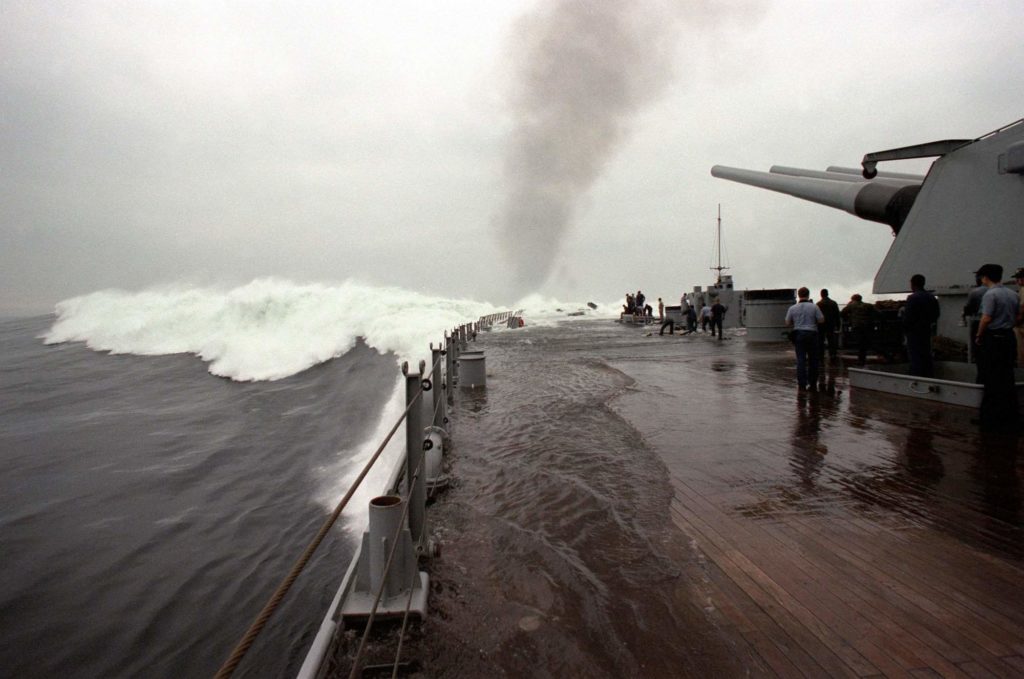
I have blogged about the Bismark more than once and the effect that the ship had on the German psyche and the British, especially when Bismark sunk the Hood. HMS Hood was a prewar battlecruiser that was the pride of the British fleet and was sunk in a 15 minute battle with the Bismark with 3 people that survived the Hood sinking.
"Sink the Bismark" (later "Sink the Bismarck") is a march song by country music singer Johnny Horton and songwriter Tillman Franks, based on the pursuit and eventual sinking of the GermanbattleshipBismarck in May 1941, during World War II. Horton released this song through Columbia Records
in 1960, when it reached #3 on the charts. As originally released, the
record label used the common misspelling "Bismark"; this error was
corrected for later releases of the song. It was inspired by the 1960
British war movie Sink the Bismarck! and was in fact (with the producer John Brabourne's approval) commissioned from Johnny Horton by 20th Century Fox
who were worried about the subject's relative obscurity. While the song
was used in U.S. theater trailers for the film, it was not used in the
film itself.
I am taking a bit of a break from the stupidity going on from the Charlotteville stupidity and the resulting fallout. I had watched a show on netflex last weekend and it was talking about finding the H.M.S Hood and it talked about the cruiser and the effect the sinking had on British Morale. Well anyway the show also had them looking for the S.M.S Bismark. They had touched about the Fairey Swordfish finding the Bismark and the torpedo attack that jammed the rudder and forced the Bismark back to the British ships that were trying to catch them.
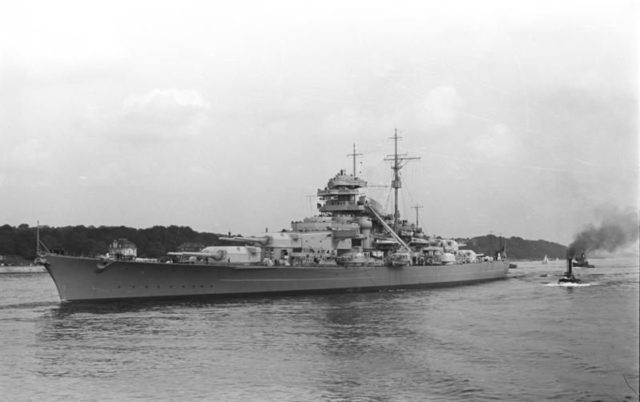
The German battleship, Bismarck, was one of the biggest vessels ever built in the first half of the 20th
century. A marvel of advanced engineering and technology, it was the
most powerful ship in the world – yet a single shot by an antiquated
biplane took it down.
At 792’8” in length, and with a beam of 118’1”, it displaced 49,500
tons of water. It was also deadly with eight 15” SK C/34 guns in four
twin turrets, twelve 5.9” L/55 guns, sixteen 4.1” L/65 guns, sixteen
1.5” L/83 guns, and twelve 0.79” anti-aircraft guns, as well as four
Arado Ar 196 reconnaissance floatplanes.
Bismarck in 1940. Photo Credit.
Its function was to destroy Allied convoys in the Atlantic, the
lifeblood of Britain. On the 18th of May 1941, it set off under Admiral
Günther Lütjens and Commander Ernst Lindemann, accompanied by the light
cruiser, Prinz Eugen. Three days later, they were spotted near Bergen, Norway.
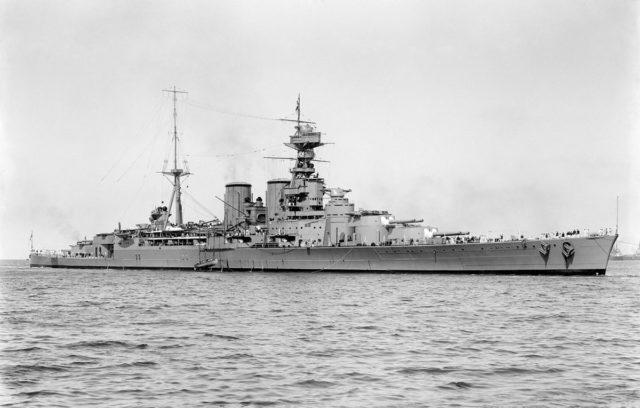
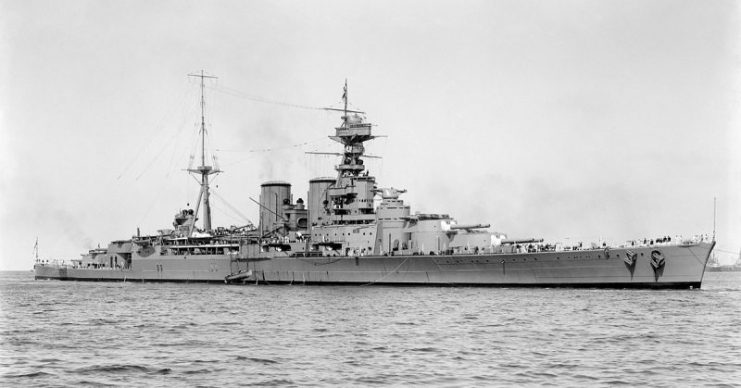
The British sent out the HMS Hood. Launched in 1918, it
measured 860’7” in length and 104’2” at the beam. It had been upgraded
in 1939, but not enough. More had to be done, but the war’s outbreak
forced the Hood to patrol Iceland and the Faroe Islands to keep the Germans at bay.
HMS Hood.
When first commissioned, it was the biggest and fastest warship in the world, securing Britain’s grip over her colonies. The Hood, therefore, represented the height of British technology, naval power, and imperial might – making it a beloved icon.
With it went the HMS Prince of Wales (PoW), which
was more up-to-date. Unfortunately, the technology was so cutting-edge
that much of it was untested. It had ten 14” guns, but eight were housed
in malfunctioning turrets. The Royal Navy knew this, but the Bismarck’s sighting had forced their hand.
The Hood and the Bismarck were almost evenly matched. Both had eight 15” guns that could shoot 1,700-pound shells over 15 miles. But the Hood could only fire two shells a minute compared to the Bismarck’s three. The latter was also more heavily armored, while the Hood was less so because it was designed for speed.
The British tried to reach the Denmark Strait before the Germans so
they could “cross the T” before them. This strategy requires positioning
the length of one’s ship to the front of an enemy ship, since ships
have more guns at their sides than they do at the front. The one who
crosses the T can then fire more salvos than the one who gets crossed.
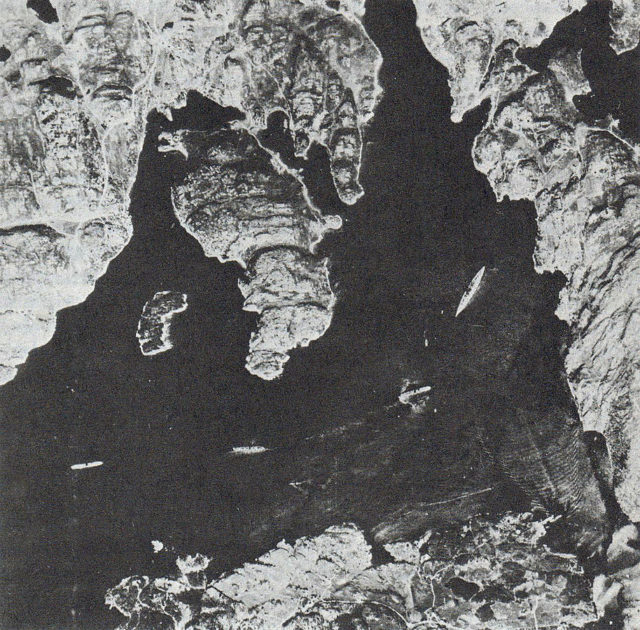
Aerial reconnaissance photo taken by Flying Officer Michael Suckling shows Bismarck anchored in Norway.
But the Hood and the PoW got there too late before
dawn on May 24, so it was the Germans who crossed the British T off the
western coast of Iceland. The Hood was sunk at a little past 6 AM and the PoW had to retreat after suffering extensive damage.
Before it did, however, it managed three solid hits – puncturing the Bismarck’s fuel tanks and flooding its front lower decks with seawater. So the Bismarck headed toward Nazi-occupied France for repairs and since the Prinz Eugen could do nothing more, it headed off toward the Atlantic. Despite the damage, the Bismarck was still heavily armed and the captain felt confident about reaching France by dawn on May 27th.
Twenty-one British destroyers, thirteen cruisers, six battleships,
and two aircraft carriers gave chase… but the German ship had vanished.
On May 26 at 10:30 AM, the Bismarck was found a mere 700
miles off the French coast. In another 500 miles, the sea and air would
be filled with German ships and planes – so a British fleet closed in
from the north, while another came in from the south.
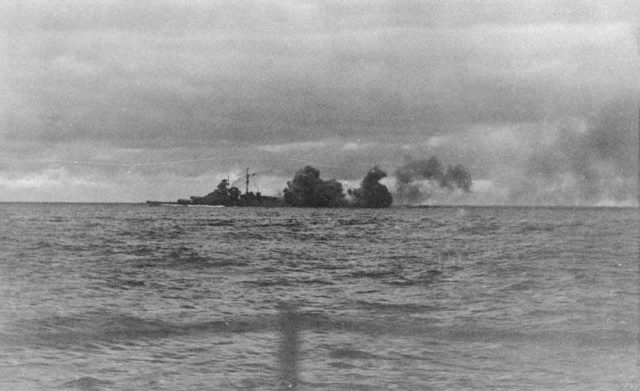
Bismarck firing her main battery during the battle. Photo Credit.
At 7 PM, fifteen Fairey Swordfish torpedo bombers took off from the HMS Ark Royal
and split into three groups to attack. Lieutenant-Commander John “Jock”
Moffat flew one of them. As he broke through the cloud cover, he was
awed at the sight of the German behemoth.
The Swordfish plummeted at 115 miles per hour. The Bismarck
desperately filled the air with flak, so the pilots dived even lower,
hugging the water and hoping the ship’s guns couldn’t aim that low. In a
worst case scenario, they might just survive a sea crash.
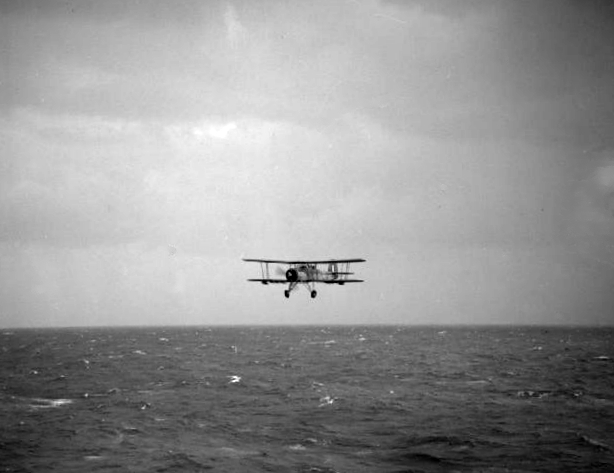
A Swordfish returns to Ark Royal after making the torpedo attack against the Bismarck.
At 2,000 yards, Moffat prepared to launch his only torpedo, when he heard a voice, “Not yet, Jock! Not yet!”
Moffat jerked and looked around. It was his Observer,
Flight-Lieutenant JD “Dusty” Miller. The man was standing on the right
wing with his butt in the air, head somewhere below the plane’s belly.
Moffat understood. The sea was rough. If his torpedo hit the crest of
a wave, it could veer off course. Miller wanted to make sure it fell
into a trough so their only weapon had a chance. But the longer they
took, the greater their chances of getting hit.
“Let her go, Jock!”
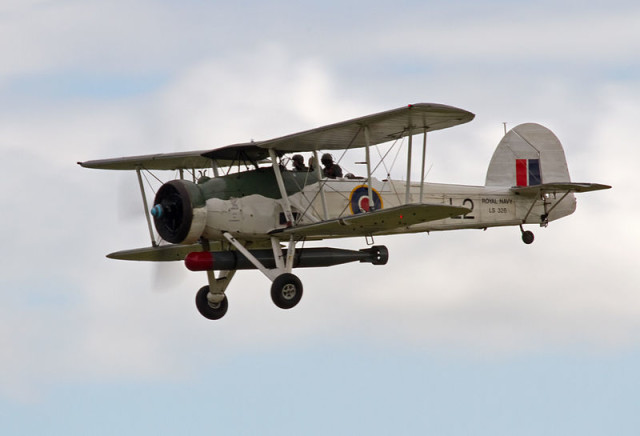
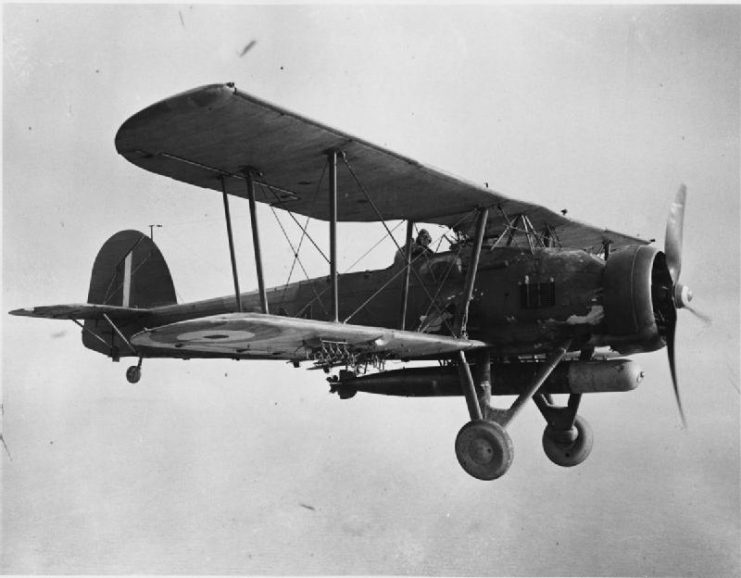
The
Fairey Swordfish biplane torpedo bomber LS326 built in 1934. It has
been refurbished and was photographed in flight on 1 July 2012. Photo Credit.
Moffat released his torpedo.
“We’ve got a runner!” Miller screamed.
The Bismarck turned left sharply – a mistake. The torpedo
hit the left rear, tearing a hole through the hull and causing rivets to
pop off the bulkhead. The ship’s twin rudders, angled for the turn,
jammed. Power died, forcing the engineers to restart everything.
Mechanics tried to fix the rudders, but too much water was rushing in.
With rudders stuck at 12° to port, the Bismarck turned around and
headed back toward the British fleet. Within minutes, it was turning
around in circles. Lütjens informed Berlin and vowed to die fighting.
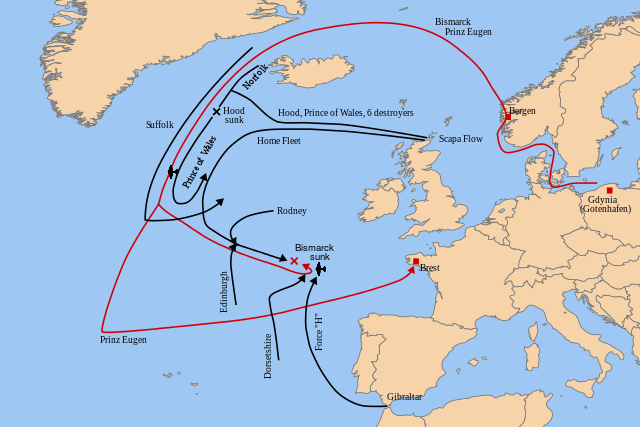
Map showing the course of Bismarck and the ships that pursued her. Photo Credit.
The British showed no mercy. They surrounded the Bismarck,
forcing it to fire in all directions. Unable to maneuver, it became a
sitting duck and ran out of ammunition at 9:31 AM the next day. Despite
the lack of return fire, the Royal Navy kept up their barrage till it
sank at 10:39 AM.
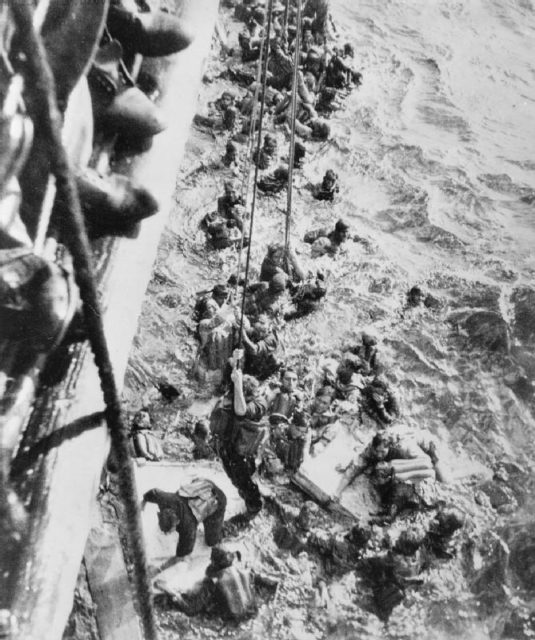
They did try to rescue survivors, but a U-boat scare forced them to
retreat with only 115 Germans (out of 2,092). The rest were left to
their fate. Germany only found out about the sinking from a News Network
at around noon. By the time they reached the scene, only five more men
were alive to be retrieved. But not Lütjens. He kept his word, as did
Lindemann.
Thanks to an outdated biplane, the Bismarck’s only combat
mission lasted a mere 215 hours. From that moment on, naval warfare
changed forever. The plane was now as important as the ship in naval
warfare.
I have several "Historical" posts in the works, I also have one that that talks about the drug use and the American troops in Vietnam, but that one I will have my Dad "Proof" the article since he was an MP his first tour and "El CID" his second tour and he knows a lot about the subject. I know that I occasionally make mistakes on my historical stuff but I try to be accurate when I can. This one comes from the German Front of WWI. I have blogged on several articles about the Germans in WWI and the "Interwar" period.
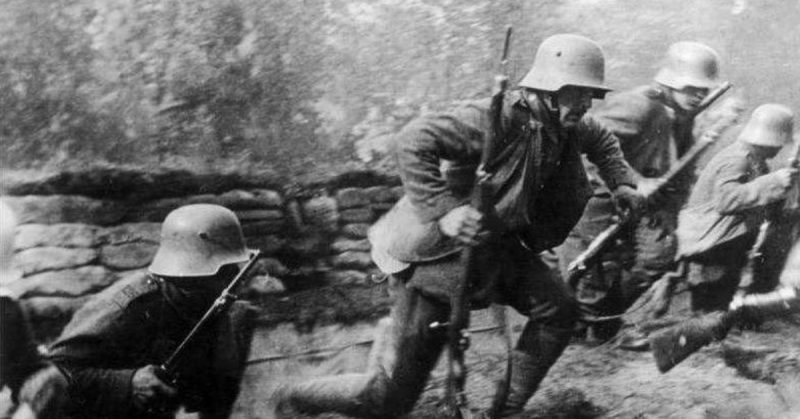
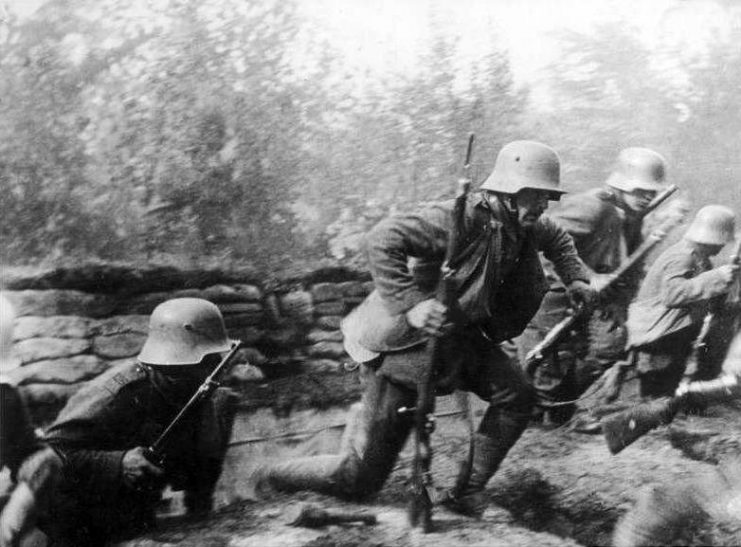
German Assault Troops getting ready for a raid on the trenches of the Allies
In recent years, the term “stormtrooper” has come to mean something out of the science fiction world of Star Wars.
It wasn’t an accident that George Lucas used the term. Before his
movies, the word was used to describe the men of the SS, Hitler’s
fanatical bodyguards.
But it was also no accident that Hitler and others used the word to
describe his elite unit. In the front lines of WWI in 1918, where Hitler
was a runner in the trenches, the new and innovative German infantry
units dubbed “Sturmtruppen” led the last great German offensive of the
war.
Otto Von Bismark taking the oath of allegiance from the various states of the German nation to form the NAtion of Germany. After soundly trouncing the French in the Franco-Prussian War in 1970 where Bismark was the architect of the stunning victory over the hated French.
In the Romantic Era of the late 19th century that saw Germany become a
united nation, the word “storm” was popular. It denoted power and
impending doom. Nothing could have described the German troops of 1918
better, but the truth is, these specially trained German soldiers were
not the only “stormtroops” of the war.
Italy had its “Arditi” – “the Ardent Ones,” and elements of the
British Lancashires actually referred to themselves as “stormtroops” and
underwent specialized small-unit training towards the end of the war,
as a way to (hopefully) break the log-jam of trench warfare, which was
not only costly but also kept each side from its larger objectives.
Other nations such as Canada and Austria experimented with similar
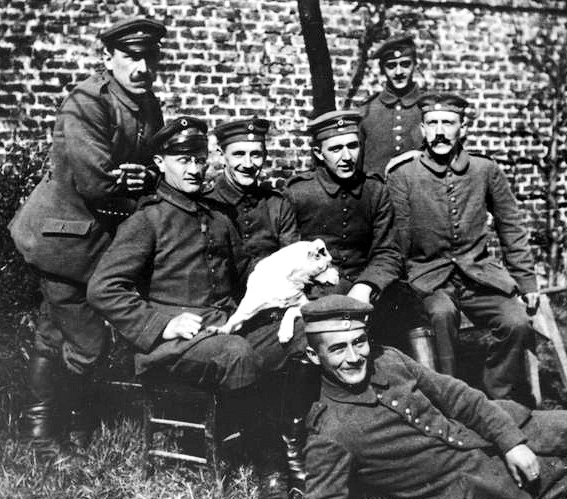
ideas. Hitler
(far right, seated) with his army comrades of the Bavarian Reserve
Infantry Regiment 16 (c. 1914–18)
The impetus in developing new infantry tactics came from the bloody
stalemate of trench warfare and the new weapons of war which made it
necessary, primarily the machine-gun. It is an axiom of warfare that
armies tend to fight their next war the way they fought their last.
Though infantry weapons had become much more deadly in the late 18th
century, men still organized themselves on the battlefield as if they
were on the parade ground. This was primarily to increase firepower and
casualties on the enemy, but also was because many of their officers
were not capable of maneuvering troops freely outside of formation.
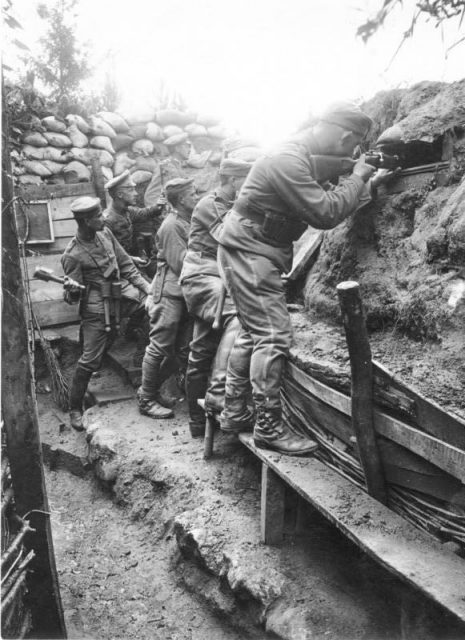
The result? The hundreds of thousands of men cut down in rows by machine guns. German soldiers of the 11th Reserve Hussar Regiment fighting from a trench, on the Western Front, 1916
This went on for years, but behind the scenes, even in 1915, the
Germans were working on training specialized units in new tactics and
weapons. In this, the Germans had a significant advantage and head start
over their rivals: their command structure.
Though the stereotype of the German soldier is one that rigidly
obeyed orders like an automaton, this in many ways was far from the
truth. Long before other nations developed the modern infantry tactics
of today and the type of command and control necessary to coordinate
them, the Germans were innovating them.
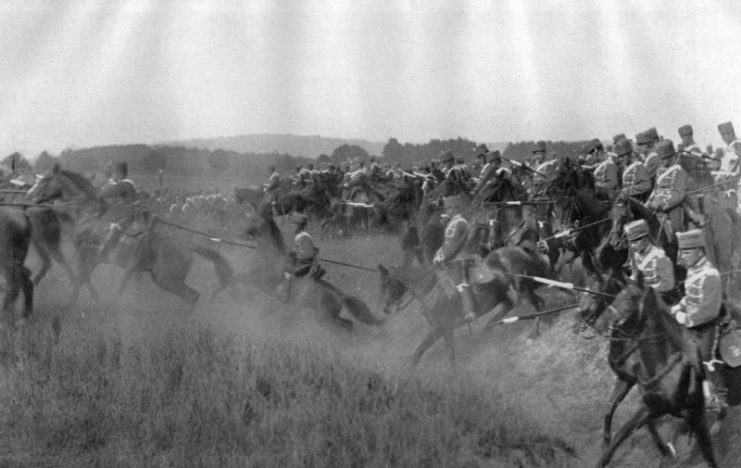
German Army hussars on the attack during maneuvers
Basically speaking, years before most of the other great powers, the
German army trained each man, from the bottom to the very top, in the
job of the man one rung higher than him on the ladder.
For example, should a sergeant fall on the field, the corporal under
him would have not only trained as a corporal but would have known the
sergeant’s job as well, and thus could fill his role. The sergeant would
have known the lieutenant’s job, etc., up to the top.
This sounds completely mundane today, but in 1914-1918 this was
pretty unheard of – you didn’t learn the job of the man above you until
you had earned it.
The Germans’ departure from that mindset meant that in the chaos of
battle, the death of one man might not stop an attack in its tracks. Of
course, this is an oversimplification, but the German Army showed a
great deal more flexibility in this regard than any of its foes. German
soldiers (wearing distinctive pickelhaube helmets with cloth covers) on
the front at the First Battle of the Marne during World War I
Another factor that contributed to the development of stormtroop
tactics in 1918 was another idea that seems to run counter to the image
of the German/Prussian military man as a mindless military machine.
From the top down, officers and men were given objectives, and
perhaps a framework to work within, but within each planning stage, all
the way down to squad level, officers and men were (generally)
responsible for working out a plan at their level for achieving their
objective.
For example, a captain commanding a company might be given the
assignment of capturing a small town. How he did this was up to him –
given the equipment allotted to him, timetable, etc. Typically, he would
assign each platoon commander an objective and they would work out with
their sergeants (and they with their corporals, and so on) how they
would go about the attack.
In many of the other armies of 1914, generals and colonels with no
knowledge of the objective would plan out the assault for company
commanders and very little deviation was allowed. Today the German idea
does not sound revolutionary at all, but back then it was, and it laid
the foundation for modern infantry tactics.
Some German gear from WWI
In the spring of 1915, a German unit was developed under the name
“Sturmabteilung” (“Assault Section”). Yes, this was the same name given
to Hitler’s early “Brownshirts” or “SA,” many of whom had served in
these type of units during the war. Later, as the unit grew, it was
referred to as a “Sturmbataillon” and the men within it as
“Sturmtruppen.”
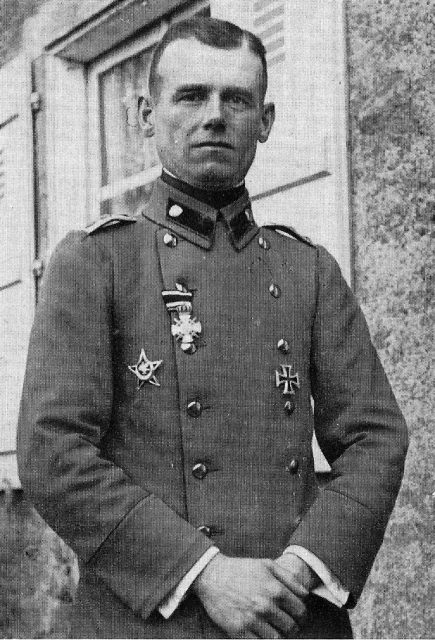
In charge of training this group of men was Captain Willi Rohr, who
had been in the army since he was 14 years old. He had come up through
the ranks and had also served in a specialized “Jäger,” or “Hunter,”
division. Captain Willy Rohr, Commander of Storm Battalion No. 5 (Rohr).
The Jäger were specialized troops that operated in forests and woods,
and many of the men within them had been gamekeepers, hunters, and even
poachers. They had different and camouflaged uniforms before most of
the rest of the German Army did, and had a strong esprit de corps.
They were also given a much greater degree of autonomy than many
other troops since they would be out of the reach of communications for
days or weeks at a time. The wooded areas in which they drilled and were
deployed also called for a more flexible formation strategy. All of
this evolved into the first stormtrooper units.
Among the first changes that Rohr made were to the units’ field
artillery. Many German units had organic artillery within them, both of
relatively small caliber: 37mm and a heavier 3-inch (7.5 cm) support
gun. Rohr and his men reduced the weight of both of these weapons,
making them much more portable. German
Stoßtruppen (stormtroopers) rising from trenches to attack
Rohr also changed the footwear of the men – instead of the
traditional jackboot we’re all familiar with, he equipped them with more
resilient and flexible Austrian mountain boots, which were lighter and
quieter as well. Different camouflage patterns were developed and the
uniform itself was equipped with elbow and knee patches made of cloth
and leather to help with crawling and to prevent injury.
German Uniforms of WWI
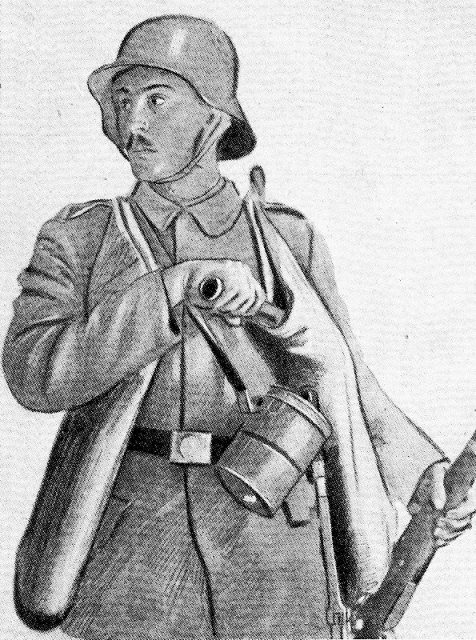
The most obvious changes came in the form of weaponry. First and
foremost, Rohr reached back into the past, using the old grenadiers of
the Prussian Army as a model. Like these men, his stormtroops would be
equipped with satchels full of grenades, making virtually every man a
walking arsenal.
The standard German infantry rifle, the famous Mauser 98k, was made
lighter and shorter for easy movement and firing. Later in the war, the
stormtroops were the first to receive sub-machine guns, those weapons
whose development was owed to the need to clear trenches. Shotguns were
also deployed. Stormtrooper of the Assault Bataillon Rohr
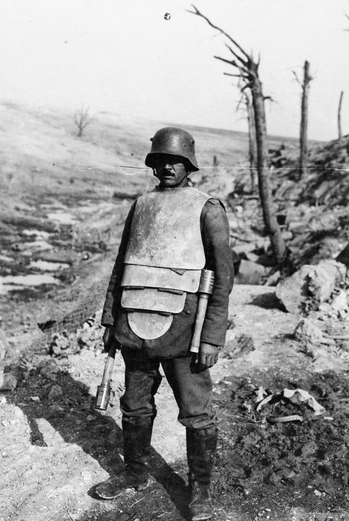
Rohr initially developed body-armor, but the materials of the time
were too heavy and impeded movement, and fast movement combined with
overwhelming violence was key to the stormtroops’ success. Other
nations, particularly the Italians, did develop and used body armor.
One piece of equipment did stay and was eventually used by the entire
German army – the coal scuttle helmet, which provided much greater
protection than the spiked “Pickelhaube” helmet of the wars’ first
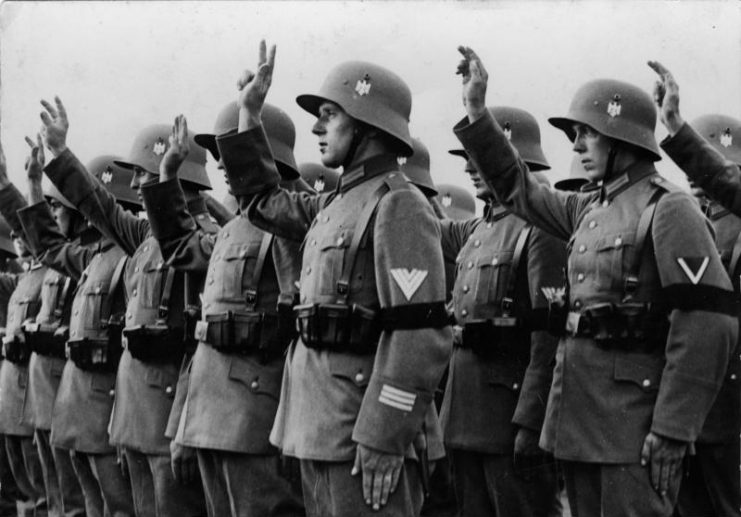
years. German Reichswehr soldiers wearing WW1 Stahlhelms. As I recall in this pic was when Adolph Hitler had the German Army swear personal loyalty to him instead of the German Republic
Rohr, and others such as future legend Erwin Rommel, developed
infiltration tactics designed to surprise and overwhelm the enemy. They
realized that the hours-long artillery bombardments that took place all
along the line didn’t inflict the desired casualties, but did alert the
enemy of a pending attack.
Accordingly, Rohr and the subsequent stormtroop units either gave up
the barrage entirely, or focused a short and intense barrage on the one
part of the line they were planning to assault. Sometimes this was a
ruse, and the units used the noise down the line to cover their
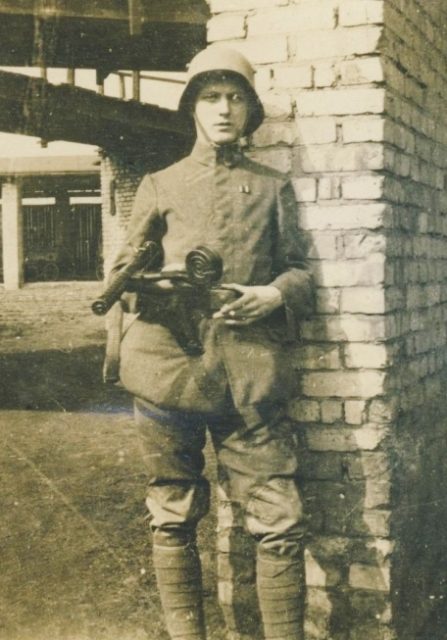
movements while attacking elsewhere. Soldier of a German stormtrooper assault group with his Bergmann MP18.1 and a Parabellum P08, Northern France, Spring 1918.
As in WWII 20-some years later, the men of the stormtroops attempted
to seize the weakest part of the enemy line, break through, and assault
the rest of the enemy position from the rear. The men would be right
behind the barrage, which became known as a “rolling barrage” when the
British used the tactic in the last part of the war.
Before the enemy could recover their senses, the stormtroops were on
them, using their grenades, shotguns, machine-guns and small field
artillery under direct fire. Once in the trenches, the men of the
stormtroops used their own brutal and primitive armament: clubs with
nails, medieval spiked maces, trench knives with grooves and skull
crackers, and of course, the sharpened shovel. A German stormtrooper on the Somme wearing a body armour. Note two potato mashers-grenades he is armed with.
In the spring of 1918, General Ludendorff launched the last German
offensive of the war. Leading the way were the stormtroops, many of whom
infiltrated enemy lines before the main attacks. For the first days of
the offensive, they caused shock and panic among the Allies, driving
them miles from the starting point.
However, as the offensive continued, attrition and exhaustion took
their toll on the men of Sturmtruppen and many of them simply collapsed.
In more than one case, deprived German troops, overrunning French
supply depots, filled themselves with bread, cheese, and gallons of
wine. The result? A lot of German POW’s.
The German Offensive of 1918 failed for a number of reasons, but the
tactics of the stormtroops live on today on almost every battlefield in
the world.
I remembered hearing this group on MTV back in the early days when MTV played music video's. I had forgotten this song until my Sirius/XM Played it and it jogged my memory. Well I almost went with Johnny Horton "Sink the Bismark" but decided to roll with an 80's song. I will probably go with Johnny Horton next week though.
Taking their name from a phrase in Pink Floyd's song, "Shine On You Crazy Diamond", the six-member band from Sacramento, California comprised- in its "classic" lineup- of Ric Jacobs (vocals), Ken Goorabian and Waylin Carpenter (guitars), Rod Toner (keyboards), Vinnie Pantaleoni (bass guitar), and Barry Lowenthal (drums) released their self-titled debut album in 1982 on RCA Records. "You Don't Want Me Anymore," the first single from the album, quickly jumped into the Top 20 on the Billboard Hot 100 supported by a video that was a favorite of early MTV, and peaked at #16. The next single, "Dreamin' Is Easy" also made it into the Top 40, but could not go higher than #30.
They had originally gotten together a few years earlier in a
different lineup and had enjoyed some local success with "You Don't Want
Me Anymore" with the hard work of manager John Wiseman, before catching
the ear of producer Kim Fowley and attorney David Chatfield, who recorded the band's first album at Rusk studios in Hollywood and got Steel Breeze their recording contract with RCA. Casey Kasem, on the March 12, 1983 edition of American Top 40, describes how Fowley discovered Steel Breeze while going through approximately 1200 demotapes
that were about to be discarded by a local Hollywood night club, Madam
Wongs. Chatfield and Fowley flew up to Sacramento and signed the band
after Chrysalis Record executive Tom Trumbo told Chatfield he was
looking for a band like Journey. Chatfield left Trumbo's office and went
to Fowley's home where Fowley pulled out the Steel Breeze demo of "You
Don't Want Me Anymore," which they both knew was a hit.
The band's lineup has shifted considerably since the release of the
debut album, with keyboardist Rod Toner remaining in the band the
longest of anyone from the classic lineup days. In 1984, Steel Breeze
(now with ex-707 vocalist Kevin Chalfant and keyboardist Loren Haas as members) released their second album, Heart On The Line on an independent record label, but the record went unnoticed despite guest appearances by Bruce Springsteen's saxophonist, Clarence Clemons and Santana's vocalist, Alex Ligertwood. Five years later, a third Steel Breeze album, Cry Thunder
came out with Bobby Thompson on vocals, Rick Lowe and Robbie Bickford
on guitar, Toner on keyboards and Paul Ojeda on drums. In 1991, Still Warrior was released with yet another lineup, just as Chalfant had a small hit with a similar act, The Storm. In 1994, Peace Of Mind was issued.
The first time I heard of this airplane,was when I read a book called "Sink the Bismark" by CS Forester,
My copy was printed in 1976, I bought it from the Stars and Stripes bookstore in Frankfurt Germany where my Dad was stationed at.
The
Second World War was a period of greatly accelerated development in the
field of aviation: this was the first war in which jet fighters were
used, and bigger bombers than the world had ever seen rained down death
from the skies.
It is tempting to think that these types of airplane – the biggest,
fastest, most powerful, most technologically advanced models – were
solely responsible for winning the air war.
However, in focusing entirely on the flashiest, most impressive
planes, it’s easy to lose sight of the plainer, simpler and smaller
aircraft that played an equally important role in the Allied victory.
One of these models was the Fairey Swordfish, nicknamed the “Stringbag,”
a basic torpedo bomber biplane used extensively by the Fleet Air Arm of
the Royal Navy during WWII.
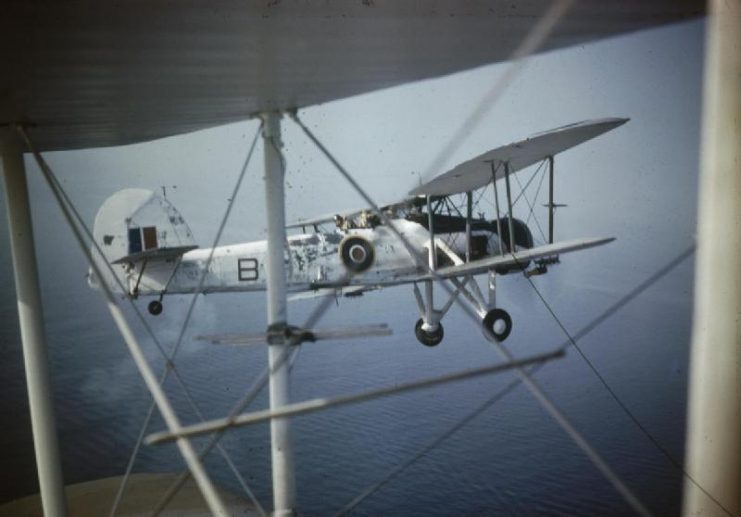
A Swordfish I during a training flight from RNAS Crail, circa 1939–1945
It was one of these humble planes that, reminiscent of Luke Skywalker taking out the Death Star in Star Wars,
managed to disable one of the German Kriegsmarine’s most gigantic
ships. Another Stringbag was also the first Allied plane to sink a
German U-boat, and then later yet another of these unassuming airplanes
was the first to sink a U-boat at night.
Stringbags also relentlessly harried the Axis shipping fleet in the
Mediterranean, accounting for over a million tons sunk by the end of the
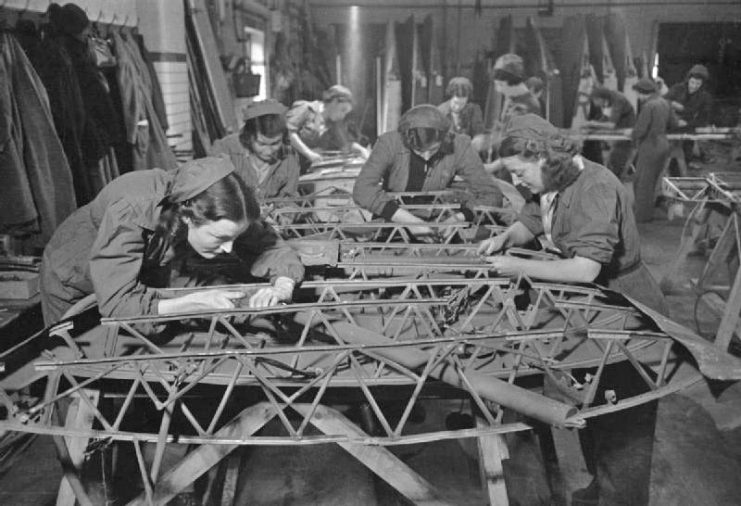
war – not a bad tally for an outdated biplane! Workers carrying out salvage and repair work on a wing of a SwordfishLooks and performance-wise, the Fairey Swordfish bore a much closer
resemblance to the airplanes of the First World War rather than those of
the Second. With its open cockpit, fixed landing gear and its pair of
stacked wings, by no stretch of one’s imagination could this humble
plane have been described as “cutting edge” even in 1933, when the first
prototype was built.
However, despite its outdated design, it was no less important to the
Allied war effort than its more technologically-advanced compatriots.
Indeed, the Swordfish’s antiquated appearance was deceptive – not so
much in terms of its flat-out performance, but rather in terms of the
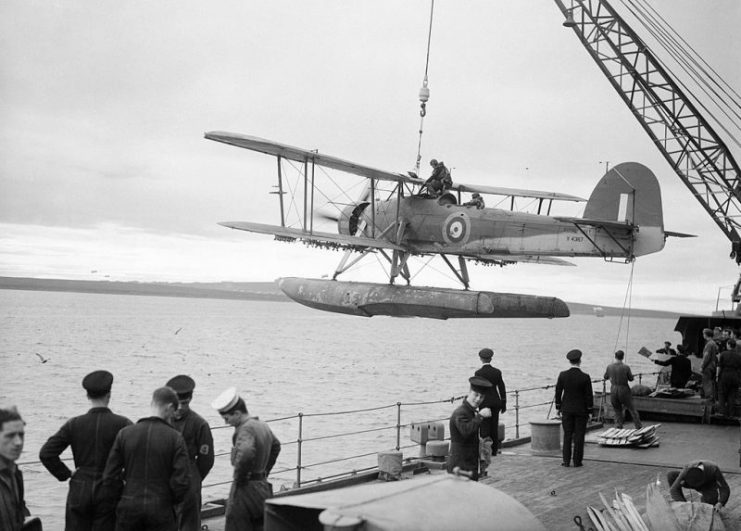
roles it was able to perform. A Fairey Swordfish floatplane being hoisted aboard the battleship HMS Malaya in October 1941
In addition to being armed with two basic but reliable 7.7mm machine
guns, one fixed in position for the pilot in the front and one trainable
at the rear for the gunner, the Swordfish was able to carry a wide
variety of ordnance: anti-ship mines, depth charges, bombs, flares, or a
ship-sinking 1,610-pound torpedo.
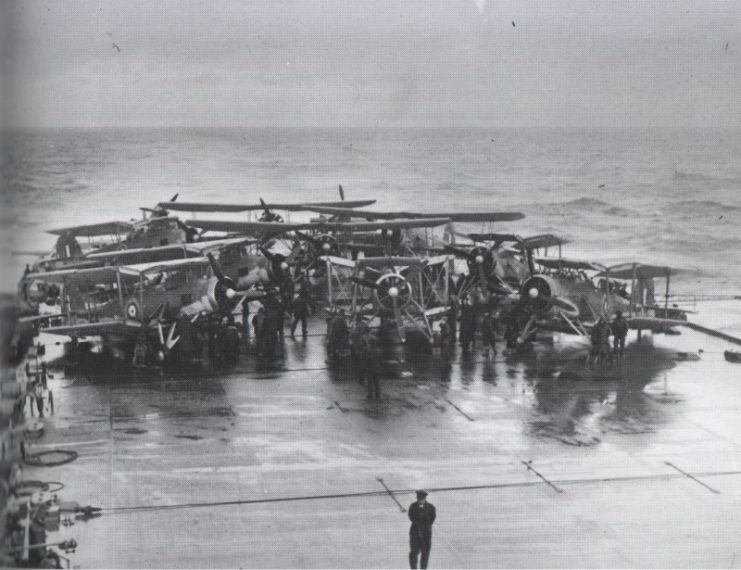
The plane was also used for a variety of roles, including reconnaissance, bombing, escort duty, or naval artillery spotting. Swordfish on the after deck of HMS Victorious, 24 May 1941. The next day, nine Swordfish from Victorious attacked Bismarck.
Because of the variety of ordnance the Swordfish could carry and the
diversity of its roles, it was given the nickname “Stringbag,” likening
the plane to a popular style in women’s handbags at the time. Humorous
as it was, the nickname was apt and it stuck.
As a basic three-seater biplane with a simple Bristol Pegasus motor
that cranked out 690-odd horsepower, the Stringbag wasn’t going to be
breaking any speed records in the air. However, the simple design meant
that maintenance of the aircraft was easy, and that the planes were
reliable. A Swordfish, circa 1943–1944
The twin wings meant that the Stringbag had an excellent lift and
could take off or land on a relatively short strip of land. This made
Stringbags perfect for use on naval aircraft carriers, with their very
limited landing and takeoff space.
Stringbags were also extraordinarily maneuverable, making up for
their slow speed with excellent agility. Their fabric-covered, all-metal under-structures were sturdy enough to deal with harsh landings, and
this meant that they were ideal for night use – an excellent advantage,
when they could fly all but invisible to Axis ships or other targets
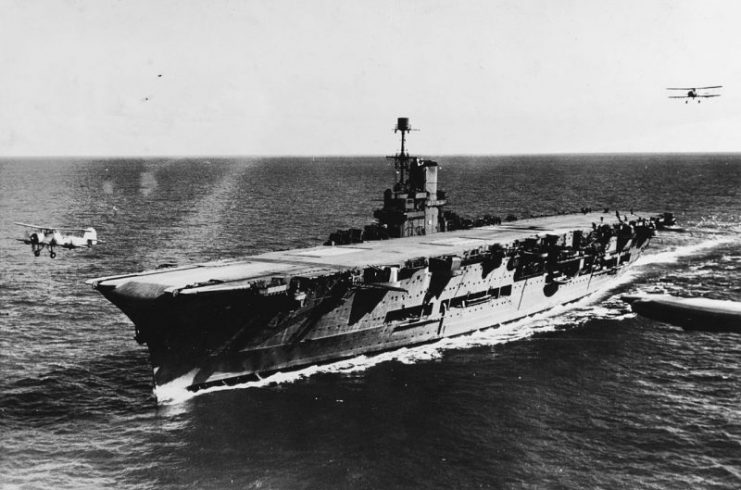
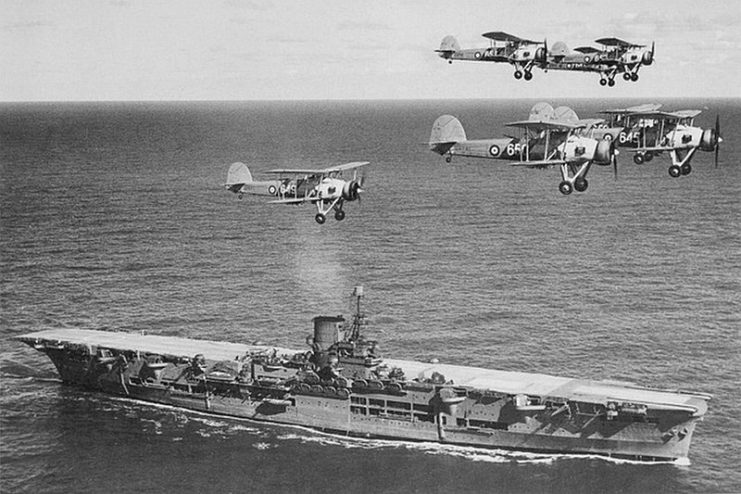
below. A Swordfish taking off from the aircraft carrier HMS Ark Royal, with another passing by astern, circa 1939
These planes weren’t without their disadvantages, of course. They
were at a severe disadvantage when it came to air-to-air combat against
Axis fighter planes, and the open cockpit meant that the men in the
plane would suffer immensely in the cold. Early in the war, Stringbags
didn’t have communication radios, so they had to rely on hand-held
signalling devices.
Nonetheless their advantages generally outweighed their
disadvantages, and Stringbags saw extensive use throughout the war. In
one of the most famous incidents in which they were involved, a
Stringbag was instrumental in the sinking of one of the Kriegsmarine’s
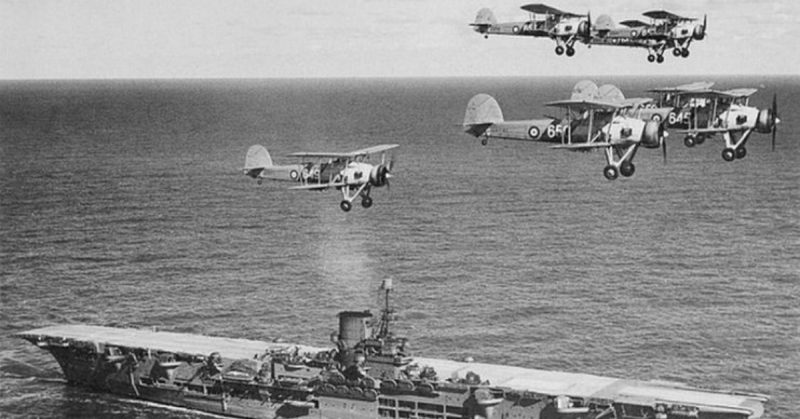
mightiest ships, the battleship Bismarck. The
Royal Navy’s HMS Ark Royal in 1939, with Swordfish biplane fighters
passing overhead. The British aircraft carrier was involved in the
crippling of the German battleship Bismarck in May 1941
The Bismarck was, at the time of its production, the most
powerful warship ever made. In a sortie into the Atlantic aimed at
crippling Britain’s crucial supply lines, the Bismarck battled and sank the British battle cruiser HMS Hood.
Realizing the Bismarck had to be stopped, Britain launched a pursuit, but the Bismarck managed to evade her pursuers. The only ship close enough to have a chance of disabling the giant was HMS Ark Royal,
which had a few Stringbags equipped with torpedoes aboard. The
Stringbags took off an hour before sunset on May 26, 1941 to take on the
German behemoth.
H.M.S. Hood
As the Stringbags, each carrying a single torpedo, approached the Bismarck
they dived low, hoping to evade the flak that filled the air from the
ship’s anti-aircraft guns. One Stringbag, piloted by Lieutenant
Commander John Moffat, got the Bismarck in its sights.
Moffat and his observer, Flight Lieutenant JD Miller, had to time the
release of their torpedo with extreme precision. They only had one
chance to do this, and if they missed or the torpedo hit the crest of a
wave in the extremely choppy sea, it was mission over. With flak flying
all around them, and Miller waiting for the exact moment, Moffat’s hands
were surely sweating on those controls. A
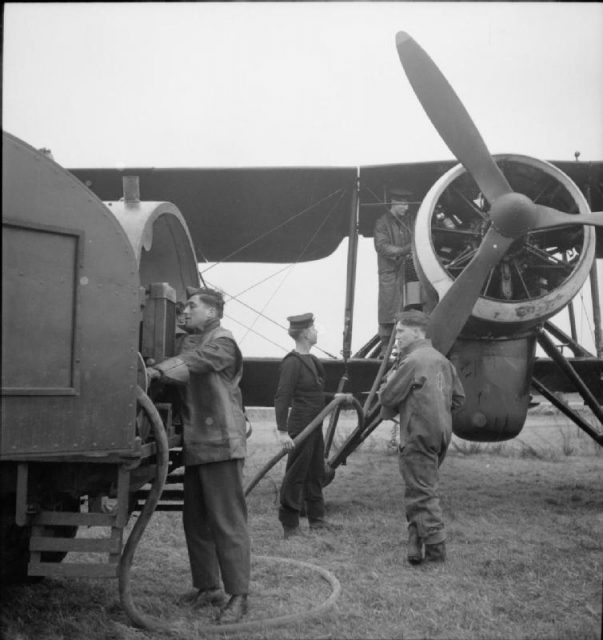
Swordfish III of RAF 119 Squadron being refueled at Maldegem, Belgium,
(1944–1945). The fairing of the aircraft’s centimetric radar can be seen
below the engine
Finally, the moment came, and the torpedo was dropped. Against all
odds it hit home, striking the mighty battleship in a small area of
vulnerability: the rudder, which the torpedo succeeded in jamming
mid-turn.
With her rudder jammed to port, and thus unable to move in anything but endless circles, the Bismarck became a sitting duck. British naval ships later surrounded the Bismarck and eventually sank her after extensive bombardment.
Stringbags also played a key role in the night attack on Italy’s
Taranto naval base. Two waves of Stringbags launched a surprise attack
on the naval base on the night of November 11, 1940, and succeeded in
destroying or disabling the bulk of Italy’s naval fleet – an attack that
would be carefully studied by the Japanese, who would use similar
tactics to attack Pearl Harbor.
Stringbags also saw extensive use in taking out Axis shipping lines,
especially in the Mediterranean, where they sunk over a million tons
throughout the war. All in all, this humble airplane proved its worth to
the British Royal Navy many times over during the course of WWII.
I decided to continue with the Johnny Horton with my Monday Music. Besides the "Battle of New Orleans" post I did last week, he also did a couple of other songs, I will probably do "sink the Bismark" next week. I remembered hearing this song as it was played on my dads record player.
"North to Alaska" is a 1960 hit song recorded by Johnny Horton which featured in the movie of the same name. Though Horton had sung several popular movie tie-in songs, this was the first one that was sung over the opening titles.
Written by Mike Phillips, "North to Alaska" topped Billboard magazine's Country Singles chart, reached number four on the Billboard Hot 100 chart and eight on Norway Singles Chart. Members of the Western Writers of America chose it as one of the Top 100 Western songs of all time.
Horton died in an automobile accident shortly after the song was released.
I am still busy, but I was taking a break from studying and was doing a bit of surfing and ran across this article and thought it was very neat and it had a lot of pics I have never seen before. I hope to continue blogging over the weekend of all goes well:) I still would like to see one of those ships to be recommissioned but with the lethality of today's missiles I am not sure that the battleships would survive and the swarm of missiles that the Chinese opposing force would launch. I am a student of History and I see parallels between the Iowa's and another famous ship that represented a country and a navy during the Prewar Years.
The "Mighty" Hood
H.M.S Hood flew the flag and was the embodiment of the British Empire during the prewar years and unfortunately by the time WWII rolled around, the Hood was very obsolete. She was due for upgrades in Armor, fire control systems and anti-aircraft defenses in the late 1930's, but the bean counters put off the upgrades that would have most likely saved the ship when she fought the Bismark in the Battle of the Denmark Strait and was destroyed by an explosion that was endemic of the British Battle Cruisers. The British knew of the flaw since Jutland but never fixed the problem.
From the time that USS Iowa was laid down in 1940 until today, the
Iowa class battleships have been around for 78 years. During that time,
the ships underwent many changes to help them adapt to the type of
conflict they were engaged in. In this article, I gathered a number of
photos from those years and organized them into this collection. They
help to show how these warships looked throughout their long and
illustrious careers.
Iowa Class Battleships From 1940 to Present
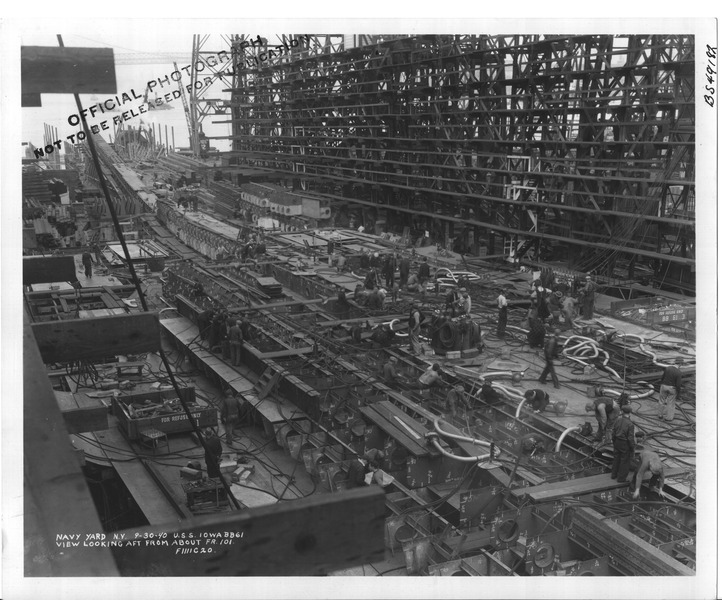
September 30, 1940. Workers lay out the bottom hull plates for the
battleship USS Iowa (BB-61) about one month into her construction. Iowa
would be the leadship for a new class of battleship design was free of
the limitations imposed by the Second London Naval Treaty.
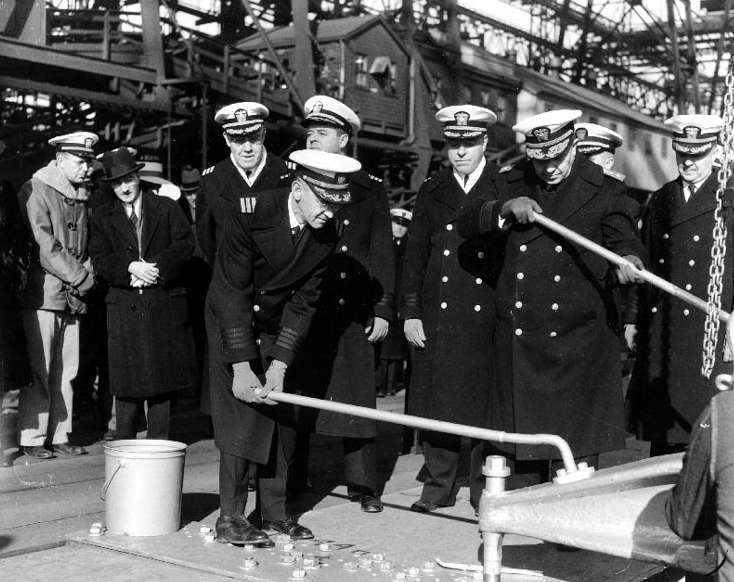
1941. The ceremonial driving of the first rivet for the battleship USS Missouri.
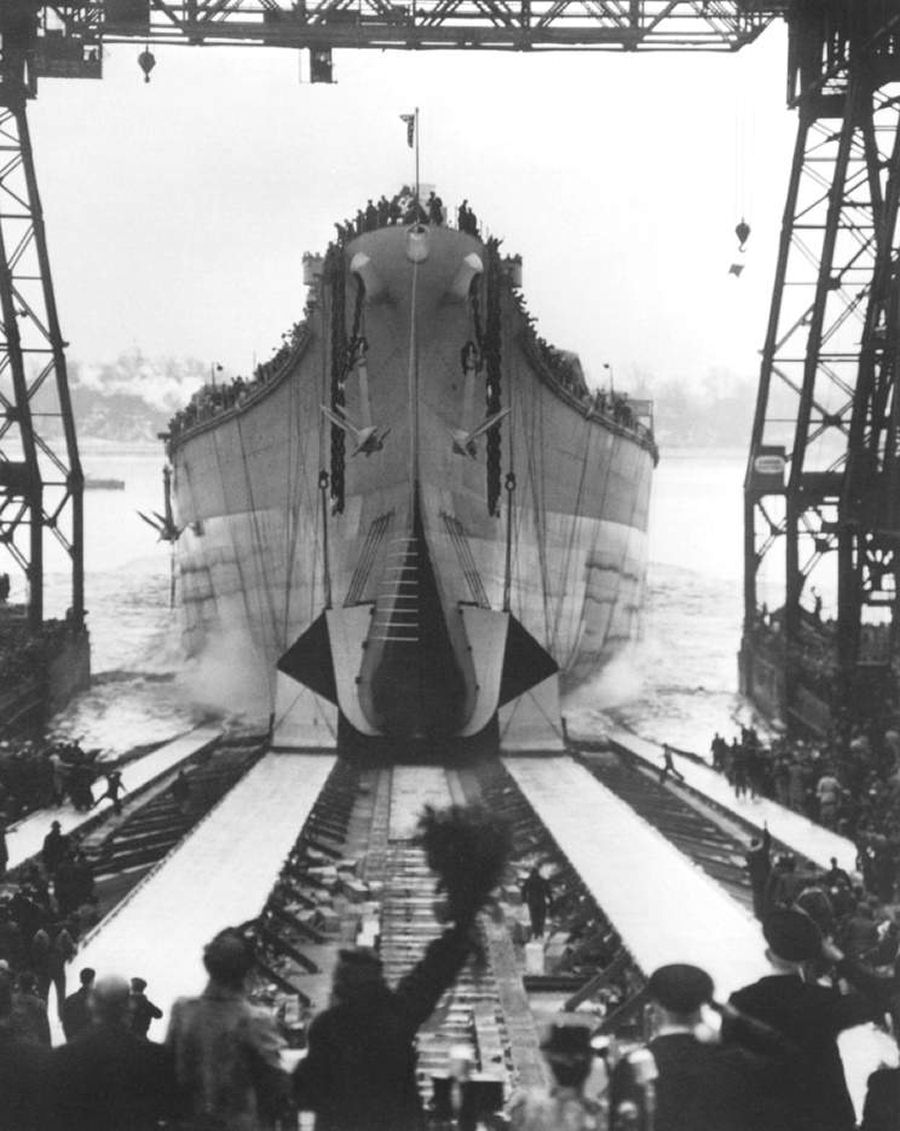
December 7, 1942. The Battleship USS New Jersey slides down the ways
on the one year anniversary of the Attack on Pearl Harbor. The day that
saw the loss of many battleship of the United States Navy now sees one
of its most powerful take to the water.
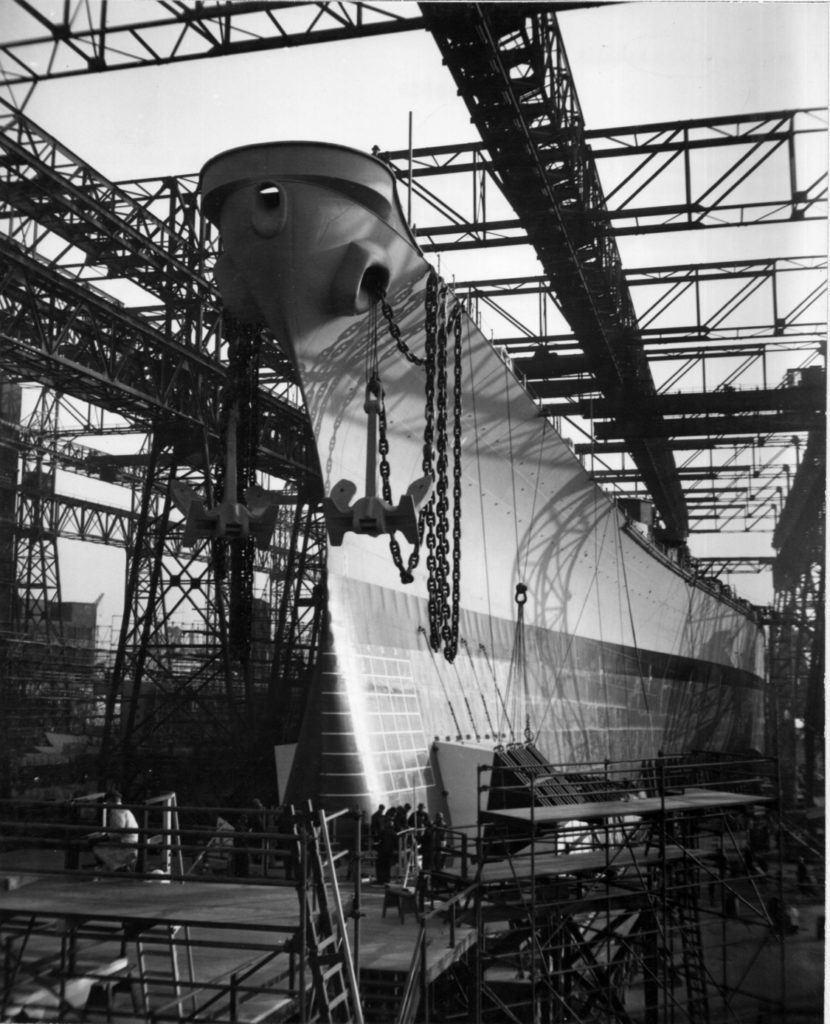
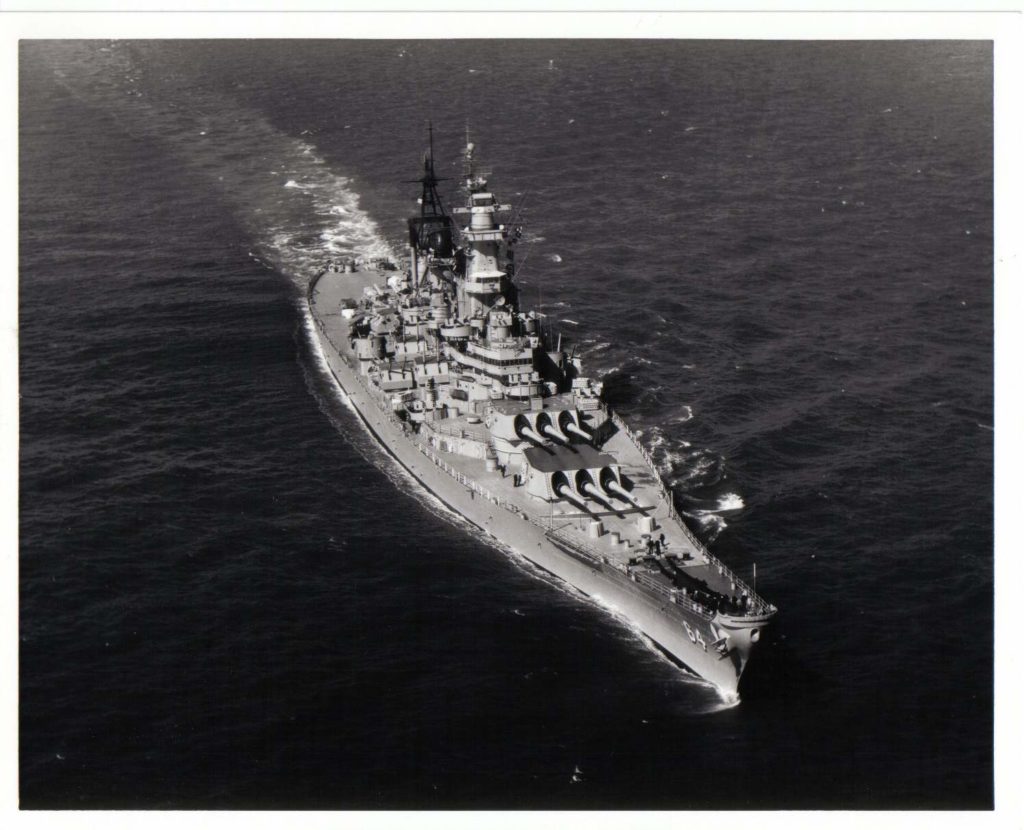
1943. The hull of the USS Wisconsin (BB-64) looks like she is ready
to take to the water. In a few months she would finally slide down the
ways during her christening on December 7, 1943.
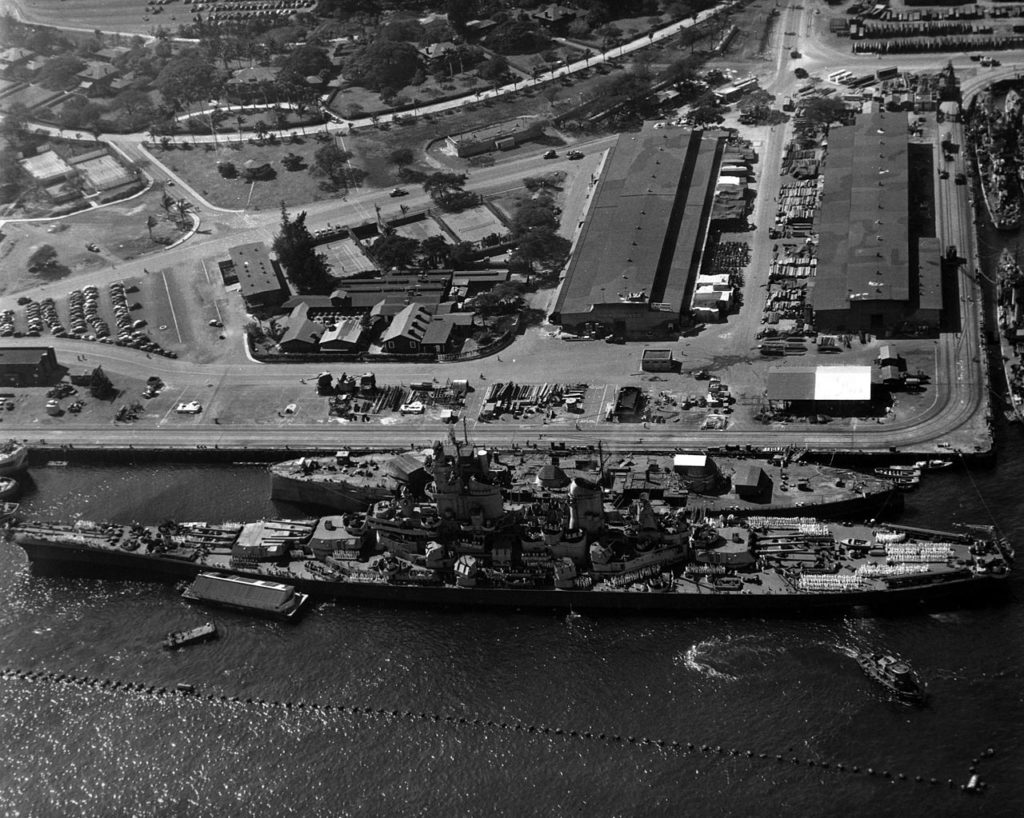
November 1944. USS Wisconsin (BB-64) ties up to the hulk of the
battleship USS Oklahoma (BB-37) while stopping at Pearl Harbor.
Wisconsin was 304′ longer than Oklahoma and displaced almost twice as
much. Oklahoma was sunk at Pearl Harbor three years earlier. Now it was
Wisconsin’s turn to go on the offensive as she headed to the front
lines.
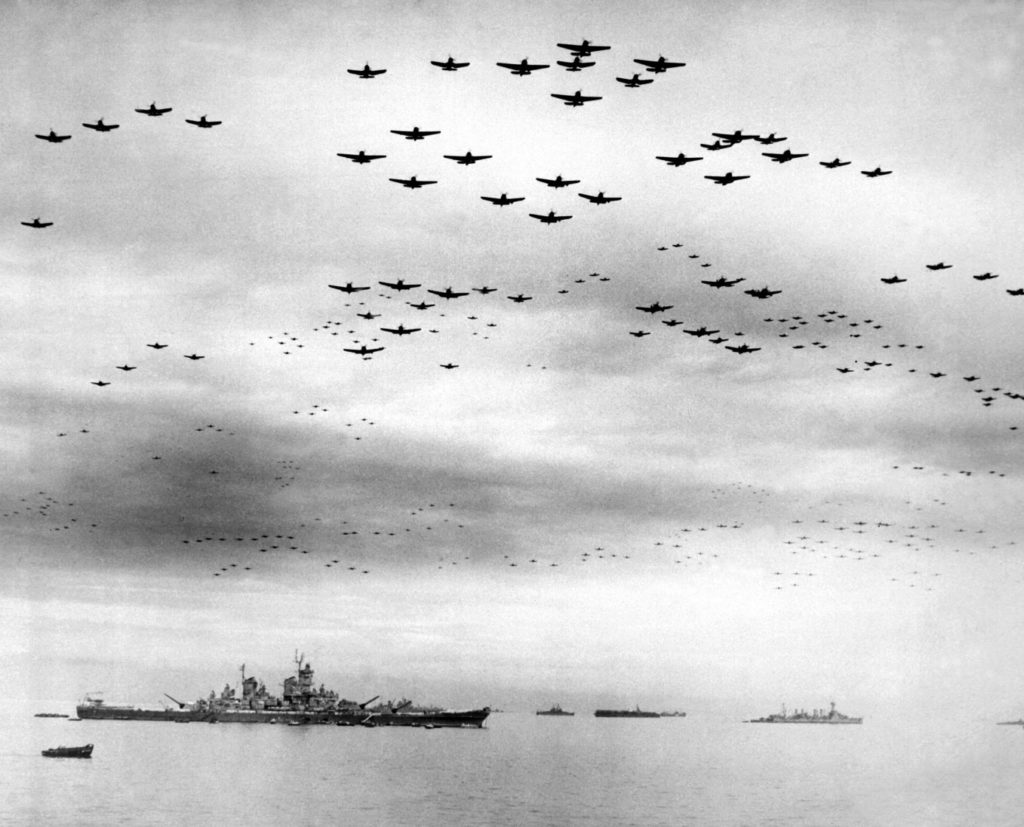
September 2, 1945. Swarms of aircraft fly over the battleship
Missouri (BB-63) during the surrender to the Allies by the Empire of
Japan.
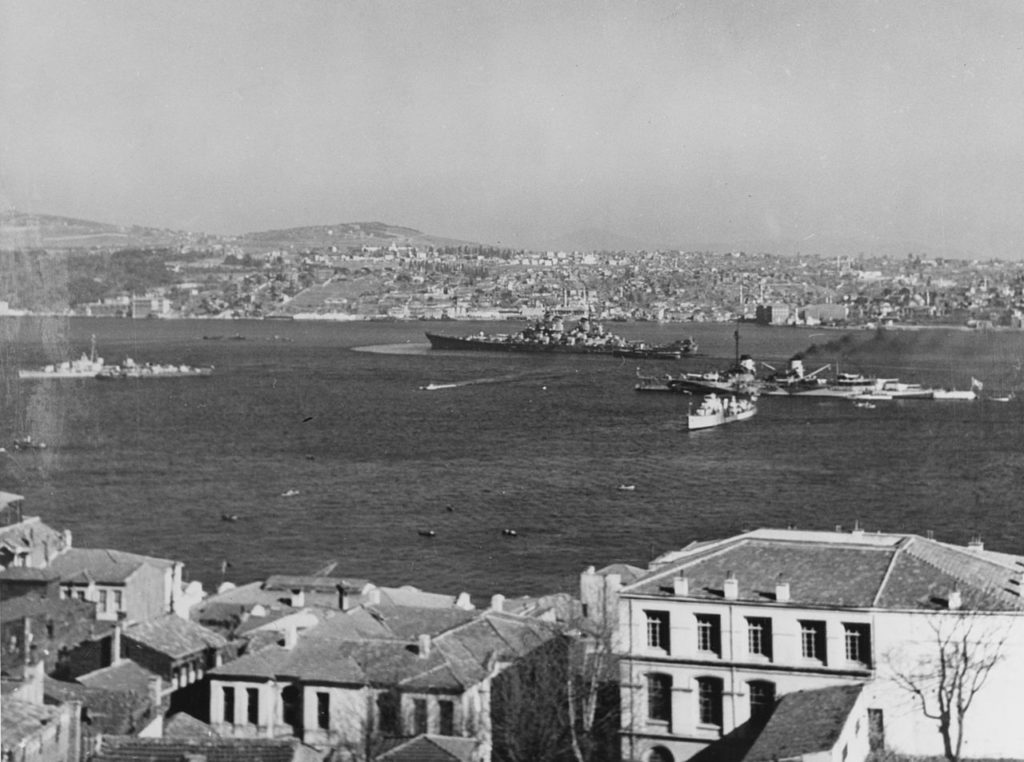
April 5, 1946. USS Missouri anchored off of Istanbul, Turkey. She
brought home the body of the Turkish Ambassador Mehmet Munir Ertegun.
She is accompanied by the Turkish battlecruiser Yavuz, formally the
battlecruiser SMS Goeben of the Imperial German Navy.
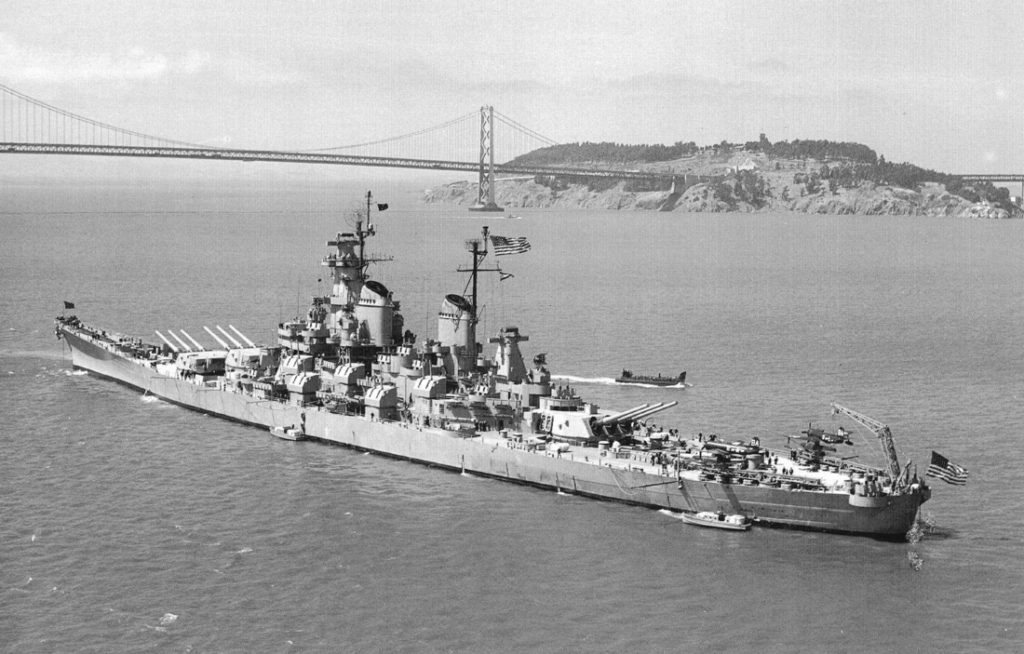
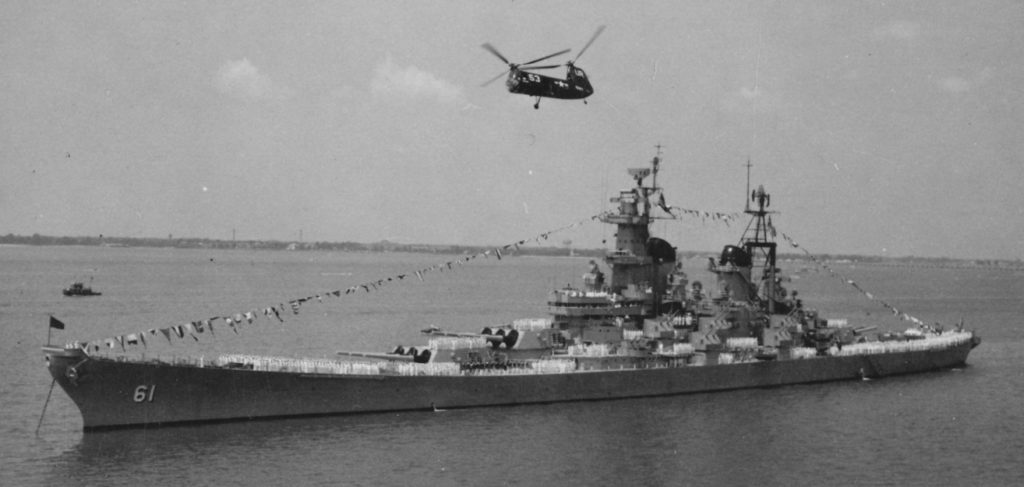
May 24, 1947. USS Iowa (BB-61) anchored in San Francisco Bay.
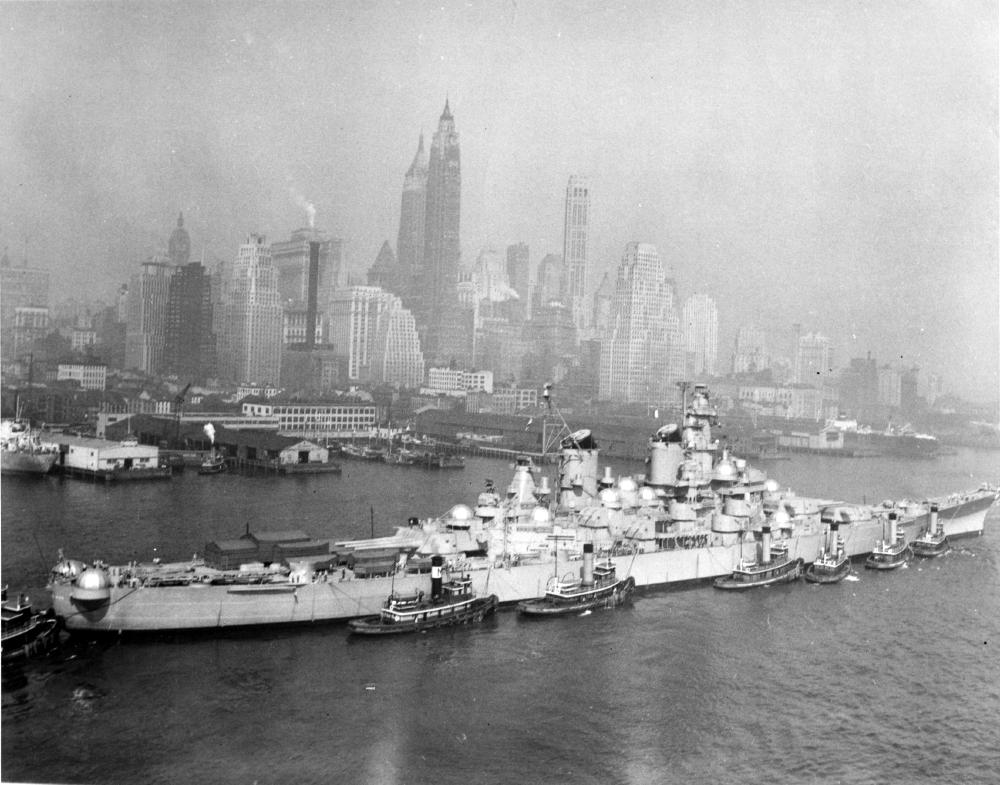
June 1948. USS New Jersey being moved from the New York Navy Yard to
the Bayonne Shipyard in New Jersey for decommissioning. The dome shaped
structures adorning her are covers for her 40mm anti-aircraft guns.
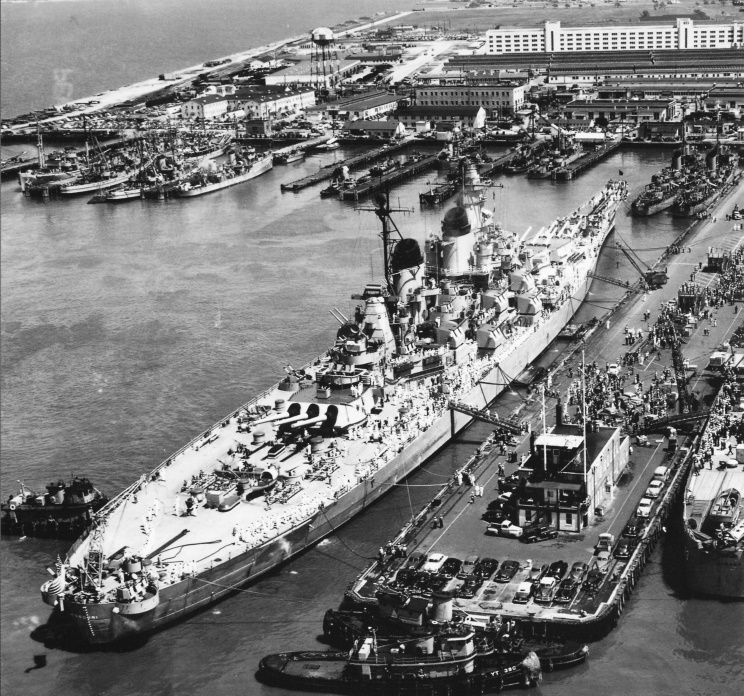
Summer 1949. USS Missouri tied up to the pier at the Norfolk Naval
Shipyard. Photos like this really show off just how amazingly large
these leviathans truly were.
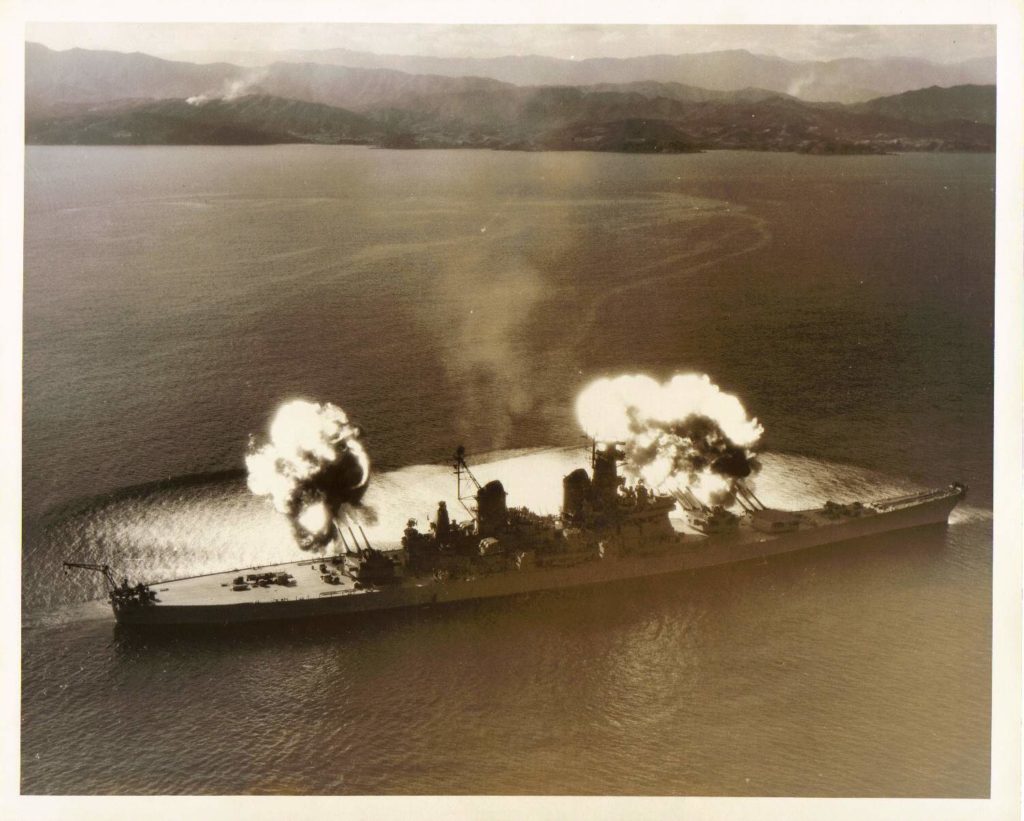
October 21, 1950. USS Missouri fires a salvo into Chong Jin, Korea.
Missouri was the first battleship to arrive off of Korea and she quickly
set to work pummeling targets of opportunity. The firepower of the
battleships was devastating to North Korean and Chinese forces.
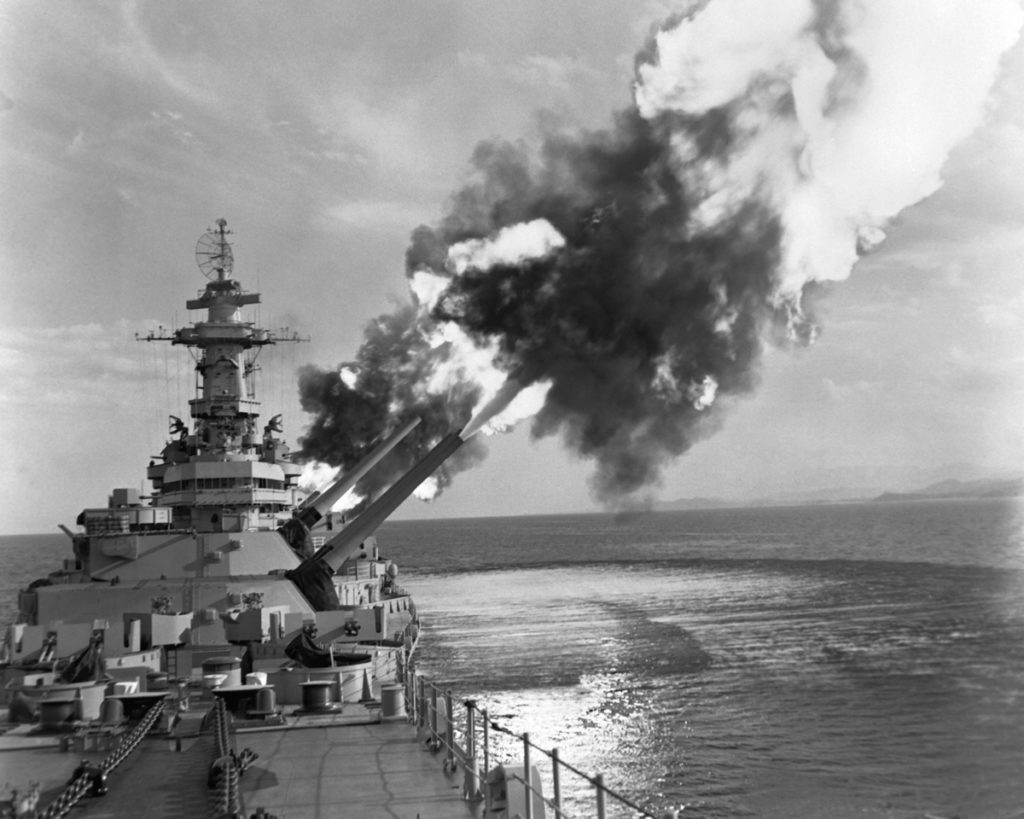
November 10, 1951. USS New Jersey (BB-62) unleashes a broadside into
the region surrounding the 38th Parallel during the Korean War. A haze
of smoke in the background marks the location of a previous salvo.
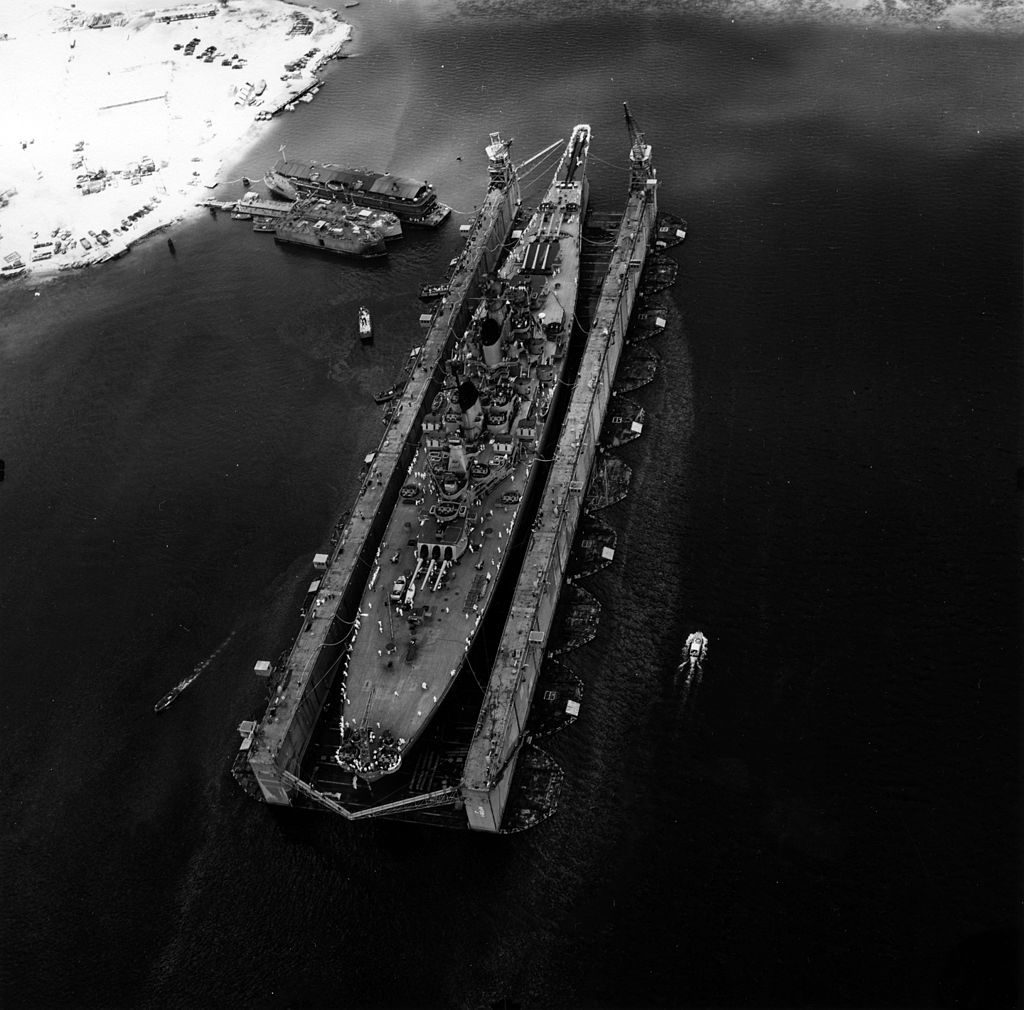
April 1952. USS Wisconsin is used to test the lifting power of the
largest drydock available to the United States Navy, AFDB-1. AFDB-1,
named Artisan was first used during the Second World War. It was one of
the only floating drydocks capable of handling an Iowa class battleship.
She was moved to Guam to serve as a forward repair base during the
Korean War.
1953. New Jersey lends her firepower during the Korean War. Judging
by the elevation of her 16″ guns, she is firing at extreme range. The
Iowa class were capable of sending a 2,700lb shell to just over 42,345
yards (24.05 miles).
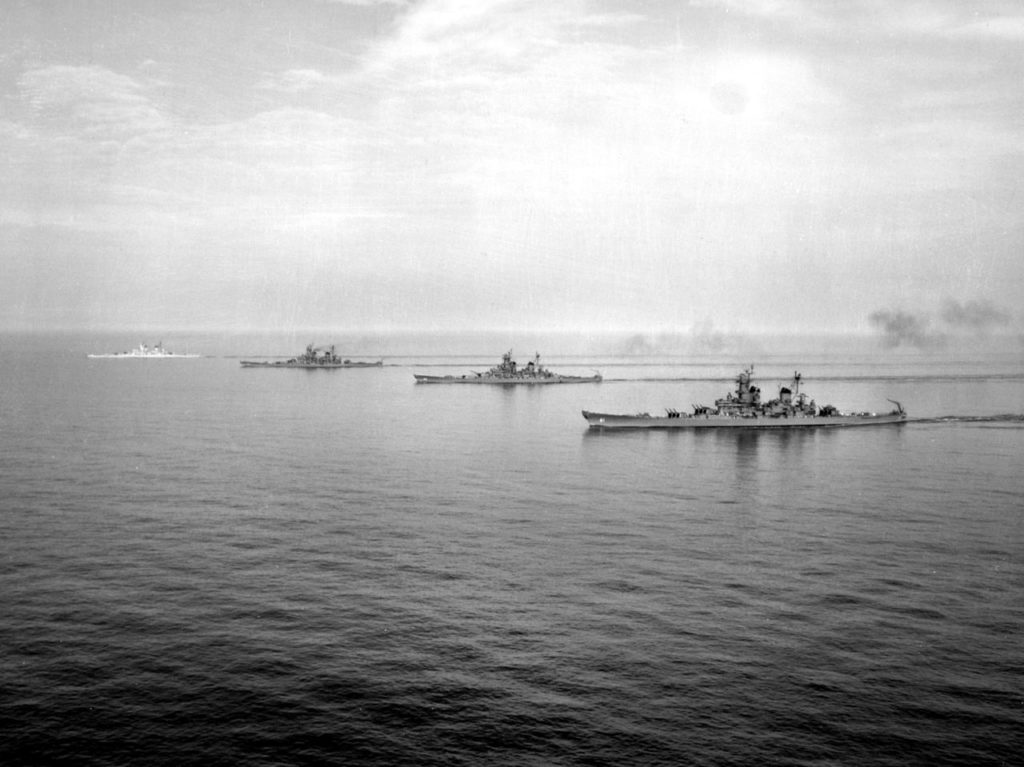
June 7, 1954. All four battleships of the Iowa class steam together
as Battleship Division 2. This was the only time that all four sisters
were together. The ships (from nearest to farthest) are USS Iowa, USS
Wisconsin, USS Missouri, and USS New Jersey.
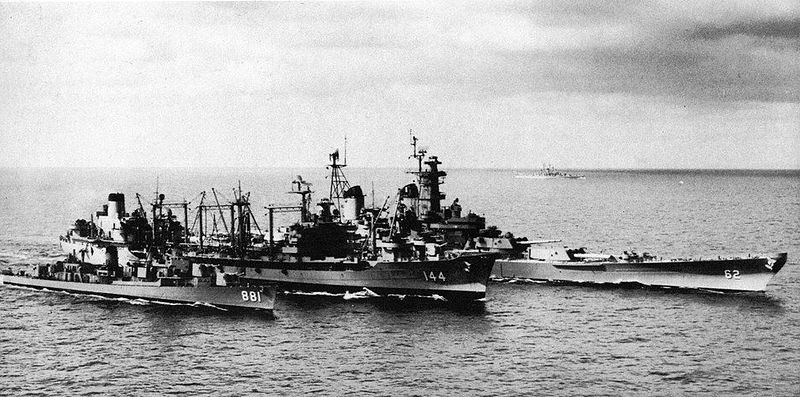
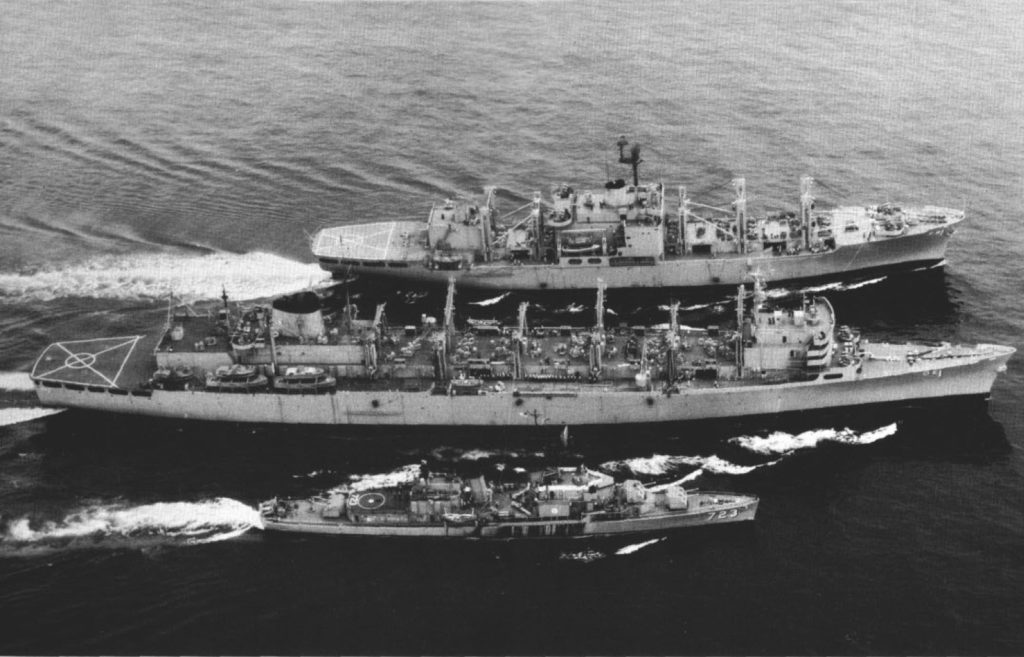
1955. USS New Jersey takes on fuel from the fleet oiler USS
Mississinewa (AO-144) along with the destroyer USS Bordelon (DDR-881).
New Jersey was operating in the Mediterranean Sea at this time.
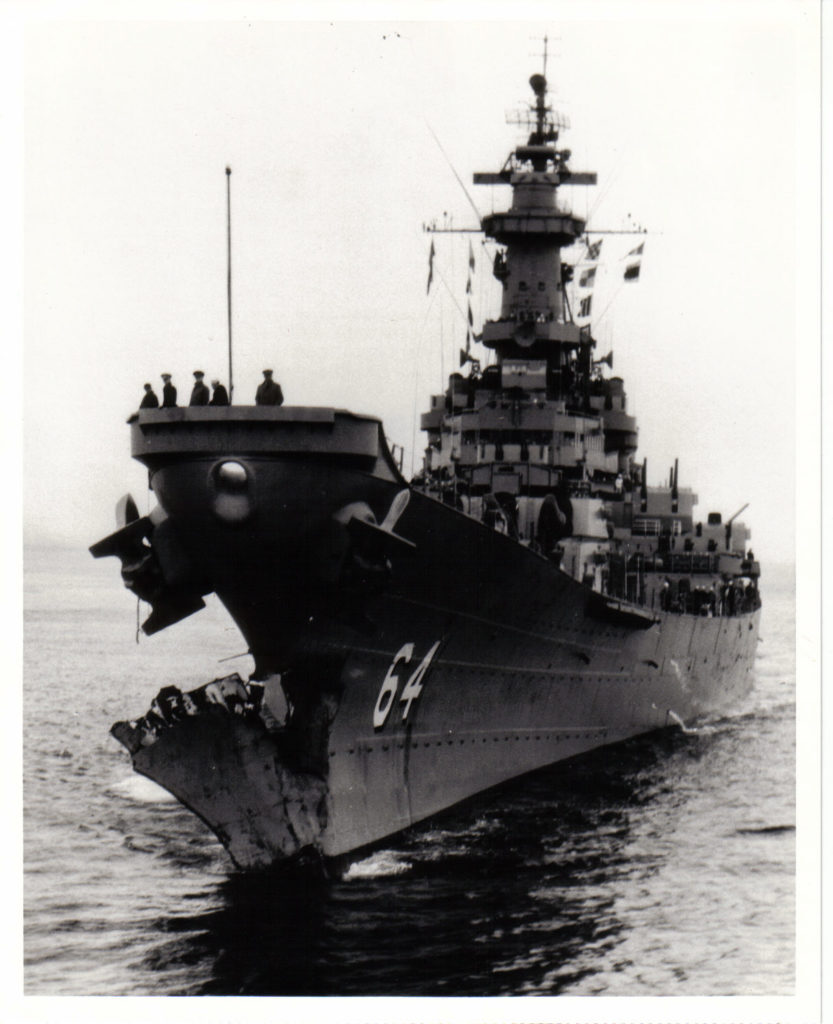
May 1956. USS Wisconsin steams to port with a chunk of her bow
missing. On the sixth of May, she had collided with the destroyer USS
Eaton (DD-510). Wisconsin was repaired by replacing her damaged bow with
that of her never finished sister, USS Kentucky (BB-66).
June 13, 1957. USS Iowa at Hampton Roads, Virginia. She was there to take part in the International Naval review.
1958. USS Wisconsin cruising off of Hampton Roads. This was one of
the last cruises she would conduct before being decommissioned later
that year.
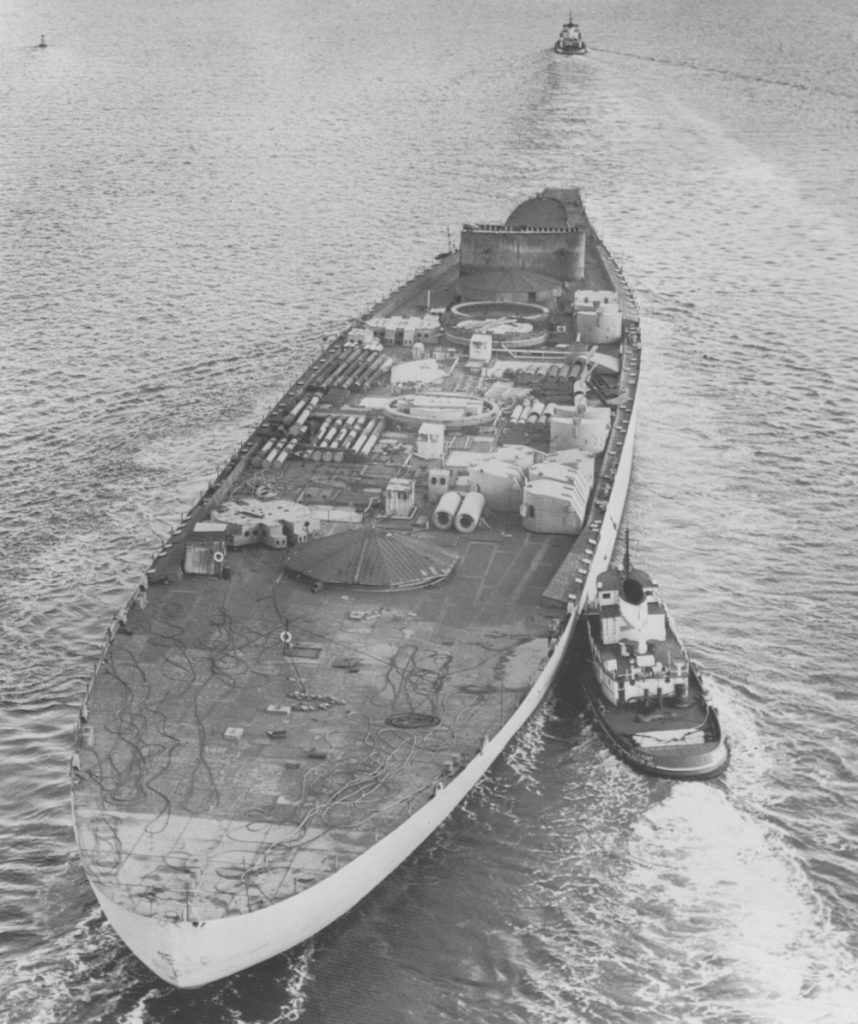
February 6, 1959. The sixth ship of the Iowa class, USS Kentucky
(BB-66) is towed up the Chesapeake Bay on her way to the scrappers. Her
deck is littered with unused material including 5″ gun barrels and their
turrets. Kentucky and her sister, Illinois (BB-65), were both cancelled
during construction.
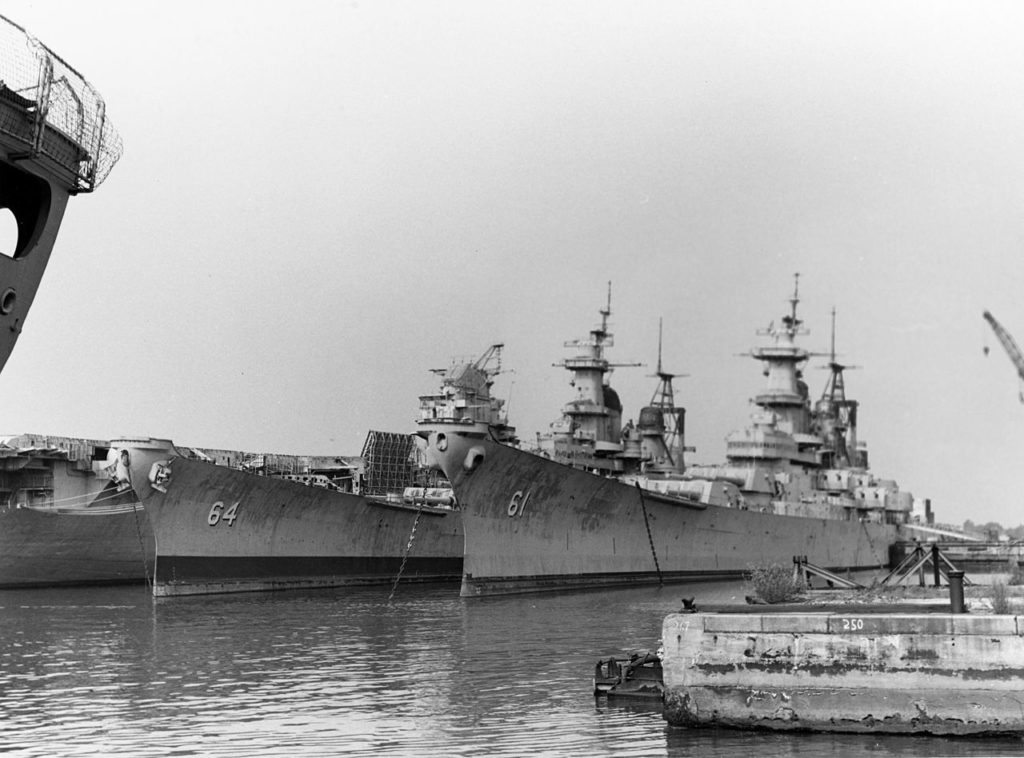
1962. Three Iowa class battleships mothballed at the Philadelphia
Naval Yard. From back to front: USS Iowa, USS New Jersey, and USS
Wisconsin. New Jersey was originally stored at Bayonne, New Jersey but
had been moved to Philadelphia the previous year.
July 4, 1963. USS Missouri continues sit in mothballs at the Puget
Sound Naval Shipyard. Missouri was mothballed on the West Coast while
her sisters were on the East Coast.
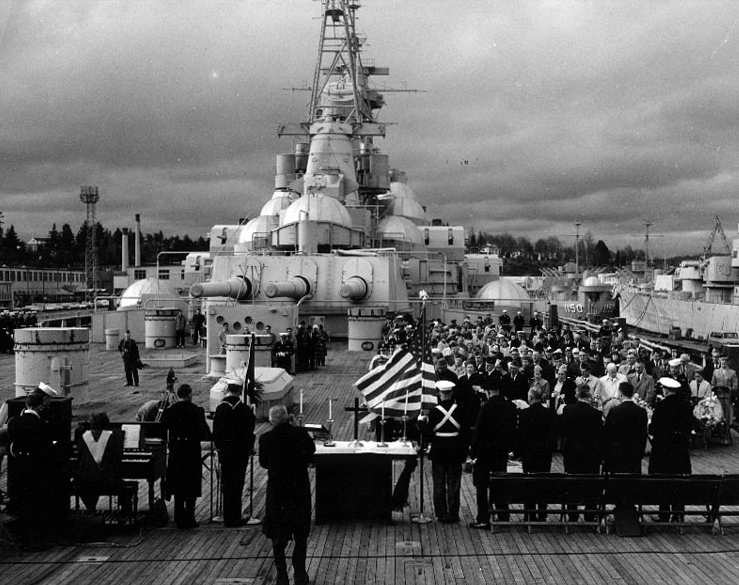
April 10, 1964. Despite her mothballed status, Missouri served as the
location of the memorial service that honored General Douglas MacArthur
following his passing.
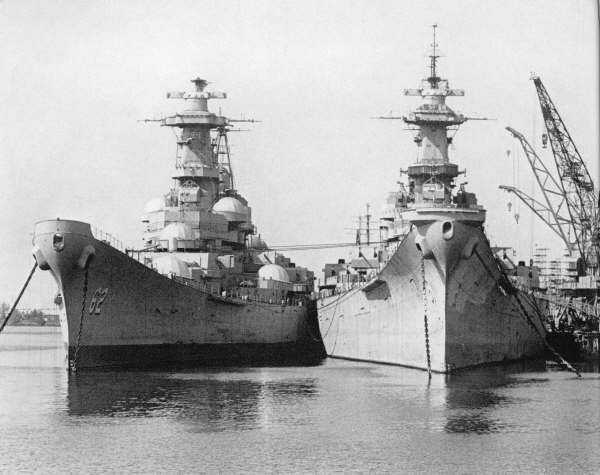
April 1965. The battleships New Jersey (Left) and Iowa (Right) tied
up together at Philadelphia. Wisconsin had been temporarily moved to
another location at the time.
1966. Though she as not a battleship, the fast combat support ship
USS Sacramento (AOE-1) was very much related to the Iowa class. Before
scrapping, the boilers and turbines of the sixth Iowa class battleship
USS Kentucky were removed. Half of the power plant would be placed into
USS Sacramento while the other half would go to her sister USS Camden
(AOE-2).
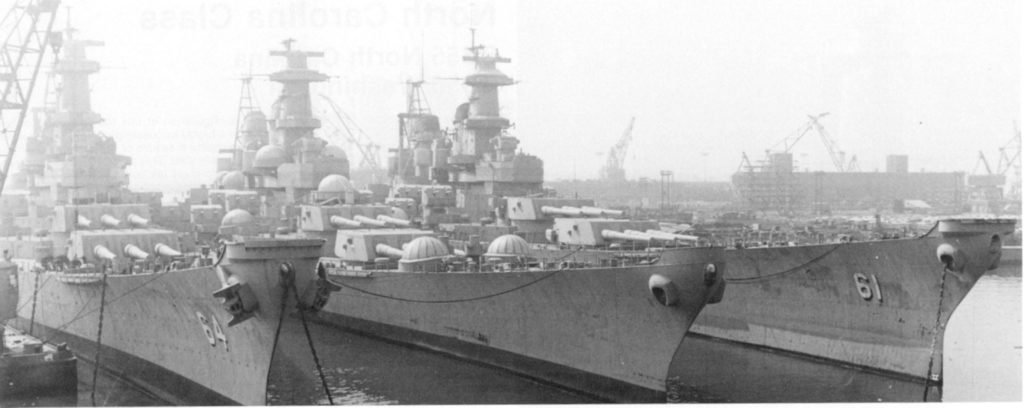
April 1967. Three of the Iowa class sisters tied up together in
mothballs. From left to right: USS Wisconsin (BB-64), USS New Jersey
(BB-62), and USS Iowa (BB-61).
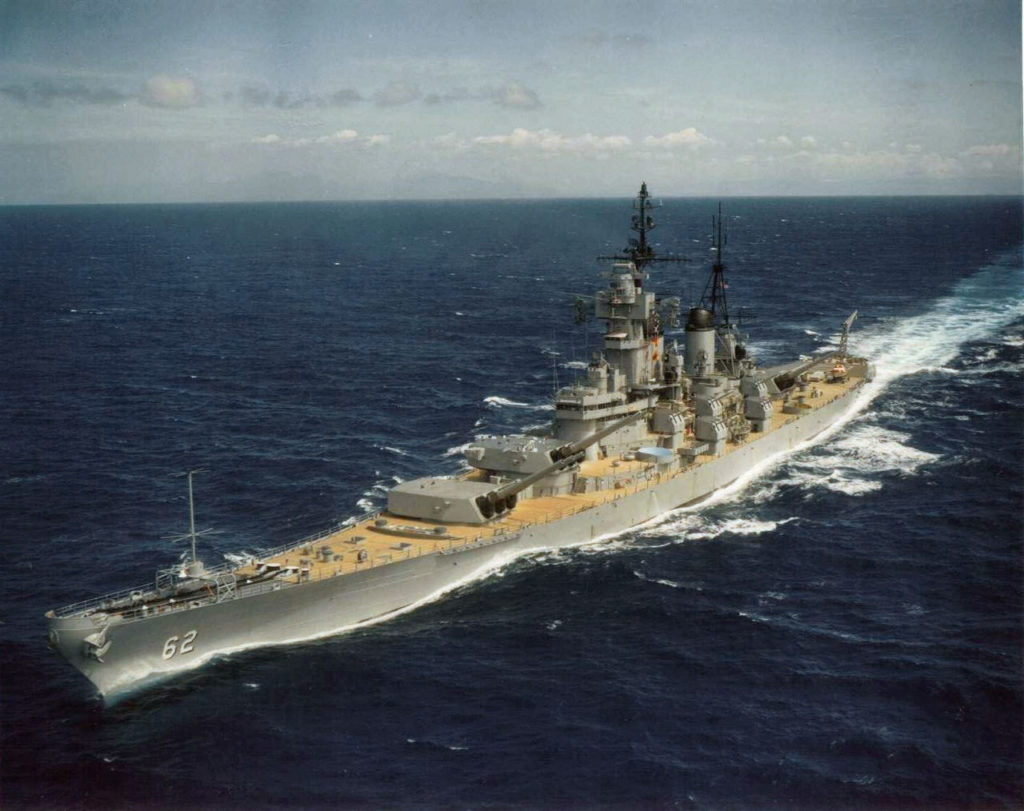
September 11, 1968. USS New Jersey cruising off of Hawaii before she
would head for Vietnam. In interesting feature of this photograph is the
40mm gun tubs just forward of the 5″ guns. These were used as swimming
pools by the crew. New Jersey was the only one of her sisters to have
such a lavish feature!
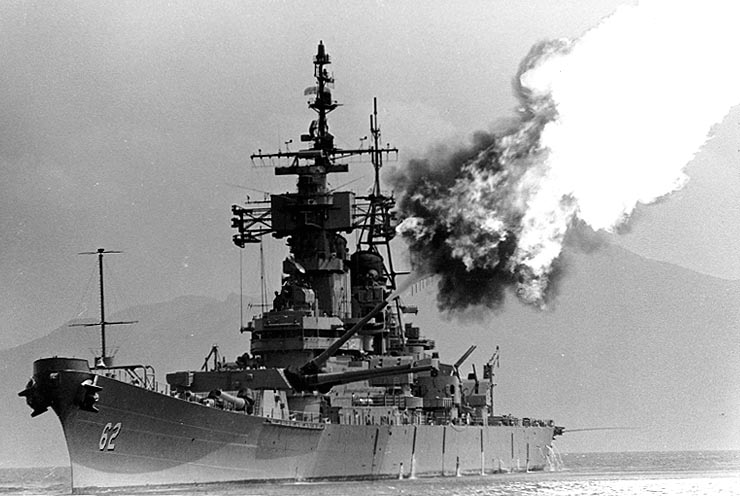
March 1969. USS New Jersey (BB-62) fires a shell into South Vietnam
during the Vietnam War. During the war, New Jersey performed
brilliantly. During her brief time off Vietnam, she fired 5,688 rounds
of 16 inch shells, and 14,891 rounds of 5-inch shells.
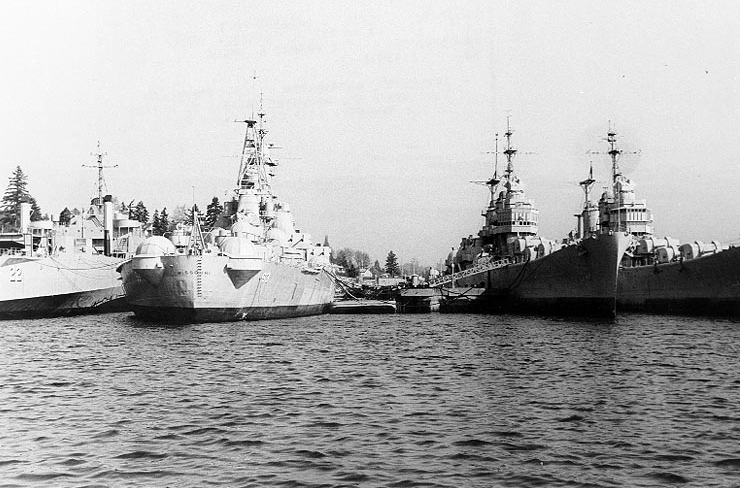
March 19, 1970. The battleship Missouri is mothballed at the Puget
Sound Naval Shipyard. She is accompanied by several other ships
including the cruisers Roanoke (CL-145) and Worcester (CL-144). Perhaps
one of the few images showing America’s last battleships alongside its
last light cruisers.
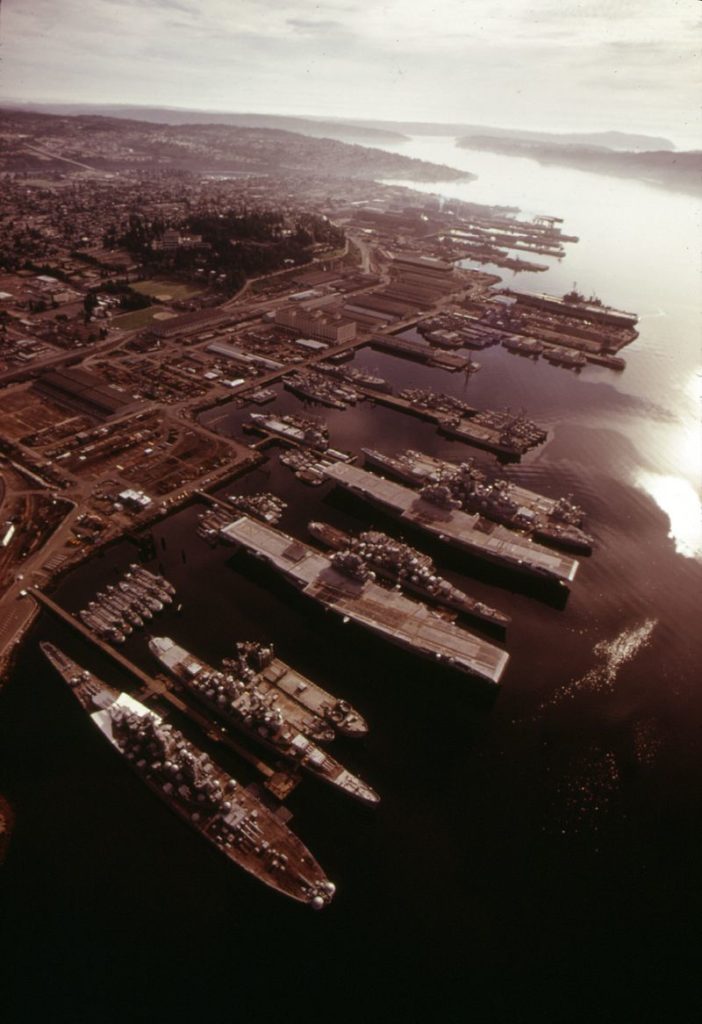
July 1974. A large assortment of mothballed ships at the Puget Sound
Naval Shipyard. USS Missouri is at the bottom of the photo while her
sister USS New Jersey can be seen farther up. Following her tour of
service off Vietnam, New Jersey was decommissioned and placed at here.
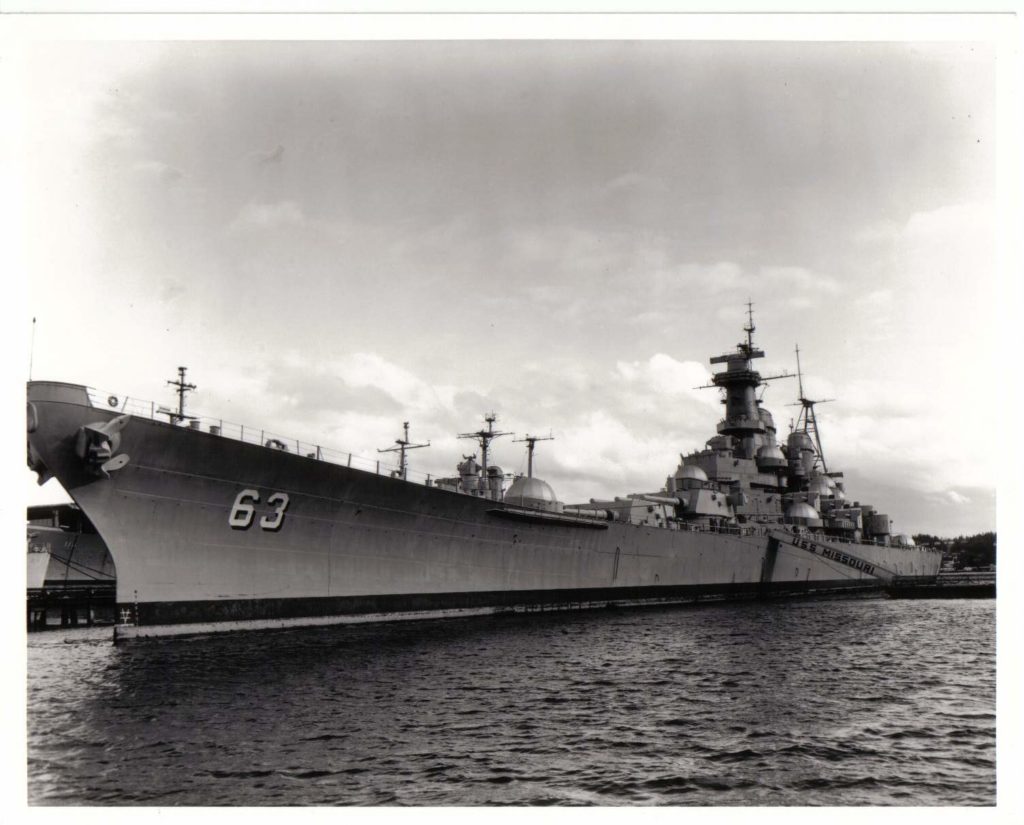
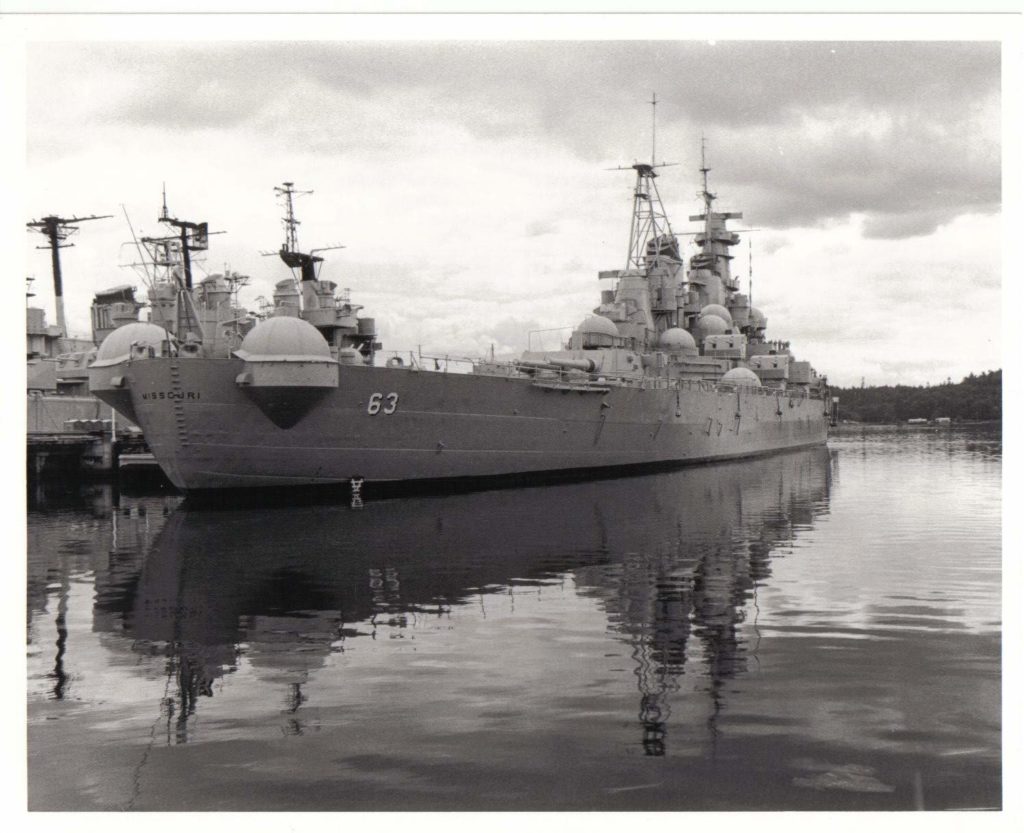
1976. The battleship Missouri still quietly moored at the Puget Sound Naval Shipyard.
1978. USS Iowa (Right) and USS Wisconsin (Left) mothballed at the
Philadelphia Naval Shipyard. Iowa was mothballed from 1958 until 1984.
Wisconsin was mothballed from 1958 until 1988. They are accompanied by
the aircraft carrier USS Shangri-La (CVS-38).
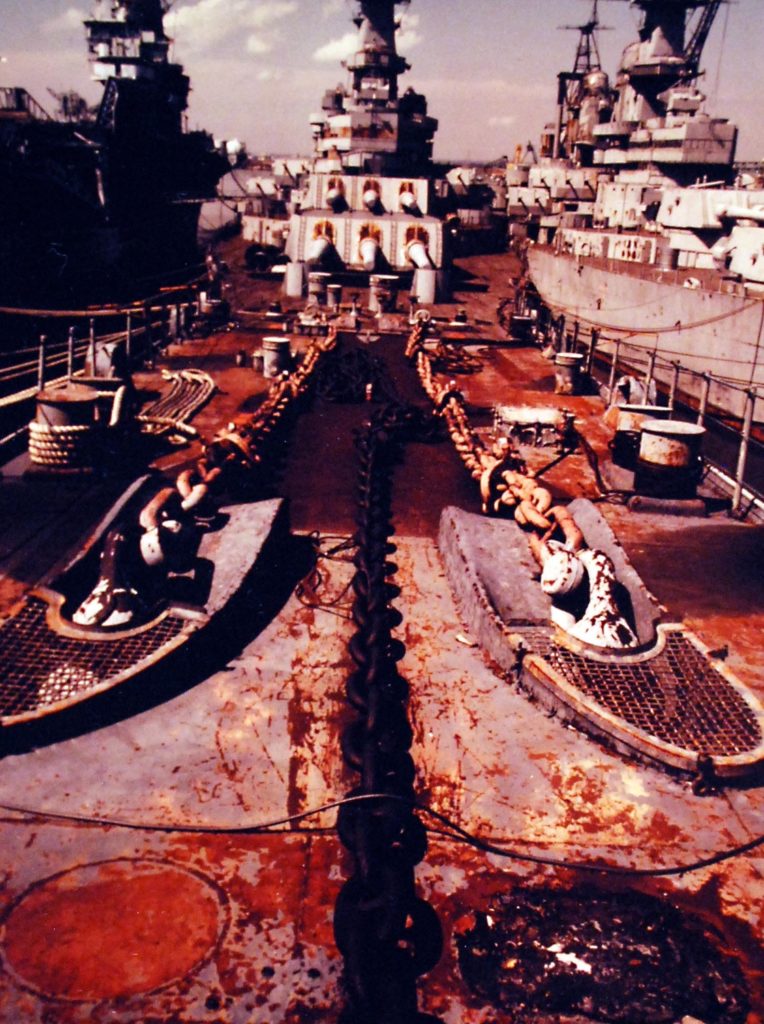
April 1980. Years of neglect are apparent in this photo taken from the bow of USS Wisconsin.
1981. The
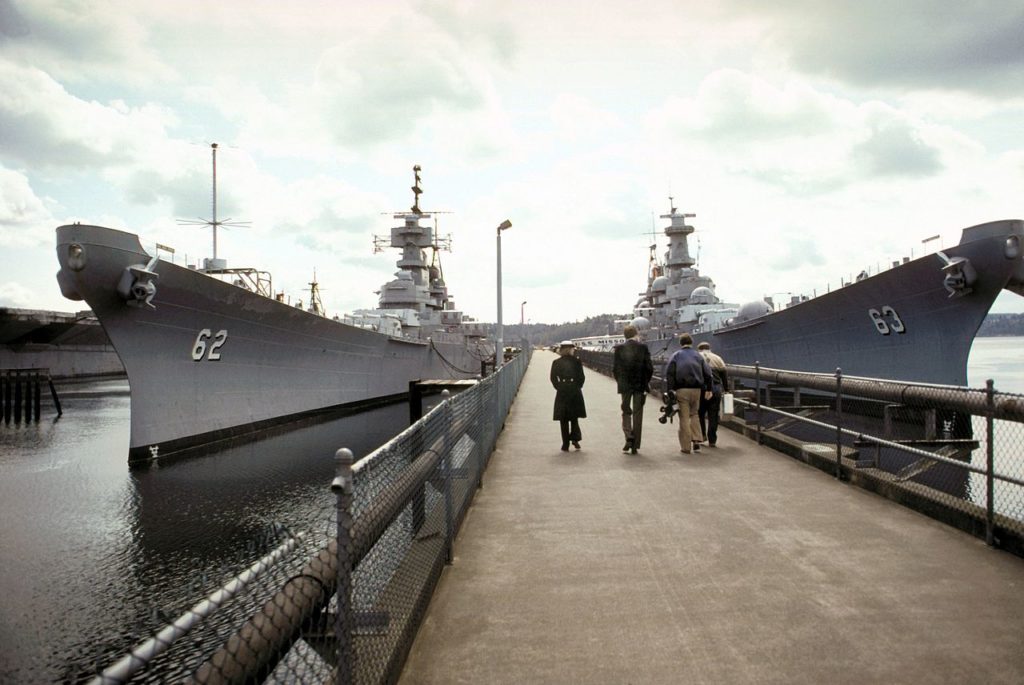
Iowa class battleship USS Missouri (BB-63) and USS New Jersey (BB-62)
at Puget Sound Naval Shipyard. Due to her being reactivated for service
in Vietnam, New Jersey looks very different from Missouri.
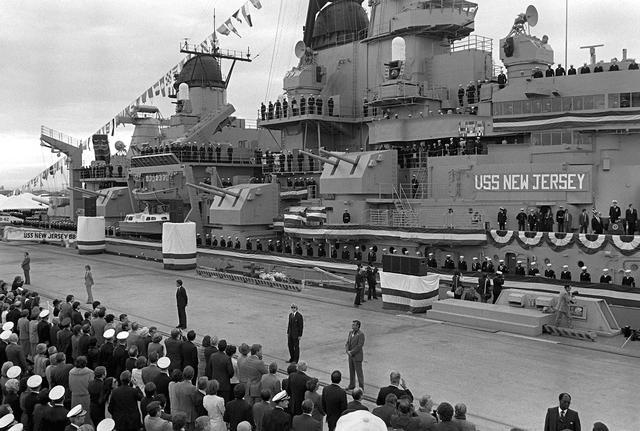
December 28, 1982. The USS New Jersey is recommissioned at Long Beach
California with President Ronald Regan in attendance. The Iowa class
had finally returned to service thirteen years after being
decommissioned.
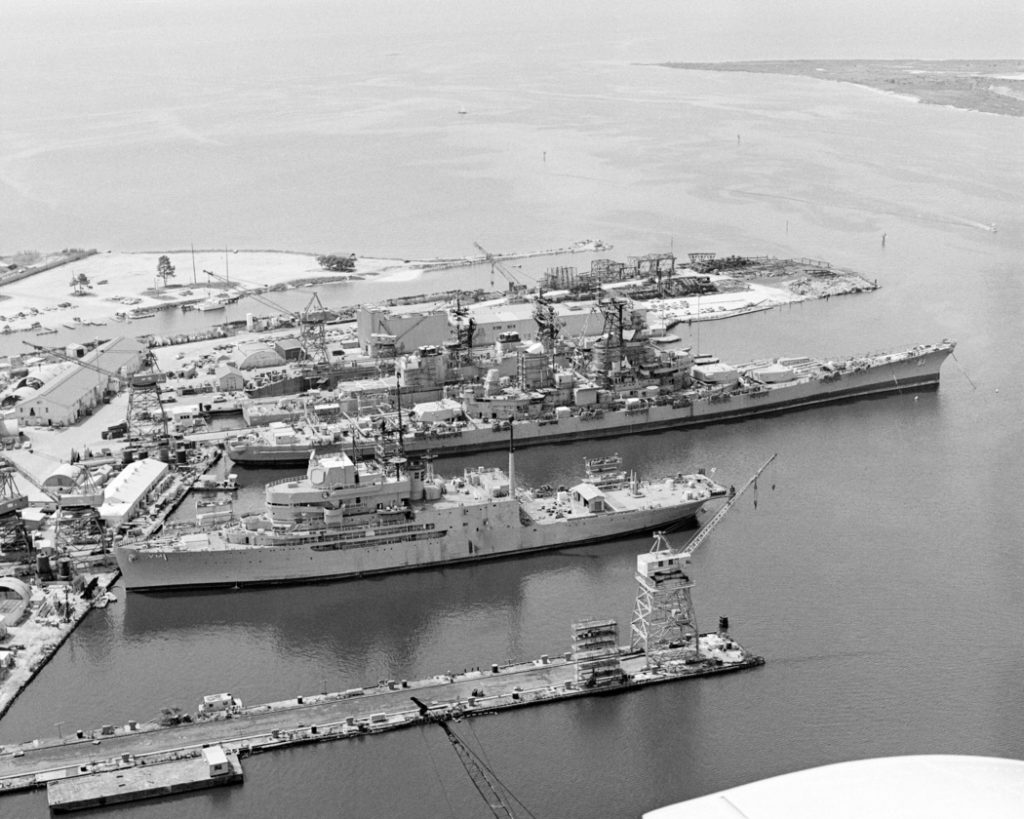
June 17, 1983. USS Iowa (BB-61) undergoing modernization at the
Ingalls Shipbuilding Yard to prepare for her recommissioning. Following
her modernization, she would finally be recommissioned on April 28,
1984.
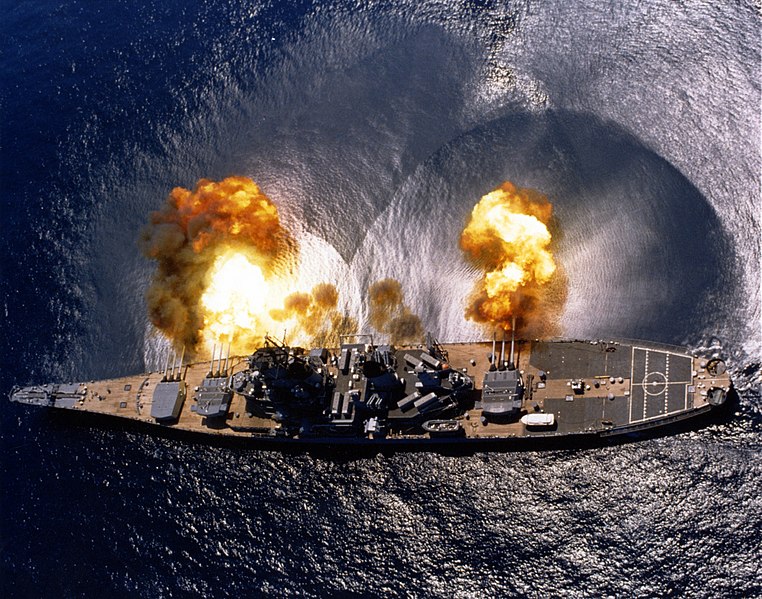
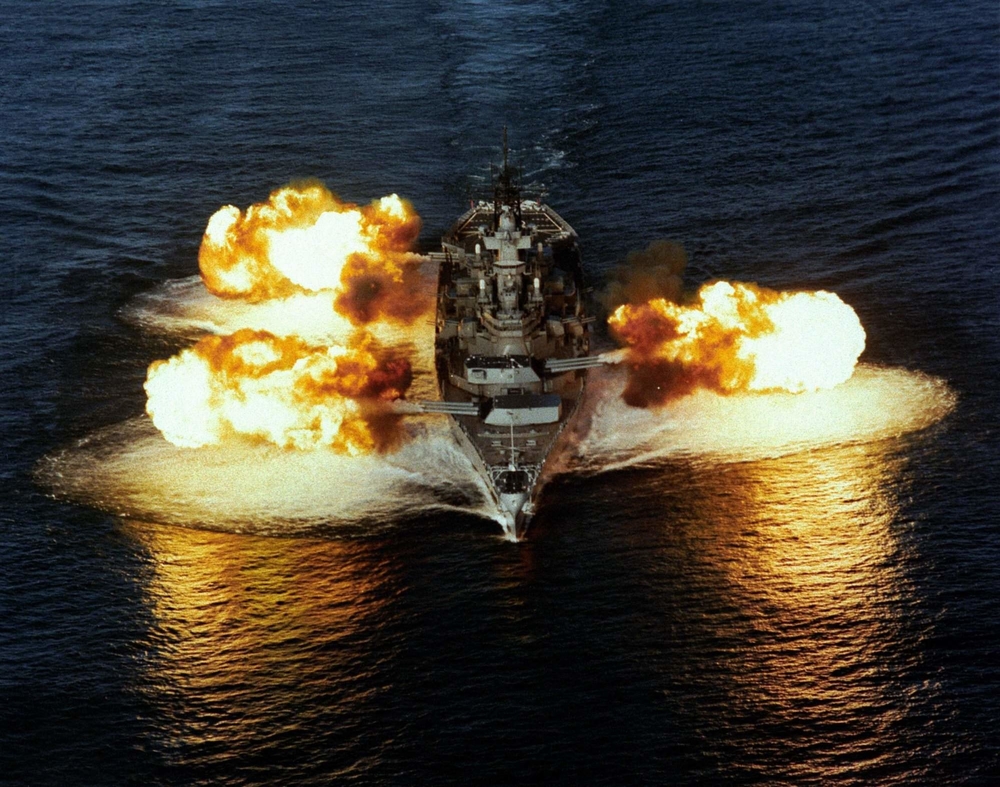
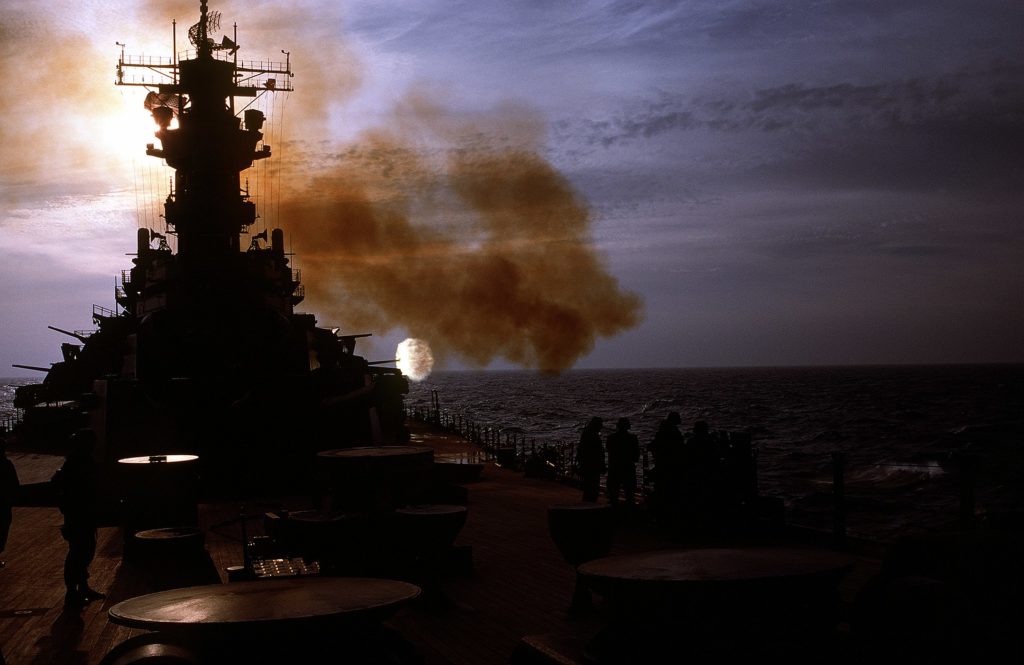
July 1, 1984. With a thunderous roar, USS Iowa demonstrates her
firepower by firing all nine of her 16″/50 as well as six of her 5″/38
guns. The blast of her main guns is easily seen o the water surrounding
them.
November 19, 1985. USS Iowa (BB-61) uses all of her 212,000 shaft
horsepower during a full power run in the Chesapeake Bay. She is kicking
up an unbelievable amount of water in her wake.
December 30, 1986. USS New Jersey (BB-62) fires all of its 16″ guns during a spectacular firepower demonstration.
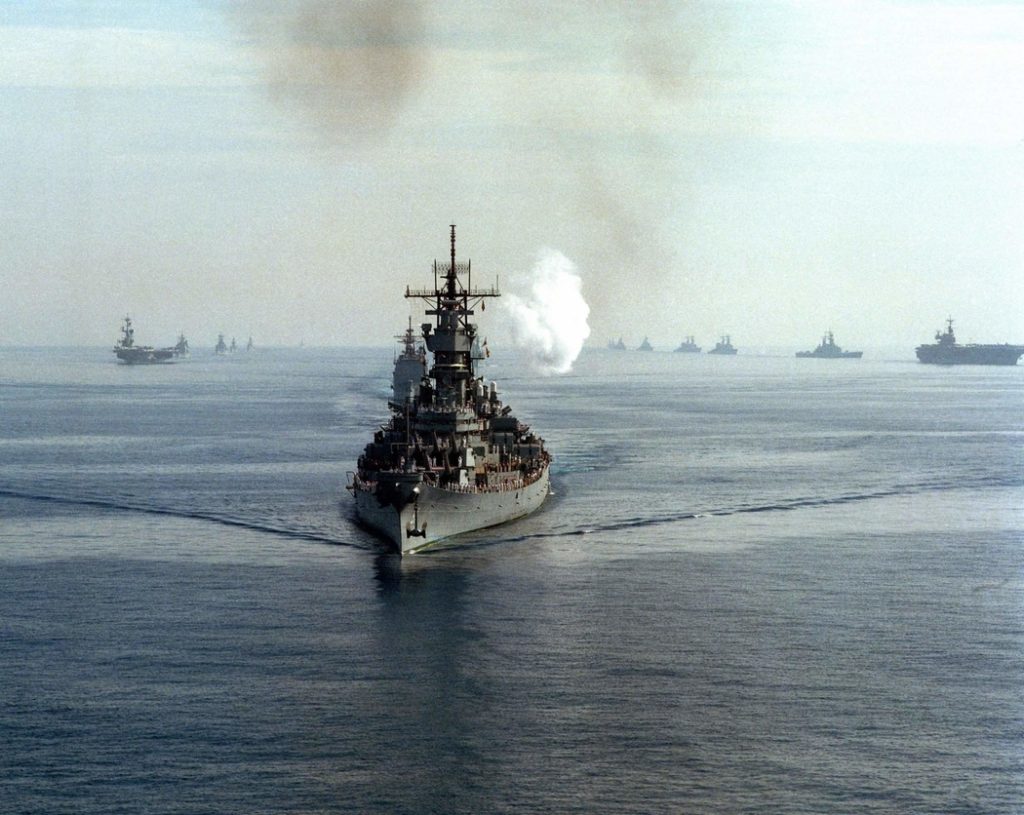
October 17, 1987. The Battleship USS Iowa (BB-61) leads the aircraft
carriers Coral Sea (CV-43) and Saratoga (CV-60) plus their respective
battlegroups into Augusta Bay, Sicily.
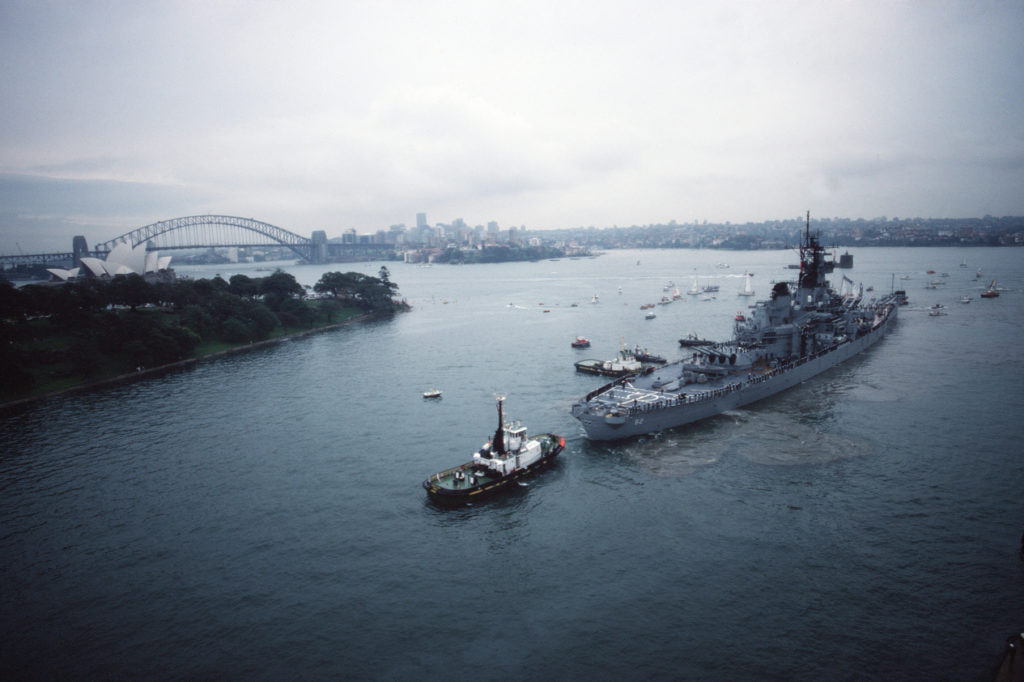
1988. Tugboats guide USS New Jersey into Port Jackson. New Jersey had
arrived in Sydney to take part in the Australian Bicentennial.
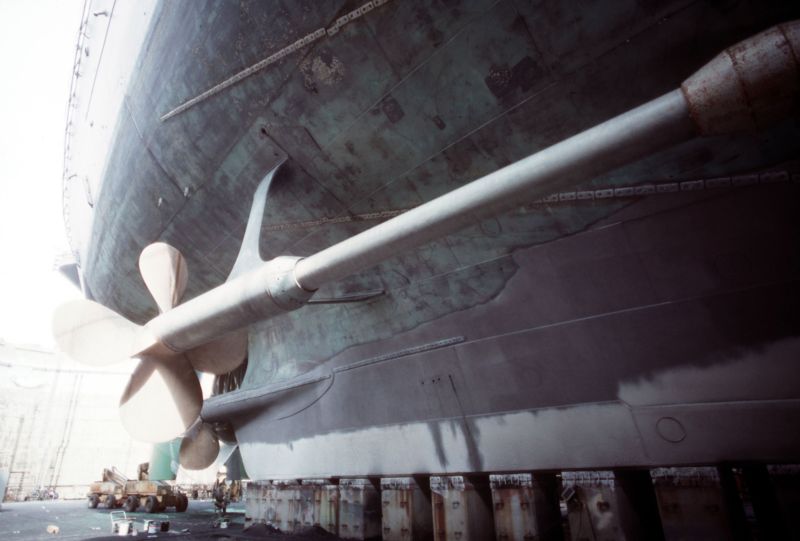
February 1, 1989. USS Missouri having her hull scrapped and other
work done while in drydock. Her outer four bladed screws are 18.25′ in
diameter while her inner five blades screws are 17′ in diameter. Couple
with the powerful 212,000 shaft horsepower turbines, the Iowa class
could exceed 32 knots.
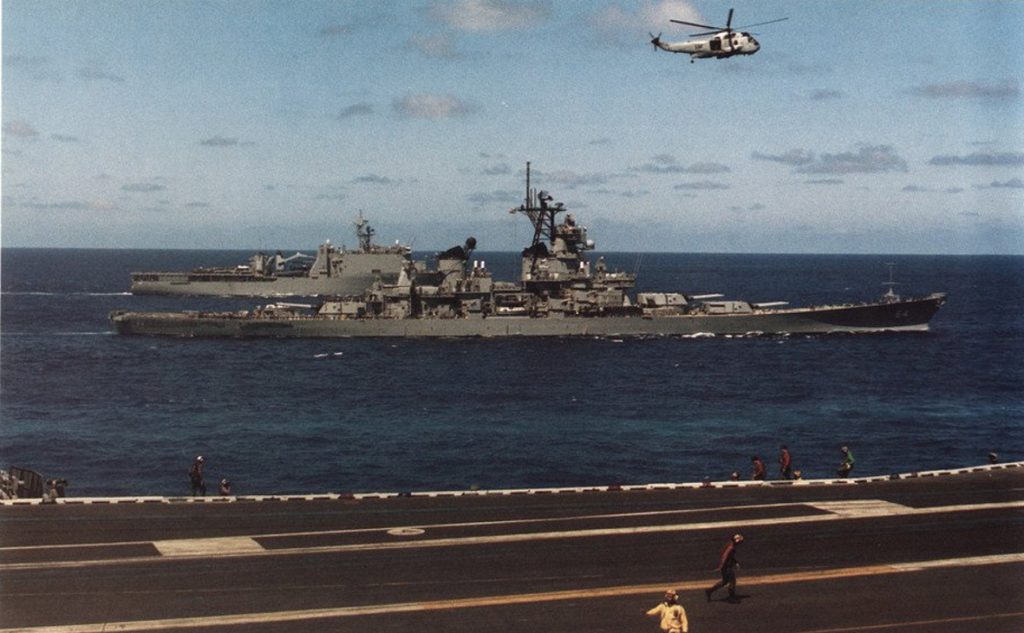
1990. USS Wisconsin steaming alongside the carrier USS Saratoga
(CV-60) during their 1990-1991 deployment in the Mediterranean and Red
Seas.
January 18, 1991. USS Wisconsin uses her 5″/58 secondary guns to
pound targets ashore during the Gulf War. Wisconsin spent eight months
in the Persian Gulf. During that time, she fired 319 16″ shells, 881 5″
shells, and 5,200 20mm rounds in addition to her 24 cruise missiles.
August 1992. The battleship New Jersey is tied up to the same pier at USS Hornet (CVS-12) at the Puget Sound Naval Shipyard.
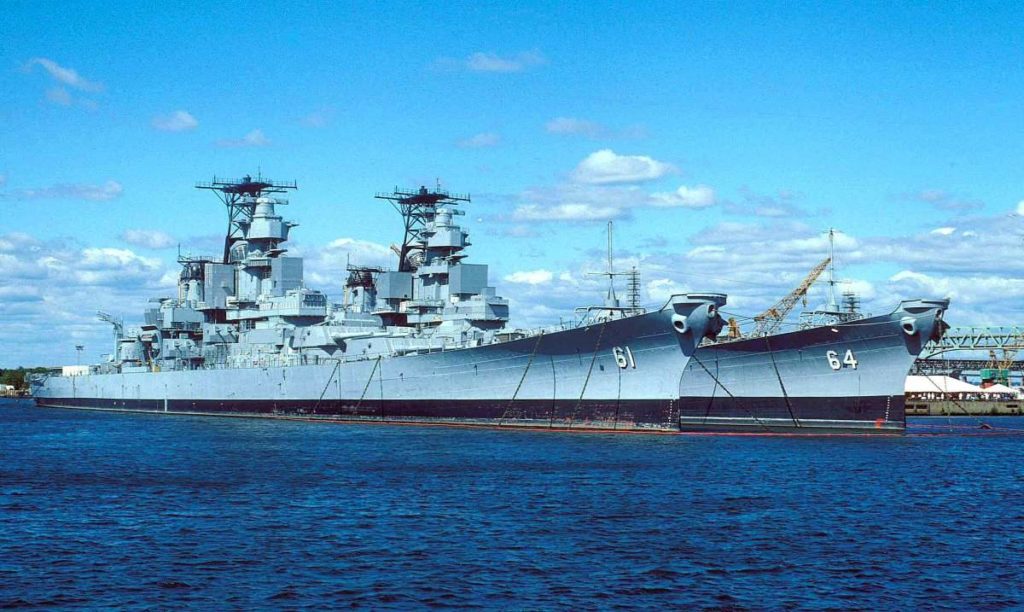
September 1993. The mothballed battleships USS Iowa (BB-61) and USS
Wisconsin (BB-64) tied up together at the Philadelphia Naval Shipyard. I remembered seeing them there while we were driving in the Northeas.
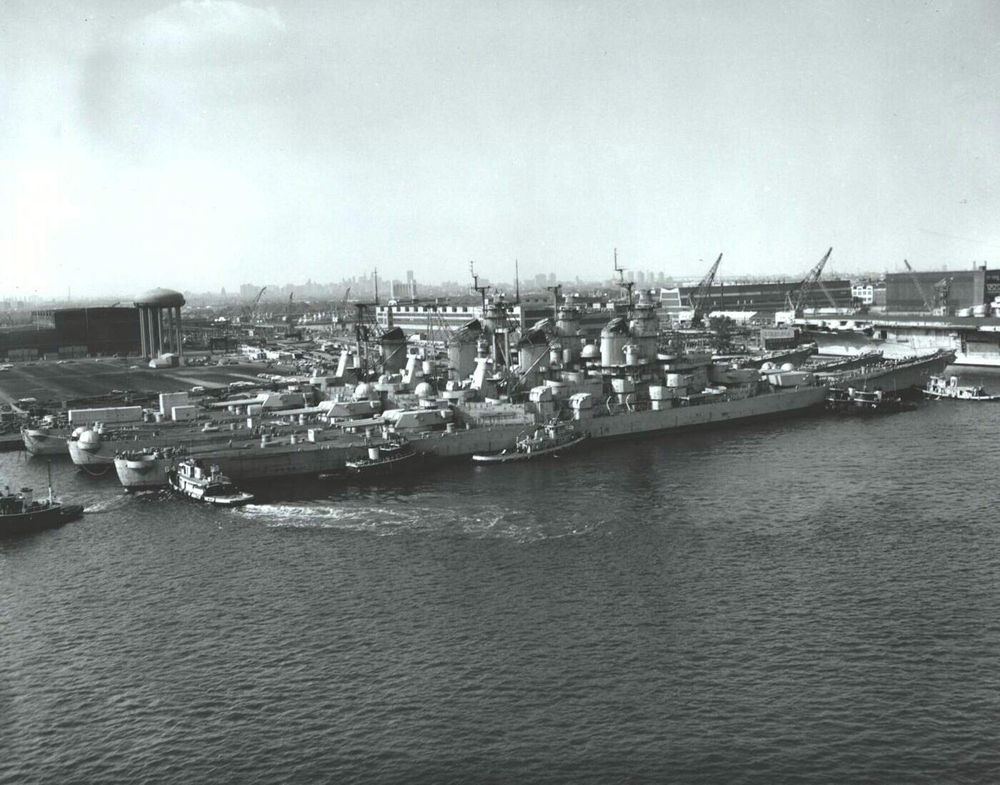
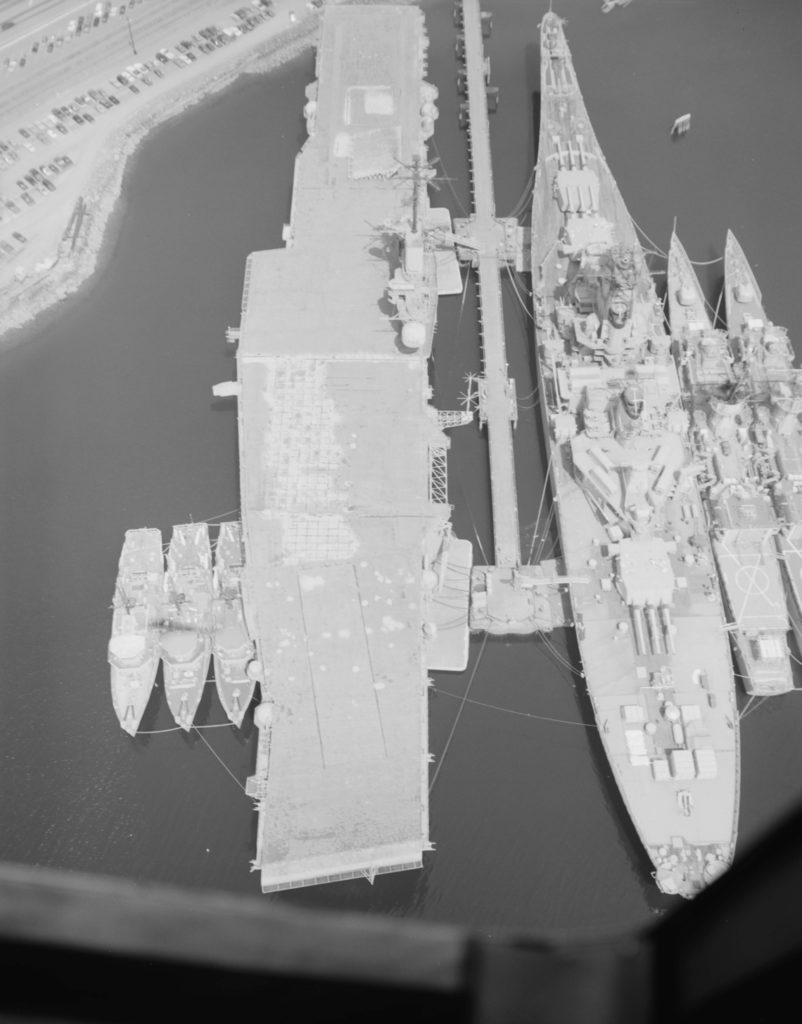
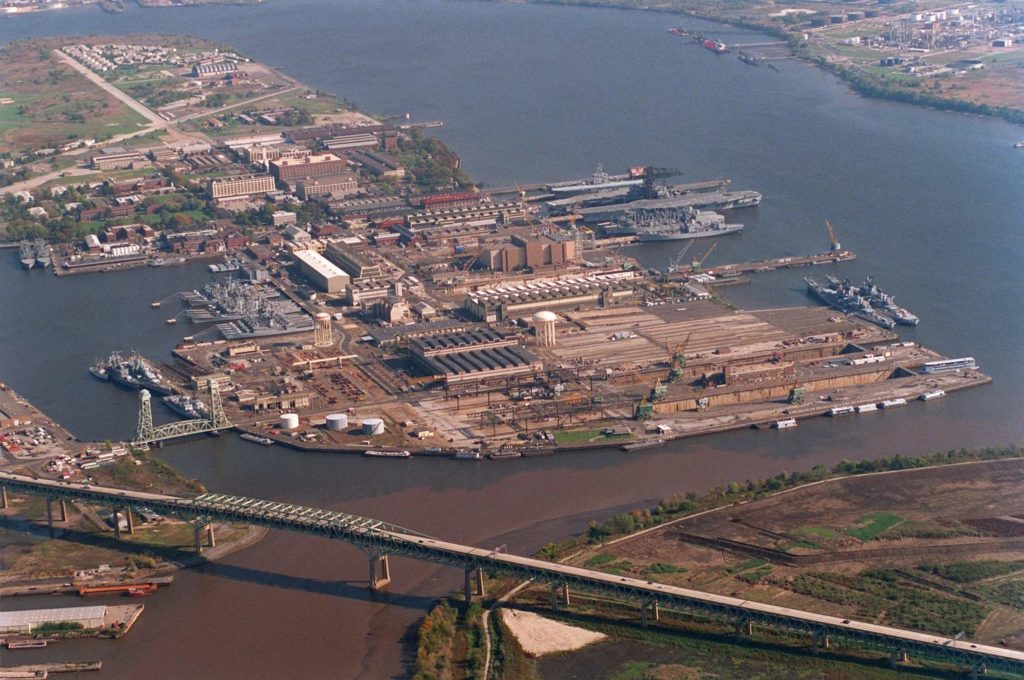
October 30, 1995. A photo of the Philadelphia Naval Shipyard along
with a wide assortment of warships. Among the battleships Iowa and
Wisconsin can be seen at the right. I was on that bridge when I saw the ships and I almost wrecked, I knew what they were and so wanted to stop...but couldn't.
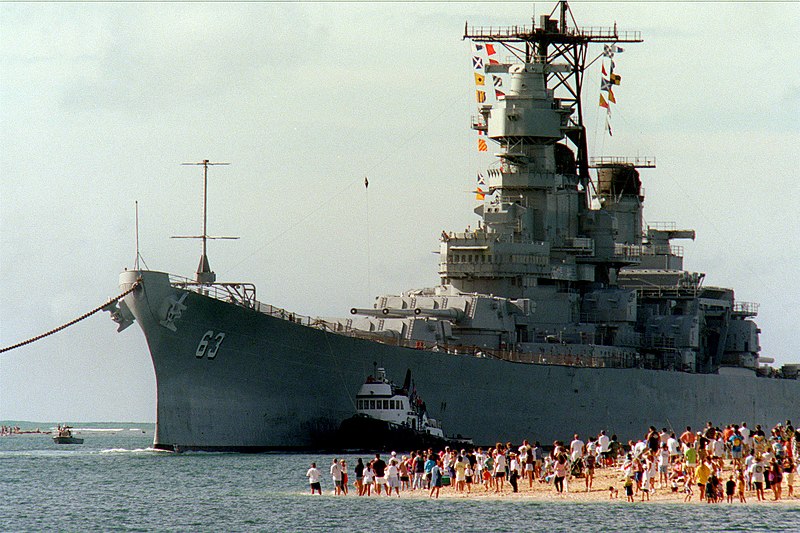
June 22, 1998. Crowds gather as USS Missouri enters the channel
leading to Pearl Harbor. She was being moved to Pearl Harbor to serve as
a museum ship. The location that saw the entrance of the United States
into World War II would now host the vessel that saw its end.
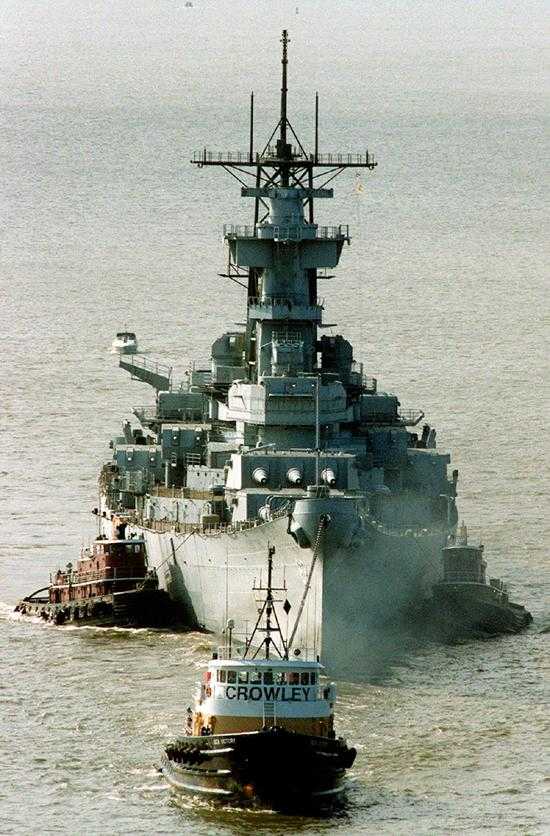
November 11, 1999. The battleship USS New Jersey is towed up the
Delaware river towards the Philadelphia Shipyard. She would go on to be
restored and converted into a floating museum.
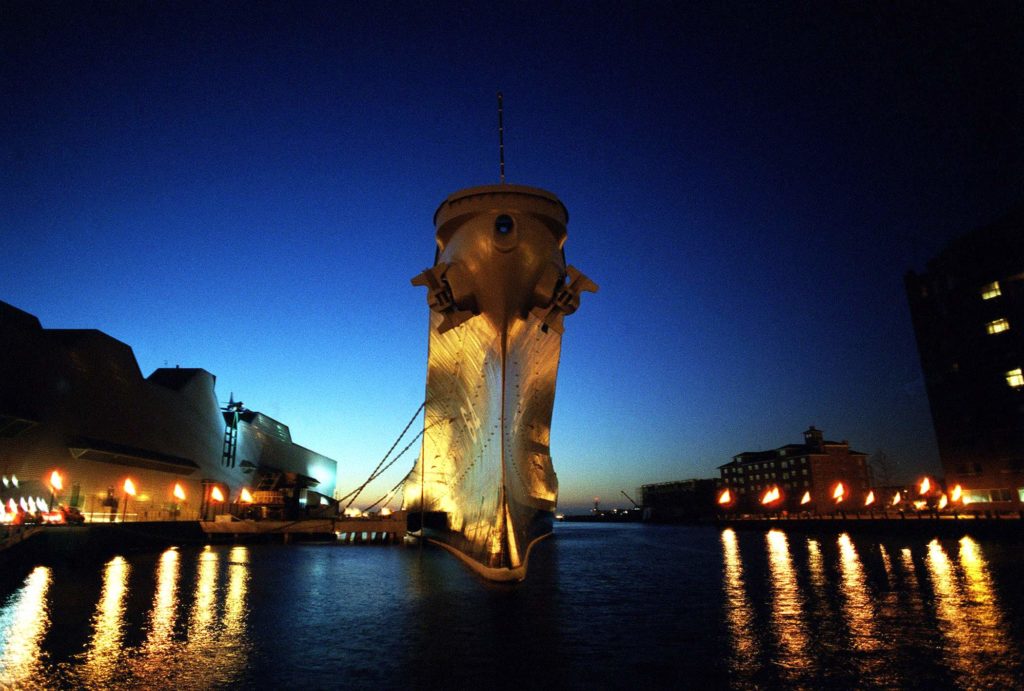
December 12, 2000. USS Wisconsin located at her new home in Norfolk, Virginia.
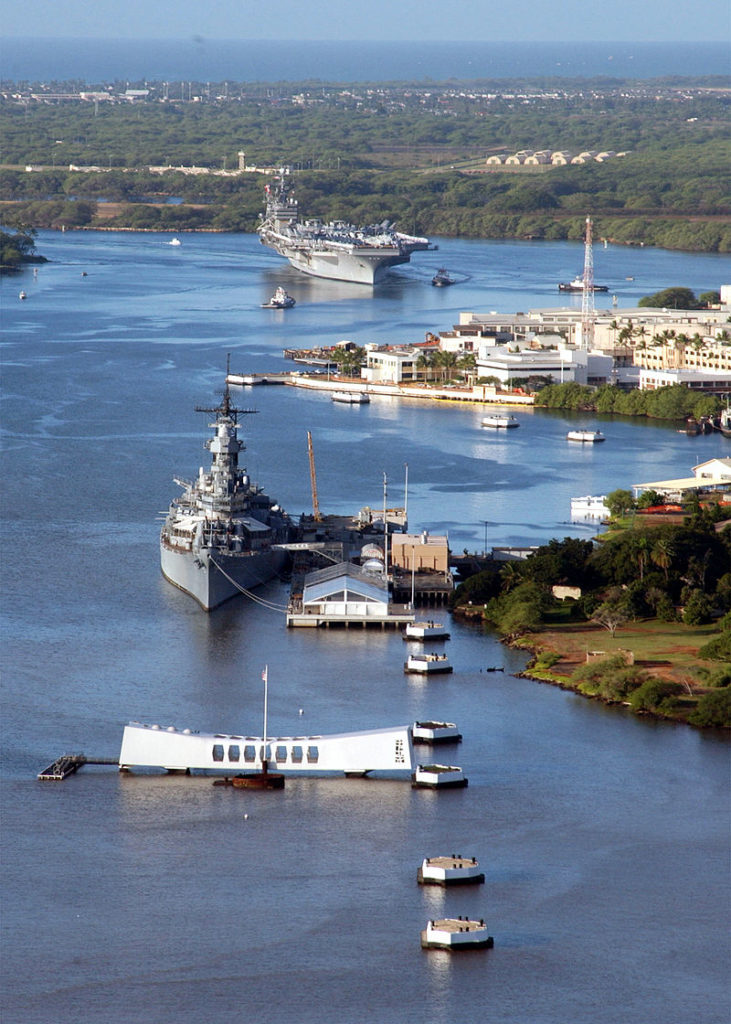
January 31, 2003. The battleship Missouri watches over the USS
Arizona. In the background, nuclear powered aircraft carrier USS Carl
Vinson (CVN-70) enters Pearl Harbor.
April 16, 2004. In celebration of the ship’s 60th anniversary of her
commissioning, sailors from the USS Theodore Roosevelt (CVN-71) man the
rails aboard USS Wisconsin.
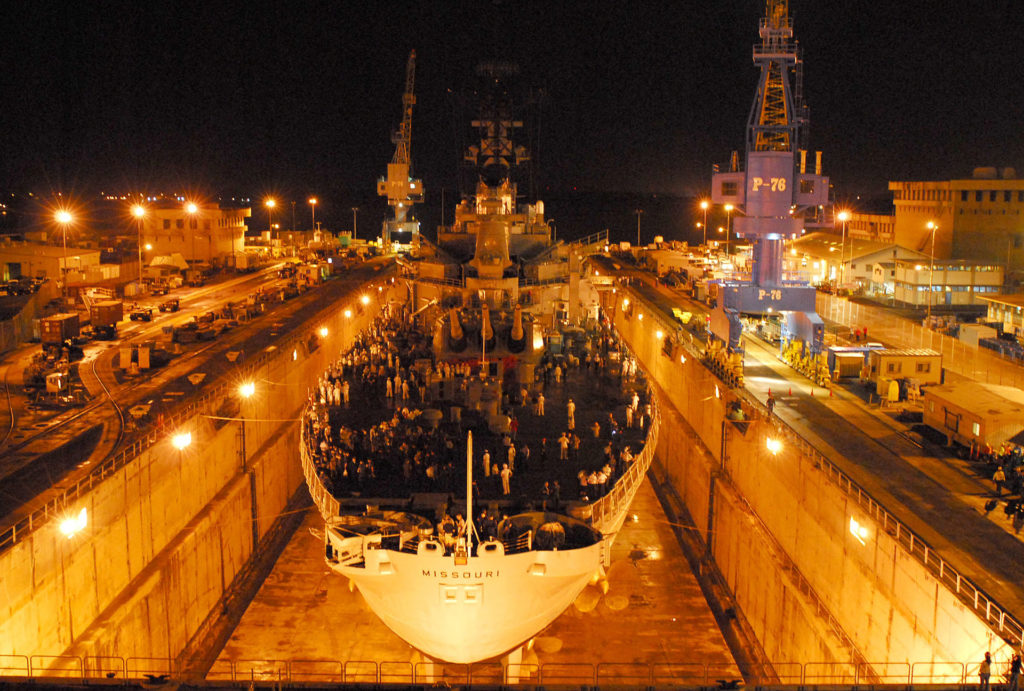
January 7, 2010. Workers work early in the morning to prepare USS
Missouri for her undocking later that day. Missouri had undergone an 18
million dollar overhaul aimed at preserving her so that future
generations could continue to visit her.
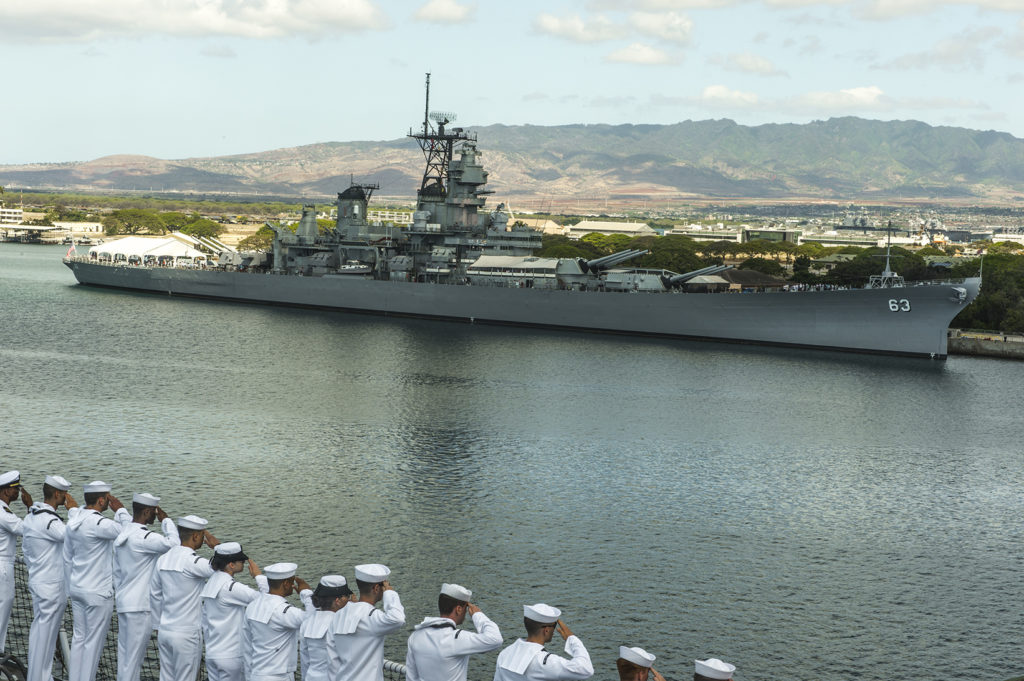
May 25, 2015. The crew renders honors aboard the USNS Mercy (T-AH-19) as they pass the battleships Arizona and Missouri.
August 30, 2016. Iowa fires her secondary guns in salute to the
assault carrier USS America (LHA-6) as she arrives at Los Angeles
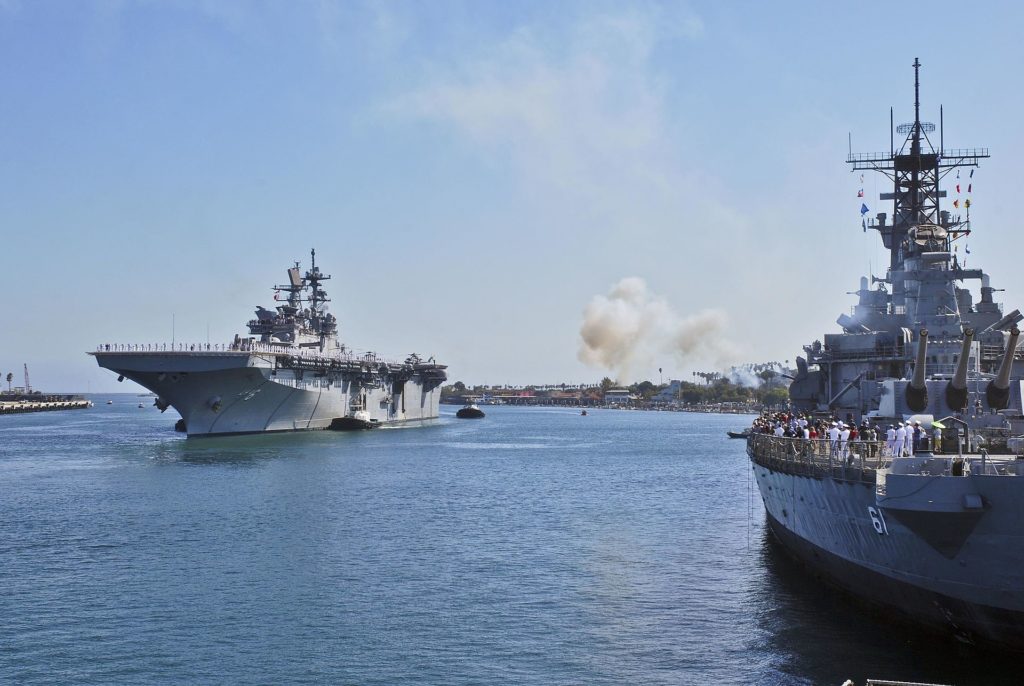
Harbor. Though it might not look like it, at full load the Iowa (58,000
tons) displaced roughly 13,000 more tons than USS America (44,971
tons).From harbingers of war to the setting for peace. From World War II to
the Gulf War. From instruments of destruction to tools of education.
The Iowa class battleships have seen plenty of change throughout the
years. Thanks to the dedicated people who maintain them today, we will
ensure that they remain around for another 78 years.