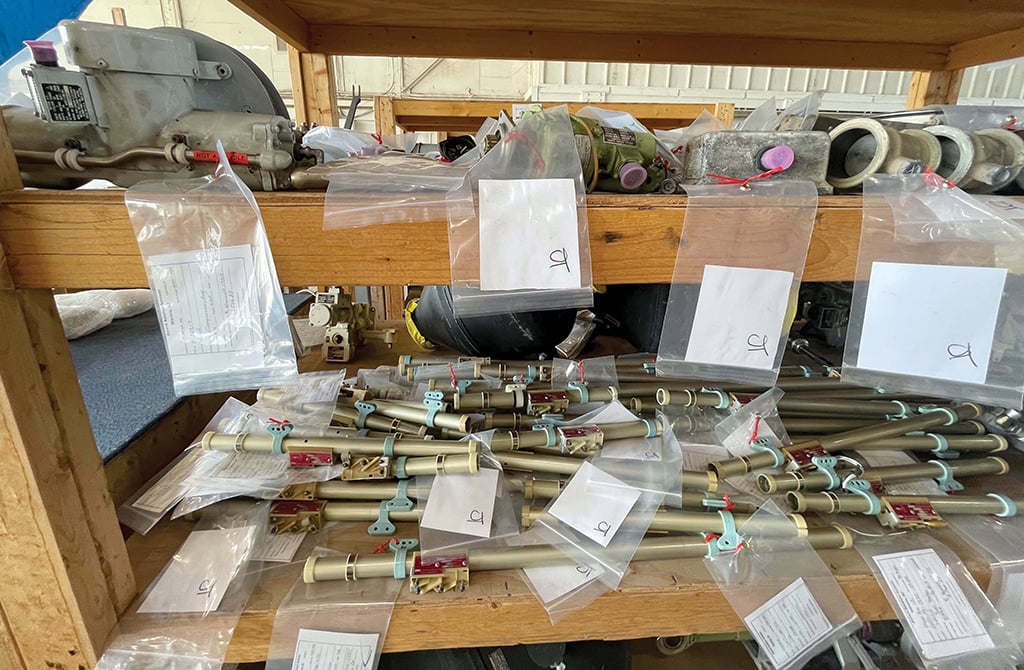
I had "blogged" several times about fake parts in the MRO supply system in the commercial aviation world, to put a part on a plane and have the repair recognized as "Legal" by the FAA and the EASA and other aviation regulatory bodies that control the commercial fleet of their respective countries, but they have reciprotive agreements across borders, like for example an "8130" is recognized around the world and is accepted. EASA has their own versions and it also carries the same weight. So if a part has that serviceable tag on it, it is considered "good to go" and meets the strict standards of the aviation world and is "airworthy" and safe to use and put on a plane that will carry passengers. The parts are engineered to last literally years under normal use unless the manufacture has a scheduled maintenance check on the part where it is removed and sent to a shop to be tested and most of the time routed to inventory for the next plane or sometimes it has to be repaired. The standards are strict for a reason and the parts are expensive. and the airlines accept it as the cost of doing business. Now you get some unscrupulous dirtbag that get bad parts make fake tags, cleans the parts up so they look like new and sells them as "repaired" or "overhauled", the profit margins are huge, almost like drug cartel huge. Hence the attraction. Now a lot of the bad parts are sold to 3rd world airlines where oversite is far less stringent and "under the table remuneration is a way of life".
I pulled this from "Aviationweek"
Airlines and MRO providers should be on the lookout for non-airworthy engine parts after 12 containers were fraudulently redirected from their intended destination, the European Union Aviation Safety Agency (EASA) has warned.
Spain’s National Aviation Authority informed EASA that a consignment of formally
declared non-airworthy turbofan parts was rerouted in late January 2026 from its destination.
The shipment consisted of 12 containers of engine parts, three of which contained critical or life-limited parts. These parts had not been rendered unairworthy by the contracted mutilation provider.
The theft covered more than 600 parts across four engine families: the CFM International CFM56, the IAE V2500, the Pratt & Whitney PW1100G, and the Rolls-Royce RB211.
EASA warned that the scale and method of the theft indicated the parts may be offered for sale on the open market.
It encouraged owners, operators and maintenance organizations to inspect their aircraft and inventories for the referenced part numbers and corresponding serial numbers; if any are found they should be removed and quarantined.
The notice appeared roughly a month after former techno DJ Jose Zamora-Yrala was jailed for four years by a British court for trading 60,000 parts with falsified documentation through his company, AOG Technics.
Airlines were forced to ground aircraft with AOG parts installed. While no in-service incidents were linked to the suspect parts, the disruption cost operators an estimated $53 million, the UK Serious Fraud office said.
The recent theft shows several similarities to that case, with low-value parts like bearings and seals targeted as well as an extensive array of serial numbers from the world’s most popular engines: the CFM56-5B and -7B.
Given tight supply and elevated pricing for legitimate parts, incentives exist for criminal activity in the aftermarket, although the industry will hope to avoid a repeat of the disruption and negative publicity generated by the AOG Technics case.
That case led to the creation of Aviation Supply Chain Integrity Coalition, an industry body that has recommended more investment in digital records, and wider adoption of electronic authorized release certificates (eARCs).
I wonder how many of these parts and chips have a backdoor weakness that could be exploited by a hostile power....like the Peoples Republic of China......or some proxy.
Counterfeit Chinese Parts Slipping …
Counterfeit electronic parts from China are "flooding" into critical
U.S. military systems, including special operations helicopters and surveillance planes, and are putting the nation's troops at risk, according to a new U.S. Senate committee report.
A year-long investigation conducted by the Senate Armed Services Committee found more than one million suspected counterfeit parts made their way into the Department of Defense's supply chain and were bound for use by "critical" military systems,
according to the 70-plus-page document released Monday. In addition to
Navy helicopters and surveillance planes, the parts were slated to be
put into the Air Force's newest cargo planes.
"The failure of a single electronic part can leave a soldier, sailor,
airman, or Marine vulnerable at the worst possible time," the report
says. "Unfortunately, a flood of counterfeit electronic parts has made
it a lot harder to prevent that from happening."
Chinese companies were identified as the "primary source" of the
counterfeit goods and the Chinese government was criticized for its
alleged disinterest in cracking down on counterfeiting there. The report
said that Chinese companies take discarded electronic parts from all
over the world, remove any identifying marks, wash and refurbish them,
and then resell them as brand-new – a practice that poses a "significant
risk" to the performance of U.S. military systems.
But the committee also pointed a finger at the Pentagon and U.S.-based
defense contractors that rely on "hundreds of unvetted independent
distributors."
According to the document, the investigation "revealed failures by
defense contractors and [the Department of Defense] to report
counterfeit parts and gaps in DoD's knowledge of the scope and impact of
such parts on defense systems."
"Our committee's report makes it abundantly clear that vulnerabilities
throughout the defense supply chain allow counterfeit electronic parts
to infiltrate critical U.S. military systems, risking our security and
the lives of the men and women who protect it," said Senate Armed
Services Committee ranking member Sen. John McCain (R.-Arizona). "As
directed by last year's Defense Authorization bill, the Department of
Defense and its contractors must attack this problem more aggressively,
particularly since counterfeiters are becoming better at shielding their
dangerous fakes from detection."
A spokesperson for the Department of Defense did not immediately respond
to requests for comment on this report, but another spokesperson told CNN the Pentagon was aware of the report and officials "looked forward to reviewing it."
"The Department takes very seriously the issue about counterfeit parts,"
Col. Melinda Morgan said. "We are working aggressively to address this
issue..."
Months after the Senate committee launched its investigation, the Pentagon said in November it was moving
to protect against counterfeit parts by modifying policies and
improving its internal process as well as working more closely with
private companies in the industry.
Then, Defense spokesperson George Little noted that "there has been no
loss of life or catastrophic mission failure as a result of these parts
entering the supply chain."
Representatives for the Chinese government at its embassy in Washington,
D.C., and consulate in New York, New York did not immediately respond
to request for comment on this report.
I have been super busy, and I still have a rant percolating, especially about those brain dead college student and their "professional Activist" handlers.
I wanted to get a post up last Sunday but I wound up sleeping 13 hours...I guess I am was tired.
These fake parts are a big deal, this is how we keep our "Airworthiness" Certificate on our airframes and engines. Several airlines got bit hard by these fake parts and it causes problems, especially when the cost of parts go up and there are supply chain issues so airlines are looking for parts wherever they can to keep their planes flying.
Forged paperwork helped AOG Technics pass off thousands of apparently used CFM56 parts as new.
Credit: Sean Broderick/AW&ST
The Canadian regional jet operator’s emailed request was routine—the airline needed six check valves. Florida-based parts broker Sofly Aviation Services went to work, soliciting quotes from other vendors. The distributor also went looking for valves in “as-removed” condition, meaning they have not been inspected or tested.
Sofly soon received a quote for new valves at $3,850 per valve. The quote included an FAA 8130-3 airworthiness approval document, or tag, issued by the part’s Arizona-based supplier indicating the valves were new—a common move to reassure would-be parts purchasers before they buy. Sofly also found a source for as-removed valves.
Sofly had everything it needed. The vendor bought as-removed valves for $300 each. It then relabeled them as new and sold them to the Canadian carrier—at new-part prices—supplying the 8130-3 tag from the new-part quote to back the deal.
The fraudulent transaction, one of several that took place over seven years, helped set the stage for guilty pleas by two Sofly executives in a case brought by the U.S. Justice Department, court filings show. The case against Sofly, which ended in the March 2024 pleas, underscores the challenging—some would argue impossible—task facing a recently formed supply chain integrity coalition.
Engine manufacturers GE Aerospace and Safran and their CFM International joint venture spearheaded formation of the Aviation Supply Chain Integrity Coalition (ASCIC) in February. Airbus, American Airlines, Boeing, Delta Air Lines, StandardAero and United Airlines are also part of the group.
The effort is a direct response to a more well-known records falsification scandal. UK-based distributor AOG Technics sold thousands of engine parts with forged regulatory approvals—8130-3s and European Union Aviation Safety Agency (EASA) Form 1s—until one customer caught on last summer (Inside MRO November 2023, p. MRO20).
Much like the Sofly case, forged mandatory paperwork appears to have been the key to AOG Technics’ fraud.
The scandal came to light last July when technicians at TAP Maintenance & Engineering flagged some GE CF6 bushings purchased from AOG Technics. Paperwork shipped with the parts suggested they were new, but the TAP mechanics suspected otherwise.
GE confirmed that documentation provided with the parts was fraudulent, and a subsequent FAA notice detailed some of the findings. The document listed the part as a “bushing.” But GE’s common terminology for the form is “bushing shrd (IGV),” states the FAA notice sent last September. Language also was missing from the form’s “user/installer responsibilities” block. “GE does not remove boilerplate language from the FAA Form 8130-3,” the FAA notice adds. The FAA also flagged boxes not grayed out on the CF6 forms that should be grayed out “for new articles.”
TAP soon found more AOG-supplied parts with forged documents.
CFM, GE and Safran alerted customers and regulators immediately, and both EASA and the UK Civil Aviation Authority issued notices in early August. A month later, the companies—eager to identify the issue’s scope and receiving little assistance from the authorities—filed suit against AOG, demanding transaction records and other possible pieces of evidence.
In all, some 200 forged documents shipped with thousands of otherwise legitimate parts, ranging from nonserialized fasteners to turbine blades, were discovered in the supply chain. Some made it into engines.
The UK Serious Fraud Office in early December opened a criminal investigation and raided AOG Technics’ London offices.
While hardly the first instance of criminal activity related to aviation parts, the AOG Technics case grabbed global headlines—and caught suppliers’ attention. CFM pledged last fall to dig into what, if anything, industry can do to reduce opportunities for parts fraud. The coalition was formed to lead that effort.
Companies are expected to follow a specific process to ensure used parts are properly tested and cataloged. Credit: Lindsay Bjerregaard/AW&ST
Coalition representatives meet every other week. In between, they seek input from other subject matter experts—a list that has been growing—coalition co-chair and former NTSB Chair Robert Sumwalt says.
“As we learn of other entities and organizations that can provide value, we’re bringing them in,” he says. “There has been a lot of interest from people in the industry that are coming to us saying that they’ve got something to offer.”
One source providing input is the Aviation Suppliers Association (ASA). Aside from serving as the primary industry voice for parts providers and distributors, the ASA also developed a standard, ASA-100, and a related audit program for companies that choose to comply with the FAA’s voluntary industry distributor accreditation laid out in Advisory Circular (AC) 00-56B.
Introduced in 1996 via the original AC 00-56, the FAA’s program was industry’s response to a wave of concern over unapproved—then often called “bogus”—parts. The ASA followed with ASA-100, providing a standard, third-party program to match.
More than 760 companies are ASA-100 certified. Other regulators, including EASA and the Civil Aviation Administration of China, have similar, voluntary programs. While they can add a level of legitimacy to a distributor’s resume, such programs cannot prevent crime.
“We will always have fraud,” ASA President Michele Dickstein says. “We need to make sure that we have increased the safeguards to protect against fraud and that we have the reaction skills to bring it to light very quickly if it happens.”
Sarah MacLeod, executive director of the Aeronautical Repair Station Association, sees the AOG Technics case as instructive. Forged paperwork got suspect parts to MRO shop floors, but calling a used part new did not fool a technician’s wary eye.
“A knowledgeable technician can pick up a part and go through a technical evaluation of whether or not it is any good,” MacLeod says. “We have agencies that are hell-bent on having their pieces of paper and only their pieces of paper. That opens another avenue for criminal activity and makes it easier for them, because we’re looking for paperwork. A piece of paper doesn’t make a part airworthy.”
Airworthiness is determined not by some approved manufacturing or repair process backed by documentation but rather by a combination of circumstances, she adds. For example, one airworthiness directive (AD) can render a new, genuine engine part sitting on a shelf with proper paperwork unusable.
“I can have the best paperwork in the world, and the FAA issues an AD against the part. Guess what? I’ve got an approved part that I can’t install,” she says. “So what can we do? Educate people to look beyond the paperwork. Educate them on what they are doing, why they are doing it and the cost of failure.”
While preventing individuals from committing fraud is a high bar, the coalition is confident that it can help strengthen parts distribution protocols.
“I think everybody is aligned with the notion that what happened with AOG Technics is totally unacceptable and cannot be allowed to happen again,” Sumwalt says.
Both Sumwalt and ASCIC co-chair John Porcari emphasize that their main goal is to balance thoroughness with expediency. Understanding how the aircraft supply chain and programs such as the FAA’s voluntary distributor accreditation program works is the first step.
“It’s fair to say we’re deep into the research phase at this point,” says Porcari, a former U.S. Transportation Department deputy secretary.
From there, “we’re going to let the facts drive where we go,” Sumwalt says. “We want to learn the issues.
“The next phase will be to draft a report,” he adds. “We’re going to take our time and do it right. That said, we’ve got an aggressive time frame to make sure that we get these recommendations out in a timely manner.”
The coalition plans to have a report ready by year-end.
“The common goal is meaningful, actionable measures that can come out of this,” Porcari says. “This is a coalition of the committed. On the safety and quality assurance side, there’s always more work you can do. I think this is an acknowledgement of that.”
A couple of years ago I "Published a couple of stories" about a huge fraud that impacted the spare parts market for mostly commercial aircraft. Well the scammer got a few years of prison for doing so. Here is the news report from "Aviation News" This for those Aviation nuts among us.
Credit: Sean Broderick/Aviation Week
The person behind AOG Technics, the broker that sold thousands of parts with falsified records that rendered them unairworthy, was sentenced to 56 months in prison, the UK Serious Fraud Office (SFO) said Feb. 23.
Jose Alejandro Zamora Yrala, operating from a home office, sold some 60,000 engine parts—many of them in bulk—to airlines and MRO shops from January 2019 to July 2023, investigators found.
Shipments were backed by fake authorized released certificates (ARCs) created on a home computer claiming the parts were new or overhauled, when they were not.
Zamora bolstered his scheme with emails from fake employees to some customers, the SFO found.
The ruse unraveled in mid-2023 when a TAP Air Portugal technician questioned the validity of a supposedly new CFM International CFM56 part. TAP contacted Safran, which supposedly provided the part’s accompanying ARC, and GE Aerospace, which co-own CFM.
The manufacturers confirmed the document was fake and alerted authorities.
Airlines were forced to ground aircraft with AOG parts installed. While no in-service incidents were linked to the suspect parts, the disruption cost operators an estimated $53 million, SFO said. The SFO’s probe led Zamora to plead guilty in December 2025 to fraudulent trading.
The issue also led to the creation of Aviation Supply Chain Integrity Coalition, an independent group of industry stakeholders focused on identifying ways to reduce parts-related fraud. The group’s initial report and recommendations have helped drive interest and investment in digital records, including ARCs, and broader parts integrity validation efforts.
Another aviation related post,
The age of an aircraft isn't measured in years but hours of use or cycles, a cycle is basically 1 takeoff and landing. That completes a cycle. When an aircraft takes off, there is pressure exerted on the fuselage by the flexing of the metal or composites and the fasteners involved. Metal or composites expands at different rates depending on the composition of the material and the weather. An aircraft working the tropics will tend to age faster due to moisture which can present a corrosion factor. Also many of the airplanes working the tropics also do a lot of island hopping, this adds cycles to the airframe.
June 22, 2012
The decline in the average and median age of commercial jets that are being retired is having an impact on aircraft valuations and financing, as well as spare parts suppliers, aviation industry observers and participants say.
“I would expect to see useful economic life and residual values reduced on certain aircraft types, primarily Boeing and Airbus narrowbodies,” says Owen Geach, commercial director for the International Bureau of Aviation, a global, U.K.-based aviation consultancy and aircraft appraisal company.
It probably will take another year, however, before the main appraisers have a more conclusive idea on where those values will end up, he adds.
That also affects who is willing to finance the acquisition of the younger used jets.
Export credit agencies have an incentive to help with financing if it helps sales of new aircraft made by a home country manufacturer, but no such motivation exists for used aircraft. Sellers of used aircraft may need to step up their efforts even more to find airlines that are cash-rich enough to buy them because fewer banks and leasing companies will be willing to finance or acquire them, Geach says.
Lessors also could be impacted. Geach says lease rates for Airbus A319s have fallen to less than $150,000 per month for some of the older aircraft, with pre-2005 aircraft under the most pricing pressure. Lease rates for A340-300s, he says, have dropped as low as $160,000 per month.
“The great evolution is getting the ownership of aging used jets to somebody else’s balance sheet,” says Fairfax, Va.-based Teal Group aviation analyst Richard Aboulafia, citing a conflict between “uninspiring” airline traffic numbers and high production rates for new aircraft by manufacturers such as Airbus and Boeing.
Conversely, Aboulafia notes, there is a school of thought that warns a reversal of the trend could cause problems for Airbus and Boeing.
“The real danger here is if you don’t accelerate retirements of what used to be called a middle-aged jet, you’re going to have a hard time justifying record-high production rates with the traffic numbers we’re seeing,” Aboulafia says
One of the chief espousers of this scenario is Adam Pilarski, senior VP for Avitas, a Chantilly, Va.-based aviation consulting company. At an International Society of Transport Aircraft Trading conference in March, he said it is possible that higher retirements and shorter economic life for aircraft are making enough room for new aircraft if oil prices remain high. But he believes oil prices are going to drop significantly.
For parts suppliers, the retirement of younger jets has “changed the face of the business completely,” says Boris Wolstenholme, CEO of U.K.-based A J Walter Aviation, a major, global spare parts supplier. Previously, parts suppliers paid a premium to get parts from an aircraft as young as the ones being retired now, he says. But now that more of those aircraft are being parted out, the prices have come down, leaving the companies that paid a premium in a difficult spot because most airlines today are ordering the parts only as needed, rather than to store for later use.
That development has not affected A J Walter, he says, because it already adjusted to airlines’ just-in-time delivery demands.
David Bridges, VP for sales and marketing at Boca Raton, Fla.-based global parts supplier VAS Aero Services, says the fast-changing market demands more attention and his company is now updating its forecast every quarter.
“I think the rules of the game have changed,” he says. Because of changes in the aircraft being parted out, “you’re not allowed to sit back and wait and see how things work out. You’re constantly managing the program.”
I have blogged before the saga about the commercial airplanes that the Russians have leased from outside Russia but will not pay for and the sanctions and restrictions will start cutting off the spare part supply to keep those airframes "Airworthy". They are going to try to reverse engineer what they need, and it is possible, remember they reverse engineered a B29 from WWII and they called it a "TU-4", and it flew during a "May Day" parade stunning the American observers. The plane was a "Hero" project under the direct orders of Joseph Stalin. So the Russians do have the capabilities to reverse engineer so this will be interesting.
Russian
airlines are looking for ways to continue airworthiness of their
foreign-made aircraft now that access to European spare parts and MRO
services has closed due to the EU sanctions.
Speaking at the MRO Russia 2022 conference held in Moscow March 10, Igor Poddubny, technical director of Russia’sUral
Airlines, said the carrier had already found other “civilized”
sources for spare parts on the global market. “I mean that consumables
and spare parts that will be offered to us, [which] meet both the
European and Russian airworthiness standards,” he explained.
The
EU decided to ban the supplies of aircraft space parts and technical
services to the Russian companies starting March 28 in response to the
conflict in Ukraine.
Ural Airlinesis Russia’s fifth largest carrier; it operates 54Airbus
A320family aircraft including a dozenA320neoandA321neotypes.
The airline has its own maintenance center, certified underEASA, Bermuda and Turkish aviation authorities, in its home airport of
Yekaterinburg.
Poddubny
recalled that during the first day of the Russian invasion, the airline
faced a cyberattack that cut it from the Swiss-AS AMOS aviation
maintenance management system. It took five days
to restore the access, while the airline continued its maintenance
activities using paper-based documentation. The airline has already
taken into account all its material, human, document and information
resources to keep its aircraft flying despite the current
difficulties. “TheUral Airlines’ fleet can fly safely, without grounding or cannibalization, for two to three months,” Poddubny said.
Vladmir
Burtzev, the head of TS Technik, an MRO subsidiary of Russia’s Utair
airline, agreed that local carriers had up to four months to settle the
problem with spare parts supplies. The Russian
Transport Ministry has recently suggested prolonging the validity of
current maintenance documentation until September and allowing locally
certified MRO providers to maintain foreign-made aircraft without OEM
support.
According
to Marat Tereshchenko, deputy head of Russia’s largest MRO provider S7
Technics, this is possible as the Russian operational and maintenance
standards had already been harmonized withEASAand
BAA requirements. “We have no difference in approach [to maintenance of foreign-made aircraft],” Tereshchenko said.
Russian
carriers operate almost 900 Western-made commercial aircraft, most of
which are registered in Bermuda and operate in Russia under the Chicago
Convention Article 83 bis. The Russian media
cited sources saying that the government discussed various options to
keep them operating inside the country despite the sanctions. However,
the final decision has not been made yet, Burtzev said. The shortage of
spare parts is likely to affect Russian-made
Superjet regional jets too as the type has many foreign-made subsystems
including avionics and engines.
Almost
all local operators are looking to ensure spare part supplies from the
third countries, confirmed Ignatiy Vakorin, head of maintenance at
another Russian MRO provider SkyTechnics. Vakorin
hopes that most of the needed consumables can be produced in Russia
while some imported spare parts can be reverse-engineered by the local
industry.
I have been busy...Yep..."Meatspace" has sunk its claws into me...So I have found it difficult to find time to blog. I am working a lot, To those that don't know, I am a commercial Chemtrail Technician, and right now it is busy, unless it is broke, or out of time or scheduled maintenance...it is flying. Commercial aviation uses a rolling maintenance schedule to maintain its "Airworthiness" on the airframe and powerplant. Unlike a private plane that gets an annual every year than an occasional overhaul, Commercial planes have a rigid schedule for maintenance checks, they are called "service", Transit" or a variation of a "Letter" check all the way to overhaul. And a lot of the parts are governed by hours and cycles. My employer uses "predictive Maintenance" to schedule parts changes especially on parts that have a cycle life. A cycle is one takeoff and landing. Aviation parts are built to such a high tolerance and bench marked to work statistically past a certain point. My employer knows this and schedules parts changes before the part is "scheduled to fail" so we get the plane in and handled before it breaks, swap out the part, and check out anything else then turn the plane loose again. This is why our reliability is so high in the industry. This is expensive to do and a lot of carriers don't do this because this entails having a vendor supply chain and a logistics support for the parts. We charge more than some because of the reliability factor. Unless the"Extenuating Factors like the FAA NOTAM System or something like that....." If we have any say, the plane lands when it is suppose to and leaves when it is supposed to with no deviation, Maintenance delays are no excuse. I say all that to say that I have been very busy, and to keep my anonymity I don't announce my employer on my blog, back in 2016 and 2020, I had some of my former Ford Peeps, they were suffering with TDS try to get me fired from my employer because I being a former union rep strayed off the reservation and wouldn't support the donk candidates. The hate is real so I wish to keep my job, I hope y'all understand.
(She took my Picture, so I took her picture...Turnabout is fair play)
Well anyway I took some time to go to Eastern Tennessee to visit my Mom, she turns 80 and it is kinda a big deal. My brother came up from Florida, and we drove up in the Wife's Edge, far more comfortable than my Focus. My son flew up, he used his flight privileges since he now works at the same employer as I do. We had to of course stopped off at ....
You betcha....Tradition.....For some reason, it makes every road trip start off good, or any time I
go to Scout camp to run a shooting event or something....or any other excuse I can come up with.
Well anyway We stopped off at Smokey Mountain Knife Works, where I bought a knife and then Buds
I picked up some shotgun ammo some "OO" buck for a good price for my 870 that I have had since the 80's, so it is one of the good ones. one of the few guns I didn't lose in that durn kayak accident.*sniff*sniff*. and while I was there I saw this.....
Yep a "Baby Nagant" They had both the carbine version and the full length for $369. I always thought
they were an "Urban Legend", apparently not....
The KSA 91/30 Mini Mosin is a youth-sized version of the classic
Russki infantry arm but in a single-shot .22LR format (Photos: KSA)
Pennsylvania-based Keystone Arms is headed to market with the first in
a line of downsized classics with their Mini Mosin .22 rifle.
The KSA 91/30 looks like a venerable Soviet Mosin-Nagant Model 91/30,
the staple of the Red Army throughout World War II. However, instead of
the shoulder-bruising 7.62x54R chambering and 29-inch barrel, Keystone’s
Mini will be a single-shot .22LR rimfire with a more
youth-accommodating 20-inch barrel. Similarly, instead of arctic birch,
the U.S-made gun will feature a walnut stock.
“This ‘Mini-Mosin’ is the perfect size for your little ‘Comrade,'”
said Keystone on social media last Friday. The company, best-known for
their Crickett and Chipmunk
series of single-shot rifles and pistols, went on to explain even
smaller Mosins — such as the M38 — are still “a full-size rifle in a
large caliber that a youth will have an unpleasant experience with.”
No word on MSRP yet but you can expect the company to have the
prototype guns on display at the NRA’s Annual Meetings in Indianapolis
later this month. If so, Guns.com will be on hand to sniff out more
information, so stay tuned.
This was off the website...
Yep, I did think about it....but I didn't have enough cash on me....and it is kinda of a novelty thing
and unfortunately I have more pressing needs for my money.
I had to put another battery in the "Precious" A.K.A my F150, "The Battery" I had bought from
Advance Auto Parts I swore had a dead cell in it and they wouldn't exchange and they kept blowing me off, and it kept dying on me. I would go out to the truck and would have to jump the truck off all the time, it got old and frustrating. I finally went to SAMS Club and bought a "Duracell" battery and swapped out the battery. Now the truck cranks when I want her to. I was irritated with Advance on this, but I had to drive 100 miles to clear the P1000 codes so I can get the truck emission tested, it will be the last time because the truck is 25 years old and the truck passed with flying colors.
My son and I had gone to "Udvar-Hazy" Aviation museum over at Dulles in D.C. it was a day trip, first flight in and next to last flight out. The preceding pic was the "Dash-80" the Prototype that spawned the 707 series and the future of Boeing Commercial Aircraft Company.
As I understand it, this was a survivor from the Pearl harbor attacks, she was a mail plane and survived the war and after a circuitous route, made it to the Smithsonian.
You Betcha....."Flak-Bait" I was stoked to see that plane and I saw what looked to be a Ju-87 "Stuka" in the shop plus other aircraft.
I got my copy from Larry Correia "In Defense of the 2nd Amendment " written in his unique style,
If you want to be able to debate and defend using logic against those that want to strip our 2nd amendment right from us, this book is a great help. Now to convert the gun control crusaders is a lost cause, what we need to do is to convince "John and Jane Q Public", the undecided, using logic and reasoning, not "Feelingz" and "Emotions" like our opponents would do. That is how we win the culture war against the rabid left. We get the regular people on our side and they will look at the anti's as kooks and squirrels. We will be the "Sane ones" and this book will help. Go to Amazon and get your copy.
I am in the aviation industry and the truth of the matter is that an airplane is worth more as parts than as a while unit, especially with low time on the parts, they can get a lot of money after they "Harvest: the parts off the airframe and release them on the MRO world(Maintenance,Repair and Overhaul). I kinda feel bad for the plane but the weight factor is a big deal because with fuel cost and the 13000 pounds basically pushed the plane out of regular commercial revenue service because she can't carry as much as het later sisters can and that doesn't make her as profitable to operate to a commercial carrier so she would have been relegated to VIP use.
Credit: C&L Aviation Group
The maturing Boeing 787 fleet and the manufacturer’s inability to meet promised specifications on some of its earliest airframes has opened the door for a rare teardown opportunity.
Bangor, Maine-located C&L Engine Solutions (C&L), part of the C&L Aviation Group, announced March 11 it will be marketing the material from a parted-out GE Aerospace GEnx-1B powered 787-8.
The aircraft was acquired by Florida-based Cloud Investment Partners (CIP) and investment funds managed by Strategic Value Partners, with C&L serving as the exclusive asset manager. CIP describes itself as a global diversified investment group with special focus in the capital markets within the aerospace, defense, and industrial power sectors.
C&L said that the aircraft, s/n 35507, is the first GE-powered 787 to be disassembled in the U.S. and that it will be the first time a new 787 will be disassembled anywhere in the world. The aircraft has only ferry flight time on the clock.
“Disassembling a virtually new 787 aircraft having only a few ferry cycles has never been done before,” Cloud Investment Partners’ managing partner David Weiss said. “We recognize the benefit of new parts in the market to assist OEMs in supporting their customers as well as providing a source for airlines to purchase hard-to-find parts.”
The aircraft is no ordinary 787. Rolled out in 2010 as line no. 17, it was one of a group of early 787s with higher-than-specification empty weights that caused their original customers to balk at taking them. Dubbed “the terrible teens” because of the problems, Boeing eventually found buyers for each of them.
S/N 35507 was initially ordered by Royal Air Maroc in November 2005 in a four-aircraft deal. But the airline declined to take it, putting it back on the market.
After five years of storage following its rollout, Boeing Business Jets bought the aircraft in a paper transaction for a VIP customer. It was then sold two more times by November 2021, landing in a fund linked to Resorts World Las Vegas. In between, it was re-marketed as a VIP aircraft pending delivery, but was never modified. Aside from a few ferry hops, it has spent its entire existence in storage.
The aircraft will be parted out in Roswell, New Mexico, by CAVU Aerospace, with the resulting components taken to C&L’s new warehouse in Wichita, Kansas. C&L added that it is working with OEMs to utilize these parts in supplementing their current inventories.
“The timing of this project for the 787 is perfect,” C&L Engine Solutions president Tim Brecher said. “The 787 fleet is hitting the 12-year mark from first deliveries and entering a busy schedule for heavy maintenance. The shortage of spares in the marketplace, combined with the ongoing challenges in the supply chain, make this project critical to OEMs and operators.”
Nobody was available from C&L to provide further details.
The 787s that made up the "terrible teens" got their name because of the extra empty weight they acquired through extensive change incorporation required to fix structural issues and bring the aircraft up to certification standards. The problem was discovered in the wing-body join area during limit load tests on the static test airframe in May 2009 and centered on high stress loads at the end of top stringers under the upper skin of the wing.
When the wing flexed, tests showed that the stress levels at the junction of the wing with the side of body caused composite skin structure to delaminate. The issue was solved by redistributing the loads through making a U-shaped cutout in the ends of the upper wing stringers as well as adding titanium fasteners to the ends of the reshaped stringers. The junction of the stringers with the upper skin was also strengthened with additional fasteners.
The fix, which was applied to the initial batch of production aircraft from line number seven to 19, added weight and required a costly maintenance and inspection program that was specifically tailored to this limited fleet.
Together with the impact of other structural and systems inefficiencies which Boeing gradually redesigned out of the aircraft over later batches, the augmented strengthening resulted in a terrible teen fleet believed to be around 13,500 lb. overweight.
Anybody that has any dealings with commercial aviation or aviation at all know that to replace a part on an airframe requires a "certified" part with an "8130" certificate or equivalent to maintain the Airworthiness of the airframe so the plane would be legal to fly in the airspace of the home country and other countries that have reciprocating agreements. With Russia doing this, it may stretch the legality of the airframe, but when the planes are eventually returned to the lessors, the papertrail will be so murky nobody will want these planes because they will be suspect by everyone else, even a freighter conversion is out of the question because of the sheer amount of parts will be suspect. These planes will be written off, parked in the desert and harvested. And good luck getting the Russians to pay the lessors for the loss,
I got this from a 3rd party in my email from work.
Credit: Russian Look Ltd./Alamy Stock Photo
Russian authorities have again adjusted the domestic continuing airworthiness procedures to help operators cope with sanctions.
The Federal Air Transport Agency (Rosaviatsia) has formally given
approval to aircraft cannibalization, meaning that parts from grounded
airframes can be re-installed on in-service aircraft.
The legislative amendments were approved Dec. 26, 2022, although the
provisions related directly to cannibalization remain classified. Citing
sources from Russian airlines, Moscow-based newspaper Izvestia reported
that a part taken from a grounded aircraft
should be tested in order to receive airworthiness approval tags, and
then tested again after being installed on a different aircraft.
Rosaviatsia is now allowing the installation of non-original spare parts
on Russian-operated foreign-made commercial aircraft, without seeking
approval from the type-certificate holders.
The new provisions mark another step in the reorganization of the
country’s continued airworthiness standards, moving it further away from
Western norms.
For decades, Western-made commercial aircraft operated in Russia have
been registered in foreign jurisdictions, mostly Bermuda and Ireland.
The airworthiness maintenance of the aircraft was regulated by the
authorities in those countries.
The situation changed in March 2022 when Western countries banned
aircraft deliveries and services to Russia after its invasion of
Ukraine, which began Feb. 24. In response, the Kremlin transferred about
600 Western-made aircraft to the local registry, entrusting
Rosaviatsia to take care of their continued airworthiness.
The agency automatically extended the airworthiness certificates of
these aircraft until the end of 2022. It also expanded the list of
Russian MRO providers which could maintain and repair Western-made jets
to replace suspendedEASAand
Bermuda Part 145 certificates.
Russian carriers appear to have found alternative ways to obtain
aircraft spare parts, while Rosaviatsia allowed the installation of
parts approved by two dozen foreign authorities, includingFAAandEASA,
as well as Aruba, Brazil, Bermuda, Canada, China, Egypt, India, Iran,
Ireland, Israel, Jordan, Mexico, South Africa, Thailand, Turkey, the
UAE, the UK and Uzbekistan.
From September to December 2022, Rosaviatsia inspected 90% of the
Russian-operated aircraft that were previously registered abroad to
prolong their airworthiness certificates for another term.