Webster

The Constitution was made to guard the people against the dangers of good intentions." --American Statesman Daniel Webster (1782-1852)


Showing posts sorted by relevance for query red storm rising. Sort by date Show all posts

Sunday, September 10, 2017

USS Narwhal (Red Storm Rising)

This is a continuation of my Red Storm Rising posts.  Red Storm Rising is the book written by Tom Clancy talking about a war in Europe.  This ship was mentioned several times in the book, her code name in the book was "Realtime" and she would hang around the Kona Peninsula and look for the Backfire regimental raids usually of 3 regiments or more.  The Narwhal prided herself on spending more time in Soviet waters than most of the Soviet Navy.  She would look for the raids after they took off and using the communication system would "Burst" a signal to the U.S satilites that there was a raid going for the convoys.  She also was the ship that alerted the U.S Navy at the beginning of hostilities that the Soviets were sortieing with everything they had, mostly submarines and some surface ships.    I had a hard time finding pics of the ship though. 


USS Narwhal (SSN-671), a unique submarine, was the third ship of the United States Navy to be named for the narwhal, a gray and white arctic whale with a unicorn-like, ivory tusk.
Her keel was laid down on 17 January 1966 by the Electric Boat Division of General Dynamics Corporation, in Groton, Connecticut. She was launched on 9 September 1967 sponsored by Glynn R. Donaho, and commissioned on 12 July 1969 with Commander W. A. Matson in command.

Very little of the Narwhal's design was based on the Sturgeon-class submarine. Her power plant, engine room, and forward compartment layout weres unlike any other U.S. submarine. Forward of her reactor compartment the crew enjoyed more available space and berthing than her Thresher/Permit, Sturgeon, or Los Angeles-class sisters. Her engine room was spacious and well laid out.

Elements of her propulsion were incorporated in later ship classes, especially the Ohio class, but no other submarine has used all of Narwhal's innovations. These innovations included a natural circulation reactor plant, scoop seawater injection (which was not repeated), the ability to cross connect main and auxiliary seawater systems, and a directly coupled main engine turbine. Her small reactor coolant pumps had two speeds: On and Off. The result was the quietest submarine of her era, and for many years to follow. Her silence was equaled only by the Ohio class and finally surpassed by the Seawolf class.
Narwhal was fitted with a "turtleback" structure just forward of her rudder that may have been used for remote-controlled underwater vehicles, or for housing an experimental towed sonar array.

Little information about Narwhal's career is available, but it was eventful and included a very heavy deployment rate interrupted only by three overhauls (two involving reactor refueling). Narwhal had few difficulties in Arctic waters, easily shadowing Soviet and Russian vessels. Those deployments earned Narwhal a Navy Unit Commendation for a 1972 deployment, and Meritorious Unit Commendations for operations in 1971, 1977, 1979, and 1998. She also earned the Battle Efficiency E (five awards), the Engineering E (four awards), and the Anti-Submarine Warfare A, the Communications C and the Supply E. She may have also been used for special operations duty.
Narwhal sustained minor damage on 22 September 1989 when Hurricane Hugo hit Charleston, South Carolina. She was moored with nine double wires and two three-inch ship's lines in preparation for the storm. All but one of the lines parted during the first half of the storm, and she drifted into the Cooper River. Tugboats and Narwhal's crew tried unsuccessfully to move the submarine back to the pier before the second half of the storm. As the storm resumed, Narwhal submerged in the river and rode out the remainder of the hurricane with only part of her sail exposed.
Narwhal was deactivated, while still in commission, on 16 January 1999 in Norfolk, Virginia. She was decommissioned and stricken from the Naval Vessel Register on 1 July 1999, and entered the Navy's Nuclear Powered Ship and Submarine Recycling Program (NPSSRP) in Bremerton, Washington on 1 October 2001. Over the next five years, efforts were made to make Narwhal the centerpiece of a planned National Submarine Science Discovery Center (NSSDC) in Newport, Kentucky. Legislation signed on 30 September 2003 authorized the Secretary of the Navy to transfer Narwhal to the NSSDC. The nuclear reactor and propulsion equipment would be removed and replaced with a plug of the proper dimensions and shape, containing a theater and classroom. However, on 26 April 2006, Peter Kay, board chair of the NSSDC, announced the cancellation of the exhibit, as fundraising had only raised $0.5 million of the $2 million needed. The ship now sits in Puget Sound Naval Shipyard in Bremerton, Washington.

Namesake: Narwhal
Ordered: 28 July 1964
Builder: General Dynamics Electric Boat, Groton, Connecticut
Laid down: 17 January 1966
Launched: 9 September 1967
Commissioned: 12 July 1969
Decommissioned: 1 July 1999
Struck: 1 July 1999
Fate: Uncertain


Class and type: Nuclear submarine
Displacement:
  • 4,948 long tons (5,027 t) light
  • 5,293 long tons (5,378 t) full
  • 345 long tons (351 t) dead
Length: 314 ft (95.7 m)
Beam: 33 ft (10 m)
Draft: 31 ft (9.4 m)
Propulsion: S5G reactor
Complement: 12 officers, 95 enlisted
Armament:


Thursday, November 14, 2019

Red Storm Rising" The SpearFish Torpedo"

It has been a year or two since I have done a "Red Storm Rising" post,. but what prompted this was the spousal unit and I are watching an episode of JAG  and there was a story about a rogue torpedo and it reminded me of the British "SpearFish". it mentioned the speed of the torpedo in excess of 80 MPH's and that will catch a Alfa Class Submarine and the prototype Papa Class  I had just finished reading "Red Storm Rising"  .  What can I say, I like the book.  Tom Clancy was a warrior Bard in my opinion.  But I digress.

The Spearfish torpedo (formally Naval Staff Target 7525) is the heavy torpedo used by the submarines of the Royal Navy. It can be guided by wire or by autonomous active or passive sonar, and provides both anti-submarine warfare (ASW) and anti-surface ship warfare (ASuW) capability. Spearfish development began in the 1970s, with production starting in 1988, and deployment in 1992. By 2004, they had completely replaced the older Tigerfish torpedo.


     The torpedo is driven by a pump-jet coupled to a Hamilton Sundstrand 21TP04 gas turbine engine using Otto fuel II and hydroxyl ammonium perchlorate as oxidiser. The addition of an oxidiser improves the specific energy of the fuel by reducing the fuel-richness of the Otto fuel. The Spearfish, which are capable of traveling at 80 knots (150 km/h; 92 mph), were designed to catch high-speed, deep-diving Soviet threats such as the Alfa-class submarine. A microprocessor enables the torpedo to make autonomous tactical decisions during the attack. It has a powerful blast warhead, triggered by either contact detonation (against a submarine hull) or an acoustic proximity fuze (for under-keel detonation against ships). A standoff detonation under the keel enhances blast effects against surface ships through the amplification of stress resulting from the interaction of the explosion's products and the flexible structure of the ship.

In a typical engagement, Spearfish will run out wire-guided to the general vicinity of the target and then conduct a covert passive search. The high-capacity guide wire system, specifically designed to match the Spearfish's maneuver and speed envelope, provides two-way data exchange between the torpedo and launch submarine, maximizing the submarine's organic sensor and combat control capabilities.
Once at close range the Spearfish uses active sonar to classify and home in on its target. High-power transmissions and sophisticated signal processing enable Spearfish to accurately discriminate targets from background noise and ensure high resistance to acoustic countermeasures and/or evasive maneuvers
Should Spearfish fail to hit the target on its first attack, it automatically selects an appropriate re-attack mode until it successfully concludes the engagement.

 The production contract for the Spearfish Torpedo was placed with GEC-Marconi Underwater Systems Ltd (now BAE Systems) in 1983, following a development program lasting several years. Spearfish entered full production in 1988.

   I had fun doing this post :)

Sunday, April 2, 2017

Some of the Ocean related equipment used by the Soviets in "Red Storm Rising"

I will post this on Sunday, I will be out of the country the rest of the week and will return on Sunday.  I hoped to load a bunch of "Red Storm Rising" equipment on next week but was unable to, time conspired against me.  I had to settle for various items in the scheduler thingie and will continue the series upon my return. 

 Soviets seized Iceland in a covert surprise attack with the Soviet merchant ship Julius Fucik


In the 1970s, the Soviet authorities issued a request for tenders for the construction of a vessel capable of carrying 25 to 30 barges with displacement of 1,300 tons. At that time, the Soviet Union had the most extensive inland waterway system in the world and the Rhine–Main–Danube Canal connecting the North Sea to the Black Sea was expected to open in the near future. Together with the increasing oil prices, the development of efficient barge-carrying systems with high loading and unloading rate generated considerable interest in the Soviet Union.
The contract for two ships was awarded to the Finnish state-owned shipbuilding company Valmet and was, at the time, the largest single contract made by a Finnish industrial company at FIM 700 million (US$200 million). Although Valmet had been developing its own barge handling system, it was agreed that the proven American Seabee concept would be adopted instead of the shipyard's own design due to the relatively short timescale before delivery. The Soviets purchased two sets of drawings from the American owners for US$1 million. However, a number of changes were made to the original design, and as a result the design costs accounted for some 25 percent of the man-hours spent on the project. The work included extensive model testing, which resulted in the adoption of a bulbous bow that alone increased the ships' service speed by 0.5 knots.
Yulius Fuchik, named after a Czech journalist, was launched on 3 March 1978 and handed to V/O Sudoimport, the Soviet foreign trade organization with a monopoly for the foreign trade of ships, on 20 October of the same year. At the time of her delivery, she was the most expensive ship ever constructed by a Finnish shipyard. The second ship, Tibor Szamueli — named after a Hungarian Communist leader — followed in 1979. The ships were later followed by two smaller feeder-type barge carriers, Boris Polevoy and Pavel Antokolskiy, in the 1980s.


Julius Fuchik was 226.4 metres (743 ft) long overall and 210.3 metres (690 ft) between perpendiculars. She had a beam of 35.0 metres (114.8 ft) and her depth to the upper deck was 23.0 metres (75.5 ft). From keel to mast, she measured 50.5 metres (166 ft). The draft of the ship when loaded to the summer load line was 11 metres (36 ft), corresponding to displacement of 60,262 tons. Her gross register tonnage was 35,817 register tons, net register tonnage 15,497 register tons and deadweight tonnage 37,850 tons. In terms of the main dimensions, Yulius Fuchik was slightly wider than the older Seabee ships, but otherwise her main dimensions were nearly identical to the original design.

Yulius Fuchik belonged to the distinct group of cargo ships known as barge carriers which offered, at the time, the highest theoretical loading and unloading rate of all cargo ships. The lighter aboard ship (LASH) system was based on unpowered barges, also known as lighters, that were loaded on board a larger vessel for transport between inland waterways separated by open seas. For this purpose, Yulius Fuchik had vast cargo decks and a large lifting platform in the stern.


Although the basic design of the ship was based on existing Seabee ships with a capacity of 38 1,000-ton lighters, Yulius Fuchik was designed for 26 slightly different "Danube-Sea barges" weighing 1,300 tons each. Both the lower deck and the 'tweendeck could accommodate eight 38-metre (125 ft) barges, two side-by-side, while the longer weather deck had enough space for ten barges, each capable of carrying 1,070 tons of cargo. The barges were moved longitudinally in the cargo holds on remote-controlled platforms. Although the bottom deck, located 0.8 metres (2.6 ft) below the waterline at maximum draught, was protected by a watertight stern door, flooding it while the ship was underway would not have compromised the stability of the vessel.
The most striking feature of the ship was the lifting platform in the stern, abaft from the propellers and rudders, which was supported by high cantilever structures on both sides. Although the arrangement was similar to the original Seabee design, the "Syncrolift" cargo elevator was electric instead of hydraulic. Eight winches in four pairs were capable of hoisting 2,600 tons of cargo at a speed of 0.7 metres per minute (2.3 feet per minute), giving the ship a calculated loading capacity of about 2,600 tons per hour in optimum conditions.
In addition to the purpose-built barges, Yulius Fuchik could also carry other types of cargo. Although each barge could be loaded with 15 standard 20-foot shipping containers, they could also be carried on the cargo decks and even moved around with the barge-handling equipment. Using special container adapters on the cargo rails, Yulius Fuchik could carry 1,312 loaded containers plus an additional 240 empty containers on the upper deck stacks, bringing the total container capacity to 1,552 TEU. In addition, 54 LASH-type barges (the type used by the nuclear-powered Sevmorput) could be carried with another set of adapters, and the decks were strengthened for ro-ro cargo with axle loads up to 22 tons. Furthermore, the ship carried two 440 kW (590 hp) pusher tugs for handling the barges.


Yulius Fuchik played a prominent role in the 1986 techno-thriller Red Storm Rising by Tom Clancy and Larry Bond. In the novel, she was disguised as the American-flagged Seabee carrier Doctor Lykes and used to transport Soviet troops to Keflavik, Iceland. In order to conform with the slightly different silhouette of the Lykes Lines ship, parts of her superstructure were removed and the shape of the funnels was altered with prefabricated parts. Furthermore, the twenty-foot Interlighter markings on the side of the ship were painted over and replaced with "Lykes Lines," and the white L on a blue diamond of the Lykes Brothers Steamship Company emblem was added on the forward superstructure.
Later in the book, Yulius Fuchik was spotted by an American P-3C Orion shortly after launching four Lebed class hovercraft from her cargo deck. After an SA-7 surface-to-air missile launched from the ship failed to hit the Orion, the American plane retaliated with a Harpoon anti-ship missile and called in two F-15s to strafe the ship with their 20 mm cannons. The damaged Yulius Fuchik eventually reached the port of Keflavik and, after running aground during the approach, slowly settled to the bottom next to the quay in water only a few feet deeper than the draught of the vessel


One of the Hovercraft that the Fucik used to ferry the Airborne Division to Iceland
The Soviets were successful,"Operation Polar Glory" was a total success, it allowed the Soviet Airborne Division to capture the NATO air station at Keflavík and eliminating the GIUK-SOSUS line to allow the Soviet Navy to surge its submarines into the Atlantic Ocean without being detected. In addition, the Soviet Navy takes steps to protect its ballistic missile submarine fleet in coastal waters behind minefields and ASW assets, freeing up its attack submarines to engage and destroy NATO shipping. Thus, the Soviet Navy is able to act as an offensive weapon contrary to prewar NATO expectations, becoming a major strategic threat against resupply convoys coming from North America with both aircraft and submarines. This advantage is put to immediate use as a NATO carrier battle group, led by , USS Saratoga and the French carrier Foch, is successfully attacked by Soviet Badger and Backfire bombers, the latter firing Kingfish missiles. The Soviet Badgers fire modified Kelt missiles as decoys whose radar transmitters make them appear to be Backfires on the predicted attack vector, far out from the main air fleet. The American carriers' F-14 interceptors are committed against the decoys, leaving an insufficient number of Crusaders from the Foch and the ships' surface-to-air missiles to defend against the 'real' Backfires approaching from another direction. A few of the Backfires and most of their Kingfish missiles are shot down by the F-8 Crusaders, the Aegis missile cruisers, the destroyers whose surface-to-air missiles can guide on the AEGIS radar signals, and the Phalanx antimissile gun systems, but some of the Kingfish get through. The Foch is sunk, the amphibious assault carrier Saipan explodes, taking 2,500 Marines with her, and the two American carriers are forced to spend several weeks under repair, Nimitz at Southampton, England and Saratoga at Norfolk, Virginia.


I also decided to roll with the "Grisha class corvette", they were used mostly in coastal waters, most of the Grisha's were controlled by the Soviet Navy but some were controlled and staffed by the KGB.

     In the book, the Grisha's did attack some of the submarines in the book and damaged the U.S.S Providence with a hit on her sail with an Anti submarine Rocket.  The damage did lead to the demise of the Providence  at the hands of an ALFA as she tried to leave the Berent straits.


  • Grisha I (1124.1)- 12 ships built 1970-1974 and decommissioned by 1979
  • The Grisha II class (1124P) were built for the KGB border guard, These ships had a second 57 mm gun mounting replacing the SA-N-4 missile system forward. 17 ships were built in the 1970s. Two were transferred to the Ukrainian Navy and around seven are in service with the Russian Maritime Border Guard.
  • The Grisha III class (1124M) were built in the late 1970s to early 1980s. These ships incorporated several small scale modifications, including a 30 mm gun and new electronics. Thirty four units were built. About 20 remain in Russian service. Two ships were in service with the Lithuanian Navy until 2009.
  • A single Grisha IV class (1124K) ship was built. This ship was a trials ship for the SA-N-9 missile system and has been decommissioned.
  • The Grisha V class (1124 ME) ships were built between 1985 and 1994. This incorporated further modifications with the twin 57 mm guns being replaced by a single 76 mm gun. Thirty ships were built. About 28 ships remain in the Russian Navy. Ternopil entered service in 2006 with the Ukrainian Navy.


Type: Anti-submarine corvette
Displacement:
  • Project 1124/P/M: 980 tons full load[1]
  • Project 1124K: 1,070 tons full load[2]
Length: 71.6 m (235 ft)
Beam: 9.8 m (32 ft)
Draught: 3.7 m (12 ft)
Propulsion:
  • 3 shaft, 2 M-507A cruise diesels, 20,000 shp, (2 shafts)
  • 1 boost gas turbine, 18,000 shp, (1 shaft)
  • Electric Plant: 1 × 500 kW, 1 × 300 kW, and 1 × 200 kW diesel sets
Speed: 34 knots (63 km/h; 39 mph)
Range: 4,000 nautical miles (7,400 km; 4,600 mi) at 10 kn (19 km/h; 12 mph)
Complement: 60
Sensors and
processing systems:
  • 1 Don-2 navigation radar
  • 1 Strut Curve air/surface search radar
  • 1 Pop Group SA-N-4 fire control radar
  • 1 Muff Cob AK-257 fire control radar
  • Bull Nose low-frequency hull-mounted sonar
  • Elk Tail medium-frequency through-hull dipping sonar
Electronic warfare
& decoys:
Bizan-4B suite with Watch Dog intercept
Armament:


Sunday, May 28, 2017

Battleship Potemkin (Soviet Propaganda Movie) Red Storm Rising

Continuing my Red Storm Rising theme I have been following, is this movie that was also mentioned.   No I ain't going communist.  When I was in the service, my specialty was the Soviet Army, I studied its tactics and how they fight.  I started learning Russian from the linguists we had in my unit to improve my craft.    I was hoping to get a slot to the language school in DLI or the local branch in Munich, I wanted to learn as much as I can, when you might have to fight someone, you learn as much as you can about them, the phrase "know your enemy" holds true. 
   Say what you want about the godless communist, they could make a good propaganda movie.  It helps when you can control the information that the people receive and make sure that it fits a narrative, it is easier to sway and control the population. 

Battleship Potemkin (Russian: Бронено́сец «Потёмкин», Bronenosets Patyomkin), sometimes rendered as Battleship Potyomkin, is a 1925 Soviet silent film directed by Sergei Eisenstein and produced by Mosfilm. It presents a dramatized version of the mutiny that occurred in 1905 when the crew of the Russian battleship Potemkin rebelled against their officers.
Battleship Potemkin was named the greatest film of all time at the Brussels World's Fair in 1958.


The film is set in June 1905; the protagonists of the film are the members of the crew of the Potemkin, a battleship of the Imperial Russian Navy's Black Sea Fleet. Eisenstein divided the plot into five acts, each with its own title:

The scene begins with two sailors, Matyushenko and Vakulinchuk, discussing the need for the crew of the Potemkin to support the revolution taking place within Russia. While the Potemkin is anchored off the island of Tendra, off-duty sailors are sleeping in their bunks. As an officer inspects the quarters, he stumbles and takes out his aggression on a sleeping sailor. The ruckus causes Vakulinchuk to awake, and he gives a speech to the men as they come to. Vakulinchuk says, "Comrades! The time has come when we too must speak out. Why wait? All of Russia has risen! Are we to be the last?" The scene cuts to morning above deck, where sailors are remarking on the poor quality of the meat for the crew. The meat appears to be rotten and covered in worms, and the sailors say that "even a dog wouldn't eat this!" The ship's doctor, Smirnov, is called over to inspect the meat by the captain. Rather than worms, the doctor says that the insects are maggots, and they can be washed off prior to cooking. The sailors further complain about the poor quality of the rations, but the doctor declares the meat edible and ends the discussion. Senior officer Giliarovsky forces the sailors still looking over the rotten meat to leave the area, and the cook begins to prepare borscht although he too questions the quality of the meat. The crew refuses to eat the borscht, instead choosing bread and water, and canned goods. While cleaning dishes, one of the sailors sees an inscription on a plate, which reads "give us this day our daily bread." After considering the meaning of this phrase, the sailor smashes the plate and the scene ends.

 All those who refuse the meat are judged guilty of insubordination and are brought to the fore-deck where they receive religious last rites. The sailors are obliged to kneel and a canvas cover is thrown over them as a firing squad marches onto the deck. The First Officer gives the order to fire, but in response to Vakulinchuk's pleas the sailors in the firing squad lower their rifles and the uprising begins. The sailors overwhelm the outnumbered officers and take control of the ship. The officers are thrown overboard, the ship's priest is dragged out of hiding, and finally the doctor is thrown into the ocean as "food for the fish".

The mutiny is successful but Vakulinchuk, the charismatic leader of the rebels, is killed. The Potemkin arrives at the port of Odessa. Vakulinchuk's body is taken ashore and displayed publicly by his companions in a tent with a sign on his chest that says "For a spoonful of soup" (Изъ-за ложки борща). The sailors gather to make a final farewell and praise Vakulinchuk as a hero. The people of Odessa welcome the sailors, but they attract the police.
 The Odessa steps in silent movie format
The best-known sequence of the film is set on the Odessa steps, connecting the waterfront with the central city. A detachment of dismounted Cossacks forms a line at the top of the steps and march towards a crowd of unarmed civilians including women and children. The soldiers halt to fire a volley into the crowd and then continue their impersonal, machine-like advance. Brief sequences show individuals amongst the people fleeing or falling, a baby's pram rolling down the steps, a woman shot in the face, broken spectacles and the high boots of the soldiers moving in unison.
In retaliation, the sailors of the Potemkin decide to fire on a military headquarters with the guns of the battleship. Meanwhile, there is news that a squadron of loyal warships is coming to quell the revolt of Potemkin.

The sailors of the Potemkin decide to go all the way and lead the battleship from the port of Odessa to face the fleet of the Tsar. Just when the battle seems inevitable, the sailors of the formerly loyal ships incredibly refuse to open fire on their comrades, externalizing with songs and shouts of joy their solidarity with the mutineers and allowing them to pass unmolested through the fleet, waving the red flag.
 Full Movie with English Subtitles
On the 20th anniversary of the first Russian revolution, commemorative Commission of the Central Executive Committee decided to stage a number of performances dedicated to the revolutionary events of 1905. In addition, as part of the celebrations was suggested a "grand film shown in a special program, with an oratory introduction, musical (solo and orchestral) and a dramatic accompaniment based on a specially written text". Nina Agadzhanova was asked to write the script and direction of the picture was assigned to 27-year-old Sergei Eisenstein.
In the original script the film was to highlight a number of episodes of the 1905 revolution: Russo-Japanese War, massacre of the Armenians, revolutionary events in St. Petersburg, Moscow uprising. Filming was supposed to be conducted in a number of cities of the USSR.
Eisenstein hired many non-professional actors for the film; he sought people who had a specific type instead of famous stars.
Shooting began on March 31, 1925. Sergei began with filming in Leningrad and had time to shoot the railway strike episode, horsecar, city at night and the strike crackdown on Sadovaya Street. Further shooting was prevented by the deterioration weather: permanent fog began. At the same time the director was placed in tight time constraints: the film was needed to be finished by the end of the year, although the script was approved only at the 4th of June. Objectively assessing the situation, Sergei Eisenstein decided to give up the original script consisting of eight episodes to focus only on one – the uprising on the battleship "Potemkin", which in the all-encompassing scenario of Agadzhanova took up only a few pages (41 frames). Sergei Eisenstein together with Grigori Aleksandrov essentially recycled and extended the script. In addition during the progress of making the picture some episodes were added which were not provided by Agadzhanova's scenario or by Eisenstein's scenic sketches, such as the storm scene with which the film begins. As a result, the content of the film was very far from the original script by Agadzhanova.
The film was shot in Odessa which at that time was one of the centers of film production and where it was possible to find a suitable boat for shooting.
The first screening of the film took place December 21, 1925 at the ceremonial meeting dedicated to the anniversary of the 1905 revolution in the Bolshoi Theatre.
The premiere took place in Moscow on January 18, 1926 in the 1st Goskinoteatre (now called the Khudozhestvenny).
The silent film received a voice dubbing in 1930 (during the life of director Sergei Eisenstein), restored in 1950 (composer Nikolai Kryukov) and reissued in 1976 (composer Dmitri Shostakovich) at Mosfilm with the participation of the USSR State Film Fund and the Museum of S.M. Eisenstein under the artistic direction of Sergei Yutkevich.
In 1925, after sale of the film negative to Germany and reediting by director Phil Jutzi, "Battleship Potemkin" was released in the world in a different version of the author's intention: the shooting of sailors was moved from the beginning to the end of the film. Later it was subjected to censorship and in the USSR some frames and intermediate titles were removed, words of Leon Trotsky in the prologue were replaced with a quote from Lenin. In 2005, under the overall guidance of the Foundation Deutsche Kinemathek, with the participation of the State Film Fund and the Russian State Archive of Literature and Art, the author's version of the film was restored with the music by Edmund Meisel.
Battleship "Prince Potemkin-Tauride" at the time of the shooting of the film was written off, prepared for recycling and was in poor condition. Instead the battleship "Twelve Apostles" residing in the port of Odessa was shot in the film. By this time it was turned into a warehouse of floating mines making it difficult for the shooting. Scenes taking place indoors were filmed on the cruiser "Komintern".
In the film the rebels raise the red flag on the battleship. However, with the limitations of that time the red flag in the black and white transmission looked black. Therefore, in the movie a white flag was shot. In the copy intended for the premiere at the Grand Theatre, 108 frames, the scene where the flag appears was hand-painted in red which greatly impressed the audience.

Thursday, October 23, 2025

The Best Propaganda Movie Ever Made

 I am reading Red Storm Rising.....again, LOL  I kinda touched on the subject on Monday's Music.


This movie was mentioned in "Red Storm Rising", as one of the movies used to inflame the passions of the Russian against the Invaders.  The movie is a production of the 1930's and the director was  Sergei M. Eisenstein. The characters are right out of a John Ford Movie,  The stand alone heroic figure in Prince Alexander Nevsky, the 2 buffoonish sidekicks and the expected love interest.   The German invaders are arrogant and mostly faceless behind helmets designed by Eisenstein.  The invading Germans have already partitioned Russia amongst themselves, one knight was made "Prince of Pskov", and in a horrible example of pacification, would throw babies on bonfires and kill anybody that resisted.    The battle was a truly epic affair on a frozen lake and the German knights attacked with casual disregard for tactics and the Russian peasants supurbly lead by Alexander Nevsky defeated the Germans in a cannae like maneuver then vanquished the leader in a one on one battle.  The rest of the movie resolved the love interests and liberated Pskov,  Alexander hoist a bunch of children onto the saddle as they ride in and disregarding any love interest, he started a sermon standing by himself and talking about what happens to those that invade Russia.  Alexander plays the strong father figure and he emulated Joseph Stalin mannerism, this was by design since Stalin commissioned the movie.


ALEXANDER NEVSKY

     In the 13th century, Russian lands suffer from foreign invasions.  The opening shows an undulating field with relics of a battle: moldering uniforms, human skulls with helmets and a horse's skeleton.  In 1242, attacks come from the East by Mongols and from the West by Teutonic Knights of the Holy Roman Empire.  The first sight of Alexander (Nikolai Cherkasov) is as a fisherman.  A courier arrives with news that neighboring Pskov has been conquered by Teutonic knights.  A Mongol governor in an impressive carriage escorted by soldier’s approaches.  Soldiers force the fishermen to kneel and answer questions.  When the soldiers consider the attitude of a young fisherman insolent, they whip him and a skirmish starts, but stops as Alexander approaches.  Alexander was known to the Mongols for having chased a Swedish army away.

     The Mongol ruler is looking for Alexander to propose for him to join his forces with the rank of captain.  Nevsky diplomatically refuses and replies: "Die in your homeland, don't leave it".  He intends to fish, build ships and trade.  Nevsky warns his followers that the Germans are a more dangerous enemy.  The scene shifts to Novgorod, busy with trade, the last unconquered city in Russia.  A pretty maid Olga (Vera Ivashova) is shopping for fabrics.  Two friends who have recently fought in battle, Vasily and Gavrilo (Nikolai Okhlopkov and Andrei Abrikosov) are looking at weapons made by Ignat, a Master Armorer (Dmitriy Orlov).They talk about wanting a peaceful life with a wife and family, and recognize Olga.  They are both attracted to Olga, and Gavrilo approaches speaks to her asking permission to send a matchmaker to her father.

    Gavrilo is serious and devoted, while Vasily is jolly and garrulous.  Vasily says he is just as interested, and asks Olga to choose between the two, but she smiles and says she needs time to think it over.  In the square in front of the church, a wounded warrior speaks to the crowd, giving news of the conquest of neighboring Pskov by the Germans, and telling of their bloody oppression.  More inhabitants join the crowd as various individuals give speeches.  Rich merchants want to purchase their liberty, but the common people want to resist.  Olga, Gavrilo, and others say they want Alexander as their leader to fight.  Despite opposition from the boyars and merchants of Novgorod, urged on by the monk Ananias, the crowd in Novgorod to decides to battle the invaders.

     Visitors from Pskov are present and wholeheartedly approve.  It is arranged for emissaries, led by Gavrilo to call on Prince Aleksandr Nevsky, who had led the battle against the Swedes, to organize a defense.  Nevsky is busy with fishing when the emissaries arrive, He first asks to be dressed in his prince costume, and receives the envoys.  He agrees to lead, but not for defense, as he prefers to attack.  He takes charge with the condition they all fight for Russia and not for themselves. Putting aside petty differences and issues, an army is raised from peasant volunteers.  The scene shifts to Pskov.  Pskov is burning, conquered with the help of the traitor Tverdilo.  The marauding occupation forces distribute the loot.

     The Grand Master of the Teutonic Order (Vladimir Yershov) speaks: a blond, cold, arrogant man of regal bearing and extreme pride.  The Teutonic knights feel invincible and have just a smug smile for the Russian women who witness helplessly how their fathers and sons are killed at the least sign of resistance.  When a prominent Pskov elder speaks in protest, he is bound in ropes. Before he is led to hang over the large fire, his daughter Vasilisa ( Aleksandra Danilova) pleads for his life but she is yanked off him and he is led to his death.  As punishment for resistance offered, children are ripped from their mothers arms and thrown in the fire while high dignitaries of the church look on.  Back in Novgorod, Nevsky arrives, and the inhabitants promise to make weapons and armor for a thousand fighters.  Vasilisa puts on a helmet and armor.  In scenes at the invaders camp, the invaders attend religious services and boast of wanting to bait the "Russian bear".

     On the Russian camp, Nevsky's plans are described. He decides to battle on the ice.  His men know the territory but the Germans, who are heavier, will break through the ice...Olga promises to marry whoever proves the more valiant of her two suitors, each of whom is given command of an important sector.  The night before the battle, the Russian troops gather on shore, and the old man tells a funny fable about how a hare trapped a wolf.  In the battle with the Germans, Nevsky uses his fisherman's knowledge of the ice as well as his experience of their military tactics to defeat them.  Battle scenes follow: masterful, repetitive, with people advancing, swinging weapons around, people riding horses, people getting bopped on heads, some arrows flying.  The Germans have heavier steel weapons, and more horses but the Russians have poles, hooks and axes of greater reach.  Close-ups of the battle concentrate on Vasily, Gavrilo, a blond youth, an old man, and Vasilisa, who come to rescue each other from time to time.

Wave after wave of advancing Germans are defeated, so they regroup and move in again.  After some give and take, the entire German fighting force forms a sort of fort surrounded by a shield wall, and sallies from the inner protected area take a heavy toll on the Russians.  In a wedge attack, Gavrilo breaks the shield wall, the fight continues inside the formerly protected area, and when attacked in a pincers movement from outside, they are forced to regroup and mass towards the West side of the lake, where the ice is thinner.  The turning point of the battle comes when Gavrilo battles single handedly against the Grand Master, a duel with ordinary fighters from both camps surrounding and watching

The old man who came to the battle is killed by treachery by Tverdilo after feigning surrender, and only because his iron shirt was too short and the knife pierced him in the open part of his neck.  In the disordered rout of the Germans, most knights are killed or drowned as the thin ice cracks and breaks.  At the end of the battle, heaps of corpses are plunged in cosmic light under an endless horizon.

    At nightfall, Olga and other women search with torches for survivors.    A devoted falcon sits on his master's dead body while a crow waits for the right moment to pick out the eyes of the deceased.  The song after the battle as Olga is looking for her suitors is emotionally devastating.  Olga finds Vasily and Gavrilo, wounded and unable to walk without help, and holds them up as they walk very slowly back.  In the early morning, victors and vanquished file into the walled area of the town, first the dead, then the prisoners, and finally the victors Slain heroes are conveyed on sleds, burning candles in their hands.  The most striking is the blond youth, shown on the screen in profile from head to hands.  The wind is blowing and his blond hair is dancing in the wind, in tune with the flicker of the candle flame.

     At the end, Nevsky displays his generosity, as he pardons and frees the foot soldiers and keeps the knights as prisoners for ransom.  Only the bearded traitor Tverdilo and a traitorous cleric who played organ are turned over to the mob.  We see the gloomy faces of the angry Russians who had lost their relatives in the battle, and when they start tearing the traitor apart.  The trials have ended. The time for celebrations arrives.  Vasily publicly states that neither he nor Gavrilo was the bravest in battle: that honor goes to Vasilisa, and that after her came Gavrilo.  Vasilys mother (Varvara Massalitinova) objects that her son has never been second to anyone, but Vasily respectfully insists.  Gavrilo and Olga are united, while Vasily chooses Vasilisa as his bride to be, with her consent amply expressed in body language, and his mother acquiescing with broad smiles.  Nevsky gives a final warning: He who comes to Russia with sword in hand will die by the sword.

Eisenstein made Alexander Nevsky, his first completed film in 10 years, during the Stalin era, at a time of strained relations between the Soviet Union and Nazi Germany. The film contains elements of obvious allegory that reflect the political situation between the two countries at the time of production. Some types of helmets worn by the Teutonic infantry resemble mock-ups of Stahlhelms from World War I. In the first draft of the Alexander Nevsky script, swastikas even appeared on the invaders' helmets. The film portrays Alexander as a folk hero and shows him bypassing a fight with the Mongols, his old foes, in order to face the more dangerous enemy.

The film also conveys highly anti-clerical and anti-Catholic messages. The knights' bishop's miter is adorned with swastikas, while religion plays a minor role on the Russian side, being present mostly as a backdrop in the form of Novgorod's St. Nicholas Cathedral and the clerics with their icons during the victorious entry of Nevsky into the city after the battle.

The film stemmed from a literary scenario entitled Rus, written by Pyotr Pavlenko, a Soviet novelist who conformed to socialist realist orthodoxy. The authorities could rely on Pavlenko, in his role of "consultant", to report any wayward tendencies on Eisenstein's part.

Alexander Nevsky stresses as a central theme the importance of the common people in saving Russia, while portraying the nobles and merchants as "bourgeoisie" and enemies of the people who do nothing, a motif that was heavily employed.

Teutonic knights take over Pskov

While shooting the film, Eisenstein published an article in the official newspaper of record Izvestia entitled "Alexander Nevsky and the Rout of the Germans". He drew a specific parallel between Nevsky and Stalin. As a result, the Kremlin requested an advance screening and, without Eisenstein being consulted, his assistants showed the footage to the General Secretary. During the process of this screening, one of the reels, which featured a scene depicting a brawl among the populace of Novgorod, disappeared. Whether it was left behind in the editing room inadvertently or whether Stalin saw the footage and objected to it, the filmmakers decided to destroy the reel permanently, since it had not received Stalin's explicit approval. Stalin was reported to be very happy with the cut of the film he was shown.

The picture was released in December 1938, and became a great success with audiences: on 15 April 1939, Semen Dukelsky – the chairman of the State Committee for Cinematography – reported that it had already been viewed by 23,000,000 people and was the most popular of the films made in recent times.

After 23 August 1939, when the USSR signed the Molotov–Ribbentrop Pact, which provided for non-aggression and collusion between Germany and the Soviet Union, Alexander Nevsky was removed from circulation. However, the situation reversed dramatically on 22 June 1941 after the Axis invasion of the Soviet Union, and the film rapidly returned to Soviet and western screens.

I pulled this off "Wiki"

Literature

Saturday, September 23, 2017

Soviet Army, Mobile Artillery(Red Storm Rising)

In the book Red Storm Rising, the Soviet Army used artillery and helicopters to suppress the NATO positions and to try to knock out the roving NATO TOW missiles that were ravaging the tank formations as they moved deeper into Germany.  Per doctrine the Soviets would bring their heavy guns right behind their tank formations.  They also would save most of their combat power for the breakout or breakthrough.  American doctrine would have our artillery support the force,like in the defense,  the Soviet had a different doctrine.  Casualties were acceptable and they would save their striking and combat power to support the advance.  If the Soviet unit was being attacked, they would not call for artillery support, they would not want to waste it.  When I was in the Army in the 80's, before the fall of the Soviet Union, we would make jokes that we would do well DFing the enemy assets, but we had a life expectancy of 17 seconds after we keyed the mike for a report even though our comms were "green", meaning they were encrypted but the carrier wave was still analog.  Since them we have gone to burst and digital, but back then, it was the AN/VRC 46.  The soviet would DF our signals and call artillery on us and they also had counter morter/counter battery assets in their HQ units to ID our gun assets and they would use the artillery.  To the Soviet Army, they prided themselves on their artillery, from both the self propelled and the towed.


 2S19 in a parade
The Russian army referred to artillery as “the god of war.” Its destructive power not only shattered enemy formations but also transformed the shape of battlefields where it was used.
Despite their adoration, self-propelled artillery was neglected by the Soviet Union. Overlooked in favor of vehicle-mounted armament, it did not emerge from its underdog status until the late 1960s. Along the way, some effective weapons were produced.

     Self-propelled artillery emerged during the period of experimentation in fighting vehicles in the lead up to WWII. In Stalin’s Soviet Republic, standardization was key, and a strong emphasis was put on the mass production of tanks, rather than on a variety of vehicles as other nations tried.
Katyusha Rockets
During WWII, the Soviets became enamored with rocketry. Seeking mobile systems to indirectly rain destruction down on their enemies, they turned to multiple rocket launchers, nicknamed Katyusha. There were no self-propelled howitzers or mortars.
 SU-76 at a museum
The necessities of war forced them to create some self-propelled artillery. To challenge German tanks, the Soviets built a self-propelled anti-tank gun, the SU-76. Hastily designed and produced, it used a modified T-70 tank body and an adapted version of the ZIS-3 76mm gun. It went into action in early 1943 but had been too hastily made. Inadequate for taking on tanks, it was used instead as an infantry support vehicle.

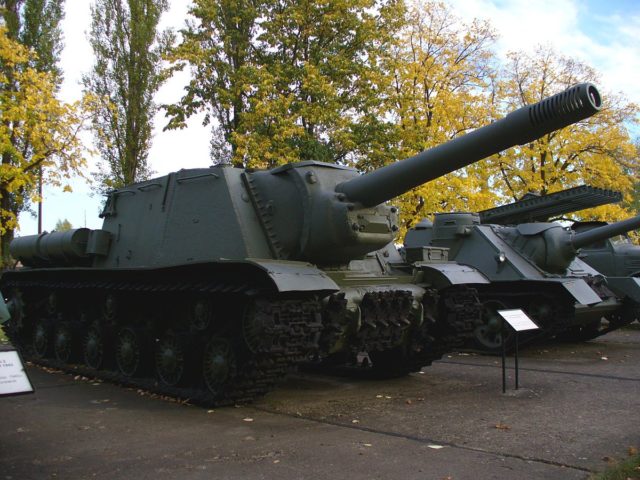
Also based on a tank chassis, the ISU-122 and ISU-152 followed the SU-76 into the war. They were equipped with heavier guns enabling them to fulfill both anti-tank and artillery roles successfully.
As the Cold War began, those machines remained in service. With the USSR so focused on rocketry, it was not until the 1960s that the next generation of significant self-propelled artillery emerged.


An ISU-152 displayed at Karlshorst, Berlin, Germany. Photo: Franco Atirador / CC BY-SA 3.0

The reign of Nikita Khrushchev, another advocate for rocketry, ensured the dominance of rockets in the Soviet military up until the mid-1960s. Following his removal from office, the situation changed. The way was open for a wider variety of self-propelled artillery.
    
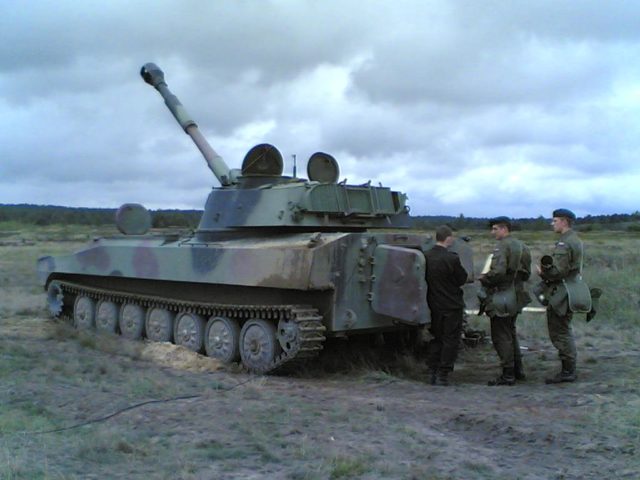
One of the most significant results was the 2S1 Gvozdika. A self-propelled howitzer, its first prototypes were made in 1969, and it entered service in 1970. The Gvozdika’s main armament was a 122mm howitzer, based on the D-30 towed howitzer. It provided greater mobility to an existing gun as well as greater protection for its crew. The howitzer could be angled for either direct or indirect fire, varying its usefulness.
The variety of options added to the Gvozdika showed how military vehicles had improved since WWII. As well as high explosives and smoke shells, it could discharge chemical ammunition or rounds that extended its 15.3km range to nearly 22km. It had infra-red equipment, different tracks depending on the terrain, and could be adjusted to make it shorter for transportation on aircraft.


Polish Land Forces Self-propelled howitzer 2S1 “Gvozdika” in artillery range.

A range of different self-propelled artillery weapons followed.
The 2S3 Akatsiya was another howitzer, this time carrying a 152mm gun. It combined a powerful engine with improvements in tracks and suspension to help it get around the battlefield. It was usually loaded using ammunition passed in from the outside through rear hatches. The 33 rounds carried inside the hull were kept for moments of necessity. It could fire a greater variety of rounds than the Gvozdika, including incendiary, flechette, and scatter mines. Later versions of the vehicle added more ammunition and a more advanced targeting system.

The 2S4 Ty ulpan’s main weapon was a 240mm mortar, carried on a chassis adapted from a minelaying vehicle. Before firing, the mortar was rotated on a hinge at the rear so that it rested on a base plate facing away from the vehicle. It was the first piece of Soviet self-propelled artillery to fire nuclear rounds.
Also introduced in the early 1970s, the 2S5 Giantsint-S was a vehicle with a 152mm artillery gun mounted on its roof. It could be fired both directly and indirectly and was again equipped with a range of rounds, as well as both direct and indirect sites. A large spade was deployed from the rear to make it more stable when firing.
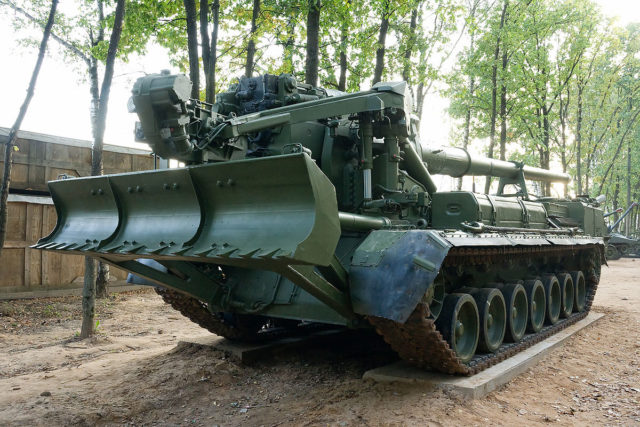
The 2S7 Pion added a larger caliber 203mm self-propelled gun to the range. Entering service in 1975, it also carried a surface-to-air missile system. Like the 2S5, it had a rear-mounted spade to stabilize it when firing. It had a range of 37.5km or 47.5km with rocket-assisted ammunition.


2S7 Pion at Museum of Technics, Arkhangelskoye, Moscow Region. Photo: Dmitry A. Mottl / CC BY-SA 3.0

In 1981, a new and highly flexible self-propelled gun entered service – the 2S9 Nona. The Nona consisted of a 120mm gun/mortar mounted on the body of a BTR-D armored personnel carrier. It was amphibious, could be airdropped, and had protection against nuclear, biological, and chemical weapons. It could be used for both direct and indirect fire, including anti-tank duty. While it’s maximum range of just under 9km was less impressive than some other artillery, it was a useful weapon.

In 1989, a replacement for the 2S3 and 2S5 came into service. It was the 2S19 Msta. It carried a 152mm howitzer with a maximum range of just under 25km. 50 rounds were kept inside the vehicle, although it was usually loaded with ammunition supplied from outside. A machine-gun and smoke grenade launchers provided extra protection.
Soviet-made vehicles were joined by the Czech vzor 77 Dana. With a 152mm self-propelled gun/howitzer, the Dana had an eight-wheeled chassis rather than a tracked one. It made it less mobile but cheaper and was considered adequate for its role serving from behind the lines.
By the end of the Cold War, the Soviet Union and its allies had a broad range of self-propelled artillery. Rockets remained important, but their days of relying on them were over.
Source:
Ian V. Hogg and John Weeks (1980), The Illustrated Encyclopedia of Military Vehicles
Russell Phillips (2017), Tanks and Combat Vehicles of the Warsaw Pact