First off, Airplane related news, the fall out about the Boeing 737 MAX is continuing...now some fast facts about the airplane...
The Boeing 737MAX is the 4th generation of the Boeing 737 which had its first flight on April 9, 1967. The MAX was launched in 2011 and got certified on March 8th 2017. The plane officially went into commercial service in May 22, 2017.
As of December 2017, 3900 737 MAX airplanes have been ordered by the various airlines around the world.and as of March 11, 2019Boeing had a backlog of 4699 planes, and it is the fastest selling airplane in History.
The Boeing 737 MAX is flown by 40 different international airlines and since February 25th has made over 8500 flights internationally.
The Boeing 737 series of aircraft is the best selling commercial airctaft in History, and there are more Boeing 737's flying around than any other type of airplanes. The 10,000th Boeing 737 rolled out of the Renton factory on March 13th 2018. Boeing completes an airplane every 11 hours and takes 9 days to build a Boeing 737 MAX in 9 days from start to finish.
Aaand during the crash of the first Boeing 737 MAX, the investigators believed that the airplane was in unsafe condition and should not have been dispatched.
Now Ethopean Air has sent the black boxes to EASA to discover what happened, rather than to the NTSB in Washington. This is political ego's at work. Rather than sending them to the foremost experts in crash science, they send them to the Europeans who have a vested interest in seeing Boeing lessened because it benefits the Airbus consortium. That being said, the same could be said about sending them to NTSB. It is a murky mess. I work on both Boeing and Airbus and from a Chemtrail technician's standpoint, I find the Airbus more maintenance friendly. Don't get me wrong, the Boeing people build a damm good airplane.
The USS Wasp anchored in Cuba in 1941
The wreck of the U.S.S Wasp (CV-7) located.
It was just a little before 3 p.m. Sept.
15. The USS Wasp, accompanied by her task force, was proceeding in a
westerly direction through the warm south pacific seas. On the forward
flight deck she was gassing her planes. Suddenly a torpedo hit her on
the starboard bow, starting a gasoline fire. Soon she was hit by
another topedo. Just before 3:30 p.m. the fires now out of control,
reached her forward bomb magazine.
There was a sudden blasting explosion; flames shot hundreds of feet into
the air; boiling columns of black smoke rolled skyward. Gasoline and
ammunition explosions flashed along the decks. The Wasp was doomed!
This was the pic I remembered in the Pacific War American History books from Elementary School in Germany . On another U.S. warship nearby was Artist, War Correspondent Tom Lea on a
Life Magazine Assignment. In his painting, he has recreated faithfully
the moment of the big explosion. Says he, "This painting has had a
peculiar effect on me. I felt very depressed while painting it. The
colors are poor inadequate symbols of the real tragedy, I do not know.
It is so strange to put a howling inferno into the middle of a soft and
beautiful sky and an untroubled tropic sea. Yet, that's how it was,
and I have painted the truth as well as I could.
Wasp was a product of the Washington Naval Treaty. After the construction of the carriers Yorktown and Enterprise, the U.S. was still permitted 15,000 long tons (15,000 t) to build a carrier.
Wasp was the first carrier fitted with a deck-edge elevator.
The Navy sought to squeeze a large air group onto a ship with nearly 25% less displacement than the Yorktown-class. To save weight and space, Wasp was constructed with low-power propulsion machinery (compare Wasp's 75,000 shp (56,000 kW) machinery with Yorktown's 120,000 shp (89,000 kW), Essex-class's 150,000 shp (110,000 kW), and the Independence-class's 100,000 shp (75,000 kW)).
Additionally, Wasp was launched with almost no armor,
modest speed, and more significantly, no protection from torpedoes.
Absence of side protection of the boilers and internal aviation fuel
stores "doomed her to a blazing demise". These were inherent design
flaws that were recognized when constructed, but could not be remedied
within the allowed tonnage.These flaws, combined with a relative lack of damage control experience in the early days of the war, were to prove fatal.
Wasp was the first carrier fitted with a deck-edge
elevator for aircraft. The elevator consisted of a platform for the
front wheels of the plane and an outrigger for the tail wheel. The two
arms on the sides moved the platform in a half-circle up and down
between the flight deck and the hangar deck.
Well the Wreck was found by the same people that found the U.S.S Hornet a few months earlier.
And Finally a nutjob in New Zealand decided to shoot a bunch of people that believe in islam in a couple of mosque. Well the first one was driven off by a muslim man that actually had a permit for a pistol. Well the second one, there was nobody armed so the nutjob proceeded to shoot 60 plus people and kill at last count 49 of them. The nutjob is an Australian immigrant who despite having the deaconian laws of New Zealand against gun ownership was able to get a couple of AR 15's. Well the left immediatly in orgasmic joy because the person is white and he is a male and he shoots the perpetual victims of the intersectional left, the muslims they react with orgasmic job blaming white people, the NRA , President Trump and of course the AR-15, He couldn't own those over there legally.
The gun control lobby is ramping up to strike while the iron is hot to push an agenda that wouldn't have stopped this because they are going after people in general and gun owners in particular and rather than blame the evil in someone's heart they blame an inanimate object with no morals, no capacity of good or evil, it is just a tool. and usually I hear from the left when someone from islam kills somebody that ain't muslim.."Don't blame the religion for one bad person." Well the same applies for us lawful gun owners.
I had to delete and repost this..Apparently I had a problem with script or something....
This
blogpost started when I happened to catch a yahoo article on
Submarines....I started digging into it and I learned a lot. Now I want
to plan a trip to Bremerhaven in Germany and check the sub out. I got the photo's from "Google" and Wiki was very helpful.
On
May 4, 1945 one of the most advanced submarines in the world crept up
to a British Royal Navy cruiser. U-2511 was one of Germany’s new Type
XXI-class “wonder” submarines, and she was hunting for Allied ships.
She also represented one of the Third Reich’s biggest failures.
More
than 250 feet long and displacing 1,620 tons, the Type XXI packed six
hydraulically-reloaded torpedo tubes capable of firing more than 23
stored torpedoes. This arsenal could turn a convoy into sinking, burning
wreckage.
But
the real improvement lay deep inside the U-boat’s bowels. There rested
an advanced electric-drive engine that allowed the submersible to travel
underwater at significantly higher speeds—and for longer periods—than
any submarine that came before.
It
was perhaps the world’s first truly modern undersea warship. The
engine, which was radical for its time, allowed the boat to operate
primarily submerged. This is in contrast to other war-era submersibles,
which operated mainly on the surface and dived for short periods to
attack or escape.
But
for the fortunate crew of that British cruiser, the war in Europe had
just ended. Adolf Hitler shot himself on April 30. Word of the European
ceasefire had also just reached U-2511. The submarine did not fire its
torpedoes at the cruiser, instead merely carrying out a mock practice
attack.
Neither
U-2511 nor its sister ship U-3008 ever fired a torpedo in anger during
the war. But the Kriegsmarine—the Nazi navy—had put its hopes in winning
the naval war on these Type XXI U-boats.
Now in a recent article
for the quarterly Naval War College Review, Marcus Jones—an associate
professor at the U.S. Naval Academy—describes the submarine as one of
the preeminent examples of Germany’s “irrational faith in technology to
prevail in operationally or strategically complex and desperate
situations.”
Desperation fuels innovation
The
Type XXI project dates to 1943. Germany was well into a submarine war
in the Atlantic, and aimed to choke and starve the United Kingdom from
its colonies.
Germany’s
goal was to surround the British isles with hundreds of submarines,
preventing anything from getting in or out. Initially, this was
successful. In October 1942 alone, U-boats sank 56 ships … and that was
just in the passage between Iceland and Greenland.
But
these successes turned badly against Germany—and fast. By 1943, new
convoy tactics, radar and anti-submarine patrol planes caused serious
problems with Germany’s predominantly Type VII submarines.
Germany’s
existing submarines were now vulnerable to being detected and sunk in
huge numbers. Their electric engines—used when underwater and recharged
with diesel on the surface—were not capable of holding a charge lasting
more than a few hours.
And
they were slow. Really slow. Many convoys could simply outrun them. If
the Allies detected a sub lurking underwater, they could simply wait it
out. In May 1943 alone, the Allies destroyed 43 U-boats, or 25 percent
of Germany’s entire operational submarine strength.
At
this point, Hitler and Germany’s senior military commanders realized
that “no amount of willpower or doctrinal ingenuity on the basis of
existing boat types could overcome the collective effects of the
countermeasures the Allies employed so well by 1943,” Jones writes.
The result was building a new kind of submarine that—in theory—would fundamentally change the nature of the war at sea.
Designed
by propulsion engineer Helmuth Walter, the Type XXI had a unique
figure-eight interior which allowed for a significantly larger electric
battery. It only had to surface rarely surface and recharge its battery
with conventional diesel fuel.
It
was also fast enough to keep up with convoys. It could run silent for
60 hours at five knots. It could also pick up the pace, traveling for an
hour and a half at a breakneck speed of 18 knots. By contrast the Type
VII could not travel faster than eight knots underwater—and then only
for short periods.
As
Jones points out, the new design also included “sensors,
countermeasures, and other devices understood to be indispensable in the
commerce war.” These devices included active radar and sonar and a more
advanced passive sonar to pick up the sounds of enemy ships.
But everything about the Type XXI was a mistake.
To
put it simply, it wasn’t a war-winning weapon. Worse for Germany, it
didn’t really do anything … and arguably hastened the Third Reich’s
defeat.
For
one, the submarines—only two were ever operational—suffered from
several technical problems that forced engineers to work overtime to
resolve. The hydraulic torpedo loading systems didn’t work at first. The
engines and steering systems were defective. This made the submarines
“decidedly less of a threat than originally foreseen,” Jones writes.
Germany
largely ironed out these problems. But even if the submarines had
worked perfectly at the outset, it’s unlikely they would have had much
of an effect on the outcome of the war.
This is because the submarines were tied to a losing strategy. And in 1945, German naval strategy was a hopeless cause.
Navies
expect their submarine commanders to operate independently. But a
mission as huge as stopping shipping across the Atlantic takes much more
than submarines. The Germans had a severe shortage of both maritime
patrol planes and air bases. In the harsh, rough seas and stormy weather
of the North Atlantic, this meant the Germans were limited by what they
could hear and see from their U-boats.
By comparison, Allied patrol planes were hunting them.
While
technologically advanced for its time, the Type XXI still existed
before the age of nuclear submarines, cruise missiles and nuclear-tipped
ballistic missiles.
These
strategic weapons turned Cold War submarines into the truly decisive
platforms they are today. Submarines during World War II were used
mainly for defending friendly coastlines, harassing enemy warships and
interdicting enemy convoys. The Type XXI was meant to carry out these
same missions, but simply more effectively.
But
in all three areas, Germany had already lost. Germany’s coastlines were
under regular attack by Allied bombers. Allied ground armies were
already closing in on the Rhine. And Allied convoys were so numerous,
Germany would have to build its new submarines by the hundreds to make
much of a dent. This was not physically possible.
As
Germany’s ports were no longer secure, engineers had to construct the
submarines in sections and transport them on a complex system of cranes
and barges to their launch points. This made fixing problems—expected on
new ship designs—much harder to fix.
Another
problem is that putting too much emphasis on wonder weapons distracts
from practical war efforts. In terms of steel committed to the project,
“the program cost the war effort some five thousand tanks, a very
consequential figure, and could be said to have hastened the defeat of
Germany on the Eastern Front,” Jones writes.
This mentality amounted to a “disease”
in German war planning, Jones argues. From V1 and V2 rockets,
super-heavy Tiger II tanks and jet fighters, Germany built radical
weapons that would fail to turn the tide against an inevitable defeat
brought about by larger economic, political and technological
disadvantages.
As
the war turned against Berlin, the Nazi commanders accelerated
development of new weapons, which distracted from other areas. Then the
war worsened, accelerating new weapon development further in a
perverted, vicious cycle.
However,
the Type XXI would last through the Cold War. Some were used for target
practice. Others were captured and commissioned into the Soviet and
French navies. The only surviving vessel of its class today is the
Wilhelm Bauer, which the modern Germany navy converted into a research
vessel. It’s now a museum ship in Bremerhaven.
But
mainly, the Type XXI provides several lessons in how technology—while
important—doesn’t alone win wars. It’s also a lesson in how the
fanatical pursuit of advanced weapons can make winning wars a lot
harder.
This was the first U-boat to be constructed of modular components to
allow for the manufacture of the various components in different
factories and subsequent assembly at the shipyard.
Between 1943 and 1945, 118 boats were assembled by Blohm & Voss of Hamburg, AG Weser of Bremen and Schichau-Werke of Danzig.
Each hull was constructed from nine prefabricated sections with final
assembly at the shipyards. This new method allowed for a hypothetical
construction time of less than six months per vessel, but in practice
all the assembled U-boats were plagued with severe quality problems that
required extensive post-production work and time to rectify.
One of the reasons for these shortcomings was that sections were made
by companies having little experience with shipbuilding, after a
decision by Albert Speer.
As a result, of 118 Type XXIs constructed, only four were fit for
combat before the Second World War ended in Europe. Of these, only two
conducted combat patrols and neither sank any Allied ships It was planned that final assembly of Type XXI boats would eventually be carried out in the Valentin submarine pens, a massive, bomb–hardened concrete bunker built at the small port of Farge,
near Bremen.
The pens were constructed between 1943 and 1945, using about 10,000
concentration camp prisoners and prisoners of war as forced labor The
facility was 90% completed when, during March 1945, it was heavily
damaged by Allied bombing with Grand Slam "earthquake" bombs and abandoned. A few weeks later the area was captured by the British Army. The Type XXI design directly influenced advanced post-war submarines,the Greater Underwater Propulsion Power Program (GUPPY) improvements to the United StatesGato, Balao, and Tench-class submarines, and the Soviet submarine projects designated Whiskey, Zuluand Romeo by NATO. The Chinese built Romeo-class submarines, and subsequent Ming class, were based on Soviet blueprints.
The only boat to survive intact is Wilhelm Bauer (ex-U-2540).
Records indicate that this sub was scuttled by the crew in 1945,
salvaged in 1957 and refurbished for use by the West German Bundesmarine
until retirement in 1983. It was then modified to appear in wartime
configuration for exhibit purposes.
I remembered this song and it played well in 1984 and I had a .45 of the single in my collection. I then forgot about the song until I heard it this past week on my Sirius/XM 80's channel. I still couldn't find out a lot about it. It isn't on an album or anything unless they had it on a greatest hits compilation...which is possible.
I do know of Manfred Mann Earth band from their song "Blinded by the light" which was a very popular song in the mid 1970's. The song is a bit haunting to me and I can't believe that I forgot the song.
In 1984, the band issued the single "Runner", a cover of the song by Ian Thomas, which had been written in response to cancer sufferer Terry Fox
and his run across Canada for cancer awareness...Fox had succumbed to
the cancer before finishing. The Manfred Man version featured Thompson
on lead vocals and Mick Rogers on backing vocals. The song was a non-LP
single in the UK but was included on the US release of Somewhere in Afrika.
It was a top 40 hit in both Canada and the US and was used during ABC's
broadcasting of the 1984 Summer Olympics and in the film The Philadelphia Experiment.
At 22 on the Hot 100 it was their biggest hit since "Blinded by the
Light" and was the band's second highest-charting song, as well as their
final US/UK chart single. In 1986, Thompson exited the group and Mick
Rogers returned with both appearing on the album Criminal Tango. For 1987's Masque
album, the band consisted solely of Mann, Rogers, and drummer John
Lingwood. Shortly thereafter, the Earth Band name was retired for a
number of years.
I went to the high speed range near my house and took the Henry to the Range to see how the repairs went...Remember I shipped off the Rifle back off to Henry to Fix the issues that I had with the rifle. You can read about it here if you want...
Well anyway I went to the high speed range and set up the rifle to shoot
I went ahead and set up the work bench..
I then went ahead and loaded the rifle..
This is what the rifle looked like holding 10 rounds in the tube..
I then slid the follower in and the moment of truth rotated the tube to lock it in place.....and it went no problem....YAY!! problem fixed.
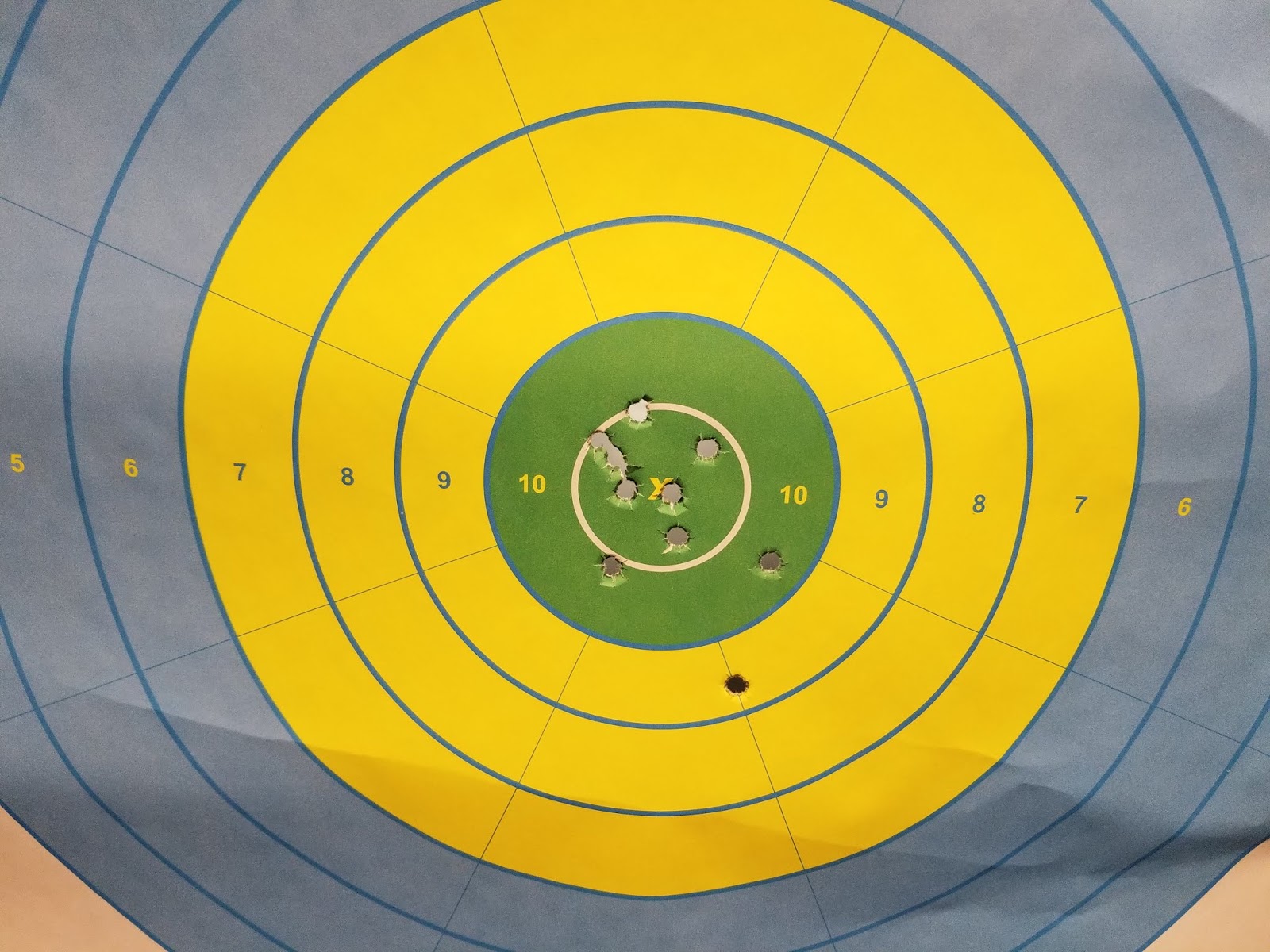
I proceeded to shoot 10 rounds...at 10 yards...With the exception of one flyer and that was me.
I then ran the rifle down 25 yards which is the max distance of the range...
This is how the target looked from the shooting bench...
I proceeded to shoot supported the rest of the rounds
I did have one problem, and it wasn't the rifle....it was the ammo....Tula strikes again....Since I already had the ammo I might as well shoot it up.
I finished firing the rifle until all the 53 rounds were gone...I did have some .38 Special along with the Tula .357 and I went and fired it up...
The rifle shot well, I do know that it isn't a "Tactical rifle." it takes time to reload the tube. The rifle is really fun to shoot and it shot well
I am very impressed with the rifle and Henry's customer's service. They got a customer for life for helping me with the rifle issues.
When I was an Armorer, I dealt with several kinds of Pistols, we had the .45 ACP, we also had 2 kinds of Revolvers,
We had a Ruger Service 6 in .38 Special and the Smith and Wessen MP in .38Special
The people in Army Aviation had the revolvers. I personally liked the Ruger better, it looked "Beefier" and better to control, although the S&W model 10 was a good revolver.
I had my personal .45, but it got stolen after I returned to the world. Still miss that pistol, but the chances of my ever getting that pistol back is slim.
From the Revolutionary War to the War on Terror, there has been a
pistol in the hands of our military men and women. Let’s take a look at
the pistols that have helped them win wars, both at home in America and
abroad.
The first sidearm used in the defense of the U.S.A. was the Flintlock
Model 1775. This was almost a direct copy of the British model 1760,
but it was made in the U.S. for the continental army.
You may recognize this pistol as the symbol of the U.S. Army Military
Police Corps or as the pistol on the U.S. Navy SEAL trident.
The Model 1775 was a .62 caliber smoothbore flintlock pistol that
became a favorite among officers due to its ease of use and its accuracy
— despite being a smoothbore pistol.
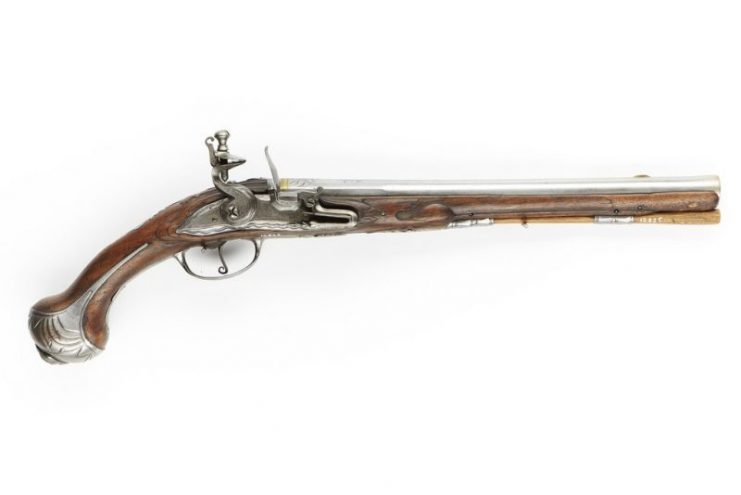
A flintlock pistol circa 1700–1730.The
first Continental Congress purchased 2,000 of these pistols to be
manufactured and produced in the U.S. by the Rappahannock Forge in
Virginia. This pistol served in the Revolutionary War, the War of 1812,
and the Spanish American War — right up until the introduction of the
revolver in the mid-1800s.
Samuel Colt, the founder of Colt Firearms, revolutionized warfare
with his revolving pistol that could shoot multiple bullets without the
need to reload. This was a major accomplishment in increasing the
lethality of warfare in the modern era.
His initial design ushered in a number of revolvers that would
service the U.S. military, including the Colt 1847, the Colt M1848
Dragoon, the Colt Army Model 1860, and the Colt Single Action Army.
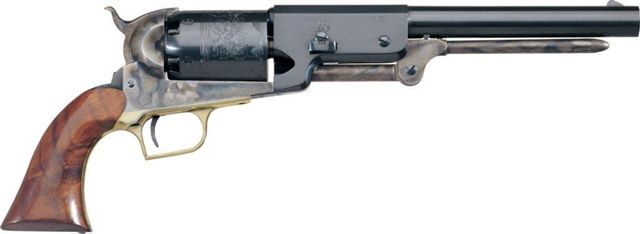
1847 Colt Walker. The
two most prominent revolvers from this list are the Colt Army Model
1860 (which saw extensive use during the American Civil War) and the
Colt Single Action Army.
The U.S. government ordered over 220,000 of the Model 1860 for the
War Between the States, and the cap and ball revolvers that shot a .44
caliber bullet were mass produced for all the Union forces.
The Colt Single Action Army — or, as it is more famously known, “the
gun that won the west” — is one of the most iconic American guns. Both
outlaws and heroes carried it in their gun holsters. Virtually unchanged
in design and still in wide use today, it is a .45 caliber pistol that
carries six metallic cartridges.
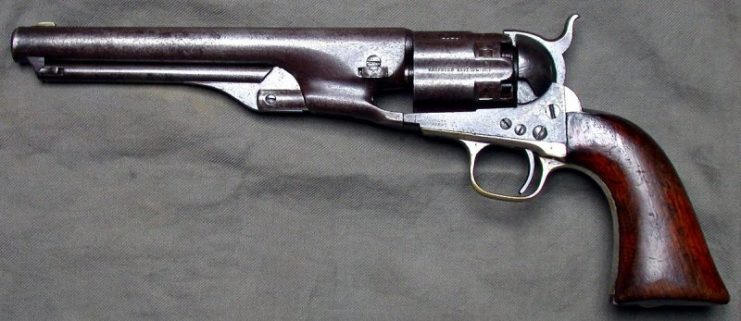
Colt Army 1860, early Model with fluted Cylinder and 7 1/2″ Barrel cal .44.
Probably the most recognizable pistol in U.S. military history, the
Colt Model 1911 served American troops in both World War I and World War
II as well as Korea, Vietnam, and many other 20th-century conflicts. In
fact, this pistol served as the sidearm for the U.S. military for 74
years.
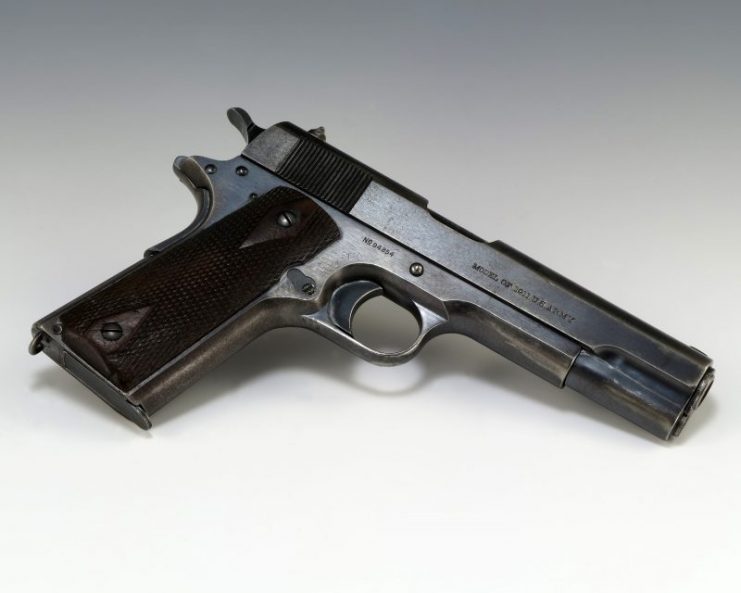
A government-issue ‘Model of 1911’ pistol (serial number: 94854) manufactured in 1914The
Colt Model 1911 was the first semi-automatic pistol to be adopted by
the U.S. military. The United States Army ran into a nasty surprise during the Philippine insurrection, the Moro warriors being hopped up on whatever the drug of choice would be almost immune to the damage caused by the .38 caliber revolvers the troops normally used. Many started carrying heavier caliber revolvers for personal protection. Over 2 million pistols were created, and it became a
favorite weapon because of the powerful .45 ACP rounds that stopped
enemies in their tracks.
This pistol’s lethality made it virtually irreplaceable until the
U.S. military decided to adopt the smaller-caliber M9 Beretta in the
mid-1980s.
Despite the military’s official adoption of this newer pistol, many
Special Forces units opted to carry the 1911 over the Berretta, and it
remains a favorite of the United States Marine Corps Reconnaissance
Forces.
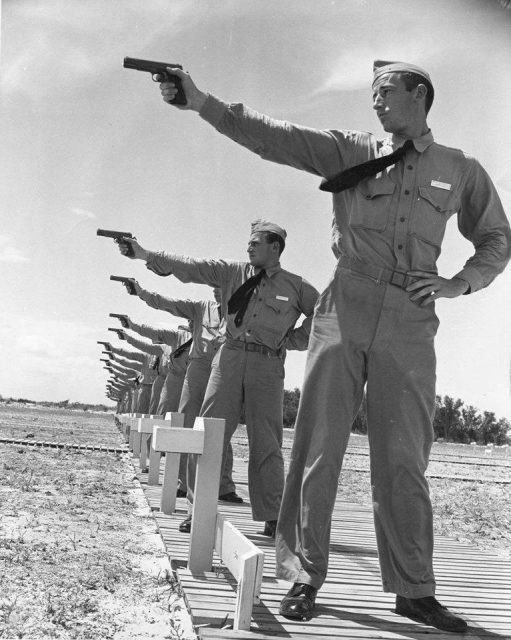
Naval
Aviation Cadets from the Naval Air Station at the pistol range with
Colt M1911-A1 .45 pistols, Corpus Christi, Texas, United States, circa
1941.
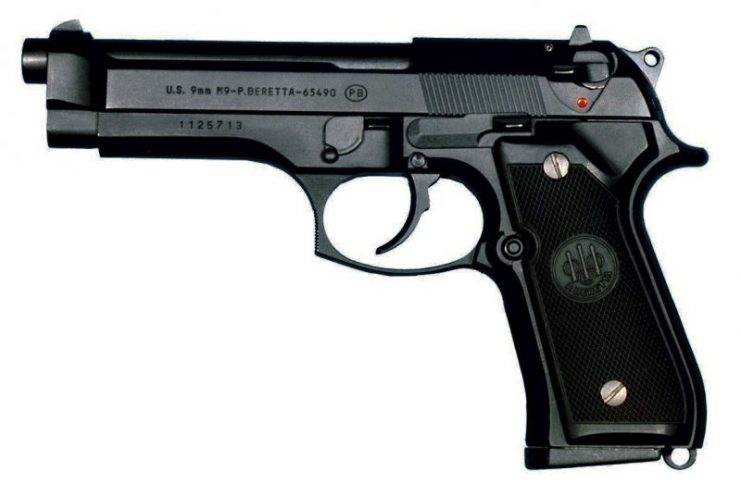
The M9 Beretta beat out a military favorite when it was chosen to
replace the Colt 1911 for a number of reasons. Not only was it lighter
and carried more rounds, but it was chambered in the NATO 9mm, making it
a top pick among Defense Department officials.
Beretta M9 pistol.The
M9 Beretta was adopted in 1985 and has served in the military ever
since, including Iraq and Afghanistan. As a single or double action
pistol, it is capable of carrying 15+1, which more than doubles the
capacity of the 1911.
Another respected feature of this pistol is it can be adapted for different missions.
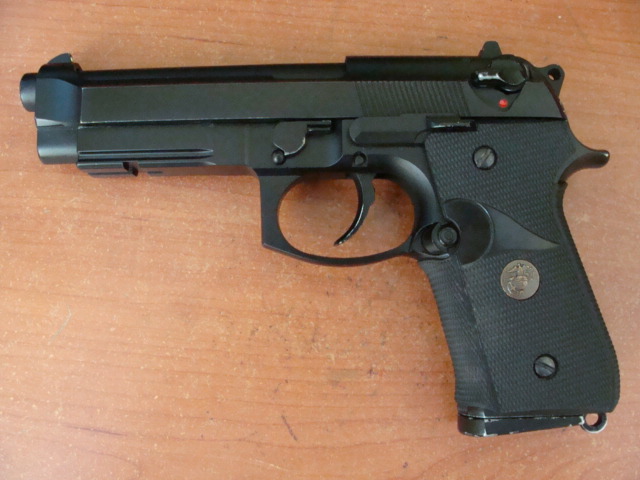
When the U.S. was caught up in deadly urban warfare conflicts in
Iraq, Beretta developed the M9A1 that featured a Picatinny rail, so the
military could affix a light or laser, making the M9 better for the
house-to-house and street-to-street fighting that was common in Iraq.
This pistol would go on to serve until 2015 when the U.S. Army announced that it was looking for a replacement to the M9. Beretta M9A1.
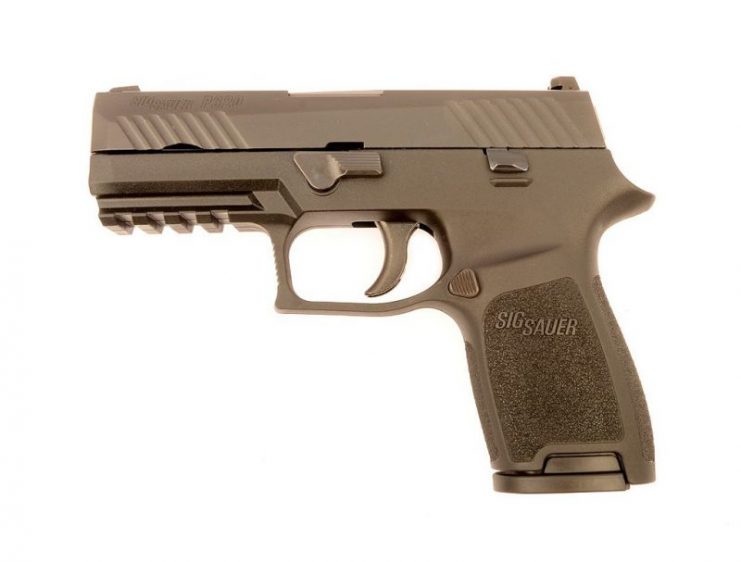
The Sig Sauer P320 is the newest addition to this long lineage of
pistols carried by the U.S. military. On January 19, 2017, the U.S. Army
formally announced that the P320 — the pistol now known as the M17 —
beat over 20 other pistols to be crowned the new standard-issue military
sidearm.
SIG Sauer P320 compact pistol. The
U.S. Army ordered almost 300,000 full-size pistols and another 7,000
compact models. Some other branches may have ordered another 200,000,
which would account for over half a million pistols commissioned by the
U.S. government.
This pistol emerged as a favorite because the Army was looking for something that was easily adaptable to their missions.
They wanted a firearm to have parts that could be swapped out to meet
the increasingly changing environments in which the Army conducts
operations. The M17 offers all this flexibility and more. It discharges a
9mm bullet, and you can change the grips and slide to meet the needs of
almost any mission.
It is easily broken down into a concealable handgun as well. This is
the new service weapon of the U.S. military, and it will serve alongside
the members of the Armed Services for years to come.
I heard something a long time ago when I was reading a lot of "Soldier of Fortune" magazines and they were talking a lot about Central America especially when it related to Nicaragua and the communist government of Daniel Ortega and that they were trying to export their revolution to El Salvador and the underground war to fight the communist in El Salvador and using the neighboring country of Honduras to supply the El Salvadorian government as they fought off the communist insurgency supported by Nicaragua. I remember reading something about the "Football War" between the 2 countries and how this war damaged the relationship between the countries. I always knew that they take their "Football" seriously....And I thought the fans in England were bad
The history of mankind has seen a number of wars that started over
awkward reasons. One such war in more recent times was the 1969 Football
War or the Soccer War. It was a brief conflict between El Salvador and
Honduras, two neighboring countries in Central America. Aside from its
almost comical name, it is one of the shorter wars in history, lasting a
mere 100 hours.
Since becoming independent states in the first half of the 19th
century, Honduras and El Salvador both developed under the influence of
big international agriculture companies, primarily from the United
States. In El Salvador it was coffee, in Honduras it was bananas that
attracted big players. In the 1960’s both countries were still
undeveloped, with high percentage of people living below the edge of
poverty. Fairtrade coffee growers in El Salvador El
Salvador was the first of the two to begin the process of
industrialization. That strengthened the weak economy of the country,
but also proved to be a big problem: it made El Salvador an
overpopulated country. Even though it was five times smaller than
neighboring Honduras, El Salvador had a population of 3.7 million while
Honduras had only 2.6 million.
This disproportion caused an enormous number of unemployed
Salvadorans to look for a better life and a piece of land to cultivate
in Honduras. As years passed, the number of Salvadoran immigrants in
Honduras increased to 300,000 people. Most of them were plain squatters,
who claimed the right to the land they cultivated only by the fact that
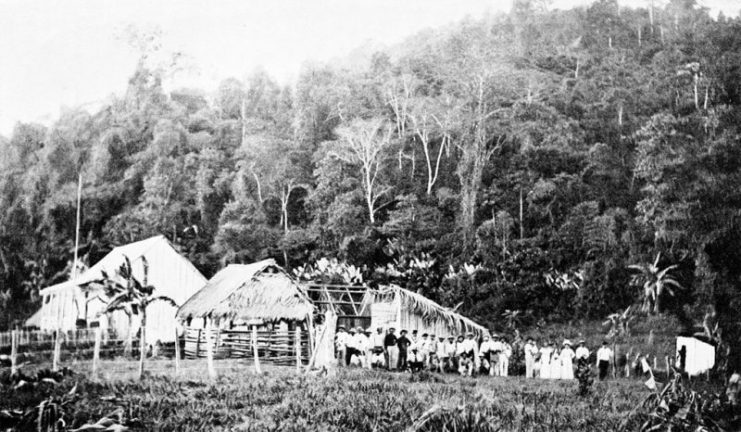
they lived there. Honduras Banana plantation
Even though Honduras was much larger and a country with bigger
potential, it also had problems of its own. Under the rule of military
dictator Oswaldo Lopez Arellano, Honduras was struggling to build an
effective government and stable economy.
Among the most discontented citizens were Honduran farmers, who were
unsatisfied with the distribution of cultivated land and were asking for
agrarian reforms. Since most of the land was in hands of big
corporations—sponsors of the regime—the only land that could be taken
into consideration was that which had been settled by Salvadoran
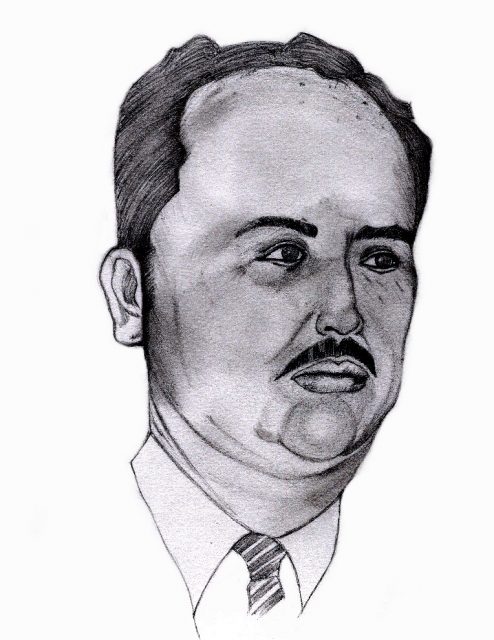
immigrants. Drawing of Former Honduras Chief of State- Oswaldo Lopez Arellano.
On the eve of the 1960’s situation in Honduras became bad. The
country was suffering a deterioration of its political and economic
situation. As its government looked for an excuse for its incompetence,
Salvadoran immigrants popped up as the best choice. They were pinpointed
as the sole reason for low wages and high unemployment.
The government started a media campaign against Salvadorans, which
raised the public discontent with their presence. Salvadorans begun to
suffer maltreatment on a daily basis both from the government and
ordinary people.
A moment that marked the beginning of conflict between the two
nations was the Honduras government’s decision in April 1969 to expel
from their lands all those that were not Hondurans by birth. It meant
that thousands of Salvadorans had to move back to their homeland.
Naturally, this was a great problem for El Salvador which had huge
problems with overpopulation. The Salvadoran government strongly
protested against the actions taken by Hondurans, but received no
response. The media in El Salvador then begun a campaign of their own,
reporting on violence against Salvadorans.
An unlucky course of events made the situation even worse. The two
countries were scheduled to meet in a semifinal qualification round for
the 1970 World Cup in Mexico. After recent events, the rivalry was so
high that incidents were unavoidable. Estadio Carías StadiumThe
first match was played on June 8, 1969 in the Honduran capital,
Tegucigalpa. In an atmosphere full of tension, Honduras won the match by
an injury time goal. While Hondurans were celebrating, Salvadorans felt
they were robbed.
To make things worse, an 18-year-old Salvadoran girl named Amelia
Bolanios took the defeat so hard that she killed herself after the
referee blew the final whistle. Her suicide made her a national hero and
also boosted the hatred toward Honduras.
There was nothing good to expect from the rematch in San Salvador one
week later. Salvadoran fans made sure that guest players felt they were
not welcome. For the entire night before the match, fans made a
terrible amount of noise in front of the hotel where the Honduran
players were located.
The next day the Honduran team was transferred to the stadium in
armored vehicles. El Salvador easily won the match by three goals to
null. To insult their rivals even more, Salvadorans raised a dirty rag
instead of the Honduran flag. On top of everything else, two Honduran
fans were murdered on their way home, while many others ended up with
severe wounds.
It is needless to say that these incidents caused severe reactions in
Honduras, where local Salvadorans experienced huge reprisals. Their
shops were demolished and the owners beat up, with some of them even
murdered. The border between the two countries was closed, and in the
days that followed approximately 1,400 Salvadorans were being expelled
from Honduras per day.
The third decisive match was played in Mexico City on June 26. In a
tight match, El Salvador won 3-2 after extra time. On the same day, the
government of El Salvador dissolved diplomatic ties with Honduras. They
were objecting that Honduras did nothing to prevent the maltreatment of
Salvadorans, nor to punish those who did it.
Salvadorans were resolved to solve the dispute through the means of
force. On July 12, 1969 the Salvadoran and Honduran armies engaged in
border clashes, but two days later the conflict erupted into war.
On the afternoon of July 14, the army of El Salvador made a
coordinated attack from the air and on the ground. Its air force made an
attack on Honduras’ main airport in Toncotin with three passenger
Douglas C-47s followed by F4U-5 Corsairs. The C-47s had been modified to
serve as bombers by attaching explosives to their wings.
On the ground, their army of around 15,000 soldiers crossed the
border along two main roads that connected the countries. The northern
group consisted of one small armored vehicles unit and a large number of
infantrymen. To the east, on the other hand, were engaged more powerful
units that included M3 Stuart tanks and 105mm M101 field howitzers.
These units were aiming for the city of Tegucigalpa.
By the end of the following day, Salvadorans made significant
progress as Honduran ground forces were no match for their strength.
However, Hondurans did have an ace up their sleeve. On July 16, the
Honduras Air Force sent T-28 Trojans, F-41s and F4U-5 Corsairs to attack
the Ilopango air base, oil facilities in the Acajutla Port, and other
smaller oil facilities.
These attacks had immediate results, since because of the resulting
gasoline shortage, Salvadoran forces had to halt their operations.
However, they were still eager to attack Tegucigalpa even if they had to
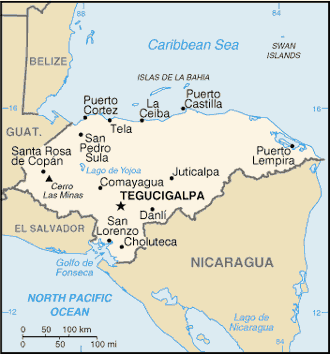
do it on foot. Map of Honduras, where most of the fighting took place
Facing a fatal scenario, the Honduran government appealed to the
Organization of American States (OAS) to intervene. In an urgent session
on July 18, the OAS called for an immediate ceasefire and a withdrawal
of Salvadoran troops from Honduras.
El Salvador agreed on the ceasefire starting from July 20, but
refused to withdraw its troops until Honduras was obliged to pay
reparations to victimized Salvadorans and guaranteed the safety of those
who remained in Honduras. Only after the OAS pressured them with
economic sanctions did El Salvador agree to withdraw its troops on
August 2. After only four days, the war was over.
Even though it was a brief conflict, the war caused more than 2,000
casualties, primarily Honduran civilians. The majority of those living
in combat zones had their houses burned down or demolished. A
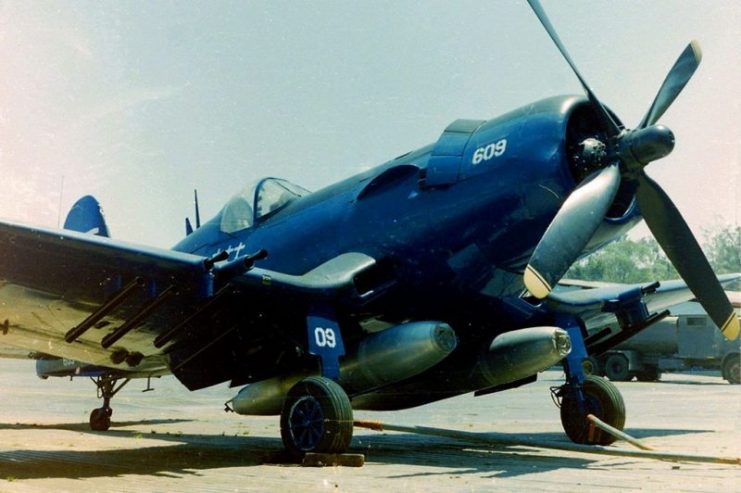
Vought F4U-5NL Corsair – at the Museo del Aire, Tegucigalpa (Honduras).
This aircaft was sold to Honduras in 1956. In the so-called “Football
War”, Cap. Fernando Soto in FAH-609 shot down a Salvadoran air force
Cavalier F-51D Mustang and two Goodyear FG-1D Corsairs on 17 July 1969
during the last known air combat between piston-engined aircraft.Diplomatic
relations between the two countries were suspended for years and the
border was closed. The war affected the economies not only of Honduras
and El Salvador but also those of the entire region, because it
suspended the program of Central American Common Market for 22 years.
El Salvador was the greater loser of the war. Between 60,000 and
130,000 Salvadorans were expelled from Honduras. The Salvadoran
government was unable to cope with such an inflow of people, causing
social unrest in the country which ultimately led to a civil war.
The two countries signed a peace treaty eleven years later, on
October 30, 1980. On November 23 that same year, the two nations played
their first post-war soccer match. El Salvador won 2-1
I had ordered my gun socks from Amazon, got them for $7.00 apiece.. and got them in the mail last night..
I was happy since I would not have to deal with "Sportsman guide" and break my self imposed ban. Like I said, I and many other gun owners remembered how we were treated after Sandy Hook by them. I understand that it was all business and I get that...but I also remembered a quote from the book "The GodFather" by Mario Puzo "Sure you can say that it is all business and nothing is personal, but when it comes to business it is all personal." When you have a business relationship with someone or a company, there is an equal exchange for goods and service, you develop a business relationship and there is a certain loyalty that goes into the business relationship and the loyalty is a 2 way street.
Well anyway my O3, My Mosin and 2 of my .22LR rifles are now happy. They are all gunsocked, LOL.
I was loaned a book by a friend of mine from work, it talks about the battle of Midway from the Japanese perspective....and it is a different point of view..
I knew from past books and other articles that I have read, the Japanese Army and the Japanese Navy really didn't get along....we talk about the Army/Navy rivalry that the United States had...we still have it to a certain extent. I remember reading in a book called "Prodigal Soldiers"
"Documenting the
transformation of the U.S. military from Vietnam to the Gulf War, a
history of a generation of officers examines changing ideas about war,
ending the draft, reducing racial tensions, and integrating women into
the ranks."
Yep that book, I remembered buying a copy of the book in the late 90's and I was mesmerized because I lived through the story from my time in the service to going to the Gulf War. I remember seeing how my Dad was treated after Vietnam and how the Military was portrayed as the "Bad guys" in all the movies and TV shows to the debacle of "Desert One". The soldiers were afraid to wear their uniforms off post because how they would be treated. To the time in the early 1980's when President Reagan showed unabashed pride in being an American and it filtered down. From our first forays in Grenada in 1983, I remembered the commercials changing from "The Army wants to join you" to "Be all you can be" and the difference several years made as the United States Military transformed itself from the nightmare that Vietnam created to the force that crushed Saddam Hussain. But I digressed...I remembered reading about the group called "The Iron Majors" whose sole function was to make sure that their own service got all it could, even at the expense of the other service and the country..Well Japan had it far worse than we ever could. In the book I read that the Japanese Military was focused on 2 foes, the Japanese Army focused on Russia and the Japanese Navy focused on the United States and the 2 worked at cross purpose to each other. The Japanese Army was hungry for war, they have been fighting in China since 1937 but the Navy was far less interested in getting into a fight. Their squabbles went all the way up to the imperial staff that advised the emperor Hirohito. The book also explained that the attack in Pearl Harbor was an attack to keep the United Stated from interfering with the seizures of the Dutch East Indies and all their rich resources. I already knew that from my other reads but it was interesting reading it from their perspective. The book explained the Japanese philosophy of attack and defense and it is a very good read. I am half way through the book and hope to have it done in a day or so...depending on what else is going on.




 Beretta M9A1.