Webster

The Constitution was made to guard the people against the dangers of good intentions." --American Statesman Daniel Webster (1782-1852)


Wednesday, October 16, 2019

"I ain't dead....Just super busy"

Sorry for not posting for the past few days, "MeatSpace" has been keeping me real busy lately.  I have started my run for my Oral and Practical which is Next week so I have been studying and of course my son needs me to help him with some projects with his truck. and of course work, and occasionally sleep.  Yesterday was switching out all his lights for LED's. after spending 15 hours at work....  I will post pics later.

Gotta use Teddy for a meme....

Saturday, October 12, 2019

Post about the Kurds...


I shamelessly cribbed this from the "GodFather" Tom Kratman.   Apparently the Neocons and the media are using President Trump's decision to pull out of Syria and the Kurds, and they all are having meltdowns"Orange Man Bad".  I am of the mindset, Obungler shouldn't have put us in the middle of the clown circus to begin with.  Sure the Kurds are allies, but which Kurds?   There are Iraqi Kurds, Syrian Kurds and Turkish Kurds.  I am not a peacenik by any means, but we can't be the worlds Policeman.  Nobody over there is our friends, well perhaps the Kuwaiti's and the Israili's.  The others.....well not so much.   The "GodFather" posted this on Facebook and it was a worthy rant.

Our Gallant Allies, the Kurds (and other fairy tales)
Ah, the Kurds. How can mere words render a proper appreciation? They’re trustworthy, loyal, helpful, friendly, courteous…um…no; no, they’re not. Oh, sure, as individuals they can be fairly boon companions, but in the main and in the mass? Not so much.
My first experience of the Kurds – rather, of how the rest of the area thinks of and feels about them – was before I’d ever met my first one. This was at a majlis, in the town of Judah (or Goodah), Saudi Arabia, sometime in December or so, 1990. Citizenship is kind of an iffy and flexible concept in that part of the world, so there were folk from Saudi, from Oman, from the Emirates. There was even one Arab who insisted he was a citizen of the Gulf Cooperation Council, since he was a fully documented citizen of so many places in the GCC. I had my doubts right up until he pulled out a bilingual ID card which, indeed, did seem to list him as a citizen of the GCC. One of the attendees had brought with him a book detailing the results of the chemical attack on the Kurdish town of Halabja by the army and air force of Saddam Hussein.
It was really heartbreaking, all those picture of gassed, dead, discolored, and decomposing Kurdish kids, who are, in fact, every bit as cute as the papers and television made them out to be. At least when they’re not dead they are. My team sergeant, Sig, and I were duly appalled and sickened.
The Arabs, though, didn’t seem to understand. To paraphrase, “What’s the problem? Don’t you understand that these were _Kurds_ who got gassed?”
At the time, I found that attitude completely inexplicable.
Fast forward a few months; we’ve incited the Kurds and Shia to rise up and overthrow Saddam. They didn’t, of course, while such an uprising would have looked difficult and might have done us some good. Oh, no; instead the Shia – whose rebellion was spontaneous, anyway – waited until it looked like the Iraqi Army was crushed and such an uprising would be easy. The Kurds – who were organized – waited even longer.
Sorry, boys, but when we offer you a quid pro quo, that doesn’t translate into “free lunch.” Moreover, when we’ve already offered someone a cease­fire it’s a bit late to try to get us to start hostilities again. In short, we owed them nothing.
Fast forward, again, to late May, 1991. I’d come home from the Middle East, hung around a while, and been sent back, this time to Operation Provide Comfort, the Kurdish Rescue, there to quasi govern a few towns, run refugee camps, coordinate humanitarian relief, and such like. While we’re waiting in the camp on the Turkish side of the border, not too far from Silopi, overwatched by a Turkish police fort on a hill, some Kurds got in position to fire at the fort such that, should the fort return fire, the Turks will be shooting at us. So much for gratitude from people you’re trying to save, eh?
Fortunately, Turkish discipline held firm and enlightened Kurdish dreams of advancing the cause of having a homeland of their own by getting their rescuers killed came to naught. After a couple of days at the camp, the crew I’m with and I are ordered forward to link up with the British Marines and their Dutch counterparts, already inside Kurdestan. We’re riding in on the back of a British Bedford Lorry, one which, based on the comfort of the ride, probably crossed the Rhine with Monty in 1945…after enduring the entire war in North Africa. If it had a suspension it was tolerably hard to see, and impossible to feel.
Sitting next to me is a Staff Sergeant Farnsworth. Farnsworth and I are both grunts, so we’re doing what grunts do when there’s nothing better to do and neither sleep nor playing cards nor reading are possible; we’re analyzing the terrain. It is fiercely rugged, with winding roads going through narrow passes between hills and mountains difficult enough to climb on foot and impossible for vehicles. Reverse slopes were of such an angle as would make defenders largely invulnerable to artillery and would make even high angle mortar fire of much reduced effect. In any case, at a certain point, looking over a particularly defensible pass, Farnsworth and I looked at each other. I no longer remember who spoke first but the conversation went like this: “If the Kurds­“ “­couldn’t defend themselves­“ “­in this kind of terrain­“ “­they don’t deserve­“ “­their own country.” And that was before we even knew how much they used mines.
*****
A little digression is in order here. As mentioned previously, Kurdish kids are adorable. (The women are also quite fetching, right up until they’re worn out, usually by age twenty-­four or so, from being used like mules, which is to say, beasts of burden, but who, unlike mules, can still bear young…and must.) Most people shy away from or are at least ignorant of the reason so many of those adorable kids died. It’s simple; the Kurds starved them to death themselves. It’s a cultural imperative among them, when times get hard, to let the little girls die of starvation (first, of course), and then the little boys. Good guess, dear reader; why, no, I didn’t like that for beans. As a matter of fact, now that you ask, I’m not much for multiculturalism, in general, either.
*****
Interestingly, before we even arrived in our area, there had been an incident – a firefight resulting in several Iraqi dead – between the British Marines and some Iraqi troops guarding one of Hussein’s palaces in that part of Iraq. I asked a British officer about it and his answer was to the effect that, “As near as we can figure, as one of our patrols was passing, two Kurds, from different positions but surely with coordination, took a shot each, close to simultaneously. One shot was at our patrol, the other at the Iraqi on the gate to the palace. Both shots missed, but the Iraqis and our men, thinking they were under attack, reacted as one would expect. We were just a lot better shots, better led, than they were. Poor bastards. One of the reasons we’re quite sure that the Iraqis didn’t shoot first was that, as our men passed, they waved at each other, as soldiers will who have no particular reasons for enmity.”
*****
The main town I ran was Assyrian and Christian, Catholic, actually, having their own rite but being in full communion with Rome. It was an experience to attend mass held in Aramaic, the language of Jesus, a memory I rather cherish despite not understanding a word of it. They are nice people, the Assyrians, seriously nice people. I’ve dealt with a lot of different kinds of foreigners, over the years, even married one, for that matter, and liked almost all of them. But the Assyrians have a special place. They’re also amazingly hardworking. They can’t defend themselves or, at least, they don’t think they can, which amounts to the same thing.
Everyone knows about the Armenian genocide. The genocide of the Assyrians, around the same time period, was about as bad and may have been worse, as a percentage of the pre­massacre population. And among the chief agents of that genocide? Of both of them, really? You guessed it, the Kurds.
I asked my Assyrian translator there, once, what he and the other Assyrians really wanted. He answered, “We’d like the British to come back and run the place, permanently. Failing that, we’d be very happy to be subjects of the American Empire, if you would just declare one. If that’s not possible, then letting the Iraqis back would be minimally acceptable. Under no circumstance, however, do we want to be under the Kurds.”
That main town was the only one in which no Kurdish babies died, of the smallish number that the Kurds didn’t let starve anyway, and the only one in which there were no political or ethnic murders in that time period. Part of that was probably my own rather forthright approach to domestic harmony – “One incident, just one, and I’ll cut off your food, medical care, and other goodies, causing all your followers to desert you for other groups and leaders I haven’t proscribed!” – but part of it, too, at least for the long term maintenance of the thing, was probably the perception among themselves that the various Kurdish groups needed one safe area in which to engage in local diplomacy, and, since this one area was peaceful, well, why not? That meant a lot of luncheons, meaning, yes, I had the chance to meet most of the bright lights of Kurdish domestic politics and self­-determination of the day. I’ve long since forgotten their names, but am pretty sure I could identify most of them in a police lineup and wouldn’t, of course, mind doing so. One in particular stands out in my mind, a rather distinguished looking middle aged barbarian who had once, over what amounts to a domestic dispute, murdered some thirty-­seven Christian men, women, and children. And then there was the day the Kurds demanded to be paid. Paid? Why, yes, we were providing free food, free medical care, free shelter, and free security, but they saw no reason not to be paid for unloading the free food and other goodies. I sent the trucks back with the food until they knuckled under.
*****
Thus, it might be better for the United States, before pinning too much hope and faith on the Kurds, to understand that they’re military imbeciles with an unearned and undeserved reputation, that their culture is barbaric, they their one talent seems to be propagandizing and manipulating liberal Western opinion, which is eager to be manipulated, anyway, that any kids who die usually do so because of their own neglect of those kids, that they have no sense of gratitude for any help you give them, that they treat women like donkeys, and that they place zero value on the lives of those who try to help them.
Why we, or anyone, would place our faith and trust in them…well, it eludes me. To help that lesson stick in your mind I offer a Kurdish National Anthem, written by my team sergeant, Sig, in a moment of complete disgust with them. Every line tells a story: (Tune: O Tannenbaum)
A voice without a hint of shame
Cries, “It’s all your fault; you’re all to blame.
We must be clothed, we must be fed
And when that’s done build our homesteads”
Chorus:
A Kurd can have no greater love
Than his brand new Kalashnikov;
O Kurdestan, my Kurdestan,
Do what you want; grab what you can.
You gave us shelter overhead
Doctors and blankets for our beds.
You’ve saved us from Iraqi raids,
Now tell us when do we get paid?
Chorus
We fought the Turks, we fought Iran
We fought Iraq for Kurdestan.
And now you’ve made us free and strong,
We’ll kill the Christians when you’re gone.
Chorus
This column is dedicated to the memory of Father Hanna Marko, of Mangesh, Iraq.

Friday, October 11, 2019

Truck Project...

Well y'all remember this truck we got for my son?
My son loves his truck, but he didn't like the grill...See the difference between my honeycomb grill and the regular grill that his truck has.
     Well we went to a junkyard where luckily for us, there was a completed honeycomb grill in a junked F150.   The Grill color was a very faded black.
Well I primed the new grill and he removed the old grill and headlight surround on his truck..

 The old grill primed, I also primed the new insert
New insert painted
New insert in the grill surround.
New grill surround and insert installed.  He was very happy with the Mod.

 Since I was painting, I decided to paint our wiper arms, they had surface rust and looked really bad, so first thing I did after priming the grill, was priming the wiper arms.
I finished painting the old grill insert
Finished the Black
Looks good.
The wiper arms look really good, far better than the old faded ones that were on there earlier.

I'm going to put the "old" repainted insert in craiglist and market place where my son can recoup the money he paid for the honeycomb grill.

    We are planning another junkyard run to see what they have in a week or so.


Monday, October 7, 2019

Monday Music "Modern Love" by David Bowie


Since I have thrown 2 of his songs under the bus, and I did mention that I would do a song from David Bowie that I do like.  Well I like this song,Granted that it is a bit campy but it plays well on the radio.   David Bowie and Bing Crosby do one of my favorite Christmas songs "Drummer Boy"

"Modern Love" is a song written and recorded by English singer-songwriter David Bowie. It is the opening track to his album Let's Dance, and was issued as the third single from the album in late 1983.


"Modern Love" was the 2nd song Bowie started recording for the album, after its title track, recorded in the first few weeks of January 1983. By the time "Modern Love" was issued as a single, Bowie's Serious Moonlight Tour was underway. The video for the song used footage of Bowie and his band performing the song from concert in Philadelphia on 20 July 1983. A live version, recorded in Montreal on 13 July 1983, was on the B-side.
As well as being a staple of the Serious Moonlight Tour, it was featured in Bowie's set at Live Aid in 1985, and in his subsequent Glass Spider and Sound+Vision tours of 1987 and 1990. It was also performed occasionally during his 2003-4 A Reality Tour. To promote the Glass Spider Tour, as part of his commitment to Pepsi for their commercial sponsorship, Bowie re-recorded the song with Tina Turner for a commercial which aired briefly in 1987.

Friday, October 4, 2019

Quick post...local goins on.

I have been busy with real life, I passed another test on the road to my A&P, I passed my "Powerplant" so all I have left is the "Oral and Practical".  This has taken a lot of time this summer to get done. 
    On a different note, I was an honored spectator where my brother from another mother gave the oath of enlistment to his son at the MEPS station. 
My Brother from another Mother first explained a few things about the delayed entry program and that "the Military is not for everyone, and if you don't want to join, please decide now rather than waste time and money in basic training."  He told me later that the recruiters hated him when he said that to the enlistee's. when he ran a MEPS station during his career but he believed that he was doing the right thing by both the enlistee's and the Service.
 Getting ready to give the oath of enlistment.
Giving the Oath of Enlistment.  His son will be going to Fort Leonard(Lost in the Woods) in Misery
Missouri then off to Fort Sills.
I remembered his son when he was 10 years old and helping me corral cub scouts at the BB ranges I used to run.  Jeez how time flies and I was honored to make the ceremony.   They say that fewer than 2% of the people in this country serve, or have served.  I consider myself fortunate and lucky to count myself in this number and that a lot of my friends have also taken the oath of enlistment.  I still even now consider my oath binding despite my getting out in 1991.


      Yes I bought myself a "new Rifle"......And Yes it is a "HiPoint"

I wanted a rifle in pistol caliber to augment my pistols, the carbine is in .40S&W like my pistols.  I would normally not buy a hipoint, although their warranty is one of the best in the industry.
 The Carbine has a good reputation,  My dad owns a 9mm version and he loved it.   I remembered a couple of years ago where some single mom ventilated 3 wanna be home invaders in Detoilet. I will take the rifle shooting next week, probably at Mack's place of employment on either Thursday or Friday and I will give my impressions at that point.

Wednesday, October 2, 2019

busier....

I am busy with stuff IRL, unfortunately the blog has to take a backseat until later this week. 

Monday, September 30, 2019

Monday Music "Lets Dance" by David Bowie

This song was supposed to be my "Monday Music" last week, but I wasn't planning on being sick so it got moved to this week.
    I am continuing my series of songs I don't care for.  Like I said, these songs are commercial successes, but to me it is a personal taste.  I flat out don't like them.  I will do David Bowie next week again and it will be a song that I do like. 

"Let's Dance" is a song recorded by English singer David Bowie from his album of the same name, Let's Dance (1983). The song was written by Bowie and produced by Nile Rodgers. It was released as the album's first single in 1983 and went on to become one of his biggest-selling tracks. Stevie Ray Vaughan played the guitar solo at the end of the song.
The single was one of Bowie's fastest selling, entering the UK Singles Chart at No. 5 on its first week of release, staying at the top of the charts for three weeks.[6] Soon afterwards, the single topped the Billboard Hot 100, becoming Bowie's first (and only) single to top the charts in both the U.S. and the UK. It was also his second and last single to reach #1 in the U.S. In Oceania, it narrowly missed topping the Australian charts, peaking at No. 2 for three weeks but it topped the chart for 4 consecutive weeks in New Zealand. The single became one of the best selling of the year across North America, Central Europe and Oceania. It is one of the 300 best-selling UK singles of all time.


The music video (which uses the shorter single version) was made in March 1983 by David Mallet on location in Australia including a bar in Carinda in New South Wales and the Warrumbungle National Park near Coonabarabran. In the beginning it featured Bowie with a double bass player inside the one-room pub at the Carinda Hotel and an Aboriginal couple 'naturally' dancing "to the song they're playin' on the radio". The couple in this scene and in the whole video is played by Terry Roberts and Joelene King, two students from Sydney's Aboriginal Islander Dance Theatre. As Bowie opted for real people, some residents of the 194-souls village of Carinda are in the pub too, watching and mocking the couple. They do not understand who David is nor what the take is all about, hence their behaviour towards the couple as seen in the video is real.
The red shoes mentioned in the song's lyrics appear in several contexts. The couple wanders solemnly through the outback with some other Aborigines, when the young woman finds a pair of mystical red pumps on a desert mountain and instantly learns to dance. Bowie's calling 'put on your red shoes' recalls Hans Christian Andersen's tale "The Red Shoes", in which the little girl was vainly tempted to wear the shoes only to find they could not be removed, separating her from God's grace - "let's dance for fear your grace should fall"  "The red shoes are a found symbol. They are the simplicity of the capitalist society and sort of striving for success - black music is all about 'Put on your red shoes'", as Bowie confirmed.
Soon, the couple is visiting museums, enjoying candlelit dinners and casually dropping credit cards, drunk on modernity and consumerism. During a stroll through an arcade of shops, the couple spots the same pair of red pumps for sale in a window display, their personal key to joy and freedom. They toss away the magic kicks in revulsion, stomping them into the dust and return to the mountains, taking one final look at the city they’ve left behind.
Bowie described this video (and the video for his subsequent single, "China Girl") as "very simple, very direct" statements against racism and oppression, but also a very direct statement about integration of one culture with another.

Friday, September 27, 2019

USS Texas in trouble..

I ran across this article while surfing around.  I really hope they can pull it together and save the ship.  There ain't any WWI Dreadnough around anymore.  Most of the American ones were either used as target ships for "Operation Crossroads" because it was quicker to blow them up rather than scrap or put the ships in a museum and others were scrapped.  We were drawing down after WWII and quickly demobilizing back to a peacetime military and we had a bunch of "Modern" ships from WWII so the older ships were expended.  USS Texas was spared such a fate as was the USS Olympia which was Admiral Dewey's flagship at the battle of Manila( where Old NFO manned the tiller and stood resolutely by, but that is another story) and IJN Mikasa the only pre-Dreadnough battleship left in the world.  The USS Texas is tangible link to our past and it showed when men of Iron sailed on ships of steel.  Tradition is important to anybody with a martial interest, it gives the Soldiers and Sailors today a link to the past and it reaffirms their belief in themselves and their country.  I keep thinking if I ever scored the lottery, I would blow a huge chunk of my fortune to save those ships.


Battleship Texas BB35 is a New York-class battleship that has the distinction of having served in both World War I and World War II. The 104-year-old ship is facing possibly its toughest battle as it fights a two front war against time and budgetary constraints.
The aging battleship is currently closed to the public as it undergoes repairs. Corrosion has caused leaks in the hull of the last remaining WWI dreadnought. Officials have stated that they are pumping 300,000 gallons of water out of the hull every day.

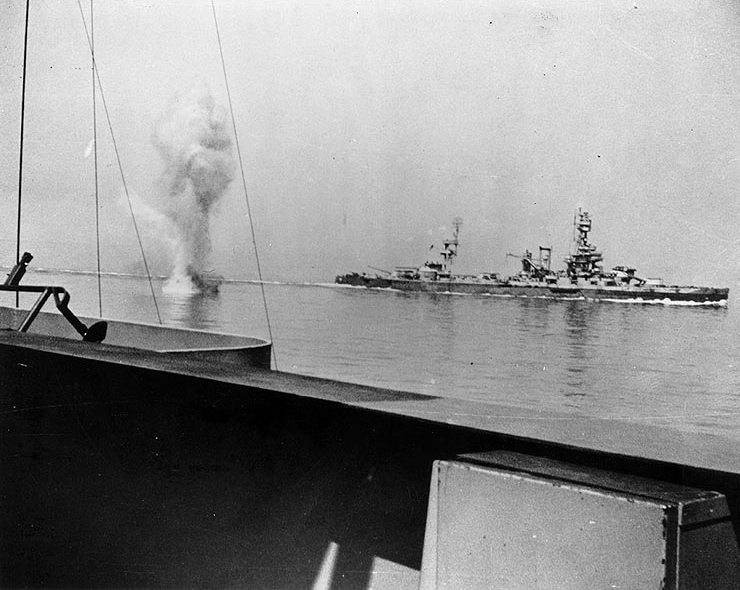
A heavy German coast artillery shell falls between Texas (in the background) and Arkansas while the two battleships were engaging Battery Hamburg during the battle of Cherbourg, France, 25 June 1944
The state of Texas had been paying for maintenance on the ship but it has announced that it will no longer do so after paying $35 million to have the ship floated to a shipyard to undergo the repairs.
This means that the ship will have to support itself based on admission fees. That would require 300,000 people to pay to visit it each year in order to fund its own maintenance costs. Currently, the ship is berthed by the San Jacinto Battle Monument in La Porte, Texas. That site does not get enough visitors to keep the ship afloat.

The tale of American exploits during WWI and WWII will not be complete without mention of Texas BB 35
Galveston has emerged as a front runner to provide a home for the Texas. They have two locations that could take the battleship, though both have problems which need to be addressed before the ship could dock there. These findings are from a citizen-led committee’s report which provides recommendations on where the ship could be berthed.
Seawolf Park on Pelican Island and Pier 21 located on Galveston’s harbor are the two locations identified in the report.

A veteran of two world wars
Bruce Bramlett, executive director of the Battleship Texas Foundation, says that the ship needs to find a spot with higher visitation which would rule Seawolf Park out in his mind. “That would be a worse location that what we’re in,” he said.
Seawolf Park currently sees 80,000 visitors per year according to park managers for the Galveston. This is not nearly enough to support the Texas. But Galveston Island Convention & Visitors Bureau Chief Tourism Officer, Michael Woody, believes that the number would rise with the Texas berthed there.

Having the historic ship located in Seawolf Park, which already hosts the USS Cavalla and the USS Stewart, would provide opportunities for education programs, school trips, corporate events and even increase leisure traffic at the park.
Pier 21 has the benefit of being near downtown and cruise ship traffic. This would provide the necessary numbers to support the ship. But having the battleship docked there would exacerbate parking and crowding issues already being experienced at the pier.
Also, the berth at Pier 21 is 510 feet long but the Texas is 560 feet long. With budgetary constraints, the city may simply not be able to afford the work required to bring the Texas to that site.
The city officials have stated that they will require more information before deciding if they want to make a bid for hosting the Texas.
Representative Mayes Middleton is on the committee researching locations in Galveston says that the bottom line is whether Galveston has the number of visitors required to support the Texas. He says that since the ship needs 300,000 visitors each year and Galveston sees over 7 million tourists every year, the numbers aren’t a problem.
The committee is expecting to release the full report along with its recommendations this month.
Meanwhile, the Battleship Texas Foundation, which is responsible for the upkeep and maintenance of the Texas, is pushing for the ship to be placed in a dry berth. The constant contact with salt water has weakened the hull of the ship and caused many leaks.
Work on building the Texas began in 1910.  After serving in both world wars, the Texas was placed under the care of the Battleship Texas Commission in 1947. The Texas became one of the first museum ships in the US. In 1983, leadership of the Texas was transferred to the Texas Park and Wildlife department. At that time, a survey showed that the watertight seal. The ship was closed to the public for nearly two years while repairs were made.
In 2010, a new leak led to the ship sinking 2-3 feet. In 2012, 30 new leaks were discovered. The ship was once again repaired and reopened to the public.
The Battle Ship Commission would like to see the ship placed in a dry berth, out of the water. Then they could stop spending money on repairs. But getting the Texas out of the water will cost $40 million. The foundation is willing to raise part of the money but seeking assurance from the government that they will provide the rest.

Wednesday, September 25, 2019

Some Goings on at Casa De Garabaldi


On  this past Saturday I worked a shooting range with the Boy Scouts in my council,  I shanghai'ed my son to assist me, well because I an the Dad.  We were supposed to run the shotgun range, I was looking forward to shooting my "over and Under" and my 870 that hasn't fired a shot in a long time.  But when I got there, there were changes and I had to run the .22LR range.  I minded it a bit, if I knew that I was going to run the .22 range, I would have brought different guns.
 Those are Scouts that happen to be "Girls"  Still getting used to the idea
More shooting....
My son shooting during Lunch
Of Course one of the scouts shoots the rope holding the targets
so My son goes out there and repairs the damage

One of the rifles that we were shooting
Ruger American Bolt Action, I really liked the 2 stage trigger
I had asked my friend Mack about them and wondered if he had any in his place of employment.
Of Course my assistant faded out on me for over an hour...I could agree, the cold/flu that I caught was starting to affect me at this point and I wasn't "feeling it" as they say.

New radio for my truck, I installed it after I started feeling better,  I gave my son the radio out of my truck for his truck and picked this one up on Amazon as a replacement.  I had to do some modifications to make it work.  Drove for 2 weeks with a hole in my dash before I got this done.


Tuesday, September 24, 2019

The Man who saved the world dies at 77

This is on my scheduler thingie, I saw this on NPR and it reminded me of the "Able Archer" blog post I did back in 2013.  1983 was a strange time as the Americans were rearming after the failure of "Detente" that Jimmy Carter tried to push on us that the Soviets could be trusted and the Soviets being Soviets took full advantage of the naivete of the American President and his administration.  Jimmy Carter learned when the Soviets went into Afghanistan.  Then the hostages were seized by Iran because the Americans were perceived as "weak".


Stanislav Petrov, a former Soviet military officer, poses at his home in 2015 near Moscow. In 1983, he was on duty when the Soviet Union's early warning satellite indicated the U.S. had fired nuclear weapons at his country. He suspected, correctly, it was a false alarm and did not immediately send the report up the chain of command. Petrov died at age 77.
Pavel Golovkin/AP
Stanislav Petrov was a lieutenant colonel in the Soviet Union's Air Defense Forces, and his job was to monitor his country's satellite system, which was looking for any possible nuclear weapons launches by the United States.
He was on the overnight shift in the early morning hours of Sept. 26, 1983, when the computers sounded an alarm, indicating that the U.S. had launched five nuclear-armed intercontinental ballistic missiles.
"The siren howled, but I just sat there for a few seconds, staring at the big, back-lit, red screen with the word 'launch' on it," Petrov told the BBC in 2013.
It was already a moment of extreme tension in the Cold War. On Sept. 1 of that year, the Soviet Union shot down a Korean Air Lines plane that had drifted into Soviet airspace, killing all 269 people on board, including a U.S. congressman. The episode led the U.S. and the Soviets to exchange warnings and threats.
Petrov had to act quickly. U.S. missiles could reach the Soviet Union in just over 20 minutes.
"There was no rule about how long we were allowed to think before we reported a strike," Petrov told the BBC. "But we knew that every second of procrastination took away valuable time, that the Soviet Union's military and political leadership needed to be informed without delay. All I had to do was to reach for the phone; to raise the direct line to our top commanders — but I couldn't move. I felt like I was sitting on a hot frying pan."


Petrov sensed something wasn't adding up.
He had been trained to expect an all-out nuclear assault from the U.S., so it seemed strange that the satellite system was detecting only a few missiles being launched. And the system itself was fairly new. He didn't completely trust it.
Arms control expert Jeffrey Lewis recalled the episode in an interview last December on NPR:
"[Petrov] just had this feeling in his gut that it wasn't right. It was five missiles. It didn't seem like enough. So even though by all of the protocols he had been trained to follow, he should absolutely have reported that up the chain of command and, you know, we should be talking about the great nuclear war of 1983 if any of us survived."
After several nerve-jangling minutes, Petrov didn't send the computer warning to his superiors. He checked to see if there had been a computer malfunction.
He had guessed correctly.
"Twenty-three minutes later I realized that nothing had happened," he said in 2013. "If there had been a real strike, then I would already know about it. It was such a relief."
That episode and the 1962 Cuban Missile Crisis are considered to be the closest the U.S. and the Soviets came to a nuclear exchange. And while the Cuban Missile Crisis has been widely examined, Petrov's actions have received much less attention.
Petrov died on May 19, at age 77, in a suburb outside Moscow, according to news reports Monday. He had long since retired and was living alone. News of his death apparently went unrecognized at the time.
 Man who saved the World trailer
Karl Schumacher, a German political activist who had highlighted Petrov's actions in recent years, tried to contact Petrov earlier this month to wish him a happy birthday. Instead, he reached Petrov's son, Dmitri, who said his father had died in May.
Petrov said he received an official reprimand for making mistakes in his logbook on Sept. 26, 1983.
His story was not publicized at the time, but it did emerge after the Soviet Union collapsed. He received a number of international awards during the final years of his life. In 2015, a docudrama about him featuring Kevin Costner was called The Man Who Saved The World.
But he never considered himself a hero.
"That was my job," he said. "But they were lucky it was me on shift that night."

Monday, September 23, 2019

being sick...sucks

Y'all know that event that I went to that was work related....?   That one...Apparently someone was sick and it nailed me.  I was doing stuff with the Boy Scouts and I started feeling *Blah* Saturday afternoon, and I was feeling like crap on Sunday and I went home and crawled into bed and that was it for me.
I am feeling better now after a lot of sleep and better living through modern chemistry. 

Thursday, September 19, 2019

Work event,


I spent the last 2 days at a seminar at work, my employer sent me as part of my ancillary responsibilities with my job.  As part of the event, we went to an Atlanta Braves game.  The Atlanta Braves were playing the Philadelphia Phillies
Well my luck stayed the same....
Well the Braves Lost......They are still out in front in the hunt for the pennant.

    It was interesting listening to the senior members of the company discuss what is going on and the state of the industry and human resources talking about things.  Was educational and I learned a lot about marketing, cost and other items


 Also won an Apple Watch.  I don't know what I am going to do with it.  For starters I wear either my fossil watch at work or I wear this one...
I will see, looking on selling it perhaps.  I would give it to my kid because he is the only "applephile" on our household but he already has one.
     

Tuesday, September 17, 2019

Reading a book rather than blogging.....

I have been reading my kindle with the following book.  It is really good, and of course I know several of the authors which makes it really neat.   Please if y'all haven't already bought it, check it out!!

Thirteen outstanding authors. Thirteen aviation stories that never happened.
Throughout the human experience, historians have wondered, “What if?” What if Americans had fought on the side of Germany in World War I? What if Germany had invested in naval aviation in World War II? What if Russia had started World War III?
Wonder no more, for these questions, along with many others, are answered within the pages of this book. Told by a variety of award-winning authors, like Sarah Hoyt, the 2018 Dragon Award Winner for Alternate History, Richard Fox, the 2017 Dragon Award Winner for Best Military Science Fiction, and Kacey Ezell, the winner of the 2018 Baen Reader’s Choice Award, “To Slip the Surly Bonds,” deals with aviation warfare that never happened in our world…but easily could have.
The second book in the exciting new “Phases of Mars” anthology series, there is something for everyone inside! From fighting alongside the Red Baron, to flying a P-38 Lightning, to present day air warfare, “To Slip the Surly Bonds” traces a century of aviation warfare…that wasn’t. From learning how the PBY got to the new world in Taylor Anderson’s “The Destroyermen” series…to fighting the French in a very different Vietnam, this book has it, so come aboard and find out “what if” all of these things had changed history…just a little. You’ll be glad you did!
Inside you’ll find:
Friends In High Places by Joelle Presby and Patrick Doyle
In Dark’ning Storms by Rob Howell
Perchance To Dream by Sarah A. Hoyt
Trial of the Red Baron by Richard Fox
The Kaiserin of the Seas by Christopher G. Nuttall
Through the Squall by Taylor Anderson
The Lightnings and the Cactus by James Young
Catching the Dark by Monalisa Foster
Do The Hard Thing by Kacey Ezell
Tail Gunner Joe by William Alan Webb
Red Tailed Tigers by Justin Watson
Zero Dark 30 by JL Curtis
Per Ardua Ad Astra by Jan Niemczyk

Monday, September 16, 2019

Monday Music "China Girl" by David Bowie

I am continuing my series of Music that I don't care for. This week and next week will be David Bowie.  This is a personal preference thing.  One of my favorite Christmas songs is Bing Crosby and David Bowie.  David has another song on this album called "Modern Love" that I really like.  I will do a Monday music on that one in a few weeks.


Let's Dance is the 15th studio album by David Bowie. It was originally released in April 1983, almost three years after his previous album, Scary Monsters (and Super Creeps). Co-produced by Chic's Nile Rodgers, the album contains three of his most successful singles: the title track, "Let's Dance", which reached No. 1 in the UK, US and various other countries, as well as "Modern Love" and "China Girl", which both reached No. 2 in the UK. "China Girl" was a new version of a song that Bowie had co-written with Iggy Pop for the latter's 1977 album The Idiot. It also contains a re-recorded version of the song "Cat People (Putting Out Fire)", which had reached No. 1 in New Zealand, Norway and Sweden a year earlier.
Let's Dance was nominated for the Album of the Year Grammy Award in 1984 but lost to Michael Jackson's Thriller. It has sold 10.7 million copies worldwide, making it Bowie's best-selling album.It was Bowie's eighteenth official album release since his debut in 1967, including two live albums, one covers album (Pin Ups, 1973), and a collaboration with the Philadelphia Orchestra (1978). At one point Bowie described the album as "a rediscovery of white-English-ex-art-school-student-meets-black-American-funk, a refocusing of Young Americans". Let's Dance was also a stepping stone for the career of the Texas blues guitarist Stevie Ray Vaughan, who played on itThe album was released as a limited edition picture disc in 1983. The album was re-mastered in 2018 and included in the Bowie box set Loving the Alien (1983–1988) (2018).
Critical reviews for Let's Dance as an album were mixed, although Rolling Stone later described it as "the conclusion of arguably the greatest 14-year run in rock history" Bowie felt he had to continue to pander to the new mass audience he acquired with the album, which led to him releasing two further solo albums in 1984 and 1987 which, despite their relative commercial success, did not sell as well as Let's Dance, were poorly received by critics at the time and subsequently dismissed by Bowie himself as his "Phil Collins years".Bowie would help form the hard rock and grunge-predecessor band Tin Machine in 1989 in an effort to rejuvenate himself artistically.

"China Girl" is a song written by Iggy Pop and David Bowie during their years in Berlin, first appearing on Pop's debut solo album The Idiot (1977). The song became more widely known when it was re-recorded by Bowie, who released it as the second single from his most commercially successful album, Let's Dance (1983). The UK single release of Bowie's version reached No. 2 for one week on 14 June 1983, while the US release reached No. 10.

Paul Trynka, the author of David Bowie's biography, Starman, explains the song was inspired by Iggy Pop's infatuation with Kuelan Nguyen, a Vietnamese woman, as a metaphor for his Stooges career.
Nile Rodgers, the producer of David Bowie's 1983 version of the song, imagined his own meaning: "I figured China Girl was about doing drugs ... because China is China White which is heroin, girl is cocaine. I thought it was a song about speedballing. I thought, in the drug community in New York, coke is girl, and heroin is boy. So then I proceeded to do this arrangement which was ultra pop. Because I thought that, being David Bowie, he would appreciate the irony of doing something so pop about something so taboo. And what was really cool was that he said 'I love that!'

The music video, featuring New Zealand model Geeling Ng, was directed by David Mallet and shot mainly in the Chinatown district of Sydney, Australia. Along with his previous single's video for "Let's Dance" with the critique of racism in Australia, Bowie described the video as a "very simple, very direct" statement against racism. The video consciously parodies Asian female stereotypes. It depicted as a hypermasculine protagonist in an interracial romance. The original video release includes the two lying naked in the surf (a visual reference to the film From Here to Eternity).Unedited versions were banned from New Zealand and some other countries at the time. The uncensored version was issued on the 1984 "Video EP" issued by Sony on Betamax, VHS and LaserDisc. Versions of the video included on subsequent video and DVD compilations (including EMI/Virgin's Best of Bowie) are censored to remove the nudity. The original video went on to win an MTV video award for Best Male Video.

Friday, September 13, 2019

A Comment about Character;


I wasn't done with the post and it posted earlier...

I have blogged a lot in the past about the virtue of "Character", it is what it is that makes us "Men", That virtue was prized in the past generation,  the term "Deal with a handshake" was all you needed sprung from this.  Now the old ways are reviled as the modern left tries to create "the new modern man" like the Soviet system did in the 1950's when they tried to remake what is considered "Natural" to something "manmade".  This was an attempt to make men without  God where there was a man who was a good for the soviet system but didn't have the character of a person that believed in a higher power and a desire to better himself by living an honorable life and how you treated people.  The Soviet system prized the belief that the state was supreme, whereas the scholars of old believed that the individual was supreme and that everyone was a "temple".  This was reflected in the teachings in the Bible and the Torah.  Now the new way is based not on who you are as an individual, but to who your group falls into in the intersectional politics of the modern left.

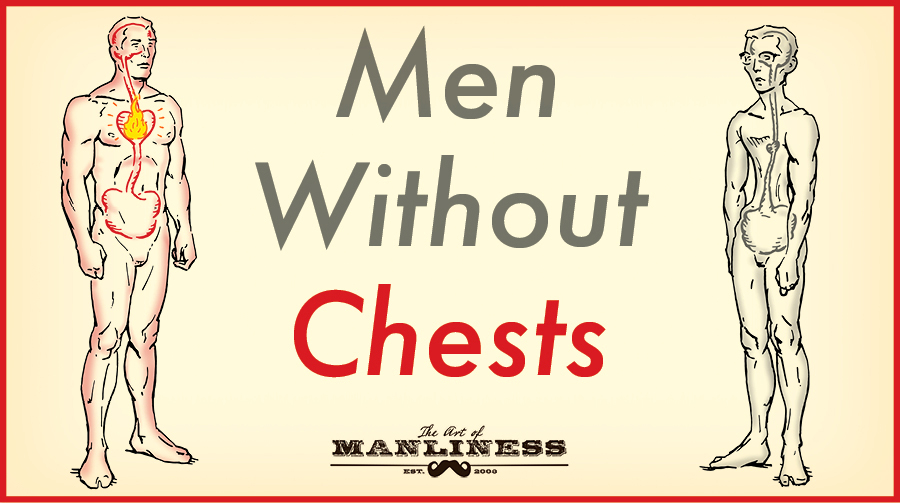
   I shamelessly clipped this from "Art of Manliness"


“We make men without chests and expect of them virtue and enterprise. We laugh at honour and are shocked to find traitors in our midst. We castrate and bid the geldings be fruitful.” —C.S. Lewis
Have you ever come across the above quote? I had, and, even in the absence of its context — it’s taken from the fairly dense first chapter of Lewis’ The Abolition of Man — figured I understood what it meant: modern society creates men who lack a chest-swelling virility, and then complain about the lack of upright, manly men.
However, having recently taken the time to actually study the full context of the quote, I learned that Lewis was actually getting at something different; or, more accurately, that he was not describing the loss of manly virtue itself, but rather the mechanism by which it, along with all other types of virtue, is produced. In fact, by “chest” he doesn’t mean some kind of literal or metaphorical scaffolding of masculinity, but sentiment.
His lament is that modern society makes men without heart.

The Tao of Sentiment

Nearly all religions and philosophical schools, whether Judaism, Christianity, Hinduism, Aristotelianism, Stoicism, or Platonism, Lewis observes, posit that there is an underlying natural order to the world, and Truth is that which most clearly reflects and explains this reality. To uphold this “doctrine of objective value” is to believe that “certain attitudes are really true, and others really false, to the kind of thing the universe is and the kind of things we are.”
Lewis feels this perspective is best described by the Chinese concept of Tao:
“It is the reality beyond all predicates . . .  It is Nature, it is the Way, the Road. It is the Way in which the universe goes on, the Way in which things everlastingly emerge, stilly and tranquilly, into space and time. It is also the Way which every man should tread in imitation of that cosmic and supercosmic progression, conforming all activities to that great exemplar.”
Within the objective reality of Nature, exist people, places, and things which possess an objective value, and are thus deserving of varying levels of esteem and respect:
“until modern times all teachers and even all men believed the universe to be such that certain emotional reactions on our part could be either congruous or incongruous to it — believed, in fact, that objects did not merely receive, but could merit our approval or disapproval, our reverence or our contempt.”
Given that the value of things is objective, then they should elicit certain responses from us. The night sky should elicit a feeling of humility; the story of a courageous warrior should elicit a feeling of veneration; little children should elicit a feeling of delight; a friend’s father’s death should elicit a feeling of empathy; a kind act should elicit a feeling of gratitude.
While the nature of emotional responses is partly visceral and automatic, a man’s sentiments also have to be intentionally educated in order to be congruent — to be more in harmony with Nature. Such training teaches a man to evaluate things as more or less just, true, beautiful, and good, and to proportion his affections as merited. As Lewis notes, this training was considered central to one’s development throughout antiquity:
“St Augustine defines virtue as ordo amoris, the ordinate condition of the affections in which every object is accorded that kind of degree of love which is appropriate to it. Aristotle says that the aim of education is to make the pupil like and dislike what he ought. . . . Plato before him had said the same. The little human animal will not at first have the right responses. It must be trained to feel pleasure, liking, disgust, and hatred at those things which really are pleasant, likeable, disgusting and hateful.”
The man who leaves a one-star Yelp review for a national park, scoffs at the brave deeds of a soldier, decides that attending his friend’s father’s funeral would be too much hassle, or fails to say thank you for a gift, shows the lack of this kind of education of the sentiments.
If one believes in objective order and value, then the failure to feel the proper sentiment in the face of a particular stimulus cannot be justified on the basis of mere personal preference, casually categorized under the rubric of “to each their own”; rather, it must be frankly countenanced as a deficiency in one’s human make-up. As Lewis confesses, “I myself do not enjoy the society of small children: because I speak from within the Tao I recognize this as a defect in myself — just as a man may have to recognize that he is tone deaf or colour blind.”
To follow the Tao in this sense is to see things as possessing a “quality which demands a certain response from us whether we make it or not.”
Given this perspective, emotions are themselves neither rational nor irrational, but do play a central part in following the dictates of Reason:
“because our approvals and disapprovals are thus recognitions of objective value or responses to an objective order, therefore emotional states can be in harmony with reason (when we feel liking for what ought to be approved) or out of harmony with reason (when we perceive that liking is due but cannot feel it). No emotion is, in itself, a judgement; in that sense all emotions and sentiments are alogical. But they can be reasonable or unreasonable as they conform to Reason or fail to conform. The heart never takes the place of the head: but it can, and should, obey it.”

A Dangerous Dissection

The “Taoist” system as described above existed anciently and across many religions and philosophical schools for thousands of years. It began to be dismantled, however, in the postmodern age. And it is this dismantling that Lewis seeks to counter in The Abolition of Man.
In the 20th century, it began to be posited that there was not a natural order to the world, and that things did not possess an objective value which demanded a certain response; rather, people simply brought their own feelings to objects, and these feelings are what gave the objects their value. Such feelings were culturally conditioned and relative to particular societies and individuals, and were thus completely subjective. Lewis observes that certain corollaries followed from this conclusion, mainly that “judgements of value are unimportant,” “all values are subjective and trivial,” and “emotion is contrary to reason.”
Rather than education seeking to improve young people by both increasing their stock of facts and honing the sensitivity of their sentiments, students began to be tutored in facts alone. This shift was thought to benefit youth, protecting them from the emotional sway of propaganda. But Lewis argues that not only did dropping an education in and emphasis on sentiment fail to provide this protective effect (and in fact made students more susceptible to hype and disinformation), it atrophied their capacity for virtue and human excellence.
Lewis sees those who propagated the first error as having “misunderstood the pressing educational need of the moment”:
“They see the world around them swayed by emotional propaganda — they have learned from tradition that youth is sentimental — and they conclude that the best thing they can do is to fortify the minds of young people against emotion. My own experience as a teacher tells an opposite tale. For every one pupil who needs to be guarded from a weak excess of sensibility there are three who need to be awakened from the slumber of cold vulgarity. The task of the modern educator is not to cut down jungles but to irrigate deserts. The right defence against false sentiments is to inculcate just sentiments. By starving the sensibility of our pupils we only make them easier prey to the propagandist when he comes. For famished nature will be avenged and a hard heart is no infallible protection against a soft head.“
What Lewis is saying is that young people have a propensity towards apathy or cynicism or sterile complacency anyway, and if you only magnify this cynicism by telling them that all value and emotion is subjective and that absolute truths do not exist, then you create a thirsty vacuum that is actually more vulnerable to being filled by advertising and propaganda. Being subjected to the endless debunking of ideals imparts to young people a smug “pleasure in their own knowingness” that can disguise an ignorance that leaves them susceptible to the enticements of disinformation. Really protecting one’s mind from indoctrination requires filling it with positive truths that are both well-reasoned and animated by sentiment. A man with a well-honed sentiment for an ideal, a real love for something, rises above the cheap plays of propaganda: A man who loves democracy deflects rhetoric that merely encapsulates a false simulacrum of it; a man with sentimental love for the philosophical value of simplicity tunes out the enticements of advertising; a man with a noble sentiment for intimacy and romance sees through the siren song of porn.
Emotional sentiment not only functions as a defense against negative propaganda, but acts as a catalyst for “offensive” activity. As Lewis argues, dry rationality alone can never be a sufficient spur to positive action:
“no justification of virtue will enable a man to be virtuous. Without the aid of trained emotions the intellect is powerless against the animal organism. I had sooner play cards against a man who was quite sceptical about ethics, but bred to believe that ‘a gentleman does not cheat’, than against an irreproachable moral philosopher who had been brought up among sharpers. In battle it is not [logical] syllogisms that will keep the reluctant nerves and muscles to their post in the third hour of the bombardment. The crudest Sentimentalism . . . about a flag or a country or a regiment will be of more use.”
Lewis compares his view of the importance of sentiment to Plato’s Allegory of the Chariot, in which the philosopher likened the soul to a charioteer (representing Reason) tasked with guiding a winged vehicle pulled by two horses: a dark horse (appetites) and a white horse (honorable spiritedness or thumos). To really soar, the charioteer needed to harness the energy of both horses, and used the white horse of thumos to pull the dark horse of the appetites into sync; it’s far easier to choose the right thing when you’re driven to do so by a heroic, noble, feeling.
Lewis puts it this way:
“The head rules the belly through the chest — the seat . . . of emotions organized by trained habit into stable sentiments . . . these are the indispensable liaison officers between cerebral man and visceral man. It may even be said that it is by this middle element that man is man: for by his intellect he is mere spirit and by his appetite mere animal.”
Thus, when society stops emphasizing and educating the sentiments, “it produce[s] what may be called Men without Chests.” Men without real feeling. Men without spiritedness, without thumos, without heart.
To those who do not lament what has been lost, who are skeptical there is an objective order to the universe, and believe in the subjectivity of feeling, it may seem that men without chests are a sign of progress – that they are more evolved, more advanced, more logical and intellectual. But this comforting affirmation is a mirage and an “outrage,” Lewis says. For the chest-less among us do not pursue truth with greater keenness, quite the opposite, since the ardent search for knowledge “cannot be long maintained without the aid of sentiment” — without a bit of passion. In reality then, “It is not excess of thought but defect of fertile and generous emotion that marks [the chest-less] out. Their heads are no bigger than the ordinary: it is the atrophy of the chest beneath that makes them seem so.”
The irony is that those who do lament what has been lost, who mourn the disappearance of men who through the sentiment-producing-seat of their chests manifest manly virtues like ambition and courage, as well as all the other traits of good character, have no idea as to what has killed off this species of man, and their own role in hastening his demise:
“And all the time — such is the tragi-comedy of our situation — we continue to clamour for those very qualities we are rendering impossible. You can hardly open a periodical without coming across the statement that what our civilization needs is more ‘drive’, or dynamism, or self-sacrifice, or ‘creativity’. In a sort of ghastly simplicity we remove the organ and demand the function. We make men without chests and expect of them virtue and enterprise. We laugh at honour and are shocked to find traitors in our midst. We castrate and bid the geldings be fruitful.”