Webster

The Constitution was made to guard the people against the dangers of good intentions." --American Statesman Daniel Webster (1782-1852)


Friday, August 28, 2020

Staying alive in the Brave New World.


I am working a new to me laptop, it is an older one that I inherited, so I wiped it and loaded some basic programs on it.  It is a the same age as my regular laptop but a bit larger so I am getting used to it.  It will become my backup in case my regular laptop bites the farm and is unrecoverable. 
     I got this in my email from Miggy and normally I like to break up items themes, but this came in my email and it ties in what I posted Yesterday.  It is full of good information that is useful in the present situations.

Staying Alive in the Brave New World

Everything has changed, and your safety depends on understanding that.
 
Okay kids, let’s make some assumptions here…you are free to accept or reject them as you see fit:
 
• We have fully entered a new phase of “acceptable” violence. What we now see is “recreational arson,” that is, the setting of fires with the inherent risk to human life for fun. Remember when you were a kid and how thrilling setting off fireworks was for you? This is the exact some thing, kicked, as Emeril might say, up a notch.
• One major political party and their farthest left members fully support this violence, because they see it as the best chance for wholesale social change, e.g.the Socialist States of America (or some other similar euphemism for fascism, which is what we are really looking at here). They are correct. Historically, times of massive uncertainty offers a narrow window for massive political/government change. The other side understands that this is “The Year of the Jackpot” [Refer: Robert Heinlein], and they are all-in.
• Yes, we have seen this kind of urban violence before in the late 1960s/early 1970s, but what is different this time is that in the earlier case there was among most citizens an agreement about what America was, a consensus of the exceptionality of the U.S., if you will. That does not exist today. Rather, well before the China Virus and the riots, the two Americas, one red and one blue, were already locked in what has been called — fairly, I think — a “Cold Civil War.”
• Maybe if we all take a deep breath, calm down and relax, we’ll come through this. But maybe not. “Maybe” is a very big word. As we have said on THE BEST DEFENSE, self-defense is always a compromise, a balance of risk/reward. If we apply that same thinking to our current situation, we see the fallacy in “relax.” If we relax and the current crisis just fades away, everything is cool If we relax and are, in fact, wrong, we lose the country, the Constitution, the Bill of Rights, the vote, our guns and maybe even our lives. The teeter-totter is wildly weighted on only one end.
 
SOOOOOOOOOOOOOOO, given those assumptions, what do we need to know as we face the Brave New World? I have been thinking about that a lot and talking to my team, who I believe are the best in the world at what they do. If we immediately move down to a “tactical,” as opposed to “strategic” level, here are some thoughts. Once again, feel free to either accept them or reject them out of hand. None of us have any words on a marble tablets delivered down from a mountaintop:
 
• If you are not armed all the time, you are a fool. The time for fond illusions of safety has passed.
• This is something I’m often deficient in, but I think we all need to be carrying less lethal weaponry in addition to a firearm. I just ordered a bunch of pepper spray (Sabre Red) to remedy that. I have bear spray for the car (you never know when you’re going to be attacked by bears in these strange times). In our upcoming episode of YOUR BEST DEFENSE, Cecil Burch notes that inside a car, gel makes more sense the spray because you don’t want all that pepper spray in your car or your kids. BTW, have you ever tried/had to function in a gas environment? The mob gets practice in that every night they riot. Consider taking a course…I recommend my friend Chuck Haggard. 
• Understand that if you use that gun or any weapon, for that matter, the full power of the state, in the form of state attorney generals bought and paid for by George Soros and Michael Bloomberg, and the media will be leveled against you. If you don’t have some form of concealed carry insurance (mine is through USCCA), sign up today. Have a criminal lawyer programmed into your phone, and talk to that lawyer IN ADVANCE. Yes, it’s going to cost you money up front, but in all likelihood (as in Kenosha) you are going to be charged with murder rather than hailed as a hero. That’s kinda a big deal.
• THERE IS A YUUUUGGGGEEEE DIFFERENCE BETWEEN PROTECTING YOUR HOME AND FAMILY AND DOING A MARSHAL DILLON DOWNTOWN! It behooves you to understand that difference. Most states do not allow the use of deadly force to protect property, but it is all hellishly complex, giving you lots of gears to be caught up in. Trust Andrew Branca. I do.
• Should you do decide to go ahead with such an act, assume you will have to use the gun you are carrying. The current batch of urban terrorists are unlikely to melt away at the sight of a firearm. They are not scared of you or the gun. KNOW THE FREAKIN’ LAW in your state and community on lethal force! Standing over a couple of cooling bodies with a smoking AR is a bad time to consider the legality of your situation. THIS IS THE TIME TO NOT BE STUPID, KIDS! Read this: 
• Gabe Suarez once made a great point to me…people talk about who/what they’re willing to kill for, but the big question is actually what/who are you willing to die for, or spend the rest of your life in prison for? Gabe has made that type of hard decision. Cecil, Mike Seeklander and I have talked about that very point in the show going up next week. Where is your line in the sand? You’d better know that when you step out of the door with a gun.
• In ANY case, assume the peaceful protestors/terrorists you are facing are also armed. A brick is a weapon. A skateboard is a weapon. A frozen water bottle is a weapon. A gun, even a crappy zinc pistol, is a weapon and can kill you stone dead. I think we have to assume that at least some members of the mob have guns, and that number will probably be increasing.
• Understand that even in the best case, an armed individual can be overrun by a mob. And when they catch you, they are unlikely to be all that happy with you. I said in my book TRAIL SAFE that none of us needed to go looking for “High Noon,” because “High Noon” would eventually find us. THE GUN IS NOT A TALISMAN AGAINST EVIL! It only matters when it goes “Bang!”
• If you are facing guns, you must be thinking about your situation at at least a semblance of a military level…when you have to move, which direction are you going? WHERE IS COVER? Where is concealment? Where is more ammo? If you are at home, does your Spousal Unit or your kids know what you are planning to do? IS THERE A PLAN? There sure needs to be. And everyone needs to know it.
• You are carrying first aid/trauma gear (caveat, Riley is a friend, but I like his stuff), right? And you know how to use them, right? You don’t? GET THE TRAINING! The ability to save a life, maybe your own, is now a necessary skill. Start here. 
•. The police are not coming. The ambulance is not coming. The first responders who would have been on the scene in minutes in the Old Days — say, February — won’t be there for you. It’s just you and what supplies you have at hand.
• YOU ARE ON YOUR OWN! Now more than ever.

Thursday, August 27, 2020

Eyes in the Back of your Head Situational Awareness.

I get emails from Ox and David Morris Tactical and this one involves "Situational Awareness"  There were a couple of tricks I didn't know and a few thinks I knew that they didn't mention, and those I will mention in "Italics". 


Eyes In The Back Of Your Head Situational Awareness

One of the first lessons that you hear when you start learning about situational awareness is to position yourself where you can have your back protected and best see approaching threats.
It’s not a new concept. 150 years or so ago, it was called the “Gunfighter’s Seat.”
It’s the seat in a restaurant, bar, office, church, etc. that’s far away from the main entrance, faces the main entrance and is, ideally, in a corner with an emergency exit nearby.
You see, if you’re in the middle of a room, you have 360 degrees to be aware of.
If you’re against a wall, you have 180 degrees to be aware of.
If you’re in a corner, you only have 90 degrees to concern yourself with.
And for the person who has trained in the tactical arts, that produces a warm, happy feeling that sheep will never fully appreciate.

But what about when you don’t have the gunfighter’s seat?

Sometimes, you might end up facing a wall or corner or find yourself smack dab in the middle of a room because it’s the only spot left.
The same applies to standing conversations. Sometimes you end up with a commanding view of the room and other times you don’t.
When there’s an easy way to improve your position, that’s an easy fix…just move.
But reality is seldom cut and dry and it’s common to find yourself in non-ideal situations and today, I’m going to give you 4 tricks today to have eyes-in-the-back-of-your-head awareness for those times.
I DO want to start with a disclaimer. I do not know about a current specific threat to my life and you’re probably in the same boat. As a result, I’m not concerned about random people sneaking up behind me and stabbing me in the back or doing other crazy stuff. Nobody that I know of has any reason to specifically target me for attack today. So, what I primarily look for are general threats to my safety.
If you’re a parent, you’ll identify with these concepts immediately.  They’re the same skills that we use with our kids to give them the impression that we’re omnipresent, can see through walls, and know what they’re doing even if they’re behind our backs.
  1. It’s fairly obvious to use mirrors to see behind you, When I am walking, I look at storefronts and I will cut my eyes and glance at the reflections and see if someone is following me or something like that., anything out of the ordinary. but I want to encourage you to take this to an extreme…look for ALL kinds of reflections, like polished surfaces, the face of your smartphone, the face of your watch, the glasses of the person you’re talking with, and—in some cases—even the pupils of the person you’re talking to.You may or may not see details when using these alternative reflections, but what you can see is whether someone is purposely approaching you.  When you’re meeting someone, it’s very powerful if you are facing away from them with no obvious way to know that they’re approaching you and turn around with a big smile (and no surprise) on your face to greet them.
  2. When you’re facing other people and you have other people behind you, watch the eyes of the people you’re facing. They’re going to see things behind you and, oftentimes, their eye lids and/or pupils will observe and unconsciously react to things before they consciously realize what’s going on.It’s not unusual for people who use this trick to pick up on eyes widening or pupils dilating, turn around, and respond to the stimulus before the person who’s eyes widened is able to. As near as I can tell, the reason why you can react faster than the person who’s actually seeing things happen has to do with surprise. Their mind is frozen in surprise, but when you observe the reaction, you KNOW that you’re going to see something that might require a response as soon as you turn around.When you start doing this, you’ll quickly start seeing the subtle differences in micro-reactions when someone sees something they like behind you (an attractive member of the opposite sex who’s favorably dressed) and something they don’t like (a threat, or more commonly, something/someone who they fear or who otherwise is threatening or repulsive to them).When you’re sitting across a table from 4 people, and you purposely tune into their pupil reactions, it’s like having 8 eyes in the back of your head. I’ve found that this works, regardless of whether or not the person is trained and switched on or not, but it definitely works better with someone who’s more switched on.
  3. “Feeling” and listening to the crowd. Also known as establishing an audio baseline. I was at a shooting event a couple of weeks ago and several dozen of us were in the bar after the awards ceremony. Because of the nature of an event like that, sometimes I was facing into the room and other times I was in circles of people where their backs were against the wall and I was facing them with my back to the room.What I did throughout the night was occasionally stop for a second or two and consciously listen to the sound of the room. People tend to stop idle conversation and either go quiet or yell when they spot something dangerous or “exciting”. Any time the “din” of the crowd changed noticeably, I looked around and, sure enough, SOMETHING had changed…whether it was a group of guys all pulling out their knives to show them off, a couple of guys deciding to start wrestling, or other harmless antics.But picking up on changes in crowd noise that happen in response to harmless antics just gets you tuned in and sensitive for a time when people are responding to something more serious.
    When the flooring/ground cooperates, start paying attention to the sound of people walking and establish a baseline for the particular event/conditions. You’ll not only start matching the sound of particular footsteps with the right person, but you’ll be able to place where they’re at in the room…even if they’re behind you.
When you combine these together, and get a little practice under your belt, it really is amazing how aware you can be of what’s going on behind you.
I play a little game in restaurants when a table gets sat behind me. Based on what I hear (footsteps, chairs, voices, etc.), others’ reactions, and reflections I see, I try to guess as many details about the group as possible, including how many, sex, age, build, and threat potential. Then, I turn around, grade myself, and try to figure out what clues I missed that would have made my guess more accurate.
This all happens in a matter of seconds. Better yet, after you get into the habit of doing it, you’ll start doing it unconsciously and don’t really have to think about it very often.
There’s a 4th little trick that I use that kind of falls into the realm of “eyes in the back of your head” but it’s more of a trick for observing a room without people realizing that you’re as switched on as you are.
It’s incredibly simple, and kind of obvious.
Whenever possible, flick your eyes instead of turning your head. Three big benefits are:
  1. It’s nice to blend in. Normal people are oblivious. **THIS IS HUGE** When you’re an obvious watcher, it marks you as an outlier. Other outliers will identify you as an outlier, but may not know whether you’re a good guy or a bad guy. Bad guys might give you unwanted attention if they identify you as a good outlier. Good guys may waste their attention on you instead of seeing real threats. When you blend in, you don’t make yourself a target for bad guys or a distraction for good guys.
  2. It’s faster to scan by flicking your eyes than to turn your head. For me, I have about 90 degrees of binocular vision before my nose gets in the way, but roughly 220 degrees if I look as far as I can to the right with my right eye (knowing my left eye is looking straight into my nose) and the same to the left side.That also means that I can turn my head 60-70 degrees to the right and see straight behind me. (It’s easier if I look down slightly) If you observe a threat, run or square your head up to it and take care of it.
  3. MOST people have issues meshing visual and vestibular (balance) signals in the brain to one degree or another, and if it goes unchecked, it gets more pronounced with age. (This is what The Automatic Aiming Course focuses on). Turning your head rapidly can cause many people to get disoriented JUST enough that they lose the ability to focus for tenths of a second, up to a second or more.If you’re one of those people who gets a slight delay when you turn your head quickly, try keeping your head still and shifting your focus instead.

Wednesday, August 26, 2020

South Korean Soldiers in Vietnam during the War

I remember My Dad talking about the South Koreans in Vietnam, some background, My Dad spent 2 tours in Vietnam, he was "El-CID" his first tour with the 25 Infantry Division and a CID agent attached as a corp asset his second tour.   In 1968 he told me more than once while he was over there that the Koreans were very effective and deadly and took no shit from Charlie and was feared for their combat effectiveness, he commented that the Capital division was particularly effective for its size.   He told me about driving up there to trade beer and Rations with the Korean CID agents in II Corp in 1972, he commented that their rations were "spicy" that's how he developed his taste for Kimche and other delicacies that he passed on to me :).  They were virulently anti communist and had no compunction about going bayonet to bayonet with the VC and the NVA.   I also dug into it that in the beginning that they were very effective in the beginning of the war but toward the end of the war, they were not so effective and switched from offensive to defensive operation and some atrocities were tied to their participation and blamed on the Koreans, he did tell me and  that there were a difference, if an American patrol or convoy got shot at and people were killed or wounded near a village we wouldn't do nothing about it by our rules of engagement, with the Koreans, it was different, if their people were wounded or killed near a village , the Koreans would go and wipe out the village, people, pigs, water buffaloes, everything for harboring the VC or the NVA.  They operated by different rules then we did and for that reason were feared.   They also shipped all the expended  artillery brass back to Korea where it was reused by their industry apparently.  They were Staunch allies as friends and brutal mother fuckers as enemies.


On the night of February 13-14, 1967, the 11th Company of the 2nd South Korean Marine Brigade was occupying a position near the village of Trah Bin Dong in Quang Ngai province, South Vietnam. Its oval-shaped base was dotted by bunkers and trenches; the lines of thick barbed wire to the front were laced claymore mines. In front of the tough South Korean marines lay a line of hills from which the communists attacked Highway 19 and coastal Highway 1. Rather than go into the hills after the communists, the South Korean marines set a trap—with themselves as bait.
The communists regularly harassed the South Koreans but did not attack them directly until that night. Two Vietcong regiments, the 1st and 21st, came out of the hills under cover of heavy mortar fire and hit the base from all directions. The South Koreans delivered devastating return fire from their bunkers with machine guns and mortar rounds dropped at point-blank range. As the communists closed, the outnumbered South Koreans fought hand to hand, refusing to surrender their positions. Some marines dismantled their heavy machine guns rather than let them fall into enemy hands. One wounded man refused to be taken alive and pulled the pins on a pair of grenades as the communists entered his bunker.
Led by their commanding officer, Captain Chung Kyong Gin, the South Korean marines eventually pulled back and allowed several hundred Vietcong to break into the camp. Chung sent two squads to plug the gap. He then ordered the rest of the marines to fix bayonets and close with the now trapped enemy, killing more than 100 inside the camp. By 0730 hours, the marines had cleared their base and chased the communists back into the jungle. American Marine Douglas A-4 Skyhawks punished them as they withdrew.
In all, 254 communists were killed in the assault compared to 15 South Koreans deaths. For his outstanding leadership, Chung was awarded South Korea’s highest honor. In the aftermath of the fight, word of the 11th Company’s deeds spread throughout South Vietnam. Even South Vietnamese President Nguyen Van Thieu stopped by for a visit. The entire company was promoted one rank. Later, the Koreans received a Presidential Unit Citation for their actions at Trah Bin Dong.

In 1964, as the communist effort in Vietnam grew more intense, the South Vietnamese government made a formal request to the Republic of Korea for military assistance. Actually, the ROK government had offered to send help as early as 1954 but was turned down. The first Korean units arrived in Vietnam in February 1965 in a brigade group called Dove Force. These included engineers, a MASH unit, military police, a navy LST, liaison staff, and other support personnel. Dove Force was deployed to the Bien Hoa region of South Vietnam, where it engaged in counterinsurgency activities. Engineering units built schools, roads and bridges. Medical teams treated over 30,000 South Vietnamese civilians.
As the communist presence in South Vietnam grew and the situation in the countryside worsened, the United States sought to spread the burden to other allied nations. Accordingly, the administration of President Lyndon B. Johnson asked the South Korean government if it would be willing to contribute a combat division. After meeting with President Johnson in June 1965, Korean President Park Chung Hee agreed to his request. There was considerable negotiation and haggling between American and South Korean authorities over several issues. The South Koreans insisted that their troops answer only to their own officers. The two sides eventually agreed that South Korean officers would exert tactical control over their units but would subordinate themselves to the senior American officer in a combat zone. South Korean units would also ultimately answer to General William Westmoreland, overall commander of U.S. forces in Vietnam.
The South Korean government sought several other concessions, including combat pay for their soldiers (at American expense), military equipment for South Korean reserve units, and a guarantee of American force levels in Korea. American authorities agreed to the terms, and on August 19, 1965, the South Korean assembly authorized the deployment of combat troops to Vietnam. The deployment began that autumn and included the Capital (Tiger) Division and the 2nd Marine Brigade, the Blue Dragons. By the end of the year, more than 18,000 South Korean troops were in country.
In 1966, the South Vietnamese government requested more troops from the Republic of Korea. After further negotiations, the 9th (White Horse) Division was deployed to Vietnam as well, bringing the total strength of South Korean forces in Vietnam to nearly 45,000 men. On the recommendation of General Westmoreland, Chae Myung Shin, the commander of the Capital Division, formed a corps headquarters under his command out of Nha Trang. General Lew Byong Hion (later the South Korean ambassador to the United States) took command of the Capital Division.

South Korean divisions were organized along similar lines as the Americans. They featured three regiments, four artillery battalions, an engineering battalion, and several supporting units such as MPs, signals, and reconnaissance. The first South Korean combat formation in Vietnam, the Capital (Tiger) Division, was formed in 1948 and saw extensive action during the Korean War. The Capital Division survived the initial North Korean onslaught, fought on the Pusan Perimeter, and later participated in General Douglas MacArthur’s celebrated counterattack.
Upon the insistence of Korean President Park Chun Hee, soldiers deploying to Vietnam would be volunteers. Both he and the military wanted to demonstrate to the Americans and the world, through the army, that South Korea had come of age and was no longer wholly dependent on the Americans for its defense. The very best of the army were plucked from their units and assigned to the Capital Division. Enlisted personnel were given special incentives to volunteer, including higher pay and credit for three years of military service. President Park personally selected senior officers.
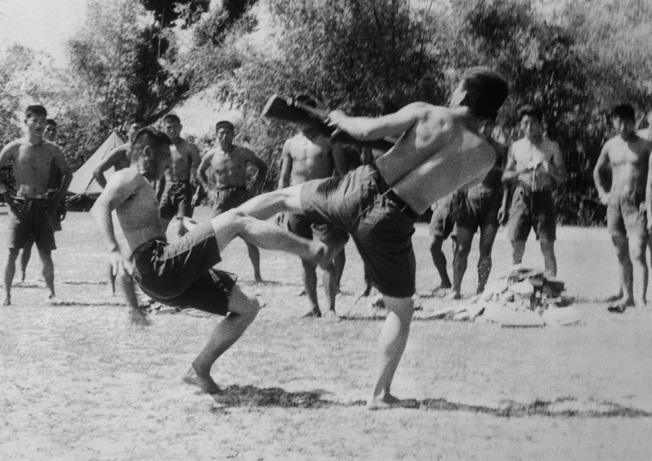
Korean soldiers were highly motivated. Because of their own struggle with Stalinist North Korea, they hated communists. They were also tough. Each man was trained in the art of tae kwon do, with 30 minutes’ practice forming an integral part of morning physical training. They were also subjected to harsh discipline. Two soldiers who raped a Vietnamese woman were executed before their company.
The South Korean soldier was also feared by the Vietcong. Time magazine reported in 1966, “Captured Vietcong orders now stipulate that contact with the Koreans is to be avoided at all costs—unless a Vietcong victory is 100 percent certain.”


Koreans in the 2nd Marine Brigade, the Blue Dragons, practice Tae Kwon Do during a morning exercise near Qui Nohn, South Vietnam, in April 1966.
The South Koreans felt better able to conduct counterinsurgency operations than the Americans. Despite the language barrier, Korean soldiers were dealing with people they considered fellow Asians whose culture they understood better. They shared Buddhism and similar dietary habits; both consumed rice prodigiously. Korean soldiers did their best to interact with the local population. They attended Buddhist religious services, ran medical clinics, and repaired damage inflicted on people’s homes. Even so, a 1968 evaluation conducted by the Americans criticized some aspects of the South Koreans’ pacification efforts, saying they were too focused on pursuing the Vietcong at the expense of building civil organizations.
South Korean troops did not always conduct themselves correctly. As in any war, civilians in South Vietnam suffered grievously. In one notorious incident, South Korean troops searching the village of Tho Lam murdered 46 civilians after a booby trap killed four of their comrades. South Korean documents indicate that as many as 8,000 Vietnamese civilians were killed by their troops from 1965 through 1973. In an interview given in 2000, General Chae admitted that his men killed civilians but blamed it on what he called “battlefield rage” and “the uncertainties of war.”

The first year of operations for the South Koreans was a huge success. The Capital Division established government sovereignty over large swaths of the province, opening up Highway 19 and Highway 1 north to Phu Cat Mountain. In the field, they killed more than 3,000 Vietcong and captured nearly 600 in return for 290 South Koreans killed. In conjunction with the American 1st Cavalry Division and ARVN (Army, Republic of Vietnam) forces, the Capital Division gradually pushed NVA (North Vietnamese Army) forces off the mountain, securing it by the end of the year. The U.S. Army called the attack “extraordinarily thorough and effective.”
To the south, the Blue Dragon Brigade moved from its initial area around Cam Ranh Bay down the coast to Tuy Hoa in Phu Yen Province, a rice-producing region of about 70,000 people. Tuy Hoa had been infiltrated by elements of the North Vietnamese 95th Regiment, which relied on the farmers for food and shelter. The Blue Dragons worked for several weeks with the 1st Brigade of the American 101st Airborne Division. In Operation Van Buren, the American paratroopers and South Korean marines spent a month clearing Tuy Hoa of communist infiltrators. Over 33 days, 54 Americans and 45 South Koreans were killed, in exchange for 679 communists. Together, they secured the harvest of 30,000 metric tons of rice. At the conclusion of the operation, the American paratroopers left and the South Koreans took sole responsibility for the area.
Like the Capital Division and the Blue Dragon Brigade, the 9th (White Horse) Division saw its share of combat in South Vietnam. The 9th Division gained its nickname in 1952 after its successful action against communist forces at the Battle of White Horse Mountain. In 1966, the White Horse Division was deployed to the Ninh Hoa region, Dar Lac Province, where Highway 1 met Highway 21. In addition to maintaining a presence in the province and opening up Highways 1 and 19, the White Horse Division contributed its 29th Regiment to the defense of the Ninh Hoa airbase and the 30th Regiment to the defense of Cam Ranh Bay. The 28th Regiment was deployed to Tua Hoa.
The White Horse Division was busy in 1967. In addition to its normal counterinsurgency activities, the division participated in several offensive operations, including Operation Oh Jac Kyu, a surprise attack against the 95th NVA Regiment in Phu Yen Province. The operation spoiled a planned communist offensive. Later that year, the White Horse and Capital Divisions conducted operation Hong Kill Dong, also in Phu Yen Province, and fought dozens of actions against the communists. In one engagement on July 27, the South Koreans killed 32 Vietcong. Two days later, the South Koreans killed another 18. In three weeks’ time, South Korean forces swept the province and killed more than 400 NVA and Vietcong. The White Horse Division had similar success the next year in Operation Baek Ma 9. In one notable battle fought on October 25 (the anniversary of the division’s founding), the White Horse soldiers killed more than 200 Vietcong without a single loss to themselves.

About that time, General Westmoreland asked the South Korean Army to contribute a battalion to the U.S. Army’s Operation Lincoln, an effort to seal off the Cambodian border. After some haggling, in which Chae got the United States to agree to send new radio sets and supplies, Chae detached the 3rd Battalion (Tiger Regiment) for the task.
In June, the 3rd Battalion left its base along the coast and took up positions along the Cambodian border. Two companies were arrayed across the front, with a third held in reserve. Each company built a well-fortified base featuring interlocking fields of fire, inner and outer trenches. The bases were stocked with three days’ worth of ammunition. The 3rd Battalion operated there for the rest of July, conducting hundreds of reconnaissance missions and ambushes.
In early August 1967, the 9th Company was occupying a position a few miles from the border, where it had also been reinforced by an American armored platoon (1st Platoon, 1st Company, 69th Armored Regiment). The recon elements encountered signs of Vietcong movement in the area, including footprints. The next day, they found four dead Vietcong, killed by a booby trap set by the South Koreans. The 9th Company stayed on alert that night with its 2nd Platoon manning the trenches. After midnight, soldiers reported sounds of movement in the jungle. Not long afterward, a mine exploded. The 2nd Platoon’s leader reported the signs of movement, but the company commander was skeptical that these represented a major Vietcong attack and took no action.


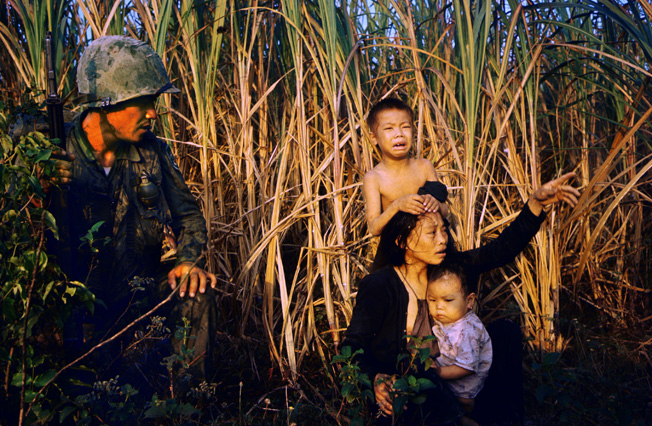
A soldier in the Korean 9th (White Horse) Division encounters a frightened Vietnamese woman and her children on patrol north of Bon Son in 1966.
Just before 0100 hours, the wood line came alive with small arms and machine-gun fire. The base was also subjected to a heavy mortar barrage, which wounded two platoon leaders and hit the command post, wounding Captain Kang. The old company commander, Captain Lee, who was still with the 9th, took command. After directing artillery fire against several suspected enemy concentrations, Lee ran from the CP, joined his men in the trenches, and ordered them to fight to the death. The Vietcong emerged from the woods and attempted to envelop the base, with the main blow falling on 3rd Platoon in the base’s southern sector.
As the Vietcong closed, South Korean soldiers tossed grenades and fixed bayonets. American tanks lashed away at the enemy, pouring fire into their ranks as they moved across no-man’s-land. The combined fire turned back the communists. The Vietcong tried again minutes later, but met a similar fate. At 0400 hours, they shifted their axis of attack against 2nd Platoon, which was facing west northwest and managed to advance as far as the barbed-wire perimeter. By dawn, the enemy was in full retreat, pursued by the 10th and 11th Companies. Lee and his men counted 184 communist bodies and several prisoners.

While the Vietnam War is often remembered as a purely American effort, U.S. forces were not alone. They were accompanied by units from allied nations such as Australia, New Zealand and, most importantly, South Korea. Throughout the Vietnam War, South Korean troops were an integral part of the American effort in South Vietnam, conducting pacification and counterinsurgency operations and fighting countless pitched battles against Vietcong and NVA troops. South Korean units were as tough and professional as any in the United States Army or Marines, and came to be justly feared by the communists. More than 300,000 Korean troops passed through Vietnam at some point, and more than 5,000 were killed.

Tuesday, August 25, 2020

Rules of the "Hells Angels" Motorcycle club.

I ran across this on the internet on one of those news sites and clipped it here.  It is a "fluff piece" but there is some interesting information in it.  I remember reading about the "Hells Angels " in some books my Dad had called "Crime and Punishment" from the mid 70's and it was far harsher on the organization than this fluff piece, particularly about it running guns, drugs, and treatment of women.  Women were considered "bitches" and "property" of whomever they belonged to and the biker would pimp them out for gas, grass and bike repairs.  Apparently the organization had tried with some success to revamp their image since the 60's and 70's. 

According to investigative journalist Julian Sher, those looking to join a Hells Angel charter start as a “hang around.” As the name implies, hang arounds are bikers who get invited to some Hells Angels events so both parties can get a feel for one another.
MediaNews Group/Bay Area News via Getty Images
Before you’re officially a part of the group, you’re called a “prospect,” a name that gets stitched into your vest. These tentative members run errands that Sher describes as “gopher work.”

The easiest way to recognize a Hells Angel is by the insignia on their vest. When a prospect becomes a full-fledged member, they get a vest with the famous logo and name on the back. Julian Sher explains that these vests are considered sacred to members.
Steve Thorne/Redferns/Getty Images
If one of the bikers gets arrested, he’ll hand his vest to a fellow member to avoid tainting it in jail. If they get hurt and need an emergency procedure, they’ll do whatever possible to prevent the vest from being cut or torn off.
The rules vary slightly from charter to charter, but there’s generally a dress code that members follow. One member told Inside The Angels that he could only wear black jeans, shirts, and vests when he joined.
hells-angels-4
GEOFF ROBINS/AFP via Getty Images
Some groups won’t even allow shorts! While some charters sport all black wear, some allow blue jeans and camouflage patterns. The color and design codes can help distinguish which charter you belong to and further establish that you’re a part of the group
The Hells Angels biker groups can be quite large, taking up an entire street as they ride. What you may not have known is that there’s an order that they maintain while riding. The road captain and charter president remain at the front of the group.
MediaNews Group/The Mercury News via Getty Images
From there, the bikers align based on seniority and rank. The older members will stay closer to the front, followed by newer members and ending with prospects in the back.
Since the Hells Angels have a particular order to maintain, if one of them gets pulled over by a cop, they all stop. Sticking together not only helps keep everyone in their place, but also signifies how the brotherhood is linked like family.
TOBIAS SCHWARZ/AFP via Getty Images
If you mess with one Hells Angel, you mess with them all. People are not too likely to start trouble with a huge mass of bikers around who have a history of being tough.
Given the Hells Angels’ history with law enforcement, it’s no wonder that they aren’t allowed to work for a prison while in the group. Members also cannot be police officers due to the conflict of interest.
ADRIAN DENNIS/AFP via Getty Images
Hells Angels have been known to engage in criminal activity at times. The group stands for freedom in the sense that they run by their own rules, so prison guards and law enforcement officers wouldn’t exactly fit in with the crowd
Another reason Hells Angels can’t be in law enforcement is because the group has a strict discretionary policy. If a member were to rat out a fellow brother, they could expect to get kicked out of the group.
MediaNews Group/Bay Area News via Getty Images
The Hells Angels website clearly states, “We do not answer questions about members,” not even missing ones. Their secrecy is meant to keep everyone in the group protected as they place loyalty to one another above all else
Once you’re an official Hells Angel, there’s no backing out. Members don’t retire, and the only time they exit the group is if they’re kicked out for breaking a rule. Your charter essentially becomes a second family.
Alexander Koerner/Getty Images
The Hells Angels spend a ton of time together and members have already known one another for years by the time they join. When one of them passes away, everyone unites to honor the memory of their fallen brother
Since the Hells Angels are very secretive in their activities, none of them are allowed to talk to the media. This not only protects the group as a whole but also helps enforce the rule that members don’t talk about one another.
JANEK SKARZYNSKI/AFP via Getty Images
Investigator Julian Sher says members are forbidden from talking to others about their codes since it’s part of their security. By keeping as many things to themselves as possible, they mitigate the risk of information leaking.
To be a Hells Angel, you don’t just need to be any biker; you need to be a very specific type of motorcyclist. As we’ve mentioned, the recruitment process can take years because they only accept those that are like family.
Christopher Furlong/Getty Images
One part of being the right kind of biker is owning a Harley Davidson. Riding only Harleys is a Hells Angels tradition that runs along the same lines as the sacred vest. It holds value because its a part of what makes them who they are
According to their website, the Hells Angels ride around 20,000 kilometers together every year. That’s more than 12,000 miles! Members need to be true motorcycle fanatics to fit in, meaning that their bike is their top mode of transportation.
Karol Serewis/Gallo Images Poland/Getty Images
While Hells Angels are like brothers, their connection is founded on their shared love of motorcycles. Riding is their outward expression of freedom and the closest they get to feeling completely liberated. As such, they’ll happily spend hours on the road
If you really take the Hells Angels way of life seriously, then the highlight of your day is attending one of their activities. Members who fail to show up to meetings and hangouts indicate to others that they are missing the point of the club.
Scott Olson/Getty Images
The biker brotherhood is known for having a strict attendance code. Those who continually miss events are seen as disrespectful and are not likely to make it past the “hanging around” phase of recruitment.
A part of what makes Hells Angels so drawn to gatherings is that the members become like family. Not only do they get to do what they love by riding bikes, but they also get to do it with other people who feel the exact same way.
Boris Roessler/picture alliance via Getty Images
Their passion runs much deeper than just excitement over motorcycles. Hells Angels is about a way of life, a belief system, that all of its members profoundly connect through
The Hells Angels have a deep bond that is meant to last a lifetime. With that connection comes commitment, meaning that members shouldn’t even consider joining another biker club.
Cate Gillon/Getty Images
Likewise, members need to be careful about who they associate with. The website warns, “Never combine your support to Hells Angels with other clubs, street gangs, or others if you are unaware of the relationship between those others and the Hells Angels Motorcycle Club.” In other words, anything members choose to support has to fit in with the group as a whole.
Hells Angels refers to itself as a brotherhood; thus, you’ll only see men with the death head insignias on their back. Though women aren’t technically in the club, they do play a major role in it.
JANEK SKARZYNSKI/AFP via Getty Images
Many of the Hells Angels have wives and families. If he’s going to be a part of the crew, then his partner has to understand the commitment and be okay with the lifestyle and all that comes with it.
As with joining a charter, creating one doesn’t just happen overnight. The Hells Angels website explains, “Motorcycle Clubs consist of people who have ridden together for years, live in the same area, are known by the community, have runs and parties, and are a brotherhood.”
Neville Elder/Corbis via Getty Images
It takes years, even decades, to become that established. Only then would you consider morphing your group into a Hells Angels charter. That’s why the website states that when you’re ready to start a charter, you won’t have to ask how.
Breaking the Hells Angels rules puts members in a position they’ll strongly regret. Since the motor club is secretive and full of loyal participants, there’s no telling what will be done to someone who betrays the brotherhood.
Boris Roessler/picture alliance via Getty Images
Investigator Julian Sher claims that the group has burned off the tattoos of past members who broke the rules. The worst form of punishment is being kicked out of the club, resulting in complete banishment from other members.
Grammar nerds will have already noticed that Hells Angels is missing an apostrophe. Since the angels belong to hell, there should be a possessive apostrophe between “Hell” and “s.” The group is all about breaking the rules, so it’s fitting they don’t obey the grammar.
Getty Images
Their website simply states, “Yes, we know there is an apostrophe missing but it is you who miss it. We don’t.” Plus, there was already a 1930 war film called Hell’s Angels when the biker club started
Though members despise people who aren’t in the club wearing the Hells Angels insignia, there is merchandise fans can buy to support the group. Hells Angels has a support shop where non-members can show their appreciation for the bikers’ way of life.
MediaNews Group/Tri-Valley Herald via Getty Images
Members love getting the support because proceeds who to local charters. The more merchandise they sell, the more events that they can put on for fellow bikers and other community members to enjoy.
Given their reputation as tough guys, you would think the Hells Angels wouldn’t be concerned about what substances its members use. The truth is the group is very strict about any members using illicit substances.
GettyImages-524257660
Neville Elder/Corbis via Getty Images
The Toronto based chapter of the club told The Star, “All ‘contact or use of [substances] is strictly forbidden’ as is the use of needles ‘for pleasure.’” The bottom line is this — stay clean or get kicked out of the club.
Another rule about the Hells Angels that isn’t as surprising as it sounds is this — you cannot link to the club’s website without express written consent. Because of how protective the club is of its members, this rule makes complete sense.
GettyImages-2431705
Scott Olson/Getty Images
As the rule is written on their website, it reads, “You may not establish and/ or operate links to this website without the prior written consent of the Hells Angels Motorcycle Club. Such consent may be withdrawn at any time at the Hells Angels MCs own discretion.”
Once you officially become a prospect to join the Hells Angels, there is one big rule you have to follow. You cannot, under any circumstances, retaliate against hazing. This is important because the process can often be a violent one.
GettyImages-89612278
Christopher Furlong/Getty Images
According to the club’s bylaws, this practice is not done to belittle potential members, but is instead seen as a test of their character. If you retaliate, you are not deemed worthy to continue the initiation process.
While it is possible for supporters of the Hells Angels to buy merchandise, only club members are allowed to wear official merchandise. The club takes this rule as seriously as they do the patches on their vests.
GettyImages-76772953
Chris Jackson/Getty Images
If you are caught wearing merchandise intended to impersonate the Hells Angels, you can expect retaliation. Just make sure that if you do plan to support the club, you are going through the proper channels!
As members grow with the Hells Angels and rise through the ranks of the club, they are given patches. These patches are seen as sacred symbols and must be respected with the utmost care.
GettyImages-89632605
Steve Thorne/Redferns
The rules about protecting these sacred patches are so strict it is even rumored that Hells Angels members must refuse to let doctors cut through the patches if bodily trauma needs to be taken care of!

Despite their tough reputation, it should be clear by now that the Hells Angels require members to show quite a bit of respect and restraint. This rule even applies to their interactions with women.
GettyImages-543821725
Hans G. Lehmann/ullstein bild via Getty Images
Any member must get consent. Taking advantage of women is unacceptable and the club has a zero tolerance policy towards this behavior. Break that policy and a member will find themselves in a world of hurt!
As respectful as the organization can seem, the Hells Angels are also very secretive and protective about its members. This protection even extends to anyone associated with the club who has gone missing.
GettyImages-78843796
Martin Rose/Getty Images
Members, as you know, are not allowed to talk to the media about members, but they also should not discuss other members with anyone not associated with the club. This not only protects the privacy of members, but it also protects them from law enforcement when necessary.
Across the Hells Angels organization, it is widely accepted that the only motorcycles members can ride are Harley Davidsons. We even wrote it as one of the rules earlier. While most charters abide by this rule, some will allow members to ride non-Harleys as long as their bikes are American made.
GettyImages-540195363
Fairfax Media via Getty Images via Getty Images
One of the other acceptable bikes, according to some charters, are Buell Motorcycles, a brand that was originally established in Wisconsin in 1983.
Once you join the Hells Angels, you are considered family, which means that no matter what else is going on in your life, the club comes first. Being a member means having voting rights and being an active participant in the club, and you are expected to value this above all else.
GettyImages-525124562
Harvey L. Silver/Corbis via Getty Images
Because it is a lifetime commitment, and even wives are expected to understand they come second to the club, you must fully embrace your new lifestyle. You won’t have time to join a yacht club any time soon.
As a club so rooted in rules and history, it is only recently that the Hells Angels have begun accepting more culturally diverse members to join. Throughout its lifespan, the club has been predominantly Caucasian, although it is not uncommon for those with Hispanic heritage to join.
GettyImages-103398020
Getty Images/Getty Images
As far as other cultures go, acceptance again varies from chapter to chapter. Some have loosened their rules, while others have stayed rooted in the past.
When club members gather for meetings, they still have to follow the rules. These guidelines are known as Robert’s Rules of Order. Invented in 1876, Robert’s Rules were initially designed for business meetings, but they have crossed over into Hell’s Angels.
GettyImages-2431719
Scott Olson/Getty Images
Robert’s Rules tell members how to hold a democratic meeting. They must stick to the agenda, interrupt only when necessary, and can raise questions before the assembly. If a Hell’s Angel breaks one of these rules, they may be fined $100.
If you want to join Hells Angels, you’ll have to hang around them first. If you get noticed, you’ll become a prospect. Prospects have a trial run where they work with Hell’s Angels for a while before getting their vest. When a member of the gang doesn’t have the “Hell’s Angels” logo or color on their vest, they’re a prospect.
GettyImages-2431691
Scott Olson/Getty Images
Prospects pick up the dirty work that members don’t want to do. For example, they may set up the meeting room before other members arrive. After their “trial period,” prospects receive the Hell’s Angels logo on their vest, making them a full member.
Certain groups in Hells Angels ride through specific areas. If one group has “claimed” that area, it’s theirs. No other gang can hang around that spot unless they’re driving through, even if they are also a part of Hells Angels.
GettyImages-844899068
TOBIAS SCHWARZ/AFP via Getty Images
Hells Angels have known rivals from other motorcycle clubs such as the Outlaws Motorcycle Club. If a Hells Angels group hangs around an area, no other motorcycle group can try to claim it. In some cities, members of each group go to separate hospitals to not run into each other.
Although Hells Angels have the reputation of being a dangerous gang, they occasionally run charities. Every year, they hold a toy drive for Toys for Tots. One time, they donated 200 bikes to the Poverello House, a nonprofit organization that aids the homeless.
GettyImages-500630714
Chip Somodevilla/Getty Images
Hells Angels frequently run motorcycle rides for charity, even letting other riders join. Even so, the members are aware that most people don’t know them for their charity. Their motto states: “When we do right, nobody remembers. When we do wrong, nobody forgets.”
Don’t be afraid of talking to a Hells Angel. The members live by a code of respect; if you treat them well, they’ll treat you well. Journalists who have interviewed Hells Angels describe them as “inviting” and “incredibly welcoming.”
GettyImages-3289586
Sasha/Getty Images
Hells Angels are also known to help their neighbors with issues and occasionally aid strangers. If you treat the riders well, you’ll have no problem interacting with a Hells Angel. But if you treat them poorly, expect them to do the same.
You may see some Hells Angels standing around at concerts. Don’t fret; they are frequently hired as concert security. It began in 1961, when George Harrison brought some Hells Angels from San Francisco over to London for a Beatles concert. The bikers’ respect earned the respect of the Beatles.
GettyImages-688365168
William L. Rukeyser/Getty Images
Since then, many bands have hired Hells Angels as a form of local security. The bikers get to attend the concert and earn some extra money on the side. It’s also an opportunity to show off their Hells Angels pride.
Since Hells Angels centers around motorcycle riding, deaths happen. When a member dies–especially a young member–the Hells Angels go out of their way to keep that person’s memory alive. They may hang up posters, ride with that person’s photos, or tell their story at a meeting.
GettyImages-1206183993
Duke Downey/San Francisco Chronicle via Getty Images
In 2019, 21-year-old Hells Angel member Clay Hubbard passed away on his birthday. His mother delivered the news to the motorcycle group. Although she felt intimidated, the group comforted her and even prayed with her in a parking lot. She gave the members a bracelet so Clay could “ride along with them on their rides.”
Hells Angels don’t only operate within their own group. They emphasize community involvement, and many members join local charities and events. It’s not uncommon to see Hells Angels support the same bars and shops in their neighborhood.
GettyImages-93423054
Justin Sullivan/Getty Images
At one point, a Hells Angels group discovered that their local bar was raising money for SELF School. The nonprofit donated educational resources to disabled children and cancer patients. Immediately, the group volunteered to help and raised money for the supplies. That’s one of many ways in which Hells Angels support their local communities
By now you know how important it is to protect the brand of the Hells Angels, but we haven’t discussed just far the club is willing to go in this regard. While you might think the rules on this would lean towards violence, sometimes the club goes by the rules of the law.
GettyImages-84865791
David Reed/Redferns
The Hells Angels have sued several large companies in order to protect their brand, including Disney after the movie Wild Hogs was released.
Perhaps the most important rule that the Hells Angels follow is this – they follow their own rules. The rules that society has created don’t concern them. Once you join the club, you have your set of rules to live by.
GettyImages-2431726
Scott Olson/Getty Images
In one publication about the club, it is written, “They, of course, didn’t have jobs. They despised everything that most Americans pursue – stability, security. They rode their bikes, hung out in bars for days at a time, fought with anyone who messed with them. They were self-contained, with their own set of rules, their own code of behavior. It was extraordinary.”
For the most part, it’s commonly accepted that the Hells Angels were officially formed on March 17, 1948 in Fontana, California. The founders included the Bishop family as well as a few other World War II veterans that came together from various post-war motorcycle clubs.
takingovercalifornia-32926-73510
American International Pictures/Getty Images
Despite various news and criminal reports, the Hell’s Angels say they got their start because It was started because military surplus made motorcycles affordable, and post-war life had left many young men feeling stagnant and missing their sense of soldier comradery.
The name Hells Angels were believed to have been suggested by an associate of the founding members named Arvid Olson. Olson had served in the Flying Tigers “Hell’s Angels” squadron in China during World War II.
hells-angels-club-name-84987-79134
Photo: Keystone/Getty Images
The nickname “Hell’s Angels” is one of the many nicknames that came about from the tradition of American soldiers giving their squadron fierce and intimidating nicknames in World War I and II.
In the early years, the club began to spread across California moderately quickly. According to the founder of the Oakland charter Ralph “Sonny” Barger, the earliest charters in California were founded in San Francisco, Oakland, Gardena, Fontana, and a few other lesser-known areas.
hells-angels-club-sonny-barger-34140-33068
Photo: Getty Images
At the time, the charters were only concerned with themselves and were unaware of all the other charters that existed. Eventually, during the 1950s, the different groups came together and unified to establish a large-scale organization and implement a system of internal codes and criteria for admission
During the 1960s, the Hells Angels became a large part of the counterculture movement, especially in California. They were very prominent in the Haight-Ashbury district of San Francisco and were frequent attendees of the local music and social events.
counterculture-21886-73623
David Reed/Redferns
Numerous members were also connected to the counterculture’s primary leaders in music and expression, such as Ken Kesey, the Merry Pranksters, Allen Ginsberg, Jerry Garcia and the Grateful Dead, the Rolling Stones, and more.
The Hells Angels, as well as a select other few motorcycle clubs, call themselves a one-percenter biker club. The phrase is a 50-year-old title that goes off the old saying that 1% of troublemakers give a bad name to 99% of bikers.
huty1989213-76819-66195
Photo: Barbara Alper/Getty Images
The name is supposed to help them separate from all of the negative stereotypes surrounding biker gangs and the Hells Angels in particular. Despite the name, numerous members have been convicted of crimes ranging from murder to selling narcotics.
In the beginning, the Hells Angels were strictly based in California but spread internationally in 1961. That year, the first charter outside of California began in Auckland, New Zealand. This opened the floodgates and the motorcycle club began to spread around the world.
luczniewski-notitle160603_npidc-29828-96254
Maciej Luczniewski/NurPhoto via Getty Images
In 1969, the first European charter was opened in London. There are now more than 275 charters in Europe alone. From the 1970s to now, there have been charters established in Australia, Brazil, South Africa, Eastern Europe, and more. New areas are currently being prospected.
The Hells Angels have a fairly obvious way of letting people know who they are. They will almost always be seen wearing a leather or denim “cut” which is slang for a motorcycle vest. On the cut, they have various patches such as Hells Angels written on the back with the name of their charter at the bottom.
attire-60840-72669
Photo by Matt Cardy/Getty Images
If they are a full member, they will also have the red and white-winged “death head” logo, the letters HAMC (Hells Angels Motorcycle Club) and the number 81. 81 stands of the letters H and A with H being the eighth letter of the alphabet and A being the first. Over the course of their time in the club, a member can also earn other patches
Becoming a member of the Hells Angels Motorcycle Club is no easy task. It is a process that can take up to a few years to achieve if you even make it that far.
becomingahellsangel-18372-70764
Photo: Getty Images
To start, you must have a valid motorcycle license, own a Harley Davidson motorcycle over 750 CC and have a personality that is cohesive with the rest of the club. You cannot have been accused of child molestation or have ever applied to become a police officer or prison guard. Other requirements are unknown to the general public.