Webster

The Constitution was made to guard the people against the dangers of good intentions." --American Statesman Daniel Webster (1782-1852)


Wednesday, April 11, 2018

"The Wraith of the Awakened Saxon" or the coming unpleasantness

Yes the title is from a Rudyard Kipling(the guy that wrote the Jungle book and many others.   But the premise of my rant is a bit different.  The past few days there has been several articles from people wanting to eliminate the 2nd amendment because it is "outdated" and no longer for the values of America.  The same people are also talking about a war between the red and the blue.   The past 20 years has seen the vitriol get worse.  Now the same people are wanting to get rid of the 2nd amendment are waging a full on assault on the 2nd and now the 1st amendment.  People are getting censured for speaking against the grouphivethink, the latest example is the ladies Diamond and Silk that got censured because facebook don't like their opinions and say that it goes against the values of the community.  Well it goes the values of the community of the left and they run the social media and the outrage machine here.  The same people that push the values of the modern Europe. The Left  believes that they are on the right side of history   Here is a quote from an article from the Twitter CEO  The Excerpt follows:

America today faces a similar juncture around fundamentally incompatible energy systems. The red states held by the Republicans are deeply entrenched in carbon-based energy systems like coal and oil. They consequently deny the science of climate change, are trying to resuscitate the dying coal industry, and recently have begun to open up coastal waters to oil drilling.
The blue states held by the Democrats are increasingly shifting to clean energy like solar and installing policies that wean the energy system off carbon. In the era of climate change, with the mounting pressure of increased natural disasters, something must give. We can’t have one step forward, one step back every time an administration changes. One side or the other has to win.

Two Classes at Odds

Another driver on the road to civil war is when two classes become fundamentally at odds. This usually takes some form of rich versus poor, the wealthy and the people, the 1 percent and the 99 percent. The system gets so skewed toward those at the top that the majority at the bottom rises up and power shifts.
The last time America was in that position was in the 1930s, during the Great Depression. We were on the road of severe class conflict that could have continued toward civil war, but we worked out a power shift that prevented widespread violence. Franklin Roosevelt, the so-called traitor to his class, helped establish a supermajority New Deal coalition of Democrats that rolled all the way through the postwar boom. The conservative Republicans who had championed a politics that advantaged the rich throughout the 1920s and promoted isolationism in the 1930s were sidelined for two generations — close to 50 years.
Today’s conservative Republicans face the same risk. Since 1980, their policies have engorged the rich while flatlining the incomes of the majority of Americans, from the presidency of Ronald Reagan through to last December’s tax overhaul, which ultimately bestows 83 percent of the benefits over time to the top 1 percent. Make no mistake: A reckoning with not just Trump, but conservatism, is coming.

Two Cultures at Odds

The differences between two economic systems or two classes that are fundamentally at odds could conceivably get worked out through a political process that peacefully resolves differences. However, culture frequently gets in the way. That’s especially true when pressures are building for big system overhauls that will create new winners and losers.
Two different political cultures already at odds through different political ideologies, philosophies, and worldviews can get trapped in a polarizing process that increasingly undermines compromise. They see the world through different lenses, consume different media, and literally live in different places. They start to misunderstand the other side, then start to misrepresent them, and eventually make them the enemy. The opportunity for compromise is then lost. This is where America is today.

Now Kurt Schlichter posted a comment/rebuttal to "Our Betters"

Tech titan Jack Dorsey of San Francisco-based social media platform Twitter applauded an article in something called Medium in which some other hipster CEO described how liberals intend to crush Normal Americans into serfdom in a bloodless “civil war.” 
Here it is. 
Ready?
It will just sort of happen. Why? Because. Americans will simply decide to be like California because of reasons and phew, no more troublesome conservatives and Gaia is saved!
So basically, wishing.
Well, that’s a kind of war plan. Perhaps by unleashing the power of hoping so they can utterly subjugate the half of America that voted against Felonia Milhous von Pantsuit and drive the people who actually operate and defend this country into silent obedience.
Or not.
Now, I know what you’re saying. You’re saying, “Why do a bunch of San Francisco dorks think that 150 million Americans with 300 million guns are just going to give up their rights and their say in their own governance and submit to the commands of people who eat kale by choice?” That’s a fair question, and they have an answer. 

Because you just are.

I didn’t say it was a good answer.
Recently I wrote a long column here describing the ugly realities of an actual Second Civil War – realities that are much uglier for the anti-freedom liberal side in terms of terrain, combat power, and morale. Naturally, this cry for sanity, which was only the latest in my long history of pleas to liberals to avoid the kind of civil strife I witnessed the consequences of overseas, was greeted by a torrent of outright lies. “You are advocating a civil war blah blah blah blah.” All liberal bull Schiff, including some by shameful collaborationist Fredocons who should know better, but not at all unexpected. The modern liberals’ rhetorical toolbox is filled exclusively with lies, which has the effect of making actual reasoned discussion impossible. Of course, that is their goal – they don’t want to defeat your argument. They want you bullied into silence. Tellingly, no one even bothered to try and counter the indisputable facts I offered many times showing why liberals will fail if they choose violence – instead, they tried to shut me up.

    The point I am making is that the left is in a hurry to get to this utopia on the hill....Like London where the honest people are disarmed, terrorized by the imports that come from another land, their opinions are stifled and they are jailed if their opinions deviate from official dogma.  This is the reality that will face America in 20 years or less, especially if the Left has their way and strip us of the 1st and 2nd amendment.  And once those are gone...y'all think the rest of the amendments will survive?  They will pick and choose which ones they will keep if it will advance the powers of the state.  Our first 10 amendments are already granted by our creator, basically we are born with them.  This concerns me because once we lose the bill of rights to the statist, we basically come the serfs and property of the state for them to use and abuse at will depending on the whims of the state and the state will be run by the leftist because they know what is best for us. and the overriding characteristic of the average leftist is the "busybody" that knows what is best.

    What I am afraid of is that the left being in such a hurry for this great utopia will finally push the "normal" to the breaking point

They want to silence you too, and every other patriot. But that’s a short-sighted tactic because people who are silenced, particularly uppity Americans who take their natural rights seriously, won’t just shrug and give up. They will stew and fume at the injustice of their oppression and then they will radicalize and then, because they have been wrongfully denied access to the means of participation in the governance of their own society, they will inevitably exercise their power in the only way left to them. They will rebel. They have before. Sometimes it’s peaceful – like by electing Donald Trump. But if peaceful doesn’t work, they are going to give not being peaceful a try. That’s just human nature.

 What I am trying to say, in their rush to push for this "bloodless civil war", we "normals" will not stand for it, we have been pushed and pushed to the breaking point,As long as we have a say in the voting process, it is a safety valve, but the left is trying to use the process against us, we have illegals voting and each illegal that votes, it cancels out the vote of a American.  We see the democratic party actively courting the interest of the illegals and ignoring the Americans.  I believe that they wish to replace us with people that are more docile and accepting of the notions that we belong to the state.  In other countries, people are taught that the state is always right and they rule over you.  Here in America we have a history of rebellion and independence that runs counter of the wish of those that would rule us.

THE WRATH OF THE AWAKENED SAXON by Rudyard Kipling

It was not part of their blood,
It came to them very late,
With long arrears to make good,
When the Saxon began to hate.

They were not easily moved,
They were icy -- willing to wait
Till every count should be proved,
Ere the Saxon began to hate.

Their voices were even and low.
Their eyes were level and straight.
There was neither sign nor show
When the Saxon began to hate.

It was not preached to the crowd.
It was not taught by the state.
No man spoke it aloud
When the Saxon began to hate.

It was not suddently bred.
It will not swiftly abate.
Through the chilled years ahead,
When Time shall count from the date
That the Saxon began to hate.

    One day the people that believe that by divine right which is divine by their ideology believe that they should rule us and bend our knees to their will will prove bad for them and the country.  Remember that map, most of the country is red, we own most of the guns and the military can't rule the entire country, it is impossible.  The left believe that we "normals" will just do as they say.  I have stated in the past that this is to break the middle class in America.  In most countries, there  are the very rich, they rule the land, and the poor, they work the land.  During the middle ages, the merchant and tradesman class started amassing power and provided a check in the desires of the nobility.  Here in America the middle class check the power of those that would rule us.  I hope I never have to participate in a "hot Civil War", but when push to shove happens, many will push back and the results will not be what the left wants.

Tuesday, April 10, 2018

The Doolittle Raid


Last week I had visited Eglin AFB and Checked Out the Armaments museum and they had a B25B in the mockup of the B25B that bombed Tokyo, so I decided to do a bit of research on the raid, I already knew a bunch about the raid because the Doolittle raid pushed the events that lead to the Battle of Midway that ended the dreams of Japanese domination in the Pacific War.

The Doolittle raid is one of the most famous air attacks of WWII. The first American attack on the Japanese Home Islands, it was achieved through careful planning. Although its practical impact was minimal, it was a powerful symbolic moment that boosted American morale and shook the Japanese.
On December 21, 1941, two weeks after the Japanese attack on Pearl Harbor, US President Franklin D. Roosevelt told the American chiefs of staff he wanted Japan bombed as soon as possible. Following the shock of Pearl Harbor, American morale needed a boost. It would also be good to shake the Japanese faith in their leaders’ ability to protect them. In January, Captain Francis Low came up with the concept for what would become the Doolittle Raid. Having observed Army bombers, he believed they could be launched from aircraft carriers. It would enable a bomb load to reach Japan from a long distance away from the American fleet.

The raid was planned and led by Lieutenant Colonel James “Jimmy” Doolittle. A pioneering aviator, Doolittle had made tremendous contributions to instrument-based flying. He instigated moving away from the limitations imposed by using human senses in high-speed aerial combat.
 Another one of my Pics, That airplane was "Skinny" and wasn't as big as I thought.  For the first time I really noticed the size of the airplane.
This from Wiki
TB-25J-25-NC Mitchell, 44-30854, the last B-25 in the USAF inventory, assigned at March AFB, California as of March 1960, was flown to Eglin AFB, Florida, from Turner Air Force Base, Georgia, on 21 May 1960, the last flight by a USAF B-25, and presented by Brigadier General A. J. Russell, Commander of SAC's 822d Air Division at Turner AFB, to the Air Proving Ground Center Commander, Brigadier General Robert H. Warren, who in turn presented the bomber to Valparaiso, Florida Mayor Randall Roberts on behalf of the Niceville-Valparaiso Chamber of Commerce. Four of the original Tokyo Raiders were present for the ceremony, Colonel (later Major General) David Jones, Colonel Jack Simms, Lieutenant Colonel Joseph Manske, and retired Master Sergeant Edwin W. Horton. It was donated back to the Air Force Armament Museum c. 1974 and marked as Doolittle's 40-2344
The B-25B Mitchell medium bomber was chosen for the mission. The best aircraft for the job, the B-25B needed to be fitted with extra fuel tanks for the unusual long-range mission. Other modifications included removing a gun turret, adding de-icers for the long high-altitude flight, and adding extra blast plates.


Lieutenant Colonel Doolittle wires a Japanese medal to a bomb, for “return” to its originators.
On April 1, the 16 modified bombers, each with a five-man crew, and their support staff were loaded on board the USS Hornet. The next day, the Hornet and its accompanying task-force set out. On the 17th, the ships received the last load of fuel from slow tankers, then raced west at 20 knots toward their launch point in enemy-controlled waters.
On the morning of the 18th, a Japanese picket boat spotted the American task force and radioed an attack warning. The American ships quickly destroyed the vessel.
Rather than let the Japanese make use of their warning, Doolittle decided to launch the raid ten hours early. It meant flying an extra 170 nautical miles.

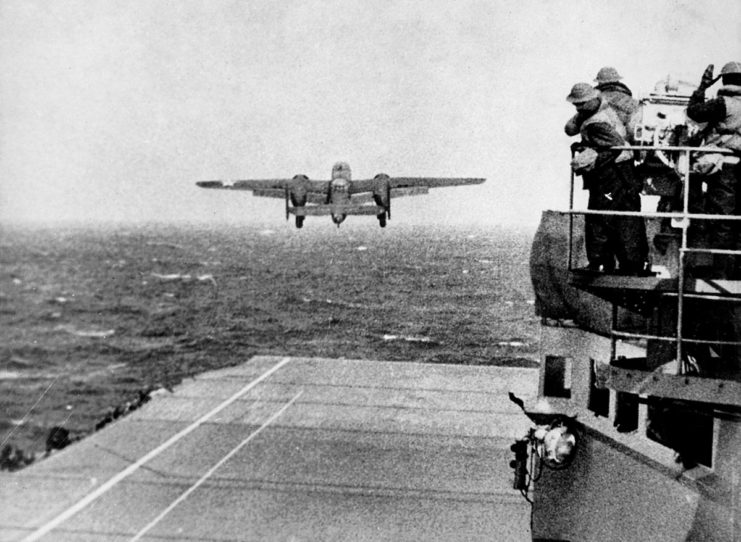
The planes had never taken off from a ship before, but every pilot succeeded. By 0920, all 16 were in the air.
Flying first in groups, then individually and low over the sea to avoid detection, the planes sped toward Japan.


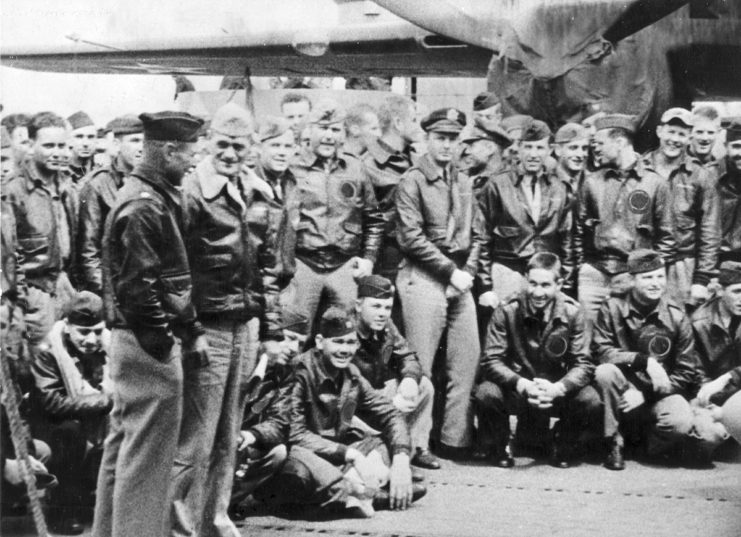
Orders in hand, Navy Capt. Marc A. Mitscher, skipper of the USS Hornet (CV-8) chats with Lt. Col. James Doolittle, leader of the Army Air Forces attack group. This group of fliers carried the battle of the Pacific to the heart of the Japanese empire with a daring raid on military targets in major Japanese cities. It was the result of coordination between the two services. The USS Hornet carried the 16 North American B-25 bombers to within take-off distances of the Japanese Islands. (U.S.Navy photo)
The Attack
It was noon in Tokyo when the planes arrived. Although the Japanese had carried out air raid drills, they had never been seriously threatened by Chinese planes in a decade of sporadic war. That was about to change.
Anti-aircraft fire and fighter planes greeted the bombers. However, the aerial defenses of Tokyo were light, and the city was unprepared for a real attack. The crew of the B-25 Whirling Dervish shot down one fighter. The crew of the Hari Kari-er got two more. Some of the weaponry had been removed from the planes to make them lighter, but they had fake guns in the tail cones, which dissuaded the Japanese from attacking them from below.
 The Fake guns on the B25B, This was my pic from last week
One B-25 received slight damage from anti-aircraft fire. Another dropped its bombs early to avoid being hit. None of them were shot down.
The bombers dropped their loads on 16 industrial and military targets, most of them in Tokyo. They also used their guns to strafe military positions.


A U.S. Army Air Forces North American B-25B Mitchell bomber takes off from the aircraft carrier USS Hornet (CV-8) during the “Doolittle Raid”.
Leaving Japan
Having dropped their bombs, the planes were to fly southwest, toward landing fields in China. There, they were to refuel before heading home.
One of the planes was too low on fuel. Instead, it headed for the Soviet Union and landed at an air base 40 miles from Vladivostok. The Russians were not at war with the Japanese. Under the terms of their neutrality pact, the Russians were obliged to intern the American crew. They were imprisoned near the Iranian border. Eventually, they bribed a smuggler to get them out and across the border, reaching the British consulate in May 1943. It later emerged that their escape had been engineered by the Russians to get around an awkward diplomatic issue.
The other 15 planes headed for China as planned. The early launch of the mission had also left them low on fuel. As bad weather descended, it became evident they would not make it to their landing fields before they ran out of fuel. They would have to abandon their planes when they reached the coast of China.
All fifteen crew members successfully abandoned their aircraft. Three of the B-25s were ditched at sea. The rest crashed on land. Only three men died in the crashes.
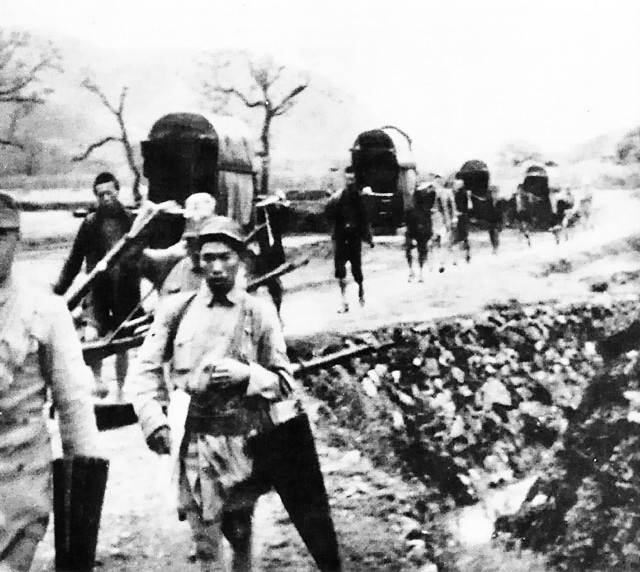
Japanese troops captured eight of the crewmen. Of them, three were executed, and one died in captivity. The rest escaped, with the help of Chinese soldiers and civilians. Many of the civilians risked their lives to do it and were punished by the occupying Japanese.


Chinese troops evacuating downed Doolittle Raiders, somewhere on the Chinese coast, April 1942.
Doolittle expected to get into trouble for the outcome of the attack. Although they had reached Tokyo, he had lost 16 valuable planes in the process.
The public reaction, however, proved that for Americans, the outcome was worth the cost. The Doolittle Raid was a huge boost to public morale. Doolittle was promoted straight to brigadier general, skipping the rank of colonel. Every man who took part in the raid was awarded the Distinguished Flying Cross. Doolittle was given the Medal of Honor.
The raid killed 87 people in Tokyo and injured 462. Some of the casualties were children, enraging the Japanese public.
Fearful of another strike against their cities, the Japanese determined to seize Midway Island. They were defeated.
The Doolittle raid had done its job. American spirits had been lifted. Japanese nerves were shaken. The Empire of Japan lay vulnerable at last.
Intro to the Movie "Midway" that showed the Doolittle Raid

Monday, April 9, 2018

Monday Music "Somebody's Knockin" by Terri Gibbs

This song I remember from the early 1980's, the song had a haunting quality about it.  I had forgotten about it because it had faded away,  I did remember the DJ's talking about the artist was blind.  This was before the age of MTV so music videos were hit and miss.  I was listening to my Sirius/XM and they were doing their top 40 for April 4 1981 and this song came on and it was like a flash from the past.


Gibbs was born in Miami, Florida, but raised in the Augusta, Georgia, suburb of Grovetown. Although born with eyesight, she lost it as a newborn due to an incubator accident. Despite her blindness, she learned to play piano at age three. As a child, she sang in the church choir and at talent contests, and at age seventeen, she opened for Bill Anderson. Her parents wanted her to be treated no differently from sighted people and she was sent to public school, graduating from Butler High School in Augusta in 1972. She performed in and around the Augusta area and eventually, she met Chet Atkins, who advised her to move to Nashville, Tennessee, to pursue a country music career, which she did at age eighteen. After failing to find a record deal, she returned to Miami and joined a band called Sound Dimension. She continued to perform locally, later forming a band called the Terri Gibbs Trio, which performed at a Steak and Ale in Augusta, Georgia. Gibbs then sent a demo tape to record producer Ed Penney of MCA Records, signing to the label in 1980. Penney was a former Boston disc jockey and a long-time songwriter. He liked her voice on her demo, but felt she needed stronger material. He co-wrote "Somebody's Knockin'" for her and also produced the song.

Gibbs' first single release was "Somebody's Knockin'", which was also the title of her 1981 debut album. This song was a crossover hit upon its 1980 release, reaching No. 8 on the U.S. country charts, No. 13 on the Billboard Hot 100 and No. 3 on the Adult Contemporary charts. It was followed by "Rich Man", a No. 19 country hit which also entered the pop charts. Her debut album won her the Academy of Country Music's Top New Female Vocalist award. She was also the first winner of the Country Music Association's Horizon Award (which is awarded to emerging artists), and was nominated for a Grammy Award for Best Country Song and Best Female Country Vocal Performance for "Somebody's Knockin'." Gibbs performed on the Grand Ole Opry as well.

Sunday, April 8, 2018

Hitlers desperate moves to avert defeat


In the summer of 1944, Adolf Hitler’s monstrous dream of an eternal empire began to collapse. Five years after his invasion of Poland had plunged the world into war, his opponents landed in northern France beginning a swift, destructive advance toward Germany. To the south, Allied forces were already clawing their way up Italy, while in the east, the long and bloody struggle of the Russian front had turned around and Soviet forces were advancing.
Hitler’s approach to military strategy had never been grounded in reality. With his life’s work threatened, he took desperate steps to avoid losing the war.
Re-manning the West Wall
The Siegfried Line, also known as the West Wall, was a massive network of defenses on Germany’s border with France. Built between 1936 and 1939, it included concrete bunkers, trenches, and anti-tank barriers.


Once Hitler had conquered France, the line became unnecessary as a western defense. Supplies and soldiers were moved out, and the doors were locked.
Four years later, with the Allies coming, things changed. Hitler ordered troops to reoccupy the line. They hurried to replace rusted parts and cut back overgrown ground. Using the West Wall, they held up the Allies for six months around the Franco-German border. However, with Allied forces advancing on every front, a localized defense line was nowhere near enough.
American soldiers cross the Siegfried Line and march into Germany.
To ensure that the full resources of the Reich went into its defense, Hitler began closing down things he considered unimportant. Theaters and music halls were closed. The only publishers allowed to continue were those publishing school textbooks and Hitler’s Mein Kampf. The only parts of universities that kept going were the medical schools.


 Luftwaffe PFC in a Ground Division
With hundreds of thousands of Allied troops on their doorstep, the Germans needed as many men on the front lines as they could get. One solution was to take them from elsewhere in the military. Pilot training programs were shut down, and ships were mothballed; the war at sea had become irrelevant. Their crews, along with those of the U-boats, were diverted into the infantry.
Anti-aircraft defences on the Flakturm Tiergarten in Berlin, one of the flak towers built from 1940. Photo: Bundesarchiv, Bild 183-H27779 / CC-BY-SA 3.0.

One of Hitler’s grandest schemes was Operation Herbstnebel or Autumn Fog.
It was to be a powerful counterattack in the west. Pouring out of the forested Ardennes, German troops would punch a hole through the Allied lines, splitting the British and American forces. Like the bold attacks early in the war, it would leave the enemy reeling and give Hitler an edge.
However, it was not the early war. Hitler’s lieutenants tried to talk him out of the attack. They realized they did not have the fuel, weapons, or manpower to succeed against the Anglo-American forces.

Hitler was not to be dissuaded. On December 16, the attack began. Within days, it ground to a halt, bogged down in the Battle of the Bulge. Hitler had spent an enormous proportion of his reserves and gained very little. Most of it was retaken within a week.
Young Boys and Old Men

Running out of able-bodied fighting men, Hitler turned whoever was left into soldiers. Ill and injured soldiers were forced into new units. One was the “ear and nose” battalion, in which orders often had to be given in sign language. The old men of the Volkssturm, a force similar to Britain’s Home Guard, were mobilized. Weapons were given to the Hitler Youth.
In Hitler’s view, any German who could fight should fight.
Winter 1945: Volkssturm members being trained to use the Panzerfaust anti-tank weapon. Photo: Bundesarchiv, Bild 183-J31391 / CC-BY-SA 3.0.
The more desperate things became, the further Hitler sank into a delusion that he could hold onto territory just by ordering it. He refused to allow withdrawals, even tactical ones that might have earned German forces an advantage. Surrenders were a complete anathema. In East Prussia, the Po Valley, Bregenz, and other places across Europe, German soldiers faced a choice between mutiny and a futile death. Soldiers and civilians alike died needlessly in their thousands.

 Field Marshall Model (Hitlers Fireman)  He would go from theater to theater and restore the front after a catastrophe, was well respected by the allies, but was suspect under Hitler, Field Marshall Model Committed Suicide surrounded in the Ruhr Pocket, rather than surrender
Hitler was unable to believe that any failure was his fault and so laid the blame on his subordinates. He was also unwilling to accept criticism or disagreement. As the failures mounted and the arguments became more heated, he began firing his most senior commanders. Heinz Guderian, one of the greatest tank commanders of the war, was dismissed for a second time. Heinrich Himmler, Head of the SS, was removed from his post as Commander of Army Group Vistula. Herman Göring lost his place as Hitler’s successor; for what that position was worth.
While the ship sank, Hitler reordered the crew.
Heinz Guderian with an Enigma machine in a Sd.Kfz. 251 half-track being used as a mobile command center during the Battle of France. Photo: Bundesarchiv, Bild 101I-769-0229-12A / Borchert, Erich (Eric) / CC-BY-SA 3.0.
Contingency for a Split Reich
As the Allies advanced on all sides, it became likely Germany would be split in two. Desperate as the situation would be for that to happen, Hitler was determined they would keep fighting. He made arrangements for the leadership of a physically divided Reich. If the south were cut off, then Field Marshal Kesselring would take over there and continue the fight.
Kesselring was one of the most capable leaders and managers in the whole German military machine, but even he could not have held out for long.
The Alpine Redoubt
The Alpine Redoubt was an old plan. In the event of failure, the last German forces would fall back into supplied and fortified positions in the mountains, where they could keep the Reich alive.
In April 1945, Hitler gave the order.
However, there was no Alpine Redoubt. Unwilling to accept the possibility of defeat, Hitler had done nothing to set up the factories, supplies, and defenses the redoubt needed. The idea of retreating there was a delusion or a lie.
To the end, Hitler’s plans were less about reality and more about the world he wanted to see.


Friday, April 6, 2018

The Pusan Perimeter of the Korean War.

I was doing a bit of research on the "Pusan" Perimeter and found out that they changed the name "officially" in 2000 to "Busan".   Learned something new :).  I have blogged about the Korean War, it was the first "faceoff" in the cold war between the USSR and the West.  The North Koreans expected to bulldoze the South Koreans and the Soviet Union was supposed to keep the United States bottled up in the new U.N. while the North Koreans unified the Peninsula under communist rule and showed the superiority of Communism to the wavering border countries that are near communist nations and as a warning to Japan that was still occupied by the Americans after WWII.  The North Koreans were primarily supported by the Red Chinese with technical help by the Soviets.  The Soviets were boycotting the U.N because they didn't recognize the "Republic of China" that lost the war against the communist Chinese the year before but the ROC was still the official voice of China at the U.N.

    
The Truman administration was unprepared for the invasion. Korea was not included in the strategic Asian Defense Perimeter outlined by Secretary of State Dean Acheson. Truman himself was at his home in Independence, Missouri. Military strategists were more concerned with the security of Europe against the Soviet Union than East Asia. At the same time, the administration was worried that a war in Korea could quickly widen into another world war should the Chinese or Soviets decide to get involved.
One facet of the changing attitude toward Korea and whether to get involved was Japan. Especially after the fall of China to the Communists, U.S. experts on East Asia saw Japan as the critical counterweight to the Soviet Union and China in the region. While there was no United States policy dealing with South Korea directly as a national interest, its proximity to Japan increased the importance of South Korea. Said Kim: "The recognition that the security of Japan required a non-hostile Korea led directly to President Truman's decision to intervene ... The essential point ... is that the American response to the North Korean attack stemmed from considerations of U.S. policy toward Japan."
Another major consideration was the possible Soviet reaction in the event that the U.S. intervened. The Truman administration was fearful that a war in Korea was a diversionary assault that would escalate to a general war in Europe once the United States committed in Korea. At the same time, "[t]here was no suggestion from anyone that the United Nations or the United States could back away from [the conflict]". Yugoslavia—a possible Soviet target because of the Tito-Stalin Split—was vital to the defense of Italy and Greece, and the country was first on the list of the National Security Council's post-North Korea invasion list of "chief danger spots". Truman believed if aggression went unchecked, a chain reaction would be initiated that would marginalize the United Nations and encourage Communist aggression elsewhere. The UN Security Council approved the use of force to help the South Koreans and the U.S. immediately began using what air and naval forces that were in the area to that end. The Truman administration still refrained from committing on the ground because some advisers believed the North Koreans could be stopped by air and naval power alone.
The Truman administration was still uncertain if the attack was a ploy by the Soviet Union or just a test of U.S. resolve. The decision to commit ground troops became viable when a communiqué was received on 27 June indicating the Soviet Union would not move against U.S. forces in Korea. The Truman administration now believed it could intervene in Korea without undermining its commitments elsewhere.
 Busan (Korean pronunciation: [pu.sɐn]), formerly known as Pusan and now officially Busan Metropolitan City, is South Korea's second most-populous city after Seoul, with a population of over 3.5 million inhabitants. It is the economic, cultural and educational center of southeastern Korea, with its port—Korea's busiest and the 9th-busiest in the world[—only about 120 miles (190 km) from the Japanese islands of Kyushu and Honshu. The surrounding "Southeast Economic Zone" (including Ulsan and South Gyeongsang) is now South Korea's largest industrial area.


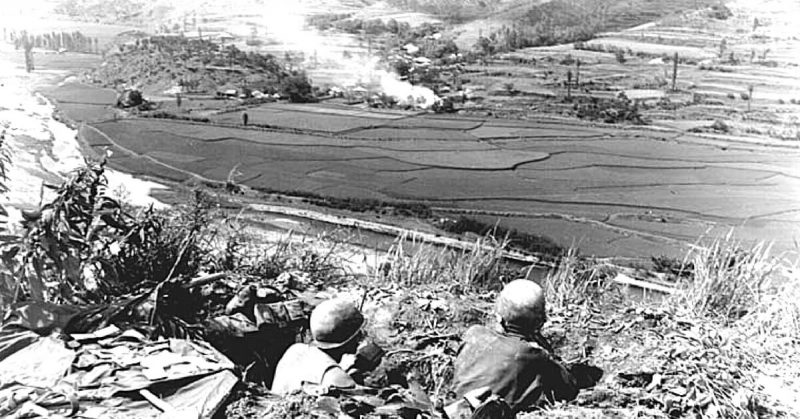
    Dug-In American Soldiers Firing on North Korean Positions during the battle


    Pusan Perimeter
    The Battle of Pusan Perimeter took place in the fall of 1950 and was one of the first major conflicts of the Korean War.
    The North Korean army was invading South Korea and attacking the forces sent by the United Nations. These troops were composed of those sent by not only the United States and Great Britain but also South Korea, the Netherlands, Canada, New Zealand and Australia.
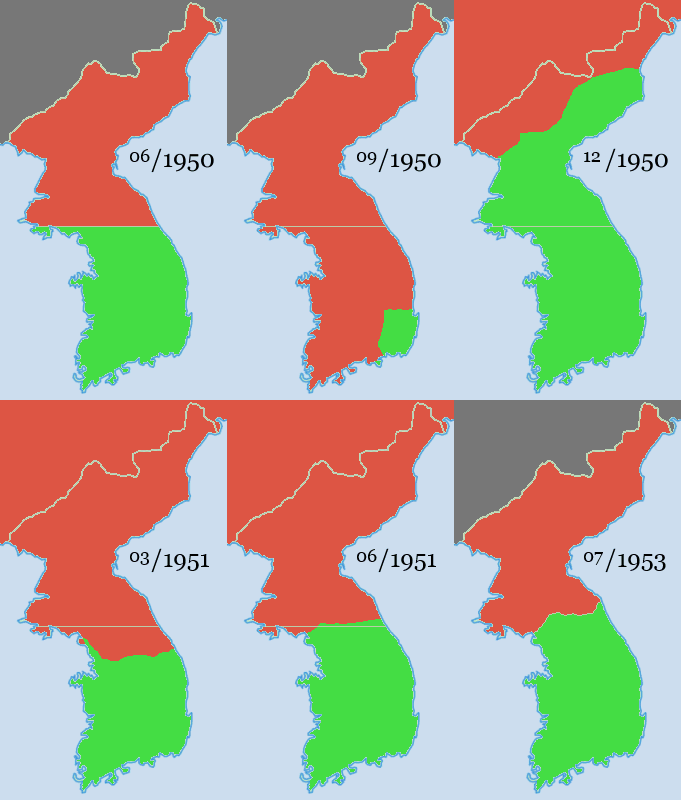
    During the battle, the North Koreans managed to drive back the United Nations forces to the Pusan Perimeter. The Pusan Perimeter is a 140-mile stretch of land on the Korean Peninsula that is also home to Pusan, a port.
    The North Koreans attacked troops stationed there for six entire weeks, while also striking in other locations. Regardless, the United Nations troops stood firm and managed to outlast the multiple attacks. It was very helpful the United Nations had access to the port of Pusan, which enabled them to ship in extra manpower, equipment and more.
    Eventually, after waiting them out, the North Koreans retreated.
    The Battle of Pusan Perimeter was the furthest South the North Koreans would make it during the war.


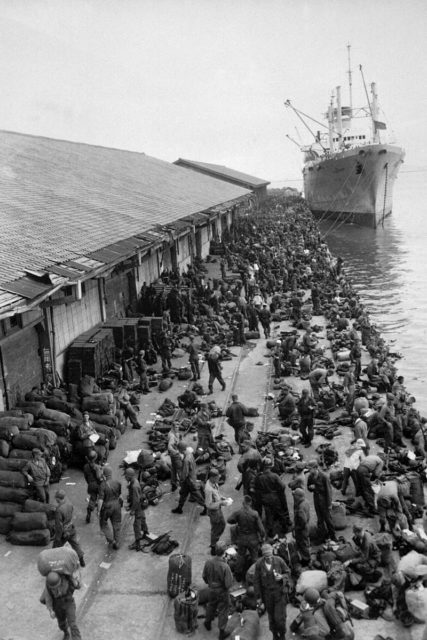
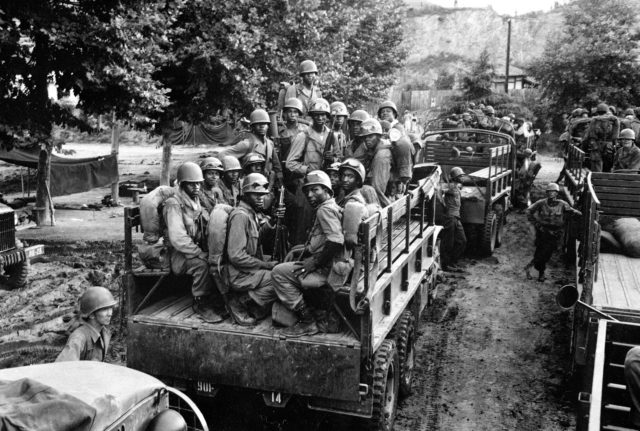
    United Nations troops arriving in South Korea.
    United Nations troops arriving in South Korea.

    The Beginning of the War
    The Battle of Pusan Perimeter took place shortly after the start of the Korean War. The Korean War began when North Korea invaded South Korea, and the United Nations felt it would be best to send troops in to help. The United States additionally sent extra troops. The goal was to prevent the invasion by North Korea, while also helping the South Koreans to defend themselves and succeed economically and diplomatically.
    The United Nations forces began to create a perimeter around Pusan through the summer of 1950. It was about 140 miles long and went from the Korean Straight to the Sea of Japan and around Pusan. It also touched on a few other cities.
    The terrain around the perimeter was very rocky, mountainous and difficult to traverse. The United Nations forces were using these mountains and valleys as natural defenses. It was very hard, though, for any of the troops to cross it. The area also gave soldiers little access to clean water and was also very jungle-heavy. This was not only a bad thing for the enemy, but also for the United Nations troops. They also suffered casualties related to the vegetation, lack of pure water and the high heat.
    The North Korean forces were arranged into ten divisions, most having appropriate training and with hundreds of T-34 tanks. However, when they incurred losses, the North Koreans would provide inferior replacements for their men and weaponry.
    The United Nations forces were under the command of the United States military. The United Nations had superior air and sea power throughout the conflict, both being led by the United States Navy and Air Force.


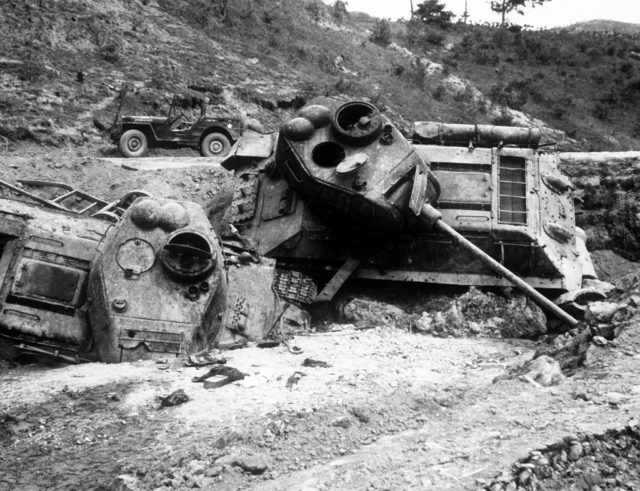
    North Korean T-34 tanks destroyed by U.S. bombing.
    North Korean T-34 tanks destroyed by U.S. bombing.

    First Attack On Pusan


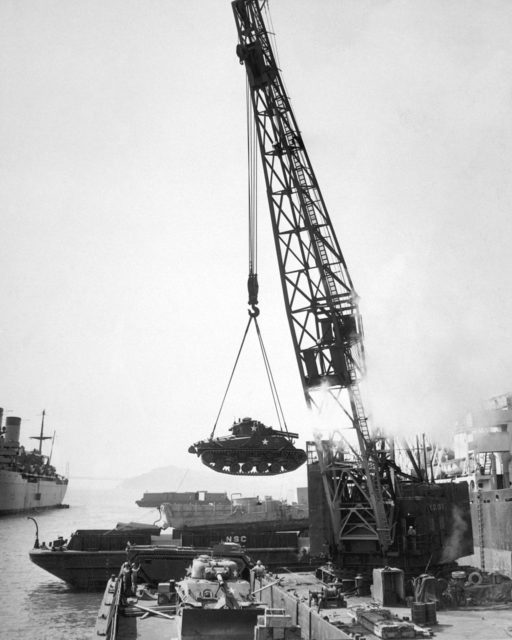
    An M4 Sherman tank being loaded into a barge at the port of Oakland, California, prior to shipment to Pusan, 1950.
    An M4 Sherman tank being loaded into a barge at the port of Oakland, California, prior to shipment to Busan, 1950.
    In August 1950, the United Nations forces began to withdraw from the perimeter leaving behind defensive positions. This would enable them to regroup and come back to fight later.  Also, it would provide the necessary manpower to keep the North Koreans at bay. They feared that any further retreat would be detrimental to the United Nations forces. They also wanted to be sure they could keep control of Busan Port, so they could continue to receive supplies and more manpower.
    North Korea attacked the perimeter trying to make their way into Pusan. They attacked in four different places: the south through two routes, the north and the east.
    The United Nations troops began to plan a counter-offensive move, and it would be their first in the war. They encountered 500 North Korean infantry and defeated them, then overran the North Korean 6th Division headquarters.
    However, after this, their good luck slowed. Fierce fighting lasted for three days near Chindong-ni, and United Nations troops were redeployed as needed.
    When one infantry division was rerouted several days later, the difficult terrain became a serious problem. American forces stuck in the mud were attacked by the North Koreans, who were hiding out at a higher elevation, perfect for a surprise assault.
    The attack quickly took out almost two battalions and their corresponding equipment. The Americans, although receiving back up, could not regain the ground.
    The Tables Turn in September


    Troops of the 24th Infantry move to the Masan battleground
    Troops of the 24th Infantry move to the Masan battleground
    However, after many similar encounters, the North Korean army was highly reduced. They had lost much of their food, weaponry, soldiers and more.
    By this time, the United Nations had amassed more troops in the area than the North Koreans. The North Korean disadvantage was growing more apparent by the day. They had fewer than 100 tanks, while the U.S. troops alone had more than 600.
    In light of this, the North Koreans decided that flanking the forces was a waste of time, thanks to the U.S. Navy superiority. They choose to go with a frontal attack. They knew, thanks to Soviet Union help, the United Nations forces were building on the perimeter in Pusan. They wanted to take one last shot at capturing the area, at the risk of losing it for good. To plan ahead for the offensive attack, the North Koreans added four new troop divisions. A five-pronged attack was scheduled for August 31 and September 2.
    The attacks greatly surprised the United Nations forces. They were busy building in Pusan, believing they had successfully taken care of North Korean troops in the area.
    The North Koreans broke through the first lines and pushed the United Nations troops back. Fierce fighting followed. However, United Nations troops rallied and forced back the North Koreans by September 15, with the fight ending around Pusan a few days later.
    The Aftermath
    During the Pusan conflicts, two war correspondents were killed. Also 40,000 South Koreans; more than 4,000 Americans; 5 British; 1 Indian; and more than 60,000 North Koreans.
    Both sides committed war crimes.
    The North Koreans were accused of severely torturing captured United Nations soldiers.
    United Nations troops (mainly South Koreans) were accused of killing captured North Koreans.

    Thursday, April 5, 2018

    The Chili Contest....

    Some Texas Humor, I have some friends living in Texas and I thought this was pretty good, LOL


    THE CHILI CONTEST
    If you can read this whole story about a Texas Chili Contest without laughing then there's no hope for you. I was crying by the end. Note: Please take time to read this slowly. If you pay attention to the first two judges, the reaction of the third judge is even better. As you know, there are numerous Chili Cook-offs throughout the State. Judge #3 in this story was an inexperienced Chili taster named Frank, who was visiting from Springfield, IL .
    ~~~~~~~~~~~~~~~~~~~~~~~~ ~~~~~~~~~~~~~~~~~~~~~~~~`
    Frank: "Recently, I was honored to be selected as a judge at a chili cook-off. The original person called in sick at the last moment and I happened to be standing there at the judge's table asking for directions to the Coors Light truck, when the call came in. I was assured by the other two judges (Native Texans) that the chili wouldn't be all that spicy and, besides, they told me I could have free beer during the tasting, so I accepted".
    Here are the scorecard notes from the event:
    CHILI # 1 - MIKE'S MANIAC MONSTER CHILI...
    Judge # 1 -- A little too heavy on the tomato. Amusing kick.
    Judge # 2 -- Nice, smooth tomato flavor. Very mild.
    Judge # 3 (Frank) -- Holy shit, what the hell is this stuff? You could remove dried paint from your driveway. Took me two beers to put the flames out. I hope that's the worst one. These Texans are crazy.
    CHILI # 2 - AUSTIN 'S AFTERBURNER CHILI...
    Judge # 1 -- Smoky, with a hint of pork. Slight jalapeno tang.
    Judge # 2 -- Exciting BBQ flavor, needs more peppers to be taken seriously.
    Judge # 3 -- Keep this out of the reach of children. I'm not sure what I'm supposed to taste besides pain. I had to wave off two people who wanted to give me the Heimlich maneuver. They had to rush in more beer when they saw the look on my face.
    CHILI # 3 - FRED'S FAMOUS BURN DOWN THE BARN CHILI...
    Judge # 1 -- Excellent firehouse chili. Great kick.
    Judge # 2 -- A bit salty, good use of peppers.
    Judge # 3 -- Call the EPA. I've located a uranium spill. My nose feels like I have been snorting Drano. Everyone knows the routine by now. Get me more beer before I ignite. Barmaid pounded me on the back, now my backbone is in the front part of my chest. I'm getting shit-faced from all of the beer.
    CHILI # 4 - BUBBA'S BLACK MAGIC...
    Judge # 1 -- Black bean chili with almost no spice. Disappointing.
    Judge # 2 -- Hint of lime in the black beans. Good side dish for fish or other mild foods, not much of a chili.
    Judge # 3 -- I felt something scraping across my tongue, but was unable to taste it. Is it possible to burn out taste buds? Sally, the beer maid, was standing behind me with fresh refills. That 300-LB woman is starting to look HOT...just like this nuclear waste I'm eating! Is chili an aphrodisiac?
    CHILI # 5 LISA'S LEGAL LIP REMOVER...
    Judge # 1 -- Meaty, strong chili. Cayenne peppers freshly ground, adding considerable kick. Very impressive.
    Judge # 2 -- Chili using shredded beef, could use more tomato. Must admit the cayenne peppers make a strong statement.
    Judge # 3 -- My ears are ringing, sweat is pouring off my forehead and I can no longer focus my eyes. I farted and four people behind me needed paramedics. The contestant seemed offended when I told her that her chili had given me brain damage. Sally saved my tongue from bleeding by pouring beer directly on it from the pitcher. I wonder if I'm burning my lips off. It really pisses me off that the other judges asked me to stop screaming. Screw those rednecks.
    CHILI # 6 - VERA'S VERY VEGETARIAN VARIETY...
    Judge # 1 -- Thin yet bold vegetarian variety chili. Good balance of spices and peppers.
    Judge # 2 -- The best yet. Aggressive use of peppers, onions, and garlic. Superb.
    Judge # 3 -- My intestines are now a straight pipe filled with gaseous, sulfuric flames. I shit on myself when I farted and I'm worried it will eat through the chair. No one seems inclined to stand behind me except that Sally. Can't feel my lips anymore. I need to wipe my ass with a snow cone.
    CHILI # 7 - SUSAN'S SCREAMING SENSATION CHILI...
    Judge # 1 -- A mediocre chili with too much reliance on canned peppers.
    Judge # 2 -- Ho hum, tastes as if the chef literally threw in a can of chili peppers at the last moment. **I should take note that I am worried about Judge # 3. He appears to be in a bit of distress as he is cursing uncontrollably.
    Judge # 3 -- You could put a grenade in my mouth, pull the pin, and I wouldn't feel a thing. I've lost sight in one eye, and the world sounds like it is made of rushing water. My shirt is covered with chili, which slid unnoticed out of my mouth. My pants are full of lava to match my shirt. At least during the autopsy, they'll know what killed me. I've decided to stop breathing it's too painful. Screw it; I'm not getting any oxygen anyway. If I need air, I'll just suck it in through the 4-inch hole in my stomach.
    CHILI # 8 - BIG TOM'S TOENAIL CURLING CHILI...
    Judge # 1 -- The perfect ending, this is a nice blend chili. Not too bold but spicy enough to declare its existence.
    Judge # 2 -- This final entry is a good, balanced chili. Neither mild nor hot. Sorry to see that most of it was lost when Judge #3 farted, passed out, fell over and pulled the chili pot down on top of himself. Not sure if he's going to make it. poor feller, wonder how he'd have reacted to really hot chili?
    Judge # 3 - No Report

    Wednesday, April 4, 2018

    Adolf Hitler was nominated for the Nobel Peace Prize...?

    This was scheduled to post on Sunday, but after realizing that it is Easter, kinda bad taste...SO it will show up on Wednesday, This I posted on my scheduler thingie because I am tied up with a work function for a couple of days.
      
        When I heard about this I figured it was an empty gesture like they gave President Obama the Nobel prize right after he was elected President because they "hoped" that he would bring peace because he was elected as the "Messiah" and they being leftist the Nobel nominating committee bought into this "Hope and Change" snake oil that President Obama was peddling.

    Your daily dose of random and strange. Kinda like Aprils Fool, but this was actually a true story.  Adolf Hitler was once nominated for the Nobel Peace Prize. The prize has a long history, dating back to the late 1800s, and in 1939, Adolf Hitler was nominated for the Peace Prize.
    History of the Prize
    The history of the prize goes back to the late 1800s. Swedish industrialist and inventor Alfred Nobel left in his will that he would like to create a series of prizes, using the funds from his estate.
    The prizes proposed fell into several categories: literature, medicine, chemistry, physics, and peace. The award Hitler was nominated for was, of course, the Peace Prize, which has been given out annually since 1901.


    Public Domain
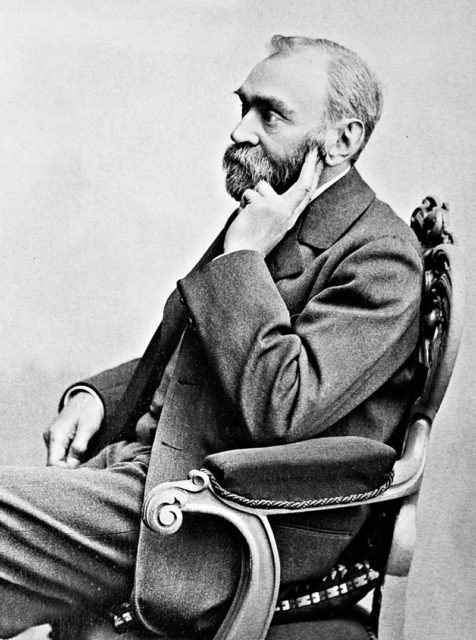
    Portrait of Alfred Nobel.
    According to Alfred Nobel’s will, the Peace award should go to those who “have done the most or the best work for fraternity between nations, for the abolition or reduction of standing armies and for the holding and promotion of peace congresses.” Nominations for each prize were – and still are – to be chosen by a Norwegian committee.
    Today, the prize is still being given. Each December, the council narrows down their list of nominees to one. For reference, this past year there were 376 nominees. The final nominee, is, of course, the winner, and is granted the name Nobel Laureate.
    Former Winners and Nominees
    The list of winners and nominees of the Nobel Peace Prize is quite long. Anyone from U.S. Presidents such as Barrack Obama to affiliations like the Organization for the Prohibition of Chemical Weapons agency have won. The award has been given out 96 times, to 129 Nobel Laureates. This number includes repeat winners. In total, 103 individual people have won the award, while 26 businesses and organizations have won the award.


    Public Domain
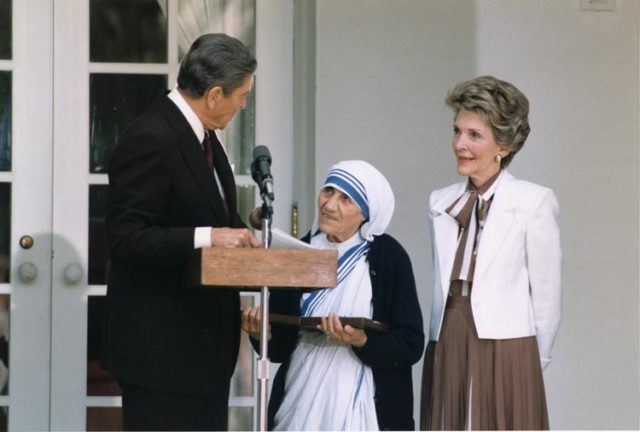
    Mother Teresa (middle) seen in the 1980s with former U.S. President Ronald Reagan.
    Popular names that have won include the European Union, Martin Luther King Jr., Mother Teresa, etc. There have been several years where there were no winners, 1914-1916, 1918, 1923-1924, 1928, 1932, the year Hitler was nominated (1939) through 1943, 1948, 1955-1966 and lastly 1966-1967.
    The number of people who can be nominated to win the Nobel Peace Prize each year has been growing, and has reached a record number in the last few years. In 2016, 376 people and organizations were nominated. This is the most ever. In 2014, the old record was set at 278. The year Hitler was nominated, 1939, the exact number of nominees is not known, but it was much less.
    Hitler’s First Run-In With the Prize
    Interestingly enough, Hitler banned anyone from Germany from receiving the prize in the mid-1930s.  It all began when a German Pacifist,  Carl von Ossietzky, was awarded the prize in 1935. Ossietzky was awarded the prize for exposing the German re-armament that had been going on for quite some time.
    The re-armament was in violation of the Treaty of Versailles, which was a peace treaty between Germany and the Allied countries, following World War I. The treaty required Germany to disarm. Once the re-armament was exposed, it came out that Germany had begun re-arming shortly after the Treaty of Versailles was signed. It’s also believed that by 1933, re-armament had increased substantially.


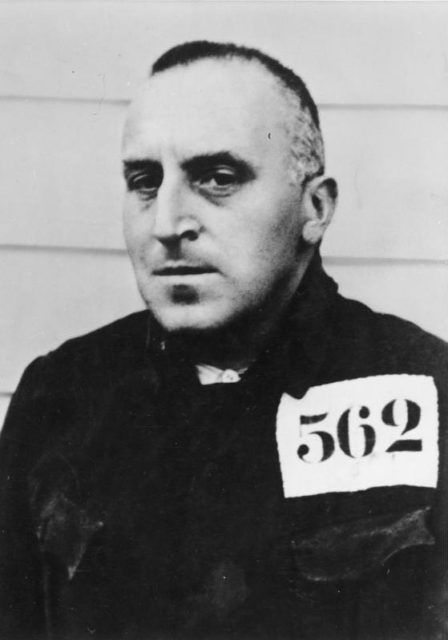
    Carl von Ossietzky seen in a concentration camp following the leak of the German re-armament.
    Carl von Ossietzky, seen in a concentration camp following the leak about the German re-armament. By Bundesarchiv – CC BY-SA 3.0 de
    Ossietzky was given the award for the 1935 Nobel Peace Prize in 1936. But he didn’t actually expose the German re-armament in 1935. It was 1931 that he exposed the re-armament. In turn, Germany charged him with high treason and espionage that same year. Ossietzky would spend several years in concentration camps and police custody until he contracted tuberculosis, dying in hospital in 1938. Ossietzky’s award caused some major disruption in the group that chooses who wins the prize, as the council didn’t believe a convicted criminal should be allowed to win the prize. This resulted in several officials stepping down.
    The Germans were unsurprisingly upset about the award, and Adolf Hitler banned anyone from Germany being allowed to receive the vote. He also banned the German media from even mentioning the award.
    Hitler Gets Nominated – Kind of
    Though Hitler banned anyone from Germany receiving the award, he might have made an exception for one person – himself. In 1939, Adolf Hitler was nominated for the Nobel Peace Prize – kind of. It was actually a joke. Erik Gottfried Christian Brandt, a member of the Swedish Parliament, nominated Adolf Hitler for the award right before World War II would begin. Brandt wrote a letter to the Norwegian Nobel Committee that opened with:
    “To the Norwegian Nobel Committee
    I hereby humbly suggest that the Peace Prize for 1939 is awarded the German Chancellor and Führer Adolf Hitler, a man, who in the opinion of millions of people, is a man who more than anyone in the world has deserved this highly prestigious reward.”
    Brandt was an anti-fascist and saw the nomination as a joke. Thus, he quickly took back his nomination for Hitler to win the award. He would go on to say that it was more of a critique of another nomination in that same year, British Prime Minister Neville Chamberlain.


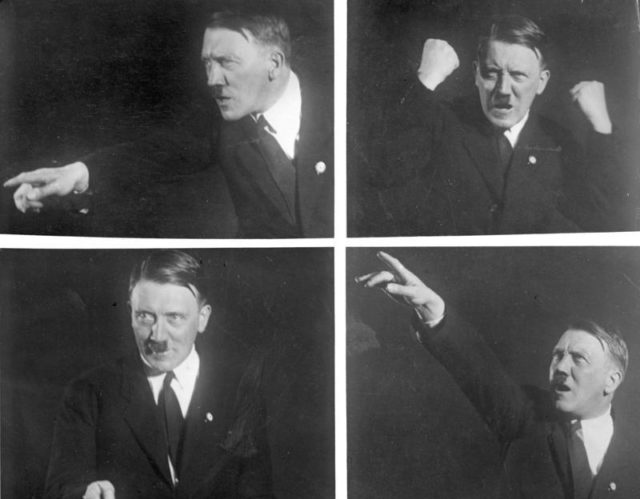
    Adolf Hitler during a 1930 camera shoot.
    Adolf Hitler during a 1930 camera shoot. By Bundesarchiv – CC BY-SA 3.0 de
    No, Adolf Hitler didn’t go on to win the nomination. In fact, as previously stated, no one did. From 1939-1943, there would be no winners of the Nobel Peace Prize.
    Backlash
    Even though the nomination was quickly taken back, it still churned out plenty of backlash. Brandt would go on to be labeled as many things, such as insane and a traitor. He was taken aback, and released the response in which he stated it all was meant to be an ironic joke.
    The Nobel Peace Prize has always been full of controversy. Since its inception, each award has been criticized due to the nature of how it’s awarded. Adolf Hitler’s nomination may have been a joke, but it makes you wonder, what would have happened if he had actually been nominated. What if he had won? It would have been truly ironic, with World War II starting, that, arguably, the main cause of the war, had won a Peace prize.

    Tuesday, April 3, 2018

    More Goings at Casa De Garabaldi

    We were heading out of town for a few days down in Florida, but we made a stopover on the way for a wedding,   My Good Friend Mack who is known to a bunch of bloggers as a regular commentator on mine and a bunch of other blogs got hitched.  For a long time we though this mysterious women was a figment of his and our imagination.   But I met her a couple of years ago and she is a class act and compliments Mack , they are made for each other, but we went to the wedding and it was a heck of a shindig, it was held at a gun range...Go Figure...Only Mack would be off the wall enough to do that.

       They both are a class act and to use an Old Southernism "they are good people"  I am sure that Mack will drag Jackie off to a museum or a military history site on their honeymoon.

         We headed down Saturday evening and got here late and went to early services on the beach...Wow Church on a beach...on Easter no less.
    While hanging around here, we went to a museum on Eglin AFB, it was the "Armaments" museum and it is pretty good.    Eglin is known as the home of MOAB or "Mother of All Bombs"

    The Air Force Armament Museum, adjacent to Eglin Air Force Base, Florida, is the only facility in the U.S. dedicated to the display of Air Force armament. Founded in 1975, it was originally located in a converted gymnasium on the northeastern edge of the Eglin main base, adjacent to Valparaiso, Florida.
    Visitors can view a variety of historical Air Force planes, from a World War II B-17 bomber to an F-4 Phantom II jet. A wide variety of bombs, missiles, and rockets are exhibited, including the newest air-to-air missile, the AMRAAM, and the GBU-28 bunker-buster developed for use during Operation Desert Storm. Other missiles include the Paveway series, Falcons, the Tomahawk, Mace, Hound Dog, radar-controlled, laser-controlled and several guided by a TV camera in the nose. Also on display is the GBU-43 MOAB, Massive Ordnance Air Blast bomb, or by its nickname, "Mother of All Bombs", the world's largest conventional explosive weapon. A predecessor, the T12 38,600 lb. demolition bomb, is displayed outside, while a Fat Man casing is indoors.
    A gun vault displays a variety of weapons ranging from a 1903 Springfield rifle to the GAU-8, which is capable of shooting 6,000 rounds per minute. Featured here is the Sikes Antique Pistol Collection, with over 180 handguns, including flintlocks, duelling pistols, Western six-shooters, Civil War pistols, and a wide variety of early military weaponry.

    B25A Configured in "Doolittle Raider" configuration down to the "fake" guns they installed to scare off any Japanese Fighters

    B17G model
    Everyones favorite DumpTruck for bombs..
    The B52, this one is a "G" model.  There a still versions of the B52 in
    service and forecast to continue until 2050, that is a 100 year run for an airplane, nothing comes close.
    F104 Starfighter
    The MOAB, My son being his usual thrilled self because I wanted to use him as a a scale of measurement.  

    P80 Shooting Star


    This is the layout of the Museum, it is well worth the trip and the Museum is "Free".  I also picked up a book about the "Son-Tay POW night raid" and the book is signed by the Author.


    The Museum is worth the visit, I wanted to visit the Naval Aviation Museum at Pensacola but time was not my friend.  Oh well, next time since my brother lives in this area.


    Monday, April 2, 2018

    Monday Music "Gypsies, Tramp and Thieves" by Cher


    I mentioned last week while I did a writeup for Cher on her song "If I could hold back time" and I had mentioned about her earlier song called "Gypsies, Tramp and Thieves", that song was on my Dad's reel to reel recorder that he listened to on a regular basis so I heard the song all the time and it was imprinted on me at my young age I guess.  I have done the same thing with my son and my 80's music :)  I do hear this song on my Sirius/XM when I switch to the 70's channel for a bit of a break on on the 80's channel.  It don't last long, I will roll back to the music of "my" decade


    "Gypsys, Tramps & Thieves" was the first single from Cher's 1971 eponymous album Cher with instrumental backing by L.A session musicians from the Wrecking Crew. The album was subsequently renamed and re-released as Gypsys, Tramps & Thieves after the success of the single. The song was written by songwriter Bob Stone as a story-song called "Gypsys, Tramps and White Trash". Producer Snuff Garrett advised that the title be changed and Stone then changed it to "Gypsys, Tramps & Thieves". The album of the same name got very positive reviews.
    Released four years after her last top ten hit "You Better Sit Down Kids", this song was a comeback single for Cher—it was her first single in four years to chart higher than #84—not only returning her to the top ten of the charts but also giving her two weeks at #1 on the Billboard Hot 100 in November 1971. It knocked off "Maggie May" by Rod Stewart which had spent the previous month at number one. The single also reached #1 in Canada and #4 in the United Kingdom. It became Cher's best-selling single at that point, selling more than 3 million copies worldwide. As of November 2011, Billboard reported the digital sales of "Gypsys, Tramps & Thieves" to be 212,000 in the US.[4]
    The song describes the life of a girl, the narrator of the song, who was "born in the wagon of a traveling show". Her mother "used to dance for the money they'd throw", while her father would do "whatever he could; preach a little gospel, sell a couple bottles of Doctor Good". Although the people of the town insulted them with such terms suggested in the title of the song, the men paid them well "every night" for their services.
    When a young man is picked up in Mobile, the narrator is 16, while he is 21. Her family took care of him for a while and allowed him to travel with them to Memphis, although her father "would have shot him if he knew what he'd done", implying that he had sex with the narrator. Three months later, the narrator describes herself as a "gal in trouble", and her young man has disappeared.
    Echoing the beginning of the song, the narrator's own daughter was "born in the wagon of a traveling show", while the narrator now dances "for the money they throw" and "Grandpa" — the narrator's own father — supported them in just the same way as before.
    The title of this song has also been shown with the alternative spelling "Gypsies", this being a correct spelling of this word.


    The album was originally released in 1971. In 1992 it was released on CD for the first time. In August 1999, the US version of the album was re-issued on Universal Records and in the UK in 1993 the original album and Cher's next studio album Foxy Lady were re-issued together on one CD called Cher/Foxy Lady, which features all of the tracks from both albums.
    "Gypsys, Tramps & Thieves", the album's first single release, reached number one in the Billboard Hot 100 and number four on the UK Singles Chart. "Gypsys, Tramps & Thieves" was her first number one in US as a solo artist on both Billboard Hot 100 chart and the Adult Contemporary chart, it also reached number one in Canada and in Japan. The song was performed live on The Sonny & Cher Comedy Hour, featuring Cher dressed as a gypsy wearing a huge wig singing in front of a wagon. The second and last single was the opening track "The Way of Love". It peaked at #7 in US, #2 in the Adult Contemporary chart and #5 in Canada. The song's melody sounds very similar to the melody of the 1970 hit "It's Impossible" by Perry Como. Both tracks were performed on numerous Cher's tours

    Sunday, April 1, 2018

    Happy Easter

    Happy Easter to my Friends and Readers...Remember the Reason for the Holiday..
     Spend time with your friends and Families, time is finite and enjoy the blessings of the Lord while you have them.

    Interesting having Easter on Aprils Fool day, the warped humor part of my personality keeps on seeing the possibilities.

    And of course Peeps are here...