Webster

The Constitution was made to guard the people against the dangers of good intentions." --American Statesman Daniel Webster (1782-1852)


Tuesday, May 8, 2018

The last voyage of the South Vietnamese Navy

I remembered reading about this back in the 1980's, I was studying the Vietnam war extensively since it was the most recent war we had been in and I know the effect that war had on my Dad and how it effected our family and how the war affected America and it took Desert Storm to get past the "Vietnam Syndrome".    I had recalled reading in one of the SOF magazines about the voyage to the Philippines to escape the fall of South Vietnam.  I still believe that we won the battles but lost the war at home due to the anti-war movement, the rules of engagements our troops had to deal with the artificial restrictions from the politicians and the yes men that inhabited the puzzle palace.  I have blogged extensively about the Vietnam war and I guess I am adding to the count.


The USS Kirk carried out one of the most significant humanitarian missions in U.S. military history. Yet the story went untold for 35 years. Correspondent Joseph Shapiro and producer Sandra Bartlett of NPR's Investigative Unit interviewed more than 20 American and Vietnamese eyewitnesses and participants in the events of late April and early May 1975. They studied hundreds of documents, photographs and other records, many never made public before — including cassette tapes recorded at the time by the ship's chief engineer.
Shapiro first learned of the Kirk from Jan Herman, historian of the U.S. Navy Medical Department, who says the Kirk's heroics got lost because, as the Vietnam War ended, Americans were bitterly divided over the war's course and cost. There was little interest in celebrating a mission that saved the lives of 20,000 to 30,000 refugees. Herman is working on a book documenting the story and a film documentary, which was shown when the Kirk crew met for a reunion in Springfield, Va., in July.

On April 30, 1975, North Vietnamese troops entered the deserted streets of Saigon. Tanks crashed through the gates of the presidential palace and soldiers hoisted the yellow and red flag of the Viet Cong.
Just hours before, the last Americans had been evacuated, rescued and flown on Marine helicopters to U.S. Navy aircraft carriers waiting off the coast.
The Vietnam War was officially over. Now those Navy ships were steaming away from Vietnam.
There was one exception. That night, the captain of a small destroyer escort, the USS Kirk, got a mysterious order to head back to Vietnam.

Paul Jacobs, the captain, received the directive from Adm. Donald Whitmire, commander of the evacuation mission — Operation Frequent Wind. He was aboard the USS Blue Ridge, the lead ship of the Navy's 7th Fleet.
The Kirk reached Con Son Island, off the southern coast of Vietnam, on May 1, 1975. There, it was met by 30 South Vietnamese navy ships and dozens of fishing boats and cargo ships — and as many as 30,000 Vietnamese refugees. Hugh Doyle
Jacobs recalls Whitmire's surprise message: "He says, 'We're going to have to send you back to rescue the Vietnamese navy. We forgot 'em. And if we don't get them or any part of them, they're all probably going to be killed.'"
The Kirk was being sent to an island off the Vietnamese mainland — by itself. And there was one more odd thing, the admiral told Jacobs: He'd be taking orders from a civilian.
Richard Armitage came aboard the Kirk late at night, wearing a borrowed sport coat. Years later, Armitage would become second in command to Colin Powell in the Bush administration's State Department. But on that last day of April 1975, he was on a special assignment from the secretary of defense. He'd just turned 30 that week.
Armitage recalls coming aboard the ship and quickly being escorted to the officer's mess where he met with Jacobs and Commodore Donald Roane, commander of the flotilla of Navy destroyers.
"Commodore Roane said something like, 'Young man, I'm not used to having strange civilians come aboard my ship in the middle of the night and give me orders,' " Armitage recalls. "I said, 'I am equally unaccustomed, sir, to coming aboard strange ships in the middle of the night and giving you orders. But steam to Con Son.' And so they did."

The Kirk and its crew of about 260 officers and men were ordered to Con Son Island, about 50 miles off the coast of South Vietnam and not yet occupied by the North Vietnamese. Con Son was the site of a notorious prison. Now, its harbors were the hiding place for the remnants of the South Vietnamese navy.
Armitage had come up with the plan for them to gather there.
Armitage, a graduate of Annapolis, had been a Navy intelligence officer, assigned to Vietnamese units. He gained respect for the South Vietnamese as he worked alongside them and became fluent in the language. Then he resigned his commission and left the Navy in protest when the Nixon administration signed the Paris peace accords. That 1973 agreement between all warring parties in Vietnam ended direct U.S. military involvement in the war. Armitage felt the U.S. had sold out the South Vietnamese.
But as it became clear that the South Vietnam government was about to fall, a Pentagon official asked Armitage to fly back to Vietnam with a dangerous mission. His assignment: to remove or destroy naval vessels and technology so they wouldn't fall into the hands of the Communists.
In 1975, Richard Armitage was a 30-year-old civilian charged with a dangerous mission: to remove or destroy South Vietnamese naval vessels and technology so they wouldn't fall into the hands of the Communists. Later, Armitage would serve as deputy secretary of state from 2001 to 2005, under Secretary of State Colin Powell in the administration of George W. Bush.  Courtesy Richard Armitage
A few weeks before Saigon fell, Armitage had shown up at the office of an old friend, Capt. Kiem Do, deputy chief of staff for the South Vietnamese navy. Together, they came up with the secret plan to rescue the Vietnamese ships when — as was becoming clear would happen — the South Vietnamese government surrendered.
Do remembers warning Armitage that they'd be saving more than ships.
"I told him, I said, 'Well, our crew would not leave Saigon without their family, so therefore there will be a lot of people,' " Do recalls.
He says Armitage remained silent. "He didn't say yes; didn't say no. So I just take it as an acknowledgement," Do says.
Armitage didn't tell his bosses at the Pentagon there would be refugees on those ships. He feared the American authorities wouldn't want them.
Neither Do nor Armitage, though, could predict how many refugees would turn up in Con Son.

The Kirk steamed through the night to Con Son and reached the island just as the sun came up on May 1. There were 30 South Vietnamese navy ships, and dozens of fishing boats and cargo ships. All of them were packed with refugees, desperate to get out of Vietnam.
A boat brings Vietnamese refugees to the Kirk near Con Son Island. The U.S. ship undertook one of the greatest humanitarian missions in the history of the U.S. military.  Hugh Doyle
The ships "were crammed full of people," says Kent Chipman, who in 1975 was a 21-year-old machinist's mate in the ship's engine room and today works at a water purification plant in Texas. "I couldn't see below deck, but above deck the people were just as tight as you could get, side by side."
There was no exact count of how many people were on those ships. Some historical records say there were 20,000 people. Other records suggest it was as many as 30,000. Jan Herman, a historian with the U.S. Navy Medical Department, who is documenting the story of the Kirk, uses the higher number.
"They were rusty, ugly, beat up," says Chipman. "Some of them wouldn't even get under way; they were towing each other. And some of them were actually taking on water and we took our guys over and got the ones under way that would run."
One cargo ship was so heavy it was sinking. People below deck were bailing out the water with their shoes.
Stephen Burwinkel, the Kirk's medic — in the Navy known as a hospital corpsman — boarded that ship to check on the sick and injured. He saw a Vietnamese army lieutenant helping passengers leave the sinking ship, crossing to another ship, over a narrow wooden plank. As people pushed to get off the sinking ship, one man knocked a woman who stopped in front of him. She fell off the plank and into the ocean.
The woman was quickly rescued. But Burwinkel worried that the others on the ship would panic. He says the lieutenant acted quickly.
"This Vietnamese lieutenant did not hesitate, he went right up the back of that guy, took his gun out and shot him in the head, killed him, kicked him over the side. Stopped all the trouble right then and there," Burwinkel recalls. The shooting was shocking, he says, but it very likely prevented a riot.

After fixing what could be fixed on the seaworthy vessels and transferring people from the ships that would be left behind, the Kirk led the flotilla of naval ships, fishing boats and cargo ships toward the Philippines.
The USS Cook, another destroyer escort, like the Kirk, helped out as the ships were leaving Con Son. The Cook's crew provided rice, and its corpsman helped Burwinkel and his assistant from the Kirk attend to the sick and injured, too.
As the flotilla headed out to sea, on the way to the Philippines, other Navy ships came in and out of the escort, according to Herman. Among those other ships were the USS Mobile, USS Tuscaloosa, USS Barbour County, USS Deliver and USS Abnaki.
But it's clear from the daily logs from the Kirk and the other ships that the crew of the Kirk took the lead.
"For me, the Kirk was ideal," says Armitage, who moved from the Kirk to the Vietnamese navy's flagship. "It could communicate with the rest of the U.S. fleet. They would go with us across to the Philippines and would be able to rescue any of the folks who might be in harm's way. Some had been wounded. Some were pregnant. All were sick after a while. And we needed a way to take care of those folks."
The Kirk's sailors kept busy providing food, water and medicine to people on the South Vietnamese ships.
The South Vietnamese fleet follows the USS Kirk to Subic Bay in the Philippines. The Kirk's final mission at the end of the Vietnam War was to bring the remnants of the South's navy to safety in the Philippines.  Hugh Doyle
Burwinkel spent his time moving from ship to ship treating the sick and injured. With thousands of people — many of them babies and children — he had to work almost nonstop.
"When they gave me the meritorious service medal over all this, I quite frankly referred to it as my 'no-sleep' medal," says Burwinkel, who made a career in the Navy and is now retired and living in Pensacola, Fla. "I would go out there and do my thing and at dark we would come back to the Kirk and try to get a little bit to eat and make some rounds — gather my wits about me, resupply myself and get ready for the next day."
Last Sovereign Territory Of The Republic Of Vietnam'
Of the some 30,000 refugees on vessels escorted by the Kirk over six days, only three died.
But as the flotilla approached the Philippines, the Kirk's captain got some bad news. The presence of South Vietnamese vessels in a Philippine port would present the government in Manila with a diplomatic predicament.
The Philippine government wasn't going to allow us in, period, because these ships belonged to the North Vietnamese now and they didn't want to offend the new country," Jacobs, the captain, recalls.
The government of Philippine President Ferdinand Marcos was one of the first to recognize the Communist rulers now in control of a single Vietnam, and Jacobs was told the ships should go back.
Armitage and his South Vietnamese friend, Capt. Do, came up with a solution that Marcos had to accept.
Do recalls the plan: "We will raise the American flag and lower the Vietnamese flag as a sign of transfer [of] the ship back to the United States, because during the war those ships are given to the Vietnamese government as a loan, if you want, from the United States, to fight the Communists. Now the war is over, we turn them back to the United States."
There was a frantic search to find 30 American flags. Two officers from the Kirk were sent aboard each Vietnamese ship to take command after a formal flag ceremony.
Rick Sautter was one of the Kirk officers who took command of a Vietnamese ship.
"That was the last vestige of South Vietnam. And when those flags came down and the American flags went up, that was it. Because a Navy ship is sovereign territory and so that was the last sovereign territory of the Republic of Vietnam," he says.
"Thousands and thousands of people on the boats start to sing the [South Vietnamese] national anthem. When they lower the flag, they cry, cry, cry," Do remembers.

On May 7, the ships flying American flags were allowed into Subic Bay.
For the refugees, it was just the beginning of their long journey, which took them to Guam and then resettlement in the United States.
For the sailors of the Kirk, ending the Vietnam War by rescuing 20,000 to 30,000 people was very satisfying.
"This was the high point of my career and I'm very proud of what we did, what we accomplished, how we did it," Jacobs says. "I felt like we handled it truly professionally and that was kind of a dark time."

Armitage says he "envied" the officers and men of the USS Kirk. The ship had not seen combat on its tour to Vietnam. But it ended with the rescue of tens of thousands of refugees, one of the greatest humanitarian missions in the history of the U.S. military.
Says Armitage: "They weren't burdened with the former misadventure of Vietnam."
This article originally appeared on NPR.org, September 1, 2010 by Joseph Shapiro & Sandra Bartlett.  Here's the original link to this story:

Monday, May 7, 2018

  I just returned from NRAAM, I will make a post about my experience in a day or 3, 
   
    I remembered this song hitting the chart in the early 1980's and I thought it was a pretty neat song, it didn't go as high as I thought it would.  I still liked it though, it is on my regular rotation of songs on my MP3 player on my phone or on the player in my motorcycle.

"Ah! Leah!" is a song by American rock musician Donnie Iris from his 1980 album Back on the Streets. The song was released as a single in late 1980 and reached number 29 on the US Billboard Hot 100, 22 on the Cash Box Top 100, and 19 on the US Billboard Top Tracks chart. The song is widely considered to be Iris' signature song[1] and was most popular in Canada, where it became a Top 10 hit.[2]
A full complement of eight musicians appeared in the early live performances of the song, including lead singer Iris, a drummer, three guitar players, one keyboardist and at least two backing vocalists, one female and one male.
The title of the song has been referenced in the form of puns on a few of Iris's later albums—the 2009 live album Ah! Live!and the 2010 Christmas album Ah! Leluiah!.


Saturday, May 5, 2018

Why Vietnam vets hate Hanoi Jane Fonda..

 I will be at NRAAM, so this will be on the scheduler thingie. 

 I was young and was watching TV in the mid to late 70's and Jane Fonda came on the TV and my dad happen to walk by  in the living room and I heard the words "Traitorous fucking Bitch " as my dad continued to the bedroom.  I was very young but smart enough not to ask my dad what all that was about.     My Dad did 2 tours in Vietnam and lost friends over there and he was really bitter about how things turned out after the "Peace with Honor". I finally asked my Dad in the early 80's right after Jane Fonda "workout Craze", when I heard him muttering something really ugly ..something about burning in hell with the devil's pitchfork jammed up her.......Well you get the picture.  I asked him and he took a deep breath and explained what the deal was.  He knew that I knew a lot of history so I knew a lot of background and would grasp the particulars of what he said.  Since then, I and many people my age have said the same thing, talk about generational hate.   I saw this article on this Site


Jane Fonda’s Broadcasts on Radio Hanoi
Co-authors: Dr. Roger Canfield, R.J. Del Vecchio
From July 8 – 22, 1972, the American actress Jane Fonda visited North Vietnam at the invitation of the “Vietnamese Committee of Solidarity with the American People.” During this period, she recorded at least 19 propaganda interviews that were broadcast by Radio Hanoi. Twelve of the speeches focused on American servicemen as their primary target. Fonda’s key themes included: demands to halt U.S. bombing of North Vietnam, allegations that the Nixon Administration was “lying” about the war, endorsements of the Viet Cong “7 Point Peace Plan,” claims that the U.S. military was violating international law and committing “genocide” in Vietnam, and statements of confidence in North Vietnam’s continued resistance and ultimate victory over America.
Listed below are all available transcripts of Jane Fonda’s Hanoi broadcasts, as recorded by the CIA’s Foreign Broadcast Information Service (FBIS). Slightly redacted versions of several broadcasts also appear in the Congressional Record for Sept. 19-25, 1972, “Hearings Regarding H.R. 16742: Restraints on Travel to Hostile Areas.” The transcripts are listed by the dates on which they were originally broadcast by Radio Hanoi.
July 10, 1972: Fonda to American POWs
“Brave heroes of the war would come back from Indochina and I was told that it is we who committed crimes, it is we who burned villages and massacred civilian people and raped the Vietnamese women. It is we who did it and we are sorry, and we want the American people to know what is being done in their names.”
July 13, 1972: Jane Fonda condemns U.S. bombings
“They seemed to be asking themselves what kind of people can Americans be who would drop these kinds of bombs so callously on their innocent heads, destroying their villages and endangering the lives of these millions of people.”
July 17, 1972: Fonda to American pilots and airmen
“I don’t know what your officers tell you, you are loading, those of you who load the bombs on the planes. But, one thing that you should know is that these weapons are illegal and that’s not, that’s not just rhetoric. They were outlawed, these kind of weapons, by several conventions of which the United States was a signatory — two Hague conventions. And the use of these bombs or the condoning the use of these bombs makes one a war criminal.”
“The men who are ordering you to use these weapons are war criminals according to international law, and in, in the past, in Germany and in Japan, men who were guilty of these kind of crimes were tried and executed.”
July 19, 1972: Fonda on visit to Nam Dihn
“I went to the dike, the dike system of the city of Nam Dinh. Just this morning at 4 o’clock, it was bombed again, and I was told that an hour after we left the city, planes came back and rebombed Nam Dinh. The dike in many places has been cut in half and there are huge fissures running across the top of it.”
July 20, 1972: Fonda on Geneva Accords anniversary
“There is an invasion taking place. It’s taking place from the 7th Fleet, from the aircraft carriers, from Thailand, from Guam, but essentially from the Pentagon and from the White House.”
“You men, it is not your fault. It is in fact tragic to think how you are being so cynically used because the time is coming very soon, it is already half-way there, when people are admitting openly that this is one of the most horrible crimes ever committed by one nation against another.”
July 20, 1972: Fonda press conference
“I’'ve met with students, with peasants, with workers and with American pilots – who are in extremely good health, I might add and will I hope be soon returned to the United States, and when they are returned, I think and they think that they will go back better citizens than when they left.”
July 20, 1972: Fonda press conference Q & A
“I would like to accuse Richard Nixon of betraying everything that is human and just in the world today. I would like to accuse him as being a new Hitler.”
“I will be working with all of those other people, ah, to that end -– to end the war according to the demands made in the Seven-Point Peace proposal of the Provisional Revolutionary Government.”
July 21, 1972: Fonda to American pilots
“The people back home are crying for you. We are afraid of what, what must be happening to you as human beings. For it isn’t possible to destroy, to receive salary for pushing buttons and pulling levers that are dropping illegal bombs on innocent people, without having that damage your own souls.”
“I know that if you saw and if you knew the Vietnamese under peaceful conditions, you would hate the men who are sending you on bombing missions.”
July 22, 1972: Fonda to U.S. pilots and airmen
“Should you then allow these same people and same liars to define for you who your enemy is? Shouldn’t we then, shouldn’t we all examine the reasons that have been given to us to justify the murder that you are being paid to commit?”
“If they told you the truth, you wouldn’t fight, you wouldn’t kill. You were not born and brought up by your mothers to be killers. So you have been -– you have been told lies so that it would be possible for you to kill.”
July 22, 1972: Fonda to U.S. pilots and airmen
“And I think, I –- I think that -– well, the other day, for example, someone told me that one of the pilots that was recent -– recently shot down, uh, near Hanoi, as he was, uh, driven across the river, uh, uh, he was, he was, uh, being being rescued by, uh, the people and he was shown a bridge and the people said, uh, that bridge was, uh, bombed, uh, recently. And he said: Well, my parents are rich. Uh, we can buy you a new bridge, we can afford to build you a new bridge after the war. And the people said to him in Vietnamese and it was then translated by the interpreter, they said, but can your parents replace our, our children, our mothers, our wives who have been killed by your bombs? And the soldier hung his head and he said: I didn’t think of that.”
July 25, 1972: Fonda to U.S. pilots and airmen
“Every time you drop your bombs on the heads of these peasants it becomes clearer to them — to them who the enemy is. How could they possibly by asking for help from a country which is destroying their land, their crops, killing their people, mutilating their babies? How can we continue to rain this kind of terror on these people who want nothing more than to live in peace and freedom and independence?”
July 26, 1972: Fonda to South Vietnamese students
“We have understood that we have a common enemy -– U.S. imperialism. We have understood that we have a common struggle and that your victory will be the victory of the American people and all peace-loving people around the world.”
“Recently in the United States we’ve been doing a lot of political propaganda work among the students and the soldiers with your Vietnamese comrades.”
July 28, 1972: Fonda to U.S. servicemen on bombing dikes
“There is only on way to stop Richard Nixon from committing mass genocide in the Democratic Republic of Vietnam, and that is for a mass protest all around the world of all peace-loving people to expose his crimes, to prevent him from fooling the people of the world into thinking that if there are floods this year it would be a natural disaster.”
July 29, 1972: Fonda to South Vietnamese soldiers
“Many people in the United States deplore what is being done to you. We understand that Nixon’s aggression against Vietnam is a racist aggression, that the American war in Vietnam is a racist war, a white man’s war…”
“We deplore that you are being used as cannon fodder for U.S. imperialism. We’ve seen photographs of American bombs and antipersonnel weapons being dropped, wantonly, accidentally perhaps, on your heads, on the heads of your comrades.”
July 30, 1972: Fonda to American servicemen in South Vietnam
“They believed in the army, but when they were here, when they discovered that their officers were incompetent, usually drunk, when they discovered that the Vietnamese people had a fight that they believed in, that the Vietnamese people were fighting for much the same reason that we fought in the beginning of our own country, they began to ask themselves questions.”
“I heard horrifying stories about the treatment of women in the U.S. military. So many women said to me that one of the first things that happens to them when they enter the service is that they are taken to see the company psychiatrist and they are given a little lecture which is made very clear to them that they are there to service the men.”
August 7, 1972: Fonda on Quang Tri and Patrick Henry
“So that now, when the People’s Liberation Armed Forces arrived in Quang Tri and joined together with the peasants to liberate the province of Quang Tri, the people have risen up, in the words of a journalist who just came from -– from Quang Tri -– like birds who have been freed from their cages.”
“We should be able to understand this very well as Americans. One of our revolutionary slogans, called out by Patrick Henry, was ‘Give Me Liberty or Give Me Death.’ And this is not so different than Ho Chi Minh’s slogan ‘Nothing is more precious than freedom and independence.'”
August 9, 1972: Fonda on “Democracy”
“Like tens of thousands of other Americans, I’m extremely concerned these days about the betrayal of everything that my country stands for –- about the betrayal of our flag, about the betrayal of the very precepts upon which our country was founded: equality for all people, liberty, and freedom.”
“Richard Nixon, history will one day report you as the new Hitler… It is no wonder that you are so cynically manipulating the American public into believing that you are striving for peace, when you are in fact committing the most heinous crimes against the innocent civilians of Vietnam.”
August 15, 1972: Fonda on meeting with American POWs
“I had the opportunity of meeting seven U.S. pilots. Some of them were shot down as long ago as 1968 and some of them had been shot down very recently. They are all in good health. We had a very long talk, a very open and casual talk. We exchanged ideas freely. They asked me to bring back to the American people their sense of disgust of the war and their shame for what they have been asked to do.”
“They asked me to bring messages back home to their loved ones and friends, telling them to please be as actively involved in the peace movement as possible, to renew their efforts to end the war.”
Jane Fonda will forever be a traitor to many of us who served our country. Some say we should forgive and forget, that Fonda has apologized for her behavior.
Here is a statement from a fellow vet:
For what it is worth, Ms. Fonda has never spoken the kind of direct apology for her activities during the war, the statement that she made a huge mistake in allowing her picture to be taken at the AA gun is not exactly what most vets would accept as a heartfelt apology. She has always been consistent in belief that she was doing the right thing in all she did there. Below are transcripts of the things she broadcast to US servicemen from Hanoi. They qualify in the minds of most of us as treason.
Keep in mind that when the POWs returned and spoke of their being tortured, she made these comments very publicly.
Jane Fonda said, POWs “implied they were forced into seeing [antiwar visitors]…that’s laughable. They are hypocrites and liars ….” At UCLA, “We have no reason to believe [they]…tell the truth. They are professional killers.” She wrote the Los Angeles Times, “It is a lie, an orchestrated lie… that the… policy… was torture.”
“Jane Fonda Claims POWs Not Tortured,” Pasadena Star News, April 1, 1973; Also: San Francisco Chronicle, April 1, 1973, 4.
So, it’s very difficult for those of us who know this, and in my case, know POWs and heard in person their accounts of torture, to just write it off as in the past and not worth thinking about anymore.
Jane does not deserve, and has not earned, our forgiveness.
This article was originally posted on the blog for Vietnam Veterans for Factual History. Here is a direct link to their website: https://www.vvfh.org/
Now that you've read the transcripts of her broadcasts, do you have a better understanding of our why Vietnam Vets hate her?

Friday, May 4, 2018

Fisking another 2nd amendment article.


I saw this article on "Politico" about a "Self Professed" gun nut and his idea for the 2nd amendment. and how to get the anti-gunners to climb on board.

     I read it and decided to "fisk" it, I have a lot of issues with this article from someone that "purports" to be on my side.   My Comments will be in "BOLD"

I am a gun industry insider, a lifelong gun owner and a vocal advocate for Second Amendment rights. I am a Texan and an American patriot who hauls my family to church every Sunday in a diesel pickup truck, where I sit in the pew and listen to the Word with a 9mm pistol tucked inside the waistband of my fanciest jeans.
Isn't this the part where the author inserts the inevitable “but”—as in, “I’m a firm Second Amendment advocate, but … ”? Well I’ve got no “buts” for you, because I don't need them. I believe there is a way to increase both our individual gun rights and our collective safety, if we can only get gun controllers to quit bitterly clinging to outmoded feature bans and gun registries, and convince gun rights advocates that “liberty” isn’t just about “what's in my gun safe” but also about being able to exercise one’s full spectrum of Second Amendment rights in every part of this great nation.
The idea is simple but powerful: a federally issued license for simple possession of all semi-automatic firearms. This license would allow us WHO IS US? to carefully vet civilian access to semi-automatic weapons, while overriding state-specific weapon bans and eliminating some of the federal paperwork that ties specific firearms to specific owners.
I offer this idea not only because I actually want to live in a world where it, or something like it, is the law of the land, but also because I and my fellow gun nuts are worried that a storm is coming that will sweep away a substantial portion of our gun rights Thanks to spineless politicians without really making the country safer in return. We're not even five months into a midterm election year, and 2018 has seen a string of high-profile incidents that have darkened the public’s view of civilian gun ownership: February’s massacre at Marjory Stoneman Douglas High School in Parkland, Florida, Caused by a guy that escaped government oversight repeatedly because of the Obama era program that said that school policies targeted student of color and the guy being Hispanic was given a pass, followed by this month’s shootings at YouTube headquarters in San Bruno, California, and at a Waffle House in Nashville, Tennessee. Caused by a guy that legally couldn't own firearms but did anyway, but lets blame honest law abiding gun owners and the NRA In the aftermath of these killings, we’re hearing proposals for anti-gun measures that we thought were widely considered out of bounds in the gun control debate, like a ban on all semi-automatic firearms, a repeal of the Second Amendment, or even an outright ban on the private ownership of guns. The same people have been trying to eliminate the 2nd amendment since the assault weapons ban of 1994, Remember Senator Feinstein stating "If I had the votes, I would have told Mr and Mrs America turn them in.   Some of us think this will all blow over, as it always does. And maybe it will. But this time definitely feels different.  No it don't unless you feel the draft on your lack of spine.

Our side faces a potent new enemy in the form of private-sector companies like REI, Delta Airlines, Citibank, YouTube and Reddit, which are taking an increasingly anti-gun stance. Due to the SJW's piling on them on social media and the companies fearing bad publicity caved ignoring that they are pissing off half of their customer base. My fellow gun owners and I are now concerned not just with the potential erosion of our gun rights at the hands of our government, but also with the erosion of our ability to communicate and to educate about this topic in the online spaces that make up so much of modern civic life. Due to the pressure from the leftist that run the social media platforms...Remember Twitter and Facebook going after conservatives, how can there be a dialogue when opposing views are suppressed.
There is fear, despair and anger on both sides, and neither side wants to give an inch. No Kidding Remember the Cake by Lawdog?

 We seem doomed to fight endlessly over the same handful of half-measures that neither side is happy with. Of Course not, they won't be happy until there is total disarmament A new approach—a federal gun license for semi-automatic weapons like the AR-15s used in the Parkland shooting and at the Nashville Waffle House—has the potential to make us all safer while offering a net increase in liberty for the country’s law-abiding gun owners. Right a Federal License..what .gov can grant, .gov can strip...ask the Indians...
Before I outline what such a license would look like, it’s important to identify the structural barrier that even moderate and discriminating efforts at gun control have run up against in recent decades. And no, that barrier isn’t a certain three-letter gun rights organization, nor is it the collective grievances of some benighted group of deplorables. Rather, it is the two pillars on which most of our modern life now rests: the market, and the forward march of technological innovation. I am sure the votors lighting up the congresscritters is a factor...ask the democrats...it cost them congress in 1994. 

The newly reintroduced Assault Weapons Ban is emblematic of gun control proponents’ consistent failure to understand how gun technology and the gun market actually work in the 21st century. Gun bans that are based on outlawing certain firearm features (like the vertical foregrip or the adjustable stock) or limiting guns’ capabilities (for instance, by limiting the number of rounds of ammunition they can hold) are relics of a bygone era when you bought a gun and didn’t modify it without the help of a professional gunsmith.People that are pushing gun control are clueless and figure that since they are "our betters" they can do what they want and we dirt people will settle for this...
Nowadays, the most popular rifles, shotguns and handguns are explicitly designed as modular weapon platforms, where parts can be mixed and matched with a few simple tools and no specialized expertise. In fact, not only is the AR-15 just such a modular and easily hackable platform, but so is the Army's new standard-issue handgun, the SIG M17 (available to civilians as the P320).
For modern firearms, the “gun” from the perspective of federal law is typically an empty (and increasingly 3D-printable) metal frame or polymer shell with a serial number stamped into it, while all the rest of the parts that actually make the gun work are widely available online to anyone with a credit card.  The 2nd amendment is an idea...not a weapons platform

Calls to end the sale of these modular weapons platforms, and to return to the classic wood-stocked hunting rifles and revolvers of a bygone era, are nothing less than calls to roll back a few decades worth of market-driven technological innovation. It’s just not going to happen. Halfway attempts are doomed, too. Any attempt to grandfather in existing guns will necessarily leave the parts market intact (otherwise, how do you repair them?), and customers who want a “new” gun can buy a new, mostly preassembled parts collection, and then insert it into an existing frame or into a newly (and easily) fabricated one. Like I said, the 2nd amendment is an idea...not a weapons platform
What, then, can be done about the violence that plagues our cities and the mass shootings that terrorize us in our malls, theaters, churches and workplaces? Having honest people armed for starters, most all the shootings happen in "Gun Free Zones". I think there is an answer, but it involves forgetting about the “what” and focusing squarely on the “who.”
A federal license for all semi-automatic firearms would rest on two simple and well-defined concepts, one technical and one legal:  Again with the Federal license...What the Febbies can grant, the Febbies can revoke.
1) A “semi-automatic” firearm is one that fires a single round for each pull of the trigger, automatically reloading in between each shot until the ammo is depleted.
2) “Possession” is a legal concept from the drug war that implies that a person has a contraband item “on or about one’s person,” or has “control” over the item, perhaps by having it in a motor vehicle or in a home.
Because both of these things—“possession” and “semi-automatic weapons”—are easy to define, they're easy to regulate.  There you go again equating legal gun ownership and the 2nd amendment with the drug war. 
Combine these two concepts with a thorough but reasonable by my standards or some nameless bureaucrat that doesn't answer to the community. vetting process, and you have the makings of a straightforward, effective system for keeping the most lethal class of weapons out of the hands of bad actors, and with a stroke of the pin, honest law abiding citizens while simultaneously lifting the burden of arbitrary weapon bans and federal red tape Remember the Federal license?....More bureaucracy from law-abiding gun owners.
Under a licensing regime  Granted by the Federal governmentthat authorizes license holders for possession of semi-autos, it doesn’t matter whose semi-auto you’re holding, where you got it, how big the magazine is, or how terrifying it looks to the New York Times editorial board. It only matters that you’ve been vetted and are licensed to possess this category of weapon. Vetted by people that may have an interest in saying "no" because you don't fit the political profile they are looking for or you don't have the political connections.
License holders could swap such guns among themselves without the need for any sort of official transfer mechanism—like today’s Federal Firearm License transfers—that leaves a paper trail with the state. Right now, all retail gun purchases, and private-party gun transfers in many states, involve a two-step process: First, the purchaser fills out a paper form that links the gun to the buyer, and second, the seller conducts a federal background check. Together, these two components are referred to as an “FFL transfer.” By federal law, these paper records are not allowed to be digitized or made centrally available.  Centrally available for a reason....Gun confiscation start after such list...Ask the Germans after Hitler took power.
If you were a federal gun license holder, you wouldn’t have to do an FFL transfer whenever you take delivery of a firearm. This would make buying a gun of any type exactly like buying alcohol or any other controlled substance (for example, prescription drugs): flash your authorization, pay your money and walk out the door with whatever it is you bought, wrapped in a paper sack for privacy if you like.  Again making it sound good that you have a federal gun license...trying to hook you in.
If you weren’t a license holder, then simple possession of any semi-auto weapon would be a felony. Don’t have one on your person, or in your car or home. As for taking possession of the types of guns you could have without a license, then it’s universal background checks and FFL transfers for you—basically the status quo, in most states. Most states have a State firearm license permit with reciprocity with most states, part of our federalist system part of the pesky 10th amendment.
There are a lot of important details to be worked out, like the status of pump-action and lever-action guns,or scooping in the maximum firearms possible in the federal net....because why let a crisis go to waste or the specific requirements for getting a license and keeping it current, or due process requirements for restoring a revoked license. that will rely on the benevolence of the state to get your license restored and if you are on the wrong side politically or don't have political connections...well you can kiss it away permanently.   Gun control advocates might want any gun that can fire without reloading included in the licensing regime (pump- and lever-action guns), and gun rights advocates might want current federal restrictions on suppressors and short-barreled rifles dropped. These types of issues could surely be ironed out, as long as we can agree on the basic framework of trading all federal and state bans and registries for a national semi-auto licensing regime.  National licensing regime....first step toward confiscation. 

***
The framework I’m proposing is essentially a grand bargain: The gun control side gives up the possibility of a federal gun registry, specific states abandon their weapon bans and long gun registries, and in exchange the gun rights side accepts a brand new federal licensing scheme with real teeth.  The 2nd amendment kinda keeps this as a "natural right".
This bargain would be scary for both sides. Cities like New York and Chicago would have to allow licensed, law-abiding citizens to own AR-15s and high-capacity magazines within their borders,  The antigun states would find a way because the federalist system allows for that. and residents of gun-friendly states like Texas would have to accept a more thorough level of Federal interference  of vetting of ownership of certain guns than they currently do. The gun rights side would be justifiably concerned that a hostile Congress and president could one day attempt to use the licensing scheme to limit the gun rights of large, law-abiding sections of the population, possibly on some arbitrary pretext.  Again just asked the indians and the newly freed slaves about the Jim Crow laws
If we can get past these concerns, this licensing scheme could make us both safer and more free. Gun safety advocates would have the security of knowing that anyone who lawfully possesses a semi-automatic weapon has been thoroughly vetted, And approved by their federal government masters and that there are clear criteria in place for temporarily or permanently revoking that license should the gun owner cross agreed-upon lines. That will move depending on the political winds flowing out of Washington DC.
An initial set of licensing requirements would undoubtedly include having one’s fingerprints on file with the Bureau of Alcohol, Tobacco, Firearms and Explosives, You know the same people that likes to put gun owners in jail, was behind the WACO fiasco, Fast and Furious and had a hand in Ruby Ridge, those people a thorough background check that screens for things like domestic violence convictions and inclusion in the government’s terrorist watch list (assuming that list has been fixed by adding a way for innocent people to get their names removed). Gun controllers have long desired a national firearm licensing scheme that includes safe storage requirements and a demonstration of basic weapon proficiency; these things would be part of the negotiations. If they didn’t make the first cut, there would be a place to implement them should they gain popular support. Maybe gun controllers could offer the pro-gun side something it badly wants, like relaxing the federal restrictions on suppressors, in exchange for them.  The Anti won't relax on anything, total disarmament is the endgame.
The requirements above, when combined with background checks for all weapon transfers involving an unlicensed party, amount to universal background checks on steroids. In other words, you get universal background checks as a baseline for everyone, and then for the more dangerous class of weapons you get the extra vetting that the license requirements would provide. Again a Federal license that can be removed by imperial fiat.
The threat of temporary or permanent license revocation would create added leverage to enforce laws around disorderly conduct, road rage, domestic violence and similar offenses that may indicate that a person is a danger to others but don’t always rise to the level of a felony that gets them flagged as a prohibited person in the current background check system.  According to the statistics from the CDC and others, people that have a CCW are the most law-abiding people with a criminal rate far less than the general population.
Finally, law enforcement officers would gain a powerful new tool for identifying and prosecuting bad actors: the ability to apprehend anyone caught in possession of a semi-auto without a valid license.
In exchange for the above rules, law-abiding gun owners would enjoy a new freedom to move to any state without surrendering any of their firearms, and to travel anywhere in the country without fear of being jailed for being pulled over with the wrong size magazine in their car. Most important, the many Second Amendment advocates for whom the threat of a national gun registry (and possible future gun confiscation) is a major concern could rest easier, knowing that such a registry would be taken off the table as a practical matter.  The Federal government never forgets and they track everything, anything that can be used against the citizens will be used if it will serve the purpose of the state. 
And all citizens would benefit from a fundamental shift in the tired, acrimonious American gun debate away from often comically inane fights over the particulars of weapon design (“how does a pistol grip turn an ordinary rifle into a weapon of mass destruction?”) and toward a more rational set of disputes around the requirements for semi-auto licensure,  A Federal license, ...something that the founding fathers feared, was turning more power over to the central government, they fought a war recently against the central government. the grounds for license revocation, and the necessary due process requirements for license restoration.  Again the 2nd amendment is kinda clear on the "no infringement part."

I know you’re thinking that this scheme sounds too simple, and has a ton of obvious holes in it. It so happens that I’ve talked this idea through with a lot of really smart people on all sides of this debate. I've heard most of the good objections and have answers for them.
Let’s start with the pro-gun side:
Objection: A registry of people is more frightening than a registry of guns.
Me: You’re already in a ton of public and private databases that contain the most intimate details of your life. Everyone from Facebook to Google to Equifax to the Social Security Administration has a big, fat file on you. So if your objection to this scheme is that putting citizens in a government-accessible database is tyranny, then it’s already well past time for you to pick up your AR-15 and get your revolution on. (Just don’t use the internet to coordinate your revolution, or half a dozen government agencies will have all the details shortly after you and your fellow patriots have finished working them out.)
I’ve talked to at least one gun-rights person who doesn’t like this idea who is nonetheless enrolled in TSA Precheck. So just imagine this license as TSA Precheck, but for guns.  Flying is a choice, the 2nd amendment isn't
You should also recognize that the only thing currently standing between us and a de facto federal gun registry is an innocuous-sounding law banning the digitization of, and centralized access to, all FFL records. The anti-gunners are currently pushing for this law to be repealed under the banner of “common sense.” By taking the FFL process out of the loop for all transfers between license holders, this proposal takes even this backdoor registry attempt off the table as a practical matter.  It will be there in fact with the federal license requirement.

Objection: Are you going to confiscate my semi-autos if I refuse to get a license?
Me: No, I’m not. I imagine there would be something like a three- to five-year grace period, during which time existing semi-auto owners would either get a license or transfer their guns to someone who does have a license.  Government seizure of firearms after the "grace period" is a certainty
Objection: I live in a state where I can buy any gun I want from a private party, without a background check or FFL transfer that puts me into a government database. So this decreases my liberty because now I’ll need a license to do something I can currently do without one.
Me: You’re not thinking big-picture enough. Yes, you're blessed to live in Gun Country right now, but what if you get a new job and have to move? Do you have the liberty to move anywhere in the United States and take your guns with you? Do you have the liberty to take your AR-15 “truck gun” with you when you vacation in a less-free state? No, you absolutely do not. But under my scheme, you will, because this whole thing is a nonstarter if the law that institutes the licensing regime doesn’t also prevent states from putting in place their own arbitrary feature bans. The gun free states will still enact their own policies and our federalist system allows for this as does the 10th amendment,
Objection: I object to federal gun laws trumping local gun laws. Let states make their own gun laws.
Me: Sorry, friend, but you lost all credibility on that score when you backed the NRA’s push for federal legislation to force all states to recognize each others’ concealed carry permits (National Concealed Carry Reciprocity), which is nothing less than a federal override of state and local gun laws. Besides, are you really telling me you don't want to see the feds tell New Jersey and California where to stuff their gun bans?  National reciprocity is each state involved, not a central federal government.
Objection: Gun ownership is a constitutional right, and we don’t license constitutional rights. You don’t need a special license for free speech, for instance.


Me: You wouldn’t need a license to own lots and lots of guns of different types under this scheme, either. You would just need a license to own semi-autos, just like you need a license to broadcast over certain parts of the public airways.  Public airways is not the same thing as the 1st amendment, and the second amendment, you are switching apples and oranges.
Objection: Wouldn’t this federal license be a “kill switch” on the right to keep and bear arms? As you’ve conceded, a hostile federal government could change the requirements in such a way that bars almost all of us from getting guns.
Me: This would be a concern, but it’s already a concern. We may have to rely on the courts for protection. The gun control side is mistaken if it thinks it’s going to immediately begin to dictate entirely new terms of American gun ownership unilaterally in November. President Donald Trump is in the process of packing the federal courts with conservative judges, and he may get another Supreme Court pick before he leaves office. So even if gun controllers can get Congress to move their way, there's no guarantee that new laws will survive the inevitable court challenges. (Justice Clarence Thomas recently hinted that he thinks state and local assault weapon bans are unconstitutional.) Plus, there’s no possibility of a gun registry under this scheme, so no matter how bad it gets there’s even less of a threat of confiscation than there is under the current system.  the anti's and activist judges are picking and choosing which laws they like to support their agenda, not the constitution.
Objection: The Constitution is my carry permit, and it’s also my semi-auto license.
Me: Alright, then. Good luck with that.  Heller and the supreme court has stated that many times...
Now, the objections from the gun control side:
Objection: This licensing scheme looks impossible to enforce if we don't back it with a gun registry that ties specific guns to specific licensees.
Me: You’re confused by the fact that we happen to pair drivers’ licenses with vehicle registration, even though licensing and registration are separate things that happen for separate reasons.
A driver’s license just says, “This person is authorized to drive a vehicle of this class. Any vehicle, really, no matter who owns it.” We also require vehicle registration for a variety of other reasons (mainly related to insurance, liability and theft) that have nothing to do with keeping people who shouldn’t be driving from getting behind the wheel. License to drive a car is a privilege in this country, owning a firearm is an inherent right.
The specific goal of this semi-auto licensing scheme is to keep people who shouldn’t be shooting from picking up a semi-auto, and not to do other gun control things you'd really love to do—like tracing crime guns, or confiscating guns from people whose licenses have lapsed.
Also, I’ll let you in on a little secret: Universal background checks are also impossible to enforce without a gun registry. If you don't know what guns I own, then how can you know which gun I just traded to my golf buddy for a nice set of clubs? You can't. So you don’t have a registry currently, and you wouldn’t have a registry under this scheme. But at least under this scheme you wouldn’t need a registry, because you would have federally licensed gun ownership instead.  Again with a federal license...
Objection: OK, but if we don't have a gun registry and we do away with FFL transfers for license holders, then what's to stop a license holder from selling a gun to a non-license holder?
Me: The law is what will stop them. As gun controllers are always fond of reminding people like me, criminalization is a deterrent. It would be illegal for a license holder to transfer a semi-auto to someone without a license, just like it’s currently illegal in many states for anyone to transfer any gun without an FFL transfer. In fact, you should go to jail and lose all your gun rights if you get caught—your license should be revoked, and you should be added to the National Instant Criminal Background Check System database.  No,  people give guns to their family all the time, we know who is "ok" or not. 
Besides, if you're someone who is willing to commit a felony in order to sell a gun to someone illegally and in a way that can’t be traced to you, then you can already do that by just grinding off the gun's serial number before you sell it on the black market, Criminals get guns illegally all the time.

This lack of a registry or of any paperwork at all accompanying the transfer of a weapon between two licensees may not be what you want, but it’s not any worse than the status quo. You’re not really giving anything up, here. And again, you’re getting federally licensed gun ownership for the most dangerous and popular category of weapons!  What the Febbies grant, they can revoke.....
The ATF says it was “potentially a violation of federal law” for the Nashville shooter’s father to return his AR-15 to him. With a federal license, there wouldn’t be any question. In fact, in all of the recent active-shooter cases where the shooter had a history with police and red flags from family members, a licensing scheme could have provided a system to prevent the shooters from legally obtaining semi-automatic weapons.  The same people that let the shooter in Florida slide because it was politically expedient?
Objection: You haven't said what the licensing requirements are. I think that anyone who wants to own a semi-auto should have four letters of recommendation, a yearly psychiatric evaluation, be a graduate of Ranger School, and have participated in at least one “Jeopardy!” Tournament of Champions.
Me: Yeah, we're going to fight over that. A lot, probably. But that fight would be way more reality-centered and sane than our current fights over pistol grips and barrel shrouds and telescoping stocks.
    The Anti will ask for training requirements that will be totally unrealistic and if they can't meet those requirements, Voila!  Disarmed citizens..or a signoff from a political police chief like that assclown in Broward County.
Objection: Someone could openly carry an AR-15 in Times Square under these rules!
Me: It will probably surprise you to learn that there’s actually no New York state law against the open carry of rifles, so the only thing currently prohibiting the AR-15-in-Times-Square scenario is a New York City ordinance. A federal gun license would not affect state and local open- or concealed-carry laws, which are a separate issue.  It just adds another level of bureaucracy to gun ownership.
Objection: This won’t decrease the number of guns in circulation, or take guns that are really scary-looking to me out of civilian hands, or generally advance the cause of total civilian disarmament.
Me: Yep, you’re right. It won't do any of those things, and in fact it would probably do the opposite. A greater number of (vetted) law abiders would have more military-style weapons with full-sized magazines in cities and states where they can’t currently get them. If that’s unacceptable to you, then you and the guy who thinks the Constitution is his carry permit can fight meme wars on Facebook while the rest of us work on ways to keep the hundreds of millions of unregistered guns that are already in circulation out of the hands of criminals, domestic abusers and would-be mass shooters.
    Key word.."Registered Firearms....."

    You put forth some interesting ideas, but ....Naa I'll pass, your idea is caving too much to the antigunners whose only goal is total disarmament except for the police and the government whose purposes are totally benevolent. 


Thursday, May 3, 2018

The Battle of Endor

 I am still getting over what had hit me like a freight train and I am not 100% yet.   I will post my "fisking article on Friday.

I saw this from ASO, or "Angry Staff Officer", He used Star and other cultural references to discuss the Modern Army and the issues facing it.  I have used articles in the past from ASO on my blog.  I consider him creative in his analogies.  My boddy Mack tuned me into ASO a while back so it is his fault, LOL


Warfighter: Battle of Endor

“He will win who, prepared himself, waits to take the enemy unprepared.”
–   Sun Tzu
In war, timing and will are two of the intangibles that are hard to train for. A battle can be all but won when suddenly the unforeseen takes place: Jackson arrives at Antietam; Sheridan rides back to Cedar Creek; the Germans appear out of the Ardennes. Timing is often a virtue of happenstance – but note that it is leaders that consider timing that are often the most successful. The other aspect – the will to win – is even more difficult to gauge. Take the US Army after World War II. By 1950, it the Army was in such bad shape that three divisions got swept backwards through South Korea by barely their same number of North Koreans. The American Army had lost the will to win – or was too used to winning. Both are grave dangers that should give commanders at all levels pause.
So it was in the Imperial military forces by the time of the Battle of Endor. Yes, they had suffered a massive reverse when the Death Star I was destroyed, but in that and subsequent engagements they had winnowed the Rebel fleet down to a fraction of what it had been. And even then, it was nothing compared to that of the Imperial Navy. Similarly, the Imperial Army reigned supreme on land, as the Rebels could do little to oppose Imperial armor without air support. Simply put, they grew used to winning.
Sound familiar?
Which is why the Battle of Endor stands as a lesson against hubris. It’s one we in the US Army could use. While we failed to win recent conflicts – at least by the convention term of winning – we’ve also not been defeated. And true defeat can be terrifying and horrendous. We prepare for victory but we don’t spend much time preparing for a defeat on the battlefield.
But back to Endor. Let’s break this thing down, shall we?

Intelligence

Although the Empire had a wide net of spies and technological collecting devices, their intelligence section categorically underrated the intensity of the Rebel attack. In letting out that he himself would be on board the Death Star II, the Emperor believed that he was using information operations to draw the Rebels into direct engagement. And while the Emperor rightly identified small Rebel military actions in the time leading up to the main battle as a diversion, that did not prevent him from being too preoccupied on his own plan – that of capturing Luke Skywalker – to notice the danger the Empire faced.
For their part, the Rebel Alliance relied heavily on indigenous peoples for HUMINT (Human Intelligence) and ALINT (Alien Intelligence). Most notably, Bothan spies relayed intelligence back to the Rebel Alliance, paying a heavy price for it in casualties. Had the Rebels been able to shield their sources better perhaps they would have been able to maintain a more robust collection network. As it was, the intelligence was enough to provide the Rebel Alliance with the information that they needed to assemble a strike force. That said, Admiral Ackbar and Mon Mothma should have realized that the intelligence provided information that was just too good to be true: a half finished and not battle-ready Death Star with the Emperor on board. Lacking trained intelligence analysts, the Rebel Alliance was nearly doomed from the get-go.
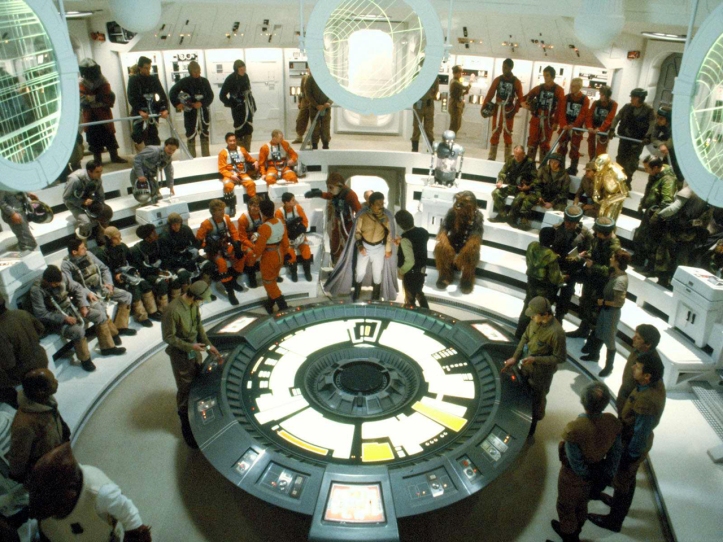
Home_One_briefing_room
The Rebel Alliance could – however- conduct large scale briefings, bringing its staff work and battle tracking capabilities into near-peer competition with that of the Empire. (Lucasfilm Ltd)
Neither the Rebels nor the Imperials had the knowledge that would eventually decide the engagement: that the forest moon of Endor was inhabited by Ewoks. The detachment of Imperial scout troopers on the forest moon should have gathered that information had they established LP/OPs, but they never dismounted their speeder bikes during patrols. If the Stormtroopers knew, they may have only seen a couple and probably would have hunted them for sport, given the Empire’s attitudes towards non-humans. It was Princess Leia Organa’s ability to make inroads with the local populace that gave the Rebels a critical advantage that they didn’t know they had.
Which was fortunate, as Imperial counterintelligence was feeding the Rebels everything that they wanted to hear, to include allowing Rebel Corona Squadron to see the Imperial fleet dispersing away from the Death Star. The Emperor permitted this squadron to escape to carry the news back to Rebel Alliance headquarters, masking his Star Destroyers behind Endor. However, his over-reliance on his own abilities of intelligence gathering using the Force methodology caused him to stop gathering data once the battle began to go as he predicted. Blinded by his belief in infallible methodology, he failed to see the fluidity of battle.
Imperial intelligence did, however, preserve one very key advantage: they protected the information that the Death Star II was an operational system.

Movement and Maneuver

Imperial forces were arrayed with the majority of the fleet forces masked on the far side of the planet Endor, in easy reinforcing range of the Death Star II. The Imperials maintained a ground task force consisting of one Legion on the forest moon of Endor to guard the shield generator and the supply dump that was sustaining the Death Star II. This force consisted of some heavy armor which was restricted to the supply dump and command center, light armor of AT-STs which provided perimeter protection for the shield generator, and detachments of Stormtroopers. A scout element ostensibly provided intelligence, surveillance, and reconnaissance (ISR) capabilities to the Imperial task force but it was not used to its full potential. And as mentioned, the Imperials also had the Death Star II with its capability to destroy Rebel capital ships with ease.
The Rebels divided their force into three elements. Admiral Ackbar commanded the fixing force, composed of the capital ships of the fleet whose mission was to bring the Imperial fleet into engagement and provide cover for the starfighter attack. The assault force was a small special operations detachment commanded by General Han Solo, which would infiltrate the forest moon, seize the shield generator, and disable it to allow for follow-on operations. This would then permit the exploitation force of General Lando Calrissian’s starfighter squadrons to penetrate the Imperial defenses around the Death Star II and deliver the decisive blow that would destroy the enemy’s center of gravity.
Solo’s assault force infiltrated the forest moon and immediately made contact with two enemy scout troopers. Rather than bypass and evade, Solo opted to attempt a capture – this failed, and one trooper escaped. At this point, the strike force cohesion broke down as Luke and Leia took off after the trooper. This action indicates that there was little in the way of a pre-mission brief. With no GOTWA, Han and the rest of the strike force moved off to find the two missing leaders rather than continuing the mission – endangering the entire operation. Leia met up with the Ewoks, conducted a Key Leader Engagement, and managed to integrate into their society. Which was vital, as the Ewoks soon captured Han, Luke, Chewbacca, R2D2, and C3PO. Between Leia’s influence and Luke’s ability to exploit the culture’s religious traditions, the strike force leadership managed to get free and made some powerful allies.
The Ewoks, though simple, possessed capabilities across the air and land, with direct and indirect fires capabilities. Irregular forces though they were, they possessed the element of surprise.
On D-Day, Luke began a diversion by turning himself in to the Empire, thereby drawing the Emperor’s attention from the engagement. Since the Imperial forces seldom allowed junior commanders any autonomy, this essentially decapitated their force. It also distracted the attention of Darth Vader, although he would return to the engagement from time to time.
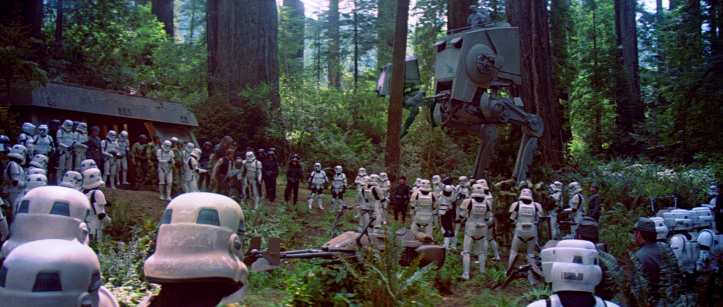
TempestForceEndor-ROTJ
Literally no one is facing outward to pull security. Nobody.  This is why you do battle drills, kids. (Lucasfilm, Ltd)
The Rebel assault force then seized the shield generator, overwhelming the small garrison. However, Imperial reinforcements soon recaptured the building as well as the strike force. It was at this point that the Ewoks drew out the Stormtroopers with a diversion and then used audio signal recognition to initiate a general attack. Their first assault with direct fire weapons drew the Stormtroopers deeper into the forest where the Ewoks had established an engagement area. Troops were canalized into ambush sites while AT-STs couldn’t maneuver in obstacle belts. The Ewoks then engaged with close air support and indirect fires. However, because of the inferiority of their weapons systems, the Ewoks risked defeat. The timely capture of an enemy armored vehicle by Chewbacca allowed the Rebels to overcome the counterattack and retake the shield generator.
ewok_glider
Ewok close air support. (Lucasfilm Ltd)
It was at this time that the Rebel fleet arrived on station and discovered that the Death Star II was operational. According to plan, the Imperial fleet moved to envelop the Rebel forces. And although the Rebels were taking irreplaceable casualties, they managed to get their smaller ships inside the perimeter of the larger enemy frigates. It was this that permitted an A-Wing single place fighter to destroy the bridge of the Executor, which then lost control of its helm and crashed into the Death Star II. Around the same time, Luke managed to turn Vader who killed the Emperor. The Empire was now leaderless.
The assault force managed to disable the shield and the exploitation force engaged the core of the Death Star II, destroying it. Having lost their flagship and main weapons system – as well as their leadership – the Imperial forces lost all momentum. Suffering heavy losses, several captains were able to retrograde their frigates and escape to fight another day. In this way, the core of the Imperial fleet – their Star Destroyers – formed a force that the First Order would eventually rally around. Space and the ability to jump to hyperspace did not permit the Rebel Alliance the decisive engagement needed to crush the Empire for once and for all time.
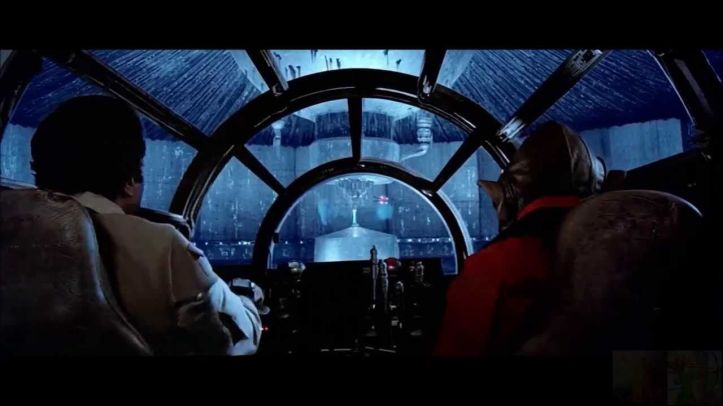
4f7b041bd216543c13f362a1674eabaf
Exploitation force closing in on the objective. (Lucasfilm Ltd)

Fires

Aside from naval gunfire being used between ships and the use of the Death Star II as an orbital bombardment platform, there was little use of coordinated fires across the battlespace from either side. Only the Ewoks showed the type of initiative to build and utilize indirect fire projectile weapons. Used in conjunction with ground forces and aerial bombardment, these weapons proved their worth when engaging the more technologically advanced Stormtroopers.
Ewok_Catapult
Ewok artillerists opening fire. (Lucasfilm Ltd)

Sustainment

In the Battle of Endor, the Empire displayed the weakness of all conventional forces: being tied down to one area for logistical reasons. With the forest moon of Endor used as a supply dump for building the Death Star II as well as the home for its shield generator, it inhibited the Imperial fleet from completely abandoning the site. As such, the Empire fought a positional engagement rather than one of maneuver.

Mission Command

The Rebel Alliance was greatly aided by having a multitude of skilled leaders who were given the authority to extemporize or innovate where needed during each step of the engagement. This is in contrast to the highly stratified Imperial forces who could only obey orders from the top and only in accordance to the plan. Once the plan fell apart and the leadership stopped sending orders, the numerically and technologically superior Imperial forces were left dead in space, so to speak.
As a sign that the Rebels were learning how to protect their communications, the assault force decided not to use comlinks during infiltration so as to avoid signal emanation. Of course, this caused difficulties when the force was separated but it did allow for covert insertion.

Protection

Protected by its shield rather than anti-ship guns, the Death Star II ended up becoming almost a liability to the Imperial Fleet. Having to hold the strategically important ground where the shield generator was located, they had no room to maneuver. Additionally, the fleet was stuck defending the battle station rather than being able to concentrate their fire on key Rebel ships. The lack of adequate anti-air/anti-ship capabilities hurt the Imperial fleet’s ability to engage single place fighters and bombers, which the Rebel Alliance used to their advantage.
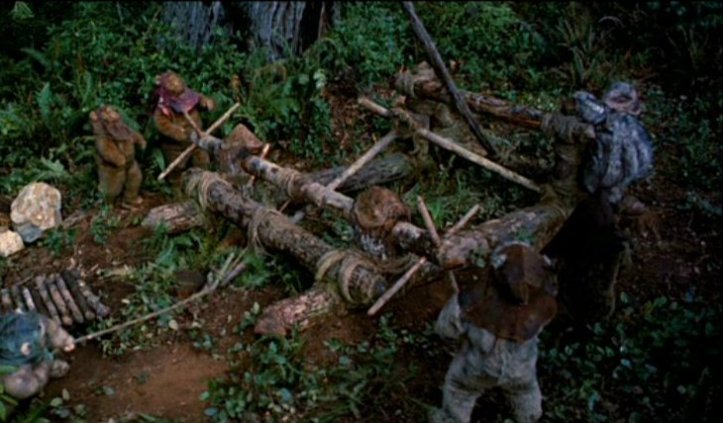
Amazingly, out of all the battles and engagements in Star Wars, only the battle on the forest moon of Endor demonstrated engineer capabilities. The Ewoks – masters of multi-domain battle – integrated log obstacles into their engagement area and covered them with fires. Much maligned, the Ewoks would be the only force out of this entire engagement to receive a “GO” at the U.S. Army’s National Training Center. Which is perhaps the greatest tragedy in all of this.
2009-11-01-ewok
Pictured: a multi-domain warrior. (Lucasfilm, Ltd)

Wednesday, May 2, 2018

Sick as a dog...


The phrase “sick as a dog” is credited as first being used back in 1705, probably in Europe.
In this time period, dogs were not seen as the human companions they are now. They were not given medical treatment and mostly left to live or die naturally outdoors.
They would not have ever received any type of medical treatment and because in these times we did not have such advanced medical technologies or even the same understanding of the world, human bodies and much less canine biology, humans often associated unpleasant things with dogs.
Back in these days, disease and misfortune was as easily blamed on stray dogs as it was anything else.
The term generally meant “very sick” or “physical unhappiness”
Here is a link to read more:

    As far as me goes....I ate something that flat out didn't agree with me....and it has pardon the expression goes"Tore me up".   I am working on another article or actually "fisking" it, but my creative energies ain't there and I don't want to do something that is substandard in my eyes, so it will be out tomorrow and not today.  
   Go visit the people on my sidebar....they are really good :)