Went to work Sunday Morning like normal and around Lunchtime I discovered that I have a kidneystone....*Ouch* So needless to say Monday Music didn't happen....I will post Monday
Music tomorrow...
Why stick to someone who couldn’t beat Donald Trump?
Failed Democrat presidential candidate Hillary Clinton may run for a third time, according to aide Philippe Reines.
The question is, do the Democrats want her? Hillary has done her best
to stay in the limelight, inserting herself into the narrative, giving
speeches and interviews, and going on a 13 city tour with her husband
President Bill Clinton.
Yet her approval rating remains low and some of her comments have had the left moaning and groaning.
Her longtime aide Reines cannot believe that his boss does not have a
spot on lists for possible 2020 Democratic presidential candidates.
From Politico:
“It’s curious why Hillary Clinton’s name isn’t in the
mix—either conversationally or in formal polling—as a 2020 candidate,”
said Philippe Reines, her longtime gatekeeper in the Senate and at the
State Department. “She’s younger than Donald Trump by a year. She’s
younger than Joe Biden by four years. Is it that she’s run before? This
would be Bernie Sanders’ second time, and Biden’s third time. Is it lack
of support? She had 65 million people vote for her.”
Even if half of those people would no longer support Clinton in
another election, Reines argued, “there’s no one in the Democratic Party
who has anywhere near a base of 32 million people. That’s multiples of
what a Sanders or a Warren have.”
Reines said his biggest fear for the Democratic Party is that they
realize, only in hindsight, that dismissing Clinton for the errors she
made in 2016 was a mistake.
“Chalking the loss up to her being a failed candidate is an
oversimplification,” Reines said. “She is smarter than most, tougher
than most, she could raise money easier than most, and it was an
absolute fight to the death.”
Does that mean she will run in 2020? Reines told Politico that the possibility is “somewhere between highly unlikely and zero, but it’s not zero.”
Some Democrats agree the party shouldn’t brush aside Hillary since
she won the popular vote. Democratic strategist Bob Shrum believes the
choice has “an element of sexism” and people have “frustration that she
lost what people perceive as the unloseable election and an element of
Clinton fatigue.”
Others wonder why she should be punished and silenced for losing an
election compared to others like John Kerry and Bernie Sanders.
Gee, maybe it’s because SHE LOST TO PRESIDENT DONALD TRUMP?! I repeat
myself: She lost to DONALD TRUMP. She didn’t lose to a polished veteran
politician. She lost to DONALD TRUMP. Not only did she lose to Donald
Trump, but she lost to him by a large margin in the electoral college.
It also doesn’t help that Hillary has not been a graceful loser. She
has shown bitterness and disdain for Americans who had the nerve not to
vote for her. She has not taken responsibility for her loss or admitted
the mistakes she made (Wisconsin? MICHIGAN?). The fact that her campaign
was all about her. “I’m With Her” isn’t exactly inspiring while Trump
campaigned on ways to Make America Great Again.
A Gallup poll from September showed that Hillary’s favorable rating remains at an all-time low at 36%.
Hillary shot herself in the foot last weekend
when she said no abuse of power happened when her husband, at the time
the most powerful man on the planet, had an affair with intern Monica
Lewinsky. She still thinks Bill was right not to resign.
Don’t forget that four other women
has accused Bill of sexual assault while Juanita Broaddrick has accused
him of raping her. Throughout the last few decades, Hillary has trashed
and tried to damage these women. Interesting coming from a woman who
said sexual assault victims deserve to be heard and believed.
These remarks caused outrage from the left with publications like ThinkProgress, The Guardian, and Vanity Fair putting out articles that criticized her “tone-deaf” comments.
Hillary and Bill’s 13 city tour
has tickets on sale between $120 and $370, but instead of doing
something thoughtful with the profits, the Clintons are keeping it.
Hillary could use them as a way to clean up her name, but it looks like
she won’t.
Let’s not forget Hillary’s comments
about how civility cannot exist until the Democrats have power again. I
may not be former First Lady Michelle Obama’s fan, but I loved the
tongue lashing she gave Hillary on the Today show:
“Fear is not — it’s not a proper motivator. Hope wins
out,” Obama said. “And if you think about how you want your kids to be
raised, how you want them to think about life and their opportunities,
do you want them afraid of their neighbors? Do you want them angry? Do
you want them vengeful?”
“We want them to grow up with promise and hope,” Obama added. “And we
can’t model something different if we want them to be better than
that.”
Hillary’s political aspirations are over. It has nothing to do with
sexism. It has everything to do with the fact that she’s a horrible
person who couldn’t beat Donald Trump.
The Cartoons are compliments of my stash on my computer, I have quite a selection of Hillary cartoons.
I saw this weird airplane on a facebook post and I decided to "Google" it and it was legit, it is an actual airplane and it flies and has some impressive specs especially for a "General Aviation" airplane. I pulled the specs from the Company website.
Design
“The Boomerang is a new high performance pressurized 5
place light twin intended for personal transportation. Its basic goals
were to provide optimum performance from two turbocharged 200 hp
Lycoming reciprocating powerplants. Probably one of the most difficult
tasks faced in the development of this aircraft was explaining why I
would design a configuration that is asymmetric. In fact, an early
comment as the aircraft arrived at the Experimental Aircraft Association
International Air Show at Oshkosh, Wisconsin this year, was from a
fellow who ran up and remarked, “What in the hell were you smokin’ when
you laid that one out?”
– Burt Rutan (1996)
In trying to explain how Burt Rutan developed the idea of the
Boomerang, he used a step-by-step comparison of a “traditional”
twin-engine aircraft (Beech Baron BE58) and his design.
Step-by-Step Comparison : Baron vs. Boomerang
Baseline Baron 58P
Span = 37.8 ft.
Wing area = 188 sq.ft.
Stab area = 56 sq.ft
Vert Area = 24.4 sq.ft.
Total BHP = 650
Empty Weight = 4018 lb
Useful Load = 2222 lb
Max Fuel = 1140 lb
Gross Weight = 6240 lb
Stall = 78 kt
Cruise (75% 20kft) = 224 kt
Range (75% 20kft) = 975 nm
Left engine moved outboard to improve symmetry at low speeds and to reduce cabin noise.
Both engines moved inboard to reduce MCS. Right engine moved forward to clear fuselage. Left engine moved aft to balance.
Wing skewed to support engines and to reduce left engine interference.
Composite construction allows smaller,
higher aspect ratio wing. but configuration is now nose-heavy, thus left
wing is swept forward. This helps, but configuration is still
nose-heavy.
The weight savings allows smaller engines and tail area can be reduced.
Higher aspect ratio tail flutter problem is fixed with nacelle boom. This allows additional baggage room in boom.
Right engine is moved to the fuselage to
reduce weight, cost and drag. Lateral balance is restored by moving
entire wing to the left. MCS is now well below stall.
Left engine is moved outboard to reduce
cabin noise and to eliminate prop interference. Entire wing is moved
left to restore lateral balance.
Twin small vertical tails improve low speed handling, reduce weight and allow low-drag pressure-recovery aft fuselage.
Continue evolution
Round fuselage, increased room.
Laminar flow flying surfaces.
Higher wing loading.
Aspect Ratio to 13.2.
Full-span camber control for aileron/flap/wing optimization
Baron 58P
Boomerang
3.8psi cabin
4.6psi cabin
6 seats
5 seats or 4 seats+1 bed
3% more span
15% wider cabin
84% more wing area
20% longer cabin
65% more tail area
92% more aspect ratio
59% more engine power
10% higher stall speed
62% more empty weight
45% more climb rate
13% more fuel
41 kt higher cruise speed
45% more gross weight
56% more range at 75%
92% more max range
Immune from MCS accidents
Technical Specifications
This table summarizes the performance and technical specifications of the Boomerang:
The Cockpit is totally computerized with LCD screens allowing for multiple selection of functions from pneumatic, hydraulic, fuel management,engine management passenger comfort and many other selections plus required analog gauges.
First off, we had the The senator from the peoples republic of Massachusetts release her DNA results..after being taunted by President Trump after she has touted her "Native American" ancestry and used that for political gains...well the results were surprising....for her and her fans...
The resulting Twitter meltdown after the results were very entertaining...Only Donald Trump could have engineered such a debacle ...for the Democrats...and their penchant for rich white liberals claiming "Victimhood" status with some marginalized group.....
The Resulting Meme's have been all over the internet..
And the Cherry on the whole circus for us conservatives has been the spokesman for the Cherokee Nation commented that "It is disingenuous for someone to claim tribe status when they have no basis, and it is an insult to those that have fought for that distinction. " And I have heard that she is having problems in her senate race, apparently even the people in the peoples republic has issues with their politicians shamelessly lying....like a cheap rug.
Or an Indian rug.....
I saw this on "The Art of Manliness" and they had an article about getting past a roadblock....and it is a very good article, I have used stuff from them in the past because they bring up what I call "Old school knowledge" stuff that isn't so common now. and especially for those that live in the cities, especially those cities that are chock full of "activist" like BLM and Antifa and their penchant for blocking traffic, usually with their bodies, but I can see them using old cars and the political structure supporting their goals especially like Portland where the Police are told to stand down and you will be on your own with no support and you really don't want to get stuck, and get pulled out of the car and get "Reginald Denny's "
Because of what is going on now with the various democrat politicians calling for violence against their political opponents and their supporters.
.I recall something like 594 attacks against Trump supporters by assorted leftist groups..
You have had Maxine Waters call for attacks against people that support Trump, we have had people that support the President run out of restaurants by the harpies of the left. And this is continuing....when the democrats lose in 2018 and I believe this likely the resulting temper tantrum will continue through the 2020 election and when President Trump wins and I believe this also likely especially when the economy is doing well people will vote with their wallets except for the perennial students, professors and other leftist that don't work for a living.
This is the article I saw on the "Art of Manliness"
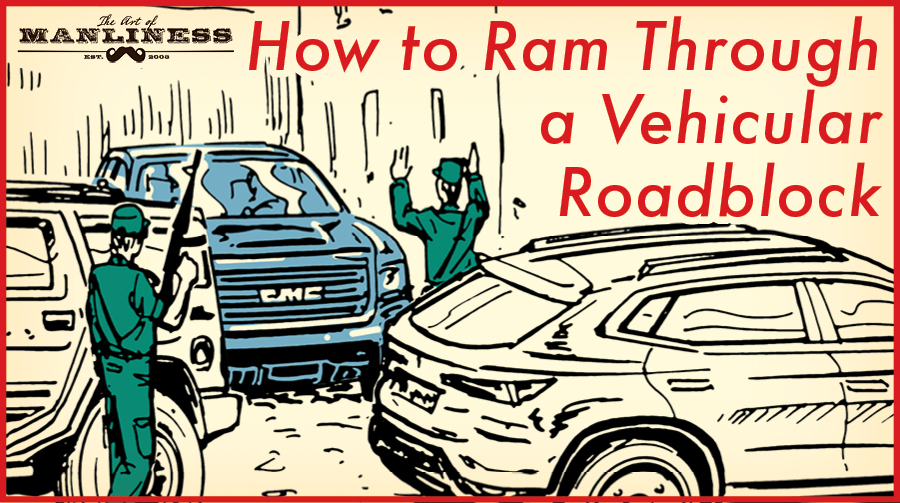
How to Ram Through a Vehicular Roadblock
You’re cruising down a narrow road when you see two cars parked
across it, blocking your path. It seems to be some kind of checkpoint or
barricade. What should you do?
If it’s an official police or military checkpoint, you better stop.
Despite what you see in movies, blowing through a police blockade is not
a sound strategy: you can kill an officer, get shot yourself, and even
if you get through, the authorities will be after you like white on
rice, inevitably nabbing you in the high-speed chase that follows (if
you don’t end it yourself by crashing).
But what if the blockade isn’t an official one? You’re in a war-torn
foreign land and are about to be stopped by insurgents, or it’s a trap
set up by carjackers, or you’re living in a Mad Max-esque dystopian
future where some baby-eating cannibals see your car as a can full of
tasty sardines? Well, then it might be worth ramming through the
obstructing vehicles and continuing on your way.
Ramming a vehicular barricade is very dangerous, and should only be
employed as a last resort — when there’s no other means of escape or
alternative routes of navigation, and when breaching and stopping carry
about equal chances of death. In such a situation, here’s how to most
effectively carry out this defensive driving maneuver.
Picking an Ideal Ramming Vehicle
When it comes to the best kind of car for ramming through a blockade,
not all vehicles are created equal. You want to think both about its
frame type and its air bags. Vehicle frame. Vehicles are basically built with two types of frames: body-on-frame and unibody.
With the body-on-frame build, the vehicle starts as a separate frame
to which the body is attached. With a unibody car, the frame and body
are integrated together. A body-on-frame chassis is made with heavier
metals, while a unibody is made with lighter weight alloys.
In
a unibody car (top), the frame and body are all one structure; in a
body-on-frame vehicle (bottom), the body goes on top of a separate
frame.
A unibody vehicle is statistically safer
than the body-on-frame type because in the event of an accident, the
stresses are evenly distributed throughout the vehicle, which is
actually designed to crumple, even in a minor crash, in way that
redirects the forces away from the passenger cabin.
But the reason they’re safer in a normal accident scenario also makes
them less effective in a ramming situation. The key to an effective
ramming is to hit a hard part of your car against a hard part of the
obstructing car; this works better than a hard part of one hitting a
soft part — like a crumple zone — of the other. You want the energy from
the contact to move/bounce the obstructing car out of the way, rather
than being absorbed.
A body-on-frame vehicle provides this desirable rigidity because the
chassis is made with high-strength steel frame rails that run the entire
length of the vehicle. Rather than being distributed throughout the
body, contact forces will be concentrated in the frame, making for
better bumping.
Almost all vehicles these days are made with unibody frames except
trucks and a few heavy-duty SUVs. While a unibody car is capable of
ramming, a body-on-frame truck will have tactical advantages in this
(and in off-road capabilities as well). Air bags. You should also keep air bags in mind in a
ramming situation. Below we’ll talk about how to minimize the chance of
the air bag being deployed, but it can certainly still happen when
you’re hitting another vehicle. Getting smacked in the face with an air
bag when you’re trying to make an already dangerous maneuver is
obviously highly undesirable; it would not only be a painful,
view-obscuring distraction, but the release of an air bag can also
trigger the automatic shutoff of your fuel pump.
For tactical purposes, you might choose a vehicle that’s too old to
have an airbag, or deactivate the air bag (something you’d have to do
yourself, as you’re required to request authorization from the National
Highway Traffic Safety Association to have a mechanic install an on/off
switch for you).
Getting Ready to Ram
Remember, ramming through a vehicular blockade is a maneuver of last
resort. As you approach a checkpoint/roadblock, assess whether or not
there’s an alternative way to avoid it. Can you go around it? Throw the
car in reverse and back away?
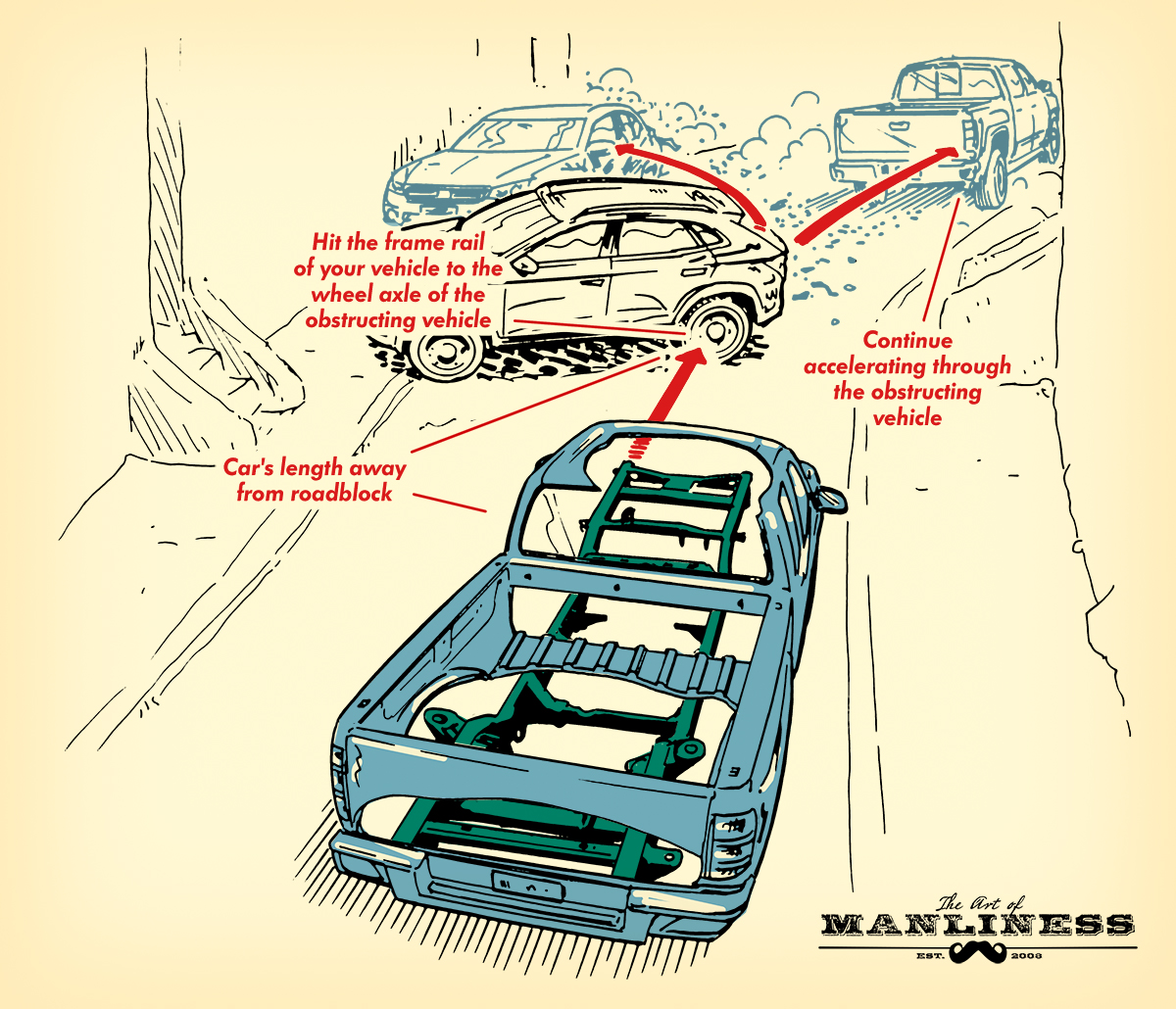
If there’s no other way through, and death awaits if you stop, then it’s time to ram the car(s) blocking your path. Line up so that the frame rail of your vehicle will hit the wheel axle of the obstructing vehicle. Remember
that you’re going to aim to hit a hard part of your vehicle, to a hard
part of the other car. The best points of contact are the frame rail of
your vehicle, and the wheel axle of the other.
The frame rail runs roughly parallel to your headlights; as that’s
hard to see when you’re driving, use your outside leg (or that of your
passenger if you’re hitting with the other side of the vehicle) as a
reference. Even in a unibody car, this will still be the strongest spot
to use; while it doesn’t have frame rails that run the whole length of
the vehicle, there is a sub-frame in the front and the rear. Aim for the rear wheel of the obstructing vehicle if possible. The trunk end of the car is lighter and easier to move than the engine-heavy front end. If there are two cars, aim for the wheel axle of one of them.
A blockade often exists of two cars parked end-to-end. In this case,
aim to drive between them, hitting the wheel axle of one of them. Drive at around 15-20 mph. Approaching slowly will
make it appear you intend to stop at the checkpoint, and it’s also the
ideal ramming speed. You need less speed and force to move a car than
you’d think. By applying this “minimum effective dose,” you 1) minimize
the damage to your own car (preserving its integrity will be key in
making your getaway), and 2) minimize the chance of the air bag
deploying.
If you have air bags in the car, slow down to 15 mph. Air bags are
triggered from rapid deceleration, and the kind of impact/body damage
which occurs when you hit another car going at least 16-28 mph. Going
slow will hopefully prevent the air bag from deploying, as will
continuing to accelerate (see below). If you have to stop completely before the blockade, leave a car’s length between you and the obstructing vehicle.
A car’s length to a car and a half’s length will give you sufficient
distance to get up to speed before you hit the obstructing vehicle.
Put your car in a low gear, so you’ll have plenty of torque. Look ahead. Don’t stare at the target of impact, but
instead look ahead to see where there’s drivable terrain past the
blockade and figure out where you’ll maneuver next. Maintain situational awareness! Keep accelerating through the obstructing vehicle.
Human nature will prompt you to take your foot off the accelerator or to
pump the brakes as you hit the obstructing car. Do neither. Keep on
accelerating as you hit the car and break on through.
Congratulations, you just rammed through a vehicular blockade. The baby-eaters will go hungry another day.
This one still amazed, how a numerically superior force surrendered to a numerically inferior force, the humiliation of the British was complete. I still had a hard time understanding this because the total ineptness of the British in fighting the Japanese. I also remembered reading that the Flying Tigers tried to tell the British how to fight the Japanese successfully and they were blown off, the British believed that the Japanese were an inferior foe and that the Japanese were crappy pilots and that their Zero fighters were unable to handle the British fighters. The end results were the beginning of the end of the British Empire that didn't survive long after the War.
The Japanese celebrating with one of the captured British Cannons at Singapore
There are certain matters that must be adhered to if a battle is to
be successful. These include a well-trained army and a good military
strategy which can be the difference between success and failure.
However, even when a military council drafts out an excellent plan,
there are no guarantees in war. Things do not always play out the way
they are expected to.
In the past, many military engagements have been quite organized.
They have followed a conventional chain of events: one force meets the
other, and one army wins either due to better positioning, military
strategy, advanced weaponry, or the simple fact of numbers. Sometimes
the battle ends at a stalemate where there is no victor. In contrast,
there are battles which have been total disasters where one army is
completely taken apart by the other.
One of the most bewildering to all was the Fall of Singapore in 1942
during the Second World War. The battle is now regarded as one of the
greatest military defeats of the British Army, but it did not look
poised to take such a humiliating turn when it began.
The British stronghold in Singapore was deemed to be an impregnable
fortress. Their air and naval bases commissioned in 1939 and 1941
respectively were impressive and intimidating. The King George VI
Graving Dock at the naval base was the largest dry dock in the world,
scaling a full 300 meters to show the capacity of the British Malayan
Navy.
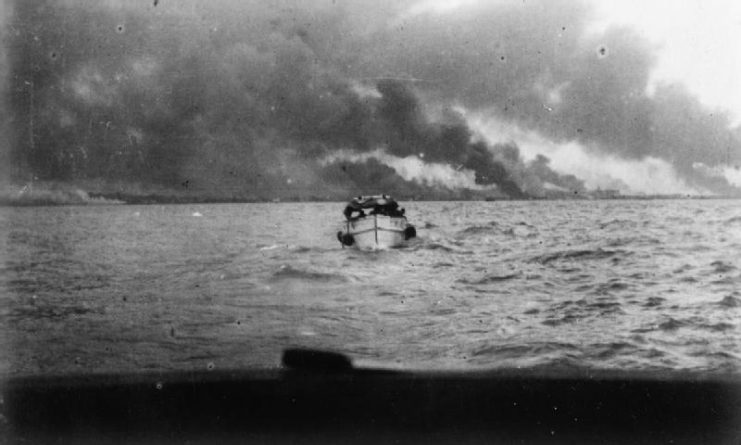
The
British Army in Malaya 1942. A launch returning from an island in
Keppel Harbour at Singapore after Royal Engineers had set fire to oil
storage tanks there, January 1942.
In March 1941, the British intercepted a message from Adolf Hitler to
the Japanese Foreign Minister, Yosuke Matsuoka. In this message, the
Nazi leader urged Matsuoka to attack the British stronghold in the Far
East. Hitler stated that conquering the British in Malaya would be
fundamental to the overthrow of England. There was little doubt as to
the importance of Singapore to the British Empire, as their naval base
was placed there to protect other Commonwealth assets.
However, the British were undaunted by this discovery and feared
little for the British troops stationed at the island. He was confident
that the fortress was impenetrable. The island had two major attack
areas of concern. The first was the sea, but the British naval base
there was more than capable of defending attacks from that direction.
The second was miles and miles of jungle terrain which were assumed to
be too arduous even to be considered by the Japanese.
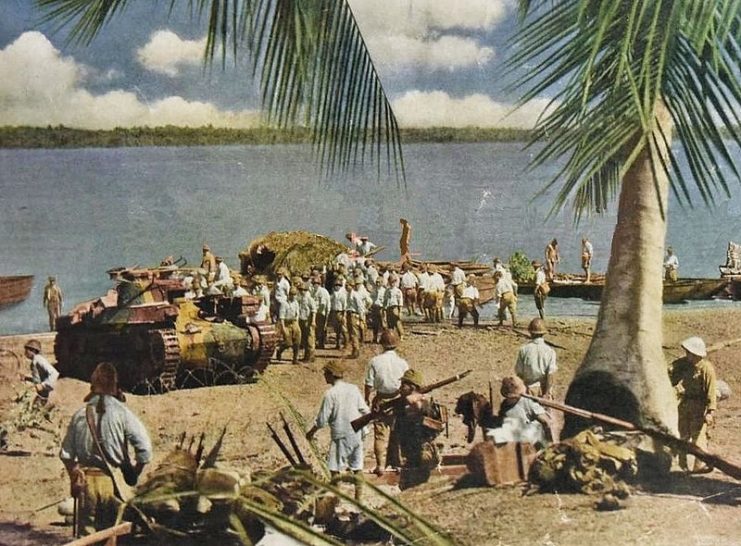
A Type 97 Chi Ha Tank of the IJA 1st Tank Regiment During the invasion of Singapore, 1942.
Newspapers carried news of Churchill’s statement referring to the
fortress as the “Gibraltar of the Far East.” There was an air of
overconfidence around the British forces. The British considered the
Japanese army to be weak, often referring to them as “Little Japs.”
However, although the Japanese believed the myth of the British fortress
being impregnable, they were nevertheless resolved to take it in their
quest to conquer Southeast Asia and the East Indies.
Japan had few mineral resources and, as such, sought to acquire them
by force from other regions. Japan had conquered most of China and
Manchuria in the 1930s for the rich iron and coal resources which the
Japanese then employed in producing steel. They had one important
resource left to acquire and that was oil. As such, the East Indies,
including Singapore, was a major target for them.
“Dispositions,
22nd Brigade, 10 p.m. 8th February” – the positions of Australian
forces around Sarimbun, Singapore, 8 February 1942. The arrows indicate
attacks by Japanese forces.
Despite the fortress’s naval capacity, it was seriously lacking in
ships. Most of the British fleet had been committed to Europe and the
Middle East where the British felt they were more needed. The Singapore
campaign kicked off on December 8, 1941, when two Japanese convoys
landed at Patani in Southern Thailand, Singora, and northern Malaya. By
the end of that day, some 27,000 Japanese soldiers, well-trained in
jungle combat and under the command of General Yamashita Tomoyuki, had
secured their position in Malaya and captured the British air base at
Kota Baharu.
After that, air bombings of Singapore began. Unaware that their air base had been captured, the Prince of Wales and the Repulse
sailed for northern Malaya in an attempt to put off any Japanese ships
that were yet to land. The ships were sunk on 10th December by Japanese
aircraft.
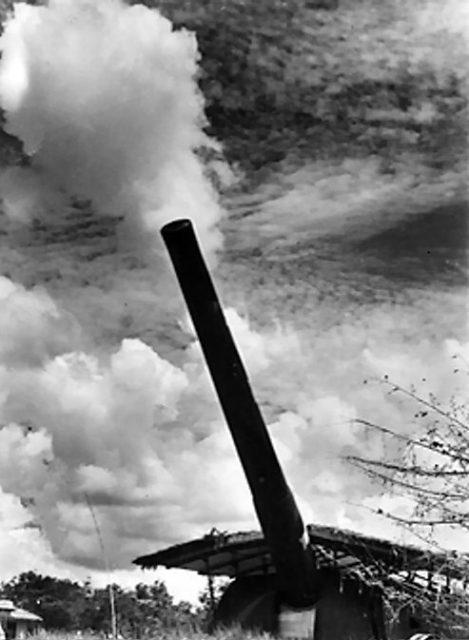
One of Singapore’s 15-inch coastal defense guns elevated for firing.8 December 1941The Japanese were very swift, employing bicycles as a means of
movement across the jungle terrain. Using a combination of bicycles and
collapsible boats, they outflanked and encircled the British army in
North Malaya, cutting off their supply lines. The British army in the
region was led by Lieutenant General Arthur Ernest Percival who was only
promoted to this command position in April, so it was his first time in
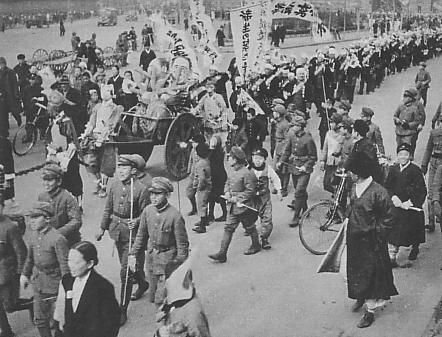
command of an army corps. Procession in celebration of “Fall of Singapore” by Keijo(Seoul) citizen.
On January 31, 1942, the causeway at Johore Baharu which linked
Malaya and Singapore was blown up by the Japanese, resulting in a
fifty-meter gap. The battle that ended in the surrender of the British
took place from 8th to 15th February, by which time half of Singapore
was already occupied by the Japanese.
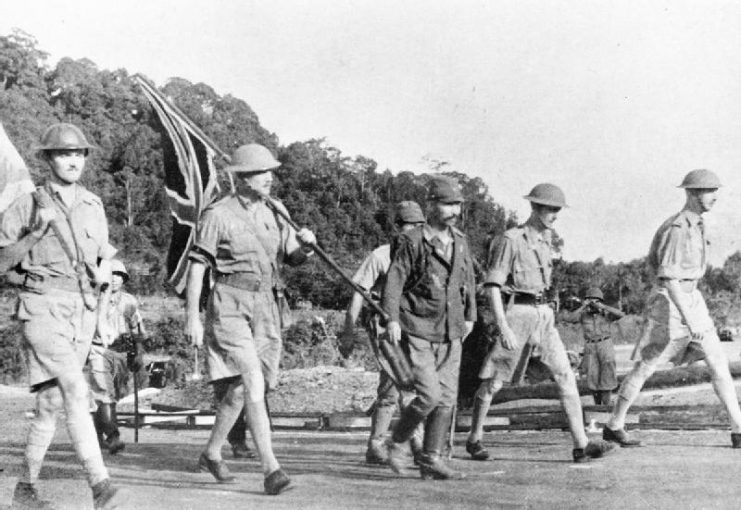
After a week of fighting, Percival was informed that ammunition and
water would run out the following day. He thereafter agreed to surrender
to the Japanese who insisted that Percival marched with the white flag
of truce to negotiate the terms of surrender. Lieutenant-General
Arthur Ernest Percival, (right), led by a Japanese officer, walks under
a flag of truce to negotiate the capitulation of Allied forces in
Singapore, on February 15, 1942. It was the largest surrender of
British-led forces in history.
The 36,000 Japanese troops had done what was thought by many as
impossible: gained a decisive victory over the British Malayan Army,
with 90 percent of the 90,000 men taken as prisoners of war. This defeat
was a crushing blow to the British Empire, and one that signaled the
start of the defection of Australia’s foreign policy away from the
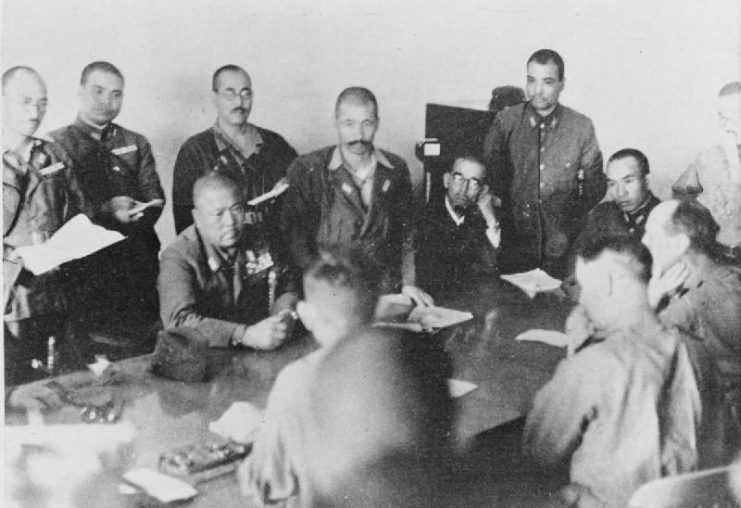
United Kingdom. Yamashita
(seated, center) thumps the table with his fist to emphasize his terms –
unconditional surrender. Percival sits between his officers, his
clenched hand to his mouth.After the British surrender, the Australians began to turn to the United
States for aid, no longer able to trust the British Army to protect
them. Australia had sided with the British during the war and their
Prime Minister at the time, John Curtin, told Churchill that Australia
would regard the act of surrender as an inexcusable betrayal. Also The British were reinforced by Australian Troops who landed and were almost immediately told to surrender and were marched to POW camps where they spent 3 years under hellish conditions
I was running an Archery range this weekend for "Spookoree" it is a cub scout campout and it is very important for the new cub scouts and gets them really excited about being a cub scout. I then headed to an Eagle Scout Ceremony where one of my scouts was getting awarded his Eagle Rank, I was pleased that he finally made it. He got the award and he made a speech and started handing out a few "Mentor" pins for the adults that were instrumental in he making his rank. I was surprised that I was awarded the first one from him and it is my first "mentor" pin.
Needless I was totally surprised to get the award from him, I was not expecting that and was honored that I was even considered a good influence.
I thought I had done this song before, it is a very good song and it was briefly my favorite song until I heard Don Henley "The Boys of Summer". But according to my blog, I never did.
Christine McVie is the second solo album by the British Fleetwood Mac vocalist / keyboardist Christine McVie, released in 1984.
It was McVie's first solo recording since her 1970 self-titled release
(under her maiden name). It features two U.S. top-40 hit singles, "Got a
Hold on Me" (US#10) and "Love Will Show Us How" (US#30). The album
itself also achieved modest success in the United States, peaking at #26
and spending 23 weeks on the Billboard 200.In the UK, the album entered at #58 on chart.
The band on this album includes Christine McVie (keyboards, percussion and vocals), Todd Sharp (guitar and backing vocals), George Hawkins (bass and backing vocals), and Steve Ferrone (drums and percussion).
Fleetwood Mac guitarist Lindsey Buckingham
sings backing vocals on tracks 2, 7 & 10, plays guitar on tracks 3
and 6, and plays lead guitar on track 10. Mick Fleetwood plays drums on
track 5. Eric Clapton plays lead guitar on "The Challenge," and Steve
Winwood shares lead vocals on "One in a Million" and contributes backing
vocals and piano to "Ask Anybody," as well as playing synthesizer on
several tracks.
The video for the song was produced and directed by Jon Roseman and premiered in February 1984.
Shot in both black-and-white and color, it is a pseudo-performance
video showing Christine McVie in a mansion-like room singing at her
piano while a backup band appears in silhouette shadows on the walls
around her.
I was doing Boy Scout stuff this weekend, I will talk about it a bit tomorrow during my "Monday Music" segment.
I shamelessly clipped this from "Angry Staff Officer", he uses Star Wars references to make a point to the people in the Army and other lesser branches. Star Wars is a huge cultural reference and easy to understand and is a great graphic training aid to make a point. Like I have said many times, My buddy "Mack" turned me on to this guy...and so I blame him for it of course.
The Rebel Alliance is going to lose, not because they are outnumbered, but because they have no model on which to base plans for their campaign. There are essentially two kinds of insurgent campaigns: city-out or countryside-in; Leningrad, or Yorktown. The Rebel Alliance is fighting both of them wrongly, and has few chances left before defeat and dissolution.
The First Order, for its part, is not a foreign force; they are fighting a campaign of imperial consolidation (think: the Union side in the US Civil War, or the British side in the Boer Wars or the War of Continental Independence) not a conquest from outside. As such, they fail to seize most of the advantages of supply and maneuver their better trained, better equipped, larger force offers.
Angry Staff Officer is right: most of the strategic errors on both sides are at the level of command, top to bottom, failing to understand the nature and goals of the war. At the bottom, we see squadron Commander Dameron trying to win in decisive battle when he ought to have withdrawn his forces in good order. This is the same strategic error repeated time and again by Nathan Bedford Forrest and Benedict Arnold, tactical officers so good they often did win, at the sacrifice of resources needed elsewhere for more important objectives. In the First Order, command is so poorly integrated and joint services so insensibly divided that the overwhelming naval theater dominance of the First Order is often caught unprepared for otherwise minor tactical maneuvers by the tiny but well-coordinated Rebel military. Time and again the First Order’s fighters remain in their bays until well after the Rebel assault has taken shape. Only their numerical advantage saves them, with otherwise-unacceptably high losses, as was frequently the accusation leveled by McClellan against “Unconditional Surrender” Grant.
Alliance command seemingly mean to initiate a Mao- or Giap-style insurgency from the hinterlands of the Outer Rim, yet are stymied by broken lines of supply and communication, lack of outside assistance from the coreward worlds, and internal dissent over whether accepting defeat in the former strongholds of the Republic represents strategic defeat. A hinterlands-in campaign depends on being able to hide from concentrated forces, isolate and strike strong points, and relies on the rural populace for its supply and places to hide. Unless and until the Princess/Commanding General can quell the squabbling in her own ranks over which type of war they are fighting, the Rebel Alliance cannot possibly hope to sustain an insurgency long enough to convince non-aligned worlds and civilian populations to support or tolerate her forces’ presence, much less to recruit and supply a critical mass of fighters for Phase III of Mao’s (and Washington’s) war plan, counter-conquest of the Order’s core worlds.
The countryside-in model of insurgency offers essentially two branching variations: the classic Maoist model, with unified command lying concealed in the hinterlands of the Outer Rim until sufficient and reliable support both monetary and material flows from an Outer Rim politically united against the core worlds of the First Order to begin massing troops for larger-scale confrontation, or the Ngo Nguyen Giap/George Washington model, relying on outside support for money and materiel, with recruitment and political support coming from within both the Outer Rim and the core worlds, in hope of eventually uniting the populace politically behind the Rebel Alliance as a more legitimate government than the First Order.
In the inverse model, the city-out campaign, exemplified by V.I. Lenin and Krim Belcacem, the Alliance lacks unity of command or internal lines of supply sufficient to sustain an independent navy adequate to protect smugglers and privateers who might convince unaligned factions (such as Incom) to sell or lease the Rebels weapons of greater magnitude than the Alliance’s small internal manufacturing base is able to produce or purchase. While Alderaan had a vibrant economy, it is as unavailable as Yavin as a base of recruitment and sustainment for the Alliance. Even Chandrila can be relied upon only to the extent that its political leadership feel safe from internal dissent or First Order suppression. Anyone suggesting (like Gen Washington) that recapturing and re-colonizing the core worlds of the Republic ought to be a primary war goal, rather than not losingfor sufficient time to convince unaligned factions and worlds that the Alliance might hold through a sustained conflict, has either to be convinced that is the wrong war model, or cashiered as quickly as practical. The critical step is internal resolution: Alliance command has to have complete buy-in for a model of campaign if the Rebellion is to succeed.
The Rebels have the advantage of a charismatic and competent political leader along the lines of Krim or Castro, but that advantage comes with the risk of internal dissolution if that leader is the only unifying center of gravity. Once they choose the hinterlands-in campaign, which they must, the Rebels may also take on the Sinn Fein/Hamas refinement, divided between public/political and covert/military divisions. It worked in Algeria for the FLN; it worked in Ireland for IRA, and it worked in Vietnam to a lesser extent. In this model, the public, political face of the Alliance treats with outside and unaligned actors while providing government and support services to Outer Rim and unaligned civilian populations gone unsupported by the First Order, whose attention (and funding) are bent on winning the military campaign against the covert military arm of the Alliance. This model enjoys the advantage of building the appearance of legitimacy to civilian populations before any overt military victories have been achieved, which makes it easier to tolerate the significant disadvantage that it relies on outside manufacturing and credit to sustain the military arm.
In brief, the Princess needs to unite the Rebel Alliance cadre behind a coherent (and achievable) model of insurgency, or be defeated by internal disunion before the First Order can manage to get its jackboots on. The Washington/Giap model offers the most practical advantages, while taking into account the disadvantages piled on the Alliance by its lack of mass popular support, internal manufacturing and finance. Adopting this insurgency model explicitly, and instructing the Rebels on its theory and tactical application, is the only plausible path to victory in war, barring a deus ex hyperspace event.
I have blogged about fighting that happened after the surrender of WWII, but the same thing happened in WWI,
"The Last Journey" of the German High Seas Fleet.
Examined with hindsight, the end of World War I was not the slam dunk
history books and popular culture implies. The Allies wanted more from
Germany than mere defeat: they wanted the country to be appropriately
punished for starting a war in the first place.
They wanted to make an example of it, should any European nation
think of going to war again. Britain, the United States, and the other
Allies wanted the world to know that starting another war would not be
tolerated.
Although much about the Armistice and the subsequent Treaty of
Versailles can be directly blamed for Hitler’s rise to power less than
two decades later, many factors contributed to the war’s slow close. War
rarely just stops. More often, it grinds to a gradual cessation, over a
few days at least.
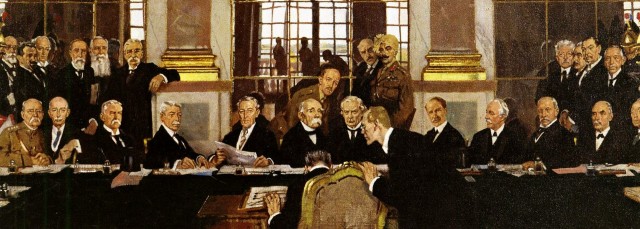
Signing of the Treaty of Versailles
The ceasefire was supposed to begin at 11/11/11 — that is: at 11 a.m. on the 11th day of the 11th
month (November), 1918. The German Empire was in disastrous shape by
then. But many in its Army and Navy did not want to accede. Instead,
they wanted to carry on fighting, particularly against Britain on the
open seas.
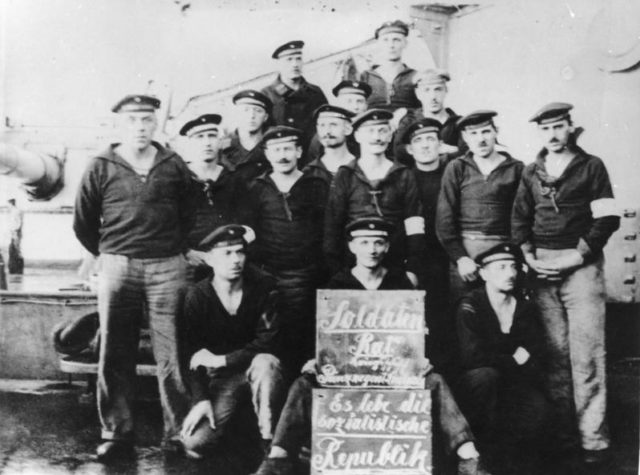
This sentiment led to the Kiel Mutiny, during which officers and some
navy personnel openly defied orders to stop the battle. This refusal
prompted further rebellion in the Army and even in civilian circles.
Kiel mutiny: the soldiers’ council of the Prinzregent Luitpold. Bundesarchiv – CC BY-SA 3.0 de
Finally, to quell the growing disquiet, Kaiser Willem II abdicated
and shifted power to the Weimar Republic. German delegates were ordered
to sign the surrender papers quickly, so the word could spread that
Germany’s war was over.
The country was finished, but some of the Allies wanted it more
severely punished, believing that only a “crushing” defeat could prevent
another war elsewhere in Europe. Though some countries were still
arguing about the terms, the papers were signed, at 5:12 a.m. on
November 18, 1918.
A great deal of the Armistice was based on U.S. President Woodrow
Wilson’s “14 Points” document, that outlined terms he believed
reasonable. These included some things still in existence today, like
the establishment of the North American Treaty Organization (NATO) and
open diplomacy.
Kaiser Willem II
Germany was ordered to remove all troops from occupied regions, and
the Ottoman and Austro-Hungarian Empires were demolished. New countries
in the Middle East were to govern themselves, but few were able to do so
without outside help from America and Europe.
Germany was compelled to disarm. Submarines were turned over to the
Allies. The country was also told to make substantial war reparations,
which was a major reason for the country’s economic near-collapse in the
1920s.
There were other harsh conditions that Germany had to agree to in the
Armistice, and while some Allied powers felt it fair, others, like
France, felt the agreement was not demanding enough.
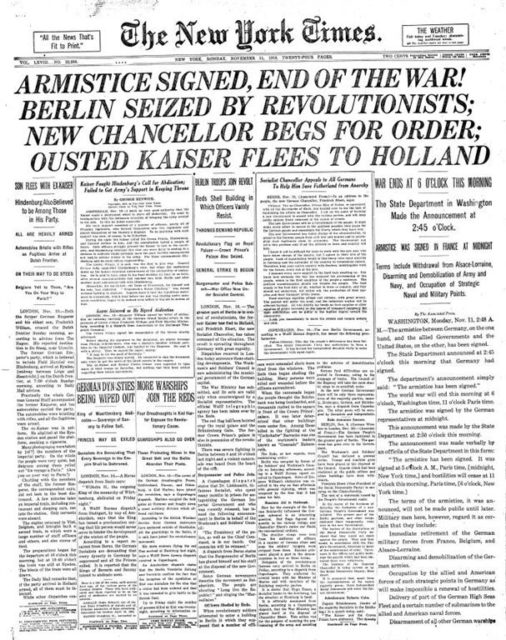
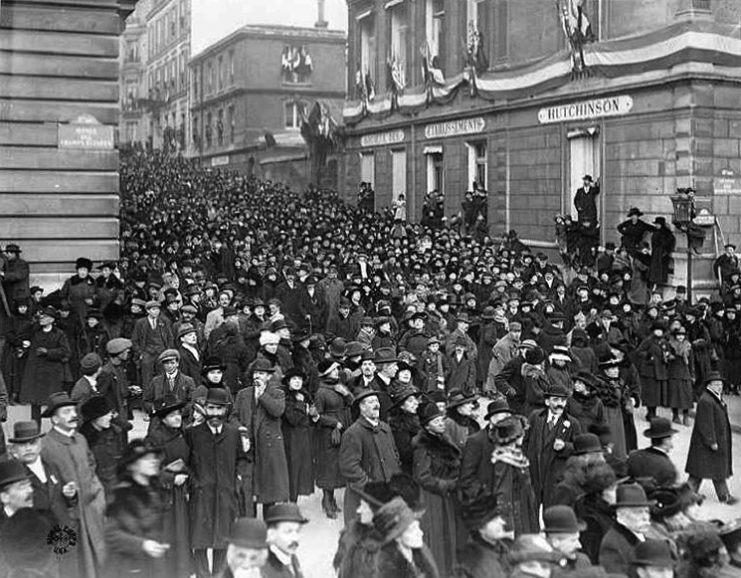
“Berlin seized by revolutionists”: The New York Times on Armistice Day, 11 November 1918.In cities like Paris, celebrating in the streets took the place of
exhaustion and war-fuelled anxiety. But for troops, things were not so
clear-cut.
Most German soldiers dropped their weapons in relief, but some, who
had not heard of the ceasefire, were killed after the 11 a.m. deadline
because they had not received word to stop fighting.
A myth was born the day the war ended: the myth of the “stab in the
back.” Many right wing people in Berlin and elsewhere began saying that
Germany had not lost, that it was the Weimar Republic’s untrue claim so
they could seize power.
At
the corner of Avenue des Champs-Elysées and Rue Balzac in Paris, the
crowd awaits the parade of 200,000 civilians and soldiers in the
afternoon of Sunday, November 17 1918
It was a false narrative, but it gave rise to a certain young, failed
art student who would soon wrest control of the government for himself
and consolidate power under a new regime:
the Nazis.
That young man was Adolph Hitler. He would one day return to the very
rail car in which the Armistice was signed, and force French officials
to sign surrender papers after the Nazis occupied their country
following the outbreak of World War II. After that, he had the train car
destroyed.
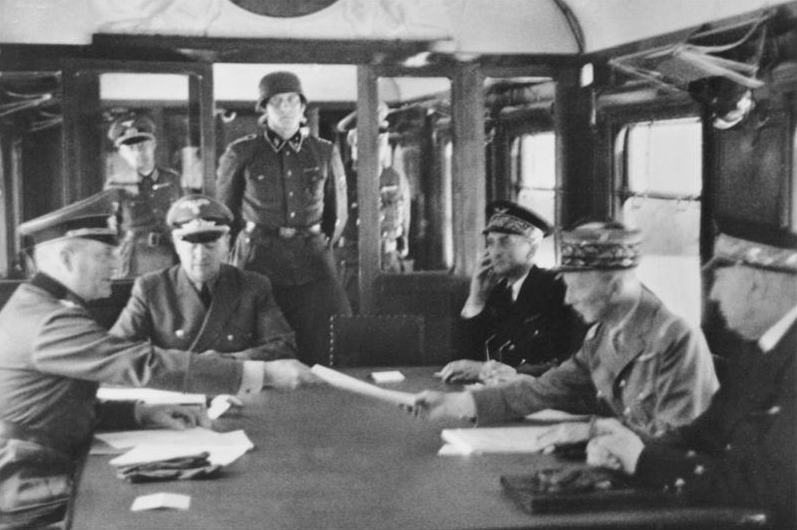
The French signing the Armistice Terms in 1940 after they decisively defeated and humiliated the French at the beginning of WWII at the Railcar that the Germans signed the Armistice in 1918 ending WWI. The Germans destroyed the Railcar after the signing to further erase the humiliation of WWI
I will have a hectic day, so I will post some musings and some video's that I like to watch over and over again.....well because I like them is a pretty good reason....
First off a musing...apparently there was our favorite Leftists in Portland blocking traffic and damaging cars and the Police did nothing, I believe that the Mayor or Police Commissioner or both gave the stand down order for the police not to interfere....this is something to think about to those that believe in disarming because the Police will protect you.....Just saying...
Now here is a funny Video...
Yes I have put this one on my blog before...but it is a good one...
And here is another one I ran across, it is a Star Wars fan film...and it is better than the later offerings from Disney
Apparently the Media is giving the Texan senator candidate the "Obama" treatment, I know the media don't like Cruz because he is a GOPer, but the cloying sweetness handling of Beto will put most people into a diabetic coma....sheesh..
Axanar, what Star Trek could have become instead of "Star Trek Dumpsterfire er I mean Discovery"
And Arnold"The Terminator" Schwarzenegger is backing off his "Girlie men" quote made famous during the 2004 election cycle.....I know that some men lose their testicles when they get older....but why be obvious about it..Sheesh..Have some Self respect.
And a Flight Safety Video, some of the Flight attendants from work thought this was hilarious






 Continue evolution