I shamelessly clipped this from Alex at
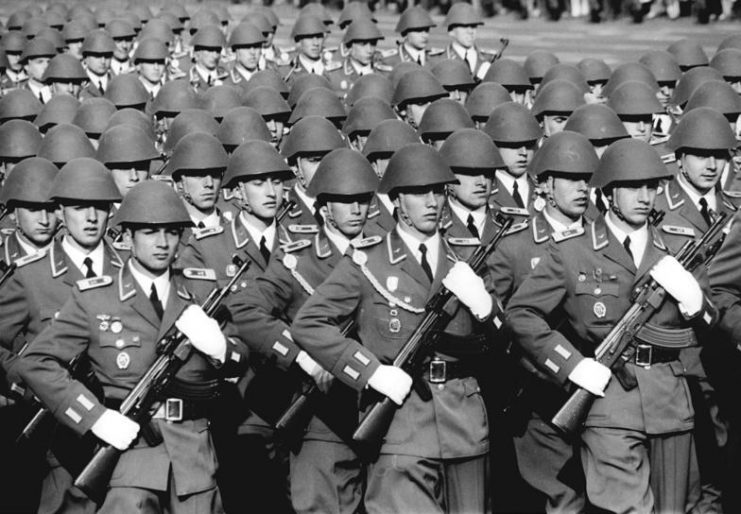
ammo.com. I remembered when this act was pushed through to "prevent another 9/11". and the subsequent rush to get it in place. There was fears of another attack somehow and people felt that the country was "behind the Power curve". Part of 9/11 was that the different intelligence agencies didn't share information and information is power and the individual fiefdoms had to be protected. What I am concerned about is that the goalposts are constantly being moved and one day the "secret Police, the boogieman of the conservative movement will actually exist to punish people who don't support the "whomever is in charge at the time.". Can you imagine the damping down on civil discourse, where people are afraid to say anything for fear that someone is an informer? This was the life in East Germany where 1 out of 7 "Osties" were informers. Some willingly, others by need for extra food or medical care or other inducements. The Stasi made the gestapo look like school children in power and ruthlessness. Our bill of rights made us the best country in the world for personal freedom to believe as we want without fear of retribution. In some countries going against the power structure gave you beatings or in some cases the ever popular
"Necklacing" or some variation. I remembered the election in Panama in 1988
It took 20 minutes for me to find this, "google" is so biased when I had originally typed in "opposition leader attacked in Panama during elections" it kept bringing up Maduro and Venezuela and President Trump.......Really? They are not even remotely related.
I got to dig into if President Trump can reauthorize the "Patriots Act". Considering how weaponized the alphabet agencies are against him, it might be a hard sell....
Do we need the "Patriot Act?" In some fashion we do, but the expanded surveillance is a concern, certain "Rogue" members of the alphabet agencies used parts of the Patriots act to start surveillance on President-Elect Trump and the resulting kerfluffle is the resulting coup attempt to get President removed because there are people that believe that the average Americans are incapable of "ruling themselves" and need the guiding hand of them and their kind to "watch over the lesser ones". This reeks of "elitism" and something that the Americans fought a war against with the British Crown over. Especially the "Class System" that was endemic of British Society and to lesser extent today still is. Some call it "the Deep State". They are in power to keep power for themselves and answer to no one.
The USA PATRIOT Act provides a textbook example of how the United
States federal government expands its power. An emergency happens,
legitimate or otherwise. The media, playing its dutiful role as goad for
greater government oversight, demands "something must be done."
Government power is massively expanded, with little regard for whether
or not what is being done is efficacious, to say nothing of the overall
impact on our nation's civil liberties.
No goals are posted, because if targets are hit, this would
necessitate the ending or scaling back of the program. Instead, the
program becomes normalized. There are no questions asked about whether
the program is accomplishing what it set out to do. It is now simply a
part of American life and there is no going back.
The American public largely accepts the
USA PATRIOT Act as a part of civic life as immutable, perhaps even more so than the
Bill of Rights. However, this act – passed in the dead of night, with little to no oversight, in a panic after
the biggest attack on American soil since Pearl Harbor
– is not only novel, it is also fundamentally opposed to virtually
every principle on which the United States of America was founded. It
might not be going anywhere anytime soon, but patriots, liberty lovers
and defenders of Constitutional government should nonetheless
familiarize themselves with the onerous provisions of this law, which is
nothing short of a full-throttle attack on the American republic.
What’s Even in the USA PATRIOT Act?
What is in the USA PATRIOT Act? In the Michael Moore film
Fahrenheit 9/11, then Rep. John Conyers
cracked wise about how no one had actually read the Act
and how this was in fact par for the course with America's laws. Thus,
before delving into the deeper issues surrounding the PATRIOT Act, it is
worth discussing what the Act actually says. Here’s a brief look at the
10 Titles in the PATRIOT Act:
- Title I: Enhancing Domestic Security Against Terrorism: This
provision dramatically expands the powers of the President, the
military and the intelligence community whenever the specter of
"terrorism" is invoked. Bizarrely, it contains a provision
condemining discrimination against Arabs, Muslims and South Asians,
which seems to have very little to do with protecting Americans from terrorism.
- Title II: Enhanced Surveillance Procedures: Title II contains the meat of the Act with regard to massive, industrial-scale surveillance on the American public.
Beyond the simple spying on Americans and their communications,
Title II increases the ability of federal intelligence agencies to
share your private communications with one another.
- Title III: International Money Laundering Abatement and Financial Anti-Terrorism Act: Not simply a section of the USA PATRIOT Act, Title III is an Act of Congress in its own right.
You might have noticed how much more difficult it is to open a
bank account or send a wire transfer after 9/11. You can blame this
provision, which shredded banking privacy rights in the United
States.
- Title IV: Protecting the Border: Other than
expanding the number of federal employees (of course), the
provision of the USA PATRIOT Act charged with protecting America's
borders does little other than point toward paths for future action
and study. It is worth noting that the weakest provision of the
Act is the only one explicitly authorized by the Constitution --
protecting the border.
- Title V: Removing Obstacles to Investigating Terrorism: Title
V authorizes bounties for the apprehension of alleged terrorists,
broadens government power to conduct DNA analysis, allows for
greater data sharing between law enforcement agencies and, perhaps
most disturbingly, requires private telecommunication carriers to
comply with government requests for electronic communication
records whenever requested by the FBI. It also expands the power of
the Secret Service to investigate computer fraud.
- Title VI: Providing for Victims of Terrorism, Public Safety Officers and Their Families: Perhaps
the most innocuous portion of the USA PATRIOT Act, Title VI
provides for a victims' fund for victims of terrorism and their
families.
- Title VII: Increased Information Sharing for Critical Infrastructure Protection: The
subtitle of this section of the Act is a rather wordy way of
saying that the United States federal government is allowing for
law enforcement agencies to share information across jurisdictional
boundaries in an easier fashion than was previously legal. To that
end, the Bureau of Justice Assistance was given a $50,000,000
budget for 2002 and a whopping $100,000,000 budget for fiscal year
2003.
- Title VIII: Strengthening the Criminal Laws Against Terrorism: Title VIII is where the rubber meets the road: What exactly is
terrorism, according to the federal government? Unfortunately,
this Title does little to clarify what terrorism is, instead
focusing on declaring a number of actions (such as attacks on
transit) as “terrorism,” regardless of intent.
- Title IX: Improved Intelligence: The section subtitled “improved intelligence” largely expands the powers and responsibilities of the Director of Central Intelligence.
- Title X: Miscellaneous: When the federal government titles a segment of a law “miscellaneous,” you know it’s going to include everything and
the kitchen sink. And so it does: The definition of electronic
surveillance, additional funds for the DEA in South and Central
Asia, research on biometric scanning systems, a limitation on hazmat
licensure and infrastructure protections are all addressed in Title X,
which is a catchall for everything the federal government forgot
to address in the first nine sections of the law.
Most of the provisions of the USA PATRIOT Act were set to sunset four
years after the bill was passed into law. However, the law was extended
first by
President George W. Bush and then by
President Barack H. Obama.
The latter is particularly scandalous given that, at least in part, a
rejection of the surveillance culture that permeated the Bush
Administration was responsible for the election of Obama in 2008.
Passing the USA PATRIOT Act
Next, it’s important to remember the environment in which the USA
PATRIOT Act was passed: Post-9/11. It is not the slightest bit of
exaggeration to label the environment in which the PATRIOT Act was
passed as “hysterical,” nor is “compliant” a misnomer for the Congress
of the time.
Opposition to the Act was slim and intensive review of one of the most sweeping Acts of Congress in American history was nonexistent.
All told, Congress took a whopping six weeks drafting, revising,
reviewing and passing the PATRIOT Act. That’s less time than Congress
typically spends on totally uncontroversial and routine bills that don’t
gut the
Fourth Amendment.
The final vote found only 66 opponents in the House and one (Wisconsin
Democrat Russ Feingold) in the Senate. The entire passage of the PATRIOT
Act, from start to finish, took place behind closed doors. There were
no committee reports or hearings for opponents to testify, nor did
anyone bother to read the bill.
“Uniting and Strengthening America by Providing Appropriate Tools
Required to Intercept and Obstruct Terrorism” is the bloated and
overwrought full name of the bill, crafted by a 23-year-old
Congressional staffer named Chris Cylke. This ridiculous name puts the
focus not on the surveillance aspects or the erosion of basic civil
liberties enshrined in Western society since the
Magna Carta,
but on patriotism. At the time of its creation, the messaging was very
clear: Real patriots support massive intrusions on civil rights. As
President George W. Bush said at the time,
“Either you are with us, or you are with the terrorists.” This sentiment very much seemed to apply to American citizens.
While the argument that
if you have nothing to hide you shouldn’t fear investigation
is anathema in a Constitutional republic with regard to citizens, it
should be standard operating procedure when it comes to our organs of
government. If we cannot expect transparency from the United States
Congress – elected officials charged with representing the will of the
people and protecting
the Constitution – then we certainly can’t expect it anywhere else.
The Unfortunate Growth of the USA PATRIOT Act
It’s no surprise to those in the
liberty
movement that given an inch, the government (in particular the
military-intelligence community) took a mile. Even the nebulous
definition of “terrorism,” largely centered around a long litany of acts
rather than the motivation behind them, has expanded to include
receiving military training from a proscribed organization (without
actually committing any
terrorist acts
or even acts of violence of any stripe) as well as “narcoterrorism” –
the latter particularly convenient, as the United States government
continues its losing “War on Drugs.”
Indeed, in many ways, the War on (Some) Drugs was the template for the
War on Terror.
Both wars have no defined enemy, no defined terms of victory. Instead,
they are waged against a nebulous concept, while enjoying bipartisan
support for their ever-expanding budgets. What’s more, it didn’t take
long for the Feds to start using the USA PATRIOT Act for things it was
never intended for, including prosecuting the War on Drugs.
Perhaps the silliest application of the USA PATRIOT Act is the prosecution of
Adam McGaughey. McGaughey maintained a fansite for the television series
Stargate SG-1.
The Feds charged him with copyright infringement and computer fraud. In
the course of their investigation, the FBI leveraged the PATRIOT Act to
get financial records from his website’s ISP. This was made possible by
the USA PATRIOT Act amending the Computer Fraud and Abuse Act, allowing
for search and seizure of ISP records.
The New York Times discovered in September 2003,
that the USA PATRIOT Act was being used to investigate alleged drug
traffickers without what would otherwise be sufficient probable cause.
These were investigations into non-terrorist acts using a law ostensibly
designed to investigate terrorism. There was some suspicion that the
Act was being used to investigate crimes occurring before the Act was
passed, violating the
ex post facto clause of the United States Constitution.
In one of the biggest power grabs (excluding virtually everything we know from
Edward Snowden
– more on that below), the FBI sent tens of thousands of “national
security letters” and procured over one million financial records from
targeted businesses in Las Vegas. These businesses were primarily
casinos, car rental bureaus and storage spaces. The data obtained
included financial records, credit histories, employment records and
even people’s personal health records.
The FBI maintains and databases this – and, indeed, all information
collected through the USA PATRIOT Act – indefinitely. In the good old
days before the PATRIOT Act, the Feds were compelled to destroy any
evidence they collected on someone later found not guilty of a crime.
Note that the aforementioned data collection brought to public attention
by Edward Snowden (which, again – we’re getting to that) falls under
this provision. Not only is the government collecting obscene amounts of
private and personal information about you, they’re also storing it
indefinitely with no plans to stop.
What’s more, the FBI has approached public libraries to turn over the
records for specific terminals, collecting information not about
specific users who might be under investigation, but about anyone who
has ever used the computer at the public library. Libraries, to their
credit, have been very much at the forefront of resistance against the
PATRIOT Act, with some litigating compliance despite operating on small
budgets and others posting “
canary letters,”
which effectively say “The FBI Hasn’t Been Here Yet.” The removal of
such a letter would warn patrons that the FBI has been sniffing around
in their records.
Indeed, the greatest criticism of the PATRIOT Act is the simplest and
perhaps most obvious: Why does an Act ostensibly passed to fight
terrorism so drastically expand the government’s power to investigate
virtually everyone else? The PATRIOT Act is not merely unconstitutional,
it is an unprecedented expansion of state power in the Anglosphere, a
culture based on restricted government and the primacy of individual
rights.
An excellent example of this is the
Foreign Intelligence Surveillance Act
(FISA) expansion. Most people are familiar with the term “FISA court,”
but very few people actually know what it is – a special federal court
created under the Carter Administration that grants approval of
electronic surveillance of both citizens and resident aliens
in the event that they are accused
of acting in the service of a foreign power. The last part of this
sentence is very important: The FISA courts are not simply for allowing
surveillance of anyone that it might be expedient to collect information
about. The scope of their powers is very, very limited.
Or was.
The PATRIOT Act lowered the burden of evidence required to obtain a
FISA warrant for electronic surveillance and expanded the overall scope
of the FISA courts. Any savvy federal agent can now drape his charges in
the garb of (what else?) “national security” and obtain electronic
surveillance privileges hitherto only dreamed of by investigators. FISA
courts have become pliant tools in the hands of the Feds, gladly
approving their requests to monitor phone and internet surveillance, as
well as access to medical, financial and educational records.
The Future of the USA PATRIOT Act
Do we still need the PATRIOT Act? Did we ever? All laws are certainly
a product of their times. But this seems much more acutely true of the
USA PATRIOT Act, which was passed in a rush and under duress without due
consideration.
Particularly in light of the revelations from Edward Snowden – that
the government is spying on everything they possibly can – it’s worth
asking if there’s any walking back. He points out that the
police state apparatus was originally for drug dealers, then for terrorists, but ultimately ended up being applied to anyone and everyone.
What’s more, Bob Bullard notes another frightful aspect of the USA PATRIOT Act: Terrorism-related cases are not subject to the
Freedom of Information Act.
This means that there is little or no oversight. There is no surer
hallmark of a police state than an all-powerful domestic surveillance
agency with no transparency or oversight. While the USA PATRIOT Act
might not create an American Stasi as such, it certainly paves the way
for one