I have blogged about Battleships before on my blog, I have blogged about the Yamato class Battleships before, there is something about an all gun Warship, I suppose that I am a traditionalist.
I clipped this article from the NGB
The Yamato class battleships hold a special place in naval history.
Popularly known as the biggest battleship to ever go to sea and carrying
the most powerful guns, it is little wonder why these dreadnoughts are
so endearing. However, there was so much more to these battleships that is
less known to many. In this article, we will look at five great
features of the Yamato class battleships! Without any delay, let us
begin.
The Yamato class was the first battleship to utilize 18.1″ guns as
well as the first Japanese battleship to carry triple gun turrets for
the main battery. To accommodate three of the gigantic 18.1″ (46cm)
guns, the Yamato class required an equally large turret. In addition, to
protect against the most powerful guns that the Allies could muster
would require armor of exceptional thickness. Japanese designers
lavished incredible attention to the layout of the turret. The result
was the most advanced turret design ever fitted to a Japanese battleship
as well as one of the most impressive among any navy.
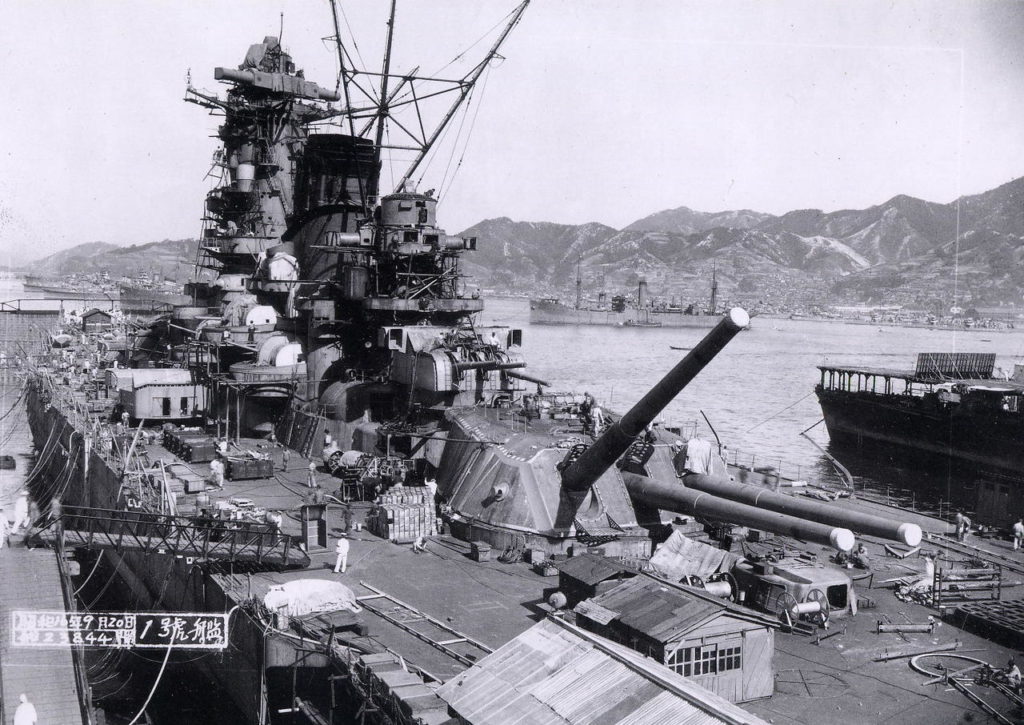
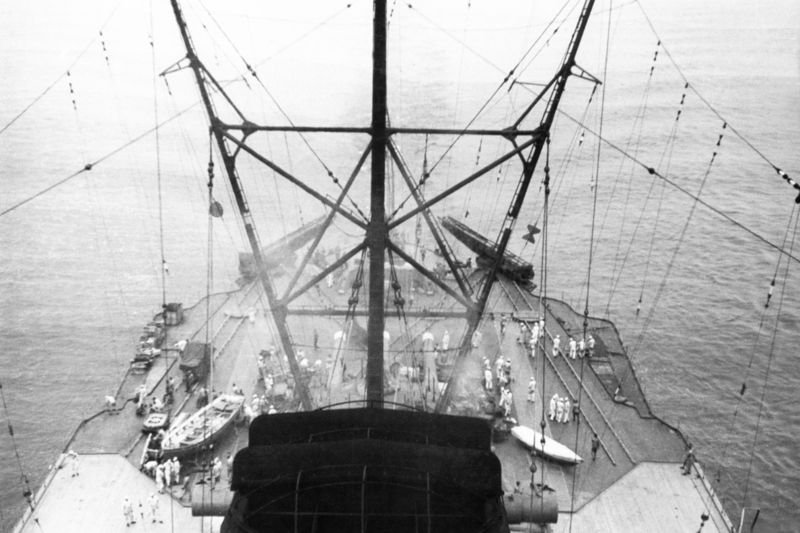
Soon to be the biggest battleship in the
world. Yamato undergoing fitting out at the Kure Naval Arsenal on
September 20, 1941. Her aft 46cm gun turret is easily seen in the
picture.
A popular description of the turrets of the Yamato class is that they
weighed more than a destroyer. At just over 2,730 tons, it is little
surprise that the biggest battleship carried the biggest turrets.
Carrying three guns that weighed over 360,000lbs apiece and a massive
slab of armor that was almost 26″ thick would result in a hefty turret.
However, despite the immense weight of the turret and the massive 18.1″
(46cm) guns inside of it, the overall size was impressively compact.
Compare the turret of the Yamato class with the American Iowa class battleships:
Yamato Class
Iowa Class
Turret Length
56′ 1″
50′ 7 1/2″
Turret Height
13′ 7″
9′ 10″
Turret Weight
2730 tons
1708 tons
Turret Armor Front
25.6″
17″ + 2.5″
Turret Armor Side
9.8″
9.5″ + .75″
Turret Armor Roof
10.6″
7.25″ + .75″
Turret Armor Rear
7.5″
12″ + .75″
Individual Gun Weight
363,000lbs
267,900lbs
Gun Length
69.3′
68′
Rate of Fire
1 round per 35 seconds
1 round per 30 seconds
Loading Angle
3 Degrees
5 Degrees
Elevation Rate
8 Degrees per Second
12 Degrees per Second
Train Rate
2 Degrees per Second
4 Degrees per Second
Despite the larger guns and heavier armor, the Yamato class turret
was not that much larger than that found on the Iowa class. That is an
impressive feat of engineering unto itself.
Even more impressive than the size of the turret was the equipment
inside of it. The Yamato class utilized a unique sliding cradle behind
each gun. The shells, weighing up to 3,218lbs, were lifted up to a tray
at the end of the cradle. The entire cradle then slid forward on rails,
moving the tray to the breech where it would be rammed inside the
chamber. Then, the cradle would retract backwards. This allowed the
powder tray to lift all six powder bags, each weighing 121.25lbs (55kg),
into position behind the breech.
A separate rammer would then ram all six charges into the chamber with a
single stroke. A person would not have to touch any of the powder bags
while loading the gun. This system reduced the number of men working
inside the turret and allowed for an excellent rate of fire of up to one
round per 30 seconds, though 35 seconds was more practical.
The Yamato class enjoyed one of the most compact turrets available to
a battleship despite the fact that it carried the largest naval guns
ever mounted to a battleship. In addition, the layout was excellent and
the equipment inside was superb. A great achievement for Japanese
designers!
As a warship designed to engage the most powerful battleships likely
to be brought against it, the Yamato class featured a tremendous amount
of armor protection. Almost 23,000 tons of armor was used on the Yamato
class and Japanese designers intensively studied the most effective
methods for utilizing this armor.
Armor Class Armour Figures
Belt:
Yamato 410mm (16.1″) Musashi 400mm (16″)
Lower Belt:
200mm (7.9″)
Traverse Bulkheads:
340mm (13.4″) – 300mm (11.8″)
Deck:
200mm (7.9″) – 230mm (9″)
Conning Tower:
500mm (19.7″)
Barbettes:
380mm (15″) – 560mm (22″)
Turrets:
Front:
650mm (25.6″)
Top:
270mm (10.6″)
Sides:
250mm (9.8″)
Yamato class were the first production battleships in Japan to adopt
the “All or Nothing” armor principle. This ensured that Armor was
maximized at the areas that needed it most while it was minimized in
less important areas of the battleship. Therefore, the most vulnerable
areas of the Yamato class (Magazines, machinery) were encased in a
heavily armored box known as a citadel. The citadel was flanked by the armored belt (16″ & angled at 20 degrees) and capped by the armored traverse bulkheads (11.8″ – 13.4″) forward and aft. The upper
section of the citadel was covered by the armored deck (7.9″ – 9″).
This armor scheme was sufficient to provide an immunity zone against
46cm (18.1″) shells at ranges between 21,800 and 32,800 yards. The deck
was designed to resist the momentum of a 1000kg (2200lb) bomb dropped
from 3,400 meters. A monstrous amount of armor to protect from some serious weaponry.
When using the “All or Nothing Principle”, the armor was to be
condensed to the vitals. Japanese designers took this a step further by
seeking ways to make the vitals even smaller, allowing for the armour
protection to be enhanced to its absolute maximum. They succeeding in
shrinking the length of the citadel to a mere 55% of the ship’s overall
length, a remarkable achievement. While this would seemingly leave 45%
of the ship’s hull exposed, Japanese designers countered this by
extensively compartmentalizing with some 1147 different compartments
(1065 below the armored deck). The citadel was also designed to provide
an immense amount of buoyancy, enough to keep the ship afloat even with
the bow and stern heavily flooded. This helped mitigate the effects of
damage to the hull, ensuring that the Yamato class could withstand
damage and keep fighting.
The Yamato class was not just protected against threats above the
waterline, they also featured the greatest underwater protection fitted
to a Japanese battleship. A torpedo belt 5.1 meters (16.7′) deep
protected the ship from torpedoes and mines. The torpedo belt was backed
by the ship’s 200mm lower belt, designed to protect against shells
striking the hull underwater (However, this feature turned out to be a
liability in practice) and act as the main holding bulkhead. Outside of
the ship’s torpedo belt, further protection against flooding was
provided by the extensive compartmentalization mentioned already.
Flooding would be contained to the compromised areas while the rest of
the hull would remain watertight and buoyant. Using her volume,
compartments, and a vast system of pumps, the Yamato class were
expected to withstand a torpedo strike and still return themselves to an
even keel despite the flooding.
A unique feature of the Yamato class was the gentle slope of the deck
in the vicinity of the forward 46cm turrets. After sloping downwards,
the deck would curve gracefully upwards again all the way to the ship’s
bow.
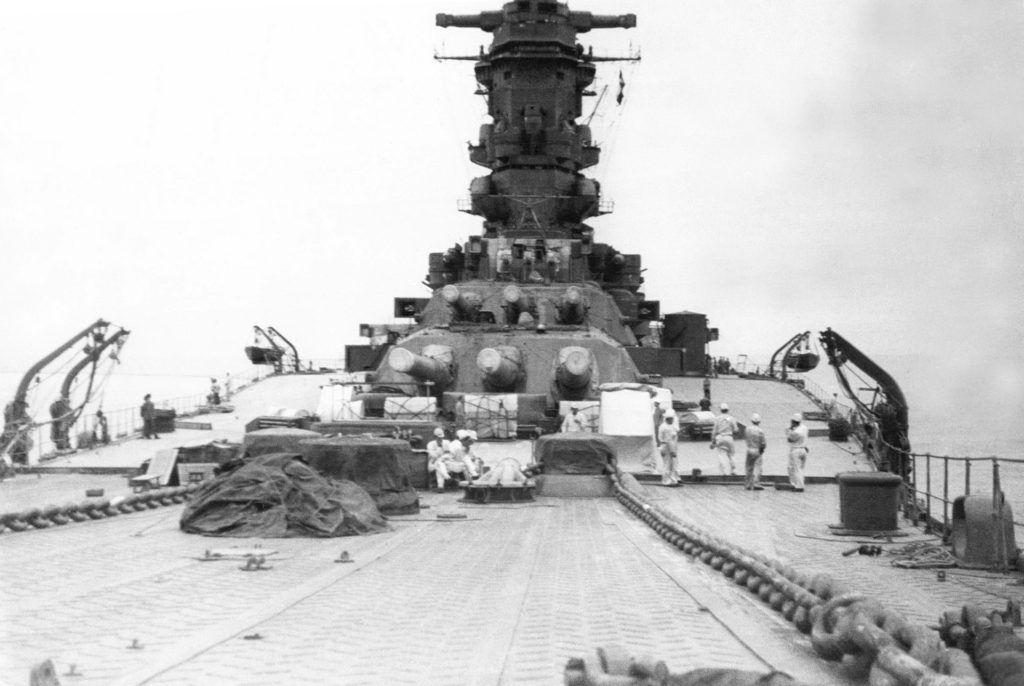
The bow and forward hull of the battleship Musashi. The slope of her forward deck is easily seen in this photograph.
Don’t let the beautiful lines fool you, the purpose of this bow was
more than aesthetics! The sloping deck helped reduce the height of the
turrets as well as the barbettes they rested on. Each main battery
turret, weighing over 2500 tons, could make the ship very top-heavy if
they were located higher up on the ships’ hull. The deck allowed them to
be lowered. Though the height reduction was modest, maybe only around
10′, it still contributed to the ship’s overall stability.
The deck also helped contribute to the protection of the Yamato
class. By lowering the turret height, the height of the barbettes could
also be lowered as well. This meant a reduction in the barbettes exposed
outside of the citadel, increasing protection. This also saved having
to armor taller barbettes, saving tonnage that could be used for
protection elsewhere on the battleships.
Overall, the use of a sloping deck was not particularly advanced, but
it was extremely effective and a further testament to lengths Japanese
designers were willing to go to enhance the ship’s capabilities.
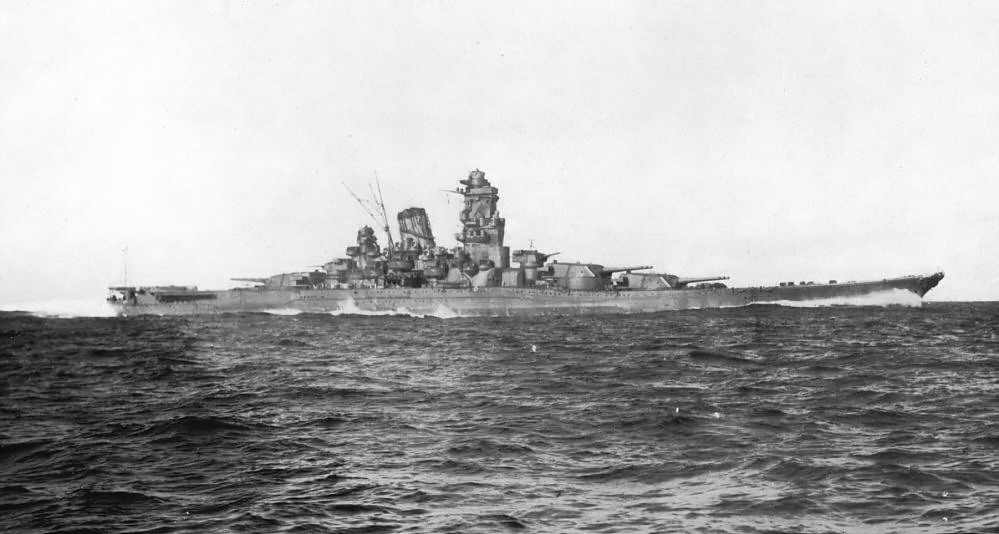
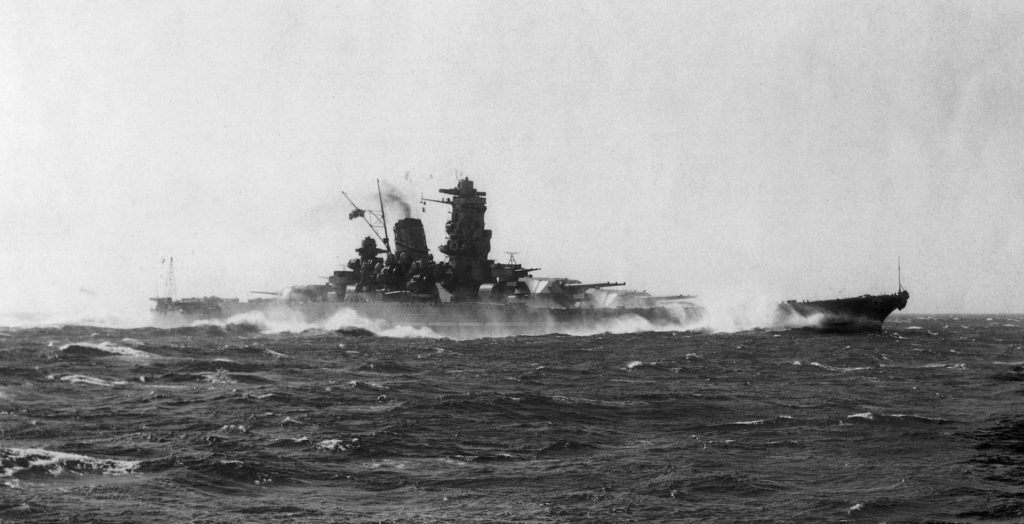
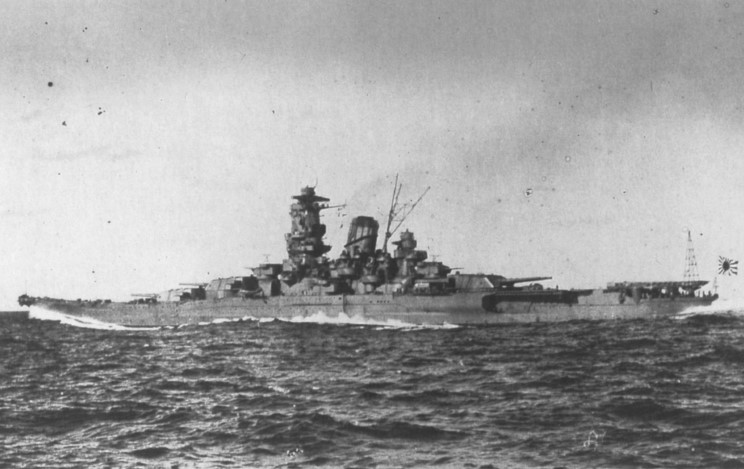
The biggest battleship is also remarkably
agile! Yamato steaming at high speed while she was undergoing trials on
October, 30, 1941.
Despite being the biggest battleship, the Yamato was relatively fast
for her gargantuan size. Generally, the phrase “biggest battleship” and
“fast” do not go well together in the same sentence. However, Japanese
designers successfully managed to squeeze every bit of speed they could
from the class.
Japan started with developing a hull that was as hydrodynamic as
possible. During the development phase, some fifty different models
tested to find the ideal hull shape. Japan went even further and applied
features such as a bulbous bow to further enhance the hull form. The
result was an extremely efficient hull of a design unique among Japanese
dreadnoughts.
The powerplant of the Yamato class was provided by twelve Kampon
boilers supplying steam (of 700 degrees) to four turbines. These
turbines each drove their own shaft connected to a screw of 6m (20′).
Though the system was rated at 150,000shp, Yamato was able to generate
153,553shp on her trials. This was enough to propel the huge battleship
to 27.5 knots. Musashi exceeded this figure when her powerplant reached
166,500shp and drove her to 28 knots.
Yamato
North Carolina
Richelieu
Bismarck
King George V
Powerplant:
150,00shp
121,000shp
155,000shp
148,116shp
110,000shp
Speed:
27.5knots
28 knots
32 knots
30 knots
28 knots
Range:
7200nmi
17400nmi
9500nmi
8870nmi
15600nmi
While the Yamato class would not be setting any speed records, they
were still impressively fast given their size. Even more importantly,
most battleships only enjoyed a knot or so advantage over the Yamato
class.
Overall, the fact the Japanese designers were able to squeeze so much
speed from the Yamato class is a major feat unto itself. Even with
massive guns and incredible amounts of armour protection, the Yamato
class was capable of achieving respectable top speed, making the ships
relatively balanced.
The Japanese Navy placed a lot of thought into the design of the
Yamato class. One area of consideration was the effect that the muzzle
blast of her 18.1″ guns would have upon equipment stored on her decks.
Japanese designers developed several innovative ways to reduce the
damage from muzzle blast. One of the most interesting methods involved
the storage of the battleship’s spotting aircraft and boats.
The stern of the battleship Musashi. Her
aircraft hangar is located between the twin catapults at the stern. The
aircraft could also be moved about the deck on a system of rails.The Yamato class utilized a lowered quarterdeck. Aircraft were
stored inside a below-decks hangar where they could be rolled via rails
to a hold located on the quarter deck. From there a crane would hoist
them out and place them on one of the battleship’s catapults or on a
system of rails mounted on the weather deck.
The ship’s boats were stored in no less than four hangars. Smaller
boats were stored in two smaller hangars mounted on either side of the
aircraft hangar. The boats would be rolled on their own system of rails
to the quarterdeck. The same crane that serviced the aircraft would also
handle the smaller boats.
Larger boats were stored in two large hangars mounted inside the
hull. A hatch could be opened that allowed the boats to be moved outside
via an overhead rail and crane system. The overhead system allowed the
boats to be moved outside the hull and lowered into the water directly.
This same system could then be used to lift the boats out of the water
and moved back inside the hull.
Sea trials of the world’s biggest battleship
at the time. This photo shows off one of the battleship’s boat hangars
located alongside the #3 turret.
Both the ship’s boats and aircraft, safely tucked away inside the
hangars, were granted a significantly higher level of protection than
they would be on other battleships. Though the hangars were mounted
outside the citadel, meaning they were still vulnerable to bombs and
heavy shells, they were still protected against shrapnel, aircraft
gunfire, and the elements. It also allowed the 18.1″ guns to fire
without fear of damaging the delicate equipment.
The placement of the aircraft and boats at the stern allowed for
uncluttered decks. Additional deck space allowed for more anti-aircraft
guns and other equipment to be installed. Other battleships during the
War generally had to give up their ship’s boats to free up space. The
downside to her hangars was that they consumed interior volume. However,
due to the immense size of the Yamato class, the loss of space did not
affect crew accommodations that badly, if at all.
Overall, the Yamato class might have enjoyed the most superior
accommodations for her aircraft or ship’s boats without affecting her
fighting ability
For Yamato and Musashi, they had a lot more going for their design
rather than simply holding onto the title of being the world’s biggest
battleship. They were technological marvels compared to the dreadnoughts
that came before them. Japan’s naval designers gave considerable
thought about the overall design and developed several innovative ways
to better enhance the capabilities of the class. Sadly, the quiet
careers of the ships somewhat overshadows their enormous potential.
Still, the Yamato class hold a special place in the minds of many naval
historian enthusiasts and for good reason!
There have been some really good war movies, from Zulu, Both Midways, A bridge too far, Siege of Firebase Gloria, Full Metal jacket and a bunch others, but there have been some dogs out there.
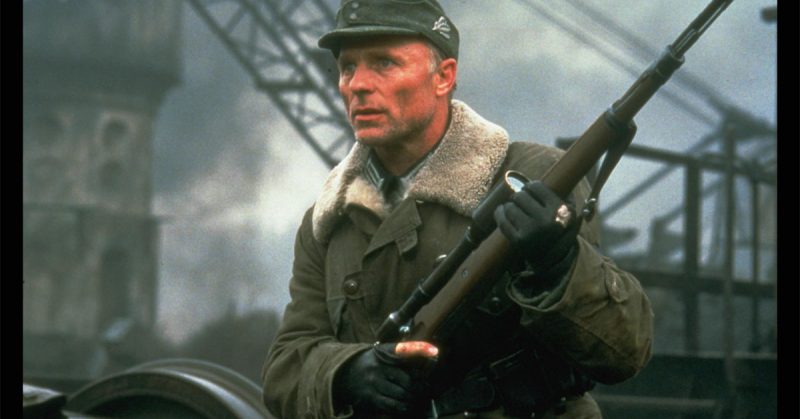
FILM 'ENEMY AT THE GATES' BY JEAN-JACQUES ANNAUD (Photo by Siemoneit/Sygma via Getty Images)
One
of the biggest bombs of Ben Affleck’s career, and there have been
several, happens to be one of the most error-ridden war movies Hollywood
has ever produced: Pearl Harbour (2001). It wasn’t just a bad
Affleck film, it is one of several films to come out of Hollywood’s
“dream factory” that can’t seem to get it consistently right when
telling wartime narratives.
Of
course, filmmakers have to enhance stories to lure audiences into
theatres. But accuracy is often sacrificed in the process. In Pearl Harbour, Affleck’s character is a member of the Air Force who joins the Eagle Squadron.
In
reality, that couldn’t happen. Neither would he have flown a Polish
plane, as he does in the film. This movie is riddled with as many errors
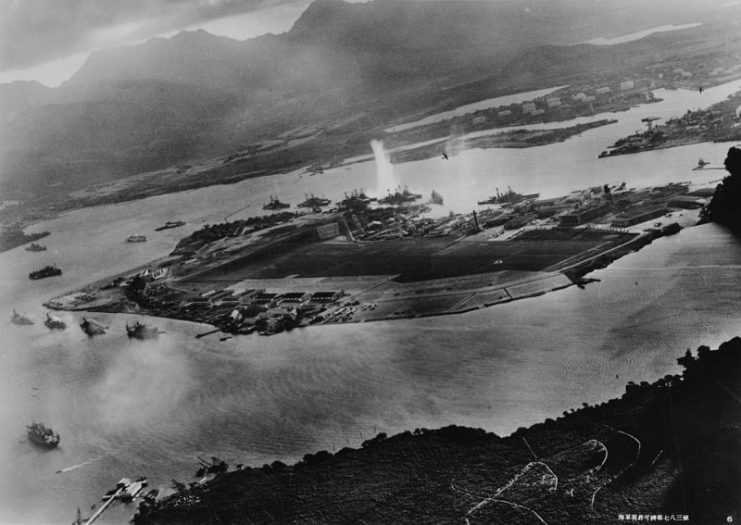
as bullets, and bad reviews followed swiftly upon its release. Photograph
of Battleship Row taken from a Japanese plane at the beginning of the
attack. The explosion in the center is a torpedo strike on USS West
Virginia. Two attacking Japanese planes can be seen: one over USS Neosho
and one over the Naval Yard.Hollywood sometimes falls prey to serving as propaganda, and there is no better example than the 1968 John Wayne film, The Green Berets. In truth, the film was trying to sell the public on an unpopular war in Vietnam.
Almost everything about the movie, from its use of forests instead of
a jungle, is wrong. I remembered seeing bleachers by the "Vietnamese Village", it was filmed at Fort Benning. Wayne’s performance is unbelievable: he is ageing,
overweight, and distracted, a man who would never be allowed in the
field in the real army.
Even a Best Picture winner like The Hurt Locker
can get it wrong. Veterans complained that this depiction of a bomb
disposal squad in Iraq bore no resemblance to reality. In the film, the
soldiers are unsupervised and surly to officials, neither of which is
fair or accurate, according to army personnel.
World War II is probably the most fertile ground for filmmakers, but that also makes it ripe for creative reinvention. Windtalkers,
a 2002 film about the role of Native Americans in WWII, depicts them
helping U.S. forces send each other coded messages in Navajo. But it
also shows them as disposable. Their bodyguards are told to kill them
rather than let them fall into enemy hands. This film failed to find an
audience, except perhaps on Netflix. A
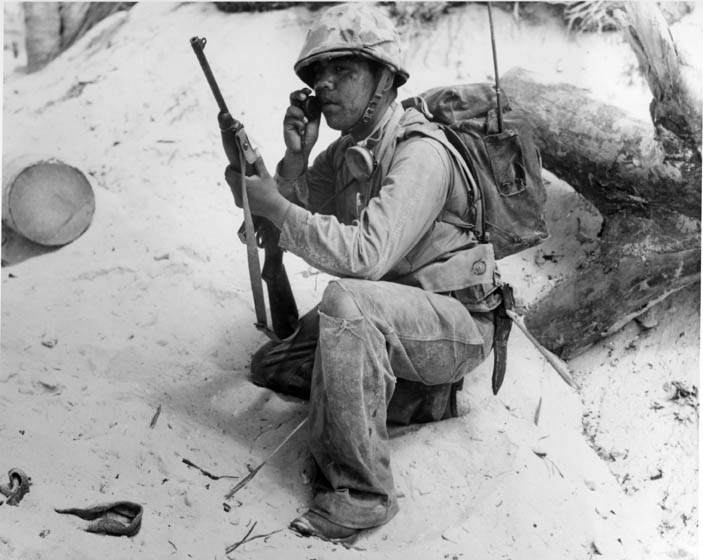
Navajo Code Talker relays a message on a field radio. The code talkers
served in the South Pacific during World War II and were kept a secret
until 1968 when the Navajo code was finally declassified.Some errors are less egregious than others. In 2006, Flyboys dramatized the battle between U.S. pilots and the German Luftstreitkräfte
but used the wrong planes. Producers said it was so audiences could
tell one side from the other, which seemed fair enough until it was
revealed that a military advisor on the film had made up his service
record.
A 2000 film, U-571, earned a rebuke from the highest-ranking
member of the British government at the time, Prime Minister Tony
Blair. The film credited America with decoding the Nazi Enigma machine
in 1941. The U.S. had not even entered the war by then, let alone done
any code breaking.
That success was achieved by the Royal Air Force, prompting Britain’s PM called the movie “an insult.” TheImitation Game
followed a few years later, a much-acclaimed film that told the true
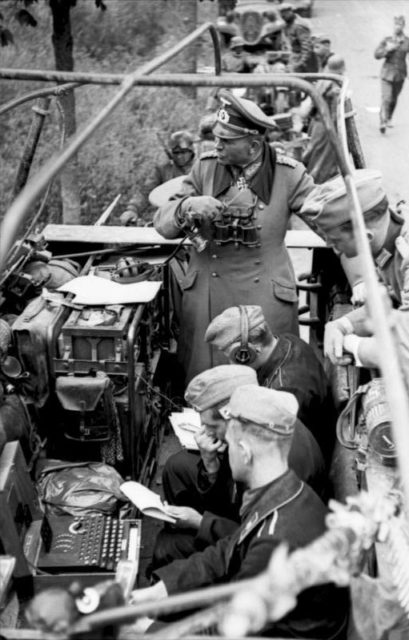
story of the first Enigma machine, and was nominated for several Oscars. Heinz
Guderian with an Enigma machine in a Sd.Kfz. 251 half-track being used
as a mobile command center during the Battle of France. By Bundesarchiv,
Bild CC-BY-SA 3.0.Enemy At The Gates (2001)
told a story of World War II from a different angle, that of a Soviet
sniper. The movie is based on the real soldier, Vasily Zaytsev, but is
believed to contain two critical mistakes.
Firstly, it shows the
Red Army severely ill-equipped, which wasn’t true. Secondly, it depicts a
one-on-one encounter between the Russian sniper and his Nazi opponent,
which experts believe likely didn’t happen. The Battle Of The Bulge,
released in 1965, is a much-admired movie, but it got plenty wrong too.
This epic film shows the famous battle being fought on flat land, but
the real one happened in a forest. The film battle was shot in “easy”
weather while the real one was plagued with snow and rain. Finally, the
tanks on the Nazi side were clearly American made. Vasily Zaytsev, left, and soviet snipers equipped with Mosin-Nagant M1891/30 with PE scope in Stalingrad, December 1942.A movie about WWII that tried to be less downbeat than most was Red Tails,
released in 2002. It told the story of the first African American air
squadron, but in its desire to be positive, it made errors. In reality,
the squad had no aces and, 25 bombers lost their lives to enemy forces.
However, the film doesn’t depict this, implying instead that the team
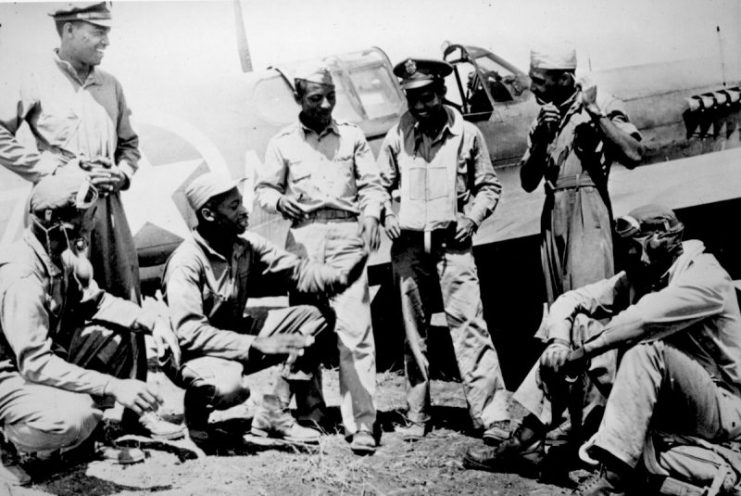
had a perfect survival rate. Pilots of a U.S. Army Air Forces fighter squadron, credited with shooting down 8 of the 28 German planes, 1944. ,Presenting the Armed Forces in a negative way has become something of a popular approach these days, as in Jarhead,
released in 2005. This film is about the first Gulf War, and is set in
the 1990s. I saw that movie and it pissed me off almost as bad as the "Three Kings" movie with George Clooney during the First Gulf War, I had a very poor reaction to that movie, I considered it "crap". Officials claim that the severe training methods shown,
during which one soldier dies, are unfair. They believe the film makes
army life look unnecessarily tough, and argue that soldiers would not be
left to die on the battlefield. Officials went on record to make known
their displeasure.
I am sure that there are others but these are the ones that jumped out at me.
I am a chemtrail technician in the aviation industry, and a friend of my wife has asked her a question "How is your husband doing?" and my wife was surprised by the question and asked her "Why, what is the matter?" and she was told" Is your husband ok? he works on airplanes and they are carriers of the coronavirus". My wife was perplexed so I explained that I work on the domestic planes, not the international planes, and we are doing the maintenance that is longer than the overnight checks, but less than the "C" or "L" checks that are required by the manufacturer and the FAA. We use all the PPE(Personal Protection Equipment) that is required for our safety. I am not overly concerned, I am more concerned about going to events with a lot of people that might be sick and not do the right thing and stay home than working on airplanes. Wash your hands, wash your hands, wash your hands...
I shanelessly clipped these from "Simply flying, a blog about Aviation and flying.
The coronavirus outbreak has triggered a surge of cabin cleaning frenzy among airlines. With measures inspired in equal amounts by public safety and self-preservation, they are now turning to hospital-grade disinfectants to kill any lingering viral particles.
Cathay Pacific is implementing strict disinfectant protocols after every flight. Photo: Getty Images
Airlines are taking extra precautions to make sure travelers will not be exposed to the coronavirus on flights. The standard cleaning procedures have been upgraded and airlines are now using products capable of stopping STDs and the MRSA superbug.
Particularly powerful disinfectants have been used by Qantas, Korean Air, and Singapore Airlines on the planes used to evacuate people from the Chinese city of Wuhan, and from the Diamond Princess cruise ship after its quarantine in Yokohama, Japan.
The Qantas Boeing 747 that was used for the evacuation flights was cleaned for 36 hours, using a substance called Viraclean. Pillows, blankets, and headphones were all tossed out, and all the cabin surfaces sprayed with the disinfectant twice, and then wiped down again for good measure. The plane’s air filters, similar to those used in surgical theatres, were also replaced.
Korean Air favored a cleaning solution known as MD-125, which is said to knock out 142 bacteria and viruses, including salmonella, avian flu, and measles.
Cathay Pacific, of course, flying in and out of Hong Kong, is cleaning and disinfecting cabins, seats, galleys, and washrooms after every flight. This includes IFE screens, tray tables, baby bassinets, and armrests. The airline has seen half of its fleet parked due to the virus outbreak.
Airlines are taking great care to clean their planes to halt the spread of the coronavirus. Photo: Getty
Singapore Airlines also disinfects surfaces on all flights from Hong Kong and mainland China. Furthermore, they implement a measure known as “fogging” on all flights arriving from these destinations. During this process, a team of two or three staff fogs the cabin with a chemical named Calla 1452, which has been proven effective against avian flu, the H1N1 virus, and SARS.
Delta Air Lines is also fogging the cabins of all incoming flights from Asia and Italy with an undisclosed “EPA-registered disinfectant on all flights which is rated to combat many communicable diseases” It plans to expand the use of the technique to all flights arriving from countries where the coronavirus is present.
Its fellow US carrier United Airlines is using an upgraded cleaning process on all international flights that was implemented during the Ebola outbreak in 2014. Every hard surface that has been touched by a passenger is wiped down with disinfectant after every international flight. Also, any plane that has carried a person infected with the coronavirus is taken out of service for complete sterilization, a spokesperson from the airline said to the Los Angeles Times.
Cabin crew from Korean Air wears protective masks as advised by IATA. Photo: Getty Images
IATA has produced a document with guidelines for airlines on how to prevent the spread of the coronavirus. These detail how every surface of the aircraft should be cleaned for stopover times under and over an hour, as well as for stops overnight.
They also include other directives for the aircraft’s crew. For example, temperature screening passengers with a non-contact infrared thermometer to detect anyone with fever, protective equipment for crew members, and onboard emergency quarantine measures.
Amid the worldwide coronavirus outbreak, airlines are taking some precautions when it comes to minimizing the risk of infection. Delta Air Lines, in particular, is taking some big steps when it comes to sanitizing its aircraft. Simple Flying takes a look.
Delta is taking steps to minimize passenger infection risk. Photo: Delta Air Lines
Delta Air Lines has posted information about its aircraft sanitation procedures. Delta’s aircraft cleaning teams are trained to use high-grade, United States Environmental Protection Agency (EPA)-registered disinfectants on flights.
Back in February, Delta used fogging techniques on the few remaining flights from Asia to the United States. In addition, Delta has deployed these fogging techniques on flights from Italy and is sourcing additional machines to disinfect more transatlantic flights.
Advertisement
Like other airlines, Delta is using a fogging technique to sterilize aircraft. Photo: Getty Images
In addition, Delta has provided its ground cleaning crews with a 19-point checklist on cabin cleanliness. These points include disinfecting cabin surfaces, as well as areas of high customer contact such as seats, seatback pockets, and tray tables. This also includes spaces in the galleys and lavatories. Again, these sanitizing procedures use high-grade EPA-registered disinfectants.
When it comes to flights landing in the United States from Asia, Delta is also utilizing additional sanitizing procedures. All tableware, cutlery, dishes, and glassware undergo separate disinfection prior to being washed.
Cutlery, glassware, tableware, and dishware are undergoing separate disinfection prior to being washed. Photo: Jay Singh/Simple Flying
All unused inbound supplies are being discarded. Bedding and headphones undergo a separate washing and sanitizing process from other bedding to minimize the risk of cross-contamination.
Advertisement
Bedding from these flights are undergoing a separate sanitizing process from other linen. Photo: Jay Singh – Simple Flying
When it comes to galley equipment, carts and carriers from inbound Asia flights are also undergo separate sanitizing and washing processes to minimize cross-contamination. Delta also has, onboard, Tidy Kits. Within these kits are gloves, disinfectant wipes, small mops, trash bags, and a trash pickup device for lavatory cleaning.
In addition, Delta is stocking more wellness items on its flights to and from Asia. This includes items like hand sanitizer, gloves, and surgical masks. Passengers in all cabin classes will find amenity kits that contain hand sanitizer or cleansing towelettes.
Passengers should check their amenity kit for hand sanitizer and tissues. Photo: Jay Singh/Simple Flying
For most passengers, one concern may be air circulation onboard the aircraft. All of Delta’s international widebodies and narrowbodies like the 737s, 757s, A319s, A320s, and A321s have air circulation systems. The 717s, on the other hand, use 100% fresh outside air.
Most of Delta’s narrowbodies have air circulation systems. Photo: Getty Images
These systems bring outside fresh air that is sterilized in a high-temperature compressor and ozone purifier. This mixes with the existing cabin air that recirculates through an industrial-grade HEPA filter. According to Delta, these filters can extract viruses as small as 0.01 micrometers while coronaviruses range from 0.08 to 0.16 micrometers.
While Delta is taking precautions to ensure its aircraft are thoroughly sanitized, passengers can still take additional measures. This includes wiping down your seat area again with a disinfectant clothing and washing your hands after you cough, sneeze, or use the restroom. In addition, passengers should maintain their general wellbeing in flight. One simple way of doing this inflight is to make sure that you drink plenty of water.
I get news from various sources because I am a chemtrail technician for an airline, I was reading this and thought it was pretty cool, I know that OldNFO and Aaron are pilots and they might get a kick out of this.
I got this article off "Aviation Week"
Earlier Airbus wake-surfing tests with an A350 behind an A380 delivered a 12% fuel saving.
Credit: Airbus
When Airbus in November announced it would demonstrate energy-saving automated formation flight in 2020 using two A350s, and Boeing subsequently revealed it had flight-tested the concept in 2018 with two 777s, it was a signal that a long-known technique could soon be ready for prime time.
Air-wake surfing for efficiency has a long pedigree of consistent research results that show an aircraft can save fuel by flying within the updraft created by the wingtip vortices shed by another—reclaiming energy left in the atmosphere by the lead aircraft’s lift-induced drag.
Significant promise but substantial challenges for wake surfing
Aircraft systems, planning tools and operating procedures are key
Since researchers at Germany’s Technical University of Braunschweig proved the concept in flight in 1984, achieving a 15% power reduction by manually flying two Dornier Do 28s wingtip behind wingtip, multiple demonstrations with different aircraft types have shown fuel savings from wake surfing ranging from 8-18%.
So why are operators, commercial or military, not already using the technique to improve efficiency? And why is it being looked at now? One reason is the availability of the avionics required to enable automated wake surfing, particularly automatic dependent surveillance-broadcast (ADS-B).
“Why now? ADS-B is now mandatory in the U.S., so we have the avionics to make this possible,” says Al Sipe, chief engineer for aviation efficiency at Boeing. “Why are we not doing it? The fuel savings are not small. We have the capability. But the regulations say don’t do it. So the next step is getting the regulations changed.”
With the benefits firmly established, Boeing’s test in 2018 with its 777F ecoDemonstrator flying behind another FedEx 777F and Airbus’ Fello’fly demonstration this year are developing systems and procedures airlines can use to safely and robustly take advantage of wake surfing.
“We have done enough tests to be confident we can do this with commercial aircraft,” says Sipe. “We think we will do it first with cargo aircraft, and we are working with Airbus on the regulatory aspects,” he told the American Institute of Aeronautics and Astronautics SciTech conference in January.
Attention is shifting to the next steps: developing the safety case and taking it to the regulators to get the rules changed; agreeing on the procedures between aircraft, operators and air traffic control (ATC) that will enable wake surfing; and developing the business case for implementation.
There are two things wake surfing is not. The first is a drag reduction technique. Instead, to maintain steady, level flight within the updraft from the wake vortex, the aircraft must pitch nose-down so it is descending relative to the upward moving air. The lift vector, normally vertical, is tilted slightly forward. This counters some of the drag, requiring less thrust to maintain horizontal flight. This reduces fuel consumption.
The second is traditional formation flying. Military aircraft fly in close formation, a few wingspans apart. Commercial aircraft would fly in extended formation, up to 1 nm apart, on what the industry prefers to call “cooperative trajectories.” This greater distance—10 or more wingspans for commercial aircraft—reduces the fuel-saving benefit but eases the workload on the pilots.
While the physics of wake surfing are on a firm footing, there are many technical and operational questions still to be answered. In a formation, only the trail aircraft sees a fuel saving. “Who gets preference? Is that an airline problem or an ATC problem?” asks Sipe.
Nelson Brown, a test engineer who worked on NASA Armstrong Flight Research Center’s Automated Cooperative Trajectories (ACT) flight-test project in 2017, cites the example of existing airline agreements to exchange pilot jump-seat rides and suggests a “benefit today, pay back tomorrow” marketplace could emerge. The trail aircraft flies outboard of the vortex core, to avoid the hazard of crossing the wake. Source: DLRThere is also the question of how big the fuel savings will be in actual operations. Tests of a prototype automated wake-surfing system conducted by DARPA, the U.S. Air Force Research Laboratory and Boeing in 2012-13 using a pair of C-17 airlifters achieved a 10% fuel saving over more than 90 min. in extended formation.
But 10% is a best case and will not be achieved all of the time. “If we can argue that the trail aircraft in a formation can see an 8% reduction in fuel burn consistently; the pair will save approximately 4% during this phase of flight,” Tristan Flanzer, Boeing flight controls engineer, told the conference.
“The aircraft are not in formation all the time, so accounting for other phases of flight, such as departure and landing, the savings may be reduced to 3%,” he says. There is then the matter of what fraction of an airline’s fleet will be in a formation at any time. “If half of all flights are paired off, the system level saving is 1.5%. So the real benefit is an order of magnitude lower,” says Flanzer.
This is still a significant saving, but wake surfing for efficiency is not just a technical challenge. “There needs to be a clear value proposition for the airlines, a well-defined conops [concept of operations] to understand the technical and operational needs, a provably safe system architecture and a plan to certify the system,” he says. Boeing is proposing a conops with four distinct phases: premission, departure and single flight, cooperative trajectory operations, and split and post-flight. It assumes: aircraft are equipped with upgraded autopilot and autothrottle, ADS-B “In” and flight deck alerting updates; pilots have been trained in manual recovery from wake-induced upsets; and operations have been approved. Unless they are ex-military, commercial pilots will not have experienced flying in extended formation, so training is important. Formation flying is a misleading term, as aircraft fly some distance apart to ensure safe separation. Credit: BoeingThe premission phase begins months in advance, with strategic planning to adjust flight schedules and maximize the opportunities for cooperative flying. Once aircraft pairs and schedule times have been identified, detailed flight plans are produced for each aircraft. Prior to departure of the first aircraft, the crews of both will conduct a preflight briefing of lead/trail responsibilities and rendezvous information. Both crews will monitor the continued viability of cooperative operations up to departure.
The aircraft may be leaving from different airports, at different times, so their departures must be closely coordinated. “Any delay is most efficiently absorbed while the second aircraft is still on the ground,” says Flanzer.
Current winds aloft strongly influence achievable formation benefits, and airlines will have to be flexible on departure times to get a wind-optimal routing for a formation that avoids incurring a large detour that costs fuel, Tobias Mark, a researcher at German aerospace center DLR, told the conference.
Once both aircraft are airborne, their onboard flight-management systems or ground-based interval management is used to adjust speed and coordinate arrival at the rendezvous point under ATC-assured separation with 2,000 ft. vertical spacing between the aircraft.
The cooperative trajectory operations phase has four subphases. The first is merge, the transition from ATC-assured horizontal separation of 5-50 nm to station-keeping managed by the crew of the trail aircraft. Using data transmitted by the lead aircraft, the trail aircraft stabilizes approximately 1 nm behind it and 500 ft. to the left or right of the predicted position of the lead aircraft’s wake vortices.
The two aircraft then join, the crews informing ATC they have assumed responsibility for separation and the lead aircraft taking leadership of the flight. ATC then deals with the pair as a flight of two operating within a 2,000-ft. block of altitude.
Now in stabilized formation, the trail pilot engages cooperative-trajectory mode to begin wake capture and tracking. Lead-aircraft data and own-ship information is used to predict wake position. With autopilot and autothrottle engaged, the wake capture function moves the trail aircraft into the ideal position—about 200 ft. from the vortex—based on ride quality and fuel saving.
The C-17 flights and NASA’s ACT tests involving a pair of Gulfstream GIIIs reported only “light chop” when surfing the wake, but it is a trade between ride quality and fuel saving. The crew can “turn the knob,” Brown says, surfing the wake more closely for fuel saving when passengers are awake, but moving further away at night to improve ride quality while they sleep. There will also be some threshold of atmospheric turbulence beyond which wake surfing is not possible, he says.
Once joined, the trail aircraft flies automatically, a situational-awareness display showing the crew its position relative to both the lead aircraft and its predicted wake. If the lead aircraft needs to change speed, altitude or heading, the intent is transmitted to the trail aircraft, which may have to move away from the wake during the maneuver. To avoid crossing the wake, a prevention and recovery function can command the trail aircraft away from the wake to avoid upsets and loads.
On reaching a preplanned point on the route, the pair will split, the lead aircraft notifying ATC, which reestablishes standard separation between them. “[Cooperative trajectory] operations will only be conducted during the cruise phases of flight, so ATC-supportable separation must be achieved at the latest by 150-200 nm from destination,” says Flanzer.
The takeaways from this conops, he says, include the need for tools for both strategic and detail mission planning, the importance of ADS-B and of leveraging existing interval management tools during the transition, and the requirement for new autopilot submodes.
The concept is based on predicting, rather than measuring, the wake position. When the trail aircraft is following behind by 20 wingspans, or about 4,000 ft, the vortices shed by the lead can drift significantly. The rate at which the wake sinks depends on the lead’s type, weight and speed, while the rate at which it drifts depends on winds aloft. Predicting position requires data from the lead aircraft.
“Absent a sensor to detect the wake, we have to use an aircraft-to-aircraft data link,” says Flanzer. “ADS-B is appealing because of its prevalence, but does it provide enough information and resolution to predict the wake? And how do we provide enough integrity to maintain safe separation?” The consensus is that ADS-B alone is not adequate.
For the level of reliable wake prediction necessary for routine commercial cooperative-trajectory operations, ADS-B data alone is likely insufficient for the actual wake-surfing phase, he says, adding: “For other aspects of the join, it does provide enough accuracy.” There are also ways to improve or augment ADS-B.
Accuracy of the wake prediction could be increased by adding wind data to the information broadcast by the lead aircraft, and a proposal to add these messages to the next standard of ADS-B, Version 3, is on the table, says Sipe. Mode S Enhanced Surveillance (EHS) already has this information, but the aircraft’s transponder must be interrogated for the data, and normally only ground radars do this.
For Boeing’s 777F ecoDemonstrator flight test, Aviation Communication & Surveillance Systems modified its traffic collision alert system (TCAS) to perform airborne interrogation of the lead aircraft for EHS data. The system sent ADS-B and EHS data to a flight-test laptop that hosted the wake prediction algorithm on the trail aircraft. The laptop then sent a command to the autopilot’s localizer control law, which was used to keep the aircraft on station relative to the wake. “ADS-B plus TCAS may work,” says Flanzer.
For maximum aerodynamic benefit, wake position must be known to within a few percent of wingspan, around 10 ft. for large commercial aircraft. This is beyond the 30-m (100-ft.) accuracy normally assumed for unaugmented GPS. If both aircraft are viewing the same satellites, they can navigate relative to each other with much greater accuracy, but this would require new ADS-B messages, and “we can’t count on the aircraft in a formation always seeing the same satellites,” he says. “We are going to need some way to sense position inside the wake,” says Sipe.
Despite the challenges that still lie ahead, wake surfing for efficiency continues to show promise, for both commercial and military operations. Maj. Will Guthrie, a U.S. Air Force Reserve tanker pilot who is also a FedEx pilot, says the cargo airline has several aircraft flying in the same direction, to Los Angeles and San Francisco, London and Paris, just minutes apart every day. “There is no reason not to link up so the trailing aircraft can take the benefit,” he told the conference.
Few pithy comments, first off, I have been seeing all these "Bloomburg" ads all over youtube, the radio and on the TV channels,,,First off I consider Mini-Mike" to be a "Wanna be" emperor, he wants to rule be imperial fiat, he believes that he knows what is best for the "little people", and that is the worst kind of person...he views people not like him as 2nd class citizens not worthy of respect.....
I really hate his ads, and his smarmy voice...and the blatant half truths...the only thing he did of note was ban drinking straws.
Well anyway, I had bought a green dot scope for my Hi-Point Carbine.
What it looks like out of the box.
This is the image I seem to like the best, they gave me 4 options on the selection switch.
Now I have to plan range time at Mack's place of employment and see how the Rifle shoots and sight in the Optics. I am looking forward to it.
We went to Nashville for the inaugural Soccer game between Nashville and Atlanta United this past weekend, We stopped at the Krasnovian Embassy for our usual before road trip breakfast.
Then we hit the road....or rather the road hit us...I always thought Atlanta Traffic was screwed up like a football bat or a soup sandwich....well Tennessee was like "Hold my Traffic Cone"...It took us over 7 hours to go on a trip that was supposed to last 4. I had plans on checking into our hotel forst and perhaps catching a nap...Yeah Right.... Then when we were trying to leave, I always thought that Atlanta PD was screwed up as far as crowd management and moving traffic after a major event...Well Nashville was so bad, they made ATL look like paragons of efficiency. Nashville PD arbitrarily closed off roads for no reason, I kept driving in circles like everyone else trying to get to the interstate. It took us over an hour and a half to go less than a mile to the interstate that we could see from the stadium.
We were on the 50 yard line in the first section, really good seats at a really good price. The Stadium itself was very nice, although the drunk guy behind me kept up with the running commentary. I am glad we went but I am really goad that we are home.
This is loaded on my scheduler thingie, I am out of town this weekend in Nashville and I will drop a post probably on Tuesday on what we did
I am continuing my string of "bugaloo" songs. This discussion was
started in the "Monster Hunter Nation, Hunters Unite", it is a facebook
group with enthusiast of the ILOH "International Lord of Hate" A.K.A Larry Correia.
We were talking about what song would we use if we looked out of our
window or glanced at our security camera and saw this.....
One of the alphabet bois lining up to take down your house...What would
be your "Valhalla" song and you would set it up to play as you load up
magazines and prepare yourself.
"Born to Be Alive" is a song written by French singer Patrick Hernandez. It became a worldwide hit and reached number one on the US Disco chart. It was first conceived as a hard rock song.
While a member of the French group Gold, Hernandez was signed by producer Jean Vanloo and left to Waterloo,
Belgium to begin work on a solo album. In November, 1978, the album
was released on the Aariana sub-label Aquarius Records (in France). The
first single released from the album was "Born to Be Alive". It found immediate success throughout Europe, and in January 1979, Hernandez received his first gold record from Italy.
In early 1979, the album reached the US market with a release on the A-Tom-Mik label and later Columbia Records. The US release contained a remixed version of "Born to Be Alive" and found great success, peaking in the US BillboardHot Dance Club Playchart at #1 and on the Billboard Hot 100 at #16. It sold over one million copies in the US.
I vaguely remembered the song, but what jarred my memory was when Bacardi Rum used the song for a commercial....
He got an awful lot of living in 24 hours...
A TV ad for Bacardi rum starts with a young fly and an old fly sitting
on a park bench. The old fly warns the young one to live life to the
fullest, and then he dies. So, young fly goes off and parties across
town, until he falls off the ceiling at the end, dying.