I have blogged about Battleships before on my blog, I have blogged about the Yamato class Battleships before, there is something about an all gun Warship, I suppose that I am a traditionalist.
I clipped this article from the NGB
The Yamato class battleships hold a special place in naval history.
Popularly known as the biggest battleship to ever go to sea and carrying
the most powerful guns, it is little wonder why these dreadnoughts are
so endearing. However, there was so much more to these battleships that is
less known to many. In this article, we will look at five great
features of the Yamato class battleships! Without any delay, let us
begin.
The Yamato class was the first battleship to utilize 18.1″ guns as
well as the first Japanese battleship to carry triple gun turrets for
the main battery. To accommodate three of the gigantic 18.1″ (46cm)
guns, the Yamato class required an equally large turret. In addition, to
protect against the most powerful guns that the Allies could muster
would require armor of exceptional thickness. Japanese designers
lavished incredible attention to the layout of the turret. The result
was the most advanced turret design ever fitted to a Japanese battleship
as well as one of the most impressive among any navy.
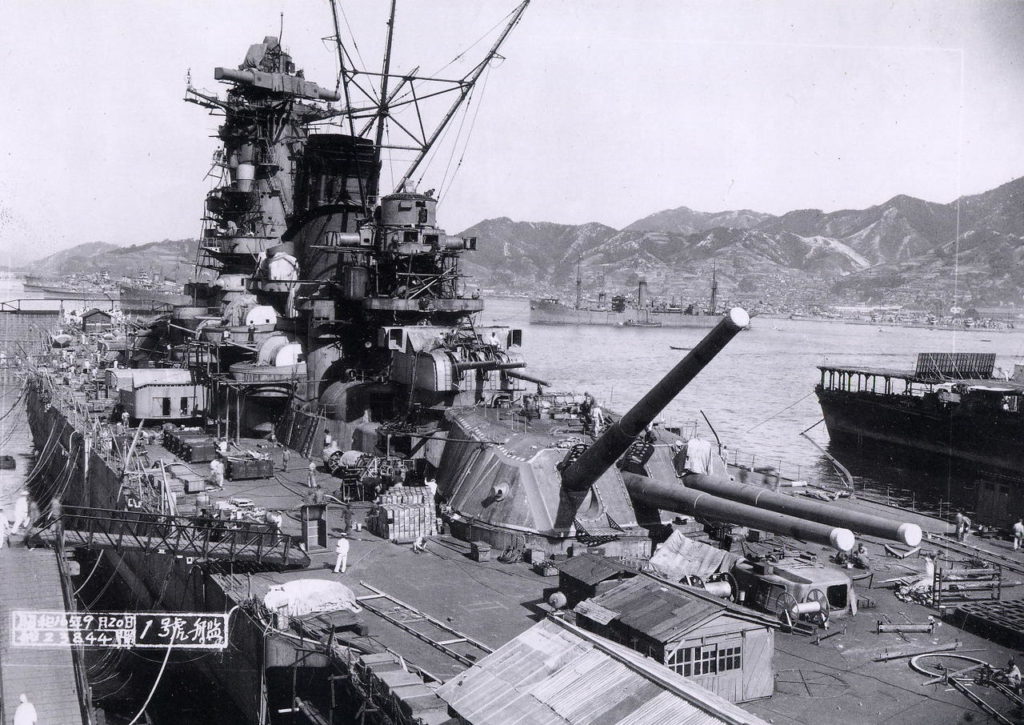
Soon to be the biggest battleship in the
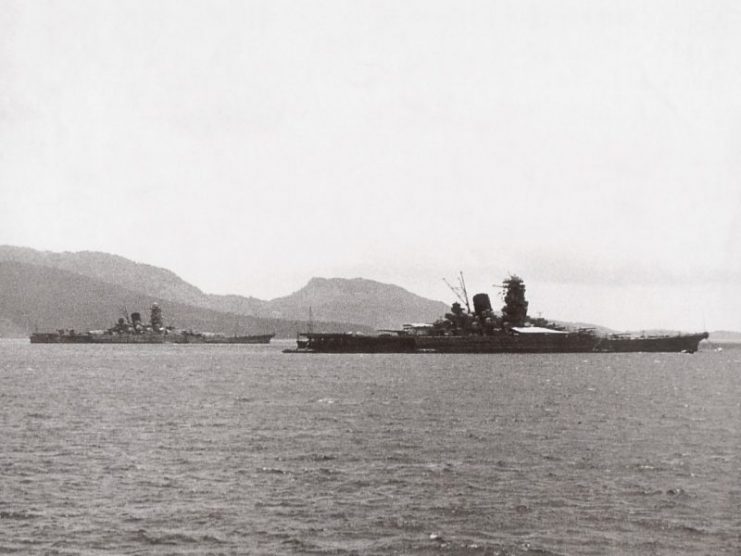
world. Yamato undergoing fitting out at the Kure Naval Arsenal on
September 20, 1941. Her aft 46cm gun turret is easily seen in the
picture.
A popular description of the turrets of the Yamato class is that they
weighed more than a destroyer. At just over 2,730 tons, it is little
surprise that the biggest battleship carried the biggest turrets.
Carrying three guns that weighed over 360,000lbs apiece and a massive
slab of armor that was almost 26″ thick would result in a hefty turret.
However, despite the immense weight of the turret and the massive 18.1″
(46cm) guns inside of it, the overall size was impressively compact.
Compare the turret of the Yamato class with the American Iowa class battleships:
Yamato Class
Iowa Class
Turret Length
56′ 1″
50′ 7 1/2″
Turret Height
13′ 7″
9′ 10″
Turret Weight
2730 tons
1708 tons
Turret Armor Front
25.6″
17″ + 2.5″
Turret Armor Side
9.8″
9.5″ + .75″
Turret Armor Roof
10.6″
7.25″ + .75″
Turret Armor Rear
7.5″
12″ + .75″
Individual Gun Weight
363,000lbs
267,900lbs
Gun Length
69.3′
68′
Rate of Fire
1 round per 35 seconds
1 round per 30 seconds
Loading Angle
3 Degrees
5 Degrees
Elevation Rate
8 Degrees per Second
12 Degrees per Second
Train Rate
2 Degrees per Second
4 Degrees per Second
Despite the larger guns and heavier armor, the Yamato class turret
was not that much larger than that found on the Iowa class. That is an
impressive feat of engineering unto itself.
Even more impressive than the size of the turret was the equipment
inside of it. The Yamato class utilized a unique sliding cradle behind
each gun. The shells, weighing up to 3,218lbs, were lifted up to a tray
at the end of the cradle. The entire cradle then slid forward on rails,
moving the tray to the breech where it would be rammed inside the
chamber. Then, the cradle would retract backwards. This allowed the
powder tray to lift all six powder bags, each weighing 121.25lbs (55kg),
into position behind the breech.
A separate rammer would then ram all six charges into the chamber with a
single stroke. A person would not have to touch any of the powder bags
while loading the gun. This system reduced the number of men working
inside the turret and allowed for an excellent rate of fire of up to one
round per 30 seconds, though 35 seconds was more practical.
The Yamato class enjoyed one of the most compact turrets available to
a battleship despite the fact that it carried the largest naval guns
ever mounted to a battleship. In addition, the layout was excellent and
the equipment inside was superb. A great achievement for Japanese
designers!
As a warship designed to engage the most powerful battleships likely
to be brought against it, the Yamato class featured a tremendous amount
of armor protection. Almost 23,000 tons of armor was used on the Yamato
class and Japanese designers intensively studied the most effective
methods for utilizing this armor.
Armor Class Armour Figures
Belt:
Yamato 410mm (16.1″) Musashi 400mm (16″)
Lower Belt:
200mm (7.9″)
Traverse Bulkheads:
340mm (13.4″) – 300mm (11.8″)
Deck:
200mm (7.9″) – 230mm (9″)
Conning Tower:
500mm (19.7″)
Barbettes:
380mm (15″) – 560mm (22″)
Turrets:
Front:
650mm (25.6″)
Top:
270mm (10.6″)
Sides:
250mm (9.8″)
Yamato class were the first production battleships in Japan to adopt
the “All or Nothing” armor principle. This ensured that Armor was
maximized at the areas that needed it most while it was minimized in
less important areas of the battleship. Therefore, the most vulnerable
areas of the Yamato class (Magazines, machinery) were encased in a
heavily armored box known as a citadel. The citadel was flanked by the armored belt (16″ & angled at 20 degrees) and capped by the armored traverse bulkheads (11.8″ – 13.4″) forward and aft. The upper
section of the citadel was covered by the armored deck (7.9″ – 9″).
This armor scheme was sufficient to provide an immunity zone against
46cm (18.1″) shells at ranges between 21,800 and 32,800 yards. The deck
was designed to resist the momentum of a 1000kg (2200lb) bomb dropped
from 3,400 meters. A monstrous amount of armor to protect from some serious weaponry.
When using the “All or Nothing Principle”, the armor was to be
condensed to the vitals. Japanese designers took this a step further by
seeking ways to make the vitals even smaller, allowing for the armour
protection to be enhanced to its absolute maximum. They succeeding in
shrinking the length of the citadel to a mere 55% of the ship’s overall
length, a remarkable achievement. While this would seemingly leave 45%
of the ship’s hull exposed, Japanese designers countered this by
extensively compartmentalizing with some 1147 different compartments
(1065 below the armored deck). The citadel was also designed to provide
an immense amount of buoyancy, enough to keep the ship afloat even with
the bow and stern heavily flooded. This helped mitigate the effects of
damage to the hull, ensuring that the Yamato class could withstand
damage and keep fighting.
The Yamato class was not just protected against threats above the
waterline, they also featured the greatest underwater protection fitted
to a Japanese battleship. A torpedo belt 5.1 meters (16.7′) deep
protected the ship from torpedoes and mines. The torpedo belt was backed
by the ship’s 200mm lower belt, designed to protect against shells
striking the hull underwater (However, this feature turned out to be a
liability in practice) and act as the main holding bulkhead. Outside of
the ship’s torpedo belt, further protection against flooding was
provided by the extensive compartmentalization mentioned already.
Flooding would be contained to the compromised areas while the rest of
the hull would remain watertight and buoyant. Using her volume,
compartments, and a vast system of pumps, the Yamato class were
expected to withstand a torpedo strike and still return themselves to an
even keel despite the flooding.
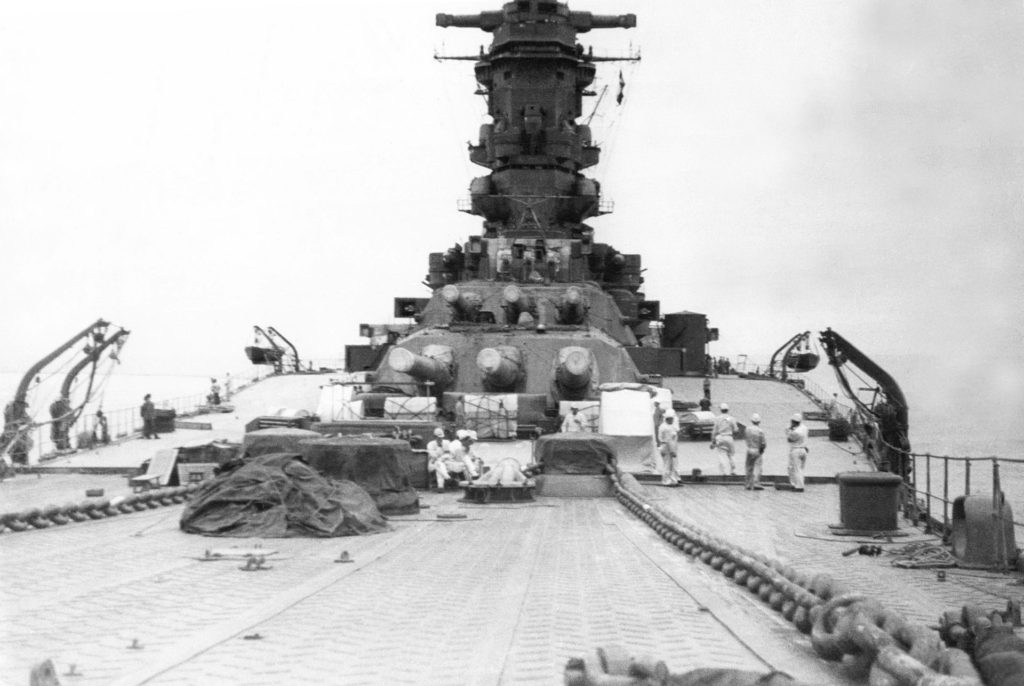
A unique feature of the Yamato class was the gentle slope of the deck
in the vicinity of the forward 46cm turrets. After sloping downwards,
the deck would curve gracefully upwards again all the way to the ship’s
bow.
The bow and forward hull of the battleship Musashi. The slope of her forward deck is easily seen in this photograph.
Don’t let the beautiful lines fool you, the purpose of this bow was
more than aesthetics! The sloping deck helped reduce the height of the
turrets as well as the barbettes they rested on. Each main battery
turret, weighing over 2500 tons, could make the ship very top-heavy if
they were located higher up on the ships’ hull. The deck allowed them to
be lowered. Though the height reduction was modest, maybe only around
10′, it still contributed to the ship’s overall stability.
The deck also helped contribute to the protection of the Yamato
class. By lowering the turret height, the height of the barbettes could
also be lowered as well. This meant a reduction in the barbettes exposed
outside of the citadel, increasing protection. This also saved having
to armor taller barbettes, saving tonnage that could be used for
protection elsewhere on the battleships.
Overall, the use of a sloping deck was not particularly advanced, but
it was extremely effective and a further testament to lengths Japanese
designers were willing to go to enhance the ship’s capabilities.
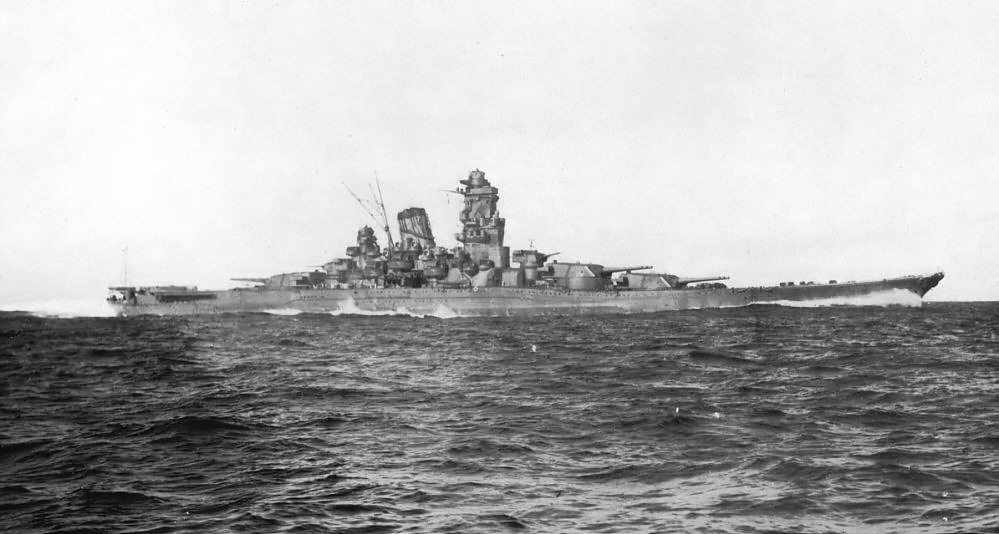
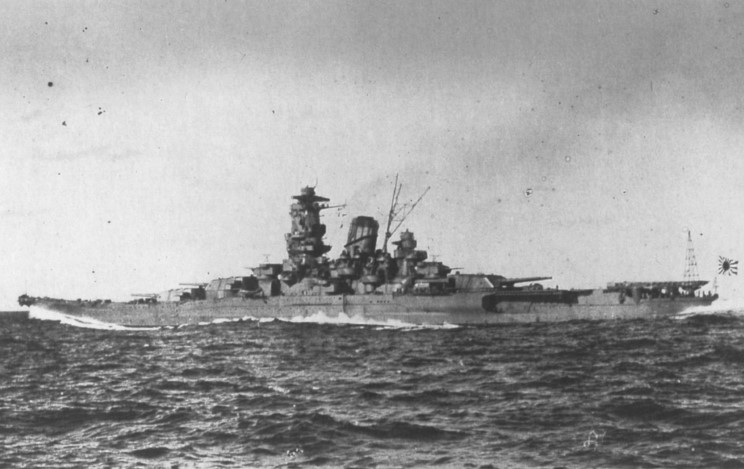
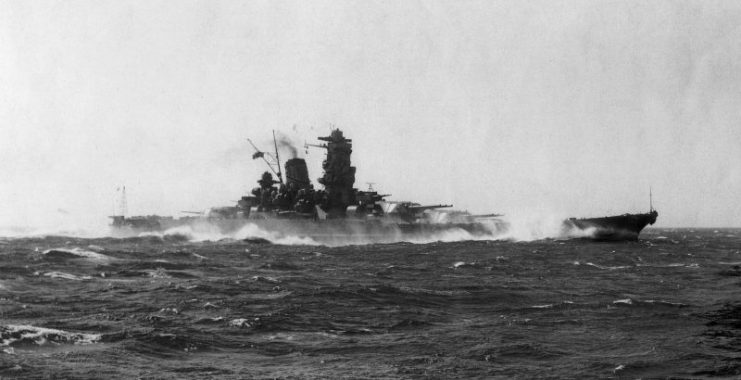
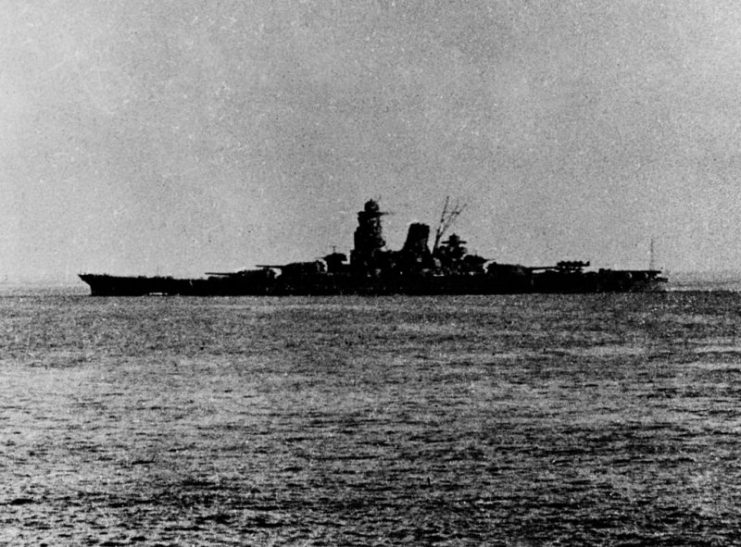
The biggest battleship is also remarkably
agile! Yamato steaming at high speed while she was undergoing trials on
October, 30, 1941.
Despite being the biggest battleship, the Yamato was relatively fast
for her gargantuan size. Generally, the phrase “biggest battleship” and
“fast” do not go well together in the same sentence. However, Japanese
designers successfully managed to squeeze every bit of speed they could
from the class.
Japan started with developing a hull that was as hydrodynamic as
possible. During the development phase, some fifty different models
tested to find the ideal hull shape. Japan went even further and applied
features such as a bulbous bow to further enhance the hull form. The
result was an extremely efficient hull of a design unique among Japanese
dreadnoughts.
The powerplant of the Yamato class was provided by twelve Kampon
boilers supplying steam (of 700 degrees) to four turbines. These
turbines each drove their own shaft connected to a screw of 6m (20′).
Though the system was rated at 150,000shp, Yamato was able to generate
153,553shp on her trials. This was enough to propel the huge battleship
to 27.5 knots. Musashi exceeded this figure when her powerplant reached
166,500shp and drove her to 28 knots.
Yamato
North Carolina
Richelieu
Bismarck
King George V
Powerplant:
150,00shp
121,000shp
155,000shp
148,116shp
110,000shp
Speed:
27.5knots
28 knots
32 knots
30 knots
28 knots
Range:
7200nmi
17400nmi
9500nmi
8870nmi
15600nmi
While the Yamato class would not be setting any speed records, they
were still impressively fast given their size. Even more importantly,
most battleships only enjoyed a knot or so advantage over the Yamato
class.
Overall, the fact the Japanese designers were able to squeeze so much
speed from the Yamato class is a major feat unto itself. Even with
massive guns and incredible amounts of armour protection, the Yamato
class was capable of achieving respectable top speed, making the ships
relatively balanced.
The Japanese Navy placed a lot of thought into the design of the
Yamato class. One area of consideration was the effect that the muzzle
blast of her 18.1″ guns would have upon equipment stored on her decks.
Japanese designers developed several innovative ways to reduce the
damage from muzzle blast. One of the most interesting methods involved
the storage of the battleship’s spotting aircraft and boats.
The stern of the battleship Musashi. Her
aircraft hangar is located between the twin catapults at the stern. The
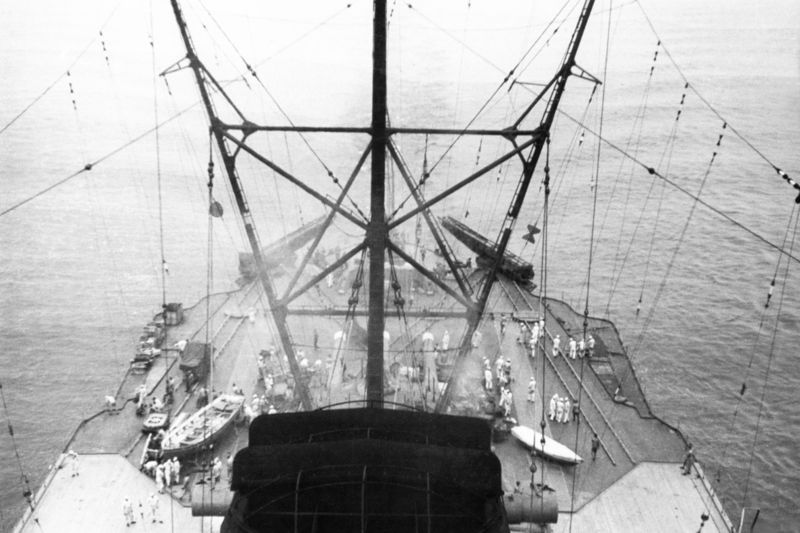
aircraft could also be moved about the deck on a system of rails.The Yamato class utilized a lowered quarterdeck. Aircraft were
stored inside a below-decks hangar where they could be rolled via rails
to a hold located on the quarter deck. From there a crane would hoist
them out and place them on one of the battleship’s catapults or on a
system of rails mounted on the weather deck.
The ship’s boats were stored in no less than four hangars. Smaller
boats were stored in two smaller hangars mounted on either side of the
aircraft hangar. The boats would be rolled on their own system of rails
to the quarterdeck. The same crane that serviced the aircraft would also
handle the smaller boats.
Larger boats were stored in two large hangars mounted inside the
hull. A hatch could be opened that allowed the boats to be moved outside
via an overhead rail and crane system. The overhead system allowed the
boats to be moved outside the hull and lowered into the water directly.
This same system could then be used to lift the boats out of the water
and moved back inside the hull.
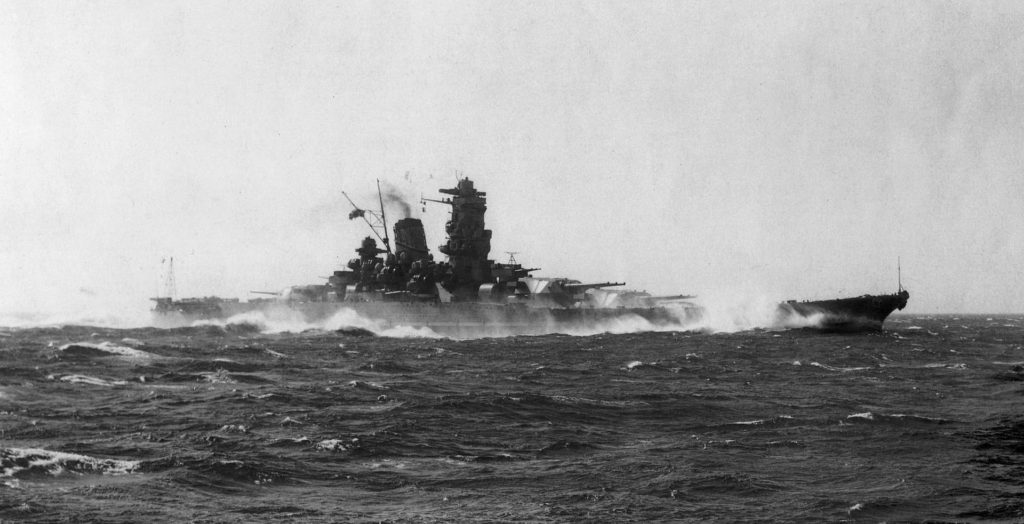
Sea trials of the world’s biggest battleship
at the time. This photo shows off one of the battleship’s boat hangars
located alongside the #3 turret.
Both the ship’s boats and aircraft, safely tucked away inside the
hangars, were granted a significantly higher level of protection than
they would be on other battleships. Though the hangars were mounted
outside the citadel, meaning they were still vulnerable to bombs and
heavy shells, they were still protected against shrapnel, aircraft
gunfire, and the elements. It also allowed the 18.1″ guns to fire
without fear of damaging the delicate equipment.
The placement of the aircraft and boats at the stern allowed for
uncluttered decks. Additional deck space allowed for more anti-aircraft
guns and other equipment to be installed. Other battleships during the
War generally had to give up their ship’s boats to free up space. The
downside to her hangars was that they consumed interior volume. However,
due to the immense size of the Yamato class, the loss of space did not
affect crew accommodations that badly, if at all.
Overall, the Yamato class might have enjoyed the most superior
accommodations for her aircraft or ship’s boats without affecting her
fighting ability
For Yamato and Musashi, they had a lot more going for their design
rather than simply holding onto the title of being the world’s biggest
battleship. They were technological marvels compared to the dreadnoughts
that came before them. Japan’s naval designers gave considerable
thought about the overall design and developed several innovative ways
to better enhance the capabilities of the class. Sadly, the quiet
careers of the ships somewhat overshadows their enormous potential.
Still, the Yamato class hold a special place in the minds of many naval
historian enthusiasts and for good reason!
I atill think that it is funny that me being an Army guy pays attention to Naval history and I have Blogged several times about "Yamato class Battleships". From the historical stuff to the Anime series "Star Blazers" that is known as "Space Cruiser Yamato" and its fight to save Earth.
The largest battleships ever built were Yamato and Musashi of
the Imperial Japanese Navy. These behemoths were triple the tonnage of
some other battleships of their day and each one had three turrets, with
three huge 18.1″ guns per turret. They also mounted numerous smaller
guns to annihilate secondary targets.
They could outrange and
outlast any ship of the line in World War II. Each ship was eventually
sunk by aircraft carrier-based planes, proving that the aircraft carrier
was now the true image of might in any navy during WWII and beyond.
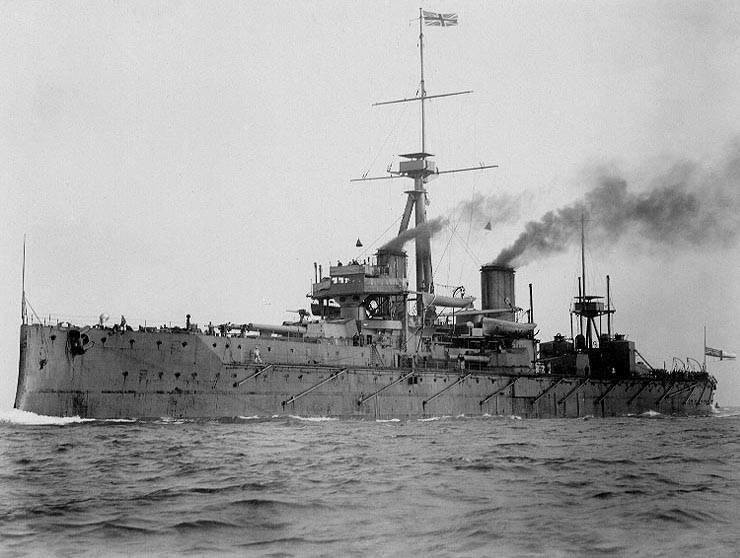
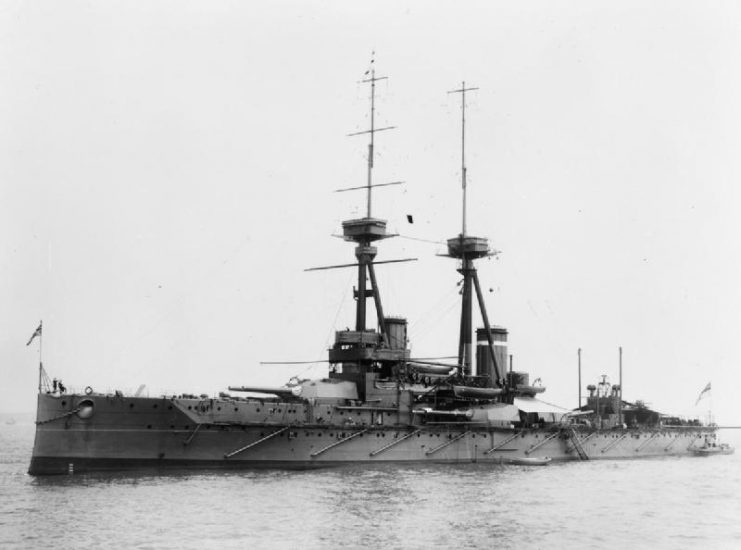
In 1906 the British Royal Navy launched the 18,000 ton HMS Dreadnought. Its revolutionary design heralded the new age of the truly all-powerful “Battleship.
This new breed of battleships had an all steel design with very large
caliber guns in rotating turrets. Despite being heavily armored, their
powerful steam turbines enabled them to be incredibly fast, too.
The concept was quickly adopted by every major nation that could afford it. HMS Dreadnought had
cost the equivalent of what in 2018 would be roughly 151 million
pounds, sparking a huge and expensive arms race, especially between the
British and the Germans.
HMS Dreadnought (British Battleship, 1906) by WWI, she was obsolete by the quick increases in Naval Technology. This
resulted in these two countries entering World War I in 1914 with large
numbers of these cutting edge battleships, and continuing to build more
of them in ever increasing numbers throughout the war.
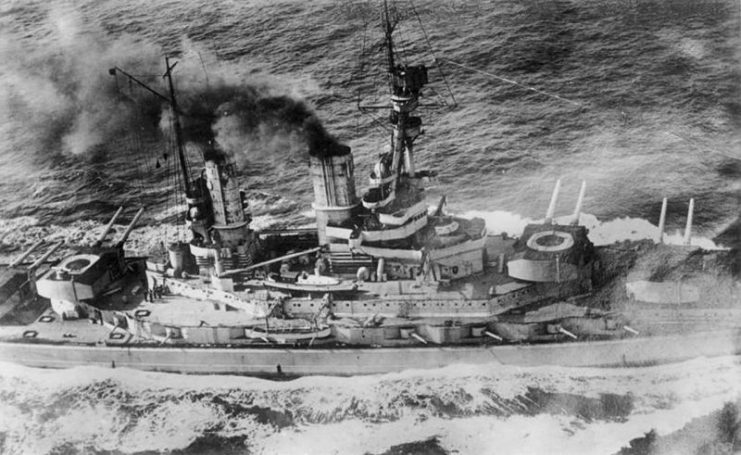
This resulted in even more refined versions, like the Imperial German Battleship SMS Baden, built in 1917, that weighed in at just over 32,000 tons.
SMS Baden Photo by Bundesarchiv, Bild But a fundamental flaw with these highly prestigious and costly war
machines became apparent: the concern that they were almost too valuable
to risk losing in battle.
So for most of the war, neither side
felt confident enough to commit them to a full scale battle. The
exception was at Jutland in 1916, which was and still is the only large
scale battle that involved a large number of battleships.
The
battle itself was inconclusive, due to being fought at very long ranges.
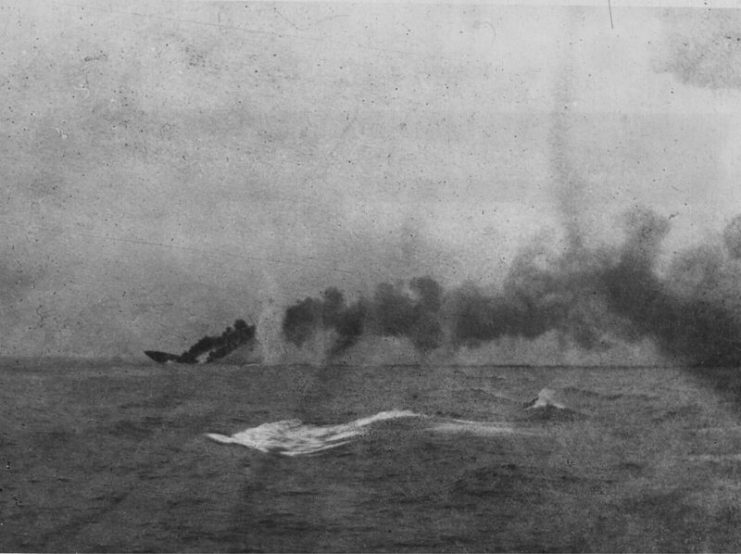
Both sides were hesitant to commit to a full-blown, head-on battle. HMS Indefatigable sinking after being struck by shells from SMS Von der Tann Battle of JutlandWith
the end of the war, large numbers of these battleships were scrapped
due to their formidable operational costs and the amount of manpower it
took to run one of these colossal monsters.
For example, the St. Vincent-class battleship HMS Collingwood needed a crew of 758 to keep her running while at sea. So in 1922, despite being only 12 years old, Collingwood was sold for scrap and sent to the junk yard for disposal. Collingwood at anchor, 1912Throughout the inter-war years, there were several attempts via naval
treaties to try to limit the size and number of battleships each major
nation could have.
Despite this, technology still helped to
further refine the battleship concept. Towards the end of this period,
Germany re-established itself as a naval superpower with such ships as
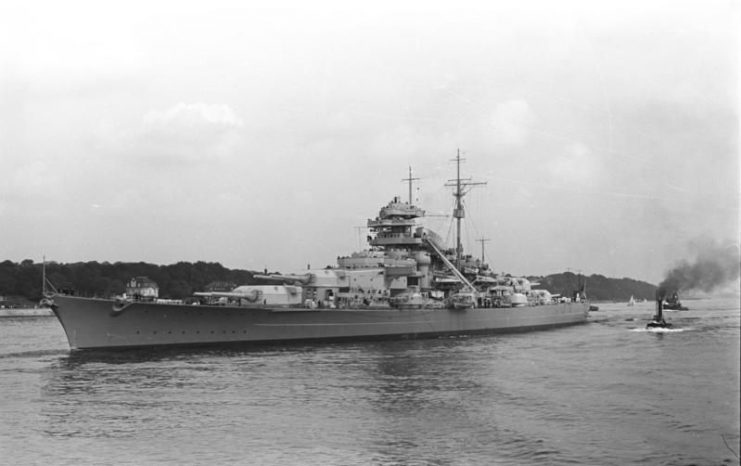
the advanced Scharnhorst (1939) and Bismarck (1940). At the same time, the United States and Japan began emerging as two other naval superpowers. THe BIzmark in 1940. By Bundesarchiv, Bild CC BY-SA 3.0 deBut
at this time, questions were starting to be asked regarding whether
such a valuable asset could survive in a battle environment that
increasingly included aircraft carriers.
For in the 1920’s, the
outspoken US Army officer William Mitchell set out to prove air power in
the form of aircraft carriers could easily destroy the incredibly
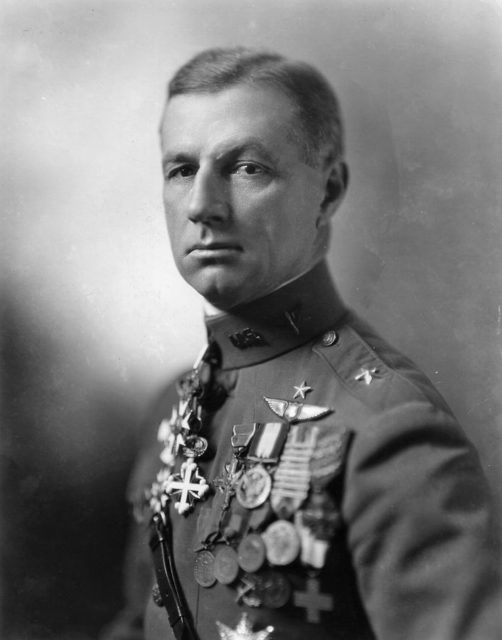
costly battleships. Brigadier General William L. Mitchell, United States Army Air Service.He did end up proving this to a degree when he sank or badly damaged
obsolete battleships in a series of tests. This caused the United States
to start to come around to his way of thinking.
So at a time when
nations were scaling back the production and development of
battleships, why did the Japanese use valuable and scant industrial
capacity to build the two largest battleships ever produced? Yamato and Musashi, the two largest battleships ever built
Japanese
logic for building such ships was to counter the fact that the U.S. had
a numerical superiority in battleships, something Japan could not hope
to match. So they concluded that a bigger and better class of
battleships would counter the numerical advantage that the Americans
had.
Thus, they came up with the Yamato class of Japanese battleships. This class ended up comprising just two ships: Yamato and Musashi. The Fuji, a member of the Fuji-class battleships of the Japanese Imperial Navy
There was a third ship, but as soon as WWII started, realization
dawned that aircraft carriers were what was going to win the Pacific
war. Therefore the Japanese decided they would convert the third
battleship before it was finished. It would become the Shinano, the largest aircraft carrier in the world at that time.
Another reason for going ahead initially with the Yamato
class of battleships was Japan’s ingrained respect for such ships. They
recalled with pride the Battle of Tsushima in 1905, which became
legendary after the Japanese fleet had crushed the Imperial Russian
fleet.
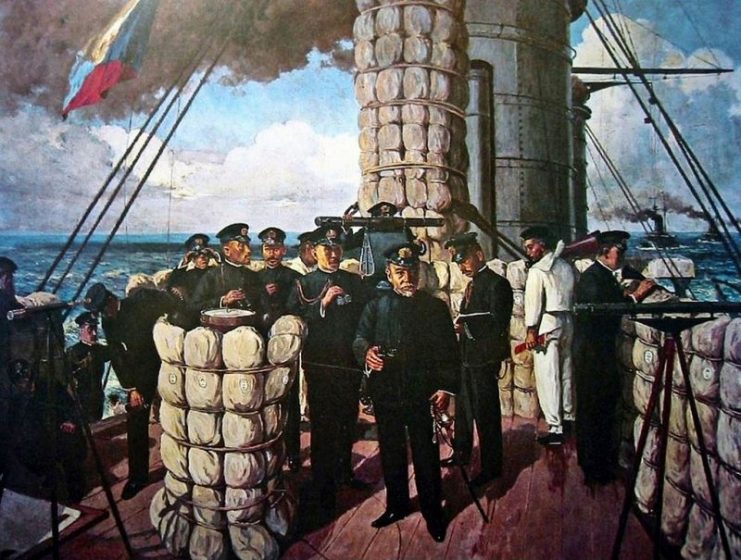
Admiral
Tōgō on the bridge of Mikasa, at the beginning of the Battle of
Tsushima in 1905. The signal flag being hoisted is the letter Z, which
was a special instruction to the Fleet.At the
center of that historic victory was the concept of using battleships
that were heavily armored and fast, and that had large caliber main
batteries.
Battle of Tsushima (1905)
Major Casualties/Losses
Imperial Russia
Japanese Empire
Battleships
7 lost, 4 surrendered
–
Cruisers
4 lost
–
Destroyers
6 lost
–
Total Tonnage Sunk
126,792 tons
*450 tons
Killed
Between 4,000 to 6,000
Around 110
Captured
Nearly 6,000
–
*3 torpedo boats sunk
It is easy to see why such a decisive victory might influence thinking in the Japanese Navy for decades to come.
Although
the big battleship concept was an important influence on Japanese Navy
planning in the inter-war years, nevertheless the Japanese Navy was also
forward-thinking, and started to build aircraft carriers as far back as
1921.
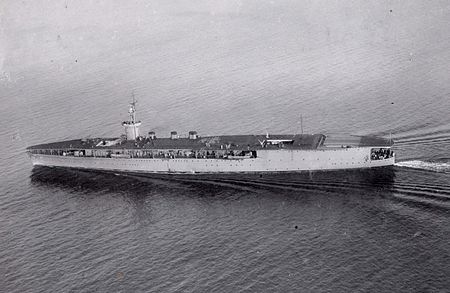
During the 1920’s Japan built Hosho, Kaga, and Akagi, and during the 1930’s they built seven more aircraft carriers.
Aerial view of Hōshō as completed in December 1922The
British raid on the Italian fleet at Taranto in 1940 was said to have
influenced Japan’s attack on Pearl Harbor. The latter attack sank or
damaged many U.S. warships including four battleships, as well as
destroying large numbers of aircraft.
As if Pearl Harbor was not
enough to vindicate the belief in the air-power that aircraft carriers
could provide, just three days later Japanese aircraft attacked the
British Z Force, sinking a battleship and a battlecruiser with very few
casualties of their own.
Early Carrier Air Power Victories
Attacker/Target
Date
Attacker’s Aircraft losses
Target’s losses
Battle of Taranto
Great Britain/Italy
Nov 12th 1940
2
3 Battleships damaged
Pearl Harbour
Japan/USA
Dec 7th 1941
29
4 Battleships sunk 4 Battleships damaged
Attack on Force Z
Japan/Great Britain
Dec 10th 1941
6
1 Battleship Sunk 1 Battlecruiser
For
the rest of the war, the Japanese concentrated on building as many
aircraft carriers as it could, as well as converting a number of
existing or near completed ships into aircraft carriers. The fact of the
matter is after the two Yamato-class battleships were completed, Japan never built another battleship ever again.
Yamato during sea trials off Japan near Bungo Strait, 20 October 1941.As for Yamato and Musashi,
the design for these ships had been finalized in 1937, after a
protracted and detailed examination of twenty-four very different and
modern design proposals. Yamato was laid down in November
1937 and was commissioned into service on December 16, 1941, just days
after Japanese carrier-based planes had successfully attacked both Pearl
Harbor and Z Force. Therefore Yamato arrived in service at a time when events were starting to raise questions about the usefulness of battleships.
Musashi leaving Brunei in October 1944 for the Battle of Leyte GulfYamato‘s sister ship Musashi
was laid down in March 1938 and was commissioned into service on August
5, 1942. Thus both ships entered service after each taking over four
years to build.
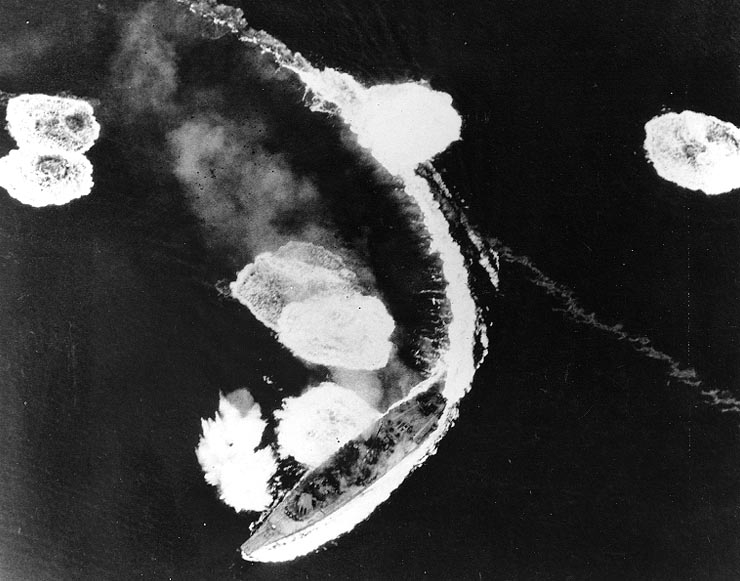
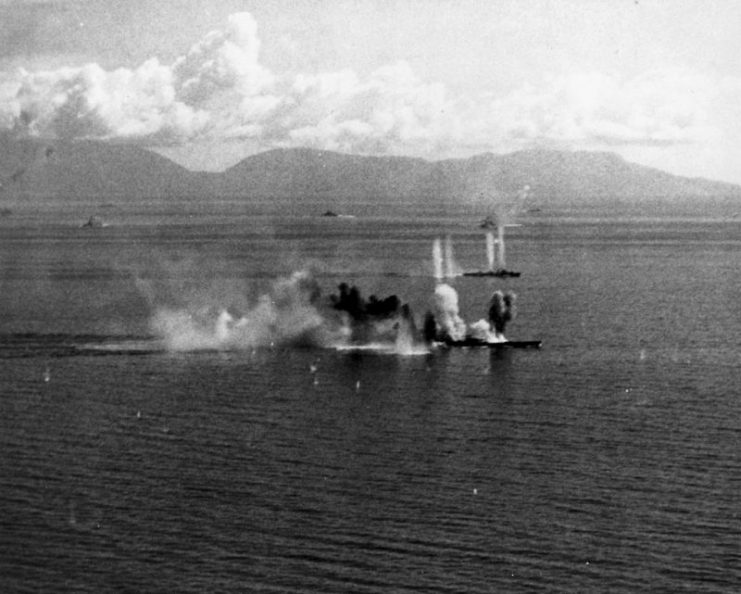
Yamato under attack off Kure on 19 March 1945To
show you how much naval air warfare had progressed in that short time,
in 1937 the British Navy was using 150 mph Blackburn Shark biplane
torpedo bombers that could carry an 18-inch torpedo or 1,600 lbs of
bombs.
By the time Musashi was commissioned in 1942, the
U.S. Navy was using the 275 mph Grumman TBF Avenger torpedo bomber that
could be armed with either a 22.5-inch torpedo or 2,000 lbs of bombs.
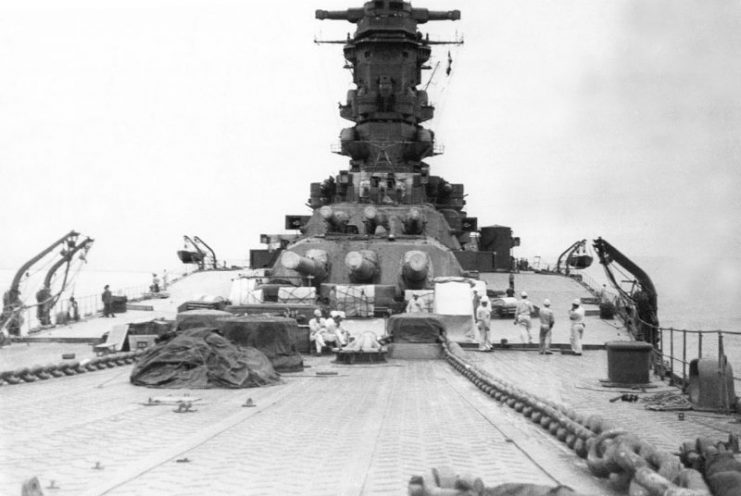
Musashi, August 1942, taken from the bowThis rapid aircraft development caught the Yamato-class battleships by surprise. Initially, Yamato had only 28 anti-aircraft guns when commissioned in 1941. The Musashi,
commissioned a year later, incorporated lessons learned from recent
events regarding air defenses, and came into service with 40 AA guns.
With aircraft carriers now dominating the Pacific theater, by 1945 the Yamato had no less than 166 AA guns!
Landmark Battleships
Nationality
Year
Tonnage
Main Gun
Length
Crew
Speed
HMS Dreadnought
British
1906
18,410
10 x 12 inch
527
750
24 mph
SMS Baden
German
1917
32,200
8 x 15 inch
590
1,271
24 mph
Bismarck
German
1941
41,700
8 x 15inch
823
2,065
34mph
Yamato
Japanese
1941
65,027
9 x 18 inch
862
2,650
31 mph
South Dakota
American
1942
35,600
9 x 16inch
680
2,364
31mph
*HMS Darling
British
2009
8,500
1 x 4.5 inch
500
191
35 mph
*For comparison The UK largest Major Surface Combat Ship in service today (2018)
The Yamato-class
ships were truly breathtaking in their scale and armament. When fully
loaded they each weighed an incredible 72,000 tonnes and were fitted
with the largest guns ever carried by a battleship. Each one had a main
armament of 18.1-inch guns capable of firing 3,220-lb shells over 26
miles. Their turrets had armor over 25 inches thick.
The ships had
been built in secret and amazingly, the Allies were totally unaware of
their existence until 1942. U.S. Intelligence was shocked that ships
like this could have been built without their knowledge.
Yamato and Musashi in the war
But
the Japanese quickly became afraid to deploy these new battleships,
even being reluctant to allow them out to do patrols. The Japanese High
Command was forever fearful of Allied submarines or aircraft carriers
attacking them. Also later on in the war, there was simply not enough
fuel available to run them regularly, so both ships spent most of the
war inactive, berthed at various “safe” naval bases.
This fear and hesitation was further reinforced when Yamato was badly damaged by the U.S. submarine Skate in December 1943. Then in March 1944 Musashi was damaged by the U.S. submarine Tunny. Yamato hit by a bomb during the Battle of the Sibuyan Sea on 24 October 1944; the hit did not produce serious damageBut by late 1944 the Japanese Navy was forced to deploy the battleships, both out of necessity and desperation. Thus Yamato and Musashi
participated in the Battle of the Philippines on June 19-20, 1944, but
this was primarily a carrier to carrier battle and neither battleship
saw any real action.
Then on October 23-26, 1944 Yamato took part in the Battle of Leyte Gulf and for the first time saw real combat. During the battle, Yamato managed to help sink the escort carrier USS Gambier Bay and the destroyer USS Johnston.
But the Yamato herself was badly damaged by aircraft from the U.S. carriers Intrepid and Cabot, though she did manage to return to port. Musashi under attack by American carrier aircraft during the Battle of Leyte Gulf.Musashi was less fortunate and was attacked by several waves of aircraft from various aircraft carriers including the Intrepid, Cabot, Essex, Lexington, Enterprise, and Franklin. Finally, after multiple torpedo and bomb hits, the Musashi sank, taking nearly half of her crew of 2,399 men with her. In her short wartime career, Musashi did not sink or damage any Allied shipping.
As for Yamato,
it did not venture out again until April 1945, when Nazi Germany was on
the eve of surrender in Europe. Japan sent out a large fleet of
warships headed by Yamato to attack Allied shipping engaged in
the Battle of Okinawa. It was an act of desperation that was almost
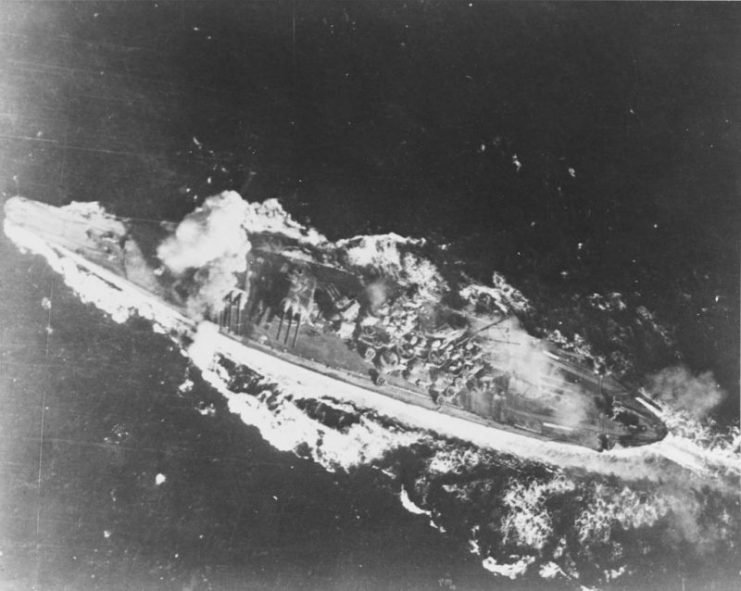
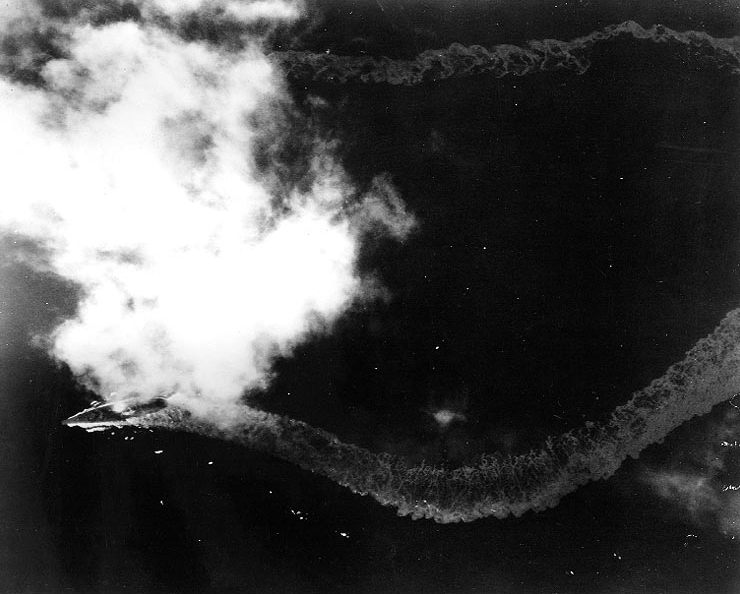
suicidal since the task force had little to no air cover. Yamato steering to avoid bombs and aerial torpedoes during Operation Ten-GoThe Americans intercepted the Japanese force with hundreds of bombers
and torpedo bombers, launching wave after wave of aerial attacks. It was
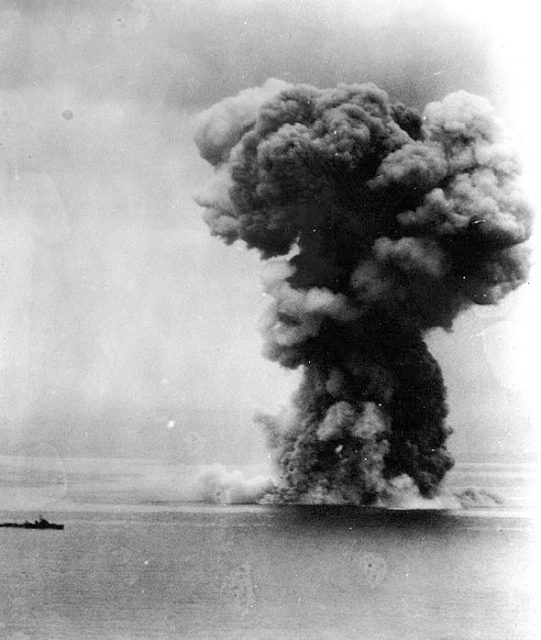
an onslaught, and it took the Americans just over 100 minutes to sink Yamato. Ninety percent of Yamato’s crew was killed, including fleet commander Vice-Admiral Seiichi Itō.The explosion of Yamato’s magazinesAfter WWII battleships were quickly phased out. All 4 of the United States’ Iowa-class battleships lingered in service on and off until 1992, when the era of the battleship finally faded into history. There is talk about bringing the Iowa class ships back into service, if I recall 2 of the ships have to be kept in "deployable status". meaning that they can be brought back into service if needed.
I am stuck at home, I had a medical procedure performed that did not go as planned so I will have a more invasive procedure done later this year to correct the problem. I was planning on going to the NRA convention this year but I had to have this procedure done instead. It had to do with timing. I could have waited and had the procedure done later, but it would put me into the summer schedule and there is a LOT of overtime in that so I had to forgo the NRA trip I wanted to do and meet all the people that I blog with. I am hoping there will be another city mentioned soon and what dates so I can make sure that my calender is clear.
So anyway I am stuck at home, and we got a "smart" tv for Christmas and I discovered I could use it in conjunction with my smart phone and watch videos that I find on my phone, play them through the TV with the "YouTube" app. So here I was bored silly, having to stay seated in the recliner, well I was surfing Star Trek TV shows, especially the remastered Original series with the "Doomsday Machine"
You Tube is really cool, what can I say. I also watched clips from the Star Trek II The Wraith of Khan, I consider it the best of the movies that involved the original series.
It had good and bad guys, Starships shooting at each others, an excellent soundtrack, it had action, adventure, a Horatio Hornblower in Space kinda thing. Star Trek II: The Wrath of Khan is a 1982 American science fictionadventurethriller film released by Paramount Pictures. The film is the second feature based on the Star Trek science fiction franchise. The plot features Admiral James T. Kirk (William Shatner) and the crew of the starship USS Enterprise facing off against the genetically-engineered tyrant Khan Noonien Singh (Ricardo Montalbán), a character who first appeared in the 1967 Star Trek television series episode "Space Seed". When Khan escapes from a 15-year exile to exact revenge on Kirk, the crew of the Enterprise must stop him from acquiring a powerful terraforming device named Genesis. The film concludes with the death of Enterprise's captain, Spock (Leonard Nimoy), beginning a story arc that continues with the 1984 film Star Trek III: The Search for Spock and concludes with 1986's Star Trek IV: The Voyage Home.
Well I went from Star Trek to "Star Blazers" A Japanamation cartoon that I saw in the late 70's. I really loved that series and saw both seasons. There was a 3rd season that was released only in Japan, I was watching those also.
Well I went and watched several episodes of "Star Blazers" which was called "Space Cruiser Yamato" in Japanese. Well something youtube does is put up video's in the Que for you to watch based on the interest you have typed in. Well there was a movie made in Japan called " The Mens Yamato". It was about 2 hours long and it was really well done. I spend the time seeing a different view, and yes it did show the draconian discipline that the Japanese Military was known for from its petty officers to the rated seamen. The story starts about a young Japanese women that wants to go to the location of the Yamato sinking, later in the movie, it was to return her fathers ashes to join his shipmates that have died there, kinda like what the U.S.S. Arizona survivors do when they die, they frequently ask to have their ashes released into the water where their shipmates died. The story talks about the bond of loyalty people have for their ship and shipmates. A very well done movie.
Yamato(大和?), named after the ancient Japanese Yamato Province, was the lead ship of the Yamato class of battleships that served with the Imperial Japanese Navy during World War II. She and her sister ship, Musashi,
were the heaviest and most powerfully armed battleships ever
constructed, displacing 72,800 tonnes at full load and armed with nine
46 cm (18.1 inch) main guns. Neither ship survived the war.
Laid down in 1937 and formally commissioned a week after the Pearl Harbor attack in late 1941, Yamato was designed to counter the numerically superior battleship fleet of the United States, Japan's main rival in the Pacific. Throughout 1942 she served as the flagship of the Japanese Combined Fleet, and in June 1942 Admiral Isoroku Yamamoto directed the fleet from her bridge during the Battle of Midway, a disastrous defeat for Japan. Musashi took over as the Combined Fleet flagship in early 1943, and Yamato spent the rest of the year, and much of 1944, moving between the major Japanese naval bases of Truk and Kure in response to American threats. Although she was present at the Battle of the Philippine Sea in June 1944, Yamato played no part in the battle.
The only time she fired her main guns at enemy surface targets was in
October 1944, when she was sent to engage American forces invading the
Philippines during the Battle of Leyte Gulf.
The Japanese were unaware that Admiral Halsey's entire massive fast
carrier task force with battleships had been successfully lured away by a
feint. Left behind was only a slow escort carrier task force armed against ground forces with no hope of protecting vulnerable troop transports from the Yamato.
But as the American light ships resembled larger cruisers and carriers,
the Japanese believed they were fighting the main fleet. The massive
guns of Yamato would not be turned against battleships, but in the Battle off Samar
would instead be a seemingly mismatched showdown against the industrial
production of small and inexpensive light ships and carriers.
Nevertheless desperate sailors and aviators delivered accurate 5 in
shellfire and torpedoes from ships as small as destroyer escorts.
These attacks wrought enough havoc on the Japanese surface force to
turn them back, but only after inflicting losses comparable in ships and
men to the Battle of Midway.
During 1944, the balance of naval power in the Pacific decisively
turned against Japan and, by early 1945, the Japanese fleet was much
depleted and critically short of fuel stocks in the home islands,
limiting its usefulness. In April 1945, in a desperate attempt to slow
the Allied advance, Yamato was dispatched on a one way voyage to Okinawa,
where it was intended that she should protect the island from invasion
and fight until destroyed. The task force was spotted south of Kyushu
by US submarines and aircraft, and on 7 April 1945 she was sunk by
American carrier-based bombers and torpedo bombers with the loss of most
of her crew.
From the time of their construction, Yamato and her sister Musashi
carried significant weight in Japanese culture. The battleships
represented the epitome of Imperial Japanese naval engineering, and
because of their size, speed, and power, visibly embodied Japan's
determination and readiness to defend its interests against the Western Powers and the United States in particular. Shigeru Fukudome, chief of the Operations Section of the Imperial Japanese Navy General Staff,
described the ships as "symbols of naval power that provided to
officers and men alike a profound sense of confidence in their navy."Yamato's
symbolic might was such that some Japanese citizens held the belief
that their country could never fall as long as the ship was able to
fight.
Decades after the war, Yamato was memorialised in various
forms by the Japanese. Historically, the word "Yamato" was used as a
poetic name for Japan; thus, her name became a metaphor for the end of
the Japanese empire. In April 1968, a memorial tower was erected on Cape Inutabu in Japan's Kagoshima Prefecture to commemorate the lives lost in Operation Ten-Go. In October 1974, Leiji Matsumoto created a new television series, Space Battleship Yamato,
about rebuilding the battleship as a starship and its interstellar
quest to save Earth. The series was a huge success, spawning five
feature films and two more TV series; as post-war Japanese tried to
redefine the purpose of their lives, Yamato became a symbol of heroism and of their desire to regain a sense of masculinity after their country's defeat in the war. Brought to the United States as Star Blazers, the animated series proved popular and established a foundation for anime in the North American entertainment market. The motif in Space Battleship Yamato was repeated in Silent Service,
a popular manga and anime that explores issues of nuclear weapons and
the Japan-US relationship. The crew of the main plot device, a
nuclear-powered super submarine, mutinied and renamed their vessel Yamato, in allusion to the World War II battleship and the ideals she symbolises.
In 2005, the Yamato Museum was opened near the site of the former Kure shipyards. Although intended to educate on the maritime history of post Meiji-era Japan,
the museum gives special attention to its namesake; the battleship is a
common theme among several of its exhibits, which includes a section
dedicated to Matsumoto's animated series. The centrepiece of the museum, occupying a large section of the first floor, is a 26.3-metre long model of Yamato (1:10 scale).
Later that year, Toei released a 143 minute movie, Yamato, based on a book by Jun Henmi, to commemorate the 60th anniversary of the end of World War II; Tamiya released special editions of scale models of the battleship in conjunction with the film's release.
Based on a book of the same name, the film is a tale about the sailors
aboard the doomed battleship and the concepts of honour and duty. The
film was shown on more than 290 screens across the country and was a
commercial success, taking in a record 5.11 billion yen at the domestic box office.
I have been binge watching "Space Battleship Yamato 2199", it is basically an updated "Space Cruiser Yamato" of the 1970's fame, the graphics are much better and the storyline is different. So it is interesting.
I still think it is strange that an Army guy likes Navy ships...especially old Navy ships...
I shamelessly clipped this from the "Navy General Board"
A stretched Iowa with an extra turret. A ship designed to kill the
Yamato class. Many myths surround the Montana class, the immensely
powerful super battleships of the United States Navy. Designed to be
larger and more powerful than any previous dreadnought, these ships
would have been the most powerful dreadnoughts of their time. However,
the ships were never built. This has led to many speculations about the
ships. In this Navy General Board article, we breakdown some of the more common myths and set the record straight!
Myth #1: The Montana class Ignored the Panama Canal Restrictions
The Montana class was the first battleship designed to ignore the
restrictions imposed by the Panama Canal locks. Prior to them, all
United States battleships had to be able to fit through the 110′ locks
of the Panama Canal. The immense size of the Montana class was in
response to the dropped requirement to fit through the locks.
The Truth
One of the common misconceptions about the Montana class battleships
is that they were to ignore the Panama canal restrictions. This is only
partially true. In realty the US was planning on expanding the Panama
Canal locks to 140ft. Construction was meant to be completed around the
same time that the Montana ships would come into service. The ability to
quickly send ships through the Panama Canal was an advantage that the
US was unwilling to part with. The fact that the canal locks were going
to be enlarged was likely a big reason why the US Navy finally designed
the Montana class.
While the Montana might have ignored the Panama Canal restrictions, they
were bound by another equally important size requirement.
A little known fact is that the US Navy placed almost as much
importance on being able to travel underneath the Brooklyn bridge as
they did the Panama Canal. The height of the bridge at low tide was an
important design consideration for ship design. This was because the New
York Naval yard was one of the largest naval bases at the time. It was
also one of the largest naval repair facilities available. The Navy
needed all ships to be able to travel to that yard and the Brooklyn
bridge was the largest obstacle blocking the way to the yard.
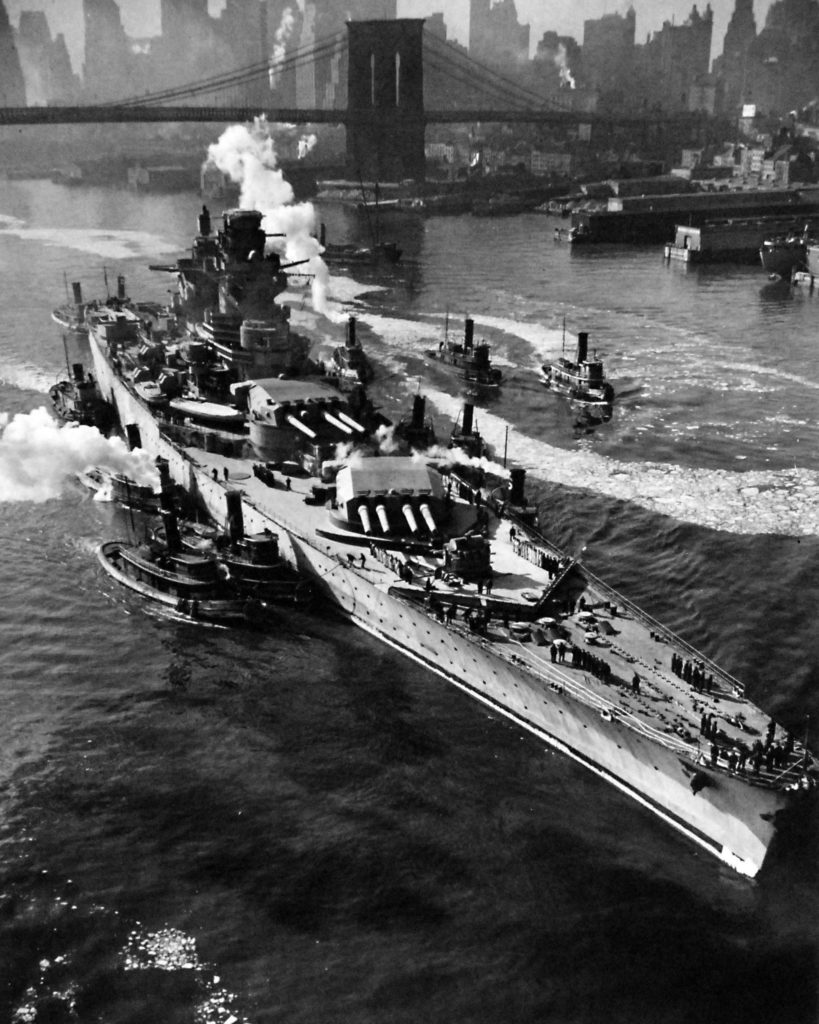
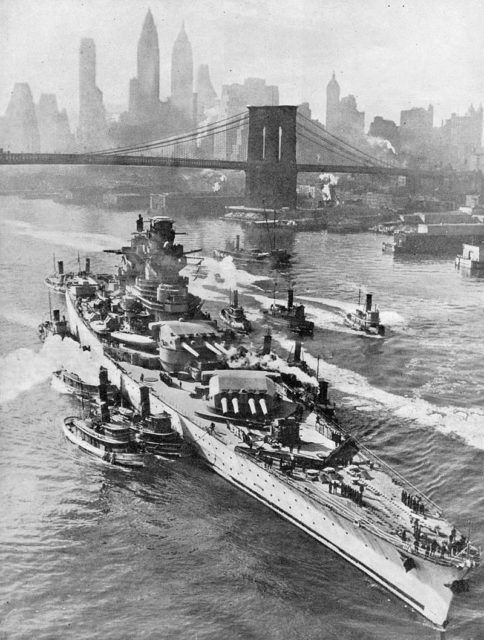
The Battleship Richelieu
arrives in New York for Repairs. Note that the top of the fire control
tower has been removed so that it can pass under the Brooklyn bridge.
All US Battleships were designed in such a way that they could easily
pass under this bridge. The Montana class would not have been any
different.
Myth #2: The Montana was Designed to Counter the Yamato
Another big misconception about the Montana class was they were
“Yamato killers”. Yes, They were the only other battleship capable of
engaging the Yamato on equal terms. Also, the Yamato was known
(Somewhat) to the US Navy at the time of the Montana’s design. However,
what the US Navy thought they knew about the Yamato was a far cry from
what it actually was at the time.
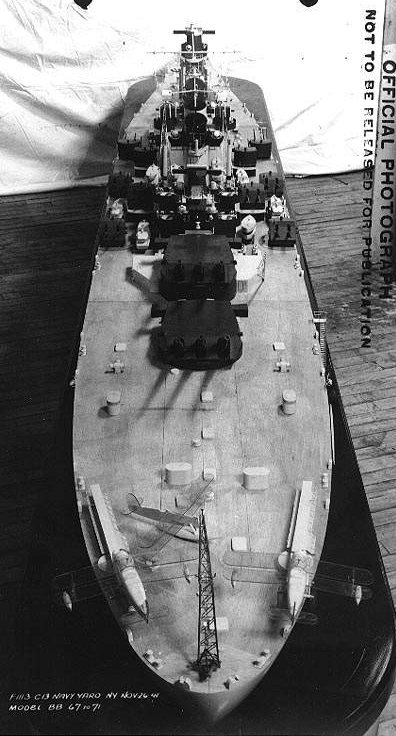
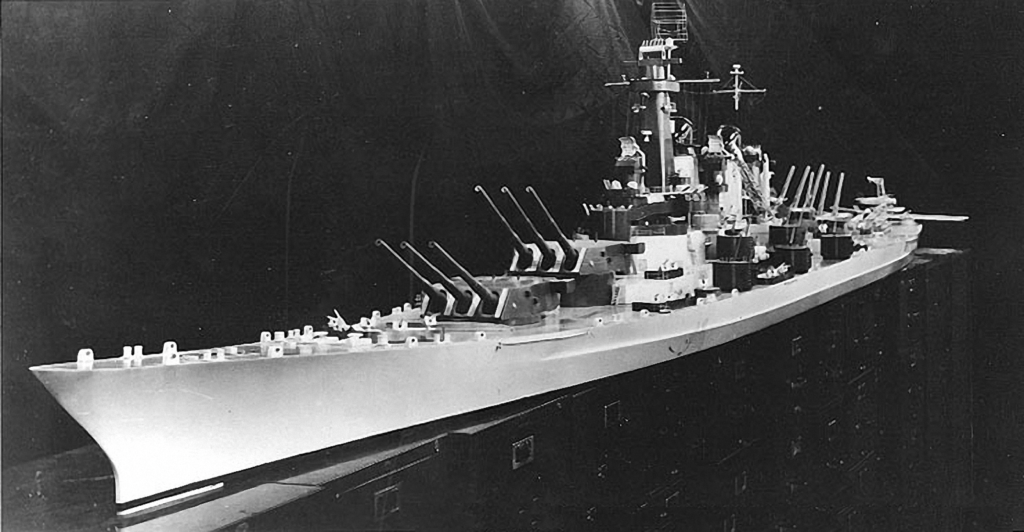
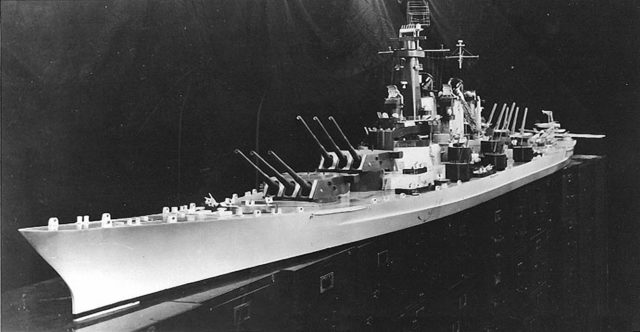
A model of the Montana class
super battleships. Though similar in appearance to the Iowa class,
several important differences separated the two classes.
The Truth
It would be a long time before the US had a grasp of the Yamato’s
capabilities. When design started in 1938, the Yamato was believed to be
a battleship of typical size and armament. In 1936, a US received
reports that Japan was building ships up to 55,000 tons.
A few years later in 1938, reports stated that Japan was building two 16″ heavy battleships with two more on the way. Over the course of the war, new evidence slowly allowed the navy to better understand what it was that it was up against. By
1944, interviews with captured Japanese personnel revealed that the
Yamato class carried 18″ guns. Finally, It wasn’t until late 1944/1945
that the US navy finally had a grasp of the accurate specifications of
the Yamato class.
Since the design of the Montana class began in 1939, this proves
without a doubt that the Montana class wasn’t designed to counter the
Yamato.
So if the Montana wasn’t designed to counter the Yamato, why was it
so large? It is largely because the ship was designed to withstand the
firepower of its own guns. The 16″/50 cannon when coupled with the
“super heavy” 2700lb shell could have been the finest battleship gun
ever to see service. At long ranges, its penetration power was almost
that of the larger Japanese18.1″ shell. Due to this similarity, the fact
that the Montana was so well protected against the Yamato’s mighty
18.1″ guns was really a happy/lucky accident.
The other contributing factor was that the US wanted a battleship
more powerful than anything its adversaries was likely to use. A ship
more powerful than the vessels preceding it, the Bismarck class of
Germany, the Nagato class of Japan, and so on. An almost impractically
large ship to dominate all others. In some ways the US didn’t believe
anyone else would construct such a large ship. Unknown to the US, Japan
had the exact same thoughts when designing the Yamato. The Montana class
and the Yamato class were the premier super battleships of their
respective navies.
Myth #3: The Montana was basically a larger Iowa Class Battleship
Probably one of the most common myths found across various forms of
media today. Perhaps its because of the visual similarity of the two
classes. Perhaps it is due to the similar choice in armament at first
glance. Many claim that the Montana class was simply a larger Iowa class
battleship with an extra turret added.
The Truth
The belief in the connection between the Iowa and Montana classes
likely stems from their similar appearance and use of the same main
armament. However, examination of their design features shows two very
different ships for two different roles.
Firepower
It is true that the Iowa and Montana class battleships shared the
same 16″/50 main armament. A remarkably powerful weapon for its size,
the United States Navy did not need to introduce a heavier weapon. While
the United States had already developed naval gun of 18″, the lower
weight of the 16″/50 allowed more of them to be carried. The twelve guns
of the Montana class would have given them the heaviest broadside of
any battleship then in service.
Outside of the main guns, the Montana class also differed from the
Iowa class in the choice of secondary armament. While still utilizing
twenty 5″ guns in ten twin mounts, the Montana class would have carried a
more powerful 5″/54 model rather than the older 5″/38. Firing a heavier
shell at a higher velocity, the Montana class would have enjoyed much
greater anti-surface firepower than the Iowa class.
Armor
Armoring is the largest difference between the two classes. The Iowa
class ships used an internal armored belt inherited from the proceeding
South Dakota class. This brought the armored belt inside the hull and
was done as a weight saving measure, helping the ships achieve their
famous speed. However, shells striking this belt first penetrated the
outer hull. This had the unwelcome effect of potentially flooding the
void space between hull and belt for shots that hit at or below the
waterline. The Montana design didn’t have to follow weight restrictions
and so reverted back to a traditional external belt where the armor was
on the outside of the hull. This ensured that potential damage was
outside of the hull and that watertight integrity would remain intact.
Perhaps the most important difference is, unlike the Iowa class, the
Montana was protected from its own guns. This armoring style reflects
the design philosophies behind the two ships. The Iowa was meant to be a
fast interceptor to guard against cruisers and fast battleships. The
Montana class was designed to participate with the main battle line and
engage in furious gunnery duels with multiple battleships.
Speed
After armor, speed shows another sizable difference between the classes. The Iowas were designed to be high speed 32 knot battleships to act as protection to the carrier fleet. While designers
considered making the Montana class faster, they decided that firepower
and armor were more important for the design. Thus, the Montana was
limited to a speed of 28 knots like the 27 knot North Carolina and South
Dakota classes. The Montana class were not fast enough to keep pace
with carriers at their highest speeds, but more than fast enough to
operate with other battleships making up the United States battle line.
Overall, the Montana was a vastly different warship compared to the
Iowa class. The design reflects the role that they were intended for, a
heavily armed and armored warship capable of taking on anything else
that it might encounter.
Final Thoughts
The Montana class battleships would have been one of the most
powerful dreadnaughts ever to be launched, rivaled only by the Yamato
class battleships. However, like the Yamato, the tiger tank, or many
other of the “wonder weapons” created during the Second World War, a
certain aura of myth has been built around them. They weren’t ultimate
weapons conjured up to single handedly win the war, just simple units
designed to fill a role particular role in warfare. Unfortunately for
the Montana class, the role of the battleship in warfare was in its
twilight phase. They were to be built right when the battleship was no
longer the glorious warship it once was. The result was that the
greatest battleship ever was never laid down.
I was surfing around and ran across this article on the Internet. I have blogged about Battleships in the past, like I have stated, funny that an Army guy likes Navy ships. I figured this would be a good article for my blog collection on Battleships.
Artist’s impression of the Montana class Battleship
Myth #1: The Montana class Ignored the Panama Canal Restrictions
The Montana class was the first battleship designed to ignore the restrictions imposed by the Panama Canal locks.
The Truth
One of the common misconceptions about the Montana class battleships
is that they were to ignore the Panama canal restrictions. This is only
partially true. In realty the US was planning on expanding the Panama
Canal locks to 140ft. Construction was meant to be completed around the
same time that the Montana ships would come into service. The ability to
quickly send ships through the Panama Canal was an advantage that the
US was unwilling to part with. The fact that the canal locks were going
to be enlarged was likely a big reason why the US Navy finally designed
the Montana class.
While the Montana might have ignored the Panama Canal restrictions,
they were bound by another. A little known fact is that the US Navy
placed almost as much importance on being able to travel underneath the
Brooklyn bridge as they did the Panama Canal. The height of the bridge
at low tide was an important design consideration for ship design. This
was because the New York Naval yard was one of the largest naval bases
at the time. It was also one of the largest naval repair facilities
available. The Navy needed all ships to be able to travel to that yard
and the Brooklyn bridge was the largest obstacle along the way.
Richelieu arrives in New York.
The Battleship Richelieu arrives in New York for Repairs. Note that
the top of the fire control tower has been removed so that it can pass
under the Brooklyn bridge. All US Battleships were designed in such a
way that they could easily pass under this bridge.
Myth #2: The Montana was Designed to Counter the Yamato
Another big misconception about the Montana class was they were
“Yamato killers”. Yes, They were the only other battleship capable of
engaging the Yamato on equal terms. Also, the Yamato was known to the US
Navy at the time of design. However, what the US Navy thought they knew
about the Yamato was a far cry from what it actually was.
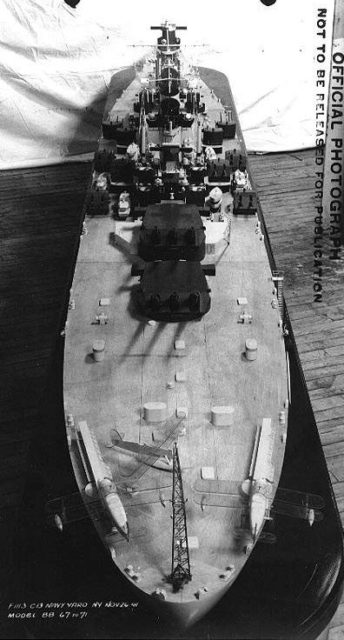
Stern view of the Montana model.
The Truth
It would be a long time before the US had a grasp of the Yamato’s
capabilities. When design started in 1938, the Yamato was believed to be
a standard battleship. Over the course of the war, new evidence slowly
allowed the navy to better understand what it was that it was up
against. A breakdown of discoveries about the Yamato can be broken down
into the following:
In 1936, a US received reports that Japan was building ships up to 55,000 tons.
In 1938, reports stated that Japan was building two 16″ heavy battleships with two more on the way.
It wasn’t until 1944 that the US found that the Yamato carried 18″ guns.
It wasn’t until late 1944/1945 that the US navy finally had a grasp of the true specifications of the Yamato.
This proves without a doubt that the Montana class wasn’t designed to counter the Yamato.
So if the Montana wasn’t designed to counter the Yamato, why was it
so large? It is largely because the ship was designed to withstand the
firepower of its own guns. The 16″/50 cannon when coupled with the
“super heavy” 2700lb shell could have been the finest battleship gun
ever to see service. At long ranges, its penetration power was almost
that of the larger Japanese18.1″ shell. Due to this similarity, the fact
that the Montana was so well protected was really a happy accident.
The other contributing factor was that the US wanted a battleship
more powerful than anything its adversaries was likely to use. A ship
more powerful than the vessels preceding it, the Bismark class of
Germany, the Nagato class of Japan, and so on. An almost impractically
large ship to dominate all others. In some ways, the US didn’t believe
anyone else would construct such a large ship. Unknown to the US, Japan
had the exact same thoughts when designing the Yamato.
Myth #3: The Montana was basically a larger Iowa Class Battleship
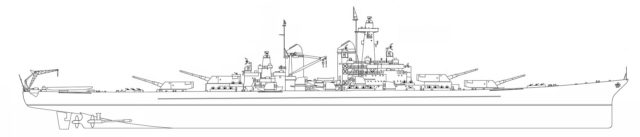
Line drawing of the Montana class.
The Montana was a larger Iowa class battleship with an extra turret.
The Truth
The belief in the connection between the Iowa and Montana classes
likely stems from their similar appearance and use of the same main
armament. However, examination of their design features shows two very
different ships for two different roles.
Armor
Armoring is the largest difference between the two classes. The Iowa
class ships used an internal armored belt inherited from the proceeding
South Dakota class. This brought the armored belt inside the hull and
was done as a weight saving measure. However, shells striking this belt
first penetrated the outer hull. This had the unwelcome effect of
potentially flooding the void space between hull and belt for shots that
hit at or below the waterline. The Montana design didn’t have to
follow weight restrictions and so reverted back to a traditional
external belt where the armor was on the outside of the hull. This
ensured that potential damage was outside of the hull and that
watertight integrity would remain intact. Unlike the Iowa, the Montana
was protected from its own guns. This armoring style reflects the design
philosophies behind the two ships. The Iowa was meant to be a fast
interceptor to guard against cruisers and fast battleships. The Montana
class was designed to participate with the main battle line and engage
in furious gunnery duels with multiple battleships.
Speed
After armor, speed shows another sizable difference between the
classes. The Iowas were designed to be high-speed 32-knot battleships to
act as the protection to the carrier fleet. While designers considered
making the Montana class faster, they decided that firepower and armor
were more important. Thus, the Montana was limited to a speed of 28
knots like the North Carolina and South Dakota classes. Not fast enough
to escort carriers, but fast enough to operate in the battle line.
Overall, the Montana was a vastly different warship compared to the
Iowa class. The design reflects the role that they were intended for, a
heavily armed and armored warship capable of taking on anything else
that it might encounter.
Final Thoughts
The Montana class battleships would have been one of the most
powerful dreadnoughts ever to be launched, rivaled only by the Yamato
class battleships. However, like the Yamato, the tiger tank, or many
other of the “wonder weapons” created during the Second World War, a
certain aura of myth has been built around them. They weren’t ultimate
weapons conjured up to single-handedly win the war, just simple units
designed to fill a role particular role in warfare. Unfortunately for
the Montana class, the role of the battleship in warfare was in its
twilight phase. They arrived too little too late.
The Invasion of Okinawa was planned as a staging area for the forthcoming invasion of Japan. We knew that to get the Japanese to surrender was in invade the home islands to end the war. Doing an armistice was a political non starter, with the Japanese code of "Bushido", this would have been seen as a sign of "weakness" and 10 years or 20 years later, we would have to fight them again...the lessons from the German example from WWI and 20 years later and million of lives spent, we are fighting them again. Also there was the "Pearl Harbor" effect, after the sneak attack that killed over 3000 American lives letting the Japanese off the hook wasn't going to happen. But the ferocious resistance by the Japanese at Iwo Jima and Okinawa showed the kind of casualties that were expected and they had forecast about 1 million American lives, plus the eradication of the Japanese culture to get them to stop. When there Japanese soldiers teaching Japanese civilians how to fight and skewer the American invaders with bamboo spears it showed the cost was going to be high. This prompted President Truman to use the Atomic bomb to force the Japanese to quit.
Codenamed Operation Iceberg, the invasion of Okinawa was the largest
amphibious landing in the Pacific theater of the Second World War which
started on April 1st, 1945.
In Spring 1945, Allied forces were advancing on Japan, and Allied
planes were able to bombard her cities. Okinawa, a 70-mile long island
350 miles from Japan, was seen as the final step before a full-scale
invasion of the Japanese Homeland.
Invading Okinawa
120,000 Japanese troops under General Mitsuru Ushijima stood ready to
defend Okinawa, though the Allies believed there were only half that
many. They were supported by 10,000 aircraft and a naval force led by
the largest battleship ever built, the Yamato.
Against them came 155,000 American troops, consisting of Marines and
infantry, though twice this number would be involved before the end.
They were led by Lieutenant-General Simon Bolivar Buckner and supported
by 1,300 ships, including a large British carrier group.
From October 1944 to March 1945 the Americans launched air raids
against Okinawa, destroying hundreds of enemy aircraft. A naval
bombardment was added from 18 March, despite kamikaze pilot attacks that
damaged four aircraft carriers and took out two ships.
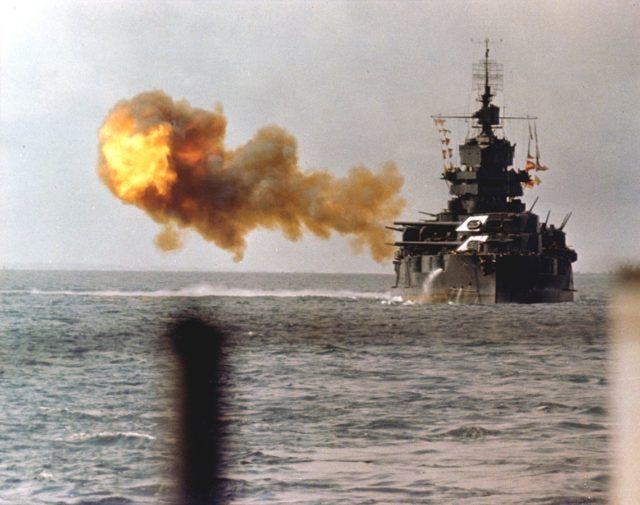
The battleship USS Idaho shells Okinawa on 1 April 1945.
Meanwhile, ground forces took outlying islands, including the forward base for the operation, the Kerama Islands.
On 1 April, the day of the invasion, a devastating bombardment fell
on the island – 44,825 shells, 22,500 mortar rounds and 32,000 rockets.
The approach to the island had been cleared of mines, and the troops
were ready to go.
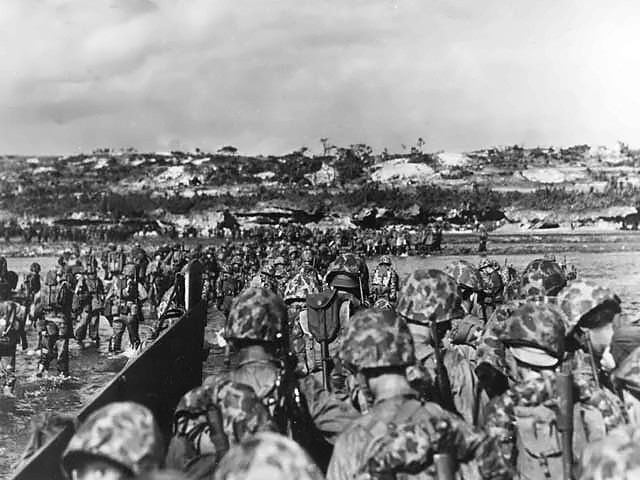
U.S. Marine reinforcements wade ashore to support the beachhead on Okinawa, 1 April 1945.
At 4 am the landing craft set off in the waters west of Okinawa,
heading for Hagushi beach. Four and a half hours later they reached land
as planned, ready for a desperate fight to establishing a beachhead. If
they could not seize a beachhead, then the invasion could fail. But
no-one stood in their way – the Japanese, adopting a new tactic would
make their stand further inland.
By the time darkness fell on 1 April, the Americans held an eight-mile wide beachhead with 60,000 men.
The Struggle for the Island
The seemingly ‘easy’ invasion to continue into the next day. American
soldiers crossed the width of the island, dividing the Japanese in two.
Two airfields were captured, an important step given the kamikaze
attacks on US ships.
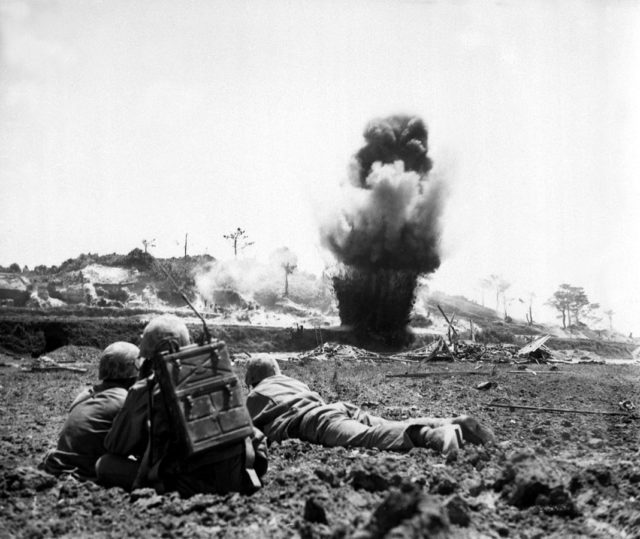
A 6th Marine Division demolition crew watches explosive charges detonate and destroy a Japanese cave, May 1945.
The 6th Marine Division was sent north. They entered into a
trap set by the Japanese. Three weeks of fighting saw them lose 218
dead and 902 wounded. In that time, they killed 2,500 Japanese troops
and secured the northern half of the island. By then Buckner already
knew where the real fighting would be – General Ushijima was defending
the south.
Ushijima could not win, but he wanted to keep the Americans tied down with a war of attrition. On 4 April, the US 24th Corps met the beginnings of this resistance at the city of Shuri.
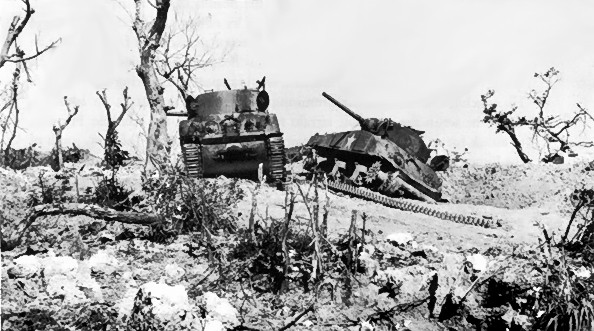
Two U.S. M4 Sherman tanks knocked out by Japanese artillery at Bloody Ridge, 20 April 1945.
On 6 April the kamikaze flights resumed. 700 planes hit the 5th
fleet, destroying or damaging 13 destroyers. These were followed just
over a week later by a new suicide weapon, the baka. A rocket-powered
glider with a tonne of explosives in the nose, the baka was towed by a
bomber until it reached strike range. Gliding to three miles out, the
pilot would ignite the rocket engines and dive on the target at speeds
above 600 miles per hour. The explosions of these devices destroyed not
only the gliders and their pilots but, in a short period of time.
some 34 Allied ships.
The Japanese fleet also undertook a suicide mission. Using what little fuel remained, the Yamato, the cruiser Yahagi
and eight destroyers headed for Okinawa, where they intended to beach
themselves, adding their guns to the firepower of the defenders. But
they were spotted on the way. Lacking air cover, they were easy targets
for the American flyers. The Yamato, the Yahagi and four destroyers were sunk.
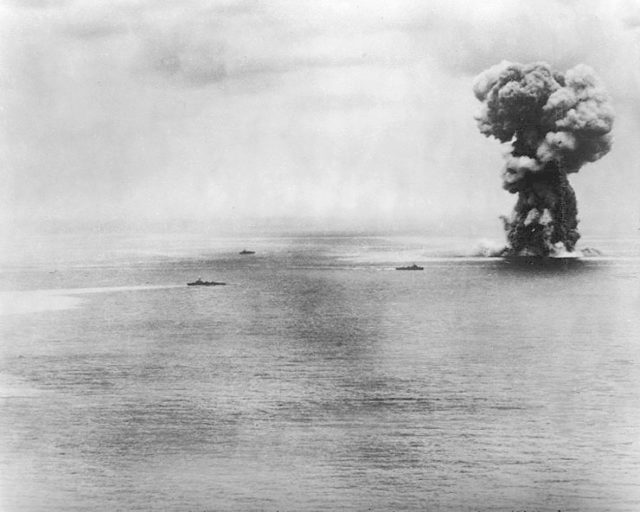
Super battleship Yamato explodes after persistent attacks from U.S. aircraft.
On land, the Americans were struggling against Ushijima’s defences.
Though they were killing ten times as many soldiers as they were losing,
they could make little progress against the determined and dug in
Japanese.
Despite his own horrifying casualties, Ushijima went on the offensive
on 12 April, sending waves of men against the Americans in attacks
almost as suicidal as those occurring at sea. Every assault was driven
back by the Americans, and after two days the Japanese returned to
defending.
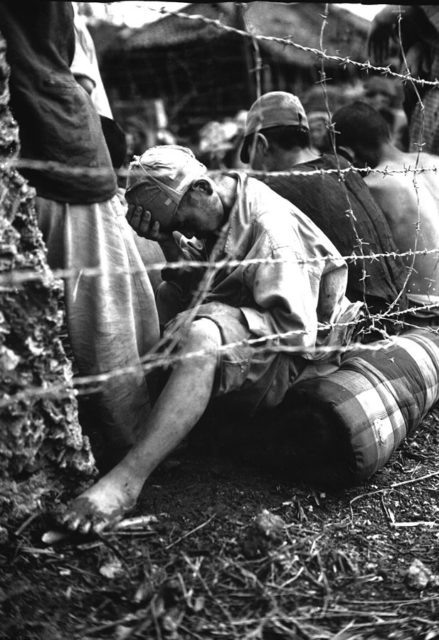
A
Japanese prisoner of war sits behind barbed wire after he and 306
others were captured within the last 24 hours of the battle by 6th
Marine Division.
Fighting to the Bitter End
Buckner ordered greater bombardments and a renewed offensive, but the
Marines could not break through the well-prepared Japanese
defences. Rather recklessly, Ushijima ordered another offensive on 2
May, in which he lost 5,000 troops.
A change in American tactics came on 11 May when Buckner
ordered attacks to be focused on the Japanese flanks. This began to work
and, rather than become surrounded, Ushijima pulled back on 21 May. A
rearguard fought fiercely, holding onto Shuri until 31 May. Meanwhile,
the rest of the Japanese made an orderly retreat to the southern tip of
Okinawa and their last stand.
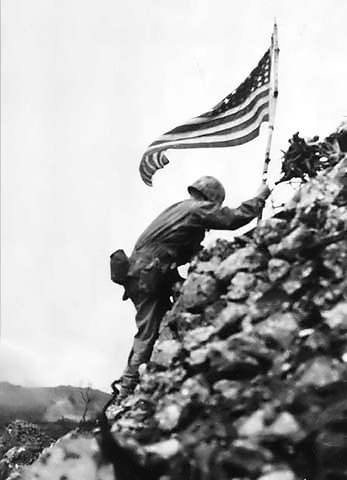
The US flag is raised at Shuri
The fanatical fighting of the Japanese made American advances
horribly slow, but they still advanced. High explosives and
flamethrowers destroyed defensive positions as the Americans crawled
south. The 6th Marines landed on the Oroku Peninsula in the south-west, providing an airfield and strongpoint for the Americans in the south.
General Buckner was fatally wounded 18 June. He was soon followed by
his opposite number. On 21 June, Ushijima and his chief of staff
committed hara-kiri outside their headquarters rather than lose or
surrender.
Following their general’s final order, the Japanese continued a
guerrilla war against the invaders until the end of June. When 7,400 men
gave in, it was the first large surrender of Japanese soldiers in the
entire war.
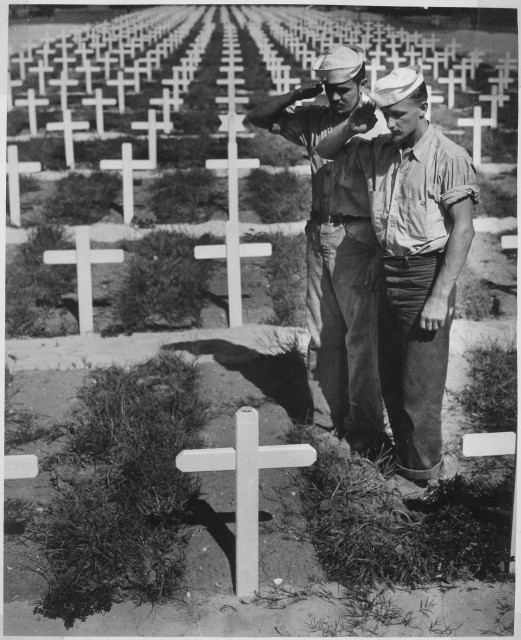
Two U.S. Coast Guardsmen pay homage to their comrade killed in the Ryukyu Islands.
Okinawa was a bloodbath for the Japanese, with 110,000 soldiers and
an unknown number of civilians dying. The Americans lost over 12,000
dead – 5,000 of them at sea – and 37,000 wounded. The Japanese navy was
annihilated, along with thousands of planes. The way to Japan now lay
open, and though it had cost the Allies dearly, it had cost their
enemies far more.
Ernest Taylor Pyle (August 3, 1900 – April 18, 1945) was a Pulitzer Prize–winning American journalist. As a roving correspondent for the Scripps-Howard
newspaper chain, he earned wide acclaim for his accounts of ordinary
people in rural America, and later, of ordinary American soldiers during
World War II. His syndicated column ran in more than 300 newspapers nationwide.
From 1935 through 1941 he traveled throughout the United States,
writing about rural towns and their inhabitants. After the U.S. entered
World War II, he lent the same distinctive, folksy style to his wartime
reports, first from the home front, and later from the European and Pacific theatres. He was killed by enemy fire on Iejima during the Battle of Okinawa.
At the time of his death he was among the best-known American war correspondents. He won the Pulitzer Prize in 1944 for his spare, poignant accounts of "dogface" infantry soldiers
from a first-person perspective. "No man in this war has so well told
the story of the American fighting man as American fighting men wanted
it told", wrote Harry Truman. "He deserves the gratitude of all his countrymen."