Webster

The Constitution was made to guard the people against the dangers of good intentions." --American Statesman Daniel Webster (1782-1852)


Wednesday, July 12, 2017

Battle Of Hoth After Action Report.

I again saw this on "Angry Staff Officer", and I read it and liked it.  I remember watching the movie "Empire Strikes Back" and I always though that the Rebels should have won that battle.  Statistically an attacker has to have a 3 to 1 advantage to win a battle, the Rebels did have terrain on their side and of course the Empire had their AT-AT's, but the Rebel speeders developed a counter for the 4 legged leviathan.  Angry Staff Officer likes to use "Star Wars" as a training aid for his military lessons and the U.S. Military loves Star Wars so the cultural references make a good training aid.  The Pics are compliments of "Google"


Strap yourselves in, folks, it’s time to ruin yet another timely classic by giving it the old “analyze it to death” treatment. And this time, we’re going back a ways. A long time ago, to be exact, in a galaxy far, far away. More precisely, we’re going to the ice planet of Hoth.
If you’ve followed me for any period of time on Twitter, you’ll know that in addition to my predilection for alcohol made from juniper berries, I am also a staunch believer that the Rebels could have easily won the battle for Hoth. The battle is – at its heart – a classic defensive scenario. And with the addition of just a little common sense, some overlays, application of the warfighting functions, and a dash of combat engineer acumen, the engagement could have been a complete and total Rebel victory.
And as a warning, you will never be able to watch The Empire Strikes Back again without being angry.

 Situation

The situation on Hoth was as such: a Rebel task force under the command of General Carlist Rieekan established defensive positions around Echo Base. The heart of Echo Base was the power shield generator which provided overall protection for the base from off-planet bombardment by the Empire’s star destroyers. This capability denied the Imperial Navy use of their chief weapons platform and forced them to deploy ground troops in a conventional force-on-force engagement.
Now, just as with all military debates, there are two schools of thought as to the Rebels’ courses of action. One states that the Rebel base was merely temporary and should not have been defended more than it was; and that General Rieekan’s evacuation of his fleet and garrison was not unlike George Washington’s evacuation from New York during the American Revolution. In essence, Rieeken saved his forces – minus the ground troops lost in delaying the Imperials – and harbored his strength to fight another day. The other school of thought is that Rieeken missed a prime opportunity to deal a devastating defeat to the Empire by luring them into an engagement area and destroying their ground troops in detail. However, this assumes a unified Rebel chain of command with adequate command and control and good staff functions, all of which were nonexistent on Hoth. Which leads us right into…


Mission Command

For the Rebels, General Rieekan provided overall command and control for operations on Hoth. However, Rieeken failed to establish cohesive staff operations, did not appoint a task force engineer for his defensive plan, and only made the decision to evacuate once Imperial ships had come out of hyperspace next to Hoth. Indeed, his instructions “prepare for ground assault” came just before the Empire attacked. Given that the Imperials could only have had one or two options to reduce the base, Rieeken should have had decision points lined up to be able to be proactive rather than reactive. Clearly he learned nothing at Galactic Command and General Staff College.
Rieekan
General Rieeken: plodding, indecisive, and unable to coordinate staff functions. (Lucasfilm Ltd)
Because of Rieeken’s inability to provide mission command, the Rebels were unable to coordinate fires, form an integrated defense, or even establish effective air sorties. These failures – and the subsequent loss of the base – must be laid at Rieeken’s feet. Rieekan can be credited with saving the majority of his force, yes, but his neglect of defensive preparations caused hundreds of needless casualties and nearly ended in Rebel disaster when their perimeter was breached so quickly.
Stepping into the communication breach was Leia Organa – serving as operations officer – who provided task and purpose to the pilots of the Rebel task force and briefed them their mission, direction, fire support plan, and coordination measures. Because of this, the air arm of the task force was able to accomplish its mission. The land forces never received the same attention.
General Rieekan’s opposite number was Lord Vader, who also failed to utilize mission command in his operations. Rather than provide vision, Lord Vader summarily executed his primary admiral in charge of fleet operations for making a tactical error. While this did inspire prompt movement from his subordinates, it was also created a risk-averse atmosphere. As the joint commander, Vader issued instructions to initiate planetary invasion while establishing a blockade around Hoth.  Vader’s desire to always be in control led him to micromanage his commanders throughout the entire operation. Nothing like holographic technology to enable you to micromanage the hell out of your troops.


Movement and Maneuver


General Veers landed his forces of All Terrain Armored Transports (AT-ATs) augmented by All Terrain Scout Transports (AT-STs) just outside the range of the Rebel shield generator. With only one avenue of approach, Veers arranged his primarily armored force into sections of AT-ATs in staggered column, providing maximum frontal firepower. He neglected to cover his flanks or to make coordination for Imperial engineers to clear any obstacles. Nor did he divide his force into sections – he simply headed straight towards the Rebel forward defensive line. Once within Rebel lines, he debarked his attached Stormtrooper Corps infantry to conduct mopping up operations. Veers was essentially an unimaginative commander. This would have played into Rebel hands had they adequately maneuvered their own forces.
Battle_of_Hoth_Map_CL
Timeline of operation on Hoth. A map reconnaissance clearly shows the advantages that the Rebels held in terrain. Click here for full image on Wookiepedia.
As it was, Rebel land forces neglected a golden opportunity. Their intelligence preparation of the battlefield had led them to build their base in the heart of a deep draw, where the only ground approach was through a long valley, flanked on either side by steep ridgelines. However, the Rebels decided that their only defenses were to be a few short lines of trenches backed by heavy weapons systems. Because they had committed themselves to a linear defense, they lost any ability to maneuver in the face of the enemy. They also allowed themselves to fall victim to the enemy’s primary forward-facing weapons on the AT-ATs. By neglecting to build any type of flanking positions, the Rebels lost their chance strike the Imperial armor from the sides and back, where it was the weakest.


Intelligence

As mentioned, Rebel intelligence had done an excellent job of siting Echo Base. They also correctly determined the enemy’s most likely course of action – attacking down the valley without air cover. Their one failure was the identification of the enemy primary maneuver force composition as being mostly armored. The majority of Rebel weapons systems on the ground on Hoth – both mobile and fixed – were not rated to penetrate the armor on AT-ATs. However, this was partially mitigated through effective counter-intelligence that denied Imperial ISR (Intelligence, surveillance, and reconnaissance) assets knowledge of the ion cannon. This permitted the Imperial fleet to be brought within range, thus allowing a major precision strike to cut a hole in the blockade.
Imperial intelligence operations with probe droids ceased as soon as Echo Base was located. Thus, Imperial forces had little in the way of understanding the Rebel strength, disposition, and composition. Fortunately for them, General Rieeken had not listened to his S-2 and so this Imperial intelligence shortcoming was never revealed.

Fires

 The incredible protection afforded Echo Base by the shield generator entirely negated the Empire’s edge in mobile firepower from their fleet of star destroyers. Imperial fires were relegated to an overwatch role as the fleet formed a blockade around Hoth.

The Rebel fire control officer devoted all of her time to the decisive operation as determined by General Rieeken – the movement of all Rebel forces off the planet. Because of this, ground-to-air fire coordination was superb. The first shots from the ion cannon were fired just as the first escape package of aircraft was closing in on the nearest star destroyer. Because of the close coordination, they managed to keep the ion cannon a close-hold secret until the very last minute, thereby preventing the Imperial fleet from maneuvering out of range. Successful integration of fires with transport assets permitted the majority of Rebel forces to be evacuated successfully.
Once again, however, the shaping operation of land defense was drastically undercut by the focus of all effective staff leadership on the decisive operation. No fire coordination plans had been developed for the land defense and heavy weapons did not properly integrate their fires to maximize their effectiveness. Nor were they given adequate protection from the heavy guns of the enemy armor. To make matters worse, Rebel fixed firing platforms were outranged by the guns of the AT-ATs, making their locations absolutely useless. Ground fires were therefore negligible.
General Rieeken entrusted the air cover for the defense to Commander Luke Skywalker. Skywalker – who had gained notoriety for his destruction of the Death Star – was not a trained airspace coordinator. Nor was he an able squadron leader. His assault with snow speeders was right over the top of the forces he was supporting and straight into the guns of the enemy armor. Had he begun his approach over either the left or right ridgeline, Skywalker could have engaged the enemy armor in their vulnerable flanks and rear while keeping his ships out of the limited fan of fire that characterizes the AT-AT. What could have been an effective sortie ended instead in the loss of all ships after only destroying two AT-ATs. Commander Skywalker’s sortie did delay the Imperial attack somewhat, but barely made a scratch in it.

Sustainment


The Rebel center of gravity was their fleet, including transports, supply ships, and life support ships.  In getting the fleet to safety and preserving their ability to sustain themselves, they effectively managed to gain a strategic victory while enduring a tactical defeat.  Poor maintenance nearly cost the Alliance Leia Organa and Han Solo, however, when the freighter Millennium Falcon nearly failed to start. Lack of spare parts for dissimilar ships was an endemic issue for the Alliance in all of its operations.

Protection


Here is where the Rebel Alliance utterly failed to do its due diligence to provide its land component an effective chance to delay or defeat the Imperial armor. Ensconced on Hoth, the Rebels built only one small network of linear trenches backed by heavy weapons. With full knowledge of where the enemy was going to land an assault force, the Rebels failed to place any mines in the landing zone. They also neglected to plant minefields on the one avenue of approach, or even to place any anti-armor defenses such as ditches, berms, trip wires, or pits. Their linear fixed defense without adequate engagement area development left them very little time to react when the Imperial strike force landed.

Once Imperial armor had overrun the forward line of defense, the Rebels did not have a retrograde plan with secondary fighting positions. There were no final protective fires in Echo Base to hold off the Stormtroopers long enough for the last remaining ground forces to escape. Instead, the Rebel ground troops were forced to evacuate individually, running over the snow in the open where they were neutralized by Imperial armor. Dozens of Rebel troopers were gunned down with no chance of escape.
Battle_of_Hoth
This is not what a successful retrograde looks like. (Lucasfilm Ltd)
This failure of protection nearly cost the Rebel Alliance the service of Leia Organa, who was trapped in the command center when it was targeted by Imperial armor. Only the actions of a non-state smuggler enabled Organa to escape capture and probable execution at the hands of the Imperial forces.

Summary

The lesson of the Battle of Hoth could be postulated as “ignore the warfighting functions at your own risk.” Rebel leadership possessed many advantages at the outset of the Battle of Hoth: superior intelligence, excellent terrain, exceptional protection from air bombardment, and experienced troops. However, each of these advantages was squandered because there was no system of unified command and control that disseminated plans in an orderly fashion. Rebel leadership continued to be plagued by breakdowns in leadership and planning as it had been in the Battle of Yavin 4.

Tuesday, July 11, 2017

More shooting

Well a couple of things, first off my son just came back from summer camp as a participant rather than a staffer at our summer camp.  He showed me what he wore for the 4th of July celebration at camp.

 
I swear he likes "triggering people".

    Anyway I went shooting today with my "Pops", they were in town to visit the grandkid when he came back from summer camp before he headed out for white water rafting with the church group.
    We went to a range that was farther away but the Air conditioner works, YAY.  It was just pistols today.
   
Here are the pistols I was shooting,  My .38 S&W, My .32 CZ50 and my S&W .357
.38 shoots
My .357 shoot bottom and my .32 shots on top
I also shot my Pops Ruger SR 45, It is a nice pistol and the 3 dot sights were real easy to use


 I also broke down down the pistol and the pistol was real easy to break down and clean.

  if you are looking for  .45 ACP pistol, it is worth a look.  I am looking at a .45 1911 style but this one is worthy of consideration.


   Another good day at the range, I didn't carry any long guns this time.  next time I will drag out some of my long guns and go shooting.

Monday, July 10, 2017

Monday Music "I think I am in Love" by Eddie Money

I heard this song come running through my Sirius/XM radio and I decided to roll with this song for my "Monday Music".  I will run with Shakin next week.  I remember when this song came on MTV in the early 80's, it was very popular song on the video playlist and it was the second song from Eddie Money that was making the rotation.  MTV made the careers of a lot of musicians and really boosted them to another level.
    
Eddie Money was born Edward Mahoney into a large Irish Catholic family in Brooklyn and raised in Massapequa on Long Island. His father, grandfather, and brother were members of the New York City Police Department and Eddie was an NYPD trainee. As his interest in music intensified, he eventually ended his law enforcement career in favor of becoming a full-time musician. He moved to Berkeley, California, and became a regular at city clubs, where he secured a recording contract with Columbia Records. In the late 1970s, he charted with singles such as "Baby Hold On" and "Two Tickets to Paradise". Money continued his successes and took advantage of the MTV music video scene in the early 1980s with his humorous narrative videos for "Shakin'" and "Think I'm in Love," but his career began to decline after an unsuccessful album in 1983, accompanied by his struggles with drug addiction.
Money made a comeback in 1986 and returned to the mainstream rock spotlight with the album Can't Hold Back. The album's Ronnie Spector duet "Take Me Home Tonight" reached the Top 10, as did the hit "I Wanna Go Back." Money followed the album with another Top 10 hit, "Walk on Water" (1988), but his Top 40 career ended following the #21 placement of "I'll Get By" in 1992. During the 1990s and 2000s, Money continued to release numerous compilation albums as well as albums featuring new material.
He joined a 12-step program in 2001 and has said of his addiction that he "came to the realization that I didn't really need [it] for my quick wit."
Today, he still tours regularly, often accompanied by other prominent rock acts from the 1970s and 1980s, and has made several television appearances on American sitcoms. He played himself in season 4, episode 23 of the sitcom, The King of Queens.
Since 1992, Money has traditionally opened the summer concert season for DTE Energy Music Theatre in Clarkston, Michigan. In 2010, Money performed a medley of his hit singles during the halftime performance at the Liberty Bowl. In 2012, he appeared in a GEICO insurance commercial, in which he owns a travel agency where he sings "Two Tickets to Paradise" to a family who wants tickets for a vacation.

"Think I'm in Love" is a 1982 hit single by American rock singer Eddie Money from his album No Control. Written by Money and Randy Oda (who is perhaps best known otherwise for his collaborations with former Creedence Clearwater Revival member Tom Fogerty). The song was released as a single and reached the Top 20 on the Billboard Hot 100 and hit #1 on the Billboard Top Tracks chart.


 No Control, released in 1982, is the fourth album from American rock musician Eddie Money. It was Platinum-certified in 1987, and contains the hits "Think I'm In Love" and "Shakin'."

The music video included elements from classic vampire movies (with Eddie Money cast as a quasi-Dracula character). It was one of the most popular early MTV music videos.


Saturday, July 8, 2017

Stalin, the man of steel

I have blogged about Stalin in the Past, his effect on the Soviet Union and in the world, he has killed more people with the exception of Chairman Mao, The purges he did in the 1930 to the Ukrainians and wiped whole villages as he forced a man made famine as he seized their assets to finance the heavy industry he wanted.  Stalin created the first modern police state with the NKVD .  The purges he also forced on the Russian people after he disarmed him.  Stalin also purged the Red Army, killing off one third of the officers in a purge because of his paranoid nature and listening to his NKVD Chief Beria.    The resulting purge affected the Red Army during the Winter War and told Hitler that the Red Army was weak an disorganized and that the Soviet Union was vulnerable.


    Here are some facts about Stalin that wasn't commonly known.


The Second World War saw the rise of some truly monumental figures, on both sides of the conflict. With leaders Franklin D. Roosevelt in America and Britain’s Winston Churchill leading the battle for the world’s future, nations rose and fell on the decisions of a few incredibly powerful men.
One of these individuals in particular – Joseph Stalin – was a titan in the east of Europe, and was instrumental in winning the battle for the Eastern Front. From his poor beginnings in Georgia to the dark myths that still swirl around his time in power, here are four facts about the man who called himself the Man of Steel.

The Georgian Hero

There are few men more associated with Russia than Stalin, but he was not actually from there originally. He was Georgian, and although the country was ruled by the Russian Empire, he grew speaking the local language and maintained a close connection his original nationality.
Born in Gori, in the east of the country, he was originally named Iosif Vissarionovich Dzhugashvili. The town of his birth remained extremely loyal to Stalin throughout the years, where he was held up as an inspiration and a national hero.
Decades later, after Stalin’s death, the new Russian Premier Nikita Khrushchev presented a damning speech, in which he heavily criticized his predecessor and attacked the “cult of personality” he had helped create. Although the speech shocked and outraged people around the world, Gori actually erupted into riots as a result, with protests continuing unabated until a military crackdown days later.

Comrade Index Card


The Man of Steel’s rivals wanted to brand him as a menial secretary
It is clear that Stalin wanted to present himself as a hard and uncompromising man, determined to uphold his beliefs at any cost. To this end, he wrote articles under the moniker “The Man of Steel”, from which the name Stalin is actually derived.
However, a rival within the Communist Party had other ideas. When Stalin assumed the position of General Secretary within the organization, Leon Trotsky began referring to him as Comrade Index Card. This belittling title came about because of the slightly mundane secretarial tasks that Stalin had to carry out in his new role within the party.
Trotsky recognized his rival’s potential, of course, and probably wished to paint him as a minor bureaucrat, rather than the Man of Steel he claimed to be. The nickname wasn’t enough to hold him back, however, and Stalin’s rise to power soon had Trotsky on the run.

The Orthodox Priest


Orthodox churches were actually torn down under Stalin
One of the defining features of Stalin and his government was the promotion of atheism and the persecution of religious groups and practices. Churches were demolished, anti-religious laws instated and atheistic educational programs were widely implemented in schools.
Under Stalin’s rule, the Russian Orthodox Church faced intense opposition, and almost completely vanished during the 1930’s. Remarkably, however, he actually once trained to become an Orthodox priest himself.
In the late 1800’s, a young Stalin enrolled in the Spiritual Seminary in Tiflis, the capital of Georgia. Initially, he was an excellent student, achieving high grades and working hard. However, as time went on he had a change of heart and became a committed atheist, rejecting his original path and leaving the religious school in 1899.

The Sinister Scientist 


Ivanov is at the center of some dark and fantastical theories about Stalin
Inevitably, as with many of the most sinister figures from the Second World War, there is no shortage of lurid urban myths and unlikely conspiracy theories about Stalin. However, one that has gained particular traction – almost to the point of being recognized as fact – is Stalin’s desire to create a “super soldier” by crossing animal and human DNA.
The story goes that the Man of Steel tasked a scientist named Ilya Ivanovich Ivanov with the job of creating a chimpanzee-human hybrid. With substantial funding behind him, Ivanov then traveled to Africa to procure primates that could be artificially inseminated with human genetic material. His experiments were continuing apace, when the Soviet authorities changed their minds and had him fired.
However, although Ivanov was certainly keen to experiment in this dubious field of science, there is very little evidence that Stalin even knew about his work, much less that he was in favor of it. The story is largely rooted in a poorly-sourced newspaper article from 2005, and thankfully it is almost certainly no more than an urban myth.


Friday, July 7, 2017

Some musings...

I have some musings, well apparently there is the G20 summit and they have about 100,000 people protesting it and from I heard the Honorable New York Mayor Bill DeBlasio will be going over there to join the protestors....I am sure New York City is soo proud.   He ditched a funeral of that slain New York Police officer to attend a protest...I guess to a leftist it is just another dead cop.  


I think it is ironic that people can protest like this only in a western based society, if they tried this anywhere else they would not see the light of day.  The protestors use the rule of law to circumvent the government that they are protesting.  I also have my pet theory about the protestors, most of them are trust fund babies, they don't have to work at all and can live comfortably on what their parents earned in a capitalist society but they protest it.  I gather that because they don't have to struggle to live and have a purpose in life, that they feel guilt over their good fortune so they protest the hands that feed them.

I wonder if this will be the death-knell of out society because we are living so good and have so much that people are rejecting the benefits of our society that they want to go back to a time where they have to scratch to survive and the average lifespan is 38 years.  This is what it was like if they want to go to a socialist feudalistic government like what Europe had where the top percenters live well and everyone else lives to serve the state.

On a different note, the #CNNBlackmail has been running around, CNN should have just let it go but they had to DOXX a 15 year old Reddit user and make him apologize to CNN for the Trump tweet that shows Trump body slamming a CNN imposed logo on somebody from Trump wrestling days as an organizer.  Well the tweet went viral and CNN tracked this guy down and made him apologize.

Here is the apology
Yes it is a parody but it very good, Lol

And here is another parody that is awesome, I picked up this from Irish and a couple other bloggers.

Wednesday, July 5, 2017

Gone Shooting....Mixed Results.

I decided to go shooting on Sunday evening after working on the yard and doing some repairs on the truck, so I decided to wash the truck.  Well after washing the truck, I decided to go to the range to see how the new O2 sensors worked if they would throw a code on the OBDII system.(which is the computer type used on all cars and trucks since 1996)
So I head to the range, this is a very nice range on the outskirts of my town.  Well I get in there, sign up for a lane and they tell me that the air conditioner in the range area isn't working due to a lightening strike.   Remember that later on in the story, it does get important.....
    Well I go back there and well it is like a sauna, this is summer in Georgia, it is not only hot...it is humid....remember that last word in a few minutes. 
     I set up the rifles first,
then I set up the Pistols, I decided this was going to be an "Old School Shoot", wheel guns and bolt action rifles.   I then set up my pistols..
The Pistol on the left is my S&W model 14-4, .38 caliber the one on the right is my favorite pistol, it is my S&W 681 .357.  The one on the right used to belong to one of the local police departments a long time ago.  I put the Pacmayer grips when I got the pistol in the late 90's.  I still have the wood grips.  I shot my favorite one first...I fired from according to the distance counter was about 40 feet, I don't know if that is a good distance or not but here was the results..
I had a couple of fliers...what can I say....I did notice that toward the end, the pistol felt like it was "binding", I will have to contact Mac and see if he can do some gunsmithing, I surmise something is worn inside the mechanism.  I do need to get it looked at, this affects reliability and until now, the revolver was my "Goto" gun
   Well next was the 14-4...
The grouping was better, the slightly longer barrel made a difference as was the sights...
I then go and grab my Enfield..
It was a joy to shoot the Enfield, This Enfield was made in 1965 in Ishapore India for the Police. this one shoots 308  It is the same place where my 303 Enfield was made in 1945.   There is something about shooting "old firearms" I bought both Enfields in the late 90's.
This was at 100 feet(the max length of the range indoors), I did ok with the shooting, I will have to start moving the rear sights to dial it center of mass.
     The last was my favorite rifle, my O3A3 made by Remington in 1943, I purchased her in 1987 in Germany and brought her back to the world. 


I sucked...By this time I had been perspiring soo much that my glasses were totally fogged up, and nothing I did would clear it.  Remember the Hot and Humid the range area was....and I couldn't even see the sights no matter what I did, so at this point I called it a day and wrapped my rifles up and the Pistols and went home.  I was a bit disgusted.  I hope they get the A/C up or it will be a while before I go back. 

Tuesday, July 4, 2017

Monday Music "God Bless the USA" by Lee Greenwood in honor of BREXIT 1776

 Yes I know it is Tuesday...It happens.....

I decided to roll with this song, and to be honest, I have a love/hate relationship with this song, while I was in the Gulf, the radio station AFDN (Armed Forces Desert Network) played this song....at first I liked it because we honestly believe that we were on on a crusade to right a wrong and the whole world agreed with us.  We had the support of the American people, which for the Vietnam vets whom were still with us was a welcome change from what they had gone through.  We were well trained and motivated, we had good equipment and knew how to use it. But the first 50 times I heard the song,it was alright but it seemed to come on every hour on the hour and after a while we hated the song, I'm talking with a visceral hate.  I heard that song soo much that when I came back to the world, I refused to listen to that song, We GI's talked about kicking Lee Greenwood in the nuts for this song, but the truth of the matter was, it wasn't his fault, he wrote a damm good song, but we got really burned out on it.  It took over 20 years before I can hear the song and not cringe.  So in honor of "BREXIT 1776" here is Lee Greenwood "God Bless the U.S.A"


"God Bless the USA" is an American patriotic song written and recorded by country music artist Lee Greenwood, and is considered to be his signature song. The first album it appears on is 1984's You've Got a Good Love Comin'. It reached No. 7 on the Billboard magazine Hot Country Singles chart when originally released in the spring of 1984, and was played at the 1984 Republican National Convention with President Ronald Reagan and first lady Nancy Reagan in attendance, but the song gained greater prominence during the Gulf War in 1990 and 1991, as a way of boosting morale.
The popularity of the song rose sharply after the September 11 attacks and during the 2003 invasion of Iraq, and the song was re-released as a single, re-entering the country music charts at No. 16 and peaking at No. 16 on the Billboard Hot 100 pop chart in 2001. The song was also re-recorded in 2003 and released as "God Bless the USA 2003". Greenwood also wrote a Canadian version of this song called "God Bless You Canada". The song has sold over a million copies in the United States by July 2015.


Greenwood wrote God Bless the USA in response to his feelings about the shooting down of Korean Air Lines Flight 007. He said that he "wanted to write it my whole life. When I got to that point, we were doing 300 days a year on the road, and we were on our fourth or fifth album on MCA. I called my producer, and I said I have a need to do this. I've always wanted to write a song about America, and I said we just need to be more united." As for writing the song itself, Greenwood wrote that it more or less "wrote itself", and that the lyrics flowed naturally from the music as a reflection of his pride to be American.
The reason behind the cities chosen in the song Greenwood says, "I'm from California, and I don't know anybody from Virginia or New York, so when I wrote it—and my producer and I had talked about it—[we] talked about the four cities I wanted to mention, the four corners of the United States. It could have been Seattle or Miami but we chose New York City and Los Angeles, and he suggested Detroit and Houston because they both were economically part of the basis of our economy—Motortown and the oil industry, so I just poetically wrote that in the bridge."

In the song, an unnamed man sings about how, if he were to lose everything he had and had to start again from scratch, he would do it in the USA because he is guaranteed his freedom in America. He remembers how other Americans in history had died to secure this freedom, and declares that if he is ever called upon to defend the USA today, he will gladly stand up and fight because he loves the country.

A music video was released for this song in 1984, depicting Greenwood as a farmer who loses the family farm. The video was produced and edited by L.A. Johnson and directed by Gary Burden. A second video was released in 1991, also on VHS, and was directed by Edd Griles. A third music video was also released after the September 11, 2001 attacks.

Saturday, July 1, 2017

When Red China Snagged a Soviet Tank

I was surfing around and ran across something about the Chinese snagging a Soviet tank during an abortive border incursion during the Sino-Soviet split.  The Chinese uses the captured tank


For a template to improve their domestic tank industry.  The resulting Type 69 which I saw a lot of in the Persian Gulf War because the Chinese sold a boatload of them to Saddam Hussain so he could replace what has been destroyed in the resulting fight with the Iranians during the the Iran–Iraq War which also contributed to Iraq's defeat in the Persian Gulf War. Iraq's military was accustomed to fighting the slow moving Iranian infantry formations with artillery and static defenses, while using mostly unsophisticated tanks to gun down and shell the infantry and overwhelm the smaller Iranian tank force; in addition to being dependent on weapons of mass destruction to help secure victories. Therefore, they were rapidly overwhelmed by the high-tech, quick-maneuvering US forces using modern doctrines such as AirLand Battle, that we had developed to counter and disrupt the Soviet armored formations.

In 1900, Russia signed the Convention of Peking which gave them Outer Manchuria and other Chinese lands. When both countries became communist, their nagging border dispute was swept under the rug, especially since China needed Russian technological expertise.
At least till Nikita Kruschev ruined it. In February 1956, he hosted the 20th Congress of the Communist Party and denounced Joseph Stalin as a monster, demanding reforms.
Mao Zedong, China’s head honcho, was shocked. He thought of Stalin as a comrade-in-arms. Worse, he believed that Kruschev was also attacking him, for Mao felt that purges and summary executions were necessary for China’s transition from its feudalist past.

Then in 1958, Kruschev wanted to install long wave radio stations along China’s coast to help guide Soviet submarines.
Mao was suspicious but agreed on the condition that China be given nuclear weapons. Kruschev balked, even though Chinese scientists had already received blueprints for an atomic bomb from their Russian counterparts.

When Kruschev visited the US in 1959, Mao accused him of sucking up to capitalists. Things came to a head in 1962 when China used the Cuban Missile Crisis as an opportunity to occupy India’s Aksai-Chin region, and the USSR sided with India. But when Kruschev pulled Soviet missiles out of Cuba, Mao had had enough, and the official friendship between the two nations ended.


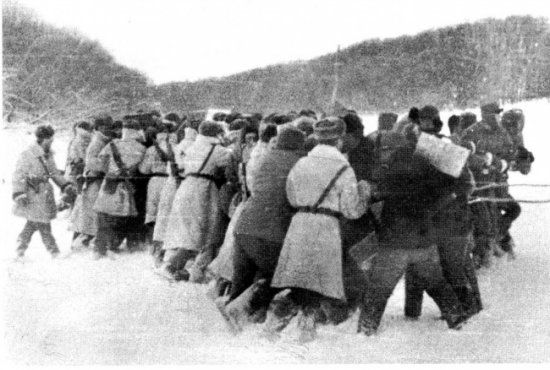
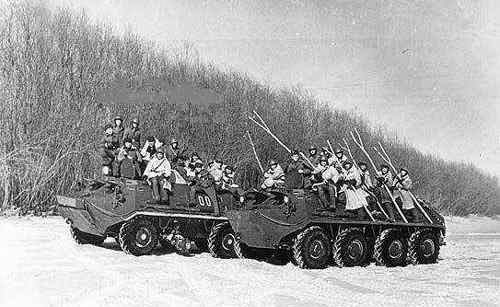
Soviets and Chinese using sticks against each other during the Sino-Soviet split
Soviets and Chinese using sticks against each other during the Sino-Soviet Split

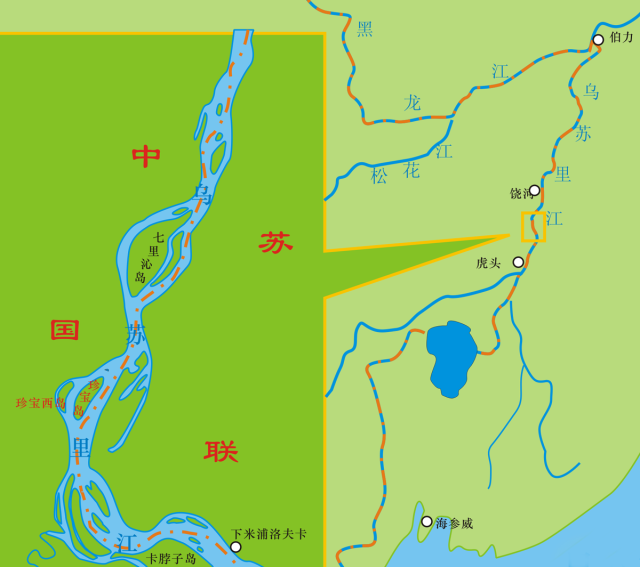
In 1964, Mao claimed that the Treaty of Beijing had been unfair. He demanded a return of territories under Soviet control, including Zhenbao (Treasure) Island, which the Russians called Damanski.


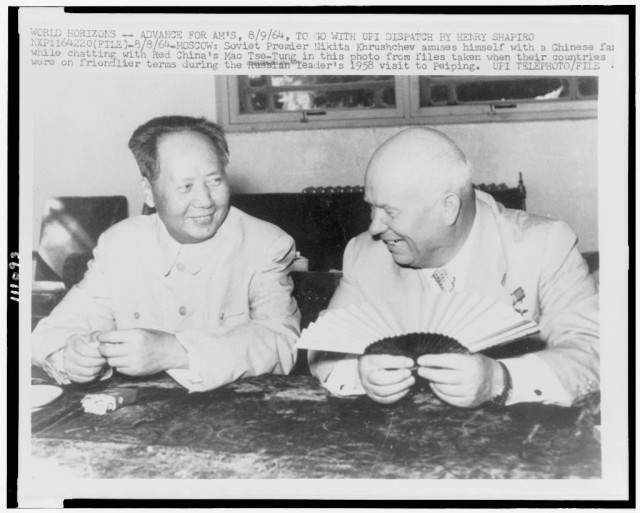
Mao (left) and Kruschev (right) together in 1958
To mitigate increasing tensions, Kruschev agreed to hand over Zhenbao and other lands, but Mao screwed it up a few months later. During a speech, he jokingly said that he’d present Russia with a bill for their occupation of Siberia, the Far East, and Kamchatka. Kruschev was furious, so he nullified his agreement with Mao.
Chinese and Soviet troops began massing on the disputed border. Though technologically inferior to Russia, Mao was convinced that China’s superior numbers would far outweigh Russian technology. He was right.
When Arkady Nikolayevich Shevchenko (former Under Secretary General of the UN) defected to the US in 1978, he admitted that the USSR was terrified of China’s numbers. Shevchenko claimed that if Mao attacked, the Kremlin was going to launch nuclear missiles.
But Nikolai Vasilyevich Ogarkov, Marshal of the Soviet Union, cautioned against it. He knew they couldn’t nuke China without consequences to themselves. But while the Soviets thought of self-preservation, Mao did not.
Mao just couldn’t grasp how dangerous nuclear weapons really were, calling them “America’s Paper Tigers.” He was convinced that China’s vast size and numbers protected it from any possibility of nuclear annihilation. Still, he took no chances, so on October 16, 1964, China detonated its first atomic bomb in their test area.


The Chinese proposal to redefine the Sino-Soviet border with Zhenbao (Damanskii) Island on the Chinese side. "中国" on the left is China, while "苏联" on the right is the Soviet Union
The Chinese proposal to redefine the Sino-Soviet border with Zhenbao (Damanskii) Island on the Chinese side. “中国” on the left is China, while “苏联” on the right is the Soviet Union. Zhuwq – CC BY-SA 3.0
Things only got worse from there. According to the official Chinese version, some of their civilians were attacked by Soviet troops in border regions. Others who peacefully protested illegal Soviet occupation were allegedly run over by Soviet tanks.
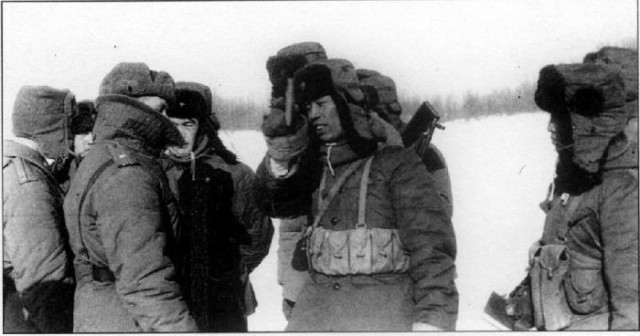
The Soviets claim that Chinese soldiers began haranguing Soviet border posts, some by waving Mao’s “Red Book” at their faces. To de-escalate tensions, Soviet border guards were ordered to use sticks to push Chinese nationals back across the border.
The Chinese retaliated by using longer sticks, resulting in ridiculous jousts. Later, they sent martial artists and wrestlers to the border, since neither side wanted outright war nor to lose face.


Soviets armed with sticks to minimize damage against the Chinese
It all came to a head on March 2nd, 1969. In supposed revenge of murdered Chinese civilians, members of the People’s Liberation Army (PLA) attacked Soviet border guards on Zhenbao Island – killing 59 and injuring 94. The Soviets counter-attacked on March 15th by shelling the PLA on the Chinese side of the Ussuri River.
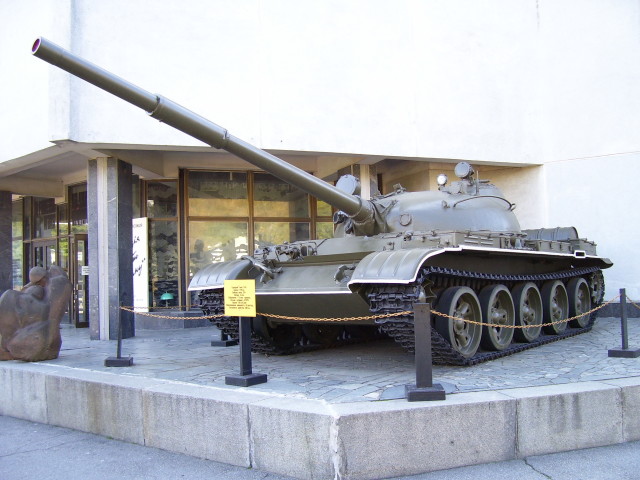
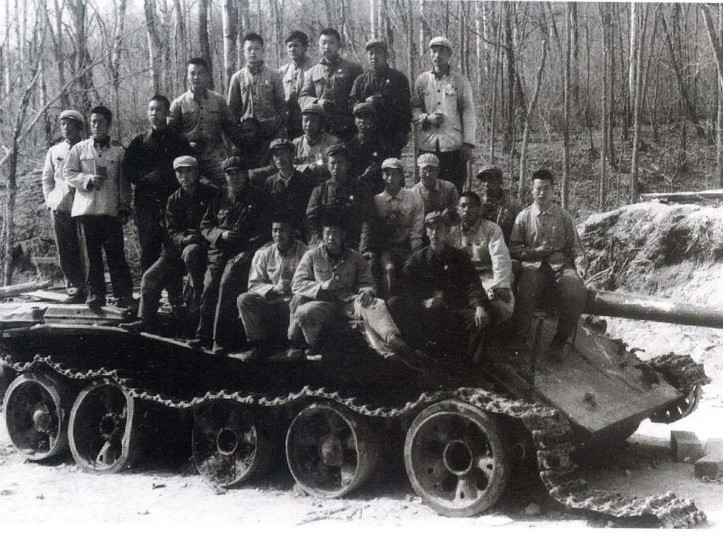
To take Zhenbao back, they sent in four of their newest weapons – the still-secret T-62. As they crossed the narrow frozen river, one ran over a landmine. The other three didn’t bother turning. They simply reversed back to the Soviet side.
A PLA soldier approached the damaged tank, opened the hatch, and found himself staring at the barrel of a pistol held by an injured Russian. The man fired, but his gun jammed, allowing the Chinese soldier to throw a grenade in. The Chinese wanted to tow the tank away, but sniper fire from the Soviet side prevented that.


Chinese border guard (on the right) waving Mao's "Red Book" in front of a Soviet border guard
Chinese border guard (on the right) waving Mao’s “Red Book” in front of a Soviet border guard
The following day, the Soviets returned to claim their dead, which the Chinese allowed. But when they tried to retrieve their tank, the Chinese fired, forcing them to retreat. On March 21st, the Soviets sent over a demolition team but were again beaten back by the Chinese.
With the Soviets gone, the Chinese navy was called in to help pull the tank onto the Chinese side. They arrived on March 28th, but were shelled, so the Chinese tried another tactic.
Using the tank and sniper fire as cover, engineers began dismantling the T-62. They were still at it on April 2nd when the ice began to melt. The Soviets took advantage of this by firing at the ice around the tank till it sank. Satisfied, they retreated.


A T-62 tank at the Museum of The History of Ukraine in WWII in Kiev, Ukraine
A T-62 tank at the Museum of The History of Ukraine in WWII in Kiev, Ukraine. Gutsul – CC BY-SA 3.0
They ignored the Chinese navy who continued their efforts to salvage the tank but whose suits were ill-equipped for the freezing temperatures, causing many to die of hypothermia. By April 29th, the Chinese pulled the rest out and sent it to a tank factory in Lyshuen.
But the Soviets hadn’t given up on their tank. In mid-May, a Chinese saboteur was caught near the factory with a bag full of explosives. Under questioning, he admitted to working for the Soviets who wanted him to destroy the factory and the T-62. He was executed, of course.


The PLA capturing the T-62 tank
The tank didn’t turn the balance of power in China’s favor, but it accomplished something far more important. Mao realized that he couldn’t fight the Capitalist West and the Soviets at the same time, which led to a thaw in Chinese-US relations.
Only in 1991 was Zhenbao Island returned to China, but it was only in 2003 that the two nations finally delineated their borders

Thursday, June 29, 2017

New Book Out!!!


My Blogbuddy Jim, who is a class act and all around good guy but we don't tell him that.  He has released a new novella(I'm not sure what that means lol), but anyway, I have bought everything that Jim has written from the Stellar "Gray Man" series which are now 4 of them, he also has branched out into MilScifi and they are worth the read.  Jim is a very good storyteller, he is the kind of guy you would have around the campfire and he can spin some good stories. 

Here is the Link To Order

A year after Calexit, the last US bases in Southern California are under siege, with their power and water cut off. Their perimeters are under constant probes by a now hostile nation. There is intelligence the government of California is planning a final all-out action to overwhelm the last bases and claim the spoils of victory for their own…
But the men and women in uniform aren’t going to let their bases be overrun, especially after the murder of their dependents. This is their story, a novella of the last military withdrawal from California. And if there’s one thing the Sailors and Marines are not going to do, it’s go quietly!

The Cover alone is real cool looking